Request Free Sample ×

Kindly complete the form below to receive a free sample of this Report

* Please use a valid business email

Leading companies partner with us for data-driven Insights

clients tt-cursor
Hero Background
English
Chinese
French
Japanese
Korean
German
Spanish

Capsule Endoscopy Market Share

ID: MRFR/MED/0851-CR
132 Pages
Nidhi Mandole
February 2021

Capsule Endoscopy Market Research Report: Size, Share, Trend Analysis By Product (Capsule Endoscopes (Small Bowel, Esophageal, Colon), Systems), By Applications (OGIB (Obscure GI Tract Bleeding), Crohn’s Disease, Small Intestine Tumor And Others), By End-User (Hospitals, Ambulatory Surgery Centers And Others) And By Region (North America, Europe, Asia-Pacific, And Rest Of The World) - Growth Outlook & Industry Forecast 2025 To 2035

Share:
Download PDF ×

We do not share your information with anyone. However, we may send you emails based on your report interest from time to time. You may contact us at any time to opt-out.

Capsule Endoscopy Market Infographic
Purchase Options

Market Share

Capsule Endoscopy Market Share Analysis

The Capsule endoscopy market, marked by technological improvements and a developing emphasis on non-invasive diagnostics, witnesses businesses were adopting numerous strategies to put themselves effectively. These techniques are vital for navigating the aggressive landscape and expanding marketplace proportion within the discipline of gastrointestinal imaging. Forming strategic alliances with healthcare institutions, which includes hospitals and clinics, is a key market share positioning approach. Collaboration permits organizations to integrate their capsule endoscopy technologies into existing healthcare workflows. Such partnerships foster vast adoption and contribute to a larger marketplace share. Geographical expansion is crucial for organizations trying to beef up their marketplace position. Targeting areas with an excessive occurrence of gastrointestinal issues and a growing healthcare infrastructure lets groups capture untapped markets. Establishing a worldwide presence enhances marketplace share and supports sustained business increase. Enhancing patient consolation and compliance is a strategic move in the Capsule endoscopy marketplace. Companies design drugs that can be easy to swallow, minimally invasive, and snug for sufferers. Prioritizing patient revel fosters advantageous comments and promotes the adoption of capsule endoscopy, contributing to improved market share. Collaborating with study institutes and academic centers is an approach employed to stay at the forefront of scientific advancements. Partnerships with research entities facilitate the improvement of modern technologies and methodologies for capsule endoscopy. Adhering to strict regulatory requirements and making sure the protection of capsule endoscopy gadgets are paramount. Companies that prioritize regulatory compliance and provide proof of the protection and efficacy of their products gain the belief of healthcare professionals. This trust is instrumental in securing a massive marketplace proportion. Educational initiatives focused on healthcare specialists play a crucial function in market proportion positioning. Companies put money into training applications, workshops, and educational substances to familiarize healthcare carriers with the benefits and high-quality practices of capsule endoscopy. Well-knowledgeable experts are more likely to endorse and use those technologies, contributing to extended market share. Ensuring the affordability and value-performance of capsule endoscopy answers is a strategic technique. Companies optimize manufacturing techniques, negotiate favorable supplier contracts, and discover price-powerful materials without compromising best. Affordable answers make capsule endoscopy more reachable, contributing to increased adoption and marketplace proportion.


Author
Author Profile
Nidhi Mandole
Senior Research Analyst

She is an extremely curious individual currently working in Healthcare and Medical Devices Domain. Nidhi is comfortably versed in data centric research backed by healthcare educational background. She leverages extensive data mining and analytics tools such as Primary and Secondary Research, Statistical Analysis, Machine Learning, Data Modelling. Her key role also involves Technical Sales Support, Client Interaction and Project management within the Healthcare team. Lastly, she showcases extensive affinity towards learning new skills and remain fascinated in implementing them.

Leave a Comment

FAQs

What is the projected market valuation of the Capsule Endoscopy Market by 2035?

<p>The Capsule Endoscopy Market is projected to reach a valuation of 1.369 USD Billion by 2035.</p>

What was the market valuation of the Capsule Endoscopy Market in 2024?

<p>In 2024, the Capsule Endoscopy Market was valued at 0.52 USD Billion.</p>

What is the expected CAGR for the Capsule Endoscopy Market during the forecast period 2025 - 2035?

<p>The expected CAGR for the Capsule Endoscopy Market during the forecast period 2025 - 2035 is 9.2%.</p>

Which companies are considered key players in the Capsule Endoscopy Market?

<p>Key players in the Capsule Endoscopy Market include Medtronic, Olympus Corporation, Given Imaging, IntroMedic, CapsoVision, PENTAX Medical, SurgiQuest, and Check-Cap.</p>

What are the main product segments in the Capsule Endoscopy Market?

<p>The main product segments in the Capsule Endoscopy Market are Capsule Endoscopes and Systems, with valuations of 0.31 and 0.21 USD Billion in 2024, respectively.</p>

How does the market for OGIB compare to other applications in the Capsule Endoscopy Market?

<p>In 2024, the market for OGIB (Obscure GI Tract Bleeding) was valued at 0.15 USD Billion, while Crohn’s Disease and Small Intestine Tumor were valued at 0.12 and 0.1 USD Billion, respectively.</p>

What is the expected growth for the Capsule Endoscopy Market in hospitals by 2035?

The market for Capsule Endoscopy in hospitals is expected to grow from 0.26 USD Billion in 2024 to a projected 0.7 USD Billion by 2035.

What role do ambulatory surgery centers play in the Capsule Endoscopy Market?

Ambulatory Surgery Centers accounted for a market valuation of 0.15 USD Billion in 2024, with expectations to reach 0.4 USD Billion by 2035.

What are the projected valuations for the 'Others' segment in the Capsule Endoscopy Market?

The 'Others' segment in the Capsule Endoscopy Market is projected to grow from 0.15 USD Billion in 2024 to 0.35 USD Billion by 2035.

How does the market performance of Capsule Endoscopes compare to Systems?

Capsule Endoscopes were valued at 0.31 USD Billion in 2024, while Systems were valued at 0.21 USD Billion, indicating a stronger performance for Capsule Endoscopes.

Market Summary

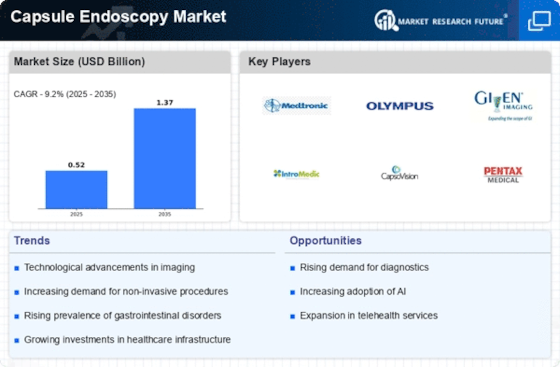
As per Market Research Future analysis, the Capsule Endoscopy Market Size was estimated at 0.52 USD Billion in 2024. The Capsule Endoscopy industry is projected to grow from USD 0.5678 Billion in 2025 to USD 1.369 Billion by 2035, exhibiting a compound annual growth rate (CAGR) of 9% during the forecast period 2025 - 2035

Key Market Trends & Highlights

The Capsule Endoscopy Market is poised for substantial growth driven by technological advancements and increasing demand for non-invasive procedures.

  • North America remains the largest market for capsule endoscopy, driven by advanced healthcare infrastructure and high patient awareness. The Asia-Pacific region is emerging as the fastest-growing market, fueled by rising healthcare investments and a growing population. Capsule endoscopes represent the largest segment, while systems are experiencing the fastest growth due to innovations in technology. Key market drivers include technological advancements in capsule endoscopy and a rising demand for non-invasive procedures, particularly in the context of gastrointestinal disorders.

Market Size & Forecast

2024 Market Size 0.52 (USD Billion)
2035 Market Size 1.369 (USD Billion)
CAGR (2025 - 2035) 9.2%
Largest Regional Market Share in 2024 North America

Major Players

<a href="https://www.medtronic.com/en-us/healthcare-professionals/products/digestive-gastrointestinal/capsule-endoscopy.html">Medtronic </a>(US), Olympus Corporation (JP), <a href="https://medtronicsolutions.medtronic.com/given-imaging">Given Imaging</a> (IL), IntroMedic (KR), CapsoVision (US), PENTAX Medical (JP), SurgiQuest (US), Check-Cap (IL)

Market Trends

The Capsule Endoscopy Market is currently experiencing a notable transformation, driven by advancements in technology and increasing awareness regarding gastrointestinal disorders within the broader endoscopy market.. This innovative diagnostic tool allows for non-invasive visualization of the gastrointestinal tract, which appears to enhance patient comfort and compliance. As healthcare providers increasingly recognize the benefits of capsule endoscopy, its adoption is likely to rise, particularly in outpatient settings supported by the expanding presence of capsule endoscopy companies and each capsule endoscopy manufacturer focusing on improved device performance.. Furthermore, the growing prevalence of conditions such as Crohn's disease and gastrointestinal bleeding is propelling demand for effective diagnostic solutions. In addition, the Capsule Endoscopy Market is witnessing a shift towards integration with digital health technologies. The incorporation of artificial intelligence and machine learning into capsule endoscopy systems may facilitate improved image analysis and interpretation, potentially leading to faster and more accurate diagnoses. This trend suggests a future where capsule endoscopy not only serves as a diagnostic tool but also plays a pivotal role in personalized medicine, tailoring treatment plans based on individual patient data. As the market evolves, stakeholders must remain vigilant to emerging technologies and changing patient needs to maintain a competitive edge.

Technological Advancements

The Capsule Endoscopy Market is significantly influenced by ongoing technological innovations. Enhanced imaging capabilities and the development of smaller, more efficient capsules are likely to improve diagnostic accuracy and patient experience. These advancements may also lead to the introduction of new features, such as real-time data transmission, which could further streamline the diagnostic process.

Rising Demand for Non-Invasive Procedures

There is a growing preference for non-invasive diagnostic methods among patients and healthcare providers. The Capsule Endoscopy Market appears to benefit from this trend, as it offers a less invasive alternative to traditional endoscopy. This shift may result in increased patient acceptance and a broader application of capsule endoscopy in various clinical settings.

Integration with Digital Health

The integration of capsule endoscopy with digital health technologies is becoming increasingly prominent. This trend suggests that the market may evolve to include features such as remote monitoring and telemedicine capabilities. Such advancements could enhance patient engagement and facilitate timely interventions, ultimately improving health outcomes.

Capsule Endoscopy Market Market Drivers

Integration with Digital Health Solutions

The Capsule Endoscopy Market is increasingly integrating with digital health solutions, enhancing the overall patient experience. The incorporation of telemedicine and mobile health applications allows for remote monitoring and consultation, making it easier for patients to access care. This integration not only streamlines the diagnostic process but also facilitates better data management and analysis. As healthcare systems evolve, the demand for such integrated solutions is expected to rise. Market analysts predict that the convergence of capsule endoscopy with digital health technologies could lead to a 15% increase in market penetration by 2027. This trend underscores the importance of adapting to technological advancements in the healthcare sector.

Rising Demand for Non-Invasive Procedures

The Capsule Endoscopy Market is witnessing a surge in demand for non-invasive diagnostic procedures. Patients and healthcare providers alike are increasingly favoring methods that minimize discomfort and risk. Capsule endoscopy offers a unique solution, allowing for comprehensive visualization of the gastrointestinal tract without the need for sedation or invasive techniques. This shift in preference is reflected in market trends, with a notable increase in the number of procedures performed annually. Reports indicate that the number of capsule endoscopies conducted has doubled over the past five years, highlighting a growing acceptance among both patients and physicians. This trend is likely to continue, further propelling the market forward.

Growing Awareness of Gastrointestinal Disorders

The Capsule Endoscopy Market is benefiting from a growing awareness of gastrointestinal disorders among the general population. As more individuals become informed about conditions such as Crohn's disease and gastrointestinal bleeding, the demand for effective diagnostic tools increases. Educational campaigns and improved access to information have led to heightened patient advocacy, prompting individuals to seek out advanced diagnostic options. This awareness is reflected in the rising number of consultations and procedures, with estimates indicating a 20% increase in demand for capsule endoscopy services over the next few years. Consequently, healthcare providers are likely to invest more in these technologies to meet patient needs.

Technological Advancements in Capsule Endoscopy

The Capsule Endoscopy Market is experiencing rapid technological advancements that enhance diagnostic capabilities. Innovations such as high-definition imaging, improved battery life, and real-time data transmission are transforming the landscape. These advancements not only improve the accuracy of gastrointestinal examinations but also increase patient comfort. The introduction of wireless technology allows for seamless data transfer, which is crucial for timely diagnosis. As a result, the market is projected to grow significantly, with estimates suggesting a compound annual growth rate of over 10% in the coming years. This growth is driven by the increasing adoption of advanced capsule endoscopy systems in clinical settings, which are becoming essential tools for gastroenterologists.

Aging Population and Increased Healthcare Expenditure

The Capsule Endoscopy Market is significantly influenced by the aging population and the corresponding increase in healthcare expenditure. As the global demographic shifts towards an older population, the prevalence of gastrointestinal disorders is expected to rise. Older adults are more susceptible to conditions that require thorough examination, thus driving the demand for capsule endoscopy. Furthermore, increased healthcare spending allows for the adoption of advanced medical technologies. Reports suggest that healthcare expenditure is projected to grow by 5% annually, which will likely facilitate greater investment in capsule endoscopy systems. This trend indicates a robust market outlook as healthcare systems adapt to the needs of an aging population.

Market Segment Insights

By Product: Capsule Endoscopes (Largest) vs. Systems (Fastest-Growing)

In the Capsule Endoscopy Market, Capsule Endoscopes hold a significant share, dominating the landscape due to their effectiveness in diagnosing gastrointestinal disorders. Meanwhile, Systems, which include the infrastructure and technology that support capsule endoscopy, are gaining traction and are considered the fastest-growing segment. This distribution illustrates a clear preference for handheld devices while also indicating the rising importance of complete systems for enhanced diagnostic efficiency in medical settings.

Capsule Endoscopes (Dominant) vs. Systems (Emerging)

Capsule Endoscopes are at the forefront of the market, primarily due to their patient-friendly design and non-invasive approach to internal examinations. They allow for a comprehensive visual assessment of the gastrointestinal tract, which adds immense value to diagnostic processes. In contrast, Systems represent the technological advancements that support the deployment and integration of capsule endoscopes in clinical practice. These systems are emerging as essential components, focusing on data management, real-time analysis, and user experience, thus facilitating a shift towards more efficient and streamlined medical procedures.

By Application: OGIB (Largest) vs. Crohn’s Disease (Fastest-Growing)

In the Capsule Endoscopy Market, the OGIB segment currently leads in market share, driven by the increasing prevalence of obscure gastrointestinal tract bleeding. This condition presents a significant challenge for healthcare providers, and capsule endoscopy has emerged as a preferred diagnostic tool due to its non-invasive nature and ability to provide comprehensive visualization of the small intestine. Following OGIB, Crohn’s Disease has been experiencing significant growth as chronic gastrointestinal disorders are on the rise, enhancing the demand for advanced diagnostic procedures.

Usage: OGIB (Dominant) vs. Crohn’s Disease (Emerging)

The OGIB segment remains the dominant force in the Capsule Endoscopy Market, characterized by its ability to detect complex gastrointestinal issues that traditional imaging cannot address. This segment benefits from a well-established base of clinical studies and healthcare protocols advocating for its use. In contrast, the Crohn’s Disease segment is emerging robustly, fueled by an increasing awareness of gastrointestinal health and advancements in capsule technology. Patients and physicians alike are gravitating towards capsule endoscopy as a reliable non-invasive alternative for diagnosing and monitoring the progression of Crohn’s Disease. This shift is propelled by the growing burden of chronic gastrointestinal diseases, reflecting an urgent need for effective diagnostic tools.

By End-User: Hospitals (Largest) vs. Ambulatory Surgery Centers (Fastest-Growing)

In the Capsule Endoscopy Market, hospitals represent the largest segment, capturing a significant portion of the market share. These facilities leverage advanced technology and specialized services, making them the primary choice for patients undergoing capsule endoscopy procedures. <a href="https://www.marketresearchfuture.com/reports/ambulatory-surgery-centers-market">Ambulatory surgery centers</a>, while smaller in market share, are rapidly increasing their presence and importance in this market. This shift is largely attributed to their focus on minimally invasive procedures and reduced patient recovery times, appealing to both providers and patients alike. The growth trends within the end-user segment are influenced by factors such as increasing awareness of gastrointestinal disorders and the benefits of non-invasive diagnosis offered by capsule endoscopy. Hospitals continue to invest in cutting-edge technologies, while ambulatory surgery centers capitalize on the growing trend of outpatient care. This evolving landscape is indicative of a shift towards convenience and efficiency in patient care, underlining the valuable role both segments play in the overall market.

Hospitals (Dominant) vs. Ambulatory Surgery Centers (Emerging)

Hospitals play a dominant role in the Capsule Endoscopy Market due to their comprehensive facilities and specialized medical teams. They offer a wide range of diagnostic procedures and have the infrastructure to support advanced technologies. This includes access to immediate follow-up and additional tests if needed, making them highly preferred for complex cases. On the other hand, ambulatory surgery centers are emerging as an important segment, appealing to patients seeking efficient and swift procedures. These centers focus on providing specialized, outpatient healthcare services, often associated with lower costs and quicker recovery times. The rise of these centers reflects a broader trend in healthcare towards convenience, factored by patient demand for less disruptive treatment options.

Get more detailed insights about Capsule Endoscopy Market Research Report - Forecast till 2035

Regional Insights

By region, the study provides the market insights into North America, Europe, Asia-Pacific and Rest of the World. The North American Capsule Endoscopy Market area will dominate this market, due to the rise in the frequency of GI illnesses and colorectal cancer. Furthermore, the region's improved healthcare infrastructure will drive the expansion of the capsule endoscopy treatment market during the projection period.

Further, the major countries studied in the market report are The US, Canada, German, France, the UK, Italy, Spain, China, Japan, India, Australia, South Korea, and Brazil.

Figure2 CAPSULE ENDOSCOPY MARKET SHARE BY REGION 2022 (USD Billion)

Source Secondary Research, Primary Research, Market Research Future Database and Analyst Review

Europe Capsule Endoscopy Market accounts for the second-largest market share due to the increasing prevalence of gastrointestinal illnesses and the growing desire for minimally invasive diagnostic treatments. Further, the German Capsule Endoscopy Market held the largest market share, and the UK Capsule Endoscopy Market was the fastest growing market in the European region

The Asia-Pacific Capsule Endoscopy Market is expected to grow at the fastest CAGR from 2023 to 2032. This is due to the rise in the patient awareness levels. Furthermore, the region's capsule endoscopy treatment market is expected to develop in the next years as healthcare infrastructure and disposable income improve. Moreover, China’s Capsule Endoscopy Market held the largest market share, and the Indian Capsule Endoscopy Market was the fastest growing market in the Asia-Pacific region.

Key Players and Competitive Insights

Leading market players are investing heavily in research and development in order to expand their product lines, which will help the Capsule Endoscopy Market, grow even more. Market participants are also undertaking a variety of strategic activities to expand their  footprint, with important market developments including new product launches, contractual agreements, mergers and acquisitions, higher investments, and collaboration with other organizations. To expand and survive in a more competitive and rising market climate, Capsule Endoscopyindustry must offer cost-effective items. Manufacturing locally to minimize operational costs is one of the key business tactics used by manufacturers in the  Capsule Endoscopy industry to benefit clients and increase the market sector. In recent years, the Capsule Endoscopy industry has offered some of the most significant advantages to medicine. Major players in the Capsule Endoscopy Market, including Northside Gastroenterology Endoscopy Center, LLC, Chongqing Jinshan Science & Technology Co., and Interscope Inc,and others, are attempting to increase market demand by investing in research and development operations.
Medtronic plc is a medical device firm based in the United States. Because of its 2015 acquisition of Irish-based Covidien, the company's operational and executive offices are in Minneapolis, Minnesota, and its legal headquarters are in Ireland. While it is headquartered in the United States, it has operations in over 150 countries and employs over 90,000 people. It creates and produces healthcare technologies and therapies. In 2020, Medtronic introduced the PillCamTM capsule endoscopy platform, which includes improved imaging capabilities as well as a streamlined workflow to increase diagnostic accuracy and efficiency. Olympus Corporation is a Japanese optical and reprography product maker. On October 12, 1919, Olympus was founded, initially specializing in microscopes and thermometers. Olympus controls nearly 70% of the  endoscope market, which is estimated to be worth $2.5 billion. Its  headquarters are in Tokyo, Japan, near Shinjuku. In 2021, The EVIS X1 platform, which comprises a capsule endoscopy device for the diagnosis and monitoring of gastrointestinal illnesses, was announced by Olympus Corporation.

Key Companies in the Capsule Endoscopy Market include

Industry Developments

May 2021, Fujifilm Holdings Corporation announced the release of the ELUXEOTM Endoscopy System, which features a capsule endoscopy system for gastrointestinal disease diagnosis and monitoring.

March 2020, Jabil Inc. subsidiary RF System Lab has introduced the VJ-3 Capsule EndoscopeTM, which has increased imaging capabilities and a compact design for improved diagnostic accuracy and efficiency.

September2021, Given Imaging Ltd., a Medtronic company, has introduced the PillCamTM SB 4, a next-generation capsule endoscopy device for the diagnosis and monitoring of gastrointestinal illnesses. To improve diagnosis accuracy and efficiency, the system includes sophisticated imaging capabilities and a streamlined workflow.

Future Outlook

Capsule Endoscopy Market Future Outlook

The Capsule Endoscopy Market is projected to grow at a 9.2% CAGR from 2025 to 2035, driven by technological advancements, increasing gastrointestinal disorders, and rising demand for non-invasive procedures.

New opportunities lie in:

  • <p>Development of AI-driven analytics for enhanced diagnostic accuracy. Expansion into emerging markets with tailored product offerings. Partnerships with healthcare providers for integrated capsule endoscopy solutions.</p>

By 2035, the Capsule Endoscopy Market is expected to achieve substantial growth, reflecting evolving healthcare needs.

Market Segmentation

Capsule Endoscopy Market Product Outlook

  • Capsule Endoscopes
  • Systems

Capsule Endoscopy Market End-User Outlook

  • Hospitals
  • Ambulatory Surgery Centers
  • Others

Capsule Endoscopy Market Application Outlook

  • OGIB (Obscure GI Tract Bleeding)
  • Crohn’s Disease
  • Small Intestine Tumor
  • Others

Report Scope

MARKET SIZE 2024 0.52(USD Billion)
MARKET SIZE 2025 0.5678(USD Billion)
MARKET SIZE 2035 1.369(USD Billion)
COMPOUND ANNUAL GROWTH RATE (CAGR) 9.2% (2025 - 2035)
REPORT COVERAGE Revenue Forecast, Competitive Landscape, Growth Factors, and Trends
BASE YEAR 2024
Market Forecast Period 2025 - 2035
Historical Data 2019 - 2024
Market Forecast Units USD Billion
Key Companies Profiled Medtronic (US), Olympus Corporation (JP), Given Imaging (IL), IntroMedic (KR), CapsoVision (US), PENTAX Medical (JP), SurgiQuest (US), Check-Cap (IL)
Segments Covered Product, Applications, End-User, Region
Key Market Opportunities Integration of artificial intelligence in Capsule Endoscopy Market enhances diagnostic accuracy and operational efficiency.
Key Market Dynamics Technological advancements and regulatory changes drive growth in the Capsule Endoscopy Market, enhancing diagnostic capabilities.
Countries Covered North America, Europe, APAC, South America, MEA

FAQs

What is the projected market valuation of the Capsule Endoscopy Market by 2035?

<p>The Capsule Endoscopy Market is projected to reach a valuation of 1.369 USD Billion by 2035.</p>

What was the market valuation of the Capsule Endoscopy Market in 2024?

<p>In 2024, the Capsule Endoscopy Market was valued at 0.52 USD Billion.</p>

What is the expected CAGR for the Capsule Endoscopy Market during the forecast period 2025 - 2035?

<p>The expected CAGR for the Capsule Endoscopy Market during the forecast period 2025 - 2035 is 9.2%.</p>

Which companies are considered key players in the Capsule Endoscopy Market?

<p>Key players in the Capsule Endoscopy Market include Medtronic, Olympus Corporation, Given Imaging, IntroMedic, CapsoVision, PENTAX Medical, SurgiQuest, and Check-Cap.</p>

What are the main product segments in the Capsule Endoscopy Market?

<p>The main product segments in the Capsule Endoscopy Market are Capsule Endoscopes and Systems, with valuations of 0.31 and 0.21 USD Billion in 2024, respectively.</p>

How does the market for OGIB compare to other applications in the Capsule Endoscopy Market?

<p>In 2024, the market for OGIB (Obscure GI Tract Bleeding) was valued at 0.15 USD Billion, while Crohn’s Disease and Small Intestine Tumor were valued at 0.12 and 0.1 USD Billion, respectively.</p>

What is the expected growth for the Capsule Endoscopy Market in hospitals by 2035?

The market for Capsule Endoscopy in hospitals is expected to grow from 0.26 USD Billion in 2024 to a projected 0.7 USD Billion by 2035.

What role do ambulatory surgery centers play in the Capsule Endoscopy Market?

Ambulatory Surgery Centers accounted for a market valuation of 0.15 USD Billion in 2024, with expectations to reach 0.4 USD Billion by 2035.

What are the projected valuations for the 'Others' segment in the Capsule Endoscopy Market?

The 'Others' segment in the Capsule Endoscopy Market is projected to grow from 0.15 USD Billion in 2024 to 0.35 USD Billion by 2035.

How does the market performance of Capsule Endoscopes compare to Systems?

Capsule Endoscopes were valued at 0.31 USD Billion in 2024, while Systems were valued at 0.21 USD Billion, indicating a stronger performance for Capsule Endoscopes.

  1. SECTION I: EXECUTIVE SUMMARY AND KEY HIGHLIGHTS
    1. | 1.1 EXECUTIVE SUMMARY
    2. | | 1.1.1 Market Overview
    3. | | 1.1.2 Key Findings
    4. | | 1.1.3 Market Segmentation
    5. | | 1.1.4 Competitive Landscape
    6. | | 1.1.5 Challenges and Opportunities
    7. | | 1.1.6 Future Outlook
  2. SECTION II: SCOPING, METHODOLOGY AND MARKET STRUCTURE
    1. | 2.1 MARKET INTRODUCTION
    2. | | 2.1.1 Definition
    3. | | 2.1.2 Scope of the study
    4. | | | 2.1.2.1 Research Objective
    5. | | | 2.1.2.2 Assumption
    6. | | | 2.1.2.3 Limitations
    7. | 2.2 RESEARCH METHODOLOGY
    8. | | 2.2.1 Overview
    9. | | 2.2.2 Data Mining
    10. | | 2.2.3 Secondary Research
    11. | | 2.2.4 Primary Research
    12. | | | 2.2.4.1 Primary Interviews and Information Gathering Process
    13. | | | 2.2.4.2 Breakdown of Primary Respondents
    14. | | 2.2.5 Forecasting Model
    15. | | 2.2.6 Market Size Estimation
    16. | | | 2.2.6.1 Bottom-Up Approach
    17. | | | 2.2.6.2 Top-Down Approach
    18. | | 2.2.7 Data Triangulation
    19. | | 2.2.8 Validation
  3. SECTION III: QUALITATIVE ANALYSIS
    1. | 3.1 MARKET DYNAMICS
    2. | | 3.1.1 Overview
    3. | | 3.1.2 Drivers
    4. | | 3.1.3 Restraints
    5. | | 3.1.4 Opportunities
    6. | 3.2 MARKET FACTOR ANALYSIS
    7. | | 3.2.1 Value chain Analysis
    8. | | 3.2.2 Porter's Five Forces Analysis
    9. | | | 3.2.2.1 Bargaining Power of Suppliers
    10. | | | 3.2.2.2 Bargaining Power of Buyers
    11. | | | 3.2.2.3 Threat of New Entrants
    12. | | | 3.2.2.4 Threat of Substitutes
    13. | | | 3.2.2.5 Intensity of Rivalry
    14. | | 3.2.3 COVID-19 Impact Analysis
    15. | | | 3.2.3.1 Market Impact Analysis
    16. | | | 3.2.3.2 Regional Impact
    17. | | | 3.2.3.3 Opportunity and Threat Analysis
  4. SECTION IV: QUANTITATIVE ANALYSIS
    1. | 4.1 Healthcare, BY Product (USD Billion)
    2. | | 4.1.1 Capsule Endoscopes
    3. | | 4.1.2 Systems
    4. | 4.2 Healthcare, BY Application (USD Billion)
    5. | | 4.2.1 OGIB (Obscure GI Tract Bleeding)
    6. | | 4.2.2 Crohn’s Disease
    7. | | 4.2.3 Small Intestine Tumor
    8. | | 4.2.4 Others
    9. | 4.3 Healthcare, BY End-User (USD Billion)
    10. | | 4.3.1 Hospitals
    11. | | 4.3.2 Ambulatory Surgery Centers
    12. | | 4.3.3 Others
    13. | 4.4 Healthcare, BY Region (USD Billion)
    14. | | 4.4.1 North America
    15. | | | 4.4.1.1 US
    16. | | | 4.4.1.2 Canada
    17. | | 4.4.2 Europe
    18. | | | 4.4.2.1 Germany
    19. | | | 4.4.2.2 UK
    20. | | | 4.4.2.3 France
    21. | | | 4.4.2.4 Russia
    22. | | | 4.4.2.5 Italy
    23. | | | 4.4.2.6 Spain
    24. | | | 4.4.2.7 Rest of Europe
    25. | | 4.4.3 APAC
    26. | | | 4.4.3.1 China
    27. | | | 4.4.3.2 India
    28. | | | 4.4.3.3 Japan
    29. | | | 4.4.3.4 South Korea
    30. | | | 4.4.3.5 Malaysia
    31. | | | 4.4.3.6 Thailand
    32. | | | 4.4.3.7 Indonesia
    33. | | | 4.4.3.8 Rest of APAC
    34. | | 4.4.4 South America
    35. | | | 4.4.4.1 Brazil
    36. | | | 4.4.4.2 Mexico
    37. | | | 4.4.4.3 Argentina
    38. | | | 4.4.4.4 Rest of South America
    39. | | 4.4.5 MEA
    40. | | | 4.4.5.1 GCC Countries
    41. | | | 4.4.5.2 South Africa
    42. | | | 4.4.5.3 Rest of MEA
  5. SECTION V: COMPETITIVE ANALYSIS
    1. | 5.1 Competitive Landscape
    2. | | 5.1.1 Overview
    3. | | 5.1.2 Competitive Analysis
    4. | | 5.1.3 Market share Analysis
    5. | | 5.1.4 Major Growth Strategy in the Healthcare
    6. | | 5.1.5 Competitive Benchmarking
    7. | | 5.1.6 Leading Players in Terms of Number of Developments in the Healthcare
    8. | | 5.1.7 Key developments and growth strategies
    9. | | | 5.1.7.1 New Product Launch/Service Deployment
    10. | | | 5.1.7.2 Merger & Acquisitions
    11. | | | 5.1.7.3 Joint Ventures
    12. | | 5.1.8 Major Players Financial Matrix
    13. | | | 5.1.8.1 Sales and Operating Income
    14. | | | 5.1.8.2 Major Players R&D Expenditure. 2023
    15. | 5.2 Company Profiles
    16. | | 5.2.1 Medtronic (US)
    17. | | | 5.2.1.1 Financial Overview
    18. | | | 5.2.1.2 Products Offered
    19. | | | 5.2.1.3 Key Developments
    20. | | | 5.2.1.4 SWOT Analysis
    21. | | | 5.2.1.5 Key Strategies
    22. | | 5.2.2 Olympus Corporation (JP)
    23. | | | 5.2.2.1 Financial Overview
    24. | | | 5.2.2.2 Products Offered
    25. | | | 5.2.2.3 Key Developments
    26. | | | 5.2.2.4 SWOT Analysis
    27. | | | 5.2.2.5 Key Strategies
    28. | | 5.2.3 Given Imaging (IL)
    29. | | | 5.2.3.1 Financial Overview
    30. | | | 5.2.3.2 Products Offered
    31. | | | 5.2.3.3 Key Developments
    32. | | | 5.2.3.4 SWOT Analysis
    33. | | | 5.2.3.5 Key Strategies
    34. | | 5.2.4 IntroMedic (KR)
    35. | | | 5.2.4.1 Financial Overview
    36. | | | 5.2.4.2 Products Offered
    37. | | | 5.2.4.3 Key Developments
    38. | | | 5.2.4.4 SWOT Analysis
    39. | | | 5.2.4.5 Key Strategies
    40. | | 5.2.5 CapsoVision (US)
    41. | | | 5.2.5.1 Financial Overview
    42. | | | 5.2.5.2 Products Offered
    43. | | | 5.2.5.3 Key Developments
    44. | | | 5.2.5.4 SWOT Analysis
    45. | | | 5.2.5.5 Key Strategies
    46. | | 5.2.6 PENTAX Medical (JP)
    47. | | | 5.2.6.1 Financial Overview
    48. | | | 5.2.6.2 Products Offered
    49. | | | 5.2.6.3 Key Developments
    50. | | | 5.2.6.4 SWOT Analysis
    51. | | | 5.2.6.5 Key Strategies
    52. | | 5.2.7 SurgiQuest (US)
    53. | | | 5.2.7.1 Financial Overview
    54. | | | 5.2.7.2 Products Offered
    55. | | | 5.2.7.3 Key Developments
    56. | | | 5.2.7.4 SWOT Analysis
    57. | | | 5.2.7.5 Key Strategies
    58. | | 5.2.8 Check-Cap (IL)
    59. | | | 5.2.8.1 Financial Overview
    60. | | | 5.2.8.2 Products Offered
    61. | | | 5.2.8.3 Key Developments
    62. | | | 5.2.8.4 SWOT Analysis
    63. | | | 5.2.8.5 Key Strategies
    64. | 5.3 Appendix
    65. | | 5.3.1 References
    66. | | 5.3.2 Related Reports
  6. LIST OF FIGURES
    1. | 6.1 MARKET SYNOPSIS
    2. | 6.2 NORTH AMERICA MARKET ANALYSIS
    3. | 6.3 US MARKET ANALYSIS BY PRODUCT
    4. | 6.4 US MARKET ANALYSIS BY APPLICATION
    5. | 6.5 US MARKET ANALYSIS BY END-USER
    6. | 6.6 CANADA MARKET ANALYSIS BY PRODUCT
    7. | 6.7 CANADA MARKET ANALYSIS BY APPLICATION
    8. | 6.8 CANADA MARKET ANALYSIS BY END-USER
    9. | 6.9 EUROPE MARKET ANALYSIS
    10. | 6.10 GERMANY MARKET ANALYSIS BY PRODUCT
    11. | 6.11 GERMANY MARKET ANALYSIS BY APPLICATION
    12. | 6.12 GERMANY MARKET ANALYSIS BY END-USER
    13. | 6.13 UK MARKET ANALYSIS BY PRODUCT
    14. | 6.14 UK MARKET ANALYSIS BY APPLICATION
    15. | 6.15 UK MARKET ANALYSIS BY END-USER
    16. | 6.16 FRANCE MARKET ANALYSIS BY PRODUCT
    17. | 6.17 FRANCE MARKET ANALYSIS BY APPLICATION
    18. | 6.18 FRANCE MARKET ANALYSIS BY END-USER
    19. | 6.19 RUSSIA MARKET ANALYSIS BY PRODUCT
    20. | 6.20 RUSSIA MARKET ANALYSIS BY APPLICATION
    21. | 6.21 RUSSIA MARKET ANALYSIS BY END-USER
    22. | 6.22 ITALY MARKET ANALYSIS BY PRODUCT
    23. | 6.23 ITALY MARKET ANALYSIS BY APPLICATION
    24. | 6.24 ITALY MARKET ANALYSIS BY END-USER
    25. | 6.25 SPAIN MARKET ANALYSIS BY PRODUCT
    26. | 6.26 SPAIN MARKET ANALYSIS BY APPLICATION
    27. | 6.27 SPAIN MARKET ANALYSIS BY END-USER
    28. | 6.28 REST OF EUROPE MARKET ANALYSIS BY PRODUCT
    29. | 6.29 REST OF EUROPE MARKET ANALYSIS BY APPLICATION
    30. | 6.30 REST OF EUROPE MARKET ANALYSIS BY END-USER
    31. | 6.31 APAC MARKET ANALYSIS
    32. | 6.32 CHINA MARKET ANALYSIS BY PRODUCT
    33. | 6.33 CHINA MARKET ANALYSIS BY APPLICATION
    34. | 6.34 CHINA MARKET ANALYSIS BY END-USER
    35. | 6.35 INDIA MARKET ANALYSIS BY PRODUCT
    36. | 6.36 INDIA MARKET ANALYSIS BY APPLICATION
    37. | 6.37 INDIA MARKET ANALYSIS BY END-USER
    38. | 6.38 JAPAN MARKET ANALYSIS BY PRODUCT
    39. | 6.39 JAPAN MARKET ANALYSIS BY APPLICATION
    40. | 6.40 JAPAN MARKET ANALYSIS BY END-USER
    41. | 6.41 SOUTH KOREA MARKET ANALYSIS BY PRODUCT
    42. | 6.42 SOUTH KOREA MARKET ANALYSIS BY APPLICATION
    43. | 6.43 SOUTH KOREA MARKET ANALYSIS BY END-USER
    44. | 6.44 MALAYSIA MARKET ANALYSIS BY PRODUCT
    45. | 6.45 MALAYSIA MARKET ANALYSIS BY APPLICATION
    46. | 6.46 MALAYSIA MARKET ANALYSIS BY END-USER
    47. | 6.47 THAILAND MARKET ANALYSIS BY PRODUCT
    48. | 6.48 THAILAND MARKET ANALYSIS BY APPLICATION
    49. | 6.49 THAILAND MARKET ANALYSIS BY END-USER
    50. | 6.50 INDONESIA MARKET ANALYSIS BY PRODUCT
    51. | 6.51 INDONESIA MARKET ANALYSIS BY APPLICATION
    52. | 6.52 INDONESIA MARKET ANALYSIS BY END-USER
    53. | 6.53 REST OF APAC MARKET ANALYSIS BY PRODUCT
    54. | 6.54 REST OF APAC MARKET ANALYSIS BY APPLICATION
    55. | 6.55 REST OF APAC MARKET ANALYSIS BY END-USER
    56. | 6.56 SOUTH AMERICA MARKET ANALYSIS
    57. | 6.57 BRAZIL MARKET ANALYSIS BY PRODUCT
    58. | 6.58 BRAZIL MARKET ANALYSIS BY APPLICATION
    59. | 6.59 BRAZIL MARKET ANALYSIS BY END-USER
    60. | 6.60 MEXICO MARKET ANALYSIS BY PRODUCT
    61. | 6.61 MEXICO MARKET ANALYSIS BY APPLICATION
    62. | 6.62 MEXICO MARKET ANALYSIS BY END-USER
    63. | 6.63 ARGENTINA MARKET ANALYSIS BY PRODUCT
    64. | 6.64 ARGENTINA MARKET ANALYSIS BY APPLICATION
    65. | 6.65 ARGENTINA MARKET ANALYSIS BY END-USER
    66. | 6.66 REST OF SOUTH AMERICA MARKET ANALYSIS BY PRODUCT
    67. | 6.67 REST OF SOUTH AMERICA MARKET ANALYSIS BY APPLICATION
    68. | 6.68 REST OF SOUTH AMERICA MARKET ANALYSIS BY END-USER
    69. | 6.69 MEA MARKET ANALYSIS
    70. | 6.70 GCC COUNTRIES MARKET ANALYSIS BY PRODUCT
    71. | 6.71 GCC COUNTRIES MARKET ANALYSIS BY APPLICATION
    72. | 6.72 GCC COUNTRIES MARKET ANALYSIS BY END-USER
    73. | 6.73 SOUTH AFRICA MARKET ANALYSIS BY PRODUCT
    74. | 6.74 SOUTH AFRICA MARKET ANALYSIS BY APPLICATION
    75. | 6.75 SOUTH AFRICA MARKET ANALYSIS BY END-USER
    76. | 6.76 REST OF MEA MARKET ANALYSIS BY PRODUCT
    77. | 6.77 REST OF MEA MARKET ANALYSIS BY APPLICATION
    78. | 6.78 REST OF MEA MARKET ANALYSIS BY END-USER
    79. | 6.79 KEY BUYING CRITERIA OF HEALTHCARE
    80. | 6.80 RESEARCH PROCESS OF MRFR
    81. | 6.81 DRO ANALYSIS OF HEALTHCARE
    82. | 6.82 DRIVERS IMPACT ANALYSIS: HEALTHCARE
    83. | 6.83 RESTRAINTS IMPACT ANALYSIS: HEALTHCARE
    84. | 6.84 SUPPLY / VALUE CHAIN: HEALTHCARE
    85. | 6.85 HEALTHCARE, BY PRODUCT, 2024 (% SHARE)
    86. | 6.86 HEALTHCARE, BY PRODUCT, 2024 TO 2035 (USD Billion)
    87. | 6.87 HEALTHCARE, BY APPLICATION, 2024 (% SHARE)
    88. | 6.88 HEALTHCARE, BY APPLICATION, 2024 TO 2035 (USD Billion)
    89. | 6.89 HEALTHCARE, BY END-USER, 2024 (% SHARE)
    90. | 6.90 HEALTHCARE, BY END-USER, 2024 TO 2035 (USD Billion)
    91. | 6.91 BENCHMARKING OF MAJOR COMPETITORS
  7. LIST OF TABLES
    1. | 7.1 LIST OF ASSUMPTIONS
    2. | | 7.1.1
    3. | 7.2 North America MARKET SIZE ESTIMATES; FORECAST
    4. | | 7.2.1 BY PRODUCT, 2025-2035 (USD Billion)
    5. | | 7.2.2 BY APPLICATION, 2025-2035 (USD Billion)
    6. | | 7.2.3 BY END-USER, 2025-2035 (USD Billion)
    7. | 7.3 US MARKET SIZE ESTIMATES; FORECAST
    8. | | 7.3.1 BY PRODUCT, 2025-2035 (USD Billion)
    9. | | 7.3.2 BY APPLICATION, 2025-2035 (USD Billion)
    10. | | 7.3.3 BY END-USER, 2025-2035 (USD Billion)
    11. | 7.4 Canada MARKET SIZE ESTIMATES; FORECAST
    12. | | 7.4.1 BY PRODUCT, 2025-2035 (USD Billion)
    13. | | 7.4.2 BY APPLICATION, 2025-2035 (USD Billion)
    14. | | 7.4.3 BY END-USER, 2025-2035 (USD Billion)
    15. | 7.5 Europe MARKET SIZE ESTIMATES; FORECAST
    16. | | 7.5.1 BY PRODUCT, 2025-2035 (USD Billion)
    17. | | 7.5.2 BY APPLICATION, 2025-2035 (USD Billion)
    18. | | 7.5.3 BY END-USER, 2025-2035 (USD Billion)
    19. | 7.6 Germany MARKET SIZE ESTIMATES; FORECAST
    20. | | 7.6.1 BY PRODUCT, 2025-2035 (USD Billion)
    21. | | 7.6.2 BY APPLICATION, 2025-2035 (USD Billion)
    22. | | 7.6.3 BY END-USER, 2025-2035 (USD Billion)
    23. | 7.7 UK MARKET SIZE ESTIMATES; FORECAST
    24. | | 7.7.1 BY PRODUCT, 2025-2035 (USD Billion)
    25. | | 7.7.2 BY APPLICATION, 2025-2035 (USD Billion)
    26. | | 7.7.3 BY END-USER, 2025-2035 (USD Billion)
    27. | 7.8 France MARKET SIZE ESTIMATES; FORECAST
    28. | | 7.8.1 BY PRODUCT, 2025-2035 (USD Billion)
    29. | | 7.8.2 BY APPLICATION, 2025-2035 (USD Billion)
    30. | | 7.8.3 BY END-USER, 2025-2035 (USD Billion)
    31. | 7.9 Russia MARKET SIZE ESTIMATES; FORECAST
    32. | | 7.9.1 BY PRODUCT, 2025-2035 (USD Billion)
    33. | | 7.9.2 BY APPLICATION, 2025-2035 (USD Billion)
    34. | | 7.9.3 BY END-USER, 2025-2035 (USD Billion)
    35. | 7.10 Italy MARKET SIZE ESTIMATES; FORECAST
    36. | | 7.10.1 BY PRODUCT, 2025-2035 (USD Billion)
    37. | | 7.10.2 BY APPLICATION, 2025-2035 (USD Billion)
    38. | | 7.10.3 BY END-USER, 2025-2035 (USD Billion)
    39. | 7.11 Spain MARKET SIZE ESTIMATES; FORECAST
    40. | | 7.11.1 BY PRODUCT, 2025-2035 (USD Billion)
    41. | | 7.11.2 BY APPLICATION, 2025-2035 (USD Billion)
    42. | | 7.11.3 BY END-USER, 2025-2035 (USD Billion)
    43. | 7.12 Rest of Europe MARKET SIZE ESTIMATES; FORECAST
    44. | | 7.12.1 BY PRODUCT, 2025-2035 (USD Billion)
    45. | | 7.12.2 BY APPLICATION, 2025-2035 (USD Billion)
    46. | | 7.12.3 BY END-USER, 2025-2035 (USD Billion)
    47. | 7.13 APAC MARKET SIZE ESTIMATES; FORECAST
    48. | | 7.13.1 BY PRODUCT, 2025-2035 (USD Billion)
    49. | | 7.13.2 BY APPLICATION, 2025-2035 (USD Billion)
    50. | | 7.13.3 BY END-USER, 2025-2035 (USD Billion)
    51. | 7.14 China MARKET SIZE ESTIMATES; FORECAST
    52. | | 7.14.1 BY PRODUCT, 2025-2035 (USD Billion)
    53. | | 7.14.2 BY APPLICATION, 2025-2035 (USD Billion)
    54. | | 7.14.3 BY END-USER, 2025-2035 (USD Billion)
    55. | 7.15 India MARKET SIZE ESTIMATES; FORECAST
    56. | | 7.15.1 BY PRODUCT, 2025-2035 (USD Billion)
    57. | | 7.15.2 BY APPLICATION, 2025-2035 (USD Billion)
    58. | | 7.15.3 BY END-USER, 2025-2035 (USD Billion)
    59. | 7.16 Japan MARKET SIZE ESTIMATES; FORECAST
    60. | | 7.16.1 BY PRODUCT, 2025-2035 (USD Billion)
    61. | | 7.16.2 BY APPLICATION, 2025-2035 (USD Billion)
    62. | | 7.16.3 BY END-USER, 2025-2035 (USD Billion)
    63. | 7.17 South Korea MARKET SIZE ESTIMATES; FORECAST
    64. | | 7.17.1 BY PRODUCT, 2025-2035 (USD Billion)
    65. | | 7.17.2 BY APPLICATION, 2025-2035 (USD Billion)
    66. | | 7.17.3 BY END-USER, 2025-2035 (USD Billion)
    67. | 7.18 Malaysia MARKET SIZE ESTIMATES; FORECAST
    68. | | 7.18.1 BY PRODUCT, 2025-2035 (USD Billion)
    69. | | 7.18.2 BY APPLICATION, 2025-2035 (USD Billion)
    70. | | 7.18.3 BY END-USER, 2025-2035 (USD Billion)
    71. | 7.19 Thailand MARKET SIZE ESTIMATES; FORECAST
    72. | | 7.19.1 BY PRODUCT, 2025-2035 (USD Billion)
    73. | | 7.19.2 BY APPLICATION, 2025-2035 (USD Billion)
    74. | | 7.19.3 BY END-USER, 2025-2035 (USD Billion)
    75. | 7.20 Indonesia MARKET SIZE ESTIMATES; FORECAST
    76. | | 7.20.1 BY PRODUCT, 2025-2035 (USD Billion)
    77. | | 7.20.2 BY APPLICATION, 2025-2035 (USD Billion)
    78. | | 7.20.3 BY END-USER, 2025-2035 (USD Billion)
    79. | 7.21 Rest of APAC MARKET SIZE ESTIMATES; FORECAST
    80. | | 7.21.1 BY PRODUCT, 2025-2035 (USD Billion)
    81. | | 7.21.2 BY APPLICATION, 2025-2035 (USD Billion)
    82. | | 7.21.3 BY END-USER, 2025-2035 (USD Billion)
    83. | 7.22 South America MARKET SIZE ESTIMATES; FORECAST
    84. | | 7.22.1 BY PRODUCT, 2025-2035 (USD Billion)
    85. | | 7.22.2 BY APPLICATION, 2025-2035 (USD Billion)
    86. | | 7.22.3 BY END-USER, 2025-2035 (USD Billion)
    87. | 7.23 Brazil MARKET SIZE ESTIMATES; FORECAST
    88. | | 7.23.1 BY PRODUCT, 2025-2035 (USD Billion)
    89. | | 7.23.2 BY APPLICATION, 2025-2035 (USD Billion)
    90. | | 7.23.3 BY END-USER, 2025-2035 (USD Billion)
    91. | 7.24 Mexico MARKET SIZE ESTIMATES; FORECAST
    92. | | 7.24.1 BY PRODUCT, 2025-2035 (USD Billion)
    93. | | 7.24.2 BY APPLICATION, 2025-2035 (USD Billion)
    94. | | 7.24.3 BY END-USER, 2025-2035 (USD Billion)
    95. | 7.25 Argentina MARKET SIZE ESTIMATES; FORECAST
    96. | | 7.25.1 BY PRODUCT, 2025-2035 (USD Billion)
    97. | | 7.25.2 BY APPLICATION, 2025-2035 (USD Billion)
    98. | | 7.25.3 BY END-USER, 2025-2035 (USD Billion)
    99. | 7.26 Rest of South America MARKET SIZE ESTIMATES; FORECAST
    100. | | 7.26.1 BY PRODUCT, 2025-2035 (USD Billion)
    101. | | 7.26.2 BY APPLICATION, 2025-2035 (USD Billion)
    102. | | 7.26.3 BY END-USER, 2025-2035 (USD Billion)
    103. | 7.27 MEA MARKET SIZE ESTIMATES; FORECAST
    104. | | 7.27.1 BY PRODUCT, 2025-2035 (USD Billion)
    105. | | 7.27.2 BY APPLICATION, 2025-2035 (USD Billion)
    106. | | 7.27.3 BY END-USER, 2025-2035 (USD Billion)
    107. | 7.28 GCC Countries MARKET SIZE ESTIMATES; FORECAST
    108. | | 7.28.1 BY PRODUCT, 2025-2035 (USD Billion)
    109. | | 7.28.2 BY APPLICATION, 2025-2035 (USD Billion)
    110. | | 7.28.3 BY END-USER, 2025-2035 (USD Billion)
    111. | 7.29 South Africa MARKET SIZE ESTIMATES; FORECAST
    112. | | 7.29.1 BY PRODUCT, 2025-2035 (USD Billion)
    113. | | 7.29.2 BY APPLICATION, 2025-2035 (USD Billion)
    114. | | 7.29.3 BY END-USER, 2025-2035 (USD Billion)
    115. | 7.30 Rest of MEA MARKET SIZE ESTIMATES; FORECAST
    116. | | 7.30.1 BY PRODUCT, 2025-2035 (USD Billion)
    117. | | 7.30.2 BY APPLICATION, 2025-2035 (USD Billion)
    118. | | 7.30.3 BY END-USER, 2025-2035 (USD Billion)
    119. | 7.31 PRODUCT LAUNCH/PRODUCT DEVELOPMENT/APPROVAL
    120. | | 7.31.1
    121. | 7.32 ACQUISITION/PARTNERSHIP
    122. | | 7.32.1

Healthcare Market Segmentation

Healthcare By Product (USD Billion, 2025-2035)

  • Capsule Endoscopes
  • Systems

Healthcare By Application (USD Billion, 2025-2035)

  • OGIB (Obscure GI Tract Bleeding)
  • Crohn’s Disease
  • Small Intestine Tumor
  • Others

Healthcare By End-User (USD Billion, 2025-2035)

  • Hospitals
  • Ambulatory Surgery Centers
  • Others
Infographic

Free Sample Request

Kindly complete the form below to receive a free sample of this Report

Get Free Sample

Customer Strories

Compare Licence

×
Features License Type
Single User Multiuser License Enterprise User
Price $4,950 $5,950 $7,250
Maximum User Access Limit 1 User Upto 10 Users Unrestricted Access Throughout the Organization
Free Customization
Direct Access to Analyst
Deliverable Format
Platform Access
Discount on Next Purchase 10% 15% 15%
Printable Versions
%>