Canned Salmon Market

ID: MRFR/FnB/22730-HCR
128 Pages
Snehal Singh
Last Updated: June 12, 2026
Canned Salmon Market Size, Share, Industry Trend & Analysis Research Report By Product Form (Skinless and Boneless, Minced/Flaked, Chunks, Fillets), By Source (Wild-Caught, Farm-Raised), By Species (Pink, Sockeye, Coho, Chinook, Atlantic, Others), By Distribution Channel (Retail, Foodservice/HoReCa), By Geography (North America, Europe, Asia-Pacific, South America, Middle East & Africa) - Forecast to 2035
Download PDF ×

We do not share your information with anyone. However, we may send you emails based on your report interest from time to time. You may contact us at any time to opt-out.

Canned Salmon Market

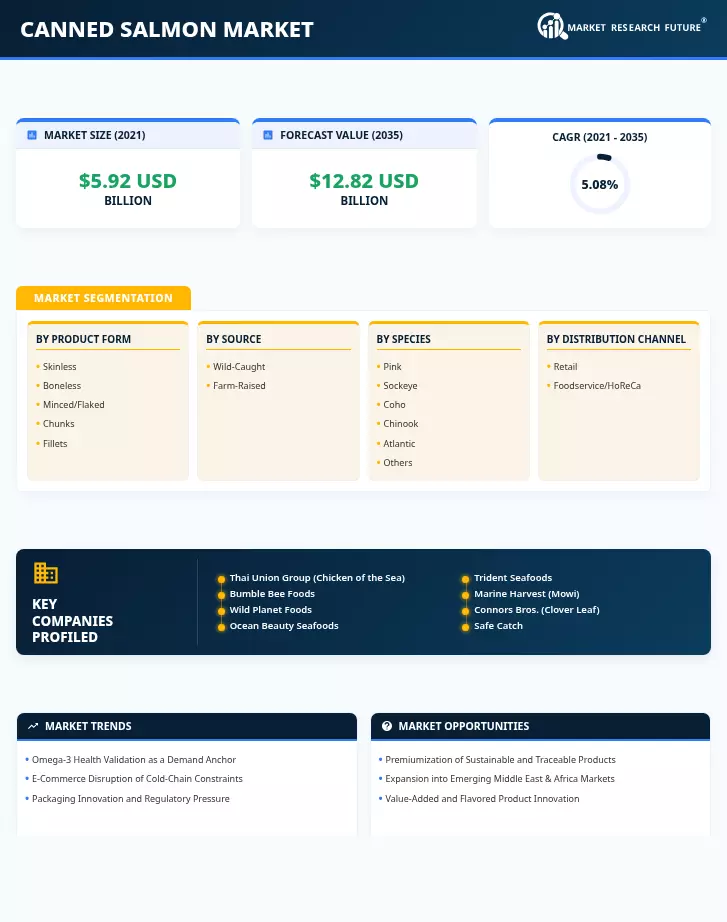
Market Size

Forecast Period2026-2035
CAGR (2026-2035)5.08%
2025 Market SizeUSD 7.70 Billion
2035 Market SizeUSD 12.82 Billion

Key Players

Thai Union Group
Bumble Bee Foods
Wild Planet Foods
Ocean Beauty Seafoods
Trident Seafoods
Marine Harvest
Opportunities
  • Premiumization of Sustainable and Traceable Products
  • Expansion into Emerging Middle East & Africa Markets
  • Value-Added and Flavored Product Innovation
  1. 1 Market Overview |
    1. 1.1 Study Assumptions & Market Definition |
    2. 1.2 Scope of the Study |
    3. 1.3 Research Methodology
  2. 2 Market Summary & Key Takeaways
  3. 3 Market Dynamics |
    1. 3.1 Market Drivers Analysis | |
      1. 3.1.1 Omega-3 Health Validation & Dietary Guidelines | |
      2. 3.1.2 E-Commerce & Direct-to-Consumer Channels | |
      3. 3.1.3 BPA-Free & Sustainable Packaging Innovation | |
      4. 3.1.4 Single-Person Household Growth | |
      5. 3.1.5 MSC/ASC Certification Premiumization | |
      6. 3.1.6 Automated Processing & Deboning Technology | |
      7. 3.1.7 Modern Retail Expansion in Emerging Economies |
    2. 3.2 Market Restraints Analysis | |
      1. 3.2.1 Mercury and Microplastics Consumer Concerns | |
      2. 3.2.2 Wild Salmon Supply Volatility & Climate Risk | |
      3. 3.2.3 Competition from Fresh and Frozen Alternatives | |
      4. 3.2.4 Tariff and Trade Policy Uncertainty | |
      5. 3.2.5 Input Cost Inflation (Aluminum, Energy) |
    3. 3.3 Market Opportunity Analysis | |
      1. 3.3.1 Premiumization of Sustainable and Traceable Products | |
      2. 3.3.2 Expansion into Emerging Middle East & Africa Markets | |
      3. 3.3.3 Value-Added and Flavored Product Innovation | |
      4. 3.3.4 Private-Label and Retailer-Brand Partnerships | |
      5. 3.3.5 Data-Driven Demand Forecasting and SKU Optimization |
    4. 3.4 Industry Value Chain Analysis |
    5. 3.5 Porter's Five Forces Analysis
  4. 4 Global Canned Salmon Market Size & Forecast (2021–2035) |
    1. 4.1 Historical Market Size (2021–2025) |
    2. 4.2 Current & Forecast Market Size (2026–2035) |
    3. 4.3 Market Size by Revenue (USD Billion) |
    4. 4.4 Year-over-Year Growth Analysis
  5. 5 Segmentation Analysis |
    1. 5.1 By Product Form | |
      1. 5.1.1 Skinless and Boneless | |
      2. 5.1.2 Minced/Flaked | |
      3. 5.1.3 Chunks | |
      4. 5.1.4 Fillets |
    2. 5.2 By Source | |
      1. 5.2.1 Wild-Caught | |
      2. 5.2.2 Farm-Raised |
    3. 5.3 By Species | |
      1. 5.3.1 Pink | |
      2. 5.3.2 Sockeye | |
      3. 5.3.3 Coho | |
      4. 5.3.4 Chinook | |
      5. 5.3.5 Atlantic | |
      6. 5.3.6 Others |
    4. 5.4 By Distribution Channel | |
      1. 5.4.1 Retail | |
      2. 5.4.2 Foodservice/HoReCa
  6. 6 Regional Analysis |
    1. 6.1 North America | |
      1. 6.1.1 United States | |
      2. 6.1.2 Canada | |
      3. 6.1.3 Mexico |
    2. 6.2 Europe | |
      1. 6.2.1 Germany | |
      2. 6.2.2 United Kingdom | |
      3. 6.2.3 France | |
      4. 6.2.4 Italy | |
      5. 6.2.5 Spain | |
      6. 6.2.6 Nordic Countries | |
      7. 6.2.7 Russia | |
      8. 6.2.8 Rest of Europe |
    3. 6.3 Asia-Pacific | |
      1. 6.3.1 China | |
      2. 6.3.2 India | |
      3. 6.3.3 Japan | |
      4. 6.3.4 South Korea | |
      5. 6.3.5 ASEAN | |
      6. 6.3.6 Rest of Asia-Pacific |
    4. 6.4 South America | |
      1. 6.4.1 Brazil | |
      2. 6.4.2 Argentina | |
      3. 6.4.3 Rest of South America |
    5. 6.5 Middle East & Africa | |
      1. 6.5.1 Saudi Arabia | |
      2. 6.5.2 UAE | |
      3. 6.5.3 South Africa | |
      4. 6.5.4 Egypt | |
      5. 6.5.5 Rest of MEA
  7. 7 Competitive Landscape |
    1. 7.1 Market Share Analysis (2025) |
    2. 7.2 Competitive Benchmarking Matrix |
    3. 7.3 Company Profiles | |
      1. 7.3.1 Thai Union Group (Chicken of the Sea) | |
      2. 7.3.2 Bumble Bee Foods | |
      3. 7.3.3 Wild Planet Foods | |
      4. 7.3.4 Ocean Beauty Seafoods | |
      5. 7.3.5 Trident Seafoods | |
      6. 7.3.6 Marine Harvest (Mowi) | |
      7. 7.3.7 Connors Bros. (Clover Leaf) | |
      8. 7.3.8 Safe Catch | |
      9. 7.3.9 Princes Group | |
      10. 7.3.10 Dongwon Industries
  8. 8 Future Outlook & Strategic Recommendations (2026–2035) |
    1. 8.1 Digital Commerce and Direct-to-Consumer Maturation |
    2. 8.2 Aquaculture Productivity and Supply Diversification |
    3. 8.3 ESG Reporting and Sustainable Sourcing Mandates |
    4. 8.4 Packaging Innovation and Circular Economy Integration
  9. 9 Recent Developments & News
  10. 10 Frequently Asked Questions (FAQs)
  11. 11 Report Scope & Methodology |
    1. 11.1 Study Period & Base Year |
    2. 11.2 Data Sources & Citations |
    3. 11.3 Abbreviations
  12. 12 LIST OF TABLES |
  13. TABLE 1 Global Canned Salmon Market Size & Forecast, by Revenue (USD Billion), 2021–2035 |
  14. TABLE 2 Global Canned Salmon Market – Year-over-Year Growth Analysis, 2021–2035 |
  15. TABLE 3 Global Canned Salmon Market – Driver Impact Analysis |
  16. TABLE 4 Global Canned Salmon Market – Restraint Impact Analysis |
  17. TABLE 5 Global Canned Salmon Market Size, by Product Form, 2021–2035 (USD Billion) |
  18. TABLE 6 Global Canned Salmon Market Size, by Source, 2021–2035 (USD Billion) |
  19. TABLE 7 Global Canned Salmon Market Size, by Species, 2021–2035 (USD Billion) |
  20. TABLE 8 Global Canned Salmon Market Size, by Distribution Channel, 2021–2035 (USD Billion) |
  21. TABLE 9 Global Canned Salmon Market Size, by Region, 2021–2035 (USD Billion) |
  22. TABLE 10 North America Canned Salmon Market Size, by Country, 2021–2035 (USD Billion) |
  23. TABLE 11 Europe Canned Salmon Market Size, by Country, 2021–2035 (USD Billion) |
  24. TABLE 12 Asia-Pacific Canned Salmon Market Size, by Country, 2021–2035 (USD Billion) |
  25. TABLE 13 South America Canned Salmon Market Size, by Country, 2021–2035 (USD Billion) |
  26. TABLE 14 Middle East & Africa Canned Salmon Market Size, by Country, 2021–2035 (USD Billion) |
  27. TABLE 15 Competitive Benchmarking Matrix – Global Canned Salmon Market, 2025 |
  28. TABLE 16 Company Profiles – Key Players, Global Canned Salmon Market |
  29. TABLE 17 Recent Developments & Strategic Announcements, 2023–2025 |
  30. TABLE 18 Report Scope & Methodology Summary |
  31. TABLE 19 Detailed Sources and Citations |
  32. TABLE 20 North America Canned Salmon Market Size, by Product Form, 2021–2035 (USD Billion) |
  33. TABLE 21 North America Canned Salmon Market Size, by Source, 2021–2035 (USD Billion) |
  34. TABLE 22 North America Canned Salmon Market Size, by Species, 2021–2035 (USD Billion) |
  35. TABLE 23 North America Canned Salmon Market Size, by Distribution Channel, 2021–2035 (USD Billion) |
  36. TABLE 24 Europe Canned Salmon Market Size, by Product Form, 2021–2035 (USD Billion) |
  37. TABLE 25 Europe Canned Salmon Market Size, by Source, 2021–2035 (USD Billion) |
  38. TABLE 26 Europe Canned Salmon Market Size, by Species, 2021–2035 (USD Billion) |
  39. TABLE 27 Europe Canned Salmon Market Size, by Distribution Channel, 2021–2035 (USD Billion) |
  40. TABLE 28 Asia-Pacific Canned Salmon Market Size, by Product Form, 2021–2035 (USD Billion) |
  41. TABLE 29 Asia-Pacific Canned Salmon Market Size, by Source, 2021–2035 (USD Billion) |
  42. TABLE 30 Asia-Pacific Canned Salmon Market Size, by Species, 2021–2035 (USD Billion) |
  43. TABLE 31 Asia-Pacific Canned Salmon Market Size, by Distribution Channel, 2021–2035 (USD Billion) |
  44. TABLE 32 South America Canned Salmon Market Size, by Product Form, 2021–2035 (USD Billion) |
  45. TABLE 33 South America Canned Salmon Market Size, by Source, 2021–2035 (USD Billion) |
  46. TABLE 34 South America Canned Salmon Market Size, by Species, 2021–2035 (USD Billion) |
  47. TABLE 35 South America Canned Salmon Market Size, by Distribution Channel, 2021–2035 (USD Billion) |
  48. TABLE 36 Middle East & Africa Canned Salmon Market Size, by Product Form, 2021–2035 (USD Billion) |
  49. TABLE 37 Middle East & Africa Canned Salmon Market Size, by Source, 2021–2035 (USD Billion) |
  50. TABLE 38 Middle East & Africa Canned Salmon Market Size, by Species, 2021–2035 (USD Billion) |
  51. TABLE 39 Middle East & Africa Canned Salmon Market Size, by Distribution Channel, 2021–2035 (USD Billion)
  52. 13 LIST OF FIGURES |
  53. FIGURE 1 Global Canned Salmon Market Dynamics (Drivers, Restraints, Opportunities) |
  54. FIGURE 2 Canned Salmon Industry Value Chain Analysis |
  55. FIGURE 3 Porter's Five Forces Analysis – Global Canned Salmon Market |
  56. FIGURE 4 Global Canned Salmon Market Size & Forecast Trend (USD Billion), 2021–2035 |
  57. FIGURE 5 Global Canned Salmon Market Share, by Product Form (%), 2025 |
  58. FIGURE 6 Global Canned Salmon Market Share, by Source (%), 2025 |
  59. FIGURE 7 Global Canned Salmon Market Share, by Species (%), 2025 |
  60. FIGURE 8 Global Canned Salmon Market Share, by Distribution Channel (%), 2025 |
  61. FIGURE 9 Global Canned Salmon Market Share, by Region (%), 2025 |
  62. FIGURE 10 North America Canned Salmon Market Size Trend (USD Billion), 2021–2035 |
  63. FIGURE 11 Europe Canned Salmon Market Size Trend (USD Billion), 2021–2035 |
  64. FIGURE 12 Asia-Pacific Canned Salmon Market Size Trend (USD Billion), 2021–2035 |
  65. FIGURE 13 South America Canned Salmon Market Size Trend (USD Billion), 2021–2035 |
  66. FIGURE 14 Middle East & Africa Canned Salmon Market Size Trend (USD Billion), 2021–2035 |
  67. FIGURE 15 Competitive Landscape – Market Share Distribution (%), 2025 |
  68. FIGURE 16 Competitive Benchmarking Radar Chart – Top 10 Players

SEGMENTATION QUICK REFERENCE

DimensionSub-SegmentsDominant SegmentFastest Growing Segment
Product FormSkinless and Boneless, Minced/Flaked, Chunks, FilletsSkinless and BonelessFillets
SourceWild-Caught, Farm-RaisedWild-CaughtFarm-Raised
SpeciesPink, Sockeye, Coho, Chinook, Atlantic, OthersPinkAtlantic
Distribution ChannelRetail, Foodservice/HoReCaRetailFoodservice/HoReCa
GeographyNorth America, Europe, Asia-Pacific, South America, Middle East & AfricaAsia-PacificMiddle East & Africa


MARKET SEGMENTATION OVERVIEW

By Product Form

Sub-SegmentKey Trend
Skinless and BonelessDominant convenience format; strong household and foodservice crossover demand
Minced/FlakedBudget-friendly option for salads, casseroles, and institutional catering applications
ChunksGrowing premium snacking and recipe-ready positioning in retail
FilletsFastest growth driven by premiumization and ready-to-eat meal applications


The product form landscape reflects a clear bifurcation between value-driven formats (minced/flaked) and premium-oriented formats (fillets). Skinless and boneless products remain the volume leader due to their broad applicability across meal occasions, while fillets capture the emerging consumer preference for restaurant-quality home dining experiences.

By Source

Sub-SegmentKey Trend
Wild-CaughtConsumer preference for natural, MSC-certified Pacific salmon remains strong.
Farm-RaisedAquaculture expansion from Norway and Chile is driving cost-competitive supply growth.


Wild-caught salmon maintains its leadership position on the strength of consumer perception and sustainability certification. Farm-raised sources are closing the gap as feed efficiency improvements and responsible aquaculture practices address earlier environmental criticism.

By Species

Sub-SegmentKey Trend
PinkLargest volume species; affordable and widely available from Alaskan and Russian fisheries
SockeyePremium tier; valued for deep-red color, firm texture, and high omega-3 content
CohoMid-range positioning bridging pink and sockeye price tiers
ChinookUltra-premium niche with limited supply and specialty retail distribution
AtlanticFastest growing species in canning applications due to aquaculture scale
OthersRegional specialty species, including chum and other Pacific varieties


Species segmentation reflects consumer willingness to trade up within the canned salmon category. Pink salmon serves as the gateway product, while sockeye and Atlantic species capture consumers seeking differentiated flavor and nutritional profiles.

By Distribution Channel

Sub-SegmentKey Trend
RetailSupermarkets, hypermarkets, and e-commerce dominate volume sales
Foodservice/HoReCaRestaurants and institutional buyers are increasingly integrating canned salmon into menus.


Retail remains the primary channel, though the e-commerce sub-channel is reshaping competitive dynamics by enabling direct brand-to-consumer relationships. Foodservice growth is anchored in quick-service and casual dining chains that value the cost efficiency and consistent quality of canned salmon ingredients.