Request Free Sample ×

Kindly complete the form below to receive a free sample of this Report

* Please use a valid business email

Leading companies partner with us for data-driven Insights

clients tt-cursor
Hero Background
English
Chinese
French
Japanese
Korean
German
Spanish

Calcium Chloride Market Analysis

ID: MRFR/CnM/1517-HCR
135 Pages
Anshula Mandaokar
April 2026

Calcium Chloride Market Research Report Information By Product Type (Flakes 77%, Flakes 94%, Prills 94%, and Pellets 94%), By Form (Liquid, Hydrated Solid, and Others), By Raw Material (Natural Brine, Solvay Process (by-product), Limestone, and Hydrochloric Acid (HCL)), By Grade (Food Grade, Industrial Grade, Agriculture Grade, and Pharmaceutical Grade), By Application (Dust Control and De-icing, Gas and Oil, Construction, Food), and By Region (North America, Europe, Asia-Pacific, and Rest Of The World) – Market Forecast Till 2035

Share:
Download PDF ×

We do not share your information with anyone. However, we may send you emails based on your report interest from time to time. You may contact us at any time to opt-out.

Calcium Chloride Market Infographic
Purchase Options

Market Analysis

In-depth Analysis of Calcium Chloride Market Industry Landscape

CaCO3 is widely used for deicing, especially in cold places. The calcium chloride market is mostly driven by this. People often use calcium chloride to melt snow and ice off of roads, highways, and sidewalks in the winter because it can lower the temperature at which water freezes. People buy calcium chloride for a lot of different reasons. One big reason is to build infrastructure, like roads and bridges. Because it keeps roads stable and reduces dust, the building industry uses more calcium chloride. This business uses a lot of different fluids, such as cutting fluids and finishing fluids. Because it depends a lot on how much the oil and gas business grows or shrinks, calcium chloride is very sensitive to changes in the energy markets. Food gets calcium chloride from this substance, which also makes it harder. The food and drink industry needs calcium chloride because of what customers want, health trends, and government rules. Keeping dust down with calcium chloride is becoming more popular, especially on dirt roads, in mines, and in construction zones. Because of environmental rules and neighborhood concerns, more and more people are using calcite chloride to successfully control dust. The growth of the science business around the world has a big effect on the calcium chloride market. CaCO3 is in high demand as the chemical making business grows because it can be used in lots of different ways. This is because Asia-Pacific countries are quickly building up their infrastructure and becoming more developed. This means that the area is becoming an important market for calcium chloride. More people are going to towns and making things there, which makes more calcium chloride needed. The market for calcium chloride is affected by environmental concerns and government rules. This is especially true in places where using certain de-icing products is limited. To make sure the market stays strong, companies are focused more and more on making options that are better for the earth and following the rules.

Author
Author Profile
Anshula Mandaokar
Team Lead - Research

Anshula Mandaokar holds an academic degree in Chemical Engineering and has been contributing to the field for more than 5 years. She has expertise in Market Research and Business Consulting and serves as a Team Lead for a reputed Market Research firm under the Chemicals and Materials domain spectrum. She has worked on multiple projects, generating explicit results in a quick turnaround time. Her understanding of data interpretation justifies her role as a leader.

Leave a Comment

FAQs

What is the projected market valuation of the Calcium Chloride Market by 2035?

<p>The Calcium Chloride Market is projected to reach a valuation of 3.661 USD Billion by 2035.</p>

What was the market valuation of Calcium Chloride in 2024?

<p>In 2024, the overall market valuation of Calcium Chloride was 2.01 USD Billion.</p>

What is the expected CAGR for the Calcium Chloride Market during the forecast period 2025 - 2035?

<p>The expected CAGR for the Calcium Chloride Market during the forecast period 2025 - 2035 is 5.6%.</p>

Which companies are considered key players in the Calcium Chloride Market?

<p>Key players in the Calcium Chloride Market include OxyChem, Tetra Technologies, Dow Chemical Company, and Solvay.</p>

What are the main product types in the Calcium Chloride Market and their valuations?

<p>Main product types include Flakes 77%, Flakes 94%, Prills 94%, and Pellets 94%, with valuations ranging from 0.41 to 1.2 USD Billion.</p>

How does the form of Calcium Chloride impact its market valuation?

<p>The form of Calcium Chloride, including Liquid and Hydrated Solid, shows valuations between 0.41 and 1.426 USD Billion.</p>

What raw materials are used in the production of Calcium Chloride and their market values?

Raw materials such as Natural Brine and Limestone have market values ranging from 0.21 to 1.426 USD Billion.

What grades of Calcium Chloride are available and what are their respective market valuations?

Available grades include Food Grade, Industrial Grade, and Pharmaceutical Grade, with valuations from 0.31 to 1.5 USD Billion.

What applications drive the demand for Calcium Chloride?

Applications such as Dust Control and De-icing, and Construction drive demand, with valuations between 0.11 and 1.25 USD Billion.

How does the Calcium Chloride Market's growth compare to other chemical markets?

The Calcium Chloride Market's growth, with a projected CAGR of 5.6%, suggests a robust performance compared to other chemical markets.

Market Summary

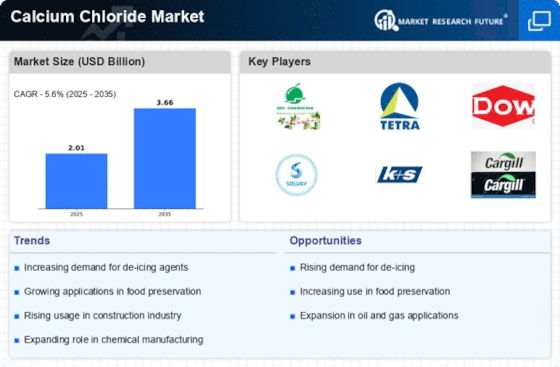
As per Market Research Future analysis, the Calcium Chloride Market Size was estimated at 2.01 USD Billion in 2024. The Calcium Chloride industry is projected to grow from USD 2.123 Billion in 2025 to USD 3.661 Billion by 2035, exhibiting a compound annual growth rate (CAGR) of 5.6% during the forecast period 2025 - 2035

Key Market Trends & Highlights

The Calcium Chloride Market is experiencing robust growth driven by diverse applications and sustainability initiatives.

  • North America remains the largest market for calcium chloride, driven by its extensive use in de-icing applications. The Asia-Pacific region is emerging as the fastest-growing market, fueled by rapid industrialization and urbanization. Flakes dominate the market with a 77% share, while pellets are recognized as the fastest-growing segment due to their versatility. Key market drivers include increasing demand in de-icing applications and expansion in the construction sector.

Market Size & Forecast

2024 Market Size 2.01 (USD Billion)
2035 Market Size 3.661 (USD Billion)
CAGR (2025 - 2035) 5.6%
Largest Regional Market Share in 2024 North America

Major Players

OxyChem (US), Tetra Technologies (US), Dow Chemical Company (US), Solvay (BE), K+S AG (DE), Cargill, Incorporated (US), Nutrien Ltd. (CA), Weifang Dazhong Chemical Co., Ltd. (CN), Shandong Haihua Group Co., Ltd. (CN)

Market Trends

The Calcium Chloride Market is currently experiencing a notable transformation, driven by various factors that influence its demand and application across multiple sectors. This compound, recognized for its hygroscopic properties, finds extensive use in de-icing, dust control, and as a drying agent. The increasing focus on environmental sustainability appears to be steering industries towards more eco-friendly alternatives, which may impact the traditional applications of calcium chloride. Furthermore, the growth of the construction and oil industries is likely to bolster the market, as these sectors utilize calcium chloride for various purposes, including enhancing concrete performance and facilitating oil extraction processes.

In addition, the calcium chloride market seems to be influenced by advancements in production technologies and the emergence of new applications. Innovations in manufacturing processes could lead to more efficient production methods, potentially reducing costs and increasing product availability. Moreover, the rising demand for calcium chloride in food preservation and agriculture suggests a diversification of its applications, which may further stimulate market growth. As industries continue to evolve, the calcium chloride market is poised to adapt, reflecting changing consumer preferences, regulatory landscapes, and emerging calcium chloride market trends. 

Sustainability Initiatives

The growing emphasis on sustainable practices within various industries is shaping the Calcium Chloride Market. Companies are increasingly seeking environmentally friendly alternatives, which may lead to a shift in how calcium chloride is utilized, particularly in applications like de-icing and dust control.

Technological Advancements

Innovations in production techniques are likely to enhance the efficiency of calcium chloride manufacturing. These advancements could result in lower production costs and improved product quality, thereby influencing market dynamics and competitiveness.

Diversification of Applications

The expanding range of applications for calcium chloride, particularly in food preservation and agriculture, indicates a trend towards diversification. This broadening of use cases may contribute to increased demand and open new avenues for market growth.

Calcium Chloride Market Market Drivers

Growth in Oil and Gas Sector

The Calcium Chloride Market is significantly impacted by the growth in the oil and gas sector. Calcium chloride is employed in drilling fluids to enhance the efficiency of oil extraction processes. As energy demands continue to rise, the oil and gas industry is expanding, leading to increased utilization of calcium chloride in various applications, including well completion and workover operations. Recent statistics indicate that the oil and gas sector is projected to grow at a compound annual growth rate of 5.2% over the next few years, which is likely to bolster the calcium chloride market. The compound's ability to control fluid density and prevent hydrate formation makes it indispensable in this sector, thereby reinforcing its critical role in the Calcium Chloride Market.

Rising Use in Food Preservation

The Calcium Chloride Market is witnessing a rising trend in the use of calcium chloride for food preservation. This compound serves as a firming agent in canned vegetables and fruits, enhancing texture and prolonging shelf life. As consumer preferences shift towards processed and preserved foods, the demand for calcium chloride in the food industry is likely to increase. Market analysis indicates that the food preservation segment is expected to grow at a rate of 3% annually, driven by the increasing consumption of convenience foods. Moreover, the regulatory approval of calcium chloride as a food additive in various regions further solidifies its position in the market. This trend highlights the multifaceted applications of calcium chloride, reinforcing its importance in the Calcium Chloride Market.

Expansion in Construction Sector

The Calcium Chloride Market is significantly influenced by the expansion of the construction sector. Calcium chloride is utilized as a concrete accelerator, enhancing the curing process and improving the strength of concrete. As urbanization continues to rise, the demand for construction materials and additives, including calcium chloride, is expected to increase. Recent data suggests that the construction industry is projected to grow at a compound annual growth rate of 4.5% over the next five years, which bodes well for the calcium chloride market. Additionally, the growing trend of infrastructure development in emerging economies further supports this expansion. The versatility of calcium chloride in various construction applications, such as dust control and moisture absorption, positions it as a critical component in the Calcium Chloride Market.

Increasing Demand in De-icing Applications

The Calcium Chloride Market experiences a notable surge in demand due to its widespread use in de-icing applications. As winter weather conditions become more severe, municipalities and road maintenance agencies increasingly rely on calcium chloride for effective ice control. This compound is favored for its ability to lower the freezing point of water, making it an efficient solution for maintaining road safety. In recent years, the market has seen a growth rate of approximately 5% annually, driven by the need for safer transportation during winter months. Furthermore, the increasing frequency of extreme weather events has led to heightened awareness regarding road safety, further propelling the demand for calcium chloride in de-icing. This trend indicates a robust future for the Calcium Chloride Market as it aligns with public safety priorities.

Environmental Regulations Favoring Calcium Chloride

The Calcium Chloride Market is positively influenced by stringent environmental regulations that favor the use of calcium chloride over other chemical alternatives. As industries seek to comply with environmental standards, calcium chloride emerges as a more eco-friendly option for various applications, including dust control and de-icing. Regulatory bodies are increasingly promoting the use of less harmful substances, which positions calcium chloride favorably in the market. Recent trends indicate that the market for environmentally friendly de-icing agents is expected to grow by 4% annually, reflecting a shift towards sustainable practices. This regulatory landscape not only enhances the appeal of calcium chloride but also ensures its continued relevance in the Calcium Chloride Market.


Market Segment Insights

By Product Type: Flakes (77% share - Largest) vs. Pellets (Fastest-Growing)

The Calcium Chloride Market exhibits a diverse range of product types, with Flakes accounting for a substantial 77% market share. This dominance illustrates the preference for flakes among users due to their versatility and ease of handling in various applications, such as de-icing, dust control, and in the chemical industry. Moreover, the 94% share of both Flakes (94%) and Prills (94%) highlights their role as significant contributors to market dynamics. As users increasingly demand specific product characteristics, the distribution reflects shifting preferences among these product types, emphasizing the need for manufacturers to adapt accordingly. In terms of growth trends, Pellets have emerged as the fastest-growing segment within the Calcium Chloride market, driven by their efficiency and effectiveness in specific applications such as road maintenance and agricultural use. The increasing focus on environmentally friendly solutions is also contributing to this growth as Pellets are positioned to meet emerging standards and consumer preferences. The trend towards bulk handling and packaging innovations is expected to bolster the uptake of Pellets, showcasing an exciting evolution in the dynamics of the Calcium Chloride market product types.

Flakes (Dominant) vs. Pellets (Emerging)

Flakes are recognized as the dominant player in the Calcium Chloride market due to their extensive use and established supply chain channels. Their versatility enables application across multiple sectors, especially in winter maintenance, where quick dissolution and effectiveness are critical. On the other hand, Pellets represent an emerging segment that is gaining traction due to their superior handling properties and reduced dust formation during application. As the market shifts towards more efficient solutions, Pellets are becoming increasingly favored for specific industrial and agricultural applications, emphasizing the growing need for innovative materials in a competitive landscape.

By Form: Liquid (Largest) vs. Hydrated Solid (Fastest-Growing)

In the Calcium Chloride Market, the distribution of market share among the form segments reveals that liquid calcium chloride remains the dominant form, capturing a significant portion of the market. Its extensive use in de-icing, dust control, and various industrial applications positions it favorably in terms of demand. Meanwhile, hydrating solid calcium chloride is emerging as a faster-growing segment, primarily driven by its increasing applications in the construction and oil industries, where it is favored for its stability and storage advantages over liquid forms.

Calcium Chloride: Liquid (Dominant) vs. Hydrated Solid (Emerging)

Liquid calcium chloride is characterized by its versatility and wide application range, making it a dominant force in the calcium chloride market. Its ease of handling and quick dissolution rates enable it to be utilized effectively in various sectors, including chemical processing, oil and gas, and agriculture. Conversely, hydrated solid calcium chloride is emerging due to its advantageous physical properties, including storage stability and lower risk of leakage compared to its liquid counterpart. This segment is increasingly being adopted in construction for effective ice melting and dust control, reflecting a growing preference for solid forms in specific applications.

By Raw Material: Natural Brine (Largest) vs. Limestone (Fastest-Growing)

In the Calcium Chloride market, the distribution of raw materials reveals that Natural Brine continues to hold the largest share among the various sources. This is primarily attributed to its cost-effectiveness and the abundance of natural reserves, making it a favored choice for producers. Following Natural Brine, the Solvay Process, a by-product, also contributes significantly to the market, providing an alternative that aligns with the increasing demand for environmentally sustainable practices. Limestone and Hydrochloric Acid are notable players as well, serving niche needs in the industry.

Limestone (Dominant) vs. Hydrochloric Acid (Emerging)

Limestone has emerged as a dominant raw material in the Calcium Chloride market due to its versatility and availability, making it a pivotal resource for manufacturers. Its role is reinforced by stringent environmental regulations that drive producers to adopt sustainable sourcing practices. On the other hand, Hydrochloric Acid is considered an emerging raw material, gaining traction thanks to its ability to produce high-purity Calcium Chloride efficiently. As industries seek to optimize production processes, Hydrochloric Acid is increasingly being recognized for its potential to meet this demand, indicating a shift towards raw materials that align with cost-efficiency and purity standards in Calcium Chloride production.

By Grade: Food Grade (Largest) vs. Industrial Grade (Fastest-Growing)

The Calcium Chloride market is segmented into Food Grade, Industrial Grade, Agriculture Grade, and Pharmaceutical Grade, each varying in market share and applications. Among these, the Food Grade segment holds the largest share, driven by its critical role in food preservation and safety. It is extensively utilized in the food and beverage industry, enhancing product quality and extending shelf life. In contrast, the Industrial Grade Calcium Chloride is witnessing rapid growth due to escalating demand from various industrial applications including ice-scaling, dust control, and de-icing formulations. This diverse applicability is contributing to its fast growth trajectory in the market.

Food Grade (Dominant) vs. Industrial Grade (Emerging)

Food Grade Calcium Chloride holds a significant position in the market due to its essential applications in the food industry, serving as a preservative and firming agent. Its quality standard ensures it is safe for human consumption, thereby making it a preferred choice for food manufacturers. On the other hand, Industrial Grade Calcium Chloride is emerging as a vital player, benefiting from its versatility across multiple sectors such as construction, road maintenance, and chemical production. As industries continue to seek efficient solutions for moisture control and de-icing, the demand for Industrial Grade is projected to escalate, showcasing its adaptability and importance in various applications.

By Application: Dust Control and De-icing (Largest) vs. Construction (Fastest-Growing)

In the Calcium Chloride Market, the application segment demonstrates a diverse range of uses, with Dust Control and De-icing leading the pack in market share. This segment benefits from extensive demand stemming from both municipal and private sectors, reflecting its effectiveness in preventing ice formation and enhancing road safety. The Construction segment, while smaller, shows a promising upward trajectory as more companies recognize the benefits of Calcium Chloride in concrete production and reinforcement, particularly in regions with extreme weather conditions.

Dust Control and De-icing (Dominant) vs. Construction (Emerging)

The Dust Control and De-icing application segment remains dominant, predominantly driven by municipalities and road organizations that apply Calcium Chloride for winter maintenance. Its effectiveness in absorbing moisture and brine formation makes it essential for safe transportation. Conversely, the Construction segment is emerging rapidly, capitalizing on the increasing demand for durable and quality construction materials. Calcium Chloride is increasingly utilized to accelerate curing processes and improve the strength of concrete mixes, positioning it as a vital additive in modern construction practices.

Get more detailed insights about Calcium Chloride Market Research Report - Global Forecast till 2035

Regional Insights

North America : Chemical Innovation Hub

The North American calcium chloride market is driven by increasing demand in de-icing, dust control, and oil and gas applications. The region holds approximately 45% of the global market share, with the United States being the largest contributor, followed by Canada. Regulatory support for safer and more effective de-icing agents is also a significant catalyst for growth, as municipalities seek environmentally friendly solutions. Leading players in this region include OxyChem, Dow Chemical Company, and Tetra Technologies, which dominate the market with innovative products and extensive distribution networks. The competitive landscape is characterized by strategic partnerships and investments in research and development to enhance product offerings. The presence of these key players ensures a robust supply chain and responsiveness to market demands.

Europe : Regulatory-Driven Market

Europe's calcium chloride market is characterized by stringent regulations aimed at environmental sustainability and safety. The region accounts for approximately 30% of the global market share, with Germany and France being the largest markets. The European Union's regulations on chemical safety and environmental impact are significant drivers, pushing companies to adopt greener practices and innovate in product development. Key players such as Solvay and K+S AG are at the forefront of this transition, focusing on sustainable production methods and expanding their product lines to meet regulatory standards. The competitive landscape is marked by collaborations and partnerships aimed at enhancing product efficiency and reducing environmental footprints. This focus on sustainability is reshaping the market dynamics in Europe.

Asia-Pacific : Emerging Market Potential

The Asia-Pacific region is witnessing rapid growth in the calcium chloride market, driven by increasing industrialization and urbanization. This region holds about 20% of the global market share, with China and India being the largest contributors. Additionally, government initiatives aimed at improving infrastructure development and agricultural productivity are further accelerating the growth of the apac calcium chloride market. China's Weifang Dazhong Chemical Co., Ltd. and Shandong Haihua Group Co., Ltd. are key players in this market, leveraging their production capabilities to meet the growing demand. The competitive landscape is evolving, with local manufacturers expanding their reach and international players exploring partnerships to enhance market presence. This dynamic environment is expected to drive further growth in the coming years.

Middle East and Africa : Resource-Rich Opportunities

The Middle East and Africa region is emerging as a significant player in the calcium chloride market, driven by resource availability and increasing industrial applications. This region holds approximately 5% of the global market share, with countries like South Africa and the UAE leading the demand. The growth is fueled by the expanding oil and gas sector, where calcium chloride is used in drilling fluids and completion fluids, as well as in construction and de-icing applications. The competitive landscape is characterized by a mix of local and international players, with companies focusing on enhancing production capabilities to meet regional demands. The presence of key players and the strategic location of the region provide opportunities for growth and expansion in the calcium chloride market, making it an attractive area for investment and development.

Key Players and Competitive Insights

The Calcium Chloride Market is currently characterized by a dynamic competitive landscape, driven by increasing demand across various sectors such as de-icing, dust control, and chemical manufacturing. Key players are actively engaging in strategic initiatives to enhance their market positioning. Notably, companies like OxyChem (US) and Dow Chemical Company (US) are focusing on innovation and sustainability, while Tetra Technologies (US) emphasizes regional expansion and partnerships to bolster its market presence. These strategies collectively contribute to a moderately fragmented market structure, where the interplay of established firms and emerging players shapes competitive dynamics.In terms of business tactics, companies are increasingly localizing manufacturing to reduce costs and optimize supply chains. This approach not only enhances operational efficiency but also allows for quicker response times to market demands. The competitive structure of the Calcium Chloride Market appears to be moderately fragmented, with several key players exerting influence over pricing and product availability. The collective actions of these companies indicate a trend towards consolidation, as firms seek to leverage synergies and enhance their competitive edge.
In August Tetra Technologies (US) announced a strategic partnership with a leading logistics firm to streamline its distribution network. This move is expected to enhance Tetra's operational efficiency and reduce lead times, thereby improving customer satisfaction. The partnership aligns with the company's broader strategy to optimize its supply chain and respond more effectively to market fluctuations, indicating a proactive approach to maintaining competitiveness in a rapidly evolving market.
In September Dow Chemical Company (US) unveiled a new line of eco-friendly calcium chloride products aimed at reducing environmental impact. This initiative reflects Dow's commitment to sustainability and innovation, positioning the company as a leader in environmentally responsible solutions. The introduction of these products not only caters to the growing demand for sustainable options but also enhances Dow's competitive differentiation in the market, potentially attracting environmentally conscious consumers.
In July Solvay (BE) expanded its production capacity for calcium chloride in response to increasing global demand. This expansion is indicative of Solvay's strategic focus on scaling operations to meet market needs. By enhancing its production capabilities, Solvay aims to solidify its market position and ensure a reliable supply of calcium chloride, which is crucial for maintaining customer relationships and market share.
As of October the Calcium Chloride Market is witnessing significant trends such as digitalization and sustainability, which are reshaping competitive strategies. Companies are increasingly forming strategic alliances to enhance their technological capabilities and market reach. The shift from price-based competition to a focus on innovation, technology, and supply chain reliability is becoming evident. Moving forward, competitive differentiation will likely hinge on the ability to adapt to these trends, with firms that prioritize sustainable practices and technological advancements poised to lead the market.

Key Companies in the Calcium Chloride Market include

Industry Developments

  • Q2 2024: OxyChem Announces Expansion of Calcium Chloride Market Production Facility in Ludington, Michigan Occidental Chemical Corporation (OxyChem) announced the completion of a major expansion at its Ludington, Michigan facility, increasing its calcium chloride production capacity to meet rising demand in de-icing and oilfield applications.
  • Q1 2024: TETRA Technologies Secures Multi-Year Calcium Chloride Market Supply Contract with Major Oilfield Services Company TETRA Technologies announced it has signed a multi-year contract to supply calcium chloride to a leading oilfield services provider, supporting enhanced oil recovery and drilling operations in North America.
  • Q3 2024: Nedmag Launches New Food-Grade Calcium Chloride Market Product Line Nedmag introduced a new line of high-purity, food-grade calcium chloride products aimed at the food processing and beverage industries, expanding its portfolio to meet growing demand for food additives.
  • Q2 2025: OxyChem Appoints New Vice President for Calcium Chloride Market Business Unit OxyChem announced the appointment of a new Vice President to lead its calcium chloride business, focusing on strategic growth and operational efficiency in North America and international markets.
  • Q1 2025: TETRA Technologies Expands Calcium Chloride Market Production at El Dorado Facility TETRA Technologies completed an expansion of its El Dorado, Arkansas facility, increasing calcium chloride output to support growing demand in industrial and municipal de-icing applications.
  • Q4 2024: Nedmag Signs Distribution Agreement for Calcium Chloride Market with European Chemical Distributor Nedmag entered into a new distribution agreement with a major European chemical distributor to expand the reach of its calcium chloride products across the continent.
  • Q2 2024: OxyChem Reports Strategic Investment in Calcium Chloride Market Logistics Infrastructure OxyChem disclosed a strategic investment in new logistics and storage infrastructure to improve the supply chain efficiency for its calcium chloride products in North America.
  • Q3 2025: TETRA Technologies Wins Major Municipal De-Icing Contract in Canada TETRA Technologies announced it has been awarded a significant contract to supply calcium chloride for municipal de-icing operations in several Canadian provinces for the 2025-2026 winter season.
  • Q1 2024: OxyChem Launches New Calcium Chloride Market Product for Dust Control Applications OxyChem introduced a new calcium chloride formulation specifically designed for dust control on unpaved roads and construction sites, targeting the infrastructure and mining sectors.
  • Q4 2024: Nedmag Receives Regulatory Approval for Expanded Calcium Chloride Market Production in Veendam Nedmag received regulatory approval to expand its calcium chloride production facility in Veendam, Netherlands, enabling increased output for European and global markets.
  • Q2 2025: TETRA Technologies Announces Partnership with Renewable Energy Firm for Sustainable Calcium Chloride Market Production TETRA Technologies entered into a partnership with a renewable energy company to power its calcium chloride production facilities with green energy, aiming to reduce the carbon footprint of its operations.
  • Q3 2024: OxyChem Signs Long-Term Supply Agreement with Major Construction Materials Company OxyChem signed a long-term agreement to supply calcium chloride to a leading construction materials company, supporting concrete acceleration and dust control applications across North America.

Future Outlook

Calcium Chloride Market Future Outlook

The Calcium Chloride Market is projected to grow at a 5.6% CAGR from 2025 to 2035, driven by increasing demand in de-icing, dust control, and industrial applications.

New opportunities lie in:

  • <p>Expansion into emerging markets with tailored product offerings. Development of eco-friendly calcium chloride alternatives. Investment in automated distribution systems for enhanced efficiency.</p>

By 2035, the Calcium Chloride Market is expected to solidify its position as a key player in various industrial sectors.

Market Segmentation

Calcium Chloride Market Form Outlook

  • Liquid
  • Hydrated Solid
  • Others

Calcium Chloride Market Grade Outlook

  • Food Grade
  • Industrial Grade
  • Agriculture Grade
  • Pharmaceutical Grade

Calcium Chloride Market Application Outlook

  • Dust Control and De-icing
  • Gas and Oil
  • Construction
  • Food
  • Others

Calcium Chloride Market Product Type Outlook

  • Flakes 77%
  • Flakes 94%
  • Prills 94%
  • Pellets 94%

Calcium Chloride Market Raw Material Outlook

  • Natural Brine
  • Solvay Process (by-product)
  • Limestone
  • Hydrochloric Acid (HCL)

Report Scope

MARKET SIZE 2024 2.01(USD Billion)
MARKET SIZE 2025 2.123(USD Billion)
MARKET SIZE 2035 3.661(USD Billion)
COMPOUND ANNUAL GROWTH RATE (CAGR) 5.6% (2025 - 2035)
REPORT COVERAGE Revenue Forecast, Competitive Landscape, Growth Factors, and Trends
BASE YEAR 2024
Market Forecast Period 2025 - 2035
Historical Data 2019 - 2024
Market Forecast Units USD Billion
Key Companies Profiled OxyChem (US), Tetra Technologies (US), Dow Chemical Company (US), Solvay (BE), K+S AG (DE), Cargill, Incorporated (US), Nutrien Ltd. (CA), Weifang Dazhong Chemical Co., Ltd. (CN), Shandong Haihua Group Co., Ltd. (CN)
Segments Covered Product Type, Form, Raw Material, Grade, Application, Region
Key Market Opportunities Growing demand for de-icing agents in transportation and construction sectors enhances opportunities in the Calcium Chloride Market.
Key Market Dynamics Rising demand for de-icing agents drives growth in the Calcium Chloride Market amid regulatory shifts.
Countries Covered North America, Europe, APAC, South America, MEA

FAQs

What is the projected market valuation of the Calcium Chloride Market by 2035?

<p>The Calcium Chloride Market is projected to reach a valuation of 3.661 USD Billion by 2035.</p>

What was the market valuation of Calcium Chloride in 2024?

<p>In 2024, the overall market valuation of Calcium Chloride was 2.01 USD Billion.</p>

What is the expected CAGR for the Calcium Chloride Market during the forecast period 2025 - 2035?

<p>The expected CAGR for the Calcium Chloride Market during the forecast period 2025 - 2035 is 5.6%.</p>

Which companies are considered key players in the Calcium Chloride Market?

<p>Key players in the Calcium Chloride Market include OxyChem, Tetra Technologies, Dow Chemical Company, and Solvay.</p>

What are the main product types in the Calcium Chloride Market and their valuations?

<p>Main product types include Flakes 77%, Flakes 94%, Prills 94%, and Pellets 94%, with valuations ranging from 0.41 to 1.2 USD Billion.</p>

How does the form of Calcium Chloride impact its market valuation?

<p>The form of Calcium Chloride, including Liquid and Hydrated Solid, shows valuations between 0.41 and 1.426 USD Billion.</p>

What raw materials are used in the production of Calcium Chloride and their market values?

Raw materials such as Natural Brine and Limestone have market values ranging from 0.21 to 1.426 USD Billion.

What grades of Calcium Chloride are available and what are their respective market valuations?

Available grades include Food Grade, Industrial Grade, and Pharmaceutical Grade, with valuations from 0.31 to 1.5 USD Billion.

What applications drive the demand for Calcium Chloride?

Applications such as Dust Control and De-icing, and Construction drive demand, with valuations between 0.11 and 1.25 USD Billion.

How does the Calcium Chloride Market's growth compare to other chemical markets?

The Calcium Chloride Market's growth, with a projected CAGR of 5.6%, suggests a robust performance compared to other chemical markets.

  1. SECTION I: EXECUTIVE SUMMARY AND KEY HIGHLIGHTS |
    1. EXECUTIVE SUMMARY | |
      1. Market Overview | |
      2. Key Findings | |
      3. Market Segmentation | |
      4. Competitive Landscape | |
      5. Challenges and Opportunities | |
      6. Future Outlook 2
  2. SECTION II: SCOPING, METHODOLOGY AND MARKET STRUCTURE |
    1. MARKET INTRODUCTION | |
      1. Definition | |
      2. Scope of the study | | |
    2. RESEARCH METHODOLOGY | |
      1. Overview | |
      2. Data Mining | |
      3. Secondary Research | |
      4. Primary Research | | |
      5. Forecasting Model | |
      6. Market Size Estimation | | |
      7. Data Triangulation | |
      8. Validation 3
  3. SECTION III: QUALITATIVE ANALYSIS |
    1. MARKET DYNAMICS | |
      1. Overview | |
      2. Drivers | |
      3. Restraints | |
      4. Opportunities |
    2. MARKET FACTOR ANALYSIS | |
      1. Value chain Analysis | |
      2. Porter's Five Forces Analysis | | |
      3. COVID-19 Impact Analysis | | |
  4. SECTION IV: QUANTITATIVE ANALYSIS |
    1. Chemicals and Materials, BY Product Type (USD Billion) | |
      1. Flakes 77% | |
      2. Flakes 94% | |
      3. Prills 94% | |
      4. Pellets 94% |
    2. Chemicals and Materials, BY Form (USD Billion) | |
      1. Liquid | |
      2. Hydrated Solid | |
      3. Others |
    3. Chemicals and Materials, BY Raw Material (USD Billion) | |
      1. Natural Brine | |
      2. Solvay Process (by-product) | |
      3. Limestone | |
      4. Hydrochloric Acid (HCL) |
    4. Chemicals and Materials, BY Grade (USD Billion) | |
      1. Food Grade | |
      2. Industrial Grade | |
      3. Agriculture Grade | |
      4. Pharmaceutical Grade |
    5. Chemicals and Materials, BY Application (USD Billion) | |
      1. Dust Control and De-icing | |
      2. Gas and Oil | |
      3. Construction | |
      4. Food | |
      5. Others |
    6. Chemicals and Materials, BY Region (USD Billion) | |
      1. North America | | |
      2. Europe | | |
      3. APAC | | |
      4. South America | | |
      5. MEA | | |
  5. SECTION V: COMPETITIVE ANALYSIS |
    1. Competitive Landscape | |
      1. Overview | |
      2. Competitive Analysis | |
      3. Market share Analysis | |
      4. Major Growth Strategy in the Chemicals and Materials | |
      5. Competitive Benchmarking | |
      6. Leading Players in Terms of Number of Developments in the Chemicals and Materials | |
      7. Key developments and growth strategies | | |
      8. Major Players Financial Matrix | | |
    2. Company Profiles | |
      1. OxyChem (US) | | |
      2. Tetra Technologies (US) | | |
      3. Dow Chemical Company (US) | | |
      4. Solvay (BE) | | |
      5. K+S AG (DE) | | |
      6. Cargill, Incorporated (US) | | |
      7. Nutrien Ltd. (CA) | | |
      8. Weifang Dazhong Chemical Co., Ltd. (CN) | | |
      9. Shandong Haihua Group Co., Ltd. (CN) | | |
    3. Appendix | |
      1. References | |
      2. Related Reports 6 LIST OF FIGURES |
    4. MARKET SYNOPSIS |
    5. NORTH AMERICA MARKET ANALYSIS |
    6. US MARKET ANALYSIS BY PRODUCT TYPE |
    7. US MARKET ANALYSIS BY FORM |
    8. US MARKET ANALYSIS BY RAW MATERIAL |
    9. US MARKET ANALYSIS BY GRADE |
    10. US MARKET ANALYSIS BY APPLICATION |
    11. CANADA MARKET ANALYSIS BY PRODUCT TYPE |
    12. CANADA MARKET ANALYSIS BY FORM |
    13. CANADA MARKET ANALYSIS BY RAW MATERIAL |
    14. CANADA MARKET ANALYSIS BY GRADE |
    15. CANADA MARKET ANALYSIS BY APPLICATION |
    16. EUROPE MARKET ANALYSIS |
    17. GERMANY MARKET ANALYSIS BY PRODUCT TYPE |
    18. GERMANY MARKET ANALYSIS BY FORM |
    19. GERMANY MARKET ANALYSIS BY RAW MATERIAL |
    20. GERMANY MARKET ANALYSIS BY GRADE |
    21. GERMANY MARKET ANALYSIS BY APPLICATION |
    22. UK MARKET ANALYSIS BY PRODUCT TYPE |
    23. UK MARKET ANALYSIS BY FORM |
    24. UK MARKET ANALYSIS BY RAW MATERIAL |
    25. UK MARKET ANALYSIS BY GRADE |
    26. UK MARKET ANALYSIS BY APPLICATION |
    27. FRANCE MARKET ANALYSIS BY PRODUCT TYPE |
    28. FRANCE MARKET ANALYSIS BY FORM |
    29. FRANCE MARKET ANALYSIS BY RAW MATERIAL |
    30. FRANCE MARKET ANALYSIS BY GRADE |
    31. FRANCE MARKET ANALYSIS BY APPLICATION |
    32. RUSSIA MARKET ANALYSIS BY PRODUCT TYPE |
    33. RUSSIA MARKET ANALYSIS BY FORM |
    34. RUSSIA MARKET ANALYSIS BY RAW MATERIAL |
    35. RUSSIA MARKET ANALYSIS BY GRADE |
    36. RUSSIA MARKET ANALYSIS BY APPLICATION |
    37. ITALY MARKET ANALYSIS BY PRODUCT TYPE |
    38. ITALY MARKET ANALYSIS BY FORM |
    39. ITALY MARKET ANALYSIS BY RAW MATERIAL |
    40. ITALY MARKET ANALYSIS BY GRADE |
    41. ITALY MARKET ANALYSIS BY APPLICATION |
    42. SPAIN MARKET ANALYSIS BY PRODUCT TYPE |
    43. SPAIN MARKET ANALYSIS BY FORM |
    44. SPAIN MARKET ANALYSIS BY RAW MATERIAL |
    45. SPAIN MARKET ANALYSIS BY GRADE |
    46. SPAIN MARKET ANALYSIS BY APPLICATION |
    47. REST OF EUROPE MARKET ANALYSIS BY PRODUCT TYPE |
    48. REST OF EUROPE MARKET ANALYSIS BY FORM |
    49. REST OF EUROPE MARKET ANALYSIS BY RAW MATERIAL |
    50. REST OF EUROPE MARKET ANALYSIS BY GRADE |
    51. REST OF EUROPE MARKET ANALYSIS BY APPLICATION |
    52. APAC MARKET ANALYSIS |
    53. CHINA MARKET ANALYSIS BY PRODUCT TYPE |
    54. CHINA MARKET ANALYSIS BY FORM |
    55. CHINA MARKET ANALYSIS BY RAW MATERIAL |
    56. CHINA MARKET ANALYSIS BY GRADE |
    57. CHINA MARKET ANALYSIS BY APPLICATION |
    58. INDIA MARKET ANALYSIS BY PRODUCT TYPE |
    59. INDIA MARKET ANALYSIS BY FORM |
    60. INDIA MARKET ANALYSIS BY RAW MATERIAL |
    61. INDIA MARKET ANALYSIS BY GRADE |
    62. INDIA MARKET ANALYSIS BY APPLICATION |
    63. JAPAN MARKET ANALYSIS BY PRODUCT TYPE |
    64. JAPAN MARKET ANALYSIS BY FORM |
    65. JAPAN MARKET ANALYSIS BY RAW MATERIAL |
    66. JAPAN MARKET ANALYSIS BY GRADE |
    67. JAPAN MARKET ANALYSIS BY APPLICATION |
    68. SOUTH KOREA MARKET ANALYSIS BY PRODUCT TYPE |
    69. SOUTH KOREA MARKET ANALYSIS BY FORM |
    70. SOUTH KOREA MARKET ANALYSIS BY RAW MATERIAL |
    71. SOUTH KOREA MARKET ANALYSIS BY GRADE |
    72. SOUTH KOREA MARKET ANALYSIS BY APPLICATION |
    73. MALAYSIA MARKET ANALYSIS BY PRODUCT TYPE |
    74. MALAYSIA MARKET ANALYSIS BY FORM |
    75. MALAYSIA MARKET ANALYSIS BY RAW MATERIAL |
    76. MALAYSIA MARKET ANALYSIS BY GRADE |
    77. MALAYSIA MARKET ANALYSIS BY APPLICATION |
    78. THAILAND MARKET ANALYSIS BY PRODUCT TYPE |
    79. THAILAND MARKET ANALYSIS BY FORM |
    80. THAILAND MARKET ANALYSIS BY RAW MATERIAL |
    81. THAILAND MARKET ANALYSIS BY GRADE |
    82. THAILAND MARKET ANALYSIS BY APPLICATION |
    83. INDONESIA MARKET ANALYSIS BY PRODUCT TYPE |
    84. INDONESIA MARKET ANALYSIS BY FORM |
    85. INDONESIA MARKET ANALYSIS BY RAW MATERIAL |
    86. INDONESIA MARKET ANALYSIS BY GRADE |
    87. INDONESIA MARKET ANALYSIS BY APPLICATION |
    88. REST OF APAC MARKET ANALYSIS BY PRODUCT TYPE |
    89. REST OF APAC MARKET ANALYSIS BY FORM |
    90. REST OF APAC MARKET ANALYSIS BY RAW MATERIAL |
    91. REST OF APAC MARKET ANALYSIS BY GRADE |
    92. REST OF APAC MARKET ANALYSIS BY APPLICATION |
    93. SOUTH AMERICA MARKET ANALYSIS |
    94. BRAZIL MARKET ANALYSIS BY PRODUCT TYPE |
    95. BRAZIL MARKET ANALYSIS BY FORM |
    96. BRAZIL MARKET ANALYSIS BY RAW MATERIAL |
    97. BRAZIL MARKET ANALYSIS BY GRADE |
    98. BRAZIL MARKET ANALYSIS BY APPLICATION |
    99. MEXICO MARKET ANALYSIS BY PRODUCT TYPE |
    100. MEXICO MARKET ANALYSIS BY FORM |
    101. MEXICO MARKET ANALYSIS BY RAW MATERIAL |
    102. MEXICO MARKET ANALYSIS BY GRADE |
    103. MEXICO MARKET ANALYSIS BY APPLICATION |
    104. ARGENTINA MARKET ANALYSIS BY PRODUCT TYPE |
    105. ARGENTINA MARKET ANALYSIS BY FORM |
    106. ARGENTINA MARKET ANALYSIS BY RAW MATERIAL |
    107. ARGENTINA MARKET ANALYSIS BY GRADE |
    108. ARGENTINA MARKET ANALYSIS BY APPLICATION |
    109. REST OF SOUTH AMERICA MARKET ANALYSIS BY PRODUCT TYPE |
    110. REST OF SOUTH AMERICA MARKET ANALYSIS BY FORM |
    111. REST OF SOUTH AMERICA MARKET ANALYSIS BY RAW MATERIAL |
    112. REST OF SOUTH AMERICA MARKET ANALYSIS BY GRADE |
    113. REST OF SOUTH AMERICA MARKET ANALYSIS BY APPLICATION |
    114. MEA MARKET ANALYSIS |
    115. GCC COUNTRIES MARKET ANALYSIS BY PRODUCT TYPE |
    116. GCC COUNTRIES MARKET ANALYSIS BY FORM |
    117. GCC COUNTRIES MARKET ANALYSIS BY RAW MATERIAL |
    118. GCC COUNTRIES MARKET ANALYSIS BY GRADE |
    119. GCC COUNTRIES MARKET ANALYSIS BY APPLICATION |
    120. SOUTH AFRICA MARKET ANALYSIS BY PRODUCT TYPE |
    121. SOUTH AFRICA MARKET ANALYSIS BY FORM |
    122. SOUTH AFRICA MARKET ANALYSIS BY RAW MATERIAL |
    123. SOUTH AFRICA MARKET ANALYSIS BY GRADE |
    124. SOUTH AFRICA MARKET ANALYSIS BY APPLICATION |
    125. REST OF MEA MARKET ANALYSIS BY PRODUCT TYPE |
    126. REST OF MEA MARKET ANALYSIS BY FORM |
    127. REST OF MEA MARKET ANALYSIS BY RAW MATERIAL |
    128. REST OF MEA MARKET ANALYSIS BY GRADE |
    129. REST OF MEA MARKET ANALYSIS BY APPLICATION |
    130. KEY BUYING CRITERIA OF CHEMICALS AND MATERIALS |
    131. RESEARCH PROCESS OF MRFR |
    132. DRO ANALYSIS OF CHEMICALS AND MATERIALS |
    133. DRIVERS IMPACT ANALYSIS: CHEMICALS AND MATERIALS |
    134. RESTRAINTS IMPACT ANALYSIS: CHEMICALS AND MATERIALS |
    135. SUPPLY / VALUE CHAIN: CHEMICALS AND MATERIALS |
    136. CHEMICALS AND MATERIALS, BY PRODUCT TYPE, 2024 (% SHARE) |
    137. CHEMICALS AND MATERIALS, BY PRODUCT TYPE, 2024 TO 2035 (USD Billion) |
    138. CHEMICALS AND MATERIALS, BY FORM, 2024 (% SHARE) |
    139. CHEMICALS AND MATERIALS, BY FORM, 2024 TO 2035 (USD Billion) |
    140. CHEMICALS AND MATERIALS, BY RAW MATERIAL, 2024 (% SHARE) |
    141. CHEMICALS AND MATERIALS, BY RAW MATERIAL, 2024 TO 2035 (USD Billion) |
    142. CHEMICALS AND MATERIALS, BY GRADE, 2024 (% SHARE) |
    143. CHEMICALS AND MATERIALS, BY GRADE, 2024 TO 2035 (USD Billion) |
    144. CHEMICALS AND MATERIALS, BY APPLICATION, 2024 (% SHARE) |
    145. CHEMICALS AND MATERIALS, BY APPLICATION, 2024 TO 2035 (USD Billion) |
    146. BENCHMARKING OF MAJOR COMPETITORS 7 LIST OF TABLES |
    147. LIST OF ASSUMPTIONS | |
      1. |
    148. North America MARKET SIZE ESTIMATES; FORECAST | |
      1. BY PRODUCT TYPE, 2025-2035 (USD Billion) | |
      2. BY FORM, 2025-2035 (USD Billion) | |
      3. BY RAW MATERIAL, 2025-2035 (USD Billion) | |
      4. BY GRADE, 2025-2035 (USD Billion) | |
      5. BY APPLICATION, 2025-2035 (USD Billion) |
    149. US MARKET SIZE ESTIMATES; FORECAST | |
      1. BY PRODUCT TYPE, 2025-2035 (USD Billion) | |
      2. BY FORM, 2025-2035 (USD Billion) | |
      3. BY RAW MATERIAL, 2025-2035 (USD Billion) | |
      4. BY GRADE, 2025-2035 (USD Billion) | |
      5. BY APPLICATION, 2025-2035 (USD Billion) |
    150. Canada MARKET SIZE ESTIMATES; FORECAST | |
      1. BY PRODUCT TYPE, 2025-2035 (USD Billion) | |
      2. BY FORM, 2025-2035 (USD Billion) | |
      3. BY RAW MATERIAL, 2025-2035 (USD Billion) | |
      4. BY GRADE, 2025-2035 (USD Billion) | |
      5. BY APPLICATION, 2025-2035 (USD Billion) |
    151. Europe MARKET SIZE ESTIMATES; FORECAST | |
      1. BY PRODUCT TYPE, 2025-2035 (USD Billion) | |
      2. BY FORM, 2025-2035 (USD Billion) | |
      3. BY RAW MATERIAL, 2025-2035 (USD Billion) | |
      4. BY GRADE, 2025-2035 (USD Billion) | |
      5. BY APPLICATION, 2025-2035 (USD Billion) |
    152. Germany MARKET SIZE ESTIMATES; FORECAST | |
      1. BY PRODUCT TYPE, 2025-2035 (USD Billion) | |
      2. BY FORM, 2025-2035 (USD Billion) | |
      3. BY RAW MATERIAL, 2025-2035 (USD Billion) | |
      4. BY GRADE, 2025-2035 (USD Billion) | |
      5. BY APPLICATION, 2025-2035 (USD Billion) |
    153. UK MARKET SIZE ESTIMATES; FORECAST | |
      1. BY PRODUCT TYPE, 2025-2035 (USD Billion) | |
      2. BY FORM, 2025-2035 (USD Billion) | |
      3. BY RAW MATERIAL, 2025-2035 (USD Billion) | |
      4. BY GRADE, 2025-2035 (USD Billion) | |
      5. BY APPLICATION, 2025-2035 (USD Billion) |
    154. France MARKET SIZE ESTIMATES; FORECAST | |
      1. BY PRODUCT TYPE, 2025-2035 (USD Billion) | |
      2. BY FORM, 2025-2035 (USD Billion) | |
      3. BY RAW MATERIAL, 2025-2035 (USD Billion) | |
      4. BY GRADE, 2025-2035 (USD Billion) | |
      5. BY APPLICATION, 2025-2035 (USD Billion) |
    155. Russia MARKET SIZE ESTIMATES; FORECAST | |
      1. BY PRODUCT TYPE, 2025-2035 (USD Billion) | |
      2. BY FORM, 2025-2035 (USD Billion) | |
      3. BY RAW MATERIAL, 2025-2035 (USD Billion) | |
      4. BY GRADE, 2025-2035 (USD Billion) | |
      5. BY APPLICATION, 2025-2035 (USD Billion) |
    156. Italy MARKET SIZE ESTIMATES; FORECAST | |
      1. BY PRODUCT TYPE, 2025-2035 (USD Billion) | |
      2. BY FORM, 2025-2035 (USD Billion) | |
      3. BY RAW MATERIAL, 2025-2035 (USD Billion) | |
      4. BY GRADE, 2025-2035 (USD Billion) | |
      5. BY APPLICATION, 2025-2035 (USD Billion) |
    157. Spain MARKET SIZE ESTIMATES; FORECAST | |
      1. BY PRODUCT TYPE, 2025-2035 (USD Billion) | |
      2. BY FORM, 2025-2035 (USD Billion) | |
      3. BY RAW MATERIAL, 2025-2035 (USD Billion) | |
      4. BY GRADE, 2025-2035 (USD Billion) | |
      5. BY APPLICATION, 2025-2035 (USD Billion) |
    158. Rest of Europe MARKET SIZE ESTIMATES; FORECAST | |
      1. BY PRODUCT TYPE, 2025-2035 (USD Billion) | |
      2. BY FORM, 2025-2035 (USD Billion) | |
      3. BY RAW MATERIAL, 2025-2035 (USD Billion) | |
      4. BY GRADE, 2025-2035 (USD Billion) | |
      5. BY APPLICATION, 2025-2035 (USD Billion) |
    159. APAC MARKET SIZE ESTIMATES; FORECAST | |
      1. BY PRODUCT TYPE, 2025-2035 (USD Billion) | |
      2. BY FORM, 2025-2035 (USD Billion) | |
      3. BY RAW MATERIAL, 2025-2035 (USD Billion) | |
      4. BY GRADE, 2025-2035 (USD Billion) | |
      5. BY APPLICATION, 2025-2035 (USD Billion) |
    160. China MARKET SIZE ESTIMATES; FORECAST | |
      1. BY PRODUCT TYPE, 2025-2035 (USD Billion) | |
      2. BY FORM, 2025-2035 (USD Billion) | |
      3. BY RAW MATERIAL, 2025-2035 (USD Billion) | |
      4. BY GRADE, 2025-2035 (USD Billion) | |
      5. BY APPLICATION, 2025-2035 (USD Billion) |
    161. India MARKET SIZE ESTIMATES; FORECAST | |
      1. BY PRODUCT TYPE, 2025-2035 (USD Billion) | |
      2. BY FORM, 2025-2035 (USD Billion) | |
      3. BY RAW MATERIAL, 2025-2035 (USD Billion) | |
      4. BY GRADE, 2025-2035 (USD Billion) | |
      5. BY APPLICATION, 2025-2035 (USD Billion) |
    162. Japan MARKET SIZE ESTIMATES; FORECAST | |
      1. BY PRODUCT TYPE, 2025-2035 (USD Billion) | |
      2. BY FORM, 2025-2035 (USD Billion) | |
      3. BY RAW MATERIAL, 2025-2035 (USD Billion) | |
      4. BY GRADE, 2025-2035 (USD Billion) | |
      5. BY APPLICATION, 2025-2035 (USD Billion) |
    163. South Korea MARKET SIZE ESTIMATES; FORECAST | |
      1. BY PRODUCT TYPE, 2025-2035 (USD Billion) | |
      2. BY FORM, 2025-2035 (USD Billion) | |
      3. BY RAW MATERIAL, 2025-2035 (USD Billion) | |
      4. BY GRADE, 2025-2035 (USD Billion) | |
      5. BY APPLICATION, 2025-2035 (USD Billion) |
    164. Malaysia MARKET SIZE ESTIMATES; FORECAST | |
      1. BY PRODUCT TYPE, 2025-2035 (USD Billion) | |
      2. BY FORM, 2025-2035 (USD Billion) | |
      3. BY RAW MATERIAL, 2025-2035 (USD Billion) | |
      4. BY GRADE, 2025-2035 (USD Billion) | |
      5. BY APPLICATION, 2025-2035 (USD Billion) |
    165. Thailand MARKET SIZE ESTIMATES; FORECAST | |
      1. BY PRODUCT TYPE, 2025-2035 (USD Billion) | |
      2. BY FORM, 2025-2035 (USD Billion) | |
      3. BY RAW MATERIAL, 2025-2035 (USD Billion) | |
      4. BY GRADE, 2025-2035 (USD Billion) | |
      5. BY APPLICATION, 2025-2035 (USD Billion) |
    166. Indonesia MARKET SIZE ESTIMATES; FORECAST | |
      1. BY PRODUCT TYPE, 2025-2035 (USD Billion) | |
      2. BY FORM, 2025-2035 (USD Billion) | |
      3. BY RAW MATERIAL, 2025-2035 (USD Billion) | |
      4. BY GRADE, 2025-2035 (USD Billion) | |
      5. BY APPLICATION, 2025-2035 (USD Billion) |
    167. Rest of APAC MARKET SIZE ESTIMATES; FORECAST | |
      1. BY PRODUCT TYPE, 2025-2035 (USD Billion) | |
      2. BY FORM, 2025-2035 (USD Billion) | |
      3. BY RAW MATERIAL, 2025-2035 (USD Billion) | |
      4. BY GRADE, 2025-2035 (USD Billion) | |
      5. BY APPLICATION, 2025-2035 (USD Billion) |
    168. South America MARKET SIZE ESTIMATES; FORECAST | |
      1. BY PRODUCT TYPE, 2025-2035 (USD Billion) | |
      2. BY FORM, 2025-2035 (USD Billion) | |
      3. BY RAW MATERIAL, 2025-2035 (USD Billion) | |
      4. BY GRADE, 2025-2035 (USD Billion) | |
      5. BY APPLICATION, 2025-2035 (USD Billion) |
    169. Brazil MARKET SIZE ESTIMATES; FORECAST | |
      1. BY PRODUCT TYPE, 2025-2035 (USD Billion) | |
      2. BY FORM, 2025-2035 (USD Billion) | |
      3. BY RAW MATERIAL, 2025-2035 (USD Billion) | |
      4. BY GRADE, 2025-2035 (USD Billion) | |
      5. BY APPLICATION, 2025-2035 (USD Billion) |
    170. Mexico MARKET SIZE ESTIMATES; FORECAST | |
      1. BY PRODUCT TYPE, 2025-2035 (USD Billion) | |
      2. BY FORM, 2025-2035 (USD Billion) | |
      3. BY RAW MATERIAL, 2025-2035 (USD Billion) | |
      4. BY GRADE, 2025-2035 (USD Billion) | |
      5. BY APPLICATION, 2025-2035 (USD Billion) |
    171. Argentina MARKET SIZE ESTIMATES; FORECAST | |
      1. BY PRODUCT TYPE, 2025-2035 (USD Billion) | |
      2. BY FORM, 2025-2035 (USD Billion) | |
      3. BY RAW MATERIAL, 2025-2035 (USD Billion) | |
      4. BY GRADE, 2025-2035 (USD Billion) | |
      5. BY APPLICATION, 2025-2035 (USD Billion) |
    172. Rest of South America MARKET SIZE ESTIMATES; FORECAST | |
      1. BY PRODUCT TYPE, 2025-2035 (USD Billion) | |
      2. BY FORM, 2025-2035 (USD Billion) | |
      3. BY RAW MATERIAL, 2025-2035 (USD Billion) | |
      4. BY GRADE, 2025-2035 (USD Billion) | |
      5. BY APPLICATION, 2025-2035 (USD Billion) |
    173. MEA MARKET SIZE ESTIMATES; FORECAST | |
      1. BY PRODUCT TYPE, 2025-2035 (USD Billion) | |
      2. BY FORM, 2025-2035 (USD Billion) | |
      3. BY RAW MATERIAL, 2025-2035 (USD Billion) | |
      4. BY GRADE, 2025-2035 (USD Billion) | |
      5. BY APPLICATION, 2025-2035 (USD Billion) |
    174. GCC Countries MARKET SIZE ESTIMATES; FORECAST | |
      1. BY PRODUCT TYPE, 2025-2035 (USD Billion) | |
      2. BY FORM, 2025-2035 (USD Billion) | |
      3. BY RAW MATERIAL, 2025-2035 (USD Billion) | |
      4. BY GRADE, 2025-2035 (USD Billion) | |
      5. BY APPLICATION, 2025-2035 (USD Billion) |
    175. South Africa MARKET SIZE ESTIMATES; FORECAST | |
      1. BY PRODUCT TYPE, 2025-2035 (USD Billion) | |
      2. BY FORM, 2025-2035 (USD Billion) | |
      3. BY RAW MATERIAL, 2025-2035 (USD Billion) | |
      4. BY GRADE, 2025-2035 (USD Billion) | |
      5. BY APPLICATION, 2025-2035 (USD Billion) |
    176. Rest of MEA MARKET SIZE ESTIMATES; FORECAST | |
      1. BY PRODUCT TYPE, 2025-2035 (USD Billion) | |
      2. BY FORM, 2025-2035 (USD Billion) | |
      3. BY RAW MATERIAL, 2025-2035 (USD Billion) | |
      4. BY GRADE, 2025-2035 (USD Billion) | |
      5. BY APPLICATION, 2025-2035 (USD Billion) |
    177. PRODUCT LAUNCH/PRODUCT DEVELOPMENT/APPROVAL | |
      1. |
    178. ACQUISITION/PARTNERSHIP | |

Chemicals and Materials Market Segmentation

Chemicals and Materials By Product Type (USD Billion, 2025-2035)

  • Flakes 77%
  • Flakes 94%
  • Prills 94%
  • Pellets 94%

Chemicals and Materials By Form (USD Billion, 2025-2035)

  • Liquid
  • Hydrated Solid
  • Others

Chemicals and Materials By Raw Material (USD Billion, 2025-2035)

  • Natural Brine
  • Solvay Process (by-product)
  • Limestone
  • Hydrochloric Acid (HCL)

Chemicals and Materials By Grade (USD Billion, 2025-2035)

  • Food Grade
  • Industrial Grade
  • Agriculture Grade
  • Pharmaceutical Grade

Chemicals and Materials By Application (USD Billion, 2025-2035)

  • Dust Control and De-icing
  • Gas and Oil
  • Construction
  • Food
  • Others
Infographic

Free Sample Request

Kindly complete the form below to receive a free sample of this Report

Get Free Sample

Customer Strories

Compare Licence

×
Features License Type
Single User Multiuser License Enterprise User
Price $4,950 $5,950 $7,250
Maximum User Access Limit 1 User Upto 10 Users Unrestricted Access Throughout the Organization
Free Customization
Direct Access to Analyst
Deliverable Format
Platform Access
Discount on Next Purchase 10% 15% 15%
Printable Versions