
Request Free Sample ×

Kindly complete the form below to receive a free sample of this Report

* Please use a valid business email

Leading companies partner with us for data-driven Insights

clients tt-cursor
Hero Background
English
Chinese
French
Japanese
Korean
German
Spanish

Business Process Outsourcing Services Market Share

ID: MRFR/ICT/3040-CR
140 Pages
Ankit Gupta
January 2020

Business Process Outsourcing Services Market Research Report Information By Service Type (Finance and Accounting Outsourcing, Marketing & Sales Outsourcing, Customer Support Outsourcing, Training & Development Outsourcing, Human Resource and Recruitment Outsourcing, Document Management & Processing), Operating Model (Traditional (On-Premise), Business Process-as-a-Service (Cloud-Based)), Organization Size (SME’S and Large Enterprises), Vertical (BFSI, IT & Telecommunication, Retail & Consumer Goods, Manufacturing) - Forecast Till 2035.

Share:
Download PDF ×

We do not share your information with anyone. However, we may send you emails based on your report interest from time to time. You may contact us at any time to opt-out.

Business Process Outsourcing Services Market Infographic
Purchase Options

Market Share

Business Process Outsourcing Services Market Share Analysis

In the BPO services market, where many businesses compete, share positioning strategies are very important for success and growth. One fundamental approach is specialization. BPO companies often stand out by concentrating on certain industries or business roles, becoming experts in those fields. This focus lets them give custom answers that fit the special needs of customers in areas like money management, health care or technology information. By showing they are experts in their field, BPO companies can get customers who want deep understanding and skill. A main approach in placing shares is using new technology.

Successful BPO companies use modern tools like AI, RPA and data analysis to improve their services. By using these high-tech tools, BPO firms can give clients better and automatic answers. This helps make things more efficient without costing too much money or time. Technology changes make BPO helpers seem like future-thinking partners. This is good for businesses looking for new and big outsourcing options. Location is very important for share positioning in the market for BPO services. BPO companies carefully pick where they deliver services to fit with what clients want and need.

Some businesses choose to outsource close by or in the same country because it helps with keeping their culture similar and making talking easier. Others use locations far away for reasons of low cost saving benefits. Where to put a business depends on things like skills in talking and matching time zones, also cost. This helps BPO companies make offerings for clients' special needs better. Many BPO companies use the strategy of expanding their service selections to differentiate themselves from competition.

By offering more services, businesses can become all-in-one providers for their customers. For example, a BPO company that focuses on customer service help might also start doing finance and accounting outsourcing. This can make them the only shop needed by clients wanting to pass off many tasks in one place. BPO companies can grab more market share and get closer to their current customers by offering different services.


Author
Author Profile
Ankit Gupta
Team Lead - Research

Ankit Gupta is a seasoned market intelligence and strategic research professional with over six plus years of experience in the ICT and Semiconductor industries. With academic roots in Telecom, Marketing, and Electronics, he blends technical insight with business strategy. Ankit has led 200+ projects, including work for Fortune 500 clients like Microsoft and Rio Tinto, covering market sizing, tech forecasting, and go-to-market strategies. Known for bridging engineering and enterprise decision-making, his insights support growth, innovation, and investment planning across diverse technology markets.

Leave a Comment

FAQs

What is the current valuation of the business process outsourcing (BPO) services market?

<p>The business process outsourcing services market was valued at 386.0 USD Billion in 2024.</p>

What is the projected market size for the BPO services market by 2035?

<p>The market is projected to reach 630.0 USD Billion by 2035.</p>

What is the expected compound annual growth rate (CAGR) for the BPO services market from 2025 to 2035?

<p>The expected CAGR for the BPO services market during the forecast period 2025 - 2035 is 4.55%.</p>

Which companies are considered key players in the BPO services market?

<p>Key players in the market include Accenture, TCS, Cognizant, Genpact, Infosys, Wipro, Teleperformance, Alorica, Sitel Group, and Concentrix.</p>

What are the primary service types within the BPO services market?

<p>The primary service types include Customer Support, Technical Support, Human Resources, Finance and Accounting, and IT Services.</p>

How much revenue is generated from IT Services in the BPO market?

<p>IT Services generated revenue ranging from 129.0 to 230.0 USD Billion.</p>

What is the revenue range for the Banking and Financial Services sector in the BPO market?

<p>The Banking and Financial Services sector generated revenue between 90.0 and 140.0 USD Billion.</p>

What engagement models are utilized in the BPO services market?

<p>Engagement models include Onshore, Offshore, Nearshore, Hybrid, and Dedicated Team.</p>

What is the revenue range for Offshore engagement in the BPO market?

<p>Offshore engagement generated revenue between 150.0 and 240.0 USD Billion.</p>

Which industry verticals are most prominent in the BPO services market?

<p>Prominent industry verticals include Healthcare, Retail, Telecommunications, Banking and Financial Services, and Manufacturing.</p>

Market Summary

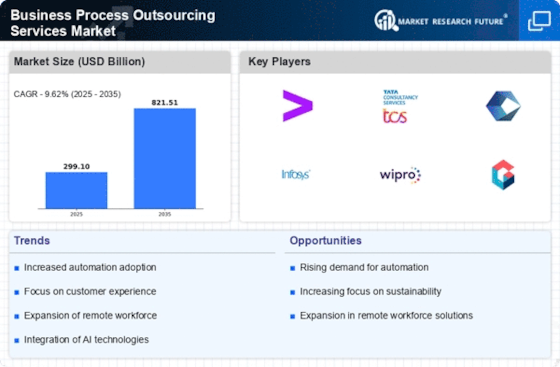
As per Market Research Future analysis, the Business Process Outsourcing Services Market was estimated at 299.1 USD Billion in 2024. The Business Process Outsourcing Services industry is projected to grow from 327.87 USD Billion in 2025 to 821.51 USD Billion by 2035, exhibiting a compound annual growth rate (CAGR) of 9.62% during the forecast period 2025 - 2035

Key Market Trends & Highlights

The Business Process Outsourcing Services Market is experiencing a dynamic shift driven by technological advancements and evolving customer needs.

  • North America remains the largest market for Business Process Outsourcing Services Market, showcasing robust demand across various sectors. The Asia-Pacific region is emerging as the fastest-growing market, fueled by increasing digital transformation initiatives. Customer Support Outsourcing continues to dominate the market, while Finance and Accounting Outsourcing is witnessing rapid growth due to rising demand for specialized services. Technological advancements and a focus on customer experience are key drivers propelling the market forward.

Market Size & Forecast

2024 Market Size 299.1 (USD Billion)
2035 Market Size 821.51 (USD Billion)
CAGR (2025 - 2035) 9.62%
Largest Regional Market Share in 2024 North America

Major Players

<p>Accenture (IE), <a title="TCS" href="https://www.tcs.com/who-we-are/newsroom/press-release/tcs-leader-banking-bpo-everest-group1" target="_blank" rel="noopener">TCS</a> (IN), Cognizant (US), Infosys (IN), <a title="Wipro" href="https://www.wipro.com/new-age-media/infrastructure-and--process-optimization/" target="_blank" rel="noopener">Wipro</a> (IN), Genpact (US), Teleperformance (FR), Alorica (US), Sitel Group (US)</p>

Market Trends

The Business Process Outsourcing Services Market is currently experiencing a transformative phase, characterized by the increasing adoption of advanced technologies and a growing emphasis on operational efficiency. Organizations are increasingly outsourcing non-core functions to specialized service providers, allowing them to focus on their primary business objectives. This trend appears to be driven by the need for cost reduction, enhanced service quality, and access to skilled labor. As companies seek to remain competitive, they are likely to leverage outsourcing as a strategic tool to optimize their processes and improve overall performance. Moreover, the market is witnessing a shift towards more integrated service offerings, where providers are not only delivering traditional outsourcing solutions but also incorporating digital transformation services. This evolution suggests that businesses are looking for comprehensive solutions that encompass both process management and technological innovation. The emphasis on data security and compliance is also becoming increasingly prominent, as organizations prioritize safeguarding sensitive information while engaging with third-party vendors. Overall, the Business Process Outsourcing Services Market is poised for continued growth, driven by these dynamic trends and the ongoing quest for operational excellence.

Technological Integration

The Business Process Outsourcing Services Market is seeing a notable trend towards the integration of advanced technologies such as artificial intelligence and automation. This shift enables service providers to enhance efficiency and deliver more sophisticated solutions to clients.

Focus on Core Competencies

Organizations are increasingly outsourcing non-essential functions to concentrate on their core competencies. This trend allows businesses to allocate resources more effectively and improve their competitive positioning in the market.

Emphasis on Data Security

As the reliance on third-party vendors grows, there is a heightened focus on data security and compliance within the Business Process Outsourcing Services Market. Companies are prioritizing partnerships with providers that demonstrate robust security measures and adherence to regulatory standards.

Business Process Outsourcing Services Market Market Drivers

Cost Efficiency

Cost efficiency remains a pivotal driver in the Business Process Outsourcing Services Market. Organizations are continually seeking ways to minimize expenses while maintaining service quality. Outsourcing non-core functions allows companies to leverage specialized providers who can deliver services at a lower cost. Reports suggest that businesses can save between 20 to 30 percent on operational costs by outsourcing. This financial incentive is particularly appealing to small and medium-sized enterprises that may lack the resources to manage these functions in-house. As the competitive landscape intensifies, the Business Process Outsourcing Services Market is expected to grow, with more companies recognizing the financial benefits of outsourcing as a strategic approach to enhance profitability.

Regulatory Compliance

Regulatory compliance is becoming increasingly complex, driving demand within the Business Process Outsourcing Services Market. Companies are often required to adhere to various regulations that govern their operations, which can be resource-intensive. Outsourcing compliance-related functions allows organizations to leverage the expertise of specialized firms that are well-versed in regulatory requirements. This not only mitigates risks associated with non-compliance but also enables companies to focus on their core business activities. The market for compliance outsourcing is projected to grow significantly, as businesses seek to navigate the intricate landscape of regulations while ensuring operational efficiency. Consequently, the Business Process Outsourcing Services Market is likely to benefit from this trend.

Technological Advancements

The Business Process Outsourcing Services Market is experiencing a surge in demand due to rapid technological advancements. Automation, artificial intelligence, and machine learning are transforming traditional outsourcing models, enabling companies to enhance efficiency and reduce operational costs. For instance, the integration of AI-driven chatbots in customer service has shown to decrease response times by up to 50 percent, thereby improving customer satisfaction. Furthermore, the global market for AI in BPO is projected to reach USD 3 billion by 2025, indicating a robust growth trajectory. As businesses increasingly adopt these technologies, the Business Process Outsourcing Services Market is likely to expand, driven by the need for innovative solutions that streamline processes and enhance service delivery.

Scalability and Flexibility

Scalability and flexibility are critical drivers in the Business Process Outsourcing Services Market. As businesses grow, their operational needs often change, necessitating a flexible approach to resource management. Outsourcing allows companies to quickly scale operations up or down based on demand without the burden of hiring or laying off staff. This adaptability is particularly beneficial in industries with fluctuating workloads. For example, seasonal businesses can ramp up customer service operations during peak periods without incurring long-term costs. The ability to respond swiftly to market changes positions the Business Process Outsourcing Services Market as a vital partner for organizations aiming to maintain agility in a dynamic business environment.

Focus on Customer Experience

In the Business Process Outsourcing Services Market, there is an increasing emphasis on enhancing customer experience. Companies are recognizing that superior customer service is a key differentiator in a crowded marketplace. Outsourcing customer support functions allows businesses to provide 24/7 service, access to multilingual support, and specialized expertise. Data indicates that organizations that prioritize customer experience can achieve revenue growth rates of 4 to 8 percent above their market competitors. As customer expectations evolve, the demand for BPO services that focus on delivering exceptional customer experiences is likely to rise, further propelling the growth of the Business Process Outsourcing Services Market.

Market Segment Insights

By Service Type: Customer Support (Largest) vs. Technical Support (Fastest-Growing)

<p>In the business process outsourcing (BPO) services market, Customer Support holds the largest market share among various service types, reflecting the high demand from businesses seeking efficient and responsive interaction with their customers. Meanwhile, Technical Support is witnessing rapid growth, driven by the increasing complexity of technology solutions and the need for expert assistance in troubleshooting technical issues. This market share distribution illustrates the distinct roles these services play in enhancing customer satisfaction and operational efficiency for organizations.</p>

<p>Customer Support (Dominant) vs. Technical Support (Emerging)</p>

<p>Customer Support is a dominant service in the BPO sector, characterized by its focus on providing customer-centric solutions that enhance client relationships and satisfaction. This segment encompasses various channels including phone, email, and chat support, catering to diverse customer inquiries and issues. On the other hand, Technical Support is emerging as a crucial area for growth, propelled by advancements in technology and rising user dependency on complex software and hardware. With a heightened demand for IT services, businesses are increasingly outsourcing technical support to specialists who offer rapid problem resolution and in-depth product knowledge, thus ensuring continuous operational flow and a competitive edge.</p>

By Industry Vertical: Healthcare (Largest) vs. Telecommunications (Fastest-Growing)

<p>The business process outsourcing (BPO) services market showcases a diverse array of industry verticals, notably featuring healthcare as the largest segment. Healthcare continues to dominate due to its inherent need for specialized services, efficient patient management, and regulatory compliance, reflecting a significant portion of market share. Other verticals like retail, telecommunications, banking and financial services, and manufacturing also contribute to the market, but at comparatively lesser shares, with telecommunications, in particular, making strides in its adoption of outsourcing services.</p>

<p>Healthcare: Dominant vs. Telecommunications: Emerging</p>

<p>Healthcare outsourcing stands as the dominant force within the BPO landscape, characterized by its robust demand for services such as medical billing, transcription, and telemedicine support. This vertical not only requires stringent compliance with health regulations but also benefits from advancements in technology, driving efficiency and patient satisfaction. Conversely, telecommunications is rapidly emerging as a dynamic player in the BPO sector, driven by the rising need for customer support and technical assistance. The shift towards digital communication channels and the need to provide 24/7 support have propelled telecommunications to embrace BPO services, allowing companies to enhance their operational efficiency while focusing on core activities.</p>

By Engagement Model: Offshore (Largest) vs. Hybrid (Fastest-Growing)

<p>In the business process outsourcing (BPO) services market, the engagement model segment is characterized by various approaches, including onshore, offshore, nearshore, hybrid, and dedicated teams. Among these, offshore outsourcing has emerged as the largest segment due to its cost-effectiveness and the ability to tap into a global talent pool. Meanwhile, the hybrid model, combining elements of onshore and offshore services, is gaining traction and is considered the fastest-growing segment as businesses seek flexibility and enhanced operational efficiency. The growth of the engagement model segment is driven by increasing demand for customer-centric services and the need for companies to adapt to fluctuating market conditions. Offshore engagement continues to expand as technological advancements enable seamless communication and collaboration across borders. At the same time, the hybrid model is becoming increasingly popular as organizations strive to balance cost savings with the benefits of onshore support, ultimately leading to a more robust service delivery framework.</p>

<p>Offshore (Dominant) vs. Hybrid (Emerging)</p>

<p>The offshore engagement model is recognized as the dominant force in the business process outsourcing services market, primarily driven by its ability to deliver cost savings and access to a skilled workforce in various regions. Businesses leveraging offshore outsourcing enjoy significant operational efficiencies, often resulting in shorter turnaround times and enhanced service quality. In contrast, the hybrid model, which combines onshore and offshore strategies, is underscored by its emerging status. It addresses the evolving needs of businesses seeking to optimize customer interactions while ensuring quality and responsiveness. This model facilitates a versatile approach, allowing organizations to capitalize on the strengths of both local teams and international resources, ultimately fostering innovation and enhancing customer satisfaction.</p>

By Vertical: BFSI (Largest) vs. Healthcare and Life Sciences (Fastest-Growing)

<p>The Business Process Outsourcing Services Market is characterized by varying degrees of market share among its vertical segments. The BFSI sector stands out as the largest segment, driven by the necessity for efficient customer service, regulatory compliance, and risk management. Other noteworthy segments include IT & Telecommunication, Manufacturing, and Retail & Consumer Goods, each contributing significantly to the overall market share, yet trailing behind BFSI. Meanwhile, Healthcare and Life Sciences has emerged strongly as a dynamic sector, focusing on patient care optimization and operational efficiencies. Growth trends within these segments are shaped by increasing <a href="https://www.marketresearchfuture.com/reports/digital-transformation-market-8685" target="_blank" title="digital transformation">digital transformation</a> and the adoption of cloud-based solutions. BFSI continues its dominance due to the demand for data security and advanced analytics, while Healthcare and Life Sciences is rapidly evolving, driven by the need for innovative services, Telehealth solutions, and a patient-centric approach. Moreover, sectors such as Transportation & Logistics are leveraging automation and data analytics to enhance efficiency, marking a significant transformation across various industries.</p>

<p>BFSI (Dominant) vs. Healthcare and Life Sciences (Emerging)</p>

<p>BFSI is characterized by its robust demand for outsourcing services that cater to regulatory compliance, risk management, and customer service enhancements. As the dominant vertical, it benefits from a vast customer base seeking operational efficiencies and cost savings. In contrast, Healthcare and Life Sciences is an emerging segment, driven by accelerated adoption of digital health solutions and Telehealth services. This vertical showcases a growing focus on improving patient outcomes and enhancing service delivery through innovative outsourcing models. While BFSI prioritizes data security and analytics, Healthcare emphasizes patient-centric solutions and operational efficiencies, representing two distinct, yet interconnected approaches to outsourcing that cater to unique industry needs.</p>

Get more detailed insights about Business Process Outsourcing Services Market Research Report - Forecast 2035

Regional Insights

North America : Innovation and Growth Hub

North America remains the largest market for Business Process Outsourcing (BPO) services, holding approximately 40% of the global market share. The region's growth is driven by technological advancements, increasing demand for cost-effective solutions, and a focus on enhancing customer experience. Regulatory support and favorable business environments further catalyze this growth, making it a prime location for BPO investments. The United States and Canada are the leading countries in this region, with major players like Accenture, Cognizant, and Genpact establishing a strong presence. The competitive landscape is characterized by a mix of established firms and emerging startups, all vying for market share. The emphasis on digital transformation and automation is reshaping service delivery, ensuring that North America remains at the forefront of BPO services.

Europe : Emerging BPO Powerhouse

Europe is witnessing significant growth in the Business Process Outsourcing (BPO) market, accounting for approximately 30% of the global share. The region's demand is fueled by digital transformation initiatives, regulatory compliance requirements, and the need for enhanced operational efficiency. Countries like the UK and Germany are leading this growth, supported by favorable government policies and investment in technology. The competitive landscape in Europe is diverse, with key players such as Teleperformance and Accenture leading the charge. The presence of a skilled workforce and a strong emphasis on data protection regulations, such as GDPR, further enhance the region's attractiveness for BPO services. As businesses increasingly seek to outsource non-core functions, Europe is poised for continued expansion in this sector.

Asia-Pacific : Rapidly Growing Market

Asia-Pacific is rapidly emerging as a significant player in the Business Process Outsourcing (BPO) market, holding around 25% of the global market share. The region's growth is primarily driven by cost advantages, a large talent pool, and increasing demand for outsourcing services from various industries. Countries like India and the Philippines are at the forefront, benefiting from their established BPO ecosystems and government support. India, in particular, is a powerhouse in the BPO sector, with major companies like TCS, Infosys, and Wipro leading the market. The competitive landscape is characterized by a mix of large firms and numerous small to medium enterprises, all contributing to the region's growth. As businesses worldwide continue to seek efficient outsourcing solutions, Asia-Pacific is set to play a crucial role in the global BPO landscape.

Middle East and Africa : Emerging BPO Frontier

The Middle East and Africa (MEA) region is emerging as a new frontier for Business Process Outsourcing (BPO) services, capturing about 5% of the global market share. The growth is driven by increasing investments in technology, a young workforce, and a rising demand for outsourcing services across various sectors. Countries like South Africa and the UAE are leading this trend, supported by government initiatives aimed at boosting the digital economy. The competitive landscape in MEA is evolving, with both local and international players entering the market. Companies are increasingly focusing on enhancing service delivery and customer experience, leveraging technology to meet client needs. As the region continues to develop its BPO capabilities, it is expected to attract more global players looking for cost-effective solutions and skilled labor.

Key Players and Competitive Insights

The Business Process Outsourcing (BPO) Services Market is currently characterized by a dynamic competitive landscape, driven by the increasing demand for efficiency and cost reduction across various sectors. Major players such as Accenture (IE), TCS (IN), and Cognizant (US) are strategically positioning themselves through digital transformation initiatives and regional expansions. Accenture (IE) focuses on integrating advanced technologies into its service offerings, while TCS (IN) emphasizes its extensive global delivery network to enhance client engagement. Cognizant (US) appears to be leveraging its expertise in AI and automation to streamline operations, collectively shaping a competitive environment that prioritizes innovation and adaptability.

The market structure is moderately fragmented, with numerous players vying for market share. Key tactics employed by these companies include localizing services to meet regional demands and optimizing supply chains to enhance operational efficiency. This competitive structure allows for a diverse range of service offerings, enabling companies to cater to specific client needs while maintaining a focus on cost-effectiveness and quality.

In August 2025, Accenture (IE) announced a strategic partnership with a leading AI firm to enhance its analytics capabilities. This move is significant as it positions Accenture to offer more sophisticated data-driven solutions, thereby attracting clients seeking to leverage AI for business insights. The partnership is likely to bolster Accenture's competitive edge in the rapidly evolving BPO landscape.

In September 2025, TCS (IN) launched a new cloud-based platform aimed at improving customer engagement for its clients. This initiative reflects TCS's commitment to digital transformation and indicates a shift towards more integrated service offerings. By enhancing customer interaction through technology, TCS is likely to strengthen its market position and appeal to businesses looking for innovative solutions.

In July 2025, Cognizant (US) expanded its operations in Asia by acquiring a regional BPO firm. This acquisition not only broadens Cognizant's service portfolio but also enhances its footprint in a rapidly growing market. The strategic importance of this move lies in Cognizant's ability to tap into local expertise and resources, which could lead to improved service delivery and client satisfaction.

As of October 2025, the BPO Services Market is witnessing trends such as increased digitalization, a focus on sustainability, and the integration of AI technologies. Strategic alliances among key players are shaping the competitive landscape, fostering innovation and collaboration. Looking ahead, it is anticipated that competitive differentiation will increasingly hinge on technological advancements and supply chain reliability, moving away from traditional price-based competition towards a model that values innovation and strategic partnerships.

Key Companies in the Business Process Outsourcing Services Market include

Industry Developments

May 2023- With the purchase of a property in Tbilisi's famed Freedom Square, Clark Staff LLC, a major participant in the world of business process outsourcing with offices in the Philippines, India, and Georgia, marks yet another significant milestone in its growth.

This ancient building, which is located at the 3 Galaktion Tabidze St., is in one of the most exclusive areas of the nation and exudes a dynamic vitality and alluring charm. With this investment, Clark Staff, which has been operating successfully in Georgia for a year, reinforces its dedication to the area.

The building, of which the Clark Staff will grab the top two floors, will undergo a thorough three-month renovation to become a state-of-the-art BPO facility that will house employees in a well-established corporate culture that promotes a great working environment.

Their operations in Georgia in the last year have indeed only reinforced their belief in the huge potential of the market, especially its active talent pool & rapidly evolving economic landscape, said Zack Williamson, CEO of Clark Staff. Not only do they find Georgia to be very business-friendly and ideal for outsourcing services, but it is just another basket they can put eggs in these times of global uncertainty to assure the stability of services to their customers all through the ever-amending geopolitical environment, the speaker continued.

The new Clark Staff facility will house multilingual agents fluent in German, French, Italian, English, and Spanish in addition to providing a wide range of services, comprising IT support, software development, and accounting/finance.

With offices in the Philippines, India, & Georgia, Clark Staff is a full-service BPO firm with American ownership and management that is based in St. Petersburg, Florida. For businesses of every size and in any sector, Clark Staff provides a broad range of service options.

Business Process Outsourcing (BPO) Services Market Covid Impact

The impact of COVID-19 led to economic and social disruptions and created challenges in outsourcing functions. However, the changes brought to business activities due to these disruptions are expected to provide impetus to the market in the long run. BPO companies have changed their business models by restructuring their Business Continuity Plans (BCP) to a distributed workforce. Businesses have realized the importance of continuous operations planning and disaster recovery to build a more reliable business model that can survive an unprecedented disruption like the COVID-19 pandemic.

In 2020, the major vendors of the market, including Accenture and Infosys Limited (Infosys BPM) stated that due to COVID-19, more than 80-90% of their employees were working from a remote location. The resultant disruption caused in the workforce management process, lack of infrastructure equipment, and increased data security risks led to a reduction in work efficiency and delays in project completions in the market.

Business Process Outsourcing (BPO) Services Market Russia-Ukraine War Impact

Russia's invasion of Ukraine and the ongoing effects of the pandemic had a negative and unclear impact on the world economy. Many of the downside risks mentioned in April World Economic Outlook have started to manifest. The world's financial conditions have become more rigid due to higher-than-expected inflation, particularly in the United States and major European nations. With COVID-19 outbreaks and lockdowns, China's recession has been greater than expected, and the conflict in Ukraine has had further detrimental effects.

Business Process Outsourcing (BPO) Services Market Segment Insights

Business Process Outsourcing (BPO) Services Service Type Insights

Future Outlook

Business Process Outsourcing Services Market Future Outlook

The Business Process Outsourcing Services Market is projected to grow at a 9.62% CAGR from 2024 to 2035, driven by technological advancements, cost efficiency, and increasing demand for specialized services.

New opportunities lie in:

  • Integration of AI-driven analytics for enhanced decision-making processes.
  • Expansion into emerging markets with tailored service offerings.
  • Development of cybersecurity solutions to protect client data and build trust.

By 2035, the market is expected to be robust, reflecting substantial growth and innovation.

Market Segmentation

Business Process Outsourcing Services Market Vertical Outlook

  • BFSI
  • IT & Telecommunication
  • Retail & Consumer Goods
  • Manufacturing
  • Healthcare and Life Sciences
  • Government and Defense
  • Transportation & Logistics
  • Energy & Power
  • Others

Business Process Outsourcing Services Market Service Type Outlook

  • Finance and Accounting Outsourcing
  • Marketing & Sales Outsourcing
  • Customer Support Outsourcing
  • Training & Development Outsourcing
  • Human Resource and Recruitment Outsourcing
  • Document Management & Processing
  • Others

Business Process Outsourcing Services Market Operating Model Outlook

  • Traditional (On-Premises)
  • Business Process-as-a-Service (BPaaS) (Cloud-Based)

Business Process Outsourcing Services Market Organization Size Outlook

  • SMEs
  • Large Enterprises

Report Scope

MARKET SIZE 2024299.1(USD Billion)
MARKET SIZE 2025327.87(USD Billion)
MARKET SIZE 2035821.51(USD Billion)
COMPOUND ANNUAL GROWTH RATE (CAGR)9.62% (2024 - 2035)
REPORT COVERAGERevenue Forecast, Competitive Landscape, Growth Factors, and Trends
BASE YEAR2024
Market Forecast Period2025 - 2035
Historical Data2019 - 2024
Market Forecast UnitsUSD Billion
Key Companies ProfiledMarket analysis in progress
Segments CoveredMarket segmentation analysis in progress
Key Market OpportunitiesIntegration of artificial intelligence and automation enhances efficiency in the Business Process Outsourcing Services Market.
Key Market DynamicsRising demand for automation and digital solutions reshapes competitive dynamics in the Business Process Outsourcing Services Market.
Countries CoveredNorth America, Europe, APAC, South America, MEA

FAQs

What is the current valuation of the business process outsourcing (BPO) services market?

<p>The business process outsourcing services market was valued at 386.0 USD Billion in 2024.</p>

What is the projected market size for the BPO services market by 2035?

<p>The market is projected to reach 630.0 USD Billion by 2035.</p>

What is the expected compound annual growth rate (CAGR) for the BPO services market from 2025 to 2035?

<p>The expected CAGR for the BPO services market during the forecast period 2025 - 2035 is 4.55%.</p>

Which companies are considered key players in the BPO services market?

<p>Key players in the market include Accenture, TCS, Cognizant, Genpact, Infosys, Wipro, Teleperformance, Alorica, Sitel Group, and Concentrix.</p>

What are the primary service types within the BPO services market?

<p>The primary service types include Customer Support, Technical Support, Human Resources, Finance and Accounting, and IT Services.</p>

How much revenue is generated from IT Services in the BPO market?

<p>IT Services generated revenue ranging from 129.0 to 230.0 USD Billion.</p>

What is the revenue range for the Banking and Financial Services sector in the BPO market?

<p>The Banking and Financial Services sector generated revenue between 90.0 and 140.0 USD Billion.</p>

What engagement models are utilized in the BPO services market?

<p>Engagement models include Onshore, Offshore, Nearshore, Hybrid, and Dedicated Team.</p>

What is the revenue range for Offshore engagement in the BPO market?

<p>Offshore engagement generated revenue between 150.0 and 240.0 USD Billion.</p>

Which industry verticals are most prominent in the BPO services market?

<p>Prominent industry verticals include Healthcare, Retail, Telecommunications, Banking and Financial Services, and Manufacturing.</p>

  1. SECTION I: EXECUTIVE SUMMARY AND KEY HIGHLIGHTS
    1. | 1.1 EXECUTIVE SUMMARY
    2. | | 1.1.1 Market Overview
    3. | | 1.1.2 Key Findings
    4. | | 1.1.3 Market Segmentation
    5. | | 1.1.4 Competitive Landscape
    6. | | 1.1.5 Challenges and Opportunities
    7. | | 1.1.6 Future Outlook
  2. SECTION II: SCOPING, METHODOLOGY AND MARKET STRUCTURE
    1. | 2.1 MARKET INTRODUCTION
    2. | | 2.1.1 Definition
    3. | | 2.1.2 Scope of the study
    4. | | | 2.1.2.1 Research Objective
    5. | | | 2.1.2.2 Assumption
    6. | | | 2.1.2.3 Limitations
    7. | 2.2 RESEARCH METHODOLOGY
    8. | | 2.2.1 Overview
    9. | | 2.2.2 Data Mining
    10. | | 2.2.3 Secondary Research
    11. | | 2.2.4 Primary Research
    12. | | | 2.2.4.1 Primary Interviews and Information Gathering Process
    13. | | | 2.2.4.2 Breakdown of Primary Respondents
    14. | | 2.2.5 Forecasting Model
    15. | | 2.2.6 Market Size Estimation
    16. | | | 2.2.6.1 Bottom-Up Approach
    17. | | | 2.2.6.2 Top-Down Approach
    18. | | 2.2.7 Data Triangulation
    19. | | 2.2.8 Validation
  3. SECTION III: QUALITATIVE ANALYSIS
    1. | 3.1 MARKET DYNAMICS
    2. | | 3.1.1 Overview
    3. | | 3.1.2 Drivers
    4. | | 3.1.3 Restraints
    5. | | 3.1.4 Opportunities
    6. | 3.2 MARKET FACTOR ANALYSIS
    7. | | 3.2.1 Value chain Analysis
    8. | | 3.2.2 Porter's Five Forces Analysis
    9. | | | 3.2.2.1 Bargaining Power of Suppliers
    10. | | | 3.2.2.2 Bargaining Power of Buyers
    11. | | | 3.2.2.3 Threat of New Entrants
    12. | | | 3.2.2.4 Threat of Substitutes
    13. | | | 3.2.2.5 Intensity of Rivalry
    14. | | 3.2.3 COVID-19 Impact Analysis
    15. | | | 3.2.3.1 Market Impact Analysis
    16. | | | 3.2.3.2 Regional Impact
    17. | | | 3.2.3.3 Opportunity and Threat Analysis
  4. SECTION IV: QUANTITATIVE ANALYSIS
    1. | 4.1 Information and Communications Technology, BY Service Type (USD Billion)
    2. | | 4.1.1 Customer Support
    3. | | 4.1.2 Technical Support
    4. | | 4.1.3 Human Resources
    5. | | 4.1.4 Finance and Accounting
    6. | | 4.1.5 IT Services
    7. | 4.2 Information and Communications Technology, BY Industry Vertical (USD Billion)
    8. | | 4.2.1 Healthcare
    9. | | 4.2.2 Retail
    10. | | 4.2.3 Telecommunications
    11. | | 4.2.4 Banking and Financial Services
    12. | | 4.2.5 Manufacturing
    13. | 4.3 Information and Communications Technology, BY Engagement Model (USD Billion)
    14. | | 4.3.1 Onshore
    15. | | 4.3.2 Offshore
    16. | | 4.3.3 Nearshore
    17. | | 4.3.4 Hybrid
    18. | | 4.3.5 Dedicated Team
    19. | 4.4 Information and Communications Technology, BY Region (USD Billion)
    20. | | 4.4.1 North America
    21. | | | 4.4.1.1 US
    22. | | | 4.4.1.2 Canada
    23. | | 4.4.2 Europe
    24. | | | 4.4.2.1 Germany
    25. | | | 4.4.2.2 UK
    26. | | | 4.4.2.3 France
    27. | | | 4.4.2.4 Russia
    28. | | | 4.4.2.5 Italy
    29. | | | 4.4.2.6 Spain
    30. | | | 4.4.2.7 Rest of Europe
    31. | | 4.4.3 APAC
    32. | | | 4.4.3.1 China
    33. | | | 4.4.3.2 India
    34. | | | 4.4.3.3 Japan
    35. | | | 4.4.3.4 South Korea
    36. | | | 4.4.3.5 Malaysia
    37. | | | 4.4.3.6 Thailand
    38. | | | 4.4.3.7 Indonesia
    39. | | | 4.4.3.8 Rest of APAC
    40. | | 4.4.4 South America
    41. | | | 4.4.4.1 Brazil
    42. | | | 4.4.4.2 Mexico
    43. | | | 4.4.4.3 Argentina
    44. | | | 4.4.4.4 Rest of South America
    45. | | 4.4.5 MEA
    46. | | | 4.4.5.1 GCC Countries
    47. | | | 4.4.5.2 South Africa
    48. | | | 4.4.5.3 Rest of MEA
  5. SECTION V: COMPETITIVE ANALYSIS
    1. | 5.1 Competitive Landscape
    2. | | 5.1.1 Overview
    3. | | 5.1.2 Competitive Analysis
    4. | | 5.1.3 Market share Analysis
    5. | | 5.1.4 Major Growth Strategy in the Information and Communications Technology
    6. | | 5.1.5 Competitive Benchmarking
    7. | | 5.1.6 Leading Players in Terms of Number of Developments in the Information and Communications Technology
    8. | | 5.1.7 Key developments and growth strategies
    9. | | | 5.1.7.1 New Product Launch/Service Deployment
    10. | | | 5.1.7.2 Merger & Acquisitions
    11. | | | 5.1.7.3 Joint Ventures
    12. | | 5.1.8 Major Players Financial Matrix
    13. | | | 5.1.8.1 Sales and Operating Income
    14. | | | 5.1.8.2 Major Players R&D Expenditure. 2023
    15. | 5.2 Company Profiles
    16. | | 5.2.1 Accenture (IE)
    17. | | | 5.2.1.1 Financial Overview
    18. | | | 5.2.1.2 Products Offered
    19. | | | 5.2.1.3 Key Developments
    20. | | | 5.2.1.4 SWOT Analysis
    21. | | | 5.2.1.5 Key Strategies
    22. | | 5.2.2 TCS (IN)
    23. | | | 5.2.2.1 Financial Overview
    24. | | | 5.2.2.2 Products Offered
    25. | | | 5.2.2.3 Key Developments
    26. | | | 5.2.2.4 SWOT Analysis
    27. | | | 5.2.2.5 Key Strategies
    28. | | 5.2.3 Cognizant (US)
    29. | | | 5.2.3.1 Financial Overview
    30. | | | 5.2.3.2 Products Offered
    31. | | | 5.2.3.3 Key Developments
    32. | | | 5.2.3.4 SWOT Analysis
    33. | | | 5.2.3.5 Key Strategies
    34. | | 5.2.4 Genpact (US)
    35. | | | 5.2.4.1 Financial Overview
    36. | | | 5.2.4.2 Products Offered
    37. | | | 5.2.4.3 Key Developments
    38. | | | 5.2.4.4 SWOT Analysis
    39. | | | 5.2.4.5 Key Strategies
    40. | | 5.2.5 Infosys (IN)
    41. | | | 5.2.5.1 Financial Overview
    42. | | | 5.2.5.2 Products Offered
    43. | | | 5.2.5.3 Key Developments
    44. | | | 5.2.5.4 SWOT Analysis
    45. | | | 5.2.5.5 Key Strategies
    46. | | 5.2.6 Wipro (IN)
    47. | | | 5.2.6.1 Financial Overview
    48. | | | 5.2.6.2 Products Offered
    49. | | | 5.2.6.3 Key Developments
    50. | | | 5.2.6.4 SWOT Analysis
    51. | | | 5.2.6.5 Key Strategies
    52. | | 5.2.7 Teleperformance (FR)
    53. | | | 5.2.7.1 Financial Overview
    54. | | | 5.2.7.2 Products Offered
    55. | | | 5.2.7.3 Key Developments
    56. | | | 5.2.7.4 SWOT Analysis
    57. | | | 5.2.7.5 Key Strategies
    58. | | 5.2.8 Alorica (US)
    59. | | | 5.2.8.1 Financial Overview
    60. | | | 5.2.8.2 Products Offered
    61. | | | 5.2.8.3 Key Developments
    62. | | | 5.2.8.4 SWOT Analysis
    63. | | | 5.2.8.5 Key Strategies
    64. | | 5.2.9 Sitel Group (US)
    65. | | | 5.2.9.1 Financial Overview
    66. | | | 5.2.9.2 Products Offered
    67. | | | 5.2.9.3 Key Developments
    68. | | | 5.2.9.4 SWOT Analysis
    69. | | | 5.2.9.5 Key Strategies
    70. | | 5.2.10 Concentrix (US)
    71. | | | 5.2.10.1 Financial Overview
    72. | | | 5.2.10.2 Products Offered
    73. | | | 5.2.10.3 Key Developments
    74. | | | 5.2.10.4 SWOT Analysis
    75. | | | 5.2.10.5 Key Strategies
    76. | 5.3 Appendix
    77. | | 5.3.1 References
    78. | | 5.3.2 Related Reports
  6. LIST OF FIGURES
    1. | 6.1 MARKET SYNOPSIS
    2. | 6.2 NORTH AMERICA MARKET ANALYSIS
    3. | 6.3 US MARKET ANALYSIS BY SERVICE TYPE
    4. | 6.4 US MARKET ANALYSIS BY INDUSTRY VERTICAL
    5. | 6.5 US MARKET ANALYSIS BY ENGAGEMENT MODEL
    6. | 6.6 CANADA MARKET ANALYSIS BY SERVICE TYPE
    7. | 6.7 CANADA MARKET ANALYSIS BY INDUSTRY VERTICAL
    8. | 6.8 CANADA MARKET ANALYSIS BY ENGAGEMENT MODEL
    9. | 6.9 EUROPE MARKET ANALYSIS
    10. | 6.10 GERMANY MARKET ANALYSIS BY SERVICE TYPE
    11. | 6.11 GERMANY MARKET ANALYSIS BY INDUSTRY VERTICAL
    12. | 6.12 GERMANY MARKET ANALYSIS BY ENGAGEMENT MODEL
    13. | 6.13 UK MARKET ANALYSIS BY SERVICE TYPE
    14. | 6.14 UK MARKET ANALYSIS BY INDUSTRY VERTICAL
    15. | 6.15 UK MARKET ANALYSIS BY ENGAGEMENT MODEL
    16. | 6.16 FRANCE MARKET ANALYSIS BY SERVICE TYPE
    17. | 6.17 FRANCE MARKET ANALYSIS BY INDUSTRY VERTICAL
    18. | 6.18 FRANCE MARKET ANALYSIS BY ENGAGEMENT MODEL
    19. | 6.19 RUSSIA MARKET ANALYSIS BY SERVICE TYPE
    20. | 6.20 RUSSIA MARKET ANALYSIS BY INDUSTRY VERTICAL
    21. | 6.21 RUSSIA MARKET ANALYSIS BY ENGAGEMENT MODEL
    22. | 6.22 ITALY MARKET ANALYSIS BY SERVICE TYPE
    23. | 6.23 ITALY MARKET ANALYSIS BY INDUSTRY VERTICAL
    24. | 6.24 ITALY MARKET ANALYSIS BY ENGAGEMENT MODEL
    25. | 6.25 SPAIN MARKET ANALYSIS BY SERVICE TYPE
    26. | 6.26 SPAIN MARKET ANALYSIS BY INDUSTRY VERTICAL
    27. | 6.27 SPAIN MARKET ANALYSIS BY ENGAGEMENT MODEL
    28. | 6.28 REST OF EUROPE MARKET ANALYSIS BY SERVICE TYPE
    29. | 6.29 REST OF EUROPE MARKET ANALYSIS BY INDUSTRY VERTICAL
    30. | 6.30 REST OF EUROPE MARKET ANALYSIS BY ENGAGEMENT MODEL
    31. | 6.31 APAC MARKET ANALYSIS
    32. | 6.32 CHINA MARKET ANALYSIS BY SERVICE TYPE
    33. | 6.33 CHINA MARKET ANALYSIS BY INDUSTRY VERTICAL
    34. | 6.34 CHINA MARKET ANALYSIS BY ENGAGEMENT MODEL
    35. | 6.35 INDIA MARKET ANALYSIS BY SERVICE TYPE
    36. | 6.36 INDIA MARKET ANALYSIS BY INDUSTRY VERTICAL
    37. | 6.37 INDIA MARKET ANALYSIS BY ENGAGEMENT MODEL
    38. | 6.38 JAPAN MARKET ANALYSIS BY SERVICE TYPE
    39. | 6.39 JAPAN MARKET ANALYSIS BY INDUSTRY VERTICAL
    40. | 6.40 JAPAN MARKET ANALYSIS BY ENGAGEMENT MODEL
    41. | 6.41 SOUTH KOREA MARKET ANALYSIS BY SERVICE TYPE
    42. | 6.42 SOUTH KOREA MARKET ANALYSIS BY INDUSTRY VERTICAL
    43. | 6.43 SOUTH KOREA MARKET ANALYSIS BY ENGAGEMENT MODEL
    44. | 6.44 MALAYSIA MARKET ANALYSIS BY SERVICE TYPE
    45. | 6.45 MALAYSIA MARKET ANALYSIS BY INDUSTRY VERTICAL
    46. | 6.46 MALAYSIA MARKET ANALYSIS BY ENGAGEMENT MODEL
    47. | 6.47 THAILAND MARKET ANALYSIS BY SERVICE TYPE
    48. | 6.48 THAILAND MARKET ANALYSIS BY INDUSTRY VERTICAL
    49. | 6.49 THAILAND MARKET ANALYSIS BY ENGAGEMENT MODEL
    50. | 6.50 INDONESIA MARKET ANALYSIS BY SERVICE TYPE
    51. | 6.51 INDONESIA MARKET ANALYSIS BY INDUSTRY VERTICAL
    52. | 6.52 INDONESIA MARKET ANALYSIS BY ENGAGEMENT MODEL
    53. | 6.53 REST OF APAC MARKET ANALYSIS BY SERVICE TYPE
    54. | 6.54 REST OF APAC MARKET ANALYSIS BY INDUSTRY VERTICAL
    55. | 6.55 REST OF APAC MARKET ANALYSIS BY ENGAGEMENT MODEL
    56. | 6.56 SOUTH AMERICA MARKET ANALYSIS
    57. | 6.57 BRAZIL MARKET ANALYSIS BY SERVICE TYPE
    58. | 6.58 BRAZIL MARKET ANALYSIS BY INDUSTRY VERTICAL
    59. | 6.59 BRAZIL MARKET ANALYSIS BY ENGAGEMENT MODEL
    60. | 6.60 MEXICO MARKET ANALYSIS BY SERVICE TYPE
    61. | 6.61 MEXICO MARKET ANALYSIS BY INDUSTRY VERTICAL
    62. | 6.62 MEXICO MARKET ANALYSIS BY ENGAGEMENT MODEL
    63. | 6.63 ARGENTINA MARKET ANALYSIS BY SERVICE TYPE
    64. | 6.64 ARGENTINA MARKET ANALYSIS BY INDUSTRY VERTICAL
    65. | 6.65 ARGENTINA MARKET ANALYSIS BY ENGAGEMENT MODEL
    66. | 6.66 REST OF SOUTH AMERICA MARKET ANALYSIS BY SERVICE TYPE
    67. | 6.67 REST OF SOUTH AMERICA MARKET ANALYSIS BY INDUSTRY VERTICAL
    68. | 6.68 REST OF SOUTH AMERICA MARKET ANALYSIS BY ENGAGEMENT MODEL
    69. | 6.69 MEA MARKET ANALYSIS
    70. | 6.70 GCC COUNTRIES MARKET ANALYSIS BY SERVICE TYPE
    71. | 6.71 GCC COUNTRIES MARKET ANALYSIS BY INDUSTRY VERTICAL
    72. | 6.72 GCC COUNTRIES MARKET ANALYSIS BY ENGAGEMENT MODEL
    73. | 6.73 SOUTH AFRICA MARKET ANALYSIS BY SERVICE TYPE
    74. | 6.74 SOUTH AFRICA MARKET ANALYSIS BY INDUSTRY VERTICAL
    75. | 6.75 SOUTH AFRICA MARKET ANALYSIS BY ENGAGEMENT MODEL
    76. | 6.76 REST OF MEA MARKET ANALYSIS BY SERVICE TYPE
    77. | 6.77 REST OF MEA MARKET ANALYSIS BY INDUSTRY VERTICAL
    78. | 6.78 REST OF MEA MARKET ANALYSIS BY ENGAGEMENT MODEL
    79. | 6.79 KEY BUYING CRITERIA OF INFORMATION AND COMMUNICATIONS TECHNOLOGY
    80. | 6.80 RESEARCH PROCESS OF MRFR
    81. | 6.81 DRO ANALYSIS OF INFORMATION AND COMMUNICATIONS TECHNOLOGY
    82. | 6.82 DRIVERS IMPACT ANALYSIS: INFORMATION AND COMMUNICATIONS TECHNOLOGY
    83. | 6.83 RESTRAINTS IMPACT ANALYSIS: INFORMATION AND COMMUNICATIONS TECHNOLOGY
    84. | 6.84 SUPPLY / VALUE CHAIN: INFORMATION AND COMMUNICATIONS TECHNOLOGY
    85. | 6.85 INFORMATION AND COMMUNICATIONS TECHNOLOGY, BY SERVICE TYPE, 2024 (% SHARE)
    86. | 6.86 INFORMATION AND COMMUNICATIONS TECHNOLOGY, BY SERVICE TYPE, 2024 TO 2035 (USD Billion)
    87. | 6.87 INFORMATION AND COMMUNICATIONS TECHNOLOGY, BY INDUSTRY VERTICAL, 2024 (% SHARE)
    88. | 6.88 INFORMATION AND COMMUNICATIONS TECHNOLOGY, BY INDUSTRY VERTICAL, 2024 TO 2035 (USD Billion)
    89. | 6.89 INFORMATION AND COMMUNICATIONS TECHNOLOGY, BY ENGAGEMENT MODEL, 2024 (% SHARE)
    90. | 6.90 INFORMATION AND COMMUNICATIONS TECHNOLOGY, BY ENGAGEMENT MODEL, 2024 TO 2035 (USD Billion)
    91. | 6.91 BENCHMARKING OF MAJOR COMPETITORS
  7. LIST OF TABLES
    1. | 7.1 LIST OF ASSUMPTIONS
    2. | | 7.1.1
    3. | 7.2 North America MARKET SIZE ESTIMATES; FORECAST
    4. | | 7.2.1 BY SERVICE TYPE, 2025-2035 (USD Billion)
    5. | | 7.2.2 BY INDUSTRY VERTICAL, 2025-2035 (USD Billion)
    6. | | 7.2.3 BY ENGAGEMENT MODEL, 2025-2035 (USD Billion)
    7. | 7.3 US MARKET SIZE ESTIMATES; FORECAST
    8. | | 7.3.1 BY SERVICE TYPE, 2025-2035 (USD Billion)
    9. | | 7.3.2 BY INDUSTRY VERTICAL, 2025-2035 (USD Billion)
    10. | | 7.3.3 BY ENGAGEMENT MODEL, 2025-2035 (USD Billion)
    11. | 7.4 Canada MARKET SIZE ESTIMATES; FORECAST
    12. | | 7.4.1 BY SERVICE TYPE, 2025-2035 (USD Billion)
    13. | | 7.4.2 BY INDUSTRY VERTICAL, 2025-2035 (USD Billion)
    14. | | 7.4.3 BY ENGAGEMENT MODEL, 2025-2035 (USD Billion)
    15. | 7.5 Europe MARKET SIZE ESTIMATES; FORECAST
    16. | | 7.5.1 BY SERVICE TYPE, 2025-2035 (USD Billion)
    17. | | 7.5.2 BY INDUSTRY VERTICAL, 2025-2035 (USD Billion)
    18. | | 7.5.3 BY ENGAGEMENT MODEL, 2025-2035 (USD Billion)
    19. | 7.6 Germany MARKET SIZE ESTIMATES; FORECAST
    20. | | 7.6.1 BY SERVICE TYPE, 2025-2035 (USD Billion)
    21. | | 7.6.2 BY INDUSTRY VERTICAL, 2025-2035 (USD Billion)
    22. | | 7.6.3 BY ENGAGEMENT MODEL, 2025-2035 (USD Billion)
    23. | 7.7 UK MARKET SIZE ESTIMATES; FORECAST
    24. | | 7.7.1 BY SERVICE TYPE, 2025-2035 (USD Billion)
    25. | | 7.7.2 BY INDUSTRY VERTICAL, 2025-2035 (USD Billion)
    26. | | 7.7.3 BY ENGAGEMENT MODEL, 2025-2035 (USD Billion)
    27. | 7.8 France MARKET SIZE ESTIMATES; FORECAST
    28. | | 7.8.1 BY SERVICE TYPE, 2025-2035 (USD Billion)
    29. | | 7.8.2 BY INDUSTRY VERTICAL, 2025-2035 (USD Billion)
    30. | | 7.8.3 BY ENGAGEMENT MODEL, 2025-2035 (USD Billion)
    31. | 7.9 Russia MARKET SIZE ESTIMATES; FORECAST
    32. | | 7.9.1 BY SERVICE TYPE, 2025-2035 (USD Billion)
    33. | | 7.9.2 BY INDUSTRY VERTICAL, 2025-2035 (USD Billion)
    34. | | 7.9.3 BY ENGAGEMENT MODEL, 2025-2035 (USD Billion)
    35. | 7.10 Italy MARKET SIZE ESTIMATES; FORECAST
    36. | | 7.10.1 BY SERVICE TYPE, 2025-2035 (USD Billion)
    37. | | 7.10.2 BY INDUSTRY VERTICAL, 2025-2035 (USD Billion)
    38. | | 7.10.3 BY ENGAGEMENT MODEL, 2025-2035 (USD Billion)
    39. | 7.11 Spain MARKET SIZE ESTIMATES; FORECAST
    40. | | 7.11.1 BY SERVICE TYPE, 2025-2035 (USD Billion)
    41. | | 7.11.2 BY INDUSTRY VERTICAL, 2025-2035 (USD Billion)
    42. | | 7.11.3 BY ENGAGEMENT MODEL, 2025-2035 (USD Billion)
    43. | 7.12 Rest of Europe MARKET SIZE ESTIMATES; FORECAST
    44. | | 7.12.1 BY SERVICE TYPE, 2025-2035 (USD Billion)
    45. | | 7.12.2 BY INDUSTRY VERTICAL, 2025-2035 (USD Billion)
    46. | | 7.12.3 BY ENGAGEMENT MODEL, 2025-2035 (USD Billion)
    47. | 7.13 APAC MARKET SIZE ESTIMATES; FORECAST
    48. | | 7.13.1 BY SERVICE TYPE, 2025-2035 (USD Billion)
    49. | | 7.13.2 BY INDUSTRY VERTICAL, 2025-2035 (USD Billion)
    50. | | 7.13.3 BY ENGAGEMENT MODEL, 2025-2035 (USD Billion)
    51. | 7.14 China MARKET SIZE ESTIMATES; FORECAST
    52. | | 7.14.1 BY SERVICE TYPE, 2025-2035 (USD Billion)
    53. | | 7.14.2 BY INDUSTRY VERTICAL, 2025-2035 (USD Billion)
    54. | | 7.14.3 BY ENGAGEMENT MODEL, 2025-2035 (USD Billion)
    55. | 7.15 India MARKET SIZE ESTIMATES; FORECAST
    56. | | 7.15.1 BY SERVICE TYPE, 2025-2035 (USD Billion)
    57. | | 7.15.2 BY INDUSTRY VERTICAL, 2025-2035 (USD Billion)
    58. | | 7.15.3 BY ENGAGEMENT MODEL, 2025-2035 (USD Billion)
    59. | 7.16 Japan MARKET SIZE ESTIMATES; FORECAST
    60. | | 7.16.1 BY SERVICE TYPE, 2025-2035 (USD Billion)
    61. | | 7.16.2 BY INDUSTRY VERTICAL, 2025-2035 (USD Billion)
    62. | | 7.16.3 BY ENGAGEMENT MODEL, 2025-2035 (USD Billion)
    63. | 7.17 South Korea MARKET SIZE ESTIMATES; FORECAST
    64. | | 7.17.1 BY SERVICE TYPE, 2025-2035 (USD Billion)
    65. | | 7.17.2 BY INDUSTRY VERTICAL, 2025-2035 (USD Billion)
    66. | | 7.17.3 BY ENGAGEMENT MODEL, 2025-2035 (USD Billion)
    67. | 7.18 Malaysia MARKET SIZE ESTIMATES; FORECAST
    68. | | 7.18.1 BY SERVICE TYPE, 2025-2035 (USD Billion)
    69. | | 7.18.2 BY INDUSTRY VERTICAL, 2025-2035 (USD Billion)
    70. | | 7.18.3 BY ENGAGEMENT MODEL, 2025-2035 (USD Billion)
    71. | 7.19 Thailand MARKET SIZE ESTIMATES; FORECAST
    72. | | 7.19.1 BY SERVICE TYPE, 2025-2035 (USD Billion)
    73. | | 7.19.2 BY INDUSTRY VERTICAL, 2025-2035 (USD Billion)
    74. | | 7.19.3 BY ENGAGEMENT MODEL, 2025-2035 (USD Billion)
    75. | 7.20 Indonesia MARKET SIZE ESTIMATES; FORECAST
    76. | | 7.20.1 BY SERVICE TYPE, 2025-2035 (USD Billion)
    77. | | 7.20.2 BY INDUSTRY VERTICAL, 2025-2035 (USD Billion)
    78. | | 7.20.3 BY ENGAGEMENT MODEL, 2025-2035 (USD Billion)
    79. | 7.21 Rest of APAC MARKET SIZE ESTIMATES; FORECAST
    80. | | 7.21.1 BY SERVICE TYPE, 2025-2035 (USD Billion)
    81. | | 7.21.2 BY INDUSTRY VERTICAL, 2025-2035 (USD Billion)
    82. | | 7.21.3 BY ENGAGEMENT MODEL, 2025-2035 (USD Billion)
    83. | 7.22 South America MARKET SIZE ESTIMATES; FORECAST
    84. | | 7.22.1 BY SERVICE TYPE, 2025-2035 (USD Billion)
    85. | | 7.22.2 BY INDUSTRY VERTICAL, 2025-2035 (USD Billion)
    86. | | 7.22.3 BY ENGAGEMENT MODEL, 2025-2035 (USD Billion)
    87. | 7.23 Brazil MARKET SIZE ESTIMATES; FORECAST
    88. | | 7.23.1 BY SERVICE TYPE, 2025-2035 (USD Billion)
    89. | | 7.23.2 BY INDUSTRY VERTICAL, 2025-2035 (USD Billion)
    90. | | 7.23.3 BY ENGAGEMENT MODEL, 2025-2035 (USD Billion)
    91. | 7.24 Mexico MARKET SIZE ESTIMATES; FORECAST
    92. | | 7.24.1 BY SERVICE TYPE, 2025-2035 (USD Billion)
    93. | | 7.24.2 BY INDUSTRY VERTICAL, 2025-2035 (USD Billion)
    94. | | 7.24.3 BY ENGAGEMENT MODEL, 2025-2035 (USD Billion)
    95. | 7.25 Argentina MARKET SIZE ESTIMATES; FORECAST
    96. | | 7.25.1 BY SERVICE TYPE, 2025-2035 (USD Billion)
    97. | | 7.25.2 BY INDUSTRY VERTICAL, 2025-2035 (USD Billion)
    98. | | 7.25.3 BY ENGAGEMENT MODEL, 2025-2035 (USD Billion)
    99. | 7.26 Rest of South America MARKET SIZE ESTIMATES; FORECAST
    100. | | 7.26.1 BY SERVICE TYPE, 2025-2035 (USD Billion)
    101. | | 7.26.2 BY INDUSTRY VERTICAL, 2025-2035 (USD Billion)
    102. | | 7.26.3 BY ENGAGEMENT MODEL, 2025-2035 (USD Billion)
    103. | 7.27 MEA MARKET SIZE ESTIMATES; FORECAST
    104. | | 7.27.1 BY SERVICE TYPE, 2025-2035 (USD Billion)
    105. | | 7.27.2 BY INDUSTRY VERTICAL, 2025-2035 (USD Billion)
    106. | | 7.27.3 BY ENGAGEMENT MODEL, 2025-2035 (USD Billion)
    107. | 7.28 GCC Countries MARKET SIZE ESTIMATES; FORECAST
    108. | | 7.28.1 BY SERVICE TYPE, 2025-2035 (USD Billion)
    109. | | 7.28.2 BY INDUSTRY VERTICAL, 2025-2035 (USD Billion)
    110. | | 7.28.3 BY ENGAGEMENT MODEL, 2025-2035 (USD Billion)
    111. | 7.29 South Africa MARKET SIZE ESTIMATES; FORECAST
    112. | | 7.29.1 BY SERVICE TYPE, 2025-2035 (USD Billion)
    113. | | 7.29.2 BY INDUSTRY VERTICAL, 2025-2035 (USD Billion)
    114. | | 7.29.3 BY ENGAGEMENT MODEL, 2025-2035 (USD Billion)
    115. | 7.30 Rest of MEA MARKET SIZE ESTIMATES; FORECAST
    116. | | 7.30.1 BY SERVICE TYPE, 2025-2035 (USD Billion)
    117. | | 7.30.2 BY INDUSTRY VERTICAL, 2025-2035 (USD Billion)
    118. | | 7.30.3 BY ENGAGEMENT MODEL, 2025-2035 (USD Billion)
    119. | 7.31 PRODUCT LAUNCH/PRODUCT DEVELOPMENT/APPROVAL
    120. | | 7.31.1
    121. | 7.32 ACQUISITION/PARTNERSHIP
    122. | | 7.32.1

Information and Communications Technology Market Segmentation

Information and Communications Technology By Service Type (USD Billion, 2025-2035)

  • Customer Support
  • Technical Support
  • Human Resources
  • Finance and Accounting
  • IT Services

Information and Communications Technology By Industry Vertical (USD Billion, 2025-2035)

  • Healthcare
  • Retail
  • Telecommunications
  • Banking and Financial Services
  • Manufacturing

Information and Communications Technology By Engagement Model (USD Billion, 2025-2035)

  • Onshore
  • Offshore
  • Nearshore
  • Hybrid
  • Dedicated Team
Infographic

Free Sample Request

Kindly complete the form below to receive a free sample of this Report

Get Free Sample

Customer Strories

Compare Licence

×
Features License Type
Single User Multiuser License Enterprise User
Price $4,950 $5,950 $7,250
Maximum User Access Limit 1 User Upto 10 Users Unrestricted Access Throughout the Organization
Free Customization
Direct Access to Analyst
Deliverable Format
Platform Access
Discount on Next Purchase 10% 15% 15%
Printable Versions