Building Automation System Market (2026 – 2035)

ID: MRFR/SEM/1878-HCR 100 Pages Aarti Dhapte Last Updated: September 15, 2026
Building Automation System Market Size, Share and Research Report By Component (Hardware, Software, Services), By System Type (HVAC Control, Lighting Control, Security & Access Control, Fire & Life Safety, Energy Management Systems), By Communication Technology (Wired, Wireless), By Installation Type (New-Build, Retrofit), By End User (Residential, Commercial, Industrial, Institutional) and By Region (North America, Europe, Asia-Pacific, South America, Middle East & Africa) – Industry Forecast to 2035.
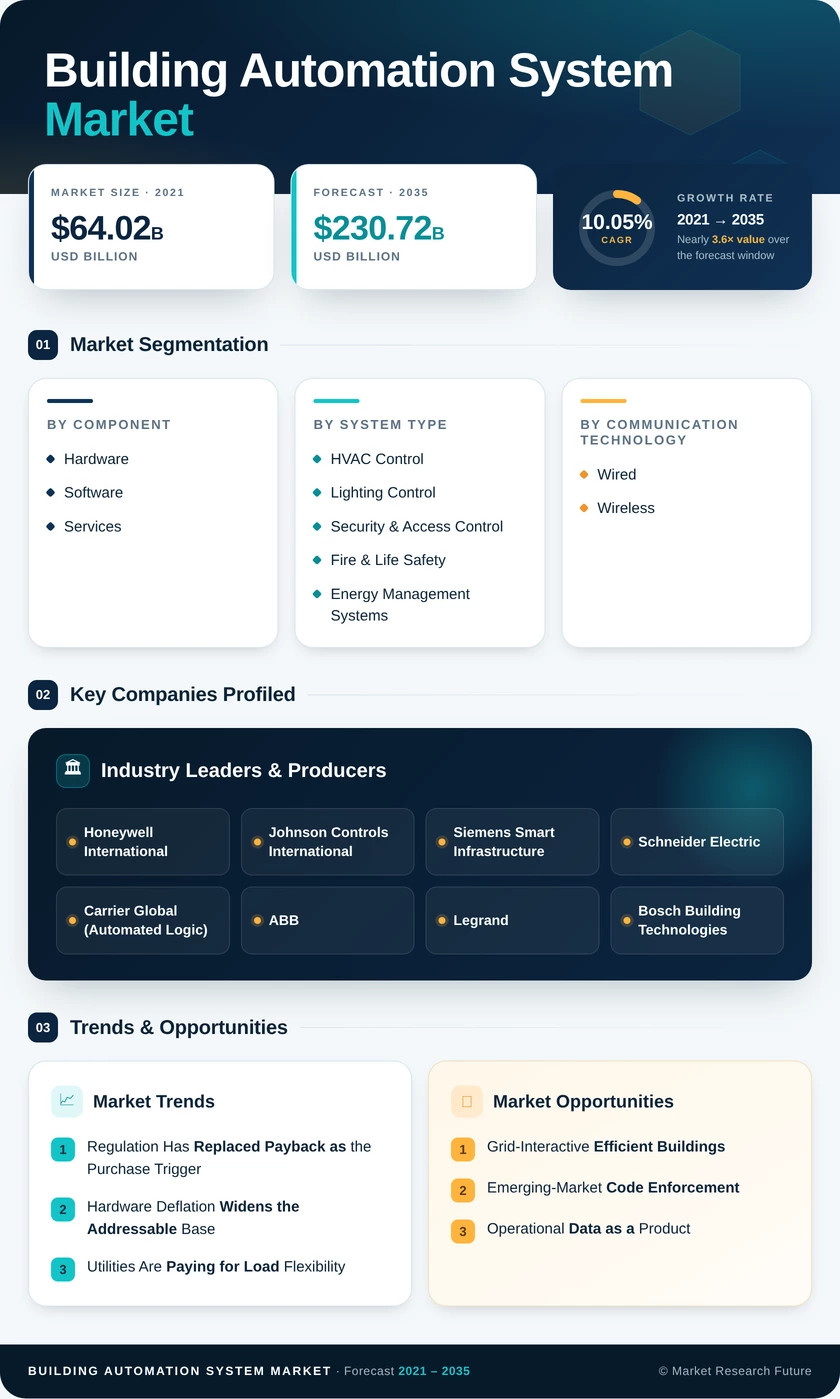
Building Automation System Market
Market Size
Forecast Period2026-2035
CAGR (2026-2035)10.05%
2025 Market SizeUSD 88.54 Billion
2035 Market SizeUSD 230.72 Billion
Key Players
Honeywell International
Johnson Controls International
Siemens Smart Infrastructure
Schneider Electric
Carrier Global
ABB
Opportunities
  • Grid-Interactive Efficient Buildings
  • Emerging-Market Code Enforcement
  • Operational Data as a Product
  1. 1 Market Summary |
    1. 1.1 Study Assumptions & Market Definition |
    2. 1.2 Scope of the Study |
    3. 1.3 Research Methodology
  2. 2 Key Report Takeaways |
    1. 2.1 By Technology |
    2. 2.2 By Sector |
    3. 2.3 By Geography
  3. 3 Market Size & Forecast (2021–2035) |
    1. 3.1 Historical Market Size (2021–2025) |
    2. 3.2 Current & Forecast Market Size (2026–2035) |
    3. 3.3 Year-over-Year Growth Analysis
  4. 4 Driver Impact Analysis |
    1. 4.1 Regulation Has Replaced Payback as the Purchase Trigger |
    2. 4.2 Hardware Deflation Widens the Addressable Base |
    3. 4.3 Utilities Are Paying for Load Flexibility |
    4. 4.4 Analytics Turns One-Time Sales Into Recurring Revenue
  5. 5 Restraints Impact Analysis |
    1. 5.1 Retrofit Economics in Ageing Building Stock |
    2. 5.2 Cybersecurity as a Board-Level Objection |
    3. 5.3 Labour Scarcity and Delivery Capacity
  6. 6 Opportunities |
    1. 6.1 Grid-Interactive Efficient Buildings |
    2. 6.2 Emerging-Market Code Enforcement |
    3. 6.3 Operational Data as a Product |
    4. 6.4 Multi-Tenant Sub-Metering and Lease Alignment |
    5. 6.5 Small-Portfolio Subscription Delivery
  7. 7 Regional Market Share & Country-Level Analysis |
    1. 7.1 North America | |
      1. 7.1.1 US | |
      2. 7.1.2 Canada | |
      3. 7.1.3 Mexico |
    2. 7.2 Europe | |
      1. 7.2.1 Germany | |
      2. 7.2.2 UK | |
      3. 7.2.3 France | |
      4. 7.2.4 Italy | |
      5. 7.2.5 Spain | |
      6. 7.2.6 Nordic Countries | |
      7. 7.2.7 Russia | |
      8. 7.2.8 Rest of Europe |
    3. 7.3 Asia-Pacific | |
      1. 7.3.1 China | |
      2. 7.3.2 India | |
      3. 7.3.3 Japan | |
      4. 7.3.4 South Korea | |
      5. 7.3.5 ASEAN | |
      6. 7.3.6 Rest of Asia-Pacific |
    4. 7.4 South America | |
      1. 7.4.1 Brazil | |
      2. 7.4.2 Argentina | |
      3. 7.4.3 Rest of South America |
    5. 7.5 Middle East & Africa | |
      1. 7.5.1 Saudi Arabia | |
      2. 7.5.2 UAE | |
      3. 7.5.3 South Africa | |
      4. 7.5.4 Egypt | |
      5. 7.5.5 Rest of Middle East & Africa
  8. 8 Future Outlook (2026–2035) |
    1. 8.1 Autonomous Operations Replace Scheduled Control |
    2. 8.2 Platform Economics Consolidate the Middle Layer |
    3. 8.3 Electrification Reshapes the Control Problem |
    4. 8.4 Disclosure Rules Make Measurement Non-Optional
  9. 9 Market Segmentation Analysis |
    1. 9.1 By Component | |
      1. 9.1.1 Hardware | |
      2. 9.1.2 Software | |
      3. 9.1.3 Services |
    2. 9.2 By System Type | |
      1. 9.2.1 HVAC Control | |
      2. 9.2.2 Lighting Control | |
      3. 9.2.3 Security & Access Control | |
      4. 9.2.4 Fire & Life Safety | |
      5. 9.2.5 Energy Management Systems |
    3. 9.3 By Communication Technology | |
      1. 9.3.1 Wired | |
      2. 9.3.2 Wireless |
    4. 9.4 By Installation Type | |
      1. 9.4.1 New-Build | |
      2. 9.4.2 Retrofit |
    5. 9.5 By End User | |
      1. 9.5.1 Residential | |
      2. 9.5.2 Commercial | |
      3. 9.5.3 Industrial | |
      4. 9.5.4 Institutional
  10. 10 Competitive Landscape |
    1. 10.1 Market Concentration Analysis (2026) |
    2. 10.2 Competitive Benchmarking Matrix |
    3. 10.3 Company Profiles | |
      1. 10.3.1 Honeywell International | |
      2. 10.3.2 Johnson Controls International | |
      3. 10.3.3 Siemens Smart Infrastructure | |
      4. 10.3.4 Schneider Electric | |
      5. 10.3.5 Carrier Global (Automated Logic) | |
      6. 10.3.6 ABB | |
      7. 10.3.7 Legrand | |
      8. 10.3.8 Bosch Building Technologies | |
      9. 10.3.9 Delta Controls | |
      10. 10.3.10 Distech Controls | |
      11. 10.3.11 Trane Technologies | |
      12. 10.3.12 Azbil Corporation
  11. 11 Recent News & Developments
  12. 12 Report Scope & Methodology
  13. 13 Detailed Sources & Citations
  14. 14 Frequently Asked Questions
  15. 15 LIST OF TABLES |
  16. TABLE 1 Global Building Automation System Market Size & Forecast, by Revenue (USD Billion), 2021–2035 |
  17. TABLE 2 Global Building Automation System Market — Year-over-Year Growth Analysis, 2021–2035 |
  18. TABLE 3 Driver Impact Analysis Matrix, 2026–2035 |
  19. TABLE 4 Restraint Impact Analysis Matrix, 2026–2035 |
  20. TABLE 5 Global Market Size, by Component, 2021–2035 (USD Billion) |
  21. TABLE 6 Global Market Size, by System Type, 2021–2035 (USD Billion) |
  22. TABLE 7 Global Market Size, by Communication Technology, 2021–2035 (USD Billion) |
  23. TABLE 8 Global Market Size, by Installation Type, 2021–2035 (USD Billion) |
  24. TABLE 9 Global Market Size, by End User, 2021–2035 (USD Billion) |
  25. TABLE 10 Global Market Size, by Region, 2021–2035 (USD Billion) |
  26. TABLE 11 North America Market Size, by Country, 2021–2035 (USD Billion) |
  27. TABLE 12 Europe Market Size, by Country, 2021–2035 (USD Billion) |
  28. TABLE 13 Asia-Pacific Market Size, by Country, 2021–2035 (USD Billion) |
  29. TABLE 14 South America Market Size, by Country, 2021–2035 (USD Billion) |
  30. TABLE 15 Middle East & Africa Market Size, by Country, 2021–2035 (USD Billion) |
  31. TABLE 16 North America Market Size, by Component and System Type, 2021–2035 (USD Billion) |
  32. TABLE 17 Europe Market Size, by Component and System Type, 2021–2035 (USD Billion) |
  33. TABLE 18 Asia-Pacific Market Size, by Component and System Type, 2021–2035 (USD Billion) |
  34. TABLE 19 South America Market Size, by Component and System Type, 2021–2035 (USD Billion) |
  35. TABLE 20 Middle East & Africa Market Size, by Component and System Type, 2021–2035 (USD Billion) |
  36. TABLE 21 Competitive Benchmarking Matrix, 2026 |
  37. TABLE 22 Company Profiles — Key Players |
  38. TABLE 23 Recent Developments & Strategic Announcements, 2023–2025 |
  39. TABLE 24 Report Scope & Methodology Summary |
  40. TABLE 25 Detailed Sources & Citations Register
  41. 16 LIST OF FIGURES |
  42. FIGURE 1 Market Dynamics — Drivers, Restraints and Opportunities Map |
  43. FIGURE 2 Industry Value Chain Analysis |
  44. FIGURE 3 Porter's Five Forces Analysis |
  45. FIGURE 4 Global Market Size Trend and Forecast, 2021–2035 (USD Billion) |
  46. FIGURE 5 Year-over-Year Growth Trajectory, 2021–2035 (%) |
  47. FIGURE 6 Market Share by Component, 2025 vs 2035 (%) |
  48. FIGURE 7 Market Share by System Type, 2025 (%) |
  49. FIGURE 8 Market Share by Communication Technology, 2025 vs 2035 (%) |
  50. FIGURE 9 Market Share by Installation Type, 2025 (%) |
  51. FIGURE 10 Market Share by End User, 2025 (%) |
  52. FIGURE 11 Regional Revenue Share, 2025 (%) |
  53. FIGURE 12 Regional CAGR Comparison, 2026–2035 (%) |
  54. FIGURE 13 Country-Level Growth Heat Map, 2026–2035 |
  55. FIGURE 14 Competitive Landscape — Market Positioning Quadrant, 2026 |
  56. FIGURE 15 Top Five Vendor Share Concentration, 2026 (%)

Segmentation Quick Reference

DimensionSub-SegmentsDominant SegmentFastest Growing Segment
By ComponentHardware, Software, ServicesHardwareSoftware
By System TypeHVAC Control, Lighting Control, Security & Access Control, Fire & Life Safety, Energy Management SystemsHVAC ControlEnergy Management Systems
By Communication TechnologyWired, WirelessWiredWireless
By Installation TypeNew-Build, RetrofitNew-BuildRetrofit
By End UserResidential, Commercial, Industrial, InstitutionalCommercialResidential
By GeographyNorth America, Europe, Asia-Pacific, South America, Middle East & AfricaNorth AmericaAsia-Pacific


Market Segmentation Overview

By Component

Sub-SegmentKey Trend
HardwareController and sensor pricing deflation expands addressable building stock
SoftwareSubscription analytics and fault detection become the primary margin pool
ServicesCommissioning and performance contracting shift toward outcome-based fees


Component economics are inverting. Hardware holds volume leadership but contributes a shrinking share of profit, while software and services capture the recurring revenue that vendors now use to value their building portfolios.

By System Type

Sub-SegmentKey Trend
HVAC ControlRemains the entry point given its share of building electricity consumption
Lighting ControlLED retrofits bundle occupancy and daylight sensing as standard
Security & Access ControlPhysical and cyber security converge onto shared network infrastructure
Fire & Life SafetyCode-mandated replacement cycles provide non-discretionary demand
Energy Management SystemsDisclosure obligations pull metering and reporting into core scope


System-type demand increasingly arrives bundled. Buyers who once tendered HVAC, lighting and security separately now specify a single supervisory layer, which favours vendors with breadth over point-solution specialists.

By Communication Technology

Sub-SegmentKey Trend
WiredPreferred in new construction for latency and reliability certainty
WirelessMesh and low-power protocols dominate retrofit where conduit cost is prohibitive


Wiring choice follows project type rather than technical preference. Retrofit growth is therefore the strongest single predictor of wireless share gains through 2035.

By Installation Type

Sub-SegmentKey Trend
New-BuildDesign-phase specification locked in by energy codes
RetrofitCompliance deadlines on existing stock accelerate replacement demand


Retrofit projects are smaller and more numerous, which reshapes go-to-market economics toward channel scale and pre-configured, rapidly commissioned packages.

By End User

Sub-SegmentKey Trend
ResidentialSmart thermostats and multifamily central control extend automation downmarket
CommercialOffice, retail and hospitality portfolios drive the largest absolute spend
IndustrialCleanroom, pharmaceutical and semiconductor environments demand tight tolerance control
InstitutionalEducation, healthcare and government estates upgrade under public sustainability targets


Commercial buildings anchor revenue, but residential and institutional segments determine long-run unit volume — and with it, the scale advantages that decide which platforms survive consolidation.




Download PDF ×

We do not share your information with anyone. However, we may send you emails based on your report interest from time to time. You may contact us at any time to opt-out.