Request Free Sample ×

Kindly complete the form below to receive a free sample of this Report

* Please use a valid business email

Leading companies partner with us for data-driven Insights

clients tt-cursor
Hero Background
English
Chinese
French
Japanese
Korean
German
Spanish

Breast Pumps Market Share

ID: MRFR/HC/10760-HCR
133 Pages
Vikita Thakur
April 2026

Breast Pumps Market Research Report By Technology (Manual Pumps, Battery Powered Pumps and Electric Pumps), By Product (Open System and Closed System), By Application (Personal Use and Hospital Grade), And By Region (North America, Europe, Asia-Pacific, And Rest Of The World) – Industry Forecast Till 2035

Share:
Download PDF ×

We do not share your information with anyone. However, we may send you emails based on your report interest from time to time. You may contact us at any time to opt-out.

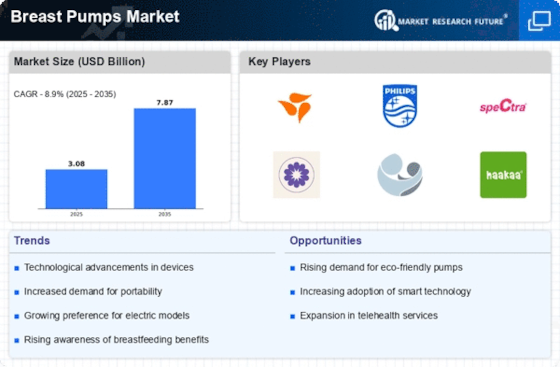
Breast Pumps Market Infographic
Purchase Options

Market Share

Breast Pumps Market Share Analysis

The strategy that companies staking a big claim in the Breast Pumps market, companies move along configurations of innovation. Technological innovation is one of the fields that are given a huge emphasis as companies invest in innovative research for creating top-tier technologies towards meeting new breastfeeding needs. These include provision of smart pumps which are digitally connected, have a silent operation as well as customizable settings for ease and comfort while using the various features of the pumping devices. Product diversify is another important strategy many of the market leaders use. Identifying a wide variety of consumers and preferences, companies provide an all-inclusive collection of breast pumps that consist of single and double electric pumps, manual pumps, as well as hospital grade pumps. This method enables them to cater to the different requirements of lactating women from those who pump occasionally sometimes breastfeed exclusively. Partnerships are therefore an important strategic consideration in positioning themselves within the market share. The relationship between a company and organizations related to healthcare also contributes to the credibility of a business in the health sector because they are collaborating with partners who, by all standards, understand what is needed and only have one interest – that of providing good healthcare for the members. Partnerships to clinical insight as well as validation of product efficacy leads to increased market acceptance by to factor the concepts, claims and reputations of consumers’ level. A significant area of market positioning is the emphasis placed on delivering specialized user customization. As this kind of products is used mostly by women who have just given birth, companies in particular pay close attention to the individual needs of breastfeeding mothers. Value need and create their pumps on a basis of user-friendliness and customized features. This is also reflected in positive reviews and widespread adoption of their products since there are features such as ease, comfort, and choices about where to fit the devices being targeted. There is a digital age where companies have to come up with such techniques of ensuring that their market strategies are strong online presence and in their excess others things which may be associated to digitally marketing strategies. Companies using their websites as platforms and utilising social media connect with their target audience to facilitate teaching, informational materials are shared, and customer support is rendered. This guarantees visibility with data showing that public behavior in today’s market is very much driven by the events taking place on the internet. Market positioning must include regulatory compliance, which is an unarguable dimension of the issue. The companies whose operations focus either on the strict compliance with regulatory standards, or safety certification are likely to engender trust among healthcare professionals and consumers alike. Showing a reliable attitude towards the conservation of product safety and continuous performance is a crucial must for any corporation to be successful in terms of market credibility and ability to live up to the industry standards. Breast pump manufacturers adopt a global strategy that entails expanding their business outside the home country to the other countries. This refers to appreciating the culture differences and modifying product design in tandem with the breastfeeding requirements of contrasting cultures. The global opportunities to companies can thrive by diversifying market demands and regional needs in a tasteful effort.


Author
Author Profile
Vikita Thakur
Senior Research Analyst

She holds an experience of about 5+ years in market research and business consulting projects for sectors such as life sciences, medical devices, and healthcare IT. She possesses a robust background in data analysis, market estimation, competitive intelligence, pipeline analysis market trend identification, and consumer behavior insights. Her expertise lies in technical Sales support, client interaction and project management, designing and implementing market research studies, conducting competitive analysis, and synthesizing complex data into actionable recommendations that drive business growth.

Leave a Comment

FAQs

What is the current valuation of the Breast Pumps Market as of 2024?

<p>The Breast Pumps Market was valued at 3.082 USD Billion in 2024.</p>

What is the projected market size for the Breast Pumps Market by 2035?

<p>The market is projected to reach 7.874 USD Billion by 2035.</p>

What is the expected CAGR for the Breast Pumps Market during the forecast period 2025 - 2035?

<p>The expected CAGR for the Breast Pumps Market during 2025 - 2035 is 8.9%.</p>

Which technology segments are included in the Breast Pumps Market?

<p>The technology segments include Manual Pumps, Battery Powered Pumps, and Electric Pumps.</p>

What were the valuations for Electric Pumps in 2024?

<p>In 2024, Electric Pumps were valued at 1.542 USD Billion.</p>

How do the valuations of Open System and Closed System breast pumps compare?

<p>In 2024, Open System pumps were valued at 1.5 USD Billion, while Closed System pumps were valued at 1.582 USD Billion.</p>

What are the primary applications of breast pumps in the market?

The primary applications include Personal Use and Hospital Grade breast pumps.

What was the valuation for Hospital Grade breast pumps in 2024?

Hospital Grade breast pumps were valued at 1.582 USD Billion in 2024.

Who are the key players in the Breast Pumps Market?

Key players include Medela, Philips, Spectra Baby USA, Lansinoh, Ameda, Haakaa, Chicco, Evenflo, and Bellababy.

What is the projected growth trend for the Breast Pumps Market in the coming years?

The market is expected to grow significantly, reaching 7.874 USD Billion by 2035, indicating robust demand.

Market Summary

As per Market Research Future analysis, the Breast Pumps Market Size was estimated at 3.082 USD Billion in 2024. The Breast Pumps industry is projected to grow from 3.356 USD Billion in 2025 to 7.874 USD Billion by 2035, exhibiting a compound annual growth rate (CAGR) of 8% during the forecast period 2025 - 2035

Key Market Trends & Highlights

The Breast Pumps Market is experiencing a dynamic shift driven by technological advancements and changing consumer preferences.

  • North America remains the largest market for breast pumps, characterized by a strong demand for electric pumps. Asia-Pacific is emerging as the fastest-growing region, with a notable increase in the adoption of battery-powered pumps. The open system segment continues to dominate the market, while closed systems are gaining traction due to their convenience and efficiency. Key drivers include rising awareness of breastfeeding benefits and supportive policies that encourage maternal health initiatives.

Market Size & Forecast

2024 Market Size 3.082 (USD Billion)
2035 Market Size 7.874 (USD Billion)
CAGR (2025 - 2035) 8.9%
Largest Regional Market Share in 2024 North America

Major Players

<p><a title="Medela" href="https://www.medela.com/en-in/breastfeeding-pumping/products/pumps" target="_blank" rel="noopener">Medela</a> (CH), Philips (NL), Spectra Baby USA (US), Lansinoh (US), Ameda (US), Haakaa (NZ), Chicco (IT), Evenflo (US), Bellababy (CN)</p>

Market Trends

The Breast Pumps Market is currently experiencing a notable transformation, driven by evolving consumer preferences and advancements in technology. Increasing awareness regarding the benefits of breastfeeding, coupled with a growing emphasis on maternal health, appears to be propelling demand for breast pumps and contributing to rising breast pump sales globally. Breast pump manufacturers are responding to these shifts by innovating their product offerings, focusing on user-friendly designs and enhanced functionality. This trend suggests a potential for growth as more mothers seek convenient and effective solutions for breastfeeding. Furthermore, the rise of e-commerce platforms is facilitating easier access to a diverse range of breast pump products, thereby expanding market reach and consumer choice. In addition to technological advancements, the Breast Pumps Market is witnessing a shift towards sustainable practices. Many companies are exploring eco-friendly materials and production methods, reflecting a broader societal trend towards environmental consciousness. This inclination towards sustainability may resonate with consumers who prioritize ethical considerations in their purchasing decisions. As the market continues to evolve, it is likely that these trends will shape the future landscape of breast pump offerings, catering to the needs of modern mothers while addressing environmental concerns.

Technological Advancements

The Breast Pumps Market is seeing significant innovations in technology, with manufacturers developing smarter and more efficient devices. Features such as app connectivity, adjustable suction levels, and quieter operation are becoming increasingly common, enhancing user experience and strengthening the competitive position of leading breast pump companies..

Sustainability Focus

A growing emphasis on sustainability is influencing the Breast Pumps Market, as companies seek to incorporate eco-friendly materials and practices. This trend reflects a broader consumer demand for environmentally responsible products.

E-commerce Growth

The rise of e-commerce is reshaping the Breast Pumps Market, providing consumers with greater access to a variety of products. Online platforms are facilitating easier comparisons and purchases, thereby expanding market reach. and supporting sustained growth in breast pump sales.

Breast Pumps Market Market Drivers

Growing Focus on Maternal Health

The growing emphasis on maternal health and wellness is a vital driver for the Breast Pumps Market. Healthcare providers and organizations are increasingly recognizing the importance of supporting mothers during the postpartum period, which includes promoting breastfeeding. This focus on maternal health has led to a rise in the availability of breast pumps as part of comprehensive maternal care packages. Data indicates that healthcare systems are investing in educational resources and products that support breastfeeding, thereby enhancing the accessibility of breast pumps. As maternal health initiatives continue to evolve, the Breast Pumps Market is likely to experience sustained growth, driven by the increasing prioritization of mothers' health and well-being.

Supportive Policies and Initiatives

Government policies and initiatives aimed at promoting breastfeeding are crucial drivers for the Breast Pumps Market. Many countries have implemented maternity leave policies and workplace accommodations that encourage breastfeeding, thereby increasing the demand for breast pumps. These supportive measures not only facilitate breastfeeding but also empower mothers to return to work while maintaining their breastfeeding routines. Data shows that regions with robust breastfeeding support systems witness higher breast pump sales, as mothers are more inclined to invest in these products. Consequently, the Breast Pumps Market is likely to benefit from continued governmental support and advocacy for breastfeeding, which may further enhance market growth.

Increasing Number of Working Mothers

The rising number of working mothers is a significant factor propelling the Breast Pumps Market. As more women enter the workforce, the need for convenient breastfeeding solutions becomes paramount. Breast pumps offer a practical solution for working mothers who wish to continue breastfeeding while managing their professional responsibilities. Market Research Future indicates that the demand for breast pumps has surged in tandem with the increase in dual-income households. This trend suggests that the Breast Pumps Market will continue to expand as more mothers seek efficient ways to balance work and breastfeeding, leading to a sustained increase in breast pump sales.

Innovations in Breast Pump Technology

Technological advancements in breast pump design and functionality are significantly influencing the Breast Pumps Market. Manufacturers are increasingly focusing on creating user-friendly, efficient, and portable breast pumps that cater to the diverse needs of mothers. Innovations such as smart breast pumps that connect to mobile applications for tracking milk production and usage patterns are gaining traction. The introduction of quieter, more discreet models has also contributed to the appeal of breast pumps among working mothers. Market data indicates that the demand for electric and hands-free breast pumps is on the rise, reflecting a shift towards more advanced solutions. This trend suggests that ongoing innovation will continue to drive growth in the Breast Pumps Market.

Rising Awareness of Breastfeeding Benefits

The increasing awareness regarding the benefits of breastfeeding is a pivotal driver for the Breast Pumps Market. Educational campaigns and healthcare initiatives emphasize the nutritional and emotional advantages of breastfeeding for both infants and mothers. This heightened awareness has led to a surge in demand for breast pumps, as mothers seek to balance their professional and personal lives while ensuring their infants receive the best nutrition. According to recent data, the breastfeeding rate has shown a steady increase, with many mothers opting for breast pumps to facilitate this process. The Breast Pumps Market is thus experiencing growth as more mothers recognize the importance of breastfeeding and the role of breast pumps in achieving their breastfeeding goals.

Market Segment Insights

By Technology: Electric Pumps (Largest) vs. Battery Powered Pumps (Fastest-Growing)

<p>In the Breast Pumps Market, the technology segment showcases a competitive distribution among manual, battery-powered, and electric pumps. Electric pumps hold the largest market share, primarily due to their efficiency and ability to mimic a baby’s natural suckling. This segment is widely favored by working mothers looking for convenience and effective milk expression. Battery-powered pumps are emerging rapidly as a preferred choice among new mothers seeking portability and ease of use without being tethered to a power source, carving out a significant niche in the market.</p>

<p>Technology: Electric Pumps (Dominant) vs. Battery Powered Pumps (Emerging)</p>

<p>Electric pumps are dominating the Breast Pumps Market due to their advanced features, including programmable settings and dual-pumping capabilities, which appeal to mothers needing efficiency and volume. These pumps are typically more effective at stimulating milk production, making them the go-to choice for many women. Meanwhile, battery-powered pumps are emerging as a convenient alternative, especially among mothers on the go. Their compact design and lightweight nature appeal to a demographic that prioritizes mobility without sacrificing performance. These pumps are also becoming increasingly popular for occasional use, adding to their attractiveness as a market segment.</p>

By Product: Open System (Largest) vs. Closed System (Fastest-Growing)

<p>In the Breast Pumps Market, the open system segment has established itself as the largest product category, catering to a significant portion of breastfeeding mothers. This system is widely preferred due to its affordability and ease of use, making it accessible to a larger demographic. Conversely, the closed system segment, while smaller, is gaining traction among health-conscious users drawn to its hygienic benefits and advanced technology. Both systems are essential components of the market, each appealing to different consumer needs and preferences. The growth trends within the Breast Pumps Market indicate a notable shift towards the closed system. This segment is emerging as the fastest-growing due to increased awareness regarding hygiene and the convenience it offers. Additionally, technological advancements are improving the efficacy and user experience of these devices, attracting a more discerning customer base. As more parents look for devices that cater to both health and convenience, the closed system segment is poised for rapid expansion in the coming years.</p>

<p>Open System: Dominant vs. Closed System: Emerging</p>

<p>The open system breast pumps dominate the current market, primarily due to their affordability and ease of availability. They are convenient for casual users who need to pump infrequently and prefer a straightforward, no-frills design. However, the closed system breast pumps are emerging strongly, appealing to parents seeking hygienic solutions. These devices feature a barrier that prevents milk from entering the pump, reducing contamination risk and ensuring easier cleaning. As health concerns continue to rise, the closed system's innovative design and safety features are becoming increasingly attractive, paving the way for a competitive space between the two types as they meet distinct consumer priorities.</p>

By Application: Personal Use (Largest) vs. Hospital Grade (Fastest-Growing)

<p>In the Breast Pumps Market, the application segment is primarily divided into Personal Use and Hospital Grade categories. Currently, Personal Use holds the largest market share, appealing to individuals who seek convenience and flexibility in breastfeeding. The Hospital Grade segment, although smaller, is gaining traction as an increasing number of healthcare facilities invest in high-quality breast pumps for mothers in need of advanced lactation support.</p>

<p>Application: Personal Use (Dominant) vs. Hospital Grade (Emerging)</p>

<p>Personal Use breast pumps are designed for convenience, typically favored by mothers looking to express milk at their own pace. This segment dominates the market due to its widespread adoption driven by increasing awareness of breastfeeding benefits and the growing number of working mothers seeking to balance professional and parental responsibilities. On the other hand, Hospital Grade pumps are emerging as a vital resource in clinical settings, providing powerful suction and advanced features for mothers with special needs. Their faster growth is largely attributed to rising healthcare standards and recommendations from pediatricians for hospital-grade products, ensuring both efficiency and safety in lactation management.</p>

Get more detailed insights about Breast Pumps Market Research Report 2035

Regional Insights

North America : Market Leader in Innovation

North America is the largest market for breast pumps, accounting for approximately 40% of the global share. The region's growth is driven by increasing awareness of breastfeeding benefits, supportive healthcare policies, and a rise in working mothers. Regulatory catalysts, such as the Affordable Care Act, mandate insurance coverage for breast pumps, further boosting demand. The United States leads the market, with key players like Medela, Philips, and Spectra Baby USA dominating the landscape. The competitive environment is characterized by continuous innovation and a focus on user-friendly designs. Canada also contributes significantly, with a growing emphasis on maternal health and breastfeeding support, enhancing the overall market dynamics.

Europe : Emerging Market with Regulations

Europe is witnessing a growing demand for breast pumps, holding approximately 30% of the global market share. The region's growth is fueled by increasing health awareness, government initiatives promoting breastfeeding, and a rise in dual-income households. Regulatory frameworks, such as the EU's directive on maternal health, encourage breastfeeding, thus driving the breast pump market. Leading countries include Germany, France, and the UK, where key players like Philips and Ameda are prominent. The competitive landscape is marked by a mix of established brands and emerging players, focusing on innovative solutions and sustainability. The presence of strong healthcare systems further supports market growth, ensuring accessibility and affordability for consumers.

Asia-Pacific : Rapid Growth in Demand

Asia-Pacific is rapidly emerging as a significant market for breast pumps, accounting for approximately 25% of the global share. The region's growth is driven by increasing urbanization, rising disposable incomes, and a growing awareness of breastfeeding benefits. Countries like China and India are witnessing a surge in demand, supported by government initiatives promoting maternal health and breastfeeding. China is the largest market in the region, with key players like Bellababy and Haakaa gaining traction. The competitive landscape is evolving, with both local and international brands vying for market share. The increasing number of working mothers and changing societal norms are further propelling the demand for breast pumps, making this region a focal point for future growth.

Middle East and Africa : Untapped Market Potential

The Middle East and Africa region is gradually emerging in the breast pump market, holding approximately 5% of the global share. The growth is primarily driven by increasing awareness of breastfeeding benefits, rising disposable incomes, and a shift towards modern parenting practices. Government initiatives aimed at improving maternal health are also contributing to market expansion. Countries like South Africa and the UAE are leading the market, with a growing number of local and international brands entering the space. The competitive landscape is characterized by a mix of established players and new entrants, focusing on affordability and accessibility. As awareness continues to grow, the region presents significant opportunities for market players to expand their reach and cater to the evolving needs of consumers.

Key Players and Competitive Insights

The Breast Pumps Market is currently characterized by a dynamic competitive landscape, driven by increasing awareness of breastfeeding benefits and a growing emphasis on maternal health. Key players such as Medela (CH), Philips (NL), and Spectra Baby USA (US) are at the forefront, each adopting distinct strategies to enhance their market presence. Medela (CH) focuses on innovation, particularly in developing smart breast pumps that integrate with mobile applications, thereby appealing to tech-savvy consumers. Philips (NL) emphasizes sustainability, launching eco-friendly products that resonate with environmentally conscious parents. Meanwhile, Spectra Baby USA (US) is expanding its distribution channels, particularly in emerging markets, to capture a broader customer base. Collectively, these strategies not only enhance brand loyalty but also intensify competition within the market. In terms of business tactics, companies are increasingly localizing manufacturing to reduce costs and improve supply chain efficiency. This approach is particularly evident in the Breast Pumps Market, which appears moderately fragmented, with several players vying for market share. The collective influence of these key players shapes a competitive structure that encourages innovation and responsiveness to consumer needs, thereby fostering a vibrant market environment. In August 2025, Medela (CH) announced the launch of its latest breast pump model, which features advanced technology for personalized pumping experiences. This strategic move is significant as it not only reinforces Medela's commitment to innovation but also positions the company to meet the evolving demands of modern parents who seek convenience and efficiency in breastfeeding solutions. The introduction of this product is likely to enhance Medela's competitive edge in a market that increasingly values technological integration. In September 2025, Philips (NL) unveiled a new initiative aimed at promoting sustainable breastfeeding practices through educational campaigns and eco-friendly product lines. This initiative underscores Philips' strategic focus on sustainability, which is becoming a critical differentiator in the market. By aligning its brand with environmental responsibility, Philips is likely to attract a growing segment of consumers who prioritize sustainability in their purchasing decisions, thereby enhancing its market position. In July 2025, Spectra Baby USA (US) expanded its operations into Southeast Asia, establishing partnerships with local distributors to enhance its market reach. This strategic expansion is crucial as it allows Spectra to tap into emerging markets with increasing demand for breastfeeding products. By localizing its distribution, Spectra is poised to strengthen its competitive position and respond more effectively to regional consumer preferences. As of October 2025, the Breast Pumps Market is witnessing trends such as digitalization, sustainability, and the integration of artificial intelligence in product development. These trends are reshaping the competitive landscape, with strategic alliances becoming increasingly important for companies seeking to enhance their technological capabilities and market reach. The shift from price-based competition to a focus on innovation, technology, and supply chain reliability is evident, suggesting that future competitive differentiation will hinge on a company's ability to adapt to these evolving trends.

Key Companies in the Breast Pumps Market include

Industry Developments

  • Q2 2024: Willow Launches Willow 360, the First All-in-One Wearable Breast Pump with Smart App Integration Willow Innovations announced the launch of Willow 360, a new wearable breast pump featuring app connectivity and real-time milk tracking, expanding its product portfolio in the smart breast pump segment.
  • Q2 2024: Medela Appoints Annette Brüls as New CEO Medela, a leading breast pump manufacturer, announced the appointment of Annette Brüls as its new Chief Executive Officer, effective May 2024, to drive the company’s next phase of growth.
  • Q2 2024: Elvie Raises $100 Million in Series C Funding to Accelerate Growth of Femtech Products Elvie, known for its wearable breast pumps, secured $100 million in Series C funding to expand its product development and global market reach.
  • Q3 2024: Spectra Baby USA Announces Opening of New Manufacturing Facility in Texas Spectra Baby USA opened a new manufacturing facility in Texas to increase production capacity and meet growing demand for its electric breast pumps in North America.
  • Q3 2024: Ameda Partners with Walgreens to Expand Retail Distribution of Breast Pumps Market Ameda announced a partnership with Walgreens to make its range of breast pumps available in Walgreens stores nationwide, enhancing retail accessibility for consumers.
  • Q4 2024: FDA Grants 510(k) Clearance to Lansinoh Smartpump 3.0 Double Electric Breast Pump Lansinoh received 510(k) clearance from the U.S. FDA for its Smartpump 3.0 Double Electric Breast Pump, allowing the company to market the device in the United States.
  • Q4 2024: Babyation Closes $20 Million Series B Funding Round Babyation, a startup focused on discreet breast pump technology, closed a $20 million Series B funding round to support product development and scale manufacturing.
  • Q1 2025: Philips Avent Launches Ultra Comfort Wearable Breast Pump in Europe Philips Avent introduced its Ultra Comfort Wearable Breast Pump in select European markets, expanding its product lineup in the wearable breast pump category.
  • Q1 2025: Motif Medical Announces Strategic Partnership with CVS Health Motif Medical entered into a strategic partnership with CVS Health to distribute its Luna breast pump through CVS retail and online channels.
  • Q2 2025: Momcozy Raises $50 Million in Series C Funding to Expand Global Operations Momcozy, a leading breast pump brand, raised $50 million in Series C funding to accelerate international expansion and invest in new product innovation.
  • Q2 2025: Freemie Receives CE Mark Approval for Next-Generation Wearable Breast Pump Freemie received CE Mark approval for its next-generation wearable breast pump, enabling the company to market the device across the European Union.
  • Q2 2025: Haakaa Announces Opening of New Distribution Center in Germany Haakaa opened a new distribution center in Germany to improve logistics and better serve its growing customer base in the European market.
  • The breast-pump sector is consolidating and scaling: product innovation (closed-system, wearable pumps) plus acquisition activity among femtech firms are reshaping supply and distribution. Market reports show robust mid-single to high-single digit CAGRs and recent M&A (notably Elvie assets being bought) highlight competitive repositioning. Watch: insurance coverage changes and femtech platform integrations

Future Outlook

Breast Pumps Market Future Outlook

<p>The Breast Pumps Market is projected to grow at an 8.9% CAGR from 2025 to 2035, driven by technological advancements, increasing awareness, and rising demand for maternal health products.</p>

New opportunities lie in:

  • <p>Expansion of <a href="https://www.marketresearchfuture.com/reports/telehealth-market-900">telehealth </a>services for remote consultations and support. Development of eco-friendly breast pump materials to attract environmentally conscious consumers. Integration of smart technology for real-time monitoring and data analytics.</p>

<p>By 2035, the Breast Pumps Market is expected to achieve substantial growth, reflecting evolving consumer needs and technological innovations.</p>

Market Segmentation

Breast Pumps Market Product Outlook

  • Open System
  • Closed System

Breast Pumps Market Technology Outlook

  • Manual Pumps
  • Battery Powered Pumps
  • Electric Pumps

Breast Pumps Market Application Outlook

  • Personal Use
  • Hospital Grade

Report Scope

MARKET SIZE 2024 3.082(USD Billion)
MARKET SIZE 2025 3.356(USD Billion)
MARKET SIZE 2035 7.874(USD Billion)
COMPOUND ANNUAL GROWTH RATE (CAGR) 8.9% (2025 - 2035)
REPORT COVERAGE Revenue Forecast, Competitive Landscape, Growth Factors, and Trends
BASE YEAR 2024
Market Forecast Period 2025 - 2035
Historical Data 2019 - 2024
Market Forecast Units USD Billion
Key Companies Profiled Medela (CH), Philips (NL), Spectra Baby USA (US), Lansinoh (US), Ameda (US), Haakaa (NZ), Chicco (IT), Evenflo (US), Bellababy (CN)
Segments Covered Technology, Product, Application, Region
Key Market Opportunities Integration of smart technology in Breast Pumps Market enhances user experience and efficiency.
Key Market Dynamics Rising consumer preference for electric breast pumps drives innovation and competition among manufacturers in the market.
Countries Covered North America, Europe, APAC, South America, MEA

FAQs

What is the current valuation of the Breast Pumps Market as of 2024?

<p>The Breast Pumps Market was valued at 3.082 USD Billion in 2024.</p>

What is the projected market size for the Breast Pumps Market by 2035?

<p>The market is projected to reach 7.874 USD Billion by 2035.</p>

What is the expected CAGR for the Breast Pumps Market during the forecast period 2025 - 2035?

<p>The expected CAGR for the Breast Pumps Market during 2025 - 2035 is 8.9%.</p>

Which technology segments are included in the Breast Pumps Market?

<p>The technology segments include Manual Pumps, Battery Powered Pumps, and Electric Pumps.</p>

What were the valuations for Electric Pumps in 2024?

<p>In 2024, Electric Pumps were valued at 1.542 USD Billion.</p>

How do the valuations of Open System and Closed System breast pumps compare?

<p>In 2024, Open System pumps were valued at 1.5 USD Billion, while Closed System pumps were valued at 1.582 USD Billion.</p>

What are the primary applications of breast pumps in the market?

The primary applications include Personal Use and Hospital Grade breast pumps.

What was the valuation for Hospital Grade breast pumps in 2024?

Hospital Grade breast pumps were valued at 1.582 USD Billion in 2024.

Who are the key players in the Breast Pumps Market?

Key players include Medela, Philips, Spectra Baby USA, Lansinoh, Ameda, Haakaa, Chicco, Evenflo, and Bellababy.

What is the projected growth trend for the Breast Pumps Market in the coming years?

The market is expected to grow significantly, reaching 7.874 USD Billion by 2035, indicating robust demand.

  1. SECTION I: EXECUTIVE SUMMARY AND KEY HIGHLIGHTS
    1. | 1.1 EXECUTIVE SUMMARY
    2. | | 1.1.1 Market Overview
    3. | | 1.1.2 Key Findings
    4. | | 1.1.3 Market Segmentation
    5. | | 1.1.4 Competitive Landscape
    6. | | 1.1.5 Challenges and Opportunities
    7. | | 1.1.6 Future Outlook
  2. SECTION II: SCOPING, METHODOLOGY AND MARKET STRUCTURE
    1. | 2.1 MARKET INTRODUCTION
    2. | | 2.1.1 Definition
    3. | | 2.1.2 Scope of the study
    4. | | | 2.1.2.1 Research Objective
    5. | | | 2.1.2.2 Assumption
    6. | | | 2.1.2.3 Limitations
    7. | 2.2 RESEARCH METHODOLOGY
    8. | | 2.2.1 Overview
    9. | | 2.2.2 Data Mining
    10. | | 2.2.3 Secondary Research
    11. | | 2.2.4 Primary Research
    12. | | | 2.2.4.1 Primary Interviews and Information Gathering Process
    13. | | | 2.2.4.2 Breakdown of Primary Respondents
    14. | | 2.2.5 Forecasting Model
    15. | | 2.2.6 Market Size Estimation
    16. | | | 2.2.6.1 Bottom-Up Approach
    17. | | | 2.2.6.2 Top-Down Approach
    18. | | 2.2.7 Data Triangulation
    19. | | 2.2.8 Validation
  3. SECTION III: QUALITATIVE ANALYSIS
    1. | 3.1 MARKET DYNAMICS
    2. | | 3.1.1 Overview
    3. | | 3.1.2 Drivers
    4. | | 3.1.3 Restraints
    5. | | 3.1.4 Opportunities
    6. | 3.2 MARKET FACTOR ANALYSIS
    7. | | 3.2.1 Value chain Analysis
    8. | | 3.2.2 Porter's Five Forces Analysis
    9. | | | 3.2.2.1 Bargaining Power of Suppliers
    10. | | | 3.2.2.2 Bargaining Power of Buyers
    11. | | | 3.2.2.3 Threat of New Entrants
    12. | | | 3.2.2.4 Threat of Substitutes
    13. | | | 3.2.2.5 Intensity of Rivalry
    14. | | 3.2.3 COVID-19 Impact Analysis
    15. | | | 3.2.3.1 Market Impact Analysis
    16. | | | 3.2.3.2 Regional Impact
    17. | | | 3.2.3.3 Opportunity and Threat Analysis
  4. SECTION IV: QUANTITATIVE ANALYSIS
    1. | 4.1 Healthcare, BY Technology (USD Billion)
    2. | | 4.1.1 Manual Pumps
    3. | | 4.1.2 Battery Powered Pumps
    4. | | 4.1.3 Electric Pumps
    5. | 4.2 Healthcare, BY Product (USD Billion)
    6. | | 4.2.1 Open System
    7. | | 4.2.2 Closed System
    8. | 4.3 Healthcare, BY Application (USD Billion)
    9. | | 4.3.1 Personal Use
    10. | | 4.3.2 Hospital Grade
    11. | 4.4 Healthcare, BY Region (USD Billion)
    12. | | 4.4.1 North America
    13. | | | 4.4.1.1 US
    14. | | | 4.4.1.2 Canada
    15. | | 4.4.2 Europe
    16. | | | 4.4.2.1 Germany
    17. | | | 4.4.2.2 UK
    18. | | | 4.4.2.3 France
    19. | | | 4.4.2.4 Russia
    20. | | | 4.4.2.5 Italy
    21. | | | 4.4.2.6 Spain
    22. | | | 4.4.2.7 Rest of Europe
    23. | | 4.4.3 APAC
    24. | | | 4.4.3.1 China
    25. | | | 4.4.3.2 India
    26. | | | 4.4.3.3 Japan
    27. | | | 4.4.3.4 South Korea
    28. | | | 4.4.3.5 Malaysia
    29. | | | 4.4.3.6 Thailand
    30. | | | 4.4.3.7 Indonesia
    31. | | | 4.4.3.8 Rest of APAC
    32. | | 4.4.4 South America
    33. | | | 4.4.4.1 Brazil
    34. | | | 4.4.4.2 Mexico
    35. | | | 4.4.4.3 Argentina
    36. | | | 4.4.4.4 Rest of South America
    37. | | 4.4.5 MEA
    38. | | | 4.4.5.1 GCC Countries
    39. | | | 4.4.5.2 South Africa
    40. | | | 4.4.5.3 Rest of MEA
  5. SECTION V: COMPETITIVE ANALYSIS
    1. | 5.1 Competitive Landscape
    2. | | 5.1.1 Overview
    3. | | 5.1.2 Competitive Analysis
    4. | | 5.1.3 Market share Analysis
    5. | | 5.1.4 Major Growth Strategy in the Healthcare
    6. | | 5.1.5 Competitive Benchmarking
    7. | | 5.1.6 Leading Players in Terms of Number of Developments in the Healthcare
    8. | | 5.1.7 Key developments and growth strategies
    9. | | | 5.1.7.1 New Product Launch/Service Deployment
    10. | | | 5.1.7.2 Merger & Acquisitions
    11. | | | 5.1.7.3 Joint Ventures
    12. | | 5.1.8 Major Players Financial Matrix
    13. | | | 5.1.8.1 Sales and Operating Income
    14. | | | 5.1.8.2 Major Players R&D Expenditure. 2023
    15. | 5.2 Company Profiles
    16. | | 5.2.1 Medela (CH)
    17. | | | 5.2.1.1 Financial Overview
    18. | | | 5.2.1.2 Products Offered
    19. | | | 5.2.1.3 Key Developments
    20. | | | 5.2.1.4 SWOT Analysis
    21. | | | 5.2.1.5 Key Strategies
    22. | | 5.2.2 Philips (NL)
    23. | | | 5.2.2.1 Financial Overview
    24. | | | 5.2.2.2 Products Offered
    25. | | | 5.2.2.3 Key Developments
    26. | | | 5.2.2.4 SWOT Analysis
    27. | | | 5.2.2.5 Key Strategies
    28. | | 5.2.3 Spectra Baby USA (US)
    29. | | | 5.2.3.1 Financial Overview
    30. | | | 5.2.3.2 Products Offered
    31. | | | 5.2.3.3 Key Developments
    32. | | | 5.2.3.4 SWOT Analysis
    33. | | | 5.2.3.5 Key Strategies
    34. | | 5.2.4 Lansinoh (US)
    35. | | | 5.2.4.1 Financial Overview
    36. | | | 5.2.4.2 Products Offered
    37. | | | 5.2.4.3 Key Developments
    38. | | | 5.2.4.4 SWOT Analysis
    39. | | | 5.2.4.5 Key Strategies
    40. | | 5.2.5 Ameda (US)
    41. | | | 5.2.5.1 Financial Overview
    42. | | | 5.2.5.2 Products Offered
    43. | | | 5.2.5.3 Key Developments
    44. | | | 5.2.5.4 SWOT Analysis
    45. | | | 5.2.5.5 Key Strategies
    46. | | 5.2.6 Haakaa (NZ)
    47. | | | 5.2.6.1 Financial Overview
    48. | | | 5.2.6.2 Products Offered
    49. | | | 5.2.6.3 Key Developments
    50. | | | 5.2.6.4 SWOT Analysis
    51. | | | 5.2.6.5 Key Strategies
    52. | | 5.2.7 Chicco (IT)
    53. | | | 5.2.7.1 Financial Overview
    54. | | | 5.2.7.2 Products Offered
    55. | | | 5.2.7.3 Key Developments
    56. | | | 5.2.7.4 SWOT Analysis
    57. | | | 5.2.7.5 Key Strategies
    58. | | 5.2.8 Evenflo (US)
    59. | | | 5.2.8.1 Financial Overview
    60. | | | 5.2.8.2 Products Offered
    61. | | | 5.2.8.3 Key Developments
    62. | | | 5.2.8.4 SWOT Analysis
    63. | | | 5.2.8.5 Key Strategies
    64. | | 5.2.9 Bellababy (CN)
    65. | | | 5.2.9.1 Financial Overview
    66. | | | 5.2.9.2 Products Offered
    67. | | | 5.2.9.3 Key Developments
    68. | | | 5.2.9.4 SWOT Analysis
    69. | | | 5.2.9.5 Key Strategies
    70. | 5.3 Appendix
    71. | | 5.3.1 References
    72. | | 5.3.2 Related Reports
  6. LIST OF FIGURES
    1. | 6.1 MARKET SYNOPSIS
    2. | 6.2 NORTH AMERICA MARKET ANALYSIS
    3. | 6.3 US MARKET ANALYSIS BY TECHNOLOGY
    4. | 6.4 US MARKET ANALYSIS BY PRODUCT
    5. | 6.5 US MARKET ANALYSIS BY APPLICATION
    6. | 6.6 CANADA MARKET ANALYSIS BY TECHNOLOGY
    7. | 6.7 CANADA MARKET ANALYSIS BY PRODUCT
    8. | 6.8 CANADA MARKET ANALYSIS BY APPLICATION
    9. | 6.9 EUROPE MARKET ANALYSIS
    10. | 6.10 GERMANY MARKET ANALYSIS BY TECHNOLOGY
    11. | 6.11 GERMANY MARKET ANALYSIS BY PRODUCT
    12. | 6.12 GERMANY MARKET ANALYSIS BY APPLICATION
    13. | 6.13 UK MARKET ANALYSIS BY TECHNOLOGY
    14. | 6.14 UK MARKET ANALYSIS BY PRODUCT
    15. | 6.15 UK MARKET ANALYSIS BY APPLICATION
    16. | 6.16 FRANCE MARKET ANALYSIS BY TECHNOLOGY
    17. | 6.17 FRANCE MARKET ANALYSIS BY PRODUCT
    18. | 6.18 FRANCE MARKET ANALYSIS BY APPLICATION
    19. | 6.19 RUSSIA MARKET ANALYSIS BY TECHNOLOGY
    20. | 6.20 RUSSIA MARKET ANALYSIS BY PRODUCT
    21. | 6.21 RUSSIA MARKET ANALYSIS BY APPLICATION
    22. | 6.22 ITALY MARKET ANALYSIS BY TECHNOLOGY
    23. | 6.23 ITALY MARKET ANALYSIS BY PRODUCT
    24. | 6.24 ITALY MARKET ANALYSIS BY APPLICATION
    25. | 6.25 SPAIN MARKET ANALYSIS BY TECHNOLOGY
    26. | 6.26 SPAIN MARKET ANALYSIS BY PRODUCT
    27. | 6.27 SPAIN MARKET ANALYSIS BY APPLICATION
    28. | 6.28 REST OF EUROPE MARKET ANALYSIS BY TECHNOLOGY
    29. | 6.29 REST OF EUROPE MARKET ANALYSIS BY PRODUCT
    30. | 6.30 REST OF EUROPE MARKET ANALYSIS BY APPLICATION
    31. | 6.31 APAC MARKET ANALYSIS
    32. | 6.32 CHINA MARKET ANALYSIS BY TECHNOLOGY
    33. | 6.33 CHINA MARKET ANALYSIS BY PRODUCT
    34. | 6.34 CHINA MARKET ANALYSIS BY APPLICATION
    35. | 6.35 INDIA MARKET ANALYSIS BY TECHNOLOGY
    36. | 6.36 INDIA MARKET ANALYSIS BY PRODUCT
    37. | 6.37 INDIA MARKET ANALYSIS BY APPLICATION
    38. | 6.38 JAPAN MARKET ANALYSIS BY TECHNOLOGY
    39. | 6.39 JAPAN MARKET ANALYSIS BY PRODUCT
    40. | 6.40 JAPAN MARKET ANALYSIS BY APPLICATION
    41. | 6.41 SOUTH KOREA MARKET ANALYSIS BY TECHNOLOGY
    42. | 6.42 SOUTH KOREA MARKET ANALYSIS BY PRODUCT
    43. | 6.43 SOUTH KOREA MARKET ANALYSIS BY APPLICATION
    44. | 6.44 MALAYSIA MARKET ANALYSIS BY TECHNOLOGY
    45. | 6.45 MALAYSIA MARKET ANALYSIS BY PRODUCT
    46. | 6.46 MALAYSIA MARKET ANALYSIS BY APPLICATION
    47. | 6.47 THAILAND MARKET ANALYSIS BY TECHNOLOGY
    48. | 6.48 THAILAND MARKET ANALYSIS BY PRODUCT
    49. | 6.49 THAILAND MARKET ANALYSIS BY APPLICATION
    50. | 6.50 INDONESIA MARKET ANALYSIS BY TECHNOLOGY
    51. | 6.51 INDONESIA MARKET ANALYSIS BY PRODUCT
    52. | 6.52 INDONESIA MARKET ANALYSIS BY APPLICATION
    53. | 6.53 REST OF APAC MARKET ANALYSIS BY TECHNOLOGY
    54. | 6.54 REST OF APAC MARKET ANALYSIS BY PRODUCT
    55. | 6.55 REST OF APAC MARKET ANALYSIS BY APPLICATION
    56. | 6.56 SOUTH AMERICA MARKET ANALYSIS
    57. | 6.57 BRAZIL MARKET ANALYSIS BY TECHNOLOGY
    58. | 6.58 BRAZIL MARKET ANALYSIS BY PRODUCT
    59. | 6.59 BRAZIL MARKET ANALYSIS BY APPLICATION
    60. | 6.60 MEXICO MARKET ANALYSIS BY TECHNOLOGY
    61. | 6.61 MEXICO MARKET ANALYSIS BY PRODUCT
    62. | 6.62 MEXICO MARKET ANALYSIS BY APPLICATION
    63. | 6.63 ARGENTINA MARKET ANALYSIS BY TECHNOLOGY
    64. | 6.64 ARGENTINA MARKET ANALYSIS BY PRODUCT
    65. | 6.65 ARGENTINA MARKET ANALYSIS BY APPLICATION
    66. | 6.66 REST OF SOUTH AMERICA MARKET ANALYSIS BY TECHNOLOGY
    67. | 6.67 REST OF SOUTH AMERICA MARKET ANALYSIS BY PRODUCT
    68. | 6.68 REST OF SOUTH AMERICA MARKET ANALYSIS BY APPLICATION
    69. | 6.69 MEA MARKET ANALYSIS
    70. | 6.70 GCC COUNTRIES MARKET ANALYSIS BY TECHNOLOGY
    71. | 6.71 GCC COUNTRIES MARKET ANALYSIS BY PRODUCT
    72. | 6.72 GCC COUNTRIES MARKET ANALYSIS BY APPLICATION
    73. | 6.73 SOUTH AFRICA MARKET ANALYSIS BY TECHNOLOGY
    74. | 6.74 SOUTH AFRICA MARKET ANALYSIS BY PRODUCT
    75. | 6.75 SOUTH AFRICA MARKET ANALYSIS BY APPLICATION
    76. | 6.76 REST OF MEA MARKET ANALYSIS BY TECHNOLOGY
    77. | 6.77 REST OF MEA MARKET ANALYSIS BY PRODUCT
    78. | 6.78 REST OF MEA MARKET ANALYSIS BY APPLICATION
    79. | 6.79 KEY BUYING CRITERIA OF HEALTHCARE
    80. | 6.80 RESEARCH PROCESS OF MRFR
    81. | 6.81 DRO ANALYSIS OF HEALTHCARE
    82. | 6.82 DRIVERS IMPACT ANALYSIS: HEALTHCARE
    83. | 6.83 RESTRAINTS IMPACT ANALYSIS: HEALTHCARE
    84. | 6.84 SUPPLY / VALUE CHAIN: HEALTHCARE
    85. | 6.85 HEALTHCARE, BY TECHNOLOGY, 2024 (% SHARE)
    86. | 6.86 HEALTHCARE, BY TECHNOLOGY, 2024 TO 2035 (USD Billion)
    87. | 6.87 HEALTHCARE, BY PRODUCT, 2024 (% SHARE)
    88. | 6.88 HEALTHCARE, BY PRODUCT, 2024 TO 2035 (USD Billion)
    89. | 6.89 HEALTHCARE, BY APPLICATION, 2024 (% SHARE)
    90. | 6.90 HEALTHCARE, BY APPLICATION, 2024 TO 2035 (USD Billion)
    91. | 6.91 BENCHMARKING OF MAJOR COMPETITORS
  7. LIST OF TABLES
    1. | 7.1 LIST OF ASSUMPTIONS
    2. | | 7.1.1
    3. | 7.2 North America MARKET SIZE ESTIMATES; FORECAST
    4. | | 7.2.1 BY TECHNOLOGY, 2025-2035 (USD Billion)
    5. | | 7.2.2 BY PRODUCT, 2025-2035 (USD Billion)
    6. | | 7.2.3 BY APPLICATION, 2025-2035 (USD Billion)
    7. | 7.3 US MARKET SIZE ESTIMATES; FORECAST
    8. | | 7.3.1 BY TECHNOLOGY, 2025-2035 (USD Billion)
    9. | | 7.3.2 BY PRODUCT, 2025-2035 (USD Billion)
    10. | | 7.3.3 BY APPLICATION, 2025-2035 (USD Billion)
    11. | 7.4 Canada MARKET SIZE ESTIMATES; FORECAST
    12. | | 7.4.1 BY TECHNOLOGY, 2025-2035 (USD Billion)
    13. | | 7.4.2 BY PRODUCT, 2025-2035 (USD Billion)
    14. | | 7.4.3 BY APPLICATION, 2025-2035 (USD Billion)
    15. | 7.5 Europe MARKET SIZE ESTIMATES; FORECAST
    16. | | 7.5.1 BY TECHNOLOGY, 2025-2035 (USD Billion)
    17. | | 7.5.2 BY PRODUCT, 2025-2035 (USD Billion)
    18. | | 7.5.3 BY APPLICATION, 2025-2035 (USD Billion)
    19. | 7.6 Germany MARKET SIZE ESTIMATES; FORECAST
    20. | | 7.6.1 BY TECHNOLOGY, 2025-2035 (USD Billion)
    21. | | 7.6.2 BY PRODUCT, 2025-2035 (USD Billion)
    22. | | 7.6.3 BY APPLICATION, 2025-2035 (USD Billion)
    23. | 7.7 UK MARKET SIZE ESTIMATES; FORECAST
    24. | | 7.7.1 BY TECHNOLOGY, 2025-2035 (USD Billion)
    25. | | 7.7.2 BY PRODUCT, 2025-2035 (USD Billion)
    26. | | 7.7.3 BY APPLICATION, 2025-2035 (USD Billion)
    27. | 7.8 France MARKET SIZE ESTIMATES; FORECAST
    28. | | 7.8.1 BY TECHNOLOGY, 2025-2035 (USD Billion)
    29. | | 7.8.2 BY PRODUCT, 2025-2035 (USD Billion)
    30. | | 7.8.3 BY APPLICATION, 2025-2035 (USD Billion)
    31. | 7.9 Russia MARKET SIZE ESTIMATES; FORECAST
    32. | | 7.9.1 BY TECHNOLOGY, 2025-2035 (USD Billion)
    33. | | 7.9.2 BY PRODUCT, 2025-2035 (USD Billion)
    34. | | 7.9.3 BY APPLICATION, 2025-2035 (USD Billion)
    35. | 7.10 Italy MARKET SIZE ESTIMATES; FORECAST
    36. | | 7.10.1 BY TECHNOLOGY, 2025-2035 (USD Billion)
    37. | | 7.10.2 BY PRODUCT, 2025-2035 (USD Billion)
    38. | | 7.10.3 BY APPLICATION, 2025-2035 (USD Billion)
    39. | 7.11 Spain MARKET SIZE ESTIMATES; FORECAST
    40. | | 7.11.1 BY TECHNOLOGY, 2025-2035 (USD Billion)
    41. | | 7.11.2 BY PRODUCT, 2025-2035 (USD Billion)
    42. | | 7.11.3 BY APPLICATION, 2025-2035 (USD Billion)
    43. | 7.12 Rest of Europe MARKET SIZE ESTIMATES; FORECAST
    44. | | 7.12.1 BY TECHNOLOGY, 2025-2035 (USD Billion)
    45. | | 7.12.2 BY PRODUCT, 2025-2035 (USD Billion)
    46. | | 7.12.3 BY APPLICATION, 2025-2035 (USD Billion)
    47. | 7.13 APAC MARKET SIZE ESTIMATES; FORECAST
    48. | | 7.13.1 BY TECHNOLOGY, 2025-2035 (USD Billion)
    49. | | 7.13.2 BY PRODUCT, 2025-2035 (USD Billion)
    50. | | 7.13.3 BY APPLICATION, 2025-2035 (USD Billion)
    51. | 7.14 China MARKET SIZE ESTIMATES; FORECAST
    52. | | 7.14.1 BY TECHNOLOGY, 2025-2035 (USD Billion)
    53. | | 7.14.2 BY PRODUCT, 2025-2035 (USD Billion)
    54. | | 7.14.3 BY APPLICATION, 2025-2035 (USD Billion)
    55. | 7.15 India MARKET SIZE ESTIMATES; FORECAST
    56. | | 7.15.1 BY TECHNOLOGY, 2025-2035 (USD Billion)
    57. | | 7.15.2 BY PRODUCT, 2025-2035 (USD Billion)
    58. | | 7.15.3 BY APPLICATION, 2025-2035 (USD Billion)
    59. | 7.16 Japan MARKET SIZE ESTIMATES; FORECAST
    60. | | 7.16.1 BY TECHNOLOGY, 2025-2035 (USD Billion)
    61. | | 7.16.2 BY PRODUCT, 2025-2035 (USD Billion)
    62. | | 7.16.3 BY APPLICATION, 2025-2035 (USD Billion)
    63. | 7.17 South Korea MARKET SIZE ESTIMATES; FORECAST
    64. | | 7.17.1 BY TECHNOLOGY, 2025-2035 (USD Billion)
    65. | | 7.17.2 BY PRODUCT, 2025-2035 (USD Billion)
    66. | | 7.17.3 BY APPLICATION, 2025-2035 (USD Billion)
    67. | 7.18 Malaysia MARKET SIZE ESTIMATES; FORECAST
    68. | | 7.18.1 BY TECHNOLOGY, 2025-2035 (USD Billion)
    69. | | 7.18.2 BY PRODUCT, 2025-2035 (USD Billion)
    70. | | 7.18.3 BY APPLICATION, 2025-2035 (USD Billion)
    71. | 7.19 Thailand MARKET SIZE ESTIMATES; FORECAST
    72. | | 7.19.1 BY TECHNOLOGY, 2025-2035 (USD Billion)
    73. | | 7.19.2 BY PRODUCT, 2025-2035 (USD Billion)
    74. | | 7.19.3 BY APPLICATION, 2025-2035 (USD Billion)
    75. | 7.20 Indonesia MARKET SIZE ESTIMATES; FORECAST
    76. | | 7.20.1 BY TECHNOLOGY, 2025-2035 (USD Billion)
    77. | | 7.20.2 BY PRODUCT, 2025-2035 (USD Billion)
    78. | | 7.20.3 BY APPLICATION, 2025-2035 (USD Billion)
    79. | 7.21 Rest of APAC MARKET SIZE ESTIMATES; FORECAST
    80. | | 7.21.1 BY TECHNOLOGY, 2025-2035 (USD Billion)
    81. | | 7.21.2 BY PRODUCT, 2025-2035 (USD Billion)
    82. | | 7.21.3 BY APPLICATION, 2025-2035 (USD Billion)
    83. | 7.22 South America MARKET SIZE ESTIMATES; FORECAST
    84. | | 7.22.1 BY TECHNOLOGY, 2025-2035 (USD Billion)
    85. | | 7.22.2 BY PRODUCT, 2025-2035 (USD Billion)
    86. | | 7.22.3 BY APPLICATION, 2025-2035 (USD Billion)
    87. | 7.23 Brazil MARKET SIZE ESTIMATES; FORECAST
    88. | | 7.23.1 BY TECHNOLOGY, 2025-2035 (USD Billion)
    89. | | 7.23.2 BY PRODUCT, 2025-2035 (USD Billion)
    90. | | 7.23.3 BY APPLICATION, 2025-2035 (USD Billion)
    91. | 7.24 Mexico MARKET SIZE ESTIMATES; FORECAST
    92. | | 7.24.1 BY TECHNOLOGY, 2025-2035 (USD Billion)
    93. | | 7.24.2 BY PRODUCT, 2025-2035 (USD Billion)
    94. | | 7.24.3 BY APPLICATION, 2025-2035 (USD Billion)
    95. | 7.25 Argentina MARKET SIZE ESTIMATES; FORECAST
    96. | | 7.25.1 BY TECHNOLOGY, 2025-2035 (USD Billion)
    97. | | 7.25.2 BY PRODUCT, 2025-2035 (USD Billion)
    98. | | 7.25.3 BY APPLICATION, 2025-2035 (USD Billion)
    99. | 7.26 Rest of South America MARKET SIZE ESTIMATES; FORECAST
    100. | | 7.26.1 BY TECHNOLOGY, 2025-2035 (USD Billion)
    101. | | 7.26.2 BY PRODUCT, 2025-2035 (USD Billion)
    102. | | 7.26.3 BY APPLICATION, 2025-2035 (USD Billion)
    103. | 7.27 MEA MARKET SIZE ESTIMATES; FORECAST
    104. | | 7.27.1 BY TECHNOLOGY, 2025-2035 (USD Billion)
    105. | | 7.27.2 BY PRODUCT, 2025-2035 (USD Billion)
    106. | | 7.27.3 BY APPLICATION, 2025-2035 (USD Billion)
    107. | 7.28 GCC Countries MARKET SIZE ESTIMATES; FORECAST
    108. | | 7.28.1 BY TECHNOLOGY, 2025-2035 (USD Billion)
    109. | | 7.28.2 BY PRODUCT, 2025-2035 (USD Billion)
    110. | | 7.28.3 BY APPLICATION, 2025-2035 (USD Billion)
    111. | 7.29 South Africa MARKET SIZE ESTIMATES; FORECAST
    112. | | 7.29.1 BY TECHNOLOGY, 2025-2035 (USD Billion)
    113. | | 7.29.2 BY PRODUCT, 2025-2035 (USD Billion)
    114. | | 7.29.3 BY APPLICATION, 2025-2035 (USD Billion)
    115. | 7.30 Rest of MEA MARKET SIZE ESTIMATES; FORECAST
    116. | | 7.30.1 BY TECHNOLOGY, 2025-2035 (USD Billion)
    117. | | 7.30.2 BY PRODUCT, 2025-2035 (USD Billion)
    118. | | 7.30.3 BY APPLICATION, 2025-2035 (USD Billion)
    119. | 7.31 PRODUCT LAUNCH/PRODUCT DEVELOPMENT/APPROVAL
    120. | | 7.31.1
    121. | 7.32 ACQUISITION/PARTNERSHIP
    122. | | 7.32.1

Healthcare Market Segmentation

Healthcare By Technology (USD Billion, 2025-2035)

  • Manual Pumps
  • Battery Powered Pumps
  • Electric Pumps

Healthcare By Product (USD Billion, 2025-2035)

  • Open System
  • Closed System

Healthcare By Application (USD Billion, 2025-2035)

  • Personal Use
  • Hospital Grade
Infographic

Free Sample Request

Kindly complete the form below to receive a free sample of this Report

Get Free Sample

Customer Strories

Compare Licence

×
Features License Type
Single User Multiuser License Enterprise User
Price $4,950 $5,950 $7,250
Maximum User Access Limit 1 User Upto 10 Users Unrestricted Access Throughout the Organization
Free Customization
Direct Access to Analyst
Deliverable Format
Platform Access
Discount on Next Purchase 10% 15% 15%
Printable Versions
%>