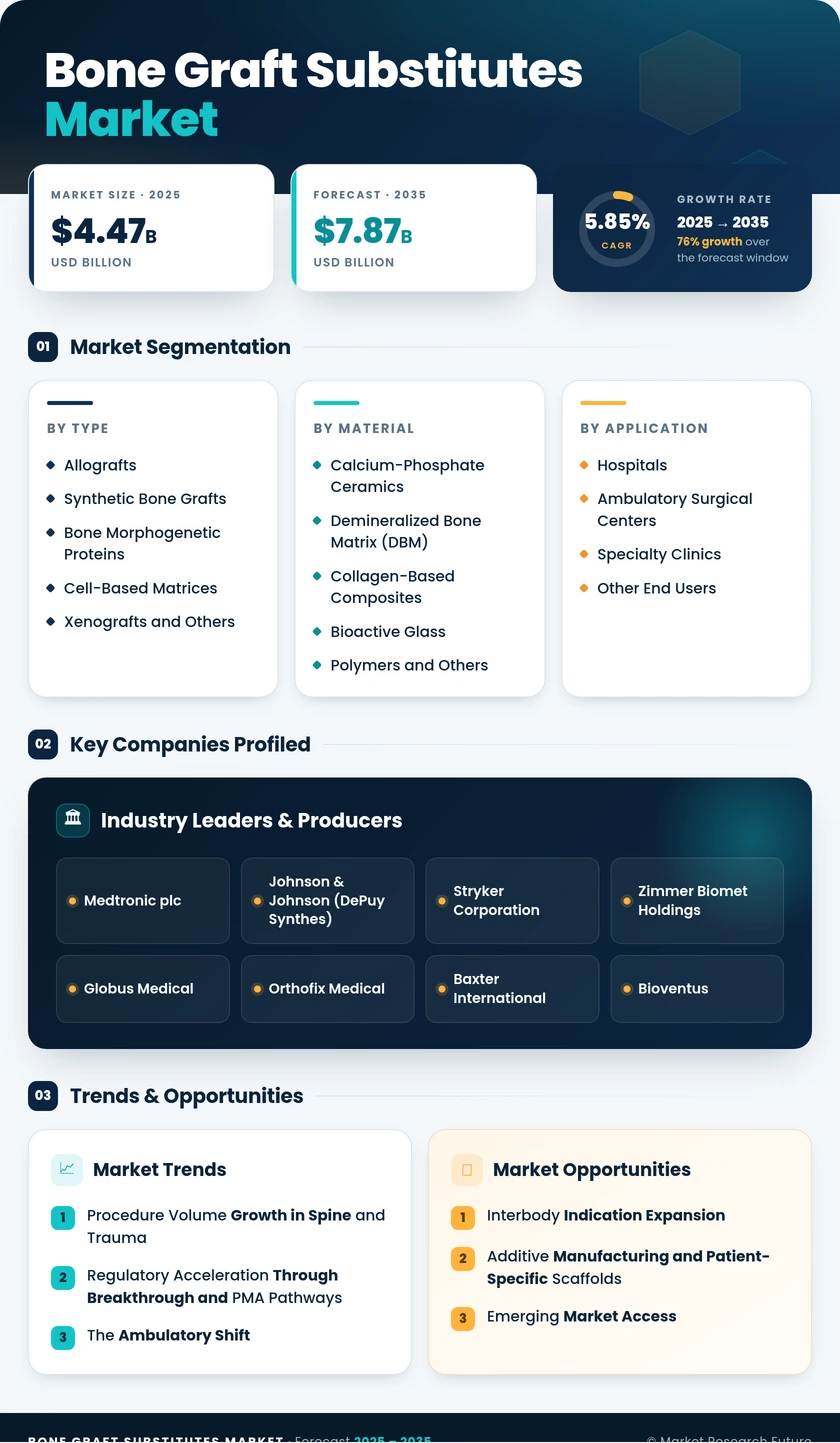
Segmentation Quick Reference
| Dimension | Sub-Segments | Dominant Segment | Fastest Growing Segment |
| By Product Type | Allografts; Synthetic Bone Grafts; Bone Morphogenetic Proteins; Cell-Based Matrices; Xenografts and Others | Allografts | Cell-Based Matrices |
| By Material | Calcium-Phosphate Ceramics; DBM; Collagen-Based Composites; Bioactive Glass; Polymers and Others | Calcium-Phosphate Ceramics | Bioactive Glass |
| By Application | Spinal Fusion; Trauma & Craniomaxillofacial; Joint Reconstruction; Dental & Oral Surgery; Other Applications | Spinal Fusion | Dental & Oral Surgery |
| By End User | Hospitals; Ambulatory Surgical Centers; Specialty Clinics; Other End Users | Hospitals | Ambulatory Surgical Centers |
| By Geography | North America; Europe; Asia-Pacific; South America; Middle East & Africa | North America | Asia-Pacific |
Market Segmentation Overview
By Product Type
| Sub-Segment | Key Trend |
| Allografts | Share erodes gradually as processing costs and donor variability favour engineered alternatives. |
| Synthetic Bone Grafts | Interbody clearances from 2024 onward remove the last labeling disadvantage versus tissue. |
| Bone Morphogenetic Proteins | Confined to complex and revision fusion where premium pricing is defensible |
| Cell-Based Matrices | Fastest expansion on osteoinductive claims in difficult unions |
| Xenografts and Others | Concentrated in dental and craniomaxillofacial reconstruction |
Product-type competition has shifted from biological origin to surface engineering. Manufacturers now differentiate on porosity architecture and topography rather than on whether the material is human, animal, or synthetic in origin.
By Material
| Sub-Segment | Key Trend |
| Calcium-Phosphate Ceramics | Cost-efficient baseline; volume leader under tender procurement |
| DBM | Valued for intraoperative handling in trauma theatres |
| Collagen-Based Composites | Growing as carrier chemistry for peptide and growth-factor products |
| Bioactive Glass | Antibacterial surface drives adoption in infection-risk revision cases. |
| Polymers and Others | Resorbable scaffolds gaining ground in craniomaxillofacial reconstruction. |
Material boundaries are dissolving. Composite constructs that pair a ceramic scaffold with collagen carriers and peptide surface chemistry increasingly outperform single-material grafts, and additive manufacturing makes graded-porosity designs commercially viable.
By Application
| Sub-Segment | Key Trend |
| Spinal Fusion | Anchor application; highest graft consumption per case |
| Trauma & Craniomaxillofacial | Road-traffic and occupational injury volumes sustain demand. |
| Joint Reconstruction | Revision arthroplasty bone loss creates steady pull. |
| Dental & Oral Surgery | Implant-site preservation drives above-average growth. |
| Other Applications | Oncology defect reconstruction remains specialised and low-volume |
Spinal fusion keeps its majority through 2035, but its share compresses as dental and joint reconstruction outpace it. Tissue processors have begun treating oral surgery as a primary commercial channel rather than a secondary outlet.
By End User
| Sub-Segment | Key Trend |
| Hospitals | Retain complex multi-level fusion and revision volume |
| Ambulatory Surgical Centers | Fastest growth; favour pre-loaded, ready-to-use graft formats |
| Specialty Clinics | Dental and minor orthopaedic interventions expand steadily. |
| Other End Users | Academic and military trauma centres drive early adoption of novel materials. |
End-user mix is reshaping product design. Outpatient settings reward small-format putties and single-use delivery systems that reduce room turnover, pushing manufacturers to package for workflow as much as for biology.
By Region
| Sub-Segment | Key Trend |
| North America | Channel access and registry evidence determine share |
| Europe | MDR recertification narrows available product catalogues |
| Asia-Pacific | Local manufacturing scales while volume-based procurement compresses pricing |
| South America | Trauma-led case mix favours cost-efficient ceramics |
| Middle East & Africa | Sovereign health programmes specify premium Western-approved biologics. |
Geographic strategy now diverges sharply by region. Western markets compete on clinical evidence and contracting sophistication, while Asia-Pacific and South America compete primarily on landed cost and local registration speed.


 Noah Malgeri
Co-Founder

 Peter Groot koerkamp
Account and Business Manager

 Younghwan Choi
Senior Retail Manager

 Mark Irwin
Management Consultant

 Akif Moroglu
Strategy & Business Development Director

 Guilherme Gomes Martins
Product Management Director

 Joseph Aguayo
Sales Operations & Pricing Manager

 La Terria Dodd
Program Support Specialist

 Rob Kooiker
Group Product Manager HVAC & Fire Protection GMA