×
Request Free Sample ×

Kindly complete the form below to receive a free sample of this Report

* Please use a valid business email

Leading companies partner with us for data-driven Insights

clients tt-cursor
Hero Background
English
Chinese
French
Japanese
Korean
German
Spanish

Bonded Abrasives Market Size

ID: MRFR/CnM/1973-HCR
135 Pages
Anshula Mandaokar
February 2026

Bonded Abrasive Market Research Report Information By Material (Natural and Synthetic), By Product Type (Bonded, Coated, and Super), By Application (Automotive, Electrical & Electronics, Metal Fabrication, Machinery, and Others), And By Region (North America, Europe, Asia-Pacific, And Rest Of The World) – Market Forecast Till 2035

Share:
Download PDF ×

We do not share your information with anyone. However, we may send you emails based on your report interest from time to time. You may contact us at any time to opt-out.

Bonded Abrasives Market Infographic
Purchase Options

Bonded Abrasives Size

Bonded Abrasives Market Growth Projections and Opportunities

The bonded abrasive market is affected by many things that together make what it does. These money elements are very important in deciding how much demand and supply there is, as well as the overall actions of the bonded abrasive industry. The market for bonded abrasive can change a lot depending on the economy. When the economy grows, higher industrial activities and production push up need for bonded abrasives. On the other hand, a bad economy might cause less manufacturing and hurt how well the market does. People use bonded abrasives a lot in different industries like cars, buildings and metalwork. This need rises with the growth of these jobs. When construction projects or car making increase, it positively affects demand in the market. Changes in making things and using materials can directly affect the market for bonded abrasives. Better tools and ways of making things help improve product workings. It also changes what is popular in the market. The bonded abrasive market is influenced by world trade actions and rules. Taxes, trade deals and big world things can change the price of raw stuff used for products. This also affects how markets look like overall. Making more people aware and putting in strong rules for the environment are changing how the bonded abrasive market works. Makers are forced to use green ways of making their products and materials, affecting how much it costs them and what people want. The abrasive-bonded industry uses lots of raw materials like grains, bonding stuff and rough things to work with. Changes in the prices of these raw materials directly affect how much it costs to make bonded abrasives. This, in turn, affects their market prices. There are many people in the market who compete on things like product quality, price and new ideas. Very strong competition can cause price battles and more work in researching new products. Changes in what people like to buy and new ways of making things add different sides to the bonded abrasive market. Makers must change to these likes so they can stay ahead in the competition. Rules about safety in workplaces and standards for product quality are very important to the bonded abrasive market. Following these rules is very important for people in the market to make sure their products are accepted and trusted by customers. How good the infrastructure is in different areas changes how much bonded abrasives are needed. Areas with big construction work need more rough materials for building tasks and similar activities. The market for bonded abrasives can be affected by changes in money values. Changes in currency values can affect the price of imported raw materials and completed goods.
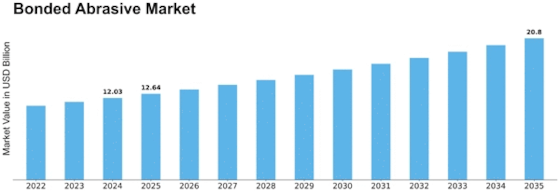
Bonded Abrasives Market Size Graph
Author
Anshula Mandaokar
Team Lead - Research

Anshula Mandaokar holds an academic degree in Chemical Engineering and has been contributing to the field for more than 5 years. She has expertise in Market Research and Business Consulting and serves as a Team Lead for a reputed Market Research firm under the Chemicals and Materials domain spectrum. She has worked on multiple projects, generating explicit results in a quick turnaround time. Her understanding of data interpretation justifies her role as a leader.

Leave a Comment

FAQs

What is the projected market valuation of the Bonded Abrasive Market by 2035?

<p>The Bonded Abrasive Market is projected to reach a valuation of 20.8 USD Billion by 2035.</p>

What was the market valuation of the Bonded Abrasive Market in 2024?

<p>In 2024, the Bonded Abrasive Market was valued at 12.03 USD Billion.</p>

What is the expected CAGR for the Bonded Abrasive Market during the forecast period 2025 - 2035?

<p>The expected CAGR for the Bonded Abrasive Market during the forecast period 2025 - 2035 is 5.1%.</p>

Which companies are considered key players in the Bonded Abrasive Market?

<p>Key players in the Bonded Abrasive Market include Saint-Gobain, 3M, Norton Abrasives, Tyrolit, Klingspor, Carborundum Universal Limited, Abrasive Technology, Sait Abrasivi, and Fujian Fengli.</p>

What are the projected valuations for Natural and Synthetic bonded abrasives by 2035?

<p>By 2035, Natural bonded abrasives are projected to reach 6.4 USD Billion, while Synthetic bonded abrasives may reach 14.4 USD Billion.</p>

How do the product types of bonded abrasives compare in terms of market valuation?

<p>By 2035, Bonded abrasives are expected to reach 8.0 USD Billion, Coated abrasives 6.0 USD Billion, and Super abrasives 6.8 USD Billion.</p>

What applications are driving growth in the Bonded Abrasive Market?

<p>The applications driving growth include Automotive, Electrical & Electronics, Metal Fabrication, and Machinery, with Metal Fabrication projected to reach 5.5 USD Billion by 2035.</p>

What was the market valuation for Automotive applications in 2024?

<p>In 2024, the market valuation for Automotive applications was 2.5 USD Billion.</p>

What is the expected growth for Electrical & Electronics applications by 2035?

<p>Electrical & Electronics applications are expected to grow to 3.2 USD Billion by 2035.</p>

How does the Bonded Abrasive Market's growth compare to other segments?

<p>The Bonded Abrasive Market's growth appears robust, with a projected valuation of 8.0 USD Billion by 2035, indicating a strong performance relative to other segments.</p>

Market Summary

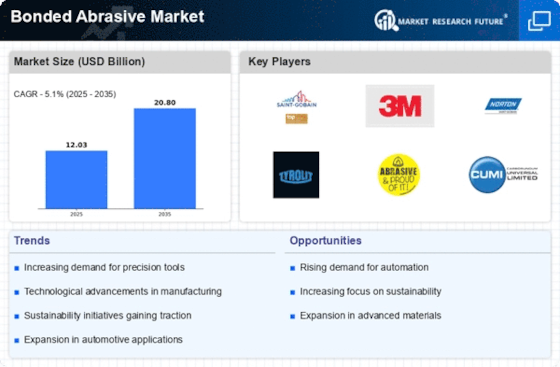
As per Market Research Future analysis, the Bonded Abrasive Market Size was estimated at 12.03 USD Billion in 2024. The Bonded Abrasive industry is projected to grow from 12.65 USD Billion in 2025 to 20.8 USD Billion by 2035, exhibiting a compound annual growth rate (CAGR) of 5.1% during the forecast period 2025 - 2035

Key Market Trends & Highlights

The Bonded Abrasive Market is poised for growth driven by technological advancements and diverse applications.

  • North America remains the largest market for bonded abrasives, reflecting robust demand across various industries.
  • The Asia-Pacific region is emerging as the fastest-growing market, fueled by rapid industrialization and urbanization.
  • Synthetic bonded abrasives dominate the market, while natural bonded abrasives are witnessing the fastest growth due to increasing eco-consciousness.
  • Key drivers include rising demand in the automotive sector and expansion of construction activities, which are propelling market growth.

Market Size & Forecast

2024 Market Size 12.03 (USD Billion)
2035 Market Size 20.8 (USD Billion)
CAGR (2025 - 2035) 5.1%
Largest Regional Market Share in 2024 Asia Pacific

Major Players

Saint-Gobain (FR), 3M (US), Norton Abrasives (US), Tyrolit (AT), Klingspor (DE), Carborundum Universal Limited (IN), Abrasive Technology (US), Sait Abrasivi (IT), Fujian Fengli (CN)

Market Trends

The Bonded Abrasive Market is currently experiencing a dynamic evolution, driven by advancements in manufacturing technologies and increasing demand across various industries. The integration of innovative materials and processes appears to enhance the performance and efficiency of bonded abrasives, making them more appealing to end-users. Furthermore, the growing emphasis on sustainability and eco-friendly practices is influencing manufacturers to develop products that align with environmental standards. This shift not only caters to consumer preferences but also positions companies favorably in a competitive landscape. In addition, the Bonded Abrasive Market is witnessing a notable expansion in applications, particularly in sectors such as automotive, aerospace, and construction. As these industries continue to evolve, the need for high-quality abrasives that can withstand rigorous conditions becomes paramount. The market seems poised for further growth, as technological advancements and increased investment in research and development pave the way for innovative solutions. Overall, the Bonded Abrasive Market reflects a complex interplay of factors that could shape its trajectory in the coming years.

Sustainability Initiatives

The Bonded Abrasive Market is increasingly influenced by sustainability initiatives, as manufacturers strive to create eco-friendly products. This trend reflects a broader commitment to reducing environmental impact, which resonates with consumers and regulatory bodies alike.

Technological Advancements

Technological advancements are reshaping the Bonded Abrasive Market, with innovations in materials and production techniques enhancing product performance. These developments enable manufacturers to meet the evolving demands of various industries more effectively.

Diverse Applications

The Bonded Abrasive Market is expanding into diverse applications, particularly in sectors such as automotive and construction. This diversification indicates a growing recognition of the versatility and utility of bonded abrasives in meeting specific industry needs.

Bonded Abrasives Market Market Drivers

Growth in Metalworking Industry

The metalworking industry is experiencing substantial growth, which is expected to positively impact the Bonded Abrasive Market. As industries such as aerospace, defense, and machinery manufacturing expand, the demand for bonded abrasives is likely to increase. In recent years, the metalworking sector has reported a compound annual growth rate (CAGR) of around 4%, driven by the need for precision tools and components. Bonded abrasives are essential for various metalworking applications, including cutting, grinding, and polishing. This growth in the metalworking industry presents a significant opportunity for the Bonded Abrasive Market to provide specialized products that cater to the evolving needs of manufacturers.

Rising Demand in Automotive Sector

The automotive sector is experiencing a notable surge in demand for bonded abrasives, primarily due to the increasing production of vehicles and the need for precision machining. As manufacturers strive for enhanced efficiency and quality, the Bonded Abrasive Market is poised to benefit significantly. In 2023, the automotive industry accounted for approximately 30% of the total demand for bonded abrasives, reflecting a trend that is likely to continue. This growth is driven by the need for high-performance materials that can withstand rigorous manufacturing processes. Furthermore, the shift towards electric vehicles is expected to create new opportunities within the Bonded Abrasive Market, as these vehicles require specialized components that necessitate advanced abrasive solutions.

Expansion of Construction Activities

The construction industry is witnessing a robust expansion, which is anticipated to drive the Bonded Abrasive Market forward. With increasing investments in infrastructure development and residential projects, the demand for bonded abrasives is likely to rise. In recent years, the construction sector has shown a growth rate of around 5% annually, leading to a heightened need for cutting, grinding, and finishing tools. Bonded abrasives play a crucial role in these applications, ensuring precision and quality in construction materials. As urbanization continues to accelerate, the Bonded Abrasive Market is expected to capitalize on this trend, providing essential products that meet the evolving needs of the construction sector.

Technological Innovations in Manufacturing

Technological advancements in manufacturing processes are significantly influencing the Bonded Abrasive Market. Innovations such as automated machining and computer numerical control (CNC) technologies are enhancing the efficiency and precision of abrasive applications. These developments are likely to increase the demand for high-quality bonded abrasives that can perform under stringent conditions. In 2023, the market for bonded abrasives in manufacturing was valued at approximately USD 2 billion, with projections indicating a steady growth trajectory. As manufacturers seek to optimize production and reduce waste, the Bonded Abrasive Market is expected to adapt by offering innovative solutions that align with these technological trends.

Increasing Focus on Quality and Performance

There is a growing emphasis on quality and performance across various industries, which is influencing the Bonded Abrasive Market. As companies strive to enhance product quality and operational efficiency, the demand for high-performance bonded abrasives is likely to rise. Industries such as aerospace and automotive are particularly focused on achieving superior finishes and tolerances, which bonded abrasives can provide. In 2023, the market for high-performance bonded abrasives was estimated to be worth USD 1.5 billion, reflecting a trend towards premium products. This focus on quality is expected to drive innovation within the Bonded Abrasive Market, as manufacturers seek to develop advanced materials that meet stringent performance criteria.

Market Segment Insights

By Material: Synthetic (Largest) vs. Natural (Fastest-Growing)

In the Bonded Abrasive Market, the material segment has seen a clear division between synthetic and natural abrasives. Synthetic materials dominate the market, accounting for a significant portion of overall share due to their consistent quality and performance in industrial applications. This makes synthetic materials the preferred choice for manufacturers looking for reliability and efficiency in production processes. On the other hand, the natural material segment is experiencing rapid growth, driven by increasing demand for sustainable and eco-friendly products. This shift in consumer preferences towards environmentally conscious choices is fueling the expansion of the natural abrasive market segment, making it one of the fastest-growing areas within the bonded abrasives industry, as it caters to a niche market prioritizing sustainability.

Material: Synthetic (Dominant) vs. Natural (Emerging)

Synthetic abrasives are predominantly used in various industrial applications due to their durability and consistency. They are manufactured using advanced technologies, allowing for precise control over their characteristics, which leads to enhanced performance and longer life. Natural abrasives, while considered emerging, are gaining traction owing to a rising inclination towards eco-friendly solutions. Although they may not match the performance levels of synthetic options, natural abrasives offer unique qualities, such as reduced environmental impact and traditional usage in specific applications. As consumers become more environmentally aware, natural abrasives are likely to forge a significant market presence, positioning them as a competitive alternative to their synthetic counterparts.

By Product Type: Bonded (Largest) vs. Coated (Fastest-Growing)

In the Bonded Abrasive Market, the product type segment exhibits a pronounced distribution of market share among its constituents. Bonded abrasives dominate the landscape, capturing a significant portion due to their widespread application in various industries, including metalworking and woodworking. <a href="https://www.marketresearchfuture.com/reports/coated-abrasives-market-2413" target="_blank" title="coated abrasives">Coated abrasives</a>, while trailing in overall share, are gaining traction due to their versatility and enhanced performance in certain applications, making them a crucial player in market dynamics.

Bonded (Dominant) vs. Coated (Emerging)

Bonded abrasives are the bastions of strength and durability in the abrasives market. Their structure, which typically consists of a solid matrix holding abrasive grains, makes them ideal for heavy-duty applications, such as cutting and grinding metals. In contrast, coated abrasives offer flexibility and adaptability, often utilized in sanding and finishing processes. The rapid emergence of coated abrasives can be attributed to their innovative manufacturing techniques and their growing acceptance in industries that demand precision and efficiency. While bonded abrasives maintain a dominant market presence, the rising demand for coated variants suggests a shift towards more specialized applications, showcasing an evolving market landscape.

By Application: Automotive (Largest) vs. Electrical & Electronics (Fastest-Growing)

In the Bonded Abrasive Market, the application segment reveals a diversified distribution of market share among its key areas. The automotive sector stands out as the largest, utilizing bonded abrasives extensively for surface finishing, polishing, and cutting tasks required in vehicle manufacturing. Following closely, the electrical and electronics sector is gaining traction due to the rising demand for precision machining in electronic components, signifying significant potential within this segment.

Automotive: Bonded Abrasives Market (Dominant) vs. Electrical & Electronics (Emerging)

The automotive application of bonded abrasives is characterized by its extensive utilization in various manufacturing processes, including grinding, cutting, and polishing. This segment benefits from innovative advancements in abrasive technologies, allowing for greater efficiency and effectiveness in auto part production. In contrast, the electrical and electronics sector, while currently smaller in comparison, shows rapid growth driven by emerging technologies and the need for high-precision finishing in electronic devices. As industries aim for improved performance and quality, bonded abrasives are proving to be essential in meeting the stringent requirements of both segments.

Get more detailed insights about Bonded Abrasive Market Research Report - Global Forecast till 2035

Regional Insights

North America : Market Leader in Innovation

North America is the largest market for bonded abrasives, holding approximately 40% of the global share. The growth is driven by increasing demand in automotive and aerospace sectors, alongside stringent regulations promoting safety and efficiency. The region's focus on technological advancements and sustainable practices further fuels market expansion. The United States and Canada are the leading countries, with major players like 3M and Norton Abrasives dominating the landscape. The competitive environment is characterized by continuous innovation and strategic partnerships, ensuring a robust supply chain and product availability.

Europe : Diverse Market Dynamics

Europe is the second-largest market for bonded abrasives, accounting for around 30% of the global market share. The region benefits from a strong manufacturing base and increasing investments in infrastructure and automotive industries. Regulatory frameworks focused on environmental sustainability are also driving innovation in product development. Germany, France, and the UK are key players in this market, with companies like Klingspor and Tyrolit leading the charge. The competitive landscape is marked by a mix of established firms and emerging players, fostering a dynamic environment for growth and collaboration.

Asia-Pacific : Emerging Market Potential

Asia-Pacific is witnessing significant growth in the bonded abrasives market, holding approximately 25% of the global share. The rapid industrialization and urbanization in countries like China and India are key drivers of this growth. Additionally, government initiatives aimed at boosting manufacturing capabilities are creating a favorable environment for market expansion. China is the largest market in the region, with Fujian Fengli and Carborundum Universal Limited being prominent players. The competitive landscape is evolving, with local manufacturers increasingly investing in technology to enhance product quality and meet international standards, thereby strengthening their market position.

Middle East and Africa : Untapped Market Opportunities

The Middle East and Africa region is gradually emerging in the bonded abrasives market, currently holding about 5% of the global share. The growth is primarily driven by increasing construction activities and a rising demand for high-quality abrasives in various industries. Government investments in infrastructure projects are also acting as catalysts for market development. Countries like South Africa and the UAE are leading the market, with a growing presence of international players. The competitive landscape is characterized by a mix of local and global companies, focusing on innovation and quality to capture the growing demand in this region.

Key Players and Competitive Insights

Major market players are spending a lot of money on R&D to increase their product lines, which will help the Bonded Abrasive market grow even more. Market participants are also taking a range of strategic initiatives to grow their worldwide footprint, with key market developments such as new product launches, contractual agreements, mergers and acquisitions, increased investments, and collaboration with other organizations. Competitors in the Bonded Abrasive industry must offer cost-effective items to expand and survive in an increasingly competitive and rising market environment.
The major market players are investing a lot of money in R&D to expand their product lines, which will spur further market growth for Bonded Abrasive. With significant market development like new product releases, contractual agreements, mergers and acquisitions, increased investments, and collaboration with other organizations, market participants are also undertaking various strategic activities to expand their presence. To grow and thrive in a market climate that is becoming more competitive and growing, competitors in the Bonded Abrasive industry must offer affordable products.
Manufacturing locally to cut operating costs is one of the main business tactics manufacturers use in the  Bonded Abrasive industry to benefit customers and expand the market sector. The Low-Profile Additives market has recently given medicine some of the most important advantages. Major Bonded Abrasive market players, including Saint-Gobain (US), 3M (US), Buffalo Abrasives Inc (US), Abrasives Manhattan, SA (Spain), and others, are attempting to increase market demand by funding R&D initiatives.
Saint-Gobain is a company that designs, manufactures, and distributes materials and solutions for the construction, mobility, healthcare, life sciences, and general manufacturing markets. It offers flat glass, thermal insulation, solar control, light transmission, interior decoration as well as bulletproof and fireproof glass. The company also provides ceramic raw materials, gypsum, insulation, mortars, pipe systems for drinking water
Also, 3M (formerly Minnesota Mining and Manufacturing) is a technology company that provides product development, manufacturing, and marketing. It operates through four business segments: Safety and Industrial, Transportation and Electronics, Health Care, and Consumer. The Safety and Industrial segment specializes in personal safety, industrial adhesives and tapes, abrasives, closure and masking systems, electrical markets,

Key Companies in the Bonded Abrasives Market include

Industry Developments

  • Q2 2024: Saint-Gobain Abrasives Expands Manufacturing Capacity in India Saint-Gobain Abrasives announced the opening of a new bonded abrasives manufacturing line at its Bangalore facility, aiming to meet growing demand in the automotive and metalworking sectors.
  • Q1 2024: Norton Abrasives Launches Next-Generation Vitrified Grinding Wheels Norton Abrasives introduced a new line of vitrified bonded grinding wheels designed for high-precision applications in aerospace and automotive manufacturing, featuring improved durability and cutting efficiency.
  • Q2 2024: 3M Appoints New Head of Abrasives Division 3M announced the appointment of a new executive to lead its global abrasives division, signaling a renewed focus on innovation and expansion in bonded abrasive products.
  • Q3 2024: Tyrolit Opens New R&D Center for Bonded Abrasives Market in Austria Tyrolit inaugurated a state-of-the-art research and development center dedicated to bonded abrasives, aiming to accelerate product innovation and sustainability initiatives.
  • Q2 2024: Bosch Acquires Minority Stake in Indian Abrasives Manufacturer Bosch announced the acquisition of a minority stake in an Indian bonded abrasives company to strengthen its supply chain and expand its presence in the Asia-Pacific market.
  • Q1 2025: Saint-Gobain Signs Strategic Partnership with Japanese Toolmaker Saint-Gobain entered a strategic partnership with a leading Japanese tool manufacturer to co-develop advanced bonded abrasive solutions for precision machining.
  • Q2 2025: Nippon Resibon Announces Major Expansion of Bonded Abrasives Market Plant Nippon Resibon revealed plans to double the capacity of its bonded abrasives manufacturing facility in Osaka, citing increased demand from the electronics and automotive sectors.
  • Q1 2024: Carborundum Universal Wins Multi-Year Supply Contract with European Automotive OEM Carborundum Universal secured a multi-year contract to supply bonded abrasive products to a major European automotive manufacturer, supporting the OEM's production of electric vehicles.
  • Q3 2024: Sia Abrasives Launches Eco-Friendly Bonded Abrasive Line Sia Abrasives, a Bosch subsidiary, launched a new range of eco-friendly bonded abrasives using recycled materials, targeting sustainability-conscious industrial customers.
  • Q2 2025: Tyrolit Acquires Brazilian Bonded Abrasives Market Producer Tyrolit completed the acquisition of a leading Brazilian bonded abrasives manufacturer, expanding its footprint in South America and enhancing its product portfolio.
  • Q1 2025: Saint-Gobain Abrasives Receives ISO 14001 Certification for Bonded Abrasives Market Plant Saint-Gobain Abrasives announced that its main bonded abrasives manufacturing facility in France has achieved ISO 14001 environmental management certification.
  • Q3 2024: 3M Launches Automated Bonded Abrasive Production Line in Germany 3M unveiled a fully automated production line for bonded abrasives at its German facility, aiming to boost efficiency and meet rising demand in the European market.

Future Outlook

Bonded Abrasives Market Future Outlook

The Bonded Abrasive Market is projected to grow at a 5.1% CAGR from 2025 to 2035, driven by technological advancements, increasing demand in manufacturing, and rising automation.

New opportunities lie in:

  • Development of eco-friendly bonded abrasives for sustainable manufacturing practices.
  • Expansion into emerging markets with tailored product offerings.
  • Integration of smart technology in abrasive tools for enhanced performance monitoring.

By 2035, the Bonded Abrasive Market is expected to achieve robust growth and innovation.

Market Segmentation

Bonded Abrasives Market Material Outlook

  • Natural
  • Synthetic

Bonded Abrasives Market Application Outlook

  • Automotive
  • Electrical & Electronics
  • Metal Fabrication
  • Machinery
  • Others

Bonded Abrasives Market Product Type Outlook

  • Bonded
  • Coated
  • Super

Report Scope

MARKET SIZE 2024 12.03(USD Billion)
MARKET SIZE 2025 12.65(USD Billion)
MARKET SIZE 2035 20.8(USD Billion)
COMPOUND ANNUAL GROWTH RATE (CAGR) 5.1% (2025 - 2035)
REPORT COVERAGE Revenue Forecast, Competitive Landscape, Growth Factors, and Trends
BASE YEAR 2024
Market Forecast Period 2025 - 2035
Historical Data 2019 - 2024
Market Forecast Units USD Billion
Key Companies Profiled Saint-Gobain (FR), 3M (US), Norton Abrasives (US), Tyrolit (AT), Klingspor (DE), Carborundum Universal Limited (IN), Abrasive Technology (US), Sait Abrasivi (IT), Fujian Fengli (CN)
Segments Covered Material, Product Type, Application, Region
Key Market Opportunities Integration of advanced materials and automation technologies enhances efficiency in the Bonded Abrasive Market.
Key Market Dynamics Technological advancements and regulatory changes drive innovation and competition in the bonded abrasive market.
Countries Covered North America, Europe, APAC, South America, MEA

FAQs

What is the projected market valuation of the Bonded Abrasive Market by 2035?

<p>The Bonded Abrasive Market is projected to reach a valuation of 20.8 USD Billion by 2035.</p>

What was the market valuation of the Bonded Abrasive Market in 2024?

<p>In 2024, the Bonded Abrasive Market was valued at 12.03 USD Billion.</p>

What is the expected CAGR for the Bonded Abrasive Market during the forecast period 2025 - 2035?

<p>The expected CAGR for the Bonded Abrasive Market during the forecast period 2025 - 2035 is 5.1%.</p>

Which companies are considered key players in the Bonded Abrasive Market?

<p>Key players in the Bonded Abrasive Market include Saint-Gobain, 3M, Norton Abrasives, Tyrolit, Klingspor, Carborundum Universal Limited, Abrasive Technology, Sait Abrasivi, and Fujian Fengli.</p>

What are the projected valuations for Natural and Synthetic bonded abrasives by 2035?

<p>By 2035, Natural bonded abrasives are projected to reach 6.4 USD Billion, while Synthetic bonded abrasives may reach 14.4 USD Billion.</p>

How do the product types of bonded abrasives compare in terms of market valuation?

<p>By 2035, Bonded abrasives are expected to reach 8.0 USD Billion, Coated abrasives 6.0 USD Billion, and Super abrasives 6.8 USD Billion.</p>

What applications are driving growth in the Bonded Abrasive Market?

<p>The applications driving growth include Automotive, Electrical & Electronics, Metal Fabrication, and Machinery, with Metal Fabrication projected to reach 5.5 USD Billion by 2035.</p>

What was the market valuation for Automotive applications in 2024?

<p>In 2024, the market valuation for Automotive applications was 2.5 USD Billion.</p>

What is the expected growth for Electrical & Electronics applications by 2035?

<p>Electrical & Electronics applications are expected to grow to 3.2 USD Billion by 2035.</p>

How does the Bonded Abrasive Market's growth compare to other segments?

<p>The Bonded Abrasive Market's growth appears robust, with a projected valuation of 8.0 USD Billion by 2035, indicating a strong performance relative to other segments.</p>

  1. SECTION I: EXECUTIVE SUMMARY AND KEY HIGHLIGHTS
    1. | 1.1 EXECUTIVE SUMMARY
    2. | | 1.1.1 Market Overview
    3. | | 1.1.2 Key Findings
    4. | | 1.1.3 Market Segmentation
    5. | | 1.1.4 Competitive Landscape
    6. | | 1.1.5 Challenges and Opportunities
    7. | | 1.1.6 Future Outlook
  2. SECTION II: SCOPING, METHODOLOGY AND MARKET STRUCTURE
    1. | 2.1 MARKET INTRODUCTION
    2. | | 2.1.1 Definition
    3. | | 2.1.2 Scope of the study
    4. | | | 2.1.2.1 Research Objective
    5. | | | 2.1.2.2 Assumption
    6. | | | 2.1.2.3 Limitations
    7. | 2.2 RESEARCH METHODOLOGY
    8. | | 2.2.1 Overview
    9. | | 2.2.2 Data Mining
    10. | | 2.2.3 Secondary Research
    11. | | 2.2.4 Primary Research
    12. | | | 2.2.4.1 Primary Interviews and Information Gathering Process
    13. | | | 2.2.4.2 Breakdown of Primary Respondents
    14. | | 2.2.5 Forecasting Model
    15. | | 2.2.6 Market Size Estimation
    16. | | | 2.2.6.1 Bottom-Up Approach
    17. | | | 2.2.6.2 Top-Down Approach
    18. | | 2.2.7 Data Triangulation
    19. | | 2.2.8 Validation
  3. SECTION III: QUALITATIVE ANALYSIS
    1. | 3.1 MARKET DYNAMICS
    2. | | 3.1.1 Overview
    3. | | 3.1.2 Drivers
    4. | | 3.1.3 Restraints
    5. | | 3.1.4 Opportunities
    6. | 3.2 MARKET FACTOR ANALYSIS
    7. | | 3.2.1 Value chain Analysis
    8. | | 3.2.2 Porter's Five Forces Analysis
    9. | | | 3.2.2.1 Bargaining Power of Suppliers
    10. | | | 3.2.2.2 Bargaining Power of Buyers
    11. | | | 3.2.2.3 Threat of New Entrants
    12. | | | 3.2.2.4 Threat of Substitutes
    13. | | | 3.2.2.5 Intensity of Rivalry
    14. | | 3.2.3 COVID-19 Impact Analysis
    15. | | | 3.2.3.1 Market Impact Analysis
    16. | | | 3.2.3.2 Regional Impact
    17. | | | 3.2.3.3 Opportunity and Threat Analysis
  4. SECTION IV: QUANTITATIVE ANALYSIS
    1. | 4.1 Chemicals and Materials, BY Material (USD Billion)
    2. | | 4.1.1 Natural
    3. | | 4.1.2 Synthetic
    4. | 4.2 Chemicals and Materials, BY Product Type (USD Billion)
    5. | | 4.2.1 Bonded
    6. | | 4.2.2 Coated
    7. | | 4.2.3 Super
    8. | 4.3 Chemicals and Materials, BY Application (USD Billion)
    9. | | 4.3.1 Automotive
    10. | | 4.3.2 Electrical & Electronics
    11. | | 4.3.3 Metal Fabrication
    12. | | 4.3.4 Machinery
    13. | | 4.3.5 Others
    14. | 4.4 Chemicals and Materials, BY Region (USD Billion)
    15. | | 4.4.1 North America
    16. | | | 4.4.1.1 US
    17. | | | 4.4.1.2 Canada
    18. | | 4.4.2 Europe
    19. | | | 4.4.2.1 Germany
    20. | | | 4.4.2.2 UK
    21. | | | 4.4.2.3 France
    22. | | | 4.4.2.4 Russia
    23. | | | 4.4.2.5 Italy
    24. | | | 4.4.2.6 Spain
    25. | | | 4.4.2.7 Rest of Europe
    26. | | 4.4.3 APAC
    27. | | | 4.4.3.1 China
    28. | | | 4.4.3.2 India
    29. | | | 4.4.3.3 Japan
    30. | | | 4.4.3.4 South Korea
    31. | | | 4.4.3.5 Malaysia
    32. | | | 4.4.3.6 Thailand
    33. | | | 4.4.3.7 Indonesia
    34. | | | 4.4.3.8 Rest of APAC
    35. | | 4.4.4 South America
    36. | | | 4.4.4.1 Brazil
    37. | | | 4.4.4.2 Mexico
    38. | | | 4.4.4.3 Argentina
    39. | | | 4.4.4.4 Rest of South America
    40. | | 4.4.5 MEA
    41. | | | 4.4.5.1 GCC Countries
    42. | | | 4.4.5.2 South Africa
    43. | | | 4.4.5.3 Rest of MEA
  5. SECTION V: COMPETITIVE ANALYSIS
    1. | 5.1 Competitive Landscape
    2. | | 5.1.1 Overview
    3. | | 5.1.2 Competitive Analysis
    4. | | 5.1.3 Market share Analysis
    5. | | 5.1.4 Major Growth Strategy in the Chemicals and Materials
    6. | | 5.1.5 Competitive Benchmarking
    7. | | 5.1.6 Leading Players in Terms of Number of Developments in the Chemicals and Materials
    8. | | 5.1.7 Key developments and growth strategies
    9. | | | 5.1.7.1 New Product Launch/Service Deployment
    10. | | | 5.1.7.2 Merger & Acquisitions
    11. | | | 5.1.7.3 Joint Ventures
    12. | | 5.1.8 Major Players Financial Matrix
    13. | | | 5.1.8.1 Sales and Operating Income
    14. | | | 5.1.8.2 Major Players R&D Expenditure. 2023
    15. | 5.2 Company Profiles
    16. | | 5.2.1 Saint-Gobain (FR)
    17. | | | 5.2.1.1 Financial Overview
    18. | | | 5.2.1.2 Products Offered
    19. | | | 5.2.1.3 Key Developments
    20. | | | 5.2.1.4 SWOT Analysis
    21. | | | 5.2.1.5 Key Strategies
    22. | | 5.2.2 3M (US)
    23. | | | 5.2.2.1 Financial Overview
    24. | | | 5.2.2.2 Products Offered
    25. | | | 5.2.2.3 Key Developments
    26. | | | 5.2.2.4 SWOT Analysis
    27. | | | 5.2.2.5 Key Strategies
    28. | | 5.2.3 Norton Abrasives (US)
    29. | | | 5.2.3.1 Financial Overview
    30. | | | 5.2.3.2 Products Offered
    31. | | | 5.2.3.3 Key Developments
    32. | | | 5.2.3.4 SWOT Analysis
    33. | | | 5.2.3.5 Key Strategies
    34. | | 5.2.4 Tyrolit (AT)
    35. | | | 5.2.4.1 Financial Overview
    36. | | | 5.2.4.2 Products Offered
    37. | | | 5.2.4.3 Key Developments
    38. | | | 5.2.4.4 SWOT Analysis
    39. | | | 5.2.4.5 Key Strategies
    40. | | 5.2.5 Klingspor (DE)
    41. | | | 5.2.5.1 Financial Overview
    42. | | | 5.2.5.2 Products Offered
    43. | | | 5.2.5.3 Key Developments
    44. | | | 5.2.5.4 SWOT Analysis
    45. | | | 5.2.5.5 Key Strategies
    46. | | 5.2.6 Carborundum Universal Limited (IN)
    47. | | | 5.2.6.1 Financial Overview
    48. | | | 5.2.6.2 Products Offered
    49. | | | 5.2.6.3 Key Developments
    50. | | | 5.2.6.4 SWOT Analysis
    51. | | | 5.2.6.5 Key Strategies
    52. | | 5.2.7 Abrasive Technology (US)
    53. | | | 5.2.7.1 Financial Overview
    54. | | | 5.2.7.2 Products Offered
    55. | | | 5.2.7.3 Key Developments
    56. | | | 5.2.7.4 SWOT Analysis
    57. | | | 5.2.7.5 Key Strategies
    58. | | 5.2.8 Sait Abrasivi (IT)
    59. | | | 5.2.8.1 Financial Overview
    60. | | | 5.2.8.2 Products Offered
    61. | | | 5.2.8.3 Key Developments
    62. | | | 5.2.8.4 SWOT Analysis
    63. | | | 5.2.8.5 Key Strategies
    64. | | 5.2.9 Fujian Fengli (CN)
    65. | | | 5.2.9.1 Financial Overview
    66. | | | 5.2.9.2 Products Offered
    67. | | | 5.2.9.3 Key Developments
    68. | | | 5.2.9.4 SWOT Analysis
    69. | | | 5.2.9.5 Key Strategies
    70. | 5.3 Appendix
    71. | | 5.3.1 References
    72. | | 5.3.2 Related Reports
  6. LIST OF FIGURES
    1. | 6.1 MARKET SYNOPSIS
    2. | 6.2 NORTH AMERICA MARKET ANALYSIS
    3. | 6.3 US MARKET ANALYSIS BY MATERIAL
    4. | 6.4 US MARKET ANALYSIS BY PRODUCT TYPE
    5. | 6.5 US MARKET ANALYSIS BY APPLICATION
    6. | 6.6 CANADA MARKET ANALYSIS BY MATERIAL
    7. | 6.7 CANADA MARKET ANALYSIS BY PRODUCT TYPE
    8. | 6.8 CANADA MARKET ANALYSIS BY APPLICATION
    9. | 6.9 EUROPE MARKET ANALYSIS
    10. | 6.10 GERMANY MARKET ANALYSIS BY MATERIAL
    11. | 6.11 GERMANY MARKET ANALYSIS BY PRODUCT TYPE
    12. | 6.12 GERMANY MARKET ANALYSIS BY APPLICATION
    13. | 6.13 UK MARKET ANALYSIS BY MATERIAL
    14. | 6.14 UK MARKET ANALYSIS BY PRODUCT TYPE
    15. | 6.15 UK MARKET ANALYSIS BY APPLICATION
    16. | 6.16 FRANCE MARKET ANALYSIS BY MATERIAL
    17. | 6.17 FRANCE MARKET ANALYSIS BY PRODUCT TYPE
    18. | 6.18 FRANCE MARKET ANALYSIS BY APPLICATION
    19. | 6.19 RUSSIA MARKET ANALYSIS BY MATERIAL
    20. | 6.20 RUSSIA MARKET ANALYSIS BY PRODUCT TYPE
    21. | 6.21 RUSSIA MARKET ANALYSIS BY APPLICATION
    22. | 6.22 ITALY MARKET ANALYSIS BY MATERIAL
    23. | 6.23 ITALY MARKET ANALYSIS BY PRODUCT TYPE
    24. | 6.24 ITALY MARKET ANALYSIS BY APPLICATION
    25. | 6.25 SPAIN MARKET ANALYSIS BY MATERIAL
    26. | 6.26 SPAIN MARKET ANALYSIS BY PRODUCT TYPE
    27. | 6.27 SPAIN MARKET ANALYSIS BY APPLICATION
    28. | 6.28 REST OF EUROPE MARKET ANALYSIS BY MATERIAL
    29. | 6.29 REST OF EUROPE MARKET ANALYSIS BY PRODUCT TYPE
    30. | 6.30 REST OF EUROPE MARKET ANALYSIS BY APPLICATION
    31. | 6.31 APAC MARKET ANALYSIS
    32. | 6.32 CHINA MARKET ANALYSIS BY MATERIAL
    33. | 6.33 CHINA MARKET ANALYSIS BY PRODUCT TYPE
    34. | 6.34 CHINA MARKET ANALYSIS BY APPLICATION
    35. | 6.35 INDIA MARKET ANALYSIS BY MATERIAL
    36. | 6.36 INDIA MARKET ANALYSIS BY PRODUCT TYPE
    37. | 6.37 INDIA MARKET ANALYSIS BY APPLICATION
    38. | 6.38 JAPAN MARKET ANALYSIS BY MATERIAL
    39. | 6.39 JAPAN MARKET ANALYSIS BY PRODUCT TYPE
    40. | 6.40 JAPAN MARKET ANALYSIS BY APPLICATION
    41. | 6.41 SOUTH KOREA MARKET ANALYSIS BY MATERIAL
    42. | 6.42 SOUTH KOREA MARKET ANALYSIS BY PRODUCT TYPE
    43. | 6.43 SOUTH KOREA MARKET ANALYSIS BY APPLICATION
    44. | 6.44 MALAYSIA MARKET ANALYSIS BY MATERIAL
    45. | 6.45 MALAYSIA MARKET ANALYSIS BY PRODUCT TYPE
    46. | 6.46 MALAYSIA MARKET ANALYSIS BY APPLICATION
    47. | 6.47 THAILAND MARKET ANALYSIS BY MATERIAL
    48. | 6.48 THAILAND MARKET ANALYSIS BY PRODUCT TYPE
    49. | 6.49 THAILAND MARKET ANALYSIS BY APPLICATION
    50. | 6.50 INDONESIA MARKET ANALYSIS BY MATERIAL
    51. | 6.51 INDONESIA MARKET ANALYSIS BY PRODUCT TYPE
    52. | 6.52 INDONESIA MARKET ANALYSIS BY APPLICATION
    53. | 6.53 REST OF APAC MARKET ANALYSIS BY MATERIAL
    54. | 6.54 REST OF APAC MARKET ANALYSIS BY PRODUCT TYPE
    55. | 6.55 REST OF APAC MARKET ANALYSIS BY APPLICATION
    56. | 6.56 SOUTH AMERICA MARKET ANALYSIS
    57. | 6.57 BRAZIL MARKET ANALYSIS BY MATERIAL
    58. | 6.58 BRAZIL MARKET ANALYSIS BY PRODUCT TYPE
    59. | 6.59 BRAZIL MARKET ANALYSIS BY APPLICATION
    60. | 6.60 MEXICO MARKET ANALYSIS BY MATERIAL
    61. | 6.61 MEXICO MARKET ANALYSIS BY PRODUCT TYPE
    62. | 6.62 MEXICO MARKET ANALYSIS BY APPLICATION
    63. | 6.63 ARGENTINA MARKET ANALYSIS BY MATERIAL
    64. | 6.64 ARGENTINA MARKET ANALYSIS BY PRODUCT TYPE
    65. | 6.65 ARGENTINA MARKET ANALYSIS BY APPLICATION
    66. | 6.66 REST OF SOUTH AMERICA MARKET ANALYSIS BY MATERIAL
    67. | 6.67 REST OF SOUTH AMERICA MARKET ANALYSIS BY PRODUCT TYPE
    68. | 6.68 REST OF SOUTH AMERICA MARKET ANALYSIS BY APPLICATION
    69. | 6.69 MEA MARKET ANALYSIS
    70. | 6.70 GCC COUNTRIES MARKET ANALYSIS BY MATERIAL
    71. | 6.71 GCC COUNTRIES MARKET ANALYSIS BY PRODUCT TYPE
    72. | 6.72 GCC COUNTRIES MARKET ANALYSIS BY APPLICATION
    73. | 6.73 SOUTH AFRICA MARKET ANALYSIS BY MATERIAL
    74. | 6.74 SOUTH AFRICA MARKET ANALYSIS BY PRODUCT TYPE
    75. | 6.75 SOUTH AFRICA MARKET ANALYSIS BY APPLICATION
    76. | 6.76 REST OF MEA MARKET ANALYSIS BY MATERIAL
    77. | 6.77 REST OF MEA MARKET ANALYSIS BY PRODUCT TYPE
    78. | 6.78 REST OF MEA MARKET ANALYSIS BY APPLICATION
    79. | 6.79 KEY BUYING CRITERIA OF CHEMICALS AND MATERIALS
    80. | 6.80 RESEARCH PROCESS OF MRFR
    81. | 6.81 DRO ANALYSIS OF CHEMICALS AND MATERIALS
    82. | 6.82 DRIVERS IMPACT ANALYSIS: CHEMICALS AND MATERIALS
    83. | 6.83 RESTRAINTS IMPACT ANALYSIS: CHEMICALS AND MATERIALS
    84. | 6.84 SUPPLY / VALUE CHAIN: CHEMICALS AND MATERIALS
    85. | 6.85 CHEMICALS AND MATERIALS, BY MATERIAL, 2024 (% SHARE)
    86. | 6.86 CHEMICALS AND MATERIALS, BY MATERIAL, 2024 TO 2035 (USD Billion)
    87. | 6.87 CHEMICALS AND MATERIALS, BY PRODUCT TYPE, 2024 (% SHARE)
    88. | 6.88 CHEMICALS AND MATERIALS, BY PRODUCT TYPE, 2024 TO 2035 (USD Billion)
    89. | 6.89 CHEMICALS AND MATERIALS, BY APPLICATION, 2024 (% SHARE)
    90. | 6.90 CHEMICALS AND MATERIALS, BY APPLICATION, 2024 TO 2035 (USD Billion)
    91. | 6.91 BENCHMARKING OF MAJOR COMPETITORS
  7. LIST OF TABLES
    1. | 7.1 LIST OF ASSUMPTIONS
    2. | | 7.1.1
    3. | 7.2 North America MARKET SIZE ESTIMATES; FORECAST
    4. | | 7.2.1 BY MATERIAL, 2025-2035 (USD Billion)
    5. | | 7.2.2 BY PRODUCT TYPE, 2025-2035 (USD Billion)
    6. | | 7.2.3 BY APPLICATION, 2025-2035 (USD Billion)
    7. | 7.3 US MARKET SIZE ESTIMATES; FORECAST
    8. | | 7.3.1 BY MATERIAL, 2025-2035 (USD Billion)
    9. | | 7.3.2 BY PRODUCT TYPE, 2025-2035 (USD Billion)
    10. | | 7.3.3 BY APPLICATION, 2025-2035 (USD Billion)
    11. | 7.4 Canada MARKET SIZE ESTIMATES; FORECAST
    12. | | 7.4.1 BY MATERIAL, 2025-2035 (USD Billion)
    13. | | 7.4.2 BY PRODUCT TYPE, 2025-2035 (USD Billion)
    14. | | 7.4.3 BY APPLICATION, 2025-2035 (USD Billion)
    15. | 7.5 Europe MARKET SIZE ESTIMATES; FORECAST
    16. | | 7.5.1 BY MATERIAL, 2025-2035 (USD Billion)
    17. | | 7.5.2 BY PRODUCT TYPE, 2025-2035 (USD Billion)
    18. | | 7.5.3 BY APPLICATION, 2025-2035 (USD Billion)
    19. | 7.6 Germany MARKET SIZE ESTIMATES; FORECAST
    20. | | 7.6.1 BY MATERIAL, 2025-2035 (USD Billion)
    21. | | 7.6.2 BY PRODUCT TYPE, 2025-2035 (USD Billion)
    22. | | 7.6.3 BY APPLICATION, 2025-2035 (USD Billion)
    23. | 7.7 UK MARKET SIZE ESTIMATES; FORECAST
    24. | | 7.7.1 BY MATERIAL, 2025-2035 (USD Billion)
    25. | | 7.7.2 BY PRODUCT TYPE, 2025-2035 (USD Billion)
    26. | | 7.7.3 BY APPLICATION, 2025-2035 (USD Billion)
    27. | 7.8 France MARKET SIZE ESTIMATES; FORECAST
    28. | | 7.8.1 BY MATERIAL, 2025-2035 (USD Billion)
    29. | | 7.8.2 BY PRODUCT TYPE, 2025-2035 (USD Billion)
    30. | | 7.8.3 BY APPLICATION, 2025-2035 (USD Billion)
    31. | 7.9 Russia MARKET SIZE ESTIMATES; FORECAST
    32. | | 7.9.1 BY MATERIAL, 2025-2035 (USD Billion)
    33. | | 7.9.2 BY PRODUCT TYPE, 2025-2035 (USD Billion)
    34. | | 7.9.3 BY APPLICATION, 2025-2035 (USD Billion)
    35. | 7.10 Italy MARKET SIZE ESTIMATES; FORECAST
    36. | | 7.10.1 BY MATERIAL, 2025-2035 (USD Billion)
    37. | | 7.10.2 BY PRODUCT TYPE, 2025-2035 (USD Billion)
    38. | | 7.10.3 BY APPLICATION, 2025-2035 (USD Billion)
    39. | 7.11 Spain MARKET SIZE ESTIMATES; FORECAST
    40. | | 7.11.1 BY MATERIAL, 2025-2035 (USD Billion)
    41. | | 7.11.2 BY PRODUCT TYPE, 2025-2035 (USD Billion)
    42. | | 7.11.3 BY APPLICATION, 2025-2035 (USD Billion)
    43. | 7.12 Rest of Europe MARKET SIZE ESTIMATES; FORECAST
    44. | | 7.12.1 BY MATERIAL, 2025-2035 (USD Billion)
    45. | | 7.12.2 BY PRODUCT TYPE, 2025-2035 (USD Billion)
    46. | | 7.12.3 BY APPLICATION, 2025-2035 (USD Billion)
    47. | 7.13 APAC MARKET SIZE ESTIMATES; FORECAST
    48. | | 7.13.1 BY MATERIAL, 2025-2035 (USD Billion)
    49. | | 7.13.2 BY PRODUCT TYPE, 2025-2035 (USD Billion)
    50. | | 7.13.3 BY APPLICATION, 2025-2035 (USD Billion)
    51. | 7.14 China MARKET SIZE ESTIMATES; FORECAST
    52. | | 7.14.1 BY MATERIAL, 2025-2035 (USD Billion)
    53. | | 7.14.2 BY PRODUCT TYPE, 2025-2035 (USD Billion)
    54. | | 7.14.3 BY APPLICATION, 2025-2035 (USD Billion)
    55. | 7.15 India MARKET SIZE ESTIMATES; FORECAST
    56. | | 7.15.1 BY MATERIAL, 2025-2035 (USD Billion)
    57. | | 7.15.2 BY PRODUCT TYPE, 2025-2035 (USD Billion)
    58. | | 7.15.3 BY APPLICATION, 2025-2035 (USD Billion)
    59. | 7.16 Japan MARKET SIZE ESTIMATES; FORECAST
    60. | | 7.16.1 BY MATERIAL, 2025-2035 (USD Billion)
    61. | | 7.16.2 BY PRODUCT TYPE, 2025-2035 (USD Billion)
    62. | | 7.16.3 BY APPLICATION, 2025-2035 (USD Billion)
    63. | 7.17 South Korea MARKET SIZE ESTIMATES; FORECAST
    64. | | 7.17.1 BY MATERIAL, 2025-2035 (USD Billion)
    65. | | 7.17.2 BY PRODUCT TYPE, 2025-2035 (USD Billion)
    66. | | 7.17.3 BY APPLICATION, 2025-2035 (USD Billion)
    67. | 7.18 Malaysia MARKET SIZE ESTIMATES; FORECAST
    68. | | 7.18.1 BY MATERIAL, 2025-2035 (USD Billion)
    69. | | 7.18.2 BY PRODUCT TYPE, 2025-2035 (USD Billion)
    70. | | 7.18.3 BY APPLICATION, 2025-2035 (USD Billion)
    71. | 7.19 Thailand MARKET SIZE ESTIMATES; FORECAST
    72. | | 7.19.1 BY MATERIAL, 2025-2035 (USD Billion)
    73. | | 7.19.2 BY PRODUCT TYPE, 2025-2035 (USD Billion)
    74. | | 7.19.3 BY APPLICATION, 2025-2035 (USD Billion)
    75. | 7.20 Indonesia MARKET SIZE ESTIMATES; FORECAST
    76. | | 7.20.1 BY MATERIAL, 2025-2035 (USD Billion)
    77. | | 7.20.2 BY PRODUCT TYPE, 2025-2035 (USD Billion)
    78. | | 7.20.3 BY APPLICATION, 2025-2035 (USD Billion)
    79. | 7.21 Rest of APAC MARKET SIZE ESTIMATES; FORECAST
    80. | | 7.21.1 BY MATERIAL, 2025-2035 (USD Billion)
    81. | | 7.21.2 BY PRODUCT TYPE, 2025-2035 (USD Billion)
    82. | | 7.21.3 BY APPLICATION, 2025-2035 (USD Billion)
    83. | 7.22 South America MARKET SIZE ESTIMATES; FORECAST
    84. | | 7.22.1 BY MATERIAL, 2025-2035 (USD Billion)
    85. | | 7.22.2 BY PRODUCT TYPE, 2025-2035 (USD Billion)
    86. | | 7.22.3 BY APPLICATION, 2025-2035 (USD Billion)
    87. | 7.23 Brazil MARKET SIZE ESTIMATES; FORECAST
    88. | | 7.23.1 BY MATERIAL, 2025-2035 (USD Billion)
    89. | | 7.23.2 BY PRODUCT TYPE, 2025-2035 (USD Billion)
    90. | | 7.23.3 BY APPLICATION, 2025-2035 (USD Billion)
    91. | 7.24 Mexico MARKET SIZE ESTIMATES; FORECAST
    92. | | 7.24.1 BY MATERIAL, 2025-2035 (USD Billion)
    93. | | 7.24.2 BY PRODUCT TYPE, 2025-2035 (USD Billion)
    94. | | 7.24.3 BY APPLICATION, 2025-2035 (USD Billion)
    95. | 7.25 Argentina MARKET SIZE ESTIMATES; FORECAST
    96. | | 7.25.1 BY MATERIAL, 2025-2035 (USD Billion)
    97. | | 7.25.2 BY PRODUCT TYPE, 2025-2035 (USD Billion)
    98. | | 7.25.3 BY APPLICATION, 2025-2035 (USD Billion)
    99. | 7.26 Rest of South America MARKET SIZE ESTIMATES; FORECAST
    100. | | 7.26.1 BY MATERIAL, 2025-2035 (USD Billion)
    101. | | 7.26.2 BY PRODUCT TYPE, 2025-2035 (USD Billion)
    102. | | 7.26.3 BY APPLICATION, 2025-2035 (USD Billion)
    103. | 7.27 MEA MARKET SIZE ESTIMATES; FORECAST
    104. | | 7.27.1 BY MATERIAL, 2025-2035 (USD Billion)
    105. | | 7.27.2 BY PRODUCT TYPE, 2025-2035 (USD Billion)
    106. | | 7.27.3 BY APPLICATION, 2025-2035 (USD Billion)
    107. | 7.28 GCC Countries MARKET SIZE ESTIMATES; FORECAST
    108. | | 7.28.1 BY MATERIAL, 2025-2035 (USD Billion)
    109. | | 7.28.2 BY PRODUCT TYPE, 2025-2035 (USD Billion)
    110. | | 7.28.3 BY APPLICATION, 2025-2035 (USD Billion)
    111. | 7.29 South Africa MARKET SIZE ESTIMATES; FORECAST
    112. | | 7.29.1 BY MATERIAL, 2025-2035 (USD Billion)
    113. | | 7.29.2 BY PRODUCT TYPE, 2025-2035 (USD Billion)
    114. | | 7.29.3 BY APPLICATION, 2025-2035 (USD Billion)
    115. | 7.30 Rest of MEA MARKET SIZE ESTIMATES; FORECAST
    116. | | 7.30.1 BY MATERIAL, 2025-2035 (USD Billion)
    117. | | 7.30.2 BY PRODUCT TYPE, 2025-2035 (USD Billion)
    118. | | 7.30.3 BY APPLICATION, 2025-2035 (USD Billion)
    119. | 7.31 PRODUCT LAUNCH/PRODUCT DEVELOPMENT/APPROVAL
    120. | | 7.31.1
    121. | 7.32 ACQUISITION/PARTNERSHIP
    122. | | 7.32.1

Chemicals and Materials Market Segmentation

Chemicals and Materials By Material (USD Billion, 2025-2035)

  • Natural
  • Synthetic

Chemicals and Materials By Product Type (USD Billion, 2025-2035)

  • Bonded
  • Coated
  • Super

Chemicals and Materials By Application (USD Billion, 2025-2035)

  • Automotive
  • Electrical & Electronics
  • Metal Fabrication
  • Machinery
  • Others
Infographic

Free Sample Request

Kindly complete the form below to receive a free sample of this Report

Get Free Sample

Customer Strories

Compare Licence

×
Features License Type
Single User Multiuser License Enterprise User
Price $4,950 $5,950 $7,250
Maximum User Access Limit 1 User Upto 10 Users Unrestricted Access Throughout the Organization
Free Customization
Direct Access to Analyst
Deliverable Format
Platform Access
Discount on Next Purchase 10% 15% 15%
Printable Versions