Request Free Sample ×

Kindly complete the form below to receive a free sample of this Report

* Please use a valid business email

Leading companies partner with us for data-driven Insights

clients tt-cursor
Hero Background
English
Chinese
French
Japanese
Korean
German
Spanish

Boiler Water Treatment Chemical Market Share

ID: MRFR/CnM/4722-HCR
100 Pages
Priya Nagrale
April 2026

Boiler Water Treatment Chemicals Market Research Report Information by Type (Oxygen Scavengers, Sludge Conditioners, Alkalinity Builders), Conditioning Method (External, Internal), End-Use Industry (Power, Oil & Gas, Chemicals & Petrochemical), Region - Forecast till 2035

Share:
Download PDF ×

We do not share your information with anyone. However, we may send you emails based on your report interest from time to time. You may contact us at any time to opt-out.

Boiler Water Treatment Chemical Market Infographic
Purchase Options

Market Share

Boiler Water Treatment Chemical Market Share Analysis

The Boiler Water Treatment Chemical market, which falls within the larger water treatment industry, employs different market share positioning strategies to thrive in a competitive environment. One key strategy involves focusing on product performance and innovation. Companies operating in the Boiler Water Treatment Chemical market keep on investing in research and development for them to improve the effectiveness of their chemical formulations. These companies develop new products that can address specific problems experienced when treating boiler water such as corrosion, scaling and microbial growth, which helps position them as leaders in the industry thus making their customers they serve to be attracted from technologically advanced and dependable water treatment options. Another important strategy employed by Boiler Water Treatment Chemical manufacturers is cost leadership. By optimizing manufacturing processes, ensuring efficient supply chain management, and achieving economies of scale, companies can offer cost-effective solutions. A company that offers boiler water treatment chemicals that are reliable yet affordable positions itself advantageously in a market where operational costs significantly influence purchasing decisions. Such a cost leadership approach attracts price-conscious consumers while bolstering its overall competitiveness within the marketplace. The positioning of Boiler Water Treatment Chemical manufacturers in market share is crucial for market segmentation. Companies targeting different industries like manufacturing, power generation and hospitality have designed specific marketing strategies as well as modifying their products to fit their intended applications. For example, water treatment requirements may differ between a hotel and a power plant. This segmentation enables penetration into multiple markets thereby addressing diverse water treatment challenges encountered by each segment and therefore consolidating their presence in various industrial segments. Moreover, geographical expansion also contributes to the market share positioning in the Boiler Water Treatment Chemical market. Since industries tend to vary from one region or country to another, companies prefer expanding their operations into these high demand markets strategically. These include partnerships with local dealers, setting up factories and making deals with top players across the water treatment industry. By locating themselves in regions that require much boiler water systems, organizations can reach new consumers while adapting to the varying practices of water treatment within specific areas hence fostering overall growth of market share.

Author
Author Profile
Priya Nagrale
Senior Research Analyst

With an experience of over five years in market research industry (Chemicals & Materials domain), I gather and analyze market data from diverse sources to produce results, which are then presented back to a client. Also, provide recommendations based on the findings. As a Senior Research Analyst, I perform quality checks (QC) for market estimations, QC for reports, and handle queries and work extensively on client customizations. Also, handle the responsibilities of client proposals, report planning, report finalization, and execution

Leave a Comment

FAQs

What is the projected market valuation for the Boiler Water Treatment Chemical Market in 2035?

<p>The projected market valuation for the Boiler Water Treatment Chemical Market in 2035 is 8.447 USD Billion.</p>

What was the market valuation of the Boiler Water Treatment Chemical Market in 2024?

<p>The market valuation of the Boiler Water Treatment Chemical Market in 2024 was 5.26 USD Billion.</p>

What is the expected CAGR for the Boiler Water Treatment Chemical Market from 2025 to 2035?

<p>The expected CAGR for the Boiler Water Treatment Chemical Market during the forecast period 2025 - 2035 is 4.4%.</p>

Which companies are considered key players in the Boiler Water Treatment Chemical Market?

<p>Key players in the Boiler Water Treatment Chemical Market include GE Water, BASF, Ecolab, SUEZ, Nalco Champion, Thermax, Veolia, AkzoNobel, and ChemTreat.</p>

What segment of the Boiler Water Treatment Chemical Market had the highest valuation in 2024?

<p>In 2024, the segment of Oxygen scavengers had a valuation of 0.79 USD Billion.</p>

What is the projected valuation for the Sludge conditioners segment by 2035?

The projected valuation for the Sludge conditioners segment by 2035 is 0.99 USD Billion.

How does the market valuation for External (pre-treatment) compare to Internal (post-treatment) in 2024?

In 2024, both External (pre-treatment) and Internal (post-treatment) segments had equal valuations of 2.63 USD Billion.

What is the expected growth for the Power end-use industry segment by 2035?

The expected growth for the Power end-use industry segment is projected to reach 1.9 USD Billion by 2035.

Which end-use industry segment is anticipated to show the least growth by 2035?

The Textiles and dyes end-use industry segment is anticipated to show the least growth, reaching 0.8 USD Billion by 2035.

What is the projected valuation for the Multifunctional segment by 2035?

The projected valuation for the Multifunctional segment by 2035 is 1.31 USD Billion.

Market Summary

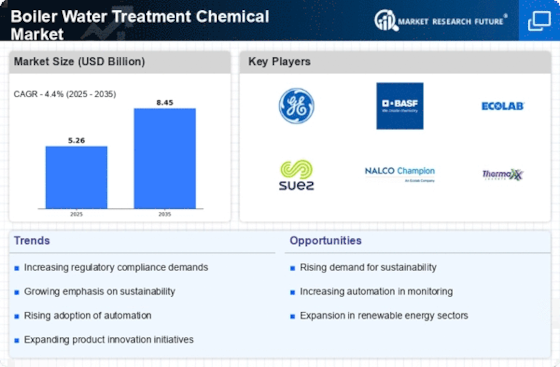
As per Market Research Future analysis, the Boiler Water Treatment Chemical Market Size was estimated at 5.26 USD Billion in 2024. The Boiler Water Treatment Chemical industry is projected to grow from 5.491 USD Billion in 2025 to 8.447 USD Billion by 2035, exhibiting a compound annual growth rate (CAGR) of 4.4% during the forecast period 2025 - 2035

Key Market Trends & Highlights

The Boiler Water Treatment Chemical Market is experiencing a dynamic shift towards sustainability and technological innovation.

  • North America remains the largest market for boiler water treatment chemicals, driven by stringent environmental regulations and a focus on energy efficiency. The Asia-Pacific region is identified as the fastest-growing market, propelled by rapid industrialization and urbanization. Oxygen scavengers dominate the market as the largest segment, while scale inhibitors are emerging as the fastest-growing segment due to increasing demand for effective water treatment solutions. Key market drivers include the rising demand for energy efficiency and growing awareness of maintenance and reliability in industrial applications.

Market Size & Forecast

2024 Market Size 5.26 (USD Billion)
2035 Market Size 8.447 (USD Billion)
CAGR (2025 - 2035) 4.4%
Largest Regional Market Share in 2024 Asia Pacific

Major Players

GE Water (US), BASF (DE), Ecolab (US), SUEZ (FR), Nalco Champion (US), Thermax (IN), Veolia (FR), AkzoNobel (NL), ChemTreat (US)

Market Trends

The Boiler Water Treatment Chemical Market is currently experiencing a dynamic evolution, driven by the increasing demand for efficient and sustainable water treatment solutions across various industries. As organizations strive to enhance operational efficiency and reduce environmental impact, the adoption of advanced chemical formulations is becoming more prevalent. This shift is largely influenced by stringent regulatory frameworks aimed at minimizing water pollution and promoting the responsible use of resources. Consequently, manufacturers are focusing on developing innovative products that not only meet compliance standards but also offer superior performance in preventing scale formation, corrosion, and microbial growth. Moreover, the market landscape is characterized by a growing emphasis on eco-friendly and biodegradable chemicals. Stakeholders are increasingly aware of the potential hazards associated with traditional chemical treatments, prompting a shift towards greener alternatives. This trend is further supported by the rising awareness of sustainability among consumers and businesses alike. As a result, companies are investing in research and development to create effective, environmentally safe solutions that align with global sustainability goals. The Boiler Water Treatment Chemical Market appears poised for continued growth, driven by these evolving consumer preferences and regulatory pressures.

Sustainability Focus

The emphasis on sustainable practices is reshaping the Boiler Water Treatment Chemical Market. Companies are increasingly prioritizing eco-friendly formulations that minimize environmental impact while maintaining efficacy. This trend reflects a broader societal shift towards sustainability, influencing product development and consumer choices.

Technological Advancements

Innovations in chemical formulations and application technologies are transforming the Boiler Water Treatment Chemical Market. Enhanced monitoring systems and automated dosing solutions are being integrated, improving efficiency and effectiveness in water treatment processes. These advancements are likely to drive market growth.

Regulatory Compliance

Stringent regulations regarding water quality and treatment are significantly impacting the Boiler Water Treatment Chemical Market. Companies are compelled to adapt their products to meet these evolving standards, leading to increased investment in compliance-driven solutions and fostering a competitive landscape.

Boiler Water Treatment Chemical Market Market Drivers

Stringent Environmental Regulations

The Boiler Water Treatment Chemical Market is significantly influenced by the implementation of stringent environmental regulations aimed at reducing water pollution and promoting sustainable practices. Governments and regulatory bodies are increasingly mandating the use of eco-friendly chemicals and processes in industrial operations. This regulatory landscape compels industries to adopt advanced boiler water treatment solutions that comply with environmental standards. The market for green chemicals is projected to expand, with a focus on reducing harmful emissions and waste. As a result, the Boiler Water Treatment Chemical Market is likely to witness a shift towards more sustainable products, aligning with global environmental goals.

Increasing Demand for Energy Efficiency

The Boiler Water Treatment Chemical Market is experiencing a notable surge in demand driven by the increasing emphasis on energy efficiency across various sectors. Industries are actively seeking ways to optimize their operations, reduce energy consumption, and minimize operational costs. The implementation of advanced boiler water treatment chemicals can enhance the efficiency of steam generation and heat transfer, thereby contributing to lower energy bills. According to recent data, the energy efficiency market is projected to grow significantly, with a compound annual growth rate (CAGR) of approximately 8% over the next few years. This trend indicates a robust opportunity for the Boiler Water Treatment Chemical Market to cater to the evolving needs of energy-conscious consumers.

Rising Industrialization and Urbanization

The Boiler Water Treatment Chemical Market is poised for growth due to the rapid industrialization and urbanization trends observed in various regions. As industries expand and urban areas develop, the demand for steam and hot water generation increases, necessitating effective boiler water treatment solutions. The rise in manufacturing activities, particularly in sectors such as power generation, food processing, and pharmaceuticals, is expected to drive the consumption of boiler water treatment chemicals. Recent statistics suggest that industrial output is anticipated to rise by 5% annually, further propelling the need for efficient boiler operations. This scenario presents a favorable environment for the Boiler Water Treatment Chemical Market to thrive.

Technological Innovations in Water Treatment

The Boiler Water Treatment Chemical Market is benefiting from ongoing technological innovations that enhance the effectiveness and efficiency of water treatment processes. Advancements in chemical formulations, monitoring systems, and automation technologies are enabling industries to achieve better water quality and operational performance. For instance, the introduction of smart monitoring systems allows for real-time analysis of water quality, leading to timely interventions and optimized chemical usage. This trend is expected to drive the adoption of advanced boiler water treatment solutions, as industries seek to leverage technology for improved operational efficiency. The market is likely to see a rise in demand for innovative products that offer superior performance.

Growing Awareness of Maintenance and Reliability

The Boiler Water Treatment Chemical Market is experiencing growth due to the increasing awareness of the importance of maintenance and reliability in boiler operations. Industries are recognizing that effective water treatment is crucial for preventing scale formation, corrosion, and other issues that can lead to costly downtime and repairs. As a result, there is a heightened focus on implementing comprehensive maintenance programs that include the use of specialized boiler water treatment chemicals. Recent surveys indicate that companies are willing to invest in reliable solutions to ensure uninterrupted operations. This trend underscores the potential for the Boiler Water Treatment Chemical Market to expand as businesses prioritize long-term operational reliability.

Market Segment Insights

By Type: Oxygen Scavengers (Largest) vs. Scale Inhibitors (Fastest-Growing)

In the Boiler Water Treatment Chemical Market, share distribution among the various types reveals that Oxygen Scavengers hold the largest portion, reflecting their crucial role in managing dissolved oxygen levels to prevent corrosion in boiler systems. Other notable segments include Scale Inhibitors, which are rapidly gaining traction due to increasing industrial applications and the need for improved efficiency in steam generation processes. Sludge Conditioners and Anti-foaming Agents collectively contribute to the market but occupy a smaller yet significant share. The growth trends in this segment are influenced by a combination of factors including stringent regulations for water treatment in industrial settings and heightened awareness of efficient water management practices. As industries strive for operational efficiency, the demand for multifunctional products is also on the rise. Innovations in chemical formulations are attracting attention, particularly for Scale Inhibitors, which are being recognized for their performance and effectiveness, positioning them as an essential component in modern boiler systems.

Oxygen Scavengers (Dominant) vs. Scale Inhibitors (Emerging)

Oxygen Scavengers are the dominant segment in the Boiler Water Treatment Chemical Market, primarily due to their effectiveness in eliminating oxygen from the boiler feedwater, thereby preventing rust and corrosion. Their formulations, often based on <a href="https://www.marketresearchfuture.com/reports/sulfur-dioxide-market-18857">sulfur dioxide</a> or hydrazine, are extensively used in various industrial applications, ensuring the longevity and efficiency of boiler operations. On the other hand, Scale Inhibitors represent an emerging segment, reflecting an increasing need for technologies that prevent mineral scale deposition in boiler systems. This growing segment employs various chemistries, such as phosphonates and polyacrylates, and is being driven by the urgent need for efficient energy use and minimized maintenance costs. As industrial landscapes evolve, both segments are vital for enhancing performance and sustainability in boiler water treatment processes.

By Conditioning Method: Internal (Largest) vs. External (Fastest-Growing)

The Boiler Water Treatment Chemical Market exhibits a competitive landscape in the Conditioning Method segment, with Internal post-treatment methods holding the largest share. This segment appeals to a broad range of industries due to its effectiveness in maintaining boiler efficiency and longevity. In contrast, External pre-treatment methods are gaining traction as they cater to the increasing demand for eco-friendly and cost-effective solutions, positioning them as a rising player in the market.

Conditioning Method: Internal (Dominant) vs. External (Emerging)

Internal conditioning methods focus on treating boiler water after it enters the system, ensuring optimal performance by controlling impurities and preventing corrosion. This established approach has gained dominance due to its reliability and efficiency in prolonging boiler life. Conversely, External conditioning methods are emerging as innovative solutions, targeting pre-treatment processes to reduce waste and promote sustainability in water usage. As industries seek to minimize their environmental impacts and enhance operational efficiency, External methods are positioned for rapid growth, driven by technological advancements and heightened regulatory pressures for greener practices.

By End-Use Industry: Power (Largest) vs. Chemicals and Petrochemicals (Fastest-Growing)

The Boiler Water Treatment Chemical Market exhibits a diverse distribution across several end-use industries. The power generation sector holds the majority share, owing to its extensive and critical need for water treatment solutions to maintain efficient operations and compliance with environmental regulations. Following closely, the oil and gas industry also constitutes a significant portion of the market, leveraging water treatment chemicals to ensure optimal performance and safety in operations. Other industries like food and beverage, paper and pulp, and textiles contribute to market dynamics but to a lesser extent.

Power: Dominant vs. Chemicals and Petrochemicals: Emerging

The power generation segment remains the dominant player in the Boiler Water Treatment Chemical Market due to its high energy demands and regulatory pressures to minimize water usage and waste. This industry relies heavily on advanced water treatment solutions to enhance operational efficiency and boiler performance. In contrast, the chemicals and petrochemicals sector is rapidly emerging, driven by demand for innovative treatments that meet stringent regulations and enhance equipment longevity. As this sector evolves, companies are increasingly focused on environmentally sustainable practices, positioning themselves for exponential growth in the near future.

Get more detailed insights about Boiler Water Treatment Chemical Market Research Report – Forecast to 2035

Regional Insights

North America : Market Leader in Innovation

North America is the largest market for boiler water treatment chemicals, holding approximately 40% of the global market share. The region's growth is driven by stringent environmental regulations and the need for efficient energy management in industrial processes. The increasing focus on sustainability and water conservation further fuels demand for advanced treatment solutions. The United States and Canada are the leading countries in this market, with major players like GE Water, Ecolab, and Nalco Champion dominating the landscape. The competitive environment is characterized by continuous innovation and strategic partnerships among key players to enhance product offerings and meet regulatory standards.

Europe : Regulatory-Driven Market Growth

Europe is the second-largest market for boiler water treatment chemicals, accounting for around 30% of the global share. The region's growth is significantly influenced by stringent EU regulations aimed at reducing environmental impact and promoting sustainable industrial practices. The increasing adoption of green technologies and the need for compliance with water quality standards are key demand drivers. Germany, France, and the UK are the leading countries in this market, with companies like BASF and SUEZ playing pivotal roles. The competitive landscape is marked by a strong emphasis on research and development, as firms strive to innovate and offer eco-friendly solutions to meet regulatory requirements.

Asia-Pacific : Emerging Market Potential

Asia-Pacific is witnessing rapid growth in the boiler water treatment chemical market, holding approximately 25% of the global share. The region's industrialization, particularly in countries like China and India, is a significant driver of demand. Additionally, increasing investments in infrastructure and energy projects are propelling the need for effective water treatment solutions. Regulatory frameworks are also evolving to address environmental concerns, further supporting market growth. China and India are the leading countries in this region, with a growing presence of key players like Thermax and AkzoNobel. The competitive landscape is becoming increasingly dynamic, with local and international companies vying for market share through innovative product offerings and strategic collaborations.

Middle East and Africa : Resource-Rich Market Dynamics

The Middle East and Africa region is emerging as a significant market for boiler water treatment chemicals, accounting for about 5% of the global share. The growth is driven by the increasing demand for water treatment solutions in oil and gas industries, coupled with the need for efficient water management in arid regions. Government initiatives aimed at improving water quality and sustainability are also contributing to market expansion. Countries like Saudi Arabia and South Africa are at the forefront of this market, with a mix of local and international players, including Veolia and ChemTreat. The competitive landscape is characterized by a focus on tailored solutions to meet the unique challenges of water scarcity and industrial requirements in the region.

Key Players and Competitive Insights

The Boiler Water Treatment Chemical Market is currently characterized by a dynamic competitive landscape, driven by increasing industrialization and stringent environmental regulations. Key players such as GE Water (US), BASF (DE), and Ecolab (US) are actively shaping the market through strategic initiatives focused on innovation and sustainability. GE Water (US) emphasizes digital transformation, leveraging data analytics to enhance water treatment processes, while BASF (DE) is concentrating on developing eco-friendly chemical solutions that align with global sustainability goals. Ecolab (US) is also investing in advanced technologies to optimize water usage in industrial applications, thereby reinforcing its market position. Collectively, these strategies not only enhance operational efficiency but also foster a competitive environment that prioritizes sustainable practices.

In terms of business tactics, companies are increasingly localizing manufacturing to reduce supply chain vulnerabilities and enhance responsiveness to regional market demands. The market structure appears moderately fragmented, with several players vying for market share, yet the influence of major companies remains substantial. This competitive structure allows for a diverse range of offerings, catering to various industrial needs while also fostering innovation through competition.

In August 2025, Ecolab (US) announced a strategic partnership with a leading technology firm to develop AI-driven water treatment solutions. This collaboration aims to integrate artificial intelligence into their existing product lines, enhancing predictive maintenance and operational efficiency for clients. The strategic importance of this move lies in Ecolab's commitment to staying at the forefront of technological advancements, which could significantly improve customer satisfaction and retention.

In September 2025, BASF (DE) launched a new line of biodegradable water treatment chemicals designed to minimize environmental impact. This initiative not only aligns with global sustainability trends but also positions BASF as a leader in eco-friendly solutions within the industry. The introduction of these products is likely to attract environmentally conscious customers, thereby expanding their market reach and reinforcing their competitive edge.

In October 2025, GE Water (US) unveiled a new digital platform aimed at optimizing water treatment processes for industrial clients. This platform utilizes real-time data analytics to provide actionable insights, thereby enhancing operational efficiency. The strategic significance of this development is profound, as it reflects GE Water's commitment to innovation and positions the company as a pioneer in the digital transformation of water treatment.

As of October 2025, the competitive trends in the Boiler Water Treatment Chemical Market are increasingly defined by digitalization, sustainability, and the integration of advanced technologies. Strategic alliances are becoming more prevalent, enabling companies to leverage complementary strengths and enhance their market offerings. Looking ahead, it appears that competitive differentiation will increasingly pivot from traditional price-based competition to a focus on innovation, technological advancements, and supply chain reliability, suggesting a transformative shift in how companies engage with the market.

Key Companies in the Boiler Water Treatment Chemical Market include

Industry Developments

H2O Innovation is the newest associate member of the Renewable Fuels Association. H2O Innovation has been a leading supplier of water treatment equipment, chemicals, consumables, and on-site services to biofuel producers in the United States and Canada since its inception. H2O innovation can tailor a solution specifically for any site and application, whether it is for boiler or feed tower cooling, cooling tower bypass filtration, wastewater treatment, or the production of USP Grade ethanol for hand sanitizer.

Recently, the City of Mississauga in Canada enlisted the services of Boiler Treatment, a leading service provider for wastewater and water treatment, for the planning and execution of chemical water treatment for its boilers and HVAC systems. Through a high-level diagnosis of each HVAC system, the City of Mississauga analyses the benefits of BTI boiler treatment. BTI has improved its reporting capabilities by launching an interactive website that offers real-time and on-demand data with a single click.

Intended Audience

  • Boiler water treatment chemicals manufacturers
  • Traders and distributors of boiler water treatment chemicals
  • Research and development institutes
  • Potential investors
  • Raw material suppliers
  • Nationalized laboratories

Future Outlook

Boiler Water Treatment Chemical Market Future Outlook

The Boiler Water Treatment Chemical Market is projected to grow at a 4.4% CAGR from 2025 to 2035, driven by increasing industrialization, stringent regulations, and the need for efficient energy management.

New opportunities lie in:

  • <p>Development of eco-friendly chemical formulations Integration of IoT for real-time monitoring solutions Expansion into emerging markets with tailored product offerings</p>

By 2035, the market is expected to achieve robust growth, reflecting evolving industry demands and technological advancements.

Market Segmentation

Boiler Water Treatment Chemical Market Type Outlook

  • Oxygen scavengers
  • Sludge conditioners
  • Alkalinity builders
  • Multifunctional
  • Scale inhibitors
  • Anti-foaming agents
  • Sequestering agents
  • Others

Boiler Water Treatment Chemical Market End-Use Industry Outlook

  • Power
  • Oil and gas
  • Chemicals and petrochemicals
  • Food and beverage
  • Paper and pulp
  • Textiles and dyes
  • Others

Boiler Water Treatment Chemical Market Conditioning Method Outlook

  • External (pre-treatment)
  • Internal (post-treatment)

Report Scope

MARKET SIZE 2024 5.26(USD Billion)
MARKET SIZE 2025 5.491(USD Billion)
MARKET SIZE 2035 8.447(USD Billion)
COMPOUND ANNUAL GROWTH RATE (CAGR) 4.4% (2025 - 2035)
REPORT COVERAGE Revenue Forecast, Competitive Landscape, Growth Factors, and Trends
BASE YEAR 2024
Market Forecast Period 2025 - 2035
Historical Data 2019 - 2024
Market Forecast Units USD Billion
Key Companies Profiled GE Water (US), BASF (DE), Ecolab (US), SUEZ (FR), Nalco Champion (US), Thermax (IN), Veolia (FR), AkzoNobel (NL), ChemTreat (US)
Segments Covered Type
Key Market Opportunities Adoption of advanced monitoring technologies enhances efficiency in the Boiler Water Treatment Chemical Market.
Key Market Dynamics Rising demand for eco-friendly chemicals drives innovation and regulatory compliance in the Boiler Water Treatment Chemical Market.
Countries Covered North America, Europe, APAC, South America, MEA

FAQs

What is the projected market valuation for the Boiler Water Treatment Chemical Market in 2035?

<p>The projected market valuation for the Boiler Water Treatment Chemical Market in 2035 is 8.447 USD Billion.</p>

What was the market valuation of the Boiler Water Treatment Chemical Market in 2024?

<p>The market valuation of the Boiler Water Treatment Chemical Market in 2024 was 5.26 USD Billion.</p>

What is the expected CAGR for the Boiler Water Treatment Chemical Market from 2025 to 2035?

<p>The expected CAGR for the Boiler Water Treatment Chemical Market during the forecast period 2025 - 2035 is 4.4%.</p>

Which companies are considered key players in the Boiler Water Treatment Chemical Market?

<p>Key players in the Boiler Water Treatment Chemical Market include GE Water, BASF, Ecolab, SUEZ, Nalco Champion, Thermax, Veolia, AkzoNobel, and ChemTreat.</p>

What segment of the Boiler Water Treatment Chemical Market had the highest valuation in 2024?

<p>In 2024, the segment of Oxygen scavengers had a valuation of 0.79 USD Billion.</p>

What is the projected valuation for the Sludge conditioners segment by 2035?

The projected valuation for the Sludge conditioners segment by 2035 is 0.99 USD Billion.

How does the market valuation for External (pre-treatment) compare to Internal (post-treatment) in 2024?

In 2024, both External (pre-treatment) and Internal (post-treatment) segments had equal valuations of 2.63 USD Billion.

What is the expected growth for the Power end-use industry segment by 2035?

The expected growth for the Power end-use industry segment is projected to reach 1.9 USD Billion by 2035.

Which end-use industry segment is anticipated to show the least growth by 2035?

The Textiles and dyes end-use industry segment is anticipated to show the least growth, reaching 0.8 USD Billion by 2035.

What is the projected valuation for the Multifunctional segment by 2035?

The projected valuation for the Multifunctional segment by 2035 is 1.31 USD Billion.

  1. SECTION I: EXECUTIVE SUMMARY AND KEY HIGHLIGHTS
    1. | 1.1 EXECUTIVE SUMMARY
    2. | | 1.1.1 Market Overview
    3. | | 1.1.2 Key Findings
    4. | | 1.1.3 Market Segmentation
    5. | | 1.1.4 Competitive Landscape
    6. | | 1.1.5 Challenges and Opportunities
    7. | | 1.1.6 Future Outlook
  2. SECTION II: SCOPING, METHODOLOGY AND MARKET STRUCTURE
    1. | 2.1 MARKET INTRODUCTION
    2. | | 2.1.1 Definition
    3. | | 2.1.2 Scope of the study
    4. | | | 2.1.2.1 Research Objective
    5. | | | 2.1.2.2 Assumption
    6. | | | 2.1.2.3 Limitations
    7. | 2.2 RESEARCH METHODOLOGY
    8. | | 2.2.1 Overview
    9. | | 2.2.2 Data Mining
    10. | | 2.2.3 Secondary Research
    11. | | 2.2.4 Primary Research
    12. | | | 2.2.4.1 Primary Interviews and Information Gathering Process
    13. | | | 2.2.4.2 Breakdown of Primary Respondents
    14. | | 2.2.5 Forecasting Model
    15. | | 2.2.6 Market Size Estimation
    16. | | | 2.2.6.1 Bottom-Up Approach
    17. | | | 2.2.6.2 Top-Down Approach
    18. | | 2.2.7 Data Triangulation
    19. | | 2.2.8 Validation
  3. SECTION III: QUALITATIVE ANALYSIS
    1. | 3.1 MARKET DYNAMICS
    2. | | 3.1.1 Overview
    3. | | 3.1.2 Drivers
    4. | | 3.1.3 Restraints
    5. | | 3.1.4 Opportunities
    6. | 3.2 MARKET FACTOR ANALYSIS
    7. | | 3.2.1 Value chain Analysis
    8. | | 3.2.2 Porter's Five Forces Analysis
    9. | | | 3.2.2.1 Bargaining Power of Suppliers
    10. | | | 3.2.2.2 Bargaining Power of Buyers
    11. | | | 3.2.2.3 Threat of New Entrants
    12. | | | 3.2.2.4 Threat of Substitutes
    13. | | | 3.2.2.5 Intensity of Rivalry
    14. | | 3.2.3 COVID-19 Impact Analysis
    15. | | | 3.2.3.1 Market Impact Analysis
    16. | | | 3.2.3.2 Regional Impact
    17. | | | 3.2.3.3 Opportunity and Threat Analysis
  4. SECTION IV: QUANTITATIVE ANALYSIS
    1. | 4.1 Chemicals and Materials, BY Type (USD Billion)
    2. | | 4.1.1 Oxygen scavengers
    3. | | 4.1.2 Sludge conditioners
    4. | | 4.1.3 Alkalinity builders
    5. | | 4.1.4 Multifunctional
    6. | | 4.1.5 Scale inhibitors
    7. | | 4.1.6 Anti-foaming agents
    8. | | 4.1.7 Sequestering agents
    9. | | 4.1.8 Others
    10. | 4.2 Chemicals and Materials, BY Conditioning Method (USD Billion)
    11. | | 4.2.1 External (pre-treatment)
    12. | | 4.2.2 Internal (post-treatment)
    13. | 4.3 Chemicals and Materials, BY End-Use Industry (USD Billion)
    14. | | 4.3.1 Power
    15. | | 4.3.2 Oil and gas
    16. | | 4.3.3 Chemicals and petrochemicals
    17. | | 4.3.4 Food and beverage
    18. | | 4.3.5 Paper and pulp
    19. | | 4.3.6 Textiles and dyes
    20. | | 4.3.7 Others
    21. | 4.4 Chemicals and Materials, BY Region (USD Billion)
    22. | | 4.4.1 North America
    23. | | | 4.4.1.1 US
    24. | | | 4.4.1.2 Canada
    25. | | 4.4.2 Europe
    26. | | | 4.4.2.1 Germany
    27. | | | 4.4.2.2 UK
    28. | | | 4.4.2.3 France
    29. | | | 4.4.2.4 Russia
    30. | | | 4.4.2.5 Italy
    31. | | | 4.4.2.6 Spain
    32. | | | 4.4.2.7 Rest of Europe
    33. | | 4.4.3 APAC
    34. | | | 4.4.3.1 China
    35. | | | 4.4.3.2 India
    36. | | | 4.4.3.3 Japan
    37. | | | 4.4.3.4 South Korea
    38. | | | 4.4.3.5 Malaysia
    39. | | | 4.4.3.6 Thailand
    40. | | | 4.4.3.7 Indonesia
    41. | | | 4.4.3.8 Rest of APAC
    42. | | 4.4.4 South America
    43. | | | 4.4.4.1 Brazil
    44. | | | 4.4.4.2 Mexico
    45. | | | 4.4.4.3 Argentina
    46. | | | 4.4.4.4 Rest of South America
    47. | | 4.4.5 MEA
    48. | | | 4.4.5.1 GCC Countries
    49. | | | 4.4.5.2 South Africa
    50. | | | 4.4.5.3 Rest of MEA
  5. SECTION V: COMPETITIVE ANALYSIS
    1. | 5.1 Competitive Landscape
    2. | | 5.1.1 Overview
    3. | | 5.1.2 Competitive Analysis
    4. | | 5.1.3 Market share Analysis
    5. | | 5.1.4 Major Growth Strategy in the Chemicals and Materials
    6. | | 5.1.5 Competitive Benchmarking
    7. | | 5.1.6 Leading Players in Terms of Number of Developments in the Chemicals and Materials
    8. | | 5.1.7 Key developments and growth strategies
    9. | | | 5.1.7.1 New Product Launch/Service Deployment
    10. | | | 5.1.7.2 Merger & Acquisitions
    11. | | | 5.1.7.3 Joint Ventures
    12. | | 5.1.8 Major Players Financial Matrix
    13. | | | 5.1.8.1 Sales and Operating Income
    14. | | | 5.1.8.2 Major Players R&D Expenditure. 2023
    15. | 5.2 Company Profiles
    16. | | 5.2.1 GE Water (US)
    17. | | | 5.2.1.1 Financial Overview
    18. | | | 5.2.1.2 Products Offered
    19. | | | 5.2.1.3 Key Developments
    20. | | | 5.2.1.4 SWOT Analysis
    21. | | | 5.2.1.5 Key Strategies
    22. | | 5.2.2 BASF (DE)
    23. | | | 5.2.2.1 Financial Overview
    24. | | | 5.2.2.2 Products Offered
    25. | | | 5.2.2.3 Key Developments
    26. | | | 5.2.2.4 SWOT Analysis
    27. | | | 5.2.2.5 Key Strategies
    28. | | 5.2.3 Ecolab (US)
    29. | | | 5.2.3.1 Financial Overview
    30. | | | 5.2.3.2 Products Offered
    31. | | | 5.2.3.3 Key Developments
    32. | | | 5.2.3.4 SWOT Analysis
    33. | | | 5.2.3.5 Key Strategies
    34. | | 5.2.4 SUEZ (FR)
    35. | | | 5.2.4.1 Financial Overview
    36. | | | 5.2.4.2 Products Offered
    37. | | | 5.2.4.3 Key Developments
    38. | | | 5.2.4.4 SWOT Analysis
    39. | | | 5.2.4.5 Key Strategies
    40. | | 5.2.5 Nalco Champion (US)
    41. | | | 5.2.5.1 Financial Overview
    42. | | | 5.2.5.2 Products Offered
    43. | | | 5.2.5.3 Key Developments
    44. | | | 5.2.5.4 SWOT Analysis
    45. | | | 5.2.5.5 Key Strategies
    46. | | 5.2.6 Thermax (IN)
    47. | | | 5.2.6.1 Financial Overview
    48. | | | 5.2.6.2 Products Offered
    49. | | | 5.2.6.3 Key Developments
    50. | | | 5.2.6.4 SWOT Analysis
    51. | | | 5.2.6.5 Key Strategies
    52. | | 5.2.7 Veolia (FR)
    53. | | | 5.2.7.1 Financial Overview
    54. | | | 5.2.7.2 Products Offered
    55. | | | 5.2.7.3 Key Developments
    56. | | | 5.2.7.4 SWOT Analysis
    57. | | | 5.2.7.5 Key Strategies
    58. | | 5.2.8 AkzoNobel (NL)
    59. | | | 5.2.8.1 Financial Overview
    60. | | | 5.2.8.2 Products Offered
    61. | | | 5.2.8.3 Key Developments
    62. | | | 5.2.8.4 SWOT Analysis
    63. | | | 5.2.8.5 Key Strategies
    64. | | 5.2.9 ChemTreat (US)
    65. | | | 5.2.9.1 Financial Overview
    66. | | | 5.2.9.2 Products Offered
    67. | | | 5.2.9.3 Key Developments
    68. | | | 5.2.9.4 SWOT Analysis
    69. | | | 5.2.9.5 Key Strategies
    70. | 5.3 Appendix
    71. | | 5.3.1 References
    72. | | 5.3.2 Related Reports
  6. LIST OF FIGURES
    1. | 6.1 MARKET SYNOPSIS
    2. | 6.2 NORTH AMERICA MARKET ANALYSIS
    3. | 6.3 US MARKET ANALYSIS BY TYPE
    4. | 6.4 US MARKET ANALYSIS BY CONDITIONING METHOD
    5. | 6.5 US MARKET ANALYSIS BY END-USE INDUSTRY
    6. | 6.6 CANADA MARKET ANALYSIS BY TYPE
    7. | 6.7 CANADA MARKET ANALYSIS BY CONDITIONING METHOD
    8. | 6.8 CANADA MARKET ANALYSIS BY END-USE INDUSTRY
    9. | 6.9 EUROPE MARKET ANALYSIS
    10. | 6.10 GERMANY MARKET ANALYSIS BY TYPE
    11. | 6.11 GERMANY MARKET ANALYSIS BY CONDITIONING METHOD
    12. | 6.12 GERMANY MARKET ANALYSIS BY END-USE INDUSTRY
    13. | 6.13 UK MARKET ANALYSIS BY TYPE
    14. | 6.14 UK MARKET ANALYSIS BY CONDITIONING METHOD
    15. | 6.15 UK MARKET ANALYSIS BY END-USE INDUSTRY
    16. | 6.16 FRANCE MARKET ANALYSIS BY TYPE
    17. | 6.17 FRANCE MARKET ANALYSIS BY CONDITIONING METHOD
    18. | 6.18 FRANCE MARKET ANALYSIS BY END-USE INDUSTRY
    19. | 6.19 RUSSIA MARKET ANALYSIS BY TYPE
    20. | 6.20 RUSSIA MARKET ANALYSIS BY CONDITIONING METHOD
    21. | 6.21 RUSSIA MARKET ANALYSIS BY END-USE INDUSTRY
    22. | 6.22 ITALY MARKET ANALYSIS BY TYPE
    23. | 6.23 ITALY MARKET ANALYSIS BY CONDITIONING METHOD
    24. | 6.24 ITALY MARKET ANALYSIS BY END-USE INDUSTRY
    25. | 6.25 SPAIN MARKET ANALYSIS BY TYPE
    26. | 6.26 SPAIN MARKET ANALYSIS BY CONDITIONING METHOD
    27. | 6.27 SPAIN MARKET ANALYSIS BY END-USE INDUSTRY
    28. | 6.28 REST OF EUROPE MARKET ANALYSIS BY TYPE
    29. | 6.29 REST OF EUROPE MARKET ANALYSIS BY CONDITIONING METHOD
    30. | 6.30 REST OF EUROPE MARKET ANALYSIS BY END-USE INDUSTRY
    31. | 6.31 APAC MARKET ANALYSIS
    32. | 6.32 CHINA MARKET ANALYSIS BY TYPE
    33. | 6.33 CHINA MARKET ANALYSIS BY CONDITIONING METHOD
    34. | 6.34 CHINA MARKET ANALYSIS BY END-USE INDUSTRY
    35. | 6.35 INDIA MARKET ANALYSIS BY TYPE
    36. | 6.36 INDIA MARKET ANALYSIS BY CONDITIONING METHOD
    37. | 6.37 INDIA MARKET ANALYSIS BY END-USE INDUSTRY
    38. | 6.38 JAPAN MARKET ANALYSIS BY TYPE
    39. | 6.39 JAPAN MARKET ANALYSIS BY CONDITIONING METHOD
    40. | 6.40 JAPAN MARKET ANALYSIS BY END-USE INDUSTRY
    41. | 6.41 SOUTH KOREA MARKET ANALYSIS BY TYPE
    42. | 6.42 SOUTH KOREA MARKET ANALYSIS BY CONDITIONING METHOD
    43. | 6.43 SOUTH KOREA MARKET ANALYSIS BY END-USE INDUSTRY
    44. | 6.44 MALAYSIA MARKET ANALYSIS BY TYPE
    45. | 6.45 MALAYSIA MARKET ANALYSIS BY CONDITIONING METHOD
    46. | 6.46 MALAYSIA MARKET ANALYSIS BY END-USE INDUSTRY
    47. | 6.47 THAILAND MARKET ANALYSIS BY TYPE
    48. | 6.48 THAILAND MARKET ANALYSIS BY CONDITIONING METHOD
    49. | 6.49 THAILAND MARKET ANALYSIS BY END-USE INDUSTRY
    50. | 6.50 INDONESIA MARKET ANALYSIS BY TYPE
    51. | 6.51 INDONESIA MARKET ANALYSIS BY CONDITIONING METHOD
    52. | 6.52 INDONESIA MARKET ANALYSIS BY END-USE INDUSTRY
    53. | 6.53 REST OF APAC MARKET ANALYSIS BY TYPE
    54. | 6.54 REST OF APAC MARKET ANALYSIS BY CONDITIONING METHOD
    55. | 6.55 REST OF APAC MARKET ANALYSIS BY END-USE INDUSTRY
    56. | 6.56 SOUTH AMERICA MARKET ANALYSIS
    57. | 6.57 BRAZIL MARKET ANALYSIS BY TYPE
    58. | 6.58 BRAZIL MARKET ANALYSIS BY CONDITIONING METHOD
    59. | 6.59 BRAZIL MARKET ANALYSIS BY END-USE INDUSTRY
    60. | 6.60 MEXICO MARKET ANALYSIS BY TYPE
    61. | 6.61 MEXICO MARKET ANALYSIS BY CONDITIONING METHOD
    62. | 6.62 MEXICO MARKET ANALYSIS BY END-USE INDUSTRY
    63. | 6.63 ARGENTINA MARKET ANALYSIS BY TYPE
    64. | 6.64 ARGENTINA MARKET ANALYSIS BY CONDITIONING METHOD
    65. | 6.65 ARGENTINA MARKET ANALYSIS BY END-USE INDUSTRY
    66. | 6.66 REST OF SOUTH AMERICA MARKET ANALYSIS BY TYPE
    67. | 6.67 REST OF SOUTH AMERICA MARKET ANALYSIS BY CONDITIONING METHOD
    68. | 6.68 REST OF SOUTH AMERICA MARKET ANALYSIS BY END-USE INDUSTRY
    69. | 6.69 MEA MARKET ANALYSIS
    70. | 6.70 GCC COUNTRIES MARKET ANALYSIS BY TYPE
    71. | 6.71 GCC COUNTRIES MARKET ANALYSIS BY CONDITIONING METHOD
    72. | 6.72 GCC COUNTRIES MARKET ANALYSIS BY END-USE INDUSTRY
    73. | 6.73 SOUTH AFRICA MARKET ANALYSIS BY TYPE
    74. | 6.74 SOUTH AFRICA MARKET ANALYSIS BY CONDITIONING METHOD
    75. | 6.75 SOUTH AFRICA MARKET ANALYSIS BY END-USE INDUSTRY
    76. | 6.76 REST OF MEA MARKET ANALYSIS BY TYPE
    77. | 6.77 REST OF MEA MARKET ANALYSIS BY CONDITIONING METHOD
    78. | 6.78 REST OF MEA MARKET ANALYSIS BY END-USE INDUSTRY
    79. | 6.79 KEY BUYING CRITERIA OF CHEMICALS AND MATERIALS
    80. | 6.80 RESEARCH PROCESS OF MRFR
    81. | 6.81 DRO ANALYSIS OF CHEMICALS AND MATERIALS
    82. | 6.82 DRIVERS IMPACT ANALYSIS: CHEMICALS AND MATERIALS
    83. | 6.83 RESTRAINTS IMPACT ANALYSIS: CHEMICALS AND MATERIALS
    84. | 6.84 SUPPLY / VALUE CHAIN: CHEMICALS AND MATERIALS
    85. | 6.85 CHEMICALS AND MATERIALS, BY TYPE, 2024 (% SHARE)
    86. | 6.86 CHEMICALS AND MATERIALS, BY TYPE, 2024 TO 2035 (USD Billion)
    87. | 6.87 CHEMICALS AND MATERIALS, BY CONDITIONING METHOD, 2024 (% SHARE)
    88. | 6.88 CHEMICALS AND MATERIALS, BY CONDITIONING METHOD, 2024 TO 2035 (USD Billion)
    89. | 6.89 CHEMICALS AND MATERIALS, BY END-USE INDUSTRY, 2024 (% SHARE)
    90. | 6.90 CHEMICALS AND MATERIALS, BY END-USE INDUSTRY, 2024 TO 2035 (USD Billion)
    91. | 6.91 BENCHMARKING OF MAJOR COMPETITORS
  7. LIST OF TABLES
    1. | 7.1 LIST OF ASSUMPTIONS
    2. | | 7.1.1
    3. | 7.2 North America MARKET SIZE ESTIMATES; FORECAST
    4. | | 7.2.1 BY TYPE, 2025-2035 (USD Billion)
    5. | | 7.2.2 BY CONDITIONING METHOD, 2025-2035 (USD Billion)
    6. | | 7.2.3 BY END-USE INDUSTRY, 2025-2035 (USD Billion)
    7. | 7.3 US MARKET SIZE ESTIMATES; FORECAST
    8. | | 7.3.1 BY TYPE, 2025-2035 (USD Billion)
    9. | | 7.3.2 BY CONDITIONING METHOD, 2025-2035 (USD Billion)
    10. | | 7.3.3 BY END-USE INDUSTRY, 2025-2035 (USD Billion)
    11. | 7.4 Canada MARKET SIZE ESTIMATES; FORECAST
    12. | | 7.4.1 BY TYPE, 2025-2035 (USD Billion)
    13. | | 7.4.2 BY CONDITIONING METHOD, 2025-2035 (USD Billion)
    14. | | 7.4.3 BY END-USE INDUSTRY, 2025-2035 (USD Billion)
    15. | 7.5 Europe MARKET SIZE ESTIMATES; FORECAST
    16. | | 7.5.1 BY TYPE, 2025-2035 (USD Billion)
    17. | | 7.5.2 BY CONDITIONING METHOD, 2025-2035 (USD Billion)
    18. | | 7.5.3 BY END-USE INDUSTRY, 2025-2035 (USD Billion)
    19. | 7.6 Germany MARKET SIZE ESTIMATES; FORECAST
    20. | | 7.6.1 BY TYPE, 2025-2035 (USD Billion)
    21. | | 7.6.2 BY CONDITIONING METHOD, 2025-2035 (USD Billion)
    22. | | 7.6.3 BY END-USE INDUSTRY, 2025-2035 (USD Billion)
    23. | 7.7 UK MARKET SIZE ESTIMATES; FORECAST
    24. | | 7.7.1 BY TYPE, 2025-2035 (USD Billion)
    25. | | 7.7.2 BY CONDITIONING METHOD, 2025-2035 (USD Billion)
    26. | | 7.7.3 BY END-USE INDUSTRY, 2025-2035 (USD Billion)
    27. | 7.8 France MARKET SIZE ESTIMATES; FORECAST
    28. | | 7.8.1 BY TYPE, 2025-2035 (USD Billion)
    29. | | 7.8.2 BY CONDITIONING METHOD, 2025-2035 (USD Billion)
    30. | | 7.8.3 BY END-USE INDUSTRY, 2025-2035 (USD Billion)
    31. | 7.9 Russia MARKET SIZE ESTIMATES; FORECAST
    32. | | 7.9.1 BY TYPE, 2025-2035 (USD Billion)
    33. | | 7.9.2 BY CONDITIONING METHOD, 2025-2035 (USD Billion)
    34. | | 7.9.3 BY END-USE INDUSTRY, 2025-2035 (USD Billion)
    35. | 7.10 Italy MARKET SIZE ESTIMATES; FORECAST
    36. | | 7.10.1 BY TYPE, 2025-2035 (USD Billion)
    37. | | 7.10.2 BY CONDITIONING METHOD, 2025-2035 (USD Billion)
    38. | | 7.10.3 BY END-USE INDUSTRY, 2025-2035 (USD Billion)
    39. | 7.11 Spain MARKET SIZE ESTIMATES; FORECAST
    40. | | 7.11.1 BY TYPE, 2025-2035 (USD Billion)
    41. | | 7.11.2 BY CONDITIONING METHOD, 2025-2035 (USD Billion)
    42. | | 7.11.3 BY END-USE INDUSTRY, 2025-2035 (USD Billion)
    43. | 7.12 Rest of Europe MARKET SIZE ESTIMATES; FORECAST
    44. | | 7.12.1 BY TYPE, 2025-2035 (USD Billion)
    45. | | 7.12.2 BY CONDITIONING METHOD, 2025-2035 (USD Billion)
    46. | | 7.12.3 BY END-USE INDUSTRY, 2025-2035 (USD Billion)
    47. | 7.13 APAC MARKET SIZE ESTIMATES; FORECAST
    48. | | 7.13.1 BY TYPE, 2025-2035 (USD Billion)
    49. | | 7.13.2 BY CONDITIONING METHOD, 2025-2035 (USD Billion)
    50. | | 7.13.3 BY END-USE INDUSTRY, 2025-2035 (USD Billion)
    51. | 7.14 China MARKET SIZE ESTIMATES; FORECAST
    52. | | 7.14.1 BY TYPE, 2025-2035 (USD Billion)
    53. | | 7.14.2 BY CONDITIONING METHOD, 2025-2035 (USD Billion)
    54. | | 7.14.3 BY END-USE INDUSTRY, 2025-2035 (USD Billion)
    55. | 7.15 India MARKET SIZE ESTIMATES; FORECAST
    56. | | 7.15.1 BY TYPE, 2025-2035 (USD Billion)
    57. | | 7.15.2 BY CONDITIONING METHOD, 2025-2035 (USD Billion)
    58. | | 7.15.3 BY END-USE INDUSTRY, 2025-2035 (USD Billion)
    59. | 7.16 Japan MARKET SIZE ESTIMATES; FORECAST
    60. | | 7.16.1 BY TYPE, 2025-2035 (USD Billion)
    61. | | 7.16.2 BY CONDITIONING METHOD, 2025-2035 (USD Billion)
    62. | | 7.16.3 BY END-USE INDUSTRY, 2025-2035 (USD Billion)
    63. | 7.17 South Korea MARKET SIZE ESTIMATES; FORECAST
    64. | | 7.17.1 BY TYPE, 2025-2035 (USD Billion)
    65. | | 7.17.2 BY CONDITIONING METHOD, 2025-2035 (USD Billion)
    66. | | 7.17.3 BY END-USE INDUSTRY, 2025-2035 (USD Billion)
    67. | 7.18 Malaysia MARKET SIZE ESTIMATES; FORECAST
    68. | | 7.18.1 BY TYPE, 2025-2035 (USD Billion)
    69. | | 7.18.2 BY CONDITIONING METHOD, 2025-2035 (USD Billion)
    70. | | 7.18.3 BY END-USE INDUSTRY, 2025-2035 (USD Billion)
    71. | 7.19 Thailand MARKET SIZE ESTIMATES; FORECAST
    72. | | 7.19.1 BY TYPE, 2025-2035 (USD Billion)
    73. | | 7.19.2 BY CONDITIONING METHOD, 2025-2035 (USD Billion)
    74. | | 7.19.3 BY END-USE INDUSTRY, 2025-2035 (USD Billion)
    75. | 7.20 Indonesia MARKET SIZE ESTIMATES; FORECAST
    76. | | 7.20.1 BY TYPE, 2025-2035 (USD Billion)
    77. | | 7.20.2 BY CONDITIONING METHOD, 2025-2035 (USD Billion)
    78. | | 7.20.3 BY END-USE INDUSTRY, 2025-2035 (USD Billion)
    79. | 7.21 Rest of APAC MARKET SIZE ESTIMATES; FORECAST
    80. | | 7.21.1 BY TYPE, 2025-2035 (USD Billion)
    81. | | 7.21.2 BY CONDITIONING METHOD, 2025-2035 (USD Billion)
    82. | | 7.21.3 BY END-USE INDUSTRY, 2025-2035 (USD Billion)
    83. | 7.22 South America MARKET SIZE ESTIMATES; FORECAST
    84. | | 7.22.1 BY TYPE, 2025-2035 (USD Billion)
    85. | | 7.22.2 BY CONDITIONING METHOD, 2025-2035 (USD Billion)
    86. | | 7.22.3 BY END-USE INDUSTRY, 2025-2035 (USD Billion)
    87. | 7.23 Brazil MARKET SIZE ESTIMATES; FORECAST
    88. | | 7.23.1 BY TYPE, 2025-2035 (USD Billion)
    89. | | 7.23.2 BY CONDITIONING METHOD, 2025-2035 (USD Billion)
    90. | | 7.23.3 BY END-USE INDUSTRY, 2025-2035 (USD Billion)
    91. | 7.24 Mexico MARKET SIZE ESTIMATES; FORECAST
    92. | | 7.24.1 BY TYPE, 2025-2035 (USD Billion)
    93. | | 7.24.2 BY CONDITIONING METHOD, 2025-2035 (USD Billion)
    94. | | 7.24.3 BY END-USE INDUSTRY, 2025-2035 (USD Billion)
    95. | 7.25 Argentina MARKET SIZE ESTIMATES; FORECAST
    96. | | 7.25.1 BY TYPE, 2025-2035 (USD Billion)
    97. | | 7.25.2 BY CONDITIONING METHOD, 2025-2035 (USD Billion)
    98. | | 7.25.3 BY END-USE INDUSTRY, 2025-2035 (USD Billion)
    99. | 7.26 Rest of South America MARKET SIZE ESTIMATES; FORECAST
    100. | | 7.26.1 BY TYPE, 2025-2035 (USD Billion)
    101. | | 7.26.2 BY CONDITIONING METHOD, 2025-2035 (USD Billion)
    102. | | 7.26.3 BY END-USE INDUSTRY, 2025-2035 (USD Billion)
    103. | 7.27 MEA MARKET SIZE ESTIMATES; FORECAST
    104. | | 7.27.1 BY TYPE, 2025-2035 (USD Billion)
    105. | | 7.27.2 BY CONDITIONING METHOD, 2025-2035 (USD Billion)
    106. | | 7.27.3 BY END-USE INDUSTRY, 2025-2035 (USD Billion)
    107. | 7.28 GCC Countries MARKET SIZE ESTIMATES; FORECAST
    108. | | 7.28.1 BY TYPE, 2025-2035 (USD Billion)
    109. | | 7.28.2 BY CONDITIONING METHOD, 2025-2035 (USD Billion)
    110. | | 7.28.3 BY END-USE INDUSTRY, 2025-2035 (USD Billion)
    111. | 7.29 South Africa MARKET SIZE ESTIMATES; FORECAST
    112. | | 7.29.1 BY TYPE, 2025-2035 (USD Billion)
    113. | | 7.29.2 BY CONDITIONING METHOD, 2025-2035 (USD Billion)
    114. | | 7.29.3 BY END-USE INDUSTRY, 2025-2035 (USD Billion)
    115. | 7.30 Rest of MEA MARKET SIZE ESTIMATES; FORECAST
    116. | | 7.30.1 BY TYPE, 2025-2035 (USD Billion)
    117. | | 7.30.2 BY CONDITIONING METHOD, 2025-2035 (USD Billion)
    118. | | 7.30.3 BY END-USE INDUSTRY, 2025-2035 (USD Billion)
    119. | 7.31 PRODUCT LAUNCH/PRODUCT DEVELOPMENT/APPROVAL
    120. | | 7.31.1
    121. | 7.32 ACQUISITION/PARTNERSHIP
    122. | | 7.32.1

Chemicals and Materials Market Segmentation

Chemicals and Materials By Type (USD Billion, 2025-2035)

  • Oxygen scavengers
  • Sludge conditioners
  • Alkalinity builders
  • Multifunctional
  • Scale inhibitors
  • Anti-foaming agents
  • Sequestering agents
  • Others

Chemicals and Materials By Conditioning Method (USD Billion, 2025-2035)

  • External (pre-treatment)
  • Internal (post-treatment)

Chemicals and Materials By End-Use Industry (USD Billion, 2025-2035)

  • Power
  • Oil and gas
  • Chemicals and petrochemicals
  • Food and beverage
  • Paper and pulp
  • Textiles and dyes
  • Others
Infographic

Free Sample Request

Kindly complete the form below to receive a free sample of this Report

Get Free Sample

Customer Strories

Compare Licence

×
Features License Type
Single User Multiuser License Enterprise User
Price $4,950 $5,950 $7,250
Maximum User Access Limit 1 User Upto 10 Users Unrestricted Access Throughout the Organization
Free Customization
Direct Access to Analyst
Deliverable Format
Platform Access
Discount on Next Purchase 10% 15% 15%
Printable Versions