×
Request Free Sample ×

Kindly complete the form below to receive a free sample of this Report

* Please use a valid business email

Leading companies partner with us for data-driven Insights

clients tt-cursor
Hero Background
English
Chinese
French
Japanese
Korean
German
Spanish

Blood Collection Market Analysis

ID: MRFR/HC/5548-HCR
200 Pages
Rahul Gotadki
October 2025

Blood Collection Market Research Report By Type (Vacutainer, Syringes, Blood Collection Tubes, Blood Bags), By Method (Manual Blood Collection, Automated Blood Collection, Capillary Blood Collection), By End Use (Hospitals, Diagnostic Laboratories, Blood Banks, Home Care), By Application (Transfusion, Diagnostic Testing, Research) and By Regional (North America, Europe, South America, Asia Pacific, Middle East and Africa) - Growth & Industry Forecast 2025 To 2035

Share:
Download PDF ×

We do not share your information with anyone. However, we may send you emails based on your report interest from time to time. You may contact us at any time to opt-out.

Blood Collection Market Infographic
×
Blood Collection Market Infographic Full View
Purchase Options

Market Analysis

In-depth Analysis of Blood Collection Market Industry Landscape

The blood collection market is undergoing significant changes influenced by several key market dynamics. Blood collection plays a crucial role in healthcare for diagnostic, therapeutic, and research purposes. One of the primary factors driving the growth of this market is the increasing demand for blood-related procedures due to rising incidences of chronic diseases, surgical interventions, and infectious diseases. As the global population continues to grow and age, the need for blood collection products and services is expected to rise, driving market expansion.

Technological advancements are shaping the dynamics of the blood collection market. Innovations such as vacuum blood collection systems, safety-engineered devices, and automation technologies are enhancing the efficiency, safety, and accuracy of blood collection procedures. These advancements not only improve the patient experience by reducing discomfort and risk of complications but also streamline workflow processes for healthcare providers. Additionally, the integration of digital solutions such as barcoding, RFID tracking, and cloud-based data management systems is enhancing traceability, quality control, and inventory management in blood collection facilities.

Changing regulatory landscapes and healthcare policies are also influencing the market dynamics of blood collection. Regulatory authorities are implementing stricter guidelines and quality standards to ensure the safety and efficacy of blood collection products and services. Compliance with these regulations is essential for manufacturers and service providers to gain market approval and maintain consumer trust. Moreover, reimbursement policies and healthcare spending trends impact the adoption of blood collection technologies, with healthcare systems seeking cost-effective solutions that deliver value to patients and providers alike.

The competitive landscape of the blood collection market is evolving rapidly, driven by the presence of numerous players competing for market share. Established companies in the medical device and diagnostics sectors, as well as smaller manufacturers and startups, are vying to introduce innovative blood collection technologies and capture niche markets. Key strategies employed by market players include product differentiation, strategic partnerships, and geographic expansion. Companies that can offer a comprehensive portfolio of blood collection products, including venous blood collection devices, lancets, needles, and tubes, are better positioned to meet the diverse needs of healthcare providers and gain a competitive advantage.

Moreover, the COVID-19 pandemic has had a significant impact on the dynamics of the blood collection market. While the pandemic initially disrupted blood collection services due to lockdowns, travel restrictions, and supply chain disruptions, the need for blood and blood products remained critical, especially for transfusions and emergency medical care. Healthcare systems adapted by implementing safety protocols, expanding mobile blood collection services, and leveraging digital platforms to facilitate blood donations. Additionally, the pandemic accelerated research and development efforts in blood-related diagnostics and therapeutics, creating new opportunities for innovation and market growth.

Author
Rahul Gotadki
Assistant Manager

He holds an experience of about 7+ years in Market Research and Business Consulting, working under the spectrum of Life Sciences and Healthcare domains. Rahul conceptualizes and implements a scalable business strategy and provides strategic leadership to the clients. His expertise lies in market estimation, competitive intelligence, pipeline analysis, customer assessment, etc. In addition to the above, his other responsibility includes strategic tracking of high growth markets & advising clients on the potential areas of focus they could direct their business initiatives

Leave a Comment

FAQs

What is the projected growth of the Blood Collection market?

The Blood Collection market is the expected increase in total market value of 9.67 USD billion over a defined forecast period 2025–2035. It is driven by factors such as demand trends, technological advances, regulatory changes, and geographic expansion.

What is the size of the Blood Collection market?

Blood Collection market size was valued at approximately 5.13 billion USD in 2024. This figure will reach 9.67 billion USD covering all regions (America, Europe, Asia, MEA and ROW), focusing its segments / services / distribution channels till 2035.

What is the CAGR of the Blood Collection market?

Blood Collection market is expected to grow at a CAGR of 5.93% between 2025 and 2035.

How much will the Blood Collection market be worth by 2035?

Blood Collection market is expected to be worth of 9.67 billion USD, reflecting growth driven by usage, technology and global demands by the end of 2035.

How will the Blood Collection market perform over the next 10 years?

Over the next 10 years the Blood Collection market is expected to shift from usd billion 5.13 to 9.67 billion USD, led by adoption of advanced tech, demographic trends, regulatory approvals, with potential headwinds from 2025 to 2035.

What was the market size of the Blood Collection Market in 2024?

The Blood Collection Market was valued at 7.08 USD Billion in 2024.

Which region is expected to dominate the Blood Collection Market by 2035?

North America is expected to dominate the Blood Collection Market with a projected value of 4.07 USD Billion by 2035.

What will be the market value of the Blood Collection Tubes by 2035?

The market value of Blood Collection Tubes is projected to reach approximately 2.1 USD Billion by 2035.

Who are the key players in the Blood Collection Market?

Major players in the market include Thermo Fisher Scientific, Haemonetics Corporation, Medtronic, and Becton Dickinson and Company.

What is the projected market value for Syringes by 2035?

The projected market value for Syringes is expected to reach approximately 2.6 USD Billion by 2035.

Market Summary

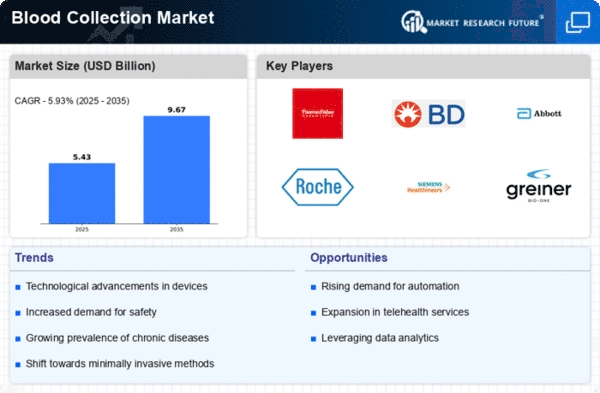
As per MRFR analysis, the Blood Collection Market Size was estimated at 5.13 USD Billion in 2024. The Blood Collection industry is projected to grow from 5.44 USD Billion in 2025 to 9.67 USD Billion by 2035, exhibiting a compound annual growth rate (CAGR) of 5.93 during the forecast period 2025 - 2035.

Key Market Trends & Highlights

The Blood Collection Market is experiencing robust growth driven by technological advancements and increasing public awareness.

  • North America remains the largest market for blood collection, driven by advanced healthcare infrastructure and technology.
  • Asia-Pacific is recognized as the fastest-growing region, reflecting a surge in healthcare investments and rising population health awareness.
  • The blood donation segment continues to dominate the market, while blood testing is emerging as the fastest-growing segment due to heightened diagnostic needs.
  • Technological advancements and the rising demand for safety and quality are key drivers propelling market expansion.

Market Size & Forecast

2024 Market Size 5.13 (USD Billion)
2035 Market Size 9.67 (USD Billion)
CAGR (2025 - 2035) 5.93%
Largest Regional Market Share in 2024 North America

Major Players

Thermo Fisher Scientific (US), BD (US), Abbott Laboratories (US), Roche Diagnostics (CH), Siemens Healthineers (DE), Greiner Bio-One (DE), Cardinal Health (US), Sekisui Medical (JP), F. Hoffmann-La Roche (CH)

Market Trends

The Blood Collection Market is currently experiencing a transformative phase, driven by advancements in technology and increasing demand for efficient healthcare solutions. Innovations in blood collection devices, such as automated systems and safety-engineered products, are enhancing the safety and efficiency of blood sampling procedures. Furthermore, the rising prevalence of chronic diseases necessitates regular blood testing, thereby propelling the market forward. Regulatory bodies are also emphasizing the importance of safety standards, which is likely to influence product development and market dynamics. In addition, the growing awareness regarding blood donation and its critical role in healthcare is fostering a culture of voluntary donations. This trend is supported by various campaigns aimed at educating the public about the importance of blood donation, which may lead to an increase in available blood supplies. As the Blood Collection Market evolves, it appears poised to adapt to the changing landscape of healthcare needs, with a focus on enhancing patient safety and improving overall efficiency in blood collection processes.

Technological Advancements

The Blood Collection Market is witnessing a surge in technological innovations, particularly in the development of automated blood collection systems. These advancements aim to streamline the collection process, reduce human error, and enhance patient comfort. As healthcare facilities increasingly adopt these technologies, the efficiency of blood collection procedures is likely to improve significantly.

Rising Demand for Safety

There is a growing emphasis on safety in blood collection practices, driven by heightened awareness of infection control and patient safety. The introduction of safety-engineered devices, such as retractable needles and safety blood collection tubes, reflects this trend. Such innovations are designed to minimize the risk of needlestick injuries and ensure safer handling of blood samples.

Increased Public Awareness

Public awareness campaigns regarding the importance of blood donation are gaining momentum, contributing to a positive shift in societal attitudes towards voluntary blood donation. This trend is expected to enhance the availability of blood supplies, thereby supporting the Blood Collection Market. Educational initiatives are likely to play a crucial role in fostering a culture of donation, ultimately benefiting healthcare systems.

Blood Collection Market Market Drivers

Market Growth Projections

The Global Blood Collection Market Industry is poised for substantial growth, with projections indicating a market value of 7.08 USD Billion in 2024 and an anticipated increase to 10.2 USD Billion by 2035. This growth trajectory reflects a compound annual growth rate (CAGR) of 3.37% from 2025 to 2035. Various factors contribute to this upward trend, including technological advancements, increasing demand for blood products, and supportive government initiatives. As the market evolves, it is essential to monitor these growth projections closely, as they provide valuable insights into the future landscape of blood collection.

Rising Demand for Blood Products

The Global Blood Collection Market Industry experiences a notable increase in demand for blood products, driven by a growing prevalence of chronic diseases and surgical procedures. As healthcare systems worldwide prioritize blood safety and availability, the market is projected to reach 7.08 USD Billion in 2024. This surge is attributed to the expanding patient population requiring transfusions and the rising awareness of blood donation's importance. Furthermore, advancements in blood collection technologies enhance efficiency and safety, thereby encouraging more individuals to donate blood. The increasing need for blood products is likely to propel the market further, indicating a robust growth trajectory.

Government Initiatives and Support

Government initiatives play a pivotal role in shaping the Global Blood Collection Market Industry. Various countries implement policies aimed at promoting voluntary blood donation and ensuring the availability of safe blood products. For example, national blood donation campaigns and funding for blood collection infrastructure enhance public awareness and participation. These initiatives are essential in addressing the increasing demand for blood products, particularly in regions with limited access to healthcare. As governments continue to invest in blood collection programs, the market is likely to benefit from improved collection rates and enhanced safety standards, contributing to its overall growth.

Increasing Awareness of Blood Donation

The Global Blood Collection Market Industry is significantly influenced by the rising awareness of blood donation's importance. Educational campaigns and community outreach programs aim to inform the public about the critical need for blood donations, especially during emergencies and natural disasters. This heightened awareness is likely to lead to increased donor participation, thereby boosting the availability of blood products. As more individuals recognize the impact of their contributions, the market is expected to grow, aligning with the projected increase in demand for blood products. The collective efforts to promote blood donation are essential for sustaining the market's growth trajectory.

Technological Advancements in Blood Collection

Innovations in blood collection technologies significantly influence the Global Blood Collection Market Industry. The introduction of automated blood collection systems and advanced blood bags enhances the efficiency and safety of the collection process. For instance, the adoption of closed blood collection systems minimizes contamination risks, which is crucial for maintaining blood quality. As these technologies evolve, they not only streamline operations but also improve donor experience, potentially leading to increased donation rates. The market's growth is further supported by the anticipated CAGR of 3.37% from 2025 to 2035, reflecting the ongoing commitment to enhancing blood collection methodologies.

Emerging Markets and Healthcare Infrastructure Development

Emerging markets present substantial opportunities for the Global Blood Collection Market Industry, particularly as healthcare infrastructure continues to develop. Countries in Asia and Africa are witnessing improvements in their healthcare systems, leading to increased access to blood collection services. As these regions enhance their medical facilities and blood banks, the demand for blood collection products is likely to rise. This growth is further supported by the anticipated market expansion, with projections indicating a market value of 10.2 USD Billion by 2035. The ongoing development of healthcare infrastructure in emerging markets is crucial for meeting the rising demand for blood products.

Market Segment Insights

By Application: Blood Donation (Largest) vs. Blood Testing (Fastest-Growing)

In the Blood Collection Market, the application segment is characterized by diverse use cases, including Blood Donation, Blood Testing, Blood Transfusion, and Therapeutic Apheresis. Blood Donation remains the largest share within the market, driven by the increasing awareness and necessity of maintaining blood banks. Blood Testing, however, is witnessing rapid growth due to the rising demand for diagnostic procedures and improving healthcare infrastructures, leading to a notable expansion in testing facilities and capabilities.

Blood Donation (Dominant) vs. Blood Testing (Emerging)

Blood Donation plays a crucial role in the Blood Collection Market as the dominant segment, significantly impacting public health by contributing to the availability of blood supply for transfusions and emergencies. Its strong character is marked by organized drives and initiatives involving healthcare organizations and non-profits, enhancing community participation in voluntary blood donation. On the other hand, Blood Testing is an emerging segment experiencing robust growth. This increase is attributed to advancements in medical technology, the surge in chronic disease prevalence, and a growing emphasis on preventive healthcare. It represents an evolving market space driven by innovations in diagnostic methods and the increasing shift towards personalized medicine.

By Product Type: Blood Collection Tubes (Largest) vs. Blood Collection Devices (Fastest-Growing)

The Blood Collection Market is characterized by a diverse range of product types, each contributing to the overall landscape. Blood Collection Tubes hold a significant share as the largest segment, catering to a variety of diagnostics and laboratory requirements. Needles and Syringes, along with Blood Bags, also play crucial roles, meeting the needs for various collection methods and storage solutions. Blood Collection Devices, while smaller in share, have gained prominence due to technological advancements and increased adoption in clinical settings.

Blood Collection Tubes (Dominant) vs. Blood Collection Devices (Emerging)

Blood Collection Tubes remain the dominant product type in the Blood Collection Market due to their versatility and ease of use in various clinical applications. They are designed to minimize contamination and are available in various configurations tailored to specific tests and applications. On the other hand, Blood Collection Devices are emerging rapidly, driven by innovations that enhance safety, efficiency, and patient comfort. These devices increasingly incorporate features such as needleless technology and integrated blood collection systems, which are appealing due to their ability to streamline the collection process and reduce the risk of needlestick injuries.

By End User: Hospitals (Largest) vs. Diagnostic Laboratories (Fastest-Growing)

The blood collection market is characterized by diverse end-users, with hospitals commanding the largest share. Hospitals account for a significant portion of the market due to their critical role in routine and emergency blood transfusions. Diagnostic laboratories, while smaller in share, are witnessing rapid growth as they expand their testing capabilities and cater to a growing demand for precise diagnostics. The combined presence of hospitals and diagnostic laboratories shapes the competitive landscape, emphasizing the need for innovative blood collection solutions. In terms of growth trends, hospitals continue to invest in advanced blood collection technologies to improve operational efficiency and patient care. Meanwhile, diagnostic laboratories are emerging as the fastest-growing segment driven by advancements in laboratory automation and the rising prevalence of chronic diseases necessitating regular blood tests. The evolving healthcare landscape, including diagnostic needs and patient care prioritization, influences the dynamics of this segment.

Hospitals (Dominant) vs. Blood Banks (Emerging)

Hospitals represent the dominant force in the blood collection market, leveraging their vast infrastructure to implement advanced blood collection and transfusion processes. They not only serve a critical function in patient care but also dictate the quality standards and practices for blood collection. As a trusted provider of critical medical services, hospitals are increasingly adopting technologies that enable safer and more efficient blood collection, making them the leaders in the sector. Conversely, blood banks are emerging as an important segment, responding to the growing demand for stored blood products and enhanced inventory management solutions. As the need for blood transfusions rises, blood banks are innovating by integrating modern collection techniques and inventory systems, positioning themselves as vital players in addressing nationwide blood shortages.

Get more detailed insights about Blood Collection Market Research Report – Global Forecast till 2035

Regional Insights

North America : Market Leader in Blood Collection

North America continues to lead the blood collection market, holding a significant share of 2.5 billion in 2024. The region's growth is driven by increasing healthcare expenditures, advancements in medical technology, and a rising demand for blood transfusions. Regulatory support from agencies like the FDA further catalyzes market expansion, ensuring safety and efficiency in blood collection processes. The competitive landscape is robust, with key players such as Thermo Fisher Scientific, BD, and Abbott Laboratories dominating the market. The U.S. remains the largest contributor, supported by a well-established healthcare infrastructure and ongoing innovations in blood collection devices. This competitive environment fosters continuous improvement and adaptation to emerging healthcare needs.

Europe : Emerging Market with Growth Potential

Europe's blood collection market is valued at 1.5 billion, reflecting a growing demand for efficient blood collection methods. Factors such as an aging population, increased prevalence of chronic diseases, and supportive regulatory frameworks are driving this growth. The European Medicines Agency (EMA) emphasizes the importance of safe blood collection practices, which further enhances market dynamics. Leading countries like Germany, France, and the UK are at the forefront of this market, with significant investments in healthcare infrastructure. Major players, including Roche Diagnostics and Siemens Healthineers, are actively innovating to meet the rising demand. The competitive landscape is characterized by collaborations and partnerships aimed at enhancing product offerings and market reach.

Asia-Pacific : Rapidly Growing Blood Collection Sector

The Asia-Pacific blood collection market, valued at 1.0 billion, is experiencing rapid growth due to increasing healthcare investments and a rising population. The demand for blood collection is driven by a surge in diagnostic testing and the need for safe blood transfusions. Government initiatives aimed at improving healthcare access and quality are also significant growth catalysts in this region. Countries like Japan, China, and India are leading the market, with a growing presence of key players such as Sekisui Medical. The competitive landscape is evolving, with local manufacturers emerging alongside established global companies. This dynamic environment fosters innovation and enhances the availability of advanced blood collection solutions.

Middle East and Africa : Emerging Market with Challenges

The Middle East and Africa blood collection market is valued at 0.13 billion, reflecting a nascent but growing sector. Key growth drivers include increasing healthcare investments and rising awareness of blood donation. However, challenges such as regulatory hurdles and limited healthcare infrastructure can impede market growth. Governments are focusing on improving healthcare systems, which is expected to enhance blood collection practices in the region. Countries like South Africa and the UAE are leading the market, with efforts to improve blood donation rates and collection methods. The presence of key players is gradually increasing, with local and international companies working to address the unique challenges of this region. This evolving landscape presents opportunities for growth and innovation.

Key Players and Competitive Insights

The Blood Collection Market is characterized by a dynamic competitive landscape, driven by technological advancements, increasing demand for blood products, and a growing emphasis on patient safety. Key players such as Thermo Fisher Scientific (US), BD (US), and Abbott Laboratories (US) are at the forefront, each adopting distinct strategies to enhance their market presence. Thermo Fisher Scientific (US) focuses on innovation through the development of advanced blood collection systems, while BD (US) emphasizes strategic partnerships to expand its product offerings. Abbott Laboratories (US) is leveraging its strong research capabilities to introduce novel blood collection devices, thereby enhancing its competitive positioning.In terms of business tactics, companies are increasingly localizing manufacturing to reduce lead times and optimize supply chains. The market appears moderately fragmented, with several players vying for market share. However, the collective influence of major companies like Roche Diagnostics (CH) and Siemens Healthineers (DE) suggests a trend towards consolidation, as these firms seek to enhance operational efficiencies and broaden their geographic reach.

In November Roche Diagnostics (CH) announced the launch of a new line of automated blood collection systems designed to improve efficiency and reduce the risk of contamination. This strategic move is likely to bolster Roche's position in the market by addressing the growing demand for safer and more efficient blood collection methods. The introduction of automation aligns with broader industry trends towards digitalization and operational efficiency.

In October Siemens Healthineers (DE) entered into a partnership with a leading healthcare technology firm to integrate AI capabilities into its blood collection processes. This collaboration aims to enhance data analytics and improve patient outcomes. By leveraging AI, Siemens Healthineers (DE) is positioning itself as a leader in the integration of technology within the blood collection sector, potentially setting new standards for operational excellence.

In September BD (US) expanded its manufacturing capabilities in Asia to meet the rising demand for blood collection products in emerging markets. This expansion not only enhances BD's supply chain resilience but also allows the company to better serve local healthcare providers. Such strategic moves indicate a shift towards regional manufacturing, which may become increasingly important in a post-pandemic world.

As of December the Blood Collection Market is witnessing trends such as digitalization, sustainability, and the integration of AI technologies. Strategic alliances are becoming pivotal in shaping the competitive landscape, as companies collaborate to enhance their technological capabilities and market reach. Looking ahead, competitive differentiation is likely to evolve from traditional price-based competition to a focus on innovation, technology integration, and supply chain reliability, reflecting the industry's response to changing market demands.

Key Companies in the Blood Collection Market include

Industry Developments

  • Q2 2024: BD Launches UltraTouch™ Push Button Blood Collection Market Set to Enhance Patient Comfort and Safety Becton, Dickinson and Company (BD) announced the launch of the UltraTouch™ Push Button Blood Collection Market Set, designed to improve patient comfort and healthcare worker safety during blood draws.
  • Q2 2024: Greiner Bio-One Launches VACUETTE® EVOPROTECT Safety Blood Collection Market Set in the U.S. Greiner Bio-One announced the U.S. launch of its VACUETTE® EVOPROTECT Safety Blood Collection Market Set, a device aimed at reducing needlestick injuries and improving blood collection safety.
  • Q2 2024: Seventh Sense Biosystems Announces FDA Clearance for TAP II Blood Collection Market Device Seventh Sense Biosystems received FDA clearance for its TAP II device, a push-button blood collection device designed for virtually painless capillary blood collection.
  • Q2 2024: Babson Diagnostics Receives FDA 510(k) Clearance for BetterWay Blood Collection Market Device Babson Diagnostics announced it has received FDA 510(k) clearance for its BetterWay blood collection device, which enables small-volume blood collection for diagnostic testing.
  • Q3 2024: Tasso Announces Partnership with Labcorp to Expand At-Home Blood Collection Market Services Tasso, Inc. announced a partnership with Labcorp to provide at-home blood collection devices for diagnostic testing, expanding access to remote healthcare services.
  • Q3 2024: Owen Mumford Opens New Automated Manufacturing Facility for Blood Collection Market Devices in Oxfordshire Owen Mumford announced the opening of a new automated manufacturing facility in Oxfordshire, UK, dedicated to the production of blood collection devices.
  • Q3 2024: BD Appoints New President of Integrated Diagnostic Solutions Segment Becton, Dickinson and Company (BD) announced the appointment of a new president for its Integrated Diagnostic Solutions segment, which includes blood collection products.
  • Q4 2024: Tasso Raises $40 Million in Series C Funding to Accelerate Blood Collection Market Device Commercialization Tasso, Inc. raised $40 million in Series C funding to support the commercialization and scaling of its at-home blood collection devices.
  • Q4 2024: Sarstedt Receives CE Mark for S-Monovette® Blood Collection Market System Sarstedt announced it has received CE Mark approval for its S-Monovette® blood collection system, allowing for expanded distribution in the European market.
  • Q1 2025: Babson Diagnostics Announces Strategic Partnership with Walgreens for Blood Collection Market Services Babson Diagnostics announced a strategic partnership with Walgreens to offer blood collection services at select pharmacy locations.
  • Q1 2025: Greiner Bio-One Expands Blood Collection Market Tube Production Capacity in North Carolina Greiner Bio-One announced the expansion of its blood collection tube production facility in Monroe, North Carolina, to meet growing demand.
  • Q2 2025: BD Acquires Velano Vascular to Expand Blood Collection Market Technology Portfolio Becton, Dickinson and Company (BD) announced the acquisition of Velano Vascular, a company specializing in needle-free blood collection technology, to enhance its product offerings.

Future Outlook

Blood Collection Market Future Outlook

The Blood Collection Market is projected to grow at a 5.93% CAGR from 2025 to 2035, driven by technological advancements, increasing demand for blood products, and rising healthcare expenditures.

New opportunities lie in:

  • Development of automated blood collection systems for hospitals
  • Expansion of mobile blood collection units in rural areas
  • Integration of AI for predictive analytics in blood donation management

By 2035, the Blood Collection Market is expected to achieve substantial growth and innovation.

Market Segmentation

Blood Collection Market End User Outlook

  • Hospitals
  • Diagnostic Laboratories
  • Blood Banks
  • Research Institutions

Blood Collection Market Application Outlook

  • Blood Donation
  • Blood Testing
  • Blood Transfusion
  • Therapeutic Apheresis

Blood Collection Market Product Type Outlook

  • Blood Collection Tubes
  • Needles and Syringes
  • Blood Bags
  • Blood Collection Devices

Report Scope

MARKET SIZE 20245.13(USD Billion)
MARKET SIZE 20255.44(USD Billion)
MARKET SIZE 20359.67(USD Billion)
COMPOUND ANNUAL GROWTH RATE (CAGR)5.93% (2025 - 2035)
REPORT COVERAGERevenue Forecast, Competitive Landscape, Growth Factors, and Trends
BASE YEAR2024
Market Forecast Period2025 - 2035
Historical Data2019 - 2024
Market Forecast UnitsUSD Billion
Key Companies ProfiledThermo Fisher Scientific (US), BD (US), Abbott Laboratories (US), Roche Diagnostics (CH), Siemens Healthineers (DE), Greiner Bio-One (DE), Cardinal Health (US), Sekisui Medical (JP), F. Hoffmann-La Roche (CH)
Segments CoveredApplication, Product Type, End User
Key Market OpportunitiesIntegration of advanced automation and digital solutions in the Blood Collection Market enhances efficiency and accuracy.
Key Market DynamicsTechnological advancements and regulatory changes drive innovation and efficiency in the blood collection market.
Countries CoveredNorth America, Europe, APAC, South America, MEA

FAQs

What is the projected growth of the Blood Collection market?

The Blood Collection market is the expected increase in total market value of 9.67 USD billion over a defined forecast period 2025–2035. It is driven by factors such as demand trends, technological advances, regulatory changes, and geographic expansion.

What is the size of the Blood Collection market?

Blood Collection market size was valued at approximately 5.13 billion USD in 2024. This figure will reach 9.67 billion USD covering all regions (America, Europe, Asia, MEA and ROW), focusing its segments / services / distribution channels till 2035.

What is the CAGR of the Blood Collection market?

Blood Collection market is expected to grow at a CAGR of 5.93% between 2025 and 2035.

How much will the Blood Collection market be worth by 2035?

Blood Collection market is expected to be worth of 9.67 billion USD, reflecting growth driven by usage, technology and global demands by the end of 2035.

How will the Blood Collection market perform over the next 10 years?

Over the next 10 years the Blood Collection market is expected to shift from usd billion 5.13 to 9.67 billion USD, led by adoption of advanced tech, demographic trends, regulatory approvals, with potential headwinds from 2025 to 2035.

What was the market size of the Blood Collection Market in 2024?

The Blood Collection Market was valued at 7.08 USD Billion in 2024.

Which region is expected to dominate the Blood Collection Market by 2035?

North America is expected to dominate the Blood Collection Market with a projected value of 4.07 USD Billion by 2035.

What will be the market value of the Blood Collection Tubes by 2035?

The market value of Blood Collection Tubes is projected to reach approximately 2.1 USD Billion by 2035.

Who are the key players in the Blood Collection Market?

Major players in the market include Thermo Fisher Scientific, Haemonetics Corporation, Medtronic, and Becton Dickinson and Company.

What is the projected market value for Syringes by 2035?

The projected market value for Syringes is expected to reach approximately 2.6 USD Billion by 2035.

  1. SECTION I: EXECUTIVE SUMMARY AND KEY HIGHLIGHTS
    1. | 1.1 EXECUTIVE SUMMARY
    2. | 1.1.1 Market Overview
    3. | 1.1.2 Key Findings
    4. | 1.1.3 Market Segmentation
    5. | 1.1.4 Competitive Landscape
    6. | 1.1.5 Challenges and Opportunities
    7. | 1.1.6 Future Outlook
  2. SECTION II: SCOPING, METHODOLOGY AND MARKET STRUCTURE
    1. | 2.1 MARKET INTRODUCTION
    2. | 2.1.1 Definition
    3. | 2.1.2 Scope of the study
    4. |-- 2.1.2.1 Research Objective
    5. |-- 2.1.2.2 Assumption
    6. |-- 2.1.2.3 Limitations
    7. | 2.2 RESEARCH METHODOLOGY
    8. | 2.2.1 Overview
    9. | 2.2.2 Data Mining
    10. | 2.2.3 Secondary Research
    11. | 2.2.4 Primary Research
    12. |-- 2.2.4.1 Primary Interviews and Information Gathering Process
    13. |-- 2.2.4.2 Breakdown of Primary Respondents
    14. | 2.2.5 Forecasting Model
    15. | 2.2.6 Market Size Estimation
    16. |-- 2.2.6.1 Bottom-Up Approach
    17. |-- 2.2.6.2 Top-Down Approach
    18. | 2.2.7 Data Triangulation
    19. | 2.2.8 Validation
  3. SECTION III: QUALITATIVE ANALYSIS
    1. | 3.1 MARKET DYNAMICS
    2. | 3.1.1 Overview
    3. | 3.1.2 Drivers
    4. | 3.1.3 Restraints
    5. | 3.1.4 Opportunities
    6. | 3.2 MARKET FACTOR ANALYSIS
    7. | 3.2.1 Value chain Analysis
    8. | 3.2.2 Porter's Five Forces Analysis
    9. |-- 3.2.2.1 Bargaining Power of Suppliers
    10. |-- 3.2.2.2 Bargaining Power of Buyers
    11. |-- 3.2.2.3 Threat of New Entrants
    12. |-- 3.2.2.4 Threat of Substitutes
    13. |-- 3.2.2.5 Intensity of Rivalry
    14. | 3.2.3 COVID-19 Impact Analysis
    15. |-- 3.2.3.1 Market Impact Analysis
    16. |-- 3.2.3.2 Regional Impact
    17. |-- 3.2.3.3 Opportunity and Threat Analysis
  4. SECTION IV: QUANTITATIVE ANALYSIS
    1. | 4.1 Healthcare, BY Application (USD Billion)
    2. | 4.1.1 Blood Donation
    3. | 4.1.2 Blood Testing
    4. | 4.1.3 Blood Transfusion
    5. | 4.1.4 Therapeutic Apheresis
    6. | 4.2 Healthcare, BY Product Type (USD Billion)
    7. | 4.2.1 Blood Collection Tubes
    8. | 4.2.2 Needles and Syringes
    9. | 4.2.3 Blood Bags
    10. | 4.2.4 Blood Collection Devices
    11. | 4.3 Healthcare, BY End User (USD Billion)
    12. | 4.3.1 Hospitals
    13. | 4.3.2 Diagnostic Laboratories
    14. | 4.3.3 Blood Banks
    15. | 4.3.4 Research Institutions
    16. | 4.4 Healthcare, BY Region (USD Billion)
    17. | 4.4.1 North America
    18. |-- 4.4.1.1 US
    19. |-- 4.4.1.2 Canada
    20. | 4.4.2 Europe
    21. |-- 4.4.2.1 Germany
    22. |-- 4.4.2.2 UK
    23. |-- 4.4.2.3 France
    24. |-- 4.4.2.4 Russia
    25. |-- 4.4.2.5 Italy
    26. |-- 4.4.2.6 Spain
    27. |-- 4.4.2.7 Rest of Europe
    28. | 4.4.3 APAC
    29. |-- 4.4.3.1 China
    30. |-- 4.4.3.2 India
    31. |-- 4.4.3.3 Japan
    32. |-- 4.4.3.4 South Korea
    33. |-- 4.4.3.5 Malaysia
    34. |-- 4.4.3.6 Thailand
    35. |-- 4.4.3.7 Indonesia
    36. |-- 4.4.3.8 Rest of APAC
    37. | 4.4.4 South America
    38. |-- 4.4.4.1 Brazil
    39. |-- 4.4.4.2 Mexico
    40. |-- 4.4.4.3 Argentina
    41. |-- 4.4.4.4 Rest of South America
    42. | 4.4.5 MEA
    43. |-- 4.4.5.1 GCC Countries
    44. |-- 4.4.5.2 South Africa
    45. |-- 4.4.5.3 Rest of MEA
  5. SECTION V: COMPETITIVE ANALYSIS
    1. | 5.1 Competitive Landscape
    2. | 5.1.1 Overview
    3. | 5.1.2 Competitive Analysis
    4. | 5.1.3 Market share Analysis
    5. | 5.1.4 Major Growth Strategy in the Healthcare
    6. | 5.1.5 Competitive Benchmarking
    7. | 5.1.6 Leading Players in Terms of Number of Developments in the Healthcare
    8. | 5.1.7 Key developments and growth strategies
    9. |-- 5.1.7.1 New Product Launch/Service Deployment
    10. |-- 5.1.7.2 Merger & Acquisitions
    11. |-- 5.1.7.3 Joint Ventures
    12. | 5.1.8 Major Players Financial Matrix
    13. |-- 5.1.8.1 Sales and Operating Income
    14. |-- 5.1.8.2 Major Players R&D Expenditure. 2023
    15. | 5.2 Company Profiles
    16. | 5.2.1 Thermo Fisher Scientific (US)
    17. |-- 5.2.1.1 Financial Overview
    18. |-- 5.2.1.2 Products Offered
    19. |-- 5.2.1.3 Key Developments
    20. |-- 5.2.1.4 SWOT Analysis
    21. |-- 5.2.1.5 Key Strategies
    22. | 5.2.2 BD (US)
    23. |-- 5.2.2.1 Financial Overview
    24. |-- 5.2.2.2 Products Offered
    25. |-- 5.2.2.3 Key Developments
    26. |-- 5.2.2.4 SWOT Analysis
    27. |-- 5.2.2.5 Key Strategies
    28. | 5.2.3 Abbott Laboratories (US)
    29. |-- 5.2.3.1 Financial Overview
    30. |-- 5.2.3.2 Products Offered
    31. |-- 5.2.3.3 Key Developments
    32. |-- 5.2.3.4 SWOT Analysis
    33. |-- 5.2.3.5 Key Strategies
    34. | 5.2.4 Roche Diagnostics (CH)
    35. |-- 5.2.4.1 Financial Overview
    36. |-- 5.2.4.2 Products Offered
    37. |-- 5.2.4.3 Key Developments
    38. |-- 5.2.4.4 SWOT Analysis
    39. |-- 5.2.4.5 Key Strategies
    40. | 5.2.5 Siemens Healthineers (DE)
    41. |-- 5.2.5.1 Financial Overview
    42. |-- 5.2.5.2 Products Offered
    43. |-- 5.2.5.3 Key Developments
    44. |-- 5.2.5.4 SWOT Analysis
    45. |-- 5.2.5.5 Key Strategies
    46. | 5.2.6 Greiner Bio-One (DE)
    47. |-- 5.2.6.1 Financial Overview
    48. |-- 5.2.6.2 Products Offered
    49. |-- 5.2.6.3 Key Developments
    50. |-- 5.2.6.4 SWOT Analysis
    51. |-- 5.2.6.5 Key Strategies
    52. | 5.2.7 Cardinal Health (US)
    53. |-- 5.2.7.1 Financial Overview
    54. |-- 5.2.7.2 Products Offered
    55. |-- 5.2.7.3 Key Developments
    56. |-- 5.2.7.4 SWOT Analysis
    57. |-- 5.2.7.5 Key Strategies
    58. | 5.2.8 Sekisui Medical (JP)
    59. |-- 5.2.8.1 Financial Overview
    60. |-- 5.2.8.2 Products Offered
    61. |-- 5.2.8.3 Key Developments
    62. |-- 5.2.8.4 SWOT Analysis
    63. |-- 5.2.8.5 Key Strategies
    64. | 5.2.9 F. Hoffmann-La Roche (CH)
    65. |-- 5.2.9.1 Financial Overview
    66. |-- 5.2.9.2 Products Offered
    67. |-- 5.2.9.3 Key Developments
    68. |-- 5.2.9.4 SWOT Analysis
    69. |-- 5.2.9.5 Key Strategies
    70. | 5.3 Appendix
    71. | 5.3.1 References
    72. | 5.3.2 Related Reports

Healthcare Market Segmentation

Healthcare By Application (USD Billion, 2025-2035)

  • Blood Donation
  • Blood Testing
  • Blood Transfusion
  • Therapeutic Apheresis

Healthcare By Product Type (USD Billion, 2025-2035)

  • Blood Collection Tubes
  • Needles and Syringes
  • Blood Bags
  • Blood Collection Devices

Healthcare By End User (USD Billion, 2025-2035)

  • Hospitals
  • Diagnostic Laboratories
  • Blood Banks
  • Research Institutions
Infographic

Free Sample Request

Kindly complete the form below to receive a free sample of this Report

Get Free Sample

Customer Strories

Compare Licence

×
Features License Type
Single User Multiuser License Enterprise User
Price $4,950 $5,950 $7,250
Maximum User Access Limit 1 User Upto 10 Users Unrestricted Access Throughout the Organization
Free Customization
Direct Access to Analyst
Deliverable Format
Platform Access
Discount on Next Purchase 10% 15% 15%
Printable Versions