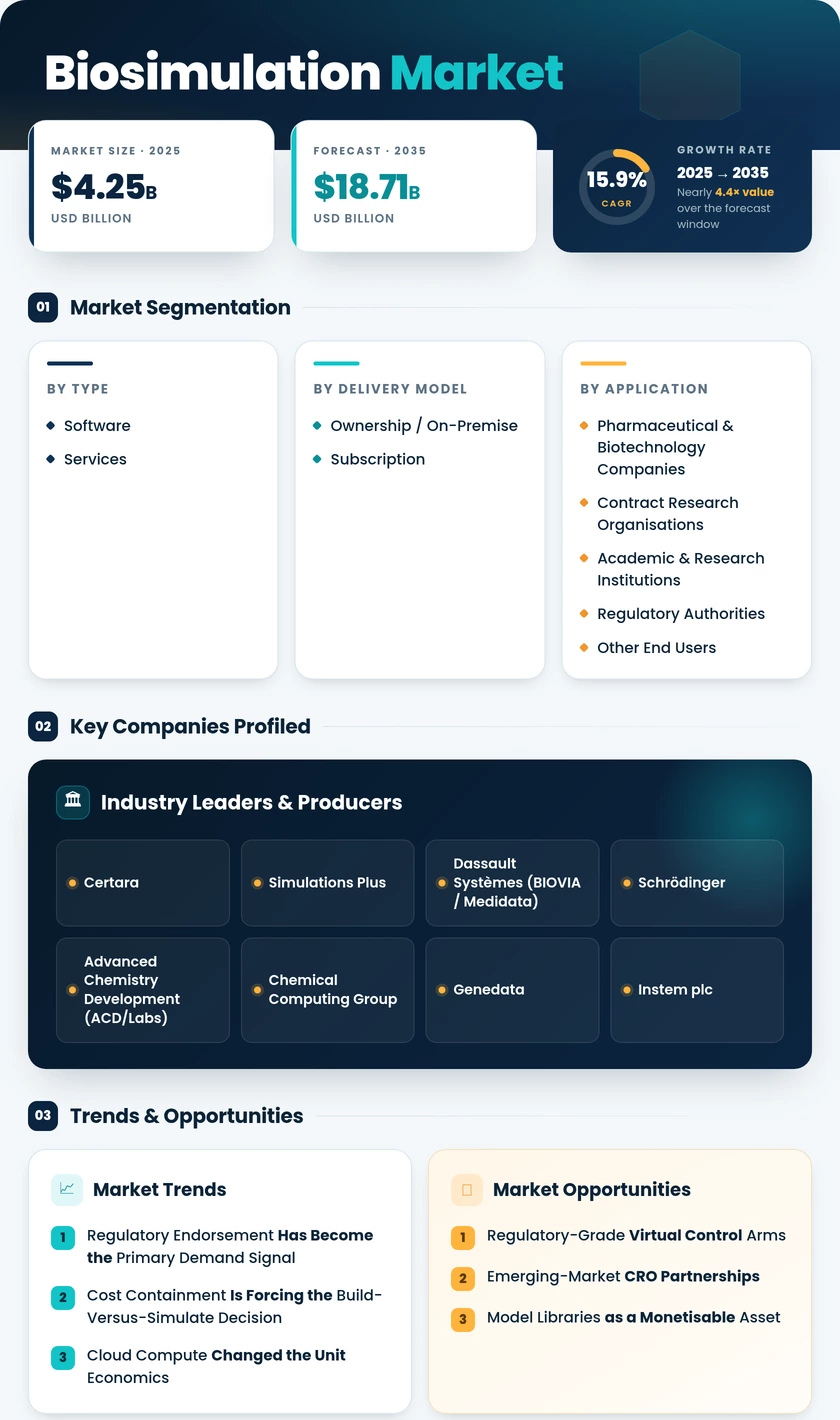
Segmentation Quick Reference
| Dimension | Sub-Segments | Dominant Segment | Fastest Growing Segment |
| By Product | Software; Services | Software | Services |
| By Delivery Model | Subscription; Ownership / On-Premise | Ownership / On-Premise | Subscription |
| By Application | Drug Discovery & Lead Optimisation; Preclinical Drug Development; Clinical Trial Design & Optimisation; Precision Medicine & Companion Diagnostics; Other Applications | Drug Discovery & Lead Optimisation | Precision Medicine & Companion Diagnostics |
| By End User | Pharmaceutical & Biotechnology Companies; Contract Research Organisations; Academic & Research Institutions; Regulatory Authorities; Other End Users | Pharmaceutical & Biotechnology Companies | Contract Research Organisations |
| By Region | North America; Europe; Asia-Pacific; South America; Middle East & Africa | North America | Asia-Pacific |
Market Segmentation Overview
By Product
| Sub-Segment | Key Trend |
| Software | Perpetual licences giving way to hybrid term-plus-compute contracts |
| Services | Managed modelling teams sold as capability, not headcount |
Product mix is shifting steadily toward services as sponsors confront a modeller shortage they cannot hire their way out of. Vendors that pair software with credentialed analysts are winning renewals at measurably higher rates.
By Delivery Model
| Sub-Segment | Key Trend |
| Subscription | Burst compute pricing attracting mid-cap biotechs and CROs |
| Ownership / On-Premise | Retained where compound IP sensitivity precludes external hosting |
Deployment preference splits cleanly along organisational size. Large sponsors defend on-premise architectures for sovereignty reasons, while emerging buyers treat simulation as a metered utility.
By Application
| Sub-Segment | Key Trend |
| Drug Discovery & Lead Optimisation | Virtual screening scaled through GPU-accelerated solvers |
| Preclinical Drug Development | First-in-human dose projection replacing additional animal cohorts |
| Clinical Trial Design & Optimisation | Adaptive protocol simulation reducing amendment frequency. |
| Precision Medicine & Companion Diagnostics | Genotype-stratified dosing evidence for payer negotiations |
| Other Applications | Formulation and continuous manufacturing modelling |
Application demand concentrates early in the pipeline, where the cost of a wrong decision compounds most severely. Later-stage uses grow faster, though, because regulators have only recently made them viable.
By End User
| Sub-Segment | Key Trend |
| Pharmaceutical & Biotechnology Companies | Internal modelling groups scaling toward 50+ staff at top sponsors |
| Contract Research Organisations | Quantitative sciences units built or acquired for margin defence |
| Academic & Research Institutions | Grant-funded methodology development feeding vendor talent pipelines |
| Regulatory Authorities | Independent model verification capability expanding at FDA, EMA, PMDA |
| Other End Users | Device manufacturers adopting coupled mechanical-pharmacokinetic models. |
Buyer composition is broadening beyond the traditional sponsor base. CROs and regulators together now represent roughly a quarter of licensed seats, a share that barely registered five years ago.
By Region
| Sub-Segment | Key Trend |
| North America | Regulatory proximity sustaining premium pricing and early adoption |
| Europe | Animal-testing reduction policy driving methodology investment |
| Asia-Pacific | CRO capacity and bioequivalence economics creating volume demand |
| South America | Consortium licensing models overcoming currency volatility |
| Middle East & Africa | Sovereign biotechnology strategies funding first-wave procurement |
Geographic momentum is rotating eastward without displacing the incumbent leader. North America keeps its revenue crown through 2035, but its share erodes by several points as Asia-Pacific converts regulatory guidance into procurement.


 Noah Malgeri
Co-Founder
Noah Malgeri
Co-Founder

 Peter Groot koerkamp
Account and Business Manager
Peter Groot koerkamp
Account and Business Manager

 Younghwan Choi
Senior Retail Manager
Younghwan Choi
Senior Retail Manager

 Mark Irwin
Management Consultant
Mark Irwin
Management Consultant

 Akif Moroglu
Strategy & Business Development Director
Akif Moroglu
Strategy & Business Development Director

 Guilherme Gomes Martins
Product Management Director
Guilherme Gomes Martins
Product Management Director

 Joseph Aguayo
Sales Operations & Pricing Manager
Joseph Aguayo
Sales Operations & Pricing Manager

 La Terria Dodd
Program Support Specialist
La Terria Dodd
Program Support Specialist

 Rob Kooiker
Group Product Manager HVAC & Fire Protection GMA
Rob Kooiker
Group Product Manager HVAC & Fire Protection GMA