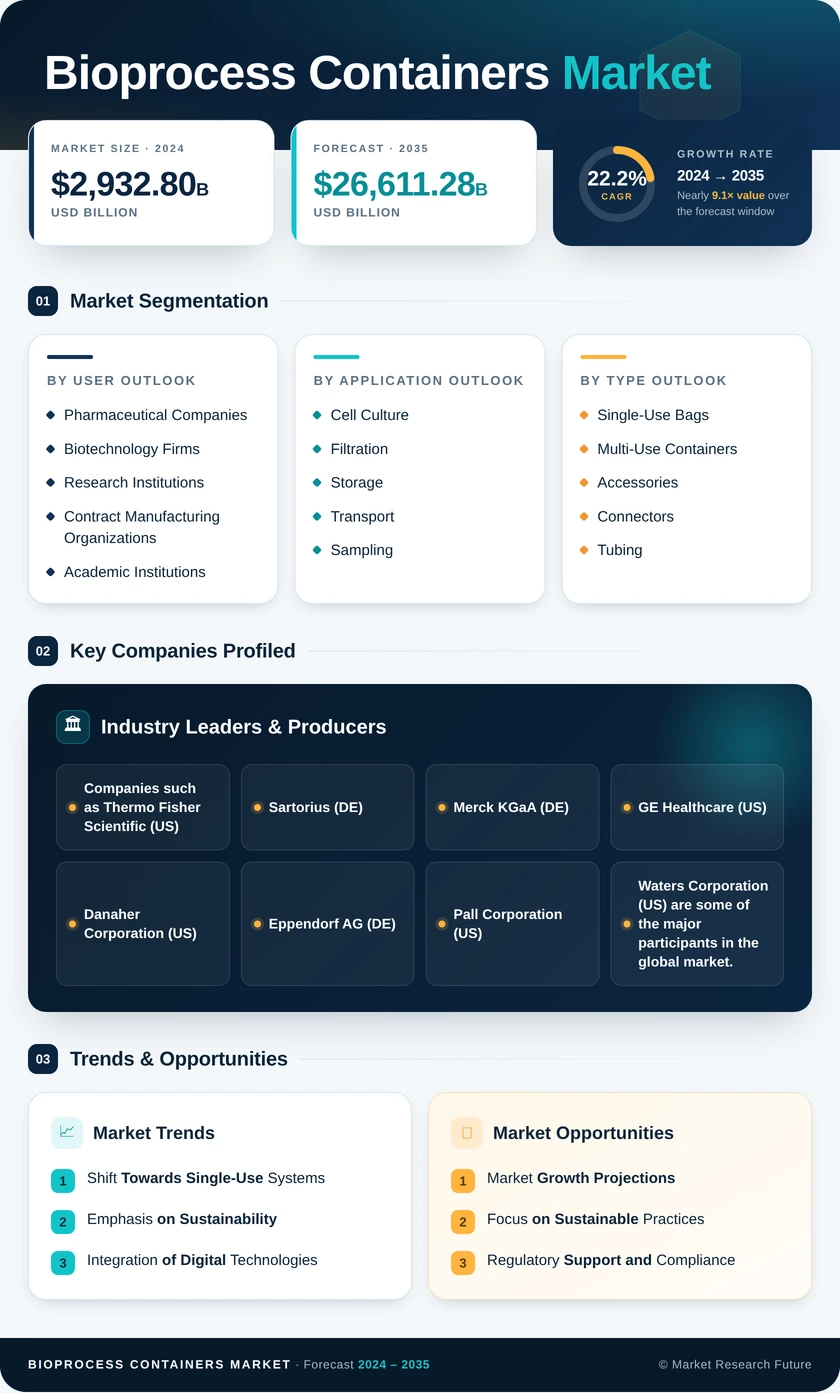
Bioprocess Containers Market (2026 - 2035)

ID: MRFR/MED/5169-HCR 100 Pages Rahul Gotadki Last Updated: October 26, 2026
Bioprocess Containers Market Report by Type (2D Container, 3D Container, Accessories), Application (Production Process, Upstream Process, Downstream Process), End User (Pharmaceutical Companies, Biotechnology Companies), and Region- Forecast till 2035
Bioprocess Containers Market
Market Size
Forecast Period2026-2035
CAGR (2026-2035)14.0%
2025 Market SizeUSD 3.97 Billion
2035 Market SizeUSD 14.70 Billion
Key Players
Thermo Fisher Scientific Inc.
Sartorius AG
Danaher Corporation
Merck KGaA
Corning Incorporated
Avantor Inc.
Opportunities
  • Greenfield Biomanufacturing in Emerging Markets
  • Supply-as-a-Service and Process Data Monetization
  • Cell and Gene Therapy Fill-Finish and Cryogenic Formats
  1. 1 Market Summary | |
  2. 2 Key Report Takeaways | |
    1. 2.1 By Type of Container | |
    2. 2.2 By Application | |
    3. 2.3 By End-User | |
    4. 2.4 By Region | |
  3. 3 Market Size and Forecast (2021–2035) | |
    1. 3.1 Historical Market Size (2021–2024) | |
    2. 3.2 Base Year Market Size (2025) | |
    3. 3.3 Forecast Market Size (2026–2035) | |
    4. 3.4 Year-over-Year Growth Analysis | |
  4. 4 Driver Impact Analysis | |
    1. 4.1 Expanding Biologics and Biosimilar Pipeline | |
    2. 4.2 Migration From Stainless Steel to Single-Use Facilities | |
    3. 4.3 CDMO Capacity Expansion and Outsourcing | |
    4. 4.4 Cell and Gene Therapy Commercialization | |
    5. 4.5 Stricter Contamination-Control Regulation | |
    6. 4.6 Pandemic Preparedness Vaccine Capacity | |
    7. 4.7 Asia-Pacific Biomanufacturing Policy Support | |
  5. 5 Restraints Impact Analysis | |
    1. 5.1 Extractables, Leachables, and Validation Burden | |
    2. 5.2 Plastic Waste and Sustainability Pressure | |
    3. 5.3 Supply Chain Concentration and Lead-Time Risk | |
    4. 5.4 Volume Ceiling of Single-Use Reactors | |
    5. 5.5 Post-Pandemic Inventory Cycles | |
  6. 6 Opportunities | |
    1. 6.1 Greenfield Biomanufacturing in Emerging Markets | |
    2. 6.2 Supply-as-a-Service and Process Data Monetization | |
    3. 6.3 Cell and Gene Therapy Fill-Finish and Cryogenic Formats | |
    4. 6.4 Recyclable and Lower-Carbon Film Technologies | |
    5. 6.5 mRNA and Rapid-Response Vaccine Platforms | |
  7. 7 Regional Market Share and Country-Level Analysis | |
    1. 7.1 North America | | |
      1. 7.1.1 United States | | |
      2. 7.1.2 Canada | | |
      3. 7.1.3 Mexico | |
    2. 7.2 Europe | | |
      1. 7.2.1 Germany | | |
      2. 7.2.2 United Kingdom | | |
      3. 7.2.3 France | | |
      4. 7.2.4 Italy | | |
      5. 7.2.5 Spain | | |
      6. 7.2.6 Rest of Europe | |
    3. 7.3 Asia-Pacific | | |
      1. 7.3.1 China | | |
      2. 7.3.2 Japan | | |
      3. 7.3.3 India | | |
      4. 7.3.4 Australia | | |
      5. 7.3.5 South Korea | | |
      6. 7.3.6 Rest of Asia-Pacific | |
    4. 7.4 South America | | |
      1. 7.4.1 Brazil | | |
      2. 7.4.2 Argentina | | |
      3. 7.4.3 Rest of South America | |
    5. 7.5 Middle East & Africa | | |
      1. 7.5.1 GCC | | |
      2. 7.5.2 South Africa | | |
      3. 7.5.3 Rest of Middle East & Africa | |
  8. 8 Future Outlook (2026–2035) | |
    1. 8.1 Continuous and Intensified Processing | |
    2. 8.2 Sensor-Integrated and Digitally Connected Containers | |
    3. 8.3 Circularity and Lower-Carbon Materials | |
    4. 8.4 Regionalized and Resilient Supply Networks | |
  9. 9 Segmentation Analysis | |
    1. 9.1 By Type of Container | | |
      1. 9.1.1 2-D Bioprocess Containers | | |
      2. 9.1.2 3-D Bioprocess Containers | | |
      3. 9.1.3 Others | |
    2. 9.2 By Application | | |
      1. 9.2.1 Upstream Processing | | |
      2. 9.2.2 Downstream Processing | | |
      3. 9.2.3 Process Development / Scale-up | | |
      4. 9.2.4 Fill-Finish Operations | |
    3. 9.3 By End-User | | |
      1. 9.3.1 Biopharmaceutical & Vaccine Manufacturers | | |
      2. 9.3.2 Contract Development & Manufacturing Organizations (CDMOs) | | |
      3. 9.3.3 Others | |
  10. 10 Competitive Landscape | |
    1. 10.1 Market Concentration Analysis | |
    2. 10.2 Competitive Benchmarking Matrix | |
    3. 10.3 Company Profiles | | |
      1. 10.3.1 Thermo Fisher Scientific Inc. | | |
      2. 10.3.2 Sartorius AG | | |
      3. 10.3.3 Danaher Corporation (Cytiva) | | |
      4. 10.3.4 Merck KGaA | | |
      5. 10.3.5 Corning Incorporated | | |
      6. 10.3.6 Avantor Inc. | | |
      7. 10.3.7 Saint-Gobain Life Sciences | | |
      8. 10.3.8 Repligen Corporation | | |
      9. 10.3.9 Entegris Inc. | | |
      10. 10.3.10 Meissner Filtration Products | | |
      11. 10.3.11 Single Use Support GmbH | |
  11. 11 Recent News & Developments | |
  12. 12 Report Scope and Methodology | |
  13. 13 Detailed Sources and Citations | |
  14. 14 Frequently Asked Questions (FAQs) | | LIST OF TABLES | |
  15. TABLE 1 Key Market Metrics Summary, 2025–2035 | |
  16. TABLE 2 Global Market Size & Forecast, by Revenue (USD Billion), 2021–2035 | |
  17. TABLE 3 Driver Impact Analysis, 2026–2035 | |
  18. TABLE 4 Restraints Impact Analysis, 2026–2035 | |
  19. TABLE 5 Regional Summary, by Region, 2025 | |
  20. TABLE 6 North America, by Country, 2025 | |
  21. TABLE 7 Europe, by Country, 2025 | |
  22. TABLE 8 Asia-Pacific, by Country, 2025 | |
  23. TABLE 9 South America, by Country, 2025 | |
  24. TABLE 10 Middle East & Africa, by Country, 2025 | |
  25. TABLE 11 Market Segmentation, by Type of Container, 2025 | |
  26. TABLE 12 Market Segmentation, by Application, 2025 | |
  27. TABLE 13 Market Segmentation, by End-User, 2025 | |
  28. TABLE 14 Competitive Benchmarking Matrix, 2025 | |
  29. TABLE 15 Report Scope and Methodology | |
  30. TABLE 16 Detailed Sources and Citations | |
  31. TABLE 17 Segmentation Quick Reference | | LIST OF FIGURES | |
  32. FIGURE 1 Market Dynamics Overview (Drivers, Restraints, Opportunities) | |
  33. FIGURE 2 Industry Value Chain Analysis | |
  34. FIGURE 3 Porter's Five Forces Analysis | |
  35. FIGURE 4 Global Market Size Trend, 2021–2035 (USD Billion) | |
  36. FIGURE 5 Market Share by Type of Container, 2025 | |
  37. FIGURE 6 Market Share by Application, 2025 | |
  38. FIGURE 7 Market Share by End-User, 2025 | |
  39. FIGURE 8 Regional Market Share, 2025 | |
  40. FIGURE 9 Asia-Pacific Growth Comparison by Country, 2026–2035 | |
  41. FIGURE 10 Competitive Landscape Positioning Map, 2025 | |
  42. FIGURE 11 Estimated Revenue Share Ranges of Key Players, 2025

Segmentation Quick Reference

DimensionSub-SegmentsDominant SegmentFastest Growing Segment
By Type of Container2-D Bioprocess Containers; 3-D Bioprocess Containers; Others3-D Bioprocess Containers (43.1% share)2-D Bioprocess Containers (14.3% CAGR)
By ApplicationUpstream Processing; Downstream Processing; Process Development / Scale-up; Fill-Finish OperationsUpstream Processing (51.2% share)Downstream Processing (14.6% CAGR)
By End-UserBiopharmaceutical & Vaccine Manufacturers; Contract Development & Manufacturing Organizations (CDMOs); OthersBiopharmaceutical & Vaccine Manufacturers (58.2% share)Contract Development & Manufacturing Organizations (CDMOs) (14.9% CAGR)
By RegionNorth America; Europe; Asia-Pacific; South America; Middle East & AfricaNorth America (39.5% share)Asia-Pacific (16.2% CAGR)

Market Segmentation Overview

By Type of Container

Sub-SegmentKey Trend
2-D Bioprocess ContainersRapid uptake in perfusion, seed-train, and rocking-platform culture
3-D Bioprocess ContainersStandard format for large fed-batch reactors and bulk fluid storage
OthersTank liners and transfer bags supporting mixing and fluid movement

3-D Bioprocess Containers lead with a 43.1% share because large fed-batch antibody reactors need supported bags that hold several thousand liters without compromising film integrity. 2-D Bioprocess Containers grow fastest at a 14.3% CAGR, since their flat profile improves oxygen transfer on rocking platforms used in perfusion and seed trains. Others, such as tank liners, remain a steady complement for mixing and transfer steps.

By Application

Sub-SegmentKey Trend
Upstream ProcessingDisposable bioreactors eliminating cleaning and sterilization cycles
Downstream ProcessingBuffer, pooling, and viral-inactivation steps moving to closed bags
Process Development / Scale-upHigh run frequency from clinical pipelines and tech transfers
Fill-Finish OperationsPre-sterilized liners and manifolds for small, high-value batches

Upstream Processing holds a 51.2% share because disposable bioreactors cut batch turnaround and suit mammalian cell culture. Downstream Processing is the fastest-growing application at a 14.6% CAGR, driven by Annex 1 pressure to close buffer preparation and viral-inactivation steps. Process Development / Scale-up and Fill-Finish Operations add specialized demand tied to clinical pipelines and advanced therapy batches.

By End-User

Sub-SegmentKey Trend
Biopharmaceutical & Vaccine ManufacturersMultiproduct facilities requiring fast molecule changeover
Contract Development & Manufacturing Organizations (CDMOs)Acquisitions and greenfield single-use suites expanding capacity
OthersAcademic, research, and government preparedness facilities

Biopharmaceutical & Vaccine Manufacturers lead with a 58.2% share, reflecting owner-operated plants that use bags to switch quickly between antibodies, fusion proteins, and vaccines. Contract Development & Manufacturing Organizations (CDMOs) grow fastest at a 14.9% CAGR, as large acquisitions and new standardized suites expand outsourced capacity. Others, including research and government facilities, contribute smaller but stable volumes for pilot work and preparedness reserves.


Download PDF ×

We do not share your information with anyone. However, we may send you emails based on your report interest from time to time. You may contact us at any time to opt-out.