
×
  • Cat-intel
  • MedIntelliX
  • Resources
  • About Us
  • Hero Background
    English
    Chinese
    French
    Japanese
    Korean
    German
    Spanish

    Biometric Banking Market Share

    ID: MRFR/BFSI/10301-HCR
    128 Pages
    Aarti Dhapte
    October 2025

    Biometric Banking Market Research Report Information By Product Type (Hardware and Software), By Product Application (Finger Print, Facial Recognition, Hand Geometry, Iris Recognition, and Others), and By Region (North America, Europe, Asia-Pacific, and Rest Of The World) – Industry Size, Share and Forecast Till 2035

    Share:
    Download PDF ×

    We do not share your information with anyone. However, we may send you emails based on your report interest from time to time. You may contact us at any time to opt-out.

    Biometric Banking Market Infographic
    Purchase Options

    Market Share

    Biometric Banking Market Share Analysis

    The Biometric Banking Market has seen critical development as of late, energized by mechanical headways and the rising accentuation on security in the monetary area. As the market keeps on developing, organizations are utilizing different market share situating techniques to acquire an upper hand. One common system is separation through advancement. Organizations endeavor to foster bleeding edge biometric advances that upgrade security and further develop client experience. By offering extraordinary and high level elements, for example, multi-modular biometrics and ceaseless confirmation, organizations can cut out a specialty for themselves in the market.

    Another key market situating system includes key associations and joint efforts. Perceiving the intricacy of biometric advances, many organizations are shaping unions with other industry players, innovation suppliers, or monetary establishments. These joint efforts help in sharing skill as well as add to the formation of complete arrangements that take care of the particular necessities of the banking area. By lining up with key accomplices, organizations can improve their market presence and make collaborations that push development.

    Cutthroat valuing is a significant component in market share situating, especially in an industry as serious as biometric banking. Offering financially savvy arrangements without settling on quality can be a strong methodology to draw in a more extensive client base. Organizations decisively value their biometric answers for appeal to both enormous monetary foundations and more modest banks, guaranteeing that their items are open across various market fragments. Cost seriousness helps in securing new clients as well as in holding existing ones, cultivating long haul connections.

    Market entrance is one more procedure utilized by organizations to expand their market share. This includes entering new geological areas or growing the scope of administrations presented inside existing markets. By distinguishing undiscovered open doors and tending to the remarkable necessities of different markets, organizations can expand their range and gain a bigger client base. This technique frequently includes adjusting items to meet the particular administrative and social subtleties of various locales, guaranteeing a fitted way to deal with market extension.

    Moreover, an emphasis on client driven systems is fundamental in the biometric banking market. Giving great client assistance, easy to use interfaces, and consistent incorporation with existing banking frameworks can altogether impact market share. As clients focus on security and comfort, organizations that focus on client experience and fulfillment can separate themselves from contenders. This remembers effective financial planning for client schooling projects to acquaint clients with the advantages and appropriate utilization of biometric banking arrangements.


    Author
    Aarti Dhapte
    Team Lead - Research

    She holds an experience of about 6+ years in Market Research and Business Consulting, working under the spectrum of Information Communication Technology, Telecommunications and Semiconductor domains. Aarti conceptualizes and implements a scalable business strategy and provides strategic leadership to the clients. Her expertise lies in market estimation, competitive intelligence, pipeline analysis, customer assessment, etc.

    Leave a Comment

    FAQs

    How much is the Biometric Banking market?

    The Biometric Banking Market size was valued at USD 6.48 billion in 2024.

    What is the growth rate of the Biometric Banking market?

    The global market is projected to grow at a CAGR of 15.80% during the forecast period, 2025 to 2035.

    Which region held the largest market share in the Biometric Banking market?

    North America had the largest share in the global market

    Who are the key players in the Biometric Banking market?

    The key players in the market are Techshino Technology, Ample trails, Inc, Biometrics Institute, State Grid Corporation of China, BPI Connected Identification, American Safety Council, Inc, Aulich & Co, Digital Persona, FIDO Alliance member, Diebold & Co, Omaha Based First Data Co, Chase & Co, Authentik Solutions, Visa Co, Biolink Solutions, Innoventry Corporation, Auraya Systems Pty Ltd, Baztech Inc, Axon Wireless International, and Charles Schwab And Co

    Which Product Type led the Biometric Banking market?

    The Hardware Product Type dominated the market in 2022.

    Which Product Application had the largest market share in the Biometric Banking market?

    The Finger Print Product Application had the largest share in the global market.

    Market Summary

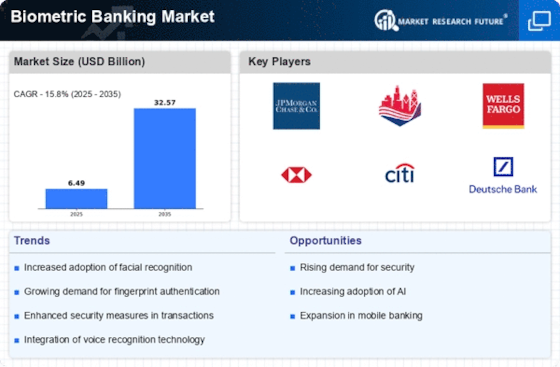
    As per MRFR analysis, the Biometric Banking Market Size was estimated at 6.485 USD Billion in 2024. The Biometric Banking industry is projected to grow from 7.51 USD Billion in 2025 to 32.57 USD Billion by 2035, exhibiting a compound annual growth rate (CAGR) of 15.8 during the forecast period 2025 - 2035.

    Key Market Trends & Highlights

    The Biometric Banking Market is experiencing robust growth driven by technological advancements and increasing consumer demand for secure banking solutions.

    • The adoption of biometric authentication is witnessing a notable increase, particularly in North America, which remains the largest market. Integration with mobile banking solutions is becoming more prevalent, enhancing user experience and security across the Asia-Pacific region. Collaborations between technology firms and banks are on the rise, fostering innovation in biometric solutions. Rising security concerns and consumer preference for convenience are key drivers propelling the growth of the hardware segment, particularly fingerprint recognition.

    Market Size & Forecast

    2024 Market Size 6.485 (USD Billion)
    2035 Market Size 32.57 (USD Billion)
    CAGR (2025 - 2035) 15.8%
    Largest Regional Market Share in 2024 North America

    Major Players

    <p>JPMorgan Chase (US), Bank of America (US), Wells Fargo (US), HSBC (GB), Citigroup (US), Deutsche Bank (DE), Barclays (GB), Santander (ES), UBS (CH)</p>

    Market Trends

    The Biometric Banking Market is currently experiencing a transformative phase, driven by advancements in technology and increasing consumer demand for secure banking solutions. Financial institutions are increasingly adopting biometric authentication methods, such as fingerprint scanning, facial recognition, and voice recognition, to enhance security and streamline customer experiences. This shift towards biometric solutions appears to be motivated by the need to combat rising fraud rates and to comply with stringent regulatory requirements. As a result, banks are investing in innovative technologies that not only protect sensitive information but also improve operational efficiency. Moreover, the integration of biometric systems into mobile banking applications is gaining traction, as consumers seek convenient and secure ways to manage their finances. The growing prevalence of smartphones equipped with biometric capabilities suggests a potential for widespread adoption of these technologies in everyday banking transactions. Additionally, partnerships between technology providers and financial institutions are likely to foster further innovation in this sector. Overall, the Biometric Banking Market seems poised for substantial growth, as stakeholders recognize the importance of enhancing security while providing seamless user experiences.

    Increased Adoption of Biometric Authentication

    Financial institutions are increasingly implementing biometric authentication methods to enhance security measures. This trend reflects a growing recognition of the need to protect sensitive customer information and reduce fraud risks.

    Integration with Mobile Banking Solutions

    The incorporation of biometric technologies into mobile banking applications is becoming more prevalent. This integration allows consumers to access their accounts securely and conveniently, aligning with the demand for user-friendly banking experiences.

    Collaborations Between Tech Firms and Banks

    Partnerships between technology companies and financial institutions are emerging as a key trend. These collaborations aim to develop innovative biometric solutions that address security challenges while improving customer engagement.

    Biometric Banking Market Market Drivers

    Regulatory Compliance

    Regulatory frameworks are increasingly mandating the use of biometric solutions to enhance security and protect consumer data. Financial institutions are required to comply with stringent regulations regarding data protection and privacy, which often necessitate the implementation of advanced security measures. The Biometric Banking Market is thus experiencing a surge in demand as banks seek to align their operations with these regulatory requirements. For example, the General Data Protection Regulation (GDPR) in Europe emphasizes the need for secure data handling practices, prompting banks to adopt biometric technologies. This regulatory landscape is likely to drive further investments in biometric solutions, as compliance becomes a critical factor for operational sustainability in the Biometric Banking Market.

    Rising Security Concerns

    The increasing prevalence of cyber threats and identity theft has heightened the demand for secure banking solutions. As financial institutions face mounting pressure to protect sensitive customer data, the Biometric Banking Market emerges as a viable solution. Biometric authentication methods, such as fingerprint and facial recognition, offer enhanced security features that traditional methods lack. According to recent data, the biometric authentication market is projected to reach USD 38 billion by 2025, indicating a robust growth trajectory. This trend suggests that banks are likely to invest heavily in biometric technologies to safeguard their operations and maintain customer trust. Consequently, the rising security concerns are driving the adoption of biometric solutions within the Biometric Banking Market.

    Technological Advancements

    Rapid advancements in technology are significantly influencing the Biometric Banking Market. Innovations in artificial intelligence and machine learning are enhancing the accuracy and efficiency of biometric systems. For instance, the integration of AI algorithms allows for real-time analysis of biometric data, improving the speed of authentication processes. Furthermore, the proliferation of smart devices equipped with biometric capabilities is facilitating the widespread adoption of these technologies in banking. As per industry forecasts, the biometric technology market is expected to grow at a compound annual growth rate of 23% from 2023 to 2030. This growth indicates that technological advancements will continue to play a pivotal role in shaping the future of the Biometric Banking Market.

    Consumer Preference for Convenience

    As consumer preferences evolve, there is a growing demand for convenient banking solutions that streamline the user experience. The Biometric Banking Market is well-positioned to meet this demand, as biometric authentication offers a seamless and user-friendly alternative to traditional methods. Customers increasingly favor quick and efficient access to their banking services, and biometric solutions provide just that. Data indicates that 70% of consumers are more likely to use banking services that incorporate biometric authentication due to its convenience. This shift in consumer behavior is likely to propel the growth of the Biometric Banking Market, as banks strive to enhance customer satisfaction and loyalty through innovative solutions.

    Competitive Pressure Among Financial Institutions

    The competitive landscape within the banking sector is intensifying, prompting financial institutions to differentiate themselves through innovative technologies. The Biometric Banking Market is benefiting from this competitive pressure, as banks seek to adopt cutting-edge solutions to attract and retain customers. Institutions that implement biometric authentication can enhance their security measures while also providing a modern banking experience. Market analysis suggests that banks investing in biometric technologies are likely to gain a competitive edge, as they can offer superior security and convenience. This trend indicates that the competitive dynamics within the banking sector will continue to drive the adoption of biometric solutions, further propelling the growth of the Biometric Banking Market.

    Market Segment Insights

    By Type: Hardware (Largest) vs. Software (Fastest-Growing)

    <p>In the Biometric Banking Market, the distribution of market share between hardware and software segments reveals a significant dominance of hardware solutions. Hardware, encompassing biometric scanners, fingerprint readers, and facial recognition devices, comprises a substantial portion of the market due to its critical role in ensuring secure transactions. On the other hand, software solutions, which facilitate biometric data processing and integration with existing banking systems, have been emerging rapidly and capturing a growing share of the market.</p>

    <p>Biometric Solutions: Hardware (Dominant) vs. Software (Emerging)</p>

    <p>Hardware in the Biometric Banking Market remains dominant due to its essential function in providing robust security measures. Devices such as fingerprint scanners and facial recognition systems are integral for banks aiming to enhance authentic user verification while preventing fraud. These hardware solutions are notably reliable and play a crucial role in creating a secure banking environment. Conversely, the software segment is recognized as emerging with vast potential. It encompasses innovative solutions that enhance user experience through seamless integration and data management. The growing emphasis on cybersecurity and digital transactions is driving significant interest in software solutions, positioning them as vital for future growth alongside hardware.</p>

    By Application: Finger Print (Largest) vs. Facial Recognition (Fastest-Growing)

    <p>In the Biometric Banking Market, Finger Print recognition remains the largest segment, capturing significant market share due to its long-standing adoption and reliability in authentication processes. Facial recognition follows closely, gaining traction and showing substantial growth due to advancements in technology and increasing consumer acceptance. The market distribution among these applications reflects a strong preference for Finger Print solutions, which are widely employed for their ease of use and quick authentication.</p>

    <p>Fingerprint (Dominant) vs. Facial Recognition (Emerging)</p>

    <p>The Fingerprint recognition segment is characterized by its dominance in the biometric banking sector, leveraging established technology that offers secure and convenient user verification methods. It's favored for its speed and accuracy, making it a go-to solution for financial institutions. On the other hand, Facial Recognition technology is emerging rapidly, driven by innovations in AI and machine learning. This segment is appealing to banks seeking to enhance security protocols and improve customer experience, capitalizing on its non-intrusiveness and efficiency in user identification. As consumers become more open to such advancements, the growth trajectory for facial recognition in banking is increasingly robust.</p>

    Get more detailed insights about Biometric Banking Market Research Report - Global Forecast till 2035

    Regional Insights

    North America : Innovation and Security Leaders

    North America is the largest market for biometric banking, holding approximately 45% of the global share. The region's growth is driven by increasing demand for secure banking solutions, advancements in biometric technology, and supportive regulatory frameworks. The U.S. government has been proactive in promoting digital security measures, which further fuels market expansion. The rise in cyber threats has also led to a heightened focus on biometric authentication as a means to enhance security. The United States is the dominant player in this market, with major banks like JPMorgan Chase, Bank of America, and Wells Fargo leading the charge in adopting biometric solutions. The competitive landscape is characterized by rapid technological advancements and partnerships between banks and tech firms. As financial institutions increasingly prioritize customer security and convenience, the adoption of biometric banking solutions is expected to accelerate significantly in the coming years.

    Europe : Regulatory Frameworks and Innovation

    Europe is the second-largest market for biometric banking, accounting for approximately 30% of the global market share. The region's growth is propelled by stringent regulations aimed at enhancing consumer protection and data security, such as the General Data Protection Regulation (GDPR). These regulations encourage banks to adopt biometric technologies to comply with security standards and improve customer trust. Additionally, the increasing prevalence of digital banking services is driving demand for biometric solutions. Leading countries in Europe include the United Kingdom, Germany, and France, where banks like HSBC, Deutsche Bank, and Barclays are at the forefront of biometric banking innovation. The competitive landscape is marked by collaborations between financial institutions and technology providers to develop advanced biometric solutions. As the market matures, European banks are expected to invest heavily in biometric technologies to enhance customer experience and security.

    Asia-Pacific : Emerging Markets and Adoption

    Asia-Pacific is witnessing rapid growth in the biometric banking market, holding approximately 20% of the global share. The region's expansion is driven by increasing smartphone penetration, a growing middle class, and rising concerns over security in digital transactions. Countries like China and India are leading the charge, with governments promoting digital banking initiatives that encourage the adoption of biometric technologies. The regulatory environment is becoming more supportive, facilitating the growth of biometric solutions in the banking sector. China and India are the key players in this market, with major banks like ICBC and State Bank of India investing in biometric authentication systems. The competitive landscape is characterized by a mix of traditional banks and fintech companies, all vying to capture the growing demand for secure banking solutions. As the region continues to embrace digital transformation, the biometric banking market is expected to flourish significantly in the coming years.

    Middle East and Africa : Growth Potential and Challenges

    The Middle East and Africa (MEA) region is an emerging market for biometric banking, holding about 5% of the global share. The growth in this region is driven by increasing smartphone usage, a young population, and a rising demand for secure banking solutions. Governments are beginning to recognize the importance of biometric technologies in enhancing financial security and are implementing supportive regulations. However, challenges such as infrastructure limitations and varying regulatory environments may hinder growth. Leading countries in the MEA region include South Africa and the UAE, where banks are increasingly adopting biometric solutions to enhance customer experience and security. The competitive landscape is evolving, with both traditional banks and fintech startups exploring biometric technologies. As awareness of the benefits of biometric banking grows, the market is expected to expand, albeit at a slower pace compared to other regions.

    Key Players and Competitive Insights

    The Biometric Banking Market is currently characterized by a dynamic competitive landscape, driven by rapid technological advancements and an increasing emphasis on security and customer experience. Major players such as JPMorgan Chase (US), Bank of America (US), and HSBC (GB) are at the forefront, leveraging innovation and strategic partnerships to enhance their biometric offerings. These institutions are not only focusing on integrating biometric solutions into their existing frameworks but are also exploring new avenues for customer engagement and operational efficiency. The collective strategies of these companies indicate a shift towards a more secure and user-friendly banking environment, which is likely to reshape customer expectations and industry standards.

    In terms of business tactics, companies are increasingly localizing their operations to better cater to regional markets, optimizing supply chains to enhance efficiency, and investing in cutting-edge technologies. The competitive structure of the biometric banking market appears moderately fragmented, with several key players vying for market share. This fragmentation allows for a diverse range of solutions and innovations, although the influence of major banks remains substantial, shaping the overall direction of the market.

    In September 2025, JPMorgan Chase (US) announced a partnership with a leading biometric technology firm to enhance its mobile banking security features. This strategic move is significant as it not only strengthens the bank's security protocols but also positions it as a leader in adopting advanced biometric solutions, potentially attracting tech-savvy customers who prioritize security in their banking experiences.

    Similarly, in August 2025, Bank of America (US) launched a new biometric authentication system that utilizes facial recognition technology for its mobile app. This initiative reflects the bank's commitment to enhancing user experience while ensuring robust security measures. The implementation of such technology may serve to differentiate Bank of America in a competitive market, appealing to customers who value convenience and safety.

    In July 2025, HSBC (GB) expanded its biometric banking services in Asia, focusing on integrating voice recognition technology into its customer service operations. This expansion is indicative of HSBC's strategy to tap into emerging markets while enhancing customer interaction through innovative solutions. By adopting voice recognition, HSBC not only improves accessibility but also aligns with the growing trend of personalized banking experiences.

    As of October 2025, the competitive trends in the biometric banking market are increasingly defined by digitalization, sustainability, and the integration of artificial intelligence. Strategic alliances among key players are shaping the landscape, fostering innovation and collaboration. The evolution of competitive differentiation appears to be shifting from traditional price-based competition towards a focus on technological innovation, enhanced customer experiences, and reliable supply chains. This transition suggests that companies that prioritize these aspects may gain a competitive edge in the rapidly evolving biometric banking sector.

    Key Companies in the Biometric Banking Market market include

    Industry Developments

    June 2021: Utilizing its expertise from hundreds of global public security initiatives, Phonexia created new audio investigative software called Phoenixia Orbis.

    September 2021: In order to become value-added resellers, Imageware and TECH5 teamed up. Through this agreement, all TECH5 offerings may be integrated with the current Imageware product range, which includes, among other things, Imageware Proof, Imageware Authenticate, Imageware Identify, and the Imageware Biometric Engine.

    May 2021: Through its subsidiary PerVoice, Phonexia teamed with Almawave, a provider of artificial intelligence (AI), natural language processing, and big data services, to add Phonexia speech Verify, a speech biometric solution, to Almawave's portfolio.

    Future Outlook

    Biometric Banking Market Future Outlook

    <p>The Biometric Banking Market is projected to grow at a 15.8% CAGR from 2024 to 2035, driven by technological advancements, increasing security concerns, and consumer demand for seamless transactions.</p>

    New opportunities lie in:

    • <p>Integration of AI-driven biometric authentication systems</p><p>Development of mobile biometric payment solutions</p><p>Expansion of biometric-enabled ATMs in urban areas</p>

    <p>By 2035, the market is expected to be robust, driven by innovation and widespread adoption.</p>

    Market Segmentation

    Biometric Banking Market Type Outlook

    • Hardware
    • Software

    Biometric Banking Market Application Outlook

    • Finger Print
    • Facial recognition
    • Hand Geometry
    • Iris Recognition
    • Others

    Report Scope

    MARKET SIZE 20246.485(USD Billion)
    MARKET SIZE 20257.51(USD Billion)
    MARKET SIZE 203532.57(USD Billion)
    COMPOUND ANNUAL GROWTH RATE (CAGR)15.8% (2024 - 2035)
    REPORT COVERAGERevenue Forecast, Competitive Landscape, Growth Factors, and Trends
    BASE YEAR2024
    Market Forecast Period2025 - 2035
    Historical Data2019 - 2024
    Market Forecast UnitsUSD Billion
    Key Companies ProfiledMarket analysis in progress
    Segments CoveredMarket segmentation analysis in progress
    Key Market OpportunitiesIntegration of advanced biometric technologies enhances security and customer experience in the Biometric Banking Market.
    Key Market DynamicsRising consumer demand for secure transactions drives innovation in biometric authentication technologies within banking.
    Countries CoveredNorth America, Europe, APAC, South America, MEA

    FAQs

    How much is the Biometric Banking market?

    The Biometric Banking Market size was valued at USD 6.48 billion in 2024.

    What is the growth rate of the Biometric Banking market?

    The global market is projected to grow at a CAGR of 15.80% during the forecast period, 2025 to 2035.

    Which region held the largest market share in the Biometric Banking market?

    North America had the largest share in the global market

    Who are the key players in the Biometric Banking market?

    The key players in the market are Techshino Technology, Ample trails, Inc, Biometrics Institute, State Grid Corporation of China, BPI Connected Identification, American Safety Council, Inc, Aulich &amp; Co, Digital Persona, FIDO Alliance member, Diebold &amp; Co, Omaha Based First Data Co, Chase &amp; Co, Authentik Solutions, Visa Co, Biolink Solutions, Innoventry Corporation, Auraya Systems Pty Ltd, Baztech Inc, Axon Wireless International, and Charles Schwab And Co

    Which Product Type led the Biometric Banking market?

    The Hardware Product Type dominated the market in 2022.

    Which Product Application had the largest market share in the Biometric Banking market?

    The Finger Print Product Application had the largest share in the global market.

    1. SECTION I: EXECUTIVE SUMMARY AND KEY HIGHLIGHTS
      1. | 1.1 EXECUTIVE SUMMARY
      2. | | 1.1.1 Market Overview
      3. | | 1.1.2 Key Findings
      4. | | 1.1.3 Market Segmentation
      5. | | 1.1.4 Competitive Landscape
      6. | | 1.1.5 Challenges and Opportunities
      7. | | 1.1.6 Future Outlook
    2. SECTION II: SCOPING, METHODOLOGY AND MARKET STRUCTURE
      1. | 2.1 MARKET INTRODUCTION
      2. | | 2.1.1 Definition
      3. | | 2.1.2 Scope of the study
      4. | | | 2.1.2.1 Research Objective
      5. | | | 2.1.2.2 Assumption
      6. | | | 2.1.2.3 Limitations
      7. | 2.2 RESEARCH METHODOLOGY
      8. | | 2.2.1 Overview
      9. | | 2.2.2 Data Mining
      10. | | 2.2.3 Secondary Research
      11. | | 2.2.4 Primary Research
      12. | | | 2.2.4.1 Primary Interviews and Information Gathering Process
      13. | | | 2.2.4.2 Breakdown of Primary Respondents
      14. | | 2.2.5 Forecasting Model
      15. | | 2.2.6 Market Size Estimation
      16. | | | 2.2.6.1 Bottom-Up Approach
      17. | | | 2.2.6.2 Top-Down Approach
      18. | | 2.2.7 Data Triangulation
      19. | | 2.2.8 Validation
    3. SECTION III: QUALITATIVE ANALYSIS
      1. | 3.1 MARKET DYNAMICS
      2. | | 3.1.1 Overview
      3. | | 3.1.2 Drivers
      4. | | 3.1.3 Restraints
      5. | | 3.1.4 Opportunities
      6. | 3.2 MARKET FACTOR ANALYSIS
      7. | | 3.2.1 Value chain Analysis
      8. | | 3.2.2 Porter's Five Forces Analysis
      9. | | | 3.2.2.1 Bargaining Power of Suppliers
      10. | | | 3.2.2.2 Bargaining Power of Buyers
      11. | | | 3.2.2.3 Threat of New Entrants
      12. | | | 3.2.2.4 Threat of Substitutes
      13. | | | 3.2.2.5 Intensity of Rivalry
      14. | | 3.2.3 COVID-19 Impact Analysis
      15. | | | 3.2.3.1 Market Impact Analysis
      16. | | | 3.2.3.2 Regional Impact
      17. | | | 3.2.3.3 Opportunity and Threat Analysis
    4. SECTION IV: QUANTITATIVE ANALYSIS
      1. | 4.1 BFSI, BY Type (USD Billion)
      2. | | 4.1.1 Hardware
      3. | | 4.1.2 Software
      4. | 4.2 BFSI, BY Application (USD Billion)
      5. | | 4.2.1 Finger Print
      6. | | 4.2.2 Facial recognition
      7. | | 4.2.3 Hand Geometry
      8. | | 4.2.4 Iris Recognition
      9. | | 4.2.5 Others
      10. | 4.3 BFSI, BY Region (USD Billion)
      11. | | 4.3.1 North America
      12. | | | 4.3.1.1 US
      13. | | | 4.3.1.2 Canada
      14. | | 4.3.2 Europe
      15. | | | 4.3.2.1 Germany
      16. | | | 4.3.2.2 UK
      17. | | | 4.3.2.3 France
      18. | | | 4.3.2.4 Russia
      19. | | | 4.3.2.5 Italy
      20. | | | 4.3.2.6 Spain
      21. | | | 4.3.2.7 Rest of Europe
      22. | | 4.3.3 APAC
      23. | | | 4.3.3.1 China
      24. | | | 4.3.3.2 India
      25. | | | 4.3.3.3 Japan
      26. | | | 4.3.3.4 South Korea
      27. | | | 4.3.3.5 Malaysia
      28. | | | 4.3.3.6 Thailand
      29. | | | 4.3.3.7 Indonesia
      30. | | | 4.3.3.8 Rest of APAC
      31. | | 4.3.4 South America
      32. | | | 4.3.4.1 Brazil
      33. | | | 4.3.4.2 Mexico
      34. | | | 4.3.4.3 Argentina
      35. | | | 4.3.4.4 Rest of South America
      36. | | 4.3.5 MEA
      37. | | | 4.3.5.1 GCC Countries
      38. | | | 4.3.5.2 South Africa
      39. | | | 4.3.5.3 Rest of MEA
    5. SECTION V: COMPETITIVE ANALYSIS
      1. | 5.1 Competitive Landscape
      2. | | 5.1.1 Overview
      3. | | 5.1.2 Competitive Analysis
      4. | | 5.1.3 Market share Analysis
      5. | | 5.1.4 Major Growth Strategy in the BFSI
      6. | | 5.1.5 Competitive Benchmarking
      7. | | 5.1.6 Leading Players in Terms of Number of Developments in the BFSI
      8. | | 5.1.7 Key developments and growth strategies
      9. | | | 5.1.7.1 New Product Launch/Service Deployment
      10. | | | 5.1.7.2 Merger & Acquisitions
      11. | | | 5.1.7.3 Joint Ventures
      12. | | 5.1.8 Major Players Financial Matrix
      13. | | | 5.1.8.1 Sales and Operating Income
      14. | | | 5.1.8.2 Major Players R&D Expenditure. 2023
      15. | 5.2 Company Profiles
      16. | | 5.2.1 JPMorgan Chase (US)
      17. | | | 5.2.1.1 Financial Overview
      18. | | | 5.2.1.2 Products Offered
      19. | | | 5.2.1.3 Key Developments
      20. | | | 5.2.1.4 SWOT Analysis
      21. | | | 5.2.1.5 Key Strategies
      22. | | 5.2.2 Bank of America (US)
      23. | | | 5.2.2.1 Financial Overview
      24. | | | 5.2.2.2 Products Offered
      25. | | | 5.2.2.3 Key Developments
      26. | | | 5.2.2.4 SWOT Analysis
      27. | | | 5.2.2.5 Key Strategies
      28. | | 5.2.3 Wells Fargo (US)
      29. | | | 5.2.3.1 Financial Overview
      30. | | | 5.2.3.2 Products Offered
      31. | | | 5.2.3.3 Key Developments
      32. | | | 5.2.3.4 SWOT Analysis
      33. | | | 5.2.3.5 Key Strategies
      34. | | 5.2.4 HSBC (GB)
      35. | | | 5.2.4.1 Financial Overview
      36. | | | 5.2.4.2 Products Offered
      37. | | | 5.2.4.3 Key Developments
      38. | | | 5.2.4.4 SWOT Analysis
      39. | | | 5.2.4.5 Key Strategies
      40. | | 5.2.5 Citigroup (US)
      41. | | | 5.2.5.1 Financial Overview
      42. | | | 5.2.5.2 Products Offered
      43. | | | 5.2.5.3 Key Developments
      44. | | | 5.2.5.4 SWOT Analysis
      45. | | | 5.2.5.5 Key Strategies
      46. | | 5.2.6 Deutsche Bank (DE)
      47. | | | 5.2.6.1 Financial Overview
      48. | | | 5.2.6.2 Products Offered
      49. | | | 5.2.6.3 Key Developments
      50. | | | 5.2.6.4 SWOT Analysis
      51. | | | 5.2.6.5 Key Strategies
      52. | | 5.2.7 Barclays (GB)
      53. | | | 5.2.7.1 Financial Overview
      54. | | | 5.2.7.2 Products Offered
      55. | | | 5.2.7.3 Key Developments
      56. | | | 5.2.7.4 SWOT Analysis
      57. | | | 5.2.7.5 Key Strategies
      58. | | 5.2.8 Santander (ES)
      59. | | | 5.2.8.1 Financial Overview
      60. | | | 5.2.8.2 Products Offered
      61. | | | 5.2.8.3 Key Developments
      62. | | | 5.2.8.4 SWOT Analysis
      63. | | | 5.2.8.5 Key Strategies
      64. | | 5.2.9 UBS (CH)
      65. | | | 5.2.9.1 Financial Overview
      66. | | | 5.2.9.2 Products Offered
      67. | | | 5.2.9.3 Key Developments
      68. | | | 5.2.9.4 SWOT Analysis
      69. | | | 5.2.9.5 Key Strategies
      70. | 5.3 Appendix
      71. | | 5.3.1 References
      72. | | 5.3.2 Related Reports
    6. LIST OF FIGURES
      1. | 6.1 MARKET SYNOPSIS
      2. | 6.2 NORTH AMERICA MARKET ANALYSIS
      3. | 6.3 US MARKET ANALYSIS BY TYPE
      4. | 6.4 US MARKET ANALYSIS BY APPLICATION
      5. | 6.5 CANADA MARKET ANALYSIS BY TYPE
      6. | 6.6 CANADA MARKET ANALYSIS BY APPLICATION
      7. | 6.7 EUROPE MARKET ANALYSIS
      8. | 6.8 GERMANY MARKET ANALYSIS BY TYPE
      9. | 6.9 GERMANY MARKET ANALYSIS BY APPLICATION
      10. | 6.10 UK MARKET ANALYSIS BY TYPE
      11. | 6.11 UK MARKET ANALYSIS BY APPLICATION
      12. | 6.12 FRANCE MARKET ANALYSIS BY TYPE
      13. | 6.13 FRANCE MARKET ANALYSIS BY APPLICATION
      14. | 6.14 RUSSIA MARKET ANALYSIS BY TYPE
      15. | 6.15 RUSSIA MARKET ANALYSIS BY APPLICATION
      16. | 6.16 ITALY MARKET ANALYSIS BY TYPE
      17. | 6.17 ITALY MARKET ANALYSIS BY APPLICATION
      18. | 6.18 SPAIN MARKET ANALYSIS BY TYPE
      19. | 6.19 SPAIN MARKET ANALYSIS BY APPLICATION
      20. | 6.20 REST OF EUROPE MARKET ANALYSIS BY TYPE
      21. | 6.21 REST OF EUROPE MARKET ANALYSIS BY APPLICATION
      22. | 6.22 APAC MARKET ANALYSIS
      23. | 6.23 CHINA MARKET ANALYSIS BY TYPE
      24. | 6.24 CHINA MARKET ANALYSIS BY APPLICATION
      25. | 6.25 INDIA MARKET ANALYSIS BY TYPE
      26. | 6.26 INDIA MARKET ANALYSIS BY APPLICATION
      27. | 6.27 JAPAN MARKET ANALYSIS BY TYPE
      28. | 6.28 JAPAN MARKET ANALYSIS BY APPLICATION
      29. | 6.29 SOUTH KOREA MARKET ANALYSIS BY TYPE
      30. | 6.30 SOUTH KOREA MARKET ANALYSIS BY APPLICATION
      31. | 6.31 MALAYSIA MARKET ANALYSIS BY TYPE
      32. | 6.32 MALAYSIA MARKET ANALYSIS BY APPLICATION
      33. | 6.33 THAILAND MARKET ANALYSIS BY TYPE
      34. | 6.34 THAILAND MARKET ANALYSIS BY APPLICATION
      35. | 6.35 INDONESIA MARKET ANALYSIS BY TYPE
      36. | 6.36 INDONESIA MARKET ANALYSIS BY APPLICATION
      37. | 6.37 REST OF APAC MARKET ANALYSIS BY TYPE
      38. | 6.38 REST OF APAC MARKET ANALYSIS BY APPLICATION
      39. | 6.39 SOUTH AMERICA MARKET ANALYSIS
      40. | 6.40 BRAZIL MARKET ANALYSIS BY TYPE
      41. | 6.41 BRAZIL MARKET ANALYSIS BY APPLICATION
      42. | 6.42 MEXICO MARKET ANALYSIS BY TYPE
      43. | 6.43 MEXICO MARKET ANALYSIS BY APPLICATION
      44. | 6.44 ARGENTINA MARKET ANALYSIS BY TYPE
      45. | 6.45 ARGENTINA MARKET ANALYSIS BY APPLICATION
      46. | 6.46 REST OF SOUTH AMERICA MARKET ANALYSIS BY TYPE
      47. | 6.47 REST OF SOUTH AMERICA MARKET ANALYSIS BY APPLICATION
      48. | 6.48 MEA MARKET ANALYSIS
      49. | 6.49 GCC COUNTRIES MARKET ANALYSIS BY TYPE
      50. | 6.50 GCC COUNTRIES MARKET ANALYSIS BY APPLICATION
      51. | 6.51 SOUTH AFRICA MARKET ANALYSIS BY TYPE
      52. | 6.52 SOUTH AFRICA MARKET ANALYSIS BY APPLICATION
      53. | 6.53 REST OF MEA MARKET ANALYSIS BY TYPE
      54. | 6.54 REST OF MEA MARKET ANALYSIS BY APPLICATION
      55. | 6.55 KEY BUYING CRITERIA OF BFSI
      56. | 6.56 RESEARCH PROCESS OF MRFR
      57. | 6.57 DRO ANALYSIS OF BFSI
      58. | 6.58 DRIVERS IMPACT ANALYSIS: BFSI
      59. | 6.59 RESTRAINTS IMPACT ANALYSIS: BFSI
      60. | 6.60 SUPPLY / VALUE CHAIN: BFSI
      61. | 6.61 BFSI, BY TYPE, 2024 (% SHARE)
      62. | 6.62 BFSI, BY TYPE, 2024 TO 2035 (USD Billion)
      63. | 6.63 BFSI, BY APPLICATION, 2024 (% SHARE)
      64. | 6.64 BFSI, BY APPLICATION, 2024 TO 2035 (USD Billion)
      65. | 6.65 BENCHMARKING OF MAJOR COMPETITORS
    7. LIST OF TABLES
      1. | 7.1 LIST OF ASSUMPTIONS
      2. | | 7.1.1
      3. | 7.2 North America MARKET SIZE ESTIMATES; FORECAST
      4. | | 7.2.1 BY TYPE, 2025-2035 (USD Billion)
      5. | | 7.2.2 BY APPLICATION, 2025-2035 (USD Billion)
      6. | 7.3 US MARKET SIZE ESTIMATES; FORECAST
      7. | | 7.3.1 BY TYPE, 2025-2035 (USD Billion)
      8. | | 7.3.2 BY APPLICATION, 2025-2035 (USD Billion)
      9. | 7.4 Canada MARKET SIZE ESTIMATES; FORECAST
      10. | | 7.4.1 BY TYPE, 2025-2035 (USD Billion)
      11. | | 7.4.2 BY APPLICATION, 2025-2035 (USD Billion)
      12. | 7.5 Europe MARKET SIZE ESTIMATES; FORECAST
      13. | | 7.5.1 BY TYPE, 2025-2035 (USD Billion)
      14. | | 7.5.2 BY APPLICATION, 2025-2035 (USD Billion)
      15. | 7.6 Germany MARKET SIZE ESTIMATES; FORECAST
      16. | | 7.6.1 BY TYPE, 2025-2035 (USD Billion)
      17. | | 7.6.2 BY APPLICATION, 2025-2035 (USD Billion)
      18. | 7.7 UK MARKET SIZE ESTIMATES; FORECAST
      19. | | 7.7.1 BY TYPE, 2025-2035 (USD Billion)
      20. | | 7.7.2 BY APPLICATION, 2025-2035 (USD Billion)
      21. | 7.8 France MARKET SIZE ESTIMATES; FORECAST
      22. | | 7.8.1 BY TYPE, 2025-2035 (USD Billion)
      23. | | 7.8.2 BY APPLICATION, 2025-2035 (USD Billion)
      24. | 7.9 Russia MARKET SIZE ESTIMATES; FORECAST
      25. | | 7.9.1 BY TYPE, 2025-2035 (USD Billion)
      26. | | 7.9.2 BY APPLICATION, 2025-2035 (USD Billion)
      27. | 7.10 Italy MARKET SIZE ESTIMATES; FORECAST
      28. | | 7.10.1 BY TYPE, 2025-2035 (USD Billion)
      29. | | 7.10.2 BY APPLICATION, 2025-2035 (USD Billion)
      30. | 7.11 Spain MARKET SIZE ESTIMATES; FORECAST
      31. | | 7.11.1 BY TYPE, 2025-2035 (USD Billion)
      32. | | 7.11.2 BY APPLICATION, 2025-2035 (USD Billion)
      33. | 7.12 Rest of Europe MARKET SIZE ESTIMATES; FORECAST
      34. | | 7.12.1 BY TYPE, 2025-2035 (USD Billion)
      35. | | 7.12.2 BY APPLICATION, 2025-2035 (USD Billion)
      36. | 7.13 APAC MARKET SIZE ESTIMATES; FORECAST
      37. | | 7.13.1 BY TYPE, 2025-2035 (USD Billion)
      38. | | 7.13.2 BY APPLICATION, 2025-2035 (USD Billion)
      39. | 7.14 China MARKET SIZE ESTIMATES; FORECAST
      40. | | 7.14.1 BY TYPE, 2025-2035 (USD Billion)
      41. | | 7.14.2 BY APPLICATION, 2025-2035 (USD Billion)
      42. | 7.15 India MARKET SIZE ESTIMATES; FORECAST
      43. | | 7.15.1 BY TYPE, 2025-2035 (USD Billion)
      44. | | 7.15.2 BY APPLICATION, 2025-2035 (USD Billion)
      45. | 7.16 Japan MARKET SIZE ESTIMATES; FORECAST
      46. | | 7.16.1 BY TYPE, 2025-2035 (USD Billion)
      47. | | 7.16.2 BY APPLICATION, 2025-2035 (USD Billion)
      48. | 7.17 South Korea MARKET SIZE ESTIMATES; FORECAST
      49. | | 7.17.1 BY TYPE, 2025-2035 (USD Billion)
      50. | | 7.17.2 BY APPLICATION, 2025-2035 (USD Billion)
      51. | 7.18 Malaysia MARKET SIZE ESTIMATES; FORECAST
      52. | | 7.18.1 BY TYPE, 2025-2035 (USD Billion)
      53. | | 7.18.2 BY APPLICATION, 2025-2035 (USD Billion)
      54. | 7.19 Thailand MARKET SIZE ESTIMATES; FORECAST
      55. | | 7.19.1 BY TYPE, 2025-2035 (USD Billion)
      56. | | 7.19.2 BY APPLICATION, 2025-2035 (USD Billion)
      57. | 7.20 Indonesia MARKET SIZE ESTIMATES; FORECAST
      58. | | 7.20.1 BY TYPE, 2025-2035 (USD Billion)
      59. | | 7.20.2 BY APPLICATION, 2025-2035 (USD Billion)
      60. | 7.21 Rest of APAC MARKET SIZE ESTIMATES; FORECAST
      61. | | 7.21.1 BY TYPE, 2025-2035 (USD Billion)
      62. | | 7.21.2 BY APPLICATION, 2025-2035 (USD Billion)
      63. | 7.22 South America MARKET SIZE ESTIMATES; FORECAST
      64. | | 7.22.1 BY TYPE, 2025-2035 (USD Billion)
      65. | | 7.22.2 BY APPLICATION, 2025-2035 (USD Billion)
      66. | 7.23 Brazil MARKET SIZE ESTIMATES; FORECAST
      67. | | 7.23.1 BY TYPE, 2025-2035 (USD Billion)
      68. | | 7.23.2 BY APPLICATION, 2025-2035 (USD Billion)
      69. | 7.24 Mexico MARKET SIZE ESTIMATES; FORECAST
      70. | | 7.24.1 BY TYPE, 2025-2035 (USD Billion)
      71. | | 7.24.2 BY APPLICATION, 2025-2035 (USD Billion)
      72. | 7.25 Argentina MARKET SIZE ESTIMATES; FORECAST
      73. | | 7.25.1 BY TYPE, 2025-2035 (USD Billion)
      74. | | 7.25.2 BY APPLICATION, 2025-2035 (USD Billion)
      75. | 7.26 Rest of South America MARKET SIZE ESTIMATES; FORECAST
      76. | | 7.26.1 BY TYPE, 2025-2035 (USD Billion)
      77. | | 7.26.2 BY APPLICATION, 2025-2035 (USD Billion)
      78. | 7.27 MEA MARKET SIZE ESTIMATES; FORECAST
      79. | | 7.27.1 BY TYPE, 2025-2035 (USD Billion)
      80. | | 7.27.2 BY APPLICATION, 2025-2035 (USD Billion)
      81. | 7.28 GCC Countries MARKET SIZE ESTIMATES; FORECAST
      82. | | 7.28.1 BY TYPE, 2025-2035 (USD Billion)
      83. | | 7.28.2 BY APPLICATION, 2025-2035 (USD Billion)
      84. | 7.29 South Africa MARKET SIZE ESTIMATES; FORECAST
      85. | | 7.29.1 BY TYPE, 2025-2035 (USD Billion)
      86. | | 7.29.2 BY APPLICATION, 2025-2035 (USD Billion)
      87. | 7.30 Rest of MEA MARKET SIZE ESTIMATES; FORECAST
      88. | | 7.30.1 BY TYPE, 2025-2035 (USD Billion)
      89. | | 7.30.2 BY APPLICATION, 2025-2035 (USD Billion)
      90. | 7.31 PRODUCT LAUNCH/PRODUCT DEVELOPMENT/APPROVAL
      91. | | 7.31.1
      92. | 7.32 ACQUISITION/PARTNERSHIP
      93. | | 7.32.1

    Biometric Banking Market Segmentation

    Biometric Banking Product Type Outlook (USD Billion, 2020-2034)

    • Hardware
    • Software

    Biometric Banking Product Application Outlook (USD Billion, 2020-2034)

    • Finger print
    • Facial recognition
    • Hand geometry
    • Iris recognition
    • Others

    Biometric Banking Regional Outlook (USD Billion, 2020-2034)

    • North America Outlook (USD Billion, 2020-2034)
      • Biometric Banking by Product Type
        • Hardware
        • Software
      • Biometric Banking by Product Application
        • Finger print
        • Facial recognition
        • Hand geometry
        • Iris recognition
        • Others
      • US Outlook (USD Billion, 2020-2034)
      • Biometric Banking by Product Type
        • Hardware
        • Software
      • Biometric Banking by Product Application
        • Finger print
        • Facial recognition
        • Hand geometry
        • Iris recognition
        • Others
      • Canada Outlook (USD Billion, 2020-2034)
      • Biometric Banking by Product Type
        • Hardware
        • Software
      • Biometric Banking by Product Application
        • Finger print
        • Facial recognition
        • Hand geometry
        • Iris recognition
        • Others
    • Europe Outlook (USD Billion, 2020-2034)
      • Biometric Banking by Product Type
        • Hardware
        • Software
      • Biometric Banking by Product Application
        • Finger print
        • Facial recognition
        • Hand geometry
        • Iris recognition
        • Others
      • Germany Outlook (USD Billion, 2020-2034)
      • Biometric Banking by Product Type
        • Hardware
        • Software
      • Biometric Banking by Product Application
        • Finger print
        • Facial recognition
        • Hand geometry
        • Iris recognition
        • Others
      • France Outlook (USD Billion, 2020-2034)
      • Biometric Banking by Product Type
        • Hardware
        • Software
      • Biometric Banking by Product Application
        • Finger print
        • Facial recognition
        • Hand geometry
        • Iris recognition
        • Others
      • UK Outlook (USD Billion, 2020-2034)
      • Biometric Banking by Product Type
        • Hardware
        • Software
      • Biometric Banking by Product Application
        • Finger print
        • Facial recognition
        • Hand geometry
        • Iris recognition
        • Others
      • Italy Outlook (USD Billion, 2020-2034)
      • Biometric Banking by Product Type
        • Hardware
        • Software
      • Biometric Banking by Product Application
        • Finger print
        • Facial recognition
        • Hand geometry
        • Iris recognition
        • Others
      • Spain Outlook (USD Billion, 2020-2034)
      • Biometric Banking by Product Type
        • Hardware
        • Software
      • Biometric Banking by Product Application
        • Finger print
        • Facial recognition
        • Hand geometry
        • Iris recognition
        • Others
      • Rest Of Europe Outlook (USD Billion, 2020-2034)
      • Biometric Banking by Product Type
        • Hardware
        • Software
      • Biometric Banking by Product Application
        • Finger print
        • Facial recognition
        • Hand geometry
        • Iris recognition
        • Others
    • Asia-Pacific Outlook (USD Billion, 2020-2034)
      • Biometric Banking by Product Type
        • Hardware
        • Software
      • Biometric Banking by Product Application
        • Finger print
        • Facial recognition
        • Hand geometry
        • Iris recognition
        • Others
      • China Outlook (USD Billion, 2020-2034)
      • Biometric Banking by Product Type
        • Hardware
        • Software
      • Biometric Banking by Product Application
        • Finger print
        • Facial recognition
        • Hand geometry
        • Iris recognition
        • Others
      • Japan Outlook (USD Billion, 2020-2034)
      • Biometric Banking by Product Type
        • Hardware
        • Software
      • Biometric Banking by Product Application
        • Finger print
        • Facial recognition
        • Hand geometry
        • Iris recognition
        • Others
      • India Outlook (USD Billion, 2020-2034)
      • Biometric Banking by Product Type
        • Hardware
        • Software
      • Biometric Banking by Product Application
        • Finger print
        • Facial recognition
        • Hand geometry
        • Iris recognition
        • Others
      • Australia Outlook (USD Billion, 2020-2034)
      • Biometric Banking by Product Type
        • Hardware
        • Software
      • Biometric Banking by Product Application
        • Finger print
        • Facial recognition
        • Hand geometry
        • Iris recognition
        • Others
      • Rest of Asia-Pacific Outlook (USD Billion, 2020-2034)
      • Biometric Banking by Product Type
        • Hardware
        • Software
      • Biometric Banking by Product Application
        • Finger print
        • Facial recognition
        • Hand geometry
        • Iris recognition
        • Others
    • Rest of the World Outlook (USD Billion, 2020-2034)
      • Biometric Banking by Product Type
        • Hardware
        • Software
      • Biometric Banking by Product Application
        • Finger print
        • Facial recognition
        • Hand geometry
        • Iris recognition
        • Others
      • Middle East Outlook (USD Billion, 2020-2034)
      • Biometric Banking by Product Type
        • Hardware
        • Software
      • Biometric Banking by Product Application
        • Finger print
        • Facial recognition
        • Hand geometry
        • Iris recognition
        • Others
      • Africa Outlook (USD Billion, 2020-2034)
      • Biometric Banking by Product Type
        • Hardware
        • Software
      • Biometric Banking by Product Application
        • Finger print
        • Facial recognition
        • Hand geometry
        • Iris recognition
        • Others
      • Latin America Outlook (USD Billion, 2020-2034)
      • Biometric Banking by Product Type
        • Hardware
        • Software
      • Biometric Banking by Product Application
        • Finger print
        • Facial recognition
        • Hand geometry
        • Iris recognition
        • Others
    Infographic

    Free Sample Request

    Kindly complete the form below to receive a free sample of this Report

    Get Free Sample

    Customer Strories

    “I am very pleased with how market segments have been defined in a relevant way for my purposes (such as "Portable Freezers & refrigerators" and "last-mile"). In general the report is well structured. Thanks very much for your efforts.”

    Victoria Milne

    Founder
    Case Study
    Chemicals and Materials

    Compare Licence

    ×
    Features License Type
    Single User Multiuser License Enterprise User
    Price $4,950 $5,950 $7,250
    Maximum User Access Limit 1 User Upto 10 Users Unrestricted Access Throughout the Organization
    Free Customization
    Direct Access to Analyst
    Deliverable Format
    Platform Access
    Discount on Next Purchase 10% 15% 15%
    Printable Versions