×
Hero Background
English
Chinese
French
Japanese
Korean
German
Spanish

Bioherbicides Market Trends

ID: MRFR/Agri/5551-HCR
90 Pages
Snehal Singh
October 2025

Bioherbicides Market Research Report Information By Type (Microbials, Biochemicals, and Others), By Mode of Application (Seed Treatment, Foliar, Soil Application, and Others), By Crop Type (Cereals & Grains, Fruits & Vegetables, Oilseed & Pulses, and others), And By Region (North America, Europe, Asia-Pacific, And Rest Of The World) – Market Forecast Till 2035.

Share:
Download PDF ×

We do not share your information with anyone. However, we may send you emails based on your report interest from time to time. You may contact us at any time to opt-out.

Bioherbicides Market Infographic
Purchase Options

Market Trends

Key Emerging Trends in the Bioherbicides Market

In the growing Bioherbicides market, firms use several approaches to gain market share. One key tactic is product innovation and differentiation. Companies study and produce bioherbicides that manage weeds sustainably. These firms want to stand out from competition, attract environmentally concerned customers, and dominate the bioherbicides industry by creating distinctive, high-quality products. Asia-Pacific dominates the worldwide bioherbicides market, followed by North America and Europe. Bioherbicide market share positioning depends on pricing tactics. Some organizations choose cost leadership to become the lowest-cost manufacturer through efficient production, economies of scale, and smart sourcing. This method might attract cost-conscious clients and give you an edge. Long-term commercial success requires balancing bioherbicide effectiveness and cost.

Market segmentation is another important bioherbicides market share factor. Companies target segments by crop type, regional weed types, or application methods. Companies can dominate niche markets and specialized client groups by tailoring bioherbicides to specific segments. Successful segmentation increases consumer happiness and loyalty, increasing market share within categories.

Bioherbicides companies are increasingly forming strategic partnerships. Companies can cooperate with agricultural research institutions, ecological specialists, and distributors to harness capabilities. Cooperative research, pooled resources, and a wider knowledge base can boost organizations' competitiveness and market share.

Geographical expansion is a common strategy for Bioherbicides firms seeking market share. This comprises entering new markets or extending regional businesses. Understanding local agricultural, regulatory environments, and weed issues is essential for geographical growth. By adapting bioherbicide products to regional demands, enterprises may reach varied customers, minimize market dependence, and enhance market share.

Bioherbicides market share positioning requires effective marketing and branding. Companies develop strong brands and promote their products through focused marketing. Bioherbicides' environmental sustainability, efficacy, and safety requirements help environmentally concerned customers see them favorably. Successful bioherbicide marketing tactics require online presence, channel involvement, and education about their benefits.

The Bioherbicides market is highly competitive, forcing players to use various techniques to gain market share. Innovative product diversification, price tactics, market segmentation, strategic partnerships, regional growth, and effective marketing are essential in this dynamic and environmentally sensitive business. By properly applying these tactics, organizations may overcome market problems, expand their client base, and increase their Bioherbicides market position.


Author
Snehal Singh
Assistant Manager - Research

High acumen in analyzing complex macro & micro markets with more than 6 years of work experience in the field of market research. By implementing her analytical skills in forecasting and estimation into market research reports, she has expertise in Packaging, Construction, and Equipment domains. She handles a team size of 20-25 resources and ensures smooth running of the projects, associated marketing activities, and client servicing.

Leave a Comment

FAQs

What is the current valuation of the Bioherbicides Market as of 2024?

The Bioherbicides Market was valued at 2.268 USD Billion in 2024.

What is the projected market size for the Bioherbicides Market in 2035?

The market is projected to reach 9.045 USD Billion by 2035.

What is the expected CAGR for the Bioherbicides Market during the forecast period 2025 - 2035?

The expected CAGR for the Bioherbicides Market during 2025 - 2035 is 13.4%.

Which segment of the Bioherbicides Market had the highest valuation in 2024?

In 2024, the Microbials segment had the highest valuation at 0.908 USD Billion.

What are the projected valuations for the Biochemicals segment by 2035?

The Biochemicals segment is projected to reach 2.724 USD Billion by 2035.

Which mode of application is expected to dominate the Bioherbicides Market by 2035?

The Foliar application mode is expected to dominate, projected at 3.628 USD Billion by 2035.

Market Summary

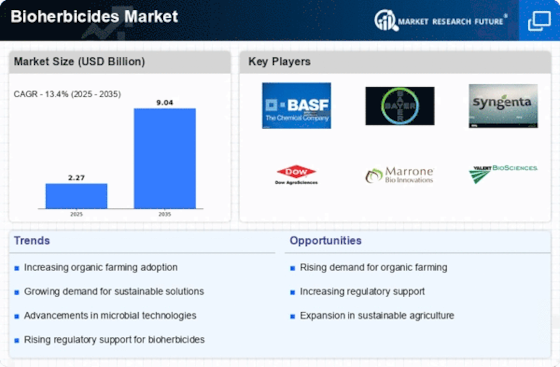
As per MRFR analysis, the Bioherbicides Market Size was estimated at 2.268 USD Billion in 2024. The Bioherbicides industry is projected to grow from 2.572 USD Billion in 2025 to 9.045 USD Billion by 2035, exhibiting a compound annual growth rate (CAGR) of 13.4 during the forecast period 2025 - 2035.

Key Market Trends & Highlights

The Bioherbicides Market is poised for substantial growth driven by increasing demand for sustainable agricultural practices.

  • The rising demand for organic farming is significantly influencing the adoption of bioherbicides in North America.
  • Regulatory support for biopesticides is fostering innovation and market expansion in the Asia-Pacific region.
  • Microbials remain the largest segment, while biochemicals are emerging as the fastest-growing category in the bioherbicides market.
  • Increasing consumer awareness and government initiatives are key drivers propelling the market forward.

Market Size & Forecast

2024 Market Size 2.268 (USD Billion)
2035 Market Size 9.045 (USD Billion)
CAGR (2025 - 2035) 13.4%
Largest Regional Market Share in 2024 North America

Major Players

<p>BASF SE (DE), Bayer AG (DE), Syngenta AG (CH), Dow AgroSciences LLC (US), Marrone Bio Innovations Inc (US), Valent BioSciences LLC (US), Certis USA LLC (US), AgraQuest Inc (US), Bioworks Inc (US)</p>

Market Trends

The Bioherbicides Market is currently experiencing a notable transformation, driven by increasing awareness regarding sustainable agricultural practices and the adverse effects of synthetic herbicides on the environment. Stakeholders in the agricultural sector are progressively recognizing the potential of bioherbicides as effective alternatives that not only mitigate weed problems but also align with eco-friendly farming methods. This shift is further supported by regulatory frameworks that encourage the adoption of biopesticides, fostering innovation and research in this domain. As a result, the market is witnessing a surge in product development, with various natural compounds being explored for their herbicidal properties. Moreover, the Bioherbicides Market appears to be influenced by the growing demand for organic produce, as consumers increasingly prefer food products that are free from chemical residues. This trend is prompting farmers to seek out bioherbicide solutions that can enhance crop yield while maintaining environmental integrity. Additionally, advancements in biotechnology are likely to play a crucial role in the evolution of this market, as new formulations and delivery systems are developed to improve the efficacy and application of bioherbicides. Overall, the Bioherbicides Market is poised for growth, driven by a confluence of environmental, regulatory, and consumer factors that favor sustainable agricultural practices.

Rising Demand for Organic Farming

The Bioherbicides Market is witnessing a surge in interest due to the increasing consumer preference for organic products. As more individuals seek food that is free from synthetic chemicals, farmers are turning to bioherbicides to meet this demand. This trend not only supports sustainable agriculture but also encourages the development of innovative bioherbicide solutions.

Regulatory Support for Biopesticides

Government policies are increasingly favoring the use of biopesticides, including bioherbicides, as part of integrated pest management strategies. This regulatory support is likely to enhance market growth by providing a framework that encourages research and development, ultimately leading to a wider acceptance of bioherbicides in mainstream agriculture.

Technological Advancements in Biotechnology

Innovations in biotechnology are playing a pivotal role in the evolution of the Bioherbicides Market. New formulations and application techniques are being developed to improve the effectiveness of bioherbicides. These advancements may lead to more efficient weed management solutions, further driving the adoption of bioherbicides among farmers.

Bioherbicides Market Market Drivers

Increasing Consumer Awareness

The rising consumer awareness regarding the adverse effects of synthetic herbicides is a pivotal driver for the Bioherbicides Market. As consumers become more informed about health and environmental issues, there is a growing preference for organic and sustainable agricultural practices. This shift is reflected in market data, indicating that the demand for bioherbicides is projected to grow at a compound annual growth rate of approximately 12% over the next five years. The increasing inclination towards eco-friendly products is compelling farmers and agricultural businesses to adopt bioherbicides, thereby enhancing their market presence. Furthermore, educational campaigns and initiatives by various organizations are likely to bolster this trend, as they emphasize the benefits of bioherbicides in promoting sustainable farming practices.

Government Initiatives and Policies

Government initiatives and policies aimed at promoting sustainable agriculture are significantly influencing the Bioherbicides Market. Various countries are implementing regulations that encourage the use of biopesticides, including bioherbicides, as part of their agricultural strategies. For instance, financial incentives and subsidies for farmers adopting eco-friendly practices are becoming more prevalent. Market data suggests that regions with supportive policies are witnessing a faster adoption of bioherbicides, with an estimated market growth of 15% in these areas. This regulatory support not only enhances the credibility of bioherbicides but also encourages research and development in this sector, leading to innovative solutions that meet the needs of modern agriculture.

Environmental Sustainability Concerns

Concerns regarding environmental sustainability are driving the Bioherbicides Market towards a more eco-friendly future. As the negative impacts of chemical herbicides on soil health, water quality, and biodiversity become increasingly apparent, there is a growing demand for sustainable alternatives. Market data indicates that the bioherbicides segment is expected to capture a larger share of the herbicide market, with projections suggesting a shift of approximately 25% towards bio-based solutions in the coming years. This trend is likely to be supported by consumer preferences for products that align with environmental stewardship, prompting agricultural stakeholders to invest in bioherbicides as a means to enhance their sustainability credentials.

Technological Innovations in Bioherbicides

Technological innovations play a crucial role in shaping the Bioherbicides Market. Advances in biotechnology are leading to the development of more effective and targeted bioherbicides, which are essential for meeting the demands of contemporary agriculture. Research indicates that the introduction of novel formulations and delivery systems is enhancing the efficacy of bioherbicides, making them a viable alternative to traditional herbicides. The market is expected to witness a surge in investment in R&D, with projections indicating a potential increase in market size by 20% over the next few years. These innovations not only improve the performance of bioherbicides but also contribute to the overall sustainability of agricultural practices.

Rising Adoption of Integrated Pest Management

The increasing adoption of Integrated Pest Management (IPM) strategies is a significant driver for the Bioherbicides Market. Farmers are increasingly recognizing the importance of combining various pest control methods, including the use of bioherbicides, to achieve sustainable agricultural outcomes. This holistic approach not only enhances crop yield but also minimizes the reliance on chemical herbicides. Market analysis shows that regions implementing IPM practices are experiencing a notable rise in bioherbicide usage, with estimates suggesting a growth rate of 10% in these markets. The synergy between bioherbicides and other pest management techniques is likely to foster a more resilient agricultural ecosystem, further propelling the demand for bioherbicides.

Market Segment Insights

By Type: Microbials (Largest) vs. Biochemicals (Fastest-Growing)

<p>In the Bioherbicides Market, the segmentation by type reveals that microbials dominate the landscape with substantial market share. This segment has established its presence over years, leveraging the natural properties of microorganisms to control weeds. On the other hand, biochemicals, while smaller in share, are gaining traction rapidly as farmers look for more environmentally friendly solutions. The emergence of new technologies and an increase in consumer awareness regarding sustainable practices contribute to this shift. The growth of the biochemicals segment is primarily driven by innovation and regulatory support for bio-based products. As the agriculture sector increasingly focuses on sustainability and organic farming, biochemicals are positioned as a revolutionary alternative to conventional herbicides. Furthermore, strategic partnerships and collaborations among leading companies have led to the development of novel formulations that meet market demands while addressing ecological concerns. As a result, the future looks promising for biochemicals in the bioherbicide market.</p>

<p>Microbials: Dominant vs. Biochemicals: Emerging</p>

<p>The microbials segment stands out as the dominant force in the Bioherbicides Market, characterized by its effective use of naturally occurring microorganisms, such as fungi and bacteria, to manage weed populations. This category is preferred by many farmers due to its proven efficacy and the minimal risk of harm to the environment. Additionally, the segment benefits from a rich history of research and development, allowing for a wide range of products that cater to diverse agricultural needs. In contrast, the biochemicals segment is emerging as a key player, known for its innovative applications of natural compounds extracted from plants. This segment is gaining popularity as it aligns with the growing consumer demand for sustainable farming practices. As regulations favor eco-friendly solutions, biochemicals are expected to capture a larger market share, resonating well with environmentally conscious consumers.</p>

By Mode of Application: Foliar (Largest) vs. Seed Treatment (Fastest-Growing)

<p>In the Bioherbicides Market, the mode of application segmentation reveals distinct shares among the various methods. Foliar application holds the largest market share due to its effectiveness in directly targeting the foliage of crops, allowing for better absorption of active ingredients. This method is favored for its ease of use and immediate impact on weed control, making it a preferred choice among farmers. Meanwhile, seed treatment is emerging as the fastest-growing segment, driven by the increasing awareness of sustainable agricultural practices and the need for preemptive weed management approaches that can enhance crop performance. Growth trends in the Bioherbicides Market show a rising inclination towards environmentally-friendly and sustainable solutions, with a significant shift in focus towards seed treatments. The demand for seed treatment is being propelled by innovations in formulation technologies that improve efficacy. Moreover, regulatory support promoting bio-based agricultural products is encouraging farmers to adopt these methods, leading to an upward trajectory for seed treatment applications, while foliar remains favored for its established benefits in treating extensive crop areas.</p>

<p>Foliar (Dominant) vs. Soil Application (Emerging)</p>

<p>Foliar application is characterized by its dominant market position, thanks to its rapid action and wide applicability across various crops. This method allows for quick absorption, leading to effective weed control during the critical growing phases of the plants. As a result, farmers increasingly prefer foliar-bioherbicides for immediate weed management. On the other hand, soil application is an emerging segment that provides a proactive approach to weed control by treating the soil before planting. Although it currently holds a smaller market share, its growth is driven by the rising demand for preventive measures in weed management. The evolving formulations in soil-based bioherbicides promise effective weed suppression and improved soil health, positioning it as a noteworthy alternative in the Bioherbicides Market.</p>

By Crop Type: Cereals & Grains (Largest) vs. Fruits & Vegetables (Fastest-Growing)

<p>The Bioherbicides Market exhibits a diverse distribution among its crop type segments. Cereals & Grains hold the largest share due to their extensive usage in agricultural practices, driven by the necessity to manage weeds effectively within these staple crops. This segment dominates the market, benefiting from traditional farming practices and a wide acceptance of bioherbicidal solutions. In contrast, the Fruits & Vegetables segment is rapidly gaining traction, reflecting an increasing awareness and demand for organic farming practices. As consumers prioritize health and sustainability, this segment is witnessing a notable increase in adoption of bioherbicides to protect and enhance the quality of produce. The growth trends within the Bioherbicides Market are notably different among the crop types. The Cereals & Grains segment continues to thrive, supported by regulatory approvals and advances in bioherbicide formulation technologies, which facilitate effective weed control without harming the ecosystem. Meanwhile, the Fruits & Vegetables segment's rapid growth is propelled by consumer trends towards organic produce and the rising incidence of herbicide-resistant weeds. The convergence of these factors is fostering a dynamic landscape where bioherbicides can offer vital solutions across various crop types, contributing to sustainable agriculture and environmental consciousness.</p>

<p>Cereals & Grains (Dominant) vs. Oilseed & Pulses (Emerging)</p>

<p>Cereals & Grains represent the dominant crop type in the Bioherbicides Market, benefiting from longstanding agricultural practices and established usage of herbicides. This segment enjoys a well-integrated chain from production to commercial application, positioning it favorably for sustained market leadership. In contrast, Oilseed & Pulses are emerging as a significant player, driven by increasing demand for plant-based protein sources and sustainable farming methods. Growers are increasingly turning to bioherbicides to manage weeds effectively while adhering to organic standards. The uniqueness of Oilseed & Pulses lies in their adaptability to different growing conditions and the rising consumer awareness of the environmental implications of chemical herbicides. Together, these segments illustrate the evolving landscape of bioherbicide applications across various crop types.</p>

Get more detailed insights about Bioherbicides Market Research Report - Global Forecast till 2035

Regional Insights

By Region, the study provides market insights into North America, Europe, Asia-Pacific, and the Rest of the World. North America Bioherbicides Market accounted for USD 1.8 billion in 2022 and is expected to exhibit a significant CAGR growth during the study period. The region’s growth can be attributed to the favorable view on organic farming and environmental safety issues. Efforts to raise consumer knowledge of environmental and health issues are expected to be crucial to the region's development, especially in the United States and Canada.

Further, the major countries studied in the market report are: The U.S, Canada, Germany, France, UK, Italy, Spain, China, Japan, India, Australia, South Korea, and Brazil.

Figure2: BIOHERBICIDES MARKET SHARE BY REGION 2022 (%)

Europe Bioherbicides Market accounts for the second-largest market share due to an increasing understanding of synthetic items' environmental dangers. Additionally, due to rising demand from rural growth, EU countries' growing demand for bioherbicides would propel the growth even further. Further, the Germany Bioherbicides Market held the largest market share, and the UK Bioherbicides Market was the fastest growing market in the European region

The Asia-Pacific Bioherbicides Market is expected to grow at the fastest CAGR from 2022 to 2030. The presence of multiple powerful entities in the area and local farmers' changing agricultural practices are likely to contribute to the region's growth. Moreover, China Bioherbicides Market held the largest market share, and the India Bioherbicides Market was the fastest-growing market in the Asia-Pacific region

For instance, India Bioherbicides Market will multiply during the forecast period. Factors such as rising Sales of bioherbicides are anticipated to increase on an incremental basis because of the growing adoption of integrated pest management (IPM) strategies and stronger crop protection laws and regulations. Improvements in yield and pest resistance have been linked to increased use of plant-based fungicides, which has been suggested to impact the expansion of the Indian bioherbicides industry significantly.

Key Players and Competitive Insights

The Major market players are focused on diversifying their product portfolios by investing heavily within their R&D departments. Additionally, players are focused on integrating various market developments such as new product launches, contractual agreements, mergers and acquisitions, increased investments, and collaboration with other organizations to widen their presence further. The dominant players in the Bioherbicides industry further offer to optimize their supply chains to widen their profit margins.

To reduce operating costs, the market leaders in the Bioherbicides industry are offering their products at a moderate price. During the forecast period, the Bioherbicides industry has produced highly viable products. The Bioherbicides Market major player Special Biochem (India), Deer Creek Holdings (US), Emery Oleochemicals (Malaysia), Verdesian Life Sciences (US), and others are working on expanding the market demand by investing in research and development activities.

Hindustan Bio-Tech Chemicals & Fertilizers Ltd began manufacturing in 2012 and follows all the international quality norms, giving their products high effectiveness. Their products are safe for use and have a longer shelf life. Hindustan Bio-Tech Chemicals & Fertilizers Ltd is known for supplying the best quality Agro Chemicals and has a laboratory with testing equipment such as HPLC, GC, and PH Meter. More than 120 products are registered under the Central Insecticide Board. They have 20 employees and are considered a manufacturer, wholesaler, distributor, and supplier.

Emergy Oleochemicals was founded by Thomas Emergy St and began the unit in 1840 in Cincinnati, Ohio, U.S. The Emery Candle Company offered customers sturdier, whiter, and dripless candles produced from stearic acid. Soon the product expanded into elaine oil and sweetwater. By 1872, the company was involved in fatty acid exploration. Today, after 180 years, Emery Oleochemicals produces high-quality chemicals commonly made from natural oils and fats. They have five dedicated business units and can provide highly customizable and high-performance solutions.

Key Companies in the Bioherbicides Market market include

Industry Developments

  • Q2 2024: Marrone Bio Innovations Launches New Bioherbicide for Row Crops Marrone Bio Innovations announced the commercial launch of a new bioherbicide product targeting broadleaf weeds in major row crops, expanding its portfolio of sustainable crop protection solutions.
  • Q1 2024: Bayer Partners with Ginkgo Bioworks to Develop Next-Generation Bioherbicides Market Bayer announced a strategic partnership with Ginkgo Bioworks to co-develop microbial-based bioherbicides, aiming to accelerate innovation in sustainable weed management for global agriculture.
  • Q2 2024: Valent BioSciences Opens New Bioherbicide Production Facility in Illinois Valent BioSciences inaugurated a new manufacturing facility dedicated to the production of bioherbicides, increasing its capacity to meet rising demand for biological weed control products in North America.
  • Q3 2024: EPA Approves New Microbial Bioherbicide for Use in U.S. Agriculture The EPA granted regulatory approval for a novel microbial bioherbicide, allowing its use on a range of crops and marking a significant step for biological weed control solutions in the U.S. market.
  • Q2 2024: Syngenta Acquires Minority Stake in Bioherbicide Startup WeedOUT Syngenta announced the acquisition of a minority equity stake in WeedOUT, an Israeli startup specializing in bioherbicide technology, to strengthen its biological crop protection pipeline.
  • Q1 2025: European Commission Grants Approval for New Bioherbicide Active Ingredient The European Commission approved a new active ingredient for use in bioherbicides, enabling its commercialization across EU member states and supporting the region’s sustainable agriculture goals.
  • Q2 2024: BASF Launches Bioherbicide Pilot Program with Major U.S. Corn Growers BASF initiated a pilot program with leading U.S. corn growers to test the efficacy of its new bioherbicide formulation under commercial field conditions.
  • Q3 2024: APVMA Approves First Locally Developed Bioherbicide for Commercial Use The APVMA approved the first Australian-developed bioherbicide for commercial sale, supporting the country’s efforts to reduce reliance on synthetic herbicides.
  • Q1 2025: Corteva Agriscience Announces Strategic Collaboration with Biotalys for Bioherbicide Development Corteva entered into a strategic collaboration with Biotalys to co-develop protein-based bioherbicides, aiming to bring new sustainable weed control solutions to market.
  • Q2 2025: CFIA Approves Registration of New Bioherbicide for Canadian Farmers The CFIA granted registration for a new bioherbicide product, allowing Canadian farmers access to an additional biological tool for integrated weed management.
  • Q2 2024: Sumitomo Chemical Invests in Expansion of Bioherbicide R&D Center in Japan Sumitomo Chemical announced a major investment to expand its bioherbicide research and development center, aiming to accelerate innovation and commercialization of new biological weed control products.
  • Q3 2024: NewLeaf Symbiotics Raises $45 Million to Advance Bioherbicide Commercialization NewLeaf Symbiotics closed a $45 million funding round to support the commercialization of its proprietary bioherbicide products and expand its market presence in North America and Europe.

Future Outlook

Bioherbicides Market Future Outlook

<p>The Bioherbicides Market is projected to grow at a 13.4% CAGR from 2024 to 2035, driven by increasing organic farming practices, regulatory support, and environmental sustainability concerns.</p>

New opportunities lie in:

  • <p>Development of proprietary bioherbicide formulations targeting specific weed species.</p>
  • <p>Expansion into emerging markets with tailored marketing strategies.</p>
  • <p>Partnerships with agricultural technology firms for integrated pest management solutions.</p>

<p>By 2035, the Bioherbicides Market is expected to achieve substantial growth, reflecting evolving agricultural practices.</p>

Market Segmentation

Bioherbicides Market Type Outlook

  • Microbials
  • Biochemicals
  • Others

Bioherbicides Market Crop Type Outlook

  • Cereals & Grains
  • Fruits & Vegetables
  • Oilseed & Pulses
  • Others

Bioherbicides Market Mode of Application Outlook

  • Seed Treatment
  • Foliar
  • Soil Application
  • Others

Report Scope

MARKET SIZE 20242.268(USD Billion)
MARKET SIZE 20252.572(USD Billion)
MARKET SIZE 20359.045(USD Billion)
COMPOUND ANNUAL GROWTH RATE (CAGR)13.4% (2024 - 2035)
REPORT COVERAGERevenue Forecast, Competitive Landscape, Growth Factors, and Trends
BASE YEAR2024
Market Forecast Period2025 - 2035
Historical Data2019 - 2024
Market Forecast UnitsUSD Billion
Key Companies ProfiledMarket analysis in progress
Segments CoveredMarket segmentation analysis in progress
Key Market OpportunitiesGrowing demand for sustainable agriculture drives innovation in the Bioherbicides Market.
Key Market DynamicsRising demand for sustainable agriculture drives innovation and competition in the bioherbicides market.
Countries CoveredNorth America, Europe, APAC, South America, MEA

FAQs

What is the current valuation of the Bioherbicides Market as of 2024?

The Bioherbicides Market was valued at 2.268 USD Billion in 2024.

What is the projected market size for the Bioherbicides Market in 2035?

The market is projected to reach 9.045 USD Billion by 2035.

What is the expected CAGR for the Bioherbicides Market during the forecast period 2025 - 2035?

The expected CAGR for the Bioherbicides Market during 2025 - 2035 is 13.4%.

Which segment of the Bioherbicides Market had the highest valuation in 2024?

In 2024, the Microbials segment had the highest valuation at 0.908 USD Billion.

What are the projected valuations for the Biochemicals segment by 2035?

The Biochemicals segment is projected to reach 2.724 USD Billion by 2035.

Which mode of application is expected to dominate the Bioherbicides Market by 2035?

The Foliar application mode is expected to dominate, projected at 3.628 USD Billion by 2035.

  1. SECTION I: EXECUTIVE SUMMARY AND KEY HIGHLIGHTS
    1. EXECUTIVE SUMMARY
      1. Market Overview
      2. Key Findings
      3. Market Segmentation
      4. Competitive Landscape
      5. Challenges and Opportunities
      6. Future Outlook
  2. SECTION II: SCOPING, METHODOLOGY AND MARKET STRUCTURE
    1. MARKET INTRODUCTION
      1. Definition
      2. Scope of the study
    2. RESEARCH METHODOLOGY
      1. Overview
      2. Data Mining
      3. Secondary Research
      4. Primary Research
      5. Forecasting Model
      6. Market Size Estimation
      7. Data Triangulation
      8. Validation
  3. SECTION III: QUALITATIVE ANALYSIS
    1. MARKET DYNAMICS
      1. Overview
      2. Drivers
      3. Restraints
      4. Opportunities
    2. MARKET FACTOR ANALYSIS
      1. Value chain Analysis
      2. Porter's Five Forces Analysis
      3. COVID-19 Impact Analysis
  4. SECTION IV: QUANTITATIVE ANALYSIS
    1. Pharmaceutical, BY Type (USD Billion)
      1. Microbials
      2. Biochemicals
      3. Others
    2. Pharmaceutical, BY Mode of Application (USD Billion)
      1. Seed Treatment
      2. Foliar
      3. Soil Application
      4. Others
    3. Pharmaceutical, BY Crop Type (USD Billion)
      1. Cereals & Grains
      2. Fruits & Vegetables
      3. Oilseed & Pulses
      4. Others
    4. Pharmaceutical, BY Region (USD Billion)
      1. North America
      2. Europe
      3. APAC
      4. South America
      5. MEA
  5. SECTION V: COMPETITIVE ANALYSIS
    1. Competitive Landscape
      1. Overview
      2. Competitive Analysis
      3. Market share Analysis
      4. Major Growth Strategy in the Pharmaceutical
      5. Competitive Benchmarking
      6. Leading Players in Terms of Number of Developments in the Pharmaceutical
      7. Key developments and growth strategies
      8. Major Players Financial Matrix
    2. Company Profiles
      1. BASF SE (DE)
      2. Bayer AG (DE)
      3. Syngenta AG (CH)
      4. Dow AgroSciences LLC (US)
      5. Marrone Bio Innovations Inc (US)
      6. Valent BioSciences LLC (US)
      7. Certis USA LLC (US)
      8. AgraQuest Inc (US)
      9. Bioworks Inc (US)
    3. Appendix
      1. References
      2. Related Reports
  6. LIST OF FIGURES
    1. MARKET SYNOPSIS
    2. NORTH AMERICA MARKET ANALYSIS
    3. US MARKET ANALYSIS BY TYPE
    4. US MARKET ANALYSIS BY MODE OF APPLICATION
    5. US MARKET ANALYSIS BY CROP TYPE
    6. CANADA MARKET ANALYSIS BY TYPE
    7. CANADA MARKET ANALYSIS BY MODE OF APPLICATION
    8. CANADA MARKET ANALYSIS BY CROP TYPE
    9. EUROPE MARKET ANALYSIS
    10. GERMANY MARKET ANALYSIS BY TYPE
    11. GERMANY MARKET ANALYSIS BY MODE OF APPLICATION
    12. GERMANY MARKET ANALYSIS BY CROP TYPE
    13. UK MARKET ANALYSIS BY TYPE
    14. UK MARKET ANALYSIS BY MODE OF APPLICATION
    15. UK MARKET ANALYSIS BY CROP TYPE
    16. FRANCE MARKET ANALYSIS BY TYPE
    17. FRANCE MARKET ANALYSIS BY MODE OF APPLICATION
    18. FRANCE MARKET ANALYSIS BY CROP TYPE
    19. RUSSIA MARKET ANALYSIS BY TYPE
    20. RUSSIA MARKET ANALYSIS BY MODE OF APPLICATION
    21. RUSSIA MARKET ANALYSIS BY CROP TYPE
    22. ITALY MARKET ANALYSIS BY TYPE
    23. ITALY MARKET ANALYSIS BY MODE OF APPLICATION
    24. ITALY MARKET ANALYSIS BY CROP TYPE
    25. SPAIN MARKET ANALYSIS BY TYPE
    26. SPAIN MARKET ANALYSIS BY MODE OF APPLICATION
    27. SPAIN MARKET ANALYSIS BY CROP TYPE
    28. REST OF EUROPE MARKET ANALYSIS BY TYPE
    29. REST OF EUROPE MARKET ANALYSIS BY MODE OF APPLICATION
    30. REST OF EUROPE MARKET ANALYSIS BY CROP TYPE
    31. APAC MARKET ANALYSIS
    32. CHINA MARKET ANALYSIS BY TYPE
    33. CHINA MARKET ANALYSIS BY MODE OF APPLICATION
    34. CHINA MARKET ANALYSIS BY CROP TYPE
    35. INDIA MARKET ANALYSIS BY TYPE
    36. INDIA MARKET ANALYSIS BY MODE OF APPLICATION
    37. INDIA MARKET ANALYSIS BY CROP TYPE
    38. JAPAN MARKET ANALYSIS BY TYPE
    39. JAPAN MARKET ANALYSIS BY MODE OF APPLICATION
    40. JAPAN MARKET ANALYSIS BY CROP TYPE
    41. SOUTH KOREA MARKET ANALYSIS BY TYPE
    42. SOUTH KOREA MARKET ANALYSIS BY MODE OF APPLICATION
    43. SOUTH KOREA MARKET ANALYSIS BY CROP TYPE
    44. MALAYSIA MARKET ANALYSIS BY TYPE
    45. MALAYSIA MARKET ANALYSIS BY MODE OF APPLICATION
    46. MALAYSIA MARKET ANALYSIS BY CROP TYPE
    47. THAILAND MARKET ANALYSIS BY TYPE
    48. THAILAND MARKET ANALYSIS BY MODE OF APPLICATION
    49. THAILAND MARKET ANALYSIS BY CROP TYPE
    50. INDONESIA MARKET ANALYSIS BY TYPE
    51. INDONESIA MARKET ANALYSIS BY MODE OF APPLICATION
    52. INDONESIA MARKET ANALYSIS BY CROP TYPE
    53. REST OF APAC MARKET ANALYSIS BY TYPE
    54. REST OF APAC MARKET ANALYSIS BY MODE OF APPLICATION
    55. REST OF APAC MARKET ANALYSIS BY CROP TYPE
    56. SOUTH AMERICA MARKET ANALYSIS
    57. BRAZIL MARKET ANALYSIS BY TYPE
    58. BRAZIL MARKET ANALYSIS BY MODE OF APPLICATION
    59. BRAZIL MARKET ANALYSIS BY CROP TYPE
    60. MEXICO MARKET ANALYSIS BY TYPE
    61. MEXICO MARKET ANALYSIS BY MODE OF APPLICATION
    62. MEXICO MARKET ANALYSIS BY CROP TYPE
    63. ARGENTINA MARKET ANALYSIS BY TYPE
    64. ARGENTINA MARKET ANALYSIS BY MODE OF APPLICATION
    65. ARGENTINA MARKET ANALYSIS BY CROP TYPE
    66. REST OF SOUTH AMERICA MARKET ANALYSIS BY TYPE
    67. REST OF SOUTH AMERICA MARKET ANALYSIS BY MODE OF APPLICATION
    68. REST OF SOUTH AMERICA MARKET ANALYSIS BY CROP TYPE
    69. MEA MARKET ANALYSIS
    70. GCC COUNTRIES MARKET ANALYSIS BY TYPE
    71. GCC COUNTRIES MARKET ANALYSIS BY MODE OF APPLICATION
    72. GCC COUNTRIES MARKET ANALYSIS BY CROP TYPE
    73. SOUTH AFRICA MARKET ANALYSIS BY TYPE
    74. SOUTH AFRICA MARKET ANALYSIS BY MODE OF APPLICATION
    75. SOUTH AFRICA MARKET ANALYSIS BY CROP TYPE
    76. REST OF MEA MARKET ANALYSIS BY TYPE
    77. REST OF MEA MARKET ANALYSIS BY MODE OF APPLICATION
    78. REST OF MEA MARKET ANALYSIS BY CROP TYPE
    79. KEY BUYING CRITERIA OF PHARMACEUTICAL
    80. RESEARCH PROCESS OF MRFR
    81. DRO ANALYSIS OF PHARMACEUTICAL
    82. DRIVERS IMPACT ANALYSIS: PHARMACEUTICAL
    83. RESTRAINTS IMPACT ANALYSIS: PHARMACEUTICAL
    84. SUPPLY / VALUE CHAIN: PHARMACEUTICAL
    85. PHARMACEUTICAL, BY TYPE, 2024 (% SHARE)
    86. PHARMACEUTICAL, BY TYPE, 2024 TO 2035 (USD Billion)
    87. PHARMACEUTICAL, BY MODE OF APPLICATION, 2024 (% SHARE)
    88. PHARMACEUTICAL, BY MODE OF APPLICATION, 2024 TO 2035 (USD Billion)
    89. PHARMACEUTICAL, BY CROP TYPE, 2024 (% SHARE)
    90. PHARMACEUTICAL, BY CROP TYPE, 2024 TO 2035 (USD Billion)
    91. BENCHMARKING OF MAJOR COMPETITORS
  7. LIST OF TABLES
    1. LIST OF ASSUMPTIONS
    2. North America MARKET SIZE ESTIMATES; FORECAST
      1. BY TYPE, 2025-2035 (USD Billion)
      2. BY MODE OF APPLICATION, 2025-2035 (USD Billion)
      3. BY CROP TYPE, 2025-2035 (USD Billion)
    3. US MARKET SIZE ESTIMATES; FORECAST
      1. BY TYPE, 2025-2035 (USD Billion)
      2. BY MODE OF APPLICATION, 2025-2035 (USD Billion)
      3. BY CROP TYPE, 2025-2035 (USD Billion)
    4. Canada MARKET SIZE ESTIMATES; FORECAST
      1. BY TYPE, 2025-2035 (USD Billion)
      2. BY MODE OF APPLICATION, 2025-2035 (USD Billion)
      3. BY CROP TYPE, 2025-2035 (USD Billion)
    5. Europe MARKET SIZE ESTIMATES; FORECAST
      1. BY TYPE, 2025-2035 (USD Billion)
      2. BY MODE OF APPLICATION, 2025-2035 (USD Billion)
      3. BY CROP TYPE, 2025-2035 (USD Billion)
    6. Germany MARKET SIZE ESTIMATES; FORECAST
      1. BY TYPE, 2025-2035 (USD Billion)
      2. BY MODE OF APPLICATION, 2025-2035 (USD Billion)
      3. BY CROP TYPE, 2025-2035 (USD Billion)
    7. UK MARKET SIZE ESTIMATES; FORECAST
      1. BY TYPE, 2025-2035 (USD Billion)
      2. BY MODE OF APPLICATION, 2025-2035 (USD Billion)
      3. BY CROP TYPE, 2025-2035 (USD Billion)
    8. France MARKET SIZE ESTIMATES; FORECAST
      1. BY TYPE, 2025-2035 (USD Billion)
      2. BY MODE OF APPLICATION, 2025-2035 (USD Billion)
      3. BY CROP TYPE, 2025-2035 (USD Billion)
    9. Russia MARKET SIZE ESTIMATES; FORECAST
      1. BY TYPE, 2025-2035 (USD Billion)
      2. BY MODE OF APPLICATION, 2025-2035 (USD Billion)
      3. BY CROP TYPE, 2025-2035 (USD Billion)
    10. Italy MARKET SIZE ESTIMATES; FORECAST
      1. BY TYPE, 2025-2035 (USD Billion)
      2. BY MODE OF APPLICATION, 2025-2035 (USD Billion)
      3. BY CROP TYPE, 2025-2035 (USD Billion)
    11. Spain MARKET SIZE ESTIMATES; FORECAST
      1. BY TYPE, 2025-2035 (USD Billion)
      2. BY MODE OF APPLICATION, 2025-2035 (USD Billion)
      3. BY CROP TYPE, 2025-2035 (USD Billion)
    12. Rest of Europe MARKET SIZE ESTIMATES; FORECAST
      1. BY TYPE, 2025-2035 (USD Billion)
      2. BY MODE OF APPLICATION, 2025-2035 (USD Billion)
      3. BY CROP TYPE, 2025-2035 (USD Billion)
    13. APAC MARKET SIZE ESTIMATES; FORECAST
      1. BY TYPE, 2025-2035 (USD Billion)
      2. BY MODE OF APPLICATION, 2025-2035 (USD Billion)
      3. BY CROP TYPE, 2025-2035 (USD Billion)
    14. China MARKET SIZE ESTIMATES; FORECAST
      1. BY TYPE, 2025-2035 (USD Billion)
      2. BY MODE OF APPLICATION, 2025-2035 (USD Billion)
      3. BY CROP TYPE, 2025-2035 (USD Billion)
    15. India MARKET SIZE ESTIMATES; FORECAST
      1. BY TYPE, 2025-2035 (USD Billion)
      2. BY MODE OF APPLICATION, 2025-2035 (USD Billion)
      3. BY CROP TYPE, 2025-2035 (USD Billion)
    16. Japan MARKET SIZE ESTIMATES; FORECAST
      1. BY TYPE, 2025-2035 (USD Billion)
      2. BY MODE OF APPLICATION, 2025-2035 (USD Billion)
      3. BY CROP TYPE, 2025-2035 (USD Billion)
    17. South Korea MARKET SIZE ESTIMATES; FORECAST
      1. BY TYPE, 2025-2035 (USD Billion)
      2. BY MODE OF APPLICATION, 2025-2035 (USD Billion)
      3. BY CROP TYPE, 2025-2035 (USD Billion)
    18. Malaysia MARKET SIZE ESTIMATES; FORECAST
      1. BY TYPE, 2025-2035 (USD Billion)
      2. BY MODE OF APPLICATION, 2025-2035 (USD Billion)
      3. BY CROP TYPE, 2025-2035 (USD Billion)
    19. Thailand MARKET SIZE ESTIMATES; FORECAST
      1. BY TYPE, 2025-2035 (USD Billion)
      2. BY MODE OF APPLICATION, 2025-2035 (USD Billion)
      3. BY CROP TYPE, 2025-2035 (USD Billion)
    20. Indonesia MARKET SIZE ESTIMATES; FORECAST
      1. BY TYPE, 2025-2035 (USD Billion)
      2. BY MODE OF APPLICATION, 2025-2035 (USD Billion)
      3. BY CROP TYPE, 2025-2035 (USD Billion)
    21. Rest of APAC MARKET SIZE ESTIMATES; FORECAST
      1. BY TYPE, 2025-2035 (USD Billion)
      2. BY MODE OF APPLICATION, 2025-2035 (USD Billion)
      3. BY CROP TYPE, 2025-2035 (USD Billion)
    22. South America MARKET SIZE ESTIMATES; FORECAST
      1. BY TYPE, 2025-2035 (USD Billion)
      2. BY MODE OF APPLICATION, 2025-2035 (USD Billion)
      3. BY CROP TYPE, 2025-2035 (USD Billion)
    23. Brazil MARKET SIZE ESTIMATES; FORECAST
      1. BY TYPE, 2025-2035 (USD Billion)
      2. BY MODE OF APPLICATION, 2025-2035 (USD Billion)
      3. BY CROP TYPE, 2025-2035 (USD Billion)
    24. Mexico MARKET SIZE ESTIMATES; FORECAST
      1. BY TYPE, 2025-2035 (USD Billion)
      2. BY MODE OF APPLICATION, 2025-2035 (USD Billion)
      3. BY CROP TYPE, 2025-2035 (USD Billion)
    25. Argentina MARKET SIZE ESTIMATES; FORECAST
      1. BY TYPE, 2025-2035 (USD Billion)
      2. BY MODE OF APPLICATION, 2025-2035 (USD Billion)
      3. BY CROP TYPE, 2025-2035 (USD Billion)
    26. Rest of South America MARKET SIZE ESTIMATES; FORECAST
      1. BY TYPE, 2025-2035 (USD Billion)
      2. BY MODE OF APPLICATION, 2025-2035 (USD Billion)
      3. BY CROP TYPE, 2025-2035 (USD Billion)
    27. MEA MARKET SIZE ESTIMATES; FORECAST
      1. BY TYPE, 2025-2035 (USD Billion)
      2. BY MODE OF APPLICATION, 2025-2035 (USD Billion)
      3. BY CROP TYPE, 2025-2035 (USD Billion)
    28. GCC Countries MARKET SIZE ESTIMATES; FORECAST
      1. BY TYPE, 2025-2035 (USD Billion)
      2. BY MODE OF APPLICATION, 2025-2035 (USD Billion)
      3. BY CROP TYPE, 2025-2035 (USD Billion)
    29. South Africa MARKET SIZE ESTIMATES; FORECAST
      1. BY TYPE, 2025-2035 (USD Billion)
      2. BY MODE OF APPLICATION, 2025-2035 (USD Billion)
      3. BY CROP TYPE, 2025-2035 (USD Billion)
    30. Rest of MEA MARKET SIZE ESTIMATES; FORECAST
      1. BY TYPE, 2025-2035 (USD Billion)
      2. BY MODE OF APPLICATION, 2025-2035 (USD Billion)
      3. BY CROP TYPE, 2025-2035 (USD Billion)
    31. PRODUCT LAUNCH/PRODUCT DEVELOPMENT/APPROVAL
    32. ACQUISITION/PARTNERSHIP

Market Segmentation

Agricultural Biologicals Type Outlook (USD Billion, 2019-2030)

  • Microbials
  • Biochemicals
  • Others

Agricultural Biologicals Mode of Application Outlook (USD Billion, 2019-2030)

  • Seed Treatment
  • Foliar
  • Soil Application
  • Others

Agricultural Biologicals Crop Type Outlook (USD Billion, 2019-2030)

  • Cereals & Grains
  • Fruits & Vegetables
  • Oilseed & Pulses
  • Others

Agricultural Biologicals Regional Outlook (USD Billion, 2019-2030)

  • North America Outlook (USD Billion, 2019-2030)

    • North America Agricultural Biologicals by Type
      • Microbials
      • Biochemicals
      • Others
    • North America Agricultural Biologicals by Mode of Application
      • Seed Treatment
      • Foliar
      • Soil Application
      • Others
    • North America Agricultural Biologicals by Crop Type
      • Cereals & Grains
      • Fruits & Vegetables
      • Oilseed & Pulses
      • Others
    • US Outlook (USD Billion, 2019-2030)

    • US Agricultural Biologicals by Type
      • Microbials
      • Biochemicals
      • Others
    • US Agricultural Biologicals by Mode of Application
      • Seed Treatment
      • Foliar
      • Soil Application
      • Others
    • US Agricultural Biologicals by Crop Type
      • Cereals & Grains
      • Fruits & Vegetables
      • Oilseed & Pulses
      • Others
    • CANADA Outlook (USD Billion, 2019-2030)

    • CANADA Agricultural Biologicals by Type
      • Microbials
      • Biochemicals
      • Others
    • CANADA Agricultural Biologicals by Mode of Application
      • Seed Treatment
      • Foliar
      • Soil Application
      • Others
    • CANADA Agricultural Biologicals by Crop Type
      • Cereals & Grains
      • Fruits & Vegetables
      • Oilseed & Pulses
      • Others
  • Europe Outlook (USD Billion, 2019-2030)

    • Europe Agricultural Biologicals by Type
      • Microbials
      • Biochemicals
      • Others
    • Europe Agricultural Biologicals by Mode of Application
      • Seed Treatment
      • Foliar
      • Soil Application
      • Others
    • Europe Agricultural Biologicals by Crop Type
      • Cereals & Grains
      • Fruits & Vegetables
      • Oilseed & Pulses
      • Others
    • Germany Outlook (USD Billion, 2019-2030)

    • Germany Agricultural Biologicals by Type
      • Microbials
      • Biochemicals
      • Others
    • Germany Agricultural Biologicals by Mode of Application
      • Seed Treatment
      • Foliar
      • Soil Application
      • Others
    • Germany Agricultural Biologicals by Crop Type
      • Cereals & Grains
      • Fruits & Vegetables
      • Oilseed & Pulses
      • Others
    • France Outlook (USD Billion, 2019-2030)

    • France Agricultural Biologicals by Type
      • Microbials
      • Biochemicals
      • Others
      • Others
    • France Agricultural Biologicals by Mode of Application
      • Seed Treatment
      • Foliar
      • Soil Application
      • Others
    • France Agricultural Biologicals by Crop Type
      • Cereals & Grains
      • Fruits & Vegetables
      • Oilseed & Pulses
      • Others
    • UK Outlook (USD Billion, 2019-2030)

    • UK Agricultural Biologicals by Type
      • Microbials
      • Biochemicals
      • Others
    • UK Agricultural Biologicals by Mode of Application
      • Seed Treatment
      • Foliar
      • Soil Application
      • Others
    • UK Agricultural Biologicals by Crop Type
      • Cereals & Grains
      • Fruits & Vegetables
      • Oilseed & Pulses
      • Others
    • ITALY Outlook (USD Billion, 2019-2030)

    • ITALY Agricultural Biologicals by Type
      • Microbials
      • Biochemicals
      • Others
    • ITALY Agricultural Biologicals by Mode of Application
      • Seed Treatment
      • Foliar
      • Soil Application
      • Others
    • ITALY Agricultural Biologicals by Crop Type
      • Cereals & Grains
      • Fruits & Vegetables
      • Oilseed & Pulses
      • Others
    • SPAIN Outlook (USD Billion, 2019-2030)

    • Spain Agricultural Biologicals by Type
      • Microbials
      • Biochemicals
      • Others
    • Spain Agricultural Biologicals by Mode of Application
      • Seed Treatment
      • Foliar
      • Soil Application
      • Others
    • Spain Agricultural Biologicals by Crop Type
      • Cereals & Grains
      • Fruits & Vegetables
      • Oilseed & Pulses
      • Others
    • Rest Of Europe Outlook (USD Billion, 2019-2030)

    • Rest Of Europe Agricultural Biologicals by Type
      • Microbials
      • Biochemicals
      • Others
      • Others
    • REST OF EUROPE Agricultural Biologicals by Mode of Application
      • Seed Treatment
      • Foliar
      • Soil Application
      • Others
    • REST OF EUROPE Agricultural Biologicals by Crop Type
      • Cereals & Grains
      • Fruits & Vegetables
      • Oilseed & Pulses
      • Others
  • Asia-Pacific Outlook (USD Billion, 2019-2030)

    • Asia-Pacific Agricultural Biologicals by Type
      • Microbials
      • Biochemicals
      • Others
    • Asia-Pacific Agricultural Biologicals by Mode of Application
      • Seed Treatment
      • Foliar
      • Soil Application
      • Others
    • Asia-Pacific Agricultural Biologicals by Crop Type
      • Cereals & Grains
      • Fruits & Vegetables
      • Oilseed & Pulses
      • Others
    • China Outlook (USD Billion, 2019-2030)

    • China Agricultural Biologicals by Type
      • Microbials
      • Biochemicals
      • Others
    • China Agricultural Biologicals by Mode of Application
      • Seed Treatment
      • Foliar
      • Soil Application
      • Others
    • China Agricultural Biologicals by Crop Type
      • Cereals & Grains
      • Fruits & Vegetables
      • Oilseed & Pulses
      • Others
    • Japan Outlook (USD Billion, 2019-2030)

    • Japan Agricultural Biologicals by Type
      • Microbials
      • Biochemicals
      • Others
    • Japan Agricultural Biologicals by Mode of Application
      • Seed Treatment
      • Foliar
      • Soil Application
      • Others
    • Japan Agricultural Biologicals by Crop Type
      • Cereals & Grains
      • Fruits & Vegetables
      • Oilseed & Pulses
      • Others
    • India Outlook (USD Billion, 2019-2030)

    • India Agricultural Biologicals by Type
      • Microbials
      • Biochemicals
      • Others
    • India Agricultural Biologicals by Mode of Application
      • Seed Treatment
      • Foliar
      • Soil Application
      • Others
    • India Agricultural Biologicals by Crop Type
      • Cereals & Grains
      • Fruits & Vegetables
      • Oilseed & Pulses
      • Others
    • Australia Outlook (USD Billion, 2019-2030)

    • Australia Agricultural Biologicals by Type
      • Microbials
      • Biochemicals
      • Others
    • Australia Agricultural Biologicals by Mode of Application
      • Seed Treatment
      • Foliar
      • Soil Application
      • Others
    • Australia Agricultural Biologicals by Crop Type
      • Cereals & Grains
      • Fruits & Vegetables
      • Oilseed & Pulses
      • Others
    • Rest of Asia-Pacific Outlook (USD Billion, 2019-2030)

    • Rest of Asia-Pacific Agricultural Biologicals by Type
      • Microbials
      • Biochemicals
      • Others
    • Rest of Asia-Pacific Agricultural Biologicals by Mode of Application
      • Seed Treatment
      • Foliar
      • Soil Application
      • Others
    • Rest of Asia-Pacific Agricultural Biologicals by Crop Type
      • Cereals & Grains
      • Fruits & Vegetables
      • Oilseed & Pulses
      • Others
  • Rest of the World Outlook (USD Billion, 2019-2030)

    • Rest of the World Agricultural Biologicals by Type
      • Microbials
      • Biochemicals
      • Others
    • Rest of the World Agricultural Biologicals by Mode of Application
      • Seed Treatment
      • Foliar
      • Soil Application
      • Others
    • Rest of the World Agricultural Biologicals by Crop Type
      • Cereals & Grains
      • Fruits & Vegetables
      • Oilseed & Pulses
      • Others

Middle East Outlook (USD Billion, 2019-2030)

    • Middle East Agricultural Biologicals by Type
      • Microbials
      • Biochemicals
      • Others
    • Middle East Agricultural Biologicals by Mode of Application
      • Seed Treatment
      • Foliar
      • Soil Application
      • Others
    • Middle East Agricultural Biologicals by Crop Type
      • Cereals & Grains
      • Fruits & Vegetables
      • Oilseed & Pulses
      • Others
    • Africa Outlook (USD Billion, 2019-2030)

    • Africa Agricultural Biologicals by Type
      • Microbials
      • Biochemicals
      • Others
    • Africa Agricultural Biologicals by Mode of Application
      • Seed Treatment
      • Foliar
      • Soil Application
      • Others
    • Africa Agricultural Biologicals by Crop Type
      • Cereals & Grains
      • Fruits & Vegetables
      • Oilseed & Pulses
      • Others
    • Latin America Outlook (USD Billion, 2019-2030)

    • Latin America Agricultural Biologicals by Type
      • Microbials
      • Biochemicals
      • Others
    • Latin America Agricultural Biologicals by Mode of Application
      • Seed Treatment
      • Foliar
      • Soil Application
      • Others
    • Latin America Agricultural Biologicals by Crop Type
      • Cereals & Grains
      • Fruits & Vegetables
      • Oilseed & Pulses
      • Others
Infographic

Free Sample Request

Kindly complete the form below to receive a free sample of this Report

Get Free Sample

Customer Strories

Compare Licence

×
Features License Type
Single User Multiuser License Enterprise User
Price $4,950 $5,950 $7,250
Maximum User Access Limit 1 User Upto 10 Users Unrestricted Access Throughout the Organization
Free Customization
Direct Access to Analyst
Deliverable Format
Platform Access
Discount on Next Purchase 10% 15% 15%
Printable Versions