Request Free Sample ×

Kindly complete the form below to receive a free sample of this Report

* Please use a valid business email

Leading companies partner with us for data-driven Insights

clients tt-cursor
Hero Background
English
Chinese
French
Japanese
Korean
German
Spanish

Biodegradable Polymer Market Share

ID: MRFR/CnM/9782-CR
128 Pages
Anshula Mandaokar
Last Updated: January 13, 2026

Biodegradable polymers Market Size, Share & Industry Analysis Research Report Information By Type (PLA, starch blends, PHA, and others), End-Use Industry (Packaging, Consumer Goods, Agriculture & Horticulture, Textiles, And Others), and region and By Region (North America, Europe, Asia-Pacific, Latin America, and the Middle East & Africa) -Global Forecast to 2035

Share:
Download PDF ×

We do not share your information with anyone. However, we may send you emails based on your report interest from time to time. You may contact us at any time to opt-out.

Biodegradable Polymer Market Infographic
Purchase Options

Market Share

Biodegradable Polymer Market Share Analysis

Market share positioning strategies are crucial for companies operating in the biodegradable polymers market, a sector at the forefront of sustainable packaging and material innovation. Biodegradable polymers, also known as bioplastics, offer a promising alternative to conventional plastics, mitigating environmental concerns such as plastic pollution and resource depletion. To succeed in this rapidly growing market, companies deploy strategic approaches tailored to market dynamics, consumer preferences, and regulatory requirements.

Product innovation and differentiation emerge as primary strategies for companies aiming to establish a strong presence in the biodegradable polymers market. By developing innovative biodegradable polymer formulations with unique properties, functionalities, or applications, firms seek to capture the attention of environmentally conscious consumers and gain a competitive edge. For example, companies may focus on creating biodegradable polymers optimized for specific packaging requirements, such as films for food packaging, trays for fresh produce, or containers for personal care products. This differentiation not only allows companies to address niche market segments but also helps in building brand loyalty among consumers seeking sustainable packaging solutions.

Cost leadership represents another essential strategy in the biodegradable polymers market, particularly as sustainability becomes increasingly important across industries. Companies adept in this strategy focus on optimizing production processes, minimizing manufacturing costs, and offering competitive pricing for biodegradable polymer products. By providing cost-effective alternatives to conventional plastics, these companies attract price-sensitive customers, such as packaging manufacturers, retailers, and consumer brands, and gain market share through increased adoption and sales volume, thereby solidifying their market position.

Market segmentation plays a crucial role in shaping market share positioning strategies for biodegradable polymer manufacturers. By segmenting the market based on factors such as end-user industries, product types, or geographic regions, companies can tailor their offerings to meet the specific needs and preferences of diverse customer segments. For instance, firms may develop specialized biodegradable polymer solutions targeting different sectors such as food and beverage packaging, agriculture, textiles, or automotive applications, each customized to deliver optimal performance within its intended application domain. This strategic segmentation facilitates targeted market penetration and enables firms to capitalize on emerging opportunities within niche segments, thereby enhancing their overall market share.

Strategic partnerships and collaborations serve as instrumental avenues for market share positioning within the biodegradable polymers market. By forging alliances with raw material suppliers, packaging manufacturers, retailers, or sustainability-focused organizations, companies can leverage complementary resources, expertise, and distribution networks to expand their market reach and penetration. Collaborative initiatives may include joint product development ventures, strategic supply chain partnerships, or cooperative marketing campaigns aimed at enhancing brand visibility and market presence. Through strategic collaborations, firms can access new markets, distribution channels, and customer segments more efficiently, thereby boosting their market share and competitive edge.

Investment in research and development (R&D) emerges as a cornerstone of market share positioning strategies for biodegradable polymer manufacturers. By continually innovating and enhancing their product offerings, companies can stay ahead of market trends, technological advancements, and regulatory requirements. This may involve developing new biodegradable polymer formulations with improved mechanical properties, thermal stability, or compostability, or creating novel applications for biodegradable polymers in areas such as 3D printing, medical devices, or consumer electronics. By investing in R&D initiatives, firms not only strengthen their competitive position but also foster innovation-driven growth and market leadership within the dynamic biodegradable polymers industry.

Branding and marketing efforts play a pivotal role in market share positioning within the biodegradable polymers market. Through strategic branding initiatives and targeted marketing campaigns, companies aim to enhance brand visibility, establish brand identity, and differentiate their offerings from competitors. This may involve highlighting the sustainability, performance, and versatility of their biodegradable polymer products, emphasizing their compliance with regulatory standards and certifications, or showcasing their applications across various industries through various marketing channels such as advertising, trade shows, or digital media. By effectively communicating the unique selling propositions of their products, companies can resonate with customers, foster brand loyalty, and capture a larger share of the market.

Regulatory compliance and product quality assurance are critical imperatives for market share positioning within the biodegradable polymers market. Companies must adhere to stringent regulatory standards governing biodegradability, compostability, and environmental sustainability to ensure consumer safety and environmental protection. By implementing robust quality control measures, conducting regular audits, and obtaining necessary certifications, firms can demonstrate their commitment to excellence and gain a competitive advantage in the market. Moreover, adherence to regulatory mandates fosters consumer trust, enhances brand credibility, and facilitates market share expansion within the biodegradable polymers industry.

Author
Author Profile
Anshula Mandaokar
Team Lead - Research

Anshula Mandaokar holds an academic degree in Chemical Engineering and has been contributing to the field for more than 5 years. She has expertise in Market Research and Business Consulting and serves as a Team Lead for a reputed Market Research firm under the Chemicals and Materials domain spectrum. She has worked on multiple projects, generating explicit results in a quick turnaround time. Her understanding of data interpretation justifies her role as a leader.

Leave a Comment

FAQs

What is the projected market valuation of the Biodegradable Polymers Market by 2035?

<p>The projected market valuation for the Biodegradable Polymers Market is 8216.14 USD Million by 2035.</p>

What was the market valuation of the Biodegradable Polymers Market in 2024?

<p>The overall market valuation of the Biodegradable Polymers Market was 3718.93 USD Million in 2024.</p>

What is the expected CAGR for the Biodegradable Polymers Market during the forecast period 2025 - 2035?

<p>The expected CAGR for the Biodegradable Polymers Market during the forecast period 2025 - 2035 is 7.47%.</p>

Which companies are considered key players in the Biodegradable Polymers Market?

<p>Key players in the Biodegradable Polymers Market include BASF SE, NatureWorks LLC, Novamont S.p.A., TotalEnergies SE, and Mitsubishi Chemical Corporation.</p>

What are the main types of biodegradable polymers and their market valuations?

The main types include PLA, with a valuation range of 1200.0 to 2700.0 USD Million, and Starch Blends, with a range of 800.0 to 1800.0 USD Million.

How does the packaging segment perform in the Biodegradable Polymers Market?

The packaging segment had a valuation range of 1110.0 to 2500.0 USD Million, indicating strong market potential.

What is the market valuation range for PHA in the Biodegradable Polymers Market?

The market valuation range for PHA in the Biodegradable Polymers Market is between 600.0 and 1400.0 USD Million.

What end-use industries are driving the demand for biodegradable polymers?

End-use industries driving demand include packaging, consumer goods, and agriculture &amp; horticulture, with valuations ranging from 600.0 to 2500.0 USD Million.

What is the valuation range for the textile segment in the Biodegradable Polymers Market?

The textile segment has a valuation range of 600.0 to 1300.0 USD Million, reflecting its growing importance.

How do the projected growth figures for biodegradable polymers compare to previous years?

The projected growth figures for biodegradable polymers indicate a substantial increase from the 2024 valuation, suggesting a robust market trajectory.

Market Summary

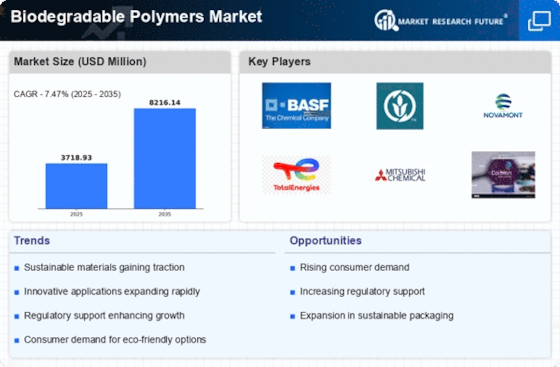
As per Market Research Future analysis, the Biodegradable Polymers Market Size was estimated at 3718.93 USD Million in 2024. The Biodegradable Polymers industry is projected to grow from USD 3996.81 Million in 2025 to USD 8216.14 Million by 2035, exhibiting a compound annual growth rate (CAGR) of 7.47% during the forecast period 2025 - 2035

Key Market Trends & Highlights

The Biodegradable Polymers Market is experiencing robust growth driven by sustainability trends and technological advancements.

  • Consumer demand for sustainable products is rising, particularly in North America, which remains the largest market for biodegradable polymers. Technological advancements in material science are facilitating the development of innovative biodegradable options, with PLA being the largest segment. The Asia-Pacific region is emerging as the fastest-growing market, driven by increasing environmental awareness and supportive government policies. Key market drivers include rising environmental awareness and growing demand from the packaging industry, which is the largest segment.

Market Size & Forecast

2024 Market Size 3718.93 (USD Million)
2035 Market Size 8216.14 (USD Million)
CAGR (2025 - 2035) 7.47%
Largest Regional Market Share in 2024 Asia Pacific

Major Players

BASF SE (DE), NatureWorks LLC (US), Novamont S.p.A. (IT), TotalEnergies SE (FR), Mitsubishi Chemical Corporation (JP), Corbion N.V. (NL), Biome Bioplastics Ltd (GB), Futerro (BE), Green Dot Bioplastics (US)

Market Trends

The Biodegradable Polymers Market is currently experiencing a notable transformation driven by increasing environmental awareness and regulatory pressures. As consumers and industries alike seek sustainable alternatives to traditional plastics, biodegradable polymers are emerging as a viable solution. This shift is not merely a trend but appears to be a fundamental change in how materials are produced and consumed. The market is characterized by a diverse range of applications, including packaging, agriculture, and textiles, which further enhances its relevance in various sectors. Companies are investing in research and development to innovate and improve the performance of biodegradable materials, indicating a commitment to sustainability and environmental stewardship. In addition to consumer demand, government initiatives aimed at reducing plastic waste are likely to bolster the Biodegradable Polymers Market. Policies promoting the use of eco-friendly materials and imposing restrictions on single-use plastics are becoming more prevalent. This regulatory landscape may encourage manufacturers to adopt biodegradable options, thereby expanding their market reach. Furthermore, collaborations between businesses and research institutions are fostering advancements in biodegradable technology, which could lead to enhanced product offerings. Overall, the Biodegradable Polymers Market is poised for growth, driven by a combination of consumer preferences, regulatory frameworks, and technological innovations.

Rising Consumer Demand for Sustainable Products

There is a growing inclination among consumers towards products that are environmentally friendly. This trend is influencing manufacturers to explore biodegradable options, as consumers increasingly prefer items that minimize ecological impact.

Government Regulations and Initiatives

Governments worldwide are implementing stricter regulations to combat plastic pollution. These policies often promote the use of biodegradable materials, creating a favorable environment for the growth of the Biodegradable Polymers Market.

Technological Advancements in Material Science

Innovations in material science are leading to the development of new biodegradable polymers with enhanced properties. These advancements may improve the performance and applicability of biodegradable materials across various industries.

Biodegradable Polymer Market Market Drivers

Rising Environmental Awareness

The increasing awareness regarding environmental issues among consumers appears to be a pivotal driver for the Biodegradable Polymers Market. As individuals become more conscious of the detrimental effects of plastic waste, there is a notable shift towards sustainable alternatives. This trend is reflected in market data, indicating that the demand for biodegradable polymers is projected to grow at a compound annual growth rate of approximately 12% over the next five years. Consumers are actively seeking products that align with their values, which has led to a surge in the adoption of biodegradable materials across various sectors, including packaging and agriculture. Consequently, manufacturers are compelled to innovate and expand their offerings in the biodegradable polymers segment to meet this rising demand.

Supportive Government Policies

Government regulations and initiatives play a crucial role in shaping the Biodegradable Polymers Market. Many governments are implementing stringent regulations aimed at reducing plastic waste and promoting sustainable practices. For instance, several countries have introduced bans on single-use plastics, which has catalyzed the demand for biodegradable alternatives. Market data suggests that regions with robust regulatory frameworks are witnessing a faster adoption of biodegradable polymers, as businesses seek compliance while also appealing to environmentally conscious consumers. Furthermore, government incentives for research and development in biodegradable materials are likely to enhance innovation, thereby expanding the market. This supportive policy environment is expected to drive significant growth in the biodegradable polymers sector.

Growing Demand from Packaging Industry

The packaging industry is experiencing a paradigm shift towards sustainable solutions, which is significantly influencing the Biodegradable Polymers Market. With the rise in e-commerce and consumer goods, the demand for eco-friendly packaging materials is escalating. Biodegradable polymers are increasingly being utilized in packaging applications due to their ability to decompose naturally, thereby reducing environmental impact. Market data reveals that the biodegradable packaging segment is projected to account for a substantial share of the overall biodegradable polymers market, with a growth rate of around 15% annually. This trend is prompting manufacturers to invest in research and development to create innovative packaging solutions that meet consumer expectations for sustainability while maintaining functionality.

Technological Innovations in Production

Technological advancements in the production of biodegradable polymers are emerging as a significant driver for the Biodegradable Polymers Market. Innovations in material science have led to the development of new biodegradable materials that offer enhanced performance characteristics, such as improved strength and durability. For instance, the introduction of polyhydroxyalkanoates (PHAs) and polylactic acid (PLA) has revolutionized the market, providing alternatives that can compete with traditional plastics. Market data indicates that the production capacity of biodegradable polymers is expected to increase substantially, driven by these technological innovations. As manufacturers adopt advanced production techniques, the cost of biodegradable polymers is likely to decrease, making them more accessible to a broader range of industries, including packaging, textiles, and consumer goods.

Increased Investment in Sustainable Practices

The trend of increased investment in sustainable practices is becoming a prominent driver for the Biodegradable Polymers Market. Companies across various sectors are recognizing the long-term benefits of adopting sustainable materials, including biodegradable polymers. This shift is not only driven by consumer demand but also by the need for businesses to enhance their corporate social responsibility profiles. Market data indicates that investments in biodegradable polymer technologies are on the rise, with many companies allocating significant resources towards developing sustainable product lines. This influx of capital is likely to accelerate innovation and production capabilities within the biodegradable polymers sector, ultimately leading to a more robust market presence and expanded application areas.

Market Segment Insights

By Type: PLA (Largest) vs. PHA (Fastest-Growing)

In the Biodegradable Polymers Market, the distribution among different types reveals PLA as the leading segment due to its widespread adoption in various applications such as packaging and disposable items. Starch Blends and PHA follow, with PHA emerging rapidly due to increasing environmental concerns and demand for sustainable alternatives. The 'Others' category, which includes various niche biodegradable polymers, contributes a smaller proportion to the market but plays a vital role in innovation and specialty applications. Growth trends in the biodegradable polymers sector are significantly influenced by evolving consumer preferences towards eco-friendly products. The demand for PLA continues to rise as industries seek sustainable solutions, while PHA's rapid growth is driven by advances in production technologies and increasing regulatory support for biodegradable materials. Starch Blends remain steady, primarily in agriculture, while the 'Others' segment showcases ongoing innovation efforts that cater to specific market needs.

PLA (Dominant) vs. PHA (Emerging)

PLA, or Polylactic Acid, dominates the Biodegradable Polymers Market due to its excellent performance characteristics and versatility across sectors such as food packaging, textiles, and medical applications. It is derived from renewable resources, making it an attractive option for consumers and manufacturers aiming for sustainability. On the other hand, PHA, or Polyhydroxyalkanoates, is rapidly emerging in the market due to its unique biodegradability properties in various environments, including marine settings. The production of PHA from organic wastes further enhances its appeal, positioning it as a critical player in future developments as industries aim to replace conventional plastics. Both PLA and PHA represent crucial aspects of the shift towards a more sustainable plastics economy.

By End-Use Industry: Packaging (Largest) vs. Consumer Goods (Fastest-Growing)

In the Biodegradable Polymers Market, the 'By End-Use Industry' segment showcases a significant distribution of market share across various applications. The Packaging sector stands out as the largest contributor, driven by increasing consumer demand for environmentally friendly packaging solutions. Consumer Goods, while smaller in market share, is rapidly gaining traction as companies focus on sustainable alternatives to traditional <a href="https://www.marketresearchfuture.com/reports/plastics-market-8347">plastics</a>. This shift highlights a growing awareness of environmental impact among consumers and manufacturers alike.

Packaging (Dominant) vs. Consumer Goods (Emerging)

The Packaging segment remains dominant within the Biodegradable Polymers Market, characterized by its extensive application in food packaging, retail, and e-commerce sectors. Key features include the use of materials such as <a href="https://www.marketresearchfuture.com/reports/polylactic-acid-for-3d-printing-market-40012">polylactic acid</a> (PLA) and polyhydroxyalkanoates (PHA) that provide performance comparable to traditional plastics while being environmentally sustainable. On the other hand, the Consumer Goods segment is emerging rapidly, propelled by innovation in product design and sustainability initiatives. Products like biodegradable utensils, containers, and personal care items are gaining popularity, driven by changing consumer preferences that favor eco-friendly products over conventional options, positioning this segment for substantial growth in the coming years.

Get more detailed insights about Biodegradable polymers Market Research Report — Global Forecast till 2035

Regional Insights

By Region, the study segments the Biodegradable polymers market into North America, Europe, Asia-Pacific, Latin America, and Middle East & Africa. The Asia-Pacific market accounted for a comparatively significant revenue share in 2022. Biodegradable polymers are widely used in the packaging industry in applications such as food & beverage packaging, cosmetics packaging, and other product packaging. The packaging industry has dominated the biodegradable polymer market owing to their biodegradability and high strength. Apart from packaging, the biodegradable polymer is widely used in textile, consumer goods, agriculture & horticulture, and other sectors.

In agriculture & horticulture, the biodegradable polymer has unique benefits. Biodegradable mulching films are making significant progress in these sectors: producing pure foods with minimal pesticide use and is a powerful sales argument in vegetable-growing or organic farming. Ploughing in mulching films after usage, rather than collecting them from the field, wiping off the soil, and returning them for recycling, is more feasible and improves the operation's profitability. Biodegradable mulching films are now extremely well-matched to the location and fruit.

In consumer goods, plastics are used in a large proportion of consumer electrical gadgets. Nowadays, casings, circuit boards, and data storage are made of plastic to keep appliances light and mobile while being tough and durable. There is an increase in demand for biodegradable polymers in consumer goods due to their biodegradability nature to decompose the product easily after use. Moreover, due to increasing awareness regarding the environmental benefits of biodegradable polymers, their use has increased in day-to-day life.

Key Players and Competitive Insights

The Biodegradable polymers Market is characterized by the presence of many global, regional, and local vendors. The market is highly competitive with all the players competing to gain maximum market share. Rapid advancements in processes, manufacturing and the growing application of Biodegradable polymers in end-use industries are the key factors that affect global market growth. The vendors compete based on cost, product quality, availability, and reliability of the products. The vendors must provide cost-effective and high-quality Biodegradable polymers to compete in the market. The competitive scenario is fragmented between tier-1 and tier-2 companies.
The growth of market players is dependent on market conditions, government regulations, and industry development. Thus, the players should focus on expanding their production capacities to meet the demand and enhancing their services. BASF SE, Total Corbion, NatureWorks, Biome Bioplastics, Novamont S.p.A, Evonik Industries, Toray Industries, Inc., Cortec Corporation, Plantic Technologies, Arkema, among others are the major companies in the market that compete in terms of quality, price, and raw materials incorporated. These players are primarily focusing on the development of more sophisticated and advanced products.
Although the international players are dominating the market, regional and local players with small market shares also have a moderate presence. The international players with presence across the globe, with established manufacturing units or sales offices, have strengthened their presence across major regions such as North America, Europe, and Asia-Pacific.
BASF SE: BASF aims to develop and offer sustainable solutions that are environmentally friendly and help reduce carbon emissions. The company is committed to reducing its own carbon footprint and helping its customers to do the same. BASF invests heavily in research and development to create innovative products and technologies that meet the changing needs of its customers. The company is focused on developing new solutions in areas such as renewable energy, energy storage, and electric mobility. BASF is constantly evaluating its portfolio of products and services to ensure that it is aligned with its strategic goals.
The company is divesting non-core businesses and investing in areas where it sees growth potential.
Total Corbion: Total Corbion aspires to improve its position in innovation and technology, and the business hopes to support the development of industries that are geared toward the future. The company aims to strengthen its leadership position by offering biodegradable polymers. It focuses on securing a leading position by leveraging the full portfolio and expanding into adjacent areas. Furthermore, A reputation for innovation, operational excellence, and dedication to environmental and safety protection polymers has been established by the company.
As a measure of the maturity of technology, the business has already secured multiple collaborations product launches with significant international industrial brands in various fields.

Key Companies in the Biodegradable Polymer Market include

Industry Developments

In April 2023, AMSilk, a German company focused on synthetic silk biopolymers, obtained a €25 million investment aimed at enhancing industrial scale-up and broadening commercial operations. The objective of this funding is to improve the production process of Biosteel®, a sustainable material made from recombinant spider silk. In February 2023, AMSilk formed a partnership with Evonik Industries to provide industrial-scale quantities of protein products derived from renewable raw materials, thereby promoting advancements in sustainable material solutions.

Samsara Eco, an Australian climate technology start-up, revealed a significant advancement in the recycling of nylon 6, a commonly used plastic, in December 2024. The organization has created an enzyme capable of decomposing nylon 6, facilitating its perpetual recycling. This advancement overcomes the shortcomings of traditional recycling techniques and promotes a sustainable circular economy.

Biocup, a Mexican enterprise focused on biodegradable disposable containers, made its entry into the U.S. market in January 2025, aided by the MileOne Incubator Program. The organization initiated its operations in Laredo, Texas, with the objective of offering environmentally sustainable options for conventional disposable containers.

Von Holzhausen, a textile material innovation company located in Los Angeles, has received recognition for its commitment to sustainable materials. In July 2024, the material Banbū was introduced on The Eames Lounge Chair and Ottoman by Herman Miller, showcasing the incorporation of plant-based textiles into premium furniture design.

Polymateria, a company located in the UK, has achieved significant progress in the development of biodegradable plastics. In April 2023, a collaboration was established with Toppan Specialty Films, an Indian manufacturer, to implement biodegradable technology in plastic bags. As of May 2023, Polymateria secured a £20 million investment and established a partnership with a subsidiary of Lotte Chemical to advance product development in Malaysia, highlighting notable growth and international outreach.

Future Outlook

Biodegradable Polymer Market Future Outlook

The Biodegradable Polymers Market is projected to grow at a 7.47% CAGR from 2025 to 2035, driven by increasing environmental regulations, consumer demand for sustainable products, and technological advancements.

New opportunities lie in:

  • Development of innovative biodegradable packaging solutions for e-commerce
  • Investment in R&amp;D for advanced biodegradable materials in automotive applications
  • Partnerships with agricultural firms for biodegradable mulch films and plant pots

By 2035, the Biodegradable Polymers Market is expected to achieve substantial growth and widespread adoption.

Market Segmentation

Biodegradable Polymer Market Type Outlook

  • PLA
  • Starch Blends
  • PHA
  • Others

Biodegradable Polymer Market End-Use Industry Outlook

  • Packaging
  • Consumer Goods
  • Textile
  • Agriculture & Horticulture
  • Others

Report Scope

MARKET SIZE 2024 3718.93(USD Million)
MARKET SIZE 2025 3996.81(USD Million)
MARKET SIZE 2035 8216.14(USD Million)
COMPOUND ANNUAL GROWTH RATE (CAGR) 7.47% (2025 - 2035)
REPORT COVERAGE Revenue Forecast, Competitive Landscape, Growth Factors, and Trends
BASE YEAR 2024
Market Forecast Period 2025 - 2035
Historical Data 2019 - 2024
Market Forecast Units USD Million
Key Companies Profiled BASF SE (DE), NatureWorks LLC (US), Novamont S.p.A. (IT), TotalEnergies SE (FR), Mitsubishi Chemical Corporation (JP), Corbion N.V. (NL), Biome Bioplastics Ltd (GB), Futerro (BE), Green Dot Bioplastics (US)
Segments Covered Type, Region
Key Market Opportunities Growing consumer demand for sustainable packaging solutions drives innovation in the Biodegradable Polymers Market.
Key Market Dynamics Rising consumer demand for sustainable products drives innovation and competition in the biodegradable polymers market.
Countries Covered North America, Europe, APAC, South America, MEA

FAQs

What is the projected market valuation of the Biodegradable Polymers Market by 2035?

<p>The projected market valuation for the Biodegradable Polymers Market is 8216.14 USD Million by 2035.</p>

What was the market valuation of the Biodegradable Polymers Market in 2024?

<p>The overall market valuation of the Biodegradable Polymers Market was 3718.93 USD Million in 2024.</p>

What is the expected CAGR for the Biodegradable Polymers Market during the forecast period 2025 - 2035?

<p>The expected CAGR for the Biodegradable Polymers Market during the forecast period 2025 - 2035 is 7.47%.</p>

Which companies are considered key players in the Biodegradable Polymers Market?

<p>Key players in the Biodegradable Polymers Market include BASF SE, NatureWorks LLC, Novamont S.p.A., TotalEnergies SE, and Mitsubishi Chemical Corporation.</p>

What are the main types of biodegradable polymers and their market valuations?

The main types include PLA, with a valuation range of 1200.0 to 2700.0 USD Million, and Starch Blends, with a range of 800.0 to 1800.0 USD Million.

How does the packaging segment perform in the Biodegradable Polymers Market?

The packaging segment had a valuation range of 1110.0 to 2500.0 USD Million, indicating strong market potential.

What is the market valuation range for PHA in the Biodegradable Polymers Market?

The market valuation range for PHA in the Biodegradable Polymers Market is between 600.0 and 1400.0 USD Million.

What end-use industries are driving the demand for biodegradable polymers?

End-use industries driving demand include packaging, consumer goods, and agriculture &amp; horticulture, with valuations ranging from 600.0 to 2500.0 USD Million.

What is the valuation range for the textile segment in the Biodegradable Polymers Market?

The textile segment has a valuation range of 600.0 to 1300.0 USD Million, reflecting its growing importance.

How do the projected growth figures for biodegradable polymers compare to previous years?

The projected growth figures for biodegradable polymers indicate a substantial increase from the 2024 valuation, suggesting a robust market trajectory.

  1. SECTION I: EXECUTIVE SUMMARY AND KEY HIGHLIGHTS
    1. | 1.1 EXECUTIVE SUMMARY
    2. | | 1.1.1 Market Overview
    3. | | 1.1.2 Key Findings
    4. | | 1.1.3 Market Segmentation
    5. | | 1.1.4 Competitive Landscape
    6. | | 1.1.5 Challenges and Opportunities
    7. | | 1.1.6 Future Outlook
  2. SECTION II: SCOPING, METHODOLOGY AND MARKET STRUCTURE
    1. | 2.1 MARKET INTRODUCTION
    2. | | 2.1.1 Definition
    3. | | 2.1.2 Scope of the study
    4. | | | 2.1.2.1 Research Objective
    5. | | | 2.1.2.2 Assumption
    6. | | | 2.1.2.3 Limitations
    7. | 2.2 RESEARCH METHODOLOGY
    8. | | 2.2.1 Overview
    9. | | 2.2.2 Data Mining
    10. | | 2.2.3 Secondary Research
    11. | | 2.2.4 Primary Research
    12. | | | 2.2.4.1 Primary Interviews and Information Gathering Process
    13. | | | 2.2.4.2 Breakdown of Primary Respondents
    14. | | 2.2.5 Forecasting Model
    15. | | 2.2.6 Market Size Estimation
    16. | | | 2.2.6.1 Bottom-Up Approach
    17. | | | 2.2.6.2 Top-Down Approach
    18. | | 2.2.7 Data Triangulation
    19. | | 2.2.8 Validation
  3. SECTION III: QUALITATIVE ANALYSIS
    1. | 3.1 MARKET DYNAMICS
    2. | | 3.1.1 Overview
    3. | | 3.1.2 Drivers
    4. | | 3.1.3 Restraints
    5. | | 3.1.4 Opportunities
    6. | 3.2 MARKET FACTOR ANALYSIS
    7. | | 3.2.1 Value chain Analysis
    8. | | 3.2.2 Porter's Five Forces Analysis
    9. | | | 3.2.2.1 Bargaining Power of Suppliers
    10. | | | 3.2.2.2 Bargaining Power of Buyers
    11. | | | 3.2.2.3 Threat of New Entrants
    12. | | | 3.2.2.4 Threat of Substitutes
    13. | | | 3.2.2.5 Intensity of Rivalry
    14. | | 3.2.3 COVID-19 Impact Analysis
    15. | | | 3.2.3.1 Market Impact Analysis
    16. | | | 3.2.3.2 Regional Impact
    17. | | | 3.2.3.3 Opportunity and Threat Analysis
  4. SECTION IV: QUANTITATIVE ANALYSIS
    1. | 4.1 Chemicals and Materials, BY Type (USD Million)
    2. | | 4.1.1 PLA
    3. | | 4.1.2 Starch Blends
    4. | | 4.1.3 PHA
    5. | | 4.1.4 Others
    6. | 4.2 Chemicals and Materials, BY End-Use Industry (USD Million)
    7. | | 4.2.1 Packaging
    8. | | 4.2.2 Consumer Goods
    9. | | 4.2.3 Textile
    10. | | 4.2.4 Agriculture & Horticulture
    11. | | 4.2.5 Others
    12. | 4.3 Chemicals and Materials, BY Region (USD Million)
    13. | | 4.3.1 North America
    14. | | | 4.3.1.1 US
    15. | | | 4.3.1.2 Canada
    16. | | 4.3.2 Europe
    17. | | | 4.3.2.1 Germany
    18. | | | 4.3.2.2 UK
    19. | | | 4.3.2.3 France
    20. | | | 4.3.2.4 Russia
    21. | | | 4.3.2.5 Italy
    22. | | | 4.3.2.6 Spain
    23. | | | 4.3.2.7 Rest of Europe
    24. | | 4.3.3 APAC
    25. | | | 4.3.3.1 China
    26. | | | 4.3.3.2 India
    27. | | | 4.3.3.3 Japan
    28. | | | 4.3.3.4 South Korea
    29. | | | 4.3.3.5 Malaysia
    30. | | | 4.3.3.6 Thailand
    31. | | | 4.3.3.7 Indonesia
    32. | | | 4.3.3.8 Rest of APAC
    33. | | 4.3.4 South America
    34. | | | 4.3.4.1 Brazil
    35. | | | 4.3.4.2 Mexico
    36. | | | 4.3.4.3 Argentina
    37. | | | 4.3.4.4 Rest of South America
    38. | | 4.3.5 MEA
    39. | | | 4.3.5.1 GCC Countries
    40. | | | 4.3.5.2 South Africa
    41. | | | 4.3.5.3 Rest of MEA
  5. SECTION V: COMPETITIVE ANALYSIS
    1. | 5.1 Competitive Landscape
    2. | | 5.1.1 Overview
    3. | | 5.1.2 Competitive Analysis
    4. | | 5.1.3 Market share Analysis
    5. | | 5.1.4 Major Growth Strategy in the Chemicals and Materials
    6. | | 5.1.5 Competitive Benchmarking
    7. | | 5.1.6 Leading Players in Terms of Number of Developments in the Chemicals and Materials
    8. | | 5.1.7 Key developments and growth strategies
    9. | | | 5.1.7.1 New Product Launch/Service Deployment
    10. | | | 5.1.7.2 Merger & Acquisitions
    11. | | | 5.1.7.3 Joint Ventures
    12. | | 5.1.8 Major Players Financial Matrix
    13. | | | 5.1.8.1 Sales and Operating Income
    14. | | | 5.1.8.2 Major Players R&D Expenditure. 2023
    15. | 5.2 Company Profiles
    16. | | 5.2.1 BASF SE (DE)
    17. | | | 5.2.1.1 Financial Overview
    18. | | | 5.2.1.2 Products Offered
    19. | | | 5.2.1.3 Key Developments
    20. | | | 5.2.1.4 SWOT Analysis
    21. | | | 5.2.1.5 Key Strategies
    22. | | 5.2.2 NatureWorks LLC (US)
    23. | | | 5.2.2.1 Financial Overview
    24. | | | 5.2.2.2 Products Offered
    25. | | | 5.2.2.3 Key Developments
    26. | | | 5.2.2.4 SWOT Analysis
    27. | | | 5.2.2.5 Key Strategies
    28. | | 5.2.3 Novamont S.p.A. (IT)
    29. | | | 5.2.3.1 Financial Overview
    30. | | | 5.2.3.2 Products Offered
    31. | | | 5.2.3.3 Key Developments
    32. | | | 5.2.3.4 SWOT Analysis
    33. | | | 5.2.3.5 Key Strategies
    34. | | 5.2.4 TotalEnergies SE (FR)
    35. | | | 5.2.4.1 Financial Overview
    36. | | | 5.2.4.2 Products Offered
    37. | | | 5.2.4.3 Key Developments
    38. | | | 5.2.4.4 SWOT Analysis
    39. | | | 5.2.4.5 Key Strategies
    40. | | 5.2.5 Mitsubishi Chemical Corporation (JP)
    41. | | | 5.2.5.1 Financial Overview
    42. | | | 5.2.5.2 Products Offered
    43. | | | 5.2.5.3 Key Developments
    44. | | | 5.2.5.4 SWOT Analysis
    45. | | | 5.2.5.5 Key Strategies
    46. | | 5.2.6 Corbion N.V. (NL)
    47. | | | 5.2.6.1 Financial Overview
    48. | | | 5.2.6.2 Products Offered
    49. | | | 5.2.6.3 Key Developments
    50. | | | 5.2.6.4 SWOT Analysis
    51. | | | 5.2.6.5 Key Strategies
    52. | | 5.2.7 Biome Bioplastics Ltd (GB)
    53. | | | 5.2.7.1 Financial Overview
    54. | | | 5.2.7.2 Products Offered
    55. | | | 5.2.7.3 Key Developments
    56. | | | 5.2.7.4 SWOT Analysis
    57. | | | 5.2.7.5 Key Strategies
    58. | | 5.2.8 Futerro (BE)
    59. | | | 5.2.8.1 Financial Overview
    60. | | | 5.2.8.2 Products Offered
    61. | | | 5.2.8.3 Key Developments
    62. | | | 5.2.8.4 SWOT Analysis
    63. | | | 5.2.8.5 Key Strategies
    64. | | 5.2.9 Green Dot Bioplastics (US)
    65. | | | 5.2.9.1 Financial Overview
    66. | | | 5.2.9.2 Products Offered
    67. | | | 5.2.9.3 Key Developments
    68. | | | 5.2.9.4 SWOT Analysis
    69. | | | 5.2.9.5 Key Strategies
    70. | 5.3 Appendix
    71. | | 5.3.1 References
    72. | | 5.3.2 Related Reports
  6. LIST OF FIGURES
    1. | 6.1 MARKET SYNOPSIS
    2. | 6.2 NORTH AMERICA MARKET ANALYSIS
    3. | 6.3 US MARKET ANALYSIS BY TYPE
    4. | 6.4 US MARKET ANALYSIS BY END-USE INDUSTRY
    5. | 6.5 CANADA MARKET ANALYSIS BY TYPE
    6. | 6.6 CANADA MARKET ANALYSIS BY END-USE INDUSTRY
    7. | 6.7 EUROPE MARKET ANALYSIS
    8. | 6.8 GERMANY MARKET ANALYSIS BY TYPE
    9. | 6.9 GERMANY MARKET ANALYSIS BY END-USE INDUSTRY
    10. | 6.10 UK MARKET ANALYSIS BY TYPE
    11. | 6.11 UK MARKET ANALYSIS BY END-USE INDUSTRY
    12. | 6.12 FRANCE MARKET ANALYSIS BY TYPE
    13. | 6.13 FRANCE MARKET ANALYSIS BY END-USE INDUSTRY
    14. | 6.14 RUSSIA MARKET ANALYSIS BY TYPE
    15. | 6.15 RUSSIA MARKET ANALYSIS BY END-USE INDUSTRY
    16. | 6.16 ITALY MARKET ANALYSIS BY TYPE
    17. | 6.17 ITALY MARKET ANALYSIS BY END-USE INDUSTRY
    18. | 6.18 SPAIN MARKET ANALYSIS BY TYPE
    19. | 6.19 SPAIN MARKET ANALYSIS BY END-USE INDUSTRY
    20. | 6.20 REST OF EUROPE MARKET ANALYSIS BY TYPE
    21. | 6.21 REST OF EUROPE MARKET ANALYSIS BY END-USE INDUSTRY
    22. | 6.22 APAC MARKET ANALYSIS
    23. | 6.23 CHINA MARKET ANALYSIS BY TYPE
    24. | 6.24 CHINA MARKET ANALYSIS BY END-USE INDUSTRY
    25. | 6.25 INDIA MARKET ANALYSIS BY TYPE
    26. | 6.26 INDIA MARKET ANALYSIS BY END-USE INDUSTRY
    27. | 6.27 JAPAN MARKET ANALYSIS BY TYPE
    28. | 6.28 JAPAN MARKET ANALYSIS BY END-USE INDUSTRY
    29. | 6.29 SOUTH KOREA MARKET ANALYSIS BY TYPE
    30. | 6.30 SOUTH KOREA MARKET ANALYSIS BY END-USE INDUSTRY
    31. | 6.31 MALAYSIA MARKET ANALYSIS BY TYPE
    32. | 6.32 MALAYSIA MARKET ANALYSIS BY END-USE INDUSTRY
    33. | 6.33 THAILAND MARKET ANALYSIS BY TYPE
    34. | 6.34 THAILAND MARKET ANALYSIS BY END-USE INDUSTRY
    35. | 6.35 INDONESIA MARKET ANALYSIS BY TYPE
    36. | 6.36 INDONESIA MARKET ANALYSIS BY END-USE INDUSTRY
    37. | 6.37 REST OF APAC MARKET ANALYSIS BY TYPE
    38. | 6.38 REST OF APAC MARKET ANALYSIS BY END-USE INDUSTRY
    39. | 6.39 SOUTH AMERICA MARKET ANALYSIS
    40. | 6.40 BRAZIL MARKET ANALYSIS BY TYPE
    41. | 6.41 BRAZIL MARKET ANALYSIS BY END-USE INDUSTRY
    42. | 6.42 MEXICO MARKET ANALYSIS BY TYPE
    43. | 6.43 MEXICO MARKET ANALYSIS BY END-USE INDUSTRY
    44. | 6.44 ARGENTINA MARKET ANALYSIS BY TYPE
    45. | 6.45 ARGENTINA MARKET ANALYSIS BY END-USE INDUSTRY
    46. | 6.46 REST OF SOUTH AMERICA MARKET ANALYSIS BY TYPE
    47. | 6.47 REST OF SOUTH AMERICA MARKET ANALYSIS BY END-USE INDUSTRY
    48. | 6.48 MEA MARKET ANALYSIS
    49. | 6.49 GCC COUNTRIES MARKET ANALYSIS BY TYPE
    50. | 6.50 GCC COUNTRIES MARKET ANALYSIS BY END-USE INDUSTRY
    51. | 6.51 SOUTH AFRICA MARKET ANALYSIS BY TYPE
    52. | 6.52 SOUTH AFRICA MARKET ANALYSIS BY END-USE INDUSTRY
    53. | 6.53 REST OF MEA MARKET ANALYSIS BY TYPE
    54. | 6.54 REST OF MEA MARKET ANALYSIS BY END-USE INDUSTRY
    55. | 6.55 KEY BUYING CRITERIA OF CHEMICALS AND MATERIALS
    56. | 6.56 RESEARCH PROCESS OF MRFR
    57. | 6.57 DRO ANALYSIS OF CHEMICALS AND MATERIALS
    58. | 6.58 DRIVERS IMPACT ANALYSIS: CHEMICALS AND MATERIALS
    59. | 6.59 RESTRAINTS IMPACT ANALYSIS: CHEMICALS AND MATERIALS
    60. | 6.60 SUPPLY / VALUE CHAIN: CHEMICALS AND MATERIALS
    61. | 6.61 CHEMICALS AND MATERIALS, BY TYPE, 2024 (% SHARE)
    62. | 6.62 CHEMICALS AND MATERIALS, BY TYPE, 2024 TO 2035 (USD Million)
    63. | 6.63 CHEMICALS AND MATERIALS, BY END-USE INDUSTRY, 2024 (% SHARE)
    64. | 6.64 CHEMICALS AND MATERIALS, BY END-USE INDUSTRY, 2024 TO 2035 (USD Million)
    65. | 6.65 BENCHMARKING OF MAJOR COMPETITORS
  7. LIST OF TABLES
    1. | 7.1 LIST OF ASSUMPTIONS
    2. | | 7.1.1
    3. | 7.2 North America MARKET SIZE ESTIMATES; FORECAST
    4. | | 7.2.1 BY TYPE, 2025-2035 (USD Million)
    5. | | 7.2.2 BY END-USE INDUSTRY, 2025-2035 (USD Million)
    6. | 7.3 US MARKET SIZE ESTIMATES; FORECAST
    7. | | 7.3.1 BY TYPE, 2025-2035 (USD Million)
    8. | | 7.3.2 BY END-USE INDUSTRY, 2025-2035 (USD Million)
    9. | 7.4 Canada MARKET SIZE ESTIMATES; FORECAST
    10. | | 7.4.1 BY TYPE, 2025-2035 (USD Million)
    11. | | 7.4.2 BY END-USE INDUSTRY, 2025-2035 (USD Million)
    12. | 7.5 Europe MARKET SIZE ESTIMATES; FORECAST
    13. | | 7.5.1 BY TYPE, 2025-2035 (USD Million)
    14. | | 7.5.2 BY END-USE INDUSTRY, 2025-2035 (USD Million)
    15. | 7.6 Germany MARKET SIZE ESTIMATES; FORECAST
    16. | | 7.6.1 BY TYPE, 2025-2035 (USD Million)
    17. | | 7.6.2 BY END-USE INDUSTRY, 2025-2035 (USD Million)
    18. | 7.7 UK MARKET SIZE ESTIMATES; FORECAST
    19. | | 7.7.1 BY TYPE, 2025-2035 (USD Million)
    20. | | 7.7.2 BY END-USE INDUSTRY, 2025-2035 (USD Million)
    21. | 7.8 France MARKET SIZE ESTIMATES; FORECAST
    22. | | 7.8.1 BY TYPE, 2025-2035 (USD Million)
    23. | | 7.8.2 BY END-USE INDUSTRY, 2025-2035 (USD Million)
    24. | 7.9 Russia MARKET SIZE ESTIMATES; FORECAST
    25. | | 7.9.1 BY TYPE, 2025-2035 (USD Million)
    26. | | 7.9.2 BY END-USE INDUSTRY, 2025-2035 (USD Million)
    27. | 7.10 Italy MARKET SIZE ESTIMATES; FORECAST
    28. | | 7.10.1 BY TYPE, 2025-2035 (USD Million)
    29. | | 7.10.2 BY END-USE INDUSTRY, 2025-2035 (USD Million)
    30. | 7.11 Spain MARKET SIZE ESTIMATES; FORECAST
    31. | | 7.11.1 BY TYPE, 2025-2035 (USD Million)
    32. | | 7.11.2 BY END-USE INDUSTRY, 2025-2035 (USD Million)
    33. | 7.12 Rest of Europe MARKET SIZE ESTIMATES; FORECAST
    34. | | 7.12.1 BY TYPE, 2025-2035 (USD Million)
    35. | | 7.12.2 BY END-USE INDUSTRY, 2025-2035 (USD Million)
    36. | 7.13 APAC MARKET SIZE ESTIMATES; FORECAST
    37. | | 7.13.1 BY TYPE, 2025-2035 (USD Million)
    38. | | 7.13.2 BY END-USE INDUSTRY, 2025-2035 (USD Million)
    39. | 7.14 China MARKET SIZE ESTIMATES; FORECAST
    40. | | 7.14.1 BY TYPE, 2025-2035 (USD Million)
    41. | | 7.14.2 BY END-USE INDUSTRY, 2025-2035 (USD Million)
    42. | 7.15 India MARKET SIZE ESTIMATES; FORECAST
    43. | | 7.15.1 BY TYPE, 2025-2035 (USD Million)
    44. | | 7.15.2 BY END-USE INDUSTRY, 2025-2035 (USD Million)
    45. | 7.16 Japan MARKET SIZE ESTIMATES; FORECAST
    46. | | 7.16.1 BY TYPE, 2025-2035 (USD Million)
    47. | | 7.16.2 BY END-USE INDUSTRY, 2025-2035 (USD Million)
    48. | 7.17 South Korea MARKET SIZE ESTIMATES; FORECAST
    49. | | 7.17.1 BY TYPE, 2025-2035 (USD Million)
    50. | | 7.17.2 BY END-USE INDUSTRY, 2025-2035 (USD Million)
    51. | 7.18 Malaysia MARKET SIZE ESTIMATES; FORECAST
    52. | | 7.18.1 BY TYPE, 2025-2035 (USD Million)
    53. | | 7.18.2 BY END-USE INDUSTRY, 2025-2035 (USD Million)
    54. | 7.19 Thailand MARKET SIZE ESTIMATES; FORECAST
    55. | | 7.19.1 BY TYPE, 2025-2035 (USD Million)
    56. | | 7.19.2 BY END-USE INDUSTRY, 2025-2035 (USD Million)
    57. | 7.20 Indonesia MARKET SIZE ESTIMATES; FORECAST
    58. | | 7.20.1 BY TYPE, 2025-2035 (USD Million)
    59. | | 7.20.2 BY END-USE INDUSTRY, 2025-2035 (USD Million)
    60. | 7.21 Rest of APAC MARKET SIZE ESTIMATES; FORECAST
    61. | | 7.21.1 BY TYPE, 2025-2035 (USD Million)
    62. | | 7.21.2 BY END-USE INDUSTRY, 2025-2035 (USD Million)
    63. | 7.22 South America MARKET SIZE ESTIMATES; FORECAST
    64. | | 7.22.1 BY TYPE, 2025-2035 (USD Million)
    65. | | 7.22.2 BY END-USE INDUSTRY, 2025-2035 (USD Million)
    66. | 7.23 Brazil MARKET SIZE ESTIMATES; FORECAST
    67. | | 7.23.1 BY TYPE, 2025-2035 (USD Million)
    68. | | 7.23.2 BY END-USE INDUSTRY, 2025-2035 (USD Million)
    69. | 7.24 Mexico MARKET SIZE ESTIMATES; FORECAST
    70. | | 7.24.1 BY TYPE, 2025-2035 (USD Million)
    71. | | 7.24.2 BY END-USE INDUSTRY, 2025-2035 (USD Million)
    72. | 7.25 Argentina MARKET SIZE ESTIMATES; FORECAST
    73. | | 7.25.1 BY TYPE, 2025-2035 (USD Million)
    74. | | 7.25.2 BY END-USE INDUSTRY, 2025-2035 (USD Million)
    75. | 7.26 Rest of South America MARKET SIZE ESTIMATES; FORECAST
    76. | | 7.26.1 BY TYPE, 2025-2035 (USD Million)
    77. | | 7.26.2 BY END-USE INDUSTRY, 2025-2035 (USD Million)
    78. | 7.27 MEA MARKET SIZE ESTIMATES; FORECAST
    79. | | 7.27.1 BY TYPE, 2025-2035 (USD Million)
    80. | | 7.27.2 BY END-USE INDUSTRY, 2025-2035 (USD Million)
    81. | 7.28 GCC Countries MARKET SIZE ESTIMATES; FORECAST
    82. | | 7.28.1 BY TYPE, 2025-2035 (USD Million)
    83. | | 7.28.2 BY END-USE INDUSTRY, 2025-2035 (USD Million)
    84. | 7.29 South Africa MARKET SIZE ESTIMATES; FORECAST
    85. | | 7.29.1 BY TYPE, 2025-2035 (USD Million)
    86. | | 7.29.2 BY END-USE INDUSTRY, 2025-2035 (USD Million)
    87. | 7.30 Rest of MEA MARKET SIZE ESTIMATES; FORECAST
    88. | | 7.30.1 BY TYPE, 2025-2035 (USD Million)
    89. | | 7.30.2 BY END-USE INDUSTRY, 2025-2035 (USD Million)
    90. | 7.31 PRODUCT LAUNCH/PRODUCT DEVELOPMENT/APPROVAL
    91. | | 7.31.1
    92. | 7.32 ACQUISITION/PARTNERSHIP
    93. | | 7.32.1

Chemicals and Materials Market Segmentation

Chemicals and Materials By Type (USD Million, 2025-2035)

  • PLA
  • Starch Blends
  • PHA
  • Others

Chemicals and Materials By End-Use Industry (USD Million, 2025-2035)

  • Packaging
  • Consumer Goods
  • Textile
  • Agriculture & Horticulture
  • Others
Infographic

Free Sample Request

Kindly complete the form below to receive a free sample of this Report

Get Free Sample

Customer Strories

Compare Licence

×
Features License Type
Single User Multiuser License Enterprise User
Price $4,950 $5,950 $7,250
Maximum User Access Limit 1 User Upto 10 Users Unrestricted Access Throughout the Organization
Free Customization
Direct Access to Analyst
Deliverable Format
Platform Access
Discount on Next Purchase 10% 15% 15%
Printable Versions