

Request Free Sample ×

Kindly complete the form below to receive a free sample of this Report

* Please use a valid business email

Leading companies partner with us for data-driven Insights

clients tt-cursor
Hero Background
English
Chinese
French
Japanese
Korean
German
Spanish

Bio-Fertilizers Market Size

ID: MRFR/Agri/0877-CR
200 Pages
Snehal Singh
May 2018

Biofertilizers Market Size, Share, Industry Trend & Analysis Research Report By Type (Nitrogen Fixing, Phosphate Solubilizing, Others), By Crop Type (Cereals & Grains, Pulses & Oilseeds, Fruits & Vegetables), By Form (Dry, Liquid), By Application (Leaf Treatment, Root Immersion, Plant Rooting, Others), By Microorganism Type (Rhizobium, Azotobacter, Azospirillum, Pseudomonas, Bacillus, VAM, Others) and By Regional (North America, Europe, South America, Asia Pacific, Middle East and Africa) - Forecast to 2035

Share:
Download PDF ×

We do not share your information with anyone. However, we may send you emails based on your report interest from time to time. You may contact us at any time to opt-out.

Bio-Fertilizers Market Infographic
Purchase Options

Bio Fertilizers Size

Bio-Fertilizers Market Growth Projections and Opportunities

biofertilizers market size for which in aggregate impact its growth and development. One influential factor is the rise in international consciousness of sustainable agriculture methods. With increasing worries about the environmental impacts and soil health, experts in agriculture are moving from chemical fertilizers to biofertilizers as a more environmentally friendly approach. Biofertilizers encompass microorganisms like bacteria, fungi and algae which improve the fertility of soil while promoting plant nutrition with less impact on nature. Government policies and regulations play a significant role in the competitive environment of biofertilizers market. Particularly, many governments across the globe are also interested in encouraging sustainable farming practices and offering financial incentives for using biofertilizers. Subsidies, grants and supportive policies favourably affect the environment for farmers to turn into using biofertilizers directly impacting on market size. Wider acceptance of biofertilizers in mainstream agriculture also results from appropriate regulatory frameworks encouraging development and commercialisation. Another main factor that contributes to the growth of this market is increasing demand for organic produce. The last point to note is that more consumers are opting for organic food products following concerns arising from chemical residues in conventional agriculture. Since biofertilizers are a natural and organic input, they align with the principles of organic farming. With the organic produce market growing, demand for biofertilizers also increases offering more room for growth and innovation in the field of biofertilizers. The growth of the market is also driven by technological advancements in biofertilizer research and development. Biofertilizers are effective and applicable, because of continuous efforts to isolate and characterize beneficial microorganisms, improve their effectiveness as well as technologies used in formulation. Studies on microbial strains, carrier materials and methods in application have of late witnessed improvements that boost the popularity and effectiveness as well as ease-of-use hence encouraging more farmers to integrate biofertilizers into their operations. Biofertilizers Market is also influenced by climate change and its effects on agriculture. Temperature, precipitation patterns and frequency of extreme weather events can impact soil fertility or nutrient availability. With their potential capacity to improve soil structure and nutrient cycling, biofertilizers become valuable tools for farmers trying to deal with the challenges of climate change. Biofertilizers adaptability to a variety of agroecological climates makes them an enduring solution amid unpredictable environmental situations.

Bio-Fertilizers Market Size Graph
Author
Author Profile
Snehal Singh
Manager - Research

High acumen in analyzing complex macro & micro markets with more than 6 years of work experience in the field of market research. By implementing her analytical skills in forecasting and estimation into market research reports, she has expertise in Packaging, Construction, and Equipment domains. She handles a team size of 20-25 resources and ensures smooth running of the projects, associated marketing activities, and client servicing.

Leave a Comment

FAQs

What is the current valuation of the bio fertilizer market?

<p>The bio fertilizer market was valued at 3.5 USD Billion in 2024.</p>

What is the projected market size for bio fertilizers by 2035?

<p>The market is projected to reach 7.0 USD Billion by 2035.</p>

What is the expected CAGR for the bio fertilizer market during the forecast period?

<p>The expected CAGR for the bio fertilizer market from 2025 to 2035 is 6.5%.</p>

Which application segments are driving growth in the bio fertilizer market?

<p>The soil amendment segment is anticipated to grow from 1.4 USD Billion in 2024 to 2.8 USD Billion by 2035.</p>

What types of bio fertilizers are experiencing the most growth?

<p>Organic bio fertilizers are projected to increase from 1.1 USD Billion in 2024 to 2.2 USD Billion by 2035.</p>

Which end-use sectors are contributing to the bio fertilizer market expansion?

<p>The agriculture sector is expected to grow from 1.4 USD Billion in 2024 to 2.8 USD Billion by 2035.</p>

Who are the key players in the bio fertilizer market?

<p>Key players include BASF SE, Novozymes A/S, Syngenta AG, and Yara International ASA.</p>

What is the growth outlook for bacterial bio fertilizers?

<p>Bacterial bio fertilizers are likely to grow from 0.9 USD Billion in 2024 to 1.8 USD Billion by 2035.</p>

How does the market for foliar application bio fertilizers compare to other segments?

<p>The foliar application segment is expected to rise from 0.7 USD Billion in 2024 to 1.4 USD Billion by 2035.</p>

What role do companies like Koppert Biological Systems play in the market?

<p>Companies like Koppert Biological Systems are instrumental in driving innovation and market growth in the bio fertilizer sector.</p>

Market Summary

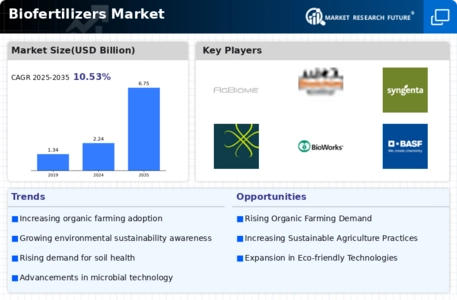
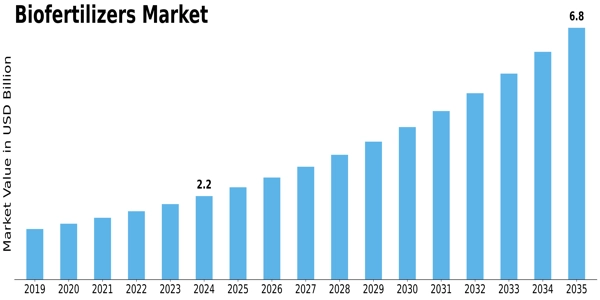
The Global Biofertilizers Market is projected to grow from 2.24 USD Billion in 2024 to 6.75 USD Billion by 2035, reflecting a robust growth trajectory.

Key Market Trends & Highlights

Biofertilizers Key Trends and Highlights

  • The market is expected to expand at a compound annual growth rate of 10.55 percent from 2025 to 2035. By 2035, the market valuation is anticipated to reach 6.75 USD Billion, indicating a substantial increase from the base year. in 2024, the market is valued at 2.24 USD Billion, highlighting the current investment in biofertilizers. Growing adoption of sustainable agricultural practices due to increasing environmental concerns is a major market driver.

Market Size & Forecast

2024 Market Size 2.24 (USD Billion)
2035 Market Size 6.75 (USD Billion)
CAGR (2025-2035) 10.53%
Largest Regional Market Share in 2024 latin_america)

Major Players

Kraft Chemical Company, AgBiome, Agroforestry Research, Valagro, Biolchim, Biotech Products, Syngenta, Arabian Agricultural Services, Raviplast, Novozymes, BioWorks, BASF, Ginkgo BioWorks, Lallemand, Nutrifield

Market Trends

The  Biofertilizers Market is experiencing notable growth driven by several key market drivers. Increasing awareness of sustainable agriculture and the adverse effects of chemical fertilizers on soil health are fueling demand for biofertilizers. Farmers are increasingly recognizing that biofertilizers enhance soil fertility, increase crop yield, and mitigate environmental impacts. The push for organic farming, supported by governmental policies across various countries promoting sustainable agricultural practices, is another significant driver.  There are several opportunities to be explored in the  Biofertilizers Industry.

Innovative technologies in biofertilizer development, such as microbial formulations and plant growth-promoting rhizobacteria, present avenues for companies to enhance product effectiveness and appeal to environmentally conscious consumers.There is also potential for expanding the application of biofertilizers in non-traditional crops and various climatic zones, which can help in tapping new markets and customer bases.  Trends in recent times indicate a growing preference for bio-based products over synthetic alternatives. This is evident in many regions ly, where consumers are demanding cleaner and greener agricultural practices.

The integration of biofertilizers with precision agriculture techniques is also becoming increasingly popular, promoting efficient resource utilization and optimized crop management. Furthermore, collaborations between research institutions and agricultural companies are on the rise, focusing on developing advanced biofertilizer formulations tailored to specific agricultural needs.Overall, the  Biofertilizers Market is shifting towards more sustainable agricultural practices driven by innovation and growing consumer awareness.

Source: Primary Research, Secondary Research, Market Research Future Database and Analyst Review

Bio-Fertilizers Market Market Drivers

Rising Demand for Organic Produce

The Global Biofertilizers Market Industry experiences a notable surge in demand for organic produce, driven by consumer preferences for sustainable and chemical-free food options. As more consumers become aware of the health benefits associated with organic farming, the market for biofertilizers is projected to grow significantly. In 2024, the market is valued at approximately 2.24 USD Billion, reflecting a shift towards environmentally friendly agricultural practices. This trend is likely to continue, as organic farming is expected to expand, further bolstering the biofertilizers market. The increasing adoption of organic farming methods indicates a promising future for the Global Biofertilizers Market Industry.

Market Segment Insights

By Application: Soil Amendment (Largest) vs. Seed Treatment (Fastest-Growing)

<p>The application segment of the bio fertilizer market is primarily characterized by four main categories: soil amendment, seed treatment, foliar application, and compost additive. Among these, soil amendment holds the largest share, as it enhances soil health and fertility, proving beneficial for a wide array of crops. Conversely, seed treatment is emerging as the fastest-growing segment, driven by advances in biotechnology and the increasing focus on sustainable agricultural practices.</p>

<p>Soil Amendment (Dominant) vs. Seed Treatment (Emerging)</p>

<p>Soil amendment is a dominant application in the bio fertilizer market due to its crucial role in enhancing soil structure, moisture retention, and nutrient supply. This segment appeals to large-scale farmers looking to improve crop yields sustainably. On the other hand, seed treatment is gaining prominence as an emerging application, incorporating biological agents that protect seeds from pests and diseases while promoting early plant growth. This method appeals especially to organic farmers and those seeking increased productivity without chemical inputs, aligning with the global trend toward sustainable agriculture.</p>

By Type: Bacterial Bio Fertilizers (Largest) vs. Fungal Bio Fertilizers (Fastest-Growing)

<p>The bio fertilizer market exhibits a diverse distribution among its primary segments. Bacterial bio fertilizers dominate this segment due to their widespread use in agriculture, driven by their effectiveness in enhancing soil fertility and crop yield. Alternately, fungal bio fertilizers are gaining remarkable traction, representing the fastest-growing segment, thanks to increasing recognition of their role in improving nutrient uptake and plant health. Their adoption is being accelerated by sustainable agriculture practices and organic farming trends.</p>

<p>Bio Fertilizers: Bacterial (Dominant) vs. Fungal (Emerging)</p>

<p>Bacterial bio fertilizers are comprised of live bacteria that facilitate microbial activity in the soil, significantly boosting nutrient availability to plants. This segment is favored for its reliable performance and proven efficacy in a variety of crops, making it the dominant choice among farmers. Meanwhile, fungal bio fertilizers, while emerging, are rapidly gaining popularity as they harness beneficial fungi to enhance soil structure and plant interaction. This growth is primarily fueled by the rising demand for organic farming solutions and sustainable agricultural practices, positioning fungi as a critical component in the enhancement of soil health and crop productivity.</p>

By End Use: Agriculture (Largest) vs. Horticulture (Fastest-Growing)

<p>The bio fertilizer market is primarily driven by its application in agriculture, accounting for a substantial share due to the increasing need for sustainable farming practices. Agriculture remains the dominant sector, as farmers seek to enhance soil fertility and improve crop yields without relying on synthetic fertilizers. Horticulture is emerging rapidly as a significant segment, spurred by the rising demand for eco-friendly practices in flower and plant cultivation.</p>

<p>Agriculture (Dominant) vs. Horticulture (Emerging)</p>

<p>The agricultural sector plays a critical role in the bio fertilizer market, characterized by its extensive adoption of organic agricultural practices. Bio fertilizers in agriculture enhance soil health, promote beneficial microbial activity, and improve nutrient availability, making them essential for sustainable crop production. Meanwhile, horticulture represents the fastest-growing segment, driven by increasing consumer preferences for organic flowers and plants. As urban gardening and landscaping trend upward, horticulture's demand for bio fertilizers is expected to surge, offering unique formulations tailored for ornamental and decorative plants.</p>

Biofertilizers Market Form Insights  

Biofertilizers Market Form Insights  

The  Biofertilizers Market is segmented by Form, with prominent categories being Dry and Liquid biofertilizers. As of 2024, the market is valued at 2.24 USD Billion, reflecting a steady increase in demand for eco-friendly agricultural solutions. The Dry biofertilizers segment is particularly significant due to its ease of storage, application efficiency, and prolonged shelf life, making it a popular choice among farmers looking to enhance soil health and crop yields.

Conversely, Liquid biofertilizers have gained traction for their rapid efficacy and ability to be seamlessly integrated into existing farming practices, particularly in <a href="https://www.marketresearchfuture.com/reports/fertigation-market-4540" target="_blank" title="fertigation">fertigation</a> systems.Overall, the  Biofertilizers Industry data indicates a strong growth trajectory driven by increasing awareness of sustainable farming, the necessity to improve agricultural productivity, and governmental support for organic farming initiatives. The market growth is further bolstered by rising environmental concerns, making the adoption of biofertilizers increasingly critical for sustainable agriculture ly.

Biofertilizers Market Application Insights  

Biofertilizers Market Application Insights  

The  Biofertilizers Market revenue reflects significant growth within the Application segment, driven by increasing awareness of sustainable agriculture practices. In 2024, the market is projected to be valued at 2.24 USD Billion, showcasing the growing adoption of biofertilizers across the globe. This segment encompasses various applications, including Leaf Treatment, Root Immersion, and Plant Rooting, each contributing uniquely to agricultural productivity and soil health.

Leaf Treatment is gaining traction as it enhances nutrient absorption while improving crop yield, making it essential for sustainable farming.Root Immersion plays a vital role in establishing strong root systems, which are crucial for overall plant health and resilience. The Others category includes a range of innovative applications tailored to specific crop needs, emphasizing the versatility of biofertilizers. The growth in this market is driven by the increasing demand for organic food and supportive government initiatives promoting environmentally friendly farming practices.

Biofertilizers Market Microorganism Type Insights  

Biofertilizers Market Microorganism Type Insights  

The Microorganism Type segment of the  Biofertilizers Market plays a crucial role in enhancing soil fertility and crop productivity, contributing significantly to the overall market growth. By 2024, the  Biofertilizers Market is expected to be valued at 2.24 billion USD, reflecting the increasing demand for sustainable agricultural practices worldwide. The segment comprises various types of microorganisms, such as Rhizobium, which is essential for nitrogen fixation in legumes, and Azotobacter, known for its ability to fix atmospheric nitrogen, providing a substantial benefit for crops across diverse environments.Azospirillum also holds importance as a growth-promoting bacterium that enhances plant growth and resilience.

Pseudomonas and Bacillus are recognized for their roles in disease suppression and nutrient solubilization, making them vital for sustainable farming. Additionally, Vesicular-Arbuscular Mycorrhizae (VAM) significantly enhance nutrient uptake, particularly phosphorus, creating a symbiotic relationship with plant roots. The  Biofertilizers Industry statistics indicate a growing trend towards organic farming, as farmers increasingly seek eco-friendly alternatives to chemical fertilizers.This segment’s growth is driven by the rising awareness of the environmental impacts of conventional farming practices and the push for agriculture that promotes soil health and sustainability.

Get more detailed insights about Biofertilizers Market Research Report – Forecast to 2035

Regional Insights

The  Biofertilizers Market showcases significant regional variations, with key areas contributing distinctively to its overall valuation. In 2024, the market is valued at 2.24 USD Billion, reflecting diverse regional dynamics. North America plays a crucial role, valued at 0.415 USD Billion, with expectations to grow to 1.279 USD Billion by 2035 due to increasing emphasis on sustainable agriculture practices.

Europe, another prominent region, is valued at 0.484 USD Billion in 2024, with an anticipated rise to 1.486 USD Billion, driven by stringent environmental regulations and organic farming trends.Asia Pacific holds a significant portion of the market at 0.581 USD Billion, projected to reach 1.763 USD Billion by 2035; the need for increasing agricultural productivity in developing countries contributes to its robust growth. South America, valued at 0.277 USD Billion, and expected to grow to 0.83 USD Billion, is gradually recognizing the potential of biofertilizers for crop enhancement.

Lastly, the Middle East and Africa, with a valuation of 0.484 USD Billion in 2024, is anticipated to rise to 1.383 USD Billion, reflecting growing awareness and adoption of biofertilizers in the agricultural sector.These regional insights collectively illustrate the diverse demand and growth potential within the  Biofertilizers Market, highlighting opportunities for innovation and investment in sustainable agriculture.

Key Players and Competitive Insights

The competitive insights of the  Biofertilizers Market reveal a rapidly evolving landscape where environmental sustainability and organic farming practices are driving innovation and growth. As agriculture faces increasing challenges related to soil fertility, climate change, and the demand for healthier food production, biofertilizers have emerged as a viable solution to replenish soil nutrients naturally. The market is characterized by a diverse range of players, from established agricultural giants to innovative startups focusing on biological and eco-friendly solutions. These competitors are leveraging advancements in biotechnology and microbiology to develop an array of biofertilizers that can enhance crop yield and improve soil health while addressing the growing consumer preference for organic produce. Traditional chemical fertilizers are gradually being replaced by bio-based alternatives, fostering a competitive environment that is continuously pushing the boundaries of research, product development, and market penetration.Kraft Chemical Company has established a formidable presence in the  Biofertilizers Market through its commitment to innovation and sustainability. Known for its robust R&D initiatives, Kraft Chemical Company has developed a portfolio of biofertilizer products that are well-regarded for their effectiveness and reliability. The company's strengths lie in its strong brand reputation, extensive distribution networks, and collaborative partnerships with agricultural institutions and research organizations. This collaborative approach not only enhances their product offerings but also ensures that they stay ahead of emerging trends in sustainable agriculture. Kraft Chemical Company's strategic focus on quality and customer-centric solutions has positioned it as a preferred choice among farmers seeking eco-friendly farming practices, allowing it to capture a significant share of the growing biofertilizer market ly.AgBiome is another notable player in the  Biofertilizers Market, recognized for its cutting-edge approach to agricultural biotechnology. The company's key products and services revolve around microbial solutions that enhance soil health and promote plant growth, making it a critical contributor to sustainable agricultural practices. AgBiome’s strengths lie in its deep-rooted expertise in microbial genomics and its capacity for innovation, which has led to selected partnerships and strategic mergers with other firms to bolster its market presence. These collaborations have enabled AgBiome to expand its product offerings and access new markets ly, solidifying its position as a leader in biofertilizer solutions. The company's dedication to research and development ensures that it is continually poised to introduce new and effective microbial-based products, creating favorable conditions for further growth within the dynamic  Biofertilizers Market.

Key Companies in the Bio-Fertilizers Market include

Industry Developments

Recent developments in the  Biofertilizers Market reflect an increasing focus on sustainable agricultural practices. Companies such as Kraft Chemical Company, AgBiome, and Valagro are expanding their product ranges to meet the rising demand for organic fertilizers, driven by environmental concerns and regulatory reforms favoring bio-based solutions. In October 2023, Novozymes announced a strategic partnership aimed at enhancing their biofertilizer effectiveness through innovative microbial formulations, signifying a trend towards collaboration for improved product efficiency.

There has also been notable growth in market valuations, with firms like BASF and Ginkgo BioWorks investing heavily in Research and Development to boost their competitiveness in bio-based inputs. Moreover, recent merger and acquisition activities have been prominent; for instance, Biolchim acquired Biotech Products in September 2023, enhancing their product offerings. Over the last few years, substantial investments have poured into biofertilizers, reflecting the industry's proactive shift towards sustainability and reduced dependency on chemical fertilizers. These trends underline a significant transition within the  agricultural landscape, as stakeholders increasingly recognize the importance of bioproducts in promoting sustainable farming practices.

Future Outlook

Bio-Fertilizers Market Future Outlook

The Global Biofertilizers Market is projected to grow at a 10.53% CAGR from 2025 to 2035, driven by increasing organic farming practices, environmental sustainability concerns, and technological advancements in biofertilizer production.

New opportunities lie in:

  • <p>Develop innovative biofertilizer formulations targeting specific crops to enhance yield. Leverage digital marketing strategies to reach organic farmers effectively. Invest in R&amp;D for microbial strains that improve soil health and nutrient uptake.</p>

By 2035, the Biofertilizers Market is expected to achieve substantial growth, reflecting a robust shift towards sustainable agricultural practices.

Market Segmentation

Biofertilizers Market Form Outlook

  • Dry
  • Liquid

Biofertilizers Market Type Outlook

  • Nitrogen Fixing
  • Phosphate Solubilizing
  • Others

Biofertilizers Market Crop Type Outlook

  • Cereals & Grains
  • Pulses & Oilseeds
  • Fruits & Vegetables

Biofertilizers Market Application Outlook

  • Leaf Treatment
  • Root Immersion
  • Plant Rooting
  • Others

Biofertilizers Market Microorganism Type Outlook

  • Rhizobium
  • Azotobacter
  • Azospirillum
  • Pseudomonas
  • Bacillus
  • VAM
  • Others

Report Scope

Report Attribute/Metric Details
Market Size 2024 2.24(USD Billion)
Market Size 2035 6.75 (USD Billion)
Compound Annual Growth Rate (CAGR) 10.53% (2025 - 2035)
Report Coverage Revenue Forecast, Competitive Landscape, Growth Factors, and Trends
Base Year 2024
Market Forecast Period 2025 - 2035
Historical Data 2019 - 2024
Market Forecast Units USD Billion
Key Companies Profiled Kraft Chemical Company, AgBiome, Agroforestry Research, Valagro, Biolchim, Biotech Products, Syngenta, Arabian Agricultural Services, Raviplast, Novozymes, BioWorks, BASF, Ginkgo BioWorks, Lallemand, Nutrifield
Segments Covered Type, Crop Type, Form, Application, Microorganism Type, Regional
Key Market Opportunities Rising organic farming trends, Government-supported sustainability initiatives, Growing awareness of chemical hazards, Increasing demand for soil health solutions, and Expansion in developing regions.
Key Market Dynamics Increasing organic farming practices, Rising awareness about environmental sustainability, Government support and regulations, Adoption of precision agriculture, Growing demand for sustainable fertilizers
Countries Covered North America, Europe, APAC, South America, MEA
Market Size 2025 2.48 (USD Billion)
 

FAQs

What is the current valuation of the bio fertilizer market?

<p>The bio fertilizer market was valued at 3.5 USD Billion in 2024.</p>

What is the projected market size for bio fertilizers by 2035?

<p>The market is projected to reach 7.0 USD Billion by 2035.</p>

What is the expected CAGR for the bio fertilizer market during the forecast period?

<p>The expected CAGR for the bio fertilizer market from 2025 to 2035 is 6.5%.</p>

Which application segments are driving growth in the bio fertilizer market?

<p>The soil amendment segment is anticipated to grow from 1.4 USD Billion in 2024 to 2.8 USD Billion by 2035.</p>

What types of bio fertilizers are experiencing the most growth?

<p>Organic bio fertilizers are projected to increase from 1.1 USD Billion in 2024 to 2.2 USD Billion by 2035.</p>

Which end-use sectors are contributing to the bio fertilizer market expansion?

<p>The agriculture sector is expected to grow from 1.4 USD Billion in 2024 to 2.8 USD Billion by 2035.</p>

Who are the key players in the bio fertilizer market?

<p>Key players include BASF SE, Novozymes A/S, Syngenta AG, and Yara International ASA.</p>

What is the growth outlook for bacterial bio fertilizers?

<p>Bacterial bio fertilizers are likely to grow from 0.9 USD Billion in 2024 to 1.8 USD Billion by 2035.</p>

How does the market for foliar application bio fertilizers compare to other segments?

<p>The foliar application segment is expected to rise from 0.7 USD Billion in 2024 to 1.4 USD Billion by 2035.</p>

What role do companies like Koppert Biological Systems play in the market?

<p>Companies like Koppert Biological Systems are instrumental in driving innovation and market growth in the bio fertilizer sector.</p>

  1. SECTION I: EXECUTIVE SUMMARY AND KEY HIGHLIGHTS
    1. | 1.1 EXECUTIVE SUMMARY
    2. | | 1.1.1 Market Overview
    3. | | 1.1.2 Key Findings
    4. | | 1.1.3 Market Segmentation
    5. | | 1.1.4 Competitive Landscape
    6. | | 1.1.5 Challenges and Opportunities
    7. | | 1.1.6 Future Outlook
  2. SECTION II: SCOPING, METHODOLOGY AND MARKET STRUCTURE
    1. | 2.1 MARKET INTRODUCTION
    2. | | 2.1.1 Definition
    3. | | 2.1.2 Scope of the study
    4. | | | 2.1.2.1 Research Objective
    5. | | | 2.1.2.2 Assumption
    6. | | | 2.1.2.3 Limitations
    7. | 2.2 RESEARCH METHODOLOGY
    8. | | 2.2.1 Overview
    9. | | 2.2.2 Data Mining
    10. | | 2.2.3 Secondary Research
    11. | | 2.2.4 Primary Research
    12. | | | 2.2.4.1 Primary Interviews and Information Gathering Process
    13. | | | 2.2.4.2 Breakdown of Primary Respondents
    14. | | 2.2.5 Forecasting Model
    15. | | 2.2.6 Market Size Estimation
    16. | | | 2.2.6.1 Bottom-Up Approach
    17. | | | 2.2.6.2 Top-Down Approach
    18. | | 2.2.7 Data Triangulation
    19. | | 2.2.8 Validation
  3. SECTION III: QUALITATIVE ANALYSIS
    1. | 3.1 MARKET DYNAMICS
    2. | | 3.1.1 Overview
    3. | | 3.1.2 Drivers
    4. | | 3.1.3 Restraints
    5. | | 3.1.4 Opportunities
    6. | 3.2 MARKET FACTOR ANALYSIS
    7. | | 3.2.1 Value chain Analysis
    8. | | 3.2.2 Porter's Five Forces Analysis
    9. | | | 3.2.2.1 Bargaining Power of Suppliers
    10. | | | 3.2.2.2 Bargaining Power of Buyers
    11. | | | 3.2.2.3 Threat of New Entrants
    12. | | | 3.2.2.4 Threat of Substitutes
    13. | | | 3.2.2.5 Intensity of Rivalry
    14. | | 3.2.3 COVID-19 Impact Analysis
    15. | | | 3.2.3.1 Market Impact Analysis
    16. | | | 3.2.3.2 Regional Impact
    17. | | | 3.2.3.3 Opportunity and Threat Analysis
  4. SECTION IV: QUANTITATIVE ANALYSIS
    1. | 4.1 Construction, BY Application (USD Billion)
    2. | | 4.1.1 Soil Amendment
    3. | | 4.1.2 Seed Treatment
    4. | | 4.1.3 Foliar Application
    5. | | 4.1.4 Compost Additive
    6. | 4.2 Construction, BY Type (USD Billion)
    7. | | 4.2.1 Bacterial Bio Fertilizers
    8. | | 4.2.2 Fungal Bio Fertilizers
    9. | | 4.2.3 Algal Bio Fertilizers
    10. | | 4.2.4 Organic Bio Fertilizers
    11. | 4.3 Construction, BY End Use (USD Billion)
    12. | | 4.3.1 Agriculture
    13. | | 4.3.2 Horticulture
    14. | | 4.3.3 Forestry
    15. | | 4.3.4 Land Rehabilitation
    16. | 4.4 Construction, BY Region (USD Billion)
    17. | | 4.4.1 North America
    18. | | | 4.4.1.1 US
    19. | | | 4.4.1.2 Canada
    20. | | 4.4.2 Europe
    21. | | | 4.4.2.1 Germany
    22. | | | 4.4.2.2 UK
    23. | | | 4.4.2.3 France
    24. | | | 4.4.2.4 Russia
    25. | | | 4.4.2.5 Italy
    26. | | | 4.4.2.6 Spain
    27. | | | 4.4.2.7 Rest of Europe
    28. | | 4.4.3 APAC
    29. | | | 4.4.3.1 China
    30. | | | 4.4.3.2 India
    31. | | | 4.4.3.3 Japan
    32. | | | 4.4.3.4 South Korea
    33. | | | 4.4.3.5 Malaysia
    34. | | | 4.4.3.6 Thailand
    35. | | | 4.4.3.7 Indonesia
    36. | | | 4.4.3.8 Rest of APAC
    37. | | 4.4.4 South America
    38. | | | 4.4.4.1 Brazil
    39. | | | 4.4.4.2 Mexico
    40. | | | 4.4.4.3 Argentina
    41. | | | 4.4.4.4 Rest of South America
    42. | | 4.4.5 MEA
    43. | | | 4.4.5.1 GCC Countries
    44. | | | 4.4.5.2 South Africa
    45. | | | 4.4.5.3 Rest of MEA
  5. SECTION V: COMPETITIVE ANALYSIS
    1. | 5.1 Competitive Landscape
    2. | | 5.1.1 Overview
    3. | | 5.1.2 Competitive Analysis
    4. | | 5.1.3 Market share Analysis
    5. | | 5.1.4 Major Growth Strategy in the Construction
    6. | | 5.1.5 Competitive Benchmarking
    7. | | 5.1.6 Leading Players in Terms of Number of Developments in the Construction
    8. | | 5.1.7 Key developments and growth strategies
    9. | | | 5.1.7.1 New Product Launch/Service Deployment
    10. | | | 5.1.7.2 Merger & Acquisitions
    11. | | | 5.1.7.3 Joint Ventures
    12. | | 5.1.8 Major Players Financial Matrix
    13. | | | 5.1.8.1 Sales and Operating Income
    14. | | | 5.1.8.2 Major Players R&D Expenditure. 2023
    15. | 5.2 Company Profiles
    16. | | 5.2.1 BASF SE (DE)
    17. | | | 5.2.1.1 Financial Overview
    18. | | | 5.2.1.2 Products Offered
    19. | | | 5.2.1.3 Key Developments
    20. | | | 5.2.1.4 SWOT Analysis
    21. | | | 5.2.1.5 Key Strategies
    22. | | 5.2.2 Novozymes A/S (DK)
    23. | | | 5.2.2.1 Financial Overview
    24. | | | 5.2.2.2 Products Offered
    25. | | | 5.2.2.3 Key Developments
    26. | | | 5.2.2.4 SWOT Analysis
    27. | | | 5.2.2.5 Key Strategies
    28. | | 5.2.3 Syngenta AG (CH)
    29. | | | 5.2.3.1 Financial Overview
    30. | | | 5.2.3.2 Products Offered
    31. | | | 5.2.3.3 Key Developments
    32. | | | 5.2.3.4 SWOT Analysis
    33. | | | 5.2.3.5 Key Strategies
    34. | | 5.2.4 Yara International ASA (NO)
    35. | | | 5.2.4.1 Financial Overview
    36. | | | 5.2.4.2 Products Offered
    37. | | | 5.2.4.3 Key Developments
    38. | | | 5.2.4.4 SWOT Analysis
    39. | | | 5.2.4.5 Key Strategies
    40. | | 5.2.5 BioWorks, Inc. (US)
    41. | | | 5.2.5.1 Financial Overview
    42. | | | 5.2.5.2 Products Offered
    43. | | | 5.2.5.3 Key Developments
    44. | | | 5.2.5.4 SWOT Analysis
    45. | | | 5.2.5.5 Key Strategies
    46. | | 5.2.6 AgriLife (IN)
    47. | | | 5.2.6.1 Financial Overview
    48. | | | 5.2.6.2 Products Offered
    49. | | | 5.2.6.3 Key Developments
    50. | | | 5.2.6.4 SWOT Analysis
    51. | | | 5.2.6.5 Key Strategies
    52. | | 5.2.7 Rizobacter Argentina S.A. (AR)
    53. | | | 5.2.7.1 Financial Overview
    54. | | | 5.2.7.2 Products Offered
    55. | | | 5.2.7.3 Key Developments
    56. | | | 5.2.7.4 SWOT Analysis
    57. | | | 5.2.7.5 Key Strategies
    58. | | 5.2.8 Koppert Biological Systems (NL)
    59. | | | 5.2.8.1 Financial Overview
    60. | | | 5.2.8.2 Products Offered
    61. | | | 5.2.8.3 Key Developments
    62. | | | 5.2.8.4 SWOT Analysis
    63. | | | 5.2.8.5 Key Strategies
    64. | | 5.2.9 T. Stanes & Company Limited (IN)
    65. | | | 5.2.9.1 Financial Overview
    66. | | | 5.2.9.2 Products Offered
    67. | | | 5.2.9.3 Key Developments
    68. | | | 5.2.9.4 SWOT Analysis
    69. | | | 5.2.9.5 Key Strategies
    70. | 5.3 Appendix
    71. | | 5.3.1 References
    72. | | 5.3.2 Related Reports
  6. LIST OF FIGURES
    1. | 6.1 MARKET SYNOPSIS
    2. | 6.2 NORTH AMERICA MARKET ANALYSIS
    3. | 6.3 US MARKET ANALYSIS BY APPLICATION
    4. | 6.4 US MARKET ANALYSIS BY TYPE
    5. | 6.5 US MARKET ANALYSIS BY END USE
    6. | 6.6 CANADA MARKET ANALYSIS BY APPLICATION
    7. | 6.7 CANADA MARKET ANALYSIS BY TYPE
    8. | 6.8 CANADA MARKET ANALYSIS BY END USE
    9. | 6.9 EUROPE MARKET ANALYSIS
    10. | 6.10 GERMANY MARKET ANALYSIS BY APPLICATION
    11. | 6.11 GERMANY MARKET ANALYSIS BY TYPE
    12. | 6.12 GERMANY MARKET ANALYSIS BY END USE
    13. | 6.13 UK MARKET ANALYSIS BY APPLICATION
    14. | 6.14 UK MARKET ANALYSIS BY TYPE
    15. | 6.15 UK MARKET ANALYSIS BY END USE
    16. | 6.16 FRANCE MARKET ANALYSIS BY APPLICATION
    17. | 6.17 FRANCE MARKET ANALYSIS BY TYPE
    18. | 6.18 FRANCE MARKET ANALYSIS BY END USE
    19. | 6.19 RUSSIA MARKET ANALYSIS BY APPLICATION
    20. | 6.20 RUSSIA MARKET ANALYSIS BY TYPE
    21. | 6.21 RUSSIA MARKET ANALYSIS BY END USE
    22. | 6.22 ITALY MARKET ANALYSIS BY APPLICATION
    23. | 6.23 ITALY MARKET ANALYSIS BY TYPE
    24. | 6.24 ITALY MARKET ANALYSIS BY END USE
    25. | 6.25 SPAIN MARKET ANALYSIS BY APPLICATION
    26. | 6.26 SPAIN MARKET ANALYSIS BY TYPE
    27. | 6.27 SPAIN MARKET ANALYSIS BY END USE
    28. | 6.28 REST OF EUROPE MARKET ANALYSIS BY APPLICATION
    29. | 6.29 REST OF EUROPE MARKET ANALYSIS BY TYPE
    30. | 6.30 REST OF EUROPE MARKET ANALYSIS BY END USE
    31. | 6.31 APAC MARKET ANALYSIS
    32. | 6.32 CHINA MARKET ANALYSIS BY APPLICATION
    33. | 6.33 CHINA MARKET ANALYSIS BY TYPE
    34. | 6.34 CHINA MARKET ANALYSIS BY END USE
    35. | 6.35 INDIA MARKET ANALYSIS BY APPLICATION
    36. | 6.36 INDIA MARKET ANALYSIS BY TYPE
    37. | 6.37 INDIA MARKET ANALYSIS BY END USE
    38. | 6.38 JAPAN MARKET ANALYSIS BY APPLICATION
    39. | 6.39 JAPAN MARKET ANALYSIS BY TYPE
    40. | 6.40 JAPAN MARKET ANALYSIS BY END USE
    41. | 6.41 SOUTH KOREA MARKET ANALYSIS BY APPLICATION
    42. | 6.42 SOUTH KOREA MARKET ANALYSIS BY TYPE
    43. | 6.43 SOUTH KOREA MARKET ANALYSIS BY END USE
    44. | 6.44 MALAYSIA MARKET ANALYSIS BY APPLICATION
    45. | 6.45 MALAYSIA MARKET ANALYSIS BY TYPE
    46. | 6.46 MALAYSIA MARKET ANALYSIS BY END USE
    47. | 6.47 THAILAND MARKET ANALYSIS BY APPLICATION
    48. | 6.48 THAILAND MARKET ANALYSIS BY TYPE
    49. | 6.49 THAILAND MARKET ANALYSIS BY END USE
    50. | 6.50 INDONESIA MARKET ANALYSIS BY APPLICATION
    51. | 6.51 INDONESIA MARKET ANALYSIS BY TYPE
    52. | 6.52 INDONESIA MARKET ANALYSIS BY END USE
    53. | 6.53 REST OF APAC MARKET ANALYSIS BY APPLICATION
    54. | 6.54 REST OF APAC MARKET ANALYSIS BY TYPE
    55. | 6.55 REST OF APAC MARKET ANALYSIS BY END USE
    56. | 6.56 SOUTH AMERICA MARKET ANALYSIS
    57. | 6.57 BRAZIL MARKET ANALYSIS BY APPLICATION
    58. | 6.58 BRAZIL MARKET ANALYSIS BY TYPE
    59. | 6.59 BRAZIL MARKET ANALYSIS BY END USE
    60. | 6.60 MEXICO MARKET ANALYSIS BY APPLICATION
    61. | 6.61 MEXICO MARKET ANALYSIS BY TYPE
    62. | 6.62 MEXICO MARKET ANALYSIS BY END USE
    63. | 6.63 ARGENTINA MARKET ANALYSIS BY APPLICATION
    64. | 6.64 ARGENTINA MARKET ANALYSIS BY TYPE
    65. | 6.65 ARGENTINA MARKET ANALYSIS BY END USE
    66. | 6.66 REST OF SOUTH AMERICA MARKET ANALYSIS BY APPLICATION
    67. | 6.67 REST OF SOUTH AMERICA MARKET ANALYSIS BY TYPE
    68. | 6.68 REST OF SOUTH AMERICA MARKET ANALYSIS BY END USE
    69. | 6.69 MEA MARKET ANALYSIS
    70. | 6.70 GCC COUNTRIES MARKET ANALYSIS BY APPLICATION
    71. | 6.71 GCC COUNTRIES MARKET ANALYSIS BY TYPE
    72. | 6.72 GCC COUNTRIES MARKET ANALYSIS BY END USE
    73. | 6.73 SOUTH AFRICA MARKET ANALYSIS BY APPLICATION
    74. | 6.74 SOUTH AFRICA MARKET ANALYSIS BY TYPE
    75. | 6.75 SOUTH AFRICA MARKET ANALYSIS BY END USE
    76. | 6.76 REST OF MEA MARKET ANALYSIS BY APPLICATION
    77. | 6.77 REST OF MEA MARKET ANALYSIS BY TYPE
    78. | 6.78 REST OF MEA MARKET ANALYSIS BY END USE
    79. | 6.79 KEY BUYING CRITERIA OF CONSTRUCTION
    80. | 6.80 RESEARCH PROCESS OF MRFR
    81. | 6.81 DRO ANALYSIS OF CONSTRUCTION
    82. | 6.82 DRIVERS IMPACT ANALYSIS: CONSTRUCTION
    83. | 6.83 RESTRAINTS IMPACT ANALYSIS: CONSTRUCTION
    84. | 6.84 SUPPLY / VALUE CHAIN: CONSTRUCTION
    85. | 6.85 CONSTRUCTION, BY APPLICATION, 2024 (% SHARE)
    86. | 6.86 CONSTRUCTION, BY APPLICATION, 2024 TO 2035 (USD Billion)
    87. | 6.87 CONSTRUCTION, BY TYPE, 2024 (% SHARE)
    88. | 6.88 CONSTRUCTION, BY TYPE, 2024 TO 2035 (USD Billion)
    89. | 6.89 CONSTRUCTION, BY END USE, 2024 (% SHARE)
    90. | 6.90 CONSTRUCTION, BY END USE, 2024 TO 2035 (USD Billion)
    91. | 6.91 BENCHMARKING OF MAJOR COMPETITORS
  7. LIST OF TABLES
    1. | 7.1 LIST OF ASSUMPTIONS
    2. | | 7.1.1
    3. | 7.2 North America MARKET SIZE ESTIMATES; FORECAST
    4. | | 7.2.1 BY APPLICATION, 2025-2035 (USD Billion)
    5. | | 7.2.2 BY TYPE, 2025-2035 (USD Billion)
    6. | | 7.2.3 BY END USE, 2025-2035 (USD Billion)
    7. | 7.3 US MARKET SIZE ESTIMATES; FORECAST
    8. | | 7.3.1 BY APPLICATION, 2025-2035 (USD Billion)
    9. | | 7.3.2 BY TYPE, 2025-2035 (USD Billion)
    10. | | 7.3.3 BY END USE, 2025-2035 (USD Billion)
    11. | 7.4 Canada MARKET SIZE ESTIMATES; FORECAST
    12. | | 7.4.1 BY APPLICATION, 2025-2035 (USD Billion)
    13. | | 7.4.2 BY TYPE, 2025-2035 (USD Billion)
    14. | | 7.4.3 BY END USE, 2025-2035 (USD Billion)
    15. | 7.5 Europe MARKET SIZE ESTIMATES; FORECAST
    16. | | 7.5.1 BY APPLICATION, 2025-2035 (USD Billion)
    17. | | 7.5.2 BY TYPE, 2025-2035 (USD Billion)
    18. | | 7.5.3 BY END USE, 2025-2035 (USD Billion)
    19. | 7.6 Germany MARKET SIZE ESTIMATES; FORECAST
    20. | | 7.6.1 BY APPLICATION, 2025-2035 (USD Billion)
    21. | | 7.6.2 BY TYPE, 2025-2035 (USD Billion)
    22. | | 7.6.3 BY END USE, 2025-2035 (USD Billion)
    23. | 7.7 UK MARKET SIZE ESTIMATES; FORECAST
    24. | | 7.7.1 BY APPLICATION, 2025-2035 (USD Billion)
    25. | | 7.7.2 BY TYPE, 2025-2035 (USD Billion)
    26. | | 7.7.3 BY END USE, 2025-2035 (USD Billion)
    27. | 7.8 France MARKET SIZE ESTIMATES; FORECAST
    28. | | 7.8.1 BY APPLICATION, 2025-2035 (USD Billion)
    29. | | 7.8.2 BY TYPE, 2025-2035 (USD Billion)
    30. | | 7.8.3 BY END USE, 2025-2035 (USD Billion)
    31. | 7.9 Russia MARKET SIZE ESTIMATES; FORECAST
    32. | | 7.9.1 BY APPLICATION, 2025-2035 (USD Billion)
    33. | | 7.9.2 BY TYPE, 2025-2035 (USD Billion)
    34. | | 7.9.3 BY END USE, 2025-2035 (USD Billion)
    35. | 7.10 Italy MARKET SIZE ESTIMATES; FORECAST
    36. | | 7.10.1 BY APPLICATION, 2025-2035 (USD Billion)
    37. | | 7.10.2 BY TYPE, 2025-2035 (USD Billion)
    38. | | 7.10.3 BY END USE, 2025-2035 (USD Billion)
    39. | 7.11 Spain MARKET SIZE ESTIMATES; FORECAST
    40. | | 7.11.1 BY APPLICATION, 2025-2035 (USD Billion)
    41. | | 7.11.2 BY TYPE, 2025-2035 (USD Billion)
    42. | | 7.11.3 BY END USE, 2025-2035 (USD Billion)
    43. | 7.12 Rest of Europe MARKET SIZE ESTIMATES; FORECAST
    44. | | 7.12.1 BY APPLICATION, 2025-2035 (USD Billion)
    45. | | 7.12.2 BY TYPE, 2025-2035 (USD Billion)
    46. | | 7.12.3 BY END USE, 2025-2035 (USD Billion)
    47. | 7.13 APAC MARKET SIZE ESTIMATES; FORECAST
    48. | | 7.13.1 BY APPLICATION, 2025-2035 (USD Billion)
    49. | | 7.13.2 BY TYPE, 2025-2035 (USD Billion)
    50. | | 7.13.3 BY END USE, 2025-2035 (USD Billion)
    51. | 7.14 China MARKET SIZE ESTIMATES; FORECAST
    52. | | 7.14.1 BY APPLICATION, 2025-2035 (USD Billion)
    53. | | 7.14.2 BY TYPE, 2025-2035 (USD Billion)
    54. | | 7.14.3 BY END USE, 2025-2035 (USD Billion)
    55. | 7.15 India MARKET SIZE ESTIMATES; FORECAST
    56. | | 7.15.1 BY APPLICATION, 2025-2035 (USD Billion)
    57. | | 7.15.2 BY TYPE, 2025-2035 (USD Billion)
    58. | | 7.15.3 BY END USE, 2025-2035 (USD Billion)
    59. | 7.16 Japan MARKET SIZE ESTIMATES; FORECAST
    60. | | 7.16.1 BY APPLICATION, 2025-2035 (USD Billion)
    61. | | 7.16.2 BY TYPE, 2025-2035 (USD Billion)
    62. | | 7.16.3 BY END USE, 2025-2035 (USD Billion)
    63. | 7.17 South Korea MARKET SIZE ESTIMATES; FORECAST
    64. | | 7.17.1 BY APPLICATION, 2025-2035 (USD Billion)
    65. | | 7.17.2 BY TYPE, 2025-2035 (USD Billion)
    66. | | 7.17.3 BY END USE, 2025-2035 (USD Billion)
    67. | 7.18 Malaysia MARKET SIZE ESTIMATES; FORECAST
    68. | | 7.18.1 BY APPLICATION, 2025-2035 (USD Billion)
    69. | | 7.18.2 BY TYPE, 2025-2035 (USD Billion)
    70. | | 7.18.3 BY END USE, 2025-2035 (USD Billion)
    71. | 7.19 Thailand MARKET SIZE ESTIMATES; FORECAST
    72. | | 7.19.1 BY APPLICATION, 2025-2035 (USD Billion)
    73. | | 7.19.2 BY TYPE, 2025-2035 (USD Billion)
    74. | | 7.19.3 BY END USE, 2025-2035 (USD Billion)
    75. | 7.20 Indonesia MARKET SIZE ESTIMATES; FORECAST
    76. | | 7.20.1 BY APPLICATION, 2025-2035 (USD Billion)
    77. | | 7.20.2 BY TYPE, 2025-2035 (USD Billion)
    78. | | 7.20.3 BY END USE, 2025-2035 (USD Billion)
    79. | 7.21 Rest of APAC MARKET SIZE ESTIMATES; FORECAST
    80. | | 7.21.1 BY APPLICATION, 2025-2035 (USD Billion)
    81. | | 7.21.2 BY TYPE, 2025-2035 (USD Billion)
    82. | | 7.21.3 BY END USE, 2025-2035 (USD Billion)
    83. | 7.22 South America MARKET SIZE ESTIMATES; FORECAST
    84. | | 7.22.1 BY APPLICATION, 2025-2035 (USD Billion)
    85. | | 7.22.2 BY TYPE, 2025-2035 (USD Billion)
    86. | | 7.22.3 BY END USE, 2025-2035 (USD Billion)
    87. | 7.23 Brazil MARKET SIZE ESTIMATES; FORECAST
    88. | | 7.23.1 BY APPLICATION, 2025-2035 (USD Billion)
    89. | | 7.23.2 BY TYPE, 2025-2035 (USD Billion)
    90. | | 7.23.3 BY END USE, 2025-2035 (USD Billion)
    91. | 7.24 Mexico MARKET SIZE ESTIMATES; FORECAST
    92. | | 7.24.1 BY APPLICATION, 2025-2035 (USD Billion)
    93. | | 7.24.2 BY TYPE, 2025-2035 (USD Billion)
    94. | | 7.24.3 BY END USE, 2025-2035 (USD Billion)
    95. | 7.25 Argentina MARKET SIZE ESTIMATES; FORECAST
    96. | | 7.25.1 BY APPLICATION, 2025-2035 (USD Billion)
    97. | | 7.25.2 BY TYPE, 2025-2035 (USD Billion)
    98. | | 7.25.3 BY END USE, 2025-2035 (USD Billion)
    99. | 7.26 Rest of South America MARKET SIZE ESTIMATES; FORECAST
    100. | | 7.26.1 BY APPLICATION, 2025-2035 (USD Billion)
    101. | | 7.26.2 BY TYPE, 2025-2035 (USD Billion)
    102. | | 7.26.3 BY END USE, 2025-2035 (USD Billion)
    103. | 7.27 MEA MARKET SIZE ESTIMATES; FORECAST
    104. | | 7.27.1 BY APPLICATION, 2025-2035 (USD Billion)
    105. | | 7.27.2 BY TYPE, 2025-2035 (USD Billion)
    106. | | 7.27.3 BY END USE, 2025-2035 (USD Billion)
    107. | 7.28 GCC Countries MARKET SIZE ESTIMATES; FORECAST
    108. | | 7.28.1 BY APPLICATION, 2025-2035 (USD Billion)
    109. | | 7.28.2 BY TYPE, 2025-2035 (USD Billion)
    110. | | 7.28.3 BY END USE, 2025-2035 (USD Billion)
    111. | 7.29 South Africa MARKET SIZE ESTIMATES; FORECAST
    112. | | 7.29.1 BY APPLICATION, 2025-2035 (USD Billion)
    113. | | 7.29.2 BY TYPE, 2025-2035 (USD Billion)
    114. | | 7.29.3 BY END USE, 2025-2035 (USD Billion)
    115. | 7.30 Rest of MEA MARKET SIZE ESTIMATES; FORECAST
    116. | | 7.30.1 BY APPLICATION, 2025-2035 (USD Billion)
    117. | | 7.30.2 BY TYPE, 2025-2035 (USD Billion)
    118. | | 7.30.3 BY END USE, 2025-2035 (USD Billion)
    119. | 7.31 PRODUCT LAUNCH/PRODUCT DEVELOPMENT/APPROVAL
    120. | | 7.31.1
    121. | 7.32 ACQUISITION/PARTNERSHIP
    122. | | 7.32.1

Construction Market Segmentation

Construction By Application (USD Billion, 2025-2035)

  • Soil Amendment
  • Seed Treatment
  • Foliar Application
  • Compost Additive

Construction By Type (USD Billion, 2025-2035)

  • Bacterial Bio Fertilizers
  • Fungal Bio Fertilizers
  • Algal Bio Fertilizers
  • Organic Bio Fertilizers

Construction By End Use (USD Billion, 2025-2035)

  • Agriculture
  • Horticulture
  • Forestry
  • Land Rehabilitation
Infographic

Free Sample Request

Kindly complete the form below to receive a free sample of this Report

Get Free Sample

Customer Strories

Compare Licence

×
Features License Type
Single User Multiuser License Enterprise User
Price $4,950 $5,950 $7,250
Maximum User Access Limit 1 User Upto 10 Users Unrestricted Access Throughout the Organization
Free Customization
Direct Access to Analyst
Deliverable Format
Platform Access
Discount on Next Purchase 10% 15% 15%
Printable Versions















