×
Request Free Sample ×

Kindly complete the form below to receive a free sample of this Report

* Please use a valid business email

Leading companies partner with us for data-driven Insights

clients tt-cursor
Hero Background
English
Chinese
French
Japanese
Korean
German
Spanish

Beta Glucan Market Size

ID: MRFR/FnB/0218-HCR
128 Pages
Snehal Singh
February 2026

Beta-Glucan Market Size, Share, Industry Trend & Analysis Research Report Information By Source (Yeast, Mushroom, Cereals, and Microalgae), By Application (Food & Beverages, Animal Feed, Personal Care, Pharmaceuticals, and Others), By Type ((1,3) Beta Glucan, (1,4) Beta Glucan, and (1,6) Beta Glucan), and By Region (North America, Europe, Asia-Pacific, and Rest Of The World) – Forecast Till 2035

Share:
Download PDF ×

We do not share your information with anyone. However, we may send you emails based on your report interest from time to time. You may contact us at any time to opt-out.

Beta Glucan Market Infographic
Purchase Options

Beta Glucan Size

Beta Glucan Market Growth Projections and Opportunities

The Beta Glucan market has witnessed significant growth in recent years, driven by increasing consumer awareness of its health benefits and rising demand for functional food and dietary supplements. Beta glucan, a type of soluble fiber found in oats, barley, mushrooms, and yeast, has gained popularity for its immune-boosting properties and potential to lower cholesterol levels. In response to growing health concerns and a shift towards preventive healthcare, consumers are seeking products enriched with beta glucan, contributing to the expansion of the market.

One notable trend in the beta glucan market is the rising demand for natural and organic products. With an increasing emphasis on clean label and transparent sourcing, consumers are gravitating towards natural sources of beta glucan, such as oats and mushrooms, over synthetic alternatives. This trend aligns with broader consumer preferences for wholesome, minimally processed ingredients, driving manufacturers to incorporate beta glucan into a wide range of natural and organic products, including beverages, snacks, and supplements.

Another key trend shaping the beta glucan market is the growing interest in immune health. In light of recent global health crises and heightened awareness of the importance of immunity, consumers are actively seeking out products that support immune function. Beta glucan's ability to enhance immune response by activating white blood cells known as macrophages has positioned it as a valuable ingredient in immune-supporting supplements and functional foods. As a result, manufacturers are increasingly incorporating beta glucan into formulations targeting immune health, driving market growth.

Furthermore, the beta glucan market is experiencing expansion driven by the rising prevalence of lifestyle-related diseases such as obesity, diabetes, and cardiovascular disorders. Clinical studies have demonstrated beta glucan's potential to regulate blood sugar levels, improve insulin sensitivity, and reduce LDL cholesterol, making it a sought-after ingredient in products targeting metabolic health. With the global burden of chronic diseases on the rise, consumers are turning to dietary interventions like beta glucan to manage their health, fueling market growth in this segment.

Moreover, advancements in food processing technologies are opening up new opportunities for beta glucan incorporation into a variety of food and beverage applications. Innovations such as microencapsulation and nanoemulsification allow for the efficient delivery of beta glucan without compromising product quality or sensory attributes. This has led to the development of beta glucan-fortified products that offer enhanced functionality without sacrificing taste or texture, driving consumer acceptance and market expansion.

Additionally, the beta glucan market is witnessing increased penetration across diverse end-use industries, including pharmaceuticals, cosmetics, and animal nutrition. In pharmaceuticals, beta glucan's immunomodulatory properties are being explored for the development of novel therapies for conditions such as cancer and inflammatory diseases. In cosmetics, beta glucan is valued for its moisturizing and anti-aging effects, driving its incorporation into skincare formulations. In animal nutrition, beta glucan is utilized to enhance immune function and promote gut health in livestock and companion animals, reflecting its broad applicability across sectors.
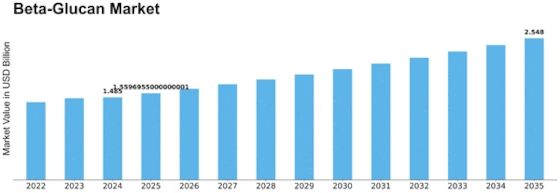
Beta Glucan Market Size Graph
Author
Snehal Singh
Assistant Manager - Research

High acumen in analyzing complex macro & micro markets with more than 6 years of work experience in the field of market research. By implementing her analytical skills in forecasting and estimation into market research reports, she has expertise in Packaging, Construction, and Equipment domains. She handles a team size of 20-25 resources and ensures smooth running of the projects, associated marketing activities, and client servicing.

Leave a Comment

FAQs

What is the projected market valuation of the Beta-Glucan Market by 2035?

<p>The Beta-Glucan Market is projected to reach a valuation of 2.548 USD Billion by 2035.</p>

What was the market valuation of the Beta-Glucan Market in 2024?

<p>In 2024, the Beta-Glucan Market was valued at 1.485 USD Billion.</p>

What is the expected CAGR for the Beta-Glucan Market during the forecast period 2025 - 2035?

<p>The expected CAGR for the Beta-Glucan Market during the forecast period 2025 - 2035 is 5.03%.</p>

Which companies are considered key players in the Beta-Glucan Market?

<p>Key players in the Beta-Glucan Market include Kerry Group, DSM Nutritional Products, Cargill, and others.</p>

What are the main sources of Beta-Glucan and their market valuations?

<p>The main sources of Beta-Glucan include Yeast, Mushrooms, Cereals, and Microalgae, with valuations ranging from 0.27 to 0.825 USD Billion.</p>

How does the application of Beta-Glucan in food and beverages compare to other applications?

<p>In 2024, the application of Beta-Glucan in Food & Beverages was valued at 0.593 USD Billion, significantly higher than other applications.</p>

What are the different types of Beta-Glucan and their market performance?

The types of Beta-Glucan include (1,3) Beta Glucan, (1,4) Beta Glucan, and (1,6) Beta Glucan, with valuations from 0.445 to 0.999 USD Billion.

What is the market valuation for Beta-Glucan in the animal feed sector?

The market valuation for Beta-Glucan in the animal feed sector was 0.297 USD Billion in 2024.

How does the personal care application of Beta-Glucan perform in the market?

The personal care application of Beta-Glucan was valued at 0.149 USD Billion in 2024, indicating a niche market.

What trends are influencing the growth of the Beta-Glucan Market?

Trends such as increasing health awareness and demand for natural ingredients are likely influencing the growth of the Beta-Glucan Market.

Market Summary

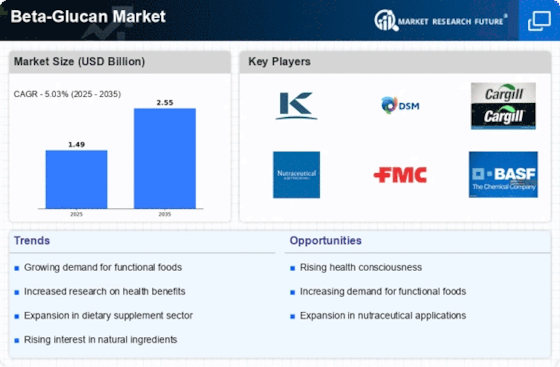
As per Market Research Future analysis, the Beta-Glucan Market Size was estimated at 1.485 USD Billion in 2024. The Beta-Glucan industry is projected to grow from USD 1.56 Billion in 2025 to USD 2.548 Billion by 2035, exhibiting a compound annual growth rate (CAGR) of 5.03% during the forecast period 2025 - 2035

Key Market Trends & Highlights

The Beta-Glucan Market is experiencing robust growth driven by health trends and technological advancements.

  • North America remains the largest market for beta-glucan, driven by increasing health consciousness among consumers.
  • The Asia-Pacific region is emerging as the fastest-growing market, fueled by rising demand for natural ingredients in various applications.
  • Yeast-derived beta-glucan continues to dominate the market, while microalgae-based products are gaining traction due to their health benefits.
  • Key market drivers include the increasing demand for functional foods and the rising incidence of chronic diseases, which are shaping consumer preferences.

Market Size & Forecast

2024 Market Size 1.485 (USD Billion)
2035 Market Size 2.548 (USD Billion)
CAGR (2025 - 2035) 5.03%
Largest Regional Market Share in 2024 North America

Major Players

Kerry Group (IE), DSM Nutritional Products (CH), Cargill, Incorporated (US), Nutraceutical Corporation (US), FMC Corporation (US), BASF SE (DE), Kemin Industries, Inc. (US), OatWell (SE), MGP Ingredients, Inc. (US)

Market Trends

The Beta-Glucan Market is currently experiencing a notable transformation, driven by increasing consumer awareness regarding health and wellness. This shift appears to be influencing demand for natural ingredients, particularly those associated with immune support and cardiovascular health. As a result, various industries, including food and beverages, pharmaceuticals, and cosmetics, are integrating beta-glucan into their products. This trend suggests a growing recognition of the potential health benefits associated with beta-glucan, which may lead to broader applications across diverse sectors. Moreover, the Beta-Glucan Market seems to be benefiting from advancements in extraction and processing technologies. These innovations could enhance the quality and bioavailability of beta-glucan, making it more appealing to manufacturers and consumers alike. Additionally, the rise of e-commerce platforms is likely facilitating greater accessibility to beta-glucan products, thereby expanding market reach. As the landscape evolves, stakeholders may need to adapt to changing consumer preferences and regulatory frameworks to capitalize on emerging opportunities.

Rising Health Consciousness

There is a growing trend of health awareness among consumers, leading to increased interest in natural ingredients like beta-glucan. This shift is prompting various sectors to incorporate beta-glucan into their offerings, particularly in health supplements and functional foods.

Technological Advancements in Extraction

Innovations in extraction and processing methods are enhancing the quality and efficacy of beta-glucan. These advancements may improve the ingredient's bioavailability, making it more attractive for manufacturers aiming to meet consumer demands.

Expansion of E-commerce Channels

The proliferation of e-commerce platforms is likely increasing the accessibility of beta-glucan products. This trend may facilitate broader market penetration, allowing consumers to easily find and purchase products containing this beneficial ingredient.

Beta Glucan Market Market Drivers

Regulatory Support for Health Claims

The Beta-Glucan Market benefits from increasing regulatory support for health claims associated with beta-glucan consumption. Regulatory bodies in various regions are recognizing the health benefits of beta-glucan, particularly its role in cholesterol management and heart health. This endorsement is likely to encourage food manufacturers to incorporate beta-glucan into their products, as it allows them to market these items with credible health claims. The potential for beta-glucan to be included in dietary guidelines further enhances its marketability. As consumers become more informed about health benefits, the regulatory backing could lead to a broader acceptance and utilization of beta-glucan in various food applications.

Rising Incidence of Chronic Diseases

The prevalence of chronic diseases such as diabetes, obesity, and cardiovascular conditions is escalating, which appears to be a significant driver for the Beta-Glucan Market. Research indicates that beta-glucan may play a role in managing blood sugar levels and reducing cholesterol, making it an appealing ingredient for health-conscious consumers. As healthcare systems worldwide grapple with the burden of chronic illnesses, there is a growing emphasis on dietary interventions. The market for beta-glucan is projected to expand as food manufacturers incorporate this ingredient into products aimed at disease prevention and management. This trend suggests a potential increase in product innovation and diversification within the beta-glucan sector.

Increasing Demand for Functional Foods

The Beta-Glucan Market is experiencing a notable surge in demand for functional foods, driven by a growing consumer awareness regarding health and wellness. As individuals increasingly seek dietary supplements that offer health benefits, products containing beta-glucan are gaining traction. This polysaccharide, primarily derived from oats and barley, is recognized for its potential to enhance immune function and lower cholesterol levels. Market data indicates that the functional food sector is projected to grow at a compound annual growth rate (CAGR) of approximately 8% over the next five years, suggesting a robust opportunity for beta-glucan products. The rising inclination towards preventive healthcare is likely to further bolster the market, as consumers prioritize nutrition that supports overall well-being.

Growing Interest in Natural Ingredients

The Beta-Glucan Market is witnessing a shift towards natural and organic ingredients, as consumers become more discerning about the products they consume. This trend is particularly evident in the food and beverage sector, where there is a marked preference for clean-label products. Beta-glucan, being a naturally occurring polysaccharide, aligns well with this consumer demand for transparency and healthfulness. Market analysis reveals that the clean-label food market is expected to grow significantly, with a projected CAGR of around 7% in the coming years. This inclination towards natural ingredients is likely to enhance the appeal of beta-glucan, as manufacturers seek to meet consumer expectations for wholesome and minimally processed foods.

Technological Innovations in Production

The Beta-Glucan Market is poised for growth due to technological advancements in the extraction and production processes of beta-glucan. Innovations in biotechnology and extraction methods are enhancing the efficiency and yield of beta-glucan, making it more accessible for manufacturers. These advancements not only improve the cost-effectiveness of production but also ensure higher purity and quality of the final product. Market data suggests that the introduction of novel extraction techniques could potentially reduce production costs by up to 20%, thereby encouraging more companies to enter the beta-glucan market. As production becomes more streamlined, the availability of beta-glucan in various forms is likely to increase, catering to diverse consumer preferences.

Market Segment Insights

By Source: Yeast (Largest) vs. Microalgae (Fastest-Growing)

In the Beta-Glucan Market, the source segment is predominantly represented by yeast, which captures the largest share due to its established applications in health supplements and pharmaceuticals. Following yeast, cereals and mushrooms contribute significant values, but lag behind yeast in overall market presence. Microalgae, while currently smaller in share, is emerging rapidly as a viable and sustainable source for beta-glucans, appealing to the increasing demand for natural and plant-based ingredients.

Yeast (Dominant) vs. Microalgae (Emerging)

Yeast is recognized as the dominant source of beta-glucans, favored for its high yield and efficacy in various applications such as dietary supplements and functional foods. Its longstanding presence in the market has made it a trusted choice for consumers and manufacturers alike. On the other hand, microalgae stands out as the emerging source, driven by innovations in cultivation techniques and a growing trend towards sustainability. The unique bioactive properties of microalgae are garnering interest from health-conscious consumers, positioning it as a promising alternative that could reshape the market dynamics in the coming years.

By Application: Food & Beverages (Largest) vs. Pharmaceuticals (Fastest-Growing)

The Beta-Glucan Market showcases a diverse range of applications, with Food & Beverages holding the largest share due to the growing consumer demand for health-beneficial ingredients. Products containing beta-glucans in this segment often emphasize immune support and heart health, which resonate well with today's health-conscious consumers. In contrast, Pharmaceuticals represents the fastest-growing segment, propelled by the increasing focus on curative health solutions harnessing the potential of beta-glucans for chronic disease management and therapeutic applications.

Food & Beverages: Dominant vs. Pharmaceuticals: Emerging

Food & Beverages is the dominant segment within the Beta-Glucan Market, as its applications in health foods, dietary supplements, and functional beverages continue to expand. The segment thrives on the rising trend of healthy eating and a preference for natural ingredients, positioning beta-glucans as key components for enhancing nutritional value. On the other hand, Pharmaceuticals is emerging rapidly, driven by healthcare advancements and the increasing recognition of beta-glucans as immunomodulators. This segment is attracting significant attention from researchers and developers hoping to capitalize on beta-glucans' potential to improve patient outcomes, therefore signaling an important shift in the market dynamics.

By Type: (1,3) Beta Glucan (Largest) vs. (1,6) Beta Glucan (Fastest-Growing)

<p>In the Beta-Glucan Market, the distribution of market share among various types reveals a clear dominance of (1,3) Beta Glucan. This segment captures a significant portion of the market, primarily due to its extensive application in dietary supplements and functional foods. Its established presence is crucial as it serves as a key ingredient recognized for its immune-boosting and cholesterol-lowering properties, resulting in a robust consumer base. In contrast, (1,6) Beta Glucan is emerging as a fast-growing segment, appealing to segments looking for innovative health solutions. As research continues to unveil the unique benefits associated with (1,6) Beta Glucan, it is gaining traction among manufacturers aiming to develop specialized health products.</p>

<p>(1,4) Beta Glucan (Dominant) vs. (1,6) Beta Glucan (Emerging)</p>

<p>(1,4) Beta Glucan plays a dominant role in the Beta-Glucan Market, primarily because of its critical applications in food products, such as bakery and dairy items, which are gaining popularity for their health benefits. This segment is characterized by its functionality as a soluble fiber, which supports digestive health and acts as a prebiotic. Meanwhile, the (1,6) Beta Glucan segment is recognized as emerging, marked by increasing research interest and potential applications in clinical settings. The distinct ways both types interact with the human body also position them uniquely in the market. (1,6) Beta Glucan's properties are being explored for immunomodulatory effects, appealing to health-conscious consumers and driving innovation in product formulations.</p>

Get more detailed insights about Beta-Glucan Market Research Report—Global Forecast till 2035

Regional Insights

By region, the study provides the market insights into North America, Europe, Asia-Pacific and Rest of the World. The North America Beta-Glucan Market dominated this market in 2022 (45.80%). American companies Merck and Lesaffre are among the major market participants in the North American beta-glucan industry. Beta-glucan is now widely used in the food and beverage industry as thickening agents, fat substitutes, dietary fiber, and hypocholesterolemic agents; these are believed to be the factors driving the rise in the area. Further, the U.S.

Beta-Glucan held the largest market share, and the Canada market of beta-glucan was the fastest growing market in the North America region.

Further, the major countries studied in the market report are The US, Canada, German, France, the UK, Italy, Spain, China, Japan, India, Australia, South Korea, and Brazil.

Figure 2: BETA-GLUCAN MARKET SHARE BY REGION 2022 (USD Billion)

Europe Beta-Glucan market accounted for the healthy market share in 2022. Because European consumers are calorie cautious, low-calorie and low-fat food products are well-liked in the continent. The frequency of obesity and cardiovascular disorders is rising, which has increased consumer demand for food products made from natural, low-calorie ingredients. Further, the German Beta-Glucan held the largest market share, and the U.K market of beta-glucan was the fastest growing market in the European region

The Asia Pacific Beta-Glucan market is expected to register significant growth from 2023 to 2032. The demand for products in this region is being supported by a large number of food processing, cosmetics, and personal care product manufacturing businesses in Asian nations like India, China, South Korea, and Japan. In terms of income, demography, and dietary needs, the area is very diverse. Consumers' increased purchasing power and the rising demand for food products with improved nutritional values are anticipated to have a favourable effect on industry growth.

Moreover, China’s Beta-Glucan held the largest market share, and the Indian beta-glucan industry was the fastest growing market in the Asia-Pacific region.

Key Players and Competitive Insights

animal nutrition

Key Companies in the Beta Glucan Market include

Industry Developments

    • In November 2022, Ceapro Inc. took a step further toward the development of PGX technology for pharmaceuticals and nutraceuticals. So far, Alginate and yeast beta-glucan have been developed as the first bio-actives under this technology. This will help in the further expansion of the company’s innovative product portfolio.
    • In July 2023, BENEO unveiled the company’s very first barley beta-glucan product, the Orafti β-Fit, designed specifically for promoting heart health and the control of blood sugar levels. It is anticipated that this new product will enable BENEO to expand its coverage throughout the world in terms of fiber as well as cardio-metabolic health.
    • In July 2023, Indian pharmaceutical company Dr. Reddy’s Laboratories entered into the infant nutrition space by launching CeleHealth Kidz Immuno Plus Gummies in India. The product seeks to provide a solution for the rising concern regarding diet and immunity for kids in India.
    • It’s interesting to note that Biohymn Biotechnology, which Lesaffre came into possession of in June 2020, is a yeast manufacturing company based in China; this now makes Lesaffre the controlling partner of the company.
    • In June 2020, a collaboration was formed between Tate & Lyle PLC and Solevo, which facilitated Lyle in being able to expand its business across the industrial and agricultural domains in Africa.
.webp

Future Outlook

Beta Glucan Market Future Outlook

The Beta-Glucan Market is projected to grow at a 5.03% CAGR from 2025 to 2035, driven by increasing health awareness, demand for functional foods, and advancements in biotechnology.

New opportunities lie in:

  • Development of personalized nutrition products incorporating beta-glucan
  • Expansion into emerging markets with tailored marketing strategies
  • Collaboration with food manufacturers for innovative beta-glucan formulations

By 2035, the Beta-Glucan Market is expected to achieve robust growth and increased market penetration.

Market Segmentation

Beta Glucan Market Type Outlook

  • (1,3) Beta Glucan
  • (1,4) Beta Glucan
  • (1,6) Beta Glucan

Beta Glucan Market Source Outlook

  • Yeast
  • Mushroom
  • Cereals
  • Microalgae

Beta Glucan Market Application Outlook

  • Food & Beverages
  • Animal Feed
  • Personal Care
  • Pharmaceuticals
  • Others

Report Scope

MARKET SIZE 2024 1.485(USD Billion)
MARKET SIZE 2025 1.56(USD Billion)
MARKET SIZE 2035 2.548(USD Billion)
COMPOUND ANNUAL GROWTH RATE (CAGR) 5.03% (2025 - 2035)
REPORT COVERAGE Revenue Forecast, Competitive Landscape, Growth Factors, and Trends
BASE YEAR 2024
Market Forecast Period 2025 - 2035
Historical Data 2019 - 2024
Market Forecast Units USD Billion
Key Companies Profiled Kerry Group (IE), DSM Nutritional Products (CH), Cargill, Incorporated (US), Nutraceutical Corporation (US), FMC Corporation (US), BASF SE (DE), Kemin Industries, Inc. (US), OatWell (SE), MGP Ingredients, Inc. (US)
Segments Covered Source, Application, Type, Region
Key Market Opportunities Rising consumer demand for natural health products enhances growth potential in the Beta-Glucan Market.
Key Market Dynamics Rising consumer demand for natural health products drives innovation and competition in the Beta-Glucan market.
Countries Covered North America, Europe, APAC, South America, MEA

FAQs

What is the projected market valuation of the Beta-Glucan Market by 2035?

<p>The Beta-Glucan Market is projected to reach a valuation of 2.548 USD Billion by 2035.</p>

What was the market valuation of the Beta-Glucan Market in 2024?

<p>In 2024, the Beta-Glucan Market was valued at 1.485 USD Billion.</p>

What is the expected CAGR for the Beta-Glucan Market during the forecast period 2025 - 2035?

<p>The expected CAGR for the Beta-Glucan Market during the forecast period 2025 - 2035 is 5.03%.</p>

Which companies are considered key players in the Beta-Glucan Market?

<p>Key players in the Beta-Glucan Market include Kerry Group, DSM Nutritional Products, Cargill, and others.</p>

What are the main sources of Beta-Glucan and their market valuations?

<p>The main sources of Beta-Glucan include Yeast, Mushrooms, Cereals, and Microalgae, with valuations ranging from 0.27 to 0.825 USD Billion.</p>

How does the application of Beta-Glucan in food and beverages compare to other applications?

<p>In 2024, the application of Beta-Glucan in Food & Beverages was valued at 0.593 USD Billion, significantly higher than other applications.</p>

What are the different types of Beta-Glucan and their market performance?

The types of Beta-Glucan include (1,3) Beta Glucan, (1,4) Beta Glucan, and (1,6) Beta Glucan, with valuations from 0.445 to 0.999 USD Billion.

What is the market valuation for Beta-Glucan in the animal feed sector?

The market valuation for Beta-Glucan in the animal feed sector was 0.297 USD Billion in 2024.

How does the personal care application of Beta-Glucan perform in the market?

The personal care application of Beta-Glucan was valued at 0.149 USD Billion in 2024, indicating a niche market.

What trends are influencing the growth of the Beta-Glucan Market?

Trends such as increasing health awareness and demand for natural ingredients are likely influencing the growth of the Beta-Glucan Market.

  1. SECTION I: EXECUTIVE SUMMARY AND KEY HIGHLIGHTS
    1. | 1.1 EXECUTIVE SUMMARY
    2. | | 1.1.1 Market Overview
    3. | | 1.1.2 Key Findings
    4. | | 1.1.3 Market Segmentation
    5. | | 1.1.4 Competitive Landscape
    6. | | 1.1.5 Challenges and Opportunities
    7. | | 1.1.6 Future Outlook
  2. SECTION II: SCOPING, METHODOLOGY AND MARKET STRUCTURE
    1. | 2.1 MARKET INTRODUCTION
    2. | | 2.1.1 Definition
    3. | | 2.1.2 Scope of the study
    4. | | | 2.1.2.1 Research Objective
    5. | | | 2.1.2.2 Assumption
    6. | | | 2.1.2.3 Limitations
    7. | 2.2 RESEARCH METHODOLOGY
    8. | | 2.2.1 Overview
    9. | | 2.2.2 Data Mining
    10. | | 2.2.3 Secondary Research
    11. | | 2.2.4 Primary Research
    12. | | | 2.2.4.1 Primary Interviews and Information Gathering Process
    13. | | | 2.2.4.2 Breakdown of Primary Respondents
    14. | | 2.2.5 Forecasting Model
    15. | | 2.2.6 Market Size Estimation
    16. | | | 2.2.6.1 Bottom-Up Approach
    17. | | | 2.2.6.2 Top-Down Approach
    18. | | 2.2.7 Data Triangulation
    19. | | 2.2.8 Validation
  3. SECTION III: QUALITATIVE ANALYSIS
    1. | 3.1 MARKET DYNAMICS
    2. | | 3.1.1 Overview
    3. | | 3.1.2 Drivers
    4. | | 3.1.3 Restraints
    5. | | 3.1.4 Opportunities
    6. | 3.2 MARKET FACTOR ANALYSIS
    7. | | 3.2.1 Value chain Analysis
    8. | | 3.2.2 Porter's Five Forces Analysis
    9. | | | 3.2.2.1 Bargaining Power of Suppliers
    10. | | | 3.2.2.2 Bargaining Power of Buyers
    11. | | | 3.2.2.3 Threat of New Entrants
    12. | | | 3.2.2.4 Threat of Substitutes
    13. | | | 3.2.2.5 Intensity of Rivalry
    14. | | 3.2.3 COVID-19 Impact Analysis
    15. | | | 3.2.3.1 Market Impact Analysis
    16. | | | 3.2.3.2 Regional Impact
    17. | | | 3.2.3.3 Opportunity and Threat Analysis
  4. SECTION IV: QUANTITATIVE ANALYSIS
    1. | 4.1 Food, Beverages & Nutrition, BY Source (USD Billion)
    2. | | 4.1.1 Yeast
    3. | | 4.1.2 Mushroom
    4. | | 4.1.3 Cereals
    5. | | 4.1.4 Microalgae
    6. | 4.2 Food, Beverages & Nutrition, BY Application (USD Billion)
    7. | | 4.2.1 Food & Beverages
    8. | | 4.2.2 Animal Feed
    9. | | 4.2.3 Personal Care
    10. | | 4.2.4 Pharmaceuticals
    11. | | 4.2.5 Others
    12. | 4.3 Food, Beverages & Nutrition, BY Type (USD Billion)
    13. | | 4.3.1 (1,3) Beta Glucan
    14. | | 4.3.2 (1,4) Beta Glucan
    15. | | 4.3.3 (1,6) Beta Glucan
    16. | 4.4 Food, Beverages & Nutrition, BY Region (USD Billion)
    17. | | 4.4.1 North America
    18. | | | 4.4.1.1 US
    19. | | | 4.4.1.2 Canada
    20. | | 4.4.2 Europe
    21. | | | 4.4.2.1 Germany
    22. | | | 4.4.2.2 UK
    23. | | | 4.4.2.3 France
    24. | | | 4.4.2.4 Russia
    25. | | | 4.4.2.5 Italy
    26. | | | 4.4.2.6 Spain
    27. | | | 4.4.2.7 Rest of Europe
    28. | | 4.4.3 APAC
    29. | | | 4.4.3.1 China
    30. | | | 4.4.3.2 India
    31. | | | 4.4.3.3 Japan
    32. | | | 4.4.3.4 South Korea
    33. | | | 4.4.3.5 Malaysia
    34. | | | 4.4.3.6 Thailand
    35. | | | 4.4.3.7 Indonesia
    36. | | | 4.4.3.8 Rest of APAC
    37. | | 4.4.4 South America
    38. | | | 4.4.4.1 Brazil
    39. | | | 4.4.4.2 Mexico
    40. | | | 4.4.4.3 Argentina
    41. | | | 4.4.4.4 Rest of South America
    42. | | 4.4.5 MEA
    43. | | | 4.4.5.1 GCC Countries
    44. | | | 4.4.5.2 South Africa
    45. | | | 4.4.5.3 Rest of MEA
  5. SECTION V: COMPETITIVE ANALYSIS
    1. | 5.1 Competitive Landscape
    2. | | 5.1.1 Overview
    3. | | 5.1.2 Competitive Analysis
    4. | | 5.1.3 Market share Analysis
    5. | | 5.1.4 Major Growth Strategy in the Food, Beverages & Nutrition
    6. | | 5.1.5 Competitive Benchmarking
    7. | | 5.1.6 Leading Players in Terms of Number of Developments in the Food, Beverages & Nutrition
    8. | | 5.1.7 Key developments and growth strategies
    9. | | | 5.1.7.1 New Product Launch/Service Deployment
    10. | | | 5.1.7.2 Merger & Acquisitions
    11. | | | 5.1.7.3 Joint Ventures
    12. | | 5.1.8 Major Players Financial Matrix
    13. | | | 5.1.8.1 Sales and Operating Income
    14. | | | 5.1.8.2 Major Players R&D Expenditure. 2023
    15. | 5.2 Company Profiles
    16. | | 5.2.1 Kerry Group (IE)
    17. | | | 5.2.1.1 Financial Overview
    18. | | | 5.2.1.2 Products Offered
    19. | | | 5.2.1.3 Key Developments
    20. | | | 5.2.1.4 SWOT Analysis
    21. | | | 5.2.1.5 Key Strategies
    22. | | 5.2.2 DSM Nutritional Products (CH)
    23. | | | 5.2.2.1 Financial Overview
    24. | | | 5.2.2.2 Products Offered
    25. | | | 5.2.2.3 Key Developments
    26. | | | 5.2.2.4 SWOT Analysis
    27. | | | 5.2.2.5 Key Strategies
    28. | | 5.2.3 Cargill, Incorporated (US)
    29. | | | 5.2.3.1 Financial Overview
    30. | | | 5.2.3.2 Products Offered
    31. | | | 5.2.3.3 Key Developments
    32. | | | 5.2.3.4 SWOT Analysis
    33. | | | 5.2.3.5 Key Strategies
    34. | | 5.2.4 Nutraceutical Corporation (US)
    35. | | | 5.2.4.1 Financial Overview
    36. | | | 5.2.4.2 Products Offered
    37. | | | 5.2.4.3 Key Developments
    38. | | | 5.2.4.4 SWOT Analysis
    39. | | | 5.2.4.5 Key Strategies
    40. | | 5.2.5 FMC Corporation (US)
    41. | | | 5.2.5.1 Financial Overview
    42. | | | 5.2.5.2 Products Offered
    43. | | | 5.2.5.3 Key Developments
    44. | | | 5.2.5.4 SWOT Analysis
    45. | | | 5.2.5.5 Key Strategies
    46. | | 5.2.6 BASF SE (DE)
    47. | | | 5.2.6.1 Financial Overview
    48. | | | 5.2.6.2 Products Offered
    49. | | | 5.2.6.3 Key Developments
    50. | | | 5.2.6.4 SWOT Analysis
    51. | | | 5.2.6.5 Key Strategies
    52. | | 5.2.7 Kemin Industries, Inc. (US)
    53. | | | 5.2.7.1 Financial Overview
    54. | | | 5.2.7.2 Products Offered
    55. | | | 5.2.7.3 Key Developments
    56. | | | 5.2.7.4 SWOT Analysis
    57. | | | 5.2.7.5 Key Strategies
    58. | | 5.2.8 OatWell (SE)
    59. | | | 5.2.8.1 Financial Overview
    60. | | | 5.2.8.2 Products Offered
    61. | | | 5.2.8.3 Key Developments
    62. | | | 5.2.8.4 SWOT Analysis
    63. | | | 5.2.8.5 Key Strategies
    64. | | 5.2.9 MGP Ingredients, Inc. (US)
    65. | | | 5.2.9.1 Financial Overview
    66. | | | 5.2.9.2 Products Offered
    67. | | | 5.2.9.3 Key Developments
    68. | | | 5.2.9.4 SWOT Analysis
    69. | | | 5.2.9.5 Key Strategies
    70. | 5.3 Appendix
    71. | | 5.3.1 References
    72. | | 5.3.2 Related Reports
  6. LIST OF FIGURES
    1. | 6.1 MARKET SYNOPSIS
    2. | 6.2 NORTH AMERICA MARKET ANALYSIS
    3. | 6.3 US MARKET ANALYSIS BY SOURCE
    4. | 6.4 US MARKET ANALYSIS BY APPLICATION
    5. | 6.5 US MARKET ANALYSIS BY TYPE
    6. | 6.6 CANADA MARKET ANALYSIS BY SOURCE
    7. | 6.7 CANADA MARKET ANALYSIS BY APPLICATION
    8. | 6.8 CANADA MARKET ANALYSIS BY TYPE
    9. | 6.9 EUROPE MARKET ANALYSIS
    10. | 6.10 GERMANY MARKET ANALYSIS BY SOURCE
    11. | 6.11 GERMANY MARKET ANALYSIS BY APPLICATION
    12. | 6.12 GERMANY MARKET ANALYSIS BY TYPE
    13. | 6.13 UK MARKET ANALYSIS BY SOURCE
    14. | 6.14 UK MARKET ANALYSIS BY APPLICATION
    15. | 6.15 UK MARKET ANALYSIS BY TYPE
    16. | 6.16 FRANCE MARKET ANALYSIS BY SOURCE
    17. | 6.17 FRANCE MARKET ANALYSIS BY APPLICATION
    18. | 6.18 FRANCE MARKET ANALYSIS BY TYPE
    19. | 6.19 RUSSIA MARKET ANALYSIS BY SOURCE
    20. | 6.20 RUSSIA MARKET ANALYSIS BY APPLICATION
    21. | 6.21 RUSSIA MARKET ANALYSIS BY TYPE
    22. | 6.22 ITALY MARKET ANALYSIS BY SOURCE
    23. | 6.23 ITALY MARKET ANALYSIS BY APPLICATION
    24. | 6.24 ITALY MARKET ANALYSIS BY TYPE
    25. | 6.25 SPAIN MARKET ANALYSIS BY SOURCE
    26. | 6.26 SPAIN MARKET ANALYSIS BY APPLICATION
    27. | 6.27 SPAIN MARKET ANALYSIS BY TYPE
    28. | 6.28 REST OF EUROPE MARKET ANALYSIS BY SOURCE
    29. | 6.29 REST OF EUROPE MARKET ANALYSIS BY APPLICATION
    30. | 6.30 REST OF EUROPE MARKET ANALYSIS BY TYPE
    31. | 6.31 APAC MARKET ANALYSIS
    32. | 6.32 CHINA MARKET ANALYSIS BY SOURCE
    33. | 6.33 CHINA MARKET ANALYSIS BY APPLICATION
    34. | 6.34 CHINA MARKET ANALYSIS BY TYPE
    35. | 6.35 INDIA MARKET ANALYSIS BY SOURCE
    36. | 6.36 INDIA MARKET ANALYSIS BY APPLICATION
    37. | 6.37 INDIA MARKET ANALYSIS BY TYPE
    38. | 6.38 JAPAN MARKET ANALYSIS BY SOURCE
    39. | 6.39 JAPAN MARKET ANALYSIS BY APPLICATION
    40. | 6.40 JAPAN MARKET ANALYSIS BY TYPE
    41. | 6.41 SOUTH KOREA MARKET ANALYSIS BY SOURCE
    42. | 6.42 SOUTH KOREA MARKET ANALYSIS BY APPLICATION
    43. | 6.43 SOUTH KOREA MARKET ANALYSIS BY TYPE
    44. | 6.44 MALAYSIA MARKET ANALYSIS BY SOURCE
    45. | 6.45 MALAYSIA MARKET ANALYSIS BY APPLICATION
    46. | 6.46 MALAYSIA MARKET ANALYSIS BY TYPE
    47. | 6.47 THAILAND MARKET ANALYSIS BY SOURCE
    48. | 6.48 THAILAND MARKET ANALYSIS BY APPLICATION
    49. | 6.49 THAILAND MARKET ANALYSIS BY TYPE
    50. | 6.50 INDONESIA MARKET ANALYSIS BY SOURCE
    51. | 6.51 INDONESIA MARKET ANALYSIS BY APPLICATION
    52. | 6.52 INDONESIA MARKET ANALYSIS BY TYPE
    53. | 6.53 REST OF APAC MARKET ANALYSIS BY SOURCE
    54. | 6.54 REST OF APAC MARKET ANALYSIS BY APPLICATION
    55. | 6.55 REST OF APAC MARKET ANALYSIS BY TYPE
    56. | 6.56 SOUTH AMERICA MARKET ANALYSIS
    57. | 6.57 BRAZIL MARKET ANALYSIS BY SOURCE
    58. | 6.58 BRAZIL MARKET ANALYSIS BY APPLICATION
    59. | 6.59 BRAZIL MARKET ANALYSIS BY TYPE
    60. | 6.60 MEXICO MARKET ANALYSIS BY SOURCE
    61. | 6.61 MEXICO MARKET ANALYSIS BY APPLICATION
    62. | 6.62 MEXICO MARKET ANALYSIS BY TYPE
    63. | 6.63 ARGENTINA MARKET ANALYSIS BY SOURCE
    64. | 6.64 ARGENTINA MARKET ANALYSIS BY APPLICATION
    65. | 6.65 ARGENTINA MARKET ANALYSIS BY TYPE
    66. | 6.66 REST OF SOUTH AMERICA MARKET ANALYSIS BY SOURCE
    67. | 6.67 REST OF SOUTH AMERICA MARKET ANALYSIS BY APPLICATION
    68. | 6.68 REST OF SOUTH AMERICA MARKET ANALYSIS BY TYPE
    69. | 6.69 MEA MARKET ANALYSIS
    70. | 6.70 GCC COUNTRIES MARKET ANALYSIS BY SOURCE
    71. | 6.71 GCC COUNTRIES MARKET ANALYSIS BY APPLICATION
    72. | 6.72 GCC COUNTRIES MARKET ANALYSIS BY TYPE
    73. | 6.73 SOUTH AFRICA MARKET ANALYSIS BY SOURCE
    74. | 6.74 SOUTH AFRICA MARKET ANALYSIS BY APPLICATION
    75. | 6.75 SOUTH AFRICA MARKET ANALYSIS BY TYPE
    76. | 6.76 REST OF MEA MARKET ANALYSIS BY SOURCE
    77. | 6.77 REST OF MEA MARKET ANALYSIS BY APPLICATION
    78. | 6.78 REST OF MEA MARKET ANALYSIS BY TYPE
    79. | 6.79 KEY BUYING CRITERIA OF FOOD, BEVERAGES & NUTRITION
    80. | 6.80 RESEARCH PROCESS OF MRFR
    81. | 6.81 DRO ANALYSIS OF FOOD, BEVERAGES & NUTRITION
    82. | 6.82 DRIVERS IMPACT ANALYSIS: FOOD, BEVERAGES & NUTRITION
    83. | 6.83 RESTRAINTS IMPACT ANALYSIS: FOOD, BEVERAGES & NUTRITION
    84. | 6.84 SUPPLY / VALUE CHAIN: FOOD, BEVERAGES & NUTRITION
    85. | 6.85 FOOD, BEVERAGES & NUTRITION, BY SOURCE, 2024 (% SHARE)
    86. | 6.86 FOOD, BEVERAGES & NUTRITION, BY SOURCE, 2024 TO 2035 (USD Billion)
    87. | 6.87 FOOD, BEVERAGES & NUTRITION, BY APPLICATION, 2024 (% SHARE)
    88. | 6.88 FOOD, BEVERAGES & NUTRITION, BY APPLICATION, 2024 TO 2035 (USD Billion)
    89. | 6.89 FOOD, BEVERAGES & NUTRITION, BY TYPE, 2024 (% SHARE)
    90. | 6.90 FOOD, BEVERAGES & NUTRITION, BY TYPE, 2024 TO 2035 (USD Billion)
    91. | 6.91 BENCHMARKING OF MAJOR COMPETITORS
  7. LIST OF TABLES
    1. | 7.1 LIST OF ASSUMPTIONS
    2. | | 7.1.1
    3. | 7.2 North America MARKET SIZE ESTIMATES; FORECAST
    4. | | 7.2.1 BY SOURCE, 2025-2035 (USD Billion)
    5. | | 7.2.2 BY APPLICATION, 2025-2035 (USD Billion)
    6. | | 7.2.3 BY TYPE, 2025-2035 (USD Billion)
    7. | 7.3 US MARKET SIZE ESTIMATES; FORECAST
    8. | | 7.3.1 BY SOURCE, 2025-2035 (USD Billion)
    9. | | 7.3.2 BY APPLICATION, 2025-2035 (USD Billion)
    10. | | 7.3.3 BY TYPE, 2025-2035 (USD Billion)
    11. | 7.4 Canada MARKET SIZE ESTIMATES; FORECAST
    12. | | 7.4.1 BY SOURCE, 2025-2035 (USD Billion)
    13. | | 7.4.2 BY APPLICATION, 2025-2035 (USD Billion)
    14. | | 7.4.3 BY TYPE, 2025-2035 (USD Billion)
    15. | 7.5 Europe MARKET SIZE ESTIMATES; FORECAST
    16. | | 7.5.1 BY SOURCE, 2025-2035 (USD Billion)
    17. | | 7.5.2 BY APPLICATION, 2025-2035 (USD Billion)
    18. | | 7.5.3 BY TYPE, 2025-2035 (USD Billion)
    19. | 7.6 Germany MARKET SIZE ESTIMATES; FORECAST
    20. | | 7.6.1 BY SOURCE, 2025-2035 (USD Billion)
    21. | | 7.6.2 BY APPLICATION, 2025-2035 (USD Billion)
    22. | | 7.6.3 BY TYPE, 2025-2035 (USD Billion)
    23. | 7.7 UK MARKET SIZE ESTIMATES; FORECAST
    24. | | 7.7.1 BY SOURCE, 2025-2035 (USD Billion)
    25. | | 7.7.2 BY APPLICATION, 2025-2035 (USD Billion)
    26. | | 7.7.3 BY TYPE, 2025-2035 (USD Billion)
    27. | 7.8 France MARKET SIZE ESTIMATES; FORECAST
    28. | | 7.8.1 BY SOURCE, 2025-2035 (USD Billion)
    29. | | 7.8.2 BY APPLICATION, 2025-2035 (USD Billion)
    30. | | 7.8.3 BY TYPE, 2025-2035 (USD Billion)
    31. | 7.9 Russia MARKET SIZE ESTIMATES; FORECAST
    32. | | 7.9.1 BY SOURCE, 2025-2035 (USD Billion)
    33. | | 7.9.2 BY APPLICATION, 2025-2035 (USD Billion)
    34. | | 7.9.3 BY TYPE, 2025-2035 (USD Billion)
    35. | 7.10 Italy MARKET SIZE ESTIMATES; FORECAST
    36. | | 7.10.1 BY SOURCE, 2025-2035 (USD Billion)
    37. | | 7.10.2 BY APPLICATION, 2025-2035 (USD Billion)
    38. | | 7.10.3 BY TYPE, 2025-2035 (USD Billion)
    39. | 7.11 Spain MARKET SIZE ESTIMATES; FORECAST
    40. | | 7.11.1 BY SOURCE, 2025-2035 (USD Billion)
    41. | | 7.11.2 BY APPLICATION, 2025-2035 (USD Billion)
    42. | | 7.11.3 BY TYPE, 2025-2035 (USD Billion)
    43. | 7.12 Rest of Europe MARKET SIZE ESTIMATES; FORECAST
    44. | | 7.12.1 BY SOURCE, 2025-2035 (USD Billion)
    45. | | 7.12.2 BY APPLICATION, 2025-2035 (USD Billion)
    46. | | 7.12.3 BY TYPE, 2025-2035 (USD Billion)
    47. | 7.13 APAC MARKET SIZE ESTIMATES; FORECAST
    48. | | 7.13.1 BY SOURCE, 2025-2035 (USD Billion)
    49. | | 7.13.2 BY APPLICATION, 2025-2035 (USD Billion)
    50. | | 7.13.3 BY TYPE, 2025-2035 (USD Billion)
    51. | 7.14 China MARKET SIZE ESTIMATES; FORECAST
    52. | | 7.14.1 BY SOURCE, 2025-2035 (USD Billion)
    53. | | 7.14.2 BY APPLICATION, 2025-2035 (USD Billion)
    54. | | 7.14.3 BY TYPE, 2025-2035 (USD Billion)
    55. | 7.15 India MARKET SIZE ESTIMATES; FORECAST
    56. | | 7.15.1 BY SOURCE, 2025-2035 (USD Billion)
    57. | | 7.15.2 BY APPLICATION, 2025-2035 (USD Billion)
    58. | | 7.15.3 BY TYPE, 2025-2035 (USD Billion)
    59. | 7.16 Japan MARKET SIZE ESTIMATES; FORECAST
    60. | | 7.16.1 BY SOURCE, 2025-2035 (USD Billion)
    61. | | 7.16.2 BY APPLICATION, 2025-2035 (USD Billion)
    62. | | 7.16.3 BY TYPE, 2025-2035 (USD Billion)
    63. | 7.17 South Korea MARKET SIZE ESTIMATES; FORECAST
    64. | | 7.17.1 BY SOURCE, 2025-2035 (USD Billion)
    65. | | 7.17.2 BY APPLICATION, 2025-2035 (USD Billion)
    66. | | 7.17.3 BY TYPE, 2025-2035 (USD Billion)
    67. | 7.18 Malaysia MARKET SIZE ESTIMATES; FORECAST
    68. | | 7.18.1 BY SOURCE, 2025-2035 (USD Billion)
    69. | | 7.18.2 BY APPLICATION, 2025-2035 (USD Billion)
    70. | | 7.18.3 BY TYPE, 2025-2035 (USD Billion)
    71. | 7.19 Thailand MARKET SIZE ESTIMATES; FORECAST
    72. | | 7.19.1 BY SOURCE, 2025-2035 (USD Billion)
    73. | | 7.19.2 BY APPLICATION, 2025-2035 (USD Billion)
    74. | | 7.19.3 BY TYPE, 2025-2035 (USD Billion)
    75. | 7.20 Indonesia MARKET SIZE ESTIMATES; FORECAST
    76. | | 7.20.1 BY SOURCE, 2025-2035 (USD Billion)
    77. | | 7.20.2 BY APPLICATION, 2025-2035 (USD Billion)
    78. | | 7.20.3 BY TYPE, 2025-2035 (USD Billion)
    79. | 7.21 Rest of APAC MARKET SIZE ESTIMATES; FORECAST
    80. | | 7.21.1 BY SOURCE, 2025-2035 (USD Billion)
    81. | | 7.21.2 BY APPLICATION, 2025-2035 (USD Billion)
    82. | | 7.21.3 BY TYPE, 2025-2035 (USD Billion)
    83. | 7.22 South America MARKET SIZE ESTIMATES; FORECAST
    84. | | 7.22.1 BY SOURCE, 2025-2035 (USD Billion)
    85. | | 7.22.2 BY APPLICATION, 2025-2035 (USD Billion)
    86. | | 7.22.3 BY TYPE, 2025-2035 (USD Billion)
    87. | 7.23 Brazil MARKET SIZE ESTIMATES; FORECAST
    88. | | 7.23.1 BY SOURCE, 2025-2035 (USD Billion)
    89. | | 7.23.2 BY APPLICATION, 2025-2035 (USD Billion)
    90. | | 7.23.3 BY TYPE, 2025-2035 (USD Billion)
    91. | 7.24 Mexico MARKET SIZE ESTIMATES; FORECAST
    92. | | 7.24.1 BY SOURCE, 2025-2035 (USD Billion)
    93. | | 7.24.2 BY APPLICATION, 2025-2035 (USD Billion)
    94. | | 7.24.3 BY TYPE, 2025-2035 (USD Billion)
    95. | 7.25 Argentina MARKET SIZE ESTIMATES; FORECAST
    96. | | 7.25.1 BY SOURCE, 2025-2035 (USD Billion)
    97. | | 7.25.2 BY APPLICATION, 2025-2035 (USD Billion)
    98. | | 7.25.3 BY TYPE, 2025-2035 (USD Billion)
    99. | 7.26 Rest of South America MARKET SIZE ESTIMATES; FORECAST
    100. | | 7.26.1 BY SOURCE, 2025-2035 (USD Billion)
    101. | | 7.26.2 BY APPLICATION, 2025-2035 (USD Billion)
    102. | | 7.26.3 BY TYPE, 2025-2035 (USD Billion)
    103. | 7.27 MEA MARKET SIZE ESTIMATES; FORECAST
    104. | | 7.27.1 BY SOURCE, 2025-2035 (USD Billion)
    105. | | 7.27.2 BY APPLICATION, 2025-2035 (USD Billion)
    106. | | 7.27.3 BY TYPE, 2025-2035 (USD Billion)
    107. | 7.28 GCC Countries MARKET SIZE ESTIMATES; FORECAST
    108. | | 7.28.1 BY SOURCE, 2025-2035 (USD Billion)
    109. | | 7.28.2 BY APPLICATION, 2025-2035 (USD Billion)
    110. | | 7.28.3 BY TYPE, 2025-2035 (USD Billion)
    111. | 7.29 South Africa MARKET SIZE ESTIMATES; FORECAST
    112. | | 7.29.1 BY SOURCE, 2025-2035 (USD Billion)
    113. | | 7.29.2 BY APPLICATION, 2025-2035 (USD Billion)
    114. | | 7.29.3 BY TYPE, 2025-2035 (USD Billion)
    115. | 7.30 Rest of MEA MARKET SIZE ESTIMATES; FORECAST
    116. | | 7.30.1 BY SOURCE, 2025-2035 (USD Billion)
    117. | | 7.30.2 BY APPLICATION, 2025-2035 (USD Billion)
    118. | | 7.30.3 BY TYPE, 2025-2035 (USD Billion)
    119. | 7.31 PRODUCT LAUNCH/PRODUCT DEVELOPMENT/APPROVAL
    120. | | 7.31.1
    121. | 7.32 ACQUISITION/PARTNERSHIP
    122. | | 7.32.1

Food, Beverages & Nutrition Market Segmentation

Food, Beverages & Nutrition By Source (USD Billion, 2025-2035)

  • Yeast
  • Mushroom
  • Cereals
  • Microalgae

Food, Beverages & Nutrition By Application (USD Billion, 2025-2035)

  • Food & Beverages
  • Animal Feed
  • Personal Care
  • Pharmaceuticals
  • Others

Food, Beverages & Nutrition By Type (USD Billion, 2025-2035)

  • (1,3) Beta Glucan
  • (1,4) Beta Glucan
  • (1,6) Beta Glucan
Infographic

Free Sample Request

Kindly complete the form below to receive a free sample of this Report

Get Free Sample

Customer Strories

Compare Licence

×
Features License Type
Single User Multiuser License Enterprise User
Price $4,950 $5,950 $7,250
Maximum User Access Limit 1 User Upto 10 Users Unrestricted Access Throughout the Organization
Free Customization
Direct Access to Analyst
Deliverable Format
Platform Access
Discount on Next Purchase 10% 15% 15%
Printable Versions