×
Request Free Sample ×

Kindly complete the form below to receive a free sample of this Report

* Please use a valid business email

Leading companies partner with us for data-driven Insights

clients tt-cursor
Hero Background
English
Chinese
French
Japanese
Korean
German
Spanish

Barium Nitrate Market Share

ID: MRFR/CnM/4198-HCR
140 Pages
Chitranshi Jaiswal
October 2025

Barium Nitrate Market Research Report Information By Purity (<98%, 98% to 99.0% and >99%), By Application (Glass/ Ceramics, Fireworks, Detonators, Tracer bullets, Vacuum tube production, Explosives, Primers, Pyrotechnics and Others), By End-Use Industry (Optical Industry, Defense and Military, Chemicals and Others), and Region (North America, Europe, Asia-Pacific, and Rest of the World)—Forecast till 2035

Share:
Download PDF ×

We do not share your information with anyone. However, we may send you emails based on your report interest from time to time. You may contact us at any time to opt-out.

Barium Nitrate Market Infographic
×
Barium Nitrate Market Infographic Full View
Purchase Options

Market Share

Barium Nitrate Market Share Analysis

In the Barium Nitrate market's dynamic landscape, firms adopt different strategies for positioning their market share so as to gain a competitive advantage and increase their presence within it. Differentiation is one of them whereby a company distinguishes its product from that of competitors through unique features, quality, or by means of technological advancements; another strategy involves cost leadership whereby a firm aims at becoming the low-cost producer within the Barium Nitrate market. Companies seeking to be competitive need to optimize production processes, efficiently source raw materials, and apply effective cost measures that will allow them to offer attractive prices in order to attract price-sensitive consumers, thereby potentially gaining larger market shares. Maintaining this strategy requires continuous focus on operational efficiency and economies of scale, thus ensuring a sustained cost advantage over other rivals. Also, market segmentation is a strategy that has been adopted in the Barium Nitrate market. Companies identify different segments of the market based on factors such as where they are located, what industry they are involved in, and what people want to buy from them. In the Barium Nitrate market, collaborative partnerships and alliances have become strategic tools. Companies usually join hands with suppliers, distributors, or even competitors to take advantage of their abilities and resources. Technological innovation serves as one of the determinants for gaining a competitive edge in terms of market share within the Barium Nitrate sector. For example, firms that invest in research and development to come up with new products or enhance existing processes can end up having the upper hand against their rivals. Moreover, global expansion is another tactic that companies employ to increase their market shares in the Barium Nitrate market. This way, businesses can go into new geographical places, thus getting access to untapped markets and broadening their customer base, among other things. Strategic marketing and branding also play a part in determining how much of a share a company should have in any given market (Barium Nitrate). This means that creating a brand image through effective communication, advertising, and promotional activities influences consumers' perceptions considerably. Lastly, due to the high competitiveness levels characterized by this sector, it necessitates the adoption of multiple strategies by various firms to determine how best they can position themselves in this kind of business. In other words, these include differentiation costs, leadership segmentation, strategic marketing partnerships, innovations, global expansions, and strategic branding, among many others, as firms attempt not only to survive but also thrive within such an environment (Barium Nitrate). However, depending on the changing nature of its market dynamics as well as customers' requirements and staying ahead of other competing firms, these strategies have proven effective so far.

Author
Chitranshi Jaiswal
Research Analyst Level I

In her 3 years of experience in the market research field, she has handled critical cross-domain projects. She has an in-depth knowledge of market estimation & analysis, problem-solving, primary as well as secondary research, and team management.She holds an engineering degree and is an MBA professional from a well-known university, capable of evaluating the market and competitive conditions. An exceptional strategist with excellent communication skills and a passion for delivering cutting-edge & practical insights for the market. Proficient in multi-tasking, and can successfully deal with competing demands, while maintaining complete confidentiality. Generated business through active client and project development, networking, and high-quality responses. Her knowledge and skills have helped in making solid business decisions, securing funding from investors, and avoiding business failures.

Leave a Comment

FAQs

What is the study period of this market?

The study period of the barium nitrate market is 2025 - 2035

What is the growth rate of the barium nitrate market?

The barium nitrate market is growing at a CAGR of 4.8% over the next 10 years.

Which region has the highest barium nitrate market growth rate?

Asia Pacific is expected to register the highest CAGR during 2025 - 2035

Which region has the largest share in the barium nitrate market?

North America held the largest share in 2021

Who are the key players in the barium nitrate market?

Solvay S.A., Sigma Aldrich Corporation, Barium Chemicals Co. Ltd, Merck KGaA, Sakai Chemical Industry Co. Ltd, Mil-Spec Industries Corp., Basstech International are the major companies operating in the barium nitrate market.

Market Summary

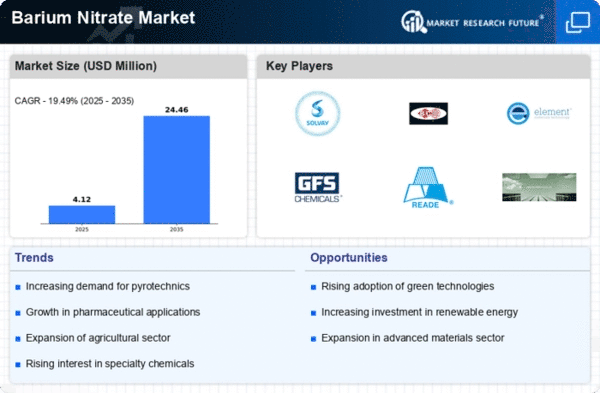
As per MRFR analysis, the Barium Nitrate Market Size was estimated at 3.45 USD Million in 2024. The Barium Nitrate industry is projected to grow from 4.12 in 2025 to 24.46 by 2035, exhibiting a compound annual growth rate (CAGR) of 19.49 during the forecast period 2025 - 2035.

Key Market Trends & Highlights

The Barium Nitrate Market is poised for growth driven by diverse applications and regional dynamics.

  • North America remains the largest market for Barium Nitrate, primarily due to its extensive use in pyrotechnics and aerospace applications.
  • Asia-Pacific is emerging as the fastest-growing region, fueled by increasing demand in electronics and healthcare sectors.
  • The pyrotechnics segment continues to dominate the market, while the electronics segment is witnessing rapid growth due to technological advancements.
  • Key market drivers include rising applications in agriculture and regulatory support for chemical safety, which are shaping industry dynamics.

Market Size & Forecast

2024 Market Size 3.45 (USD Million)
2035 Market Size 24.46 (USD Million)
CAGR (2025 - 2035) 19.49%
Largest Regional Market Share in 2024 North America

Major Players

Solvay (BE), Barium & Chemicals Inc. (US), American Elements (US), GFS Chemicals (US), Reade International Corp. (US), Hefei Zhonghong Chemical (CN), Shaanxi Jintai Chemical (CN), Hubei Greenhome Chemical (CN)

Market Trends

The Barium Nitrate Market is currently experiencing a phase of evolution, driven by various factors that influence its demand and supply dynamics. The compound, known for its applications in pyrotechnics, glass manufacturing, and as a chemical reagent, is witnessing a shift in usage patterns. This shift appears to be influenced by the growing emphasis on sustainable practices and the need for environmentally friendly alternatives in industrial processes. As industries increasingly prioritize eco-conscious solutions, the Barium Nitrate Market may adapt to meet these changing preferences, potentially leading to innovations in production methods and applications. Moreover, the market landscape is characterized by a competitive environment where manufacturers are striving to enhance product quality and expand their reach. The emergence of new players alongside established firms suggests a diversification of offerings, which could cater to a broader range of applications. This competitive dynamic may foster collaboration and partnerships, further driving advancements in the sector. As the Barium Nitrate Market continues to evolve, stakeholders must remain vigilant to emerging trends and shifts in consumer preferences, which could shape the future trajectory of this market.

Sustainability Initiatives

The Barium Nitrate Market is increasingly influenced by sustainability initiatives. Manufacturers are exploring eco-friendly production methods and alternative materials to reduce environmental impact. This trend reflects a broader industry shift towards greener practices, aligning with global sustainability goals.

Technological Advancements

Technological advancements are playing a crucial role in the Barium Nitrate Market. Innovations in production techniques and applications are enhancing efficiency and product quality. These advancements may lead to new uses for barium nitrate, expanding its market potential.

Regulatory Changes

Regulatory changes are impacting the Barium Nitrate Market, as governments implement stricter guidelines on chemical usage and safety. Compliance with these regulations is becoming essential for manufacturers, influencing production processes and market strategies.

Barium Nitrate Market Market Drivers

Growing Demand in Pyrotechnics

The Global Barium Nitrate Market Industry experiences a notable increase in demand due to its essential role in pyrotechnics. Barium nitrate is utilized as an oxidizer in fireworks and flares, contributing to vibrant colors and effects. As global celebrations and events continue to rise, the pyrotechnics sector is projected to expand significantly. This growth is anticipated to drive the market value, with estimates suggesting it could reach 2.65 USD Billion in 2024. The increasing popularity of fireworks displays, particularly in regions such as Asia-Pacific and North America, further supports this trend, indicating a robust future for the Global Barium Nitrate Market Industry.

Rising Applications in Electronics

The Global Barium Nitrate Market Industry benefits from the rising applications of barium nitrate in the electronics sector. Barium nitrate is utilized in the production of electronic components, particularly in the manufacture of capacitors and semiconductors. As the demand for electronic devices continues to surge, driven by advancements in technology and consumer electronics, the need for high-quality materials like barium nitrate is expected to increase. This trend is likely to contribute to the market's growth, with projections indicating a market value of 4.44 USD Billion by 2035, underscoring the importance of barium nitrate in the evolving electronics landscape.

Expansion in Chemical Manufacturing

The Global Barium Nitrate Market Industry is poised for growth due to the expansion of the chemical manufacturing sector. Barium nitrate serves as a precursor for various chemical compounds, including barium carbonate and barium sulfate, which are widely used in industries such as glass, ceramics, and pigments. As industrial activities ramp up globally, the demand for these compounds is likely to increase, thereby boosting the consumption of barium nitrate. The market is projected to grow at a CAGR of 4.8% from 2025 to 2035, reflecting the increasing reliance on barium nitrate in diverse applications within the chemical manufacturing landscape.

Market Dynamics and Competitive Landscape

The Global Barium Nitrate Market Industry is characterized by dynamic market conditions and a competitive landscape. Various players are actively engaged in enhancing their product offerings and expanding their market presence. This competitive environment encourages innovation and the development of high-purity barium nitrate products to meet specific industry requirements. Additionally, strategic partnerships and collaborations among manufacturers are becoming increasingly common, aiming to leverage synergies and enhance supply chain efficiencies. As the market evolves, these dynamics are expected to shape the future trajectory of the Global Barium Nitrate Market Industry, fostering growth and diversification.

Regulatory Support for Environmental Applications

The Global Barium Nitrate Market Industry is influenced by regulatory support for environmental applications. Barium nitrate is increasingly recognized for its potential in wastewater treatment and environmental remediation processes. Governments worldwide are implementing stricter regulations to manage industrial waste, which may drive the adoption of barium nitrate in treatment solutions. This regulatory environment creates opportunities for market growth, as industries seek compliant and effective solutions for environmental challenges. The ongoing emphasis on sustainability and environmental protection is likely to enhance the demand for barium nitrate, further solidifying its role in the Global Barium Nitrate Market Industry.

Market Segment Insights

By Application: Pyrotechnics (Largest) vs. Electronics (Fastest-Growing)

In the Barium Nitrate Market, the application segment is predominantly driven by Pyrotechnics, which holds the largest market share. This is due to its essential role in the production of fireworks and other pyrotechnic devices. Following Pyrotechnics, segments such as Glass Manufacturing, Chemical Synthesis, and Pharmaceuticals are significant. Each of these applications utilizes barium nitrate for its unique chemical properties, resulting in a diversified market landscape that caters to multiple industries. The Electronics application is emerging robustly, driven by the increasing demand for advanced electronic components. The rapid technological advancements and the shift towards miniaturization in electronic devices have significantly influenced this growth. Moreover, the global push for sustainable materials is steering research towards greener alternatives, which further propels the Electronics segment's expansion in the Barium Nitrate Market.

Pyrotechnics (Dominant) vs. Electronics (Emerging)

Pyrotechnics remains the dominant force in the Barium Nitrate Market, primarily due to its integral role in the production of various pyrotechnic products such as flares, fireworks, and ammunition. The vibrancy and vivid colors produced during combustion are primarily attributed to barium nitrate, making it a staple in the pyrotechnics industry. On the other hand, the Electronics segment is gradually emerging, driven by innovations in technology that require high-performance materials. Barium nitrate's unique properties, such as thermal stability and low toxicity, make it ideal for various electronic applications, including capacitors and semiconductors. As the demand for advanced electronic devices surges, the Electronics segment is poised for significant growth, carving out a substantial market share.

By End Use: Aerospace (Largest) vs. Healthcare (Fastest-Growing)

In the Barium Nitrate Market, Aerospace holds the largest share, driven by its extensive application in producing propellants and enhancing various materials. This segment benefits from a consistent demand tied to the aerospace industry's growth, making it a central focus for manufacturers. Following closely is the Healthcare segment, which, while smaller, is rapidly expanding due to the increasing use of barium nitrate in medical imaging and diagnostic procedures. This shift reflects broader trends towards advanced medical technologies and improved healthcare infrastructure. As global demand for aerospace products escalates due to rising air traffic and defense expenditures, the Barium Nitrate Market is set for growth. On the other hand, the Healthcare sector is emerging as the fastest-growing segment, attributed to innovations in imaging technologies and the increasing prevalence of diagnostic procedures. The growing emphasis on health and wellness is likely to sustain this upward trend, establishing Barium Nitrate as a crucial component in both established and emergent applications across these sectors.

Aerospace: Dominant vs. Healthcare: Emerging

The Aerospace segment is currently the dominant force in the Barium Nitrate Market, leveraging its critical role in the production of various aerospace materials and propellants. The aerospace industry’s reliance on high-performance chemicals like barium nitrate ensures strong market positioning, bolstered by technological advancements and increased investments in air travel and defense. Meanwhile, the Healthcare sector is proving to be an emerging player, bolstered by growing applications in medical imaging and diagnostics. This segment is witnessing a surge in demand as healthcare providers adopt advanced technologies for precise diagnostics, thus enhancing the overall market landscape. These divergent trends illustrate a robust interplay between established dominance and burgeoning opportunities in the Barium Nitrate Market.

By Form: Powder (Largest) vs. Granules (Fastest-Growing)

In the Barium Nitrate Market, the 'Powder' form holds the largest share, primarily due to its wide acceptance in various industrial applications such as explosives and glass manufacturing. Its versatility makes it a preferred choice among manufacturers. Following closely, 'Granules' emerge as the fastest-growing segment, gaining traction for applications requiring specific flow properties and easy handling without dust formation. As industries evolve, these segments continue to adapt to meet demand.

Powder (Dominant) vs. Granules (Emerging)

The 'Powder' form of Barium Nitrate is well-established in the market, characterized by its fine texture, which enhances dissolvability and application efficiency in various industries. Its dominance stems from its suitability for diverse manufacturing processes such as pyrotechnics and electronics. Meanwhile, 'Granules' are carving a niche as an emerging alternative, favored for their consistency in size, which facilitates precise applications in agricultural and chemical formulations. As industries seek improved handling and storage solutions, 'Granules' are quickly gaining popularity, reflecting a growing trend towards bulk handling and reduced airborne particulate matter.

By Purity Level: Industrial Grade (Largest) vs. High Purity (Fastest-Growing)

In the Barium Nitrate Market, the purity level segment reflects a clear hierarchy among Industrial Grade, Reagent Grade, and High Purity classifications. Industrial Grade is the largest segment, holding a significant share of the market as it caters to a broad range of industrial applications. Following this, the Reagent Grade and High Purity segments serve specialized needs in chemical analysis and advanced applications, contributing to a smaller yet vital portion of the market.

Reagent Grade (Dominant) vs. High Purity (Emerging)

The Reagent Grade Barium Nitrate is widely utilized in laboratories and industrial settings for its balance of purity and cost-effectiveness, making it a dominant force in the market. It is favored for applications in synthesis and chemical analysis where high quality is essential, but cost considerations are also critical. Conversely, the High Purity segment is emerging rapidly, driven by advancements in technological applications requiring superior quality Barium Nitrate. This segment is gaining traction in electronics and pharmaceuticals, where even minor impurities can significantly affect product performance and safety.

Get more detailed insights about Barium Nitrate Market Research Report - Forecast to 2035

Regional Insights

North America : Market Leader in Barium Nitrate

North America is poised to maintain its leadership in the Barium Nitrate market, holding a significant share of 1.5 million kg in 2025. The region's growth is driven by increasing demand in various applications, including pyrotechnics and pharmaceuticals. Regulatory support for chemical manufacturing and environmental compliance is also a catalyst for market expansion. The focus on sustainable practices is further enhancing the market landscape. The United States is the primary contributor to this market, with key players such as Solvay, Barium & Chemicals Inc., and American Elements leading the charge. The competitive landscape is characterized by innovation and strategic partnerships, ensuring a robust supply chain. The presence of established manufacturers and a growing emphasis on research and development are expected to bolster market growth in the coming years.

Europe : Emerging Market with Potential

Europe's Barium Nitrate market is projected to grow, with a market size of 1.0 million kg by 2025. The region benefits from stringent regulations that promote the use of high-quality chemicals, driving demand in sectors like agriculture and electronics. The push for sustainable practices and eco-friendly products is also a significant growth driver, aligning with EU regulations aimed at reducing environmental impact. Leading countries in this region include Germany, France, and the UK, where companies are increasingly investing in R&D to innovate and meet regulatory standards. Key players like Solvay and Hefei Zhonghong Chemical are expanding their operations to capture market share. The competitive landscape is evolving, with a focus on collaboration and technological advancements to enhance product offerings.

Asia-Pacific : Rapid Growth and Demand

The Asia-Pacific region is witnessing rapid growth in the Barium Nitrate market, with a projected size of 0.8 million kg by 2025. This growth is fueled by increasing industrialization and urbanization, particularly in countries like China and India. The demand for Barium Nitrate in various applications, including glass manufacturing and fireworks, is on the rise, supported by favorable government policies promoting industrial growth. China stands out as a leading country in this market, with major players like Shaanxi Jintai Chemical and Hubei Greenhome Chemical driving production. The competitive landscape is marked by a mix of local and international companies, all vying for market share. As the region continues to develop, investments in technology and infrastructure are expected to further enhance market dynamics.

Middle East and Africa : Emerging Market with Challenges

The Middle East and Africa (MEA) region represents an emerging market for Barium Nitrate, with a size of 0.15 million kg anticipated by 2025. The growth in this region is primarily driven by increasing demand in the construction and agriculture sectors. However, challenges such as regulatory hurdles and limited infrastructure can impede market expansion. Efforts to improve regulatory frameworks are essential for fostering growth in this sector. Countries like South Africa and the UAE are leading the way in market development, with local companies beginning to establish a foothold. The competitive landscape is still developing, with opportunities for both local and international players to enter the market. As the region focuses on diversifying its economy, the Barium Nitrate market is expected to gain traction in the coming years.

Key Players and Competitive Insights

The Barium Nitrate Market is currently characterized by a competitive landscape that is both dynamic and multifaceted. Key growth drivers include the increasing demand for barium nitrate in various applications such as pyrotechnics, glass manufacturing, and as a chemical reagent. Major players like Solvay (BE), Barium & Chemicals Inc. (US), and Hefei Zhonghong Chemical (CN) are strategically positioned to leverage their operational strengths. Solvay (BE) focuses on innovation and sustainability, aiming to enhance its product offerings while minimizing environmental impact. In contrast, Barium & Chemicals Inc. (US) emphasizes regional expansion and customer-centric solutions, which allows it to cater effectively to local markets. Hefei Zhonghong Chemical (CN) appears to be concentrating on optimizing its supply chain to improve efficiency and reduce costs, thereby enhancing its competitive edge. Collectively, these strategies shape a competitive environment that is increasingly focused on sustainability and operational efficiency.In terms of business tactics, companies are localizing manufacturing to better serve regional markets and optimize their supply chains to mitigate risks associated with global logistics. The market structure is moderately fragmented, with several players vying for market share. However, the collective influence of key players is significant, as they drive innovation and set industry standards. This competitive structure suggests that while there is room for smaller entrants, the established companies are likely to maintain a stronghold through strategic initiatives.

In November Solvay (BE) announced a partnership with a leading technology firm to develop advanced barium nitrate formulations aimed at enhancing performance in pyrotechnic applications. This strategic move is likely to bolster Solvay's market position by expanding its product portfolio and addressing the growing demand for high-performance materials in the fireworks industry. The collaboration underscores the importance of innovation in maintaining competitive advantage.

In October Barium & Chemicals Inc. (US) launched a new line of eco-friendly barium nitrate products designed to meet stringent environmental regulations. This initiative not only aligns with global sustainability trends but also positions the company as a leader in environmentally responsible manufacturing. By prioritizing eco-friendly solutions, Barium & Chemicals Inc. (US) is likely to attract a broader customer base concerned with sustainability.

In September Hefei Zhonghong Chemical (CN) completed a significant upgrade to its production facilities, enhancing its capacity to produce high-purity barium nitrate. This upgrade is expected to improve operational efficiency and reduce production costs, thereby allowing the company to offer competitive pricing. Such investments in technology and capacity are crucial for maintaining relevance in a rapidly evolving market.

As of December current competitive trends indicate a strong shift towards digitalization, sustainability, and the integration of AI technologies in production processes. Strategic alliances are increasingly shaping the landscape, enabling companies to pool resources and expertise to drive innovation. The competitive differentiation is likely to evolve from traditional price-based competition to a focus on technological advancements, product innovation, and supply chain reliability. This shift suggests that companies that can effectively leverage these trends will be better positioned to thrive in the Barium Nitrate Market.

Key Companies in the Barium Nitrate Market include

Industry Developments

Future Outlook

Barium Nitrate Market Future Outlook

The Barium Nitrate Market is projected to grow at a 19.49% CAGR from 2025 to 2035, driven by increasing demand in pyrotechnics, pharmaceuticals, and electronics.

New opportunities lie in:

  • Expansion into emerging markets with tailored product offerings.
  • Development of eco-friendly barium nitrate alternatives.
  • Strategic partnerships with key players in the electronics sector.

By 2035, the Barium Nitrate Market is expected to achieve substantial growth, solidifying its position in various industries.

Market Segmentation

Barium Nitrate Market Form Outlook

  • Powder
  • Granules
  • Crystals
  • Solution

Barium Nitrate Market End Use Outlook

  • Aerospace
  • Automotive
  • Construction
  • Healthcare
  • Agriculture

Barium Nitrate Market Application Outlook

  • Pyrotechnics
  • Glass Manufacturing
  • Chemical Synthesis
  • Electronics
  • Pharmaceuticals

Barium Nitrate Market Purity Level Outlook

  • Industrial Grade
  • Reagent Grade
  • High Purity

Report Scope

MARKET SIZE 20243.45(USD Million)
MARKET SIZE 20254.12(USD Million)
MARKET SIZE 203524.46(USD Million)
COMPOUND ANNUAL GROWTH RATE (CAGR)19.49% (2025 - 2035)
REPORT COVERAGERevenue Forecast, Competitive Landscape, Growth Factors, and Trends
BASE YEAR2024
Market Forecast Period2025 - 2035
Historical Data2019 - 2024
Market Forecast UnitsUSD Million
Key Companies ProfiledSolvay (BE), Barium & Chemicals Inc. (US), American Elements (US), GFS Chemicals (US), Reade International Corp. (US), Hefei Zhonghong Chemical (CN), Shaanxi Jintai Chemical (CN), Hubei Greenhome Chemical (CN)
Segments CoveredApplication, End Use, Form, Purity Level
Key Market OpportunitiesGrowing demand for Barium Nitrate in pyrotechnics and specialty glass applications presents market opportunities.
Key Market DynamicsRising demand for barium nitrate in pyrotechnics and electronics drives market growth amid regulatory scrutiny.
Countries CoveredNorth America, Europe, APAC, South America, MEA

FAQs

What is the study period of this market?

The study period of the barium nitrate market is 2025 - 2035

What is the growth rate of the barium nitrate market?

The barium nitrate market is growing at a CAGR of 4.8% over the next 10 years.

Which region has the highest barium nitrate market growth rate?

Asia Pacific is expected to register the highest CAGR during 2025 - 2035

Which region has the largest share in the barium nitrate market?

North America held the largest share in 2021

Who are the key players in the barium nitrate market?

Solvay S.A., Sigma Aldrich Corporation, Barium Chemicals Co. Ltd, Merck KGaA, Sakai Chemical Industry Co. Ltd, Mil-Spec Industries Corp., Basstech International are the major companies operating in the barium nitrate market.

  1. SECTION I: EXECUTIVE SUMMARY AND KEY HIGHLIGHTS
    1. | 1.1 EXECUTIVE SUMMARY
    2. | 1.1.1 Market Overview
    3. | 1.1.2 Key Findings
    4. | 1.1.3 Market Segmentation
    5. | 1.1.4 Competitive Landscape
    6. | 1.1.5 Challenges and Opportunities
    7. | 1.1.6 Future Outlook
  2. SECTION II: SCOPING, METHODOLOGY AND MARKET STRUCTURE
    1. | 2.1 MARKET INTRODUCTION
    2. | 2.1.1 Definition
    3. | 2.1.2 Scope of the study
    4. |-- 2.1.2.1 Research Objective
    5. |-- 2.1.2.2 Assumption
    6. |-- 2.1.2.3 Limitations
    7. | 2.2 RESEARCH METHODOLOGY
    8. | 2.2.1 Overview
    9. | 2.2.2 Data Mining
    10. | 2.2.3 Secondary Research
    11. | 2.2.4 Primary Research
    12. |-- 2.2.4.1 Primary Interviews and Information Gathering Process
    13. |-- 2.2.4.2 Breakdown of Primary Respondents
    14. | 2.2.5 Forecasting Model
    15. | 2.2.6 Market Size Estimation
    16. |-- 2.2.6.1 Bottom-Up Approach
    17. |-- 2.2.6.2 Top-Down Approach
    18. | 2.2.7 Data Triangulation
    19. | 2.2.8 Validation
  3. SECTION III: QUALITATIVE ANALYSIS
    1. | 3.1 MARKET DYNAMICS
    2. | 3.1.1 Overview
    3. | 3.1.2 Drivers
    4. | 3.1.3 Restraints
    5. | 3.1.4 Opportunities
    6. | 3.2 MARKET FACTOR ANALYSIS
    7. | 3.2.1 Value chain Analysis
    8. | 3.2.2 Porter's Five Forces Analysis
    9. |-- 3.2.2.1 Bargaining Power of Suppliers
    10. |-- 3.2.2.2 Bargaining Power of Buyers
    11. |-- 3.2.2.3 Threat of New Entrants
    12. |-- 3.2.2.4 Threat of Substitutes
    13. |-- 3.2.2.5 Intensity of Rivalry
    14. | 3.2.3 COVID-19 Impact Analysis
    15. |-- 3.2.3.1 Market Impact Analysis
    16. |-- 3.2.3.2 Regional Impact
    17. |-- 3.2.3.3 Opportunity and Threat Analysis
  4. SECTION IV: QUANTITATIVE ANALYSIS
    1. | 4.1 Chemicals and Materials, BY Application (USD Million)
    2. | 4.1.1 Pyrotechnics
    3. | 4.1.2 Glass Manufacturing
    4. | 4.1.3 Chemical Synthesis
    5. | 4.1.4 Electronics
    6. | 4.1.5 Pharmaceuticals
    7. | 4.2 Chemicals and Materials, BY End Use (USD Million)
    8. | 4.2.1 Aerospace
    9. | 4.2.2 Automotive
    10. | 4.2.3 Construction
    11. | 4.2.4 Healthcare
    12. | 4.2.5 Agriculture
    13. | 4.3 Chemicals and Materials, BY Form (USD Million)
    14. | 4.3.1 Powder
    15. | 4.3.2 Granules
    16. | 4.3.3 Crystals
    17. | 4.3.4 Solution
    18. | 4.4 Chemicals and Materials, BY Purity Level (USD Million)
    19. | 4.4.1 Industrial Grade
    20. | 4.4.2 Reagent Grade
    21. | 4.4.3 High Purity
    22. | 4.5 Chemicals and Materials, BY Region (USD Million)
    23. | 4.5.1 North America
    24. |-- 4.5.1.1 US
    25. |-- 4.5.1.2 Canada
    26. | 4.5.2 Europe
    27. |-- 4.5.2.1 Germany
    28. |-- 4.5.2.2 UK
    29. |-- 4.5.2.3 France
    30. |-- 4.5.2.4 Russia
    31. |-- 4.5.2.5 Italy
    32. |-- 4.5.2.6 Spain
    33. |-- 4.5.2.7 Rest of Europe
    34. | 4.5.3 APAC
    35. |-- 4.5.3.1 China
    36. |-- 4.5.3.2 India
    37. |-- 4.5.3.3 Japan
    38. |-- 4.5.3.4 South Korea
    39. |-- 4.5.3.5 Malaysia
    40. |-- 4.5.3.6 Thailand
    41. |-- 4.5.3.7 Indonesia
    42. |-- 4.5.3.8 Rest of APAC
    43. | 4.5.4 South America
    44. |-- 4.5.4.1 Brazil
    45. |-- 4.5.4.2 Mexico
    46. |-- 4.5.4.3 Argentina
    47. |-- 4.5.4.4 Rest of South America
    48. | 4.5.5 MEA
    49. |-- 4.5.5.1 GCC Countries
    50. |-- 4.5.5.2 South Africa
    51. |-- 4.5.5.3 Rest of MEA
  5. SECTION V: COMPETITIVE ANALYSIS
    1. | 5.1 Competitive Landscape
    2. | 5.1.1 Overview
    3. | 5.1.2 Competitive Analysis
    4. | 5.1.3 Market share Analysis
    5. | 5.1.4 Major Growth Strategy in the Chemicals and Materials
    6. | 5.1.5 Competitive Benchmarking
    7. | 5.1.6 Leading Players in Terms of Number of Developments in the Chemicals and Materials
    8. | 5.1.7 Key developments and growth strategies
    9. |-- 5.1.7.1 New Product Launch/Service Deployment
    10. |-- 5.1.7.2 Merger & Acquisitions
    11. |-- 5.1.7.3 Joint Ventures
    12. | 5.1.8 Major Players Financial Matrix
    13. |-- 5.1.8.1 Sales and Operating Income
    14. |-- 5.1.8.2 Major Players R&D Expenditure. 2023
    15. | 5.2 Company Profiles
    16. | 5.2.1 Solvay (BE)
    17. |-- 5.2.1.1 Financial Overview
    18. |-- 5.2.1.2 Products Offered
    19. |-- 5.2.1.3 Key Developments
    20. |-- 5.2.1.4 SWOT Analysis
    21. |-- 5.2.1.5 Key Strategies
    22. | 5.2.2 Barium & Chemicals Inc. (US)
    23. |-- 5.2.2.1 Financial Overview
    24. |-- 5.2.2.2 Products Offered
    25. |-- 5.2.2.3 Key Developments
    26. |-- 5.2.2.4 SWOT Analysis
    27. |-- 5.2.2.5 Key Strategies
    28. | 5.2.3 American Elements (US)
    29. |-- 5.2.3.1 Financial Overview
    30. |-- 5.2.3.2 Products Offered
    31. |-- 5.2.3.3 Key Developments
    32. |-- 5.2.3.4 SWOT Analysis
    33. |-- 5.2.3.5 Key Strategies
    34. | 5.2.4 GFS Chemicals (US)
    35. |-- 5.2.4.1 Financial Overview
    36. |-- 5.2.4.2 Products Offered
    37. |-- 5.2.4.3 Key Developments
    38. |-- 5.2.4.4 SWOT Analysis
    39. |-- 5.2.4.5 Key Strategies
    40. | 5.2.5 Reade International Corp. (US)
    41. |-- 5.2.5.1 Financial Overview
    42. |-- 5.2.5.2 Products Offered
    43. |-- 5.2.5.3 Key Developments
    44. |-- 5.2.5.4 SWOT Analysis
    45. |-- 5.2.5.5 Key Strategies
    46. | 5.2.6 Hefei Zhonghong Chemical (CN)
    47. |-- 5.2.6.1 Financial Overview
    48. |-- 5.2.6.2 Products Offered
    49. |-- 5.2.6.3 Key Developments
    50. |-- 5.2.6.4 SWOT Analysis
    51. |-- 5.2.6.5 Key Strategies
    52. | 5.2.7 Shaanxi Jintai Chemical (CN)
    53. |-- 5.2.7.1 Financial Overview
    54. |-- 5.2.7.2 Products Offered
    55. |-- 5.2.7.3 Key Developments
    56. |-- 5.2.7.4 SWOT Analysis
    57. |-- 5.2.7.5 Key Strategies
    58. | 5.2.8 Hubei Greenhome Chemical (CN)
    59. |-- 5.2.8.1 Financial Overview
    60. |-- 5.2.8.2 Products Offered
    61. |-- 5.2.8.3 Key Developments
    62. |-- 5.2.8.4 SWOT Analysis
    63. |-- 5.2.8.5 Key Strategies
    64. | 5.3 Appendix
    65. | 5.3.1 References
    66. | 5.3.2 Related Reports

Chemicals and Materials Market Segmentation

Chemicals and Materials By Application (USD Million, 2025-2035)

  • Pyrotechnics
  • Glass Manufacturing
  • Chemical Synthesis
  • Electronics
  • Pharmaceuticals

Chemicals and Materials By End Use (USD Million, 2025-2035)

  • Aerospace
  • Automotive
  • Construction
  • Healthcare
  • Agriculture

Chemicals and Materials By Form (USD Million, 2025-2035)

  • Powder
  • Granules
  • Crystals
  • Solution

Chemicals and Materials By Purity Level (USD Million, 2025-2035)

  • Industrial Grade
  • Reagent Grade
  • High Purity
Infographic

Free Sample Request

Kindly complete the form below to receive a free sample of this Report

Get Free Sample

Customer Strories

Compare Licence

×
Features License Type
Single User Multiuser License Enterprise User
Price $4,950 $5,950 $7,250
Maximum User Access Limit 1 User Upto 10 Users Unrestricted Access Throughout the Organization
Free Customization
Direct Access to Analyst
Deliverable Format
Platform Access
Discount on Next Purchase 10% 15% 15%
Printable Versions