Request Free Sample ×

Kindly complete the form below to receive a free sample of this Report

* Please use a valid business email

Leading companies partner with us for data-driven Insights

clients tt-cursor
Hero Background
English
Chinese
French
Japanese
Korean
German
Spanish

Bariatric Surgery Devices Market Size

ID: MRFR/MED/4649-CR
123 Pages
Rahul Gotadki
May 2020

Bariatric Surgery Devices Market Research Report: Size, Share, Trend Analysis By Types (Minimally Invasive Surgical Devices, Non-invasive Surgical Devices) By Procedure (Sleeve Gastrectomy, Gastric Bypass, Revision Surgery, Adjustable Gastric Band), By End Users (Hospitals, Specialty Centers, Ambulatory Surgical Centers), and By Region (North America, Europe, Asia-Pacific, And Rest Of The World) - Growth Outlook & Industry Forecast 2025 To 2035

Share:
Download PDF ×

We do not share your information with anyone. However, we may send you emails based on your report interest from time to time. You may contact us at any time to opt-out.

Bariatric Surgery Devices Market Infographic
Purchase Options

Bariatric Surgery Devices Size

Bariatric Surgery Devices Market Growth Projections and Opportunities

The growing emphasis on personalized nutrition strongly influences nutrigenomics marketing. As individuals seek customized nutritional plans based totally on their genetic makeup, the call for nutrigenomic trying out and answers rises. Government initiatives selling health and preventive healthcare measures impact the nutrigenomics marketplace. Policies helping studies, schooling, and the integration of nutrigenomics into public health programs contribute to the marketplace boom. Collaborations among geneticists and nutritionists are pivotal in advancing nutrigenomics. Joint efforts to interpret genetic information and translate it into actionable nutritional tips beautify the effectiveness of nutrigenomic interventions. The growing prevalence of lifestyle-related illnesses, along with obesity, diabetes, and cardiovascular situations, contributes to the nutrigenomics marketplace. Personalized nutritional interventions based totally on genetic elements are increasingly more diagnosed as valuable in stopping and managing these illnesses. Consumers are increasingly more stressed about transparency in nutritional information. Nutrigenomics meets this demand by supplying personalized insights into how individuals metabolize vitamins, empowering them to make informed picks about their eating regimen and lifestyle. Education and focus tasks approximately the benefits of nutrigenomics pressure marketplace adoption. Healthcare experts, nutritionists, and genetic counselors play an essential function in disseminating facts and promoting the combination of nutrigenomics into dietary practices. Ethical concerns and privacy issues related to genetic testing affect the nutrigenomics market. Striking a balance between imparting treasured insights and making sure the confidentiality of genetic statistics is essential for maintaining public acceptance as true with a market boom. The impact of social media and health influencers on lifestyle picks extends to the nutrigenomics market. Celebrities and influencers advocating customized vitamins based totally on genetic records contribute to the marketplace's visibility and adoption. The integration of nutrigenomics with wearable generation enhances the marketplace's attraction. Wearable gadgets that display health parameters can supplement nutrigenomic insights, growing a holistic approach to customized health.
Bariatric Surgery Devices Market Size Graph
Author
Author Profile
Rahul Gotadki
Research Manager

He holds an experience of about 9+ years in Market Research and Business Consulting, working under the spectrum of Life Sciences and Healthcare domains. Rahul conceptualizes and implements a scalable business strategy and provides strategic leadership to the clients. His expertise lies in market estimation, competitive intelligence, pipeline analysis, customer assessment, etc.

Leave a Comment

FAQs

What is the projected market valuation for the Bariatric Surgery Devices Market in 2035?

<p>The projected market valuation for the Bariatric Surgery Devices Market in 2035 is 4752.63 USD Million.</p>

What was the overall market valuation for the Bariatric Surgery Devices Market in 2024?

<p>The overall market valuation for the Bariatric Surgery Devices Market in 2024 was 2472.6 USD Million.</p>

What is the expected CAGR for the Bariatric Surgery Devices Market during the forecast period 2025 - 2035?

<p>The expected CAGR for the Bariatric Surgery Devices Market during the forecast period 2025 - 2035 is 6.12%.</p>

Which companies are considered key players in the Bariatric Surgery Devices Market?

<p>Key players in the Bariatric Surgery Devices Market include Medtronic, Johnson & Johnson, Boston Scientific, and Stryker.</p>

What are the main applications of bariatric surgery devices and their market valuations?

<p>The main applications include Sleeve Gastrectomy valued at 1600.0 USD Million and Gastric Bypass valued at 1200.0 USD Million.</p>

How do the market valuations for different types of bariatric surgery devices compare?

<p>Surgical Instruments are valued at 1000.0 USD Million, while Implantable Devices reach 1200.0 USD Million.</p>

What is the market valuation for bariatric surgery devices used in hospitals?

The market valuation for bariatric surgery devices used in hospitals is 1980.52 USD Million.

Which patient demographics are driving the Bariatric Surgery Devices Market?

Obese adults represent a significant segment, with a market valuation of 2380.0 USD Million.

What surgical techniques are utilized in the Bariatric Surgery Devices Market and their valuations?

Laparoscopic Surgery is valued at 2400.0 USD Million, indicating its prominence in the market.

What is the market valuation for ambulatory surgical centers in the Bariatric Surgery Devices Market?

The market valuation for ambulatory surgical centers is 990.26 USD Million.

Market Summary

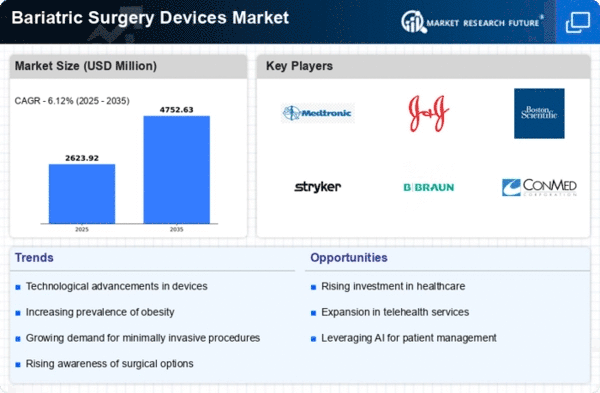
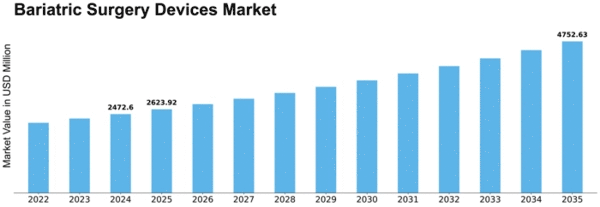
As per MRFR analysis, the Bariatric Surgery Devices Market was estimated at 2472.6 USD Million in 2024. The Bariatric Surgery Devices industry is projected to grow from 2623.93 USD Million in 2025 to 4752.63 USD Million by 2035, exhibiting a compound annual growth rate (CAGR) of 6.12% during the forecast period 2025 - 2035.

Key Market Trends & Highlights

The Bariatric Surgery Devices Market is experiencing robust growth driven by technological advancements and rising obesity rates.

  • North America remains the largest market for bariatric surgery devices, reflecting a high prevalence of obesity. Asia-Pacific is emerging as the fastest-growing region, driven by increasing awareness and healthcare access. Gastric bypass procedures dominate the market, while sleeve gastrectomy is witnessing the fastest growth in adoption. Technological advancements and rising obesity rates are key drivers propelling market expansion.

Market Size & Forecast

2024 Market Size 2472.6 (USD Million)
2035 Market Size 4752.63 (USD Million)
CAGR (2025 - 2035) 6.12%
Largest Regional Market Share in 2024 North America

Major Players

<p>Medtronic (US), Johnson &amp; Johnson (US), Boston Scientific (US), Stryker (US), B. Braun Melsungen AG (DE), Conmed Corporation (US), Intuitive Surgical (US), Hologic (US), Ethicon (US)</p>

Market Trends

The Bariatric Surgery Devices Market is currently experiencing a notable transformation, driven by increasing awareness of obesity-related health issues and the rising prevalence of obesity globally. This market encompasses a range of devices utilized in surgical procedures aimed at weight reduction, including gastric bands, gastric sleeves, and gastric bypass instruments. As healthcare providers and patients alike recognize the importance of effective weight management solutions, the demand for innovative surgical devices is likely to grow. Furthermore, advancements in technology are enhancing the efficacy and safety of these procedures, which may contribute to a more favorable perception of bariatric surgery among potential candidates.

In addition to technological advancements, the Bariatric Surgery Devices Market is influenced by evolving regulatory frameworks and reimbursement policies. These factors can either facilitate or hinder market growth, depending on how they align with the needs of healthcare providers and patients. The bariatric market is currently undergoing a shift as patients seek combination therapies that pair surgical procedures with metabolic medications.

Moreover, the increasing focus on minimally invasive surgical devices is reshaping the landscape of bariatric surgery, as these methods often result in shorter recovery times and reduced complications. Overall, the Bariatric Surgery Devices Market appears poised for continued expansion, driven by a combination of societal trends, technological innovations, and regulatory developments.

Technological Advancements

The Bariatric Surgery Devices Market is witnessing a surge in technological innovations, which enhance the precision and safety of surgical procedures. Newer devices are being developed with advanced materials and designs that improve patient outcomes and reduce recovery times. This trend suggests a shift towards more effective and less invasive options, appealing to both surgeons and patients. 

Rising Obesity Rates

The increasing prevalence of obesity worldwide is a significant driver for the Bariatric Surgery Devices Market. As more individuals seek effective solutions for weight management, the demand for surgical interventions is likely to rise. This trend indicates a growing recognition of the health risks associated with obesity, prompting more patients to consider surgical options.

Patient-Centric Approaches

There is a noticeable shift towards patient-centric care in the Bariatric Surgery Devices Market. Healthcare providers are increasingly focusing on personalized treatment plans, which may enhance patient engagement and adherence to post-surgery protocols.

Bariatric Surgery Devices Market Market Drivers

Rising Obesity Rates

The increasing prevalence of obesity globally serves as a primary driver for the Global Bariatric Surgery Devices Market Industry. According to the World Health Organization, obesity rates have nearly tripled since 1975, with more than 1.9 billion adults classified as overweight. This alarming trend necessitates effective weight management solutions, leading to a growing demand for bariatric surgery devices. In 2024, the market is projected to reach 2.47 USD Billion, reflecting the urgent need for surgical interventions to combat obesity-related health issues. As awareness of obesity's health implications rises, the market is likely to expand further.

Technological Advancements

Technological innovations in bariatric surgery devices significantly enhance their effectiveness and safety, thereby propelling the Global Bariatric Surgery Devices Market Industry. Minimally invasive techniques, such as laparoscopic surgery, have gained traction, resulting in shorter recovery times and reduced complications. The introduction of advanced surgical instruments and robotic-assisted systems has further improved surgical outcomes. These advancements not only attract more patients but also encourage healthcare providers to adopt these technologies. As a result, the market is expected to grow, with projections indicating a rise to 4.75 USD Billion by 2035, driven by ongoing technological improvements.

Growing Awareness and Acceptance

The rising awareness and acceptance of bariatric surgery as a viable treatment option for obesity significantly influence the Global Bariatric Surgery Devices Market Industry. Educational campaigns and advocacy efforts by health organizations have helped to destigmatize surgical weight loss, encouraging individuals to consider surgical options. This shift in perception is crucial, as it leads to increased patient inquiries and consultations regarding bariatric procedures. As more patients seek surgical interventions, the market is poised for growth, with an anticipated increase in demand for various bariatric devices. This trend underscores the importance of education in driving market expansion.

Increasing Healthcare Expenditure

Rising healthcare expenditure across various regions contributes to the growth of the Global Bariatric Surgery Devices Market Industry. Governments and private sectors are investing more in healthcare infrastructure, which includes funding for obesity treatment programs. This trend is particularly evident in developed nations, where healthcare budgets are expanding to accommodate advanced surgical procedures. As healthcare systems allocate more resources to combat obesity, the demand for bariatric surgery devices is likely to increase. This financial commitment may lead to a compound annual growth rate of 6.13% from 2025 to 2035, reflecting the growing recognition of obesity as a critical public health issue.

Regulatory Support and Guidelines

Regulatory support and the establishment of guidelines for bariatric surgery play a pivotal role in shaping the Global Bariatric Surgery Devices Market Industry. Health authorities are increasingly recognizing the necessity of surgical interventions for obesity management, leading to the development of standardized protocols and approval processes for bariatric devices. This regulatory framework not only ensures patient safety but also fosters innovation within the industry. As regulatory bodies continue to endorse bariatric surgery, the market is likely to experience sustained growth, driven by the introduction of new devices and techniques that meet established safety and efficacy standards.

Market Segment Insights

By Application: Gastric Bypass (Largest) vs. Sleeve Gastrectomy (Fastest-Growing)

<p>The Bariatric Surgery Devices Market is characterized by a diverse application spectrum, with Gastric Bypass leading as the dominant procedure due to its long-established efficacy and popularity among patients seeking significant weight loss. Sleeves Gastrectomy follows closely, gaining traction as a preferred choice for both its safety profile and the absence of foreign objects. Other procedures like Adjustable Gastric Banding and Biliopancreatic Diversion play smaller roles, while Intragastric Balloon is emerging, especially among patients looking for non-surgical options.</p>

<p>Bariatric Surgery: Gastric Bypass (Dominant) vs. Sleeve Gastrectomy (Emerging)</p>

<p>Gastric Bypass remains the dominant procedure in the bariatric landscape due to its substantial weight loss results and metabolic benefits. Its proven efficacy drives patient choice and surgeon recommendation, solidifying its market position. On the other hand, Sleeve Gastrectomy is rapidly emerging, particularly appealing to younger demographics and patients prioritizing minimally invasive techniques. This procedure is largely favored for its practical advantages, including a lower complication rate and quicker recovery time. As guidelines evolve and the acceptance of these methods continues, both procedures will likely maintain significant shares in the market, albeit with differential impacts driven by patient preferences and advancements in surgical techniques.</p>

By Device Type: Surgical Staplers (Largest) vs. Endoscopes (Fastest-Growing)

<p>The Bariatric Surgery Devices Market is characterized by a complex landscape where Surgical Staplers account for the largest share among various device types. This segment has established a solid foothold due to its critical role in facilitating effective surgical procedures, thus becoming a preferred choice among surgeons. Following closely, Endoscopes are emerging as a significant contender, gaining traction due to their minimally invasive nature and the rising demand for less traumatic surgical solutions. Growth trends indicate that advancements in technology and increasing patient awareness are pivotal drivers for the Bariatric Surgery Devices Market. Endoscopes, in particular, are witnessing rapid acceleration as they integrate newer imaging technologies, enhancing surgical precision. Additionally, the overall rise in obesity-related health issues globally has led to an increased focus on innovative devices that improve surgical outcomes and patient recovery times.</p>

<p>Surgical Staplers (Dominant) vs. Implantable Devices (Emerging)</p>

<p>Surgical Staplers are recognized as the dominant force in the Bariatric Surgery Devices Market due to their reliability and effectiveness in various surgical procedures. These devices facilitate the joining of tissues, making them a critical component for achieving optimal surgical results. On the other hand, Implantable Devices are positioned as an emerging segment, gaining attention for their role in long-term weight management solutions. While Surgical Staplers have established market trust, Implantable Devices are innovating with various mechanisms that promote sustained weight loss. This duality showcases how established efficacy and new technologies coexist, enriching the overall market landscape.</p>

By End User: Hospitals (Largest) vs. Ambulatory Surgical Centers (Fastest-Growing)

<p>In the Bariatric Surgery Devices Market, hospitals dominate the end-user segment, capturing the largest share of the market due to their advanced infrastructure and comprehensive healthcare services. Ambulatory surgical centers, on the other hand, are rapidly gaining attention and are becoming a significant player owing to reduced surgery costs and shorter recovery times associated with outpatient procedures. Specialty clinics and research institutions also play critical roles, but they represent smaller market shares compared to the primary segments of hospitals and surgical centers.</p>

<p>Ambulatory Surgical Centers: Fastest-Growing vs. Specialty Clinics: Emerging</p>

<p>Ambulatory surgical centers (ASCs) are emerging as a fast-growing segment in the Bariatric Surgery Devices Market, driven by a surge in demand for outpatient procedures that facilitate quick recovery. These centers offer specialized bariatric surgery services with lower operational costs, making them increasingly attractive to both surgeons and patients. In contrast, specialty clinics focus on niche bariatric procedures but remain a smaller player in the market. They tend to offer highly personalized care and post-operative support, catering to specific patient needs, yet may lack the extensive resources of larger hospitals. The growth trajectory of ASCs is supported by technological advancements and increasing patient awareness of obesity treatment options.</p>

By Patient Demographics: Obese Adults (Largest) vs. Patients Seeking Weight Loss Solutions (Fastest-Growing)

<p>In the Bariatric Surgery Devices Market, the segment of Obese Adults holds the largest share, primarily due to the increasing prevalence of obesity in the adult population. This demographic, often defined as individuals with a Body Mass Index (BMI) of 30 or higher, is a major driver for demand as more adults seek surgical interventions to manage their weight. Following closely are Patients Seeking Weight Loss Solutions, who are showing a rapid increase in numbers as awareness and acceptance of bariatric surgery gain traction. This segment is effectively capitalizing on the burgeoning lifestyle and wellness trends, making it a significant contributor to the market landscape.</p>

<p>Obese Adults (Dominant) vs. Patients with Comorbidities (Emerging)</p>

<p>Obese Adults represent the dominant segment in the Bariatric Surgery Devices Market, characterized by a significant need for surgical interventions due to lifestyle-related conditions. This group typically experiences a range of health issues, including diabetes and hypertension, necessitating more aggressive weight management strategies. On the other hand, Patients with Comorbidities is an emerging segment that is gaining traction as healthcare providers recognize the urgent need to treat obesity-related diseases that may complicate other health conditions. This demographic often includes patients suffering from multiple comorbidities, thereby increasing the propensity for surgical solutions as part of comprehensive care strategies. Consequently, both segments reflect distinct yet intertwined trends influencing the overall market dynamics.</p>

By Surgical Technique: Laparoscopic Surgery (Largest) vs. Robotic Surgery (Fastest-Growing)

<p>In the Bariatric Surgery Devices Market, the distribution of market share among surgical techniques reveals Laparoscopic Surgery as the dominant approach, commanding a significant share. It is favored due to its minimally invasive nature, leading to shorter recovery times and reduced complications for patients. Open Surgery, while still performing a notable number of procedures, is gradually being overshadowed by the advancement in laparoscopic technologies. Robotic Surgery, although currently holding a smaller segment of the market, is gaining traction rapidly among surgeons due to enhanced precision and control.</p>

<p>Surgical Technique: Laparoscopic Surgery (Dominant) vs. Robotic Surgery (Emerging)</p>

<p>Laparoscopic Surgery stands out in the Bariatric Surgery Devices Market as a preferred choice due to its ability to minimize patient trauma while maximizing procedural efficiency. Surgeons appreciate the reduced postoperative pain and quicker recovery associated with this technique. Meanwhile, Robotic Surgery, though less established, is emerging as a game-changer. The use of robotic systems enhances surgical precision and allows for complex procedures to be carried out with great accuracy. As more healthcare facilities adopt robotic systems, the demand is expected to rise, positioning Robotic Surgery as a futuristic solution that is carving its niche in bariatric practices.</p>

Get more detailed insights about Bariatric Surgery Devices Market Research Report - Forecast till 2035

Regional Insights

North America : Market Leader in Innovation

North America is the largest market for bariatric surgery devices, holding a significant share of 1230.0M in 2024. The region's growth is driven by rising obesity rates, increasing awareness of weight management, and advancements in surgical technologies. Regulatory support from agencies like the FDA has also catalyzed market expansion, ensuring safety and efficacy in new devices. The demand for minimally invasive procedures is further propelling market growth, as patients seek quicker recovery times and reduced hospital stays. The competitive landscape in North America is robust, featuring key players such as Medtronic, Johnson & Johnson, and Intuitive Surgical. These companies are at the forefront of innovation, developing cutting-edge technologies that enhance surgical outcomes. The U.S. remains the leading country, with a well-established healthcare infrastructure and high patient demand for bariatric procedures. This competitive environment fosters continuous improvement and investment in research and development, solidifying North America's position as a market leader.

Europe : Emerging Market with Potential

Europe's bariatric surgery devices market is valued at 750.0M, reflecting a growing awareness of obesity-related health issues. The region is witnessing an increase in demand for surgical interventions, driven by rising obesity rates and supportive healthcare policies. Regulatory frameworks across European countries are evolving to facilitate the approval of innovative devices, enhancing patient access to advanced surgical options. The focus on preventive healthcare is also contributing to market growth, as governments prioritize obesity management. Leading countries in Europe include Germany, France, and the UK, where healthcare systems are increasingly adopting bariatric procedures. The competitive landscape features prominent players like B. Braun Melsungen AG and Ethicon, which are investing in new technologies to improve surgical outcomes. The presence of established healthcare networks and a growing number of specialized clinics are further driving the market, positioning Europe as a significant player in The Bariatric Surgery Devices.

Asia-Pacific : Rapidly Growing Market

The Asia-Pacific region is experiencing rapid growth in the bariatric surgery devices market, valued at 400.0M. This growth is fueled by increasing obesity rates, changing lifestyles, and rising disposable incomes. Countries like China and India are witnessing a surge in demand for bariatric procedures, driven by a growing awareness of obesity-related health risks. Regulatory bodies are also becoming more supportive, streamlining approval processes for new devices, which is essential for market expansion. In this region, key players such as Boston Scientific and Stryker are actively expanding their presence, focusing on innovative solutions tailored to local needs. The competitive landscape is evolving, with an increasing number of healthcare facilities offering bariatric services. As the region continues to develop its healthcare infrastructure, the demand for advanced surgical devices is expected to rise, making Asia-Pacific a crucial market for future growth.

Middle East and Africa : Emerging Market Opportunities

The Middle East and Africa (MEA) bariatric surgery devices market is valued at 92.6M, reflecting emerging opportunities in this region. The rising prevalence of obesity and related health issues is driving demand for surgical interventions. Governments are increasingly recognizing the importance of addressing obesity as a public health concern, leading to supportive policies and initiatives. The market is also benefiting from the growing number of healthcare facilities offering bariatric services, enhancing patient access to treatment. Leading countries in the MEA region include South Africa and the UAE, where healthcare systems are evolving to meet the rising demand for bariatric procedures. The competitive landscape features both local and international players, with companies like Conmed Corporation making significant inroads. As awareness of obesity management grows, the MEA region is poised for substantial growth in the bariatric surgery devices market, presenting opportunities for investment and innovation.

Key Players and Competitive Insights

The Bariatric Surgery Devices Market is currently characterized by a dynamic competitive landscape, driven by increasing obesity rates and a growing awareness of surgical options. Key players such as Medtronic (US), Johnson & Johnson (US), and Boston Scientific (US) are strategically positioned to leverage innovation and technological advancements. Medtronic (US) focuses on enhancing its product portfolio through continuous innovation, while Johnson & Johnson (US) emphasizes strategic partnerships to expand its market reach. Boston Scientific (US) is actively pursuing mergers and acquisitions to bolster its capabilities in minimally invasive surgical devices, thereby shaping a competitive environment that is increasingly reliant on technological differentiation and strategic collaborations. In terms of business tactics, companies are localizing manufacturing to reduce costs and optimize supply chains, which is particularly crucial in a moderately fragmented market. The competitive structure is influenced by the collective actions of these key players, who are increasingly adopting strategies that enhance operational efficiency and responsiveness to market demands. This collective influence fosters a competitive atmosphere where innovation and strategic positioning are paramount. In November 2025, Medtronic (US) announced the launch of a new line of advanced bariatric surgical instruments designed to improve patient outcomes and reduce recovery times. This strategic move is significant as it not only enhances Medtronic's product offerings but also reinforces its commitment to innovation in the bariatric surgery space, potentially increasing its market share. In October 2025, Johnson & Johnson (US) entered into a partnership with a leading telehealth provider to integrate digital health solutions into its bariatric surgery offerings. This collaboration is indicative of a broader trend towards digital transformation in healthcare, allowing for improved patient monitoring and engagement, which could enhance surgical outcomes and patient satisfaction. In September 2025, Boston Scientific (US) completed the acquisition of a smaller firm specializing in robotic-assisted surgical technologies. This acquisition is strategically important as it positions Boston Scientific to compete more effectively in the growing market for robotic-assisted bariatric procedures, aligning with the increasing demand for minimally invasive surgical options. As of December 2025, the competitive trends in the Bariatric Surgery Devices Market are increasingly defined by digitalization, sustainability, and the integration of artificial intelligence (AI). Strategic alliances are becoming more prevalent, as companies recognize the need to collaborate to enhance their technological capabilities. Looking ahead, competitive differentiation is likely to evolve from traditional price-based competition to a focus on innovation, advanced technology, and supply chain reliability, reflecting the changing dynamics of the market.

Key Companies in the Bariatric Surgery Devices Market include

Industry Developments

August 2022 As part of the agreement, Teleflex agreed to pay USD 170 million in cash up front and USD 130 million more if certain commercial targets were achieved.

January 2022 Apollo Hospital in Hyderabad claimed it had carried out the first Full Robotic Bariatric surgery in Telugu. Hibibo Abdulle Mohamed, a 40-year-old Somalian who weighed 180 kg and had several health issues, underwent the procedure.

Future Outlook

Bariatric Surgery Devices Market Future Outlook

<p>The Bariatric Surgery Devices Market is projected to grow at a 6.12% CAGR from 2025 to 2035, driven by rising obesity rates, technological advancements, and increasing healthcare expenditure.</p>

New opportunities lie in:

  • <p>Development of AI-driven surgical planning software Expansion of telehealth services for pre- and post-operative care Partnerships with insurance providers for coverage expansion</p>

<p>By 2035, the market is expected to achieve substantial growth, reflecting evolving healthcare dynamics.</p>

Market Segmentation

Bariatric Surgery Devices Market End User Outlook

  • Hospitals
  • Ambulatory Surgical Centers
  • Specialty Clinics
  • Research Institutions

Bariatric Surgery Devices Market Application Outlook

  • Gastric Bypass
  • Sleeve Gastrectomy
  • Adjustable Gastric Banding
  • Biliopancreatic Diversion
  • Intragastric Balloon

Bariatric Surgery Devices Market Device Type Outlook

  • Surgical Staplers
  • Endoscopes
  • Surgical Instruments
  • Implantable Devices
  • Anesthesia Equipment

Bariatric Surgery Devices Market Surgical Technique Outlook

  • Open Surgery
  • Laparoscopic Surgery
  • Robotic Surgery
  • Endoscopic Surgery

Bariatric Surgery Devices Market Patient Demographics Outlook

  • Obese Adults
  • Adolescents
  • Elderly Patients
  • Patients with Comorbidities

Report Scope

MARKET SIZE 2024 2472.6(USD Million)
MARKET SIZE 2025 2623.93(USD Million)
MARKET SIZE 2035 4752.63(USD Million)
COMPOUND ANNUAL GROWTH RATE (CAGR) 6.12% (2025 - 2035)
REPORT COVERAGE Revenue Forecast, Competitive Landscape, Growth Factors, and Trends
BASE YEAR 2024
Market Forecast Period 2025 - 2035
Historical Data 2019 - 2024
Market Forecast Units USD Million
Key Companies Profiled Medtronic (US), Johnson & Johnson (US), Boston Scientific (US), Stryker (US), B. Braun Melsungen AG (DE), Conmed Corporation (US), Intuitive Surgical (US), Hologic (US), Ethicon (US)
Segments Covered Application, Device Type, End User, Patient Demographics, Surgical Technique
Key Market Opportunities Integration of advanced minimally invasive techniques enhances patient outcomes in the Bariatric Surgery Devices Market.
Key Market Dynamics Technological advancements and regulatory changes drive innovation and competition in the Bariatric Surgery Devices Market.
Countries Covered North America, Europe, APAC, South America, MEA

FAQs

What is the projected market valuation for the Bariatric Surgery Devices Market in 2035?

<p>The projected market valuation for the Bariatric Surgery Devices Market in 2035 is 4752.63 USD Million.</p>

What was the overall market valuation for the Bariatric Surgery Devices Market in 2024?

<p>The overall market valuation for the Bariatric Surgery Devices Market in 2024 was 2472.6 USD Million.</p>

What is the expected CAGR for the Bariatric Surgery Devices Market during the forecast period 2025 - 2035?

<p>The expected CAGR for the Bariatric Surgery Devices Market during the forecast period 2025 - 2035 is 6.12%.</p>

Which companies are considered key players in the Bariatric Surgery Devices Market?

<p>Key players in the Bariatric Surgery Devices Market include Medtronic, Johnson & Johnson, Boston Scientific, and Stryker.</p>

What are the main applications of bariatric surgery devices and their market valuations?

<p>The main applications include Sleeve Gastrectomy valued at 1600.0 USD Million and Gastric Bypass valued at 1200.0 USD Million.</p>

How do the market valuations for different types of bariatric surgery devices compare?

<p>Surgical Instruments are valued at 1000.0 USD Million, while Implantable Devices reach 1200.0 USD Million.</p>

What is the market valuation for bariatric surgery devices used in hospitals?

The market valuation for bariatric surgery devices used in hospitals is 1980.52 USD Million.

Which patient demographics are driving the Bariatric Surgery Devices Market?

Obese adults represent a significant segment, with a market valuation of 2380.0 USD Million.

What surgical techniques are utilized in the Bariatric Surgery Devices Market and their valuations?

Laparoscopic Surgery is valued at 2400.0 USD Million, indicating its prominence in the market.

What is the market valuation for ambulatory surgical centers in the Bariatric Surgery Devices Market?

The market valuation for ambulatory surgical centers is 990.26 USD Million.

  1. SECTION I: EXECUTIVE SUMMARY AND KEY HIGHLIGHTS
    1. | 1.1 EXECUTIVE SUMMARY
    2. | | 1.1.1 Market Overview
    3. | | 1.1.2 Key Findings
    4. | | 1.1.3 Market Segmentation
    5. | | 1.1.4 Competitive Landscape
    6. | | 1.1.5 Challenges and Opportunities
    7. | | 1.1.6 Future Outlook
  2. SECTION II: SCOPING, METHODOLOGY AND MARKET STRUCTURE
    1. | 2.1 MARKET INTRODUCTION
    2. | | 2.1.1 Definition
    3. | | 2.1.2 Scope of the study
    4. | | | 2.1.2.1 Research Objective
    5. | | | 2.1.2.2 Assumption
    6. | | | 2.1.2.3 Limitations
    7. | 2.2 RESEARCH METHODOLOGY
    8. | | 2.2.1 Overview
    9. | | 2.2.2 Data Mining
    10. | | 2.2.3 Secondary Research
    11. | | 2.2.4 Primary Research
    12. | | | 2.2.4.1 Primary Interviews and Information Gathering Process
    13. | | | 2.2.4.2 Breakdown of Primary Respondents
    14. | | 2.2.5 Forecasting Model
    15. | | 2.2.6 Market Size Estimation
    16. | | | 2.2.6.1 Bottom-Up Approach
    17. | | | 2.2.6.2 Top-Down Approach
    18. | | 2.2.7 Data Triangulation
    19. | | 2.2.8 Validation
  3. SECTION III: QUALITATIVE ANALYSIS
    1. | 3.1 MARKET DYNAMICS
    2. | | 3.1.1 Overview
    3. | | 3.1.2 Drivers
    4. | | 3.1.3 Restraints
    5. | | 3.1.4 Opportunities
    6. | 3.2 MARKET FACTOR ANALYSIS
    7. | | 3.2.1 Value chain Analysis
    8. | | 3.2.2 Porter's Five Forces Analysis
    9. | | | 3.2.2.1 Bargaining Power of Suppliers
    10. | | | 3.2.2.2 Bargaining Power of Buyers
    11. | | | 3.2.2.3 Threat of New Entrants
    12. | | | 3.2.2.4 Threat of Substitutes
    13. | | | 3.2.2.5 Intensity of Rivalry
    14. | | 3.2.3 COVID-19 Impact Analysis
    15. | | | 3.2.3.1 Market Impact Analysis
    16. | | | 3.2.3.2 Regional Impact
    17. | | | 3.2.3.3 Opportunity and Threat Analysis
  4. SECTION IV: QUANTITATIVE ANALYSIS
    1. | 4.1 Healthcare, BY Application (USD Million)
    2. | | 4.1.1 Gastric Bypass
    3. | | 4.1.2 Sleeve Gastrectomy
    4. | | 4.1.3 Adjustable Gastric Banding
    5. | | 4.1.4 Biliopancreatic Diversion
    6. | | 4.1.5 Intragastric Balloon
    7. | 4.2 Healthcare, BY Device Type (USD Million)
    8. | | 4.2.1 Surgical Staplers
    9. | | 4.2.2 Endoscopes
    10. | | 4.2.3 Surgical Instruments
    11. | | 4.2.4 Implantable Devices
    12. | | 4.2.5 Anesthesia Equipment
    13. | 4.3 Healthcare, BY End User (USD Million)
    14. | | 4.3.1 Hospitals
    15. | | 4.3.2 Ambulatory Surgical Centers
    16. | | 4.3.3 Specialty Clinics
    17. | | 4.3.4 Research Institutions
    18. | 4.4 Healthcare, BY Patient Demographics (USD Million)
    19. | | 4.4.1 Obese Adults
    20. | | 4.4.2 Adolescents
    21. | | 4.4.3 Patients with Comorbidities
    22. | | 4.4.4 Patients Seeking Weight Loss Solutions
    23. | 4.5 Healthcare, BY Surgical Technique (USD Million)
    24. | | 4.5.1 Open Surgery
    25. | | 4.5.2 Laparoscopic Surgery
    26. | | 4.5.3 Robotic Surgery
    27. | | 4.5.4 Endoscopic Surgery
    28. | 4.6 Healthcare, BY Region (USD Million)
    29. | | 4.6.1 North America
    30. | | | 4.6.1.1 US
    31. | | | 4.6.1.2 Canada
    32. | | 4.6.2 Europe
    33. | | | 4.6.2.1 Germany
    34. | | | 4.6.2.2 UK
    35. | | | 4.6.2.3 France
    36. | | | 4.6.2.4 Russia
    37. | | | 4.6.2.5 Italy
    38. | | | 4.6.2.6 Spain
    39. | | | 4.6.2.7 Rest of Europe
    40. | | 4.6.3 APAC
    41. | | | 4.6.3.1 China
    42. | | | 4.6.3.2 India
    43. | | | 4.6.3.3 Japan
    44. | | | 4.6.3.4 South Korea
    45. | | | 4.6.3.5 Malaysia
    46. | | | 4.6.3.6 Thailand
    47. | | | 4.6.3.7 Indonesia
    48. | | | 4.6.3.8 Rest of APAC
    49. | | 4.6.4 South America
    50. | | | 4.6.4.1 Brazil
    51. | | | 4.6.4.2 Mexico
    52. | | | 4.6.4.3 Argentina
    53. | | | 4.6.4.4 Rest of South America
    54. | | 4.6.5 MEA
    55. | | | 4.6.5.1 GCC Countries
    56. | | | 4.6.5.2 South Africa
    57. | | | 4.6.5.3 Rest of MEA
  5. SECTION V: COMPETITIVE ANALYSIS
    1. | 5.1 Competitive Landscape
    2. | | 5.1.1 Overview
    3. | | 5.1.2 Competitive Analysis
    4. | | 5.1.3 Market share Analysis
    5. | | 5.1.4 Major Growth Strategy in the Healthcare
    6. | | 5.1.5 Competitive Benchmarking
    7. | | 5.1.6 Leading Players in Terms of Number of Developments in the Healthcare
    8. | | 5.1.7 Key developments and growth strategies
    9. | | | 5.1.7.1 New Product Launch/Service Deployment
    10. | | | 5.1.7.2 Merger & Acquisitions
    11. | | | 5.1.7.3 Joint Ventures
    12. | | 5.1.8 Major Players Financial Matrix
    13. | | | 5.1.8.1 Sales and Operating Income
    14. | | | 5.1.8.2 Major Players R&D Expenditure. 2023
    15. | 5.2 Company Profiles
    16. | | 5.2.1 Medtronic (US)
    17. | | | 5.2.1.1 Financial Overview
    18. | | | 5.2.1.2 Products Offered
    19. | | | 5.2.1.3 Key Developments
    20. | | | 5.2.1.4 SWOT Analysis
    21. | | | 5.2.1.5 Key Strategies
    22. | | 5.2.2 Johnson & Johnson (US)
    23. | | | 5.2.2.1 Financial Overview
    24. | | | 5.2.2.2 Products Offered
    25. | | | 5.2.2.3 Key Developments
    26. | | | 5.2.2.4 SWOT Analysis
    27. | | | 5.2.2.5 Key Strategies
    28. | | 5.2.3 Boston Scientific (US)
    29. | | | 5.2.3.1 Financial Overview
    30. | | | 5.2.3.2 Products Offered
    31. | | | 5.2.3.3 Key Developments
    32. | | | 5.2.3.4 SWOT Analysis
    33. | | | 5.2.3.5 Key Strategies
    34. | | 5.2.4 Stryker (US)
    35. | | | 5.2.4.1 Financial Overview
    36. | | | 5.2.4.2 Products Offered
    37. | | | 5.2.4.3 Key Developments
    38. | | | 5.2.4.4 SWOT Analysis
    39. | | | 5.2.4.5 Key Strategies
    40. | | 5.2.5 B. Braun Melsungen AG (DE)
    41. | | | 5.2.5.1 Financial Overview
    42. | | | 5.2.5.2 Products Offered
    43. | | | 5.2.5.3 Key Developments
    44. | | | 5.2.5.4 SWOT Analysis
    45. | | | 5.2.5.5 Key Strategies
    46. | | 5.2.6 Conmed Corporation (US)
    47. | | | 5.2.6.1 Financial Overview
    48. | | | 5.2.6.2 Products Offered
    49. | | | 5.2.6.3 Key Developments
    50. | | | 5.2.6.4 SWOT Analysis
    51. | | | 5.2.6.5 Key Strategies
    52. | | 5.2.7 Intuitive Surgical (US)
    53. | | | 5.2.7.1 Financial Overview
    54. | | | 5.2.7.2 Products Offered
    55. | | | 5.2.7.3 Key Developments
    56. | | | 5.2.7.4 SWOT Analysis
    57. | | | 5.2.7.5 Key Strategies
    58. | | 5.2.8 Hologic (US)
    59. | | | 5.2.8.1 Financial Overview
    60. | | | 5.2.8.2 Products Offered
    61. | | | 5.2.8.3 Key Developments
    62. | | | 5.2.8.4 SWOT Analysis
    63. | | | 5.2.8.5 Key Strategies
    64. | | 5.2.9 Ethicon (US)
    65. | | | 5.2.9.1 Financial Overview
    66. | | | 5.2.9.2 Products Offered
    67. | | | 5.2.9.3 Key Developments
    68. | | | 5.2.9.4 SWOT Analysis
    69. | | | 5.2.9.5 Key Strategies
    70. | 5.3 Appendix
    71. | | 5.3.1 References
    72. | | 5.3.2 Related Reports
  6. LIST OF FIGURES
    1. | 6.1 MARKET SYNOPSIS
    2. | 6.2 NORTH AMERICA MARKET ANALYSIS
    3. | 6.3 US MARKET ANALYSIS BY APPLICATION
    4. | 6.4 US MARKET ANALYSIS BY DEVICE TYPE
    5. | 6.5 US MARKET ANALYSIS BY END USER
    6. | 6.6 US MARKET ANALYSIS BY PATIENT DEMOGRAPHICS
    7. | 6.7 US MARKET ANALYSIS BY SURGICAL TECHNIQUE
    8. | 6.8 CANADA MARKET ANALYSIS BY APPLICATION
    9. | 6.9 CANADA MARKET ANALYSIS BY DEVICE TYPE
    10. | 6.10 CANADA MARKET ANALYSIS BY END USER
    11. | 6.11 CANADA MARKET ANALYSIS BY PATIENT DEMOGRAPHICS
    12. | 6.12 CANADA MARKET ANALYSIS BY SURGICAL TECHNIQUE
    13. | 6.13 EUROPE MARKET ANALYSIS
    14. | 6.14 GERMANY MARKET ANALYSIS BY APPLICATION
    15. | 6.15 GERMANY MARKET ANALYSIS BY DEVICE TYPE
    16. | 6.16 GERMANY MARKET ANALYSIS BY END USER
    17. | 6.17 GERMANY MARKET ANALYSIS BY PATIENT DEMOGRAPHICS
    18. | 6.18 GERMANY MARKET ANALYSIS BY SURGICAL TECHNIQUE
    19. | 6.19 UK MARKET ANALYSIS BY APPLICATION
    20. | 6.20 UK MARKET ANALYSIS BY DEVICE TYPE
    21. | 6.21 UK MARKET ANALYSIS BY END USER
    22. | 6.22 UK MARKET ANALYSIS BY PATIENT DEMOGRAPHICS
    23. | 6.23 UK MARKET ANALYSIS BY SURGICAL TECHNIQUE
    24. | 6.24 FRANCE MARKET ANALYSIS BY APPLICATION
    25. | 6.25 FRANCE MARKET ANALYSIS BY DEVICE TYPE
    26. | 6.26 FRANCE MARKET ANALYSIS BY END USER
    27. | 6.27 FRANCE MARKET ANALYSIS BY PATIENT DEMOGRAPHICS
    28. | 6.28 FRANCE MARKET ANALYSIS BY SURGICAL TECHNIQUE
    29. | 6.29 RUSSIA MARKET ANALYSIS BY APPLICATION
    30. | 6.30 RUSSIA MARKET ANALYSIS BY DEVICE TYPE
    31. | 6.31 RUSSIA MARKET ANALYSIS BY END USER
    32. | 6.32 RUSSIA MARKET ANALYSIS BY PATIENT DEMOGRAPHICS
    33. | 6.33 RUSSIA MARKET ANALYSIS BY SURGICAL TECHNIQUE
    34. | 6.34 ITALY MARKET ANALYSIS BY APPLICATION
    35. | 6.35 ITALY MARKET ANALYSIS BY DEVICE TYPE
    36. | 6.36 ITALY MARKET ANALYSIS BY END USER
    37. | 6.37 ITALY MARKET ANALYSIS BY PATIENT DEMOGRAPHICS
    38. | 6.38 ITALY MARKET ANALYSIS BY SURGICAL TECHNIQUE
    39. | 6.39 SPAIN MARKET ANALYSIS BY APPLICATION
    40. | 6.40 SPAIN MARKET ANALYSIS BY DEVICE TYPE
    41. | 6.41 SPAIN MARKET ANALYSIS BY END USER
    42. | 6.42 SPAIN MARKET ANALYSIS BY PATIENT DEMOGRAPHICS
    43. | 6.43 SPAIN MARKET ANALYSIS BY SURGICAL TECHNIQUE
    44. | 6.44 REST OF EUROPE MARKET ANALYSIS BY APPLICATION
    45. | 6.45 REST OF EUROPE MARKET ANALYSIS BY DEVICE TYPE
    46. | 6.46 REST OF EUROPE MARKET ANALYSIS BY END USER
    47. | 6.47 REST OF EUROPE MARKET ANALYSIS BY PATIENT DEMOGRAPHICS
    48. | 6.48 REST OF EUROPE MARKET ANALYSIS BY SURGICAL TECHNIQUE
    49. | 6.49 APAC MARKET ANALYSIS
    50. | 6.50 CHINA MARKET ANALYSIS BY APPLICATION
    51. | 6.51 CHINA MARKET ANALYSIS BY DEVICE TYPE
    52. | 6.52 CHINA MARKET ANALYSIS BY END USER
    53. | 6.53 CHINA MARKET ANALYSIS BY PATIENT DEMOGRAPHICS
    54. | 6.54 CHINA MARKET ANALYSIS BY SURGICAL TECHNIQUE
    55. | 6.55 INDIA MARKET ANALYSIS BY APPLICATION
    56. | 6.56 INDIA MARKET ANALYSIS BY DEVICE TYPE
    57. | 6.57 INDIA MARKET ANALYSIS BY END USER
    58. | 6.58 INDIA MARKET ANALYSIS BY PATIENT DEMOGRAPHICS
    59. | 6.59 INDIA MARKET ANALYSIS BY SURGICAL TECHNIQUE
    60. | 6.60 JAPAN MARKET ANALYSIS BY APPLICATION
    61. | 6.61 JAPAN MARKET ANALYSIS BY DEVICE TYPE
    62. | 6.62 JAPAN MARKET ANALYSIS BY END USER
    63. | 6.63 JAPAN MARKET ANALYSIS BY PATIENT DEMOGRAPHICS
    64. | 6.64 JAPAN MARKET ANALYSIS BY SURGICAL TECHNIQUE
    65. | 6.65 SOUTH KOREA MARKET ANALYSIS BY APPLICATION
    66. | 6.66 SOUTH KOREA MARKET ANALYSIS BY DEVICE TYPE
    67. | 6.67 SOUTH KOREA MARKET ANALYSIS BY END USER
    68. | 6.68 SOUTH KOREA MARKET ANALYSIS BY PATIENT DEMOGRAPHICS
    69. | 6.69 SOUTH KOREA MARKET ANALYSIS BY SURGICAL TECHNIQUE
    70. | 6.70 MALAYSIA MARKET ANALYSIS BY APPLICATION
    71. | 6.71 MALAYSIA MARKET ANALYSIS BY DEVICE TYPE
    72. | 6.72 MALAYSIA MARKET ANALYSIS BY END USER
    73. | 6.73 MALAYSIA MARKET ANALYSIS BY PATIENT DEMOGRAPHICS
    74. | 6.74 MALAYSIA MARKET ANALYSIS BY SURGICAL TECHNIQUE
    75. | 6.75 THAILAND MARKET ANALYSIS BY APPLICATION
    76. | 6.76 THAILAND MARKET ANALYSIS BY DEVICE TYPE
    77. | 6.77 THAILAND MARKET ANALYSIS BY END USER
    78. | 6.78 THAILAND MARKET ANALYSIS BY PATIENT DEMOGRAPHICS
    79. | 6.79 THAILAND MARKET ANALYSIS BY SURGICAL TECHNIQUE
    80. | 6.80 INDONESIA MARKET ANALYSIS BY APPLICATION
    81. | 6.81 INDONESIA MARKET ANALYSIS BY DEVICE TYPE
    82. | 6.82 INDONESIA MARKET ANALYSIS BY END USER
    83. | 6.83 INDONESIA MARKET ANALYSIS BY PATIENT DEMOGRAPHICS
    84. | 6.84 INDONESIA MARKET ANALYSIS BY SURGICAL TECHNIQUE
    85. | 6.85 REST OF APAC MARKET ANALYSIS BY APPLICATION
    86. | 6.86 REST OF APAC MARKET ANALYSIS BY DEVICE TYPE
    87. | 6.87 REST OF APAC MARKET ANALYSIS BY END USER
    88. | 6.88 REST OF APAC MARKET ANALYSIS BY PATIENT DEMOGRAPHICS
    89. | 6.89 REST OF APAC MARKET ANALYSIS BY SURGICAL TECHNIQUE
    90. | 6.90 SOUTH AMERICA MARKET ANALYSIS
    91. | 6.91 BRAZIL MARKET ANALYSIS BY APPLICATION
    92. | 6.92 BRAZIL MARKET ANALYSIS BY DEVICE TYPE
    93. | 6.93 BRAZIL MARKET ANALYSIS BY END USER
    94. | 6.94 BRAZIL MARKET ANALYSIS BY PATIENT DEMOGRAPHICS
    95. | 6.95 BRAZIL MARKET ANALYSIS BY SURGICAL TECHNIQUE
    96. | 6.96 MEXICO MARKET ANALYSIS BY APPLICATION
    97. | 6.97 MEXICO MARKET ANALYSIS BY DEVICE TYPE
    98. | 6.98 MEXICO MARKET ANALYSIS BY END USER
    99. | 6.99 MEXICO MARKET ANALYSIS BY PATIENT DEMOGRAPHICS
    100. | 6.100 MEXICO MARKET ANALYSIS BY SURGICAL TECHNIQUE
    101. | 6.101 ARGENTINA MARKET ANALYSIS BY APPLICATION
    102. | 6.102 ARGENTINA MARKET ANALYSIS BY DEVICE TYPE
    103. | 6.103 ARGENTINA MARKET ANALYSIS BY END USER
    104. | 6.104 ARGENTINA MARKET ANALYSIS BY PATIENT DEMOGRAPHICS
    105. | 6.105 ARGENTINA MARKET ANALYSIS BY SURGICAL TECHNIQUE
    106. | 6.106 REST OF SOUTH AMERICA MARKET ANALYSIS BY APPLICATION
    107. | 6.107 REST OF SOUTH AMERICA MARKET ANALYSIS BY DEVICE TYPE
    108. | 6.108 REST OF SOUTH AMERICA MARKET ANALYSIS BY END USER
    109. | 6.109 REST OF SOUTH AMERICA MARKET ANALYSIS BY PATIENT DEMOGRAPHICS
    110. | 6.110 REST OF SOUTH AMERICA MARKET ANALYSIS BY SURGICAL TECHNIQUE
    111. | 6.111 MEA MARKET ANALYSIS
    112. | 6.112 GCC COUNTRIES MARKET ANALYSIS BY APPLICATION
    113. | 6.113 GCC COUNTRIES MARKET ANALYSIS BY DEVICE TYPE
    114. | 6.114 GCC COUNTRIES MARKET ANALYSIS BY END USER
    115. | 6.115 GCC COUNTRIES MARKET ANALYSIS BY PATIENT DEMOGRAPHICS
    116. | 6.116 GCC COUNTRIES MARKET ANALYSIS BY SURGICAL TECHNIQUE
    117. | 6.117 SOUTH AFRICA MARKET ANALYSIS BY APPLICATION
    118. | 6.118 SOUTH AFRICA MARKET ANALYSIS BY DEVICE TYPE
    119. | 6.119 SOUTH AFRICA MARKET ANALYSIS BY END USER
    120. | 6.120 SOUTH AFRICA MARKET ANALYSIS BY PATIENT DEMOGRAPHICS
    121. | 6.121 SOUTH AFRICA MARKET ANALYSIS BY SURGICAL TECHNIQUE
    122. | 6.122 REST OF MEA MARKET ANALYSIS BY APPLICATION
    123. | 6.123 REST OF MEA MARKET ANALYSIS BY DEVICE TYPE
    124. | 6.124 REST OF MEA MARKET ANALYSIS BY END USER
    125. | 6.125 REST OF MEA MARKET ANALYSIS BY PATIENT DEMOGRAPHICS
    126. | 6.126 REST OF MEA MARKET ANALYSIS BY SURGICAL TECHNIQUE
    127. | 6.127 KEY BUYING CRITERIA OF HEALTHCARE
    128. | 6.128 RESEARCH PROCESS OF MRFR
    129. | 6.129 DRO ANALYSIS OF HEALTHCARE
    130. | 6.130 DRIVERS IMPACT ANALYSIS: HEALTHCARE
    131. | 6.131 RESTRAINTS IMPACT ANALYSIS: HEALTHCARE
    132. | 6.132 SUPPLY / VALUE CHAIN: HEALTHCARE
    133. | 6.133 HEALTHCARE, BY APPLICATION, 2024 (% SHARE)
    134. | 6.134 HEALTHCARE, BY APPLICATION, 2024 TO 2035 (USD Million)
    135. | 6.135 HEALTHCARE, BY DEVICE TYPE, 2024 (% SHARE)
    136. | 6.136 HEALTHCARE, BY DEVICE TYPE, 2024 TO 2035 (USD Million)
    137. | 6.137 HEALTHCARE, BY END USER, 2024 (% SHARE)
    138. | 6.138 HEALTHCARE, BY END USER, 2024 TO 2035 (USD Million)
    139. | 6.139 HEALTHCARE, BY PATIENT DEMOGRAPHICS, 2024 (% SHARE)
    140. | 6.140 HEALTHCARE, BY PATIENT DEMOGRAPHICS, 2024 TO 2035 (USD Million)
    141. | 6.141 HEALTHCARE, BY SURGICAL TECHNIQUE, 2024 (% SHARE)
    142. | 6.142 HEALTHCARE, BY SURGICAL TECHNIQUE, 2024 TO 2035 (USD Million)
    143. | 6.143 BENCHMARKING OF MAJOR COMPETITORS
  7. LIST OF TABLES
    1. | 7.1 LIST OF ASSUMPTIONS
    2. | | 7.1.1
    3. | 7.2 North America MARKET SIZE ESTIMATES; FORECAST
    4. | | 7.2.1 BY APPLICATION, 2025-2035 (USD Million)
    5. | | 7.2.2 BY DEVICE TYPE, 2025-2035 (USD Million)
    6. | | 7.2.3 BY END USER, 2025-2035 (USD Million)
    7. | | 7.2.4 BY PATIENT DEMOGRAPHICS, 2025-2035 (USD Million)
    8. | | 7.2.5 BY SURGICAL TECHNIQUE, 2025-2035 (USD Million)
    9. | 7.3 US MARKET SIZE ESTIMATES; FORECAST
    10. | | 7.3.1 BY APPLICATION, 2025-2035 (USD Million)
    11. | | 7.3.2 BY DEVICE TYPE, 2025-2035 (USD Million)
    12. | | 7.3.3 BY END USER, 2025-2035 (USD Million)
    13. | | 7.3.4 BY PATIENT DEMOGRAPHICS, 2025-2035 (USD Million)
    14. | | 7.3.5 BY SURGICAL TECHNIQUE, 2025-2035 (USD Million)
    15. | 7.4 Canada MARKET SIZE ESTIMATES; FORECAST
    16. | | 7.4.1 BY APPLICATION, 2025-2035 (USD Million)
    17. | | 7.4.2 BY DEVICE TYPE, 2025-2035 (USD Million)
    18. | | 7.4.3 BY END USER, 2025-2035 (USD Million)
    19. | | 7.4.4 BY PATIENT DEMOGRAPHICS, 2025-2035 (USD Million)
    20. | | 7.4.5 BY SURGICAL TECHNIQUE, 2025-2035 (USD Million)
    21. | 7.5 Europe MARKET SIZE ESTIMATES; FORECAST
    22. | | 7.5.1 BY APPLICATION, 2025-2035 (USD Million)
    23. | | 7.5.2 BY DEVICE TYPE, 2025-2035 (USD Million)
    24. | | 7.5.3 BY END USER, 2025-2035 (USD Million)
    25. | | 7.5.4 BY PATIENT DEMOGRAPHICS, 2025-2035 (USD Million)
    26. | | 7.5.5 BY SURGICAL TECHNIQUE, 2025-2035 (USD Million)
    27. | 7.6 Germany MARKET SIZE ESTIMATES; FORECAST
    28. | | 7.6.1 BY APPLICATION, 2025-2035 (USD Million)
    29. | | 7.6.2 BY DEVICE TYPE, 2025-2035 (USD Million)
    30. | | 7.6.3 BY END USER, 2025-2035 (USD Million)
    31. | | 7.6.4 BY PATIENT DEMOGRAPHICS, 2025-2035 (USD Million)
    32. | | 7.6.5 BY SURGICAL TECHNIQUE, 2025-2035 (USD Million)
    33. | 7.7 UK MARKET SIZE ESTIMATES; FORECAST
    34. | | 7.7.1 BY APPLICATION, 2025-2035 (USD Million)
    35. | | 7.7.2 BY DEVICE TYPE, 2025-2035 (USD Million)
    36. | | 7.7.3 BY END USER, 2025-2035 (USD Million)
    37. | | 7.7.4 BY PATIENT DEMOGRAPHICS, 2025-2035 (USD Million)
    38. | | 7.7.5 BY SURGICAL TECHNIQUE, 2025-2035 (USD Million)
    39. | 7.8 France MARKET SIZE ESTIMATES; FORECAST
    40. | | 7.8.1 BY APPLICATION, 2025-2035 (USD Million)
    41. | | 7.8.2 BY DEVICE TYPE, 2025-2035 (USD Million)
    42. | | 7.8.3 BY END USER, 2025-2035 (USD Million)
    43. | | 7.8.4 BY PATIENT DEMOGRAPHICS, 2025-2035 (USD Million)
    44. | | 7.8.5 BY SURGICAL TECHNIQUE, 2025-2035 (USD Million)
    45. | 7.9 Russia MARKET SIZE ESTIMATES; FORECAST
    46. | | 7.9.1 BY APPLICATION, 2025-2035 (USD Million)
    47. | | 7.9.2 BY DEVICE TYPE, 2025-2035 (USD Million)
    48. | | 7.9.3 BY END USER, 2025-2035 (USD Million)
    49. | | 7.9.4 BY PATIENT DEMOGRAPHICS, 2025-2035 (USD Million)
    50. | | 7.9.5 BY SURGICAL TECHNIQUE, 2025-2035 (USD Million)
    51. | 7.10 Italy MARKET SIZE ESTIMATES; FORECAST
    52. | | 7.10.1 BY APPLICATION, 2025-2035 (USD Million)
    53. | | 7.10.2 BY DEVICE TYPE, 2025-2035 (USD Million)
    54. | | 7.10.3 BY END USER, 2025-2035 (USD Million)
    55. | | 7.10.4 BY PATIENT DEMOGRAPHICS, 2025-2035 (USD Million)
    56. | | 7.10.5 BY SURGICAL TECHNIQUE, 2025-2035 (USD Million)
    57. | 7.11 Spain MARKET SIZE ESTIMATES; FORECAST
    58. | | 7.11.1 BY APPLICATION, 2025-2035 (USD Million)
    59. | | 7.11.2 BY DEVICE TYPE, 2025-2035 (USD Million)
    60. | | 7.11.3 BY END USER, 2025-2035 (USD Million)
    61. | | 7.11.4 BY PATIENT DEMOGRAPHICS, 2025-2035 (USD Million)
    62. | | 7.11.5 BY SURGICAL TECHNIQUE, 2025-2035 (USD Million)
    63. | 7.12 Rest of Europe MARKET SIZE ESTIMATES; FORECAST
    64. | | 7.12.1 BY APPLICATION, 2025-2035 (USD Million)
    65. | | 7.12.2 BY DEVICE TYPE, 2025-2035 (USD Million)
    66. | | 7.12.3 BY END USER, 2025-2035 (USD Million)
    67. | | 7.12.4 BY PATIENT DEMOGRAPHICS, 2025-2035 (USD Million)
    68. | | 7.12.5 BY SURGICAL TECHNIQUE, 2025-2035 (USD Million)
    69. | 7.13 APAC MARKET SIZE ESTIMATES; FORECAST
    70. | | 7.13.1 BY APPLICATION, 2025-2035 (USD Million)
    71. | | 7.13.2 BY DEVICE TYPE, 2025-2035 (USD Million)
    72. | | 7.13.3 BY END USER, 2025-2035 (USD Million)
    73. | | 7.13.4 BY PATIENT DEMOGRAPHICS, 2025-2035 (USD Million)
    74. | | 7.13.5 BY SURGICAL TECHNIQUE, 2025-2035 (USD Million)
    75. | 7.14 China MARKET SIZE ESTIMATES; FORECAST
    76. | | 7.14.1 BY APPLICATION, 2025-2035 (USD Million)
    77. | | 7.14.2 BY DEVICE TYPE, 2025-2035 (USD Million)
    78. | | 7.14.3 BY END USER, 2025-2035 (USD Million)
    79. | | 7.14.4 BY PATIENT DEMOGRAPHICS, 2025-2035 (USD Million)
    80. | | 7.14.5 BY SURGICAL TECHNIQUE, 2025-2035 (USD Million)
    81. | 7.15 India MARKET SIZE ESTIMATES; FORECAST
    82. | | 7.15.1 BY APPLICATION, 2025-2035 (USD Million)
    83. | | 7.15.2 BY DEVICE TYPE, 2025-2035 (USD Million)
    84. | | 7.15.3 BY END USER, 2025-2035 (USD Million)
    85. | | 7.15.4 BY PATIENT DEMOGRAPHICS, 2025-2035 (USD Million)
    86. | | 7.15.5 BY SURGICAL TECHNIQUE, 2025-2035 (USD Million)
    87. | 7.16 Japan MARKET SIZE ESTIMATES; FORECAST
    88. | | 7.16.1 BY APPLICATION, 2025-2035 (USD Million)
    89. | | 7.16.2 BY DEVICE TYPE, 2025-2035 (USD Million)
    90. | | 7.16.3 BY END USER, 2025-2035 (USD Million)
    91. | | 7.16.4 BY PATIENT DEMOGRAPHICS, 2025-2035 (USD Million)
    92. | | 7.16.5 BY SURGICAL TECHNIQUE, 2025-2035 (USD Million)
    93. | 7.17 South Korea MARKET SIZE ESTIMATES; FORECAST
    94. | | 7.17.1 BY APPLICATION, 2025-2035 (USD Million)
    95. | | 7.17.2 BY DEVICE TYPE, 2025-2035 (USD Million)
    96. | | 7.17.3 BY END USER, 2025-2035 (USD Million)
    97. | | 7.17.4 BY PATIENT DEMOGRAPHICS, 2025-2035 (USD Million)
    98. | | 7.17.5 BY SURGICAL TECHNIQUE, 2025-2035 (USD Million)
    99. | 7.18 Malaysia MARKET SIZE ESTIMATES; FORECAST
    100. | | 7.18.1 BY APPLICATION, 2025-2035 (USD Million)
    101. | | 7.18.2 BY DEVICE TYPE, 2025-2035 (USD Million)
    102. | | 7.18.3 BY END USER, 2025-2035 (USD Million)
    103. | | 7.18.4 BY PATIENT DEMOGRAPHICS, 2025-2035 (USD Million)
    104. | | 7.18.5 BY SURGICAL TECHNIQUE, 2025-2035 (USD Million)
    105. | 7.19 Thailand MARKET SIZE ESTIMATES; FORECAST
    106. | | 7.19.1 BY APPLICATION, 2025-2035 (USD Million)
    107. | | 7.19.2 BY DEVICE TYPE, 2025-2035 (USD Million)
    108. | | 7.19.3 BY END USER, 2025-2035 (USD Million)
    109. | | 7.19.4 BY PATIENT DEMOGRAPHICS, 2025-2035 (USD Million)
    110. | | 7.19.5 BY SURGICAL TECHNIQUE, 2025-2035 (USD Million)
    111. | 7.20 Indonesia MARKET SIZE ESTIMATES; FORECAST
    112. | | 7.20.1 BY APPLICATION, 2025-2035 (USD Million)
    113. | | 7.20.2 BY DEVICE TYPE, 2025-2035 (USD Million)
    114. | | 7.20.3 BY END USER, 2025-2035 (USD Million)
    115. | | 7.20.4 BY PATIENT DEMOGRAPHICS, 2025-2035 (USD Million)
    116. | | 7.20.5 BY SURGICAL TECHNIQUE, 2025-2035 (USD Million)
    117. | 7.21 Rest of APAC MARKET SIZE ESTIMATES; FORECAST
    118. | | 7.21.1 BY APPLICATION, 2025-2035 (USD Million)
    119. | | 7.21.2 BY DEVICE TYPE, 2025-2035 (USD Million)
    120. | | 7.21.3 BY END USER, 2025-2035 (USD Million)
    121. | | 7.21.4 BY PATIENT DEMOGRAPHICS, 2025-2035 (USD Million)
    122. | | 7.21.5 BY SURGICAL TECHNIQUE, 2025-2035 (USD Million)
    123. | 7.22 South America MARKET SIZE ESTIMATES; FORECAST
    124. | | 7.22.1 BY APPLICATION, 2025-2035 (USD Million)
    125. | | 7.22.2 BY DEVICE TYPE, 2025-2035 (USD Million)
    126. | | 7.22.3 BY END USER, 2025-2035 (USD Million)
    127. | | 7.22.4 BY PATIENT DEMOGRAPHICS, 2025-2035 (USD Million)
    128. | | 7.22.5 BY SURGICAL TECHNIQUE, 2025-2035 (USD Million)
    129. | 7.23 Brazil MARKET SIZE ESTIMATES; FORECAST
    130. | | 7.23.1 BY APPLICATION, 2025-2035 (USD Million)
    131. | | 7.23.2 BY DEVICE TYPE, 2025-2035 (USD Million)
    132. | | 7.23.3 BY END USER, 2025-2035 (USD Million)
    133. | | 7.23.4 BY PATIENT DEMOGRAPHICS, 2025-2035 (USD Million)
    134. | | 7.23.5 BY SURGICAL TECHNIQUE, 2025-2035 (USD Million)
    135. | 7.24 Mexico MARKET SIZE ESTIMATES; FORECAST
    136. | | 7.24.1 BY APPLICATION, 2025-2035 (USD Million)
    137. | | 7.24.2 BY DEVICE TYPE, 2025-2035 (USD Million)
    138. | | 7.24.3 BY END USER, 2025-2035 (USD Million)
    139. | | 7.24.4 BY PATIENT DEMOGRAPHICS, 2025-2035 (USD Million)
    140. | | 7.24.5 BY SURGICAL TECHNIQUE, 2025-2035 (USD Million)
    141. | 7.25 Argentina MARKET SIZE ESTIMATES; FORECAST
    142. | | 7.25.1 BY APPLICATION, 2025-2035 (USD Million)
    143. | | 7.25.2 BY DEVICE TYPE, 2025-2035 (USD Million)
    144. | | 7.25.3 BY END USER, 2025-2035 (USD Million)
    145. | | 7.25.4 BY PATIENT DEMOGRAPHICS, 2025-2035 (USD Million)
    146. | | 7.25.5 BY SURGICAL TECHNIQUE, 2025-2035 (USD Million)
    147. | 7.26 Rest of South America MARKET SIZE ESTIMATES; FORECAST
    148. | | 7.26.1 BY APPLICATION, 2025-2035 (USD Million)
    149. | | 7.26.2 BY DEVICE TYPE, 2025-2035 (USD Million)
    150. | | 7.26.3 BY END USER, 2025-2035 (USD Million)
    151. | | 7.26.4 BY PATIENT DEMOGRAPHICS, 2025-2035 (USD Million)
    152. | | 7.26.5 BY SURGICAL TECHNIQUE, 2025-2035 (USD Million)
    153. | 7.27 MEA MARKET SIZE ESTIMATES; FORECAST
    154. | | 7.27.1 BY APPLICATION, 2025-2035 (USD Million)
    155. | | 7.27.2 BY DEVICE TYPE, 2025-2035 (USD Million)
    156. | | 7.27.3 BY END USER, 2025-2035 (USD Million)
    157. | | 7.27.4 BY PATIENT DEMOGRAPHICS, 2025-2035 (USD Million)
    158. | | 7.27.5 BY SURGICAL TECHNIQUE, 2025-2035 (USD Million)
    159. | 7.28 GCC Countries MARKET SIZE ESTIMATES; FORECAST
    160. | | 7.28.1 BY APPLICATION, 2025-2035 (USD Million)
    161. | | 7.28.2 BY DEVICE TYPE, 2025-2035 (USD Million)
    162. | | 7.28.3 BY END USER, 2025-2035 (USD Million)
    163. | | 7.28.4 BY PATIENT DEMOGRAPHICS, 2025-2035 (USD Million)
    164. | | 7.28.5 BY SURGICAL TECHNIQUE, 2025-2035 (USD Million)
    165. | 7.29 South Africa MARKET SIZE ESTIMATES; FORECAST
    166. | | 7.29.1 BY APPLICATION, 2025-2035 (USD Million)
    167. | | 7.29.2 BY DEVICE TYPE, 2025-2035 (USD Million)
    168. | | 7.29.3 BY END USER, 2025-2035 (USD Million)
    169. | | 7.29.4 BY PATIENT DEMOGRAPHICS, 2025-2035 (USD Million)
    170. | | 7.29.5 BY SURGICAL TECHNIQUE, 2025-2035 (USD Million)
    171. | 7.30 Rest of MEA MARKET SIZE ESTIMATES; FORECAST
    172. | | 7.30.1 BY APPLICATION, 2025-2035 (USD Million)
    173. | | 7.30.2 BY DEVICE TYPE, 2025-2035 (USD Million)
    174. | | 7.30.3 BY END USER, 2025-2035 (USD Million)
    175. | | 7.30.4 BY PATIENT DEMOGRAPHICS, 2025-2035 (USD Million)
    176. | | 7.30.5 BY SURGICAL TECHNIQUE, 2025-2035 (USD Million)
    177. | 7.31 PRODUCT LAUNCH/PRODUCT DEVELOPMENT/APPROVAL
    178. | | 7.31.1
    179. | 7.32 ACQUISITION/PARTNERSHIP
    180. | | 7.32.1

Healthcare Market Segmentation

Healthcare By Application (USD Million, 2025-2035)

  • Gastric Bypass
  • Sleeve Gastrectomy
  • Adjustable Gastric Banding
  • Biliopancreatic Diversion
  • Intragastric Balloon

Healthcare By Device Type (USD Million, 2025-2035)

  • Surgical Staplers
  • Endoscopes
  • Surgical Instruments
  • Implantable Devices
  • Anesthesia Equipment

Healthcare By End User (USD Million, 2025-2035)

  • Hospitals
  • Ambulatory Surgical Centers
  • Specialty Clinics
  • Research Institutions

Healthcare By Patient Demographics (USD Million, 2025-2035)

  • Obese Adults
  • Adolescents
  • Patients with Comorbidities
  • Patients Seeking Weight Loss Solutions

Healthcare By Surgical Technique (USD Million, 2025-2035)

  • Open Surgery
  • Laparoscopic Surgery
  • Robotic Surgery
  • Endoscopic Surgery
Infographic

Free Sample Request

Kindly complete the form below to receive a free sample of this Report

Get Free Sample

Customer Strories

Compare Licence

×
Features License Type
Single User Multiuser License Enterprise User
Price $4,950 $5,950 $7,250
Maximum User Access Limit 1 User Upto 10 Users Unrestricted Access Throughout the Organization
Free Customization
Direct Access to Analyst
Deliverable Format
Platform Access
Discount on Next Purchase 10% 15% 15%
Printable Versions