×
Hero Background
English
Chinese
French
Japanese
Korean
German
Spanish

Bagging Machine Market Share

ID: MRFR/Equip/9487-CR
110 Pages
Snehal Singh
October 2022

Bagging Machine Market Research Report Information by Product Type (Open Mouth Bagging Machines, Form Fill Seal Machine, Valve Bagger Machine, FIBC Machine, Roto Packaging Machines), Automation Type (Automatic Bagging Machines and Semi-Automatic Bagging Machines), Machine Type (Vertical Bagging Machine and Horizontal Bagging Machine), End-Use Industry (Food, Building Materials, Minerals, and Chemical), Bag Size (0.1 kg-5 kg, 5.1 kg-25 kg, 25.1 kg-50 kg, and more than 50 kg), and Region —Forecast till 2035

Share:
Download PDF ×

We do not share your information with anyone. However, we may send you emails based on your report interest from time to time. You may contact us at any time to opt-out.

Bagging Machine Market Infographic
Purchase Options

Market Share

Bagging Machine Market Share Analysis

In countries like China, India, and Indonesia, there has been a steady increase in the number of commercial properties in recent years. This growth is driven by the rise of start-ups and the opportunities presented by these rapidly expanding economies. There is a growing demand for large office spaces that come with modern amenities like Wi-Fi, meeting rooms, break areas, and conference rooms in these emerging nations. A recent study by MRFR revealed that the leasing of large office spaces surged from around 13 million sq. ft in 2018 to a substantial 50 million sq. ft.

In the Asia-Pacific region, particularly in developing economies, corporate offices are going the extra mile to provide attractive facilities for their employees. This includes features like games, vending machines, and modular kitchens equipped with the latest appliances such as coffee and tea machines, microwaves, refrigerators, and cooktops. These amenities are designed to cater to the needs and preferences of the workforce.

Southeast Asia has experienced rapid growth in the hospitality industry in recent years. Governments in this sub-region are actively taking initiatives to support and further boost the growth of the hospitality sector. For instance, in Thailand, the tourism and hotel industries made up 9% of the Gross Domestic Product (GDP) in 2018. With the high growth rate of this industry, there is an anticipated increase in the demand for coffee machines, especially traditional espresso machines, in Thailand and other countries in the region.

As a result of these developments, the commercial sector's expansion and the increasing number of start-ups in developing nations are expected to create lucrative opportunities for companies in the global coffee machines market in the coming years. The need for modern and well-equipped office spaces, along with the growing hospitality industry, is driving the demand for coffee machines, making it a promising market for manufacturers and suppliers. This trend is likely to continue during the forecast period, making it a favorable time for businesses operating in the coffee machine industry to capitalize on these opportunities.

Author
Snehal Singh
Assistant Manager - Research

High acumen in analyzing complex macro & micro markets with more than 6 years of work experience in the field of market research. By implementing her analytical skills in forecasting and estimation into market research reports, she has expertise in Packaging, Construction, and Equipment domains. She handles a team size of 20-25 resources and ensures smooth running of the projects, associated marketing activities, and client servicing.

Leave a Comment

Market Summary

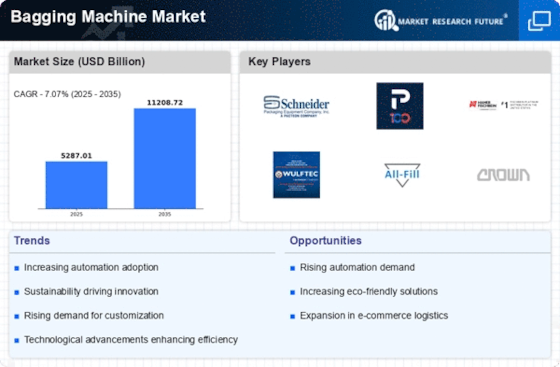
As per MRFR analysis, the Bagging Machine Market Size was estimated at 5287.01 USD Billion in 2024. The Bagging Machine industry is projected to grow from 5660.8 in 2025 to 11208.72 by 2035, exhibiting a compound annual growth rate (CAGR) of 7.07 during the forecast period 2025 - 2035.

Key Market Trends & Highlights

The Bagging Machine Market is experiencing robust growth driven by automation and sustainability trends.

  • North America remains the largest market for bagging machines, driven by advanced manufacturing capabilities. Asia-Pacific is emerging as the fastest-growing region, fueled by increasing industrialization and demand for efficient packaging solutions. Open Mouth Bagging Machines dominate the market, while Form Fill Seal Machines are witnessing rapid growth due to their efficiency. Rising demand for efficient packaging solutions and increasing focus on sustainability are key drivers propelling market expansion.

Market Size & Forecast

2024 Market Size 5287.01 (USD Billion)
2035 Market Size 11208.72 (USD Billion)
CAGR (2025 - 2035) 7.07%
Largest Regional Market Share in 2024 Asia Pacific

Major Players

<p>Schneider Packaging Equipment Co. (US), Premier Tech (CA), Hamer-Fischbein (US), Wulftec International (CA), All-Fill Inc. (US), Crown Equipment Corporation (US), Bosch Packaging Technology (DE), Schaefer Systems International (US)</p>

Market Trends

The Bagging Machine Market is currently experiencing a notable transformation, driven by advancements in technology and increasing demand for automation across various industries. Manufacturers are increasingly adopting innovative solutions to enhance efficiency and reduce operational costs. This shift towards automation is not merely a trend but appears to be a fundamental change in how products are packaged and distributed. As companies strive to meet consumer expectations for speed and accuracy, the integration of smart technologies into bagging machines is becoming more prevalent. Moreover, sustainability concerns are influencing the Bagging Machine Market, as businesses seek to minimize their environmental impact. The push for eco-friendly packaging solutions is prompting manufacturers to develop machines that can handle biodegradable and recyclable materials. This focus on sustainability not only aligns with global environmental goals but also caters to a growing consumer base that prioritizes eco-conscious products. As the market evolves, it seems likely that these trends will shape the future landscape of bagging technology, fostering a more efficient and responsible approach to packaging.

Automation and Smart Technology Integration

The Bagging Machine Market is witnessing a surge in the adoption of automation and smart technologies. This trend is characterized by the incorporation of advanced sensors, artificial intelligence, and machine learning capabilities into bagging systems. Such innovations enhance operational efficiency, reduce labor costs, and improve accuracy in packaging processes.

Sustainability and Eco-Friendly Solutions

A significant trend within the Bagging Machine Market is the increasing emphasis on sustainability. Manufacturers are responding to consumer demand for environmentally friendly packaging by developing machines capable of handling biodegradable and recyclable materials. This shift not only addresses environmental concerns but also aligns with corporate social responsibility initiatives.

Customization and Versatility in Design

The Bagging Machine Market is also experiencing a trend towards customization and versatility in machine design. As businesses seek to differentiate their products, bagging machines are being tailored to accommodate various sizes, shapes, and materials. This adaptability allows manufacturers to respond swiftly to changing market demands and consumer preferences.

Bagging Machine Market Market Drivers

Increasing Focus on Sustainability

Sustainability has emerged as a critical driver in the Bagging Machine Market. With growing environmental concerns, manufacturers are increasingly seeking eco-friendly packaging solutions that minimize waste and reduce carbon footprints. The demand for biodegradable and recyclable materials is on the rise, prompting bagging machine manufacturers to innovate and adapt their technologies accordingly. In 2025, it is estimated that the market for sustainable bagging solutions will grow by approximately 8%, reflecting a shift towards environmentally responsible practices. This trend is particularly relevant in industries such as agriculture and retail, where sustainable packaging is becoming a key differentiator. Consequently, the Bagging Machine Market is likely to evolve, with a greater emphasis on developing machines that support sustainable practices while maintaining efficiency and performance.

Growth of the Food and Beverage Sector

The Bagging Machine Market is significantly influenced by the growth of the food and beverage sector. As consumer preferences shift towards convenience and ready-to-eat products, manufacturers are compelled to adopt efficient bagging solutions to meet rising demand. In 2025, the food and beverage industry is expected to account for over 40% of the total bagging machine market share. This trend is driven by the need for hygienic and efficient packaging methods that ensure product safety and extend shelf life. Additionally, the increasing focus on sustainable packaging solutions further propels the demand for advanced bagging machines that can accommodate eco-friendly materials. As a result, the Bagging Machine Market is likely to witness robust growth, fueled by the evolving dynamics of the food and beverage landscape.

Rising Demand for Efficient Packaging Solutions

The Bagging Machine Market experiences a notable surge in demand for efficient packaging solutions across various sectors. As industries strive to enhance productivity and reduce operational costs, the adoption of advanced bagging machines becomes increasingly prevalent. In 2025, the market is projected to witness a growth rate of approximately 6.5%, driven by the need for automation in packaging processes. This trend is particularly evident in the food and beverage sector, where the requirement for quick and reliable packaging solutions is paramount. Furthermore, the rise of e-commerce has amplified the necessity for efficient bagging systems, as companies seek to streamline their supply chains and meet consumer expectations for timely deliveries. Consequently, the Bagging Machine Market is poised for substantial growth as businesses prioritize efficiency and speed in their packaging operations.

Technological Advancements in Bagging Machinery

Technological advancements play a pivotal role in shaping the Bagging Machine Market. Innovations such as smart technology integration and automation are revolutionizing the way bagging machines operate. The introduction of features like real-time monitoring, predictive maintenance, and enhanced user interfaces significantly improves operational efficiency. In 2025, it is anticipated that the market will see an increase in the adoption of these advanced technologies, with a projected market value reaching USD 1.2 billion. This growth is largely attributed to manufacturers' efforts to develop machines that not only meet but exceed industry standards. As companies increasingly invest in state-of-the-art bagging solutions, the Bagging Machine Market is likely to evolve, offering more sophisticated and efficient machinery that caters to diverse packaging needs.

Customization and Versatility in Bagging Solutions

Customization and versatility are increasingly recognized as vital components within the Bagging Machine Market. As businesses seek to differentiate their products, the demand for tailored bagging solutions that cater to specific requirements is on the rise. In 2025, it is projected that the market for customizable bagging machines will expand significantly, driven by the need for flexibility in packaging designs and sizes. This trend is particularly evident in sectors such as pharmaceuticals and consumer goods, where unique packaging can enhance brand identity and consumer appeal. Furthermore, the ability to adapt bagging machines for various materials and product types allows manufacturers to optimize their operations. As a result, the Bagging Machine Market is expected to witness a shift towards more versatile and customizable solutions that meet the diverse needs of modern businesses.


Market Segment Insights

By Product Type: Open Mouth Bagging Machines (Largest) vs. Form Fill Seal Machines (Fastest-Growing)

<p>The Bagging Machine Market is significantly influenced by various product types, each contributing to the overall growth. The Open Mouth Bagging Machines hold a major share in the market, dominating thanks to their efficiency in packaging bulk products. Following this, the Form Fill Seal Machines are recognized as the fastest-growing segment, driven by advancements in automation and increasing demand for flexible packaging solutions. Other segments like Valve Baggers, FIBC Machines, Roto Packaging, and Others also play crucial roles, although their shares remain relatively smaller. As businesses focus on improving operational efficiency and sustainability, the demand for specific bagging machines is evolving. The growing food &amp; beverage and chemical industries, in particular, are expanding the need for FIBC Machines and Roto Packaging Machines. Additionally, technological advancements are enhancing the functionality and performance of these machines. The market is set to continue shifting as traditional bagging methods give way to more innovative solutions, reflected by the increasing growth rates of emerging product types.</p>

<p>Open Mouth Bagging Machines (Dominant) vs. Form Fill Seal Machines (Emerging)</p>

<p>The Open Mouth Bagging Machines are characterized by their ability to handle a wide range of bulk materials and their high-speed operations, making them a preferred choice across several industries. These machines are robust, reliable, and easy to operate, solidifying their position as the dominant force in the Bagging Machine Market. Conversely, Form Fill Seal Machines offer a more modern approach, combining packaging and sealing in a single process which enhances efficiency and reduces operational costs. Their emergence is also propelled by growing consumer demands for packaging that extends shelf life and reduces waste. The rising trend towards automated solutions plays a significant role in their rapid adoption, as companies aim to streamline their packaging processes.</p>

By Automation Type: Automatic Bagging Machines (Largest) vs. Semi-Automatic Bagging Machines (Fastest-Growing)

<p>In the Bagging Machine Market, Automatic Bagging Machines hold the largest share, showcasing their dominance in terms of efficiency and productivity. These machines are preferred by large-scale manufacturers due to their ability to operate continuously with minimal human intervention, thus reducing labor costs and increasing throughput. In contrast, Semi-Automatic Bagging Machines are gaining traction among small to medium-sized enterprises. They provide greater flexibility and are easier to implement without the need for significant investment, which contributes to their growing popularity.</p>

<p>Bagging Solutions: Automatic (Dominant) vs. Semi-Automatic (Emerging)</p>

<p>Automatic bagging machines are recognized for their high-speed operations and efficiency, making them the go-to choice for industries requiring large-scale production. These machines can integrate seamlessly into production lines, optimizing workflow and reducing manual errors. On the other hand, Semi-Automatic Bagging Machines serve as an emerging solution, particularly appealing to businesses that may not require the extensive capabilities of fully automatic systems. They allow for greater adaptability and are often less demanding in terms of infrastructure, making them ideal for growing businesses that seek to enhance their bagging operations incrementally.</p>

By Machine Type: Vertical Bagging Machine Market (Largest) vs. Horizontal Bagging Machine Market (Fastest-Growing)

<p>In the Bagging Machine Market, the Vertical Bagging Machine Market holds a significant share, appealing primarily due to its high efficiency and ability to handle a variety of products with precision. This segment is favored in industries that require high speed and automation, ensuring packaged products maintain quality while reducing labor costs. Meanwhile, Horizontal Bagging Machines are emerging strongly, finding applications in sectors requiring robust and versatile packing solutions, thus gaining momentum in both share and consumer preference.</p>

<p>Bagging Type: Vertical (Dominant) vs. Horizontal (Emerging)</p>

<p>The Vertical Bagging Machine Market is characterized by its compact design and high throughput capabilities. It is ideal for lightweight products and offers versatility in bag sizes, making it a favorite among industries like food, pharmaceuticals, and consumer goods. On the other hand, the Horizontal Bagging Machine Market is emerging rapidly due to its ability to handle larger and bulkier items, reflecting trends towards sustainability and functional packaging. While it requires more floor space, its capacity to provide diverse packaging options makes it increasingly attractive to manufacturers seeking to innovate and meet consumer demands.</p>

By End-Use Industry: Food (Largest) vs. Chemicals (Fastest-Growing)

<p>In the Bagging Machine Market, the Food industry holds the largest share, driven by the increasing demand for efficient packaging solutions that ensure product safety and longevity. The market distribution shows notable segments, with Building Materials and Minerals also contributing significantly, yet none rival Food's commanding position. Coupled with their large output requirements, these sectors continue to favor automated solutions for handling bulk items, highlighting a robust growth opportunity for bagging machines in these applications. On the other hand, the Chemicals sector is rapidly emerging as the fastest-growing segment within the Bagging Machine Market. The push for sustainable and efficient production methods in chemical manufacturing is fueling innovation in bagging technologies. As stringent regulations and environmental concerns become more prevalent, chemical companies are increasingly adopting bagging solutions that enhance operational efficiency and reduce waste, marking this sector as one poised for significant growth in the coming years.</p>

<p>Food (Dominant) vs. Chemicals (Emerging)</p>

<p>The Food segment in the Bagging Machine Market is characterized by its established dominance, driven by food safety regulations and the need for hygienic packaging solutions. This segment thrives on the versatility of bagging machines in handling various food types, from grains to liquids, and the continuous innovation in packaging technologies. In contrast, the Chemicals segment, although currently smaller, is classified as emerging due to the rising adoption of automated bagging systems aimed at meeting regulatory standards and improving operational efficiencies. This shift is influenced by the growing demand for eco-friendly packaging solutions and the necessity for precise and efficient handling of chemical products. As a result, both sectors exhibit unique but complementary characteristics that shape the market landscape.</p>

By Bag Size: 5.1 kg-25 kg (Largest) vs. More than 50 kg (Fastest-Growing)

<p>The Bagging Machine Market exhibits a diverse distribution of bag sizes, predominantly dominated by the 5.1 kg-25 kg segment, which captures a significant portion of market share. This range appeals particularly to industries that require moderate packaging solutions, such as food processing and agriculture. In contrast, the smaller 0.1 kg-5 kg segment holds a smaller market share but serves niche sectors like spices and small-scale manufacturing. The larger than 50 kg segment, while comparatively smaller, is rapidly gaining traction due to the increasing demand from bulk manufacturing and logistics sectors. The growth trends within the Bagging Machine Market are significantly influenced by the rising automation in packaging processes and the expanding e-commerce sector. The 5.1 kg-25 kg segment benefits from a consistent demand in consumer goods and agricultural products, whereas the more than 50 kg segment is experiencing the most substantial growth, driven by industries that require high-capacity packaging solutions. Technological advancements and increased production efficiency are critical drivers propelling this segment forward, reflecting a shift towards larger operational scales in the manufacturing and logistics industries.</p>

<p>5.1 kg-25 kg (Dominant) vs. More than 50 kg (Emerging)</p>

<p>The 5.1 kg-25 kg bag size segment stands as a dominant force in the Bagging Machine Market, catering to a wide array of industries including food, agricultural products, and chemicals. This segment is pivotal for companies focused on packaging products ranging from grains to pet food, offering versatility and efficiency in packaging operations. The ease of handling and compatibility with various filling and sealing technologies makes this bag size a preferred choice among manufacturers. In contrast, the more than 50 kg segment, while considered emerging, is gaining momentum particularly in heavy industries like construction and bulk material handling. Demand in this segment is driven by the necessity for economies of scale and the need for robust packaging solutions that ensure product integrity during transport.</p>

Get more detailed insights about Bagging Machine Market Research Report—Global Forecast till 2035

Regional Insights

North America : Innovation and Demand Surge

North America is witnessing robust growth in the bagging machine market, driven by increasing automation in manufacturing and rising demand for packaged goods. The region holds the largest market share at approximately 40%, with the U.S. leading due to its advanced manufacturing capabilities and technological innovations. Regulatory support for automation and efficiency further fuels this growth. The competitive landscape is dominated by key players such as Schneider Packaging Equipment Co., Hamer-Fischbein, and All-Fill Inc. These companies are leveraging advanced technologies to enhance product offerings. The U.S. market is characterized by a strong focus on R&D, with significant investments aimed at improving efficiency and sustainability in packaging processes. Canada also plays a vital role, contributing to the region's overall market strength.

Europe : Sustainability and Innovation Focus

Europe is emerging as a significant player in the bagging machine market, driven by stringent regulations on packaging waste and a strong emphasis on sustainability. The region holds the second-largest market share at around 30%. Countries like Germany and France are at the forefront, implementing policies that encourage the adoption of eco-friendly packaging solutions, thus boosting demand for advanced bagging technologies. Leading countries in Europe are Germany, France, and the UK, with a competitive landscape featuring major players like Bosch Packaging Technology. The market is characterized by innovation, with companies investing in smart technologies and automation to meet regulatory requirements and consumer preferences for sustainable packaging. The European market is also seeing collaborations between manufacturers and regulatory bodies to enhance compliance and efficiency.

Asia-Pacific : Rapid Growth and Expansion

The Asia-Pacific region is experiencing rapid growth in the bagging machine market, driven by increasing industrialization and urbanization. Countries like China and India are leading this growth, with the region holding a market share of approximately 25%. The demand for efficient packaging solutions in food and beverage, pharmaceuticals, and consumer goods sectors is a key driver, supported by favorable government policies promoting manufacturing and exports. China is the largest market in the region, with significant investments in automation and technology upgrades. The competitive landscape includes local and international players, with companies like Wulftec International and Crown Equipment Corporation expanding their presence. The region is also witnessing a surge in startups focusing on innovative packaging solutions, further enhancing market dynamics.

Middle East and Africa : Emerging Markets and Opportunities

The Middle East and Africa (MEA) region is gradually emerging in the bagging machine market, driven by increasing investments in infrastructure and manufacturing. The region holds a smaller market share of around 5%, but countries like South Africa and the UAE are showing promising growth trends. The demand for efficient packaging solutions in various sectors, including agriculture and construction, is a significant driver, supported by government initiatives to boost local manufacturing. South Africa is leading the market in the region, with a growing number of manufacturers adopting advanced bagging technologies. The competitive landscape is evolving, with both local and international players vying for market share. Companies are focusing on innovation and sustainability to meet the unique needs of the MEA market, creating opportunities for growth and collaboration.

Key Companies in the Bagging Machine Market market include

Industry Developments

Few developments that occurred in recent times influencing the market growth of Bagging machine are listed below:

  • In March 2021,Fres-co System USA, Inc., announced to launch packaging printing services with the addition of digital printing capabilities. Fres-co’s traditional flexographic and rotogravure printing services are supplemented with digital printing, expanding the options accessible to customers in the coffee, food, pet food, and chemical industries.

Future Outlook

Bagging Machine Market Future Outlook

<p>The Bagging Machine Market is projected to grow at a 7.07% CAGR from 2024 to 2035, driven by automation, demand for efficiency, and sustainability initiatives.</p>

New opportunities lie in:

  • <p>Integration of AI for predictive maintenance solutions.</p><p>Expansion into emerging markets with tailored bagging solutions.</p><p>Development of eco-friendly packaging materials for bagging machines.</p>

<p>By 2035, the Bagging Machine Market is expected to achieve robust growth, reflecting evolving industry demands.</p>

Market Segmentation

Bagging Machine Market Bag Size Outlook

  • 0.1 kg-5 kg
  • 5.1 kg-25 kg
  • 25.1 kg-50 kg
  • More than 50 kg

Bagging Machine Market Machine Type Outlook

  • Vertical bagging machine
  • Horizontal bagging machine

Bagging Machine Market Product Type Outlook

  • Open mouth bagging machines
  • Form fill seal machine
  • Valve bagger machine
  • FIBC machine
  • Roto packaging machines
  • Others

Bagging Machine Market Automation Type Outlook

  • Automatic bagging machines
  • Semi-automatic bagging machines

Bagging Machine Market End-Use Industry Outlook

  • Food
  • Building materials
  • Minerals
  • Chemical
  • Others

Report Scope

MARKET SIZE 20245287.01(USD Billion)
MARKET SIZE 20255660.8(USD Billion)
MARKET SIZE 203511208.72(USD Billion)
COMPOUND ANNUAL GROWTH RATE (CAGR)7.07% (2024 - 2035)
REPORT COVERAGERevenue Forecast, Competitive Landscape, Growth Factors, and Trends
BASE YEAR2024
Market Forecast Period2025 - 2035
Historical Data2019 - 2024
Market Forecast UnitsUSD Billion
Key Companies ProfiledMarket analysis in progress
Segments CoveredMarket segmentation analysis in progress
Key Market OpportunitiesIntegration of automation and smart technology enhances efficiency in the Bagging Machine Market.
Key Market DynamicsTechnological advancements and automation drive efficiency in the bagging machine market, reshaping competitive dynamics.
Countries CoveredNorth America, Europe, APAC, South America, MEA

FAQs

  1. SECTION I: EXECUTIVE SUMMARY AND KEY HIGHLIGHTS
    1. EXECUTIVE SUMMARY
      1. Market Overview
      2. Key Findings
      3. Market Segmentation
      4. Competitive Landscape
      5. Challenges and Opportunities
      6. Future Outlook 2
  2. SECTION II: SCOPING, METHODOLOGY AND MARKET STRUCTURE
    1. MARKET INTRODUCTION
      1. Definition
      2. Scope of the study
    2. RESEARCH METHODOLOGY
      1. Overview
      2. Data Mining
      3. Secondary Research
      4. Primary Research
      5. Forecasting Model
      6. Market Size Estimation
      7. Data Triangulation
      8. Validation 3
  3. SECTION III: QUALITATIVE ANALYSIS
    1. MARKET DYNAMICS
      1. Overview
      2. Drivers
      3. Restraints
      4. Opportunities
    2. MARKET FACTOR ANALYSIS
      1. Value chain Analysis
      2. Porter's Five Forces Analysis
      3. COVID-19 Impact Analysis
  4. SECTION IV: QUANTITATIVE ANALYSIS
    1. Construction, BY Product Type (USD Billion)
      1. Open mouth bagging machines
      2. Form fill seal machine
      3. Valve bagger machine
      4. FIBC machine
      5. Roto packaging machines
      6. Others
    2. Construction, BY Automation Type (USD Billion)
      1. Automatic bagging machines
      2. Semi-automatic bagging machines
    3. Construction, BY Machine Type (USD Billion)
      1. Vertical bagging machine
      2. Horizontal bagging machine
    4. Construction, BY End-Use Industry (USD Billion)
      1. Food
      2. Building materials
      3. Minerals
      4. Chemical
      5. Others
    5. Construction, BY Bag Size (USD Billion)
    6. kg-5 kg
    7. kg-25 kg
    8. kg-50 kg
      1. More than 50 kg
    9. Construction, BY Region (USD Billion)
      1. North America
      2. Europe
      3. APAC
      4. South America
      5. MEA
  5. SECTION V: COMPETITIVE ANALYSIS
    1. Competitive Landscape
      1. Overview
      2. Competitive Analysis
      3. Market share Analysis
      4. Major Growth Strategy in the Construction
      5. Competitive Benchmarking
      6. Leading Players in Terms of Number of Developments in the Construction
      7. Key developments and growth strategies
      8. Major Players Financial Matrix
    2. Company Profiles
      1. Schneider Packaging Equipment Co. (US)
      2. Premier Tech (CA)
      3. Hamer-Fischbein (US)
      4. Wulftec International (CA)
      5. All-Fill Inc. (US)
      6. Crown Equipment Corporation (US)
      7. Bosch Packaging Technology (DE)
      8. Schaefer Systems International (US)
    3. Appendix
      1. References
      2. Related Reports 6 LIST OF FIGURES
    4. MARKET SYNOPSIS
    5. NORTH AMERICA MARKET ANALYSIS
    6. US MARKET ANALYSIS BY PRODUCT TYPE
    7. US MARKET ANALYSIS BY AUTOMATION TYPE
    8. US MARKET ANALYSIS BY MACHINE TYPE
    9. US MARKET ANALYSIS BY END-USE INDUSTRY
    10. US MARKET ANALYSIS BY BAG SIZE
    11. CANADA MARKET ANALYSIS BY PRODUCT TYPE
    12. CANADA MARKET ANALYSIS BY AUTOMATION TYPE
    13. CANADA MARKET ANALYSIS BY MACHINE TYPE
    14. CANADA MARKET ANALYSIS BY END-USE INDUSTRY
    15. CANADA MARKET ANALYSIS BY BAG SIZE
    16. EUROPE MARKET ANALYSIS
    17. GERMANY MARKET ANALYSIS BY PRODUCT TYPE
    18. GERMANY MARKET ANALYSIS BY AUTOMATION TYPE
    19. GERMANY MARKET ANALYSIS BY MACHINE TYPE
    20. GERMANY MARKET ANALYSIS BY END-USE INDUSTRY
    21. GERMANY MARKET ANALYSIS BY BAG SIZE
    22. UK MARKET ANALYSIS BY PRODUCT TYPE
    23. UK MARKET ANALYSIS BY AUTOMATION TYPE
    24. UK MARKET ANALYSIS BY MACHINE TYPE
    25. UK MARKET ANALYSIS BY END-USE INDUSTRY
    26. UK MARKET ANALYSIS BY BAG SIZE
    27. FRANCE MARKET ANALYSIS BY PRODUCT TYPE
    28. FRANCE MARKET ANALYSIS BY AUTOMATION TYPE
    29. FRANCE MARKET ANALYSIS BY MACHINE TYPE
    30. FRANCE MARKET ANALYSIS BY END-USE INDUSTRY
    31. FRANCE MARKET ANALYSIS BY BAG SIZE
    32. RUSSIA MARKET ANALYSIS BY PRODUCT TYPE
    33. RUSSIA MARKET ANALYSIS BY AUTOMATION TYPE
    34. RUSSIA MARKET ANALYSIS BY MACHINE TYPE
    35. RUSSIA MARKET ANALYSIS BY END-USE INDUSTRY
    36. RUSSIA MARKET ANALYSIS BY BAG SIZE
    37. ITALY MARKET ANALYSIS BY PRODUCT TYPE
    38. ITALY MARKET ANALYSIS BY AUTOMATION TYPE
    39. ITALY MARKET ANALYSIS BY MACHINE TYPE
    40. ITALY MARKET ANALYSIS BY END-USE INDUSTRY
    41. ITALY MARKET ANALYSIS BY BAG SIZE
    42. SPAIN MARKET ANALYSIS BY PRODUCT TYPE
    43. SPAIN MARKET ANALYSIS BY AUTOMATION TYPE
    44. SPAIN MARKET ANALYSIS BY MACHINE TYPE
    45. SPAIN MARKET ANALYSIS BY END-USE INDUSTRY
    46. SPAIN MARKET ANALYSIS BY BAG SIZE
    47. REST OF EUROPE MARKET ANALYSIS BY PRODUCT TYPE
    48. REST OF EUROPE MARKET ANALYSIS BY AUTOMATION TYPE
    49. REST OF EUROPE MARKET ANALYSIS BY MACHINE TYPE
    50. REST OF EUROPE MARKET ANALYSIS BY END-USE INDUSTRY
    51. REST OF EUROPE MARKET ANALYSIS BY BAG SIZE
    52. APAC MARKET ANALYSIS
    53. CHINA MARKET ANALYSIS BY PRODUCT TYPE
    54. CHINA MARKET ANALYSIS BY AUTOMATION TYPE
    55. CHINA MARKET ANALYSIS BY MACHINE TYPE
    56. CHINA MARKET ANALYSIS BY END-USE INDUSTRY
    57. CHINA MARKET ANALYSIS BY BAG SIZE
    58. INDIA MARKET ANALYSIS BY PRODUCT TYPE
    59. INDIA MARKET ANALYSIS BY AUTOMATION TYPE
    60. INDIA MARKET ANALYSIS BY MACHINE TYPE
    61. INDIA MARKET ANALYSIS BY END-USE INDUSTRY
    62. INDIA MARKET ANALYSIS BY BAG SIZE
    63. JAPAN MARKET ANALYSIS BY PRODUCT TYPE
    64. JAPAN MARKET ANALYSIS BY AUTOMATION TYPE
    65. JAPAN MARKET ANALYSIS BY MACHINE TYPE
    66. JAPAN MARKET ANALYSIS BY END-USE INDUSTRY
    67. JAPAN MARKET ANALYSIS BY BAG SIZE
    68. SOUTH KOREA MARKET ANALYSIS BY PRODUCT TYPE
    69. SOUTH KOREA MARKET ANALYSIS BY AUTOMATION TYPE
    70. SOUTH KOREA MARKET ANALYSIS BY MACHINE TYPE
    71. SOUTH KOREA MARKET ANALYSIS BY END-USE INDUSTRY
    72. SOUTH KOREA MARKET ANALYSIS BY BAG SIZE
    73. MALAYSIA MARKET ANALYSIS BY PRODUCT TYPE
    74. MALAYSIA MARKET ANALYSIS BY AUTOMATION TYPE
    75. MALAYSIA MARKET ANALYSIS BY MACHINE TYPE
    76. MALAYSIA MARKET ANALYSIS BY END-USE INDUSTRY
    77. MALAYSIA MARKET ANALYSIS BY BAG SIZE
    78. THAILAND MARKET ANALYSIS BY PRODUCT TYPE
    79. THAILAND MARKET ANALYSIS BY AUTOMATION TYPE
    80. THAILAND MARKET ANALYSIS BY MACHINE TYPE
    81. THAILAND MARKET ANALYSIS BY END-USE INDUSTRY
    82. THAILAND MARKET ANALYSIS BY BAG SIZE
    83. INDONESIA MARKET ANALYSIS BY PRODUCT TYPE
    84. INDONESIA MARKET ANALYSIS BY AUTOMATION TYPE
    85. INDONESIA MARKET ANALYSIS BY MACHINE TYPE
    86. INDONESIA MARKET ANALYSIS BY END-USE INDUSTRY
    87. INDONESIA MARKET ANALYSIS BY BAG SIZE
    88. REST OF APAC MARKET ANALYSIS BY PRODUCT TYPE
    89. REST OF APAC MARKET ANALYSIS BY AUTOMATION TYPE
    90. REST OF APAC MARKET ANALYSIS BY MACHINE TYPE
    91. REST OF APAC MARKET ANALYSIS BY END-USE INDUSTRY
    92. REST OF APAC MARKET ANALYSIS BY BAG SIZE
    93. SOUTH AMERICA MARKET ANALYSIS
    94. BRAZIL MARKET ANALYSIS BY PRODUCT TYPE
    95. BRAZIL MARKET ANALYSIS BY AUTOMATION TYPE
    96. BRAZIL MARKET ANALYSIS BY MACHINE TYPE
    97. BRAZIL MARKET ANALYSIS BY END-USE INDUSTRY
    98. BRAZIL MARKET ANALYSIS BY BAG SIZE
    99. MEXICO MARKET ANALYSIS BY PRODUCT TYPE
    100. MEXICO MARKET ANALYSIS BY AUTOMATION TYPE
    101. MEXICO MARKET ANALYSIS BY MACHINE TYPE
    102. MEXICO MARKET ANALYSIS BY END-USE INDUSTRY
    103. MEXICO MARKET ANALYSIS BY BAG SIZE
    104. ARGENTINA MARKET ANALYSIS BY PRODUCT TYPE
    105. ARGENTINA MARKET ANALYSIS BY AUTOMATION TYPE
    106. ARGENTINA MARKET ANALYSIS BY MACHINE TYPE
    107. ARGENTINA MARKET ANALYSIS BY END-USE INDUSTRY
    108. ARGENTINA MARKET ANALYSIS BY BAG SIZE
    109. REST OF SOUTH AMERICA MARKET ANALYSIS BY PRODUCT TYPE
    110. REST OF SOUTH AMERICA MARKET ANALYSIS BY AUTOMATION TYPE
    111. REST OF SOUTH AMERICA MARKET ANALYSIS BY MACHINE TYPE
    112. REST OF SOUTH AMERICA MARKET ANALYSIS BY END-USE INDUSTRY
    113. REST OF SOUTH AMERICA MARKET ANALYSIS BY BAG SIZE
    114. MEA MARKET ANALYSIS
    115. GCC COUNTRIES MARKET ANALYSIS BY PRODUCT TYPE
    116. GCC COUNTRIES MARKET ANALYSIS BY AUTOMATION TYPE
    117. GCC COUNTRIES MARKET ANALYSIS BY MACHINE TYPE
    118. GCC COUNTRIES MARKET ANALYSIS BY END-USE INDUSTRY
    119. GCC COUNTRIES MARKET ANALYSIS BY BAG SIZE
    120. SOUTH AFRICA MARKET ANALYSIS BY PRODUCT TYPE
    121. SOUTH AFRICA MARKET ANALYSIS BY AUTOMATION TYPE
    122. SOUTH AFRICA MARKET ANALYSIS BY MACHINE TYPE
    123. SOUTH AFRICA MARKET ANALYSIS BY END-USE INDUSTRY
    124. SOUTH AFRICA MARKET ANALYSIS BY BAG SIZE
    125. REST OF MEA MARKET ANALYSIS BY PRODUCT TYPE
    126. REST OF MEA MARKET ANALYSIS BY AUTOMATION TYPE
    127. REST OF MEA MARKET ANALYSIS BY MACHINE TYPE
    128. REST OF MEA MARKET ANALYSIS BY END-USE INDUSTRY
    129. REST OF MEA MARKET ANALYSIS BY BAG SIZE
    130. KEY BUYING CRITERIA OF CONSTRUCTION
    131. RESEARCH PROCESS OF MRFR
    132. DRO ANALYSIS OF CONSTRUCTION
    133. DRIVERS IMPACT ANALYSIS: CONSTRUCTION
    134. RESTRAINTS IMPACT ANALYSIS: CONSTRUCTION
    135. SUPPLY / VALUE CHAIN: CONSTRUCTION
    136. CONSTRUCTION, BY PRODUCT TYPE, 2024 (% SHARE)
    137. CONSTRUCTION, BY PRODUCT TYPE, 2024 TO 2035 (USD Billion)
    138. CONSTRUCTION, BY AUTOMATION TYPE, 2024 (% SHARE)
    139. CONSTRUCTION, BY AUTOMATION TYPE, 2024 TO 2035 (USD Billion)
    140. CONSTRUCTION, BY MACHINE TYPE, 2024 (% SHARE)
    141. CONSTRUCTION, BY MACHINE TYPE, 2024 TO 2035 (USD Billion)
    142. CONSTRUCTION, BY END-USE INDUSTRY, 2024 (% SHARE)
    143. CONSTRUCTION, BY END-USE INDUSTRY, 2024 TO 2035 (USD Billion)
    144. CONSTRUCTION, BY BAG SIZE, 2024 (% SHARE)
    145. CONSTRUCTION, BY BAG SIZE, 2024 TO 2035 (USD Billion)
    146. BENCHMARKING OF MAJOR COMPETITORS 7 LIST OF TABLES
    147. LIST OF ASSUMPTIONS
    148. North America MARKET SIZE ESTIMATES; FORECAST
      1. BY PRODUCT TYPE, 2025-2035 (USD Billion)
      2. BY AUTOMATION TYPE, 2025-2035 (USD Billion)
      3. BY MACHINE TYPE, 2025-2035 (USD Billion)
      4. BY END-USE INDUSTRY, 2025-2035 (USD Billion)
      5. BY BAG SIZE, 2025-2035 (USD Billion)
    149. US MARKET SIZE ESTIMATES; FORECAST
      1. BY PRODUCT TYPE, 2025-2035 (USD Billion)
      2. BY AUTOMATION TYPE, 2025-2035 (USD Billion)
      3. BY MACHINE TYPE, 2025-2035 (USD Billion)
      4. BY END-USE INDUSTRY, 2025-2035 (USD Billion)
      5. BY BAG SIZE, 2025-2035 (USD Billion)
    150. Canada MARKET SIZE ESTIMATES; FORECAST
      1. BY PRODUCT TYPE, 2025-2035 (USD Billion)
      2. BY AUTOMATION TYPE, 2025-2035 (USD Billion)
      3. BY MACHINE TYPE, 2025-2035 (USD Billion)
      4. BY END-USE INDUSTRY, 2025-2035 (USD Billion)
      5. BY BAG SIZE, 2025-2035 (USD Billion)
    151. Europe MARKET SIZE ESTIMATES; FORECAST
      1. BY PRODUCT TYPE, 2025-2035 (USD Billion)
      2. BY AUTOMATION TYPE, 2025-2035 (USD Billion)
      3. BY MACHINE TYPE, 2025-2035 (USD Billion)
      4. BY END-USE INDUSTRY, 2025-2035 (USD Billion)
      5. BY BAG SIZE, 2025-2035 (USD Billion)
    152. Germany MARKET SIZE ESTIMATES; FORECAST
      1. BY PRODUCT TYPE, 2025-2035 (USD Billion)
      2. BY AUTOMATION TYPE, 2025-2035 (USD Billion)
      3. BY MACHINE TYPE, 2025-2035 (USD Billion)
      4. BY END-USE INDUSTRY, 2025-2035 (USD Billion)
      5. BY BAG SIZE, 2025-2035 (USD Billion)
    153. UK MARKET SIZE ESTIMATES; FORECAST
      1. BY PRODUCT TYPE, 2025-2035 (USD Billion)
      2. BY AUTOMATION TYPE, 2025-2035 (USD Billion)
      3. BY MACHINE TYPE, 2025-2035 (USD Billion)
      4. BY END-USE INDUSTRY, 2025-2035 (USD Billion)
      5. BY BAG SIZE, 2025-2035 (USD Billion)
    154. France MARKET SIZE ESTIMATES; FORECAST
      1. BY PRODUCT TYPE, 2025-2035 (USD Billion)
      2. BY AUTOMATION TYPE, 2025-2035 (USD Billion)
      3. BY MACHINE TYPE, 2025-2035 (USD Billion)
      4. BY END-USE INDUSTRY, 2025-2035 (USD Billion)
      5. BY BAG SIZE, 2025-2035 (USD Billion)
    155. Russia MARKET SIZE ESTIMATES; FORECAST
      1. BY PRODUCT TYPE, 2025-2035 (USD Billion)
      2. BY AUTOMATION TYPE, 2025-2035 (USD Billion)
      3. BY MACHINE TYPE, 2025-2035 (USD Billion)
      4. BY END-USE INDUSTRY, 2025-2035 (USD Billion)
      5. BY BAG SIZE, 2025-2035 (USD Billion)
    156. Italy MARKET SIZE ESTIMATES; FORECAST
      1. BY PRODUCT TYPE, 2025-2035 (USD Billion)
      2. BY AUTOMATION TYPE, 2025-2035 (USD Billion)
      3. BY MACHINE TYPE, 2025-2035 (USD Billion)
      4. BY END-USE INDUSTRY, 2025-2035 (USD Billion)
      5. BY BAG SIZE, 2025-2035 (USD Billion)
    157. Spain MARKET SIZE ESTIMATES; FORECAST
      1. BY PRODUCT TYPE, 2025-2035 (USD Billion)
      2. BY AUTOMATION TYPE, 2025-2035 (USD Billion)
      3. BY MACHINE TYPE, 2025-2035 (USD Billion)
      4. BY END-USE INDUSTRY, 2025-2035 (USD Billion)
      5. BY BAG SIZE, 2025-2035 (USD Billion)
    158. Rest of Europe MARKET SIZE ESTIMATES; FORECAST
      1. BY PRODUCT TYPE, 2025-2035 (USD Billion)
      2. BY AUTOMATION TYPE, 2025-2035 (USD Billion)
      3. BY MACHINE TYPE, 2025-2035 (USD Billion)
      4. BY END-USE INDUSTRY, 2025-2035 (USD Billion)
      5. BY BAG SIZE, 2025-2035 (USD Billion)
    159. APAC MARKET SIZE ESTIMATES; FORECAST
      1. BY PRODUCT TYPE, 2025-2035 (USD Billion)
      2. BY AUTOMATION TYPE, 2025-2035 (USD Billion)
      3. BY MACHINE TYPE, 2025-2035 (USD Billion)
      4. BY END-USE INDUSTRY, 2025-2035 (USD Billion)
      5. BY BAG SIZE, 2025-2035 (USD Billion)
    160. China MARKET SIZE ESTIMATES; FORECAST
      1. BY PRODUCT TYPE, 2025-2035 (USD Billion)
      2. BY AUTOMATION TYPE, 2025-2035 (USD Billion)
      3. BY MACHINE TYPE, 2025-2035 (USD Billion)
      4. BY END-USE INDUSTRY, 2025-2035 (USD Billion)
      5. BY BAG SIZE, 2025-2035 (USD Billion)
    161. India MARKET SIZE ESTIMATES; FORECAST
      1. BY PRODUCT TYPE, 2025-2035 (USD Billion)
      2. BY AUTOMATION TYPE, 2025-2035 (USD Billion)
      3. BY MACHINE TYPE, 2025-2035 (USD Billion)
      4. BY END-USE INDUSTRY, 2025-2035 (USD Billion)
      5. BY BAG SIZE, 2025-2035 (USD Billion)
    162. Japan MARKET SIZE ESTIMATES; FORECAST
      1. BY PRODUCT TYPE, 2025-2035 (USD Billion)
      2. BY AUTOMATION TYPE, 2025-2035 (USD Billion)
      3. BY MACHINE TYPE, 2025-2035 (USD Billion)
      4. BY END-USE INDUSTRY, 2025-2035 (USD Billion)
      5. BY BAG SIZE, 2025-2035 (USD Billion)
    163. South Korea MARKET SIZE ESTIMATES; FORECAST
      1. BY PRODUCT TYPE, 2025-2035 (USD Billion)
      2. BY AUTOMATION TYPE, 2025-2035 (USD Billion)
      3. BY MACHINE TYPE, 2025-2035 (USD Billion)
      4. BY END-USE INDUSTRY, 2025-2035 (USD Billion)
      5. BY BAG SIZE, 2025-2035 (USD Billion)
    164. Malaysia MARKET SIZE ESTIMATES; FORECAST
      1. BY PRODUCT TYPE, 2025-2035 (USD Billion)
      2. BY AUTOMATION TYPE, 2025-2035 (USD Billion)
      3. BY MACHINE TYPE, 2025-2035 (USD Billion)
      4. BY END-USE INDUSTRY, 2025-2035 (USD Billion)
      5. BY BAG SIZE, 2025-2035 (USD Billion)
    165. Thailand MARKET SIZE ESTIMATES; FORECAST
      1. BY PRODUCT TYPE, 2025-2035 (USD Billion)
      2. BY AUTOMATION TYPE, 2025-2035 (USD Billion)
      3. BY MACHINE TYPE, 2025-2035 (USD Billion)
      4. BY END-USE INDUSTRY, 2025-2035 (USD Billion)
      5. BY BAG SIZE, 2025-2035 (USD Billion)
    166. Indonesia MARKET SIZE ESTIMATES; FORECAST
      1. BY PRODUCT TYPE, 2025-2035 (USD Billion)
      2. BY AUTOMATION TYPE, 2025-2035 (USD Billion)
      3. BY MACHINE TYPE, 2025-2035 (USD Billion)
      4. BY END-USE INDUSTRY, 2025-2035 (USD Billion)
      5. BY BAG SIZE, 2025-2035 (USD Billion)
    167. Rest of APAC MARKET SIZE ESTIMATES; FORECAST
      1. BY PRODUCT TYPE, 2025-2035 (USD Billion)
      2. BY AUTOMATION TYPE, 2025-2035 (USD Billion)
      3. BY MACHINE TYPE, 2025-2035 (USD Billion)
      4. BY END-USE INDUSTRY, 2025-2035 (USD Billion)
      5. BY BAG SIZE, 2025-2035 (USD Billion)
    168. South America MARKET SIZE ESTIMATES; FORECAST
      1. BY PRODUCT TYPE, 2025-2035 (USD Billion)
      2. BY AUTOMATION TYPE, 2025-2035 (USD Billion)
      3. BY MACHINE TYPE, 2025-2035 (USD Billion)
      4. BY END-USE INDUSTRY, 2025-2035 (USD Billion)
      5. BY BAG SIZE, 2025-2035 (USD Billion)
    169. Brazil MARKET SIZE ESTIMATES; FORECAST
      1. BY PRODUCT TYPE, 2025-2035 (USD Billion)
      2. BY AUTOMATION TYPE, 2025-2035 (USD Billion)
      3. BY MACHINE TYPE, 2025-2035 (USD Billion)
      4. BY END-USE INDUSTRY, 2025-2035 (USD Billion)
      5. BY BAG SIZE, 2025-2035 (USD Billion)
    170. Mexico MARKET SIZE ESTIMATES; FORECAST
      1. BY PRODUCT TYPE, 2025-2035 (USD Billion)
      2. BY AUTOMATION TYPE, 2025-2035 (USD Billion)
      3. BY MACHINE TYPE, 2025-2035 (USD Billion)
      4. BY END-USE INDUSTRY, 2025-2035 (USD Billion)
      5. BY BAG SIZE, 2025-2035 (USD Billion)
    171. Argentina MARKET SIZE ESTIMATES; FORECAST
      1. BY PRODUCT TYPE, 2025-2035 (USD Billion)
      2. BY AUTOMATION TYPE, 2025-2035 (USD Billion)
      3. BY MACHINE TYPE, 2025-2035 (USD Billion)
      4. BY END-USE INDUSTRY, 2025-2035 (USD Billion)
      5. BY BAG SIZE, 2025-2035 (USD Billion)
    172. Rest of South America MARKET SIZE ESTIMATES; FORECAST
      1. BY PRODUCT TYPE, 2025-2035 (USD Billion)
      2. BY AUTOMATION TYPE, 2025-2035 (USD Billion)
      3. BY MACHINE TYPE, 2025-2035 (USD Billion)
      4. BY END-USE INDUSTRY, 2025-2035 (USD Billion)
      5. BY BAG SIZE, 2025-2035 (USD Billion)
    173. MEA MARKET SIZE ESTIMATES; FORECAST
      1. BY PRODUCT TYPE, 2025-2035 (USD Billion)
      2. BY AUTOMATION TYPE, 2025-2035 (USD Billion)
      3. BY MACHINE TYPE, 2025-2035 (USD Billion)
      4. BY END-USE INDUSTRY, 2025-2035 (USD Billion)
      5. BY BAG SIZE, 2025-2035 (USD Billion)
    174. GCC Countries MARKET SIZE ESTIMATES; FORECAST
      1. BY PRODUCT TYPE, 2025-2035 (USD Billion)
      2. BY AUTOMATION TYPE, 2025-2035 (USD Billion)
      3. BY MACHINE TYPE, 2025-2035 (USD Billion)
      4. BY END-USE INDUSTRY, 2025-2035 (USD Billion)
      5. BY BAG SIZE, 2025-2035 (USD Billion)
    175. South Africa MARKET SIZE ESTIMATES; FORECAST
      1. BY PRODUCT TYPE, 2025-2035 (USD Billion)
      2. BY AUTOMATION TYPE, 2025-2035 (USD Billion)
      3. BY MACHINE TYPE, 2025-2035 (USD Billion)
      4. BY END-USE INDUSTRY, 2025-2035 (USD Billion)
      5. BY BAG SIZE, 2025-2035 (USD Billion)
    176. Rest of MEA MARKET SIZE ESTIMATES; FORECAST
      1. BY PRODUCT TYPE, 2025-2035 (USD Billion)
      2. BY AUTOMATION TYPE, 2025-2035 (USD Billion)
      3. BY MACHINE TYPE, 2025-2035 (USD Billion)
      4. BY END-USE INDUSTRY, 2025-2035 (USD Billion)
      5. BY BAG SIZE, 2025-2035 (USD Billion)
    177. PRODUCT LAUNCH/PRODUCT DEVELOPMENT/APPROVAL
    178. ACQUISITION/PARTNERSHIP

Bagging Machine Market Segmentation

Market Segmentation Overview

  • Detailed segmentation data will be available in the full report
  • Comprehensive analysis by multiple parameters
  • Regional and country-level breakdowns
  • Market size forecasts by segment
Infographic

Free Sample Request

Kindly complete the form below to receive a free sample of this Report

Get Free Sample

Customer Strories

Compare Licence

×
Features License Type
Single User Multiuser License Enterprise User
Price $4,950 $5,950 $7,250
Maximum User Access Limit 1 User Upto 10 Users Unrestricted Access Throughout the Organization
Free Customization
Direct Access to Analyst
Deliverable Format
Platform Access
Discount on Next Purchase 10% 15% 15%
Printable Versions