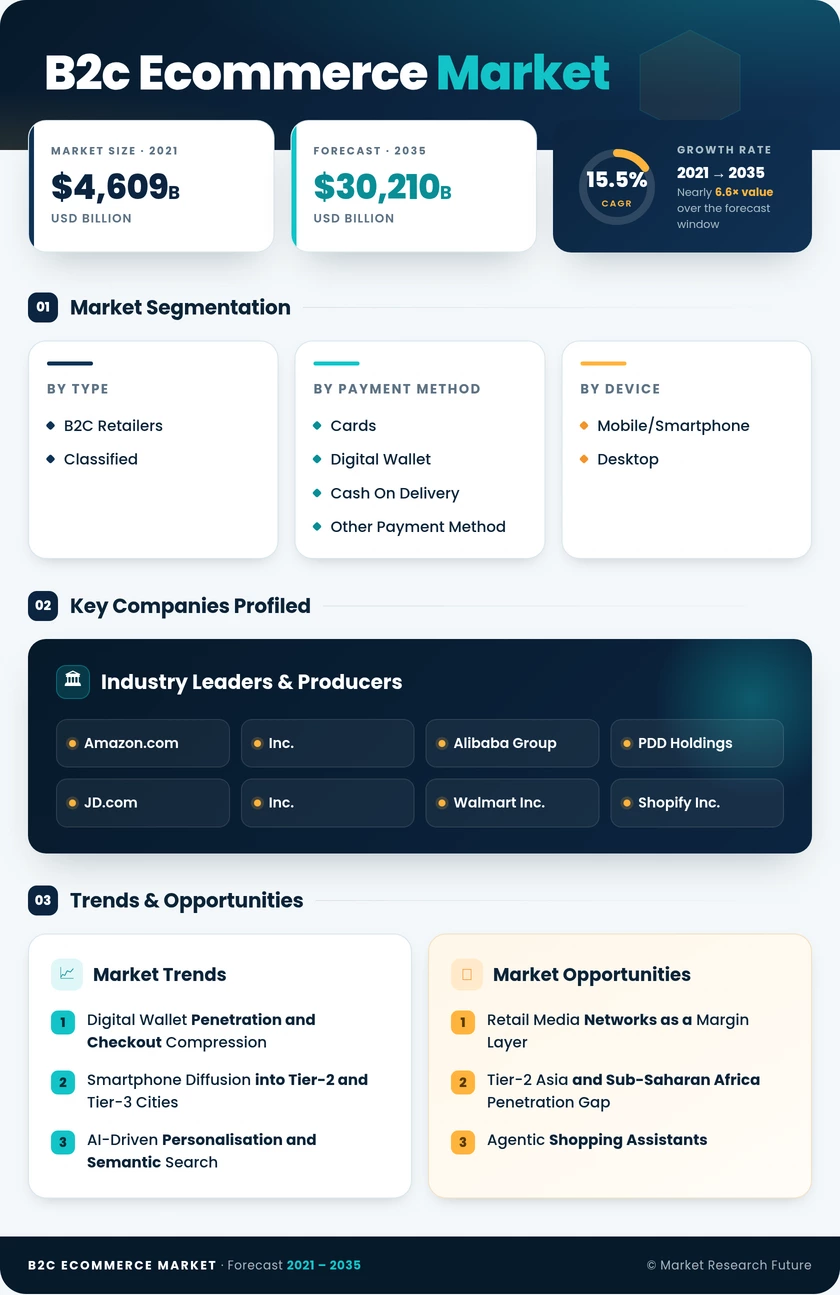
Segmentation Quick Reference
| Dimension | Sub-Segments | Dominant Segment | Fastest Growing Segment |
| By Type | B2C Retailers; Classified | B2C Retailers (85.8% share) | Classified (19.6% CAGR) |
| By Payment Method | Cards; Digital Wallet; Cash On Delivery; Other Payment Method | Digital Wallet (45.2% share) | Other Payment Method (21.3% CAGR) |
| By Device | Mobile/Smartphone; Desktop | Mobile/Smartphone (66.4% share) | Mobile/Smartphone |
| By Application | Beauty & Personal Care; Consumer Electronics; Fashion & Apparel; Food & Beverage; Furniture & Home; Other | Fashion & Apparel (22.0% share) | Food & Beverage (20.4% CAGR) |
Market Segmentation Overview
By Type
| Sub-Segment | Key Trend |
| B2C Retailers | Hybrid owned-plus-third-party inventory models expand assortment without capital commitment. |
| Classified | Premium placement and vertical specialisation replace flat listing fees. |
B2C Retailers lead the dimension because owning inventory and delivery lets operators guarantee fulfilment windows, which is what converts high-consideration baskets. Classified grows fastest by avoiding that capital burden entirely — property, automotive and recruitment portals monetise placement rather than transactions, so regional expansion costs little. The practical consequence for buyers is convergence: retailers are opening third-party listings while classified operators add escrow and delivery, narrowing the structural gap between the two models.
By Payment Method
| Sub-Segment | Key Trend |
| Cards | Share erosion accelerates as tokenisation transfers the convenience advantage to wallets. |
| Digital Wallet | Loyalty, micro-credit and insurance bundling deepen retention beyond payment. |
| Cash On Delivery | Persists as a trust bridge in low-card-penetration markets; declines with repeat purchase |
| Other Payment Method | Open-banking account-to-account transfers cut interchange for merchants |
Digital Wallet dominates on value share because a single biometric confirmation replaces a multi-field card form, and the ecosystems layered on top raise switching costs. Other Payment Method is the fastest-growing sub-segment as open banking makes account-to-account settlement viable at scale, appealing directly to merchants whose interchange costs exceed net margin on low-ticket orders. Cards retain relevance for chargeback protection, while Cash On Delivery remains a working-capital burden merchants accept only until a payment relationship is established.
By Device
| Sub-Segment | Key Trend |
| Mobile/Smartphone | App-native one-click checkout and social discovery drive high-frequency micro-purchases |
| Desktop | Retains higher average order values on complex, multi-variant configurations |
Mobile/Smartphone both leads and grows fastest because the acquisition path now starts in a feed rather than a search bar, and biometric authentication removed the last friction point at checkout. Desktop is not disappearing — its average order values run roughly a third higher, since side-by-side comparison of specifications and finance terms remains easier on a large screen. Augmented-reality previews and conversational assistants are steadily closing that capability gap on handsets.
By Application
| Sub-Segment | Key Trend |
| Beauty & Personal Care | Subscription replenishment and sampling programmes lift repeat purchase frequency. |
| Consumer Electronics | Standardised SKUs make online comparison structurally superior to in-store browsing. |
| Fashion & Apparel | Creator-led demand cycles compress assortment lifespans; return rates remain the margin constraint. |
| Food & Beverage | Dark-store density normalises sub-60-minute grocery and convenience fulfilment. |
| Furniture & Home | Augmented-reality visualisation reduces size and colour uncertainty on high-ticket orders. |
| Other | Pharmacy, pet and hobby categories benefit from regulatory easing on online dispensing. |
Fashion & Apparel holds the largest application share on assortment velocity and influencer-driven demand. However, it also carries the highest return rates, which is why sizing algorithms and paid-return policies are concentrated in this category. Food & Beverage grows fastest because quick-commerce networks made frequency viable, and frequency builds the habit that later spills into adjacent baskets. Consumer Electronics remains a large, stable pool on SKU standardisation, while Furniture & Home converts specifically where visualisation tools reduce purchase uncertainty.


 Noah Malgeri
Co-Founder

 Peter Groot koerkamp
Account and Business Manager

 Younghwan Choi
Senior Retail Manager

 Mark Irwin
Management Consultant

 Akif Moroglu
Strategy & Business Development Director

 Guilherme Gomes Martins
Product Management Director

 Joseph Aguayo
Sales Operations & Pricing Manager

 La Terria Dodd
Program Support Specialist

 Rob Kooiker
Group Product Manager HVAC & Fire Protection GMA