
×
Request Free Sample ×

Kindly complete the form below to receive a free sample of this Report

* Please use a valid business email

Leading companies partner with us for data-driven Insights

clients tt-cursor
Hero Background
English
Chinese
French
Japanese
Korean
German
Spanish

Aviation Software Market Size

ID: MRFR/AD/8140-HCR
168 Pages
Swapnil Palwe
October 2025

Aviation Software Market Size, Share, Industry Trend & Analysis Research Report Information By Application (Airports and Airlines), By Software Type (Management Software, Analysis Software, Design Software, Simulation Software, and MRO Software), And By Region (North America, Europe, Asia-Pacific, And Rest Of The World) –Market Size, Share, Industry Trend & Analysis Forecast Till 2035

Share:
Download PDF ×

We do not share your information with anyone. However, we may send you emails based on your report interest from time to time. You may contact us at any time to opt-out.

Aviation Software Market Infographic
×
Aviation Software Market Infographic Full View
Purchase Options

Aviation Software Size

Aviation Software Market Growth Projections and Opportunities

The aviation software market has seen significant growth due to a host of factors that enable effective utilization of software solutions in the aviation field as people become more reliant on such innovation for improved efficiency and safety. One of the key factors contributing to this market is an increasing demand for digitalization across different sectors in aviation operations. From the airlines and airports to ATCs as well as maintenance organizations, aviation software solutions have been on high demand in recent years due to their ability simplify processes and aid decision-making for adhering with changing regulatory standards.

The aviation software market is greatly influenced by technological advancements. Innovations concerning cloud computing, artificial intelligence and data analytics continue to shape the aviation software landscape. Cloud-based solutions allow real time data access and collaboration, ensuring easy communication and coordination between various stakeholders in the aviation community. Advanced aviation software that utilizes artificial intelligence and machine learning algorithms enables predictive maintenance, optimal route planning, safety measures etc. Compliance with regulations has a significant impact under the dynamics of the aviation software market. The aviation industry works under tough regulatory environments to guarantee the safety and security of travelling by air. Aviation software solutions should meet international aviation standards and local regulations, which required to update it frequently in order to adapt them into new requirements. It is essential that software providers can guarantee compliance with all applicable regulations if an environment of trust should be created among airlines, airports and aviation authorities. Market competition and the presence of significant players affect greatly aviation software market. The development and delivery of aviation software solutions are conducted by established software providers as well as emerging technology companies. The presence of intense competition ensures innovation; hence companies invest in research and development to create software that is more user friendly as well feature rich with scalability. Competitive landscape helps determining the pricing strategies and service offerings, creating a wide variety of opportunities for aviation organizations to improve their operational efficiencies. Global economic circumstances also significantly influence the aviation software market. The demand for aviation software solutions is affected by economic conditions such as airline profitability, fleet expansion plans and investment in technology infrastructure.

Aviation Software Market Size Graph
Author
Swapnil Palwe
Team Lead - Research

With a technical background as Bachelor's in Mechanical Engineering, with MBA in Operations Management , Swapnil has 6+ years of experience in market research, consulting and analytics with the tasks of data mining, analysis, and project execution. He is the POC for our clients, for their consulting projects running under the Automotive/A&D domain. Swapnil has worked on major projects in verticals such as Aerospace & Defense, Automotive and many other domain projects. He has worked on projects for fortune 500 companies' syndicate and consulting projects along with several government projects.

Leave a Comment

FAQs

How much is the aviation software market?

The aviation software market size was valued at USD 4.17 Billion in 2023.

What is the growth rate of the aviation software market?

The market is projected to grow at a CAGR of 9.15% during the forecast period, 2025-2034.

Which region held the largest market share in the aviation software market?

North America had the largest share of the market.

Who are the key players in the aviation software market?

The key players in the market are GE Aviation (U.S.), Rolls-Royce (U.K.), Pratt and Whitney (U.S.), Lufthansa Technik (Germany), Safran Aircraft Engines (Paris), SIA Engineering Company (Singapore), Air France Industries KLM Engineering and Maintenance (France), MTU Aero Engines (Germany), ST Aerospace (Singapore), Delta Tech-Ops (U.S.)

Which type led the aviation software market?

The MRO software category dominated the market in 2023.

Which application had the largest market share in the aviation software market?

The airlines category had the largest share of the market.

Market Summary

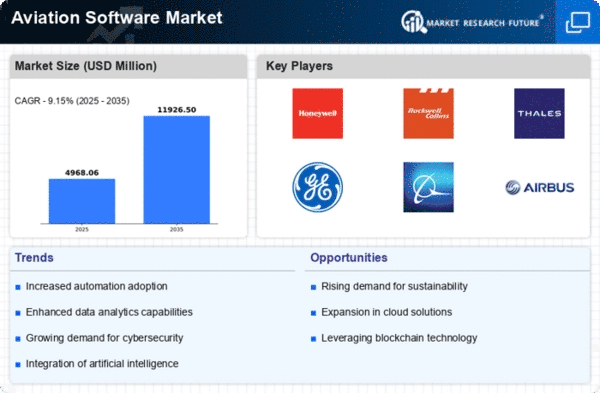
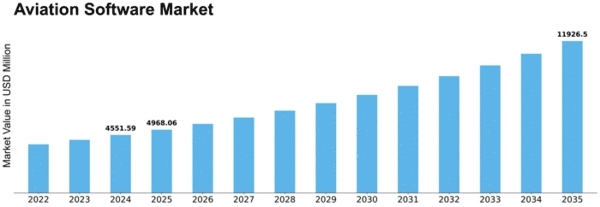
As per MRFR analysis, the Aviation Software Market Size was estimated at 4551.59 USD Million in 2024. The Aviation Software industry is projected to grow from 4968.16 USD Million in 2025 to 11926.5 USD Million by 2035, exhibiting a compound annual growth rate (CAGR) of 9.15 during the forecast period 2025 - 2035.

Key Market Trends & Highlights

The Aviation Software Market is experiencing robust growth driven by technological advancements and evolving operational needs.

  • The integration of Artificial Intelligence is transforming operational efficiencies in the Aviation Software Market.
  • Cloud-Based Solutions remain the largest segment, while Hybrid Solutions are emerging as the fastest-growing alternative.
  • North America continues to dominate the market, whereas the Asia-Pacific region is recognized as the fastest-growing area.
  • Increased demand for operational efficiency and advancements in maintenance and repair operations are key drivers propelling market growth.

Market Size & Forecast

2024 Market Size 4551.59 (USD Million)
2035 Market Size 11926.5 (USD Million)
CAGR (2025 - 2035) 9.15%
Largest Regional Market Share in 2024 North America

Major Players

<p>Honeywell (US), Rockwell Collins (US), Thales (FR), General Electric (US), Boeing (US), Airbus (FR), SAP (DE), IBM (US), L3Harris Technologies (US)</p>

Market Trends

The Aviation Software Market is currently experiencing a transformative phase, driven by advancements in technology and increasing demand for efficiency in operations. The integration of artificial intelligence and machine learning into aviation software solutions appears to enhance decision-making processes, optimize flight operations, and improve safety measures. Furthermore, the growing emphasis on sustainability within the aviation sector is likely to propel the development of software that supports eco-friendly practices, such as fuel management and emissions tracking. As airlines and operators seek to streamline their operations, the Aviation Software Market is poised for substantial growth, with innovations that cater to both operational efficiency and environmental responsibility. In addition, the rise of cloud-based solutions is reshaping the landscape of the Aviation Software Market. These platforms offer flexibility, scalability, and cost-effectiveness, allowing organizations to adapt to changing demands with ease. The shift towards remote operations and data accessibility is becoming increasingly vital, as stakeholders require real-time information to make informed decisions. Consequently, the Aviation Software Market is evolving to meet these needs, fostering a competitive environment where software providers must continuously innovate to stay relevant.

Integration of Artificial Intelligence

The incorporation of artificial intelligence into aviation software is revolutionizing operational efficiency. AI-driven analytics facilitate predictive maintenance, enhance safety protocols, and streamline flight planning, thereby reducing costs and improving service quality.

Cloud-Based Solutions

The transition to cloud-based platforms is reshaping the Aviation Software Market. These solutions provide enhanced flexibility and scalability, enabling organizations to access critical data remotely and adapt to evolving operational requirements.

Focus on Sustainability

There is a growing emphasis on sustainability within the Aviation Software Market. Software solutions that support fuel efficiency, emissions tracking, and eco-friendly practices are increasingly sought after, reflecting the industry's commitment to environmental responsibility.

Aviation Software Market Market Drivers

Increased Demand for Efficient Operations

The Global Aviation Software Market Industry experiences heightened demand for operational efficiency as airlines and aviation companies seek to optimize their processes. This trend is driven by the need to reduce operational costs and improve service delivery. For instance, the implementation of software solutions for flight planning and scheduling has shown to enhance efficiency significantly. In 2024, the market is valued at 4.55 USD Billion, reflecting the industry's focus on adopting advanced technologies. As companies increasingly prioritize efficiency, the Global Aviation Software Market Industry is poised for substantial growth.

Market Segment Insights

By Application: Flight Operations Management (Largest) vs. Maintenance Management (Fastest-Growing)

<p>In the Aviation Software Market, the application segment is categorized into Flight Operations Management, Maintenance Management, Crew Management, Passenger Services, and <a href="https://www.marketresearchfuture.com/reports/air-traffic-market-33794" target="_blank">air traffic</a> Management. Among these, Flight Operations Management holds the largest market share due to the increasing demand for efficient flight planning, optimization of flight routes, and enhancing overall operational productivity. It is followed closely by Maintenance Management, which also plays a crucial role in ensuring aircraft safety and compliance with regulations, contributing significantly to market dynamics. The growth in the Aviation Software Market is primarily driven by advancements in technology, increasing air traffic, and a growing emphasis on operational efficiency. With airlines and aviation authorities increasingly adopting software solutions to streamline operations, Maintenance Management has emerged as the fastest-growing segment. Factors like predictive maintenance and real-time data analytics are increasingly adopted to enhance operational reliability and reduce downtime, positioning it for rapid growth in the coming years.</p>

<p>Flight Operations Management (Dominant) vs. Crew Management (Emerging)</p>

<p>Flight Operations Management is the dominant segment in the Aviation Software Market, primarily due to its comprehensive functionalities that encompass flight planning, scheduling, and operational efficiency. This software aids airlines in optimizing routes and resources, and enhancing overall service delivery. In contrast, Crew Management, while emerging, is gaining traction due to the increasing complexities associated with crew scheduling, regulatory compliance, and the need for integrated solutions that ensure the effective utilization of crew resources. It leverages advanced technologies to manage crew assignments, training, and performance evaluations. As airlines focus on improving operational efficiency and compliance, Crew Management is being recognized for its potential to enhance workforce management and reduce operational costs.</p>

By Deployment Type: Cloud-Based (Largest) vs. Hybrid (Fastest-Growing)

<p>The Aviation Software Market's deployment type segment is witnessing a significant shift, with Cloud-Based solutions currently holding the largest market share. This preference for Cloud-Based deployment is driven by the need for enhanced accessibility and flexibility in operations, reducing infrastructure costs and enabling easier updates. Meanwhile, the Hybrid deployment model is emerging rapidly, reflecting an increasing demand for solutions that combine the benefits of both on-premises and cloud deployments. As organizations seek more tailored and adaptable software solutions, the adoption of Hybrid models is likely to increase.</p>

<p>Deployment Type: On-Premises (Dominant) vs. Cloud-Based (Emerging)</p>

<p>On-Premises deployment in the Aviation Software Market continues to be a dominant choice for organizations that prioritize control over their data and compliance with specific regulations. This model is particularly favored in environments where data sensitivity and security are paramount. In contrast, Cloud-Based solutions are becoming increasingly important as airlines and aviation service providers recognize the advantages of scalability, cost efficiency, and enhanced collaboration across platforms. The transition towards Cloud-Based models is fueled by technological advancements and a growing acceptance of digital transformation in the aviation sector.</p>

By End User: Commercial Aviation (Largest) vs. Military Aviation (Fastest-Growing)

<p>In the Aviation Software Market, the distribution of market share among the end-user segments reveals that Commercial Aviation holds the largest share, accounting for a significant portion of the overall market. This dominance can be attributed to the extensive use of aviation software solutions in managing flight operations, maintenance, and passenger services across commercial airlines. Military Aviation follows closely with growing adoption of advanced software technologies for mission planning and logistics, but still represents a smaller segment of the overall market.</p>

<p>Commercial Aviation: Dominant vs. Military Aviation: Emerging</p>

<p>Commercial Aviation remains the dominant end user in the Aviation Software Market, leveraging software for a wide range of operational needs including flight scheduling, maintenance management, and passenger services. Its established infrastructure and significant investment in technology drive ongoing demand for innovative solutions, facilitating operational efficiency and enhancing customer satisfaction. Conversely, Military Aviation is emerging rapidly, experiencing growth driven by the need for sophisticated training and tactical software solutions. As armed forces increasingly integrate technology into their operations, the demand for software that supports tactical planning, simulation, and resource management is surging, positioning Military Aviation as a segment with untapped potential.</p>

By Functionality: Flight Planning (Largest) vs. Performance Monitoring (Fastest-Growing)

<p>The Aviation Software Market showcases a diverse functionality segment characterized by Flight Planning, Scheduling, Safety Management, and Performance Monitoring. Among these, Flight Planning emerges as the largest component, reflecting its crucial role in optimizing flight routes and enhancing operational efficiency. A significant market share is snatched by Scheduling, which supports the effective allocation of resources and personnel. Safety Management is paramount as regulatory compliance increasingly demands robust monitoring of safety protocols, while Performance Monitoring stands out as the fastest-growing area, demonstrating a shift towards data-driven decision-making in real-time performance assessment.</p>

<p>Flight Planning (Dominant) vs. Performance Monitoring (Emerging)</p>

<p>Flight Planning has established itself as the dominant force within the Aviation Software Market, largely due to its foundational role in airline operations. It facilitates efficient routing, fuel management, and compliance with aviation regulations, enabling airlines to reduce costs and enhance operational effectiveness. Conversely, Performance Monitoring has erupted as an emerging functionality, driven by technological advancements in analytics and reporting tools. It allows operators to track real-time performance metrics and make informed adjustments quickly. As airlines increasingly prioritize data to enhance operational decisions, Performance Monitoring is projected to capture a growing share of the market, reflecting a broader trend of digitization and the necessity for adaptable strategies within aviation operations.</p>

By Technology: Artificial Intelligence (Largest) vs. Blockchain (Fastest-Growing)

<p>In the Aviation Software Market, Artificial Intelligence (AI) holds the largest share, driven by advancements in machine learning and predictive analytics. This technology is extensively utilized for enhancing decision-making processes, optimizing flight operations, and improving passenger experience. Big Data Analytics follows closely, facilitating vast data analysis to improve operational efficiencies and safety measures. IoT also plays a significant role by connecting various systems to streamline aircraft maintenance and logistics, while Blockchain is emerging rapidly, primarily for enhancing security and transparency in transactions within the aviation sector.</p>

<p>Technology: AI (Dominant) vs. Blockchain (Emerging)</p>

<p>Artificial Intelligence (AI) stands as the dominant player in the Aviation Software Market, revolutionizing various functions including predictive maintenance, flight planning, and customer relationship management. Its capabilities in data processing and machine learning allow airlines to optimize routes and reduce operational costs significantly. On the other hand, Blockchain, while currently regarded as an emerging technology, is gaining traction due to its potential to enhance data integrity and security across the aviation supply chain. As the industry looks to improve transparency and reduce fraud, Blockchain's applications in managing maintenance records and transactions are paving the way for its accelerated adoption.</p>

Get more detailed insights about Aviation Software Market Research Report - Global Forecast till 2035

Regional Insights

air traffic management

Key Players and Competitive Insights

The Aviation Software Market is currently characterized by a dynamic competitive landscape, driven by technological advancements and increasing demand for operational efficiency. Major players such as Honeywell (US), Rockwell Collins (US), and Thales (FR) are strategically positioned to leverage innovation and digital transformation. Honeywell (US) focuses on enhancing its software solutions for flight operations and maintenance, while Rockwell Collins (US) emphasizes integrated avionics systems. Thales (FR) is investing heavily in cybersecurity solutions for aviation, indicating a collective shift towards more secure and efficient operational frameworks among these key players.

In terms of business tactics, companies are increasingly localizing manufacturing and optimizing supply chains to enhance responsiveness to market demands. The competitive structure of the Aviation Software Market appears moderately fragmented, with a mix of established players and emerging startups. This fragmentation allows for diverse offerings, yet the influence of key players remains substantial, as they set benchmarks for innovation and service quality.

In November 2025, Honeywell (US) announced a partnership with a leading airline to implement its latest predictive maintenance software, which is expected to reduce operational downtime by 30%. This strategic move not only enhances Honeywell's market position but also underscores the growing importance of data analytics in aviation maintenance, potentially reshaping industry standards for efficiency.

In October 2025, Rockwell Collins (US) unveiled a new suite of software solutions aimed at improving air traffic management. This initiative is particularly significant as it aligns with global efforts to modernize air traffic control systems, suggesting that Rockwell Collins is positioning itself as a leader in addressing the complexities of increasing air traffic volumes.

In September 2025, Thales (FR) launched a cybersecurity framework specifically designed for aviation software, responding to the rising concerns over cyber threats in the industry. This proactive approach not only strengthens Thales's portfolio but also reflects a broader trend towards prioritizing security in aviation technology, which is likely to become a critical differentiator in the market.

As of December 2025, the Aviation Software Market is witnessing trends such as digitalization, sustainability, and AI integration, which are redefining competitive dynamics. Strategic alliances among key players are increasingly shaping the landscape, fostering innovation and enhancing service offerings. The shift from price-based competition to a focus on technological advancement and supply chain reliability is evident, suggesting that future competitive differentiation will hinge on the ability to innovate and adapt to evolving market needs.

Key Companies in the Aviation Software Market include

Industry Developments

For Instance, March 2023 GE Aerospace has announced that the next generation of its Rotor Analysis Diagnostic System (RADS) has begun testing with civilian and military clients. By facilitating operators' completion of rotor track and balance procedures and diagnostics in fewer flights, the RADS-NG (next generation) will minimize pilot time and save fuel.

For Instance, March 2023 Pratt & Whitney Canada (P&WC), a division of Pratt & Whitney, announced that it had signed an agreement with helicopter distributor Rotortrade to increase the number of helicopter engines enrolled annually in the Certified Pre-Owned (CPO) Engine Program.

For Instance, January 2023 Lufthansa Technik uses Swiss Aviation Software Market (Swiss-AS) as part of a Digital Tech Ops Ecosystem to drive the digital transformation of the aviation industry's technical asset operation. In a recent deal, Lufthansa acquired Swiss International Air Lines' stake in Swiss-AS.

Future Outlook

Aviation Software Market Future Outlook

<p>The Aviation Software Market is projected to grow at a 9.15% CAGR from 2024 to 2035, driven by advancements in technology, increased <a href="https://www.marketresearchfuture.com/reports/air-traffic-market-33794" target="_blank">air traffic</a>, and regulatory compliance demands.</p>

New opportunities lie in:

  • <p>Integration of AI-driven predictive maintenance solutions</p>
  • <p>Development of cloud-based flight management systems</p>
  • <p>Expansion of mobile applications for real-time data access</p>

<p>By 2035, the Aviation Software Market is expected to be robust, reflecting substantial growth and innovation.</p>

Market Segmentation

Aviation Software Market End User Outlook

  • Commercial Aviation
  • Military Aviation
  • Cargo Aviation
  • General Aviation

Aviation Software Market Technology Outlook

  • Artificial Intelligence
  • Big Data Analytics
  • Internet of Things
  • Blockchain

Aviation Software Market Application Outlook

  • Flight Operations Management
  • Maintenance Management
  • Crew Management
  • Passenger Services
  • Air Traffic Management

Aviation Software Market Functionality Outlook

  • Flight Planning
  • Scheduling
  • Safety Management
  • Performance Monitoring

Aviation Software Market Deployment Type Outlook

  • On-Premises
  • Cloud-Based
  • Hybrid

Report Scope

MARKET SIZE 20244551.59(USD Million)
MARKET SIZE 20254968.16(USD Million)
MARKET SIZE 203511926.5(USD Million)
COMPOUND ANNUAL GROWTH RATE (CAGR)9.15% (2024 - 2035)
REPORT COVERAGERevenue Forecast, Competitive Landscape, Growth Factors, and Trends
BASE YEAR2024
Market Forecast Period2025 - 2035
Historical Data2019 - 2024
Market Forecast UnitsUSD Million
Key Companies ProfiledHoneywell (US), Rockwell Collins (US), Thales (FR), General Electric (US), Boeing (US), Airbus (FR), SAP (DE), IBM (US), L3Harris Technologies (US)
Segments CoveredApplication, Deployment Type, End User, Functionality, Technology
Key Market OpportunitiesIntegration of artificial intelligence for enhanced operational efficiency in the Aviation Software Market.
Key Market DynamicsRising demand for advanced analytics and automation in aviation software drives competitive innovation and regulatory compliance.
Countries CoveredNorth America, Europe, APAC, South America, MEA

FAQs

How much is the aviation software market?

The aviation software market size was valued at USD 4.17 Billion in 2023.

What is the growth rate of the aviation software market?

The market is projected to grow at a CAGR of 9.15% during the forecast period, 2025-2034.

Which region held the largest market share in the aviation software market?

North America had the largest share of the market.

Who are the key players in the aviation software market?

The key players in the market are GE Aviation (U.S.), Rolls-Royce (U.K.), Pratt and Whitney (U.S.), Lufthansa Technik (Germany), Safran Aircraft Engines (Paris), SIA Engineering Company (Singapore), Air France Industries KLM Engineering and Maintenance (France), MTU Aero Engines (Germany), ST Aerospace (Singapore), Delta Tech-Ops (U.S.)

Which type led the aviation software market?

The MRO software category dominated the market in 2023.

Which application had the largest market share in the aviation software market?

The airlines category had the largest share of the market.

  1. SECTION I: EXECUTIVE SUMMARY AND KEY HIGHLIGHTS
    1. | 1.1 EXECUTIVE SUMMARY
  2. SECTION II: SCOPING, METHODOLOGY AND MARKET STRUCTURE
    1. | 2.1 MARKET INTRODUCTION
    2. | 2.2 RESEARCH METHODOLOGY
  3. SECTION III: QUALITATIVE ANALYSIS
    1. | 3.1 MARKET DYNAMICS
    2. | 3.2 MARKET FACTOR ANALYSIS
  4. SECTION IV: QUANTITATIVE ANALYSIS
    1. | 4.1 Aerospace & Defense, BY Application (USD Million)
    2. | 4.2 Aerospace & Defense, BY Deployment Type (USD Million)
    3. | 4.3 Aerospace & Defense, BY End User (USD Million)
    4. | 4.4 Aerospace & Defense, BY Functionality (USD Million)
    5. | 4.5 Aerospace & Defense, BY Technology (USD Million)
    6. | 4.6 Aerospace & Defense, BY Region (USD Million)
  5. SECTION V: COMPETITIVE ANALYSIS
    1. | 5.1 Competitive Landscape
    2. | 5.2 Company Profiles
    3. | 5.3 Appendix

Aviation Software Market Segmentation

Market Segmentation Overview

  • Detailed segmentation data will be available in the full report
  • Comprehensive analysis by multiple parameters
  • Regional and country-level breakdowns
  • Market size forecasts by segment
Infographic

Free Sample Request

Kindly complete the form below to receive a free sample of this Report

Get Free Sample

Customer Strories

Compare Licence

×
Features License Type
Single User Multiuser License Enterprise User
Price $4,950 $5,950 $7,250
Maximum User Access Limit 1 User Upto 10 Users Unrestricted Access Throughout the Organization
Free Customization
Direct Access to Analyst
Deliverable Format
Platform Access
Discount on Next Purchase 10% 15% 15%
Printable Versions