Request Free Sample ×

Kindly complete the form below to receive a free sample of this Report

* Please use a valid business email

Leading companies partner with us for data-driven Insights

clients tt-cursor
Hero Background

Aviation Analytics Market

ID: MRFR/AD/7145-HCR
168 Pages
Abbas Raut
Last Updated: May 22, 2026

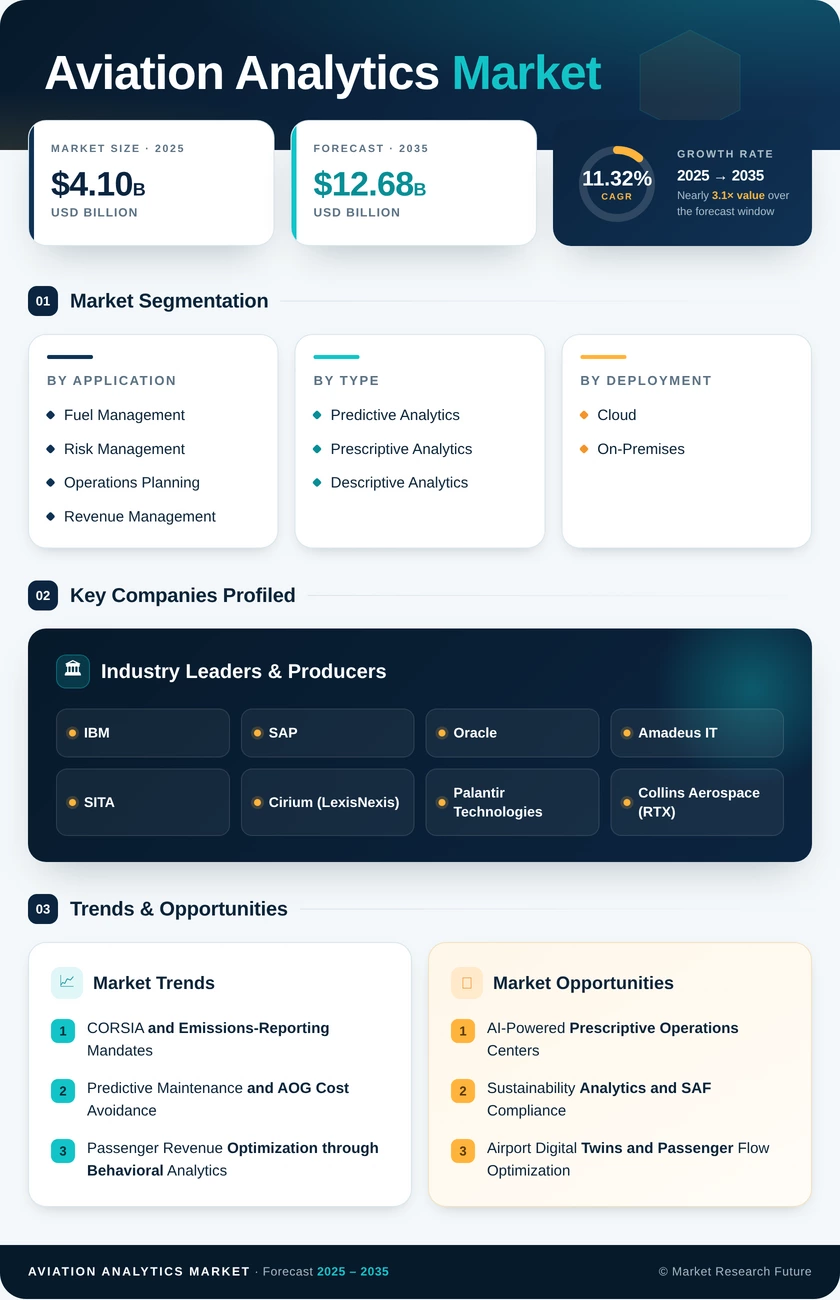
Aviation Analytics Market Size, Share, Industry Trend & Analysis Information By End User (Airlines, Airports), By Application (Fuel Management, Risk Management, Operations Planning, Revenue Management), By Analytics Type (Predictive Analytics, Prescriptive Analytics, Descriptive Analytics), By Deployment (Cloud, On-Premises), By Component (Software, Services), By Business Function (Finance, Supply Chain, Sales & Marketing) – 2035

Share:
Download PDF ×

We do not share your information with anyone. However, we may send you emails based on your report interest from time to time. You may contact us at any time to opt-out.

  1. 1 Market Overview |
    1. 1.1 Study Assumptions & Market Definition |
    2. 1.2 Scope of the Study |
    3. 1.3 Research Methodology
  2. 2 Market Summary & Key Takeaways
  3. 3 Market Dynamics |
    1. 3.1 Market Drivers Analysis | |
      1. 3.1.1 CORSIA & Emissions-Reporting Mandates | |
      2. 3.1.2 Predictive Maintenance and AOG Cost Avoidance | |
      3. 3.1.3 Passenger Revenue Optimization through Behavioral Analytics | |
      4. 3.1.4 Cloud Migration and Scalable Infrastructure | |
      5. 3.1.5 Aviation Fuel Efficiency Analytics Adoption | |
      6. 3.1.6 Mega-Hub Airport Expansion Programs | |
      7. 3.1.7 AI/ML Maturity in Prescriptive Analytics |
    2. 3.2 Market Restraints Analysis | |
      1. 3.2.1 Data-Sovereignty and Cross-Border Transfer Rules | |
      2. 3.2.2 Legacy IT System Integration Complexity | |
      3. 3.2.3 Cybersecurity Risk in Connected Aircraft Systems | |
      4. 3.2.4 Shortage of Aviation-Domain Data Scientists | |
      5. 3.2.5 High Upfront Cost for Small/Regional Carriers |
    3. 3.3 Market Opportunity Analysis | |
      1. 3.3.1 AI-Powered Prescriptive Operations Centers | |
      2. 3.3.2 Sustainability Analytics and SAF Compliance | |
      3. 3.3.3 Airport Digital Twins and Passenger Flow Optimization | |
      4. 3.3.4 Emerging-Market Carrier Digitization | |
      5. 3.3.5 Data Monetization and Ancillary Revenue Platforms |
    4. 3.4 Industry Value Chain Analysis |
    5. 3.5 Porter's Five Forces Analysis
  4. 4 Global Aviation Analytics Market Size & Forecast (2021–2035) |
    1. 4.1 Historical Market Size (2021–2025) |
    2. 4.2 Current & Forecast Market Size (2026–2035) |
    3. 4.3 Market Size by Revenue (USD Billion) |
    4. 4.4 Year-over-Year Growth Analysis
  5. 5 Segmentation Analysis |
    1. 5.1 By End User | |
      1. 5.1.1 Airlines | |
      2. 5.1.2 Airports |
    2. 5.2 By Application | |
      1. 5.2.1 Fuel Management | |
      2. 5.2.2 Risk Management | |
      3. 5.2.3 Operations Planning | |
      4. 5.2.4 Revenue Management |
    3. 5.3 By Analytics Type | |
      1. 5.3.1 Predictive Analytics | |
      2. 5.3.2 Prescriptive Analytics | |
      3. 5.3.3 Descriptive Analytics |
    4. 5.4 By Deployment | |
      1. 5.4.1 Cloud | |
      2. 5.4.2 On-Premises |
    5. 5.5 By Component | |
      1. 5.5.1 Software | |
      2. 5.5.2 Services |
    6. 5.6 By Business Function | |
      1. 5.6.1 Finance | |
      2. 5.6.2 Supply Chain | |
      3. 5.6.3 Sales & Marketing
  6. 6 Regional Analysis |
    1. 6.1 North America | |
      1. 6.1.1 United States | |
      2. 6.1.2 Canada | |
      3. 6.1.3 Mexico |
    2. 6.2 Europe | |
      1. 6.2.1 Germany | |
      2. 6.2.2 United Kingdom | |
      3. 6.2.3 France | |
      4. 6.2.4 Italy | |
      5. 6.2.5 Spain | |
      6. 6.2.6 Nordic Countries | |
      7. 6.2.7 Russia | |
      8. 6.2.8 Rest of Europe |
    3. 6.3 Asia-Pacific | |
      1. 6.3.1 China | |
      2. 6.3.2 India | |
      3. 6.3.3 Japan | |
      4. 6.3.4 South Korea | |
      5. 6.3.5 ASEAN | |
      6. 6.3.6 Rest of Asia-Pacific |
    4. 6.4 South America | |
      1. 6.4.1 Brazil | |
      2. 6.4.2 Argentina | |
      3. 6.4.3 Rest of South America |
    5. 6.5 Middle East & Africa | |
      1. 6.5.1 Saudi Arabia | |
      2. 6.5.2 UAE | |
      3. 6.5.3 South Africa | |
      4. 6.5.4 Egypt | |
      5. 6.5.5 Rest of MEA
  7. 7 Competitive Landscape |
    1. 7.1 Market Share Analysis (2025) |
    2. 7.2 Competitive Benchmarking Matrix |
    3. 7.3 Company Profiles | |
      1. 7.3.1 IBM | |
      2. 7.3.2 SAP | |
      3. 7.3.3 Oracle | |
      4. 7.3.4 Amadeus IT | |
      5. 7.3.5 SITA | |
      6. 7.3.6 Cirium (LexisNexis) | |
      7. 7.3.7 Palantir Technologies | |
      8. 7.3.8 Collins Aerospace (RTX) | |
      9. 7.3.9 GE Aerospace (GE Digital) | |
      10. 7.3.10 Sabre Corporation
  8. 8 Future Outlook & Strategic Recommendations (2026–2035) |
    1. 8.1 AI-Autonomous Operations and Crew-Free Decision Loops |
    2. 8.2 Platform Economics and Analytics-as-a-Service |
    3. 8.3 Sustainability Reporting and ESG-Linked Analytics |
    4. 8.4 Digital Twins and Predictive Airport Infrastructure
  9. 9 Recent Developments & News
  10. 10 Frequently Asked Questions (FAQs)
  11. 11 Report Scope & Methodology |
    1. 11.1 Study Period & Base Year |
    2. 11.2 Data Sources & Citations |
    3. 11.3 Abbreviations
  12. 12 LIST OF TABLES |
  13. TABLE 1 Global Aviation Analytics Market Size & Forecast, by Revenue (USD Billion), 2021–2035 |
  14. TABLE 2 Global Aviation Analytics Market — Year-over-Year Growth Analysis, 2021–2035 |
  15. TABLE 3 Global Aviation Analytics Market — Driver Impact Analysis, 2026–2035 |
  16. TABLE 4 Global Aviation Analytics Market — Restraints Impact Analysis, 2026–2035 |
  17. TABLE 5 Global Aviation Analytics Market Size, by End User, 2021–2035 (USD Billion) |
  18. TABLE 6 Global Aviation Analytics Market Size, by Application, 2021–2035 (USD Billion) |
  19. TABLE 7 Global Aviation Analytics Market Size, by Analytics Type, 2021–2035 (USD Billion) |
  20. TABLE 8 Global Aviation Analytics Market Size, by Deployment, 2021–2035 (USD Billion) |
  21. TABLE 9 Global Aviation Analytics Market Size, by Component, 2021–2035 (USD Billion) |
  22. TABLE 10 Global Aviation Analytics Market Size, by Business Function, 2021–2035 (USD Billion) |
  23. TABLE 11 Global Aviation Analytics Market Size, by Region, 2021–2035 (USD Billion) |
  24. TABLE 12 North America Aviation Analytics Market Size, by Country, 2021–2035 (USD Billion) |
  25. TABLE 13 Europe Aviation Analytics Market Size, by Country, 2021–2035 (USD Billion) |
  26. TABLE 14 Asia-Pacific Aviation Analytics Market Size, by Country, 2021–2035 (USD Billion) |
  27. TABLE 15 South America Aviation Analytics Market Size, by Country, 2021–2035 (USD Billion) |
  28. TABLE 16 Middle East & Africa Aviation Analytics Market Size, by Country, 2021–2035 (USD Billion) |
  29. TABLE 17 Competitive Benchmarking Matrix — Global Aviation Analytics Market, 2025 |
  30. TABLE 18 Company Profiles — Key Players, Global Aviation Analytics Market |
  31. TABLE 19 Recent Developments & Strategic Announcements, 2023–2025 |
  32. TABLE 20 Report Scope & Methodology Summary |
  33. TABLE 21 Detailed Sources and Citations
  34. 13 LIST OF FIGURES |
  35. FIGURE 1 Aviation Analytics Market Dynamics — Drivers, Restraints, and Opportunities |
  36. FIGURE 2 Industry Value Chain Analysis — Aviation Analytics Market |
  37. FIGURE 3 Porter's Five Forces Analysis — Aviation Analytics Market |
  38. FIGURE 4 Global Aviation Analytics Market Size Trend (USD Billion), 2021–2035 |
  39. FIGURE 5 Aviation Analytics Market Share, by End User (%), 2025 |
  40. FIGURE 6 Aviation Analytics Market Share, by Application (%), 2025 |
  41. FIGURE 7 Aviation Analytics Market Share, by Analytics Type (%), 2025 |
  42. FIGURE 8 Aviation Analytics Market Share, by Deployment (%), 2025 |
  43. FIGURE 9 Aviation Analytics Market Share, by Component (%), 2025 |
  44. FIGURE 10 Aviation Analytics Market Share, by Business Function (%), 2025 |
  45. FIGURE 11 Aviation Analytics Market Share, by Region (%), 2025 |
  46. FIGURE 12 North America Aviation Analytics Market Size (USD Billion), 2021–2035 |
  47. FIGURE 13 Europe Aviation Analytics Market Size (USD Billion), 2021–2035 |
  48. FIGURE 14 Asia-Pacific Aviation Analytics Market Size (USD Billion), 2021–2035 |
  49. FIGURE 15 South America Aviation Analytics Market Size (USD Billion), 2021–2035 |
  50. FIGURE 16 Middle East & Africa Aviation Analytics Market Size (USD Billion), 2021–2035 |
  51. FIGURE 17 Competitive Landscape — Market Share Distribution (%), 2025

Segmentation Quick Reference

DimensionSub-SegmentsDominant SegmentFastest Growing Segment
End UserAirlines, AirportsAirlines (57.8% share, 2025)Airports (13.72% CAGR)
ApplicationFuel Management, Risk Management, Operations Planning, Revenue ManagementFuel Management (largest by CAGR contribution)Fuel Management (12.85% CAGR)
Analytics TypePredictive Analytics, Prescriptive Analytics, Descriptive AnalyticsPredictive Analytics (48.2% share, 2025)Prescriptive Analytics (14.18% CAGR)
DeploymentCloud, On-PremisesCloud (largest by new contracts)Cloud (13.85% CAGR)
ComponentSoftware, ServicesSoftware (62.1% share, 2025)Services (13.0% CAGR)
Business FunctionFinance, Supply Chain, Sales & MarketingFinance (34.4% share, 2025)Supply Chain (11.42% CAGR)


By End User

Sub-SegmentKey Trend
AirlinesEnterprise-wide SaaS deployment of airline operations data analytics platforms integrating fuel, crew, and maintenance modules
AirportsDigital-twin adoption for terminal flow optimization and non-aeronautical revenue growth


Airlines account for the majority of Aviation Analytics Market revenue as carriers invest in integrated platforms that unify fuel management, crew scheduling, and predictive maintenance into single dashboards. Airports are catching up rapidly, deploying passenger behavior analytics aviation solutions to optimize retail concession placement and security-checkpoint throughput.

By Application

Sub-SegmentKey Trend
Fuel ManagementML-driven flight-plan optimization and tankering decision support delivering 1.5–4.0% fuel savings
Risk ManagementSafety-event prediction models integrated with SMS (Safety Management Systems)
Operations PlanningAircraft utilization analytics for block-time optimization and turnaround-time reduction
Revenue ManagementDynamic pricing and ancillary-revenue bundling powered by passenger behavior analytics aviation


Fuel management leads application-level demand as aviation fuel efficiency analytics directly addresses airlines' largest variable cost. Operations planning is the second-largest application, using aircraft utilization analytics to maximize fleet productivity across complex hub-and-spoke networks.

By Analytics Type

Sub-SegmentKey Trend
Predictive AnalyticsPredictive flight delay models using weather, ATC, and historical disruption data
Prescriptive AnalyticsAutonomous decision engines for crew reallocation and rerouting
Descriptive AnalyticsHistorical benchmarking and KPI dashboards


Predictive analytics dominates the Aviation Analytics Market's analytics-type segmentation, with airlines deploying predictive flight delay models to reduce disruptions and improve on-time performance. Prescriptive analytics is the fastest-growing type as carriers seek closed-loop systems that autonomously execute corrective actions.

By Deployment

Sub-SegmentKey Trend
CloudSaaS-native platforms with per-flight-leg pricing models
On-PremisesRetained by carriers with strict data-sovereignty or defense-adjacent operations


Cloud deployment leads new contract signings in the Aviation Analytics Market, with AWS, Azure, and GCP offering aviation-specific analytics accelerators. On-premises deployments persist where cross-border data-transfer restrictions or military-adjacent operations require local data residency.

By Component

Sub-SegmentKey Trend
SoftwareSubscription-based platforms with continuous model retraining and AI/ML engines
ServicesConsulting, system integration, and managed airline operations data analytics


Software dominates revenue in the Aviation Analytics Market as vendors shift to recurring-revenue SaaS models. Services are growing faster as airlines seek partners with deep aviation-domain expertise to customize off-the-shelf platforms to carrier-specific operational workflows.

By Business Function

Sub-SegmentKey Trend
FinanceFuel-hedge analytics, route-profitability modeling, cost-allocation dashboards
Supply ChainRotable-parts inventory optimization and MRO turnaround analytics
Sales & MarketingPassenger behavior analytics aviation for loyalty optimization and dynamic offer creation


Finance is the largest business-function segment in the Aviation Analytics Market, reflecting CFO-led initiatives to improve cost transparency and hedging accuracy. Supply-chain analytics is the fastest-growing function as airlines apply predictive algorithms to reduce spare-parts inventory carrying costs by 15–25%.




Compare Licence

×
Features License Type
Single User Multiuser License Enterprise User
Price $4,950 $5,950 $7,250
Maximum User Access Limit 1 User Upto 10 Users Unrestricted Access Throughout the Organization
Free Customization
Direct Access to Analyst
Deliverable Format
Platform Access
Discount on Next Purchase 10% 15% 15%
Printable Versions