Request Free Sample ×

Kindly complete the form below to receive a free sample of this Report

* Please use a valid business email

Leading companies partner with us for data-driven Insights

clients tt-cursor
Hero Background
English
Chinese
French
Japanese
Korean
German
Spanish

Automotive Terminals Market Trends

ID: MRFR/AT/4709-HCR
100 Pages
Triveni Bhoyar
March 2026

Automotive Terminals Market Research Report By Application (Engine Control Units, Transmission Control Units, Body Control Modules, Safety and Security Systems, Infotainment Systems), By Terminal Type (Flat Blade Terminals, Ring Terminals, Spade Terminals, Pin Terminals), By Material Type (Copper, Aluminum, Gold, Silver), By End Use (Passenger Vehicles, Commercial Vehicles, Two Wheelers) and By Regional (North America, Europe, South America, Asia Pacific, Middle East and Africa) - Forecast to 2035

Share:
Download PDF ×

We do not share your information with anyone. However, we may send you emails based on your report interest from time to time. You may contact us at any time to opt-out.

Automotive Terminals Market Infographic
Purchase Options

Market Trends

Key Emerging Trends in the Automotive Terminals Market

Automotive Terminals Market is predicted to expand 12.1% per year, or CAGR, from 22.3 USD Bn in 2021 to 31.1 USD Bn in 2032. Automobile terminals are electric machines. It connects to a gas-powered car's battery or an electric or hybrid car's cell. Both sorts of autos are taxed this way. Companies preserve their market share in the auto terminal sector using a few important share positioning tactics. Diversity of products is a key strategy. Companies aim to create unique, high-quality, and newly designed links. Companies aim to distinguish out by developing items that perform differently, endure longer, or work well with others. Another key strategy is targeting certain markets or applications. Different cars and systems utilize automotive connectors differently. Companies target electric, hybrid, and industrial vehicles by building ports for them. This lets them specialize and establish consumer loyalty. Key selling plans include geographic expansion to increase the market. Building a robust distribution network or partnering with local dealers helps companies enter new markets. They may reach new clients and increase market share by expanding globally or regionally. Share placement in the auto port sector requires smart partnerships. Businesses typically collaborate with manufacturers or system developers to build vehicle-specific stations. These partnerships make terminal customization simpler for OEMs, making the market more competitive and helping firms create long-term relationships with industry leaders. Technology advancement must also be monitored. Companies invest in R&D to create automotive systems that use new technology. Terminals with sophisticated technology, greater power systems, or new automotive features like connectivity and self-driving help companies remain ahead of the competition and innovate. Be the cheapest in the automotive connection industry to obtain market share. Some companies offer cheap, high-quality computers. Find cost-effective strategies to enhance production processes, procure supplies, and simplify operations to attract price-conscious clients and gain market share. After-sales support is crucial to market share. Great customer service, technical assistance, and guarantees lead to customer loyalty and market success. Service networks and fast assistance keep consumers pleased and coming back. Finally, it's crucial to innovate and adapt to client wants. Companies must continually introduce new products, adapt to industry norms, and respond promptly to client demands to be competitive in the auto port business. Differentiating products, targeting niche markets, expanding into new areas, strategically working with other companies, advancing technology, offering the best prices, providing excellent after-sales service, establishing a brand, and always coming up with new ideas are ways to gain market share in the car terminals market. These techniques may help companies discover their niche, acquire market share, and develop in the difficult auto industry.


Author
Author Profile
Triveni Bhoyar
Senior Research Analyst

Triveni Bhoyar has over 5 years of experience in the market research industry, specializing in the Automotive and Aerospace & Defense sectors. She has contributed to 200+ reports, including numerous custom projects for leading global companies, delivering solutions to complex business challenges. Renowned for her ability to generate valuable insights, Triveni excels in addressing unique market dynamics with precision and depth. Her expertise spans market sizing, competitive intelligence, and trend analysis, enabling clients to craft data-driven growth strategies. With strong analytical rigor and a client-centric approach, she plays a pivotal role in driving impactful, strategic decision-making.

Leave a Comment

FAQs

What is the projected market valuation of the Automotive Terminals Market by 2035?

<p>The Automotive Terminals Market is projected to reach a valuation of 45.02 USD Billion by 2035.</p>

What was the market valuation of the Automotive Terminals Market in 2024?

<p>In 2024, the Automotive Terminals Market was valued at 29.22 USD Billion.</p>

What is the expected CAGR for the Automotive Terminals Market during the forecast period 2025 - 2035?

<p>The expected CAGR for the Automotive Terminals Market during the forecast period 2025 - 2035 is 4.01%.</p>

Which application segment is anticipated to have the highest valuation by 2035?

<p>By 2035, the Infotainment Systems segment is anticipated to reach a valuation of 11.52 USD Billion.</p>

What are the projected valuations for Body Control Modules by 2035?

<p>The Body Control Modules segment is projected to reach a valuation of 9.0 USD Billion by 2035.</p>

Which terminal type is expected to dominate the market by 2035?

<p>The Spade Terminals segment is expected to dominate the market with a projected valuation of 12.0 USD Billion by 2035.</p>

What is the anticipated valuation for Copper as a material type by 2035?

<p>Copper is anticipated to reach a valuation of 15.0 USD Billion by 2035.</p>

Which end-use segment is projected to have the highest growth by 2035?

<p>The Two Wheelers segment is projected to grow to a valuation of 18.02 USD Billion by 2035.</p>

Who are the key players in the Automotive Terminals Market?

<p>Key players in the Automotive Terminals Market include TE Connectivity, Molex, Amphenol, and Yazaki.</p>

What is the projected valuation for Ring Terminals by 2035?

<p>The Ring Terminals segment is projected to reach a valuation of 9.0 USD Billion by 2035.</p>

Market Summary

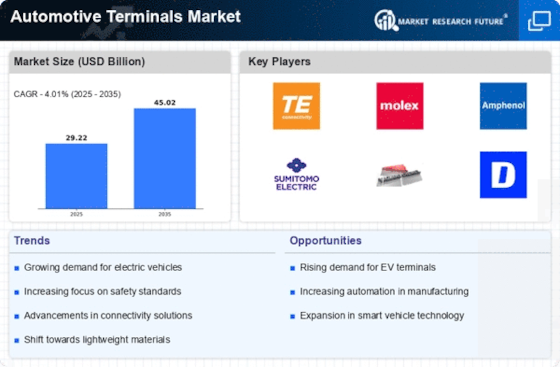
As per Market Research Future analysis, the Automotive Terminals Market Size was estimated at 29.22 USD Billion in 2024. The Automotive Terminals industry is projected to grow from 30.39 USD Billion in 2025 to 45.02 USD Billion by 2035, exhibiting a compound annual growth rate (CAGR) of 4.01% during the forecast period 2025 - 2035

Key Market Trends & Highlights

The Automotive Terminals Market is poised for substantial growth driven by technological advancements and evolving consumer preferences.

  • Technological advancements in connectivity are reshaping the Automotive Terminals Market, particularly in North America. The rise of electric vehicles is propelling demand for innovative terminal solutions, especially in the Asia-Pacific region. Engine control units remain the largest segment, while infotainment systems are experiencing the fastest growth in market share. Increasing demand for advanced safety features and the expansion of electric vehicle infrastructure are key drivers influencing market dynamics.

Market Size & Forecast

2024 Market Size 29.22 (USD Billion)
2035 Market Size 45.02 (USD Billion)
CAGR (2025 - 2035) 4.01%
Largest Regional Market Share in 2024 North America

Major Players

TE Connectivity (US), Molex (US), Amphenol (US), Sumitomo Electric (JP), Yazaki (JP), Delphi Technologies (IE), Lear Corporation (US), Bosch (DE), Furukawa Electric (JP)

Market Trends

The Automotive Terminals Market is currently experiencing a transformative phase, driven by advancements in technology and increasing demand for efficient connectivity solutions in vehicles. As automotive manufacturers strive to enhance vehicle performance and safety, the integration of sophisticated terminal systems becomes paramount. These terminals facilitate seamless communication between various electronic components, thereby improving overall functionality. Furthermore, the growing trend towards electric vehicles necessitates the development of specialized terminals that can handle higher power requirements and ensure reliable operation under diverse conditions. In addition to technological advancements, the Automotive Terminals Market is influenced by evolving consumer preferences and regulatory standards. As consumers become more environmentally conscious, there is a noticeable shift towards sustainable materials and practices within the industry. This shift not only aligns with global sustainability goals but also encourages manufacturers to innovate in terminal design and production processes. Consequently, the market is poised for growth as stakeholders adapt to these changes, focusing on enhancing product quality and performance while meeting the demands of a rapidly changing automotive landscape.

Technological Advancements in Connectivity

The Automotive Terminals Market is witnessing a surge in technological innovations aimed at enhancing connectivity within vehicles. As vehicles become increasingly equipped with advanced electronic systems, the demand for terminals that support high-speed data transfer and robust communication protocols is rising. This trend indicates a shift towards more integrated and efficient terminal solutions that can accommodate the complexities of modern automotive applications.

Sustainability and Eco-Friendly Materials

There is a growing emphasis on sustainability within the Automotive Terminals Market, as manufacturers seek to incorporate eco-friendly materials into their products. This trend reflects a broader commitment to reducing environmental impact and aligns with consumer preferences for greener alternatives. The adoption of sustainable practices not only enhances brand reputation but also meets regulatory requirements, potentially influencing purchasing decisions.

Rise of Electric Vehicles

The increasing prevalence of electric vehicles is reshaping the Automotive Terminals Market, as these vehicles require specialized terminals to manage higher power demands and ensure efficient energy distribution. This trend suggests a need for innovation in terminal design, focusing on durability and performance under varying operational conditions. As the electric vehicle segment expands, the market is likely to adapt to these new requirements, fostering growth and development.

Automotive Terminals Market Market Drivers

Growth of Autonomous Driving Technologies

The Automotive Terminals Market is poised for growth due to the increasing investment in autonomous driving technologies. As automakers strive to develop self-driving vehicles, the need for robust and efficient automotive terminals becomes paramount. These terminals are essential for the seamless operation of various sensors, cameras, and communication systems that enable autonomous functionality. Market analysis suggests that the autonomous vehicle segment could reach a valuation of several billion dollars by the end of the decade, indicating a substantial opportunity for automotive terminal manufacturers. This growth trajectory underscores the importance of automotive terminals in the evolving landscape of the Automotive Terminals Market.

Expansion of Electric Vehicle Infrastructure

The Automotive Terminals Market is benefiting from the expansion of electric vehicle (EV) infrastructure. As governments and private entities invest in charging stations and related technologies, the demand for automotive terminals that support electric drivetrains is increasing. These terminals are critical for managing power distribution and communication between the battery, motor, and control systems in electric vehicles. Recent data indicates that the electric vehicle market is expected to grow at a compound annual growth rate of over 20% in the next few years. This rapid expansion presents a significant opportunity for automotive terminal suppliers to cater to the evolving needs of the Automotive Terminals Market.

Rising Consumer Preference for Customization

The Automotive Terminals Market is influenced by the rising consumer preference for vehicle customization. As consumers seek personalized features and functionalities, automotive manufacturers are adapting their designs to accommodate various electronic components. This shift necessitates the use of versatile automotive terminals that can support a wide range of applications, from lighting systems to advanced infotainment setups. Market Research Future suggest that the customization trend is likely to continue, with a growing number of consumers willing to invest in tailored automotive experiences. This evolving landscape presents a unique opportunity for automotive terminal manufacturers to innovate and expand their offerings within the Automotive Terminals Market.

Integration of Smart Technologies in Vehicles

The Automotive Terminals Market is witnessing a trend towards the integration of smart technologies in vehicles. Features such as infotainment systems, advanced driver-assistance systems (ADAS), and vehicle-to-everything (V2X) communication require sophisticated automotive terminals for effective operation. As consumers increasingly demand connectivity and convenience, manufacturers are compelled to innovate and enhance their electronic architectures. Market forecasts indicate that the smart automotive segment could account for a substantial share of the overall automotive market, further driving the need for reliable automotive terminals. This trend highlights the pivotal role of automotive terminals in the Automotive Terminals Market.

Increasing Demand for Advanced Safety Features

The Automotive Terminals Market is experiencing a surge in demand for advanced safety features in vehicles. As consumers become more safety-conscious, manufacturers are integrating sophisticated electronic systems that require reliable automotive terminals. These terminals facilitate communication between various safety components, such as airbags, anti-lock braking systems, and electronic stability control. According to industry reports, the market for automotive safety systems is projected to grow significantly, with a compound annual growth rate of over 8% in the coming years. This trend indicates that automotive terminals will play a crucial role in enhancing vehicle safety, thereby driving their demand in the Automotive Terminals Market.

Market Segment Insights

By Application: Engine Control Units (Largest) vs. Infotainment Systems (Fastest-Growing)

In the Automotive Terminals Market, the application segments exhibit a varied distribution of market share. Engine Control Units (ECUs) currently hold the largest share as they are critical for the efficient operation of vehicle engines, controlling various engine functions. Conversely, Infotainment Systems, which enhance the driving experience through multimedia and connectivity, are rapidly growing in market share as consumer preferences shift towards more advanced technology features in vehicles.

Infotainment Systems (Emerging) vs. Engine Control Units (Dominant)

Engine Control Units are integral to modern automotive technology, acting as the brain for various automotive functions such as fuel injection and emissions control. Their dominance in the market is backed by the necessity for regulatory compliance and performance optimization. On the other hand, Infotainment Systems represent an emerging category that is seeing rapid growth due to increasing consumer demand for connectivity features like navigation and smartphone integration. This trend has propelled automakers to invest heavily in infotainment technologies, creating competitive pressure in a landscape dominated by ECUs.

By Terminal Type: Flat Blade Terminals (Largest) vs. Ring Terminals (Fastest-Growing)

The Automotive Terminals Market showcases a diverse distribution of terminal types, with flat blade terminals leading the share due to their widespread application in modern vehicles. Their robustness and ease of use make them a preferred choice among automotive manufacturers. On the other hand, ring terminals are gaining significant traction, especially in high-performance and electric vehicle applications, contributing to their rapid growth within the segment.

Flat Blade (Dominant) vs. Ring (Emerging)

Flat blade terminals are recognized for their versatility and reliability, making them the dominant player in the automotive terminals segment. They are extensively used in various automotive wiring systems due to their ability to provide stable connections and withstand vibration. In contrast, ring terminals are emerging as a popular choice in newer vehicle models, particularly for battery and high-current applications, where secure connections are crucial. Their design allows for efficient conductivity, making them essential as vehicle electrification accelerates, and their adoption increases in hybrid and electric vehicles.

By Material Type: Copper (Largest) vs. Aluminum (Fastest-Growing)

In the Automotive Terminals Market, the material type segment shows significant variation in market share distribution. Copper is recognized as the largest segment due to its superior electrical conductivity and reliability, making it a preferred choice for automotive applications. Aluminum follows as a considerable segment, favored for its lightweight properties, increasing fuel efficiency and performance in electric vehicles. Meanwhile, precious metals like Gold and Silver hold niche roles due to their high conductivity, but their market share remains limited compared to Copper and Aluminum. Growth trends in the material type segment are primarily driven by advancements in electric and hybrid vehicle technology, which demand materials that enhance performance and efficiency. Aluminum is entering a growth phase as automakers shift towards <a href="https://www.marketresearchfuture.com/reports/lightweight-materials-market-8528" target="_blank" title="lightweight materials">lightweight materials</a> to improve vehicle range and efficiency. Overall, the push for sustainable and high-performance vehicles facilitates a remarkable growth trajectory for Aluminum and a stable dominance for Copper.

Copper (Dominant) vs. Aluminum (Emerging)

Copper remains the dominant material in the Automotive Terminals Market because of its exceptional electrical and thermal conductivity, essential for efficient electrical systems in vehicles. Its established presence in automotive manufacturing is complemented by a robust supply chain and high reliability standards. On the other hand, Aluminum is emerging as a formidable alternative as manufacturers increasingly recognize the benefits of weight reduction in improving fuel efficiency and lowering emissions. The automotive industry's shift towards electric vehicles further enhances Aluminum's appeal, given its lighter weight compared to Copper, helping to enhance overall vehicle performance. The competitive landscape indicates ongoing innovation in manufacturing processes for both materials, maintaining their relevance in a rapidly evolving market.

By End Use: Passenger Vehicles (Largest) vs. Commercial Vehicles (Fastest-Growing)

In the Automotive Terminals Market, the distribution of market share among various end-use segments reveals that passenger vehicles hold the largest share, driven by the consistent demand for personal transportation and the increasing adoption of advanced automotive technologies. This segment benefits from innovations in electric and hybrid vehicles, where terminals are essential for efficient power distribution and management. Meanwhile, commercial vehicles are emerging as the fastest-growing segment, fueled by the rise in e-commerce and logistics activities that demand more sophisticated terminal systems to enhance vehicle performance and reliability. Growth trends indicate that the automotive terminals market is adapting to changing consumer preferences and regulatory requirements. The push for electrification and sustainability in the automotive industry is further driving the need for advanced terminals in both passenger and commercial vehicles, with heightened focus on efficient energy storage solutions. Additionally, the integration of smart technologies and IoT in vehicles is expected to bolster the growth of terminal systems across all segments, with commercial vehicles increasingly adopting these innovations for operational efficiency and enhanced functionality.

Passenger Vehicles (Dominant) vs. Commercial Vehicles (Emerging)

Passenger vehicles dominate the automotive terminals market primarily due to their widespread use and consumer demand for innovative safety and performance features. The increasing integration of advanced technology such as infotainment systems and driving assistance enhancements requires reliable terminal systems to ensure seamless functionality. On the other hand, commercial vehicles represent an emerging segment, characterized by robust demand for efficiency and fleet management solutions. As businesses seek to optimize their operations, the adoption of advanced automotive terminals in commercial applications is rapidly increasing, driven by the need for reliability under heavy usage and the integration of telematics systems that provide real-time data for enhanced decision-making.

Get more detailed insights about Automotive Terminals Market Research Report – Forecast to 2035

Regional Insights

The Regional segmentation of the Automotive Terminals Market reflected varied growth dynamics and market valuations across key areas. In 2023, North America held the majority share, valued at 10.61 USD Billion, and is projected to grow to 15.25 USD Billion by 2032, highlighting its significant contribution to the market due to advanced automotive technology and high vehicle production levels.

Europe followed with a valuation of 8.34 USD Billion in 2023, expected to reach 11.9 USD Billion by 2032, demonstrating strong demand driven by the increasing adoption of electric vehicles and stringent safety regulations.

The APAC region, valued at 6.64 USD Billion in 2023 and anticipated to rise to 9.5 USD Billion by 2032, reflected rapid industrialization and growing automotive manufacturing hubs, notably in countries like China and India. South America and MEA represented smaller markets, with valuations of 1.93 USD Billion and 0.56 USD Billion in 2023, growing to 2.88 USD Billion and 0.87 USD Billion, respectively, by 2032, indicating potential for future growth but lesser current dominance.

Overall, these diverse Regional valuations in the Automotive Terminals Market highlighted different levels of market maturity and growth opportunities across the globe.

Key Players and Competitive Insights

The Automotive Terminals Market is characterized by intense competition among leading manufacturers and emerging players aiming to capitalize on the growing automotive sector. This market comprises a wide range of terminal types, including connectors, sockets, and other electrical components used to ensure reliable electrical connectivity in vehicles.
As the automotive industry continues to evolve with the rise of electric vehicles and advanced driver-assistance systems, the demand for high-quality terminals is projected to increase. Key players are focusing on innovation, enhancing product quality, and expanding their technological capabilities to maintain a competitive edge, all while addressing the challenges presented by new regulations and shifting consumer preferences.
Tyco Electronics is a prominent player in the Global Automotive terminal market, boasting a strong market presence due to its extensive range of automotive terminal solutions. The company's strengths lie in its commitment to research and development, enabling it to stay ahead in the rapidly evolving automotive landscape. Tyco Electronics has established a reputation for producing high-performance terminals, which are vital for the reliability and safety of various automotive applications.
Its robust distribution network and strong relationships with original equipment manufacturers enhance its market position, allowing for rapid responses to market needs. Additionally, the company has made significant investments in sustainability and efficiency, aligning its product offerings with global trends toward greener automotive technologies.
Yazaki Corporation is another key player in the Automotive Terminals Market, well-known for its innovative approach to automotive electrical systems, including terminals and connectors. The company's strengths are anchored in its vast experience in the industry and a deep understanding of customer needs, resulting in a comprehensive product portfolio that meets diverse requirements.
Yazaki Corporation's efficient manufacturing processes and a strong commitment to quality have positioned it as a trusted supplier to numerous automotive manufacturers. The company's focus on technological advancements, such as the integration of smart terminal solutions, allows it to support the growing demand for complex automotive systems.
With a global footprint, Yazaki Corporation continually enhances its competencies, ensuring it remains competitive in an ever-changing market landscape.

Key Companies in the Automotive Terminals Market include

Industry Developments

  • Q2 2024: Identec Solutions Launches New RFID-Based Vehicle Tracking System for Car Terminals Identec Solutions announced the deployment of a new RFID and GPS-based vehicle tracking system designed to optimize inventory management and reduce delays at automotive terminals, addressing growing capacity and labor challenges in the sector.

Future Outlook

Automotive Terminals Market Future Outlook

The Automotive Terminals Market is projected to grow at a 4.01% CAGR from 2025 to 2035, driven by advancements in electric vehicles, increased connectivity, and demand for lightweight materials.

New opportunities lie in:

  • Development of modular terminal systems for electric vehicles
  • Integration of smart technology in automotive terminals
  • Expansion into emerging markets with tailored terminal solutions

By 2035, the market is expected to be robust, reflecting significant advancements and strategic growth.

Market Segmentation

Automotive Terminals Market End Use Outlook

  • Passenger Vehicles
  • Commercial Vehicles
  • Two Wheelers

Automotive Terminals Market Application Outlook

  • Engine Control Units
  • Transmission Control Units
  • Body Control Modules
  • Safety and Security Systems
  • Infotainment Systems

Automotive Terminals Market Material Type Outlook

  • Copper
  • Aluminum
  • Gold
  • Silver

Automotive Terminals Market Terminal Type Outlook

  • Flat Blade Terminals
  • Ring Terminals
  • Spade Terminals
  • Pin Terminals

Report Scope

MARKET SIZE 2024 29.22(USD Billion)
MARKET SIZE 2025 30.39(USD Billion)
MARKET SIZE 2035 45.02(USD Billion)
COMPOUND ANNUAL GROWTH RATE (CAGR) 4.01% (2025 - 2035)
REPORT COVERAGE Revenue Forecast, Competitive Landscape, Growth Factors, and Trends
BASE YEAR 2024
Market Forecast Period 2025 - 2035
Historical Data 2019 - 2024
Market Forecast Units USD Billion
Key Companies Profiled TE Connectivity (US), Molex (US), Amphenol (US), Sumitomo Electric (JP), Yazaki (JP), Delphi Technologies (IE), Lear Corporation (US), Bosch (DE), Furukawa Electric (JP)
Segments Covered Application, Terminal Type, Material Type, End Use, Regional
Key Market Opportunities Integration of advanced connectivity solutions enhances growth potential in the Automotive Terminals Market.
Key Market Dynamics Rising demand for electric vehicles drives innovation in automotive terminal technology and supply chain optimization.
Countries Covered North America, Europe, APAC, South America, MEA

FAQs

What is the projected market valuation of the Automotive Terminals Market by 2035?

<p>The Automotive Terminals Market is projected to reach a valuation of 45.02 USD Billion by 2035.</p>

What was the market valuation of the Automotive Terminals Market in 2024?

<p>In 2024, the Automotive Terminals Market was valued at 29.22 USD Billion.</p>

What is the expected CAGR for the Automotive Terminals Market during the forecast period 2025 - 2035?

<p>The expected CAGR for the Automotive Terminals Market during the forecast period 2025 - 2035 is 4.01%.</p>

Which application segment is anticipated to have the highest valuation by 2035?

<p>By 2035, the Infotainment Systems segment is anticipated to reach a valuation of 11.52 USD Billion.</p>

What are the projected valuations for Body Control Modules by 2035?

<p>The Body Control Modules segment is projected to reach a valuation of 9.0 USD Billion by 2035.</p>

Which terminal type is expected to dominate the market by 2035?

<p>The Spade Terminals segment is expected to dominate the market with a projected valuation of 12.0 USD Billion by 2035.</p>

What is the anticipated valuation for Copper as a material type by 2035?

<p>Copper is anticipated to reach a valuation of 15.0 USD Billion by 2035.</p>

Which end-use segment is projected to have the highest growth by 2035?

<p>The Two Wheelers segment is projected to grow to a valuation of 18.02 USD Billion by 2035.</p>

Who are the key players in the Automotive Terminals Market?

<p>Key players in the Automotive Terminals Market include TE Connectivity, Molex, Amphenol, and Yazaki.</p>

What is the projected valuation for Ring Terminals by 2035?

<p>The Ring Terminals segment is projected to reach a valuation of 9.0 USD Billion by 2035.</p>

  1. SECTION I: EXECUTIVE SUMMARY AND KEY HIGHLIGHTS
    1. | 1.1 EXECUTIVE SUMMARY
    2. | | 1.1.1 Market Overview
    3. | | 1.1.2 Key Findings
    4. | | 1.1.3 Market Segmentation
    5. | | 1.1.4 Competitive Landscape
    6. | | 1.1.5 Challenges and Opportunities
    7. | | 1.1.6 Future Outlook
  2. SECTION II: SCOPING, METHODOLOGY AND MARKET STRUCTURE
    1. | 2.1 MARKET INTRODUCTION
    2. | | 2.1.1 Definition
    3. | | 2.1.2 Scope of the study
    4. | | | 2.1.2.1 Research Objective
    5. | | | 2.1.2.2 Assumption
    6. | | | 2.1.2.3 Limitations
    7. | 2.2 RESEARCH METHODOLOGY
    8. | | 2.2.1 Overview
    9. | | 2.2.2 Data Mining
    10. | | 2.2.3 Secondary Research
    11. | | 2.2.4 Primary Research
    12. | | | 2.2.4.1 Primary Interviews and Information Gathering Process
    13. | | | 2.2.4.2 Breakdown of Primary Respondents
    14. | | 2.2.5 Forecasting Model
    15. | | 2.2.6 Market Size Estimation
    16. | | | 2.2.6.1 Bottom-Up Approach
    17. | | | 2.2.6.2 Top-Down Approach
    18. | | 2.2.7 Data Triangulation
    19. | | 2.2.8 Validation
  3. SECTION III: QUALITATIVE ANALYSIS
    1. | 3.1 MARKET DYNAMICS
    2. | | 3.1.1 Overview
    3. | | 3.1.2 Drivers
    4. | | 3.1.3 Restraints
    5. | | 3.1.4 Opportunities
    6. | 3.2 MARKET FACTOR ANALYSIS
    7. | | 3.2.1 Value chain Analysis
    8. | | 3.2.2 Porter's Five Forces Analysis
    9. | | | 3.2.2.1 Bargaining Power of Suppliers
    10. | | | 3.2.2.2 Bargaining Power of Buyers
    11. | | | 3.2.2.3 Threat of New Entrants
    12. | | | 3.2.2.4 Threat of Substitutes
    13. | | | 3.2.2.5 Intensity of Rivalry
    14. | | 3.2.3 COVID-19 Impact Analysis
    15. | | | 3.2.3.1 Market Impact Analysis
    16. | | | 3.2.3.2 Regional Impact
    17. | | | 3.2.3.3 Opportunity and Threat Analysis
  4. SECTION IV: QUANTITATIVE ANALYSIS
    1. | 4.1 Automobile, BY Application (USD Billion)
    2. | | 4.1.1 Engine Control Units
    3. | | 4.1.2 Transmission Control Units
    4. | | 4.1.3 Body Control Modules
    5. | | 4.1.4 Safety and Security Systems
    6. | | 4.1.5 Infotainment Systems
    7. | 4.2 Automobile, BY Terminal Type (USD Billion)
    8. | | 4.2.1 Flat Blade Terminals
    9. | | 4.2.2 Ring Terminals
    10. | | 4.2.3 Spade Terminals
    11. | | 4.2.4 Pin Terminals
    12. | 4.3 Automobile, BY Material Type (USD Billion)
    13. | | 4.3.1 Copper
    14. | | 4.3.2 Aluminum
    15. | | 4.3.3 Gold
    16. | | 4.3.4 Silver
    17. | 4.4 Automobile, BY End Use (USD Billion)
    18. | | 4.4.1 Passenger Vehicles
    19. | | 4.4.2 Commercial Vehicles
    20. | | 4.4.3 Two Wheelers
    21. | 4.5 Automobile, BY Region (USD Billion)
    22. | | 4.5.1 North America
    23. | | | 4.5.1.1 US
    24. | | | 4.5.1.2 Canada
    25. | | 4.5.2 Europe
    26. | | | 4.5.2.1 Germany
    27. | | | 4.5.2.2 UK
    28. | | | 4.5.2.3 France
    29. | | | 4.5.2.4 Russia
    30. | | | 4.5.2.5 Italy
    31. | | | 4.5.2.6 Spain
    32. | | | 4.5.2.7 Rest of Europe
    33. | | 4.5.3 APAC
    34. | | | 4.5.3.1 China
    35. | | | 4.5.3.2 India
    36. | | | 4.5.3.3 Japan
    37. | | | 4.5.3.4 South Korea
    38. | | | 4.5.3.5 Malaysia
    39. | | | 4.5.3.6 Thailand
    40. | | | 4.5.3.7 Indonesia
    41. | | | 4.5.3.8 Rest of APAC
    42. | | 4.5.4 South America
    43. | | | 4.5.4.1 Brazil
    44. | | | 4.5.4.2 Mexico
    45. | | | 4.5.4.3 Argentina
    46. | | | 4.5.4.4 Rest of South America
    47. | | 4.5.5 MEA
    48. | | | 4.5.5.1 GCC Countries
    49. | | | 4.5.5.2 South Africa
    50. | | | 4.5.5.3 Rest of MEA
  5. SECTION V: COMPETITIVE ANALYSIS
    1. | 5.1 Competitive Landscape
    2. | | 5.1.1 Overview
    3. | | 5.1.2 Competitive Analysis
    4. | | 5.1.3 Market share Analysis
    5. | | 5.1.4 Major Growth Strategy in the Automobile
    6. | | 5.1.5 Competitive Benchmarking
    7. | | 5.1.6 Leading Players in Terms of Number of Developments in the Automobile
    8. | | 5.1.7 Key developments and growth strategies
    9. | | | 5.1.7.1 New Product Launch/Service Deployment
    10. | | | 5.1.7.2 Merger & Acquisitions
    11. | | | 5.1.7.3 Joint Ventures
    12. | | 5.1.8 Major Players Financial Matrix
    13. | | | 5.1.8.1 Sales and Operating Income
    14. | | | 5.1.8.2 Major Players R&D Expenditure. 2023
    15. | 5.2 Company Profiles
    16. | | 5.2.1 TE Connectivity (US)
    17. | | | 5.2.1.1 Financial Overview
    18. | | | 5.2.1.2 Products Offered
    19. | | | 5.2.1.3 Key Developments
    20. | | | 5.2.1.4 SWOT Analysis
    21. | | | 5.2.1.5 Key Strategies
    22. | | 5.2.2 Molex (US)
    23. | | | 5.2.2.1 Financial Overview
    24. | | | 5.2.2.2 Products Offered
    25. | | | 5.2.2.3 Key Developments
    26. | | | 5.2.2.4 SWOT Analysis
    27. | | | 5.2.2.5 Key Strategies
    28. | | 5.2.3 Amphenol (US)
    29. | | | 5.2.3.1 Financial Overview
    30. | | | 5.2.3.2 Products Offered
    31. | | | 5.2.3.3 Key Developments
    32. | | | 5.2.3.4 SWOT Analysis
    33. | | | 5.2.3.5 Key Strategies
    34. | | 5.2.4 Sumitomo Electric (JP)
    35. | | | 5.2.4.1 Financial Overview
    36. | | | 5.2.4.2 Products Offered
    37. | | | 5.2.4.3 Key Developments
    38. | | | 5.2.4.4 SWOT Analysis
    39. | | | 5.2.4.5 Key Strategies
    40. | | 5.2.5 Yazaki (JP)
    41. | | | 5.2.5.1 Financial Overview
    42. | | | 5.2.5.2 Products Offered
    43. | | | 5.2.5.3 Key Developments
    44. | | | 5.2.5.4 SWOT Analysis
    45. | | | 5.2.5.5 Key Strategies
    46. | | 5.2.6 Delphi Technologies (IE)
    47. | | | 5.2.6.1 Financial Overview
    48. | | | 5.2.6.2 Products Offered
    49. | | | 5.2.6.3 Key Developments
    50. | | | 5.2.6.4 SWOT Analysis
    51. | | | 5.2.6.5 Key Strategies
    52. | | 5.2.7 Lear Corporation (US)
    53. | | | 5.2.7.1 Financial Overview
    54. | | | 5.2.7.2 Products Offered
    55. | | | 5.2.7.3 Key Developments
    56. | | | 5.2.7.4 SWOT Analysis
    57. | | | 5.2.7.5 Key Strategies
    58. | | 5.2.8 Bosch (DE)
    59. | | | 5.2.8.1 Financial Overview
    60. | | | 5.2.8.2 Products Offered
    61. | | | 5.2.8.3 Key Developments
    62. | | | 5.2.8.4 SWOT Analysis
    63. | | | 5.2.8.5 Key Strategies
    64. | | 5.2.9 Furukawa Electric (JP)
    65. | | | 5.2.9.1 Financial Overview
    66. | | | 5.2.9.2 Products Offered
    67. | | | 5.2.9.3 Key Developments
    68. | | | 5.2.9.4 SWOT Analysis
    69. | | | 5.2.9.5 Key Strategies
    70. | 5.3 Appendix
    71. | | 5.3.1 References
    72. | | 5.3.2 Related Reports
  6. LIST OF FIGURES
    1. | 6.1 MARKET SYNOPSIS
    2. | 6.2 NORTH AMERICA MARKET ANALYSIS
    3. | 6.3 US MARKET ANALYSIS BY APPLICATION
    4. | 6.4 US MARKET ANALYSIS BY TERMINAL TYPE
    5. | 6.5 US MARKET ANALYSIS BY MATERIAL TYPE
    6. | 6.6 US MARKET ANALYSIS BY END USE
    7. | 6.7 CANADA MARKET ANALYSIS BY APPLICATION
    8. | 6.8 CANADA MARKET ANALYSIS BY TERMINAL TYPE
    9. | 6.9 CANADA MARKET ANALYSIS BY MATERIAL TYPE
    10. | 6.10 CANADA MARKET ANALYSIS BY END USE
    11. | 6.11 EUROPE MARKET ANALYSIS
    12. | 6.12 GERMANY MARKET ANALYSIS BY APPLICATION
    13. | 6.13 GERMANY MARKET ANALYSIS BY TERMINAL TYPE
    14. | 6.14 GERMANY MARKET ANALYSIS BY MATERIAL TYPE
    15. | 6.15 GERMANY MARKET ANALYSIS BY END USE
    16. | 6.16 UK MARKET ANALYSIS BY APPLICATION
    17. | 6.17 UK MARKET ANALYSIS BY TERMINAL TYPE
    18. | 6.18 UK MARKET ANALYSIS BY MATERIAL TYPE
    19. | 6.19 UK MARKET ANALYSIS BY END USE
    20. | 6.20 FRANCE MARKET ANALYSIS BY APPLICATION
    21. | 6.21 FRANCE MARKET ANALYSIS BY TERMINAL TYPE
    22. | 6.22 FRANCE MARKET ANALYSIS BY MATERIAL TYPE
    23. | 6.23 FRANCE MARKET ANALYSIS BY END USE
    24. | 6.24 RUSSIA MARKET ANALYSIS BY APPLICATION
    25. | 6.25 RUSSIA MARKET ANALYSIS BY TERMINAL TYPE
    26. | 6.26 RUSSIA MARKET ANALYSIS BY MATERIAL TYPE
    27. | 6.27 RUSSIA MARKET ANALYSIS BY END USE
    28. | 6.28 ITALY MARKET ANALYSIS BY APPLICATION
    29. | 6.29 ITALY MARKET ANALYSIS BY TERMINAL TYPE
    30. | 6.30 ITALY MARKET ANALYSIS BY MATERIAL TYPE
    31. | 6.31 ITALY MARKET ANALYSIS BY END USE
    32. | 6.32 SPAIN MARKET ANALYSIS BY APPLICATION
    33. | 6.33 SPAIN MARKET ANALYSIS BY TERMINAL TYPE
    34. | 6.34 SPAIN MARKET ANALYSIS BY MATERIAL TYPE
    35. | 6.35 SPAIN MARKET ANALYSIS BY END USE
    36. | 6.36 REST OF EUROPE MARKET ANALYSIS BY APPLICATION
    37. | 6.37 REST OF EUROPE MARKET ANALYSIS BY TERMINAL TYPE
    38. | 6.38 REST OF EUROPE MARKET ANALYSIS BY MATERIAL TYPE
    39. | 6.39 REST OF EUROPE MARKET ANALYSIS BY END USE
    40. | 6.40 APAC MARKET ANALYSIS
    41. | 6.41 CHINA MARKET ANALYSIS BY APPLICATION
    42. | 6.42 CHINA MARKET ANALYSIS BY TERMINAL TYPE
    43. | 6.43 CHINA MARKET ANALYSIS BY MATERIAL TYPE
    44. | 6.44 CHINA MARKET ANALYSIS BY END USE
    45. | 6.45 INDIA MARKET ANALYSIS BY APPLICATION
    46. | 6.46 INDIA MARKET ANALYSIS BY TERMINAL TYPE
    47. | 6.47 INDIA MARKET ANALYSIS BY MATERIAL TYPE
    48. | 6.48 INDIA MARKET ANALYSIS BY END USE
    49. | 6.49 JAPAN MARKET ANALYSIS BY APPLICATION
    50. | 6.50 JAPAN MARKET ANALYSIS BY TERMINAL TYPE
    51. | 6.51 JAPAN MARKET ANALYSIS BY MATERIAL TYPE
    52. | 6.52 JAPAN MARKET ANALYSIS BY END USE
    53. | 6.53 SOUTH KOREA MARKET ANALYSIS BY APPLICATION
    54. | 6.54 SOUTH KOREA MARKET ANALYSIS BY TERMINAL TYPE
    55. | 6.55 SOUTH KOREA MARKET ANALYSIS BY MATERIAL TYPE
    56. | 6.56 SOUTH KOREA MARKET ANALYSIS BY END USE
    57. | 6.57 MALAYSIA MARKET ANALYSIS BY APPLICATION
    58. | 6.58 MALAYSIA MARKET ANALYSIS BY TERMINAL TYPE
    59. | 6.59 MALAYSIA MARKET ANALYSIS BY MATERIAL TYPE
    60. | 6.60 MALAYSIA MARKET ANALYSIS BY END USE
    61. | 6.61 THAILAND MARKET ANALYSIS BY APPLICATION
    62. | 6.62 THAILAND MARKET ANALYSIS BY TERMINAL TYPE
    63. | 6.63 THAILAND MARKET ANALYSIS BY MATERIAL TYPE
    64. | 6.64 THAILAND MARKET ANALYSIS BY END USE
    65. | 6.65 INDONESIA MARKET ANALYSIS BY APPLICATION
    66. | 6.66 INDONESIA MARKET ANALYSIS BY TERMINAL TYPE
    67. | 6.67 INDONESIA MARKET ANALYSIS BY MATERIAL TYPE
    68. | 6.68 INDONESIA MARKET ANALYSIS BY END USE
    69. | 6.69 REST OF APAC MARKET ANALYSIS BY APPLICATION
    70. | 6.70 REST OF APAC MARKET ANALYSIS BY TERMINAL TYPE
    71. | 6.71 REST OF APAC MARKET ANALYSIS BY MATERIAL TYPE
    72. | 6.72 REST OF APAC MARKET ANALYSIS BY END USE
    73. | 6.73 SOUTH AMERICA MARKET ANALYSIS
    74. | 6.74 BRAZIL MARKET ANALYSIS BY APPLICATION
    75. | 6.75 BRAZIL MARKET ANALYSIS BY TERMINAL TYPE
    76. | 6.76 BRAZIL MARKET ANALYSIS BY MATERIAL TYPE
    77. | 6.77 BRAZIL MARKET ANALYSIS BY END USE
    78. | 6.78 MEXICO MARKET ANALYSIS BY APPLICATION
    79. | 6.79 MEXICO MARKET ANALYSIS BY TERMINAL TYPE
    80. | 6.80 MEXICO MARKET ANALYSIS BY MATERIAL TYPE
    81. | 6.81 MEXICO MARKET ANALYSIS BY END USE
    82. | 6.82 ARGENTINA MARKET ANALYSIS BY APPLICATION
    83. | 6.83 ARGENTINA MARKET ANALYSIS BY TERMINAL TYPE
    84. | 6.84 ARGENTINA MARKET ANALYSIS BY MATERIAL TYPE
    85. | 6.85 ARGENTINA MARKET ANALYSIS BY END USE
    86. | 6.86 REST OF SOUTH AMERICA MARKET ANALYSIS BY APPLICATION
    87. | 6.87 REST OF SOUTH AMERICA MARKET ANALYSIS BY TERMINAL TYPE
    88. | 6.88 REST OF SOUTH AMERICA MARKET ANALYSIS BY MATERIAL TYPE
    89. | 6.89 REST OF SOUTH AMERICA MARKET ANALYSIS BY END USE
    90. | 6.90 MEA MARKET ANALYSIS
    91. | 6.91 GCC COUNTRIES MARKET ANALYSIS BY APPLICATION
    92. | 6.92 GCC COUNTRIES MARKET ANALYSIS BY TERMINAL TYPE
    93. | 6.93 GCC COUNTRIES MARKET ANALYSIS BY MATERIAL TYPE
    94. | 6.94 GCC COUNTRIES MARKET ANALYSIS BY END USE
    95. | 6.95 SOUTH AFRICA MARKET ANALYSIS BY APPLICATION
    96. | 6.96 SOUTH AFRICA MARKET ANALYSIS BY TERMINAL TYPE
    97. | 6.97 SOUTH AFRICA MARKET ANALYSIS BY MATERIAL TYPE
    98. | 6.98 SOUTH AFRICA MARKET ANALYSIS BY END USE
    99. | 6.99 REST OF MEA MARKET ANALYSIS BY APPLICATION
    100. | 6.100 REST OF MEA MARKET ANALYSIS BY TERMINAL TYPE
    101. | 6.101 REST OF MEA MARKET ANALYSIS BY MATERIAL TYPE
    102. | 6.102 REST OF MEA MARKET ANALYSIS BY END USE
    103. | 6.103 KEY BUYING CRITERIA OF AUTOMOBILE
    104. | 6.104 RESEARCH PROCESS OF MRFR
    105. | 6.105 DRO ANALYSIS OF AUTOMOBILE
    106. | 6.106 DRIVERS IMPACT ANALYSIS: AUTOMOBILE
    107. | 6.107 RESTRAINTS IMPACT ANALYSIS: AUTOMOBILE
    108. | 6.108 SUPPLY / VALUE CHAIN: AUTOMOBILE
    109. | 6.109 AUTOMOBILE, BY APPLICATION, 2024 (% SHARE)
    110. | 6.110 AUTOMOBILE, BY APPLICATION, 2024 TO 2035 (USD Billion)
    111. | 6.111 AUTOMOBILE, BY TERMINAL TYPE, 2024 (% SHARE)
    112. | 6.112 AUTOMOBILE, BY TERMINAL TYPE, 2024 TO 2035 (USD Billion)
    113. | 6.113 AUTOMOBILE, BY MATERIAL TYPE, 2024 (% SHARE)
    114. | 6.114 AUTOMOBILE, BY MATERIAL TYPE, 2024 TO 2035 (USD Billion)
    115. | 6.115 AUTOMOBILE, BY END USE, 2024 (% SHARE)
    116. | 6.116 AUTOMOBILE, BY END USE, 2024 TO 2035 (USD Billion)
    117. | 6.117 BENCHMARKING OF MAJOR COMPETITORS
  7. LIST OF TABLES
    1. | 7.1 LIST OF ASSUMPTIONS
    2. | | 7.1.1
    3. | 7.2 North America MARKET SIZE ESTIMATES; FORECAST
    4. | | 7.2.1 BY APPLICATION, 2025-2035 (USD Billion)
    5. | | 7.2.2 BY TERMINAL TYPE, 2025-2035 (USD Billion)
    6. | | 7.2.3 BY MATERIAL TYPE, 2025-2035 (USD Billion)
    7. | | 7.2.4 BY END USE, 2025-2035 (USD Billion)
    8. | 7.3 US MARKET SIZE ESTIMATES; FORECAST
    9. | | 7.3.1 BY APPLICATION, 2025-2035 (USD Billion)
    10. | | 7.3.2 BY TERMINAL TYPE, 2025-2035 (USD Billion)
    11. | | 7.3.3 BY MATERIAL TYPE, 2025-2035 (USD Billion)
    12. | | 7.3.4 BY END USE, 2025-2035 (USD Billion)
    13. | 7.4 Canada MARKET SIZE ESTIMATES; FORECAST
    14. | | 7.4.1 BY APPLICATION, 2025-2035 (USD Billion)
    15. | | 7.4.2 BY TERMINAL TYPE, 2025-2035 (USD Billion)
    16. | | 7.4.3 BY MATERIAL TYPE, 2025-2035 (USD Billion)
    17. | | 7.4.4 BY END USE, 2025-2035 (USD Billion)
    18. | 7.5 Europe MARKET SIZE ESTIMATES; FORECAST
    19. | | 7.5.1 BY APPLICATION, 2025-2035 (USD Billion)
    20. | | 7.5.2 BY TERMINAL TYPE, 2025-2035 (USD Billion)
    21. | | 7.5.3 BY MATERIAL TYPE, 2025-2035 (USD Billion)
    22. | | 7.5.4 BY END USE, 2025-2035 (USD Billion)
    23. | 7.6 Germany MARKET SIZE ESTIMATES; FORECAST
    24. | | 7.6.1 BY APPLICATION, 2025-2035 (USD Billion)
    25. | | 7.6.2 BY TERMINAL TYPE, 2025-2035 (USD Billion)
    26. | | 7.6.3 BY MATERIAL TYPE, 2025-2035 (USD Billion)
    27. | | 7.6.4 BY END USE, 2025-2035 (USD Billion)
    28. | 7.7 UK MARKET SIZE ESTIMATES; FORECAST
    29. | | 7.7.1 BY APPLICATION, 2025-2035 (USD Billion)
    30. | | 7.7.2 BY TERMINAL TYPE, 2025-2035 (USD Billion)
    31. | | 7.7.3 BY MATERIAL TYPE, 2025-2035 (USD Billion)
    32. | | 7.7.4 BY END USE, 2025-2035 (USD Billion)
    33. | 7.8 France MARKET SIZE ESTIMATES; FORECAST
    34. | | 7.8.1 BY APPLICATION, 2025-2035 (USD Billion)
    35. | | 7.8.2 BY TERMINAL TYPE, 2025-2035 (USD Billion)
    36. | | 7.8.3 BY MATERIAL TYPE, 2025-2035 (USD Billion)
    37. | | 7.8.4 BY END USE, 2025-2035 (USD Billion)
    38. | 7.9 Russia MARKET SIZE ESTIMATES; FORECAST
    39. | | 7.9.1 BY APPLICATION, 2025-2035 (USD Billion)
    40. | | 7.9.2 BY TERMINAL TYPE, 2025-2035 (USD Billion)
    41. | | 7.9.3 BY MATERIAL TYPE, 2025-2035 (USD Billion)
    42. | | 7.9.4 BY END USE, 2025-2035 (USD Billion)
    43. | 7.10 Italy MARKET SIZE ESTIMATES; FORECAST
    44. | | 7.10.1 BY APPLICATION, 2025-2035 (USD Billion)
    45. | | 7.10.2 BY TERMINAL TYPE, 2025-2035 (USD Billion)
    46. | | 7.10.3 BY MATERIAL TYPE, 2025-2035 (USD Billion)
    47. | | 7.10.4 BY END USE, 2025-2035 (USD Billion)
    48. | 7.11 Spain MARKET SIZE ESTIMATES; FORECAST
    49. | | 7.11.1 BY APPLICATION, 2025-2035 (USD Billion)
    50. | | 7.11.2 BY TERMINAL TYPE, 2025-2035 (USD Billion)
    51. | | 7.11.3 BY MATERIAL TYPE, 2025-2035 (USD Billion)
    52. | | 7.11.4 BY END USE, 2025-2035 (USD Billion)
    53. | 7.12 Rest of Europe MARKET SIZE ESTIMATES; FORECAST
    54. | | 7.12.1 BY APPLICATION, 2025-2035 (USD Billion)
    55. | | 7.12.2 BY TERMINAL TYPE, 2025-2035 (USD Billion)
    56. | | 7.12.3 BY MATERIAL TYPE, 2025-2035 (USD Billion)
    57. | | 7.12.4 BY END USE, 2025-2035 (USD Billion)
    58. | 7.13 APAC MARKET SIZE ESTIMATES; FORECAST
    59. | | 7.13.1 BY APPLICATION, 2025-2035 (USD Billion)
    60. | | 7.13.2 BY TERMINAL TYPE, 2025-2035 (USD Billion)
    61. | | 7.13.3 BY MATERIAL TYPE, 2025-2035 (USD Billion)
    62. | | 7.13.4 BY END USE, 2025-2035 (USD Billion)
    63. | 7.14 China MARKET SIZE ESTIMATES; FORECAST
    64. | | 7.14.1 BY APPLICATION, 2025-2035 (USD Billion)
    65. | | 7.14.2 BY TERMINAL TYPE, 2025-2035 (USD Billion)
    66. | | 7.14.3 BY MATERIAL TYPE, 2025-2035 (USD Billion)
    67. | | 7.14.4 BY END USE, 2025-2035 (USD Billion)
    68. | 7.15 India MARKET SIZE ESTIMATES; FORECAST
    69. | | 7.15.1 BY APPLICATION, 2025-2035 (USD Billion)
    70. | | 7.15.2 BY TERMINAL TYPE, 2025-2035 (USD Billion)
    71. | | 7.15.3 BY MATERIAL TYPE, 2025-2035 (USD Billion)
    72. | | 7.15.4 BY END USE, 2025-2035 (USD Billion)
    73. | 7.16 Japan MARKET SIZE ESTIMATES; FORECAST
    74. | | 7.16.1 BY APPLICATION, 2025-2035 (USD Billion)
    75. | | 7.16.2 BY TERMINAL TYPE, 2025-2035 (USD Billion)
    76. | | 7.16.3 BY MATERIAL TYPE, 2025-2035 (USD Billion)
    77. | | 7.16.4 BY END USE, 2025-2035 (USD Billion)
    78. | 7.17 South Korea MARKET SIZE ESTIMATES; FORECAST
    79. | | 7.17.1 BY APPLICATION, 2025-2035 (USD Billion)
    80. | | 7.17.2 BY TERMINAL TYPE, 2025-2035 (USD Billion)
    81. | | 7.17.3 BY MATERIAL TYPE, 2025-2035 (USD Billion)
    82. | | 7.17.4 BY END USE, 2025-2035 (USD Billion)
    83. | 7.18 Malaysia MARKET SIZE ESTIMATES; FORECAST
    84. | | 7.18.1 BY APPLICATION, 2025-2035 (USD Billion)
    85. | | 7.18.2 BY TERMINAL TYPE, 2025-2035 (USD Billion)
    86. | | 7.18.3 BY MATERIAL TYPE, 2025-2035 (USD Billion)
    87. | | 7.18.4 BY END USE, 2025-2035 (USD Billion)
    88. | 7.19 Thailand MARKET SIZE ESTIMATES; FORECAST
    89. | | 7.19.1 BY APPLICATION, 2025-2035 (USD Billion)
    90. | | 7.19.2 BY TERMINAL TYPE, 2025-2035 (USD Billion)
    91. | | 7.19.3 BY MATERIAL TYPE, 2025-2035 (USD Billion)
    92. | | 7.19.4 BY END USE, 2025-2035 (USD Billion)
    93. | 7.20 Indonesia MARKET SIZE ESTIMATES; FORECAST
    94. | | 7.20.1 BY APPLICATION, 2025-2035 (USD Billion)
    95. | | 7.20.2 BY TERMINAL TYPE, 2025-2035 (USD Billion)
    96. | | 7.20.3 BY MATERIAL TYPE, 2025-2035 (USD Billion)
    97. | | 7.20.4 BY END USE, 2025-2035 (USD Billion)
    98. | 7.21 Rest of APAC MARKET SIZE ESTIMATES; FORECAST
    99. | | 7.21.1 BY APPLICATION, 2025-2035 (USD Billion)
    100. | | 7.21.2 BY TERMINAL TYPE, 2025-2035 (USD Billion)
    101. | | 7.21.3 BY MATERIAL TYPE, 2025-2035 (USD Billion)
    102. | | 7.21.4 BY END USE, 2025-2035 (USD Billion)
    103. | 7.22 South America MARKET SIZE ESTIMATES; FORECAST
    104. | | 7.22.1 BY APPLICATION, 2025-2035 (USD Billion)
    105. | | 7.22.2 BY TERMINAL TYPE, 2025-2035 (USD Billion)
    106. | | 7.22.3 BY MATERIAL TYPE, 2025-2035 (USD Billion)
    107. | | 7.22.4 BY END USE, 2025-2035 (USD Billion)
    108. | 7.23 Brazil MARKET SIZE ESTIMATES; FORECAST
    109. | | 7.23.1 BY APPLICATION, 2025-2035 (USD Billion)
    110. | | 7.23.2 BY TERMINAL TYPE, 2025-2035 (USD Billion)
    111. | | 7.23.3 BY MATERIAL TYPE, 2025-2035 (USD Billion)
    112. | | 7.23.4 BY END USE, 2025-2035 (USD Billion)
    113. | 7.24 Mexico MARKET SIZE ESTIMATES; FORECAST
    114. | | 7.24.1 BY APPLICATION, 2025-2035 (USD Billion)
    115. | | 7.24.2 BY TERMINAL TYPE, 2025-2035 (USD Billion)
    116. | | 7.24.3 BY MATERIAL TYPE, 2025-2035 (USD Billion)
    117. | | 7.24.4 BY END USE, 2025-2035 (USD Billion)
    118. | 7.25 Argentina MARKET SIZE ESTIMATES; FORECAST
    119. | | 7.25.1 BY APPLICATION, 2025-2035 (USD Billion)
    120. | | 7.25.2 BY TERMINAL TYPE, 2025-2035 (USD Billion)
    121. | | 7.25.3 BY MATERIAL TYPE, 2025-2035 (USD Billion)
    122. | | 7.25.4 BY END USE, 2025-2035 (USD Billion)
    123. | 7.26 Rest of South America MARKET SIZE ESTIMATES; FORECAST
    124. | | 7.26.1 BY APPLICATION, 2025-2035 (USD Billion)
    125. | | 7.26.2 BY TERMINAL TYPE, 2025-2035 (USD Billion)
    126. | | 7.26.3 BY MATERIAL TYPE, 2025-2035 (USD Billion)
    127. | | 7.26.4 BY END USE, 2025-2035 (USD Billion)
    128. | 7.27 MEA MARKET SIZE ESTIMATES; FORECAST
    129. | | 7.27.1 BY APPLICATION, 2025-2035 (USD Billion)
    130. | | 7.27.2 BY TERMINAL TYPE, 2025-2035 (USD Billion)
    131. | | 7.27.3 BY MATERIAL TYPE, 2025-2035 (USD Billion)
    132. | | 7.27.4 BY END USE, 2025-2035 (USD Billion)
    133. | 7.28 GCC Countries MARKET SIZE ESTIMATES; FORECAST
    134. | | 7.28.1 BY APPLICATION, 2025-2035 (USD Billion)
    135. | | 7.28.2 BY TERMINAL TYPE, 2025-2035 (USD Billion)
    136. | | 7.28.3 BY MATERIAL TYPE, 2025-2035 (USD Billion)
    137. | | 7.28.4 BY END USE, 2025-2035 (USD Billion)
    138. | 7.29 South Africa MARKET SIZE ESTIMATES; FORECAST
    139. | | 7.29.1 BY APPLICATION, 2025-2035 (USD Billion)
    140. | | 7.29.2 BY TERMINAL TYPE, 2025-2035 (USD Billion)
    141. | | 7.29.3 BY MATERIAL TYPE, 2025-2035 (USD Billion)
    142. | | 7.29.4 BY END USE, 2025-2035 (USD Billion)
    143. | 7.30 Rest of MEA MARKET SIZE ESTIMATES; FORECAST
    144. | | 7.30.1 BY APPLICATION, 2025-2035 (USD Billion)
    145. | | 7.30.2 BY TERMINAL TYPE, 2025-2035 (USD Billion)
    146. | | 7.30.3 BY MATERIAL TYPE, 2025-2035 (USD Billion)
    147. | | 7.30.4 BY END USE, 2025-2035 (USD Billion)
    148. | 7.31 PRODUCT LAUNCH/PRODUCT DEVELOPMENT/APPROVAL
    149. | | 7.31.1
    150. | 7.32 ACQUISITION/PARTNERSHIP
    151. | | 7.32.1

Automobile Market Segmentation

Automobile By Application (USD Billion, 2025-2035)

  • Engine Control Units
  • Transmission Control Units
  • Body Control Modules
  • Safety and Security Systems
  • Infotainment Systems

Automobile By Terminal Type (USD Billion, 2025-2035)

  • Flat Blade Terminals
  • Ring Terminals
  • Spade Terminals
  • Pin Terminals

Automobile By Material Type (USD Billion, 2025-2035)

  • Copper
  • Aluminum
  • Gold
  • Silver

Automobile By End Use (USD Billion, 2025-2035)

  • Passenger Vehicles
  • Commercial Vehicles
  • Two Wheelers
Infographic

Free Sample Request

Kindly complete the form below to receive a free sample of this Report

Get Free Sample

Customer Strories

Compare Licence

×
Features License Type
Single User Multiuser License Enterprise User
Price $4,950 $5,950 $7,250
Maximum User Access Limit 1 User Upto 10 Users Unrestricted Access Throughout the Organization
Free Customization
Direct Access to Analyst
Deliverable Format
Platform Access
Discount on Next Purchase 10% 15% 15%
Printable Versions
%>