×
Request Free Sample ×

Kindly complete the form below to receive a free sample of this Report

* Please use a valid business email

Leading companies partner with us for data-driven Insights

clients tt-cursor
Hero Background
English
Chinese
French
Japanese
Korean
German
Spanish

Automotive Secondary Wiring Harness Market Size

ID: MRFR/AT/4633-HCR
100 Pages
Swapnil Palwe
October 2025

Automotive Secondary Wiring Harness Market Report Information by Application (Cabin, Door Harness, Engine, Electronic Parking Brakes, Airbag Harness, and Electronic Gear Shift System), by Vehicle Type (ICE and EV), by Region- Global Industry Size, Share, Growth, Trends and Forecast To 2035

Share:
Download PDF ×

We do not share your information with anyone. However, we may send you emails based on your report interest from time to time. You may contact us at any time to opt-out.

Automotive Secondary Wiring Harness Market Infographic
×
Automotive Secondary Wiring Harness Market Infographic Full View
Purchase Options

Automotive Secondary Wiring Harness Size

Automotive Secondary Wiring Harness Market Growth Projections and Opportunities

The global automotive wiring harness market is anticipated to grow at a rate of 6.35% during the forecast period from 2017 to 2023. In 2016, Asia Pacific dominated the market, holding a substantial share of 45.22%, followed by Europe with 25.33% and North America with 22.01%. The market is categorized based on applications, including Engine, HVAC, Body, Chassis, Sensors, and Others. The Engine segment held the largest market share.

When it comes to components, the market is divided into wires, connectors, and terminals. Among these, wires had the most significant market share in 2016, accounting for 70.66% in the automotive wiring harness market.

The automotive wiring harness market is witnessing substantial growth globally, driven by factors such as technological advancements, increasing vehicle production, and rising demand for electric and hybrid vehicles. The Asia Pacific region, particularly China and India, plays a crucial role in the market's growth due to the booming automotive industry in these countries.

The Engine segment holds a prominent position in the automotive wiring harness market. This is because the engine is a critical part of a vehicle, and wiring harnesses are essential components for transmitting electrical signals and power to various engine parts. As the demand for fuel-efficient and high-performance vehicles continues to rise, the need for sophisticated wiring harness systems in the engine becomes more pronounced.

In terms of components, wires are integral to the automotive wiring harness. They form the backbone of the entire system, facilitating the transmission of electrical signals between different components of a vehicle. The increasing complexity of automotive systems and the growing emphasis on safety and connectivity contribute to the rising demand for high-quality wires in wiring harnesses.

The market is witnessing continuous advancements in technology, leading to the development of lightweight and efficient wiring harness systems. These innovations contribute to better fuel efficiency and overall vehicle performance. Moreover, the growing popularity of electric and hybrid vehicles, which rely heavily on advanced wiring systems, is a significant driver for the market.

Considering the regional landscape, Asia Pacific is a powerhouse in the automotive wiring harness market. The region's dominance is attributed to the substantial growth in vehicle production, particularly in countries like China and India. The increasing consumer demand for automobiles and the expansion of manufacturing facilities by key automotive players further fuel the market's growth in Asia Pacific.

Europe and North America also play crucial roles in the global automotive wiring harness market. The stringent regulations pertaining to vehicle safety and emissions in these regions drive the adoption of advanced wiring harness systems. Additionally, the presence of leading automotive manufacturers and the continuous focus on research and development contribute to the market's growth in Europe and North America.

In conclusion, the global automotive wiring harness market is on a robust growth trajectory, driven by technological advancements, increasing vehicle production, and the growing popularity of electric and hybrid vehicles. The market's landscape is shaped by the dynamic automotive industry, with Asia Pacific emerging as a key player due to its thriving automotive sector. As the demand for sophisticated wiring systems continues to rise, the market is poised for further expansion in the coming years.

Automotive Secondary Wiring Harness Market Size Graph
Author
Swapnil Palwe
Team Lead - Research

With a technical background as Bachelor's in Mechanical Engineering, with MBA in Operations Management , Swapnil has 6+ years of experience in market research, consulting and analytics with the tasks of data mining, analysis, and project execution. He is the POC for our clients, for their consulting projects running under the Automotive/A&D domain. Swapnil has worked on major projects in verticals such as Aerospace & Defense, Automotive and many other domain projects. He has worked on projects for fortune 500 companies' syndicate and consulting projects along with several government projects.

Leave a Comment

FAQs

What is going to be the growth rate of the market in the near future?

In the coming period, the market growth rate can be approximately 10.2%.

What can be the market value by the end of the review timeframe?

The market has quite a lot of potential to note excellent growth in the near future.

Who are the significant vendors in the global market?

The notable companies are THB Group. (China), Yazaki Corporation. (Japan), Spark Minda, Sumitomo Electric Industries, Ltd. (Japan), Aptiv PLC (UK), Leoni AG (Germany), Nexans (France), Ashok Minda Group (India), Samvardhana Motherson Group. (India), Lear Corporation. (US), Furukawa Electric Co., Ltd. (Japan), and others.

Which is the top market in Europe?

Germany is estimated to be the top market in Europe.

Which regional market can perform the best during the review period?

APAC can possibly perform the best during the review period, among all the regions.

Market Summary

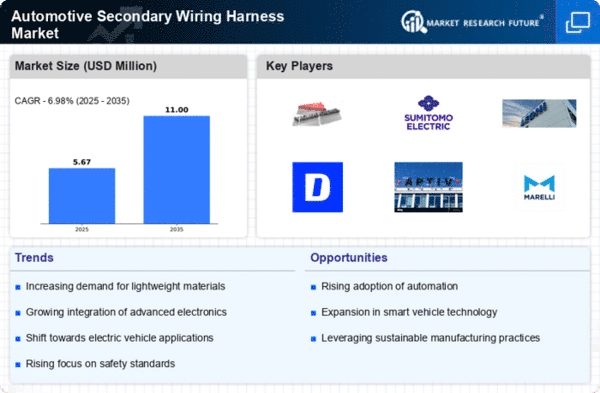
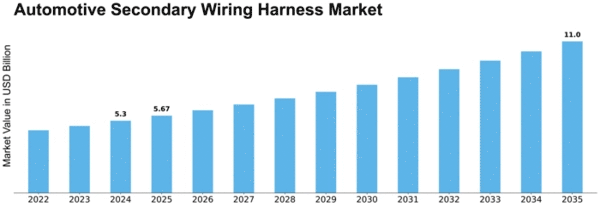
As per MRFR analysis, the Automotive Secondary Wiring Harness Market Size was estimated at 5.3 USD Million in 2024. The Automotive Secondary Wiring Harness industry is projected to grow from 5.6 in 2025 to 11.0 by 2035, exhibiting a compound annual growth rate (CAGR) of 6.98 during the forecast period 2025 - 2035.

Key Market Trends & Highlights

The Automotive Secondary Wiring Harness Market is poised for substantial growth driven by technological advancements and evolving consumer preferences.

  • The integration of advanced technologies is reshaping the automotive secondary wiring harness landscape, particularly in North America.
  • A notable trend is the increasing focus on lightweight materials, which enhances fuel efficiency and performance in passenger vehicles.
  • Sustainability and environmental compliance are becoming critical factors influencing design and manufacturing processes across the industry.
  • The rise in electric vehicle production and the integration of advanced safety features are key drivers propelling market expansion.

Market Size & Forecast

2024 Market Size 5.3 (USD Million)
2035 Market Size 11.0 (USD Million)
CAGR (2025 - 2035) 6.98%
Largest Regional Market Share in 2024 North America

Major Players

Yazaki (JP), Sumitomo Electric (JP), Leoni (DE), Delphi Technologies (GB), Aptiv (IE), Marelli (IT), Kromberg & Schubert (DE), Furukawa Electric (JP), TE Connectivity (CH)

Market Trends

The Automotive Secondary Wiring Harness Market is currently experiencing a transformative phase, driven by advancements in automotive technology and increasing consumer demand for enhanced vehicle performance. This segment of the automotive industry focuses on the intricate network of wires and connectors that facilitate communication and power distribution within vehicles. As vehicles become more sophisticated, the need for reliable and efficient wiring solutions has intensified. Manufacturers are increasingly investing in innovative materials and designs to improve durability and reduce weight, which in turn enhances overall vehicle efficiency. Furthermore, the rise of electric and hybrid vehicles is reshaping the market landscape, as these vehicles require specialized wiring harnesses to support their unique electrical systems. In addition to technological advancements, regulatory pressures aimed at improving vehicle safety and environmental sustainability are influencing the Automotive Secondary Wiring Harness Market. Stricter regulations regarding emissions and safety standards compel manufacturers to adopt more efficient wiring solutions that comply with these guidelines. The growing trend towards automation and connectivity in vehicles also necessitates the integration of advanced wiring systems that can support various electronic components. As the market evolves, it appears poised for growth, with opportunities emerging from the increasing adoption of smart technologies and the ongoing shift towards sustainable automotive solutions. The future of this market seems promising, as it adapts to the changing dynamics of the automotive industry.

Integration of Advanced Technologies

The Automotive Secondary Wiring Harness Market is witnessing a notable trend towards the integration of advanced technologies. This includes the incorporation of smart wiring systems that enhance vehicle connectivity and functionality. As vehicles become more reliant on electronic components, the demand for sophisticated wiring solutions that can support these technologies is likely to increase.

Focus on Lightweight Materials

Another significant trend in the Automotive Secondary Wiring Harness Market is the emphasis on lightweight materials. Manufacturers are exploring innovative materials that reduce the overall weight of wiring harnesses, which can lead to improved fuel efficiency and performance. This shift towards lighter components aligns with the broader industry goal of enhancing vehicle efficiency.

Sustainability and Environmental Compliance

Sustainability is becoming a critical consideration in the Automotive Secondary Wiring Harness Market. As regulations surrounding environmental impact tighten, manufacturers are increasingly focusing on eco-friendly materials and production processes. This trend not only addresses regulatory requirements but also meets the growing consumer demand for environmentally responsible automotive solutions.

Automotive Secondary Wiring Harness Market Market Drivers

Market Growth Projections

The Global Automotive Secondary Wiring Harness Market Industry is poised for substantial growth, with projections indicating a market value of 3.96 USD Billion in 2024 and an expected increase to 9.08 USD Billion by 2035. This growth trajectory suggests a compound annual growth rate (CAGR) of 7.85% from 2025 to 2035. Such figures highlight the increasing importance of wiring harnesses in modern vehicles, driven by trends such as electrification, technological advancements, and regulatory compliance. The market's expansion reflects the automotive industry's ongoing evolution, necessitating innovative wiring solutions that meet the demands of contemporary vehicle design and functionality.

Expansion of Automotive Aftermarket

The expansion of the automotive aftermarket presents a notable opportunity for the Global Automotive Secondary Wiring Harness Market Industry. As vehicle ownership increases globally, the demand for replacement parts and upgrades is also rising. This trend is particularly pronounced in regions with aging vehicle fleets, where older models require wiring harness replacements to maintain performance and safety. The aftermarket segment is becoming increasingly lucrative, as consumers seek high-quality, reliable wiring solutions. This growth is likely to be supported by advancements in manufacturing technologies that enable the production of cost-effective and durable wiring harnesses, further enhancing market dynamics.

Rising Vehicle Production and Sales

The resurgence in global vehicle production and sales is a significant driver for the Global Automotive Secondary Wiring Harness Market Industry. As economies recover and consumer demand for personal and commercial vehicles increases, manufacturers are ramping up production. This surge in vehicle manufacturing directly correlates with the demand for wiring harnesses, which are essential components in all vehicle types. The market's growth trajectory is evident, with projections indicating a rise to 3.96 USD Billion in 2024. This trend is expected to continue, as the automotive industry adapts to changing consumer preferences and technological advancements, thereby sustaining a robust market environment.

Growing Demand for Electric Vehicles

The increasing adoption of electric vehicles (EVs) is a pivotal driver for the Global Automotive Secondary Wiring Harness Market Industry. As manufacturers transition towards electrification, the complexity of wiring harnesses escalates, necessitating advanced designs to accommodate high-voltage systems and battery management. In 2024, the market is projected to reach 3.96 USD Billion, reflecting the surge in EV production. This trend is expected to continue, with the market anticipated to grow significantly as EV sales rise, indicating a robust CAGR of 7.85% from 2025 to 2035. The shift towards sustainable transportation is reshaping the wiring harness landscape, emphasizing innovation and efficiency.

Regulatory Compliance and Safety Standards

Regulatory compliance and safety standards are critical factors influencing the Global Automotive Secondary Wiring Harness Market Industry. Governments worldwide are implementing stringent regulations to enhance vehicle safety and environmental sustainability. These regulations often mandate the use of advanced wiring harness technologies that can withstand harsh conditions and reduce fire risks. As a result, automotive manufacturers are increasingly focusing on high-quality wiring solutions that meet these standards. This shift not only ensures compliance but also promotes consumer confidence in vehicle safety. The ongoing evolution of regulations is likely to drive innovation in wiring harness design, further propelling market growth.

Technological Advancements in Automotive Electronics

Technological innovations in automotive electronics are driving the Global Automotive Secondary Wiring Harness Market Industry forward. The integration of advanced driver-assistance systems (ADAS), infotainment systems, and connectivity features necessitates sophisticated wiring solutions. As vehicles become increasingly equipped with smart technologies, the demand for reliable and efficient wiring harnesses rises. This trend is underscored by the projected market growth, which is expected to reach 9.08 USD Billion by 2035. Manufacturers are compelled to invest in R&D to develop lightweight and durable wiring solutions that can support the growing electronic load in modern vehicles, thereby enhancing overall vehicle performance and safety.

Market Segment Insights

By Application: Body Wiring Harness (Largest) vs. Engine Wiring Harness (Fastest-Growing)

In the Automotive Secondary Wiring Harness Market, the Body Wiring Harness holds the largest market share among the various segment values, primarily due to its essential role in connecting major components for power distribution and communications within the vehicle. Conversely, the Engine Wiring Harness is emerging as the fastest-growing segment owing to the increasing demand for enhanced engine performance and the proliferation of advanced engine technologies, highlighting the dynamic nature of this market.

Body Wiring Harness (Dominant) vs. Engine Wiring Harness (Emerging)

The Body Wiring Harness is a dominant player in the Automotive Secondary Wiring Harness Market, as it integrates various functionalities such as power distribution, signaling, and audio system connectivity. With robust demand for vehicle comfort and safety features, this segment is well-positioned for sustained growth. On the other hand, the Engine Wiring Harness represents an emerging segment shaped by advancements in engine technologies, including electric and hybrid engines, which require more complex wiring solutions. As manufacturers focus on enhancing engine efficiency and reducing emissions, the Engine Wiring Harness will likely experience rapid growth, driven by innovation and the push for sustainability.

By End Use: Passenger Vehicles (Largest) vs. Electric Vehicles (Fastest-Growing)

The Automotive Secondary Wiring Harness Market showcases a distinct distribution of market share across various end-use segments. Passenger vehicles hold the largest share, driven by the high demand for reliable and efficient wiring systems that are essential for various functionalities like lighting, infotainment, and safety features. In contrast, commercial vehicles and hybrid vehicles also contribute significantly, but they lag behind passenger vehicles and electric vehicles, which are increasingly gaining traction due to the global shift towards cleaner transportation solutions.

Passenger Vehicles (Dominant) vs. Electric Vehicles (Emerging)

Passenger vehicles continue to dominate the Automotive Secondary Wiring Harness Market, attributed to their established market presence and ongoing innovation in design and functionality. This segment benefits from the increasing consumer preference for comfort and safety, pushing manufacturers to integrate advanced wiring systems. Simultaneously, electric vehicles emerge as a crucial segment, gaining momentum due to advancements in battery technology and infrastructure. These vehicles require specialized wiring harnesses that can handle higher voltages and support sophisticated electronic systems, positioning them as a key player in the future of automotive technology. Together, these segments shape the landscape of automotive wiring harness needs.

By Material Type: Copper (Largest) vs. Aluminum (Fastest-Growing)

The Automotive Secondary Wiring Harness Market showcases a diverse material distribution. Copper remains the largest component, dominating the market due to its superior electrical conductivity and durability, which are critical in automotive applications. Aluminum, while smaller than copper, is gaining attention for its lightweight properties, allowing for improved vehicle fuel efficiency. Plastics and rubber serve vital roles as insulators and protective coatings, yet their market shares are comparatively lower than the metal counterparts.

Copper (Dominant) vs. Aluminum (Emerging)

Copper is the dominant choice for automotive wiring harnesses, primarily due to its excellent conductivity and strength, which ensure reliable and efficient power transmission. It withstands the automotive environment's demands, including temperature variations and vibrations. On the other hand, aluminum is emerging in prominence, driven by the automotive industry's shift towards lightweight solutions to enhance fuel economy. With advancements in technology enhancing aluminum's conductivity capabilities and the growing emphasis on sustainability, aluminum's adoption is poised for rapid growth, presenting a compelling alternative to traditional copper wiring.

By Connector Type: Sealed Connectors (Largest) vs. Waterproof Connectors (Fastest-Growing)

In the Automotive Secondary Wiring Harness Market, the segment of connector types exhibits diverse preferences among manufacturers and consumers. Sealed connectors dominate this segment, primarily due to their ability to provide durability and reliability in varying environmental conditions. Waterproof connectors are closely following, appealing to the growing demand for enhanced protection against water ingress, particularly in electric vehicle applications. Unsealed and terminal connectors, while utilized in specific applications, are witnessing relatively lower market presence compared to their sealed and waterproof counterparts. The growth trends in the connector types market are driven by advancements in automotive technology and the increasing adoption of electric vehicles. Manufacturers are focusing on enhancing connector designs to improve efficiency and longevity, thereby meeting regulatory requirements and consumer expectations. Sealed connectors are expected to maintain their strength due to the need for reliability, while waterproof connectors are emerging rapidly as vehicle electrification grows, predominantly driven by electric and hybrid vehicles' trends toward environmental resilience.

Sealed Connectors (Dominant) vs. Terminal Connectors (Emerging)

Sealed connectors have established themselves as the dominant force in the Automotive Secondary Wiring Harness Market, primarily due to their superior resistance to moisture and dirt, making them ideal for a variety of automotive applications including high-performance vehicles. Their robust design enhances vehicle longevity and reliability, particularly in harsh environments, thus making them highly preferred among manufacturers. On the other hand, terminal connectors, while historically seen as optional, are becoming an emerging segment. Their simplicity and lower cost make them attractive for basic applications within less demanding environments. However, as automotive technology progresses toward increased complexity and functionality, terminal connectors face the challenge of evolving to meet the increasingly stringent requirements for performance and durability.

By Voltage Rating: High Voltage (Largest) vs. Low Voltage (Fastest-Growing)

The Automotive Secondary Wiring Harness Market exhibits a diverse voltage rating segmentation. High Voltage harnesses currently dominate the market due to their essential role in electric and hybrid vehicles, which increasingly utilize advanced electrical systems. Conversely, Low Voltage harnesses are gaining momentum, particularly in traditional vehicles and emerging automotive technologies that require less complex wiring solutions.

Low Voltage (Emerging) vs. High Voltage (Dominant)

Low Voltage wiring harnesses, characterized by their capability to handle lower electrical loads, are becoming increasingly popular as manufacturers aim to enhance vehicle safety and efficiency. This segment is rapidly emerging due to trends favoring lightweight designs and cost-effective solutions, particularly in conventional automotive manufacturing. On the other hand, High Voltage harnesses, essential for hybrid and electric vehicles, remain dominant due to the increasing demand for more powerful systems supporting advanced features, such as electric drivetrains and enhanced connectivity. This dual positioning illustrates the contrasting evolution of the market, where Low Voltage serves traditional expectations while High Voltage meets cutting-edge technological requirements.

Get more detailed insights about Automotive Secondary Wiring Harness Market Research Report – Forecast to 2035

Regional Insights

North America : Market Leader in Innovation

North America is poised to maintain its leadership in the Automotive Secondary Wiring Harness Market, holding a market size of $2.65B in 2025. Key growth drivers include the increasing demand for electric vehicles (EVs) and stringent safety regulations. The region's robust automotive industry, coupled with advancements in technology, is expected to further boost market growth. Regulatory support for EV infrastructure is also a significant catalyst for demand. The competitive landscape in North America is characterized by the presence of major players such as Yazaki, Delphi Technologies, and Aptiv. The U.S. and Canada are the leading countries, with a strong focus on innovation and sustainability. Companies are investing heavily in R&D to enhance product offerings and meet evolving consumer demands. This competitive environment is expected to drive further advancements in wiring harness technology, solidifying North America's market position.

Europe : Emerging Hub for Sustainability

Europe's Automotive Secondary Wiring Harness Market is projected to reach $1.5B by 2025, driven by stringent environmental regulations and a shift towards sustainable automotive solutions. The European Union's Green Deal and various national policies are catalyzing the transition to electric and hybrid vehicles, significantly impacting demand for advanced wiring solutions. The focus on reducing carbon emissions is a key driver for market growth in this region. Leading countries in Europe include Germany, France, and Italy, where major automotive manufacturers are investing in innovative wiring technologies. Key players like Leoni and Marelli are at the forefront, enhancing their product lines to meet regulatory standards. The competitive landscape is marked by collaborations and partnerships aimed at developing eco-friendly solutions, positioning Europe as a leader in sustainable automotive technology.

Asia-Pacific : Rapid Growth in Emerging Markets

The Asia-Pacific region is witnessing significant growth in the Automotive Secondary Wiring Harness Market, projected to reach $1.0B by 2025. This growth is fueled by rising vehicle production, increasing disposable incomes, and a growing middle class. Countries like China and India are leading the charge, with government initiatives promoting electric vehicles and advanced automotive technologies. The demand for wiring harnesses is expected to surge as manufacturers adapt to these trends. China stands out as the largest automotive market, with major players like Sumitomo Electric and Furukawa Electric establishing a strong presence. The competitive landscape is characterized by rapid technological advancements and a focus on cost-effective solutions. As the region continues to develop, the automotive sector's expansion will drive further demand for innovative wiring harness technologies, enhancing the overall market landscape.

Middle East and Africa : Emerging Market Potential

The Middle East and Africa (MEA) region is at the nascent stage of development in the Automotive Secondary Wiring Harness Market, with a projected size of $0.15B by 2025. The market is driven by increasing vehicle ownership and infrastructure development. Governments in the region are investing in transportation networks, which is expected to boost automotive production and, consequently, the demand for wiring harnesses. The growing interest in electric vehicles is also beginning to shape market dynamics. Leading countries in the MEA region include South Africa and the UAE, where automotive manufacturing is gaining traction. However, the competitive landscape remains fragmented, with several local and international players vying for market share. Companies are focusing on establishing partnerships and enhancing their supply chains to capitalize on emerging opportunities in this developing market.

Key Players and Competitive Insights

The Automotive Secondary Wiring Harness Market is currently characterized by a competitive landscape that is both dynamic and multifaceted. Key growth drivers include the increasing demand for electric vehicles (EVs), advancements in automotive technology, and a heightened focus on vehicle safety and connectivity. Major players such as Yazaki (Japan), Sumitomo Electric (Japan), and Aptiv (Ireland) are strategically positioned to leverage these trends. Yazaki (Japan) emphasizes innovation in lightweight materials and smart wiring solutions, while Sumitomo Electric (Japan) focuses on expanding its global footprint through strategic partnerships and local manufacturing. Aptiv (Ireland) is heavily investing in digital transformation and AI integration, which collectively shapes a competitive environment that is increasingly reliant on technological advancements and strategic collaborations.In terms of business tactics, companies are localizing manufacturing to enhance supply chain efficiency and reduce costs. The market structure appears moderately fragmented, with several key players exerting considerable influence. This fragmentation allows for a variety of competitive strategies, as companies seek to differentiate themselves through innovation and operational excellence.

In November Yazaki (Japan) announced the opening of a new manufacturing facility in Eastern Europe, aimed at increasing production capacity for EV wiring harnesses. This strategic move is likely to enhance Yazaki's ability to meet the growing demand for EV components in the region, positioning the company favorably against competitors. The establishment of this facility not only signifies a commitment to regional growth but also reflects a broader trend of localized production in response to market demands.

In October Sumitomo Electric (Japan) entered into a partnership with a leading EV manufacturer to develop advanced wiring solutions tailored for next-generation electric vehicles. This collaboration underscores the importance of strategic alliances in fostering innovation and enhancing product offerings. By aligning with a prominent player in the EV sector, Sumitomo Electric (Japan) is poised to strengthen its market position and drive future growth.

In September Aptiv (Ireland) unveiled a new suite of AI-driven wiring harness solutions designed to improve vehicle connectivity and safety. This launch highlights Aptiv's commitment to integrating cutting-edge technology into its product offerings. The introduction of AI capabilities not only enhances the functionality of wiring harnesses but also positions Aptiv as a leader in the digital transformation of the automotive sector.

As of December current competitive trends are increasingly defined by digitalization, sustainability, and the integration of AI technologies. Strategic alliances are playing a pivotal role in shaping the landscape, as companies collaborate to enhance their technological capabilities and market reach. Looking ahead, competitive differentiation is likely to evolve from traditional price-based competition to a focus on innovation, technology, and supply chain reliability. This shift suggests that companies that prioritize R&D and strategic partnerships will be better positioned to thrive in an increasingly complex market.

Key Companies in the Automotive Secondary Wiring Harness Market include

Industry Developments

The Automotive Secondary Wiring Harness Market was valued at 43.3 billion in 2019, and it is all set to register a CAGR of 11% in the forecast period. 

Automotive Secondary Wiring Harness Market dynamics

    • Major Drivers 

Various factors play a huge part in driving the demand of the market. One of the major factors is the huge demand for advanced and safe cars. Wiring Harness offers various safety features and also electronic gadgets. The demand for advanced cars with great design is increasing among car manufacturers. As a result, it is propelling the Automotive Secondary Wiring Harness Market growth. Compared to the traditional wiring methods, the wiring harness offers reliable and secured connections and improves the vehicles' fuel capacity. Population growth is also a major factor. With population growth, the demand for vehicles will also grow significantly.

According to the Green Mobility report by the World Bank, 1.2 vehicles were on the road by 2020 and are increasing rapidly. 

    • Opportunities 

Automotive Secondary Wiring Harness Market systems provide better fuel consumption ability. Due to this, the government is taking the initiative to increase its use. The fuel need will be lower by decreasing the emissions of harmful chemicals into the environment. And it will generate opportunities for the Automotive Secondary Wiring Harness industry. 

    • Restraints 

In some regions with critical climate conditions such as heavy rain and snowfall, the wring system shows heating and short circuit problems. A small problem in the wiring can lead to the replacement of the entire system. The high-cost replacement and the technical problems in some regions are restraining the Automotive Secondary Wiring Harness Market growth. 

    • Challenges 

With the increasing need for advanced vehicles, the manufacturer of the wiring system has to produce a better wiring system. The lack of manufacturers in underdeveloped regions is a major challenge for the Automotive Secondary Wiring Harness industry. The key players in the market are trying their best to overcome all these challenges and boost the Automotive Secondary Wiring Harness Market. 

Automotive Secondary Wiring Harness Market Cumulative growth analysis

A wiring harness is used in the electronic brakes, infotainment systems, connectivity technology, and lighting systems. The wide application of wiring systems will drive the market growth. The market is expected to grow with a healthy CAGR of 11% in the market's forecast period. 

Future Outlook

Automotive Secondary Wiring Harness Market Future Outlook

The Automotive Secondary Wiring Harness Market is projected to grow at a 6.98% CAGR from 2025 to 2035, driven by advancements in electric vehicles, increased automation, and enhanced connectivity.

New opportunities lie in:

  • Integration of smart wiring solutions for enhanced vehicle connectivity.
  • Development of lightweight materials to improve fuel efficiency.
  • Expansion into emerging markets with tailored wiring harness solutions.

By 2035, the market is expected to achieve robust growth, reflecting evolving automotive technologies.

Market Segmentation

Automotive Secondary Wiring Harness Market End Use Outlook

  • Passenger Vehicles
  • Commercial Vehicles
  • Electric Vehicles
  • Hybrid Vehicles

Automotive Secondary Wiring Harness Market Application Outlook

  • Body Wiring Harness
  • Chassis Wiring Harness
  • Engine Wiring Harness
  • Dashboard Wiring Harness
  • Lighting Wiring Harness

Automotive Secondary Wiring Harness Market Material Type Outlook

  • Copper
  • Aluminum
  • Plastic
  • Rubber

Automotive Secondary Wiring Harness Market Connector Type Outlook

  • Sealed Connectors
  • Unsealed Connectors
  • Waterproof Connectors
  • Terminal Connectors

Automotive Secondary Wiring Harness Market Voltage Rating Outlook

  • Low Voltage
  • Medium Voltage
  • High Voltage

Report Scope

MARKET SIZE 20245.3(USD Million)
MARKET SIZE 20255.6(USD Million)
MARKET SIZE 203511.0(USD Million)
COMPOUND ANNUAL GROWTH RATE (CAGR)6.98% (2025 - 2035)
REPORT COVERAGERevenue Forecast, Competitive Landscape, Growth Factors, and Trends
BASE YEAR2024
Market Forecast Period2025 - 2035
Historical Data2019 - 2024
Market Forecast UnitsUSD Million
Key Companies ProfiledYazaki (JP), Sumitomo Electric (JP), Leoni (DE), Delphi Technologies (GB), Aptiv (IE), Marelli (IT), Kromberg & Schubert (DE), Furukawa Electric (JP), TE Connectivity (CH)
Segments CoveredApplication, End Use, Material Type, Connector Type, Voltage Rating
Key Market OpportunitiesIntegration of advanced materials and smart technologies in Automotive Secondary Wiring Harness Market enhances performance and efficiency.
Key Market DynamicsRising demand for electric vehicles drives innovation and competition in the automotive secondary wiring harness market.
Countries CoveredNorth America, Europe, APAC, South America, MEA

FAQs

What is going to be the growth rate of the market in the near future?

In the coming period, the market growth rate can be approximately 10.2%.

What can be the market value by the end of the review timeframe?

The market has quite a lot of potential to note excellent growth in the near future.

Who are the significant vendors in the global market?

The notable companies are THB Group. (China), Yazaki Corporation. (Japan), Spark Minda, Sumitomo Electric Industries, Ltd. (Japan), Aptiv PLC (UK), Leoni AG (Germany), Nexans (France), Ashok Minda Group (India), Samvardhana Motherson Group. (India), Lear Corporation. (US), Furukawa Electric Co., Ltd. (Japan), and others.

Which is the top market in Europe?

Germany is estimated to be the top market in Europe.

Which regional market can perform the best during the review period?

APAC can possibly perform the best during the review period, among all the regions.

  1. SECTION I: EXECUTIVE SUMMARY AND KEY HIGHLIGHTS
    1. | 1.1 EXECUTIVE SUMMARY
    2. | 1.1.1 Market Overview
    3. | 1.1.2 Key Findings
    4. | 1.1.3 Market Segmentation
    5. | 1.1.4 Competitive Landscape
    6. | 1.1.5 Challenges and Opportunities
    7. | 1.1.6 Future Outlook
  2. SECTION II: SCOPING, METHODOLOGY AND MARKET STRUCTURE
    1. | 2.1 MARKET INTRODUCTION
    2. | 2.1.1 Definition
    3. | 2.1.2 Scope of the study
    4. |-- 2.1.2.1 Research Objective
    5. |-- 2.1.2.2 Assumption
    6. |-- 2.1.2.3 Limitations
    7. | 2.2 RESEARCH METHODOLOGY
    8. | 2.2.1 Overview
    9. | 2.2.2 Data Mining
    10. | 2.2.3 Secondary Research
    11. | 2.2.4 Primary Research
    12. |-- 2.2.4.1 Primary Interviews and Information Gathering Process
    13. |-- 2.2.4.2 Breakdown of Primary Respondents
    14. | 2.2.5 Forecasting Model
    15. | 2.2.6 Market Size Estimation
    16. |-- 2.2.6.1 Bottom-Up Approach
    17. |-- 2.2.6.2 Top-Down Approach
    18. | 2.2.7 Data Triangulation
    19. | 2.2.8 Validation
  3. SECTION III: QUALITATIVE ANALYSIS
    1. | 3.1 MARKET DYNAMICS
    2. | 3.1.1 Overview
    3. | 3.1.2 Drivers
    4. | 3.1.3 Restraints
    5. | 3.1.4 Opportunities
    6. | 3.2 MARKET FACTOR ANALYSIS
    7. | 3.2.1 Value chain Analysis
    8. | 3.2.2 Porter's Five Forces Analysis
    9. |-- 3.2.2.1 Bargaining Power of Suppliers
    10. |-- 3.2.2.2 Bargaining Power of Buyers
    11. |-- 3.2.2.3 Threat of New Entrants
    12. |-- 3.2.2.4 Threat of Substitutes
    13. |-- 3.2.2.5 Intensity of Rivalry
    14. | 3.2.3 COVID-19 Impact Analysis
    15. |-- 3.2.3.1 Market Impact Analysis
    16. |-- 3.2.3.2 Regional Impact
    17. |-- 3.2.3.3 Opportunity and Threat Analysis
  4. SECTION IV: QUANTITATIVE ANALYSIS
    1. | 4.1 Automobile, BY Application (USD Million)
    2. | 4.1.1 Body Wiring Harness
    3. | 4.1.2 Chassis Wiring Harness
    4. | 4.1.3 Engine Wiring Harness
    5. | 4.1.4 Dashboard Wiring Harness
    6. | 4.1.5 Lighting Wiring Harness
    7. | 4.2 Automobile, BY End Use (USD Million)
    8. | 4.2.1 Passenger Vehicles
    9. | 4.2.2 Commercial Vehicles
    10. | 4.2.3 Electric Vehicles
    11. | 4.2.4 Hybrid Vehicles
    12. | 4.3 Automobile, BY Material Type (USD Million)
    13. | 4.3.1 Copper
    14. | 4.3.2 Aluminum
    15. | 4.3.3 Plastic
    16. | 4.3.4 Rubber
    17. | 4.4 Automobile, BY Connector Type (USD Million)
    18. | 4.4.1 Sealed Connectors
    19. | 4.4.2 Unsealed Connectors
    20. | 4.4.3 Waterproof Connectors
    21. | 4.4.4 Terminal Connectors
    22. | 4.5 Automobile, BY Voltage Rating (USD Million)
    23. | 4.5.1 Low Voltage
    24. | 4.5.2 Medium Voltage
    25. | 4.5.3 High Voltage
    26. | 4.6 Automobile, BY Region (USD Million)
    27. | 4.6.1 North America
    28. |-- 4.6.1.1 US
    29. |-- 4.6.1.2 Canada
    30. | 4.6.2 Europe
    31. |-- 4.6.2.1 Germany
    32. |-- 4.6.2.2 UK
    33. |-- 4.6.2.3 France
    34. |-- 4.6.2.4 Russia
    35. |-- 4.6.2.5 Italy
    36. |-- 4.6.2.6 Spain
    37. |-- 4.6.2.7 Rest of Europe
    38. | 4.6.3 APAC
    39. |-- 4.6.3.1 China
    40. |-- 4.6.3.2 India
    41. |-- 4.6.3.3 Japan
    42. |-- 4.6.3.4 South Korea
    43. |-- 4.6.3.5 Malaysia
    44. |-- 4.6.3.6 Thailand
    45. |-- 4.6.3.7 Indonesia
    46. |-- 4.6.3.8 Rest of APAC
    47. | 4.6.4 South America
    48. |-- 4.6.4.1 Brazil
    49. |-- 4.6.4.2 Mexico
    50. |-- 4.6.4.3 Argentina
    51. |-- 4.6.4.4 Rest of South America
    52. | 4.6.5 MEA
    53. |-- 4.6.5.1 GCC Countries
    54. |-- 4.6.5.2 South Africa
    55. |-- 4.6.5.3 Rest of MEA
  5. SECTION V: COMPETITIVE ANALYSIS
    1. | 5.1 Competitive Landscape
    2. | 5.1.1 Overview
    3. | 5.1.2 Competitive Analysis
    4. | 5.1.3 Market share Analysis
    5. | 5.1.4 Major Growth Strategy in the Automobile
    6. | 5.1.5 Competitive Benchmarking
    7. | 5.1.6 Leading Players in Terms of Number of Developments in the Automobile
    8. | 5.1.7 Key developments and growth strategies
    9. |-- 5.1.7.1 New Product Launch/Service Deployment
    10. |-- 5.1.7.2 Merger & Acquisitions
    11. |-- 5.1.7.3 Joint Ventures
    12. | 5.1.8 Major Players Financial Matrix
    13. |-- 5.1.8.1 Sales and Operating Income
    14. |-- 5.1.8.2 Major Players R&D Expenditure. 2023
    15. | 5.2 Company Profiles
    16. | 5.2.1 Yazaki (JP)
    17. |-- 5.2.1.1 Financial Overview
    18. |-- 5.2.1.2 Products Offered
    19. |-- 5.2.1.3 Key Developments
    20. |-- 5.2.1.4 SWOT Analysis
    21. |-- 5.2.1.5 Key Strategies
    22. | 5.2.2 Sumitomo Electric (JP)
    23. |-- 5.2.2.1 Financial Overview
    24. |-- 5.2.2.2 Products Offered
    25. |-- 5.2.2.3 Key Developments
    26. |-- 5.2.2.4 SWOT Analysis
    27. |-- 5.2.2.5 Key Strategies
    28. | 5.2.3 Leoni (DE)
    29. |-- 5.2.3.1 Financial Overview
    30. |-- 5.2.3.2 Products Offered
    31. |-- 5.2.3.3 Key Developments
    32. |-- 5.2.3.4 SWOT Analysis
    33. |-- 5.2.3.5 Key Strategies
    34. | 5.2.4 Delphi Technologies (GB)
    35. |-- 5.2.4.1 Financial Overview
    36. |-- 5.2.4.2 Products Offered
    37. |-- 5.2.4.3 Key Developments
    38. |-- 5.2.4.4 SWOT Analysis
    39. |-- 5.2.4.5 Key Strategies
    40. | 5.2.5 Aptiv (IE)
    41. |-- 5.2.5.1 Financial Overview
    42. |-- 5.2.5.2 Products Offered
    43. |-- 5.2.5.3 Key Developments
    44. |-- 5.2.5.4 SWOT Analysis
    45. |-- 5.2.5.5 Key Strategies
    46. | 5.2.6 Marelli (IT)
    47. |-- 5.2.6.1 Financial Overview
    48. |-- 5.2.6.2 Products Offered
    49. |-- 5.2.6.3 Key Developments
    50. |-- 5.2.6.4 SWOT Analysis
    51. |-- 5.2.6.5 Key Strategies
    52. | 5.2.7 Kromberg & Schubert (DE)
    53. |-- 5.2.7.1 Financial Overview
    54. |-- 5.2.7.2 Products Offered
    55. |-- 5.2.7.3 Key Developments
    56. |-- 5.2.7.4 SWOT Analysis
    57. |-- 5.2.7.5 Key Strategies
    58. | 5.2.8 Furukawa Electric (JP)
    59. |-- 5.2.8.1 Financial Overview
    60. |-- 5.2.8.2 Products Offered
    61. |-- 5.2.8.3 Key Developments
    62. |-- 5.2.8.4 SWOT Analysis
    63. |-- 5.2.8.5 Key Strategies
    64. | 5.2.9 TE Connectivity (CH)
    65. |-- 5.2.9.1 Financial Overview
    66. |-- 5.2.9.2 Products Offered
    67. |-- 5.2.9.3 Key Developments
    68. |-- 5.2.9.4 SWOT Analysis
    69. |-- 5.2.9.5 Key Strategies
    70. | 5.3 Appendix
    71. | 5.3.1 References
    72. | 5.3.2 Related Reports

Automobile Market Segmentation

Automobile By Application (USD Million, 2025-2035)

  • Body Wiring Harness
  • Chassis Wiring Harness
  • Engine Wiring Harness
  • Dashboard Wiring Harness
  • Lighting Wiring Harness

Automobile By End Use (USD Million, 2025-2035)

  • Passenger Vehicles
  • Commercial Vehicles
  • Electric Vehicles
  • Hybrid Vehicles

Automobile By Material Type (USD Million, 2025-2035)

  • Copper
  • Aluminum
  • Plastic
  • Rubber

Automobile By Connector Type (USD Million, 2025-2035)

  • Sealed Connectors
  • Unsealed Connectors
  • Waterproof Connectors
  • Terminal Connectors

Automobile By Voltage Rating (USD Million, 2025-2035)

  • Low Voltage
  • Medium Voltage
  • High Voltage
Infographic

Free Sample Request

Kindly complete the form below to receive a free sample of this Report

Get Free Sample

Customer Strories

Compare Licence

×
Features License Type
Single User Multiuser License Enterprise User
Price $4,950 $5,950 $7,250
Maximum User Access Limit 1 User Upto 10 Users Unrestricted Access Throughout the Organization
Free Customization
Direct Access to Analyst
Deliverable Format
Platform Access
Discount on Next Purchase 10% 15% 15%
Printable Versions