Request Free Sample ×

Kindly complete the form below to receive a free sample of this Report

* Please use a valid business email

Leading companies partner with us for data-driven Insights

clients tt-cursor
Hero Background
English
Chinese
French
Japanese
Korean
German
Spanish

Automotive Robotics Market Trends

ID: MRFR/AT/1457-HCR
200 Pages
Shubham Munde
March 2026

Automotive Robotics Market Size, Share & Growth Analysis Report By Application (Welding, Painting, Assembly, Material Handling), By Robotics Type (Articulated Robots, SCARA Robots, Delta Robots, Collaborative Robots), By End Use (Passenger Cars, Commercial Vehicles, Electric Vehicles), By Technology (Industrial Robotics, Automation Solutions, Machine Learning) and By Regional (North America, Europe, South America, Asia Pacific, Middle East and Africa) - Industry Growth & Forecast to 2035

Share:
Download PDF ×

We do not share your information with anyone. However, we may send you emails based on your report interest from time to time. You may contact us at any time to opt-out.

Automotive Robotics Market Infographic
Purchase Options

Market Trends

Key Emerging Trends in the Automotive Robotics Market

The automotive robotics industry is as of now going through huge changes, fundamentally because of the rising business sector interest in electric vehicles (EVs). Natural worries and the exceptional hardships related with electric vehicle production are persuading makers to dispense assets towards mechanical technology to handle the many-sided gathering requests of EV parts.

The mix of mechanical technology into the improvement of independent vehicles is a critical turn of events, moved by the requirement for cutting edge parts like cameras, sensors, and LiDAR frameworks. The headway of advanced mechanics in the car business is driven by the requirement for refined mechanization arrangements, which exhibits the area's devotion to creating cutting edge advancements that upgrade the wellbeing and productivity of independent vehicles.

Automotive robotics technology is seeing an expansion in the pervasiveness of cobots because of their ability to work couple with human administrators, in this way expanding versatility and adaptability. This change toward human-robot joint effort in car fabricating means to build efficiency, precision, and wellbeing. This progress means a significant shift in course towards achieving greatest effectiveness on the assembling office's premises.

To be sure, the automotive robotics industry is encountering a blossoming "lights-out" fabricating pattern, which incorporates completely mechanized creation offices that work without human mediation, in any event, during non-working hours. By coordinating man-made reasoning, high level advanced mechanics, and information examination, this innovation tries to further develop eco-friendliness, decrease functional costs, and increment creation limit. The reception of savvy plants in the car business is adding to the developing force of this efficiency pattern.

The automotive robotics market is going through a change towards Asia-Pacific countries like China, Japan, and South Korea because of elements including blossoming vehicle interest, industrialization, government drives, and quick assembling development. The quest for advanced mechanics answers for further develop producing capacities is continuous.

Automated frameworks keep on requiring master work force and involve significant starting venture costs. Innovative advances have worked with the arrangement of easy to understand, practical arrangements that empower little and medium-sized undertakings to embrace mechanical technology.

The automotive robotics industry is at present going through a time of massive change, as the execution of mechanical technology because of developing industry prerequisites, like the creation of electric and independent vehicles, cooperative robots, and lights-out assembling, advances supported extension and headway.


Author
Author Profile
Shubham Munde
Team Lead - Research

Shubham brings over 7 years of expertise in Market Intelligence and Strategic Consulting, with a strong focus on the Automotive, Aerospace, and Defense sectors. Backed by a solid foundation in semiconductors, electronics, and software, he has successfully delivered high-impact syndicated and custom research on a global scale. His core strengths include market sizing, forecasting, competitive intelligence, consumer insights, and supply chain mapping. Widely recognized for developing scalable growth strategies, Shubham empowers clients to navigate complex markets and achieve a lasting competitive edge. Trusted by start-ups and Fortune 500 companies alike, he consistently converts challenges into strategic opportunities that drive sustainable growth.

Leave a Comment

FAQs

What is the projected market valuation of the Automotive Robotics Market by 2035?

<p>The Automotive Robotics Market is projected to reach a valuation of 13.6 USD Billion by 2035.</p>

What was the market valuation of the Automotive Robotics Market in 2024?

<p>In 2024, the Automotive Robotics Market was valued at 5.091 USD Billion.</p>

What is the expected CAGR for the Automotive Robotics Market during the forecast period 2025 - 2035?

<p>The expected CAGR for the Automotive Robotics Market during the forecast period 2025 - 2035 is 9.34%.</p>

Which application segments are driving growth in the Automotive Robotics Market?

<p>The application segments driving growth include Welding, Painting, Assembly, and Material Handling, with valuations ranging from 1.1 to 3.8 USD Billion.</p>

What types of robots are included in the Automotive Robotics Market?

<p>The market includes various types of robots such as Articulated Robots, SCARA Robots, Delta Robots, and Collaborative Robots, with valuations from 0.8 to 5.1 USD Billion.</p>

Which end-use segments are contributing to the Automotive Robotics Market?

<p>Key end-use segments include Passenger Cars, Commercial Vehicles, and Electric Vehicles, with valuations between 1.091 and 6.5 USD Billion.</p>

Who are the key players in the Automotive Robotics Market?

<p>Key players in the Automotive Robotics Market include ABB, KUKA, FANUC, Yaskawa, Siemens, Rockwell Automation, Omron, Cognex, and Universal Robots.</p>

What technological advancements are influencing the Automotive Robotics Market?

<p>Technological advancements in Industrial Robotics, Automation Solutions, and Machine Learning are influencing the market, with valuations from 1.5 to 5.5 USD Billion.</p>

How does the Automotive Robotics Market compare to other sectors in terms of growth?

<p>The Automotive Robotics Market appears to be on a robust growth trajectory, with a projected increase from 5.091 USD Billion in 2024 to 13.6 USD Billion by 2035.</p>

What are the implications of the projected growth for industry stakeholders?

<p>The projected growth in the Automotive Robotics Market suggests potential opportunities for industry stakeholders to innovate and expand their offerings in automation and robotics.</p>

Market Summary

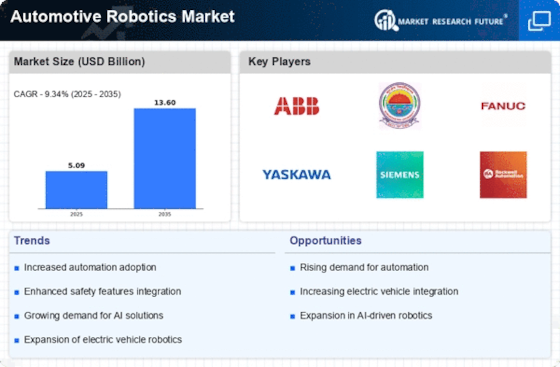
As per Market Research Future analysis, the Automotive Robotics Market Size was estimated at 5.091 USD Billion in 2024. The Automotive Robotics industry is projected to grow from 5.567 USD Billion in 2025 to 13.6 USD Billion by 2035, exhibiting a compound annual growth rate (CAGR) of 9.34% during the forecast period 2025 - 2035

Key Market Trends & Highlights

The Automotive Robotics Market is experiencing robust growth driven by technological advancements and increasing automation demands.

  • North America remains the largest market for automotive robotics, driven by established manufacturing infrastructure. The Asia-Pacific region is the fastest-growing market, fueled by rapid industrialization and increasing investments in automation. Welding robots dominate the market, while collaborative robots are emerging as the fastest-growing segment due to their versatility and ease of use. Rising demand for automation in automotive manufacturing and advancements in electric and autonomous vehicle technologies are key drivers of market growth.

Market Size & Forecast

2024 Market Size 5.091 (USD Billion)
2035 Market Size 13.6 (USD Billion)
CAGR (2025 - 2035) 9.34%
Largest Regional Market Share in 2024 North America

Major Players

<p>ABB (CH), KUKA (DE), FANUC (JP), Yaskawa (JP), Siemens (DE), Rockwell Automation (US), Omron (JP), Cognex (US), Universal Robots (DK)</p>

Market Trends

The Automotive Robotics Market is currently experiencing a transformative phase, driven by advancements in technology and increasing demand for automation in manufacturing processes. As automotive manufacturers strive to enhance efficiency and reduce production costs, the integration of robotics into assembly lines has become more prevalent. This shift not only streamlines operations but also improves precision and safety, thereby fostering a more competitive landscape.

Furthermore, the growing emphasis on electric vehicles and autonomous driving technologies is likely to propel the adoption of robotics, as these innovations require sophisticated manufacturing techniques and systems. In addition to technological advancements, the auto robotics industry is influenced by changing consumer preferences and regulatory pressures. As sustainability becomes a focal point for both manufacturers and consumers, the need for eco-friendly production methods is paramount.

Robotics can play a crucial role in achieving these goals by optimizing resource usage and minimizing waste. Moreover, the collaboration between humans and robots, often referred to as cobots, is gaining traction, suggesting a future where human workers and machines coexist harmoniously on the production floor. This evolving dynamic may redefine workforce roles and enhance overall productivity in the automotive sector.

Increased Automation in Manufacturing

The trend towards greater automation in manufacturing processes is reshaping the Automotive Robot Market. As companies seek to enhance efficiency and reduce labor costs, the deployment of robotic systems is becoming more widespread. This shift not only streamlines production but also improves product quality and consistency.

Focus on Electric and Autonomous Vehicles

The rising interest in electric and autonomous vehicles is driving innovation within the Automotive Robot Market. Manufacturers are increasingly investing in robotics to meet the unique challenges posed by these advanced technologies, which require specialized production techniques and components.

Collaboration Between Humans and Robots

The emergence of collaborative robots, or cobots, is transforming the interaction between human workers and robotic systems. This trend indicates a shift towards a more integrated workforce, where robots assist humans in various tasks, enhancing productivity and safety on the production floor.

Automotive Robotics Market Market Drivers

Collaboration Between Humans and Robots

The Global Automotive Robotics Market is increasingly characterized by the collaboration between humans and robots, often referred to as cobots. This trend reflects a shift towards a more integrated approach to manufacturing, where robots assist human workers rather than replace them. In 2025, the market for collaborative robots is expected to grow substantially, driven by the need for flexibility and adaptability in production lines. Cobots are designed to work alongside humans, enhancing productivity while ensuring safety. This collaborative dynamic allows for the efficient handling of complex tasks, such as assembly and quality checks, where human intuition and robotic precision complement each other. The rise of cobots is likely to redefine workforce dynamics in the automotive sector, fostering a more harmonious relationship between technology and human labor.

Increased Focus on Safety and Quality Control

The Automotive Robot Market is witnessing an increased focus on safety and quality control measures within manufacturing environments. As consumer expectations for vehicle safety rise, manufacturers are compelled to adopt advanced robotics to ensure compliance with stringent safety standards. In 2025, it is anticipated that investments in robotics for quality assurance will account for a significant portion of the Auto Robotics Industry, potentially exceeding 5 billion USD. Robotics systems equipped with artificial intelligence and machine learning capabilities can perform real-time inspections, identifying defects and ensuring that products meet quality benchmarks. This proactive approach not only enhances safety but also reduces the likelihood of costly recalls, thereby improving brand reputation and consumer trust.

Sustainability Initiatives in Automotive Production

The Automotive Robots Market is increasingly influenced by sustainability initiatives aimed at reducing the environmental impact of automotive production. As regulatory pressures mount and consumer preferences shift towards eco-friendly practices, manufacturers are adopting robotics to enhance sustainability. In 2025, it is projected that the market for robotics focused on sustainable practices will grow significantly, potentially reaching 10 billion USD. Robotics can optimize resource usage, minimize waste, and improve energy efficiency in manufacturing processes. For instance, robotic systems can be programmed to utilize materials more effectively, reducing scrap rates and energy consumption. This alignment with sustainability goals not only meets regulatory requirements but also appeals to environmentally conscious consumers, positioning companies favorably in a competitive market.

Rising Demand for Automation in Automotive Manufacturing

The Vehicles Robotics Market is experiencing a surge in demand for automation within manufacturing processes. As manufacturers strive to enhance efficiency and reduce operational costs, the integration of robotics has become increasingly prevalent. In 2025, it is estimated that the market for automotive robotics will reach approximately 20 billion USD, driven by the need for precision and speed in production lines. Robotics not only minimizes human error but also allows for 24/7 operations, thereby increasing output. This trend is particularly evident in assembly lines, where robotic arms are utilized for tasks such as welding, painting, and assembly. The shift towards automation is expected to continue, as companies seek to remain competitive in a rapidly evolving market.

Advancements in Electric and Autonomous Vehicle Technologies

The Vehicle Manufacturing Robotics Market is significantly influenced by advancements in electric and autonomous vehicle technologies. As the automotive sector transitions towards electric vehicles (EVs), the demand for robotics that can support the production of these vehicles is on the rise. In 2025, the market for automotive robotics is projected to grow by 15% annually, largely due to the increasing complexity of EV manufacturing processes. Robotics plays a crucial role in the assembly of battery systems and electric drivetrains, which require high precision and efficiency. Furthermore, the development of autonomous vehicles necessitates sophisticated robotics for tasks such as navigation and obstacle detection. This convergence of robotics and vehicle technology is likely to reshape the automotive landscape, fostering innovation and enhancing production capabilities.

Market Segment Insights

By Application: Welding (Largest) vs. Material Handling (Fastest-Growing)

<p>In the Automotive Robotics Market, the application segments exhibit distinct distribution of Automotive Robotics Market share, with welding being the largest segment. Welding robots are heavily utilized due to their efficiency and precision in manufacturing, which lowers labor costs and improves safety. Following welding, painting and assembly applications hold considerable shares, while material handling is rapidly gaining ground as manufacturers adopt advanced robotics to streamline operations. The growth trends in this segment are driven by technological advancements, such as increased automation and integration of AI in robotics. Furthermore, manufacturing industries are increasingly looking to enhance productivity and reduce downtime. As a result, material handling has emerged as the fastest-growing segment, enabling industries to manage their supply chains more effectively through automation and robotics solutions.</p>

<p>Welding (Dominant) vs. Material Handling (Emerging)</p>

<p>Welding robots dominate the automotive robotics application sector due to their proven efficiency and effectiveness in large-scale production. They offer superior precision in joining components, which is essential in automotive manufacturing where quality control is paramount. In contrast, material handling robots are an emerging force in the Automotive Robotics Market, showcasing rapid growth as industries leverage these systems to optimize <a href="https://www.marketresearchfuture.com/reports/logistics-market-5076" target="_blank" title="logistics">logistics</a> and inventory management. These robots are designed to perform tasks such as transporting materials, loading and unloading goods, and sorting items, which are critical in streamlining processes and improving throughput. The increasing focus on automation is propelling the adoption of material handling robots as manufacturers seek to enhance operational efficiencies.</p>

By Robotics Type: Articulated Robots (Largest) vs. Collaborative Robots (Fastest-Growing)

<p>In the Automotive Robotics Market, articulated robots hold the largest Automotive Robotics Market share, primarily due to their versatility and ability to perform complex tasks with precision. They are widely used in various automotive manufacturing processes, leading to increased efficiency and productivity. Following articulated robots, <a href="https://www.marketresearchfuture.com/reports/collaborative-robots-market-6708" target="_blank" title="collaborative robots">collaborative robots</a> are gaining momentum, catering to industries that require human-robot collaboration. Their ease of use and adaptability to different environments contribute to their rising adoption in automotive applications.</p>

<p>Articulated Robots (Dominant) vs. Collaborative Robots (Emerging)</p>

<p>Articulated robots are dominating the automotive <a href="https://www.marketresearchfuture.com/reports/robotics-market-4732">robotics landscape</a>, showcasing exceptional flexibility and range of motion, making them ideal for tasks like welding, painting, and assembly. Their advanced capabilities enable manufacturers to achieve high precision and efficiency, significantly enhancing production timelines. On the other hand, collaborative robots, or cobots, are emerging remarkably due to their ability to work alongside human operators safely. Designed to assist rather than replace humans, they are becoming increasingly popular in tasks requiring hand-eye coordination and dexterity. The growing emphasis on safety and productivity in manufacturing is propelling cobots into the spotlight, making them an evolving segment within the automotive sector.</p>

By End Use: Passenger Cars (Largest) vs. Electric Vehicles (Fastest-Growing)

<p>In the Automotive Robotics Market, the distribution of end-use segments reveals that passenger cars hold the largest share, benefiting from the increasing popularity of autonomous and semi-autonomous vehicles. This segment is primarily driven by the demand for enhanced safety features, increased comfort, and improved manufacturing efficiency. Meanwhile, commercial vehicles are also influential, yet the electric vehicles segment is gaining traction rapidly, showcasing a significant shift in consumer preferences towards sustainability and innovation. As we move forward, the growth trends in the automotive robotics sector are largely influenced by technological advancements and regulatory policies. Electric vehicles are the fastest-growing segment, propelled by the push for zero-emission transportation and advancements in battery technologies. The increasing integration of robotic automation in manufacturing processes for both passenger cars and electric vehicles ensures greater efficiency, indicating a transformative shift within the <a href="https://www.marketresearchfuture.com/reports/automotive-industry-7683">automotive landscape</a>.</p>

<p>Passenger Cars (Dominant) vs. Electric Vehicles (Emerging)</p>

<p>Passenger cars represent the dominant segment in automotive robotics, primarily due to their widespread use and the continuous evolution of technology aimed at enhancing user experience. Features such as advanced driver assistance systems (ADAS) and autonomous driving technologies have led to an increased installation of robotic systems in this segment. On the other hand, electric vehicles are positioned as an emerging segment, characterized by rapid advancements in electric drivetrains and the growing emphasis on sustainable practices within the automotive industry. They require sophisticated robotics for manufacturing processes as companies strive to meet rising demand. The dichotomy between these segments illustrates the transition towards a more efficient and eco-friendly automotive future.</p>

By Technology: Industrial Robotics (Largest) vs. Automation Solutions (Fastest-Growing)

<p>In the Automotive Robotics Market, industrial robotics holds the largest Automotive Robotics Market share, driven by the widespread adoption of automation in manufacturing processes. This segment primarily includes robotic arms, welding robots, and assembly robots that streamline operations and minimize labor costs. In contrast, automation solutions are rapidly gaining ground, reflecting a shift towards increased efficiency and the integration of advanced technologies into traditional workflows. This includes software and hardware systems that support robotics operations, enhancing productivity and flexibility in automotive manufacturing.</p>

<p>Technology: Industrial Robotics (Dominant) vs. Automation Solutions (Emerging)</p>

<p>Industrial robotics has established itself as a dominant force in the automotive sector, characterized by its ability to perform complex tasks with precision and speed. The integration of robotic systems has improved manufacturing efficiency, enabling automotive companies to meet growing production demands. On the other hand, automation solutions represent an emerging trend within this Automotive Robotics Market, focusing on enhancing the capabilities of industrial robots through artificial intelligence and smart technology. As automotive manufacturers pursue greater operational efficiency and flexibility, solutions that combine automation with data-driven insights will likely shape the industry's future, paving the way for innovative applications and improved logistics.</p>

Get more detailed insights about Automotive Robotics Market Research Report - Forecast to 2035

Regional Insights

North America : Innovation and Investment Hub

North America is the largest Automotive Robotics Market for automotive robotics, holding approximately 40% of the global share. The region benefits from strong demand driven by technological advancements, increased automation, and supportive government regulations. The U.S. and Canada are the primary contributors, with significant investments in R&D and infrastructure supporting the growth of robotics in the automotive sector. The competitive landscape is dominated by key players such as Rockwell Automation and ABB, alongside emerging companies. The U.S. leads in innovation, with a focus on integrating AI and machine learning into robotics. Canada is also making strides, particularly in developing collaborative robots. The presence of major automotive manufacturers further fuels the demand for advanced robotics solutions.

Europe : Manufacturing Powerhouse

Europe is the second-largest  Automotive Robotics Market, accounting for around 30% of the global  Automotive Robotics Market share. The region's growth is propelled by stringent regulations aimed at enhancing safety and efficiency in manufacturing processes. Countries like Germany and France are at the forefront, with strong automotive industries driving demand for advanced robotic solutions. Germany, home to major automotive manufacturers, leads in the adoption of robotics, while France and Italy follow closely. The competitive landscape features established players like KUKA and Siemens, who are innovating to meet the evolving needs of the automotive sector. The European Union's initiatives to promote automation and sustainability further bolster  Automotive Robotics Market growth.

Asia-Pacific : Emerging Market Dynamics

Asia-Pacific is witnessing rapid growth in the automotive robotics Automotive Robotics Market, holding approximately 25% of the global share. The region's expansion is driven by increasing automotive production, rising labor costs, and a shift towards automation. Countries like Japan and China are leading the charge, with significant investments in robotics technology to enhance manufacturing efficiency. Japan, home to major robotics manufacturers like FANUC and Yaskawa, is a key player in the Automotive Robotics Market. China is also emerging as a significant Automotive Robotics Market, focusing on smart manufacturing and automation. The competitive landscape is characterized by a mix of established companies and new entrants, all vying for a share in this dynamic Automotive Robotics Market. Government initiatives to promote automation further support growth in the region.

Middle East and Africa : Resource-Rich Frontier

The Middle East and Africa are gradually emerging in the automotive robotics Automotive Robotics Market, currently holding about 5% of the global share. The growth is primarily driven by increasing investments in infrastructure and a push towards modernization in the automotive sector. Countries like South Africa and the UAE are beginning to adopt robotics to enhance manufacturing capabilities and efficiency. South Africa is leading the way in the region, with initiatives aimed at boosting local manufacturing through automation. The competitive landscape is still developing, with a few key players starting to establish a presence. Government support for technology adoption and training programs is crucial for fostering growth in this nascent Automotive Robotics Market.

Key Players and Competitive Insights

The Automotive Robotics Market is currently characterized by a dynamic competitive landscape, driven by rapid technological advancements and increasing demand for automation in manufacturing processes. Key players such as ABB (Switzerland), KUKA (Germany), and FANUC (Japan) are strategically positioned to leverage their expertise in robotics and automation. ABB (Switzerland) focuses on innovation and digital transformation, emphasizing the integration of AI and machine learning into their robotic solutions. KUKA (Germany) has been actively pursuing partnerships to enhance its product offerings, while FANUC (Japan) continues to expand its global footprint through strategic acquisitions and localized manufacturing initiatives. Collectively, these strategies contribute to a competitive environment that is increasingly focused on technological differentiation and operational efficiency.


In terms of business tactics, companies are increasingly localizing manufacturing to reduce lead times and enhance supply chain resilience. The Vehicle Manufacturing Robotics Market appears moderately fragmented, with a mix of established players and emerging startups. The collective influence of key players is significant, as they drive innovation and set industry standards, thereby shaping the Automotive Robotics Market structure and competitive dynamics.


In August 2025, ABB (Switzerland) announced the launch of a new line of collaborative robots designed specifically for the automotive sector. This strategic move is likely to enhance ABB's Automotive Robotics Market position by addressing the growing demand for flexible automation solutions that can work alongside human operators. The introduction of these robots is expected to streamline production processes and improve operational efficiency for automotive manufacturers.


In September 2025, KUKA (Germany) entered into a strategic partnership with a leading automotive manufacturer to develop advanced robotic solutions for electric vehicle production. This collaboration underscores KUKA's commitment to innovation and positions the company to capitalize on the burgeoning electric vehicle Automotive Robotics Market. By aligning with a major player in the automotive sector, KUKA is likely to enhance its technological capabilities and expand its Automotive Robotics Market reach.


In July 2025, FANUC (Japan) unveiled a new AI-driven robotic system aimed at optimizing assembly line processes in automotive manufacturing. This development reflects FANUC's focus on integrating artificial intelligence into its robotics solutions, which could significantly improve productivity and reduce operational costs for manufacturers. The introduction of AI capabilities positions FANUC as a leader in the automation space, potentially reshaping competitive dynamics in the Automotive Robotics Market.


As of October 2025, current trends in the Auto Robotics Industry are heavily influenced by digitalization, sustainability, and the integration of AI technologies. Strategic alliances among key players are increasingly shaping the competitive landscape, fostering innovation and collaboration. Looking ahead, it is anticipated that competitive differentiation will evolve, with a shift from traditional price-based competition to a focus on technological innovation, supply chain reliability, and sustainable practices. This transition is likely to redefine how companies compete, emphasizing the importance of advanced technologies and strategic partnerships in driving future growth.


In October 2025, NIO confirmed new chip licensing and development partnerships with automotive and robotics firms. These collaborations aim to accelerate intelligent vehicle technologies and boost chip supply resilience. The move supports NIO’s long-term strategy in autonomous and smart EV systems.


Recently, NVIDIA highlighted major robotics and AI advancements at an international automation event, demonstrating next-gen industrial robots powered by GPU-accelerated perception and simulation. The showcase emphasised AI’s growing role in autonomous manufacturing and mobility automation.

Key Companies in the Automotive Robotics Market include

Industry Developments

The  Automotive Robotics Industry has seen significant developments recently, particularly with advancements in automation technology by major players. Companies like Hitachi and ABB are advancing their offerings in smart manufacturing solutions, enhancing efficiency across automotive production lines.

In early 2023, Rockwell Automation announced a new partnership focused on artificial intelligence integration within robotics, aiming to streamline production processes.

Meanwhile, KUKA has been expanding its footprint in the electric vehicle segment, with new robotic systems tailored for battery assembly, released in February 2023.

Merger activities have also been notable; Overall, the Automotive Robotics Market is experiencing robust growth driven by innovation and strategic partnerships among leaders in automotive robotics.

Future Outlook

Automotive Robotics Market Future Outlook

<p>The Automotive Robotics Market is projected to grow at a 9.34% CAGR from 2025 to 2035, driven by advancements in automation, AI integration, and increasing demand for efficiency.</p>

New opportunities lie in:

  • <p>Development of autonomous vehicle assembly lines Integration of AI-driven predictive maintenance solutions Expansion of robotic process automation in supply chain logistics</p>

<p>By 2035, the Automotive Robotics Market is expected to be robust, driven by innovation and increased automation.</p>

Market Segmentation

Automotive Robotics Market End Use Outlook

  • Passenger Cars
  • Commercial Vehicles
  • Electric Vehicles

Automotive Robotics Market Technology Outlook

  • Industrial Robotics
  • Automation Solutions
  • Machine Learning

Automotive Robotics Market Application Outlook

  • Welding
  • Painting
  • Assembly
  • Material Handling

Automotive Robotics Market Robotics Type Outlook

  • Articulated Robots
  • SCARA Robots
  • Delta Robots
  • Collaborative Robots

Report Scope

MARKET SIZE 2024 5.091(USD Billion)
MARKET SIZE 2025 5.567(USD Billion)
MARKET SIZE 2035 13.6(USD Billion)
COMPOUND ANNUAL GROWTH RATE (CAGR) 9.34% (2025 - 2035)
REPORT COVERAGE Revenue Forecast, Competitive Landscape, Growth Factors, and Trends
BASE YEAR 2024
Market Forecast Period 2025 - 2035
Historical Data 2019 - 2024
Market Forecast Units USD Billion
Key Companies Profiled ABB (CH), KUKA (DE), FANUC (JP), Yaskawa (JP), Siemens (DE), Rockwell Automation (US), Omron (JP), Cognex (US), Universal Robots (DK)
Segments Covered Application, Robotics Type, End Use, Technology, Regional
Key Market Opportunities Integration of artificial intelligence in automotive robotics enhances efficiency and safety in manufacturing processes.
Key Market Dynamics Rising demand for automation in manufacturing drives innovation and competition in the automotive robotics sector.
Countries Covered North America, Europe, APAC, South America, MEA

FAQs

What is the projected market valuation of the Automotive Robotics Market by 2035?

<p>The Automotive Robotics Market is projected to reach a valuation of 13.6 USD Billion by 2035.</p>

What was the market valuation of the Automotive Robotics Market in 2024?

<p>In 2024, the Automotive Robotics Market was valued at 5.091 USD Billion.</p>

What is the expected CAGR for the Automotive Robotics Market during the forecast period 2025 - 2035?

<p>The expected CAGR for the Automotive Robotics Market during the forecast period 2025 - 2035 is 9.34%.</p>

Which application segments are driving growth in the Automotive Robotics Market?

<p>The application segments driving growth include Welding, Painting, Assembly, and Material Handling, with valuations ranging from 1.1 to 3.8 USD Billion.</p>

What types of robots are included in the Automotive Robotics Market?

<p>The market includes various types of robots such as Articulated Robots, SCARA Robots, Delta Robots, and Collaborative Robots, with valuations from 0.8 to 5.1 USD Billion.</p>

Which end-use segments are contributing to the Automotive Robotics Market?

<p>Key end-use segments include Passenger Cars, Commercial Vehicles, and Electric Vehicles, with valuations between 1.091 and 6.5 USD Billion.</p>

Who are the key players in the Automotive Robotics Market?

<p>Key players in the Automotive Robotics Market include ABB, KUKA, FANUC, Yaskawa, Siemens, Rockwell Automation, Omron, Cognex, and Universal Robots.</p>

What technological advancements are influencing the Automotive Robotics Market?

<p>Technological advancements in Industrial Robotics, Automation Solutions, and Machine Learning are influencing the market, with valuations from 1.5 to 5.5 USD Billion.</p>

How does the Automotive Robotics Market compare to other sectors in terms of growth?

<p>The Automotive Robotics Market appears to be on a robust growth trajectory, with a projected increase from 5.091 USD Billion in 2024 to 13.6 USD Billion by 2035.</p>

What are the implications of the projected growth for industry stakeholders?

<p>The projected growth in the Automotive Robotics Market suggests potential opportunities for industry stakeholders to innovate and expand their offerings in automation and robotics.</p>

  1. SECTION I: EXECUTIVE SUMMARY AND KEY HIGHLIGHTS
    1. | 1.1 EXECUTIVE SUMMARY
    2. | | 1.1.1 Market Overview
    3. | | 1.1.2 Key Findings
    4. | | 1.1.3 Market Segmentation
    5. | | 1.1.4 Competitive Landscape
    6. | | 1.1.5 Challenges and Opportunities
    7. | | 1.1.6 Future Outlook
  2. SECTION II: SCOPING, METHODOLOGY AND MARKET STRUCTURE
    1. | 2.1 MARKET INTRODUCTION
    2. | | 2.1.1 Definition
    3. | | 2.1.2 Scope of the study
    4. | | | 2.1.2.1 Research Objective
    5. | | | 2.1.2.2 Assumption
    6. | | | 2.1.2.3 Limitations
    7. | 2.2 RESEARCH METHODOLOGY
    8. | | 2.2.1 Overview
    9. | | 2.2.2 Data Mining
    10. | | 2.2.3 Secondary Research
    11. | | 2.2.4 Primary Research
    12. | | | 2.2.4.1 Primary Interviews and Information Gathering Process
    13. | | | 2.2.4.2 Breakdown of Primary Respondents
    14. | | 2.2.5 Forecasting Model
    15. | | 2.2.6 Market Size Estimation
    16. | | | 2.2.6.1 Bottom-Up Approach
    17. | | | 2.2.6.2 Top-Down Approach
    18. | | 2.2.7 Data Triangulation
    19. | | 2.2.8 Validation
  3. SECTION III: QUALITATIVE ANALYSIS
    1. | 3.1 MARKET DYNAMICS
    2. | | 3.1.1 Overview
    3. | | 3.1.2 Drivers
    4. | | 3.1.3 Restraints
    5. | | 3.1.4 Opportunities
    6. | 3.2 MARKET FACTOR ANALYSIS
    7. | | 3.2.1 Value chain Analysis
    8. | | 3.2.2 Porter's Five Forces Analysis
    9. | | | 3.2.2.1 Bargaining Power of Suppliers
    10. | | | 3.2.2.2 Bargaining Power of Buyers
    11. | | | 3.2.2.3 Threat of New Entrants
    12. | | | 3.2.2.4 Threat of Substitutes
    13. | | | 3.2.2.5 Intensity of Rivalry
    14. | | 3.2.3 COVID-19 Impact Analysis
    15. | | | 3.2.3.1 Market Impact Analysis
    16. | | | 3.2.3.2 Regional Impact
    17. | | | 3.2.3.3 Opportunity and Threat Analysis
  4. SECTION IV: QUANTITATIVE ANALYSIS
    1. | 4.1 Automobile, BY Application (USD Billion)
    2. | | 4.1.1 Welding
    3. | | 4.1.2 Painting
    4. | | 4.1.3 Assembly
    5. | | 4.1.4 Material Handling
    6. | 4.2 Automobile, BY Robotics Type (USD Billion)
    7. | | 4.2.1 Articulated Robots
    8. | | 4.2.2 SCARA Robots
    9. | | 4.2.3 Delta Robots
    10. | | 4.2.4 Collaborative Robots
    11. | 4.3 Automobile, BY End Use (USD Billion)
    12. | | 4.3.1 Passenger Cars
    13. | | 4.3.2 Commercial Vehicles
    14. | | 4.3.3 Electric Vehicles
    15. | 4.4 Automobile, BY Technology (USD Billion)
    16. | | 4.4.1 Industrial Robotics
    17. | | 4.4.2 Automation Solutions
    18. | | 4.4.3 Machine Learning
    19. | 4.5 Automobile, BY Region (USD Billion)
    20. | | 4.5.1 North America
    21. | | | 4.5.1.1 US
    22. | | | 4.5.1.2 Canada
    23. | | 4.5.2 Europe
    24. | | | 4.5.2.1 Germany
    25. | | | 4.5.2.2 UK
    26. | | | 4.5.2.3 France
    27. | | | 4.5.2.4 Russia
    28. | | | 4.5.2.5 Italy
    29. | | | 4.5.2.6 Spain
    30. | | | 4.5.2.7 Rest of Europe
    31. | | 4.5.3 APAC
    32. | | | 4.5.3.1 China
    33. | | | 4.5.3.2 India
    34. | | | 4.5.3.3 Japan
    35. | | | 4.5.3.4 South Korea
    36. | | | 4.5.3.5 Malaysia
    37. | | | 4.5.3.6 Thailand
    38. | | | 4.5.3.7 Indonesia
    39. | | | 4.5.3.8 Rest of APAC
    40. | | 4.5.4 South America
    41. | | | 4.5.4.1 Brazil
    42. | | | 4.5.4.2 Mexico
    43. | | | 4.5.4.3 Argentina
    44. | | | 4.5.4.4 Rest of South America
    45. | | 4.5.5 MEA
    46. | | | 4.5.5.1 GCC Countries
    47. | | | 4.5.5.2 South Africa
    48. | | | 4.5.5.3 Rest of MEA
  5. SECTION V: COMPETITIVE ANALYSIS
    1. | 5.1 Competitive Landscape
    2. | | 5.1.1 Overview
    3. | | 5.1.2 Competitive Analysis
    4. | | 5.1.3 Market share Analysis
    5. | | 5.1.4 Major Growth Strategy in the Automobile
    6. | | 5.1.5 Competitive Benchmarking
    7. | | 5.1.6 Leading Players in Terms of Number of Developments in the Automobile
    8. | | 5.1.7 Key developments and growth strategies
    9. | | | 5.1.7.1 New Product Launch/Service Deployment
    10. | | | 5.1.7.2 Merger & Acquisitions
    11. | | | 5.1.7.3 Joint Ventures
    12. | | 5.1.8 Major Players Financial Matrix
    13. | | | 5.1.8.1 Sales and Operating Income
    14. | | | 5.1.8.2 Major Players R&D Expenditure. 2023
    15. | 5.2 Company Profiles
    16. | | 5.2.1 ABB (CH)
    17. | | | 5.2.1.1 Financial Overview
    18. | | | 5.2.1.2 Products Offered
    19. | | | 5.2.1.3 Key Developments
    20. | | | 5.2.1.4 SWOT Analysis
    21. | | | 5.2.1.5 Key Strategies
    22. | | 5.2.2 KUKA (DE)
    23. | | | 5.2.2.1 Financial Overview
    24. | | | 5.2.2.2 Products Offered
    25. | | | 5.2.2.3 Key Developments
    26. | | | 5.2.2.4 SWOT Analysis
    27. | | | 5.2.2.5 Key Strategies
    28. | | 5.2.3 FANUC (JP)
    29. | | | 5.2.3.1 Financial Overview
    30. | | | 5.2.3.2 Products Offered
    31. | | | 5.2.3.3 Key Developments
    32. | | | 5.2.3.4 SWOT Analysis
    33. | | | 5.2.3.5 Key Strategies
    34. | | 5.2.4 Yaskawa (JP)
    35. | | | 5.2.4.1 Financial Overview
    36. | | | 5.2.4.2 Products Offered
    37. | | | 5.2.4.3 Key Developments
    38. | | | 5.2.4.4 SWOT Analysis
    39. | | | 5.2.4.5 Key Strategies
    40. | | 5.2.5 Siemens (DE)
    41. | | | 5.2.5.1 Financial Overview
    42. | | | 5.2.5.2 Products Offered
    43. | | | 5.2.5.3 Key Developments
    44. | | | 5.2.5.4 SWOT Analysis
    45. | | | 5.2.5.5 Key Strategies
    46. | | 5.2.6 Rockwell Automation (US)
    47. | | | 5.2.6.1 Financial Overview
    48. | | | 5.2.6.2 Products Offered
    49. | | | 5.2.6.3 Key Developments
    50. | | | 5.2.6.4 SWOT Analysis
    51. | | | 5.2.6.5 Key Strategies
    52. | | 5.2.7 Omron (JP)
    53. | | | 5.2.7.1 Financial Overview
    54. | | | 5.2.7.2 Products Offered
    55. | | | 5.2.7.3 Key Developments
    56. | | | 5.2.7.4 SWOT Analysis
    57. | | | 5.2.7.5 Key Strategies
    58. | | 5.2.8 Cognex (US)
    59. | | | 5.2.8.1 Financial Overview
    60. | | | 5.2.8.2 Products Offered
    61. | | | 5.2.8.3 Key Developments
    62. | | | 5.2.8.4 SWOT Analysis
    63. | | | 5.2.8.5 Key Strategies
    64. | | 5.2.9 Universal Robots (DK)
    65. | | | 5.2.9.1 Financial Overview
    66. | | | 5.2.9.2 Products Offered
    67. | | | 5.2.9.3 Key Developments
    68. | | | 5.2.9.4 SWOT Analysis
    69. | | | 5.2.9.5 Key Strategies
    70. | 5.3 Appendix
    71. | | 5.3.1 References
    72. | | 5.3.2 Related Reports
  6. LIST OF FIGURES
    1. | 6.1 MARKET SYNOPSIS
    2. | 6.2 NORTH AMERICA MARKET ANALYSIS
    3. | 6.3 US MARKET ANALYSIS BY APPLICATION
    4. | 6.4 US MARKET ANALYSIS BY ROBOTICS TYPE
    5. | 6.5 US MARKET ANALYSIS BY END USE
    6. | 6.6 US MARKET ANALYSIS BY TECHNOLOGY
    7. | 6.7 CANADA MARKET ANALYSIS BY APPLICATION
    8. | 6.8 CANADA MARKET ANALYSIS BY ROBOTICS TYPE
    9. | 6.9 CANADA MARKET ANALYSIS BY END USE
    10. | 6.10 CANADA MARKET ANALYSIS BY TECHNOLOGY
    11. | 6.11 EUROPE MARKET ANALYSIS
    12. | 6.12 GERMANY MARKET ANALYSIS BY APPLICATION
    13. | 6.13 GERMANY MARKET ANALYSIS BY ROBOTICS TYPE
    14. | 6.14 GERMANY MARKET ANALYSIS BY END USE
    15. | 6.15 GERMANY MARKET ANALYSIS BY TECHNOLOGY
    16. | 6.16 UK MARKET ANALYSIS BY APPLICATION
    17. | 6.17 UK MARKET ANALYSIS BY ROBOTICS TYPE
    18. | 6.18 UK MARKET ANALYSIS BY END USE
    19. | 6.19 UK MARKET ANALYSIS BY TECHNOLOGY
    20. | 6.20 FRANCE MARKET ANALYSIS BY APPLICATION
    21. | 6.21 FRANCE MARKET ANALYSIS BY ROBOTICS TYPE
    22. | 6.22 FRANCE MARKET ANALYSIS BY END USE
    23. | 6.23 FRANCE MARKET ANALYSIS BY TECHNOLOGY
    24. | 6.24 RUSSIA MARKET ANALYSIS BY APPLICATION
    25. | 6.25 RUSSIA MARKET ANALYSIS BY ROBOTICS TYPE
    26. | 6.26 RUSSIA MARKET ANALYSIS BY END USE
    27. | 6.27 RUSSIA MARKET ANALYSIS BY TECHNOLOGY
    28. | 6.28 ITALY MARKET ANALYSIS BY APPLICATION
    29. | 6.29 ITALY MARKET ANALYSIS BY ROBOTICS TYPE
    30. | 6.30 ITALY MARKET ANALYSIS BY END USE
    31. | 6.31 ITALY MARKET ANALYSIS BY TECHNOLOGY
    32. | 6.32 SPAIN MARKET ANALYSIS BY APPLICATION
    33. | 6.33 SPAIN MARKET ANALYSIS BY ROBOTICS TYPE
    34. | 6.34 SPAIN MARKET ANALYSIS BY END USE
    35. | 6.35 SPAIN MARKET ANALYSIS BY TECHNOLOGY
    36. | 6.36 REST OF EUROPE MARKET ANALYSIS BY APPLICATION
    37. | 6.37 REST OF EUROPE MARKET ANALYSIS BY ROBOTICS TYPE
    38. | 6.38 REST OF EUROPE MARKET ANALYSIS BY END USE
    39. | 6.39 REST OF EUROPE MARKET ANALYSIS BY TECHNOLOGY
    40. | 6.40 APAC MARKET ANALYSIS
    41. | 6.41 CHINA MARKET ANALYSIS BY APPLICATION
    42. | 6.42 CHINA MARKET ANALYSIS BY ROBOTICS TYPE
    43. | 6.43 CHINA MARKET ANALYSIS BY END USE
    44. | 6.44 CHINA MARKET ANALYSIS BY TECHNOLOGY
    45. | 6.45 INDIA MARKET ANALYSIS BY APPLICATION
    46. | 6.46 INDIA MARKET ANALYSIS BY ROBOTICS TYPE
    47. | 6.47 INDIA MARKET ANALYSIS BY END USE
    48. | 6.48 INDIA MARKET ANALYSIS BY TECHNOLOGY
    49. | 6.49 JAPAN MARKET ANALYSIS BY APPLICATION
    50. | 6.50 JAPAN MARKET ANALYSIS BY ROBOTICS TYPE
    51. | 6.51 JAPAN MARKET ANALYSIS BY END USE
    52. | 6.52 JAPAN MARKET ANALYSIS BY TECHNOLOGY
    53. | 6.53 SOUTH KOREA MARKET ANALYSIS BY APPLICATION
    54. | 6.54 SOUTH KOREA MARKET ANALYSIS BY ROBOTICS TYPE
    55. | 6.55 SOUTH KOREA MARKET ANALYSIS BY END USE
    56. | 6.56 SOUTH KOREA MARKET ANALYSIS BY TECHNOLOGY
    57. | 6.57 MALAYSIA MARKET ANALYSIS BY APPLICATION
    58. | 6.58 MALAYSIA MARKET ANALYSIS BY ROBOTICS TYPE
    59. | 6.59 MALAYSIA MARKET ANALYSIS BY END USE
    60. | 6.60 MALAYSIA MARKET ANALYSIS BY TECHNOLOGY
    61. | 6.61 THAILAND MARKET ANALYSIS BY APPLICATION
    62. | 6.62 THAILAND MARKET ANALYSIS BY ROBOTICS TYPE
    63. | 6.63 THAILAND MARKET ANALYSIS BY END USE
    64. | 6.64 THAILAND MARKET ANALYSIS BY TECHNOLOGY
    65. | 6.65 INDONESIA MARKET ANALYSIS BY APPLICATION
    66. | 6.66 INDONESIA MARKET ANALYSIS BY ROBOTICS TYPE
    67. | 6.67 INDONESIA MARKET ANALYSIS BY END USE
    68. | 6.68 INDONESIA MARKET ANALYSIS BY TECHNOLOGY
    69. | 6.69 REST OF APAC MARKET ANALYSIS BY APPLICATION
    70. | 6.70 REST OF APAC MARKET ANALYSIS BY ROBOTICS TYPE
    71. | 6.71 REST OF APAC MARKET ANALYSIS BY END USE
    72. | 6.72 REST OF APAC MARKET ANALYSIS BY TECHNOLOGY
    73. | 6.73 SOUTH AMERICA MARKET ANALYSIS
    74. | 6.74 BRAZIL MARKET ANALYSIS BY APPLICATION
    75. | 6.75 BRAZIL MARKET ANALYSIS BY ROBOTICS TYPE
    76. | 6.76 BRAZIL MARKET ANALYSIS BY END USE
    77. | 6.77 BRAZIL MARKET ANALYSIS BY TECHNOLOGY
    78. | 6.78 MEXICO MARKET ANALYSIS BY APPLICATION
    79. | 6.79 MEXICO MARKET ANALYSIS BY ROBOTICS TYPE
    80. | 6.80 MEXICO MARKET ANALYSIS BY END USE
    81. | 6.81 MEXICO MARKET ANALYSIS BY TECHNOLOGY
    82. | 6.82 ARGENTINA MARKET ANALYSIS BY APPLICATION
    83. | 6.83 ARGENTINA MARKET ANALYSIS BY ROBOTICS TYPE
    84. | 6.84 ARGENTINA MARKET ANALYSIS BY END USE
    85. | 6.85 ARGENTINA MARKET ANALYSIS BY TECHNOLOGY
    86. | 6.86 REST OF SOUTH AMERICA MARKET ANALYSIS BY APPLICATION
    87. | 6.87 REST OF SOUTH AMERICA MARKET ANALYSIS BY ROBOTICS TYPE
    88. | 6.88 REST OF SOUTH AMERICA MARKET ANALYSIS BY END USE
    89. | 6.89 REST OF SOUTH AMERICA MARKET ANALYSIS BY TECHNOLOGY
    90. | 6.90 MEA MARKET ANALYSIS
    91. | 6.91 GCC COUNTRIES MARKET ANALYSIS BY APPLICATION
    92. | 6.92 GCC COUNTRIES MARKET ANALYSIS BY ROBOTICS TYPE
    93. | 6.93 GCC COUNTRIES MARKET ANALYSIS BY END USE
    94. | 6.94 GCC COUNTRIES MARKET ANALYSIS BY TECHNOLOGY
    95. | 6.95 SOUTH AFRICA MARKET ANALYSIS BY APPLICATION
    96. | 6.96 SOUTH AFRICA MARKET ANALYSIS BY ROBOTICS TYPE
    97. | 6.97 SOUTH AFRICA MARKET ANALYSIS BY END USE
    98. | 6.98 SOUTH AFRICA MARKET ANALYSIS BY TECHNOLOGY
    99. | 6.99 REST OF MEA MARKET ANALYSIS BY APPLICATION
    100. | 6.100 REST OF MEA MARKET ANALYSIS BY ROBOTICS TYPE
    101. | 6.101 REST OF MEA MARKET ANALYSIS BY END USE
    102. | 6.102 REST OF MEA MARKET ANALYSIS BY TECHNOLOGY
    103. | 6.103 KEY BUYING CRITERIA OF AUTOMOBILE
    104. | 6.104 RESEARCH PROCESS OF MRFR
    105. | 6.105 DRO ANALYSIS OF AUTOMOBILE
    106. | 6.106 DRIVERS IMPACT ANALYSIS: AUTOMOBILE
    107. | 6.107 RESTRAINTS IMPACT ANALYSIS: AUTOMOBILE
    108. | 6.108 SUPPLY / VALUE CHAIN: AUTOMOBILE
    109. | 6.109 AUTOMOBILE, BY APPLICATION, 2024 (% SHARE)
    110. | 6.110 AUTOMOBILE, BY APPLICATION, 2024 TO 2035 (USD Billion)
    111. | 6.111 AUTOMOBILE, BY ROBOTICS TYPE, 2024 (% SHARE)
    112. | 6.112 AUTOMOBILE, BY ROBOTICS TYPE, 2024 TO 2035 (USD Billion)
    113. | 6.113 AUTOMOBILE, BY END USE, 2024 (% SHARE)
    114. | 6.114 AUTOMOBILE, BY END USE, 2024 TO 2035 (USD Billion)
    115. | 6.115 AUTOMOBILE, BY TECHNOLOGY, 2024 (% SHARE)
    116. | 6.116 AUTOMOBILE, BY TECHNOLOGY, 2024 TO 2035 (USD Billion)
    117. | 6.117 BENCHMARKING OF MAJOR COMPETITORS
  7. LIST OF TABLES
    1. | 7.1 LIST OF ASSUMPTIONS
    2. | | 7.1.1
    3. | 7.2 North America MARKET SIZE ESTIMATES; FORECAST
    4. | | 7.2.1 BY APPLICATION, 2025-2035 (USD Billion)
    5. | | 7.2.2 BY ROBOTICS TYPE, 2025-2035 (USD Billion)
    6. | | 7.2.3 BY END USE, 2025-2035 (USD Billion)
    7. | | 7.2.4 BY TECHNOLOGY, 2025-2035 (USD Billion)
    8. | 7.3 US MARKET SIZE ESTIMATES; FORECAST
    9. | | 7.3.1 BY APPLICATION, 2025-2035 (USD Billion)
    10. | | 7.3.2 BY ROBOTICS TYPE, 2025-2035 (USD Billion)
    11. | | 7.3.3 BY END USE, 2025-2035 (USD Billion)
    12. | | 7.3.4 BY TECHNOLOGY, 2025-2035 (USD Billion)
    13. | 7.4 Canada MARKET SIZE ESTIMATES; FORECAST
    14. | | 7.4.1 BY APPLICATION, 2025-2035 (USD Billion)
    15. | | 7.4.2 BY ROBOTICS TYPE, 2025-2035 (USD Billion)
    16. | | 7.4.3 BY END USE, 2025-2035 (USD Billion)
    17. | | 7.4.4 BY TECHNOLOGY, 2025-2035 (USD Billion)
    18. | 7.5 Europe MARKET SIZE ESTIMATES; FORECAST
    19. | | 7.5.1 BY APPLICATION, 2025-2035 (USD Billion)
    20. | | 7.5.2 BY ROBOTICS TYPE, 2025-2035 (USD Billion)
    21. | | 7.5.3 BY END USE, 2025-2035 (USD Billion)
    22. | | 7.5.4 BY TECHNOLOGY, 2025-2035 (USD Billion)
    23. | 7.6 Germany MARKET SIZE ESTIMATES; FORECAST
    24. | | 7.6.1 BY APPLICATION, 2025-2035 (USD Billion)
    25. | | 7.6.2 BY ROBOTICS TYPE, 2025-2035 (USD Billion)
    26. | | 7.6.3 BY END USE, 2025-2035 (USD Billion)
    27. | | 7.6.4 BY TECHNOLOGY, 2025-2035 (USD Billion)
    28. | 7.7 UK MARKET SIZE ESTIMATES; FORECAST
    29. | | 7.7.1 BY APPLICATION, 2025-2035 (USD Billion)
    30. | | 7.7.2 BY ROBOTICS TYPE, 2025-2035 (USD Billion)
    31. | | 7.7.3 BY END USE, 2025-2035 (USD Billion)
    32. | | 7.7.4 BY TECHNOLOGY, 2025-2035 (USD Billion)
    33. | 7.8 France MARKET SIZE ESTIMATES; FORECAST
    34. | | 7.8.1 BY APPLICATION, 2025-2035 (USD Billion)
    35. | | 7.8.2 BY ROBOTICS TYPE, 2025-2035 (USD Billion)
    36. | | 7.8.3 BY END USE, 2025-2035 (USD Billion)
    37. | | 7.8.4 BY TECHNOLOGY, 2025-2035 (USD Billion)
    38. | 7.9 Russia MARKET SIZE ESTIMATES; FORECAST
    39. | | 7.9.1 BY APPLICATION, 2025-2035 (USD Billion)
    40. | | 7.9.2 BY ROBOTICS TYPE, 2025-2035 (USD Billion)
    41. | | 7.9.3 BY END USE, 2025-2035 (USD Billion)
    42. | | 7.9.4 BY TECHNOLOGY, 2025-2035 (USD Billion)
    43. | 7.10 Italy MARKET SIZE ESTIMATES; FORECAST
    44. | | 7.10.1 BY APPLICATION, 2025-2035 (USD Billion)
    45. | | 7.10.2 BY ROBOTICS TYPE, 2025-2035 (USD Billion)
    46. | | 7.10.3 BY END USE, 2025-2035 (USD Billion)
    47. | | 7.10.4 BY TECHNOLOGY, 2025-2035 (USD Billion)
    48. | 7.11 Spain MARKET SIZE ESTIMATES; FORECAST
    49. | | 7.11.1 BY APPLICATION, 2025-2035 (USD Billion)
    50. | | 7.11.2 BY ROBOTICS TYPE, 2025-2035 (USD Billion)
    51. | | 7.11.3 BY END USE, 2025-2035 (USD Billion)
    52. | | 7.11.4 BY TECHNOLOGY, 2025-2035 (USD Billion)
    53. | 7.12 Rest of Europe MARKET SIZE ESTIMATES; FORECAST
    54. | | 7.12.1 BY APPLICATION, 2025-2035 (USD Billion)
    55. | | 7.12.2 BY ROBOTICS TYPE, 2025-2035 (USD Billion)
    56. | | 7.12.3 BY END USE, 2025-2035 (USD Billion)
    57. | | 7.12.4 BY TECHNOLOGY, 2025-2035 (USD Billion)
    58. | 7.13 APAC MARKET SIZE ESTIMATES; FORECAST
    59. | | 7.13.1 BY APPLICATION, 2025-2035 (USD Billion)
    60. | | 7.13.2 BY ROBOTICS TYPE, 2025-2035 (USD Billion)
    61. | | 7.13.3 BY END USE, 2025-2035 (USD Billion)
    62. | | 7.13.4 BY TECHNOLOGY, 2025-2035 (USD Billion)
    63. | 7.14 China MARKET SIZE ESTIMATES; FORECAST
    64. | | 7.14.1 BY APPLICATION, 2025-2035 (USD Billion)
    65. | | 7.14.2 BY ROBOTICS TYPE, 2025-2035 (USD Billion)
    66. | | 7.14.3 BY END USE, 2025-2035 (USD Billion)
    67. | | 7.14.4 BY TECHNOLOGY, 2025-2035 (USD Billion)
    68. | 7.15 India MARKET SIZE ESTIMATES; FORECAST
    69. | | 7.15.1 BY APPLICATION, 2025-2035 (USD Billion)
    70. | | 7.15.2 BY ROBOTICS TYPE, 2025-2035 (USD Billion)
    71. | | 7.15.3 BY END USE, 2025-2035 (USD Billion)
    72. | | 7.15.4 BY TECHNOLOGY, 2025-2035 (USD Billion)
    73. | 7.16 Japan MARKET SIZE ESTIMATES; FORECAST
    74. | | 7.16.1 BY APPLICATION, 2025-2035 (USD Billion)
    75. | | 7.16.2 BY ROBOTICS TYPE, 2025-2035 (USD Billion)
    76. | | 7.16.3 BY END USE, 2025-2035 (USD Billion)
    77. | | 7.16.4 BY TECHNOLOGY, 2025-2035 (USD Billion)
    78. | 7.17 South Korea MARKET SIZE ESTIMATES; FORECAST
    79. | | 7.17.1 BY APPLICATION, 2025-2035 (USD Billion)
    80. | | 7.17.2 BY ROBOTICS TYPE, 2025-2035 (USD Billion)
    81. | | 7.17.3 BY END USE, 2025-2035 (USD Billion)
    82. | | 7.17.4 BY TECHNOLOGY, 2025-2035 (USD Billion)
    83. | 7.18 Malaysia MARKET SIZE ESTIMATES; FORECAST
    84. | | 7.18.1 BY APPLICATION, 2025-2035 (USD Billion)
    85. | | 7.18.2 BY ROBOTICS TYPE, 2025-2035 (USD Billion)
    86. | | 7.18.3 BY END USE, 2025-2035 (USD Billion)
    87. | | 7.18.4 BY TECHNOLOGY, 2025-2035 (USD Billion)
    88. | 7.19 Thailand MARKET SIZE ESTIMATES; FORECAST
    89. | | 7.19.1 BY APPLICATION, 2025-2035 (USD Billion)
    90. | | 7.19.2 BY ROBOTICS TYPE, 2025-2035 (USD Billion)
    91. | | 7.19.3 BY END USE, 2025-2035 (USD Billion)
    92. | | 7.19.4 BY TECHNOLOGY, 2025-2035 (USD Billion)
    93. | 7.20 Indonesia MARKET SIZE ESTIMATES; FORECAST
    94. | | 7.20.1 BY APPLICATION, 2025-2035 (USD Billion)
    95. | | 7.20.2 BY ROBOTICS TYPE, 2025-2035 (USD Billion)
    96. | | 7.20.3 BY END USE, 2025-2035 (USD Billion)
    97. | | 7.20.4 BY TECHNOLOGY, 2025-2035 (USD Billion)
    98. | 7.21 Rest of APAC MARKET SIZE ESTIMATES; FORECAST
    99. | | 7.21.1 BY APPLICATION, 2025-2035 (USD Billion)
    100. | | 7.21.2 BY ROBOTICS TYPE, 2025-2035 (USD Billion)
    101. | | 7.21.3 BY END USE, 2025-2035 (USD Billion)
    102. | | 7.21.4 BY TECHNOLOGY, 2025-2035 (USD Billion)
    103. | 7.22 South America MARKET SIZE ESTIMATES; FORECAST
    104. | | 7.22.1 BY APPLICATION, 2025-2035 (USD Billion)
    105. | | 7.22.2 BY ROBOTICS TYPE, 2025-2035 (USD Billion)
    106. | | 7.22.3 BY END USE, 2025-2035 (USD Billion)
    107. | | 7.22.4 BY TECHNOLOGY, 2025-2035 (USD Billion)
    108. | 7.23 Brazil MARKET SIZE ESTIMATES; FORECAST
    109. | | 7.23.1 BY APPLICATION, 2025-2035 (USD Billion)
    110. | | 7.23.2 BY ROBOTICS TYPE, 2025-2035 (USD Billion)
    111. | | 7.23.3 BY END USE, 2025-2035 (USD Billion)
    112. | | 7.23.4 BY TECHNOLOGY, 2025-2035 (USD Billion)
    113. | 7.24 Mexico MARKET SIZE ESTIMATES; FORECAST
    114. | | 7.24.1 BY APPLICATION, 2025-2035 (USD Billion)
    115. | | 7.24.2 BY ROBOTICS TYPE, 2025-2035 (USD Billion)
    116. | | 7.24.3 BY END USE, 2025-2035 (USD Billion)
    117. | | 7.24.4 BY TECHNOLOGY, 2025-2035 (USD Billion)
    118. | 7.25 Argentina MARKET SIZE ESTIMATES; FORECAST
    119. | | 7.25.1 BY APPLICATION, 2025-2035 (USD Billion)
    120. | | 7.25.2 BY ROBOTICS TYPE, 2025-2035 (USD Billion)
    121. | | 7.25.3 BY END USE, 2025-2035 (USD Billion)
    122. | | 7.25.4 BY TECHNOLOGY, 2025-2035 (USD Billion)
    123. | 7.26 Rest of South America MARKET SIZE ESTIMATES; FORECAST
    124. | | 7.26.1 BY APPLICATION, 2025-2035 (USD Billion)
    125. | | 7.26.2 BY ROBOTICS TYPE, 2025-2035 (USD Billion)
    126. | | 7.26.3 BY END USE, 2025-2035 (USD Billion)
    127. | | 7.26.4 BY TECHNOLOGY, 2025-2035 (USD Billion)
    128. | 7.27 MEA MARKET SIZE ESTIMATES; FORECAST
    129. | | 7.27.1 BY APPLICATION, 2025-2035 (USD Billion)
    130. | | 7.27.2 BY ROBOTICS TYPE, 2025-2035 (USD Billion)
    131. | | 7.27.3 BY END USE, 2025-2035 (USD Billion)
    132. | | 7.27.4 BY TECHNOLOGY, 2025-2035 (USD Billion)
    133. | 7.28 GCC Countries MARKET SIZE ESTIMATES; FORECAST
    134. | | 7.28.1 BY APPLICATION, 2025-2035 (USD Billion)
    135. | | 7.28.2 BY ROBOTICS TYPE, 2025-2035 (USD Billion)
    136. | | 7.28.3 BY END USE, 2025-2035 (USD Billion)
    137. | | 7.28.4 BY TECHNOLOGY, 2025-2035 (USD Billion)
    138. | 7.29 South Africa MARKET SIZE ESTIMATES; FORECAST
    139. | | 7.29.1 BY APPLICATION, 2025-2035 (USD Billion)
    140. | | 7.29.2 BY ROBOTICS TYPE, 2025-2035 (USD Billion)
    141. | | 7.29.3 BY END USE, 2025-2035 (USD Billion)
    142. | | 7.29.4 BY TECHNOLOGY, 2025-2035 (USD Billion)
    143. | 7.30 Rest of MEA MARKET SIZE ESTIMATES; FORECAST
    144. | | 7.30.1 BY APPLICATION, 2025-2035 (USD Billion)
    145. | | 7.30.2 BY ROBOTICS TYPE, 2025-2035 (USD Billion)
    146. | | 7.30.3 BY END USE, 2025-2035 (USD Billion)
    147. | | 7.30.4 BY TECHNOLOGY, 2025-2035 (USD Billion)
    148. | 7.31 PRODUCT LAUNCH/PRODUCT DEVELOPMENT/APPROVAL
    149. | | 7.31.1
    150. | 7.32 ACQUISITION/PARTNERSHIP
    151. | | 7.32.1

Automobile Market Segmentation

Automobile By Application (USD Billion, 2025-2035)

  • Welding
  • Painting
  • Assembly
  • Material Handling

Automobile By Robotics Type (USD Billion, 2025-2035)

  • Articulated Robots
  • SCARA Robots
  • Delta Robots
  • Collaborative Robots

Automobile By End Use (USD Billion, 2025-2035)

  • Passenger Cars
  • Commercial Vehicles
  • Electric Vehicles

Automobile By Technology (USD Billion, 2025-2035)

  • Industrial Robotics
  • Automation Solutions
  • Machine Learning
Infographic

Free Sample Request

Kindly complete the form below to receive a free sample of this Report

Get Free Sample

Customer Strories

Compare Licence

×
Features License Type
Single User Multiuser License Enterprise User
Price $4,950 $5,950 $7,250
Maximum User Access Limit 1 User Upto 10 Users Unrestricted Access Throughout the Organization
Free Customization
Direct Access to Analyst
Deliverable Format
Platform Access
Discount on Next Purchase 10% 15% 15%
Printable Versions