Request Free Sample ×

Kindly complete the form below to receive a free sample of this Report

* Please use a valid business email

Leading companies partner with us for data-driven Insights

clients tt-cursor
Hero Background
English
Chinese
French
Japanese
Korean
German
Spanish

Automotive Navigation Systems Market Share

ID: MRFR/AT/6393-CR
100 Pages
Swapnil Palwe
July 2022

Automotive Navigation Systems Market Research Report Information By Device Type (In-Dash Navigation System, Portable Navigation System, Mobile Navigation System), By Vehicle Type (Passenger Car, Heavy Commercial Vehicle, Light Commercial Vehicle), By Propulsion (Electric Vehicle, ICE), By Sales Channel (OEM, Aftermarket) And By Region (North America, Europe, Asia-Pacific, And Rest Of The World) –Market Forecast Till 2035

Share:
Download PDF ×

We do not share your information with anyone. However, we may send you emails based on your report interest from time to time. You may contact us at any time to opt-out.

Automotive Navigation Systems Market Infographic
Purchase Options

Market Share

Automotive Navigation Systems Market Share Analysis

Mobile satellite systems cater to various end users, with primary sectors including military and defense, aviation, oil and gas, and media and entertainment. An analysis by MRFR indicates a projected increase in investments in mobile satellite services within these segments. Among them, the aviation sector is anticipated to experience the most rapid growth during the forecast period, driven by a significant rise in passenger volume.

The military and defense domain, spanning across the globe, is poised for substantial growth in spending during the forecast period. This surge in investment is expected to contribute to the expansion of mobile satellite services, addressing the critical communication needs of military operations. As geopolitical scenarios evolve, the reliance on satellite systems for secure and efficient communication becomes increasingly crucial for defense organizations.

Sectors like oil and gas, as well as mining, are venturing into previously unexplored areas globally. These areas include deep ocean trenches and remote rainforests, where traditional communication infrastructure may be lacking. To bridge this gap, these industries are turning to satellite services to establish reliable communication links for both operational and safety purposes. The dependence on mobile satellite systems is crucial for these sectors as they navigate challenging terrains in search of valuable resources.

The aviation industry, marked by the anticipated substantial growth in passenger volume, is gearing up for an increased reliance on mobile satellite services. The demand for connectivity during flights, for both passenger entertainment and operational purposes, is a key driving force. Airlines are recognizing the importance of seamless communication and are investing in mobile satellite systems to meet the evolving expectations of air travelers.

Furthermore, the media and entertainment sector is undergoing a paradigm shift in its approach to content delivery. With a focus on reaching audiences worldwide, the industry is heavily investing in mobile satellite systems. This investment aims to ensure the seamless distribution of high-quality programming to viewers, regardless of their geographical location. As streaming services and global content delivery become the norm, mobile satellite systems play a crucial role in facilitating reliable and efficient communication networks.

The identified end users of mobile satellite systems—military and defense, aviation, oil and gas, and media and entertainment—are expected to witness increased investments in these services. The aviation sector, driven by the anticipated growth in passenger volume, is poised for the fastest rate of expansion. Simultaneously, rising global military and defense spending, exploration in untapped areas by industries like oil and gas, and the entertainment sector's push for global content delivery contribute to the overall opportunities for market growth during the forecast period. The versatile applications of mobile satellite systems across diverse industries underscore their importance in supporting communication needs in various challenging environments and scenarios.

Author
Author Profile
Swapnil Palwe
Team Lead - Research

With a technical background as Bachelor's in Mechanical Engineering, with MBA in Operations Management , Swapnil has 6+ years of experience in market research, consulting and analytics with the tasks of data mining, analysis, and project execution. He is the POC for our clients, for their consulting projects running under the Automotive/A&D domain. Swapnil has worked on major projects in verticals such as Aerospace & Defense, Automotive and many other domain projects. He has worked on projects for fortune 500 companies' syndicate and consulting projects along with several government projects.

Leave a Comment

FAQs

What is the projected market valuation of the Automotive Navigation Systems Market by 2035?

<p>The Automotive Navigation Systems Market is projected to reach a valuation of 38.45 USD Billion by 2035.</p>

What was the market valuation of the Automotive Navigation Systems Market in 2024?

<p>In 2024, the market valuation of the Automotive Navigation Systems Market was 18.51 USD Billion.</p>

What is the expected CAGR for the Automotive Navigation Systems Market during the forecast period 2025 - 2035?

<p>The expected CAGR for the Automotive Navigation Systems Market during the forecast period 2025 - 2035 is 6.87%.</p>

Which device type segment is projected to have the highest growth in the Automotive Navigation Systems Market?

<p>The In-Dash Navigation System segment is projected to grow from 7.41 USD Billion in 2024 to 15.25 USD Billion by 2035.</p>

How does the Portable Navigation System segment compare to other device types in terms of market size?

<p>The Portable Navigation System segment was valued at 4.12 USD Billion in 2024 and is expected to reach 8.5 USD Billion by 2035.</p>

What is the projected market size for Electric Vehicles in the Automotive Navigation Systems Market by 2035?

<p>The Electric Vehicle segment is projected to grow from 6.0 USD Billion in 2024 to 15.0 USD Billion by 2035.</p>

Which key players are leading the Automotive Navigation Systems Market?

Key players in the Automotive Navigation Systems Market include Garmin, TomTom, Bosch, Continental, and Denso.

What is the expected growth for the Heavy Commercial Vehicle segment in the Automotive Navigation Systems Market?

The Heavy Commercial Vehicle segment is projected to grow from 4.0 USD Billion in 2024 to 8.0 USD Billion by 2035.

How does the aftermarket sales channel compare to OEM in the Automotive Navigation Systems Market?

The aftermarket sales channel was valued at 8.51 USD Billion in 2024 and is expected to reach 18.45 USD Billion by 2035, compared to OEM's growth from 10.0 USD Billion to 20.0 USD Billion.

What is the projected market size for Light Commercial Vehicles in the Automotive Navigation Systems Market by 2035?

The Light Commercial Vehicle segment is projected to grow from 6.51 USD Billion in 2024 to 14.45 USD Billion by 2035.

Market Summary

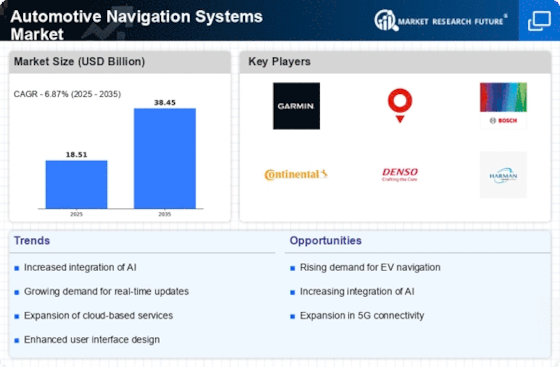
As per Market Research Future analysis, the Automotive Navigation Systems Market was estimated at 18.51 USD Billion in 2024. The Automotive Navigation Systems industry is projected to grow from 19.78 USD Billion in 2025 to 38.45 USD Billion by 2035, exhibiting a compound annual growth rate (CAGR) of 6.87% during the forecast period 2025 - 2035

Key Market Trends & Highlights

The Automotive Navigation Systems Market is poised for substantial growth driven by technological advancements and evolving consumer preferences.

  • The integration of AI and machine learning is transforming navigation systems, enhancing user experience and accuracy. North America remains the largest market, while the Asia-Pacific region is emerging as the fastest-growing area for automotive navigation solutions. In-dash navigation systems dominate the market, yet mobile navigation systems are witnessing rapid growth due to increasing smartphone usage. The rising demand for advanced driver assistance systems and government initiatives promoting smart transportation are key drivers of market expansion.

Market Size & Forecast

2024 Market Size 18.51 (USD Billion)
2035 Market Size 38.45 (USD Billion)
CAGR (2025 - 2035) 6.87%
Largest Regional Market Share in 2024 North America

Major Players

Garmin (US), TomTom (NL), Bosch (DE), Continental (DE), <a href="https://www.denso.com/global/en/business/products-and-services/mobility/pick-up/td/">Denso</a> (JP), Harman (US), Magellan (US), Navman (AU), Pioneer (JP)

Market Trends

The Automotive Navigation Systems Market is currently experiencing a transformative phase, driven by advancements in technology and changing consumer preferences. The integration of artificial intelligence and machine learning into navigation systems appears to enhance user experience significantly. Moreover, the growing emphasis on safety and efficiency in transportation is likely to propel the demand for sophisticated navigation solutions. As vehicles become increasingly connected, the role of navigation systems evolves, suggesting a shift towards more interactive and real-time functionalities. In addition, the rise of electric vehicles and autonomous driving technology is influencing the Automotive Navigation Systems Market. These vehicles often require advanced navigation capabilities to optimize routes and manage energy consumption effectively. Furthermore, the increasing availability of high-speed internet and mobile connectivity is facilitating the development of cloud-based navigation solutions, which may offer more accurate and timely information to users. Overall, the market appears poised for substantial growth as it adapts to these emerging trends and technologies.

Integration of AI and Machine Learning

The incorporation of artificial intelligence and machine learning into navigation systems is enhancing their functionality. These technologies enable systems to learn from user behavior, providing personalized recommendations and improving route optimization.

Rise of Electric and Autonomous Vehicles

The growing prevalence of electric and autonomous vehicles is reshaping the Automotive Navigation Systems Market. These vehicles necessitate advanced navigation solutions to manage energy efficiency and ensure safe operation.

Cloud-Based Navigation Solutions

The increasing availability of high-speed internet is facilitating the development of cloud-based navigation systems. These solutions offer real-time data and updates, enhancing the overall user experience and accuracy of navigation.

Automotive Navigation Systems Market Market Drivers

Expansion of E-commerce and Delivery Services

The Automotive Navigation Systems Market is also being driven by the expansion of e-commerce and delivery services. As online shopping continues to grow, logistics companies are increasingly relying on advanced navigation systems to optimize delivery routes and improve efficiency. The demand for real-time navigation solutions that can adapt to changing traffic conditions is becoming essential for these businesses. Market data indicates that the logistics sector is projected to invest heavily in navigation technologies, with estimates suggesting a multi-billion dollar market opportunity. This trend is likely to create new avenues for growth within the Automotive Navigation Systems Market, as companies develop tailored solutions to meet the specific needs of the delivery and logistics sectors.

Rising Consumer Preference for Connected Vehicles

The Automotive Navigation Systems Market is witnessing a significant shift towards connected vehicles, which are equipped with internet access and advanced communication capabilities. This trend is fueled by consumer preferences for seamless connectivity and enhanced user experiences. As more drivers seek integrated solutions that combine navigation with entertainment and communication, manufacturers are responding by developing systems that offer real-time traffic updates, weather information, and personalized route suggestions. Market data suggests that the connected vehicle segment is expected to grow substantially, with projections indicating a market size exceeding several billion dollars by the end of the decade. This evolution in consumer expectations is reshaping the Automotive Navigation Systems Market, compelling companies to innovate and enhance their offerings.

Government Initiatives Promoting Smart Transportation

The Automotive Navigation Systems Market is significantly influenced by government initiatives aimed at promoting smart transportation solutions. Various governments are investing in infrastructure that supports intelligent transportation systems, which include advanced navigation technologies. These initiatives often focus on improving road safety, reducing traffic congestion, and enhancing overall mobility. For instance, funding for smart city projects is increasingly being allocated to develop integrated navigation systems that can communicate with traffic signals and other vehicles. This trend is expected to drive the adoption of advanced navigation systems, as municipalities seek to implement solutions that align with their smart transportation goals. As a result, the Automotive Navigation Systems Market is likely to benefit from these supportive policies and investments.

Technological Advancements in GPS and Mapping Solutions

The Automotive Navigation Systems Market is propelled by rapid technological advancements in GPS and mapping solutions. Innovations in satellite technology and mapping algorithms are enhancing the accuracy and reliability of navigation systems. As a result, consumers are increasingly favoring systems that offer precise location tracking and real-time updates. The integration of high-definition maps and 3D visualization is becoming commonplace, providing users with a more intuitive navigation experience. Market analysis indicates that the demand for high-precision navigation systems is on the rise, with expectations of substantial growth in the coming years. This technological evolution is reshaping the Automotive Navigation Systems Market, as manufacturers strive to meet the growing expectations of tech-savvy consumers.

Increasing Demand for Advanced Driver Assistance Systems

The Automotive Navigation Systems Market is experiencing a notable surge in demand for advanced driver assistance systems (ADAS). This trend is largely driven by the growing emphasis on vehicle safety and the need for enhanced driving experiences. As consumers become more aware of the benefits of ADAS, manufacturers are integrating sophisticated navigation systems that provide real-time data and alerts. According to recent statistics, the ADAS segment is projected to grow at a compound annual growth rate of over 20% in the coming years. This growth is indicative of a broader shift towards smarter vehicles, where navigation systems play a crucial role in ensuring safety and efficiency. Consequently, the Automotive Navigation Systems Market is likely to see increased investments in technology that supports these advanced features.

Market Segment Insights

By Device Type: In-Dash Navigation System (Largest) vs. Mobile Navigation System (Fastest-Growing)

The Automotive Navigation Systems Market is segmented into three primary device types: In-Dash Navigation Systems, Portable Navigation Systems, and Mobile Navigation Systems. Among these, In-Dash Navigation Systems hold the largest market share due to their integration into new vehicle models and consumer preference for sophisticated in-car technology. Portable Navigation Systems are gradually losing market relevance as they are being overshadowed by the convenience offered by mobile navigation apps, which are highly accessible and often free.

In-Dash Navigation System (Dominant) vs. Mobile Navigation System (Emerging)

The In-Dash Navigation System is characterized by its seamless integration into vehicles, providing users with advanced features such as real-time traffic updates, voice commands, and enhanced safety navigation tools. Its dominance in the market is fueled by partnerships between automotive manufacturers and technology companies, ensuring that new vehicles come equipped with the latest navigation technology. On the other hand, Mobile Navigation Systems, while emerging rapidly, offer flexibility and portability that appeals to a tech-savvy audience. These systems are continuously evolving with apps that include innovative features like crowd-sourced data and offline maps, making them increasingly popular as drivers seek functionality outside traditional in-car navigation.

By Vehicle Type: Passenger Car (Largest) vs. Heavy Commercial Vehicle (Fastest-Growing)

In the Automotive Navigation Systems Market, the market share distribution among vehicle types reveals that Passenger Cars dominate significantly, constituting the largest segment. This is driven by the proliferation of personal vehicles and technological advancements that make navigation systems increasingly accessible and user-friendly for everyday commuters. Conversely, Heavy Commercial Vehicles are experiencing rapid growth, reflecting the broader trends toward connectivity and automation in logistics and transportation, where efficient navigation is crucial for operational efficiency.

Passenger Car (Dominant) vs. Heavy Commercial Vehicle (Emerging)

Passenger Cars represent the dominant segment within the Automotive Navigation Systems Market, characterized by widespread adoption and integration of advanced navigation features. These systems often include real-time traffic updates, routing suggestions, and voice-activated controls, catering to the demands of tech-savvy consumers seeking convenience. In contrast, Heavy Commercial Vehicles, while currently smaller in share, are emerging rapidly owing to the increasing emphasis on fleet management solutions, regulatory compliance regarding tracking, and the need for enhanced operational efficiency. Companies are investing in AI-driven systems and telematics solutions, thus evolving the navigation technologies within this segment to meet the unique requirements of the commercial sector.

By Propulsion: Electric Vehicle (Largest) vs. ICE (Fastest-Growing)

In the Automotive Navigation Systems Market, the distribution of market share between Electric Vehicles (EVs) and Internal Combustion Engine (ICE) vehicles highlights EVs as the dominant segment. With an increasing number of EV models entering the market, their reliance on advanced navigation systems is intensifying, shaping consumer preferences and industry focus. Conversely, ICE vehicles, equipped with traditional navigation systems, continue to hold a significant portion of the market but are gradually transitioning due to stricter emissions regulations and changing automotive trends.

Propulsion: Electric Vehicle (Dominant) vs. ICE (Emerging)

The Electric Vehicle segment is currently dominating the Automotive Navigation Systems Market, driven by the growing shift towards sustainable transportation solutions. EVs require cutting-edge navigation systems that integrate real-time data, charging station locations, and performance analytics. This focus complements the rise in EV sales and broader consumer acceptance. On the other hand, the ICE segment, while considered more traditional and less innovative, is experiencing growth as manufacturers enhance their navigation offerings to remain competitive. Features such as user-friendly interfaces and advanced route optimization are bridging the gap, making ICE vehicles increasingly relevant in today's technology-driven market.

By Sales Channel: OEM (Largest) vs. Aftermarket (Fastest-Growing)

In the Automotive Navigation Systems Market, the sales channel segmentation reveals that OEM (Original Equipment Manufacturer) segments dominate significantly. OEMs capture a substantial portion of the market due to their integration of navigation systems directly into new vehicles, establishing a strong foothold in the consumer preference landscape. This trend reflects the industry's inclination towards complete vehicle solutions that offer seamless functionalities and superior performance, appealing to new car buyers looking for advanced technologies that enhance driving experience. On the other hand, the Aftermarket segment is emerging rapidly, fueled by increasing consumer demand for vehicle upgrades and personalized navigation options. As technology advances and consumer habits shift towards feature-rich systems, aftermarket solutions are becoming essential for enhancing older vehicles. Factors driving this segment's growth include improved ease of installation, a diverse range of innovative products available, and a rise in the number of vehicle owners opting for GPS systems that offer updated traffic data and navigation services more than ever before.

Sales Channel: OEM (Dominant) vs. Aftermarket (Emerging)

The OEM sales channel in the Automotive Navigation Systems Market holds dominance as it embodies the latest advancements directly from manufacturers. OEM systems are designed for specific vehicle models, which ensures optimal compatibility and performance, catering primarily to new vehicle buyers. In contrast, the Aftermarket segment represents a growing opportunity for customization and enhancements in older vehicles. It is characterized by a variety of navigation solutions that often appeal to tech-savvy consumers interested in updating their current systems. Aftermarket products are increasingly favored due to their adaptability, competitive pricing, and the promise of advanced features such as real-time traffic updates, smartphone integration, and accessibility, which propel its growth in a rapidly evolving market.

Get more detailed insights about Automotive Navigation Systems Market Research Report—Global Forecast till 2035

Regional Insights

North America : Technological Innovation Leader

North America is the largest market for automotive navigation systems, holding approximately 40% of the global market share. The region's growth is driven by increasing demand for advanced navigation features, integration with smart technologies, and regulatory support for vehicle safety standards. The U.S. leads this market, followed by Canada, which is experiencing a surge in demand for connected vehicle technologies. The competitive landscape is dominated by key players such as Garmin, Harman, and TomTom, who are continuously innovating to enhance user experience. The presence of major automotive manufacturers in the U.S. further fuels market growth, as they increasingly incorporate advanced navigation systems into their vehicles. The focus on autonomous driving technologies is also expected to drive future demand for sophisticated navigation solutions.

Europe : Emerging Market Dynamics

Europe is the second-largest market for automotive navigation systems, accounting for around 30% of the global share. The region's growth is propelled by stringent regulations aimed at reducing carbon emissions and enhancing road safety. Countries like Germany and France are at the forefront, with increasing investments in smart mobility solutions and connected vehicle technologies, which are expected to drive demand for advanced navigation systems. Germany, as a leading automotive hub, hosts major players like Bosch and Continental, who are innovating in navigation technologies. The competitive landscape is characterized by collaborations between automotive manufacturers and tech companies to develop integrated navigation solutions. The European market is also witnessing a rise in demand for electric vehicles, further influencing the navigation systems market.

Asia-Pacific : Rapid Growth and Adoption

Asia-Pacific is witnessing rapid growth in the automotive navigation systems market, holding approximately 25% of the global share. The region's expansion is driven by increasing vehicle production, rising disposable incomes, and a growing preference for advanced navigation features. Countries like China and Japan are leading this growth, with significant investments in smart city initiatives and connected vehicle technologies that enhance navigation capabilities. China, as the largest automotive market, is home to numerous local and international players, including Denso and Pioneer. The competitive landscape is marked by a surge in startups focusing on innovative navigation solutions, alongside established companies. The region's focus on integrating AI and machine learning into navigation systems is expected to further boost market growth in the coming years.

Middle East and Africa : Emerging Market Potential

The Middle East and Africa region is emerging as a potential market for automotive navigation systems, accounting for about 5% of the global share. The growth is driven by increasing vehicle ownership, urbanization, and the need for efficient navigation solutions in rapidly developing cities. Countries like South Africa and the UAE are leading the way, with investments in infrastructure and smart city projects that enhance navigation system adoption. The competitive landscape is characterized by a mix of local and international players, with companies like Magellan and Navman making strides in the market. The region's unique geographical challenges also present opportunities for tailored navigation solutions. As the automotive sector continues to grow, the demand for advanced navigation systems is expected to rise significantly.

Key Players and Competitive Insights

Leading market players are investing heavily in research and development to expand their product lines, which will help the automotive navigation systems market grow even more. Market participants are also undertaking a variety of strategic activities to expand their global footprint, with important market developments including new product launches, contractual agreements, mergers and acquisitions, higher investments, and collaboration with other organizations. The automotive navigation systems industry must offer cost-effective items to expand and survive in a more competitive and rising market climate. Manufacturing locally to minimize operational costs is one of the key business tactics used by manufacturers in the global automotive gps systems industry to benefit clients and increase the market sector. In recent years, the gps system for car industry has offered some of the most significant advantages to medicine. Major players in the automotive gps systems market, includingContinental, Alpine, Robert Bosch GmbH, Denso, Aisin Seiki, Faurecia Clarion, Garmin Ltd., NNG Software, TomTom, Harman, HERE Technologies, JVC Kenwood, Pioneer, Telenav, and others, are attempting to increase market demand by investing in research and development operations. Gentex Corporation, a technology and electronics company based in the United States, has recently introduced three new products in the aftermarket sector. These include an advanced Full Display Mirror (FDM) that enhances the driver's view of the rear of the vehicle through a combination of a custom camera and mirror-integrated display, a high-performance FDM specifically designed for professional race teams, and a state-of-the-art automatic-dimming mirror equipped with HomeLink buttons for operating RF and cloud-based home automation devices. All three products will be available for purchase through Voxx Electronics. Mahindra & Mahindra Limited is a leading Indian multinational automotive manufacturer headquartered in Ludhiana. It has produced vehicles since 1945 and is part of the larger Mahindra Group. The company is one of the largest vehicle manufacturers in India, with a significant production capacity. Recently, Mahindra announced that the Bolero Neo's N10 variant, the second-highest in the range, will now come with Kenwood's new aftermarket infotainment system. However, the top-spec N10 (O) variant will continue to be fitted with the existing unit.

Key Companies in the Automotive Navigation Systems Market include

Industry Developments

November 2019: Gentex Corporation, a technology company in the US automotive industry, has released three new products for the Aftermarket. These include a next-generation Full Display Mirror (FDM) that utilizes a specialized camera and mirror-integrated display to improve the driver's rearward view. A high-performance FDM is designed particularly for professional racecar teams, and an all-new automatic-dimming mirror featuring integrated HomeLink buttons that can operate RF (radio frequency) and cloud-based home automation devices. All three products will be accessible through Voxx Electronics.

September 2021: Mahindra has recently announced that its Bolero Neo's N10 variant, which is the second-to-top variant, will be delivered with Kenwood's latest aftermarket infotainment system. On the other hand, the top-spec N10 (O) variant will still have the existing unit.

Future Outlook

Automotive Navigation Systems Market Future Outlook

The Automotive Navigation Systems Market is projected to grow at a 6.87% CAGR from 2025 to 2035, driven by advancements in technology, increased demand for safety features, and the rise of connected vehicles.

New opportunities lie in:

  • <p>Integration of AI-driven predictive analytics for route optimization. Development of subscription-based navigation services for enhanced user experience. Partnerships with automotive manufacturers for embedded navigation solutions.</p>

By 2035, the market is expected to be robust, reflecting substantial growth and innovation.

Market Segmentation

Automotive Navigation Systems Market Propulsion Outlook

  • Electric Vehicle
  • ICE

Automotive Navigation Systems Market Device Type Outlook

  • In-Dash Navigation System
  • Portable Navigation System
  • Mobile Navigation System

Automotive Navigation Systems Market Vehicle Type Outlook

  • Passenger Car
  • Heavy Commercial Vehicle
  • Light Commercial Vehicle

Automotive Navigation Systems Market Sales Channel Outlook

  • OEM
  • Aftermarket

Report Scope

MARKET SIZE 2024 18.51(USD Billion)
MARKET SIZE 2025 19.78(USD Billion)
MARKET SIZE 2035 38.45(USD Billion)
COMPOUND ANNUAL GROWTH RATE (CAGR) 6.87% (2025 - 2035)
REPORT COVERAGE Revenue Forecast, Competitive Landscape, Growth Factors, and Trends
BASE YEAR 2024
Market Forecast Period 2025 - 2035
Historical Data 2019 - 2024
Market Forecast Units USD Billion
Key Companies Profiled Garmin (US), TomTom (NL), Bosch (DE), Continental (DE), Denso (JP), Harman (US), Magellan (US), Navman (AU), Pioneer (JP)
Segments Covered Device Type, Vehicle Type, Propulsion, Sales Channel, Region
Key Market Opportunities Integration of advanced artificial intelligence for enhanced real-time navigation and user experience in Automotive Navigation Systems Market.
Key Market Dynamics Technological advancements and consumer demand drive innovation in Automotive Navigation Systems, enhancing user experience and functionality.
Countries Covered North America, Europe, APAC, South America, MEA

FAQs

What is the projected market valuation of the Automotive Navigation Systems Market by 2035?

<p>The Automotive Navigation Systems Market is projected to reach a valuation of 38.45 USD Billion by 2035.</p>

What was the market valuation of the Automotive Navigation Systems Market in 2024?

<p>In 2024, the market valuation of the Automotive Navigation Systems Market was 18.51 USD Billion.</p>

What is the expected CAGR for the Automotive Navigation Systems Market during the forecast period 2025 - 2035?

<p>The expected CAGR for the Automotive Navigation Systems Market during the forecast period 2025 - 2035 is 6.87%.</p>

Which device type segment is projected to have the highest growth in the Automotive Navigation Systems Market?

<p>The In-Dash Navigation System segment is projected to grow from 7.41 USD Billion in 2024 to 15.25 USD Billion by 2035.</p>

How does the Portable Navigation System segment compare to other device types in terms of market size?

<p>The Portable Navigation System segment was valued at 4.12 USD Billion in 2024 and is expected to reach 8.5 USD Billion by 2035.</p>

What is the projected market size for Electric Vehicles in the Automotive Navigation Systems Market by 2035?

<p>The Electric Vehicle segment is projected to grow from 6.0 USD Billion in 2024 to 15.0 USD Billion by 2035.</p>

Which key players are leading the Automotive Navigation Systems Market?

Key players in the Automotive Navigation Systems Market include Garmin, TomTom, Bosch, Continental, and Denso.

What is the expected growth for the Heavy Commercial Vehicle segment in the Automotive Navigation Systems Market?

The Heavy Commercial Vehicle segment is projected to grow from 4.0 USD Billion in 2024 to 8.0 USD Billion by 2035.

How does the aftermarket sales channel compare to OEM in the Automotive Navigation Systems Market?

The aftermarket sales channel was valued at 8.51 USD Billion in 2024 and is expected to reach 18.45 USD Billion by 2035, compared to OEM's growth from 10.0 USD Billion to 20.0 USD Billion.

What is the projected market size for Light Commercial Vehicles in the Automotive Navigation Systems Market by 2035?

The Light Commercial Vehicle segment is projected to grow from 6.51 USD Billion in 2024 to 14.45 USD Billion by 2035.

  1. SECTION I: EXECUTIVE SUMMARY AND KEY HIGHLIGHTS
    1. | 1.1 EXECUTIVE SUMMARY
    2. | | 1.1.1 Market Overview
    3. | | 1.1.2 Key Findings
    4. | | 1.1.3 Market Segmentation
    5. | | 1.1.4 Competitive Landscape
    6. | | 1.1.5 Challenges and Opportunities
    7. | | 1.1.6 Future Outlook
  2. SECTION II: SCOPING, METHODOLOGY AND MARKET STRUCTURE
    1. | 2.1 MARKET INTRODUCTION
    2. | | 2.1.1 Definition
    3. | | 2.1.2 Scope of the study
    4. | | | 2.1.2.1 Research Objective
    5. | | | 2.1.2.2 Assumption
    6. | | | 2.1.2.3 Limitations
    7. | 2.2 RESEARCH METHODOLOGY
    8. | | 2.2.1 Overview
    9. | | 2.2.2 Data Mining
    10. | | 2.2.3 Secondary Research
    11. | | 2.2.4 Primary Research
    12. | | | 2.2.4.1 Primary Interviews and Information Gathering Process
    13. | | | 2.2.4.2 Breakdown of Primary Respondents
    14. | | 2.2.5 Forecasting Model
    15. | | 2.2.6 Market Size Estimation
    16. | | | 2.2.6.1 Bottom-Up Approach
    17. | | | 2.2.6.2 Top-Down Approach
    18. | | 2.2.7 Data Triangulation
    19. | | 2.2.8 Validation
  3. SECTION III: QUALITATIVE ANALYSIS
    1. | 3.1 MARKET DYNAMICS
    2. | | 3.1.1 Overview
    3. | | 3.1.2 Drivers
    4. | | 3.1.3 Restraints
    5. | | 3.1.4 Opportunities
    6. | 3.2 MARKET FACTOR ANALYSIS
    7. | | 3.2.1 Value chain Analysis
    8. | | 3.2.2 Porter's Five Forces Analysis
    9. | | | 3.2.2.1 Bargaining Power of Suppliers
    10. | | | 3.2.2.2 Bargaining Power of Buyers
    11. | | | 3.2.2.3 Threat of New Entrants
    12. | | | 3.2.2.4 Threat of Substitutes
    13. | | | 3.2.2.5 Intensity of Rivalry
    14. | | 3.2.3 COVID-19 Impact Analysis
    15. | | | 3.2.3.1 Market Impact Analysis
    16. | | | 3.2.3.2 Regional Impact
    17. | | | 3.2.3.3 Opportunity and Threat Analysis
  4. SECTION IV: QUANTITATIVE ANALYSIS
    1. | 4.1 Automobile, BY Device Type (USD Billion)
    2. | | 4.1.1 In-Dash Navigation System
    3. | | 4.1.2 Portable Navigation System
    4. | | 4.1.3 Mobile Navigation System
    5. | 4.2 Automobile, BY Vehicle Type (USD Billion)
    6. | | 4.2.1 Passenger Car
    7. | | 4.2.2 Heavy Commercial Vehicle
    8. | | 4.2.3 Light Commercial Vehicle
    9. | 4.3 Automobile, BY Propulsion (USD Billion)
    10. | | 4.3.1 Electric Vehicle
    11. | | 4.3.2 ICE
    12. | 4.4 Automobile, BY Sales Channel (USD Billion)
    13. | | 4.4.1 OEM
    14. | | 4.4.2 Aftermarket
    15. | 4.5 Automobile, BY Region (USD Billion)
    16. | | 4.5.1 North America
    17. | | | 4.5.1.1 US
    18. | | | 4.5.1.2 Canada
    19. | | 4.5.2 Europe
    20. | | | 4.5.2.1 Germany
    21. | | | 4.5.2.2 UK
    22. | | | 4.5.2.3 France
    23. | | | 4.5.2.4 Russia
    24. | | | 4.5.2.5 Italy
    25. | | | 4.5.2.6 Spain
    26. | | | 4.5.2.7 Rest of Europe
    27. | | 4.5.3 APAC
    28. | | | 4.5.3.1 China
    29. | | | 4.5.3.2 India
    30. | | | 4.5.3.3 Japan
    31. | | | 4.5.3.4 South Korea
    32. | | | 4.5.3.5 Malaysia
    33. | | | 4.5.3.6 Thailand
    34. | | | 4.5.3.7 Indonesia
    35. | | | 4.5.3.8 Rest of APAC
    36. | | 4.5.4 South America
    37. | | | 4.5.4.1 Brazil
    38. | | | 4.5.4.2 Mexico
    39. | | | 4.5.4.3 Argentina
    40. | | | 4.5.4.4 Rest of South America
    41. | | 4.5.5 MEA
    42. | | | 4.5.5.1 GCC Countries
    43. | | | 4.5.5.2 South Africa
    44. | | | 4.5.5.3 Rest of MEA
  5. SECTION V: COMPETITIVE ANALYSIS
    1. | 5.1 Competitive Landscape
    2. | | 5.1.1 Overview
    3. | | 5.1.2 Competitive Analysis
    4. | | 5.1.3 Market share Analysis
    5. | | 5.1.4 Major Growth Strategy in the Automobile
    6. | | 5.1.5 Competitive Benchmarking
    7. | | 5.1.6 Leading Players in Terms of Number of Developments in the Automobile
    8. | | 5.1.7 Key developments and growth strategies
    9. | | | 5.1.7.1 New Product Launch/Service Deployment
    10. | | | 5.1.7.2 Merger & Acquisitions
    11. | | | 5.1.7.3 Joint Ventures
    12. | | 5.1.8 Major Players Financial Matrix
    13. | | | 5.1.8.1 Sales and Operating Income
    14. | | | 5.1.8.2 Major Players R&D Expenditure. 2023
    15. | 5.2 Company Profiles
    16. | | 5.2.1 Garmin (US)
    17. | | | 5.2.1.1 Financial Overview
    18. | | | 5.2.1.2 Products Offered
    19. | | | 5.2.1.3 Key Developments
    20. | | | 5.2.1.4 SWOT Analysis
    21. | | | 5.2.1.5 Key Strategies
    22. | | 5.2.2 TomTom (NL)
    23. | | | 5.2.2.1 Financial Overview
    24. | | | 5.2.2.2 Products Offered
    25. | | | 5.2.2.3 Key Developments
    26. | | | 5.2.2.4 SWOT Analysis
    27. | | | 5.2.2.5 Key Strategies
    28. | | 5.2.3 Bosch (DE)
    29. | | | 5.2.3.1 Financial Overview
    30. | | | 5.2.3.2 Products Offered
    31. | | | 5.2.3.3 Key Developments
    32. | | | 5.2.3.4 SWOT Analysis
    33. | | | 5.2.3.5 Key Strategies
    34. | | 5.2.4 Continental (DE)
    35. | | | 5.2.4.1 Financial Overview
    36. | | | 5.2.4.2 Products Offered
    37. | | | 5.2.4.3 Key Developments
    38. | | | 5.2.4.4 SWOT Analysis
    39. | | | 5.2.4.5 Key Strategies
    40. | | 5.2.5 Denso (JP)
    41. | | | 5.2.5.1 Financial Overview
    42. | | | 5.2.5.2 Products Offered
    43. | | | 5.2.5.3 Key Developments
    44. | | | 5.2.5.4 SWOT Analysis
    45. | | | 5.2.5.5 Key Strategies
    46. | | 5.2.6 Harman (US)
    47. | | | 5.2.6.1 Financial Overview
    48. | | | 5.2.6.2 Products Offered
    49. | | | 5.2.6.3 Key Developments
    50. | | | 5.2.6.4 SWOT Analysis
    51. | | | 5.2.6.5 Key Strategies
    52. | | 5.2.7 Magellan (US)
    53. | | | 5.2.7.1 Financial Overview
    54. | | | 5.2.7.2 Products Offered
    55. | | | 5.2.7.3 Key Developments
    56. | | | 5.2.7.4 SWOT Analysis
    57. | | | 5.2.7.5 Key Strategies
    58. | | 5.2.8 Navman (AU)
    59. | | | 5.2.8.1 Financial Overview
    60. | | | 5.2.8.2 Products Offered
    61. | | | 5.2.8.3 Key Developments
    62. | | | 5.2.8.4 SWOT Analysis
    63. | | | 5.2.8.5 Key Strategies
    64. | | 5.2.9 Pioneer (JP)
    65. | | | 5.2.9.1 Financial Overview
    66. | | | 5.2.9.2 Products Offered
    67. | | | 5.2.9.3 Key Developments
    68. | | | 5.2.9.4 SWOT Analysis
    69. | | | 5.2.9.5 Key Strategies
    70. | 5.3 Appendix
    71. | | 5.3.1 References
    72. | | 5.3.2 Related Reports
  6. LIST OF FIGURES
    1. | 6.1 MARKET SYNOPSIS
    2. | 6.2 NORTH AMERICA MARKET ANALYSIS
    3. | 6.3 US MARKET ANALYSIS BY DEVICE TYPE
    4. | 6.4 US MARKET ANALYSIS BY VEHICLE TYPE
    5. | 6.5 US MARKET ANALYSIS BY PROPULSION
    6. | 6.6 US MARKET ANALYSIS BY SALES CHANNEL
    7. | 6.7 CANADA MARKET ANALYSIS BY DEVICE TYPE
    8. | 6.8 CANADA MARKET ANALYSIS BY VEHICLE TYPE
    9. | 6.9 CANADA MARKET ANALYSIS BY PROPULSION
    10. | 6.10 CANADA MARKET ANALYSIS BY SALES CHANNEL
    11. | 6.11 EUROPE MARKET ANALYSIS
    12. | 6.12 GERMANY MARKET ANALYSIS BY DEVICE TYPE
    13. | 6.13 GERMANY MARKET ANALYSIS BY VEHICLE TYPE
    14. | 6.14 GERMANY MARKET ANALYSIS BY PROPULSION
    15. | 6.15 GERMANY MARKET ANALYSIS BY SALES CHANNEL
    16. | 6.16 UK MARKET ANALYSIS BY DEVICE TYPE
    17. | 6.17 UK MARKET ANALYSIS BY VEHICLE TYPE
    18. | 6.18 UK MARKET ANALYSIS BY PROPULSION
    19. | 6.19 UK MARKET ANALYSIS BY SALES CHANNEL
    20. | 6.20 FRANCE MARKET ANALYSIS BY DEVICE TYPE
    21. | 6.21 FRANCE MARKET ANALYSIS BY VEHICLE TYPE
    22. | 6.22 FRANCE MARKET ANALYSIS BY PROPULSION
    23. | 6.23 FRANCE MARKET ANALYSIS BY SALES CHANNEL
    24. | 6.24 RUSSIA MARKET ANALYSIS BY DEVICE TYPE
    25. | 6.25 RUSSIA MARKET ANALYSIS BY VEHICLE TYPE
    26. | 6.26 RUSSIA MARKET ANALYSIS BY PROPULSION
    27. | 6.27 RUSSIA MARKET ANALYSIS BY SALES CHANNEL
    28. | 6.28 ITALY MARKET ANALYSIS BY DEVICE TYPE
    29. | 6.29 ITALY MARKET ANALYSIS BY VEHICLE TYPE
    30. | 6.30 ITALY MARKET ANALYSIS BY PROPULSION
    31. | 6.31 ITALY MARKET ANALYSIS BY SALES CHANNEL
    32. | 6.32 SPAIN MARKET ANALYSIS BY DEVICE TYPE
    33. | 6.33 SPAIN MARKET ANALYSIS BY VEHICLE TYPE
    34. | 6.34 SPAIN MARKET ANALYSIS BY PROPULSION
    35. | 6.35 SPAIN MARKET ANALYSIS BY SALES CHANNEL
    36. | 6.36 REST OF EUROPE MARKET ANALYSIS BY DEVICE TYPE
    37. | 6.37 REST OF EUROPE MARKET ANALYSIS BY VEHICLE TYPE
    38. | 6.38 REST OF EUROPE MARKET ANALYSIS BY PROPULSION
    39. | 6.39 REST OF EUROPE MARKET ANALYSIS BY SALES CHANNEL
    40. | 6.40 APAC MARKET ANALYSIS
    41. | 6.41 CHINA MARKET ANALYSIS BY DEVICE TYPE
    42. | 6.42 CHINA MARKET ANALYSIS BY VEHICLE TYPE
    43. | 6.43 CHINA MARKET ANALYSIS BY PROPULSION
    44. | 6.44 CHINA MARKET ANALYSIS BY SALES CHANNEL
    45. | 6.45 INDIA MARKET ANALYSIS BY DEVICE TYPE
    46. | 6.46 INDIA MARKET ANALYSIS BY VEHICLE TYPE
    47. | 6.47 INDIA MARKET ANALYSIS BY PROPULSION
    48. | 6.48 INDIA MARKET ANALYSIS BY SALES CHANNEL
    49. | 6.49 JAPAN MARKET ANALYSIS BY DEVICE TYPE
    50. | 6.50 JAPAN MARKET ANALYSIS BY VEHICLE TYPE
    51. | 6.51 JAPAN MARKET ANALYSIS BY PROPULSION
    52. | 6.52 JAPAN MARKET ANALYSIS BY SALES CHANNEL
    53. | 6.53 SOUTH KOREA MARKET ANALYSIS BY DEVICE TYPE
    54. | 6.54 SOUTH KOREA MARKET ANALYSIS BY VEHICLE TYPE
    55. | 6.55 SOUTH KOREA MARKET ANALYSIS BY PROPULSION
    56. | 6.56 SOUTH KOREA MARKET ANALYSIS BY SALES CHANNEL
    57. | 6.57 MALAYSIA MARKET ANALYSIS BY DEVICE TYPE
    58. | 6.58 MALAYSIA MARKET ANALYSIS BY VEHICLE TYPE
    59. | 6.59 MALAYSIA MARKET ANALYSIS BY PROPULSION
    60. | 6.60 MALAYSIA MARKET ANALYSIS BY SALES CHANNEL
    61. | 6.61 THAILAND MARKET ANALYSIS BY DEVICE TYPE
    62. | 6.62 THAILAND MARKET ANALYSIS BY VEHICLE TYPE
    63. | 6.63 THAILAND MARKET ANALYSIS BY PROPULSION
    64. | 6.64 THAILAND MARKET ANALYSIS BY SALES CHANNEL
    65. | 6.65 INDONESIA MARKET ANALYSIS BY DEVICE TYPE
    66. | 6.66 INDONESIA MARKET ANALYSIS BY VEHICLE TYPE
    67. | 6.67 INDONESIA MARKET ANALYSIS BY PROPULSION
    68. | 6.68 INDONESIA MARKET ANALYSIS BY SALES CHANNEL
    69. | 6.69 REST OF APAC MARKET ANALYSIS BY DEVICE TYPE
    70. | 6.70 REST OF APAC MARKET ANALYSIS BY VEHICLE TYPE
    71. | 6.71 REST OF APAC MARKET ANALYSIS BY PROPULSION
    72. | 6.72 REST OF APAC MARKET ANALYSIS BY SALES CHANNEL
    73. | 6.73 SOUTH AMERICA MARKET ANALYSIS
    74. | 6.74 BRAZIL MARKET ANALYSIS BY DEVICE TYPE
    75. | 6.75 BRAZIL MARKET ANALYSIS BY VEHICLE TYPE
    76. | 6.76 BRAZIL MARKET ANALYSIS BY PROPULSION
    77. | 6.77 BRAZIL MARKET ANALYSIS BY SALES CHANNEL
    78. | 6.78 MEXICO MARKET ANALYSIS BY DEVICE TYPE
    79. | 6.79 MEXICO MARKET ANALYSIS BY VEHICLE TYPE
    80. | 6.80 MEXICO MARKET ANALYSIS BY PROPULSION
    81. | 6.81 MEXICO MARKET ANALYSIS BY SALES CHANNEL
    82. | 6.82 ARGENTINA MARKET ANALYSIS BY DEVICE TYPE
    83. | 6.83 ARGENTINA MARKET ANALYSIS BY VEHICLE TYPE
    84. | 6.84 ARGENTINA MARKET ANALYSIS BY PROPULSION
    85. | 6.85 ARGENTINA MARKET ANALYSIS BY SALES CHANNEL
    86. | 6.86 REST OF SOUTH AMERICA MARKET ANALYSIS BY DEVICE TYPE
    87. | 6.87 REST OF SOUTH AMERICA MARKET ANALYSIS BY VEHICLE TYPE
    88. | 6.88 REST OF SOUTH AMERICA MARKET ANALYSIS BY PROPULSION
    89. | 6.89 REST OF SOUTH AMERICA MARKET ANALYSIS BY SALES CHANNEL
    90. | 6.90 MEA MARKET ANALYSIS
    91. | 6.91 GCC COUNTRIES MARKET ANALYSIS BY DEVICE TYPE
    92. | 6.92 GCC COUNTRIES MARKET ANALYSIS BY VEHICLE TYPE
    93. | 6.93 GCC COUNTRIES MARKET ANALYSIS BY PROPULSION
    94. | 6.94 GCC COUNTRIES MARKET ANALYSIS BY SALES CHANNEL
    95. | 6.95 SOUTH AFRICA MARKET ANALYSIS BY DEVICE TYPE
    96. | 6.96 SOUTH AFRICA MARKET ANALYSIS BY VEHICLE TYPE
    97. | 6.97 SOUTH AFRICA MARKET ANALYSIS BY PROPULSION
    98. | 6.98 SOUTH AFRICA MARKET ANALYSIS BY SALES CHANNEL
    99. | 6.99 REST OF MEA MARKET ANALYSIS BY DEVICE TYPE
    100. | 6.100 REST OF MEA MARKET ANALYSIS BY VEHICLE TYPE
    101. | 6.101 REST OF MEA MARKET ANALYSIS BY PROPULSION
    102. | 6.102 REST OF MEA MARKET ANALYSIS BY SALES CHANNEL
    103. | 6.103 KEY BUYING CRITERIA OF AUTOMOBILE
    104. | 6.104 RESEARCH PROCESS OF MRFR
    105. | 6.105 DRO ANALYSIS OF AUTOMOBILE
    106. | 6.106 DRIVERS IMPACT ANALYSIS: AUTOMOBILE
    107. | 6.107 RESTRAINTS IMPACT ANALYSIS: AUTOMOBILE
    108. | 6.108 SUPPLY / VALUE CHAIN: AUTOMOBILE
    109. | 6.109 AUTOMOBILE, BY DEVICE TYPE, 2024 (% SHARE)
    110. | 6.110 AUTOMOBILE, BY DEVICE TYPE, 2024 TO 2035 (USD Billion)
    111. | 6.111 AUTOMOBILE, BY VEHICLE TYPE, 2024 (% SHARE)
    112. | 6.112 AUTOMOBILE, BY VEHICLE TYPE, 2024 TO 2035 (USD Billion)
    113. | 6.113 AUTOMOBILE, BY PROPULSION, 2024 (% SHARE)
    114. | 6.114 AUTOMOBILE, BY PROPULSION, 2024 TO 2035 (USD Billion)
    115. | 6.115 AUTOMOBILE, BY SALES CHANNEL, 2024 (% SHARE)
    116. | 6.116 AUTOMOBILE, BY SALES CHANNEL, 2024 TO 2035 (USD Billion)
    117. | 6.117 BENCHMARKING OF MAJOR COMPETITORS
  7. LIST OF TABLES
    1. | 7.1 LIST OF ASSUMPTIONS
    2. | | 7.1.1
    3. | 7.2 North America MARKET SIZE ESTIMATES; FORECAST
    4. | | 7.2.1 BY DEVICE TYPE, 2025-2035 (USD Billion)
    5. | | 7.2.2 BY VEHICLE TYPE, 2025-2035 (USD Billion)
    6. | | 7.2.3 BY PROPULSION, 2025-2035 (USD Billion)
    7. | | 7.2.4 BY SALES CHANNEL, 2025-2035 (USD Billion)
    8. | 7.3 US MARKET SIZE ESTIMATES; FORECAST
    9. | | 7.3.1 BY DEVICE TYPE, 2025-2035 (USD Billion)
    10. | | 7.3.2 BY VEHICLE TYPE, 2025-2035 (USD Billion)
    11. | | 7.3.3 BY PROPULSION, 2025-2035 (USD Billion)
    12. | | 7.3.4 BY SALES CHANNEL, 2025-2035 (USD Billion)
    13. | 7.4 Canada MARKET SIZE ESTIMATES; FORECAST
    14. | | 7.4.1 BY DEVICE TYPE, 2025-2035 (USD Billion)
    15. | | 7.4.2 BY VEHICLE TYPE, 2025-2035 (USD Billion)
    16. | | 7.4.3 BY PROPULSION, 2025-2035 (USD Billion)
    17. | | 7.4.4 BY SALES CHANNEL, 2025-2035 (USD Billion)
    18. | 7.5 Europe MARKET SIZE ESTIMATES; FORECAST
    19. | | 7.5.1 BY DEVICE TYPE, 2025-2035 (USD Billion)
    20. | | 7.5.2 BY VEHICLE TYPE, 2025-2035 (USD Billion)
    21. | | 7.5.3 BY PROPULSION, 2025-2035 (USD Billion)
    22. | | 7.5.4 BY SALES CHANNEL, 2025-2035 (USD Billion)
    23. | 7.6 Germany MARKET SIZE ESTIMATES; FORECAST
    24. | | 7.6.1 BY DEVICE TYPE, 2025-2035 (USD Billion)
    25. | | 7.6.2 BY VEHICLE TYPE, 2025-2035 (USD Billion)
    26. | | 7.6.3 BY PROPULSION, 2025-2035 (USD Billion)
    27. | | 7.6.4 BY SALES CHANNEL, 2025-2035 (USD Billion)
    28. | 7.7 UK MARKET SIZE ESTIMATES; FORECAST
    29. | | 7.7.1 BY DEVICE TYPE, 2025-2035 (USD Billion)
    30. | | 7.7.2 BY VEHICLE TYPE, 2025-2035 (USD Billion)
    31. | | 7.7.3 BY PROPULSION, 2025-2035 (USD Billion)
    32. | | 7.7.4 BY SALES CHANNEL, 2025-2035 (USD Billion)
    33. | 7.8 France MARKET SIZE ESTIMATES; FORECAST
    34. | | 7.8.1 BY DEVICE TYPE, 2025-2035 (USD Billion)
    35. | | 7.8.2 BY VEHICLE TYPE, 2025-2035 (USD Billion)
    36. | | 7.8.3 BY PROPULSION, 2025-2035 (USD Billion)
    37. | | 7.8.4 BY SALES CHANNEL, 2025-2035 (USD Billion)
    38. | 7.9 Russia MARKET SIZE ESTIMATES; FORECAST
    39. | | 7.9.1 BY DEVICE TYPE, 2025-2035 (USD Billion)
    40. | | 7.9.2 BY VEHICLE TYPE, 2025-2035 (USD Billion)
    41. | | 7.9.3 BY PROPULSION, 2025-2035 (USD Billion)
    42. | | 7.9.4 BY SALES CHANNEL, 2025-2035 (USD Billion)
    43. | 7.10 Italy MARKET SIZE ESTIMATES; FORECAST
    44. | | 7.10.1 BY DEVICE TYPE, 2025-2035 (USD Billion)
    45. | | 7.10.2 BY VEHICLE TYPE, 2025-2035 (USD Billion)
    46. | | 7.10.3 BY PROPULSION, 2025-2035 (USD Billion)
    47. | | 7.10.4 BY SALES CHANNEL, 2025-2035 (USD Billion)
    48. | 7.11 Spain MARKET SIZE ESTIMATES; FORECAST
    49. | | 7.11.1 BY DEVICE TYPE, 2025-2035 (USD Billion)
    50. | | 7.11.2 BY VEHICLE TYPE, 2025-2035 (USD Billion)
    51. | | 7.11.3 BY PROPULSION, 2025-2035 (USD Billion)
    52. | | 7.11.4 BY SALES CHANNEL, 2025-2035 (USD Billion)
    53. | 7.12 Rest of Europe MARKET SIZE ESTIMATES; FORECAST
    54. | | 7.12.1 BY DEVICE TYPE, 2025-2035 (USD Billion)
    55. | | 7.12.2 BY VEHICLE TYPE, 2025-2035 (USD Billion)
    56. | | 7.12.3 BY PROPULSION, 2025-2035 (USD Billion)
    57. | | 7.12.4 BY SALES CHANNEL, 2025-2035 (USD Billion)
    58. | 7.13 APAC MARKET SIZE ESTIMATES; FORECAST
    59. | | 7.13.1 BY DEVICE TYPE, 2025-2035 (USD Billion)
    60. | | 7.13.2 BY VEHICLE TYPE, 2025-2035 (USD Billion)
    61. | | 7.13.3 BY PROPULSION, 2025-2035 (USD Billion)
    62. | | 7.13.4 BY SALES CHANNEL, 2025-2035 (USD Billion)
    63. | 7.14 China MARKET SIZE ESTIMATES; FORECAST
    64. | | 7.14.1 BY DEVICE TYPE, 2025-2035 (USD Billion)
    65. | | 7.14.2 BY VEHICLE TYPE, 2025-2035 (USD Billion)
    66. | | 7.14.3 BY PROPULSION, 2025-2035 (USD Billion)
    67. | | 7.14.4 BY SALES CHANNEL, 2025-2035 (USD Billion)
    68. | 7.15 India MARKET SIZE ESTIMATES; FORECAST
    69. | | 7.15.1 BY DEVICE TYPE, 2025-2035 (USD Billion)
    70. | | 7.15.2 BY VEHICLE TYPE, 2025-2035 (USD Billion)
    71. | | 7.15.3 BY PROPULSION, 2025-2035 (USD Billion)
    72. | | 7.15.4 BY SALES CHANNEL, 2025-2035 (USD Billion)
    73. | 7.16 Japan MARKET SIZE ESTIMATES; FORECAST
    74. | | 7.16.1 BY DEVICE TYPE, 2025-2035 (USD Billion)
    75. | | 7.16.2 BY VEHICLE TYPE, 2025-2035 (USD Billion)
    76. | | 7.16.3 BY PROPULSION, 2025-2035 (USD Billion)
    77. | | 7.16.4 BY SALES CHANNEL, 2025-2035 (USD Billion)
    78. | 7.17 South Korea MARKET SIZE ESTIMATES; FORECAST
    79. | | 7.17.1 BY DEVICE TYPE, 2025-2035 (USD Billion)
    80. | | 7.17.2 BY VEHICLE TYPE, 2025-2035 (USD Billion)
    81. | | 7.17.3 BY PROPULSION, 2025-2035 (USD Billion)
    82. | | 7.17.4 BY SALES CHANNEL, 2025-2035 (USD Billion)
    83. | 7.18 Malaysia MARKET SIZE ESTIMATES; FORECAST
    84. | | 7.18.1 BY DEVICE TYPE, 2025-2035 (USD Billion)
    85. | | 7.18.2 BY VEHICLE TYPE, 2025-2035 (USD Billion)
    86. | | 7.18.3 BY PROPULSION, 2025-2035 (USD Billion)
    87. | | 7.18.4 BY SALES CHANNEL, 2025-2035 (USD Billion)
    88. | 7.19 Thailand MARKET SIZE ESTIMATES; FORECAST
    89. | | 7.19.1 BY DEVICE TYPE, 2025-2035 (USD Billion)
    90. | | 7.19.2 BY VEHICLE TYPE, 2025-2035 (USD Billion)
    91. | | 7.19.3 BY PROPULSION, 2025-2035 (USD Billion)
    92. | | 7.19.4 BY SALES CHANNEL, 2025-2035 (USD Billion)
    93. | 7.20 Indonesia MARKET SIZE ESTIMATES; FORECAST
    94. | | 7.20.1 BY DEVICE TYPE, 2025-2035 (USD Billion)
    95. | | 7.20.2 BY VEHICLE TYPE, 2025-2035 (USD Billion)
    96. | | 7.20.3 BY PROPULSION, 2025-2035 (USD Billion)
    97. | | 7.20.4 BY SALES CHANNEL, 2025-2035 (USD Billion)
    98. | 7.21 Rest of APAC MARKET SIZE ESTIMATES; FORECAST
    99. | | 7.21.1 BY DEVICE TYPE, 2025-2035 (USD Billion)
    100. | | 7.21.2 BY VEHICLE TYPE, 2025-2035 (USD Billion)
    101. | | 7.21.3 BY PROPULSION, 2025-2035 (USD Billion)
    102. | | 7.21.4 BY SALES CHANNEL, 2025-2035 (USD Billion)
    103. | 7.22 South America MARKET SIZE ESTIMATES; FORECAST
    104. | | 7.22.1 BY DEVICE TYPE, 2025-2035 (USD Billion)
    105. | | 7.22.2 BY VEHICLE TYPE, 2025-2035 (USD Billion)
    106. | | 7.22.3 BY PROPULSION, 2025-2035 (USD Billion)
    107. | | 7.22.4 BY SALES CHANNEL, 2025-2035 (USD Billion)
    108. | 7.23 Brazil MARKET SIZE ESTIMATES; FORECAST
    109. | | 7.23.1 BY DEVICE TYPE, 2025-2035 (USD Billion)
    110. | | 7.23.2 BY VEHICLE TYPE, 2025-2035 (USD Billion)
    111. | | 7.23.3 BY PROPULSION, 2025-2035 (USD Billion)
    112. | | 7.23.4 BY SALES CHANNEL, 2025-2035 (USD Billion)
    113. | 7.24 Mexico MARKET SIZE ESTIMATES; FORECAST
    114. | | 7.24.1 BY DEVICE TYPE, 2025-2035 (USD Billion)
    115. | | 7.24.2 BY VEHICLE TYPE, 2025-2035 (USD Billion)
    116. | | 7.24.3 BY PROPULSION, 2025-2035 (USD Billion)
    117. | | 7.24.4 BY SALES CHANNEL, 2025-2035 (USD Billion)
    118. | 7.25 Argentina MARKET SIZE ESTIMATES; FORECAST
    119. | | 7.25.1 BY DEVICE TYPE, 2025-2035 (USD Billion)
    120. | | 7.25.2 BY VEHICLE TYPE, 2025-2035 (USD Billion)
    121. | | 7.25.3 BY PROPULSION, 2025-2035 (USD Billion)
    122. | | 7.25.4 BY SALES CHANNEL, 2025-2035 (USD Billion)
    123. | 7.26 Rest of South America MARKET SIZE ESTIMATES; FORECAST
    124. | | 7.26.1 BY DEVICE TYPE, 2025-2035 (USD Billion)
    125. | | 7.26.2 BY VEHICLE TYPE, 2025-2035 (USD Billion)
    126. | | 7.26.3 BY PROPULSION, 2025-2035 (USD Billion)
    127. | | 7.26.4 BY SALES CHANNEL, 2025-2035 (USD Billion)
    128. | 7.27 MEA MARKET SIZE ESTIMATES; FORECAST
    129. | | 7.27.1 BY DEVICE TYPE, 2025-2035 (USD Billion)
    130. | | 7.27.2 BY VEHICLE TYPE, 2025-2035 (USD Billion)
    131. | | 7.27.3 BY PROPULSION, 2025-2035 (USD Billion)
    132. | | 7.27.4 BY SALES CHANNEL, 2025-2035 (USD Billion)
    133. | 7.28 GCC Countries MARKET SIZE ESTIMATES; FORECAST
    134. | | 7.28.1 BY DEVICE TYPE, 2025-2035 (USD Billion)
    135. | | 7.28.2 BY VEHICLE TYPE, 2025-2035 (USD Billion)
    136. | | 7.28.3 BY PROPULSION, 2025-2035 (USD Billion)
    137. | | 7.28.4 BY SALES CHANNEL, 2025-2035 (USD Billion)
    138. | 7.29 South Africa MARKET SIZE ESTIMATES; FORECAST
    139. | | 7.29.1 BY DEVICE TYPE, 2025-2035 (USD Billion)
    140. | | 7.29.2 BY VEHICLE TYPE, 2025-2035 (USD Billion)
    141. | | 7.29.3 BY PROPULSION, 2025-2035 (USD Billion)
    142. | | 7.29.4 BY SALES CHANNEL, 2025-2035 (USD Billion)
    143. | 7.30 Rest of MEA MARKET SIZE ESTIMATES; FORECAST
    144. | | 7.30.1 BY DEVICE TYPE, 2025-2035 (USD Billion)
    145. | | 7.30.2 BY VEHICLE TYPE, 2025-2035 (USD Billion)
    146. | | 7.30.3 BY PROPULSION, 2025-2035 (USD Billion)
    147. | | 7.30.4 BY SALES CHANNEL, 2025-2035 (USD Billion)
    148. | 7.31 PRODUCT LAUNCH/PRODUCT DEVELOPMENT/APPROVAL
    149. | | 7.31.1
    150. | 7.32 ACQUISITION/PARTNERSHIP
    151. | | 7.32.1

Automobile Market Segmentation

Automobile By Device Type (USD Billion, 2025-2035)

  • In-Dash Navigation System
  • Portable Navigation System
  • Mobile Navigation System

Automobile By Vehicle Type (USD Billion, 2025-2035)

  • Passenger Car
  • Heavy Commercial Vehicle
  • Light Commercial Vehicle

Automobile By Propulsion (USD Billion, 2025-2035)

  • Electric Vehicle
  • ICE

Automobile By Sales Channel (USD Billion, 2025-2035)

  • OEM
  • Aftermarket
Infographic

Free Sample Request

Kindly complete the form below to receive a free sample of this Report

Get Free Sample

Customer Strories

Compare Licence

×
Features License Type
Single User Multiuser License Enterprise User
Price $4,950 $5,950 $7,250
Maximum User Access Limit 1 User Upto 10 Users Unrestricted Access Throughout the Organization
Free Customization
Direct Access to Analyst
Deliverable Format
Platform Access
Discount on Next Purchase 10% 15% 15%
Printable Versions