
Request Free Sample ×

Kindly complete the form below to receive a free sample of this Report

* Please use a valid business email

Leading companies partner with us for data-driven Insights

clients tt-cursor
Hero Background
English
Chinese
French
Japanese
Korean
German
Spanish

Automotive Microcontrollers Market Share

ID: MRFR/AT/10014-HCR
128 Pages
Shubham Munde
April 2026

Automotive Microcontrollers Market Research Report Information By Application (Powertrain & Chassis, Safety & Security, Body Electronics, Telematics & Infotainment AND Others), By Technology (Park Assist System, Blind Spot Detection System, Adaptive Cruise Control, and Tire Pressure Monitoring System), By Vehicle Type (Passenger ICE Vehicle, Commercial IVE Vehicle, and Electric Vehicle) And By Region (North America, Europe, Asia-Pacific, And Rest Of The World) –Market Forecast Till 2035

Share:
Download PDF ×

We do not share your information with anyone. However, we may send you emails based on your report interest from time to time. You may contact us at any time to opt-out.

Automotive Microcontrollers Market Infographic
Purchase Options

Market Share

Automotive Microcontrollers Market Share Analysis

Automotive Microcontrollers Market members are putting an exceptional on mechanical development to keep an upper hand. Huge speculations are made in innovative work to make microcontrollers that display prevalent execution, energy proficiency, and mix abilities. This not just fulfils present requests in the auto business yet additionally positions them for impending progressions like independent driving and electric vehicles. To extend their market presence and integrate microcontrollers into the auto environment, it is fitting for organizations to lay out essential unions with automakers and framework integrators. This is especially pivotal given the ongoing interest for brought together correspondence among parts in vehicles. Valuing procedures fundamentally influence a business' portion of the overall industry. Associations might utilize a minimal expense way to deal with give serious microcontrollers that keep an exclusive requirement of value, though an exceptional evaluating system targets premium items with cutting edge highlights, in this way obtaining extra piece of the pie in portions where shoppers are more ready to pay. Associations deliberately expand their presence in key geographic regions to get to different business sectors and alleviate the likely adverse consequences of local monetary unpredictability and administrative adjustments. Developing business sectors offer critical possibilities for extension because of expanding auto producing and worked on innovative reception. Likewise, flexibility and personalization have arisen as basic parts chasing portion of the overall industry extension. Associations that offer adaptable microcontroller arrangements, which enable producers to change capabilities as per their particular necessities, get an upper hand. The previously mentioned versatility is extremely critical as auto makers look for microcontrollers that can definitively match the particulars of their vehicles, consequently furnishing them with an upper hand in the commercial center. The market for automotive microcontrollers is portrayed by unique techniques pointed toward procuring and growing piece of the pie. The scene is dominatingly recognized by mechanical progressions, vital organizations, evaluating systems, geographic development, and customization. Considering the continuous headways in electric vehicles, network, and independent driving, organizations that capably explore these systems will enjoy a serious benefit in the car area.


Author
Author Profile
Shubham Munde
Team Lead - Research

Shubham brings over 7 years of expertise in Market Intelligence and Strategic Consulting, with a strong focus on the Automotive, Aerospace, and Defense sectors. Backed by a solid foundation in semiconductors, electronics, and software, he has successfully delivered high-impact syndicated and custom research on a global scale. His core strengths include market sizing, forecasting, competitive intelligence, consumer insights, and supply chain mapping. Widely recognized for developing scalable growth strategies, Shubham empowers clients to navigate complex markets and achieve a lasting competitive edge. Trusted by start-ups and Fortune 500 companies alike, he consistently converts challenges into strategic opportunities that drive sustainable growth.

Leave a Comment

FAQs

What is the projected market valuation of the Automotive Microcontrollers Market by 2035?

<p>The Automotive Microcontrollers Market is projected to reach a valuation of 33.99 USD Billion by 2035.</p>

What was the market valuation of the Automotive Microcontrollers Market in 2024?

<p>In 2024, the Automotive Microcontrollers Market was valued at 14.28 USD Billion.</p>

What is the expected CAGR for the Automotive Microcontrollers Market during the forecast period 2025 - 2035?

<p>The expected CAGR for the Automotive Microcontrollers Market during the forecast period 2025 - 2035 is 8.2%.</p>

Which application segment is projected to have the highest valuation by 2035?

<p>The Powertrain & Chassis application segment is projected to reach a valuation of 12.0 USD Billion by 2035.</p>

What are the key players in the Automotive Microcontrollers Market?

<p>Key players in the Automotive Microcontrollers Market include NXP Semiconductors, Infineon Technologies, Texas Instruments, and Microchip Technology.</p>

How much is the Adaptive Cruise Control technology segment expected to be valued by 2035?

<p>The Adaptive Cruise Control technology segment is expected to be valued at 8.5 USD Billion by 2035.</p>

What is the projected valuation for the Electric Vehicle segment by 2035?

The Electric Vehicle segment is projected to reach a valuation of 6.99 USD Billion by 2035.

Which vehicle type segment had the highest valuation in 2024?

In 2024, the Passenger ICE Vehicle segment had the highest valuation at 8.57 USD Billion.

What is the expected growth for the Tire Pressure Monitoring System technology segment by 2035?

The Tire Pressure Monitoring System technology segment is expected to grow to a valuation of 13.64 USD Billion by 2035.

How does the Body Electronics application segment's growth compare to others by 2035?

The Body Electronics application segment is projected to grow to 5.5 USD Billion by 2035, indicating a moderate growth compared to other segments.

Market Summary

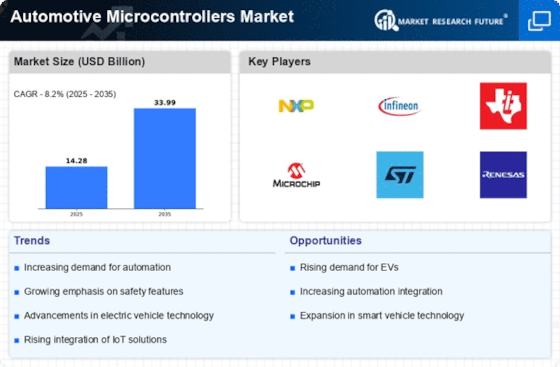
As per Market Research Future analysis, the Automotive Microcontrollers Market Size was estimated at 14.28 USD Billion in 2024. The Automotive Microcontrollers industry is projected to grow from 15.45 USD Billion in 2025 to 33.99 USD Billion by 2035, exhibiting a compound annual growth rate (CAGR) of 8.2% during the forecast period 2025 - 2035

Key Market Trends & Highlights

The Automotive Microcontrollers Market is poised for substantial growth driven by technological advancements and evolving consumer demands.

  • The integration of Advanced Driver Assistance Systems (ADAS) is becoming increasingly prevalent in the automotive microcontrollers market. North America remains the largest market, while Asia-Pacific is recognized as the fastest-growing region in this sector. The Powertrain and Chassis segment holds the largest share, whereas the Safety and Security segment is experiencing rapid growth. Key market drivers include the growing demand for enhanced safety features and advancements in electric vehicle technology.

Market Size & Forecast

2024 Market Size 14.28 (USD Billion)
2035 Market Size 33.99 (USD Billion)
CAGR (2025 - 2035) 8.2%
Largest Regional Market Share in 2024 North America

Major Players

NXP Semiconductors (NL), Infineon Technologies (DE), Texas Instruments (US), Microchip Technology (US), STMicroelectronics (FR), Renesas Electronics (JP), Analog Devices (US), ON Semiconductor (US), Cypress Semiconductor (US)

Market Trends

The Automotive Microcontrollers Market is currently experiencing a transformative phase, driven by the increasing demand for advanced vehicle functionalities and enhanced safety features. As automotive technology evolves, automotive microcontrollers and automotive MCU solutions play a pivotal role in managing various systems, including engine control, infotainment, and driver assistance. The use of MCU in automotive applications is expanding rapidly, as these devices enable precise control and real-time processing across multiple vehicle functions.

The integration of automotive microcontroller into electric and hybrid vehicles is particularly noteworthy, as these systems require sophisticated management to optimize performance and efficiency. Furthermore, the rise of connected vehicles necessitates robust MCU automotive  solutions to facilitate communication between different vehicle components and external networks. In addition to technological advancements, regulatory pressures aimed at improving vehicle safety and reducing emissions are propelling the Automotive Microcontrollers Market forward within the broader microcontroller market.

Manufacturers are compelled to innovate and adopt more efficient microcontroller designs to comply with stringent standards. This environment fosters collaboration among automotive suppliers and technology firms, leading to the development of cutting-edge automotive microcontrollers  As the market continues to expand, it appears poised for further growth, with opportunities emerging in areas such as autonomous driving and smart mobility solutions. The future landscape of the Automotive Microcontrollers Market seems promising, characterized by rapid advancements and a focus on sustainability and connectivity.

Integration of Advanced Driver Assistance Systems (ADAS)

The Automotive Microcontrollers Market is witnessing a notable trend towards the integration of Advanced Driver Assistance Systems (ADAS). These systems enhance vehicle safety and convenience by utilizing microcontrollers to process data from various sensors. As consumer demand for safety features increases, manufacturers are investing in microcontroller technologies that support real-time data processing and decision-making, thereby improving overall vehicle performance.

Shift Towards Electrification

Another significant trend in the Automotive Microcontrollers Market is the shift towards electrification. With the growing popularity of electric and hybrid vehicles, microcontrollers are essential for managing battery systems, power distribution, and energy efficiency. This transition necessitates the development of specialized microcontroller solutions that can handle the unique requirements of electric drivetrains, indicating a shift in focus for manufacturers.

Rise of Connectivity and IoT Integration

The rise of connectivity and the Internet of Things (IoT) is reshaping the Automotive Microcontrollers Market. Vehicles are increasingly becoming connected devices, requiring microcontrollers that can facilitate communication between the vehicle and external networks. This trend suggests a growing need for microcontroller solutions that support data exchange, remote diagnostics, and over-the-air updates, enhancing the overall user experience.

Automotive Microcontrollers Market Market Drivers

Increased Focus on Fuel Efficiency

The Automotive Microcontrollers Market is significantly impacted by the increased focus on fuel efficiency among consumers and manufacturers alike. As fuel prices fluctuate and environmental concerns rise, there is a growing demand for vehicles that optimize fuel consumption. Microcontrollers play a pivotal role in managing engine performance, transmission systems, and hybrid technologies, thereby enhancing fuel efficiency. The market for fuel-efficient vehicles is projected to grow substantially, with estimates suggesting that by 2025, over 50% of new vehicles will incorporate advanced fuel-saving technologies. This trend not only aligns with consumer preferences but also meets regulatory requirements aimed at reducing emissions. Consequently, the Automotive Microcontrollers Market is poised for growth as manufacturers invest in microcontroller technologies that promote fuel efficiency.

Rising Demand for Connectivity Solutions

The Automotive Microcontrollers Market is witnessing a rising demand for connectivity solutions as vehicles become increasingly integrated with digital technologies. The proliferation of connected cars, which utilize microcontrollers to enable features such as vehicle-to-vehicle communication and real-time data analytics, is reshaping the automotive landscape. According to industry estimates, the connected car market is anticipated to reach USD 200 billion by 2025. This growth is driven by consumer expectations for enhanced convenience, safety, and entertainment options. Microcontrollers serve as the backbone of these connectivity solutions, facilitating seamless communication between various vehicle systems and external networks. As automakers strive to meet consumer demands, the Automotive Microcontrollers Market is likely to expand, fostering innovation in connectivity technologies.

Advancements in Electric Vehicle Technology

The Automotive Microcontrollers Market is significantly influenced by advancements in electric vehicle (EV) technology. As the automotive sector shifts towards electrification, the demand for sophisticated microcontrollers that manage battery systems, power distribution, and energy efficiency is on the rise. The EV market is projected to grow at a compound annual growth rate of over 20% through 2025, necessitating the integration of advanced microcontrollers to optimize performance and reliability. These microcontrollers play a crucial role in managing the complex interactions between various vehicle systems, ensuring efficient energy usage and enhancing overall vehicle performance. Consequently, the increasing adoption of electric vehicles is expected to propel the Automotive Microcontrollers Market forward, fostering innovation and technological advancements.

Growing Demand for Enhanced Safety Features

The Automotive Microcontrollers Market is experiencing a notable surge in demand for enhanced safety features in vehicles. As consumers increasingly prioritize safety, manufacturers are integrating advanced microcontrollers to support systems such as automatic emergency braking, lane-keeping assistance, and adaptive cruise control. This trend is reflected in the projected growth of the automotive safety systems market, which is expected to reach USD 60 billion by 2025. The incorporation of microcontrollers facilitates real-time data processing and decision-making, thereby improving vehicle safety. Furthermore, regulatory bodies are imposing stricter safety standards, compelling automakers to adopt advanced microcontroller technologies. This growing emphasis on safety not only enhances consumer confidence but also drives innovation within the Automotive Microcontrollers Market.

Emergence of Autonomous Driving Technologies

The Automotive Microcontrollers Market is being transformed by the emergence of autonomous driving technologies. As automakers invest heavily in research and development to achieve higher levels of automation, the demand for advanced microcontrollers that can process vast amounts of data in real-time is increasing. These microcontrollers are essential for enabling features such as adaptive cruise control, lane departure warning, and full self-driving capabilities. The autonomous vehicle market is projected to reach USD 60 billion by 2025, indicating a robust growth trajectory. This shift towards automation not only enhances driving convenience but also raises safety standards. As a result, the Automotive Microcontrollers Market is likely to experience significant growth, driven by the need for sophisticated microcontroller solutions that support autonomous driving functionalities.

Market Segment Insights

By Application: Powertrain & Chassis (Largest) vs. Safety & Security (Fastest-Growing)

In the Automotive <a href="https://www.marketresearchfuture.com/reports/microcontroller-market-10909" target="_blank" title="microcontroller">Microcontrollers</a> Market, the application segment shows varied distribution with Powertrain &amp; Chassis claiming the largest share. This segment benefits from the increasing demand for fuel-efficient and performance-oriented vehicles. Furthermore, Safety &amp; Security applications are gaining traction, driven by stringent regulations and consumer demand for advanced safety features in vehicles, positioning them as the fastest-growing area within microcontroller applications. Growth in the Automotive Microcontrollers Market is largely propelled by technological advancements and the integration of electronics in vehicles. As automotive manufacturers increasingly focus on enhancing vehicle performance, safety, and user experience, the demand for microcontrollers in applications such as body electronics and infotainment continues to thrive. The push towards electrification and autonomous driving technologies are setting the stage for sustained growth across various application segments within the market.

Powertrain &amp; Chassis (Dominant) vs. Telematics &amp; Infotainment (Emerging)

The Powertrain &amp; Chassis segment in automotive microcontrollers is dominant due to its critical role in vehicle performance, efficiency, and dynamics. These microcontrollers manage essential functions such as <a href="https://www.marketresearchfuture.com/reports/engine-market-24300" target="_blank" title="engine">engine</a> control, transmission systems, and chassis stability, making them integral to vehicle functionality. In contrast, Telematics &amp; Infotainment represents an emerging segment, driven by the rise in connectivity features and consumer demand for advanced entertainment systems. While still developing, this segment is rapidly gaining market relevance as automotive manufacturers incorporate connected technology and real-time data functionalities to enhance user experience and safety, resulting in considerable investment and innovation.

By Technology: Park Assist System (Largest) vs. Adaptive Cruise Control (Fastest-Growing)

The Automotive Microcontrollers Market shows distinct segment values, with Park Assist Systems leading the market share due to widespread adoption across various vehicle models. Meanwhile, Adaptive Cruise Control is rapidly gaining traction as a preferred feature among consumers and manufacturers alike, appealing to the growing demand for safety and convenience in driving experiences. Other segments like Blind Spot Detection and Tire Pressure Monitoring Systems play a supportive role, contributing to the holistic development of advanced automotive technologies.

Technology: Park Assist System (Dominant) vs. Adaptive Cruise Control (Emerging)

Park Assist Systems are currently at the forefront of the Automotive Microcontrollers Market, providing critical functionality that enhances parking ease and safety for drivers. As vehicles become more complex and consumer expectations for safety increase, the prevalence of Park Assist Systems continues to grow, positioning it as a dominant force in the market. In contrast, Adaptive Cruise Control is an emerging technology that is gaining momentum due to innovations in driver assistance systems. This segment is characterized by its ability to regulate a vehicle's speed, maintaining safe distances from other vehicles, thereby enhancing road safety and driving comfort. As a result, Adaptive Cruise Control is considered the fastest-growing segment in the market.

By Vehicle Type: Passenger ICE Vehicle (Largest) vs. Electric Vehicle (Fastest-Growing)

The automotive microcontrollers market is primarily driven by three key vehicle types: Passenger ICE Vehicles, Commercial IVE Vehicles, and Electric Vehicles. Among these, Passenger ICE Vehicles represent the largest share, continuing to dominate the market due to their widespread adoption and established technology. In contrast, Electric Vehicles, while currently a smaller segment, are rapidly gaining traction due to increasing environmental concerns and government regulations promoting greener transportation options.

Passenger ICE Vehicle (Dominant) vs. Electric Vehicle (Emerging)

Passenger ICE Vehicles dominate the automotive microcontrollers market, characterized by mature technologies and broad manufacturing processes. They utilize microcontrollers for various onboard systems, including engine control, infotainment, and safety features. In contrast, Electric Vehicles represent an emerging segment marked by rapid growth and innovation. The rise of electric mobility is propelled by advances in battery technology and the need for sustainable alternatives to fossil fuels. Automotive microcontrollers in electric vehicles are increasingly utilized for energy management, vehicle-to-grid communication, and enhanced driver-assist technologies, positioning them as a critical component in the evolution of automotive technology.

Get more detailed insights about Automotive Microcontrollers Market Research Report—Global Forecast till 2035

Regional Insights

North America : Innovation and Technology Hub

North America is the largest market for automotive microcontrollers, holding approximately 40% of the global share. The region's growth is driven by the increasing demand for advanced driver-assistance systems (ADAS) and electric vehicles (EVs). Regulatory support for emissions reduction and safety standards further catalyzes market expansion. The U.S. and Canada are the primary contributors, with significant investments in automotive technology and infrastructure. The competitive landscape in North America is robust, featuring key players such as Texas Instruments, NXP Semiconductors, and Microchip Technology. These companies are at the forefront of innovation, focusing on developing high-performance microcontrollers tailored for automotive applications. The presence of established automotive manufacturers and a strong supply chain ecosystem enhances the region's market position, fostering collaboration and technological advancements.

Europe : Regulatory-Driven Market Growth

Europe is the second-largest market for automotive microcontrollers, accounting for approximately 30% of the global market share. The region's growth is significantly influenced by stringent regulations aimed at reducing carbon emissions and enhancing vehicle safety. The European Union's Green Deal and various national initiatives promote the adoption of electric and hybrid vehicles, driving demand for advanced microcontroller technologies. Leading countries in this region include Germany, France, and the UK, where major automotive manufacturers are investing heavily in R&D. Key players like Infineon Technologies and STMicroelectronics are pivotal in this landscape, focusing on innovative solutions that meet regulatory requirements. The competitive environment is characterized by collaborations between automotive OEMs and semiconductor manufacturers, fostering advancements in microcontroller applications.

Asia-Pacific : Emerging Market Potential

Asia-Pacific is witnessing rapid growth in the automotive microcontrollers market, holding approximately 25% of the global share. The region's expansion is driven by increasing vehicle production, rising disposable incomes, and a growing focus on smart automotive technologies. Countries like China and Japan are leading the charge, supported by government initiatives promoting electric vehicles and smart transportation systems. China stands out as a major player, with significant investments in automotive technology and a burgeoning electric vehicle market. Key companies such as Renesas Electronics and ON Semiconductor are actively involved in developing microcontrollers tailored for the region's unique automotive needs. The competitive landscape is evolving, with local manufacturers emerging alongside established global players, enhancing innovation and market dynamics.

Middle East and Africa : Untapped Market Opportunities

The Middle East and Africa region is gradually emerging in the automotive microcontrollers market, currently holding about 5% of the global share. The growth is primarily driven by increasing vehicle ownership and a rising demand for advanced automotive technologies. Government initiatives aimed at improving transportation infrastructure and promoting electric vehicles are expected to catalyze market growth in the coming years. Countries like South Africa and the UAE are at the forefront of this development, with investments in automotive manufacturing and technology. The competitive landscape is still developing, with opportunities for both local and international players to establish a foothold. Companies are focusing on partnerships and collaborations to enhance their product offerings and meet the growing demand for automotive microcontrollers in the region.

Key Players and Competitive Insights

The Automotive Microcontrollers Market is currently characterized by a dynamic competitive landscape, driven by rapid technological advancements and increasing demand for vehicle electrification and automation. Key players such as NXP Semiconductors (Netherlands), Infineon Technologies (Germany), and Renesas Electronics (Japan) are strategically positioned to leverage their extensive portfolios and R&D capabilities. NXP Semiconductors (Netherlands) focuses on innovation in automotive safety and connectivity solutions, while Infineon Technologies (Germany) emphasizes its commitment to sustainability through energy-efficient microcontrollers. Renesas Electronics (Japan) is enhancing its market presence by investing in advanced semiconductor technologies, which collectively shape a competitive environment that prioritizes technological superiority and sustainability. The market structure appears moderately fragmented, with several players vying for market share through localized manufacturing and optimized supply chains. Companies are increasingly localizing their production to mitigate supply chain disruptions and enhance responsiveness to regional demands. This strategy not only strengthens their market position but also fosters a competitive atmosphere where agility and efficiency are paramount. The collective influence of these key players is significant, as they drive innovation and set industry standards, thereby shaping the overall market dynamics. In August 2025, NXP Semiconductors (Netherlands) announced a strategic partnership with a leading automotive manufacturer to develop next-generation electric vehicle (EV) microcontrollers. This collaboration is poised to enhance NXP's position in the EV segment, aligning with the growing trend towards electrification in the automotive industry. The partnership underscores NXP's commitment to innovation and its proactive approach to meeting the evolving needs of the automotive sector. In September 2025, Infineon Technologies (Germany) unveiled a new line of microcontrollers designed specifically for advanced driver-assistance systems (ADAS). This launch reflects Infineon's focus on enhancing vehicle safety and automation capabilities. By investing in ADAS technology, Infineon positions itself as a leader in the automotive microcontroller market, catering to the increasing demand for safety features in modern vehicles. In July 2025, Renesas Electronics (Japan) expanded its manufacturing capabilities by opening a new facility dedicated to automotive microcontroller production. This strategic move aims to bolster Renesas's supply chain resilience and meet the surging demand for automotive electronics. The new facility is expected to enhance production efficiency and support the company's growth trajectory in the automotive sector, further solidifying its competitive stance. As of October 2025, the competitive trends in the Automotive Microcontrollers Market are increasingly defined by digitalization, sustainability, and the integration of artificial intelligence (AI). Strategic alliances among key players are shaping the landscape, fostering innovation and collaboration. The shift from price-based competition to a focus on technological advancement and supply chain reliability is evident, suggesting that future competitive differentiation will hinge on the ability to innovate and adapt to changing market demands.

Key Companies in the Automotive Microcontrollers Market include

Industry Developments

  • Q2 2024: Renesas Expands Automotive Microcontroller Portfolio with New RH850/U2B Series for Next-Generation Vehicle Architectures Renesas announced the launch of its RH850/U2B automotive microcontroller series, designed to support next-generation vehicle architectures including domain and zone control, with enhanced performance and security features.
  • Q2 2024: Infineon launches new AURIX TC4x family of automotive microcontrollers for eMobility and ADAS Infineon introduced the AURIX TC4x family of automotive microcontrollers, targeting applications in electric vehicles and advanced driver-assistance systems, with improved processing power and safety capabilities.
  • Q2 2024: STMicroelectronics Unveils Stellar E MCUs for Next-Generation Electric Vehicle Powertrain Systems STMicroelectronics launched the Stellar E series of automotive microcontrollers, specifically designed for electric vehicle powertrain and domain-oriented architectures, offering high performance and energy efficiency.
  • Q2 2024: NXP Semiconductors Announces Partnership with TSMC for Advanced Automotive Microcontroller Production NXP Semiconductors entered a partnership with TSMC to manufacture advanced automotive microcontrollers using TSMC’s 16nm FinFET process, aiming to enhance performance and energy efficiency for future vehicle platforms.
  • Q2 2024: Renesas Electronics to Acquire Panthronics AG, Expanding Automotive Connectivity Solutions Renesas Electronics announced the acquisition of Panthronics AG, a move to strengthen its automotive connectivity and microcontroller offerings for next-generation vehicles.
  • Q2 2024: Infineon Opens New Automotive Microcontroller R&D Center in Dresden Infineon Technologies inaugurated a new research and development center in Dresden, Germany, focused on advancing automotive microcontroller technologies for electric and autonomous vehicles.
  • Q3 2024: STMicroelectronics and Mobileye Announce Collaboration on Automotive Microcontroller Integration for ADAS STMicroelectronics and Mobileye revealed a collaboration to integrate ST’s automotive microcontrollers into Mobileye’s advanced driver-assistance systems, aiming to improve processing speed and safety.
  • Q3 2024: NXP Launches S32Z and S32E Automotive Microcontrollers Market for Real-Time Vehicle Processing NXP Semiconductors launched the S32Z and S32E series of automotive microcontrollers, designed for real-time processing in domain and zonal vehicle architectures, supporting electrification and autonomous driving.
  • Q3 2024: Renesas and BlackBerry QNX Partner to Deliver Secure Automotive Microcontroller Solutions Renesas Electronics and BlackBerry QNX announced a partnership to provide secure automotive microcontroller solutions, combining Renesas’ hardware with BlackBerry’s cybersecurity software for next-generation vehicles.
  • Q4 2024: Infineon Technologies Wins Major Automotive Microcontroller Supply Contract with Leading EV Manufacturer Infineon Technologies secured a significant supply contract to provide automotive microcontrollers to a leading electric vehicle manufacturer, supporting the development of advanced vehicle control systems.
  • Q1 2025: Chinese Chipmaker BYD Semiconductor Launches New Automotive Microcontroller Series for EVs BYD Semiconductor announced the launch of a new series of automotive microcontrollers tailored for electric vehicles, aiming to enhance performance and reliability in EV powertrain and control systems.
  • Q2 2025: Renesas Electronics Appoints New Head of Automotive Microcontroller Division Renesas Electronics named a new executive to lead its automotive microcontroller division, signaling a strategic focus on expanding its product portfolio and market presence in the sector.

Future Outlook

Automotive Microcontrollers Market Future Outlook

The Automotive Microcontrollers Market is projected to grow at an 8.2% CAGR from 2025 to 2035, driven by advancements in electric vehicles, autonomous driving technologies, and increased demand for connectivity.

New opportunities lie in:

  • <p>Development of advanced driver-assistance systems (ADAS) microcontrollers. Integration of AI-driven microcontrollers for enhanced vehicle performance. Expansion into emerging markets with tailored microcontroller solutions.</p>

By 2035, the market is expected to be robust, reflecting substantial growth and innovation.

Market Segmentation

Automotive Microcontrollers Market Technology Outlook

  • Park Assist System
  • Blind Spot Detection System
  • Adaptive Cruise Control
  • Tire Pressure Monitoring System

Automotive Microcontrollers Market Application Outlook

  • Powertrain & Chassis
  • Safety & Security
  • Body Electronics
  • Telematics & Infotainment
  • Others

Automotive Microcontrollers Market Vehicle Type Outlook

  • Passenger ICE Vehicle
  • Commercial IVE Vehicle
  • Electric Vehicle

Report Scope

MARKET SIZE 2024 14.28(USD Billion)
MARKET SIZE 2025 15.45(USD Billion)
MARKET SIZE 2035 33.99(USD Billion)
COMPOUND ANNUAL GROWTH RATE (CAGR) 8.2% (2025 - 2035)
REPORT COVERAGE Revenue Forecast, Competitive Landscape, Growth Factors, and Trends
BASE YEAR 2024
Market Forecast Period 2025 - 2035
Historical Data 2019 - 2024
Market Forecast Units USD Billion
Key Companies Profiled NXP Semiconductors (NL), Infineon Technologies (DE), Texas Instruments (US), Microchip Technology (US), STMicroelectronics (FR), Renesas Electronics (JP), Analog Devices (US), ON Semiconductor (US), Cypress Semiconductor (US)
Segments Covered Application, Technology, Vehicle Type, Region
Key Market Opportunities Integration of advanced driver assistance systems (ADAS) drives demand in the Automotive Microcontrollers Market.
Key Market Dynamics Rising demand for advanced driver assistance systems drives innovation in automotive microcontrollers and enhances vehicle safety features.
Countries Covered North America, Europe, APAC, South America, MEA

FAQs

What is the projected market valuation of the Automotive Microcontrollers Market by 2035?

<p>The Automotive Microcontrollers Market is projected to reach a valuation of 33.99 USD Billion by 2035.</p>

What was the market valuation of the Automotive Microcontrollers Market in 2024?

<p>In 2024, the Automotive Microcontrollers Market was valued at 14.28 USD Billion.</p>

What is the expected CAGR for the Automotive Microcontrollers Market during the forecast period 2025 - 2035?

<p>The expected CAGR for the Automotive Microcontrollers Market during the forecast period 2025 - 2035 is 8.2%.</p>

Which application segment is projected to have the highest valuation by 2035?

<p>The Powertrain & Chassis application segment is projected to reach a valuation of 12.0 USD Billion by 2035.</p>

What are the key players in the Automotive Microcontrollers Market?

<p>Key players in the Automotive Microcontrollers Market include NXP Semiconductors, Infineon Technologies, Texas Instruments, and Microchip Technology.</p>

How much is the Adaptive Cruise Control technology segment expected to be valued by 2035?

<p>The Adaptive Cruise Control technology segment is expected to be valued at 8.5 USD Billion by 2035.</p>

What is the projected valuation for the Electric Vehicle segment by 2035?

The Electric Vehicle segment is projected to reach a valuation of 6.99 USD Billion by 2035.

Which vehicle type segment had the highest valuation in 2024?

In 2024, the Passenger ICE Vehicle segment had the highest valuation at 8.57 USD Billion.

What is the expected growth for the Tire Pressure Monitoring System technology segment by 2035?

The Tire Pressure Monitoring System technology segment is expected to grow to a valuation of 13.64 USD Billion by 2035.

How does the Body Electronics application segment's growth compare to others by 2035?

The Body Electronics application segment is projected to grow to 5.5 USD Billion by 2035, indicating a moderate growth compared to other segments.

  1. SECTION I: EXECUTIVE SUMMARY AND KEY HIGHLIGHTS
    1. | 1.1 EXECUTIVE SUMMARY
    2. | | 1.1.1 Market Overview
    3. | | 1.1.2 Key Findings
    4. | | 1.1.3 Market Segmentation
    5. | | 1.1.4 Competitive Landscape
    6. | | 1.1.5 Challenges and Opportunities
    7. | | 1.1.6 Future Outlook
  2. SECTION II: SCOPING, METHODOLOGY AND MARKET STRUCTURE
    1. | 2.1 MARKET INTRODUCTION
    2. | | 2.1.1 Definition
    3. | | 2.1.2 Scope of the study
    4. | | | 2.1.2.1 Research Objective
    5. | | | 2.1.2.2 Assumption
    6. | | | 2.1.2.3 Limitations
    7. | 2.2 RESEARCH METHODOLOGY
    8. | | 2.2.1 Overview
    9. | | 2.2.2 Data Mining
    10. | | 2.2.3 Secondary Research
    11. | | 2.2.4 Primary Research
    12. | | | 2.2.4.1 Primary Interviews and Information Gathering Process
    13. | | | 2.2.4.2 Breakdown of Primary Respondents
    14. | | 2.2.5 Forecasting Model
    15. | | 2.2.6 Market Size Estimation
    16. | | | 2.2.6.1 Bottom-Up Approach
    17. | | | 2.2.6.2 Top-Down Approach
    18. | | 2.2.7 Data Triangulation
    19. | | 2.2.8 Validation
  3. SECTION III: QUALITATIVE ANALYSIS
    1. | 3.1 MARKET DYNAMICS
    2. | | 3.1.1 Overview
    3. | | 3.1.2 Drivers
    4. | | 3.1.3 Restraints
    5. | | 3.1.4 Opportunities
    6. | 3.2 MARKET FACTOR ANALYSIS
    7. | | 3.2.1 Value chain Analysis
    8. | | 3.2.2 Porter's Five Forces Analysis
    9. | | | 3.2.2.1 Bargaining Power of Suppliers
    10. | | | 3.2.2.2 Bargaining Power of Buyers
    11. | | | 3.2.2.3 Threat of New Entrants
    12. | | | 3.2.2.4 Threat of Substitutes
    13. | | | 3.2.2.5 Intensity of Rivalry
    14. | | 3.2.3 COVID-19 Impact Analysis
    15. | | | 3.2.3.1 Market Impact Analysis
    16. | | | 3.2.3.2 Regional Impact
    17. | | | 3.2.3.3 Opportunity and Threat Analysis
  4. SECTION IV: QUANTITATIVE ANALYSIS
    1. | 4.1 Automobile, BY Application (USD Billion)
    2. | | 4.1.1 Powertrain & Chassis
    3. | | 4.1.2 Safety & Security
    4. | | 4.1.3 Body Electronics
    5. | | 4.1.4 Telematics & Infotainment
    6. | | 4.1.5 Others
    7. | 4.2 Automobile, BY Technology (USD Billion)
    8. | | 4.2.1 Park Assist System
    9. | | 4.2.2 Blind Spot Detection System
    10. | | 4.2.3 Adaptive Cruise Control
    11. | | 4.2.4 Tire Pressure Monitoring System
    12. | 4.3 Automobile, BY Vehicle Type (USD Billion)
    13. | | 4.3.1 Passenger ICE Vehicle
    14. | | 4.3.2 Commercial IVE Vehicle
    15. | | 4.3.3 Electric Vehicle
    16. | 4.4 Automobile, BY Region (USD Billion)
    17. | | 4.4.1 North America
    18. | | | 4.4.1.1 US
    19. | | | 4.4.1.2 Canada
    20. | | 4.4.2 Europe
    21. | | | 4.4.2.1 Germany
    22. | | | 4.4.2.2 UK
    23. | | | 4.4.2.3 France
    24. | | | 4.4.2.4 Russia
    25. | | | 4.4.2.5 Italy
    26. | | | 4.4.2.6 Spain
    27. | | | 4.4.2.7 Rest of Europe
    28. | | 4.4.3 APAC
    29. | | | 4.4.3.1 China
    30. | | | 4.4.3.2 India
    31. | | | 4.4.3.3 Japan
    32. | | | 4.4.3.4 South Korea
    33. | | | 4.4.3.5 Malaysia
    34. | | | 4.4.3.6 Thailand
    35. | | | 4.4.3.7 Indonesia
    36. | | | 4.4.3.8 Rest of APAC
    37. | | 4.4.4 South America
    38. | | | 4.4.4.1 Brazil
    39. | | | 4.4.4.2 Mexico
    40. | | | 4.4.4.3 Argentina
    41. | | | 4.4.4.4 Rest of South America
    42. | | 4.4.5 MEA
    43. | | | 4.4.5.1 GCC Countries
    44. | | | 4.4.5.2 South Africa
    45. | | | 4.4.5.3 Rest of MEA
  5. SECTION V: COMPETITIVE ANALYSIS
    1. | 5.1 Competitive Landscape
    2. | | 5.1.1 Overview
    3. | | 5.1.2 Competitive Analysis
    4. | | 5.1.3 Market share Analysis
    5. | | 5.1.4 Major Growth Strategy in the Automobile
    6. | | 5.1.5 Competitive Benchmarking
    7. | | 5.1.6 Leading Players in Terms of Number of Developments in the Automobile
    8. | | 5.1.7 Key developments and growth strategies
    9. | | | 5.1.7.1 New Product Launch/Service Deployment
    10. | | | 5.1.7.2 Merger & Acquisitions
    11. | | | 5.1.7.3 Joint Ventures
    12. | | 5.1.8 Major Players Financial Matrix
    13. | | | 5.1.8.1 Sales and Operating Income
    14. | | | 5.1.8.2 Major Players R&D Expenditure. 2023
    15. | 5.2 Company Profiles
    16. | | 5.2.1 NXP Semiconductors (NL)
    17. | | | 5.2.1.1 Financial Overview
    18. | | | 5.2.1.2 Products Offered
    19. | | | 5.2.1.3 Key Developments
    20. | | | 5.2.1.4 SWOT Analysis
    21. | | | 5.2.1.5 Key Strategies
    22. | | 5.2.2 Infineon Technologies (DE)
    23. | | | 5.2.2.1 Financial Overview
    24. | | | 5.2.2.2 Products Offered
    25. | | | 5.2.2.3 Key Developments
    26. | | | 5.2.2.4 SWOT Analysis
    27. | | | 5.2.2.5 Key Strategies
    28. | | 5.2.3 Texas Instruments (US)
    29. | | | 5.2.3.1 Financial Overview
    30. | | | 5.2.3.2 Products Offered
    31. | | | 5.2.3.3 Key Developments
    32. | | | 5.2.3.4 SWOT Analysis
    33. | | | 5.2.3.5 Key Strategies
    34. | | 5.2.4 Microchip Technology (US)
    35. | | | 5.2.4.1 Financial Overview
    36. | | | 5.2.4.2 Products Offered
    37. | | | 5.2.4.3 Key Developments
    38. | | | 5.2.4.4 SWOT Analysis
    39. | | | 5.2.4.5 Key Strategies
    40. | | 5.2.5 STMicroelectronics (FR)
    41. | | | 5.2.5.1 Financial Overview
    42. | | | 5.2.5.2 Products Offered
    43. | | | 5.2.5.3 Key Developments
    44. | | | 5.2.5.4 SWOT Analysis
    45. | | | 5.2.5.5 Key Strategies
    46. | | 5.2.6 Renesas Electronics (JP)
    47. | | | 5.2.6.1 Financial Overview
    48. | | | 5.2.6.2 Products Offered
    49. | | | 5.2.6.3 Key Developments
    50. | | | 5.2.6.4 SWOT Analysis
    51. | | | 5.2.6.5 Key Strategies
    52. | | 5.2.7 Analog Devices (US)
    53. | | | 5.2.7.1 Financial Overview
    54. | | | 5.2.7.2 Products Offered
    55. | | | 5.2.7.3 Key Developments
    56. | | | 5.2.7.4 SWOT Analysis
    57. | | | 5.2.7.5 Key Strategies
    58. | | 5.2.8 ON Semiconductor (US)
    59. | | | 5.2.8.1 Financial Overview
    60. | | | 5.2.8.2 Products Offered
    61. | | | 5.2.8.3 Key Developments
    62. | | | 5.2.8.4 SWOT Analysis
    63. | | | 5.2.8.5 Key Strategies
    64. | | 5.2.9 Cypress Semiconductor (US)
    65. | | | 5.2.9.1 Financial Overview
    66. | | | 5.2.9.2 Products Offered
    67. | | | 5.2.9.3 Key Developments
    68. | | | 5.2.9.4 SWOT Analysis
    69. | | | 5.2.9.5 Key Strategies
    70. | 5.3 Appendix
    71. | | 5.3.1 References
    72. | | 5.3.2 Related Reports
  6. LIST OF FIGURES
    1. | 6.1 MARKET SYNOPSIS
    2. | 6.2 NORTH AMERICA MARKET ANALYSIS
    3. | 6.3 US MARKET ANALYSIS BY APPLICATION
    4. | 6.4 US MARKET ANALYSIS BY TECHNOLOGY
    5. | 6.5 US MARKET ANALYSIS BY VEHICLE TYPE
    6. | 6.6 CANADA MARKET ANALYSIS BY APPLICATION
    7. | 6.7 CANADA MARKET ANALYSIS BY TECHNOLOGY
    8. | 6.8 CANADA MARKET ANALYSIS BY VEHICLE TYPE
    9. | 6.9 EUROPE MARKET ANALYSIS
    10. | 6.10 GERMANY MARKET ANALYSIS BY APPLICATION
    11. | 6.11 GERMANY MARKET ANALYSIS BY TECHNOLOGY
    12. | 6.12 GERMANY MARKET ANALYSIS BY VEHICLE TYPE
    13. | 6.13 UK MARKET ANALYSIS BY APPLICATION
    14. | 6.14 UK MARKET ANALYSIS BY TECHNOLOGY
    15. | 6.15 UK MARKET ANALYSIS BY VEHICLE TYPE
    16. | 6.16 FRANCE MARKET ANALYSIS BY APPLICATION
    17. | 6.17 FRANCE MARKET ANALYSIS BY TECHNOLOGY
    18. | 6.18 FRANCE MARKET ANALYSIS BY VEHICLE TYPE
    19. | 6.19 RUSSIA MARKET ANALYSIS BY APPLICATION
    20. | 6.20 RUSSIA MARKET ANALYSIS BY TECHNOLOGY
    21. | 6.21 RUSSIA MARKET ANALYSIS BY VEHICLE TYPE
    22. | 6.22 ITALY MARKET ANALYSIS BY APPLICATION
    23. | 6.23 ITALY MARKET ANALYSIS BY TECHNOLOGY
    24. | 6.24 ITALY MARKET ANALYSIS BY VEHICLE TYPE
    25. | 6.25 SPAIN MARKET ANALYSIS BY APPLICATION
    26. | 6.26 SPAIN MARKET ANALYSIS BY TECHNOLOGY
    27. | 6.27 SPAIN MARKET ANALYSIS BY VEHICLE TYPE
    28. | 6.28 REST OF EUROPE MARKET ANALYSIS BY APPLICATION
    29. | 6.29 REST OF EUROPE MARKET ANALYSIS BY TECHNOLOGY
    30. | 6.30 REST OF EUROPE MARKET ANALYSIS BY VEHICLE TYPE
    31. | 6.31 APAC MARKET ANALYSIS
    32. | 6.32 CHINA MARKET ANALYSIS BY APPLICATION
    33. | 6.33 CHINA MARKET ANALYSIS BY TECHNOLOGY
    34. | 6.34 CHINA MARKET ANALYSIS BY VEHICLE TYPE
    35. | 6.35 INDIA MARKET ANALYSIS BY APPLICATION
    36. | 6.36 INDIA MARKET ANALYSIS BY TECHNOLOGY
    37. | 6.37 INDIA MARKET ANALYSIS BY VEHICLE TYPE
    38. | 6.38 JAPAN MARKET ANALYSIS BY APPLICATION
    39. | 6.39 JAPAN MARKET ANALYSIS BY TECHNOLOGY
    40. | 6.40 JAPAN MARKET ANALYSIS BY VEHICLE TYPE
    41. | 6.41 SOUTH KOREA MARKET ANALYSIS BY APPLICATION
    42. | 6.42 SOUTH KOREA MARKET ANALYSIS BY TECHNOLOGY
    43. | 6.43 SOUTH KOREA MARKET ANALYSIS BY VEHICLE TYPE
    44. | 6.44 MALAYSIA MARKET ANALYSIS BY APPLICATION
    45. | 6.45 MALAYSIA MARKET ANALYSIS BY TECHNOLOGY
    46. | 6.46 MALAYSIA MARKET ANALYSIS BY VEHICLE TYPE
    47. | 6.47 THAILAND MARKET ANALYSIS BY APPLICATION
    48. | 6.48 THAILAND MARKET ANALYSIS BY TECHNOLOGY
    49. | 6.49 THAILAND MARKET ANALYSIS BY VEHICLE TYPE
    50. | 6.50 INDONESIA MARKET ANALYSIS BY APPLICATION
    51. | 6.51 INDONESIA MARKET ANALYSIS BY TECHNOLOGY
    52. | 6.52 INDONESIA MARKET ANALYSIS BY VEHICLE TYPE
    53. | 6.53 REST OF APAC MARKET ANALYSIS BY APPLICATION
    54. | 6.54 REST OF APAC MARKET ANALYSIS BY TECHNOLOGY
    55. | 6.55 REST OF APAC MARKET ANALYSIS BY VEHICLE TYPE
    56. | 6.56 SOUTH AMERICA MARKET ANALYSIS
    57. | 6.57 BRAZIL MARKET ANALYSIS BY APPLICATION
    58. | 6.58 BRAZIL MARKET ANALYSIS BY TECHNOLOGY
    59. | 6.59 BRAZIL MARKET ANALYSIS BY VEHICLE TYPE
    60. | 6.60 MEXICO MARKET ANALYSIS BY APPLICATION
    61. | 6.61 MEXICO MARKET ANALYSIS BY TECHNOLOGY
    62. | 6.62 MEXICO MARKET ANALYSIS BY VEHICLE TYPE
    63. | 6.63 ARGENTINA MARKET ANALYSIS BY APPLICATION
    64. | 6.64 ARGENTINA MARKET ANALYSIS BY TECHNOLOGY
    65. | 6.65 ARGENTINA MARKET ANALYSIS BY VEHICLE TYPE
    66. | 6.66 REST OF SOUTH AMERICA MARKET ANALYSIS BY APPLICATION
    67. | 6.67 REST OF SOUTH AMERICA MARKET ANALYSIS BY TECHNOLOGY
    68. | 6.68 REST OF SOUTH AMERICA MARKET ANALYSIS BY VEHICLE TYPE
    69. | 6.69 MEA MARKET ANALYSIS
    70. | 6.70 GCC COUNTRIES MARKET ANALYSIS BY APPLICATION
    71. | 6.71 GCC COUNTRIES MARKET ANALYSIS BY TECHNOLOGY
    72. | 6.72 GCC COUNTRIES MARKET ANALYSIS BY VEHICLE TYPE
    73. | 6.73 SOUTH AFRICA MARKET ANALYSIS BY APPLICATION
    74. | 6.74 SOUTH AFRICA MARKET ANALYSIS BY TECHNOLOGY
    75. | 6.75 SOUTH AFRICA MARKET ANALYSIS BY VEHICLE TYPE
    76. | 6.76 REST OF MEA MARKET ANALYSIS BY APPLICATION
    77. | 6.77 REST OF MEA MARKET ANALYSIS BY TECHNOLOGY
    78. | 6.78 REST OF MEA MARKET ANALYSIS BY VEHICLE TYPE
    79. | 6.79 KEY BUYING CRITERIA OF AUTOMOBILE
    80. | 6.80 RESEARCH PROCESS OF MRFR
    81. | 6.81 DRO ANALYSIS OF AUTOMOBILE
    82. | 6.82 DRIVERS IMPACT ANALYSIS: AUTOMOBILE
    83. | 6.83 RESTRAINTS IMPACT ANALYSIS: AUTOMOBILE
    84. | 6.84 SUPPLY / VALUE CHAIN: AUTOMOBILE
    85. | 6.85 AUTOMOBILE, BY APPLICATION, 2024 (% SHARE)
    86. | 6.86 AUTOMOBILE, BY APPLICATION, 2024 TO 2035 (USD Billion)
    87. | 6.87 AUTOMOBILE, BY TECHNOLOGY, 2024 (% SHARE)
    88. | 6.88 AUTOMOBILE, BY TECHNOLOGY, 2024 TO 2035 (USD Billion)
    89. | 6.89 AUTOMOBILE, BY VEHICLE TYPE, 2024 (% SHARE)
    90. | 6.90 AUTOMOBILE, BY VEHICLE TYPE, 2024 TO 2035 (USD Billion)
    91. | 6.91 BENCHMARKING OF MAJOR COMPETITORS
  7. LIST OF TABLES
    1. | 7.1 LIST OF ASSUMPTIONS
    2. | | 7.1.1
    3. | 7.2 North America MARKET SIZE ESTIMATES; FORECAST
    4. | | 7.2.1 BY APPLICATION, 2025-2035 (USD Billion)
    5. | | 7.2.2 BY TECHNOLOGY, 2025-2035 (USD Billion)
    6. | | 7.2.3 BY VEHICLE TYPE, 2025-2035 (USD Billion)
    7. | 7.3 US MARKET SIZE ESTIMATES; FORECAST
    8. | | 7.3.1 BY APPLICATION, 2025-2035 (USD Billion)
    9. | | 7.3.2 BY TECHNOLOGY, 2025-2035 (USD Billion)
    10. | | 7.3.3 BY VEHICLE TYPE, 2025-2035 (USD Billion)
    11. | 7.4 Canada MARKET SIZE ESTIMATES; FORECAST
    12. | | 7.4.1 BY APPLICATION, 2025-2035 (USD Billion)
    13. | | 7.4.2 BY TECHNOLOGY, 2025-2035 (USD Billion)
    14. | | 7.4.3 BY VEHICLE TYPE, 2025-2035 (USD Billion)
    15. | 7.5 Europe MARKET SIZE ESTIMATES; FORECAST
    16. | | 7.5.1 BY APPLICATION, 2025-2035 (USD Billion)
    17. | | 7.5.2 BY TECHNOLOGY, 2025-2035 (USD Billion)
    18. | | 7.5.3 BY VEHICLE TYPE, 2025-2035 (USD Billion)
    19. | 7.6 Germany MARKET SIZE ESTIMATES; FORECAST
    20. | | 7.6.1 BY APPLICATION, 2025-2035 (USD Billion)
    21. | | 7.6.2 BY TECHNOLOGY, 2025-2035 (USD Billion)
    22. | | 7.6.3 BY VEHICLE TYPE, 2025-2035 (USD Billion)
    23. | 7.7 UK MARKET SIZE ESTIMATES; FORECAST
    24. | | 7.7.1 BY APPLICATION, 2025-2035 (USD Billion)
    25. | | 7.7.2 BY TECHNOLOGY, 2025-2035 (USD Billion)
    26. | | 7.7.3 BY VEHICLE TYPE, 2025-2035 (USD Billion)
    27. | 7.8 France MARKET SIZE ESTIMATES; FORECAST
    28. | | 7.8.1 BY APPLICATION, 2025-2035 (USD Billion)
    29. | | 7.8.2 BY TECHNOLOGY, 2025-2035 (USD Billion)
    30. | | 7.8.3 BY VEHICLE TYPE, 2025-2035 (USD Billion)
    31. | 7.9 Russia MARKET SIZE ESTIMATES; FORECAST
    32. | | 7.9.1 BY APPLICATION, 2025-2035 (USD Billion)
    33. | | 7.9.2 BY TECHNOLOGY, 2025-2035 (USD Billion)
    34. | | 7.9.3 BY VEHICLE TYPE, 2025-2035 (USD Billion)
    35. | 7.10 Italy MARKET SIZE ESTIMATES; FORECAST
    36. | | 7.10.1 BY APPLICATION, 2025-2035 (USD Billion)
    37. | | 7.10.2 BY TECHNOLOGY, 2025-2035 (USD Billion)
    38. | | 7.10.3 BY VEHICLE TYPE, 2025-2035 (USD Billion)
    39. | 7.11 Spain MARKET SIZE ESTIMATES; FORECAST
    40. | | 7.11.1 BY APPLICATION, 2025-2035 (USD Billion)
    41. | | 7.11.2 BY TECHNOLOGY, 2025-2035 (USD Billion)
    42. | | 7.11.3 BY VEHICLE TYPE, 2025-2035 (USD Billion)
    43. | 7.12 Rest of Europe MARKET SIZE ESTIMATES; FORECAST
    44. | | 7.12.1 BY APPLICATION, 2025-2035 (USD Billion)
    45. | | 7.12.2 BY TECHNOLOGY, 2025-2035 (USD Billion)
    46. | | 7.12.3 BY VEHICLE TYPE, 2025-2035 (USD Billion)
    47. | 7.13 APAC MARKET SIZE ESTIMATES; FORECAST
    48. | | 7.13.1 BY APPLICATION, 2025-2035 (USD Billion)
    49. | | 7.13.2 BY TECHNOLOGY, 2025-2035 (USD Billion)
    50. | | 7.13.3 BY VEHICLE TYPE, 2025-2035 (USD Billion)
    51. | 7.14 China MARKET SIZE ESTIMATES; FORECAST
    52. | | 7.14.1 BY APPLICATION, 2025-2035 (USD Billion)
    53. | | 7.14.2 BY TECHNOLOGY, 2025-2035 (USD Billion)
    54. | | 7.14.3 BY VEHICLE TYPE, 2025-2035 (USD Billion)
    55. | 7.15 India MARKET SIZE ESTIMATES; FORECAST
    56. | | 7.15.1 BY APPLICATION, 2025-2035 (USD Billion)
    57. | | 7.15.2 BY TECHNOLOGY, 2025-2035 (USD Billion)
    58. | | 7.15.3 BY VEHICLE TYPE, 2025-2035 (USD Billion)
    59. | 7.16 Japan MARKET SIZE ESTIMATES; FORECAST
    60. | | 7.16.1 BY APPLICATION, 2025-2035 (USD Billion)
    61. | | 7.16.2 BY TECHNOLOGY, 2025-2035 (USD Billion)
    62. | | 7.16.3 BY VEHICLE TYPE, 2025-2035 (USD Billion)
    63. | 7.17 South Korea MARKET SIZE ESTIMATES; FORECAST
    64. | | 7.17.1 BY APPLICATION, 2025-2035 (USD Billion)
    65. | | 7.17.2 BY TECHNOLOGY, 2025-2035 (USD Billion)
    66. | | 7.17.3 BY VEHICLE TYPE, 2025-2035 (USD Billion)
    67. | 7.18 Malaysia MARKET SIZE ESTIMATES; FORECAST
    68. | | 7.18.1 BY APPLICATION, 2025-2035 (USD Billion)
    69. | | 7.18.2 BY TECHNOLOGY, 2025-2035 (USD Billion)
    70. | | 7.18.3 BY VEHICLE TYPE, 2025-2035 (USD Billion)
    71. | 7.19 Thailand MARKET SIZE ESTIMATES; FORECAST
    72. | | 7.19.1 BY APPLICATION, 2025-2035 (USD Billion)
    73. | | 7.19.2 BY TECHNOLOGY, 2025-2035 (USD Billion)
    74. | | 7.19.3 BY VEHICLE TYPE, 2025-2035 (USD Billion)
    75. | 7.20 Indonesia MARKET SIZE ESTIMATES; FORECAST
    76. | | 7.20.1 BY APPLICATION, 2025-2035 (USD Billion)
    77. | | 7.20.2 BY TECHNOLOGY, 2025-2035 (USD Billion)
    78. | | 7.20.3 BY VEHICLE TYPE, 2025-2035 (USD Billion)
    79. | 7.21 Rest of APAC MARKET SIZE ESTIMATES; FORECAST
    80. | | 7.21.1 BY APPLICATION, 2025-2035 (USD Billion)
    81. | | 7.21.2 BY TECHNOLOGY, 2025-2035 (USD Billion)
    82. | | 7.21.3 BY VEHICLE TYPE, 2025-2035 (USD Billion)
    83. | 7.22 South America MARKET SIZE ESTIMATES; FORECAST
    84. | | 7.22.1 BY APPLICATION, 2025-2035 (USD Billion)
    85. | | 7.22.2 BY TECHNOLOGY, 2025-2035 (USD Billion)
    86. | | 7.22.3 BY VEHICLE TYPE, 2025-2035 (USD Billion)
    87. | 7.23 Brazil MARKET SIZE ESTIMATES; FORECAST
    88. | | 7.23.1 BY APPLICATION, 2025-2035 (USD Billion)
    89. | | 7.23.2 BY TECHNOLOGY, 2025-2035 (USD Billion)
    90. | | 7.23.3 BY VEHICLE TYPE, 2025-2035 (USD Billion)
    91. | 7.24 Mexico MARKET SIZE ESTIMATES; FORECAST
    92. | | 7.24.1 BY APPLICATION, 2025-2035 (USD Billion)
    93. | | 7.24.2 BY TECHNOLOGY, 2025-2035 (USD Billion)
    94. | | 7.24.3 BY VEHICLE TYPE, 2025-2035 (USD Billion)
    95. | 7.25 Argentina MARKET SIZE ESTIMATES; FORECAST
    96. | | 7.25.1 BY APPLICATION, 2025-2035 (USD Billion)
    97. | | 7.25.2 BY TECHNOLOGY, 2025-2035 (USD Billion)
    98. | | 7.25.3 BY VEHICLE TYPE, 2025-2035 (USD Billion)
    99. | 7.26 Rest of South America MARKET SIZE ESTIMATES; FORECAST
    100. | | 7.26.1 BY APPLICATION, 2025-2035 (USD Billion)
    101. | | 7.26.2 BY TECHNOLOGY, 2025-2035 (USD Billion)
    102. | | 7.26.3 BY VEHICLE TYPE, 2025-2035 (USD Billion)
    103. | 7.27 MEA MARKET SIZE ESTIMATES; FORECAST
    104. | | 7.27.1 BY APPLICATION, 2025-2035 (USD Billion)
    105. | | 7.27.2 BY TECHNOLOGY, 2025-2035 (USD Billion)
    106. | | 7.27.3 BY VEHICLE TYPE, 2025-2035 (USD Billion)
    107. | 7.28 GCC Countries MARKET SIZE ESTIMATES; FORECAST
    108. | | 7.28.1 BY APPLICATION, 2025-2035 (USD Billion)
    109. | | 7.28.2 BY TECHNOLOGY, 2025-2035 (USD Billion)
    110. | | 7.28.3 BY VEHICLE TYPE, 2025-2035 (USD Billion)
    111. | 7.29 South Africa MARKET SIZE ESTIMATES; FORECAST
    112. | | 7.29.1 BY APPLICATION, 2025-2035 (USD Billion)
    113. | | 7.29.2 BY TECHNOLOGY, 2025-2035 (USD Billion)
    114. | | 7.29.3 BY VEHICLE TYPE, 2025-2035 (USD Billion)
    115. | 7.30 Rest of MEA MARKET SIZE ESTIMATES; FORECAST
    116. | | 7.30.1 BY APPLICATION, 2025-2035 (USD Billion)
    117. | | 7.30.2 BY TECHNOLOGY, 2025-2035 (USD Billion)
    118. | | 7.30.3 BY VEHICLE TYPE, 2025-2035 (USD Billion)
    119. | 7.31 PRODUCT LAUNCH/PRODUCT DEVELOPMENT/APPROVAL
    120. | | 7.31.1
    121. | 7.32 ACQUISITION/PARTNERSHIP
    122. | | 7.32.1

Automobile Market Segmentation

Automobile By Application (USD Billion, 2025-2035)

  • Powertrain & Chassis
  • Safety & Security
  • Body Electronics
  • Telematics & Infotainment
  • Others

Automobile By Technology (USD Billion, 2025-2035)

  • Park Assist System
  • Blind Spot Detection System
  • Adaptive Cruise Control
  • Tire Pressure Monitoring System

Automobile By Vehicle Type (USD Billion, 2025-2035)

  • Passenger ICE Vehicle
  • Commercial IVE Vehicle
  • Electric Vehicle
Infographic

Free Sample Request

Kindly complete the form below to receive a free sample of this Report

Get Free Sample

Customer Strories

Compare Licence

×
Features License Type
Single User Multiuser License Enterprise User
Price $4,950 $5,950 $7,250
Maximum User Access Limit 1 User Upto 10 Users Unrestricted Access Throughout the Organization
Free Customization
Direct Access to Analyst
Deliverable Format
Platform Access
Discount on Next Purchase 10% 15% 15%
Printable Versions
%>