×
Request Free Sample ×

Kindly complete the form below to receive a free sample of this Report

* Please use a valid business email

Leading companies partner with us for data-driven Insights

clients tt-cursor
Hero Background
English
Chinese
French
Japanese
Korean
German
Spanish

Automotive Logistics Market Trends

ID: MRFR/PCM/10511-HCR
111 Pages
Snehal Singh
October 2025

Automotive Logistics Market Research Report: By Service Type (Transportation, Warehousing, Inventory Management, Freight Forwarding), By Logistics Mode (Road, Rail, Air, Sea), By Vehicle Type (Passenger Cars, Commercial Vehicles, Electric Vehicles, Hybrid Vehicles), By Supply Chain Type (Inbound Logistics, Outbound Logistics, Third Party Logistics) andBy Regional (North America, Europe, South America, Asia Pacific, Middle East and Africa)- Forecast to 2035.

Share:
Download PDF ×

We do not share your information with anyone. However, we may send you emails based on your report interest from time to time. You may contact us at any time to opt-out.

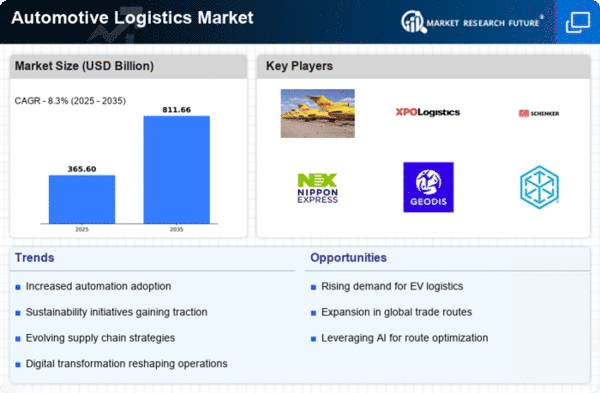
Automotive Logistics Market Infographic
Purchase Options

Market Trends

Key Emerging Trends in the Automotive Logistics Market

The growing emphasis on ecological awareness and supportability is one of the distinctive tendencies. Concerns about climate change are causing manufacturers of automobiles and logistics providers to adopt eco-friendly techniques more and more. This includes using electric cars for transportation and combining renewable energy sources with logistical activities. Constant vehicle tracking, predictive analysis for inventory management, and blockchain-enabled safe information exchange are becoming essential components of automotive logistics processes. In a way, globalization has left a very durable impact on the designs of the automobile logistics sector. The manufacturing network has grown increasingly unpredictable since manufacturers are now purchasing parts and putting cars together from various areas of the world. This has prompted a heightened emphasis on expanding logistics partnerships and embracing adaptable creation network processes to address the ever-evolving market dynamics. The need for an effective and adaptable logistics framework is further highlighted by the rise of collecting techniques, without even trying to mention them. Another factor influencing the automobile logistics sector is internet commerce. Conventional appropriation channels are changing due to the growing trend of online car sales and the rise of new electric vehicle firms that sell directly to customers. Due to this change, logistics providers must adapt and develop new models that meet the unique requirements of online car sales, such as last-mile delivery and customer support logistics. Automotive organizations and logistics suppliers are presently putting resources into methodologies to fabricate stronger stock chains, expanding providers, and embracing alternate courses of action to explore unexpected difficulties. The interest for customization in the automotive business is likewise impacting logistics patterns. Buyers progressively expect customized choices while buying vehicles, prompting a more noteworthy assortment of models and designs. This pattern requires an adaptable and deft logistics network that can proficiently deal with different item portfolios and convey redid vehicles to clients as soon as possible. Partners in the automotive business, including makers, providers, and logistics suppliers, need to adjust to these market patterns to stay cutthroat and guarantee the consistent progression of vehicles and parts across the production network. As the automotive business keeps on developing, keeping up to date with these patterns will be urgent for molding compelling logistics techniques and keeping an upper hand in the market.


Author
Snehal Singh
Assistant Manager - Research

High acumen in analyzing complex macro & micro markets with more than 6 years of work experience in the field of market research. By implementing her analytical skills in forecasting and estimation into market research reports, she has expertise in Packaging, Construction, and Equipment domains. She handles a team size of 20-25 resources and ensures smooth running of the projects, associated marketing activities, and client servicing.

Leave a Comment

FAQs

What is the projected market size of the Global Automotive Logistics Market by 2024?

The Global Automotive Logistics Market is expected to be valued at 266.8 USD Billion by 2024.

What is the expected market value of the Global Automotive Logistics Market in 2035?

By 2035, the Global Automotive Logistics Market is projected to reach approximately 585.1 USD Billion.

What is the expected CAGR for the Global Automotive Logistics Market from 2025 to 2035?

Automotive Logistics Market is expected to grow with a CAGR of 7.4% in the period 2025-2035

Which region is anticipated to have the highest market size in 2024?

In 2024, the APAC region is expected to have the largest market size at 40.0 USD Billion.

What market value is expected for North America in 2035?

In 2035, the North American market size is expected to reach 45.0 USD Billion.

What is the projected value for Transportation services in the Global Automotive Logistics Market by 2035?

By 2035, the Transportation segment is forecasted to be valued at 68.0 USD Billion.

Which company is expected to be one of the major players in the Global Automotive Logistics Market?

DB Schenker is recognized as one of the major players in the Global Automotive Logistics Market.

What will the value of Warehousing services be in the Global Automotive Logistics Market by 2035?

By 2035, the Warehousing segment is projected to reach a value of 48.5 USD Billion.

What is the expected market size for Freight Forwarding services by 2024?

The Freight Forwarding services are expected to have a market size of 22.28 USD Billion by 2024.

What is the projected market growth rate for South America by 2035?

By 2035, the market size for South America is anticipated to grow to 20.0 USD Billion.

Market Summary

As per MRFR analysis, the Automotive Logistics Market Size was estimated at 266.8 USD Billion in 2024. The Automotive Logistics industry is projected to grow from 286.5 USD Billion in 2025 to 585.1 USD Billion by 2035, exhibiting a compound annual growth rate (CAGR) of 7.4% during the forecast period 2025 - 2035.

Key Market Trends & Highlights

The Automotive Logistics Market is experiencing a transformative shift driven by technological advancements and evolving consumer demands.

  • Digital transformation is reshaping logistics operations, enhancing efficiency and transparency across the supply chain. Sustainability initiatives are gaining traction, with companies increasingly adopting eco-friendly practices to meet regulatory standards. The integration of autonomous vehicles is poised to revolutionize transportation logistics, particularly in North America. E-commerce growth and rising fuel costs are significant drivers, influencing both the transportation and warehousing segments.

Market Size & Forecast

2024 Market Size 266.8 (USD Billion)
2035 Market Size 585.1(USD Billion)
CAGR (2025 - 2035) 7.4%
Largest Regional Market Share in 2024 North America

Major Players

DHL Supply Chain, Kuehne + Nagel, XPO Logistics, DB Schenker, Nippon Express, Geodis, C.H. Robinson, Penske Logistics, Ryder System, Expeditors International of Washington, Inc.

Market Trends

The Automotive Logistics Market is currently experiencing a transformative phase, driven by advancements in technology and evolving consumer expectations. Companies are increasingly adopting digital solutions to enhance supply chain efficiency and transparency. This shift towards automation and data analytics appears to be reshaping traditional logistics practices, enabling firms to respond more swiftly to market demands. Furthermore, the integration of electric and autonomous vehicles into logistics operations suggests a potential reconfiguration of transportation methods, which may lead to reduced operational costs and improved sustainability outcomes. In addition, the growing emphasis on sustainability within the Automotive Logistics Market indicates a shift towards greener practices. Companies are exploring alternative fuels and eco-friendly transportation options to minimize their carbon footprint. This trend not only aligns with global environmental goals but also resonates with consumers who are increasingly prioritizing sustainability in their purchasing decisions. As the market continues to evolve, it seems likely that these trends will play a crucial role in shaping the future landscape of automotive logistics.

Digital Transformation

The Automotive Logistics Market is witnessing a significant shift towards digitalization. Companies are leveraging advanced technologies such as artificial intelligence and blockchain to streamline operations. This transformation enhances visibility across the supply chain, allowing for better decision-making and improved efficiency.

Sustainability Initiatives

There is a growing focus on sustainability within the Automotive Logistics Market. Firms are adopting eco-friendly practices, including the use of alternative fuels and electric vehicles. This trend reflects a broader commitment to reducing environmental impact and meeting consumer demand for greener solutions.

Integration of Autonomous Vehicles

The integration of autonomous vehicles into logistics operations is emerging as a noteworthy trend. This development could potentially revolutionize transportation methods, leading to increased efficiency and reduced costs. As technology advances, the role of autonomous vehicles in the Automotive Logistics Market is likely to expand.

Automotive Logistics Market Market Drivers

Global Trade Dynamics

The dynamics of global trade significantly influence the Global Automotive Logistics Market Industry. As countries engage in trade agreements and tariffs fluctuate, the logistics sector must adapt to changing regulations and market conditions. For example, the recent trade agreements among major automotive-producing nations have facilitated smoother cross-border logistics operations. This adaptability is crucial, as the market is expected to grow at a CAGR of 2.84% from 2025 to 2035. Consequently, logistics providers must remain agile, leveraging their expertise to navigate complex international supply chains while ensuring compliance with diverse regulations.

Sustainability Initiatives

Sustainability initiatives are becoming increasingly integral to the Global Automotive Logistics Market Industry. As environmental concerns rise, logistics providers are adopting greener practices to minimize their carbon footprint. This includes optimizing transportation routes, utilizing eco-friendly packaging, and investing in electric or hybrid delivery vehicles. The push for sustainability not only aligns with regulatory requirements but also resonates with environmentally conscious consumers. As the market evolves, the emphasis on sustainable logistics solutions is expected to contribute to its growth, with projections indicating a market size of 132.3 USD Billion in 2024. This trend may further influence logistics strategies across the automotive sector.

Rising Consumer Expectations

Rising consumer expectations regarding delivery speed and service quality are driving changes in the Global Automotive Logistics Market Industry. Customers now demand faster delivery times and enhanced transparency throughout the logistics process. This shift compels logistics providers to invest in advanced tracking systems and improve communication channels with consumers. As a result, companies are likely to adopt more efficient logistics strategies to meet these demands. The anticipated growth of the market to 180 USD Billion by 2035 underscores the importance of addressing consumer expectations, as failure to do so may result in lost market share to more agile competitors.

Growing Demand for Electric Vehicles

The increasing global demand for electric vehicles (EVs) is a pivotal driver of the Global Automotive Logistics Market Industry. As governments worldwide implement stringent emissions regulations and consumers shift towards sustainable transportation, the logistics sector must adapt to accommodate the unique requirements of EVs. This includes specialized handling, transportation, and storage solutions for batteries and other components. The market for EVs is projected to reach 132.3 USD Billion in 2024, necessitating a robust logistics framework to support this growth. Consequently, logistics providers are likely to invest in innovative technologies and infrastructure to enhance efficiency and meet evolving consumer expectations.

Technological Advancements in Logistics

Technological advancements are reshaping the Global Automotive Logistics Industry, enhancing efficiency and reducing costs. Innovations such as automation, artificial intelligence, and blockchain are streamlining supply chain processes, improving inventory management, and facilitating real-time tracking of vehicles and parts. For instance, the implementation of AI-driven analytics allows logistics companies to optimize routes and reduce delivery times. As the industry evolves, the integration of these technologies is expected to drive growth, with the market projected to expand to 180 USD Billion by 2035. This transformation may lead to increased competitiveness among logistics providers, ultimately benefiting manufacturers and consumers alike.

Market Segment Insights

By Application: Transportation (Largest) vs. Warehousing (Fastest-Growing)

The Automotive Logistics Market's application segment is primarily dominated by Transportation, which accounts for a significant portion of the market share. This segment's critical role in ensuring the timely and efficient movement of vehicles and parts cannot be overstated. Following closely, Warehousing emerges as a substantial sector within the market, providing essential storage solutions that cater specifically to the needs of the automotive industry. As manufacturers strive for optimization, the importance of effective warehousing solutions continues to grow. Looking ahead, the Automotive Logistics sector is experiencing substantial growth, especially in Warehousing, which is noted as the fastest-growing segment. The rise of e-commerce and the increasing demand for just-in-time delivery are key drivers behind this trend. Additionally, advancements in logistics technology are enhancing efficiencies across the board, particularly in Inventory Management and Supply Chain Management, paving the way for an integrated approach that better meets customer expectations and boosts overall operational effectiveness.

Transportation (Dominant) vs. Inventory Management (Emerging)

Transportation plays a dominant role in the Automotive Logistics Market, serving as the backbone for the movement of vehicles and components. With the increasing complexity of global supply chains, Transportation specialists are enhancing their strategies to include multimodal solutions that improve efficiency and reduce delivery times. In contrast, Inventory Management is emerging as a crucial segment, driven by advancements in technology such as real-time tracking and predictive analytics. These innovations enable manufacturers and suppliers to manage stock levels better, reducing the risk of overproduction or shortages. The shift towards data-driven decision-making in Inventory Management reflects its growing importance in achieving streamlined operations and cost savings, positioning it as an essential player in the automotive logistics landscape.

By End Use: Passenger Vehicles (Largest) vs. Commercial Vehicles (Fastest-Growing)

In the Automotive Logistics Market, the end-use segment is dominated by passenger vehicles, which command a substantial share of logistics operations, given the continuous rise in consumer demand for personal transportation. With increasing urbanization and a growing middle class, the passenger vehicle segment continues to witness strong logistical support, ensuring efficient transportation and distribution networks are in place. In contrast, commercial vehicles are experiencing rapid growth, driven by the expansion of e-commerce and the need for goods transportation. This trend indicates an increasing investment in logistics for commercial vehicles as businesses strive to enhance supply chain efficiencies. The growth trends in the automotive logistics market are heavily influenced by technological advancements, regulatory changes, and shifting consumer preferences. The demand for electric vehicles is reshaping logistics strategies, prompting companies to adapt to new supply chains that cater to electric passenger vehicles. On the other hand, the commercial vehicle segment is propelled forward by the necessity for faster and more reliable delivery services, particularly in urban areas, where last-mile logistics become crucial. Emerging technologies such as AI and IoT are further driving efficiency in logistics, enabling better route management and inventory controls for both passenger and commercial transport, solidifying their respective positions in the market.

Passenger Vehicles (Dominant) vs. Heavy-Duty Vehicles (Emerging)

Passenger vehicles are established as the dominant segment within the automotive logistics market, primarily due to their significant volume in unit sales and the robust infrastructure supporting consumer transport. These vehicles benefit from advancements in logistics capabilities, including enhanced tracking and freight management systems that cater effectively to consumer demands. Conversely, heavy-duty vehicles represent an emerging segment, characterized by their pivotal role in freight and goods movement. The logistics surrounding heavy-duty vehicles are evolving, especially with the rise of eco-friendly transportation and stricter emissions regulations. Companies are increasingly focused on optimizing logistics for heavy-duty vehicles, incorporating strategies that reduce operational costs and enhance sustainability. This dual focus illustrates the contrasting yet complementary nature of these segments within the overarching logistics framework.

By Logistics Type: Inbound Logistics (Largest) vs. Reverse Logistics (Fastest-Growing)

The Automotive Logistics Market is fundamentally segmented into Inbound Logistics, Outbound Logistics, Third-Party Logistics, and Reverse Logistics. Currently, Inbound Logistics commands the largest share, owing to its critical role in the supply chain management of integrating parts and components into manufacturing facilities. Outbound Logistics follows, driven by the necessity to distribute finished vehicles efficiently to dealerships and customers. Meanwhile, Third-Party Logistics provide flexible solutions, adapting to the needs of manufacturers and consumers, while Reverse Logistics ensures the effective management of returned goods, thereby contributing positively to sustainability initiatives in the industry.

Inbound Logistics (Dominant) vs. Reverse Logistics (Emerging)

Inbound Logistics has solidified its position as the dominant force in the automotive logistics sector, focusing on the efficient transportation of parts from suppliers to manufacturers. Its substantial role is characterized by systematic inventory management, strategic supplier partnerships, and streamlined processes to minimize downtime in production. In contrast, Reverse Logistics is emerging rapidly, reflecting a growing trend in sustainability and waste reduction. This segment manages the returns process, refurbishing, recycling, or disposing of vehicles and parts effectively. The increasing consumer emphasis on eco-friendly practices is propelling Reverse Logistics to the forefront, making it a crucial aspect of automotive operations.

By Mode of Transportation: Road (Largest) vs. Rail (Fastest-Growing)

In the Automotive Logistics Market, the distribution of transportation modes reveals that road transportation holds the largest market share due to its flexibility, direct access to consumer hotspots, and a well-established infrastructure that caters to the automotive sector. Rail transportation, while a smaller segment, is emerging as a strategic player, particularly for bulk and long-distance deliveries, appealing to automakers seeking cost efficiencies and lower carbon footprints in their supply chains.

Road (Dominant) vs. Rail (Emerging)

Road transportation remains the dominant mode in the Automotive Logistics Market, acclaimed for its capability to provide timely deliveries and a vast network allowing access to remote areas. Additionally, the road transport sector is adapting rapidly to market needs by incorporating advanced tracking technologies and improving vehicle fleets for enhanced efficiency. In contrast, rail transportation is viewed as an emerging choice, driven by green logistics initiatives and the increasing demand for sustainable transport solutions. Rail offers cost-effective and energy-efficient options, garnering attention from automotive companies looking to balance service levels with economic and environmental considerations.

By Technology: Telematics (Largest) vs. Blockchain (Fastest-Growing)

In the Automotive Logistics Market, Telematics remains the largest segment, significantly contributing to operational efficiencies and enhanced tracking capabilities. Warehouse Management Systems and Transportation Management Systems are also vital, providing essential tools for inventory management and route optimization. Meanwhile, Blockchain is rapidly emerging as a transformative technology, offering secure and transparent transaction tracking across the supply chain, garnering increased interest for its potential to improve trust and reliability.

Technology: Telematics (Dominant) vs. Blockchain (Emerging)

Telematics dominates the Automotive Logistics Market with its established presence, facilitating real-time tracking, vehicle condition monitoring, and data analytics. It enhances fleet management efficiency and reduces operational costs. Conversely, Blockchain, while still emerging, is gaining momentum for its ability to securely record transactions and documentation in an immutable ledger. This technology is poised to revolutionize supply chain transparency, reduce fraud, and streamline processes, making it an exciting area of growth as automotive logistics increasingly adopts digital solutions.

Get more detailed insights about Automotive Logistics Market Research Report—Global Forecast till 2035

Regional Insights

North America : Logistics Powerhouse

North America is poised to maintain its dominance in the automotive logistics market, holding a significant share of 150.0 in 2025. Key growth drivers include the increasing demand for electric vehicles (EVs) and advancements in supply chain technologies. Regulatory support for sustainable logistics practices is also a catalyst for growth, as companies adapt to new environmental standards and consumer preferences for greener options. The competitive landscape is robust, with the U.S. leading the charge, followed by Canada and Mexico. Major players like XPO Logistics, DHL Supply Chain, and Ryder System are investing heavily in technology and infrastructure to enhance efficiency. The presence of established automotive manufacturers further strengthens the market, ensuring a steady demand for logistics services. The region's strategic location and advanced transportation networks also contribute to its market leadership.

Europe : Innovative Logistics Solutions

Europe's automotive logistics market is characterized by innovation and sustainability, with a market size of 100.0 in 2025. The region is witnessing a shift towards electric and hybrid vehicles, driving demand for efficient logistics solutions. Regulatory frameworks, such as the European Green Deal, are pushing companies to adopt sustainable practices, which is reshaping the logistics landscape and enhancing operational efficiencies. Leading countries like Germany, France, and the UK are at the forefront of this transformation, with key players such as Kuehne + Nagel and DB Schenker leading the charge. The competitive environment is marked by collaborations and partnerships aimed at improving supply chain resilience. As the market evolves, companies are leveraging technology to optimize logistics processes, ensuring they meet the growing demands of the automotive sector.

Asia-Pacific : Emerging Market Dynamics

The Asia-Pacific region is rapidly emerging as a key player in the automotive logistics market, with a projected size of 75.0 in 2025. Factors driving this growth include rising disposable incomes, urbanization, and an increasing demand for vehicles. Additionally, government initiatives to enhance infrastructure and logistics capabilities are pivotal in supporting market expansion, particularly in countries like China and India. China stands out as a leader in automotive production and logistics, with significant investments from companies like Nippon Express and Geodis. The competitive landscape is evolving, with local players gaining traction alongside established global firms. As the region continues to develop, the focus on efficient logistics solutions and technology adoption will be crucial in meeting the demands of a growing automotive market.

Middle East and Africa : Untapped Potential

The Middle East and Africa (MEA) region presents untapped potential in the automotive logistics market, with a size of 12.58 in 2025. The growth is driven by increasing vehicle sales and investments in infrastructure development. Governments are actively promoting automotive manufacturing, which is expected to boost logistics demand. Regulatory frameworks are gradually evolving to support this growth, enhancing the overall logistics environment. Countries like South Africa and the UAE are leading the way in automotive logistics, with a growing presence of international players. The competitive landscape is characterized by a mix of local and global firms, including emerging logistics providers. As the region continues to develop, the focus on improving logistics efficiency and infrastructure will be essential for capturing market opportunities.

Key Players and Competitive Insights

The Automotive Logistics Market is currently characterized by a dynamic competitive landscape, driven by factors such as technological advancements, increasing demand for electric vehicles (EVs), and the need for efficient supply chain management. Major players like DHL Supply Chain (DE), Kuehne + Nagel (CH), and XPO Logistics (US) are strategically positioning themselves through innovation and partnerships. For instance, DHL Supply Chain (DE) has been focusing on enhancing its digital capabilities to streamline operations, while Kuehne + Nagel (CH) emphasizes sustainability in its logistics solutions, thereby shaping a competitive environment that prioritizes efficiency and environmental responsibility.The market structure appears moderately fragmented, with numerous players vying for market share. Key business tactics such as localizing manufacturing and optimizing supply chains are prevalent among these companies. This fragmentation allows for a diverse range of services and solutions, although the collective influence of major players like DB Schenker (DE) and Nippon Express (JP) is significant in setting industry standards and practices.
In November XPO Logistics (US) announced a strategic partnership with a leading EV manufacturer to enhance its logistics capabilities specifically for electric vehicle components. This collaboration is likely to bolster XPO's position in the growing EV market, reflecting a broader trend towards specialized logistics solutions that cater to emerging automotive technologies. The partnership underscores the importance of aligning logistics strategies with industry shifts towards electrification.
In October DB Schenker (DE) launched a new digital platform aimed at optimizing supply chain visibility and efficiency. This initiative is indicative of the increasing reliance on technology to enhance operational performance. By leveraging data analytics and real-time tracking, DB Schenker is positioning itself as a leader in digital transformation within the automotive logistics sector, which is crucial for meeting the demands of modern supply chains.
In September Kuehne + Nagel (CH) expanded its operations in Asia by acquiring a regional logistics provider. This move not only strengthens its market presence but also enhances its capabilities in managing complex supply chains across diverse geographical regions. The acquisition reflects a strategic focus on regional expansion, which is essential for catering to the growing automotive market in Asia.
As of December the competitive trends in the Automotive Logistics Market are increasingly defined by digitalization, sustainability, and the integration of artificial intelligence (AI). Strategic alliances are becoming more prevalent, as companies recognize the need to collaborate to enhance service offerings and operational efficiencies. The shift from price-based competition to a focus on innovation, technology, and supply chain reliability is evident, suggesting that future competitive differentiation will hinge on the ability to adapt to these evolving trends.

Key Companies in the Automotive Logistics Market include

Industry Developments

  • Q2 2024: Volkswagen Group opens new logistics center in Poland to support EV supply chain Volkswagen Group inaugurated a new logistics center in Września, Poland, designed to streamline the supply of electric vehicle components to its European manufacturing plants. The facility aims to enhance efficiency and reduce lead times for EV production.
  • Q2 2024: Maersk launches dedicated automotive logistics service for EV manufacturers in China Maersk announced the launch of a new logistics service tailored for electric vehicle manufacturers in China, providing integrated supply chain solutions from parts procurement to finished vehicle delivery.
  • Q2 2024: DHL Supply Chain expands automotive logistics operations with new facility in Mexico DHL Supply Chain opened a new logistics hub in San Luis Potosí, Mexico, to support the growing demand for automotive logistics services from OEMs and suppliers in the region.
  • Q3 2024: CEVA Logistics secures contract to manage finished vehicle logistics for Stellantis in Europe CEVA Logistics was awarded a multi-year contract by Stellantis to manage finished vehicle logistics across several European countries, including transport, storage, and distribution services.
  • Q3 2024: Kuehne+Nagel acquires Spanish automotive logistics provider Grupo Logístico Santos Kuehne+Nagel completed the acquisition of Grupo Logístico Santos, strengthening its automotive logistics footprint in Southern Europe and expanding its service portfolio for OEMs.
  • Q3 2024: Nippon Express opens new automotive logistics center in Hungary Nippon Express announced the opening of a new automotive logistics center in Győr, Hungary, to support Japanese and European automakers with inbound and outbound logistics services.
  • Q4 2024: DB Schenker partners with BYD to provide EV logistics solutions in Europe DB Schenker entered into a partnership with BYD to offer end-to-end logistics solutions for electric vehicles and components, focusing on distribution across key European markets.
  • Q4 2024: Ryder System wins contract to manage parts distribution for Ford’s EV division in North America Ryder System secured a contract to oversee parts distribution for Ford’s electric vehicle division, including warehousing, transportation, and inventory management across North America.
  • Q1 2025: DSV launches digital automotive logistics platform for OEMs and suppliers DSV introduced a new digital platform designed to optimize logistics operations for automotive OEMs and suppliers, offering real-time tracking, analytics, and supply chain visibility.
  • Q1 2025: Hellmann Worldwide Logistics opens new automotive logistics hub in Slovakia Hellmann Worldwide Logistics opened a new hub in Bratislava, Slovakia, to support the growing automotive manufacturing sector in Central Europe with integrated logistics services.
  • Q2 2025: C.H. Robinson appoints new head of automotive logistics division C.H. Robinson announced the appointment of a new executive to lead its automotive logistics division, aiming to drive growth and innovation in the sector.
  • Q2 2025: Kerry Logistics Network signs partnership with Hyundai Glovis for Southeast Asia automotive logistics Kerry Logistics Network entered a strategic partnership with Hyundai Glovis to provide comprehensive automotive logistics solutions in Southeast Asia, including cross-border transportation and supply chain management.

Future Outlook

Automotive Logistics Market Future Outlook

The Automotive Logistics Market is projected to grow at an 7.4% CAGR from 2025 to 2035, driven by technological advancements, increased e-commerce, and demand for efficient supply chains.

New opportunities lie in:

  • <p>Integration of AI-driven logistics management systems Expansion of electric vehicle transportation networks Development of real-time tracking and analytics platforms</p>

By 2035, the market is expected to be robust, driven by innovation and efficiency.

Market Segmentation

Automotive Logistics Market End Use Outlook

  • Passenger Vehicles
  • Commercial Vehicles
  • Two-Wheelers
  • Heavy-Duty Vehicles

Automotive Logistics Market Technology Outlook

  • Telematics
  • Warehouse Management Systems
  • Transportation Management Systems
  • Blockchain

Automotive Logistics Market Application Outlook

  • Transportation
  • Warehousing
  • Inventory Management
  • Supply Chain Management

Automotive Logistics Market Logistics Type Outlook

  • Inbound Logistics
  • Outbound Logistics
  • Third-Party Logistics
  • Reverse Logistics

Automotive Logistics Market Mode of Transportation Outlook

  • Road
  • Rail
  • Air
  • Sea

Report Scope

MARKET SIZE 2024 266.8 (USD Billion)
MARKET SIZE 2025 286.5(USD Billion)
MARKET SIZE 2035 585.1(USD Billion)
COMPOUND ANNUAL GROWTH RATE (CAGR) 7.4% (2025 - 2035)
REPORT COVERAGE Revenue Forecast, Competitive Landscape, Growth Factors, and Trends
BASE YEAR 2024
Market Forecast Period 2025 - 2035
Historical Data 2019 - 2024
Market Forecast Units USD Billion
Key Companies Profiled DHL Supply Chain, Kuehne + Nagel, XPO Logistics, DB Schenker, Nippon Express, Geodis, C.H. Robinson, Penske Logistics, Ryder System, Expeditors International of Washington, Inc.
Segments Covered Application, End Use, Logistics Type, Mode of Transportation, Technology
Key Market Opportunities Integration of advanced automation and artificial intelligence in the Automotive Logistics Market enhances efficiency and reduces costs.
Key Market Dynamics Technological advancements and regulatory changes are reshaping supply chain dynamics in the Automotive Logistics Market.
Countries Covered North America, Europe, APAC, South America, MEA

FAQs

What is the projected market size of the Global Automotive Logistics Market by 2024?

The Global Automotive Logistics Market is expected to be valued at 266.8 USD Billion by 2024.

What is the expected market value of the Global Automotive Logistics Market in 2035?

By 2035, the Global Automotive Logistics Market is projected to reach approximately 585.1 USD Billion.

What is the expected CAGR for the Global Automotive Logistics Market from 2025 to 2035?

Automotive Logistics Market is expected to grow with a CAGR of 7.4% in the period 2025-2035

Which region is anticipated to have the highest market size in 2024?

In 2024, the APAC region is expected to have the largest market size at 40.0 USD Billion.

What market value is expected for North America in 2035?

In 2035, the North American market size is expected to reach 45.0 USD Billion.

What is the projected value for Transportation services in the Global Automotive Logistics Market by 2035?

By 2035, the Transportation segment is forecasted to be valued at 68.0 USD Billion.

Which company is expected to be one of the major players in the Global Automotive Logistics Market?

DB Schenker is recognized as one of the major players in the Global Automotive Logistics Market.

What will the value of Warehousing services be in the Global Automotive Logistics Market by 2035?

By 2035, the Warehousing segment is projected to reach a value of 48.5 USD Billion.

What is the expected market size for Freight Forwarding services by 2024?

The Freight Forwarding services are expected to have a market size of 22.28 USD Billion by 2024.

What is the projected market growth rate for South America by 2035?

By 2035, the market size for South America is anticipated to grow to 20.0 USD Billion.

  1. SECTION I: EXECUTIVE SUMMARY AND KEY HIGHLIGHTS
    1. EXECUTIVE SUMMARY
      1. Market Overview
      2. Key Findings
      3. Market Segmentation
      4. Competitive Landscape
      5. Challenges and Opportunities
      6. Future Outlook 2 SECTION II: SCOPING, METHODOLOGY AND MARKET STRUCTURE
    2. MARKET INTRODUCTION
      1. Definition
      2. Scope of the study
    3. RESEARCH METHODOLOGY
      1. Overview
      2. Data Mining
      3. Secondary Research
      4. Primary Research
      5. Forecasting Model
      6. Market Size Estimation
      7. Data Triangulation
      8. Validation 3 SECTION III: QUALITATIVE ANALYSIS
    4. MARKET DYNAMICS
      1. Overview
      2. Drivers
      3. Restraints
      4. Opportunities
    5. MARKET FACTOR ANALYSIS
      1. Value chain Analysis
      2. Porter's Five Forces Analysis
      3. COVID-19 Impact Analysis
    6. Packaging & Transport, BY Application (USD Billion)
      1. Transportation
      2. Warehousing
      3. Inventory Management
      4. Supply Chain Management
    7. Packaging & Transport, BY End Use (USD Billion)
      1. Passenger Vehicles
      2. Commercial Vehicles
      3. Two-Wheelers
      4. Heavy-Duty Vehicles
    8. Packaging & Transport, BY Logistics Type (USD Billion)
      1. Inbound Logistics
      2. Outbound Logistics
      3. Third-Party Logistics
      4. Reverse Logistics
    9. Packaging & Transport, BY Mode of Transportation (USD Billion)
      1. Road
      2. Rail
      3. Air
      4. Sea
    10. Packaging & Transport, BY Technology (USD Billion)
      1. Telematics
      2. Warehouse Management Systems
      3. Transportation Management Systems
      4. Blockchain
    11. Packaging & Transport, BY Region (USD Billion)
      1. North America
      2. Europe
      3. APAC
      4. South America
      5. MEA
    12. Competitive Landscape
      1. Overview
      2. Competitive Analysis
      3. Market share Analysis
      4. Major Growth Strategy in the Packaging & Transport
      5. Competitive Benchmarking
      6. Leading Players in Terms of Number of Developments in the Packaging & Transport
      7. Key developments and growth strategies
      8. Major Players Financial Matrix
    13. Company Profiles
      1. DHL Supply Chain (DE)
      2. Kuehne + Nagel (CH)
      3. XPO Logistics (US)
      4. DB Schenker (DE)
      5. Nippon Express (JP)
      6. Geodis (FR)
      7. C.H. Robinson (US)
      8. Penske Logistics (US)
      9. Ryder System (US)
    14. Appendix
      1. References
      2. Related Reports

Packaging & Transport Market Segmentation

Packaging & Transport By Application (USD Billion, 2025-2035)

  • Transportation
  • Warehousing
  • Inventory Management
  • Supply Chain Management

Packaging & Transport By End Use (USD Billion, 2025-2035)

  • Passenger Vehicles
  • Commercial Vehicles
  • Two-Wheelers
  • Heavy-Duty Vehicles

Packaging & Transport By Logistics Type (USD Billion, 2025-2035)

  • Inbound Logistics
  • Outbound Logistics
  • Third-Party Logistics
  • Reverse Logistics

Packaging & Transport By Mode of Transportation (USD Billion, 2025-2035)

  • Road
  • Rail
  • Air
  • Sea

Packaging & Transport By Technology (USD Billion, 2025-2035)

  • Telematics
  • Warehouse Management Systems
  • Transportation Management Systems
  • Blockchain
Infographic

Free Sample Request

Kindly complete the form below to receive a free sample of this Report

Get Free Sample

Customer Strories

Compare Licence

×
Features License Type
Single User Multiuser License Enterprise User
Price $4,950 $ $7,250
Maximum User Access Limit 1 User Upto 10 Users Unrestricted Access Throughout the Organization
Free Customization
Direct Access to Analyst
Deliverable Format
Platform Access
Discount on Next Purchase 10% 15% 15%
Printable Versions