×
Request Free Sample ×

Kindly complete the form below to receive a free sample of this Report

* Please use a valid business email

Leading companies partner with us for data-driven Insights

clients tt-cursor
Hero Background
English
Chinese
French
Japanese
Korean
German
Spanish

Automotive Lighting Market Size

ID: MRFR/AT/1287-CR
200 Pages
Sejal Akre
July 2025

Automotive Lighting Market Size, Share & Growth Analysis Report By Application (Exterior Lighting, Interior Lighting, Signaling Lighting, Accent Lighting), By Technology (Halogen, LED, Xenon, Laser), By Vehicle Type (Passenger Cars, Commercial Vehicles, Two Wheelers, Buses), By End Use (OEM, Aftermarket) and By Regional (North America, Europe, South America, Asia Pacific, Middle East and Africa) - Industry Trends & Forecast to 2035

Share:
Download PDF ×

We do not share your information with anyone. However, we may send you emails based on your report interest from time to time. You may contact us at any time to opt-out.

Automotive Lighting Market Infographic
Purchase Options

Automotive Lighting Size

Automotive Lighting Market Growth Projections and Opportunities

The automotive lighting market is notably influenced by diverse marketplace elements that shape its dynamics and boom. These factors embody technological advancements, regulatory requirements, purchaser choices, and general car enterprise traits. One of the primary forces within the automotive lighting zone is technological advancements. The continuous evolution of lighting fixture technologies, including LED and OLED, has revolutionized the market. LED lighting fixtures have won an enormous reputation due to their electricity efficiency, durability, and layout flexibility. Innovations like adaptive headlights and advanced lighting fixtures manipulate systems have improved protection and aesthetics, contributing to the marketplace's expansion. Consumer possibilities and demands closely affect the automotive lighting marketplace. Consumers now seek not only the simplest safety but also aesthetics and customization options. The developing emphasis on vehicle aesthetics has caused a surge in demand for stylish and customizable lighting solutions. Elements like ambient lighting, dynamic flip indicators, and customizable interior lighting fixtures have received a reputation amongst consumers, impacting marketplace trends. The average tendencies inside the automobile enterprise substantially affect the lighting market. Factors like the rise of electrical vehicles (EVs), autonomous driving technology, and the shift toward connected motors affect the demand for innovative lighting fixture solutions. EVs, for instance, demand greater strength and green light systems to maximize battery life. At the same time, self-sufficient automobiles require state-of-the-art light setups to enhance detection and communication with pedestrians and different automobiles. Economic situations, along with GDP increase, client spending strength, and currency fluctuations, additionally affect the automotive lighting marketplace. Economic downturns can lead to reduced client spending on motors, impacting the demand for automotive lighting merchandise. Conversely, a thriving financial system with increased buying energy may also drive better demand for premium light alternatives and innovative functions. The availability and fee of uncooked substances required for manufacturing automotive lighting additives at once impact the market. In conclusion, the automotive lighting marketplace is encouraged by a myriad of things that form its trajectory. Technological advancements, regulatory standards, consumer options, enterprise tendencies, economic conditions, competition, and the delivery chain intricately intertwine to force innovation, product development, and marketplace boom within this dynamic region. Understanding and adapting to those market elements are important for organizations seeking to thrive and remain aggressive inside the ever-evolving automotive lighting enterprise.
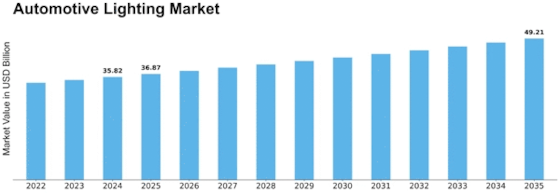

Automotive Lighting Market Size Graph
Author
Sejal Akre
Senior Research Analyst

She has over 5 years of rich experience, in market research and consulting providing valuable market insights to client. Hands on expertise in management consulting, and extensive knowledge in domain including ICT, Automotive & Transportation and Aerospace & Defense. She is skilled in Go-to market strategy, industry analysis, market sizing, in depth company profiling, competitive intelligence & benchmarking and value chain amongst others.

Leave a Comment

FAQs

What is the projected market valuation of the Automotive Lighting Market by 2035?

<p>The Automotive Lighting Market is projected to reach a valuation of 49.21 USD Billion by 2035.</p>

What was the market valuation of the Automotive Lighting Market in 2024?

<p>In 2024, the Automotive Lighting Market was valued at 35.82 USD Billion.</p>

What is the expected CAGR for the Automotive Lighting Market during the forecast period 2025 - 2035?

<p>The expected CAGR for the Automotive Lighting Market during the forecast period 2025 - 2035 is 2.93%.</p>

Which segment of the Automotive Lighting Market had the highest valuation in 2024?

<p>In 2024, the Exterior Lighting segment had the highest valuation at 12.0 USD Billion.</p>

What are the projected valuations for the LED technology segment by 2035?

<p>The LED technology segment is projected to reach valuations between 15.0 and 20.0 USD Billion by 2035.</p>

Which vehicle type is expected to dominate the Automotive Lighting Market by 2035?

<p>Passenger Cars are expected to dominate the Automotive Lighting Market, with projected valuations between 15.0 and 20.0 USD Billion by 2035.</p>

What is the projected growth for the Aftermarket segment of the Automotive Lighting Market by 2035?

<p>The Aftermarket segment is projected to grow to valuations between 15.82 and 22.21 USD Billion by 2035.</p>

Who are the key players in the Automotive Lighting Market?

<p>Key players in the Automotive Lighting Market include Valeo, Hella, Osram, Koito Manufacturing, and Philips.</p>

What is the projected valuation for the Accent Lighting segment by 2035?

<p>The Accent Lighting segment is projected to reach valuations between 8.82 and 13.71 USD Billion by 2035.</p>

How does the market valuation of Xenon technology compare to Halogen technology by 2035?

<p>By 2035, the Xenon technology segment is projected to reach valuations between 8.0 and 10.0 USD Billion, while Halogen technology is expected to reach between 5.0 and 6.5 USD Billion.</p>

Market Summary

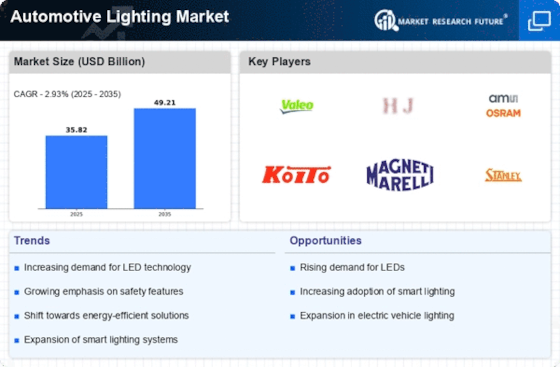
As per Market Research Future analysis, the Automotive Lighting Market was estimated at 35.82 USD Billion in 2024. The automotive lighting industry is projected to grow from 36.87 USD Billion in 2025 to 49.21 USD Billion by 2035, exhibiting a compound annual growth rate (CAGR) of 2.9% during the forecast period 2025 - 2035

Key Market Trends & Highlights

The Automotive Lighting Market is poised for substantial growth driven by technological advancements and sustainability initiatives.

  • North America remains the largest market for automotive lighting, reflecting robust vehicle production and consumer demand. Asia-Pacific is identified as the fastest-growing region, propelled by increasing vehicle ownership and urbanization. Exterior lighting continues to dominate the market, while interior lighting is emerging as the fastest-growing segment due to evolving consumer preferences. Rising vehicle production and a heightened focus on safety features are key drivers influencing the automotive lighting market.

Market Size & Forecast

2024 Market Size 35.82 (USD Billion)
2035 Market Size 49.21 (USD Billion)
CAGR (2025 - 2035) 2.93%
Largest Regional Market Share in 2024 North America

Major Players

Valeo (FR), Hella (DE), Osram (DE), Koito Manufacturing (JP), Magneti Marelli (IT), Stanley Electric (JP), Philips (NL), General Electric (US), Cree (US)

Market Trends

The Automotive Lighting Market is currently experiencing a transformative phase, driven by advancements in technology and evolving consumer preferences. The integration of LED and OLED technologies is reshaping the landscape, offering enhanced energy efficiency and design flexibility. As vehicles become increasingly equipped with smart features, the demand for adaptive lighting systems is on the rise. These systems not only improve visibility but also contribute to overall vehicle aesthetics, aligning with modern design trends. Furthermore, regulatory changes aimed at improving road safety are prompting manufacturers to innovate and comply with new standards, thereby influencing product development and market dynamics. In addition, the growing emphasis on sustainability is steering the Automotive Lighting Market towards eco-friendly solutions. Manufacturers are exploring materials and processes that minimize environmental impact, reflecting a broader industry shift towards greener practices. The rise of electric vehicles is also contributing to this trend, as these vehicles often require specialized lighting solutions that cater to their unique design and functionality. Overall, the Automotive Lighting Market appears poised for continued growth, with technological advancements and sustainability initiatives likely to shape its future trajectory.

Technological Advancements

The Automotive Lighting Market is witnessing rapid technological advancements, particularly with the adoption of LED and OLED lighting solutions. These technologies offer superior energy efficiency, longer lifespans, and greater design flexibility, which are appealing to both manufacturers and consumers. As vehicles increasingly incorporate smart lighting features, the market is likely to see a surge in demand for adaptive lighting systems that enhance safety and aesthetics.

Sustainability Initiatives

Sustainability is becoming a central theme within the Automotive Lighting Market, as manufacturers seek to reduce their environmental footprint. This trend is reflected in the exploration of eco-friendly materials and production processes. The rise of electric vehicles further amplifies this focus, as these vehicles often necessitate innovative lighting solutions that align with their sustainable design ethos.

Regulatory Compliance

Regulatory changes aimed at enhancing road safety are significantly influencing the Automotive Lighting Market. Manufacturers are compelled to innovate and adapt their products to meet new standards, which can drive both product development and market dynamics. This compliance not only ensures safety but also fosters competition among manufacturers to deliver cutting-edge lighting solutions.

Automotive Lighting Market Market Drivers

Rising Vehicle Production

The increasing production of vehicles is a primary driver for the Automotive Lighting Market. As manufacturers ramp up production to meet consumer demand, the need for advanced lighting solutions becomes more pronounced. In 2025, the automotive sector is projected to produce over 90 million vehicles, which directly correlates with the demand for innovative lighting technologies. This surge in vehicle production necessitates the integration of efficient and high-performance lighting systems, thereby propelling the growth of the Automotive Lighting Market. Furthermore, the shift towards electric vehicles, which often require specialized lighting solutions, adds another layer of complexity and opportunity for market players. As such, the interplay between vehicle production rates and lighting technology advancements is likely to shape the future landscape of the industry.

Technological Innovations

Technological advancements in lighting solutions are significantly influencing the Automotive Lighting Market. Innovations such as LED and laser lighting technologies are becoming increasingly prevalent due to their energy efficiency and superior performance. The market for LED automotive lighting is expected to grow at a compound annual growth rate of approximately 10% through 2025, driven by the demand for longer-lasting and more efficient lighting options. Additionally, the integration of smart lighting systems, which can adapt to driving conditions and enhance safety, is gaining traction. These technological innovations not only improve visibility but also contribute to the overall aesthetic appeal of vehicles, making them a crucial factor in consumer purchasing decisions. As manufacturers continue to invest in research and development, the Automotive Lighting Market is poised for substantial growth.

Increased Focus on Safety Features

The heightened emphasis on safety features in vehicles is a significant driver for the Automotive Lighting Market. As consumers become more safety-conscious, manufacturers are compelled to enhance lighting systems to improve visibility and reduce accident rates. Advanced lighting technologies, such as adaptive headlights and automatic high beams, are being integrated into new vehicle models to meet these safety demands. In 2025, it is estimated that vehicles equipped with advanced lighting systems will account for over 30% of new car sales. This trend not only reflects consumer preferences but also aligns with regulatory requirements aimed at improving road safety. Consequently, the Automotive Lighting Market is likely to experience robust growth as manufacturers prioritize safety-enhancing lighting solutions.

Regulatory Standards and Compliance

Regulatory standards play a crucial role in shaping the Automotive Lighting Market. Governments worldwide are implementing stringent regulations regarding vehicle lighting to enhance safety and reduce environmental impact. Compliance with these regulations often necessitates the adoption of advanced lighting technologies, which can drive innovation and investment in the sector. For instance, regulations mandating the use of energy-efficient lighting solutions are pushing manufacturers to explore new technologies and materials. By 2025, it is anticipated that compliance with these standards will lead to a significant increase in the adoption of LED and other energy-efficient lighting systems. As such, the Automotive Lighting Market is likely to benefit from the dual pressures of regulatory compliance and the need for improved vehicle safety.

Sustainability and Environmental Concerns

Sustainability initiatives are increasingly shaping the Automotive Lighting Market. As environmental concerns gain prominence, manufacturers are focusing on developing eco-friendly lighting solutions. The shift towards LED technology, which consumes less energy and has a longer lifespan compared to traditional lighting, is a testament to this trend. In 2025, the market for sustainable automotive lighting is projected to reach a valuation of several billion dollars, driven by both consumer demand and regulatory pressures. Additionally, the use of recyclable materials in lighting components is becoming more common, further aligning with sustainability goals. This focus on environmentally friendly practices not only enhances brand reputation but also meets the expectations of a more environmentally conscious consumer base, thereby driving growth in the Automotive Lighting Market.

Market Segment Insights

By Application: Exterior Lighting (Largest) vs. Interior Lighting (Fastest-Growing)

In the Automotive Lighting Market, the application segment is divided into various categories, including Exterior Lighting, Interior Lighting, Signaling Lighting, and Accent Lighting. Exterior Lighting holds the largest market share, driven by the essential role of headlights and taillights in vehicle safety and <a href="https://www.marketresearchfuture.com/reports/aesthetics-market-3136" target="_blank" title="aesthetics">aesthetics</a>. Interior Lighting and Signaling Lighting also contribute, but to a lesser extent, with Accent Lighting gaining popularity as vehicles are increasingly seen as personal spaces for drivers and passengers.

Exterior Lighting (Dominant) vs. Interior Lighting (Emerging)

Exterior Lighting is crucial in the automotive industry, encompassing headlights, taillights, and turn signals that enhance visibility and safety. As regulations evolve, manufacturers continuously innovate to produce more efficient and stylish designs. On the other hand, Interior Lighting has emerged as a key player, transforming the cabin experience for passengers. This segment is gaining traction due to advancements in LED technology and a growing demand for customizable lighting environments that enhance user experience. Together, these segments reflect the shift towards not only functionality but also aesthetic appeal in vehicle design.

By Technology: LED (Largest) vs. Xenon (Fastest-Growing)

In the Automotive Lighting Market, the segmentation by technology reveals that LED lighting has captured the largest market share, reflecting its immense popularity due to energy efficiency and longevity. Meanwhile, Xenon lighting, which is favored for its brightness and clarity, is noted for its rapid growth, attracting more manufacturers and consumers alike. Halogen lighting continues to hold a significant presence, particularly in lower-end models, while <a href="https://www.marketresearchfuture.com/reports/laser-technology-market-5109">Laser technology</a> is emerging but still occupies a smaller niche.

Technology: LED (Dominant) vs. Xenon (Emerging)

LED technology stands out as the dominant force in automotive lighting, characterized by its energy efficiency, long lifespan, and reduced environmental impact. LED lights are quickly becoming standard in modern vehicles due to their ability to provide better visibility and safety. In contrast, Xenon technology, while not as widely used as LED, is experiencing notable growth. Known for its high-intensity output and advanced optical performance, Xenon lights are increasingly adopted in luxury and high-performance vehicles, making them an attractive choice for consumers looking for superior lighting solutions.

By Vehicle Type: Passenger Cars (Largest) vs. Commercial Vehicles (Fastest-Growing)

In the Automotive Lighting Market, Passenger Cars hold the largest market share among various vehicle types, driven by continuous innovations in headlight technology and consumer demand for enhanced safety features. Following closely are Commercial Vehicles, which are experiencing rapid growth due to increasing logistics and transportation needs worldwide. Two Wheelers and Buses also play essential roles, contributing to the diversified demand for automotive lighting solutions across different applications.

Passenger Cars (Dominant) vs. Two Wheelers (Emerging)

Passenger Cars dominate the Automotive Lighting Market with a strong preference for advanced lighting solutions such as LED and adaptive lighting systems. These vehicles are increasingly equipped with features that enhance nighttime visibility and safety, appealing to consumers who prioritize high performance. In contrast, the Two Wheelers segment, while emerging, showcases significant potential for growth as manufacturers adopt innovative lighting designs to cater to urban commuters. With the rise of electric scooters and enhanced safety standards, Two Wheelers are becoming adaptable platforms for modern lighting technologies.

By End Use: OEM (Largest) vs. Aftermarket (Fastest-Growing)

In the Automotive Lighting Market, the end-use segment is primarily classified into Original Equipment Manufacturer (OEM) and Aftermarket segments. The OEM segment is currently the largest, attributed to the substantial demand from vehicle manufacturers for integrated lighting solutions in new vehicle models. This segment commands a significant share of the market due to partnerships with automakers and the trends towards advanced vehicle lighting technologies.

End Use: OEM (Dominant) vs. Aftermarket (Emerging)

The OEM segment of the Automotive Lighting Market is characterized by its relationships with vehicle manufacturers, supplying lighting systems that integrate seamlessly with new vehicle designs. This segment focuses on innovations like adaptive lighting and LED technologies, catering to the needs of safety and aesthetics in automotive designs. In contrast, the Aftermarket segment is emerging rapidly, driven by vehicle maintenance and enhancement trends among consumers. Customers in this segment seek replacement parts and upgraded lighting solutions to improve vehicle performance and appearance, thus fostering a competitive environment for various manufacturers.

Get more detailed insights about Automotive Lighting Market Research Report - Global Forecast till 2035

Regional Insights

The Automotive Lighting Market revenue showcases diverse regional dynamics, with North America leading significantly, valued at 11.0 USD Billion in 2024 and projected to reach 15.0 USD Billion by 2035, indicating its major dominance in the industry.

Europe closely follows, valued at 10.5 USD Billion in 2024, with expectations of growing to 14.0 USD billion in 2035, reflecting a strong market presence due to stringent regulatory standards and consumer demands for innovative lighting technologies.

The Asia Pacific region, valued at 9.5 USD Billion in 2024 and expected to grow to 12.5 USD billion by 2035, is crucial for introducing advanced automotive technologies, spurred by increasing vehicle production.

South America stands at a valuation of 2.5 USD Billion in 2024, rising to 3.5 USD billion by 2035, but represents a smaller segment overall.

The Middle East and Africa, valued at 2.32 USD billion in 2024 and forecasted to increase to 4.2 USD billion by 2035, are emerging markets presenting opportunities due to increasing automobile ownership and infrastructure improvements.

This regional segmentation of the Automotive Lighting Market data indicates varying growth opportunities and competitive landscapes influenced by local consumer preferences, economic conditions, and regulatory frameworks.

Key Players and Competitive Insights

The Automotive Lighting Market is characterized by a diverse competitive landscape, driven by innovation and technological advancements. Various companies are vying for market share, focusing on enhancing product capabilities, quality, and design while adapting to changing regulatory standards and consumer preferences.
The increasing demand for energy-efficient lighting solutions, primarily LED technology, has prompted significant investments in research and development, leading to various collaborations, mergers, and product launches.
Companies within the market are recognizing the importance of sustainability, integration of smart technologies, and customization to meet the needs of customers and OEMs alike.
This dynamic environment fosters competition among established players and new entrants, each aiming to capture a larger share of the market through strategic initiatives.
Magneti Marelli has established a formidable presence within the Automotive Lighting Market, attributed to its commitment to innovative designs and advanced technologies.
The company focuses on creating high-quality lighting systems that enhance vehicle safety and aesthetics, thus meeting the evolving demands of automotive manufacturers. One of Magneti Marelli's core strengths lies in its extensive experience in the automotive sector, which equips it with insights to effectively respond to changing trends and customer requirements.
This expertise allows Magneti Marelli to develop reliable, cutting-edge lighting solutions that not only comply with international standards but also enhance the overall driving experience.
The company has seen success through strategic partnerships and alliances, which have bolstered its market reach and product development capabilities, thereby positioning itself as a competitive player in the global landscape.
Hella operates robustly within the Automotive Lighting Market, offering a wide array of products that include innovative light systems, electronics, and accessories aimed at enhancing vehicle functionality and safety. Hella's strength lies in its commitment to research and development, enabling the company to deliver high-performance and stylish lighting solutions tailored to meet diverse consumer preferences.
Furthermore, Hella's global market presence is supported by a strong focus on sustainability and energy efficiency, which aligns with the automotive industry’s shift towards greener technologies.
The company has also made significant strides through strategic mergers and acquisitions that have expanded its capabilities and market footprint, enabling it to leverage unique technologies and insights from acquired firms.
This strategic positioning, combined with an extensive product range and a keen focus on addressing market demands, ensures that Hella remains a key player within the global automotive lighting sector.

Key Companies in the Automotive Lighting Market include

Industry Developments

  • Q4 2024: ams OSRAM and Valeo collaborate to revolutionize vehicle interiors with intelligent RGB LEDs ams OSRAM and Valeo announced a partnership to integrate OSIRE E3731i intelligent RGB LEDs and Open System Protocol (OSP) into automotive ambient lighting, enabling dynamic, personalized visual cues for navigation and driver assistance functions in vehicle interiors.[3]
  • Q2 2024: Nichia launches Automotive Innovation Center in Aachen, Germany Nichia, a leading LED manufacturer, opened its Automotive Innovation Center in Germany to accelerate development and support for advanced automotive lighting solutions, focusing on next-generation LED technologies for vehicles.[2]

Future Outlook

Automotive Lighting Market Future Outlook

The Automotive Lighting Market is projected to grow at 2.93% CAGR from 2025 to 2035, driven by technological advancements, regulatory changes, and increasing vehicle production.

New opportunities lie in:

  • Integration of smart lighting systems in vehicles
  • Expansion of LED technology in aftermarket products
  • Development of adaptive lighting solutions for enhanced safety

By 2035, the market is expected to achieve robust growth, driven by innovation and evolving consumer preferences.

Market Segmentation

Automotive Lighting Market End Use Outlook

  • OEM
  • Aftermarket

Automotive Lighting Market Technology Outlook

  • Halogen
  • LED
  • Xenon
  • Laser

Automotive Lighting Market Application Outlook

  • Exterior Lighting
  • Interior Lighting
  • Signaling Lighting
  • Accent Lighting

Automotive Lighting Market Vehicle Type Outlook

  • Passenger Cars
  • Commercial Vehicles
  • Two Wheelers
  • Buses

Report Scope

MARKET SIZE 2024 35.82(USD Billion)
MARKET SIZE 2025 36.87(USD Billion)
MARKET SIZE 2035 49.21(USD Billion)
COMPOUND ANNUAL GROWTH RATE (CAGR) 2.93% (2025 - 2035)
REPORT COVERAGE Revenue Forecast, Competitive Landscape, Growth Factors, and Trends
BASE YEAR 2024
Market Forecast Period 2025 - 2035
Historical Data 2019 - 2024
Market Forecast Units USD Billion
Key Companies Profiled Valeo (FR), Hella (DE), Osram (DE), Koito Manufacturing (JP), Magneti Marelli (IT), Stanley Electric (JP), Philips (NL), General Electric (US), Cree (US)
Segments Covered Application, Technology, Vehicle Type, End Use, Regional
Key Market Opportunities Integration of smart lighting systems enhances safety and efficiency in the Automotive Lighting Market.
Key Market Dynamics Technological advancements in LED lighting are reshaping consumer preferences and driving market competition in automotive lighting.
Countries Covered North America, Europe, APAC, South America, MEA

FAQs

What is the projected market valuation of the Automotive Lighting Market by 2035?

<p>The Automotive Lighting Market is projected to reach a valuation of 49.21 USD Billion by 2035.</p>

What was the market valuation of the Automotive Lighting Market in 2024?

<p>In 2024, the Automotive Lighting Market was valued at 35.82 USD Billion.</p>

What is the expected CAGR for the Automotive Lighting Market during the forecast period 2025 - 2035?

<p>The expected CAGR for the Automotive Lighting Market during the forecast period 2025 - 2035 is 2.93%.</p>

Which segment of the Automotive Lighting Market had the highest valuation in 2024?

<p>In 2024, the Exterior Lighting segment had the highest valuation at 12.0 USD Billion.</p>

What are the projected valuations for the LED technology segment by 2035?

<p>The LED technology segment is projected to reach valuations between 15.0 and 20.0 USD Billion by 2035.</p>

Which vehicle type is expected to dominate the Automotive Lighting Market by 2035?

<p>Passenger Cars are expected to dominate the Automotive Lighting Market, with projected valuations between 15.0 and 20.0 USD Billion by 2035.</p>

What is the projected growth for the Aftermarket segment of the Automotive Lighting Market by 2035?

<p>The Aftermarket segment is projected to grow to valuations between 15.82 and 22.21 USD Billion by 2035.</p>

Who are the key players in the Automotive Lighting Market?

<p>Key players in the Automotive Lighting Market include Valeo, Hella, Osram, Koito Manufacturing, and Philips.</p>

What is the projected valuation for the Accent Lighting segment by 2035?

<p>The Accent Lighting segment is projected to reach valuations between 8.82 and 13.71 USD Billion by 2035.</p>

How does the market valuation of Xenon technology compare to Halogen technology by 2035?

<p>By 2035, the Xenon technology segment is projected to reach valuations between 8.0 and 10.0 USD Billion, while Halogen technology is expected to reach between 5.0 and 6.5 USD Billion.</p>

  1. SECTION I: EXECUTIVE SUMMARY AND KEY HIGHLIGHTS
    1. | 1.1 EXECUTIVE SUMMARY
    2. | | 1.1.1 Market Overview
    3. | | 1.1.2 Key Findings
    4. | | 1.1.3 Market Segmentation
    5. | | 1.1.4 Competitive Landscape
    6. | | 1.1.5 Challenges and Opportunities
    7. | | 1.1.6 Future Outlook
  2. SECTION II: SCOPING, METHODOLOGY AND MARKET STRUCTURE
    1. | 2.1 MARKET INTRODUCTION
    2. | | 2.1.1 Definition
    3. | | 2.1.2 Scope of the study
    4. | | | 2.1.2.1 Research Objective
    5. | | | 2.1.2.2 Assumption
    6. | | | 2.1.2.3 Limitations
    7. | 2.2 RESEARCH METHODOLOGY
    8. | | 2.2.1 Overview
    9. | | 2.2.2 Data Mining
    10. | | 2.2.3 Secondary Research
    11. | | 2.2.4 Primary Research
    12. | | | 2.2.4.1 Primary Interviews and Information Gathering Process
    13. | | | 2.2.4.2 Breakdown of Primary Respondents
    14. | | 2.2.5 Forecasting Model
    15. | | 2.2.6 Market Size Estimation
    16. | | | 2.2.6.1 Bottom-Up Approach
    17. | | | 2.2.6.2 Top-Down Approach
    18. | | 2.2.7 Data Triangulation
    19. | | 2.2.8 Validation
  3. SECTION III: QUALITATIVE ANALYSIS
    1. | 3.1 MARKET DYNAMICS
    2. | | 3.1.1 Overview
    3. | | 3.1.2 Drivers
    4. | | 3.1.3 Restraints
    5. | | 3.1.4 Opportunities
    6. | 3.2 MARKET FACTOR ANALYSIS
    7. | | 3.2.1 Value chain Analysis
    8. | | 3.2.2 Porter's Five Forces Analysis
    9. | | | 3.2.2.1 Bargaining Power of Suppliers
    10. | | | 3.2.2.2 Bargaining Power of Buyers
    11. | | | 3.2.2.3 Threat of New Entrants
    12. | | | 3.2.2.4 Threat of Substitutes
    13. | | | 3.2.2.5 Intensity of Rivalry
    14. | | 3.2.3 COVID-19 Impact Analysis
    15. | | | 3.2.3.1 Market Impact Analysis
    16. | | | 3.2.3.2 Regional Impact
    17. | | | 3.2.3.3 Opportunity and Threat Analysis
  4. SECTION IV: QUANTITATIVE ANALYSIS
    1. | 4.1 Automobile, BY Application (USD Billion)
    2. | | 4.1.1 Exterior Lighting
    3. | | 4.1.2 Interior Lighting
    4. | | 4.1.3 Signaling Lighting
    5. | | 4.1.4 Accent Lighting
    6. | 4.2 Automobile, BY Technology (USD Billion)
    7. | | 4.2.1 Halogen
    8. | | 4.2.2 LED
    9. | | 4.2.3 Xenon
    10. | | 4.2.4 Laser
    11. | 4.3 Automobile, BY Vehicle Type (USD Billion)
    12. | | 4.3.1 Passenger Cars
    13. | | 4.3.2 Commercial Vehicles
    14. | | 4.3.3 Two Wheelers
    15. | | 4.3.4 Buses
    16. | 4.4 Automobile, BY End Use (USD Billion)
    17. | | 4.4.1 OEM
    18. | | 4.4.2 Aftermarket
    19. | 4.5 Automobile, BY Region (USD Billion)
    20. | | 4.5.1 North America
    21. | | | 4.5.1.1 US
    22. | | | 4.5.1.2 Canada
    23. | | 4.5.2 Europe
    24. | | | 4.5.2.1 Germany
    25. | | | 4.5.2.2 UK
    26. | | | 4.5.2.3 France
    27. | | | 4.5.2.4 Russia
    28. | | | 4.5.2.5 Italy
    29. | | | 4.5.2.6 Spain
    30. | | | 4.5.2.7 Rest of Europe
    31. | | 4.5.3 APAC
    32. | | | 4.5.3.1 China
    33. | | | 4.5.3.2 India
    34. | | | 4.5.3.3 Japan
    35. | | | 4.5.3.4 South Korea
    36. | | | 4.5.3.5 Malaysia
    37. | | | 4.5.3.6 Thailand
    38. | | | 4.5.3.7 Indonesia
    39. | | | 4.5.3.8 Rest of APAC
    40. | | 4.5.4 South America
    41. | | | 4.5.4.1 Brazil
    42. | | | 4.5.4.2 Mexico
    43. | | | 4.5.4.3 Argentina
    44. | | | 4.5.4.4 Rest of South America
    45. | | 4.5.5 MEA
    46. | | | 4.5.5.1 GCC Countries
    47. | | | 4.5.5.2 South Africa
    48. | | | 4.5.5.3 Rest of MEA
  5. SECTION V: COMPETITIVE ANALYSIS
    1. | 5.1 Competitive Landscape
    2. | | 5.1.1 Overview
    3. | | 5.1.2 Competitive Analysis
    4. | | 5.1.3 Market share Analysis
    5. | | 5.1.4 Major Growth Strategy in the Automobile
    6. | | 5.1.5 Competitive Benchmarking
    7. | | 5.1.6 Leading Players in Terms of Number of Developments in the Automobile
    8. | | 5.1.7 Key developments and growth strategies
    9. | | | 5.1.7.1 New Product Launch/Service Deployment
    10. | | | 5.1.7.2 Merger & Acquisitions
    11. | | | 5.1.7.3 Joint Ventures
    12. | | 5.1.8 Major Players Financial Matrix
    13. | | | 5.1.8.1 Sales and Operating Income
    14. | | | 5.1.8.2 Major Players R&D Expenditure. 2023
    15. | 5.2 Company Profiles
    16. | | 5.2.1 Valeo (FR)
    17. | | | 5.2.1.1 Financial Overview
    18. | | | 5.2.1.2 Products Offered
    19. | | | 5.2.1.3 Key Developments
    20. | | | 5.2.1.4 SWOT Analysis
    21. | | | 5.2.1.5 Key Strategies
    22. | | 5.2.2 Hella (DE)
    23. | | | 5.2.2.1 Financial Overview
    24. | | | 5.2.2.2 Products Offered
    25. | | | 5.2.2.3 Key Developments
    26. | | | 5.2.2.4 SWOT Analysis
    27. | | | 5.2.2.5 Key Strategies
    28. | | 5.2.3 Osram (DE)
    29. | | | 5.2.3.1 Financial Overview
    30. | | | 5.2.3.2 Products Offered
    31. | | | 5.2.3.3 Key Developments
    32. | | | 5.2.3.4 SWOT Analysis
    33. | | | 5.2.3.5 Key Strategies
    34. | | 5.2.4 Koito Manufacturing (JP)
    35. | | | 5.2.4.1 Financial Overview
    36. | | | 5.2.4.2 Products Offered
    37. | | | 5.2.4.3 Key Developments
    38. | | | 5.2.4.4 SWOT Analysis
    39. | | | 5.2.4.5 Key Strategies
    40. | | 5.2.5 Magneti Marelli (IT)
    41. | | | 5.2.5.1 Financial Overview
    42. | | | 5.2.5.2 Products Offered
    43. | | | 5.2.5.3 Key Developments
    44. | | | 5.2.5.4 SWOT Analysis
    45. | | | 5.2.5.5 Key Strategies
    46. | | 5.2.6 Stanley Electric (JP)
    47. | | | 5.2.6.1 Financial Overview
    48. | | | 5.2.6.2 Products Offered
    49. | | | 5.2.6.3 Key Developments
    50. | | | 5.2.6.4 SWOT Analysis
    51. | | | 5.2.6.5 Key Strategies
    52. | | 5.2.7 Philips (NL)
    53. | | | 5.2.7.1 Financial Overview
    54. | | | 5.2.7.2 Products Offered
    55. | | | 5.2.7.3 Key Developments
    56. | | | 5.2.7.4 SWOT Analysis
    57. | | | 5.2.7.5 Key Strategies
    58. | | 5.2.8 General Electric (US)
    59. | | | 5.2.8.1 Financial Overview
    60. | | | 5.2.8.2 Products Offered
    61. | | | 5.2.8.3 Key Developments
    62. | | | 5.2.8.4 SWOT Analysis
    63. | | | 5.2.8.5 Key Strategies
    64. | | 5.2.9 Cree (US)
    65. | | | 5.2.9.1 Financial Overview
    66. | | | 5.2.9.2 Products Offered
    67. | | | 5.2.9.3 Key Developments
    68. | | | 5.2.9.4 SWOT Analysis
    69. | | | 5.2.9.5 Key Strategies
    70. | 5.3 Appendix
    71. | | 5.3.1 References
    72. | | 5.3.2 Related Reports
  6. LIST OF FIGURES
    1. | 6.1 MARKET SYNOPSIS
    2. | 6.2 NORTH AMERICA MARKET ANALYSIS
    3. | 6.3 US MARKET ANALYSIS BY APPLICATION
    4. | 6.4 US MARKET ANALYSIS BY TECHNOLOGY
    5. | 6.5 US MARKET ANALYSIS BY VEHICLE TYPE
    6. | 6.6 US MARKET ANALYSIS BY END USE
    7. | 6.7 CANADA MARKET ANALYSIS BY APPLICATION
    8. | 6.8 CANADA MARKET ANALYSIS BY TECHNOLOGY
    9. | 6.9 CANADA MARKET ANALYSIS BY VEHICLE TYPE
    10. | 6.10 CANADA MARKET ANALYSIS BY END USE
    11. | 6.11 EUROPE MARKET ANALYSIS
    12. | 6.12 GERMANY MARKET ANALYSIS BY APPLICATION
    13. | 6.13 GERMANY MARKET ANALYSIS BY TECHNOLOGY
    14. | 6.14 GERMANY MARKET ANALYSIS BY VEHICLE TYPE
    15. | 6.15 GERMANY MARKET ANALYSIS BY END USE
    16. | 6.16 UK MARKET ANALYSIS BY APPLICATION
    17. | 6.17 UK MARKET ANALYSIS BY TECHNOLOGY
    18. | 6.18 UK MARKET ANALYSIS BY VEHICLE TYPE
    19. | 6.19 UK MARKET ANALYSIS BY END USE
    20. | 6.20 FRANCE MARKET ANALYSIS BY APPLICATION
    21. | 6.21 FRANCE MARKET ANALYSIS BY TECHNOLOGY
    22. | 6.22 FRANCE MARKET ANALYSIS BY VEHICLE TYPE
    23. | 6.23 FRANCE MARKET ANALYSIS BY END USE
    24. | 6.24 RUSSIA MARKET ANALYSIS BY APPLICATION
    25. | 6.25 RUSSIA MARKET ANALYSIS BY TECHNOLOGY
    26. | 6.26 RUSSIA MARKET ANALYSIS BY VEHICLE TYPE
    27. | 6.27 RUSSIA MARKET ANALYSIS BY END USE
    28. | 6.28 ITALY MARKET ANALYSIS BY APPLICATION
    29. | 6.29 ITALY MARKET ANALYSIS BY TECHNOLOGY
    30. | 6.30 ITALY MARKET ANALYSIS BY VEHICLE TYPE
    31. | 6.31 ITALY MARKET ANALYSIS BY END USE
    32. | 6.32 SPAIN MARKET ANALYSIS BY APPLICATION
    33. | 6.33 SPAIN MARKET ANALYSIS BY TECHNOLOGY
    34. | 6.34 SPAIN MARKET ANALYSIS BY VEHICLE TYPE
    35. | 6.35 SPAIN MARKET ANALYSIS BY END USE
    36. | 6.36 REST OF EUROPE MARKET ANALYSIS BY APPLICATION
    37. | 6.37 REST OF EUROPE MARKET ANALYSIS BY TECHNOLOGY
    38. | 6.38 REST OF EUROPE MARKET ANALYSIS BY VEHICLE TYPE
    39. | 6.39 REST OF EUROPE MARKET ANALYSIS BY END USE
    40. | 6.40 APAC MARKET ANALYSIS
    41. | 6.41 CHINA MARKET ANALYSIS BY APPLICATION
    42. | 6.42 CHINA MARKET ANALYSIS BY TECHNOLOGY
    43. | 6.43 CHINA MARKET ANALYSIS BY VEHICLE TYPE
    44. | 6.44 CHINA MARKET ANALYSIS BY END USE
    45. | 6.45 INDIA MARKET ANALYSIS BY APPLICATION
    46. | 6.46 INDIA MARKET ANALYSIS BY TECHNOLOGY
    47. | 6.47 INDIA MARKET ANALYSIS BY VEHICLE TYPE
    48. | 6.48 INDIA MARKET ANALYSIS BY END USE
    49. | 6.49 JAPAN MARKET ANALYSIS BY APPLICATION
    50. | 6.50 JAPAN MARKET ANALYSIS BY TECHNOLOGY
    51. | 6.51 JAPAN MARKET ANALYSIS BY VEHICLE TYPE
    52. | 6.52 JAPAN MARKET ANALYSIS BY END USE
    53. | 6.53 SOUTH KOREA MARKET ANALYSIS BY APPLICATION
    54. | 6.54 SOUTH KOREA MARKET ANALYSIS BY TECHNOLOGY
    55. | 6.55 SOUTH KOREA MARKET ANALYSIS BY VEHICLE TYPE
    56. | 6.56 SOUTH KOREA MARKET ANALYSIS BY END USE
    57. | 6.57 MALAYSIA MARKET ANALYSIS BY APPLICATION
    58. | 6.58 MALAYSIA MARKET ANALYSIS BY TECHNOLOGY
    59. | 6.59 MALAYSIA MARKET ANALYSIS BY VEHICLE TYPE
    60. | 6.60 MALAYSIA MARKET ANALYSIS BY END USE
    61. | 6.61 THAILAND MARKET ANALYSIS BY APPLICATION
    62. | 6.62 THAILAND MARKET ANALYSIS BY TECHNOLOGY
    63. | 6.63 THAILAND MARKET ANALYSIS BY VEHICLE TYPE
    64. | 6.64 THAILAND MARKET ANALYSIS BY END USE
    65. | 6.65 INDONESIA MARKET ANALYSIS BY APPLICATION
    66. | 6.66 INDONESIA MARKET ANALYSIS BY TECHNOLOGY
    67. | 6.67 INDONESIA MARKET ANALYSIS BY VEHICLE TYPE
    68. | 6.68 INDONESIA MARKET ANALYSIS BY END USE
    69. | 6.69 REST OF APAC MARKET ANALYSIS BY APPLICATION
    70. | 6.70 REST OF APAC MARKET ANALYSIS BY TECHNOLOGY
    71. | 6.71 REST OF APAC MARKET ANALYSIS BY VEHICLE TYPE
    72. | 6.72 REST OF APAC MARKET ANALYSIS BY END USE
    73. | 6.73 SOUTH AMERICA MARKET ANALYSIS
    74. | 6.74 BRAZIL MARKET ANALYSIS BY APPLICATION
    75. | 6.75 BRAZIL MARKET ANALYSIS BY TECHNOLOGY
    76. | 6.76 BRAZIL MARKET ANALYSIS BY VEHICLE TYPE
    77. | 6.77 BRAZIL MARKET ANALYSIS BY END USE
    78. | 6.78 MEXICO MARKET ANALYSIS BY APPLICATION
    79. | 6.79 MEXICO MARKET ANALYSIS BY TECHNOLOGY
    80. | 6.80 MEXICO MARKET ANALYSIS BY VEHICLE TYPE
    81. | 6.81 MEXICO MARKET ANALYSIS BY END USE
    82. | 6.82 ARGENTINA MARKET ANALYSIS BY APPLICATION
    83. | 6.83 ARGENTINA MARKET ANALYSIS BY TECHNOLOGY
    84. | 6.84 ARGENTINA MARKET ANALYSIS BY VEHICLE TYPE
    85. | 6.85 ARGENTINA MARKET ANALYSIS BY END USE
    86. | 6.86 REST OF SOUTH AMERICA MARKET ANALYSIS BY APPLICATION
    87. | 6.87 REST OF SOUTH AMERICA MARKET ANALYSIS BY TECHNOLOGY
    88. | 6.88 REST OF SOUTH AMERICA MARKET ANALYSIS BY VEHICLE TYPE
    89. | 6.89 REST OF SOUTH AMERICA MARKET ANALYSIS BY END USE
    90. | 6.90 MEA MARKET ANALYSIS
    91. | 6.91 GCC COUNTRIES MARKET ANALYSIS BY APPLICATION
    92. | 6.92 GCC COUNTRIES MARKET ANALYSIS BY TECHNOLOGY
    93. | 6.93 GCC COUNTRIES MARKET ANALYSIS BY VEHICLE TYPE
    94. | 6.94 GCC COUNTRIES MARKET ANALYSIS BY END USE
    95. | 6.95 SOUTH AFRICA MARKET ANALYSIS BY APPLICATION
    96. | 6.96 SOUTH AFRICA MARKET ANALYSIS BY TECHNOLOGY
    97. | 6.97 SOUTH AFRICA MARKET ANALYSIS BY VEHICLE TYPE
    98. | 6.98 SOUTH AFRICA MARKET ANALYSIS BY END USE
    99. | 6.99 REST OF MEA MARKET ANALYSIS BY APPLICATION
    100. | 6.100 REST OF MEA MARKET ANALYSIS BY TECHNOLOGY
    101. | 6.101 REST OF MEA MARKET ANALYSIS BY VEHICLE TYPE
    102. | 6.102 REST OF MEA MARKET ANALYSIS BY END USE
    103. | 6.103 KEY BUYING CRITERIA OF AUTOMOBILE
    104. | 6.104 RESEARCH PROCESS OF MRFR
    105. | 6.105 DRO ANALYSIS OF AUTOMOBILE
    106. | 6.106 DRIVERS IMPACT ANALYSIS: AUTOMOBILE
    107. | 6.107 RESTRAINTS IMPACT ANALYSIS: AUTOMOBILE
    108. | 6.108 SUPPLY / VALUE CHAIN: AUTOMOBILE
    109. | 6.109 AUTOMOBILE, BY APPLICATION, 2024 (% SHARE)
    110. | 6.110 AUTOMOBILE, BY APPLICATION, 2024 TO 2035 (USD Billion)
    111. | 6.111 AUTOMOBILE, BY TECHNOLOGY, 2024 (% SHARE)
    112. | 6.112 AUTOMOBILE, BY TECHNOLOGY, 2024 TO 2035 (USD Billion)
    113. | 6.113 AUTOMOBILE, BY VEHICLE TYPE, 2024 (% SHARE)
    114. | 6.114 AUTOMOBILE, BY VEHICLE TYPE, 2024 TO 2035 (USD Billion)
    115. | 6.115 AUTOMOBILE, BY END USE, 2024 (% SHARE)
    116. | 6.116 AUTOMOBILE, BY END USE, 2024 TO 2035 (USD Billion)
    117. | 6.117 BENCHMARKING OF MAJOR COMPETITORS
  7. LIST OF TABLES
    1. | 7.1 LIST OF ASSUMPTIONS
    2. | | 7.1.1
    3. | 7.2 North America MARKET SIZE ESTIMATES; FORECAST
    4. | | 7.2.1 BY APPLICATION, 2025-2035 (USD Billion)
    5. | | 7.2.2 BY TECHNOLOGY, 2025-2035 (USD Billion)
    6. | | 7.2.3 BY VEHICLE TYPE, 2025-2035 (USD Billion)
    7. | | 7.2.4 BY END USE, 2025-2035 (USD Billion)
    8. | 7.3 US MARKET SIZE ESTIMATES; FORECAST
    9. | | 7.3.1 BY APPLICATION, 2025-2035 (USD Billion)
    10. | | 7.3.2 BY TECHNOLOGY, 2025-2035 (USD Billion)
    11. | | 7.3.3 BY VEHICLE TYPE, 2025-2035 (USD Billion)
    12. | | 7.3.4 BY END USE, 2025-2035 (USD Billion)
    13. | 7.4 Canada MARKET SIZE ESTIMATES; FORECAST
    14. | | 7.4.1 BY APPLICATION, 2025-2035 (USD Billion)
    15. | | 7.4.2 BY TECHNOLOGY, 2025-2035 (USD Billion)
    16. | | 7.4.3 BY VEHICLE TYPE, 2025-2035 (USD Billion)
    17. | | 7.4.4 BY END USE, 2025-2035 (USD Billion)
    18. | 7.5 Europe MARKET SIZE ESTIMATES; FORECAST
    19. | | 7.5.1 BY APPLICATION, 2025-2035 (USD Billion)
    20. | | 7.5.2 BY TECHNOLOGY, 2025-2035 (USD Billion)
    21. | | 7.5.3 BY VEHICLE TYPE, 2025-2035 (USD Billion)
    22. | | 7.5.4 BY END USE, 2025-2035 (USD Billion)
    23. | 7.6 Germany MARKET SIZE ESTIMATES; FORECAST
    24. | | 7.6.1 BY APPLICATION, 2025-2035 (USD Billion)
    25. | | 7.6.2 BY TECHNOLOGY, 2025-2035 (USD Billion)
    26. | | 7.6.3 BY VEHICLE TYPE, 2025-2035 (USD Billion)
    27. | | 7.6.4 BY END USE, 2025-2035 (USD Billion)
    28. | 7.7 UK MARKET SIZE ESTIMATES; FORECAST
    29. | | 7.7.1 BY APPLICATION, 2025-2035 (USD Billion)
    30. | | 7.7.2 BY TECHNOLOGY, 2025-2035 (USD Billion)
    31. | | 7.7.3 BY VEHICLE TYPE, 2025-2035 (USD Billion)
    32. | | 7.7.4 BY END USE, 2025-2035 (USD Billion)
    33. | 7.8 France MARKET SIZE ESTIMATES; FORECAST
    34. | | 7.8.1 BY APPLICATION, 2025-2035 (USD Billion)
    35. | | 7.8.2 BY TECHNOLOGY, 2025-2035 (USD Billion)
    36. | | 7.8.3 BY VEHICLE TYPE, 2025-2035 (USD Billion)
    37. | | 7.8.4 BY END USE, 2025-2035 (USD Billion)
    38. | 7.9 Russia MARKET SIZE ESTIMATES; FORECAST
    39. | | 7.9.1 BY APPLICATION, 2025-2035 (USD Billion)
    40. | | 7.9.2 BY TECHNOLOGY, 2025-2035 (USD Billion)
    41. | | 7.9.3 BY VEHICLE TYPE, 2025-2035 (USD Billion)
    42. | | 7.9.4 BY END USE, 2025-2035 (USD Billion)
    43. | 7.10 Italy MARKET SIZE ESTIMATES; FORECAST
    44. | | 7.10.1 BY APPLICATION, 2025-2035 (USD Billion)
    45. | | 7.10.2 BY TECHNOLOGY, 2025-2035 (USD Billion)
    46. | | 7.10.3 BY VEHICLE TYPE, 2025-2035 (USD Billion)
    47. | | 7.10.4 BY END USE, 2025-2035 (USD Billion)
    48. | 7.11 Spain MARKET SIZE ESTIMATES; FORECAST
    49. | | 7.11.1 BY APPLICATION, 2025-2035 (USD Billion)
    50. | | 7.11.2 BY TECHNOLOGY, 2025-2035 (USD Billion)
    51. | | 7.11.3 BY VEHICLE TYPE, 2025-2035 (USD Billion)
    52. | | 7.11.4 BY END USE, 2025-2035 (USD Billion)
    53. | 7.12 Rest of Europe MARKET SIZE ESTIMATES; FORECAST
    54. | | 7.12.1 BY APPLICATION, 2025-2035 (USD Billion)
    55. | | 7.12.2 BY TECHNOLOGY, 2025-2035 (USD Billion)
    56. | | 7.12.3 BY VEHICLE TYPE, 2025-2035 (USD Billion)
    57. | | 7.12.4 BY END USE, 2025-2035 (USD Billion)
    58. | 7.13 APAC MARKET SIZE ESTIMATES; FORECAST
    59. | | 7.13.1 BY APPLICATION, 2025-2035 (USD Billion)
    60. | | 7.13.2 BY TECHNOLOGY, 2025-2035 (USD Billion)
    61. | | 7.13.3 BY VEHICLE TYPE, 2025-2035 (USD Billion)
    62. | | 7.13.4 BY END USE, 2025-2035 (USD Billion)
    63. | 7.14 China MARKET SIZE ESTIMATES; FORECAST
    64. | | 7.14.1 BY APPLICATION, 2025-2035 (USD Billion)
    65. | | 7.14.2 BY TECHNOLOGY, 2025-2035 (USD Billion)
    66. | | 7.14.3 BY VEHICLE TYPE, 2025-2035 (USD Billion)
    67. | | 7.14.4 BY END USE, 2025-2035 (USD Billion)
    68. | 7.15 India MARKET SIZE ESTIMATES; FORECAST
    69. | | 7.15.1 BY APPLICATION, 2025-2035 (USD Billion)
    70. | | 7.15.2 BY TECHNOLOGY, 2025-2035 (USD Billion)
    71. | | 7.15.3 BY VEHICLE TYPE, 2025-2035 (USD Billion)
    72. | | 7.15.4 BY END USE, 2025-2035 (USD Billion)
    73. | 7.16 Japan MARKET SIZE ESTIMATES; FORECAST
    74. | | 7.16.1 BY APPLICATION, 2025-2035 (USD Billion)
    75. | | 7.16.2 BY TECHNOLOGY, 2025-2035 (USD Billion)
    76. | | 7.16.3 BY VEHICLE TYPE, 2025-2035 (USD Billion)
    77. | | 7.16.4 BY END USE, 2025-2035 (USD Billion)
    78. | 7.17 South Korea MARKET SIZE ESTIMATES; FORECAST
    79. | | 7.17.1 BY APPLICATION, 2025-2035 (USD Billion)
    80. | | 7.17.2 BY TECHNOLOGY, 2025-2035 (USD Billion)
    81. | | 7.17.3 BY VEHICLE TYPE, 2025-2035 (USD Billion)
    82. | | 7.17.4 BY END USE, 2025-2035 (USD Billion)
    83. | 7.18 Malaysia MARKET SIZE ESTIMATES; FORECAST
    84. | | 7.18.1 BY APPLICATION, 2025-2035 (USD Billion)
    85. | | 7.18.2 BY TECHNOLOGY, 2025-2035 (USD Billion)
    86. | | 7.18.3 BY VEHICLE TYPE, 2025-2035 (USD Billion)
    87. | | 7.18.4 BY END USE, 2025-2035 (USD Billion)
    88. | 7.19 Thailand MARKET SIZE ESTIMATES; FORECAST
    89. | | 7.19.1 BY APPLICATION, 2025-2035 (USD Billion)
    90. | | 7.19.2 BY TECHNOLOGY, 2025-2035 (USD Billion)
    91. | | 7.19.3 BY VEHICLE TYPE, 2025-2035 (USD Billion)
    92. | | 7.19.4 BY END USE, 2025-2035 (USD Billion)
    93. | 7.20 Indonesia MARKET SIZE ESTIMATES; FORECAST
    94. | | 7.20.1 BY APPLICATION, 2025-2035 (USD Billion)
    95. | | 7.20.2 BY TECHNOLOGY, 2025-2035 (USD Billion)
    96. | | 7.20.3 BY VEHICLE TYPE, 2025-2035 (USD Billion)
    97. | | 7.20.4 BY END USE, 2025-2035 (USD Billion)
    98. | 7.21 Rest of APAC MARKET SIZE ESTIMATES; FORECAST
    99. | | 7.21.1 BY APPLICATION, 2025-2035 (USD Billion)
    100. | | 7.21.2 BY TECHNOLOGY, 2025-2035 (USD Billion)
    101. | | 7.21.3 BY VEHICLE TYPE, 2025-2035 (USD Billion)
    102. | | 7.21.4 BY END USE, 2025-2035 (USD Billion)
    103. | 7.22 South America MARKET SIZE ESTIMATES; FORECAST
    104. | | 7.22.1 BY APPLICATION, 2025-2035 (USD Billion)
    105. | | 7.22.2 BY TECHNOLOGY, 2025-2035 (USD Billion)
    106. | | 7.22.3 BY VEHICLE TYPE, 2025-2035 (USD Billion)
    107. | | 7.22.4 BY END USE, 2025-2035 (USD Billion)
    108. | 7.23 Brazil MARKET SIZE ESTIMATES; FORECAST
    109. | | 7.23.1 BY APPLICATION, 2025-2035 (USD Billion)
    110. | | 7.23.2 BY TECHNOLOGY, 2025-2035 (USD Billion)
    111. | | 7.23.3 BY VEHICLE TYPE, 2025-2035 (USD Billion)
    112. | | 7.23.4 BY END USE, 2025-2035 (USD Billion)
    113. | 7.24 Mexico MARKET SIZE ESTIMATES; FORECAST
    114. | | 7.24.1 BY APPLICATION, 2025-2035 (USD Billion)
    115. | | 7.24.2 BY TECHNOLOGY, 2025-2035 (USD Billion)
    116. | | 7.24.3 BY VEHICLE TYPE, 2025-2035 (USD Billion)
    117. | | 7.24.4 BY END USE, 2025-2035 (USD Billion)
    118. | 7.25 Argentina MARKET SIZE ESTIMATES; FORECAST
    119. | | 7.25.1 BY APPLICATION, 2025-2035 (USD Billion)
    120. | | 7.25.2 BY TECHNOLOGY, 2025-2035 (USD Billion)
    121. | | 7.25.3 BY VEHICLE TYPE, 2025-2035 (USD Billion)
    122. | | 7.25.4 BY END USE, 2025-2035 (USD Billion)
    123. | 7.26 Rest of South America MARKET SIZE ESTIMATES; FORECAST
    124. | | 7.26.1 BY APPLICATION, 2025-2035 (USD Billion)
    125. | | 7.26.2 BY TECHNOLOGY, 2025-2035 (USD Billion)
    126. | | 7.26.3 BY VEHICLE TYPE, 2025-2035 (USD Billion)
    127. | | 7.26.4 BY END USE, 2025-2035 (USD Billion)
    128. | 7.27 MEA MARKET SIZE ESTIMATES; FORECAST
    129. | | 7.27.1 BY APPLICATION, 2025-2035 (USD Billion)
    130. | | 7.27.2 BY TECHNOLOGY, 2025-2035 (USD Billion)
    131. | | 7.27.3 BY VEHICLE TYPE, 2025-2035 (USD Billion)
    132. | | 7.27.4 BY END USE, 2025-2035 (USD Billion)
    133. | 7.28 GCC Countries MARKET SIZE ESTIMATES; FORECAST
    134. | | 7.28.1 BY APPLICATION, 2025-2035 (USD Billion)
    135. | | 7.28.2 BY TECHNOLOGY, 2025-2035 (USD Billion)
    136. | | 7.28.3 BY VEHICLE TYPE, 2025-2035 (USD Billion)
    137. | | 7.28.4 BY END USE, 2025-2035 (USD Billion)
    138. | 7.29 South Africa MARKET SIZE ESTIMATES; FORECAST
    139. | | 7.29.1 BY APPLICATION, 2025-2035 (USD Billion)
    140. | | 7.29.2 BY TECHNOLOGY, 2025-2035 (USD Billion)
    141. | | 7.29.3 BY VEHICLE TYPE, 2025-2035 (USD Billion)
    142. | | 7.29.4 BY END USE, 2025-2035 (USD Billion)
    143. | 7.30 Rest of MEA MARKET SIZE ESTIMATES; FORECAST
    144. | | 7.30.1 BY APPLICATION, 2025-2035 (USD Billion)
    145. | | 7.30.2 BY TECHNOLOGY, 2025-2035 (USD Billion)
    146. | | 7.30.3 BY VEHICLE TYPE, 2025-2035 (USD Billion)
    147. | | 7.30.4 BY END USE, 2025-2035 (USD Billion)
    148. | 7.31 PRODUCT LAUNCH/PRODUCT DEVELOPMENT/APPROVAL
    149. | | 7.31.1
    150. | 7.32 ACQUISITION/PARTNERSHIP
    151. | | 7.32.1

Automobile Market Segmentation

Automobile By Application (USD Billion, 2025-2035)

  • Exterior Lighting
  • Interior Lighting
  • Signaling Lighting
  • Accent Lighting

Automobile By Technology (USD Billion, 2025-2035)

  • Halogen
  • LED
  • Xenon
  • Laser

Automobile By Vehicle Type (USD Billion, 2025-2035)

  • Passenger Cars
  • Commercial Vehicles
  • Two Wheelers
  • Buses

Automobile By End Use (USD Billion, 2025-2035)

  • OEM
  • Aftermarket
Infographic

Free Sample Request

Kindly complete the form below to receive a free sample of this Report

Get Free Sample

Customer Strories

Compare Licence

×
Features License Type
Single User Multiuser License Enterprise User
Price $4,950 $5,950 $7,250
Maximum User Access Limit 1 User Upto 10 Users Unrestricted Access Throughout the Organization
Free Customization
Direct Access to Analyst
Deliverable Format
Platform Access
Discount on Next Purchase 10% 15% 15%
Printable Versions