×
Hero Background
English
Chinese
French
Japanese
Korean
German
Spanish

Automotive Ignition System Market Analysis

ID: MRFR/AT/2717-HCR
100 Pages
Sejal Akre
October 2025

Automotive Ignition System Market Research Report Information, By Type (Conventional, Electronic and Distributor-less), By Component (Ignition Coil, Ignition Switch, Condenser, Spark Plug, Ignition Resistor and Others) and By Region - Forecast To 2035

Share:
Download PDF ×

We do not share your information with anyone. However, we may send you emails based on your report interest from time to time. You may contact us at any time to opt-out.

Automotive Ignition System Market Infographic
Purchase Options

Market Analysis

In-depth Analysis of Automotive Ignition System Market Industry Landscape

The Automotive Ignition System market has various factors that influence its growth and dynamics. One key element that is affecting this market pertains to the changing paradigm of automobile technology, which is constantly evolving. With improvements in vehicle technology leading to higher levels of demand for improved efficient ignitions, there has been the need for more advanced ones as well as more technologically developed ones. Therefore, one major driver behind the Automotive Ignition System Market Transformation over time has been the development of cleaner vehicles globally through various emission standards adopted across nations aimed at reducing global warming effects, making many car companies shift towards electronic ignition systems. Another important factor that affects the Automotive Ignition System market is global regulation. As the world's governments concentrate on environmental conservation and emission reduction, cleaner and greener technologies are encouraged in vehicle manufacture. This push by regulators compels auto manufacturers to develop ignition systems capable of complying with strict emission norms. Market competition is another crucial determinant of the Automotive Ignition System landscape. The increasing number of firms competing for market share has driven the need for innovation and cost-effective solutions. Market dynamics are influenced by key players who use strategies such as mergers, acquisitions, partnerships, and product launches. On a macro and micro level, economic factors have a profound influence on the automotive ignition system market globally. Such economic factors could be GDP growth rates, consumer patterns on spending, or even disposable income levels that would influence customers' buying power changes (Porter 3). During periods of economic downturns, people may delay or even not buy cars at all, leading to temporary stagnation in the automotive ignition system market, while at other times when economies are doing well, people tend to buy more cars, leading to higher sales of new vehicles and consequently ignition systems. Technological integration of vehicles, more than just ignition systems, is one such market factor that cannot be ignored. Finally, environmental awareness and sustainability focus are key factors in shaping the Automotive Ignition System market. As a result of this, customers are now aware of the environmental impacts of their automobiles, thus demanding eco-friendly and energy-efficient solutions. In short, the automotive ignition system market is not static but dynamic and is influenced by several factors. Thus, technological advancements interwoven with regulatory requirements, economic conditions, and competition in the market, along with technological integration and environmental considerations, collectively propel this industry to new heights.

Author
Sejal Akre
Senior Research Analyst

She has over 5 years of rich experience, in market research and consulting providing valuable market insights to client. Hands on expertise in management consulting, and extensive knowledge in domain including ICT, Automotive & Transportation and Aerospace & Defense. She is skilled in Go-to market strategy, industry analysis, market sizing, in depth company profiling, competitive intelligence & benchmarking and value chain amongst others.

Leave a Comment

FAQs

At what CAGR can the automotive ignition system market expand?

The automotive ignition system market can thrive at 6.5%CAGR by 2032.

What is the estimated valuation for the automotive ignition system market?

The automotive ignition system market can value at USD 18.1 billion by 2032.

Who are the key players of the automotive ignition system market?

Mitsubishi Electric Corporation, Federal-Mogul Corporation, Hitachi Automotive Systems, Continental AG, and Diamond Electric are some reputed companies in the automotive ignition system market.

What are the types of automotive ignition system?

Conventional, distributor-less, and electronic are types of automotive ignition system.

What are the automotive ignition system components?

Ignition Coil, ignition switch, ignition resistor, spark plug, and condenser are components of automotive ignition system.

Market Summary

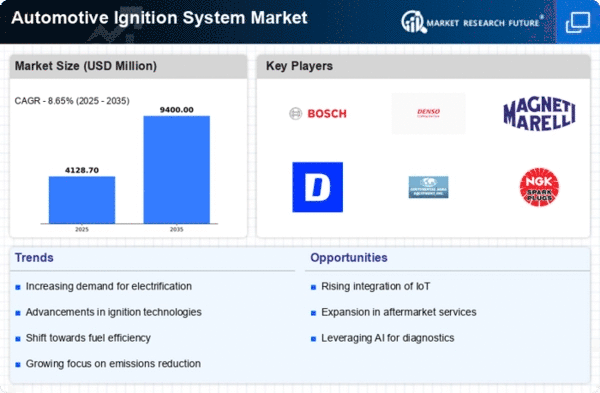
As per MRFR analysis, the Automotive Ignition System Market Size was estimated at 3800.0 USD Million in 2024. The Automotive Ignition System industry is projected to grow from 4100.0 in 2025 to 9400.0 by 2035, exhibiting a compound annual growth rate (CAGR) of 8.65 during the forecast period 2025 - 2035.

Key Market Trends & Highlights

The Automotive Ignition System Market is experiencing a transformative shift driven by technological advancements and changing consumer preferences.

  • The market is witnessing a notable shift towards electric vehicles, influencing ignition system designs.
  • Integration of smart technologies is becoming increasingly prevalent, enhancing vehicle performance and user experience.
  • North America remains the largest market, while Asia-Pacific is emerging as the fastest-growing region in the automotive ignition sector.
  • Technological advancements in ignition systems and rising demand for fuel efficiency are key drivers propelling market growth.

Market Size & Forecast

2024 Market Size 3800.0 (USD Million)
2035 Market Size 9400.0 (USD Million)
CAGR (2025 - 2035) 8.65%
Largest Regional Market Share in 2024 North America

Major Players

<p>Denso (JP), Bosch (DE), Delphi Technologies (GB), Magneti Marelli (IT), Valeo (FR), NGK Spark Plug (JP), Aisin Seiki (JP), Hitachi Astemo (JP), Standard Motor Products (US)</p>

Market Trends

The Automotive Ignition System Market is currently experiencing a transformative phase, driven by advancements in technology and evolving consumer preferences. The shift towards electric vehicles and hybrid models is reshaping the landscape, as manufacturers seek to innovate traditional ignition systems to enhance efficiency and performance. This transition appears to be influenced by a growing emphasis on sustainability and environmental concerns, prompting companies to explore alternative ignition technologies that align with these values. Furthermore, the integration of smart technologies into vehicles is likely to redefine ignition systems, making them more sophisticated and user-friendly. In addition to technological advancements, the Automotive Ignition System Market is also witnessing a shift in consumer behavior. As vehicle owners become more informed about the importance of ignition systems in overall vehicle performance, there is a noticeable increase in demand for high-quality, reliable components. This trend suggests that manufacturers may need to focus on quality assurance and customer satisfaction to maintain a competitive edge. Overall, the market appears poised for growth, with opportunities for innovation and improvement in response to changing consumer needs and technological advancements.

Shift Towards Electric Vehicles

The Automotive Ignition System Market is adapting to the increasing prevalence of electric and hybrid vehicles. This shift necessitates the development of new ignition technologies that cater to the unique requirements of these vehicles, potentially leading to innovative solutions that enhance performance and efficiency.

Integration of Smart Technologies

The incorporation of smart technologies into vehicles is influencing the Automotive Ignition System Market. As vehicles become more connected, ignition systems are likely to evolve, incorporating features that enhance user experience and improve overall vehicle functionality.

Rising Consumer Awareness

There is a growing awareness among consumers regarding the significance of ignition systems in vehicle performance. This trend indicates a potential increase in demand for high-quality ignition components, prompting manufacturers to prioritize quality and reliability in their offerings.

Automotive Ignition System Market Market Drivers

Market Growth Projections

The Global Automotive Ignition System Market Industry is poised for substantial growth, with projections indicating a market value of 12.6 USD Billion in 2024 and an expected increase to 21.9 USD Billion by 2035. This growth trajectory suggests a compound annual growth rate of 5.14% from 2025 to 2035. Various factors contribute to this positive outlook, including technological advancements, increasing vehicle production, and stringent emission regulations. The market's expansion reflects the automotive industry's ongoing evolution, driven by the need for enhanced performance, efficiency, and compliance with environmental standards.

Stringent Emission Regulations

The Global Automotive Ignition System Market Industry is significantly influenced by stringent emission regulations imposed by governments worldwide. These regulations compel manufacturers to adopt advanced ignition technologies that minimize harmful emissions. For example, the implementation of Euro 6 standards in Europe has necessitated the development of ignition systems that enhance combustion efficiency. As a result, the demand for high-performance ignition systems is likely to increase, driving market growth. The anticipated market value of 21.9 USD Billion by 2035 underscores the importance of compliance with these regulations, as manufacturers strive to meet environmental targets while maintaining vehicle performance.

Increasing Vehicle Production and Sales

The Global Automotive Ignition System Market Industry is closely tied to the rising production and sales of vehicles worldwide. As economies recover and consumer confidence grows, the automotive sector is witnessing a resurgence. In 2024, the market is expected to be valued at 12.6 USD Billion, reflecting the increased demand for ignition systems in new vehicles. This growth is further supported by the expansion of electric vehicles, which require advanced ignition technologies. The projected compound annual growth rate of 5.14% from 2025 to 2035 suggests a sustained upward trajectory in vehicle production, thereby bolstering the ignition system market.

Emergence of Electric and Hybrid Vehicles

The Global Automotive Ignition System Market Industry is undergoing transformation due to the emergence of electric and hybrid vehicles. While traditional ignition systems are essential for internal combustion engines, the rise of electric vehicles introduces new challenges and opportunities for ignition technology. Manufacturers are now focusing on developing ignition systems that can integrate with hybrid technologies, ensuring optimal performance. This shift is likely to reshape the market landscape, as the demand for innovative solutions grows. The anticipated CAGR of 5.14% from 2025 to 2035 indicates a potential for significant growth in this segment, reflecting the industry's adaptation to changing consumer preferences.

Rising Demand for Fuel-Efficient Vehicles

The Global Automotive Ignition System Market Industry is witnessing a growing demand for fuel-efficient vehicles, driven by consumer preferences and rising fuel prices. As consumers become more environmentally conscious, manufacturers are compelled to innovate and produce vehicles that offer better fuel economy. Advanced ignition systems play a crucial role in achieving these efficiencies by optimizing combustion processes. This trend is expected to contribute to the market's growth, with projections indicating a market value of 21.9 USD Billion by 2035. The emphasis on fuel efficiency aligns with global sustainability goals, further enhancing the relevance of advanced ignition technologies.

Technological Advancements in Ignition Systems

The Global Automotive Ignition System Market Industry is experiencing a surge in technological advancements, particularly with the integration of electronic ignition systems. These systems enhance fuel efficiency and reduce emissions, aligning with global environmental standards. For instance, the shift towards more sophisticated ignition technologies, such as coil-on-plug systems, is becoming prevalent. This trend is likely to drive market growth as manufacturers seek to comply with stringent regulations. The market is projected to reach 12.6 USD Billion in 2024, indicating a robust demand for innovative ignition solutions that improve vehicle performance and sustainability.

Market Segment Insights

By Application: Spark Ignition (Largest) vs. Compression Ignition (Fastest-Growing)

<p>The Automotive Ignition System Market exhibits a varied distribution among the application segments, with Spark Ignition systems taking the lead due to their prevalent use in gasoline-powered vehicles. This segment accounts for the majority of market share, driven by the continuous demand for conventional engines. In contrast, Compression Ignition is gaining momentum owing to the increasing preference for diesel engines, which are being adopted for their fuel efficiency and lower CO2 emissions. This competition highlights the dynamic nature of the market in terms of evolving consumer preferences. Growth trends indicate that the Compression Ignition segment is becoming the fastest-growing area within the Automotive Ignition System Market, propelled by regulatory changes and rising environmental concerns that favor diesel technology. Additionally, advancements in ignition technologies are enhancing performance and reliability, further driving expansion in this segment. The dual fuel capabilities of systems, particularly for gas ignition, indicate a shift towards cleaner alternatives, fostering innovation and diversification in the market as automotive manufacturers adapt to changing regulations and consumer expectations.</p>

<p>Spark Ignition (Dominant) vs. Gas Ignition (Emerging)</p>

<p>The Spark Ignition segment dominates the Automotive Ignition System Market, particularly in the context of passenger vehicles and light-duty applications. Its wide applicability in conventional gasoline engines ensures consistent demand, supported by established manufacturing processes and supply chains. Conversely, the Gas Ignition segment represents an emerging trend, characterized by increasing adaptations of alternative fuel systems aimed at reducing emissions and enhancing energy efficiency. This segment is gaining traction as automotive manufacturers seek to comply with stringent environmental regulations while appealing to eco-conscious consumers. Despite its smaller market share, Gas Ignition technology's adoption indicates a significant shift towards sustainability, showcasing a potential growth trajectory in the coming years.</p>

By End Use: Passenger Vehicles (Largest) vs. Heavy Duty Vehicles (Fastest-Growing)

<p>The automotive ignition system market shows a diverse distribution across various end-use segments. Passenger vehicles dominate the market, driven by their prevalent use and the increasing number of new car registrations globally. Following them, commercial vehicles and two wheelers capture significant market shares, contributing to the growth of ignition systems due to enhanced vehicle performance requirements. Meanwhile, heavy duty vehicles are witnessing robust demand, especially in logistics and infrastructure, marking changing utilization patterns in the industry. In terms of growth trends, the ignition system market is buoyed by technological advancements and innovations aimed at improving efficiency and performance. The growing electric vehicle segment prompts manufacturers to adapt their ignition technologies accordingly. Influences such as environmental regulations and rising consumer expectations for fuel efficiency further drive the evolution of the ignition systems, indicating a shift in the automotive landscape towards smarter and more sustainable solutions.</p>

<p>Passenger Vehicles (Dominant) vs. Two Wheelers (Emerging)</p>

<p>Passenger vehicles represent the dominant segment in the automotive ignition system market, characterized by their necessity in personal transportation and the widespread adoption of internal combustion engines. Market players focus on incorporating advanced ignition technologies to enhance engine performance and fuel efficiency. On the other hand, two wheelers are emerging as a significant segment, spurred by increasing urbanization and the growing trend towards smaller and more efficient vehicles. Manufacturers are innovating in ignition systems for two wheelers to meet rising demands for performance while keeping within economical and environmental constraints. This segment not only caters to a diverse range of consumers but also leverages eco-friendly initiatives, positioning itself strongly within the evolving automotive landscape.</p>

By Ignition Type: Distributor Ignition System (Largest) vs. Coil-on-Plug Ignition System (Fastest-Growing)

<p>The Automotive Ignition System Market reveals a diverse landscape with Distributor Ignition Systems holding a significant share. This traditional ignition solution is favored for its simplicity and reliability, making it widely adopted in various vehicle types, particularly those with older engine configurations. Meanwhile, the Coil-on-Plug Ignition System is gaining traction, especially in newer models, due to its efficiency and performance benefits, indicating a shift in consumer preferences towards advanced technology. Growth trends show a clear inclination towards the Distributor-less Ignition System and Coil-on-Plug Ignition System. The former is becoming increasingly popular due to its reduced maintenance requirements and better fuel efficiency, appealing to manufacturers aiming for longer vehicle lifespans. In contrast, the Coil-on-Plug system is seen as the fastest-growing segment, driven by the automotive industry's continuous push for innovation and improved engine performance, emphasizing the need for advanced ignition solutions.</p>

<p>Distributor Ignition System (Dominant) vs. Distributor-less Ignition System (Emerging)</p>

<p>The Distributor Ignition System remains a dominant player within the Automotive Ignition System Market due to its established reliability and cost-effectiveness, particularly in older vehicles. Its straightforward design allows for easier repairs, making it a preferred choice among budget-conscious consumers. In contrast, the Distributor-less Ignition System is emerging rapidly, representing a shift toward modern solutions that enhance ignition timing accuracy and fuel efficiency. This system eliminates mechanical wear, thus becoming a favored option for manufacturers aiming for innovative technologies. As vehicles evolve with electronic controls, the demand for distributor-less applications is likely to surge, positioning it as a significant player in future market dynamics.</p>

By Fuel Type: Gasoline (Largest) vs. Diesel (Fastest-Growing)

<p>The Automotive Ignition System Market is significantly influenced by the fuel type, with gasoline engines dominating the market share due to their high usage in personal and commercial vehicles. Gasoline-powered vehicles have established a strong presence owing to their reliability and established infrastructure. However, diesel fuel is rapidly gaining traction as an alternative, primarily driven by advancements in diesel technology and the increasing demand for fuel-efficient vehicles across various sectors.</p>

<p>Gasoline (Dominant) vs. Diesel (Emerging)</p>

<p>Gasoline ignition systems are characterized by their widespread acceptance and established market presence, making them the dominant player in the automotive sector. With a more extensive refueling infrastructure and a significant number of automotive models supporting this fuel type, gasoline remains the preferred choice among consumers. Conversely, diesel ignition systems, while currently seen as emerging, are rapidly gaining ground, particularly in commercial applications. Their ability to provide superior fuel economy and lower CO2 emissions positions diesel ignition systems as a favorable alternative, supported by technological enhancements that improve performance and efficiency.</p>

By Technology: Electronic Ignition System (Largest) vs. Smart Ignition System (Fastest-Growing)

<p>In the Automotive Ignition System Market, the distribution of market share among various technologies reveals that the Electronic Ignition System holds the largest proportion due to its widespread adoption across numerous vehicle models. This dominance can be attributed to its reliability, efficiency, and decreasing costs, which have made it favorable among manufacturers and consumers alike. Following closely is the Smart Ignition System, which, while smaller in market share, is rapidly gaining traction due to increasing demand for advanced features and connectivity in vehicles, making them more attractive to tech-savvy consumers. As we examine growth trends, the Smart Ignition System is recognized as the fastest-growing segment driven by the evolving automotive landscape that increasingly fosters innovation and automation. Factors such as the rise in electric vehicles, emphasis on fuel efficiency, and integration of digital technologies are propelling the growth of smart ignition systems. Additionally, their capability to enhance vehicle performance and user experience positions them favorably in a competitive market, drawing investments that further accelerate their development.</p>

<p>Technology: Electronic Ignition System (Dominant) vs. Smart Ignition System (Emerging)</p>

<p>The Electronic Ignition System stands as the dominant technology in the automotive ignition system market, characterized by its capability to provide accurate and timely ignition timing, resulting in improved engine performance and fuel efficiency. Its resilience and adaptability have made it a staple across a diverse range of vehicle types. As regulations tightening around emissions and fuel consumption, manufacturers favor this reliable technology to comply with stringent environmental standards. Conversely, the Smart Ignition System is viewed as an emerging technology, integrating advanced features such as real-time diagnostics, smart functionality, and compatibility with various automotive applications. Its growing prevalence aligns with the industry's shift towards smart vehicles, highlighting its potential for growth as manufacturers seek to innovate and enhance user experience through automation and connectivity.</p>

Get more detailed insights about Automotive Ignition System Market Research Report - Trends & Forecast to 2035

Regional Insights

North America : Market Leader in Innovation

North America is poised to maintain its leadership in the automotive ignition system market, holding a significant share of 1900.0 million in 2024. The region's growth is driven by increasing vehicle production, technological advancements, and stringent emission regulations. The demand for high-performance ignition systems is further fueled by the shift towards electric and hybrid vehicles, which require advanced ignition technologies to enhance efficiency and reduce emissions. The competitive landscape in North America is robust, featuring key players such as Denso, Bosch, and Standard Motor Products. The U.S. stands out as the largest market, supported by a strong automotive manufacturing base and a focus on innovation. The presence of major automotive OEMs and a growing aftermarket segment contribute to the region's market dynamics, ensuring a steady demand for advanced ignition solutions.

Europe : Emerging Market with Regulations

Europe's automotive ignition system market is projected to reach 1100.0 million by 2025, driven by stringent environmental regulations and a growing emphasis on fuel efficiency. The European Union's commitment to reducing carbon emissions has catalyzed the adoption of advanced ignition technologies, enhancing vehicle performance and compliance with regulatory standards. The demand for innovative solutions is further supported by the increasing popularity of electric vehicles, which require sophisticated ignition systems. Leading countries in this region include Germany, France, and the UK, where major players like Bosch and Valeo are actively innovating. The competitive landscape is characterized by a mix of established manufacturers and emerging startups focusing on sustainable technologies. The presence of a well-developed automotive supply chain and strong R&D capabilities positions Europe as a key player in The Automotive Ignition System.

Asia-Pacific : Rapid Growth and Demand

The Asia-Pacific region is witnessing rapid growth in the automotive ignition system market, projected to reach 700.0 million by 2025. This growth is primarily driven by increasing vehicle production, rising disposable incomes, and a growing middle class. Countries like China and India are leading the charge, with a surge in demand for both passenger and commercial vehicles. Additionally, government initiatives promoting electric vehicles are further stimulating the market for advanced ignition technologies. China is the largest market in the region, supported by a robust automotive industry and significant investments in R&D. Key players such as Denso and NGK Spark Plug are expanding their operations to meet the growing demand. The competitive landscape is evolving, with both domestic and international companies vying for market share, making Asia-Pacific a dynamic hub for automotive ignition systems.

Middle East and Africa : Emerging Market with Potential

The Middle East and Africa region, while smaller in size at 100.0 million, presents significant growth opportunities in the automotive ignition system market. The increasing urbanization and rising vehicle ownership in countries like South Africa and the UAE are driving demand for advanced ignition technologies. Additionally, government initiatives aimed at improving transportation infrastructure are expected to further boost market growth in the coming years. The competitive landscape is characterized by a mix of local and international players, with companies like Delphi Technologies and Magneti Marelli establishing a presence in the region. As the automotive sector continues to evolve, the demand for reliable and efficient ignition systems is expected to rise, positioning the Middle East and Africa as a potential growth market in the global automotive landscape.

Key Players and Competitive Insights

The Automotive Ignition System Market is currently characterized by a dynamic competitive landscape, driven by technological advancements and increasing demand for fuel-efficient vehicles. Key players such as Denso (Japan), Bosch (Germany), and Valeo (France) are at the forefront, each adopting distinct strategies to enhance their market positioning. Denso (Japan) focuses on innovation, particularly in developing advanced ignition technologies that align with the growing trend towards electrification in vehicles. Bosch (Germany), on the other hand, emphasizes strategic partnerships and collaborations to bolster its product offerings and expand its global reach. Valeo (France) is actively pursuing digital transformation initiatives, integrating smart technologies into its ignition systems to cater to the evolving needs of consumers and manufacturers alike. Collectively, these strategies contribute to a competitive environment that is increasingly centered around technological innovation and customer-centric solutions.

In terms of business tactics, companies are localizing manufacturing to reduce costs and enhance supply chain efficiency. This approach is particularly evident in regions with high automotive production, where proximity to manufacturers can lead to significant logistical advantages. The market structure appears moderately fragmented, with several key players holding substantial market shares while also facing competition from emerging firms. The collective influence of these established companies shapes market dynamics, as they continuously adapt to changing consumer preferences and regulatory requirements.

In November 2025, Bosch (Germany) announced a strategic partnership with a leading electric vehicle manufacturer to develop next-generation ignition systems tailored for electric and hybrid vehicles. This collaboration is significant as it positions Bosch to leverage its expertise in ignition technology while addressing the growing demand for sustainable automotive solutions. The partnership is expected to enhance Bosch's product portfolio and strengthen its competitive edge in the rapidly evolving market.

In October 2025, Valeo (France) launched a new line of smart ignition systems that utilize AI to optimize engine performance and fuel efficiency. This innovation reflects Valeo's commitment to integrating cutting-edge technology into its products, potentially setting a new standard in the industry. The introduction of AI-driven solutions may not only improve vehicle performance but also align with the broader trend towards smart automotive technologies, thereby enhancing Valeo's market appeal.

In September 2025, Denso (Japan) expanded its manufacturing capabilities in North America by investing $50 million in a new facility dedicated to producing advanced ignition components. This strategic move underscores Denso's focus on localizing production to meet the increasing demand from North American automakers. By enhancing its manufacturing footprint, Denso aims to improve supply chain reliability and responsiveness, which are critical factors in maintaining competitiveness in the automotive sector.

As of December 2025, the competitive trends in the Automotive Ignition System Market are increasingly defined by digitalization, sustainability, and the integration of AI technologies. Strategic alliances are becoming more prevalent, as companies recognize the need to collaborate in order to innovate and meet the demands of a rapidly changing market. Looking ahead, it is likely that competitive differentiation will evolve, shifting from traditional price-based competition to a focus on innovation, technological advancement, and supply chain resilience. This transition may redefine how companies position themselves in the market, emphasizing the importance of adaptability and forward-thinking strategies.

Key Companies in the Automotive Ignition System Market market include

Industry Developments

  • Q2 2024: Bosch to invest $1 billion in new automotive ignition system plant in Mexico Bosch announced the opening of a new manufacturing facility in Mexico dedicated to advanced automotive ignition systems, aiming to meet growing demand from North American automakers.

  • Q2 2024: DENSO Launches Next-Generation Ignition Coil for Hybrid Vehicles DENSO introduced a new high-efficiency ignition coil designed specifically for hybrid vehicles, targeting improved fuel efficiency and reduced emissions for global automakers.

  • Q1 2024: BorgWarner Secures Major Ignition System Supply Contract with Stellantis BorgWarner announced it has been awarded a multi-year contract to supply advanced ignition systems for Stellantis’ next-generation internal combustion engine platforms.

  • Q2 2024: Valeo and Marelli Form Joint Venture for Smart Ignition Modules Valeo and Marelli revealed a new joint venture focused on developing and manufacturing smart ignition modules for electric and hybrid vehicles, aiming to accelerate innovation in powertrain electrification.

  • Q3 2024: Hitachi Astemo Opens R&D Center for Advanced Ignition Technologies in Japan Hitachi Astemo inaugurated a new research and development center in Japan to accelerate the development of advanced ignition technologies for both traditional and electrified powertrains.

  • Q2 2024: NGK Spark Plug Rebrands as Niterra and Launches Solid-State Ignition System NGK Spark Plug, now rebranded as Niterra, launched a new solid-state ignition system aimed at improving reliability and efficiency in next-generation vehicles.

  • Q1 2024: Delphi Technologies Wins Contract to Supply Ignition Systems for Renault’s New Engine Line Delphi Technologies secured a contract to provide ignition systems for Renault’s latest line of turbocharged gasoline engines, supporting the automaker’s push for lower emissions.

  • Q2 2024: Federal-Mogul Unveils High-Performance Ignition Module for Motorsport Applications Federal-Mogul launched a new high-performance ignition module designed for motorsport and high-performance vehicles, offering enhanced spark energy and durability.

  • Q3 2024: Magneti Marelli Expands Ignition System Production in Poland Magneti Marelli announced the expansion of its ignition system manufacturing facility in Poland to increase capacity and serve growing demand from European automakers.

  • Q2 2024: Continental Appoints New Head of Powertrain Division Continental named a new executive to lead its Powertrain Division, which oversees the company’s ignition system business, as part of a broader leadership restructuring.

  • Q1 2024: MSD Performance Launches Digital Ignition Controller for Aftermarket MSD Performance introduced a new digital ignition controller targeting the automotive aftermarket, offering tunable ignition timing and improved compatibility with modern engines.

  • Q2 2024: Valeo Receives Regulatory Approval for New Ignition System Technology in Europe Valeo announced it has received regulatory approval for its latest ignition system technology, enabling the rollout of its advanced ignition modules across European markets.

Covid 19 Analysis

The Covid 19 pandemic has negatively impacted the global automotive ignition system industry by restricting its sales turnover. As lockdown strict regulations had been introduced to curb the transmission of the virus, the mobility of people got diminished. It ultimately decreased the overall demand in the global automotive ignition system market setting. However, the market is expected to recover during the forecasted period due to eased restrictions and high awareness of sustainable mobility approaches.

Chief variables existing in the market

    • Key market drivers

Several market drivers have contributed to the good performance of the automotive ignition system market, such as the increase in demand for vehicles using petrol engines, high-income level of people, and solid performance of the automobile market. These market trends could play a major role in influencing market performance during the forecasted period.

    • Market challenges

One of the major challenges in the global market revolves around the rising demand for electric and autonomous vehicles. These vehicles could diminish the demand for automotive ignition systems during the forecasted period. Another challenge in the market setting relates to the high level of competitive intensity. During the forecasted period, the market players need to deal with their rivals strategically so that they could capture a large portion of the automotive ignition system market share.

    • Opportunities in the global market

Several opportunities arise in the global market, such as the rising demand for vehicles at the global level and the introduction of new and strict environmental standards by various national governments. Business entities operating in the global automotive ignition system market setting could exploit these opportunities to create improved, sustainable, and environmentally friendly solutions for the intended market audience. Emerging markets such as India and China also create an opportunity for businesses to expand globally and offer their automotive ignition system solutions. Companies need to devise suitable strategies to address these challenges to capture a decent portion of the global market share.

    • Restraints

In the global automotive ignition system market, several restraining factors exist that could limit the market's growth potential. A major restraint relates to the high cost associated with the development of innovative automotive ignition systems. Poor fuel efficiency is a major obstacle for organizations in the vast and dynamic market during the production stage. The lack of technically skilled personnel also poses a major shortcoming for businesses that effectively restricts their ability to function in the global automotive ignition system industry. 

Cumulative evaluation of the market

The automotive ignition system market is highly dynamic. A diverse range of micro and macro variables exist in the market that influences the growth of the market and the performance of the key players. A critical assessment of the global market has been conducted, which has helped to identify the market drivers, restraints, challenges, and opportunities. The attractiveness of the market increases due to several critical market drivers, such as the surge in demand for petrol engine vehicles and the introduction of strict environmental guidelines in varying nations.

To optimally function in the promising global market, companies have been integrating digital technologies to make better and innovative offerings in the market. 

Overview of the main market segments

    • By Type

The global automotive ignition system industry can be divided into conventional, electronic, and distributor-less types. The demand for the electronic segment has increased greatly as it can enhance the spark plug life by offering cleaner combustion. However, the conventional and electronic segments are likely to dominate the market and influence the future market of the automotive ignition system.

    • By Component

Based on the component, the global automotive ignition system market can be segmented into ignition coil, ignition switch, condenser, spark plug, ignition resistor, and others. These components play a distinctive role in influencing how ignition systems are used in diverse transportation applications. For instance, the ignition switch is responsible for starting the entire electric circuit by using a key. The spark plug also plays an integral role in improving the effectiveness of an engine's ignition system. The functionality of each of these components influences their demand in the global market domain.

Geographical regional analysis

The global automotive ignition system market can be segmented into Europe, North America, the Asia Pacific, and the rest of the world. In each regional segment, varying drivers exist that influence the performance of the automotive ignition system industry in the respective regions. In the past, the Asia Pacific segment has been acting as one of the major revenue generators of the market. Asian nations like India, Japan, and China are expected to influence the global market due to the rising demand for vehicles. North America and Europe are also expected to demonstrate good performance during the forecasted period. 

Future Outlook

Automotive Ignition System Market Future Outlook

<p>The Automotive Ignition System Market is projected to grow at an 8.65% CAGR from 2024 to 2035, driven by technological advancements, increasing vehicle production, and rising demand for fuel efficiency.</p>

New opportunities lie in:

  • <p>Development of advanced ignition systems for electric vehicles</p>
  • <p>Integration of IoT technology for predictive maintenance</p>
  • <p>Expansion into emerging markets with tailored ignition solutions</p>

<p>By 2035, the market is expected to achieve robust growth, positioning itself as a leader in automotive innovation.</p>

Market Segmentation

Automotive Ignition System Market End Use Outlook

  • Passenger Vehicles
  • Commercial Vehicles
  • Two Wheelers
  • Heavy Duty Vehicles

Automotive Ignition System Market Fuel Type Outlook

  • Gasoline
  • Diesel
  • Natural Gas
  • Ethanol

Automotive Ignition System Market Technology Outlook

  • Conventional Ignition System
  • Smart Ignition System
  • Electronic Ignition System
  • Magneto Ignition System

Automotive Ignition System Market Application Outlook

  • Spark Ignition
  • Compression Ignition
  • Gas Ignition
  • Dual Fuel Ignition

Automotive Ignition System Market Ignition Type Outlook

  • Distributor Ignition System
  • Distributor-less Ignition System
  • Coil-on-Plug Ignition System
  • Transistor Ignition System

Report Scope

MARKET SIZE 20243800.0(USD Million)
MARKET SIZE 20254100.0(USD Million)
MARKET SIZE 20359400.0(USD Million)
COMPOUND ANNUAL GROWTH RATE (CAGR)8.65% (2024 - 2035)
REPORT COVERAGERevenue Forecast, Competitive Landscape, Growth Factors, and Trends
BASE YEAR2024
Market Forecast Period2025 - 2035
Historical Data2019 - 2024
Market Forecast UnitsUSD Million
Key Companies ProfiledDenso (JP), Bosch (DE), Delphi Technologies (GB), Magneti Marelli (IT), Valeo (FR), NGK Spark Plug (JP), Aisin Seiki (JP), Hitachi Astemo (JP), Standard Motor Products (US)
Segments CoveredApplication, End Use, Ignition Type, Fuel Type, Technology
Key Market OpportunitiesIntegration of advanced ignition technologies to enhance fuel efficiency and reduce emissions in the Automotive Ignition System Market.
Key Market DynamicsTechnological advancements in ignition systems drive competition and influence consumer preferences towards efficiency and performance.
Countries CoveredNorth America, Europe, APAC, South America, MEA

FAQs

At what CAGR can the automotive ignition system market expand?

The automotive ignition system market can thrive at 6.5%CAGR by 2032.

What is the estimated valuation for the automotive ignition system market?

The automotive ignition system market can value at USD 18.1 billion by 2032.

Who are the key players of the automotive ignition system market?

Mitsubishi Electric Corporation, Federal-Mogul Corporation, Hitachi Automotive Systems, Continental AG, and Diamond Electric are some reputed companies in the automotive ignition system market.

What are the types of automotive ignition system?

Conventional, distributor-less, and electronic are types of automotive ignition system.

What are the automotive ignition system components?

Ignition Coil, ignition switch, ignition resistor, spark plug, and condenser are components of automotive ignition system.

  1. Executive Summary
  2. Research Methodology
    1. Scope of the Study
      1. Definition
      2. Research Objective
      3. Assumptions
      4. Limitations
    2. Research Process
      1. Primary Research
      2. Secondary Research
    3. Market size Estimation
    4. Forecast Model
  3. Market Dynamics
    1. Market Drivers
    2. Market Inhibitors
    3. Supply/Value Chain Analysis
    4. Porter’s Five Forces Analysis
  4. Global Automotive Ignition System Market, By Type
    1. Introduction
    2. Conventional
    3. Electronic
    4. Distributor-less
  5. Global Automotive Ignition System Market, By Components
    1. Introduction
    2. Ignition Coil
    3. Ignition Switch
    4. Condenser
    5. Spark Plug
    6. Ignition Resistor
    7. Other
  6. Regional Market Analysis
    1. Introduction
    2. North America
      1. U.S.
      2. Canada
    3. Europe
      1. U.K
      2. France
      3. Germany
      4. Spain
      5. Rest of Europe
    4. Asia-Pacific
      1. China
      2. Japan
      3. India
      4. Rest of Asia-Pacific
    5. Rest of the World
  7. Competitive Analysis
    1. Introduction
    2. Competitive Scenario
      1. Market Share Analysis
      2. Market Development Analysis
      3. Material/Service Benchmarking
    3. Delphi Automotive
      1. Overview
      2. Material/Service Offering
      3. Strategy
    4. Robert Bosch
      1. Overview
      2. Material/Service Offering
      3. Strategy
    5. DENSO
      1. Overview
      2. Material/Service Offering
      3. Strategy
    6. Borgwarner
      1. Overview
      2. Material/Service Offering
      3. Strategy
    7. Federal-Mogul Corporation
      1. Overview
      2. Material/Service Offering
      3. Strategy
    8. Mitsubishi Electric Corporation
      1. Overview
      2. Material/Service Offering
      3. Strategy
    9. Continental AG
      1. Overview
      2. Material/Service Offering
      3. Strategy
    10. Hitachi Automotive Systems
      1. Overview
      2. Material/Service Offering
      3. Strategy
    11. Diamond Electric
      1. Overview
      2. Material/Service Offering
      3. Strategy
  8. LIST OF TABLES
  9. GLOBAL AUTOMOTIVE IGNITION SYSTEM MARKET, BY TYPE
  10. GLOBAL AUTOMOTIVE IGNITION SYSTEM MARKET, BY COMPONENTS
  11. GLOBAL AUTOMOTIVE IGNITION SYSTEM MARKET, BY REGIONS
  12. NORTH AMERICA AUTOMOTIVE IGNITION SYSTEM MARKET, BY TYPE
  13. NORTH AMERICA AUTOMOTIVE IGNITION SYSTEM MARKET, BY COMPONENTS
  14. U.S. AUTOMOTIVE IGNITION SYSTEM MARKET, BY TYPE
  15. U.S. AUTOMOTIVE IGNITION SYSTEM MARKET, BY COMPONENTS
  16. CANADA AUTOMOTIVE IGNITION SYSTEM MARKET, BY TYPE
  17. CANADA AUTOMOTIVE IGNITION SYSTEM MARKET, BY COMPONENTS
  18. EUROPE AUTOMOTIVE IGNITION SYSTEM MARKET, BY TYPE
  19. EUROPE AUTOMOTIVE IGNITION SYSTEM MARKET, BY COMPONENTS
  20. GERMANY AUTOMOTIVE IGNITION SYSTEM MARKET, BY TYPE
  21. GERMANY AUTOMOTIVE IGNITION SYSTEM MARKET, BY COMPONENTS
  22. FRANCE AUTOMOTIVE IGNITION SYSTEM MARKET, BY TYPE
  23. FRANCE AUTOMOTIVE IGNITION SYSTEM MARKET, BY COMPONENTS
  24. U.K. AUTOMOTIVE IGNITION SYSTEM MARKET, BY TYPE
  25. U.K. AUTOMOTIVE IGNITION SYSTEM MARKET, BY COMPONENTS
  26. REST OF EUROPE AUTOMOTIVE IGNITION SYSTEM MARKET, BY TYPE
  27. REST OF EUROPE AUTOMOTIVE IGNITION SYSTEM MARKET, BY COMPONENTS
  28. ASIA-PACIFIC AUTOMOTIVE IGNITION SYSTEM MARKET, BY TYPE
  29. ASIA-PACIFIC AUTOMOTIVE IGNITION SYSTEM MARKET, BY COMPONENTS
  30. ROW AUTOMOTIVE IGNITION SYSTEM MARKET, BY TYPE
  31. ROW AUTOMOTIVE IGNITION SYSTEM MARKET, BY COMPONENTS
  32. LIST OF FIGURES
  33. RESEARCH METHODOLOGY
  34. GLOBAL AUTOMOTIVE IGNITION SYSTEM MARKET: BY TYPE (%)
  35. GLOBAL AUTOMOTIVE IGNITION SYSTEM MARKET: BY COMPONENTS (%)
  36. GLOBAL AUTOMOTIVE IGNITION SYSTEM MARKET: BY REGION
  37. NORTH AMERICA AUTOMOTIVE IGNITION SYSTEM MARKET, BY TYPE (%)
  38. NORTH AMERICA AUTOMOTIVE IGNITION SYSTEM MARKET, BY COMPONENTS (%)
  39. EUROPE AUTOMOTIVE IGNITION SYSTEM MARKET, BY TYPE (%)
  40. EUROPE AUTOMOTIVE IGNITION SYSTEM MARKET, BY COMPONENTS (%)
  41. ASIA-PACIFIC AUTOMOTIVE IGNITION SYSTEM MARKET, BY TYPE (%)
  42. ASIA-PACIFIC AUTOMOTIVE IGNITION SYSTEM MARKET, BY COMPONENTS (%)
  43. ROW AUTOMOTIVE IGNITION SYSTEM MARKET, BY TYPE (%)
  44. ROW AUTOMOTIVE IGNITION SYSTEM MARKET, BY COMPONENTS (%)

Automotive Ignition System Market Segmentation

Market Segmentation Overview

  • Detailed segmentation data will be available in the full report
  • Comprehensive analysis by multiple parameters
  • Regional and country-level breakdowns
  • Market size forecasts by segment
Infographic

Free Sample Request

Kindly complete the form below to receive a free sample of this Report

Get Free Sample

Customer Strories

Compare Licence

×
Features License Type
Single User Multiuser License Enterprise User
Price $4,950 $5,950 $7,250
Maximum User Access Limit 1 User Upto 10 Users Unrestricted Access Throughout the Organization
Free Customization
Direct Access to Analyst
Deliverable Format
Platform Access
Discount on Next Purchase 10% 15% 15%
Printable Versions