×
Request Free Sample ×

Kindly complete the form below to receive a free sample of this Report

* Please use a valid business email

Leading companies partner with us for data-driven Insights

clients tt-cursor
Hero Background
English
Chinese
French
Japanese
Korean
German
Spanish

Automotive Engine Oil Coolant Market Share

ID: MRFR/AT/4237-HCR
100 Pages
Swapnil Palwe
October 2025

Automotive Engine Oil Coolant Market by Type (Synthetic, Organic, Hybrid), Cooling Mechanism (Air Cooled, Liquid Cooled), Function (Engine Cooling, Corrosion Prevention), End Market (OEM, AfterMarket), Vehicle Type (Passenger, LCV, HCV), Region | Forecast 2032

Share:
Download PDF ×

We do not share your information with anyone. However, we may send you emails based on your report interest from time to time. You may contact us at any time to opt-out.

Automotive Engine Oil Coolant Market Infographic
×
Automotive Engine Oil Coolant Market Infographic Full View
Purchase Options

Market Share

Automotive Engine Oil Coolant Market Share Analysis

The Automotive Engine Oil Coolant sector is undergoing significant trends that demonstrate that it has become more dynamic within the greater car industry. One major trend relates to enhanced fuel economy and thermal management of engines. Cooler solutions have become increasingly important in today's advanced environments, where engines are becoming more powerful and complicated. The transition towards electric vehicles (EVs) is another key factor shaping the automotive engine oil coolant market. Although EVs are seen as futuristic, conventional internal combustion engines (ICEs) play a significant role, especially within hybrids that comprise a significant part of the contemporary auto landscape. Materials used in manufacturing are also driving changes in the automotive engine oil coolants business environment. Many companies are developing new materials that enhance the thermal conductivity and durability of their engine oils, such as surfactants or Teflon surfaces like those found on frying pans, which have high thermal resistance properties, protecting them from burning up while cooking at high temperatures, etc. Furthermore, there is an increasing demand for smaller, lighter designs necessitated by weight reduction efforts in this industry aimed at achieving better fuel economy. The engine oil coolants market is also affected by the integration of smart technology in motor vehicles. Systems for cars that have been integrated with smart technologies have affected the engine oil coolant market. Coolant solutions should be intelligent in order to cope with the rise of connected vehicles and advanced driver assistance systems (ADAS). Toward this end, automakers are currently adopting innovative coolant solutions that can change their cooling capacities based on live information from various sensors, hence making it easy to regulate temperatures and prevent overheating. Besides, as the automotive industry becomes more focused on sustainability, demand for environmentally friendly and biodegradable coolant solutions has increased in the engine oil coolant market. Manufacturers are now seeking alternatives that minimize the environmental impacts associated with disposing of coolants and still provide high performance. Rather, they fall in line with the industry's commitment to environment-friendly practices and increasing consumers' consciousness of environmentally sustainable products. Another trend impacting the auto engine oil coolant market is moving towards self-driving vehicles. Autonomous vehicle systems such as cooling need different cooling requirements. The continuous operation of autonomous vehicles requires robust and reliable coolant systems to prevent overheating and ensure uninterrupted performance. In other words, we conclude that due to its focus on engine efficiency, electrification, material innovation & design, smart technology sustainability, and the advent of autonomous vehicles, the automotive engine oil coolant market has undergone a transformational phase. Automotive system transformations meant to meet new landscape demands have made engine oil coolants very important in realizing better industry performance efficiency and sustainability goals.

Author
Swapnil Palwe
Team Lead - Research

With a technical background as Bachelor's in Mechanical Engineering, with MBA in Operations Management , Swapnil has 6+ years of experience in market research, consulting and analytics with the tasks of data mining, analysis, and project execution. He is the POC for our clients, for their consulting projects running under the Automotive/A&D domain. Swapnil has worked on major projects in verticals such as Aerospace & Defense, Automotive and many other domain projects. He has worked on projects for fortune 500 companies' syndicate and consulting projects along with several government projects.

Leave a Comment

FAQs

At what CAGR can the automotive engine oil coolant market expand?

The automotive engine oil coolant market can surge at 4.6%CAGR by 2032.

What is the estimated valuation for the automotive engine oil coolant market?

By 2032, the automotive engine oil coolant market can experience a decent hike in its valuation.

Who are the key players of the automotive engine oil coolant market?

Fluidyne Control Systems (P) Ltd (India), PWR Holdings (Australia), Titanx Engine Cooling, Inc. (U.S.), Setrab (U.S.), and Amsoil Inc. (U.S.) are some reputed companies in the automotive engine oil coolant market.

What are the automotive engine oil coolant types?

Synthetic, hybrid, and organic are types of automotive engine oil coolant.

What are automotive engine oil coolant functions?

Extensively used for cooling, automotive engine oil coolants are also used for preventing from corrosion.

Market Summary

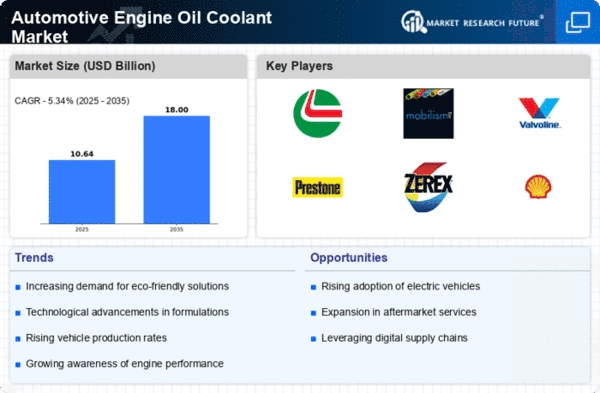
As per MRFR analysis, the Automotive Engine Oil Coolant Market Size was estimated at 10.1 USD Billion in 2024. The Automotive Engine Oil Coolant industry is projected to grow from 10.7 USD Billion in 2025 to 18.0 USD Billion by 2035, exhibiting a compound annual growth rate (CAGR) of 5.34 during the forecast period 2025 - 2035.

Key Market Trends & Highlights

The Automotive Engine Oil Coolant Market is experiencing a dynamic shift towards eco-friendly solutions and advanced technologies.

  • The market is witnessing a notable shift towards eco-friendly products, driven by increasing environmental awareness.
  • Technological advancements in cooling systems are enhancing the efficiency and performance of automotive engines.
  • In North America, the engine cooling segment remains the largest, while the brake cooling segment is rapidly gaining traction in Asia-Pacific.
  • Rising vehicle production and stringent emission regulations are key drivers propelling market growth across both passenger and commercial vehicle segments.

Market Size & Forecast

2024 Market Size 10.1 (USD Billion)
2035 Market Size 18.0 (USD Billion)
CAGR (2025 - 2035) 5.34%
Largest Regional Market Share in 2024 North America

Major Players

<p>Castrol (GB), Mobil (US), Valvoline (US), Prestone (US), Zerex (US), Shell (NL), Total (FR), Petro-Canada (CA), Glysantin (DE)</p>

Market Trends

The Automotive Engine Oil Coolant Market is currently experiencing a dynamic evolution, driven by various factors that influence consumer preferences and technological advancements. The increasing focus on vehicle performance and longevity has led to a heightened demand for high-quality engine coolants. Manufacturers are responding by developing innovative formulations that enhance thermal efficiency and protect against corrosion. Additionally, the growing awareness of environmental sustainability is prompting a shift towards eco-friendly coolant options, which are perceived as safer for both vehicles and the environment. This trend indicates a potential transformation in product offerings, as companies strive to meet the changing expectations of consumers. Moreover, the Automotive Engine Oil Coolant Market is witnessing a rise in the adoption of advanced cooling technologies. As vehicles become more sophisticated, the need for efficient cooling systems has become paramount. This has resulted in an increased emphasis on research and development, with companies exploring new materials and technologies to improve coolant performance. The integration of smart technologies into vehicles also suggests a future where coolant systems may be monitored and adjusted in real-time, further enhancing efficiency. Overall, the market appears poised for growth, driven by innovation and a commitment to sustainability.

Shift Towards Eco-Friendly Products

There is a noticeable trend towards the adoption of environmentally friendly engine coolants. Consumers are increasingly seeking products that minimize environmental impact, leading manufacturers to develop biodegradable and non-toxic formulations. This shift not only aligns with global sustainability goals but also caters to a growing demographic that prioritizes eco-conscious choices.

Technological Advancements in Cooling Systems

The Automotive Engine Oil Coolant Market is experiencing significant advancements in cooling technologies. Innovations such as enhanced thermal management systems and the use of advanced materials are becoming more prevalent. These developments aim to improve the efficiency and effectiveness of engine cooling, thereby extending the lifespan of vehicles and optimizing performance.

Increased Focus on Performance and Longevity

There is a rising emphasis on the performance and longevity of engine coolants. Consumers are becoming more discerning, seeking products that offer superior protection against overheating and corrosion. This trend is prompting manufacturers to invest in research and development to create high-performance coolants that meet the evolving demands of modern vehicles.

Automotive Engine Oil Coolant Market Market Drivers

Growing Demand for Advanced Engine Technologies

The Global Automotive Engine Oil Coolant Market Industry is experiencing a surge in demand for advanced engine technologies, driven by the automotive sector's shift towards higher efficiency and performance. As manufacturers increasingly adopt turbocharged engines and hybrid systems, the need for effective cooling solutions becomes paramount. This trend is expected to contribute to the market's growth, with projections indicating a market value of 5.17 USD Billion in 2024. Enhanced engine designs necessitate specialized coolants that can withstand higher temperatures and pressures, thereby fostering innovation within the industry.

Market Segment Insights

By Application: Engine Cooling (Largest) vs. Brake Cooling (Fastest-Growing)

<p>The Automotive Engine Oil Coolant Market is primarily driven by the application of engine cooling systems, which capture the largest share of the market. Engine cooling systems play a crucial role in maintaining optimal performance by preventing overheating. Transmission cooling follows closely but demonstrates a more modest share. Additionally, brake cooling systems are gaining traction as awareness of their importance in vehicle safety processes increases, contributing to a more competitive landscape in the coolant application market.</p>

<p>Engine Cooling (Dominant) vs. Brake Cooling (Emerging)</p>

<p>Engine cooling systems are long-established leaders in the Automotive Engine Oil Coolant Market, due to their vital role in maintaining engine integrity and performance. These systems utilize specialized coolants that efficiently dissipate heat, making them essential during intense driving conditions. On the other hand, brake cooling systems are emerging as a vital component in modern vehicles, particularly as performance demands heighten. Due to their crucial role in enhancing vehicle safety and performance, brake cooling solutions are starting to capture market attention, indicating a shift towards greater investment and innovation in these systems.</p>

By End Use: Passenger Vehicles (Largest) vs. Commercial Vehicles (Fastest-Growing)

<p>In the Automotive Engine Oil Coolant Market, the 'Passenger Vehicles' segment holds the largest share. This dominance can be attributed to the increasing global vehicle production and rising consumer preference for personal vehicles. The steady growth in urbanization and changing lifestyles further enhance the demand for passenger vehicles, leading to a robust market presence for automotive engine oil coolants designed specifically for this category. On the other hand, 'Commercial Vehicles' are emerging as the fastest-growing segment within this market. This growth is largely driven by the expansion of e-commerce and logistics industries, which rely heavily on commercial transport. The increasing need for robust cooling solutions to enhance efficiency and longevity in heavy-duty applications leads to a surge in demand, suggesting a trend towards higher-quality, performance-oriented engine oil coolants in this category.</p>

<p>Passenger Vehicles (Dominant) vs. Commercial Vehicles (Emerging)</p>

<p>The characteristics of the 'Passenger Vehicles' segment reflect its dominance in the Automotive Engine Oil Coolant Market. These vehicles typically require high-performance coolants that ensure optimal engine temperatures and efficiency. Manufacturers often focus on formulating oil coolants that not only protect against overheating but also enhance fuel efficiency. In contrast, the 'Commercial Vehicles' segment shows emerging potential, as these vehicles are designed for durability and heavy usage. Here, oil coolants are engineered to manage severe heat loads and stress, making them essential for maintaining operational performance in logistics and transportation. This division illustrates a critical contrast between consumer-oriented products for passenger vehicles and performance-driven solutions in the commercial sector.</p>

By Type: Ethylene Glycol Based Coolant (Largest) vs. Propylene Glycol Based Coolant (Fastest-Growing)

<p>In the Automotive Engine Oil Coolant Market, the distribution of market share among the various types of coolants reveals that Ethylene Glycol Based Coolant occupies the largest segment, primarily due to its extensive use and established reliability in various automotive applications. Propylene Glycol Based Coolant, on the other hand, is gaining traction, particularly in eco-friendly circles, thus indicating a significant shift in consumer preferences towards safer alternatives that prioritize not just performance but also environmental impact. Growth trends within this segment are being driven by several factors, including stringent regulations regarding emissions and environmental safety. The increasing demand for efficient cooling solutions in modern engines is also contributing to the growth of Propylene Glycol Based Coolant. Consequently, while Ethylene Glycol remains a dominant player, the emergence of Propylene Glycol as a fast-growing option illustrates the dynamic nature of consumer choices in automotive engine coolants.</p>

<p>Ethylene Glycol (Dominant) vs. Propylene Glycol (Emerging)</p>

<p>Ethylene Glycol Based Coolant stands out as the dominant choice in the Automotive Engine Oil Coolant Market, largely due to its superior thermal conductivity and cost-effectiveness, making it suitable for a variety of combustion engines. Its ability to withstand high temperatures and prevent freezing in cold conditions adds to its appeal, establishing it as a trusted option among traditional automotive manufacturers. Conversely, Propylene Glycol Based Coolant is emerging as a safer alternative, particularly favored in electric and hybrid vehicles where sustainability is increasingly prioritized. Although typically higher in cost, its biodegradable nature and non-toxic properties resonate well with environmentally conscious consumers, positioning it as a worthy competitor in the evolving automotive sector.</p>

By Distribution Channel: Online Retail (Largest) vs. Automotive Service Centers (Fastest-Growing)

<p>The distribution of automotive engine oil coolant in various channels reveals a competitive landscape. Online retail currently holds the largest share due to increased consumer preference for e-commerce, making it a convenient option for purchasing automotive fluids. In contrast, traditional distribution methods like offline retail remain popular, but with a lesser impact compared to online platforms. Automotive service centers are also pivotal, being a trusted source for consumers seeking professional advice and services. Looking at the growth trends, automotive service centers are emerging as the fastest-growing segment in the market. This can be attributed to the rising number of vehicles requiring maintenance and the growing consumer tendency to rely on experts for automotive care. Furthermore, the evolution of online retailing is shaping buying patterns, with more consumers opting for home delivery of engine oil coolant products. However, offline retail still plays a vital role, especially in regions where access to online services might be limited.</p>

<p>Online Retail (Dominant) vs. Wholesale (Emerging)</p>

<p>The online retail segment dominates the automotive engine oil coolant market, providing consumers with unmatched convenience and accessibility. This channel has made significant customization options available, catering to varied consumer needs with just a click. Conversely, wholesale channels, while historically significant, are emerging in importance as they facilitate bulk purchases for service stations and auto repair shops. The convenience offered by wholesalers, combined with competitive pricing, makes them an attractive option for businesses aiming to stock up on automotive supplies efficiently. With evolving supply chain dynamics and an increasing number of DIY enthusiasts, wholesale channels are becoming integral to the distribution landscape, allowing for enhanced reach and satisfaction.</p>

By Formulation: Concentrated Coolant (Largest) vs. Pre-Mixed Coolant (Fastest-Growing)

<p>The automotive engine oil coolant market features a varied distribution among its formulation types, primarily concentrated coolants, pre-mixed coolants, and additive packages. Concentrated coolants hold a substantial share due to their widespread usage and cost-effectiveness. On the other hand, pre-mixed coolants are gaining traction and standard adoption among consumers due to their ease of use, reducing the complexity of mixing ratios for end-users.</p>

<p>Coolants: Concentrated (Dominant) vs. Pre-Mixed (Emerging)</p>

<p>Concentrated coolants are the dominant player in the automotive engine oil coolant market, primarily recognized for their efficiency and budget-friendliness, appealing to fleet operators and individual consumers alike. These products require dilution before use, which allows for tailored formulations based on vehicle specifications. Conversely, pre-mixed coolants represent an emerging segment that caters to convenience-seekers, necessitating no additional mixing, thus providing a hassle-free solution for consumers. The growing trend towards quick maintenance and user-friendly products positions pre-mixed coolants favorably for increased market penetration.</p>

Get more detailed insights about Automotive Engine Oil Coolant Market Research Report - Forecast to 2035

Regional Insights

North America : Market Leader in Coolants

North America is poised to maintain its leadership in the Automotive Engine Oil Coolant Market, holding a significant market share of 4.5 in 2024. The region's growth is driven by increasing vehicle production, stringent environmental regulations, and a rising demand for high-performance coolants. The regulatory landscape is supportive, with initiatives aimed at reducing emissions and enhancing fuel efficiency, further propelling market growth. The competitive landscape in North America is robust, featuring key players such as ExxonMobil, Chevron, and Valvoline. These companies are investing in innovative coolant formulations to meet the evolving needs of consumers. The U.S. remains the largest market, driven by a high number of vehicles on the road and a growing focus on vehicle maintenance. The presence of established brands ensures a competitive environment, fostering continuous improvement and product development.

Europe : Emerging Market Dynamics

Europe's Automotive Engine Oil Coolant Market is projected to grow significantly, with a market size of 3.0 in 2024. The region benefits from a strong automotive industry, with increasing investments in electric vehicles and advanced cooling technologies. Regulatory frameworks, such as the EU's Green Deal, are pushing for more sustainable coolant solutions, driving demand for eco-friendly products and innovations in coolant formulations. Leading countries in this region include Germany, France, and the UK, where major players like Royal Dutch Shell and BP are actively competing. The competitive landscape is characterized by a mix of established brands and emerging companies focusing on sustainability. The presence of stringent regulations ensures that manufacturers prioritize quality and environmental impact, fostering a dynamic market environment.

Asia-Pacific : Rapid Growth and Innovation

The Asia-Pacific region is witnessing rapid growth in the Automotive Engine Oil Coolant Market, with a market size of 2.5 in 2024. This growth is fueled by increasing vehicle ownership, urbanization, and rising disposable incomes. Additionally, government initiatives aimed at improving vehicle standards and reducing emissions are acting as catalysts for market expansion, encouraging the adoption of advanced coolant technologies. Countries like China, Japan, and India are leading the market, with significant contributions from local and international players. Companies such as TotalEnergies and Fuchs Petrolub SE are expanding their presence in this region, focusing on innovative products tailored to local needs. The competitive landscape is evolving, with a mix of The Automotive Engine Oil Coolant share through product differentiation and strategic partnerships.

Middle East and Africa : Emerging Market Potential

The Middle East and Africa region represents an emerging market for Automotive Engine Oil Coolants, with a market size of 0.1 in 2024. The growth in this region is driven by increasing automotive sales, infrastructure development, and a growing awareness of vehicle maintenance. Regulatory frameworks are gradually evolving, promoting better environmental practices and encouraging the use of high-quality coolants to enhance vehicle performance. Leading countries in this region include South Africa and the UAE, where the automotive market is expanding rapidly. The competitive landscape is characterized by a mix of local and international players, with companies like Castrol and Prestone making significant inroads. As the market matures, there is a growing emphasis on quality and sustainability, presenting opportunities for innovative coolant solutions.

Key Players and Competitive Insights

The Automotive Engine Oil Coolant Market is currently characterized by a dynamic competitive landscape, driven by increasing vehicle production and a growing emphasis on engine efficiency. Key players such as Castrol (GB), Mobil (US), and Valvoline (US) are strategically positioned to leverage innovation and sustainability in their product offerings. Castrol (GB) focuses on developing high-performance coolants that enhance engine longevity, while Mobil (US) emphasizes technological advancements in its formulations to meet evolving consumer demands. Valvoline (US) has adopted a strategy of regional expansion, targeting emerging markets to capture a larger share of the growing demand for automotive lubricants and coolants. Collectively, these strategies contribute to a competitive environment that is increasingly focused on product differentiation and technological innovation.

In terms of business tactics, companies are localizing manufacturing to reduce costs and optimize supply chains. The market structure appears moderately fragmented, with several key players holding substantial market shares. This fragmentation allows for a diverse range of products and innovations, as companies strive to differentiate themselves in a crowded marketplace. The collective influence of these key players shapes the competitive dynamics, as they engage in strategic partnerships and collaborations to enhance their market presence.

In November 2025, Shell (NL) announced a partnership with a leading automotive manufacturer to co-develop a new line of eco-friendly engine coolants. This collaboration is significant as it aligns with the growing consumer demand for sustainable products, positioning Shell (NL) as a leader in environmentally conscious solutions. The partnership is expected to enhance Shell's product portfolio and strengthen its market position in the automotive sector.

In October 2025, Prestone (US) launched a new range of advanced engine coolants designed to provide superior protection against extreme temperatures. This strategic move is indicative of Prestone's commitment to innovation and addresses the increasing need for high-performance products in the automotive industry. By focusing on temperature resilience, Prestone (US) aims to capture a larger segment of the market that prioritizes engine protection and efficiency.

In September 2025, Total (FR) expanded its distribution network in North America, enhancing its accessibility to a broader customer base. This expansion is crucial as it allows Total (FR) to tap into the growing demand for automotive engine coolants in the region. By optimizing its distribution channels, Total (FR) is likely to improve its market penetration and strengthen its competitive position.

As of December 2025, current trends in the Automotive Engine Oil Coolant Market indicate a strong shift towards digitalization, sustainability, and the integration of AI technologies. Strategic alliances are increasingly shaping the competitive landscape, as companies collaborate to enhance their technological capabilities and product offerings. The evolution of competitive differentiation appears to be moving away from price-based competition towards a focus on innovation, technology, and supply chain reliability. This shift suggests that companies that prioritize research and development, alongside sustainable practices, will likely emerge as leaders in the market.

Key Companies in the Automotive Engine Oil Coolant Market include

Industry Developments

Future Outlook

Automotive Engine Oil Coolant Market Future Outlook

<p>The Automotive Engine Oil Coolant Market is projected to grow at a 5.34% CAGR from 2024 to 2035, driven by increasing vehicle production and technological advancements in coolant formulations.</p>

New opportunities lie in:

  • <p>Development of eco-friendly coolant alternatives</p>
  • <p>Expansion into emerging markets with tailored products</p>
  • <p>Integration of smart monitoring systems for coolant efficiency</p>

<p>By 2035, the market is expected to achieve robust growth, driven by innovation and strategic expansion.</p>

Market Segmentation

Automotive Engine Oil Coolant Market Type Outlook

  • Ethylene Glycol Based Coolant
  • Propylene Glycol Based Coolant
  • Water Based Coolant
  • Hybrid Coolant

Automotive Engine Oil Coolant Market End Use Outlook

  • Passenger Vehicles
  • Commercial Vehicles
  • Heavy-Duty Vehicles
  • Motorcycles

Automotive Engine Oil Coolant Market Application Outlook

  • Automotive Cooling System
  • Engine Cooling
  • Transmission Cooling
  • Brake Cooling

Automotive Engine Oil Coolant Market Formulation Outlook

  • Concentrated Coolant
  • Pre-Mixed Coolant
  • Additive Packages

Automotive Engine Oil Coolant Market Distribution Channel Outlook

  • Online Retail
  • Offline Retail
  • Automotive Service Centers
  • Wholesale

Report Scope

MARKET SIZE 202410.1(USD Billion)
MARKET SIZE 202510.7(USD Billion)
MARKET SIZE 203518.0(USD Billion)
COMPOUND ANNUAL GROWTH RATE (CAGR)5.34% (2024 - 2035)
REPORT COVERAGERevenue Forecast, Competitive Landscape, Growth Factors, and Trends
BASE YEAR2024
Market Forecast Period2025 - 2035
Historical Data2019 - 2024
Market Forecast UnitsUSD Billion
Key Companies ProfiledCastrol (GB), Mobil (US), Valvoline (US), Prestone (US), Zerex (US), Shell (NL), Total (FR), Petro-Canada (CA), Glysantin (DE)
Segments CoveredApplication, End Use, Type, Distribution Channel, Formulation
Key Market OpportunitiesGrowing demand for eco-friendly coolants driven by regulatory changes and consumer preferences in the Automotive Engine Oil Coolant Market.
Key Market DynamicsRising demand for environmentally friendly coolants drives innovation and regulatory compliance in the Automotive Engine Oil Coolant Market.
Countries CoveredNorth America, Europe, APAC, South America, MEA

FAQs

At what CAGR can the automotive engine oil coolant market expand?

The automotive engine oil coolant market can surge at 4.6%CAGR by 2032.

What is the estimated valuation for the automotive engine oil coolant market?

By 2032, the automotive engine oil coolant market can experience a decent hike in its valuation.

Who are the key players of the automotive engine oil coolant market?

Fluidyne Control Systems (P) Ltd (India), PWR Holdings (Australia), Titanx Engine Cooling, Inc. (U.S.), Setrab (U.S.), and Amsoil Inc. (U.S.) are some reputed companies in the automotive engine oil coolant market.

What are the automotive engine oil coolant types?

Synthetic, hybrid, and organic are types of automotive engine oil coolant.

What are automotive engine oil coolant functions?

Extensively used for cooling, automotive engine oil coolants are also used for preventing from corrosion.

  1. SECTION I: EXECUTIVE SUMMARY AND KEY HIGHLIGHTS
    1. | 1.1 EXECUTIVE SUMMARY
  2. SECTION II: SCOPING, METHODOLOGY AND MARKET STRUCTURE
    1. | 2.1 MARKET INTRODUCTION
    2. | 2.2 RESEARCH METHODOLOGY
  3. SECTION III: QUALITATIVE ANALYSIS
    1. | 3.1 MARKET DYNAMICS
    2. | 3.2 MARKET FACTOR ANALYSIS
  4. SECTION IV: QUANTITATIVE ANALYSIS
    1. | 4.1 Automobile, BY Application (USD Billion)
    2. | 4.2 Automobile, BY End Use (USD Billion)
    3. | 4.3 Automobile, BY Type (USD Billion)
    4. | 4.4 Automobile, BY Distribution Channel (USD Billion)
    5. | 4.5 Automobile, BY Formulation (USD Billion)
    6. | 4.6 Automobile, BY Region (USD Billion)
  5. SECTION V: COMPETITIVE ANALYSIS
    1. | 5.1 Competitive Landscape
    2. | 5.2 Company Profiles
    3. | 5.3 Appendix

Automotive Engine Oil Coolant Market Segmentation

Market Segmentation Overview

  • Detailed segmentation data will be available in the full report
  • Comprehensive analysis by multiple parameters
  • Regional and country-level breakdowns
  • Market size forecasts by segment
Infographic

Free Sample Request

Kindly complete the form below to receive a free sample of this Report

Get Free Sample

Customer Strories

Compare Licence

×
Features License Type
Single User Multiuser License Enterprise User
Price $4,950 $5,950 $7,250
Maximum User Access Limit 1 User Upto 10 Users Unrestricted Access Throughout the Organization
Free Customization
Direct Access to Analyst
Deliverable Format
Platform Access
Discount on Next Purchase 10% 15% 15%
Printable Versions