
×
Hero Background
English
Chinese
French
Japanese
Korean
German
Spanish

Automotive Electronic Expansion Valve Market Analysis

ID: MRFR/AT/9136-HCR
111 Pages
Sejal Akre
October 2025

Automotive Electronic Expansion Valve Market Research Report Information By Type (Electromagnetic and Electric), Application (Commercial Vehicle and Passenger Car) And By Region (North America, Europe, Asia-Pacific, And Rest Of The World) –Market Forecast Till 2035

Share:
Download PDF ×

We do not share your information with anyone. However, we may send you emails based on your report interest from time to time. You may contact us at any time to opt-out.

Automotive Electronic Expansion Valve Market Infographic
Purchase Options

Market Analysis

In-depth Analysis of Automotive Electronic Expansion Valve Market Industry Landscape

The Automotive Electronic Expansion Valve (EEV) market powerfully depends on the existing environment that plays an important role in shaping its ups and downs. The main factor that drives this market is the rising demand of the customers for green and energy-efficient automotive technologies. While the worldwide recognition of environmental problems still evolve to the next level, the emphasis on car fuel efficiency as well as lower emissions is clearly seen. The auto-made EEV’S contribute a lot towards attainment of these objectives by maximizing the efficiency of AC and refrigeration systems in vehicles thus aiding in energy conservation.

The second important determinant of the Automotive EEV market is the cutting edge innovation in the sector of the automobile technology. As vehicle manufacturers adopt electronic control systems in modern vehicles, the need for sophisticated parts such as EEVs have soared. These electronic expansion valves provide the precise control needed for refrigerant flow determining thus, the acceptable performance and efficiency of air conditioning systems. In the context of automobile manufacturers that compete fiercely, advanced technologies start to be the cornerstone, leading to the increase in demand for the Automotive EEVs.

The Carbon reduction restrictions as well as Government interventions aimed at reducing emissions from the market are also some of the factors influencing the market dynamics. Stronger restrictions on vehicle emissions and impact on the environment together have encouraged the automobile manufactures to go for the innovation. EEV are the facilitators for higher energy efficiency, meeting country - wide regulatory requirements and overall sustainability goals. The approval of vehicles with Automotive EEVs by manufacturers becomes one of the strategies to observe the standards and to get the lead in the market.

Now, the rapid increase in the auto industry's emphasis on electric and hybrid vehicles plays a vital part in the Automotive EEV market development. Along with the growth of electric and hybrid cars, an effective climate control system is gradually gaining immense significance. ABS have the ability to stabilize the temperature and energy efficiency in cars, and this is what makes the cars comfortable and are appealing to consumers who are environmentally aware.

Nevertheless, there are some challenges facing the industry, for instance high initial costs and the complexities of integrating the electronic parts to the vehicle systems remains an obstacle. Automotive manufacturers, as the industry leaders, must therefore consider both the advantages of EEVs and the associated burden alongside consumers’ affordability.


Author
Sejal Akre
Senior Research Analyst

She has over 5 years of rich experience, in market research and consulting providing valuable market insights to client. Hands on expertise in management consulting, and extensive knowledge in domain including ICT, Automotive & Transportation and Aerospace & Defense. She is skilled in Go-to market strategy, industry analysis, market sizing, in depth company profiling, competitive intelligence & benchmarking and value chain amongst others.

Leave a Comment

FAQs

What is the projected market valuation of the Automotive Electronic Expansion Valve Market by 2035?

The projected market valuation for the Automotive Electronic Expansion Valve Market is 0.9732 USD Billion by 2035.

What was the market valuation of the Automotive Electronic Expansion Valve Market in 2024?

The overall market valuation was 0.56 USD Billion in 2024.

What is the expected CAGR for the Automotive Electronic Expansion Valve Market during the forecast period 2025 - 2035?

The expected CAGR for the Automotive Electronic Expansion Valve Market during the forecast period 2025 - 2035 is 5.15%.

Which companies are considered key players in the Automotive Electronic Expansion Valve Market?

Key players in the market include Denso Corporation, Sanden Corporation, Mahle GmbH, Valeo SA, Hanon Systems, Continental AG, Aisin Seiki Co., Ltd., BorgWarner Inc., and Delphi Technologies.

What are the two main types of automotive electronic expansion valves and their market values?

The two main types are Electromagnetic, valued at 0.56 USD Billion, and Electric, valued at 0.4132 USD Billion.

How does the market for passenger cars compare to commercial vehicles in terms of electronic expansion valve applications?

In 2024, the market for passenger cars was valued at 0.7232 USD Billion, whereas the commercial vehicle segment was valued at 0.25 USD Billion.

Market Summary

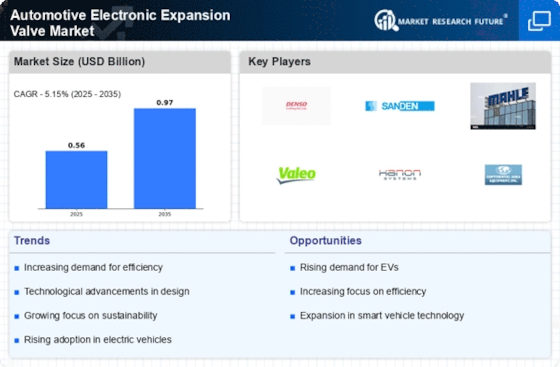
As per MRFR analysis, the Automotive Electronic Expansion Valve Market Size was estimated at 0.56 USD Billion in 2024. The Automotive Electronic Expansion Valve industry is projected to grow from 0.5889 in 2025 to 0.9732 by 2035, exhibiting a compound annual growth rate (CAGR) of 5.15 during the forecast period 2025 - 2035.

Key Market Trends & Highlights

The Automotive Electronic Expansion Valve Market is poised for substantial growth driven by technological advancements and evolving consumer preferences.

  • The integration of smart technologies is transforming the functionality of electronic expansion valves, enhancing vehicle performance. Sustainability remains a focal point, with manufacturers increasingly prioritizing eco-friendly materials and processes. The electric vehicle segment is experiencing rapid growth, driven by rising consumer demand and regulatory support in the Asia-Pacific region. Rising demand for fuel efficiency and technological advancements in HVAC systems are key drivers propelling market expansion, particularly in North America.

Market Size & Forecast

2024 Market Size 0.56 (USD Billion)
2035 Market Size 0.9732 (USD Billion)
CAGR (2025 - 2035) 5.15%
Largest Regional Market Share in 2024 Asia Pacific

Major Players

<p>Denso Corporation (JP), Sanden Corporation (JP), Mahle GmbH (DE), Valeo SA (FR), Hanon Systems (KR), Continental AG (DE), Aisin Seiki Co., Ltd. (JP), BorgWarner Inc. (US), Delphi Technologies (GB)</p>

Market Trends

The Automotive Electronic Expansion Valve Market is currently experiencing a transformative phase, driven by advancements in automotive technology and increasing demand for energy-efficient solutions. This market appears to be influenced by the growing emphasis on reducing emissions and enhancing vehicle performance. As manufacturers strive to meet stringent environmental regulations, the integration of electronic components into traditional systems is becoming more prevalent. This shift not only optimizes the cooling process but also contributes to overall vehicle efficiency, suggesting a promising trajectory for future growth. Moreover, the Automotive Electronic Expansion Valve Market seems to be benefiting from the rising popularity of electric and hybrid vehicles. These vehicles often require sophisticated thermal management systems, which rely heavily on electronic expansion valves for optimal performance. The trend towards automation and smart technologies in vehicles further indicates that the demand for advanced electronic components will likely continue to rise. As consumers become more environmentally conscious, the market may witness an increase in the adoption of innovative solutions that enhance both comfort and sustainability in automotive applications.

Integration of Smart Technologies

The Automotive Electronic Expansion Valve Market is witnessing a trend towards the incorporation of smart technologies. This integration allows for real-time monitoring and adjustments, enhancing system efficiency and performance. As vehicles become more connected, the demand for intelligent components that can communicate with other systems is likely to grow.

Focus on Sustainability

There is a noticeable shift towards sustainability within the Automotive Electronic Expansion Valve Market. Manufacturers are increasingly prioritizing eco-friendly materials and processes, aligning with global efforts to reduce carbon footprints. This trend reflects a broader commitment to environmental responsibility in the automotive sector.

Growth in Electric Vehicle Adoption

The rise in electric vehicle adoption is significantly impacting the Automotive Electronic Expansion Valve Market. As more consumers opt for electric and hybrid models, the need for advanced thermal management solutions becomes critical. This trend suggests a robust future demand for electronic expansion valves tailored to meet the unique requirements of these vehicles.

Automotive Electronic Expansion Valve Market Market Drivers

Rising Demand for Fuel Efficiency

The Automotive Electronic Expansion Valve Market is experiencing a notable surge in demand for fuel-efficient vehicles. As consumers become increasingly conscious of fuel costs and environmental impacts, automakers are compelled to enhance the efficiency of their vehicles. Electronic expansion valves play a crucial role in optimizing the performance of air conditioning systems, thereby improving overall fuel efficiency. According to recent data, vehicles equipped with advanced electronic components, including expansion valves, can achieve up to 15% better fuel economy compared to traditional systems. This trend is likely to drive innovation and investment in the Automotive Electronic Expansion Valve Market, as manufacturers seek to meet consumer expectations and regulatory standards.

Increasing Electric Vehicle Production

The Automotive Electronic Expansion Valve Market is poised for growth due to the increasing production of electric vehicles (EVs). As the automotive industry shifts towards electrification, the demand for efficient thermal management systems becomes paramount. Electronic expansion valves are essential in managing the cooling and heating systems of EVs, ensuring optimal battery performance and passenger comfort. Recent statistics indicate that the EV market is expected to grow at a CAGR of over 20% in the coming years, which will likely drive the demand for electronic components, including expansion valves. This trend suggests a promising future for the Automotive Electronic Expansion Valve Market as manufacturers adapt to the evolving landscape of vehicle technology.

Technological Advancements in HVAC Systems

Technological advancements in heating, ventilation, and air conditioning (HVAC) systems are significantly influencing the Automotive Electronic Expansion Valve Market. The integration of smart technologies, such as IoT and AI, into HVAC systems allows for more precise control of temperature and humidity, enhancing passenger comfort. Electronic expansion valves are pivotal in these systems, enabling real-time adjustments based on environmental conditions. The market for automotive HVAC systems is projected to grow at a CAGR of approximately 6% over the next few years, indicating a robust demand for electronic components that improve system efficiency and performance. This growth is likely to bolster the Automotive Electronic Expansion Valve Market as manufacturers innovate to keep pace with technological advancements.

Regulatory Pressure for Emission Reductions

Regulatory pressure for emission reductions is a significant driver for the Automotive Electronic Expansion Valve Market. Governments worldwide are implementing stringent regulations aimed at reducing greenhouse gas emissions from vehicles. Electronic expansion valves contribute to this effort by enhancing the efficiency of HVAC systems, which in turn reduces the overall energy consumption of vehicles. As automakers strive to comply with these regulations, the demand for advanced electronic components that support emission reduction strategies is likely to increase. The market for automotive components that facilitate compliance with environmental standards is projected to expand, thereby positively impacting the Automotive Electronic Expansion Valve Market.

Consumer Preference for Advanced Comfort Features

Consumer preference for advanced comfort features in vehicles is shaping the Automotive Electronic Expansion Valve Market. Modern consumers increasingly seek vehicles equipped with sophisticated climate control systems that provide personalized comfort. Electronic expansion valves are integral to these systems, allowing for precise temperature regulation and improved air quality. Market Research Future indicates that vehicles with advanced HVAC systems can command higher prices and attract more buyers. As automakers respond to this consumer demand by incorporating more electronic components into their designs, the Automotive Electronic Expansion Valve Market is likely to benefit from this trend, leading to increased sales and innovation in product offerings.

Market Segment Insights

By Type: Electromagnetic (Largest) vs. Electric (Fastest-Growing)

<p>In the Automotive Electronic Expansion Valve Market, the market share distribution reveals that the electromagnetic segment is currently the largest, dominating the landscape due to its established technology and widespread adoption among various vehicle manufacturers. In contrast, the electric segment, though smaller in share, is rapidly gaining traction as advancements in electric vehicle technology drive demand.</p>

<p>Type: Electromagnetic (Dominant) vs. Electric (Emerging)</p>

<p>The electromagnetic expansion valves are predominantly characterized by their reliability and proven technology, making them the preferred choice in traditional internal combustion vehicles. They offer precise control and durability under various conditions, ensuring optimal engine performance. On the other hand, electric expansion valves represent a transformative shift towards electrification and automation. As the <a href="https://www.marketresearchfuture.com/reports/automotive-industry-7683">automotive industry</a> pivots towards electric vehicles, the growing demand for energy efficiency and system integration positions the electric segment as an emerging force in this market. As technology advances, electric valves are anticipated to play a vital role in cooling and thermal management systems, catering to new automotive trends.</p>

By Application: Passenger Car (Largest) vs. Commercial Vehicle (Fastest-Growing)

<p>In the automotive electronic expansion valve market, the passenger car segment holds the largest market share, driven by the growing demand for advanced climate control systems and energy-efficient vehicles. As manufacturers focus on providing improved performance and features, passenger cars continue to dominate, showcasing a significant preference with consumers. On the other hand, the commercial vehicle segment is the fastest-growing, fueled by the rising need for efficient &amp; reliable HVAC systems due to stringent emissions regulations and operational cost savings. Innovative technologies in thermal management are propelling this segment forward, making it an attractive area for investments and growth in the market.</p>

<p>Application: Passenger Car (Dominant) vs. Commercial Vehicle (Emerging)</p>

<p>The passenger car segment is characterized by high demand for performance and efficiency, leading to innovative designs in electronic expansion valves that cater to the requirements of dynamic climate control solutions. Automakers emphasize integrating these components to ensure optimal operation, enhancing both comfort and energy efficiency. Conversely, the commercial vehicle segment represents an emerging market front, rapidly adopting electronic expansion valves to meet not only performance standards but also stringent environmental regulations. The increasing focus on reducing carbon footprints in logistics and transport sectors drives this adoption, suggesting a shift in consumer preferences towards more sustainable solutions. As technologies evolve, both segments will continue to shape the competitive landscape.</p>

Get more detailed insights about Automotive Electronic Expansion Valve Market Research Report—Global Forecast till 2035

Regional Insights

North America : Innovation and Demand Surge

North America is the largest market for automotive electronic expansion valves, holding approximately 40% of the global market share. The region's growth is driven by increasing vehicle production, rising demand for fuel-efficient vehicles, and stringent emission regulations. The U.S. and Canada are the primary contributors, with a focus on advanced automotive technologies and electric vehicles, further propelling market demand. The competitive landscape in North America is characterized by the presence of major players such as BorgWarner Inc. and Delphi Technologies. These companies are investing in R&D to enhance product offerings and meet regulatory standards. The market is also witnessing collaborations and partnerships aimed at innovation and sustainability, ensuring a robust competitive environment.

Europe : Regulatory-Driven Market Growth

Europe is the second-largest market for automotive electronic expansion valves, accounting for around 30% of the global market share. The region's growth is significantly influenced by stringent environmental regulations and a shift towards electric vehicles. Countries like Germany and France are leading the charge, with policies promoting sustainable automotive technologies and reducing carbon emissions, which are crucial for market expansion. The competitive landscape in Europe is marked by key players such as Mahle GmbH and Valeo SA, who are at the forefront of innovation. The presence of a well-established automotive industry, coupled with a focus on research and development, enhances the region's market dynamics. Collaborations between manufacturers and technology firms are also fostering advancements in electronic expansion valve technologies.

Asia-Pacific : Emerging Market Potential

Asia-Pacific is witnessing rapid growth in the automotive electronic expansion valve market, holding approximately 25% of the global market share. The region's expansion is fueled by increasing vehicle production, rising disposable incomes, and a growing middle class. Countries like China and Japan are leading the market, supported by government initiatives promoting electric vehicles and advanced automotive technologies, which are essential for market growth. The competitive landscape in Asia-Pacific features key players such as Denso Corporation and Aisin Seiki Co., Ltd. These companies are focusing on innovation and expanding their product portfolios to cater to the growing demand. The region is also seeing an influx of foreign investments aimed at enhancing manufacturing capabilities and technological advancements, further solidifying its market position.

Middle East and Africa : Untapped Market Opportunities

The Middle East and Africa region is gradually emerging in the automotive electronic expansion valve market, holding about 5% of the global market share. The growth is driven by increasing urbanization, rising vehicle ownership, and government initiatives to enhance the automotive sector. Countries like South Africa and the UAE are focusing on developing their automotive industries, which is expected to boost market demand in the coming years. The competitive landscape in this region is still developing, with a few key players like Hanon Systems making strides in the market. The presence of local manufacturers is increasing, and partnerships with global companies are fostering technology transfer and innovation. As the automotive sector grows, the demand for electronic components, including expansion valves, is anticipated to rise significantly.

Key Players and Competitive Insights

The Automotive Electronic Expansion Valve Market is currently characterized by a dynamic competitive landscape, driven by technological advancements and increasing demand for energy-efficient automotive solutions. Key players such as Denso Corporation (Japan), Valeo SA (France), and BorgWarner Inc. (United States) are strategically positioning themselves through innovation and partnerships. Denso Corporation (Japan) focuses on enhancing its product offerings by integrating advanced technologies, while Valeo SA (France) emphasizes sustainability in its operations, aiming to reduce carbon footprints. BorgWarner Inc. (United States) is actively pursuing mergers and acquisitions to bolster its market presence, indicating a trend towards consolidation in the industry. Collectively, these strategies contribute to a competitive environment that is increasingly focused on technological differentiation and sustainability.

In terms of business tactics, companies are localizing manufacturing to reduce costs and enhance supply chain efficiency. The market structure appears moderately fragmented, with several key players exerting influence over various segments. This fragmentation allows for niche players to thrive, while larger corporations leverage their scale to optimize operations and innovate. The collective influence of these key players shapes market dynamics, as they compete not only on product quality but also on operational efficiency and sustainability initiatives.

In August 2025, Denso Corporation (Japan) announced a partnership with a leading electric vehicle manufacturer to develop next-generation electronic expansion valves tailored for electric vehicles. This strategic move underscores Denso's commitment to innovation and positions the company favorably within the growing electric vehicle segment. By aligning with a prominent player in the EV market, Denso aims to enhance its technological capabilities and expand its market reach.

In September 2025, Valeo SA (France) launched a new line of electronic expansion valves designed to optimize thermal management in hybrid vehicles. This initiative reflects Valeo's focus on sustainability and energy efficiency, aligning with global trends towards greener automotive solutions. The introduction of this product line is likely to strengthen Valeo's competitive position as consumers increasingly prioritize eco-friendly technologies.

In July 2025, BorgWarner Inc. (United States) completed the acquisition of a technology firm specializing in smart thermal management systems. This acquisition is significant as it enhances BorgWarner's capabilities in developing advanced electronic expansion valves that integrate artificial intelligence for improved performance. The move not only diversifies BorgWarner's product portfolio but also positions the company at the forefront of technological innovation in the automotive sector.

As of October 2025, the competitive trends in the Automotive Electronic Expansion Valve Market are increasingly defined by digitalization, sustainability, and the integration of artificial intelligence. Strategic alliances are becoming more prevalent, as companies recognize the need to collaborate to enhance their technological capabilities and market reach. Looking ahead, competitive differentiation is likely to evolve from traditional price-based competition to a focus on innovation, technology integration, and supply chain reliability. This shift suggests that companies that prioritize R&D and sustainable practices will be better positioned to thrive in an increasingly competitive landscape.

Key Companies in the Automotive Electronic Expansion Valve Market market include

Industry Developments

  • Q2 2024: Denso announces new manufacturing facility for automotive electronic expansion valves in Mexico Denso Corporation revealed plans to open a new plant in Mexico dedicated to producing automotive electronic expansion valves, aiming to meet rising demand from North American automakers.
  • Q2 2024: Sanhua Automotive launches next-generation electronic expansion valve for EV thermal management Sanhua Automotive introduced its latest electronic expansion valve designed specifically for electric vehicle battery cooling systems, targeting improved efficiency and reliability.
  • Q3 2024: Valeo signs supply agreement with Hyundai for electronic expansion valves in new EV models Valeo secured a multi-year contract to supply electronic expansion valves for Hyundai's upcoming electric vehicle lineup, strengthening its position in the EV thermal management market.
  • Q3 2024: BorgWarner acquires minority stake in startup specializing in smart electronic expansion valves BorgWarner announced the acquisition of a 20% stake in a Silicon Valley startup focused on AI-driven electronic expansion valve technology for automotive HVAC systems.
  • Q4 2024: Hella and Panasonic form joint venture for automotive electronic expansion valve production Hella and Panasonic entered a joint venture to co-develop and manufacture advanced electronic expansion valves for global automotive OEMs, with production set to begin in 2025.
  • Q4 2024: CAREL INDUSTRIES S.p.A. receives regulatory approval for new automotive electronic expansion valve in Europe CAREL INDUSTRIES S.p.A. announced that its latest automotive electronic expansion valve has received CE certification, allowing sales and installation across the European Union.
  • Q1 2025: Delphi Technologies wins contract to supply electronic expansion valves for Ford's hybrid SUV platform Delphi Technologies secured a major contract to provide electronic expansion valves for Ford's next-generation hybrid SUVs, with deliveries scheduled to start in late 2025.
  • Q1 2025: Denso appoints new head of automotive thermal systems division Denso Corporation named Dr. Akira Sato as the new head of its automotive thermal systems division, overseeing the expansion of electronic expansion valve production and R&D.
  • Q2 2025: Valeo announces expansion of electronic expansion valve production capacity in China Valeo revealed a significant investment to expand its electronic expansion valve manufacturing facilities in China, aiming to support growing demand from local and international automakers.
  • Q2 2025: Sanhua Automotive secures supply contract with BYD for electronic expansion valves in new EV models Sanhua Automotive signed a supply agreement with BYD to provide electronic expansion valves for its latest electric vehicle models, reinforcing its leadership in the Chinese EV market.
  • Q3 2025: Panasonic unveils smart electronic expansion valve with integrated IoT diagnostics for automotive applications Panasonic launched a new electronic expansion valve featuring built-in IoT diagnostics, enabling real-time performance monitoring and predictive maintenance for automotive HVAC systems.
  • Q3 2025: BorgWarner opens R&D center for advanced electronic expansion valve technology in Germany BorgWarner inaugurated a new research and development center in Germany focused on next-generation electronic expansion valve solutions for electric and hybrid vehicles.

Future Outlook

Automotive Electronic Expansion Valve Market Future Outlook

<p>The Automotive Electronic Expansion Valve Market is projected to grow at a 5.15% CAGR from 2024 to 2035, driven by advancements in automotive technology and increasing demand for fuel efficiency.</p>

New opportunities lie in:

  • <p>Integration of smart sensors for real-time performance monitoring</p>
  • <p>Development of lightweight materials to enhance valve efficiency</p>
  • <p>Expansion into emerging markets with tailored product offerings</p>

<p>By 2035, the market is expected to achieve robust growth, positioning itself as a leader in automotive innovation.</p>

Market Segmentation

Automotive Electronic Expansion Valve Market Type Outlook

  • Electromagnetic
  • Electric

Automotive Electronic Expansion Valve Market Application Outlook

  • Commercial Vehicle
  • Passenger Car

Report Scope

MARKET SIZE 2024 0.56(USD Billion)
MARKET SIZE 2025 0.5889(USD Billion)
MARKET SIZE 2035 0.9732(USD Billion)
COMPOUND ANNUAL GROWTH RATE (CAGR) 5.15% (2024 - 2035)
REPORT COVERAGE Revenue Forecast, Competitive Landscape, Growth Factors, and Trends
BASE YEAR 2024
Market Forecast Period 2025 - 2035
Historical Data 2019 - 2024
Market Forecast Units USD Billion
Key Companies Profiled Market analysis in progress
Segments Covered Market segmentation analysis in progress
Key Market Opportunities Integration of advanced sensors enhances efficiency in the Automotive Electronic Expansion Valve Market.
Key Market Dynamics Rising demand for energy-efficient vehicles drives innovation in Automotive Electronic Expansion Valve technology and design.
Countries Covered North America, Europe, APAC, South America, MEA

FAQs

What is the projected market valuation of the Automotive Electronic Expansion Valve Market by 2035?

The projected market valuation for the Automotive Electronic Expansion Valve Market is 0.9732 USD Billion by 2035.

What was the market valuation of the Automotive Electronic Expansion Valve Market in 2024?

The overall market valuation was 0.56 USD Billion in 2024.

What is the expected CAGR for the Automotive Electronic Expansion Valve Market during the forecast period 2025 - 2035?

The expected CAGR for the Automotive Electronic Expansion Valve Market during the forecast period 2025 - 2035 is 5.15%.

Which companies are considered key players in the Automotive Electronic Expansion Valve Market?

Key players in the market include Denso Corporation, Sanden Corporation, Mahle GmbH, Valeo SA, Hanon Systems, Continental AG, Aisin Seiki Co., Ltd., BorgWarner Inc., and Delphi Technologies.

What are the two main types of automotive electronic expansion valves and their market values?

The two main types are Electromagnetic, valued at 0.56 USD Billion, and Electric, valued at 0.4132 USD Billion.

How does the market for passenger cars compare to commercial vehicles in terms of electronic expansion valve applications?

In 2024, the market for passenger cars was valued at 0.7232 USD Billion, whereas the commercial vehicle segment was valued at 0.25 USD Billion.

  1. SECTION I: EXECUTIVE SUMMARY AND KEY HIGHLIGHTS
    1. EXECUTIVE SUMMARY
      1. Market Overview
      2. Key Findings
      3. Market Segmentation
      4. Competitive Landscape
      5. Challenges and Opportunities
      6. Future Outlook 2
  2. SECTION II: SCOPING, METHODOLOGY AND MARKET STRUCTURE
    1. MARKET INTRODUCTION
      1. Definition
      2. Scope of the study
    2. RESEARCH METHODOLOGY
      1. Overview
      2. Data Mining
      3. Secondary Research
      4. Primary Research
      5. Forecasting Model
      6. Market Size Estimation
      7. Data Triangulation
      8. Validation 3
  3. SECTION III: QUALITATIVE ANALYSIS
    1. MARKET DYNAMICS
      1. Overview
      2. Drivers
      3. Restraints
      4. Opportunities
    2. MARKET FACTOR ANALYSIS
      1. Value chain Analysis
      2. Porter's Five Forces Analysis
      3. COVID-19 Impact Analysis
  4. SECTION IV: QUANTITATIVE ANALYSIS
    1. Automobile, BY Type (USD Billion)
      1. Electromagnetic
      2. Electric
    2. Automobile, BY Application (USD Billion)
      1. Commercial Vehicle
      2. Passenger Car
    3. Automobile, BY Region (USD Billion)
      1. North America
      2. Europe
      3. APAC
      4. South America
      5. MEA
  5. SECTION V: COMPETITIVE ANALYSIS
    1. Competitive Landscape
      1. Overview
      2. Competitive Analysis
      3. Market share Analysis
      4. Major Growth Strategy in the Automobile
      5. Competitive Benchmarking
      6. Leading Players in Terms of Number of Developments in the Automobile
      7. Key developments and growth strategies
      8. Major Players Financial Matrix
    2. Company Profiles
      1. Denso Corporation (JP)
      2. Sanden Corporation (JP)
      3. Mahle GmbH (DE)
      4. Valeo SA (FR)
      5. Hanon Systems (KR)
      6. Continental AG (DE)
      7. Aisin Seiki Co., Ltd. (JP)
      8. BorgWarner Inc. (US)
      9. Delphi Technologies (GB)
    3. Appendix
      1. References
      2. Related Reports 6 LIST OF FIGURES
    4. MARKET SYNOPSIS
    5. NORTH AMERICA MARKET ANALYSIS
    6. US MARKET ANALYSIS BY TYPE
    7. US MARKET ANALYSIS BY APPLICATION
    8. CANADA MARKET ANALYSIS BY TYPE
    9. CANADA MARKET ANALYSIS BY APPLICATION
    10. EUROPE MARKET ANALYSIS
    11. GERMANY MARKET ANALYSIS BY TYPE
    12. GERMANY MARKET ANALYSIS BY APPLICATION
    13. UK MARKET ANALYSIS BY TYPE
    14. UK MARKET ANALYSIS BY APPLICATION
    15. FRANCE MARKET ANALYSIS BY TYPE
    16. FRANCE MARKET ANALYSIS BY APPLICATION
    17. RUSSIA MARKET ANALYSIS BY TYPE
    18. RUSSIA MARKET ANALYSIS BY APPLICATION
    19. ITALY MARKET ANALYSIS BY TYPE
    20. ITALY MARKET ANALYSIS BY APPLICATION
    21. SPAIN MARKET ANALYSIS BY TYPE
    22. SPAIN MARKET ANALYSIS BY APPLICATION
    23. REST OF EUROPE MARKET ANALYSIS BY TYPE
    24. REST OF EUROPE MARKET ANALYSIS BY APPLICATION
    25. APAC MARKET ANALYSIS
    26. CHINA MARKET ANALYSIS BY TYPE
    27. CHINA MARKET ANALYSIS BY APPLICATION
    28. INDIA MARKET ANALYSIS BY TYPE
    29. INDIA MARKET ANALYSIS BY APPLICATION
    30. JAPAN MARKET ANALYSIS BY TYPE
    31. JAPAN MARKET ANALYSIS BY APPLICATION
    32. SOUTH KOREA MARKET ANALYSIS BY TYPE
    33. SOUTH KOREA MARKET ANALYSIS BY APPLICATION
    34. MALAYSIA MARKET ANALYSIS BY TYPE
    35. MALAYSIA MARKET ANALYSIS BY APPLICATION
    36. THAILAND MARKET ANALYSIS BY TYPE
    37. THAILAND MARKET ANALYSIS BY APPLICATION
    38. INDONESIA MARKET ANALYSIS BY TYPE
    39. INDONESIA MARKET ANALYSIS BY APPLICATION
    40. REST OF APAC MARKET ANALYSIS BY TYPE
    41. REST OF APAC MARKET ANALYSIS BY APPLICATION
    42. SOUTH AMERICA MARKET ANALYSIS
    43. BRAZIL MARKET ANALYSIS BY TYPE
    44. BRAZIL MARKET ANALYSIS BY APPLICATION
    45. MEXICO MARKET ANALYSIS BY TYPE
    46. MEXICO MARKET ANALYSIS BY APPLICATION
    47. ARGENTINA MARKET ANALYSIS BY TYPE
    48. ARGENTINA MARKET ANALYSIS BY APPLICATION
    49. REST OF SOUTH AMERICA MARKET ANALYSIS BY TYPE
    50. REST OF SOUTH AMERICA MARKET ANALYSIS BY APPLICATION
    51. MEA MARKET ANALYSIS
    52. GCC COUNTRIES MARKET ANALYSIS BY TYPE
    53. GCC COUNTRIES MARKET ANALYSIS BY APPLICATION
    54. SOUTH AFRICA MARKET ANALYSIS BY TYPE
    55. SOUTH AFRICA MARKET ANALYSIS BY APPLICATION
    56. REST OF MEA MARKET ANALYSIS BY TYPE
    57. REST OF MEA MARKET ANALYSIS BY APPLICATION
    58. KEY BUYING CRITERIA OF AUTOMOBILE
    59. RESEARCH PROCESS OF MRFR
    60. DRO ANALYSIS OF AUTOMOBILE
    61. DRIVERS IMPACT ANALYSIS: AUTOMOBILE
    62. RESTRAINTS IMPACT ANALYSIS: AUTOMOBILE
    63. SUPPLY / VALUE CHAIN: AUTOMOBILE
    64. AUTOMOBILE, BY TYPE, 2024 (% SHARE)
    65. AUTOMOBILE, BY TYPE, 2024 TO 2035 (USD Billion)
    66. AUTOMOBILE, BY APPLICATION, 2024 (% SHARE)
    67. AUTOMOBILE, BY APPLICATION, 2024 TO 2035 (USD Billion)
    68. BENCHMARKING OF MAJOR COMPETITORS 7 LIST OF TABLES
    69. LIST OF ASSUMPTIONS
    70. North America MARKET SIZE ESTIMATES; FORECAST
      1. BY TYPE, 2025-2035 (USD Billion)
      2. BY APPLICATION, 2025-2035 (USD Billion)
    71. US MARKET SIZE ESTIMATES; FORECAST
      1. BY TYPE, 2025-2035 (USD Billion)
      2. BY APPLICATION, 2025-2035 (USD Billion)
    72. Canada MARKET SIZE ESTIMATES; FORECAST
      1. BY TYPE, 2025-2035 (USD Billion)
      2. BY APPLICATION, 2025-2035 (USD Billion)
    73. Europe MARKET SIZE ESTIMATES; FORECAST
      1. BY TYPE, 2025-2035 (USD Billion)
      2. BY APPLICATION, 2025-2035 (USD Billion)
    74. Germany MARKET SIZE ESTIMATES; FORECAST
      1. BY TYPE, 2025-2035 (USD Billion)
      2. BY APPLICATION, 2025-2035 (USD Billion)
    75. UK MARKET SIZE ESTIMATES; FORECAST
      1. BY TYPE, 2025-2035 (USD Billion)
      2. BY APPLICATION, 2025-2035 (USD Billion)
    76. France MARKET SIZE ESTIMATES; FORECAST
      1. BY TYPE, 2025-2035 (USD Billion)
      2. BY APPLICATION, 2025-2035 (USD Billion)
    77. Russia MARKET SIZE ESTIMATES; FORECAST
      1. BY TYPE, 2025-2035 (USD Billion)
      2. BY APPLICATION, 2025-2035 (USD Billion)
    78. Italy MARKET SIZE ESTIMATES; FORECAST
      1. BY TYPE, 2025-2035 (USD Billion)
      2. BY APPLICATION, 2025-2035 (USD Billion)
    79. Spain MARKET SIZE ESTIMATES; FORECAST
      1. BY TYPE, 2025-2035 (USD Billion)
      2. BY APPLICATION, 2025-2035 (USD Billion)
    80. Rest of Europe MARKET SIZE ESTIMATES; FORECAST
      1. BY TYPE, 2025-2035 (USD Billion)
      2. BY APPLICATION, 2025-2035 (USD Billion)
    81. APAC MARKET SIZE ESTIMATES; FORECAST
      1. BY TYPE, 2025-2035 (USD Billion)
      2. BY APPLICATION, 2025-2035 (USD Billion)
    82. China MARKET SIZE ESTIMATES; FORECAST
      1. BY TYPE, 2025-2035 (USD Billion)
      2. BY APPLICATION, 2025-2035 (USD Billion)
    83. India MARKET SIZE ESTIMATES; FORECAST
      1. BY TYPE, 2025-2035 (USD Billion)
      2. BY APPLICATION, 2025-2035 (USD Billion)
    84. Japan MARKET SIZE ESTIMATES; FORECAST
      1. BY TYPE, 2025-2035 (USD Billion)
      2. BY APPLICATION, 2025-2035 (USD Billion)
    85. South Korea MARKET SIZE ESTIMATES; FORECAST
      1. BY TYPE, 2025-2035 (USD Billion)
      2. BY APPLICATION, 2025-2035 (USD Billion)
    86. Malaysia MARKET SIZE ESTIMATES; FORECAST
      1. BY TYPE, 2025-2035 (USD Billion)
      2. BY APPLICATION, 2025-2035 (USD Billion)
    87. Thailand MARKET SIZE ESTIMATES; FORECAST
      1. BY TYPE, 2025-2035 (USD Billion)
      2. BY APPLICATION, 2025-2035 (USD Billion)
    88. Indonesia MARKET SIZE ESTIMATES; FORECAST
      1. BY TYPE, 2025-2035 (USD Billion)
      2. BY APPLICATION, 2025-2035 (USD Billion)
    89. Rest of APAC MARKET SIZE ESTIMATES; FORECAST
      1. BY TYPE, 2025-2035 (USD Billion)
      2. BY APPLICATION, 2025-2035 (USD Billion)
    90. South America MARKET SIZE ESTIMATES; FORECAST
      1. BY TYPE, 2025-2035 (USD Billion)
      2. BY APPLICATION, 2025-2035 (USD Billion)
    91. Brazil MARKET SIZE ESTIMATES; FORECAST
      1. BY TYPE, 2025-2035 (USD Billion)
      2. BY APPLICATION, 2025-2035 (USD Billion)
    92. Mexico MARKET SIZE ESTIMATES; FORECAST
      1. BY TYPE, 2025-2035 (USD Billion)
      2. BY APPLICATION, 2025-2035 (USD Billion)
    93. Argentina MARKET SIZE ESTIMATES; FORECAST
      1. BY TYPE, 2025-2035 (USD Billion)
      2. BY APPLICATION, 2025-2035 (USD Billion)
    94. Rest of South America MARKET SIZE ESTIMATES; FORECAST
      1. BY TYPE, 2025-2035 (USD Billion)
      2. BY APPLICATION, 2025-2035 (USD Billion)
    95. MEA MARKET SIZE ESTIMATES; FORECAST
      1. BY TYPE, 2025-2035 (USD Billion)
      2. BY APPLICATION, 2025-2035 (USD Billion)
    96. GCC Countries MARKET SIZE ESTIMATES; FORECAST
      1. BY TYPE, 2025-2035 (USD Billion)
      2. BY APPLICATION, 2025-2035 (USD Billion)
    97. South Africa MARKET SIZE ESTIMATES; FORECAST
      1. BY TYPE, 2025-2035 (USD Billion)
      2. BY APPLICATION, 2025-2035 (USD Billion)
    98. Rest of MEA MARKET SIZE ESTIMATES; FORECAST
      1. BY TYPE, 2025-2035 (USD Billion)
      2. BY APPLICATION, 2025-2035 (USD Billion)
    99. PRODUCT LAUNCH/PRODUCT DEVELOPMENT/APPROVAL
    100. ACQUISITION/PARTNERSHIP

Automotive Electronic Expansion Valve Market Segmentation

Automotive Electronic Expansion Valve Type Outlook (USD Billion, 2018-2032)

Electromagnetic

Electric

Automotive Electronic Expansion Valve Application Outlook (USD Billion, 2018-2032)

Commercial Vehicle

Passenger Car

Automotive Electronic Expansion Valve Regional Outlook (USD Billion, 2018-2032)

North America Outlook (USD Billion, 2018-2032)

Automotive Electronic Expansion Valve by Type

Electromagnetic

Electric

Automotive Electronic Expansion Valve by Application

Commercial Vehicle

Passenger Car

US Outlook (USD Billion, 2018-2032)

Automotive Electronic Expansion Valve by Type

Electromagnetic

Electric

Automotive Electronic Expansion Valve by Application

Commercial Vehicle

Passenger Car

Canada Outlook (USD Billion, 2018-2032)

Automotive Electronic Expansion Valve by Type

Electromagnetic

Electric

Automotive Electronic Expansion Valve by Application

Commercial Vehicle

Passenger Car

Europe Outlook (USD Billion, 2018-2032)

Automotive Electronic Expansion Valve by Type

Electromagnetic

Electric

Automotive Electronic Expansion Valve by Application

Commercial Vehicle

Passenger Car

Germany Outlook (USD Billion, 2018-2032)

Automotive Electronic Expansion Valve by Type

Electromagnetic

Electric

Automotive Electronic Expansion Valve by Application

Commercial Vehicle

Passenger Car

France Outlook (USD Billion, 2018-2032)

Automotive Electronic Expansion Valve by Type

Electromagnetic

Electric

Automotive Electronic Expansion Valve by Application

Commercial Vehicle

Passenger Car

UK Outlook (USD Billion, 2018-2032)

Automotive Electronic Expansion Valve by Type

Electromagnetic

Electric

Automotive Electronic Expansion Valve by Application

Commercial Vehicle

Passenger Car

Italy Outlook (USD Billion, 2018-2032)

Automotive Electronic Expansion Valve by Type

Electromagnetic

Electric

Automotive Electronic Expansion Valve by Application

Commercial Vehicle

Passenger Car

Spain Outlook (USD Billion, 2018-2032)

Automotive Electronic Expansion Valve by Type

Electromagnetic

Electric

Automotive Electronic Expansion Valve by Application

Commercial Vehicle

Passenger Car

Rest Of Europe Outlook (USD Billion, 2018-2032)

Automotive Electronic Expansion Valve by Type

Electromagnetic

Electric

Automotive Electronic Expansion Valve by Application

Commercial Vehicle

Passenger Car

Asia-Pacific Outlook (USD Billion, 2018-2032)

Automotive Electronic Expansion Valve by Type

Electromagnetic

Electric

Automotive Electronic Expansion Valve by Application

Commercial Vehicle

Passenger Car

China Outlook (USD Billion, 2018-2032)

Automotive Electronic Expansion Valve by Type

Electromagnetic

Electric

Automotive Electronic Expansion Valve by Application

Commercial Vehicle

Passenger Car

Japan Outlook (USD Billion, 2018-2032)

Automotive Electronic Expansion Valve by Type

Electromagnetic

Electric

Automotive Electronic Expansion Valve by Application

Commercial Vehicle

Passenger Car

India Outlook (USD Billion, 2018-2032)

Automotive Electronic Expansion Valve by Type

Electromagnetic

Electric

Automotive Electronic Expansion Valve by Application

Commercial Vehicle

Passenger Car

Australia Outlook (USD Billion, 2018-2032)

Automotive Electronic Expansion Valve by Type

Electromagnetic

Electric

Automotive Electronic Expansion Valve by Application

Commercial Vehicle

Passenger Car

Rest of Asia-Pacific Outlook (USD Billion, 2018-2032)

Automotive Electronic Expansion Valve by Type

Electromagnetic

Electric

Automotive Electronic Expansion Valve by Application

Commercial Vehicle

Passenger Car

Rest of the World Outlook (USD Billion, 2018-2032)

Automotive Electronic Expansion Valve by Type

Electromagnetic

Electric

Automotive Electronic Expansion Valve by Application

Commercial Vehicle

Passenger Car

Middle East Outlook (USD Billion, 2018-2032)

Automotive Electronic Expansion Valve by Type

Electromagnetic

Electric

Automotive Electronic Expansion Valve by Application

Commercial Vehicle

Passenger Car

Africa Outlook (USD Billion, 2018-2032)

Automotive Electronic Expansion Valve by Type

Electromagnetic

Electric

Automotive Electronic Expansion Valve by Application

Commercial Vehicle

Passenger Car

Latin America Outlook (USD Billion, 2018-2032)

Automotive Electronic Expansion Valve by Type

Electromagnetic

Electric

Automotive Electronic Expansion Valve by Application

Commercial Vehicle

Passenger Car

Infographic

Free Sample Request

Kindly complete the form below to receive a free sample of this Report

Get Free Sample

Customer Strories

Compare Licence

×
Features License Type
Single User Multiuser License Enterprise User
Price $4,950 $5,950 $7,250
Maximum User Access Limit 1 User Upto 10 Users Unrestricted Access Throughout the Organization
Free Customization
Direct Access to Analyst
Deliverable Format
Platform Access
Discount on Next Purchase 10% 15% 15%
Printable Versions