Request Free Sample ×

Kindly complete the form below to receive a free sample of this Report

* Please use a valid business email

Leading companies partner with us for data-driven Insights

clients tt-cursor
Hero Background
English
Chinese
French
Japanese
Korean
German
Spanish

Automotive Electric Compressor Market Size

ID: MRFR/AT/8961-HCR
100 Pages
Triveni Bhoyar
April 2026

Automotive E-Compressor Market Research Report By Application (Air Conditioning Systems, Refrigeration Systems, Thermal Management Systems, Electric Vehicle Heating Systems), By Type (Scroll E-Compressor, Rotary E-Compressor, Piston E-Compressor), By Cooling Capacity (Below 5kW, 5kW to 10kW, Above 10kW), By End Use (Passenger Vehicles, Commercial Vehicles, Electric Vehicles) and By Regional (North America, Europe, South America, Asia Pacific, Middle East and Africa) - Industry Outlook & Forecast to 2035

Share:
Download PDF ×

We do not share your information with anyone. However, we may send you emails based on your report interest from time to time. You may contact us at any time to opt-out.

Automotive E Compressor Market Infographic
Purchase Options

Automotive E Compressor Size

Automotive E Compressor Market Growth Projections and Opportunities

The automotive e-compressor market operates within a dynamic landscape influenced by a confluence of factors that collectively shape its demand and growth patterns. E-compressors, a crucial component in electric and hybrid vehicles, are responsible for managing the air conditioning system and optimizing energy efficiency. The market dynamics are closely tied to advancements in electric vehicle (EV) technology, environmental concerns, and global economic conditions.

One of the primary drivers influencing the dynamics of the automotive e-compressor market is the expanding electric and hybrid vehicle market. As the automotive industry shifts towards electrification, there is a growing demand for efficient and sustainable components, including e-compressors. Electric and hybrid vehicles rely on these compressors for maintaining cabin comfort while ensuring minimal impact on the vehicle's overall energy consumption. The increasing adoption of electric vehicles worldwide propels the demand for e-compressors.

Technological advancements play a pivotal role in shaping the dynamics of the automotive e-compressor market. Ongoing research and development efforts focus on improving the efficiency, performance, and integration of e-compressors within electric and hybrid vehicles. Innovations in electronic controls, materials, and cooling technologies contribute to the evolution of e-compressor technologies. Manufacturers investing in cutting-edge solutions are better positioned to meet the increasing demand for high-performance and technologically sophisticated e-compressors.

Environmental considerations and the pursuit of sustainable mobility impact the market dynamics of automotive e-compressors. With a growing emphasis on reducing carbon emissions and addressing climate change, electric vehicles emerge as a viable solution. E-compressors, being an integral part of the electric vehicle ecosystem, contribute to creating a more sustainable transportation option. The market responds to the global shift towards eco-friendly mobility solutions, reflecting a changing landscape within the automotive e-compressor market.

Consumer preferences for electric vehicles and the overall growth of the electric vehicle market influence market dynamics. As awareness of environmental issues and the benefits of electric mobility increases, there is a rising demand for electric and hybrid vehicles equipped with advanced e-compressors. Automakers are actively incorporating these compressors to enhance the driving experience and address range anxiety concerns, impacting the overall dynamics of the automotive e-compressor market.

The automotive industry's performance and production trends significantly influence market dynamics. Fluctuations in electric vehicle production, changes in consumer purchasing behavior, and global economic conditions impact the demand for automotive e-compressors. The market is responsive to shifts in the broader automotive landscape, adapting to the evolving needs of automakers and consumers seeking sustainable and energy-efficient vehicle solutions.

Competitive forces within the industry contribute to the dynamics of the automotive e-compressor market. Manufacturers engage in strategic initiatives, including partnerships, collaborations, and technology acquisitions, to strengthen their market position. Differentiation through product features, cost competitiveness, and collaboration with electric vehicle manufacturers are key factors driving competition within the e-compressor market. Companies that can offer reliable, efficient, and innovative e-compressor solutions gain a competitive advantage in this dynamic landscape.

Global economic conditions and government policies related to electric vehicle adoption impact the automotive e-compressor market dynamics. Economic factors, such as subsidies, incentives, and consumer confidence, influence the growth of the electric vehicle market and, consequently, the demand for e-compressors. Additionally, regulatory standards and emissions targets drive the adoption of electric vehicles, shaping market dynamics and prompting manufacturers to align their offerings with evolving industry requirements.

In conclusion, the automotive e-compressor market operates in a dynamic environment shaped by the expanding electric vehicle market, technological advancements, environmental considerations, and competitive forces. As the automotive industry continues its shift towards electrification, the e-compressor market is expected to adapt to emerging trends and consumer demands. Staying informed about these dynamics is essential for manufacturers and industry participants to navigate the competitive landscape and capitalize on opportunities within the evolving automotive e-compressor market.

Automotive E Compressor Market Size Graph
Author
Author Profile
Triveni Bhoyar
Senior Research Analyst

Triveni Bhoyar has over 5 years of experience in the market research industry, specializing in the Automotive and Aerospace & Defense sectors. She has contributed to 200+ reports, including numerous custom projects for leading global companies, delivering solutions to complex business challenges. Renowned for her ability to generate valuable insights, Triveni excels in addressing unique market dynamics with precision and depth. Her expertise spans market sizing, competitive intelligence, and trend analysis, enabling clients to craft data-driven growth strategies. With strong analytical rigor and a client-centric approach, she plays a pivotal role in driving impactful, strategic decision-making.

Leave a Comment

FAQs

What is the projected market valuation of the Automotive E-Compressor Market by 2035?

<p>The projected market valuation for the Automotive E-Compressor Market by 2035 is 11.99 USD Billion.</p>

What was the market valuation of the Automotive E-Compressor Market in 2024?

<p>The overall market valuation of the Automotive E-Compressor Market was 2.87 USD Billion in 2024.</p>

What is the expected CAGR for the Automotive E-Compressor Market during the forecast period 2025 - 2035?

<p>The expected CAGR for the Automotive E-Compressor Market during the forecast period 2025 - 2035 is 13.88%.</p>

Which application segment is projected to have the highest valuation by 2035?

<p>The Air Conditioning Systems segment is projected to reach a valuation of 4.8 USD Billion by 2035.</p>

What are the key types of e-compressors in the Automotive E-Compressor Market?

<p>The key types of e-compressors include Scroll E-Compressor, Rotary E-Compressor, and Piston E-Compressor.</p>

How does the valuation of Electric Vehicles in the Automotive E-Compressor Market compare to other end-use segments by 2035?

<p>By 2035, the valuation for Electric Vehicles is expected to reach 3.29 USD Billion, which is lower than Passenger Vehicles at 5.5 USD Billion.</p>

Which company is a leading player in the Automotive E-Compressor Market?

<p>Denso Corporation is recognized as one of the leading players in the Automotive E-Compressor Market.</p>

What is the projected valuation for Thermal Management Systems by 2035?

<p>The projected valuation for Thermal Management Systems by 2035 is 2.6 USD Billion.</p>

What is the expected market size for the Piston E-Compressor type by 2035?

<p>The expected market size for the Piston E-Compressor type is projected to be 4.67 USD Billion by 2035.</p>

How does the market for Commercial Vehicles compare to that of Passenger Vehicles in 2035?

<p>In 2035, the market for Commercial Vehicles is projected to reach 3.2 USD Billion, significantly lower than the 5.5 USD Billion for Passenger Vehicles.</p>

Why do electric vehicles need an electric compressor?

Unlike ICE vehicles where AC runs off a belt-driven compressor powered by the engine, BEVs have no running engine. An electric (e-) compressor is mandatory for cabin cooling and battery thermal management. NREL research shows that without efficient AC management, an EV's range can decrease by up to 38% under maximum cooling load. 

How much does air conditioning affect electric vehicle range?

NREL research quantifies that increasing the electrical accessory load from 500W to 3,500W (the maximum AC demand) reduces EV range on a repeated city driving cycle by 38%. At 95°F ambient temperature, BEV range decreases by an average of 14% vs a 72°F reference, per DOE's 2024 analysis.

Market Summary

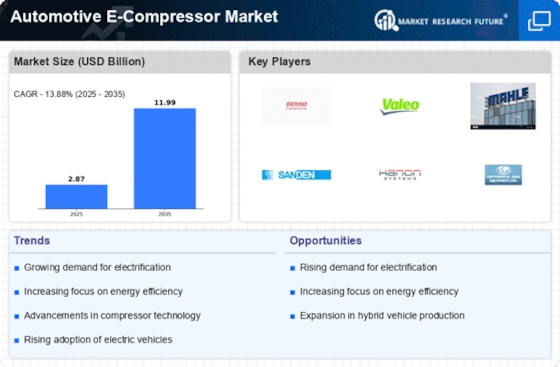
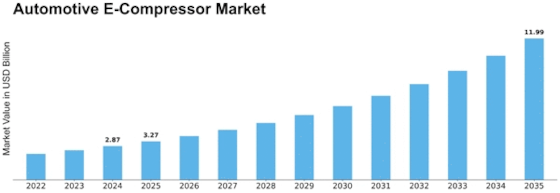
As per Market Research Future analysis, the Automotive E-Compressor Market Size was estimated at USD 2.87 Billion in 2024. The Automotive E-Compressor industry is projected to grow from USD 3.268 Billion in 2025 to USD 11.99 Billion by 2035, exhibiting a compound annual growth rate (CAGR) of 13.88% during the forecast period 2025 - 2035

Key Market Trends & Highlights

The Automotive E-Compressor Market is poised for substantial growth driven by technological advancements and increasing demand for electric vehicles.

  • The North American region remains the largest market for automotive e-compressors, reflecting a robust demand for electric vehicles. Asia-Pacific is recognized as the fastest-growing region, propelled by rapid urbanization and a shift towards sustainable transportation solutions. Air conditioning systems dominate the market, while thermal management systems are emerging as the fastest-growing segment due to their critical role in electric vehicle efficiency. Key market drivers include the increasing adoption of electric vehicles and regulatory support for emission reductions, which are shaping the industry's future.

Market Size & Forecast

2024 Market Size 2.87 (USD Billion)
2035 Market Size 11.99 (USD Billion)
CAGR (2025 - 2035) 13.88%
Largest Regional Market Share in 2024 Asia Pacific

Major Players

global leading companies in the Automotive e-compressor industry are, Denso Corporation (JP), <a href="https://www.valeo.com/en/catalogue/ths/electrical-compressors/">Valeo SA</a> (FR), Mahle GmbH (DE), Sanden Corporation (JP), Hanon Systems (KR), Continental AG (DE), Aisin Seiki Co., Ltd. (JP), BorgWarner Inc. (US), Delphi Technologies (GB) and others.

Market Trends

The Automotive E-Compressor Market is currently experiencing a transformative phase, driven by the increasing demand for energy-efficient solutions in the automotive sector. As manufacturers strive to enhance vehicle performance while minimizing environmental impact, the adoption of e-compressors is gaining traction. These devices, which utilize electric power to compress refrigerants, offer several advantages over traditional mechanical compressors, including improved efficiency and reduced emissions. Furthermore, the shift towards electric and hybrid vehicles is propelling the market forward, as e-compressors are integral to the climate control systems in these advanced vehicles. In addition to the growing emphasis on sustainability, technological advancements are playing a crucial role in shaping the Automotive E-Compressor Market. Innovations in materials and design are leading to lighter, more compact units that can be easily integrated into various vehicle architectures. This trend is further supported by regulatory frameworks that encourage the adoption of cleaner technologies. As the automotive industry continues to evolve, the Automotive E-Compressor Market is poised for substantial growth, reflecting broader shifts towards electrification and enhanced energy efficiency in transportation.

Rising Demand for Electric Vehicles

The increasing popularity of electric vehicles is significantly influencing the Automotive E-Compressor Market. As more consumers opt for electric and hybrid models, the need for efficient climate control systems becomes paramount. E-compressors are essential in these vehicles, providing effective cooling while maintaining energy efficiency. NREL's Vehicle Thermal Management programme uses CoolCalc and FASTSim Hot to model and analyse HVAC management strategies — evaluating cabin insulation, battery sizing, glass transmissivity, and compressor efficiency impact on vehicle range and performance. These government-funded modelling tools are informing OEM design specifications for next-generation electric compressors.

Technological Innovations

Advancements in technology are driving the development of more efficient and compact e-compressors. Innovations in design and materials are enabling manufacturers to produce lighter units that integrate seamlessly into modern vehicle architectures, enhancing overall performance and efficiency. NREL's vehicle thermal management research shows modern BEV HVAC systems use the electric compressor in both cooling (AC) and heating (heat pump) modes — without reversing the refrigeration cycle. This dual-function capability means the e-compressor handles both summer cooling and winter heating loads, making it the most thermally critical single component in a BEV's auxiliary system architecture.

Regulatory Support for Sustainable Technologies

Government regulations aimed at reducing emissions and promoting sustainability are fostering growth in the Automotive E-Compressor Market. Policies encouraging the adoption of cleaner technologies are likely to accelerate the shift towards e-compressors, as manufacturers seek to comply with stringent environmental standards.

Automotive E Compressor Market Market Drivers

Expansion of Hybrid Vehicle Segment

The expansion of the hybrid vehicle segment is another key driver for the Automotive E-Compressor Market. Hybrid vehicles, which combine internal combustion engines with electric propulsion, require sophisticated thermal management systems to optimize performance and efficiency. E-compressors are integral to these systems, providing the necessary cooling for both the electric and combustion components. As the hybrid vehicle market continues to grow, driven by consumer demand for fuel-efficient options, the Automotive E-Compressor Market is likely to see increased demand for e-compressors tailored to hybrid applications. This trend indicates a promising future for manufacturers who can adapt their offerings to meet the unique requirements of hybrid vehicles.
 
USDOT's final CAFE standards for MY2024–2026 require an industry-wide fleet average of approximately 49 mpg by 2026 — the strongest fuel economy standards in US history. NHTSA analysis confirms that since CAFE was enacted in 1975, standards have reduced US oil consumption by 25% (approximately 5 million barrels/day). Achieving 49 mpg increasingly requires electrified auxiliary systems — including electric rather than belt-driven AC compressors — in hybrid and mild-hybrid platforms.

Regulatory Push for Emission Reductions

The Automotive E-Compressor Market is also influenced by regulatory frameworks aimed at reducing emissions and promoting energy efficiency. Governments worldwide are implementing stringent regulations that encourage the adoption of cleaner technologies in the automotive sector. This regulatory push is particularly relevant for electric vehicles, which require efficient thermal management systems to optimize performance.
 
As a result, the demand for e-compressors is likely to increase, as they are essential for maintaining optimal operating temperatures in electric drivetrains. The Automotive E-Compressor Market stands to benefit from these regulations, as manufacturers align their product offerings with compliance requirements, thereby enhancing their market position and driving innovation.
 
DOE's August 2024 FOTW confirms EV battery pack costs for light-duty vehicles in 2023 are 90% lower than in 2008. As battery costs fall, BEV production volumes expand — and every new BEV produced requires an electric compressor. DOE's 2025 Incremental Purchase Cost Report projects continued decline in EV battery and powertrain component costs, supporting accelerating BEV volume growth.

Increasing Adoption of Electric Vehicles

The Automotive E-Compressor Market is experiencing a notable surge due to the increasing adoption of electric vehicles (EVs). As consumers and manufacturers alike shift towards more sustainable transportation options, the demand for efficient cooling systems in EVs has escalated. E-compressors play a crucial role in enhancing the performance of electric drivetrains by providing effective thermal management. According to recent data, the EV market is projected to grow at a compound annual growth rate (CAGR) of over 20% in the coming years, which directly influences the Automotive E-Compressor Market. This trend indicates a robust opportunity for manufacturers to innovate and cater to the specific needs of electric vehicle platforms, thereby driving growth in the e-compressor segment.
 
NREL's total thermal management research (SAE paper 2018) demonstrates that BEVs require integrated thermal management systems — specifically a refrigerant loop with an electric compressor — to simultaneously cool the cabin, manage battery temperature, and recover waste heat. Without an e-compressor, battery thermal management in BEVs cannot function. Every BEV produced requires at least one electric compressor, making BEV production volume a direct demand multiplier.

Growing Consumer Awareness of Sustainability

Consumer awareness regarding sustainability is a driving force in the Automotive E-Compressor Market. As individuals become more conscious of their environmental impact, there is a growing preference for vehicles that utilize energy-efficient technologies. This shift in consumer behavior is prompting automakers to invest in e-compressor technologies that align with sustainable practices.
 
The demand for e-compressors is expected to rise as consumers increasingly seek vehicles that not only perform well but also contribute to lower carbon footprints. This trend suggests that the Automotive E-Compressor Market will continue to expand, as manufacturers respond to consumer preferences by developing innovative and eco-friendly e-compressor solutions.

Technological Advancements in E-Compressor Design

Technological advancements are significantly shaping the Automotive E-Compressor Market. Innovations in compressor design, such as the integration of variable speed drives and advanced materials, are enhancing the efficiency and performance of e-compressors. These advancements not only improve energy consumption but also reduce the overall weight of the systems, which is critical for electric vehicles. The market is witnessing a shift towards more compact and lightweight e-compressors, which can lead to improved vehicle range and performance. As manufacturers invest in research and development, the introduction of next-generation e-compressors is expected to further stimulate growth in the Automotive E-Compressor Market, potentially leading to a market size exceeding several billion dollars by the end of the decade.
 
DOE/NREL research on vehicle air conditioning impact confirms that a 400W load on a conventional ICE engine decreases fuel economy by approximately 0.4 km/L (1 mpg). The US could save over $6 billion annually if all light-duty vehicles achieved a modest 1 mpg improvement. Replacing belt-driven compressors with electric compressors in hybrid and EV platforms directly delivers this efficiency gain.

Market Segment Insights

By Application: Air Conditioning Systems (Largest) vs. Thermal Management Systems (Fastest-Growing)

The Automotive E-Compressor Market showcases a diverse application landscape, with Air Conditioning Systems leading in market share. This segment dominates due to the ongoing demand for comfortable driving experiences across various vehicle types. Following closely are Refrigeration Systems, primarily for commercial vehicles, alongside emerging applications like Thermal Management Systems and Electric Vehicle Heating Systems, which are gaining traction as manufacturers strive to enhance vehicle performance and efficiency. As the automotive industry shifts towards electrification, Thermal Management Systems are expected to be the fastest-growing application. The increasing focus on energy efficiency, combined with the rising demand for electric vehicles, is propelling this segment forward. Furthermore, innovations in compressor technology and an emphasis on integrated heating and cooling solutions are driving remarkable growth across these applications, positioning them favorably for the future.

Air Conditioning Systems (Dominant) vs. Thermal Management Systems (Emerging)

Air Conditioning Systems remain the dominant application in the Automotive E-Compressor Market due to their essential role in passenger comfort and vehicle operation during hot weather. This segment has established a strong market position, supported by advancements in compressor technology that enhance efficiency and reduce energy consumption. In contrast, Thermal Management Systems represent an emerging application driven by the rise of electric and hybrid vehicles. These systems are critical for maintaining optimal battery performance and overall vehicle energy efficiency. As the need for climate control and energy conservation becomes more pronounced in the automotive sector, both segments are expected to thrive, albeit with differing strategies and technological focuses.

By Type: Scroll E-Compressor (Largest) vs. Piston E-Compressor (Fastest-Growing)

In the Automotive E-Compressor Market, the Scroll E-Compressor holds the largest market share due to its increasing adoption in electric vehicles and hybrid models. This segment is acclaimed for its efficiency and compact design, appealing to manufacturers looking to maximize performance while minimizing space consumption. Rotary E-Compressors are also prominent but lag behind Scroll technology, primarily due to a less favorable perception of efficiency compared to Scroll designs. Piston E-Compressors, while historically significant, are experiencing dwindling interest as newer technologies gain traction.

Scroll E-Compressor (Dominant) vs. Piston E-Compressor (Emerging)

Scroll E-Compressors dominate the Automotive E-Compressor Market because of their superior performance and energy efficiency. These compressors are designed to operate quietly and smoothly, making them ideal for today's electric and hybrid vehicles where noise reduction is a priority. In contrast, Piston E-Compressors are considered emerging despite having demonstrated reliability and a long-standing presence in the market. They are facing challenges related to size and efficiency compared to newer designs. However, ongoing innovations could see them finding niche applications, particularly in more traditional internal combustion engine vehicles.

By Cooling Capacity: 5kW to 10kW (Largest) vs. Above 10kW (Fastest-Growing)

In the Automotive E-Compressor Market, the cooling capacity segment showcases a notable distribution where the 5kW to 10kW category occupies the largest share. This segment has become a preferred choice for many automakers, thanks to its balance between performance and energy efficiency. In contrast, the Above 10kW segment is rapidly gaining traction among manufacturers aiming for high-performance applications, reflecting a growing demand for advanced cooling solutions in electric and hybrid vehicles.

Cooling Capacity: 5kW to 10kW (Dominant) vs. Above 10kW (Emerging)

The 5kW to 10kW segment of the Automotive E-Compressor Market stands out as the dominant cooling capacity range, appealing to a wide array of vehicles that require reliable air conditioning systems without excessive energy consumption. This category's efficiency makes it an attractive choice for mainstream electric vehicles, especially as manufacturers strive to enhance range and reduce battery drain. Conversely, the Above 10kW segment is emerging swiftly, driven by the need for robust cooling solutions in high-performance vehicles. This growth is fueled by the increasing integration of electric and hybrid technologies, which demand advanced atmospheric controls to ensure optimal performance under varying driving conditions.

By End Use: Passenger Vehicles (Largest) vs. Electric Vehicles (Fastest-Growing)

In the Automotive E-Compressor Market, the passenger vehicles segment holds the largest share, primarily driven by the growing demand for comfort and efficiency in personal transport. This segment's established infrastructure and widespread adoption of vehicle technology reinforce its strong position, alongside a steady increase in vehicle production and sales globally. In contrast, commercial vehicles and electric vehicles segment share a smaller yet significant portion of the market, with commercial vehicles notably catering to specific needs in transportation and logistics. The electric vehicles segment is observed as the fastest-growing within the e-compressor market, attributed to increasing consumer preferences for eco-friendly options and stringent emission regulations. The rise in electric vehicle production is significantly influenced by government incentives and innovations in battery technology, which enhance overall vehicle performance. As manufacturers pivot toward sustainable offerings, the electric vehicle segment is projected to experience substantial growth over the next few years. NHTSA's MY2024–2026 CAFE standards increase fuel economy requirements 8% annually for MY2024–2025 and 10% for MY2026. NHTSA analysis confirms manufacturers make technology changes during existing product refresh cycles. Electric compressors for mild-hybrid and HEV platforms are among the most cost-effective near-term improvements that can be applied during model refreshes to meet CAFE targets without full platform redesigns.

Passenger Vehicles (Dominant) vs. Electric Vehicles (Emerging)

The passenger vehicles segment represents a dominant force in the Automotive E-Compressor Market, benefiting from an extensive range of applications and consumer acceptance. This segment includes a variety of vehicles, each prioritizing performance, comfort, and fuel efficiency, thus driving the adoption of advanced e-compressor technologies. Major automotive manufacturers continue to innovate in this area, enhancing the HVAC systems, which in turn ensures optimal cabin comfort and lower emissions. Meanwhile, the electric vehicles segment is emerging rapidly, driven by a paradigm shift towards sustainability and significant investments in EV infrastructure. With advancements in technology and reductions in battery cost, electric vehicles are set to reshape market dynamics, compelling traditional manufacturers to adapt and meet the rising demand for more efficient and environmentally-friendly transport options. 

Get more detailed insights about Automotive E Compressor Market Research Report - Global Forecast till 2035

Regional Insights

The Automotive E-Compressor Market is showing steady growth across various regions. In 2024, the North America region held a market value of 0.73 USD Billion, expected to rise significantly to 2.568 USD Billion by 2035, reflecting its importance in the automotive industry due to technological advancements and innovation. Europe, was valued at 0.87 USD Billion in 2024, is projected to reach 3.928 USD Billion by 2035, marking it as a key player influenced by strict environmental regulations and a move towards electric vehicles

The Asia-Pacific (APAC) region dominated the market with a valuation of 1.1 USD Billion in 2024, climbing to 4.736 USD Billion by 2035, driven by high demand for electric vehicles and rapid industrialization, showcasing its majority holding in the Automotive E-Compressor Market revenue.

South America and the Middle East and Africa (MEA) represented smaller segments, valued at 0.12 USD Billion and 0.05 USD Billion in 2024, respectively, highlighting significant growth potential yet to be fully realized. South America is set to reach 0.504 USD Billion by 2035, focusing on improving automotive efficiency, while MEA’s valuation grows to 0.264 USD Billion, indicating emerging opportunities in developing automotive sectors.

Key Players and Competitive Insights

The Automotive E-Compressor Market has emerged as a vital segment within the automotive industry, responding to increasing demands for energy-efficient and environmentally friendly vehicle systems. This market is characterized by intense competition among key players who are innovating their product lines to enhance performance, efficiency, and compliance with stringent environmental regulations. The rise in electric vehicles and the shift towards hybrid models have necessitated advancements in compressor technology, prompting a race among manufacturers to leverage their R&D capabilities effectively.
 
Competitive insights into this market reveal a landscape that is continually evolving with technological advancements, partnerships, and strategic investments aimed at capturing market share in this lucrative segment. Denso has established itself as a formidable player in the Automotive E-Compressor Market through its extensive portfolio of high-quality products and a strong focus on research and development. Known for integrating state-of-the-art technology into its e-compressor solutions, Denso benefits from its long-standing reputation and brand trust built over decades. The company’s global presence is substantial, enabling it to implement tailored solutions that meet the diverse needs of different regions. Denso's strengths lie in its commitment to innovation, which has allowed it to lead in efficiency and performance metrics within its product offerings. The company strategically invests in advanced manufacturing processes and sustainability initiatives, further solidifying its competitive edge in the market. 
 
Mahle is another significant contender in the Automotive E-Compressor Market, recognized for its comprehensive solutions in thermal management and highly efficient compression systems. The firm specializes in the production of e-compressors tailored for hybrid and electric vehicles, showcasing its adaptability to shifting market demands. Mahle has built a strong market presence by leveraging its expertise in thermal management to offer innovative compressor solutions that enhance vehicle efficiency and performance.  The company has entered into strategic mergers and acquisitions to broaden its capabilities and improve its technological offerings in the global arena. Furthermore, Mahle's focus on sustainability and its investment in research and development underscores its dedication to maintaining a competitive position in the evolving automotive sector. The synergistic effect of these initiatives has allowed Mahle to sustain its relevance and enhance its strengths in the Automotive E-Compressor Market.

Key Companies in the Automotive E Compressor Market include

Industry Developments

The Automotive E-Compressor Market is witnessing significant developments, particularly with increasing demand for energy-efficient systems amidst the electric vehicle surge. Companies such as Denso and Valeo are focusing on advanced technologies to enhance the efficiency and integration of e-compressors within automotive air conditioning systems. As of September 2023, a noteworthy merger occurred between Hanon Systems and Mitsubishi Electric, aimed at consolidating their capabilities in developing sustainable HVAC solutions, presenting both companies with greater market leverage. 

Furthermore, the market was valued at approximately USD 1.8 billion in 2022, reflecting a steady growth rate driven by electrification within the automotive sector. Notably, in early 2022, Bosch announced significant investments to enhance its e-compressor production facilities, positioning it as a front-runner amid fierce competition.

The regulatory landscape is also shaping the market, with various governments worldwide emphasizing the transition to low-emission vehicles, positively impacting acceptance trends for e-compressors. Overall, the competitive landscape is sharpening, with firms like Mahle and Continental advancing their R&D endeavors to foster innovation in this evolving field while meeting consumer demand for sustainable automotive solutions.

Future Outlook

Automotive E Compressor Market Future Outlook

The Automotive E-Compressor Market is poised for growth at 13.88% CAGR from 2025 to 2035, driven by increasing electric vehicle adoption, regulatory pressures, and technological advancements.

New opportunities lie in:

  • <p>Development of integrated thermal management systems for electric vehicles. Expansion into emerging markets with tailored e-compressor solutions. Partnerships with automotive manufacturers for co-development of next-gen e-compressors.</p>

By 2035, the market is expected to achieve substantial growth, solidifying its role in the automotive industry.

Market Segmentation

Automotive E Compressor Market Type Outlook

  • Scroll E-Compressor
  • Rotary E-Compressor
  • Piston E-Compressor

Automotive E Compressor Market End Use Outlook

  • Passenger Vehicles
  • Commercial Vehicles
  • Electric Vehicles

Automotive E Compressor Market Application Outlook

  • Air Conditioning Systems
  • Refrigeration Systems
  • Thermal Management Systems
  • Electric Vehicle Heating Systems

Automotive E Compressor Market Cooling Capacity Outlook

  • Below 5kW
  • 5kW to 10kW
  • Above 10kW

Report Scope

MARKET SIZE 2024 2.87(USD Billion)
MARKET SIZE 2025 3.268(USD Billion)
MARKET SIZE 2035 11.99(USD Billion)
COMPOUND ANNUAL GROWTH RATE (CAGR) 13.88% (2025 - 2035)
REPORT COVERAGE Revenue Forecast, Competitive Landscape, Growth Factors, and Trends
BASE YEAR 2024
Market Forecast Period 2025 - 2035
Historical Data 2019 - 2024
Market Forecast Units USD Billion
Key Companies Profiled Denso Corporation (JP), Valeo SA (FR), Mahle GmbH (DE), Sanden Corporation (JP), Hanon Systems (KR), Continental AG (DE), Aisin Seiki Co., Ltd. (JP), BorgWarner Inc. (US), Delphi Technologies (GB)
Segments Covered Application, Type, Cooling Capacity, End Use, Regional
Key Market Opportunities Growing demand for energy-efficient vehicles drives innovation in the Automotive E-Compressor Market.
Key Market Dynamics Rising demand for energy-efficient vehicles drives innovation in Automotive E-Compressor technology and competitive market dynamics.
Countries Covered North America, Europe, APAC, South America, MEA

FAQs

What is the projected market valuation of the Automotive E-Compressor Market by 2035?

<p>The projected market valuation for the Automotive E-Compressor Market by 2035 is 11.99 USD Billion.</p>

What was the market valuation of the Automotive E-Compressor Market in 2024?

<p>The overall market valuation of the Automotive E-Compressor Market was 2.87 USD Billion in 2024.</p>

What is the expected CAGR for the Automotive E-Compressor Market during the forecast period 2025 - 2035?

<p>The expected CAGR for the Automotive E-Compressor Market during the forecast period 2025 - 2035 is 13.88%.</p>

Which application segment is projected to have the highest valuation by 2035?

<p>The Air Conditioning Systems segment is projected to reach a valuation of 4.8 USD Billion by 2035.</p>

What are the key types of e-compressors in the Automotive E-Compressor Market?

<p>The key types of e-compressors include Scroll E-Compressor, Rotary E-Compressor, and Piston E-Compressor.</p>

How does the valuation of Electric Vehicles in the Automotive E-Compressor Market compare to other end-use segments by 2035?

<p>By 2035, the valuation for Electric Vehicles is expected to reach 3.29 USD Billion, which is lower than Passenger Vehicles at 5.5 USD Billion.</p>

Which company is a leading player in the Automotive E-Compressor Market?

<p>Denso Corporation is recognized as one of the leading players in the Automotive E-Compressor Market.</p>

What is the projected valuation for Thermal Management Systems by 2035?

<p>The projected valuation for Thermal Management Systems by 2035 is 2.6 USD Billion.</p>

What is the expected market size for the Piston E-Compressor type by 2035?

<p>The expected market size for the Piston E-Compressor type is projected to be 4.67 USD Billion by 2035.</p>

How does the market for Commercial Vehicles compare to that of Passenger Vehicles in 2035?

<p>In 2035, the market for Commercial Vehicles is projected to reach 3.2 USD Billion, significantly lower than the 5.5 USD Billion for Passenger Vehicles.</p>

Why do electric vehicles need an electric compressor?

Unlike ICE vehicles where AC runs off a belt-driven compressor powered by the engine, BEVs have no running engine. An electric (e-) compressor is mandatory for cabin cooling and battery thermal management. NREL research shows that without efficient AC management, an EV's range can decrease by up to 38% under maximum cooling load. 

How much does air conditioning affect electric vehicle range?

NREL research quantifies that increasing the electrical accessory load from 500W to 3,500W (the maximum AC demand) reduces EV range on a repeated city driving cycle by 38%. At 95°F ambient temperature, BEV range decreases by an average of 14% vs a 72°F reference, per DOE's 2024 analysis.

  1. SECTION I: EXECUTIVE SUMMARY AND KEY HIGHLIGHTS |
    1. EXECUTIVE SUMMARY | |
      1. Market Overview | |
      2. Key Findings | |
      3. Market Segmentation | |
      4. Competitive Landscape | |
      5. Challenges and Opportunities | |
      6. Future Outlook 2
  2. SECTION II: SCOPING, METHODOLOGY AND MARKET STRUCTURE |
    1. MARKET INTRODUCTION | |
      1. Definition | |
      2. Scope of the study | | |
    2. RESEARCH METHODOLOGY | |
      1. Overview | |
      2. Data Mining | |
      3. Secondary Research | |
      4. Primary Research | | |
      5. Forecasting Model | |
      6. Market Size Estimation | | |
      7. Data Triangulation | |
      8. Validation 3
  3. SECTION III: QUALITATIVE ANALYSIS |
    1. MARKET DYNAMICS | |
      1. Overview | |
      2. Drivers | |
      3. Restraints | |
      4. Opportunities |
    2. MARKET FACTOR ANALYSIS | |
      1. Value chain Analysis | |
      2. Porter's Five Forces Analysis | | |
      3. COVID-19 Impact Analysis | | |
  4. SECTION IV: QUANTITATIVE ANALYSIS |
    1. Automobile, BY Application (USD Billion) | |
      1. Air Conditioning Systems | |
      2. Refrigeration Systems | |
      3. Thermal Management Systems | |
      4. Electric Vehicle Heating Systems |
    2. Automobile, BY Type (USD Billion) | |
      1. Scroll E-Compressor | |
      2. Rotary E-Compressor | |
      3. Piston E-Compressor |
    3. Automobile, BY Cooling Capacity (USD Billion) | |
      1. Below 5kW | |
      2. 5kW to 10kW | |
      3. Above 10kW |
    4. Automobile, BY End Use (USD Billion) | |
      1. Passenger Vehicles | |
      2. Commercial Vehicles | |
      3. Electric Vehicles |
    5. Automobile, BY Region (USD Billion) | |
      1. North America | | |
      2. Europe | | |
      3. APAC | | |
      4. South America | | |
      5. MEA | | |
  5. SECTION V: COMPETITIVE ANALYSIS |
    1. Competitive Landscape | |
      1. Overview | |
      2. Competitive Analysis | |
      3. Market share Analysis | |
      4. Major Growth Strategy in the Automobile | |
      5. Competitive Benchmarking | |
      6. Leading Players in Terms of Number of Developments in the Automobile | |
      7. Key developments and growth strategies | | |
      8. Major Players Financial Matrix | | |
    2. Company Profiles | |
      1. Denso Corporation (JP) | | |
      2. Valeo SA (FR) | | |
      3. Mahle GmbH (DE) | | |
      4. Sanden Corporation (JP) | | |
      5. Hanon Systems (KR) | | |
      6. Continental AG (DE) | | |
      7. Aisin Seiki Co., Ltd. (JP) | | |
      8. BorgWarner Inc. (US) | | |
      9. Delphi Technologies (GB) | | |
    3. Appendix | |
      1. References | |
      2. Related Reports 6 LIST OF FIGURES |
    4. MARKET SYNOPSIS |
    5. NORTH AMERICA MARKET ANALYSIS |
    6. US MARKET ANALYSIS BY APPLICATION |
    7. US MARKET ANALYSIS BY TYPE |
    8. US MARKET ANALYSIS BY COOLING CAPACITY |
    9. US MARKET ANALYSIS BY END USE |
    10. CANADA MARKET ANALYSIS BY APPLICATION |
    11. CANADA MARKET ANALYSIS BY TYPE |
    12. CANADA MARKET ANALYSIS BY COOLING CAPACITY |
    13. CANADA MARKET ANALYSIS BY END USE |
    14. EUROPE MARKET ANALYSIS |
    15. GERMANY MARKET ANALYSIS BY APPLICATION |
    16. GERMANY MARKET ANALYSIS BY TYPE |
    17. GERMANY MARKET ANALYSIS BY COOLING CAPACITY |
    18. GERMANY MARKET ANALYSIS BY END USE |
    19. UK MARKET ANALYSIS BY APPLICATION |
    20. UK MARKET ANALYSIS BY TYPE |
    21. UK MARKET ANALYSIS BY COOLING CAPACITY |
    22. UK MARKET ANALYSIS BY END USE |
    23. FRANCE MARKET ANALYSIS BY APPLICATION |
    24. FRANCE MARKET ANALYSIS BY TYPE |
    25. FRANCE MARKET ANALYSIS BY COOLING CAPACITY |
    26. FRANCE MARKET ANALYSIS BY END USE |
    27. RUSSIA MARKET ANALYSIS BY APPLICATION |
    28. RUSSIA MARKET ANALYSIS BY TYPE |
    29. RUSSIA MARKET ANALYSIS BY COOLING CAPACITY |
    30. RUSSIA MARKET ANALYSIS BY END USE |
    31. ITALY MARKET ANALYSIS BY APPLICATION |
    32. ITALY MARKET ANALYSIS BY TYPE |
    33. ITALY MARKET ANALYSIS BY COOLING CAPACITY |
    34. ITALY MARKET ANALYSIS BY END USE |
    35. SPAIN MARKET ANALYSIS BY APPLICATION |
    36. SPAIN MARKET ANALYSIS BY TYPE |
    37. SPAIN MARKET ANALYSIS BY COOLING CAPACITY |
    38. SPAIN MARKET ANALYSIS BY END USE |
    39. REST OF EUROPE MARKET ANALYSIS BY APPLICATION |
    40. REST OF EUROPE MARKET ANALYSIS BY TYPE |
    41. REST OF EUROPE MARKET ANALYSIS BY COOLING CAPACITY |
    42. REST OF EUROPE MARKET ANALYSIS BY END USE |
    43. APAC MARKET ANALYSIS |
    44. CHINA MARKET ANALYSIS BY APPLICATION |
    45. CHINA MARKET ANALYSIS BY TYPE |
    46. CHINA MARKET ANALYSIS BY COOLING CAPACITY |
    47. CHINA MARKET ANALYSIS BY END USE |
    48. INDIA MARKET ANALYSIS BY APPLICATION |
    49. INDIA MARKET ANALYSIS BY TYPE |
    50. INDIA MARKET ANALYSIS BY COOLING CAPACITY |
    51. INDIA MARKET ANALYSIS BY END USE |
    52. JAPAN MARKET ANALYSIS BY APPLICATION |
    53. JAPAN MARKET ANALYSIS BY TYPE |
    54. JAPAN MARKET ANALYSIS BY COOLING CAPACITY |
    55. JAPAN MARKET ANALYSIS BY END USE |
    56. SOUTH KOREA MARKET ANALYSIS BY APPLICATION |
    57. SOUTH KOREA MARKET ANALYSIS BY TYPE |
    58. SOUTH KOREA MARKET ANALYSIS BY COOLING CAPACITY |
    59. SOUTH KOREA MARKET ANALYSIS BY END USE |
    60. MALAYSIA MARKET ANALYSIS BY APPLICATION |
    61. MALAYSIA MARKET ANALYSIS BY TYPE |
    62. MALAYSIA MARKET ANALYSIS BY COOLING CAPACITY |
    63. MALAYSIA MARKET ANALYSIS BY END USE |
    64. THAILAND MARKET ANALYSIS BY APPLICATION |
    65. THAILAND MARKET ANALYSIS BY TYPE |
    66. THAILAND MARKET ANALYSIS BY COOLING CAPACITY |
    67. THAILAND MARKET ANALYSIS BY END USE |
    68. INDONESIA MARKET ANALYSIS BY APPLICATION |
    69. INDONESIA MARKET ANALYSIS BY TYPE |
    70. INDONESIA MARKET ANALYSIS BY COOLING CAPACITY |
    71. INDONESIA MARKET ANALYSIS BY END USE |
    72. REST OF APAC MARKET ANALYSIS BY APPLICATION |
    73. REST OF APAC MARKET ANALYSIS BY TYPE |
    74. REST OF APAC MARKET ANALYSIS BY COOLING CAPACITY |
    75. REST OF APAC MARKET ANALYSIS BY END USE |
    76. SOUTH AMERICA MARKET ANALYSIS |
    77. BRAZIL MARKET ANALYSIS BY APPLICATION |
    78. BRAZIL MARKET ANALYSIS BY TYPE |
    79. BRAZIL MARKET ANALYSIS BY COOLING CAPACITY |
    80. BRAZIL MARKET ANALYSIS BY END USE |
    81. MEXICO MARKET ANALYSIS BY APPLICATION |
    82. MEXICO MARKET ANALYSIS BY TYPE |
    83. MEXICO MARKET ANALYSIS BY COOLING CAPACITY |
    84. MEXICO MARKET ANALYSIS BY END USE |
    85. ARGENTINA MARKET ANALYSIS BY APPLICATION |
    86. ARGENTINA MARKET ANALYSIS BY TYPE |
    87. ARGENTINA MARKET ANALYSIS BY COOLING CAPACITY |
    88. ARGENTINA MARKET ANALYSIS BY END USE |
    89. REST OF SOUTH AMERICA MARKET ANALYSIS BY APPLICATION |
    90. REST OF SOUTH AMERICA MARKET ANALYSIS BY TYPE |
    91. REST OF SOUTH AMERICA MARKET ANALYSIS BY COOLING CAPACITY |
    92. REST OF SOUTH AMERICA MARKET ANALYSIS BY END USE |
    93. MEA MARKET ANALYSIS |
    94. GCC COUNTRIES MARKET ANALYSIS BY APPLICATION |
    95. GCC COUNTRIES MARKET ANALYSIS BY TYPE |
    96. GCC COUNTRIES MARKET ANALYSIS BY COOLING CAPACITY |
    97. GCC COUNTRIES MARKET ANALYSIS BY END USE |
    98. SOUTH AFRICA MARKET ANALYSIS BY APPLICATION |
    99. SOUTH AFRICA MARKET ANALYSIS BY TYPE |
    100. SOUTH AFRICA MARKET ANALYSIS BY COOLING CAPACITY |
    101. SOUTH AFRICA MARKET ANALYSIS BY END USE |
    102. REST OF MEA MARKET ANALYSIS BY APPLICATION |
    103. REST OF MEA MARKET ANALYSIS BY TYPE |
    104. REST OF MEA MARKET ANALYSIS BY COOLING CAPACITY |
    105. REST OF MEA MARKET ANALYSIS BY END USE |
    106. KEY BUYING CRITERIA OF AUTOMOBILE |
    107. RESEARCH PROCESS OF MRFR |
    108. DRO ANALYSIS OF AUTOMOBILE |
    109. DRIVERS IMPACT ANALYSIS: AUTOMOBILE |
    110. RESTRAINTS IMPACT ANALYSIS: AUTOMOBILE |
    111. SUPPLY / VALUE CHAIN: AUTOMOBILE |
    112. AUTOMOBILE, BY APPLICATION, 2024 (% SHARE) |
    113. AUTOMOBILE, BY APPLICATION, 2024 TO 2035 (USD Billion) |
    114. AUTOMOBILE, BY TYPE, 2024 (% SHARE) |
    115. AUTOMOBILE, BY TYPE, 2024 TO 2035 (USD Billion) |
    116. AUTOMOBILE, BY COOLING CAPACITY, 2024 (% SHARE) |
    117. AUTOMOBILE, BY COOLING CAPACITY, 2024 TO 2035 (USD Billion) |
    118. AUTOMOBILE, BY END USE, 2024 (% SHARE) |
    119. AUTOMOBILE, BY END USE, 2024 TO 2035 (USD Billion) |
    120. BENCHMARKING OF MAJOR COMPETITORS 7 LIST OF TABLES |
    121. LIST OF ASSUMPTIONS | |
      1. |
    122. North America MARKET SIZE ESTIMATES; FORECAST | |
      1. BY APPLICATION, 2025-2035 (USD Billion) | |
      2. BY TYPE, 2025-2035 (USD Billion) | |
      3. BY COOLING CAPACITY, 2025-2035 (USD Billion) | |
      4. BY END USE, 2025-2035 (USD Billion) |
    123. US MARKET SIZE ESTIMATES; FORECAST | |
      1. BY APPLICATION, 2025-2035 (USD Billion) | |
      2. BY TYPE, 2025-2035 (USD Billion) | |
      3. BY COOLING CAPACITY, 2025-2035 (USD Billion) | |
      4. BY END USE, 2025-2035 (USD Billion) |
    124. Canada MARKET SIZE ESTIMATES; FORECAST | |
      1. BY APPLICATION, 2025-2035 (USD Billion) | |
      2. BY TYPE, 2025-2035 (USD Billion) | |
      3. BY COOLING CAPACITY, 2025-2035 (USD Billion) | |
      4. BY END USE, 2025-2035 (USD Billion) |
    125. Europe MARKET SIZE ESTIMATES; FORECAST | |
      1. BY APPLICATION, 2025-2035 (USD Billion) | |
      2. BY TYPE, 2025-2035 (USD Billion) | |
      3. BY COOLING CAPACITY, 2025-2035 (USD Billion) | |
      4. BY END USE, 2025-2035 (USD Billion) |
    126. Germany MARKET SIZE ESTIMATES; FORECAST | |
      1. BY APPLICATION, 2025-2035 (USD Billion) | |
      2. BY TYPE, 2025-2035 (USD Billion) | |
      3. BY COOLING CAPACITY, 2025-2035 (USD Billion) | |
      4. BY END USE, 2025-2035 (USD Billion) |
    127. UK MARKET SIZE ESTIMATES; FORECAST | |
      1. BY APPLICATION, 2025-2035 (USD Billion) | |
      2. BY TYPE, 2025-2035 (USD Billion) | |
      3. BY COOLING CAPACITY, 2025-2035 (USD Billion) | |
      4. BY END USE, 2025-2035 (USD Billion) |
    128. France MARKET SIZE ESTIMATES; FORECAST | |
      1. BY APPLICATION, 2025-2035 (USD Billion) | |
      2. BY TYPE, 2025-2035 (USD Billion) | |
      3. BY COOLING CAPACITY, 2025-2035 (USD Billion) | |
      4. BY END USE, 2025-2035 (USD Billion) |
    129. Russia MARKET SIZE ESTIMATES; FORECAST | |
      1. BY APPLICATION, 2025-2035 (USD Billion) | |
      2. BY TYPE, 2025-2035 (USD Billion) | |
      3. BY COOLING CAPACITY, 2025-2035 (USD Billion) | |
      4. BY END USE, 2025-2035 (USD Billion) |
    130. Italy MARKET SIZE ESTIMATES; FORECAST | |
      1. BY APPLICATION, 2025-2035 (USD Billion) | |
      2. BY TYPE, 2025-2035 (USD Billion) | |
      3. BY COOLING CAPACITY, 2025-2035 (USD Billion) | |
      4. BY END USE, 2025-2035 (USD Billion) |
    131. Spain MARKET SIZE ESTIMATES; FORECAST | |
      1. BY APPLICATION, 2025-2035 (USD Billion) | |
      2. BY TYPE, 2025-2035 (USD Billion) | |
      3. BY COOLING CAPACITY, 2025-2035 (USD Billion) | |
      4. BY END USE, 2025-2035 (USD Billion) |
    132. Rest of Europe MARKET SIZE ESTIMATES; FORECAST | |
      1. BY APPLICATION, 2025-2035 (USD Billion) | |
      2. BY TYPE, 2025-2035 (USD Billion) | |
      3. BY COOLING CAPACITY, 2025-2035 (USD Billion) | |
      4. BY END USE, 2025-2035 (USD Billion) |
    133. APAC MARKET SIZE ESTIMATES; FORECAST | |
      1. BY APPLICATION, 2025-2035 (USD Billion) | |
      2. BY TYPE, 2025-2035 (USD Billion) | |
      3. BY COOLING CAPACITY, 2025-2035 (USD Billion) | |
      4. BY END USE, 2025-2035 (USD Billion) |
    134. China MARKET SIZE ESTIMATES; FORECAST | |
      1. BY APPLICATION, 2025-2035 (USD Billion) | |
      2. BY TYPE, 2025-2035 (USD Billion) | |
      3. BY COOLING CAPACITY, 2025-2035 (USD Billion) | |
      4. BY END USE, 2025-2035 (USD Billion) |
    135. India MARKET SIZE ESTIMATES; FORECAST | |
      1. BY APPLICATION, 2025-2035 (USD Billion) | |
      2. BY TYPE, 2025-2035 (USD Billion) | |
      3. BY COOLING CAPACITY, 2025-2035 (USD Billion) | |
      4. BY END USE, 2025-2035 (USD Billion) |
    136. Japan MARKET SIZE ESTIMATES; FORECAST | |
      1. BY APPLICATION, 2025-2035 (USD Billion) | |
      2. BY TYPE, 2025-2035 (USD Billion) | |
      3. BY COOLING CAPACITY, 2025-2035 (USD Billion) | |
      4. BY END USE, 2025-2035 (USD Billion) |
    137. South Korea MARKET SIZE ESTIMATES; FORECAST | |
      1. BY APPLICATION, 2025-2035 (USD Billion) | |
      2. BY TYPE, 2025-2035 (USD Billion) | |
      3. BY COOLING CAPACITY, 2025-2035 (USD Billion) | |
      4. BY END USE, 2025-2035 (USD Billion) |
    138. Malaysia MARKET SIZE ESTIMATES; FORECAST | |
      1. BY APPLICATION, 2025-2035 (USD Billion) | |
      2. BY TYPE, 2025-2035 (USD Billion) | |
      3. BY COOLING CAPACITY, 2025-2035 (USD Billion) | |
      4. BY END USE, 2025-2035 (USD Billion) |
    139. Thailand MARKET SIZE ESTIMATES; FORECAST | |
      1. BY APPLICATION, 2025-2035 (USD Billion) | |
      2. BY TYPE, 2025-2035 (USD Billion) | |
      3. BY COOLING CAPACITY, 2025-2035 (USD Billion) | |
      4. BY END USE, 2025-2035 (USD Billion) |
    140. Indonesia MARKET SIZE ESTIMATES; FORECAST | |
      1. BY APPLICATION, 2025-2035 (USD Billion) | |
      2. BY TYPE, 2025-2035 (USD Billion) | |
      3. BY COOLING CAPACITY, 2025-2035 (USD Billion) | |
      4. BY END USE, 2025-2035 (USD Billion) |
    141. Rest of APAC MARKET SIZE ESTIMATES; FORECAST | |
      1. BY APPLICATION, 2025-2035 (USD Billion) | |
      2. BY TYPE, 2025-2035 (USD Billion) | |
      3. BY COOLING CAPACITY, 2025-2035 (USD Billion) | |
      4. BY END USE, 2025-2035 (USD Billion) |
    142. South America MARKET SIZE ESTIMATES; FORECAST | |
      1. BY APPLICATION, 2025-2035 (USD Billion) | |
      2. BY TYPE, 2025-2035 (USD Billion) | |
      3. BY COOLING CAPACITY, 2025-2035 (USD Billion) | |
      4. BY END USE, 2025-2035 (USD Billion) |
    143. Brazil MARKET SIZE ESTIMATES; FORECAST | |
      1. BY APPLICATION, 2025-2035 (USD Billion) | |
      2. BY TYPE, 2025-2035 (USD Billion) | |
      3. BY COOLING CAPACITY, 2025-2035 (USD Billion) | |
      4. BY END USE, 2025-2035 (USD Billion) |
    144. Mexico MARKET SIZE ESTIMATES; FORECAST | |
      1. BY APPLICATION, 2025-2035 (USD Billion) | |
      2. BY TYPE, 2025-2035 (USD Billion) | |
      3. BY COOLING CAPACITY, 2025-2035 (USD Billion) | |
      4. BY END USE, 2025-2035 (USD Billion) |
    145. Argentina MARKET SIZE ESTIMATES; FORECAST | |
      1. BY APPLICATION, 2025-2035 (USD Billion) | |
      2. BY TYPE, 2025-2035 (USD Billion) | |
      3. BY COOLING CAPACITY, 2025-2035 (USD Billion) | |
      4. BY END USE, 2025-2035 (USD Billion) |
    146. Rest of South America MARKET SIZE ESTIMATES; FORECAST | |
      1. BY APPLICATION, 2025-2035 (USD Billion) | |
      2. BY TYPE, 2025-2035 (USD Billion) | |
      3. BY COOLING CAPACITY, 2025-2035 (USD Billion) | |
      4. BY END USE, 2025-2035 (USD Billion) |
    147. MEA MARKET SIZE ESTIMATES; FORECAST | |
      1. BY APPLICATION, 2025-2035 (USD Billion) | |
      2. BY TYPE, 2025-2035 (USD Billion) | |
      3. BY COOLING CAPACITY, 2025-2035 (USD Billion) | |
      4. BY END USE, 2025-2035 (USD Billion) |
    148. GCC Countries MARKET SIZE ESTIMATES; FORECAST | |
      1. BY APPLICATION, 2025-2035 (USD Billion) | |
      2. BY TYPE, 2025-2035 (USD Billion) | |
      3. BY COOLING CAPACITY, 2025-2035 (USD Billion) | |
      4. BY END USE, 2025-2035 (USD Billion) |
    149. South Africa MARKET SIZE ESTIMATES; FORECAST | |
      1. BY APPLICATION, 2025-2035 (USD Billion) | |
      2. BY TYPE, 2025-2035 (USD Billion) | |
      3. BY COOLING CAPACITY, 2025-2035 (USD Billion) | |
      4. BY END USE, 2025-2035 (USD Billion) |
    150. Rest of MEA MARKET SIZE ESTIMATES; FORECAST | |
      1. BY APPLICATION, 2025-2035 (USD Billion) | |
      2. BY TYPE, 2025-2035 (USD Billion) | |
      3. BY COOLING CAPACITY, 2025-2035 (USD Billion) | |
      4. BY END USE, 2025-2035 (USD Billion) |
    151. PRODUCT LAUNCH/PRODUCT DEVELOPMENT/APPROVAL | |
      1. |
    152. ACQUISITION/PARTNERSHIP | |

Automobile Market Segmentation

Automobile By Application (USD Billion, 2025-2035)

  • Air Conditioning Systems
  • Refrigeration Systems
  • Thermal Management Systems
  • Electric Vehicle Heating Systems

Automobile By Type (USD Billion, 2025-2035)

  • Scroll E-Compressor
  • Rotary E-Compressor
  • Piston E-Compressor

Automobile By Cooling Capacity (USD Billion, 2025-2035)

  • Below 5kW
  • 5kW to 10kW
  • Above 10kW

Automobile By End Use (USD Billion, 2025-2035)

  • Passenger Vehicles
  • Commercial Vehicles
  • Electric Vehicles
Infographic

Free Sample Request

Kindly complete the form below to receive a free sample of this Report

Get Free Sample

Customer Strories

Compare Licence

×
Features License Type
Single User Multiuser License Enterprise User
Price $4,950 $5,950 $7,250
Maximum User Access Limit 1 User Upto 10 Users Unrestricted Access Throughout the Organization
Free Customization
Direct Access to Analyst
Deliverable Format
Platform Access
Discount on Next Purchase 10% 15% 15%
Printable Versions
%>