×
Hero Background
English
Chinese
French
Japanese
Korean
German
Spanish

Automotive Differential System Market Share

ID: MRFR/AT/5659-HCR
100 Pages
Swapnil Palwe
October 2025

Automotive Differential System Market Research Report Information by Drive Type (2WD,4WD), By Type (Electronic Limited Slip Differential, Open Differential, Torque Vectoring Differential, Locking Differential, Limited Slip Differential), By Component (Differential Gear Differential Case, Differential Bearing), By  Vehicle Type (Passenger Vehicle, Commercial Vehicle, Truck, Bus, Off-Highway Vehicle), By Propulsion (ICE & Hybrid Vehicles) and Industry Size, Share, Trends & Forecast to 2035

Share:
Download PDF ×

We do not share your information with anyone. However, we may send you emails based on your report interest from time to time. You may contact us at any time to opt-out.

Automotive Differential System Market Infographic
Purchase Options

Market Share

Automotive Differential System Market Share Analysis

The Automotive Differential System Market is undergoing significant trends, reflecting the constant evolution of the automotive industry toward improved performance, efficiency, and advanced drivetrain technologies. One key trend in this market is the growing demand for electronic limited-slip differentials (eLSDs) and advanced torque vectoring systems. As automotive enthusiasts seek enhanced vehicle dynamics and handling performance, manufacturers are incorporating electronic controls to manage torque distribution between the wheels. This not only improves traction and stability but also enhances overall driving experience, particularly in high-performance and off-road vehicles.

Moreover, the market is witnessing a shift towards electric and hybrid vehicles, influencing trends in automotive differential systems. Unlike traditional internal combustion engines, electric powertrains deliver instantaneous torque to the wheels, necessitating sophisticated differential systems. Electric vehicles (EVs) often utilize electronic differential controls to manage power distribution between the individual electric motors, optimizing traction and efficiency. This trend aligns with the broader industry push towards electrification and the integration of advanced drivetrain technologies in next-generation vehicles.

Another noteworthy trend is the increasing focus on lightweight and compact differential designs. Automakers are exploring innovative materials and manufacturing techniques to reduce the weight and size of differential systems. Lighter differentials contribute to overall vehicle weight reduction, improving fuel efficiency and handling characteristics. Additionally, compact designs allow for more flexibility in vehicle packaging, enabling automakers to optimize interior space and meet design requirements without compromising performance.

Furthermore, the market is responding to the demand for all-wheel-drive (AWD) and four-wheel-drive (4WD) systems across various vehicle segments. Consumers are increasingly seeking vehicles with enhanced off-road capabilities, and differential systems play a crucial role in providing power to all wheels, improving traction in challenging terrains. This trend is not limited to traditional off-road vehicles but extends to SUVs, crossovers, and even electric or hybrid models, as automakers aim to offer diverse drivetrain options to meet consumer preferences.

Additionally, the integration of advanced sensor technologies and connectivity features is shaping trends in the automotive differential system market. Sensors, such as wheel speed sensors and accelerometers, provide real-time data to the vehicle's control systems, enabling precise management of differential functions. Connectivity features allow for seamless communication between different components of the vehicle's drivetrain, enhancing overall performance and safety. This trend aligns with the broader industry shift towards smart and connected vehicles, where data-driven technologies play a central role in optimizing various vehicle systems.

In conclusion, the Automotive Differential System Market is witnessing transformative trends driven by the industry's pursuit of enhanced performance, electrification, lightweight designs, off-road capabilities, and connectivity. The adoption of electronic limited-slip differentials, advancements in torque vectoring systems, lightweight and compact designs, and the integration of sensor technologies are shaping the evolution of differential systems in modern vehicles. As the automotive landscape continues to evolve, differential systems remain a critical component in delivering optimal traction, stability, and performance across a wide range of vehicle types and driving conditions.


Author
Swapnil Palwe
Team Lead - Research

With a technical background as Bachelor's in Mechanical Engineering, with MBA in Operations Management , Swapnil has 6+ years of experience in market research, consulting and analytics with the tasks of data mining, analysis, and project execution. He is the POC for our clients, for their consulting projects running under the Automotive/A&D domain. Swapnil has worked on major projects in verticals such as Aerospace & Defense, Automotive and many other domain projects. He has worked on projects for fortune 500 companies' syndicate and consulting projects along with several government projects.

Leave a Comment

FAQs

At what growth rate is the automotive differential system market evolving?

The global automotive differential system market is maturing at a moderate 4.63% CAGR over the review period of 2023 to 2032.

Who are the key participants of the automotive differential system market?

The key players of the automotive differential system market are ZF Friedrichshafen AG (Germany), BorgWarnerInc. (US), Eaton (Ireland), Schaeffler AG (Germany), JTEKT Corporation (Japan), GKN plc (UK), Dana Limited (US), neapco (US), DREXLER AUTOMOTIVE (Germany), and Powertrax (US).

On the basis of propulsion, the what are the segments of the automotive differential system market?

The segments of the automotive differential system market, by propulsion, are hybrid vehicles and ICE.

By type, what are the segments of the automotive differential system market?

The segments of the automotive differential system market, by type, are electronic limited slip differential, torque vectoring differential, open differential, locking differential, and limited slip differential.

What are the segments of the automotive differential system market on the basis of component?

By component, the automotive differential system market is segmented into differential bearing and differential gear differential case.

Market Summary

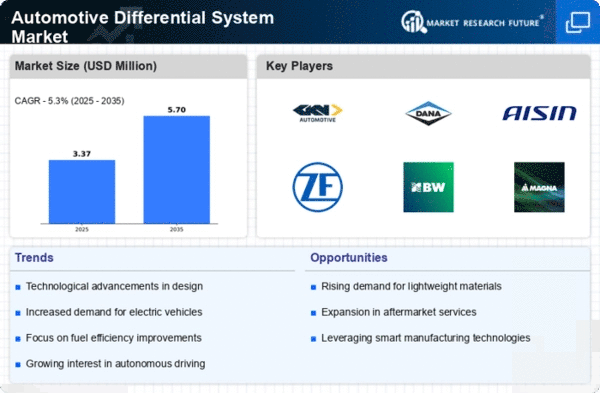
As per MRFR analysis, the Automotive Differential System Market Size was estimated at 3.2 USD Million in 2024. The Automotive Differential System industry is projected to grow from 3.4 in 2025 to 5.7 by 2035, exhibiting a compound annual growth rate (CAGR) of 5.3 during the forecast period 2025 - 2035.

Key Market Trends & Highlights

The Automotive Differential System Market is poised for substantial growth driven by technological advancements and increasing demand for sustainable solutions.

  • Technological advancements in differential systems are enhancing performance and efficiency across various vehicle types.
  • North America remains the largest market, while the Asia-Pacific region is recognized as the fastest-growing market for automotive differentials.
  • The passenger vehicle segment dominates the market, whereas the electric vehicle segment is experiencing rapid growth due to rising consumer interest.
  • Key market drivers include the integration of lightweight materials and the increasing demand for all-wheel drive systems, which are shaping the future of automotive differentials.

Market Size & Forecast

2024 Market Size 3.2 (USD Million)
2035 Market Size 5.7 (USD Million)
CAGR (2025 - 2035) 5.3%
Largest Regional Market Share in 2024 North America

Major Players

<p>GKN Automotive (GB), Dana Incorporated (US), Aisin Seiki Co., Ltd. (JP), ZF Friedrichshafen AG (DE), BorgWarner Inc. (US), Eaton Corporation (US), JTEKT Corporation (JP), Magna International Inc. (CA), American Axle & Manufacturing (US)</p>

Market Trends

The Automotive Differential System Market is currently experiencing a transformative phase, driven by advancements in technology and evolving consumer preferences. As vehicles become increasingly sophisticated, the demand for efficient and reliable differential systems has surged. This market encompasses various types of differentials, including open, limited-slip, and locking differentials, each serving distinct purposes in enhancing vehicle performance and safety. The integration of electric and hybrid vehicles into the automotive landscape further complicates the dynamics of this market, as manufacturers seek to optimize power distribution and traction control in these innovative models. Moreover, the growing emphasis on sustainability and fuel efficiency is influencing the design and functionality of differential systems. Manufacturers are exploring lightweight materials and innovative engineering solutions to reduce overall vehicle weight while maintaining performance standards. This trend aligns with the broader automotive industry's shift towards greener technologies, as stakeholders aim to meet stringent environmental regulations. As the Automotive Differential System Market continues to evolve, it appears poised for growth, with potential opportunities arising from the increasing adoption of autonomous driving technologies and smart vehicle systems. The interplay between traditional mechanical systems and emerging digital solutions may redefine the future landscape of this market.

Technological Advancements in Differential Systems

Recent innovations in automotive technology are reshaping the design and functionality of differential systems. Enhanced electronic control systems are being integrated, allowing for improved traction management and vehicle stability. This trend indicates a shift towards more sophisticated solutions that cater to the demands of modern driving conditions.

Sustainability and Lightweight Materials

The push for sustainability within the automotive sector is prompting manufacturers to explore lightweight materials for differential systems. This approach not only contributes to fuel efficiency but also aligns with environmental goals. The adoption of such materials may lead to a significant transformation in product offerings.

Integration with Electric and Hybrid Vehicles

As electric and hybrid vehicles gain traction in the market, the Automotive Differential System Market is adapting to meet new requirements. These vehicles necessitate unique differential solutions to optimize power distribution and enhance performance. This trend suggests a growing need for specialized products tailored to the evolving automotive landscape.

Automotive Differential System Market Market Drivers

Market Growth Projections

The Global Automotive Differential System Market Industry is poised for substantial growth, with projections indicating a market size of 22.6 USD Billion in 2024 and an expected increase to 36.4 USD Billion by 2035. This growth trajectory reflects a compound annual growth rate of 4.41% from 2025 to 2035, driven by various factors including technological advancements, regulatory changes, and evolving consumer preferences. The market's expansion is indicative of the automotive industry's response to the increasing demand for efficient and high-performance differential systems. As manufacturers adapt to these changes, the market is likely to witness significant innovations and enhancements in differential technologies.

Growing Demand for Electric Vehicles

The increasing adoption of electric vehicles (EVs) is a pivotal driver for the Global Automotive Differential System Market Industry. As manufacturers pivot towards electrification, the need for advanced differential systems that can efficiently manage torque distribution becomes paramount. This shift is evidenced by the projected market size of 22.6 USD Billion in 2024, reflecting the industry's response to evolving consumer preferences. EVs often require specialized differentials to optimize performance and enhance driving dynamics, thereby propelling innovation and investment in this sector. The integration of sophisticated differential systems in EVs could potentially redefine performance standards in the automotive landscape.

Regulatory Standards and Emission Norms

Stringent regulatory standards and emission norms are driving the Global Automotive Differential System Market Industry towards innovation and compliance. Governments worldwide are implementing more rigorous emissions regulations, compelling manufacturers to develop differential systems that contribute to lower vehicle emissions. This regulatory landscape encourages the adoption of technologies such as limited-slip differentials and electronic differentials, which can enhance vehicle efficiency. As the market evolves, the emphasis on meeting these standards is likely to spur growth, with projections indicating a compound annual growth rate of 4.41% from 2025 to 2035. Compliance with these regulations not only aids in reducing environmental impact but also enhances the marketability of vehicles.

Market Dynamics and Competitive Landscape

The competitive landscape of the Global Automotive Differential System Market Industry is characterized by dynamic market forces that influence innovation and pricing strategies. Major automotive manufacturers are increasingly collaborating with technology firms to develop cutting-edge differential solutions that meet evolving consumer demands. This competitive environment fosters a culture of innovation, leading to the introduction of new products and enhancements to existing systems. As the market continues to expand, driven by factors such as rising vehicle production and technological advancements, the interplay of competition and collaboration is likely to shape the future of differential systems. The anticipated growth trajectory suggests a robust market presence in the coming years.

Technological Advancements in Differential Systems

Technological innovation plays a crucial role in shaping the Global Automotive Differential System Market Industry. The introduction of advanced materials and manufacturing techniques has led to the development of lighter, more efficient differentials that enhance vehicle performance. For instance, the use of carbon fiber and advanced alloys can reduce weight while improving durability. These advancements not only contribute to better fuel efficiency but also align with global sustainability goals. As the market anticipates a growth trajectory towards 36.4 USD Billion by 2035, the continuous evolution of differential technology is likely to attract significant investment and research, fostering a competitive environment among manufacturers.

Rising Consumer Preferences for Performance Vehicles

The increasing consumer preference for performance-oriented vehicles is a significant driver of the Global Automotive Differential System Market Industry. Enthusiasts are seeking vehicles that offer superior handling, acceleration, and overall driving experience. This trend has led manufacturers to invest in high-performance differential systems that can deliver enhanced torque distribution and responsiveness. As a result, the market is witnessing a surge in demand for advanced differentials, such as active and electronic differentials, which can adapt to driving conditions in real-time. This shift in consumer behavior is expected to contribute to the market's growth, aligning with the anticipated increase in market size to 36.4 USD Billion by 2035.

Market Segment Insights

By Application: Passenger Vehicle (Largest) vs. Electric Vehicle (Fastest-Growing)

<p>In the Automotive Differential System Market, the application segment is primarily dominated by passenger vehicles, which capture a significant share due to their widespread use and consistent demand. These vehicles are equipped with advanced differential systems that enhance performance, safety, and fuel efficiency. Conversely, electric vehicles represent the fastest-growing segment in this market, driven by the increase in electric vehicle adoption worldwide and advancements in technology that streamline powertrain designs.</p>

<p>Passenger Vehicle (Dominant) vs. Electric Vehicle (Emerging)</p>

<p>Passenger vehicles play a crucial role in the Automotive Differential System Market, as they continually evolve with new technologies aimed at improving overall driving dynamics and efficiency. With features such as electronic control systems, they offer enhanced traction and stability, which are essential for consumer satisfaction. On the other hand, electric vehicles are emerging as a significant force in this segment, characterized by unique powertrain configurations that require innovative differential designs. This transitional phase underscores the shift towards sustainable mobility solutions, with electric vehicles leveraging advanced differential systems for optimized performance, ultimately capturing increasing market interest.</p>

By Type: Limited Slip Differential (Largest) vs. Electronic Differential (Fastest-Growing)

<p>In the Automotive Differential System Market, the segment distribution reveals that Limited Slip Differentials hold a significant share, preferred for their ability to enhance traction in various driving conditions. In contrast, Open Differentials offer basic functionality and have a diminished market presence as advanced options gain traction. Locking Differentials cater to off-road enthusiasts, while Electronic Differentials emerge as a specialized choice for high-performance vehicles, gradually capturing interest among consumers seeking innovation.</p>

<p>Differentials: Limited Slip (Dominant) vs. Electronic (Emerging)</p>

<p>Limited Slip Differentials (LSDs) are renowned for their superior torque distribution and enhanced traction control on diverse terrains, making them highly valued in both passenger and sports vehicles. Their reliability and performance under cornering conditions position them as the dominant choice among consumers who require efficiency and safety. On the other hand, Electronic Differentials represent an emerging trend, integrating smart technology to optimize performance dynamically. This segment is gaining momentum due to rising demands for automation in vehicle systems, reflecting a noteworthy shift toward sophisticated driving experiences that prioritize precision and adaptability.</p>

By Drive Type: Front Wheel Drive (Largest) vs. All Wheel Drive (Fastest-Growing)

<p>In the Automotive Differential System Market, the distribution of market share among various drive types reveals a significant preference for Front Wheel Drive (FWD) systems, particularly in sedans and compact vehicles, where they dominate due to their efficiency and cost-effectiveness. Rear Wheel Drive (RWD) systems maintain a stable presence, favored by sports cars and luxury vehicles for enhanced performance. In contrast, All Wheel Drive (AWD) systems are experiencing rapid adoption, especially in SUVs and crossovers, appealing to consumers seeking enhanced handling and safety in diverse driving conditions.</p>

<p>Rear Wheel Drive (Dominant) vs. Four Wheel Drive (Emerging)</p>

<p>Rear Wheel Drive (RWD) systems remain dominant in the automotive sector, particularly within high-performance and luxury segments. Their design characteristics allow for better weight distribution and handling, making them the choice for enthusiasts and drivers who prioritize driving dynamics. Conversely, Four Wheel Drive (4WD) systems serve as an emerging option, especially in off-road vehicles and trucks, where traction and stability are paramount. As off-road and adventure driving becomes more popular, the demand for 4WD systems is elevating, appealing to consumers who require robust performance in rugged terrains.</p>

By Component Type: Gear Set (Largest) vs. Differential Case (Fastest-Growing)

<p>In the Automotive Differential System Market, the Gear Set component dominates the segment with a significant market share. It is an essential part of the differential system, primarily used for torque conversion and enabling the vehicle to turn corners smoothly. Meanwhile, the Differential Case, while holding a smaller share, is recognized as the fastest-growing segment due to evolving vehicle designs and increasing performance requirements. As more manufacturers focus on enhancing vehicle engineering, the demand for advanced differential cases is on the rise. Market growth trends for the Component Type segment are largely driven by the constantly advancing automotive technology. The push for improved fuel efficiency and performance has made the Gear Set highly sought-after, while the rising popularity of electric and hybrid vehicles has contributed to the exponential growth of the Differential Case segment. As automakers adapt to the shift towards sustainability, the interplay of different component types is evolving, indicating a dynamic market landscape.</p>

<p>Gear Set (Dominant) vs. Differential Case (Emerging)</p>

<p>The Gear Set serves as the backbone of the automotive differential system, ensuring smooth transitions during vehicle operation. It is characterized by its design efficiency and durability, which are crucial for optimizing performance in various driving conditions. This component remains dominant in the market due to its critical role in power distribution across driven wheels. In contrast, the Differential Case is emerging as a key player in the evolving automotive landscape. With advancements aimed at reducing weight and enhancing strength, this component adapts to new design paradigms in modern vehicles. As manufacturers innovate, the Differential Case is seeing increased interest, reflecting a shift towards smarter, more efficient vehicle architectures.</p>

Get more detailed insights about Automotive Differential System Market Research Report – Global Forecast till 2035

Regional Insights

North America : Market Leader in Innovation

North America is poised to maintain its leadership in the automotive differential system market, holding a significant share of 1.6 in 2024. The region's growth is driven by increasing vehicle production, technological advancements, and a shift towards electric vehicles (EVs). Regulatory support for emissions reduction and fuel efficiency is further propelling demand for advanced differential systems that enhance vehicle performance and sustainability. The competitive landscape is robust, with key players like GKN Automotive, Dana Incorporated, and BorgWarner leading the charge. The U.S. and Canada are the primary markets, benefiting from strong automotive manufacturing bases and innovation hubs. The presence of major automotive OEMs and a growing focus on R&D in differential technologies are expected to sustain market growth in the coming years.

Europe : Emerging Market with Regulations

Europe's automotive differential system market is projected to grow, with a market size of 0.8 in 2024. The region is experiencing a surge in demand for advanced automotive technologies, driven by stringent regulations on emissions and safety standards. The European Union's commitment to reducing carbon emissions is fostering innovation in differential systems, particularly in hybrid and electric vehicles, which are gaining traction across member states. Leading countries such as Germany, France, and the UK are at the forefront of this market, hosting major manufacturers like ZF Friedrichshafen and Aisin Seiki. The competitive landscape is characterized by a mix of established players and emerging startups focusing on sustainable technologies. The presence of a well-developed automotive supply chain further enhances the region's market potential.

Asia-Pacific : Rapid Growth in Emerging Markets

Asia-Pacific is witnessing rapid growth in the automotive differential system market, with a size of 0.7 in 2024. The region's expansion is fueled by increasing vehicle ownership, urbanization, and rising disposable incomes. Countries like China and India are leading this growth, supported by government initiatives aimed at boosting the automotive sector and enhancing infrastructure. The demand for fuel-efficient and technologically advanced vehicles is driving the need for innovative differential systems. China stands out as a key player, with significant investments in electric vehicle technology and a growing automotive manufacturing base. Major companies like JTEKT Corporation and Magna International are actively expanding their operations in the region. The competitive landscape is evolving, with both domestic and international players vying for market share, indicating a promising future for the automotive differential system market in Asia-Pacific.

Middle East and Africa : Emerging Market Opportunities

The Middle East and Africa region is at the nascent stage of developing its automotive differential system market, with a size of 0.1 in 2024. The growth is primarily driven by increasing automotive sales and a burgeoning interest in local manufacturing. Governments in the region are implementing policies to promote automotive production, which is expected to stimulate demand for differential systems in the coming years. Countries like South Africa and the UAE are leading the charge, with investments in automotive infrastructure and manufacturing capabilities. The competitive landscape is still developing, with opportunities for both local and international players to establish a foothold. As the region continues to grow, the automotive differential system market is likely to see increased activity and investment.

Key Players and Competitive Insights

The Automotive Differential System Market is currently characterized by a dynamic competitive landscape, driven by technological advancements and increasing demand for efficient vehicle performance. Key players such as GKN Automotive (GB), Dana Incorporated (US), and ZF Friedrichshafen AG (DE) are strategically positioning themselves through innovation and partnerships. GKN Automotive (GB) focuses on developing advanced electric and hybrid vehicle differentials, which aligns with the growing trend towards electrification in the automotive sector. Meanwhile, Dana Incorporated (US) emphasizes its commitment to sustainability by enhancing its product offerings with lightweight materials and energy-efficient designs. ZF Friedrichshafen AG (DE) is actively pursuing digital transformation initiatives, integrating AI and IoT technologies into its differential systems to improve performance and reliability. Collectively, these strategies are shaping a competitive environment that prioritizes technological innovation and sustainability.

In terms of business tactics, companies are increasingly localizing manufacturing to reduce costs and enhance supply chain efficiency. The market structure appears moderately fragmented, with several key players exerting considerable influence. This fragmentation allows for a diverse range of products and innovations, fostering competition that drives advancements in technology and efficiency across the sector.

In November 2025, GKN Automotive (GB) announced a partnership with a leading electric vehicle manufacturer to co-develop next-generation differential systems tailored for electric drivetrains. This collaboration is strategically significant as it positions GKN at the forefront of the electrification trend, potentially enhancing its market share in the rapidly growing electric vehicle segment.

In October 2025, Dana Incorporated (US) unveiled its new line of lightweight differentials designed specifically for hybrid vehicles. This launch is crucial as it reflects Dana's proactive approach to meet the evolving demands of the automotive market, particularly in the context of increasing fuel efficiency regulations and consumer preferences for greener technologies.

In September 2025, ZF Friedrichshafen AG (DE) expanded its digital services portfolio by integrating advanced analytics into its differential systems. This move is indicative of ZF's commitment to leveraging data-driven insights to optimize performance and reliability, thereby enhancing customer satisfaction and operational efficiency.

As of December 2025, the competitive trends in the Automotive Differential System Market are increasingly defined by digitalization, sustainability, and AI integration. Strategic alliances are becoming more prevalent, as companies recognize the need to collaborate to innovate and meet market demands. Looking ahead, competitive differentiation is likely to evolve from traditional price-based competition to a focus on innovation, technology, and supply chain reliability, underscoring the importance of adaptability in a rapidly changing market.

Key Companies in the Automotive Differential System Market market include

Industry Developments

Eaton has designed an electronically controlled, scalable limited-slip differential that can be used on a variety of vehicle platforms to improve performance and driver safety.

Dana has introduced a new series of eight Spicer Torque-Hub drives, bringing the company's drive and motion solutions for crawler cranes and other big tracked vehicles to a wider audience. The new drives offer adjustable packaging and gear ratios to satisfy manufacturer requirements for tracked and wheeled applications, with torque ratings ranging from 80,000 N-m to 450,000 N-m.

GKN Automotive and Delta Electronics have announced a cooperative development of eDrive technology that will allow for the quick development of next-generation integrated 3-in-1 drive systems with power classes ranging from 80kW to 155kW.

Automotive Differential System Market Report Insights

The study on the Global Automotive Differential System Market includes thorough primary research. The report is prepared to acquire a better understanding of the market and industry performance, many industry experts and key opinion leaders conduct extensive qualitative and quantitative analyses. The study provides a thorough picture of the current market situation, including historical and projected market sizes in terms of value and volume, technical advancements, macroeconomic considerations, and market controlling factors. The research includes detailed information on the strategies of the industry's leading firms, as well as a thorough examination of the various market segments and geographies.

With recent technological advancements, the Automotive Differential market report covers present and next trends. The study will provide a thorough examination of numerous market segments based on vehicle, product, and drive type. It will be possible to see the market share of major connected car firms around the world.

Future Outlook

Automotive Differential System Market Future Outlook

<p>The Automotive Differential System Market is projected to grow at a 5.3% CAGR from 2024 to 2035, driven by technological advancements, increasing vehicle production, and demand for enhanced performance.</p>

New opportunities lie in:

  • <p>Development of electric vehicle-specific differential systems</p>
  • <p>Integration of smart differentials with IoT technology</p>
  • <p>Expansion into emerging markets with tailored product offerings</p>

<p>By 2035, the market is expected to achieve robust growth, reflecting evolving automotive technologies and consumer preferences.</p>

Market Segmentation

Automotive Differential System Market Type Outlook

  • Open Differential
  • Limited Slip Differential
  • Locking Differential
  • Electronic Differential

Automotive Differential System Market Drive Type Outlook

  • Front Wheel Drive
  • Rear Wheel Drive
  • All Wheel Drive
  • Four Wheel Drive

Automotive Differential System Market Application Outlook

  • Passenger Vehicle
  • Commercial Vehicle
  • Off-Road Vehicle
  • Electric Vehicle

Automotive Differential System Market Component Type Outlook

  • Gear Set
  • Differential Case
  • Axle Shaft
  • Bearing

Report Scope

MARKET SIZE 20243.2(USD Million)
MARKET SIZE 20253.4(USD Million)
MARKET SIZE 20355.7(USD Million)
COMPOUND ANNUAL GROWTH RATE (CAGR)5.3% (2024 - 2035)
REPORT COVERAGERevenue Forecast, Competitive Landscape, Growth Factors, and Trends
BASE YEAR2024
Market Forecast Period2025 - 2035
Historical Data2019 - 2024
Market Forecast UnitsUSD Million
Key Companies ProfiledGKN Automotive (GB), Dana Incorporated (US), Aisin Seiki Co., Ltd. (JP), ZF Friedrichshafen AG (DE), BorgWarner Inc. (US), Eaton Corporation (US), JTEKT Corporation (JP), Magna International Inc. (CA), American Axle & Manufacturing (US)
Segments CoveredApplication, Type, Drive Type, Component Type
Key Market OpportunitiesIntegration of advanced electronic control systems enhances performance in the Automotive Differential System Market.
Key Market DynamicsTechnological advancements in electric vehicles drive demand for innovative automotive differential systems and enhanced performance.
Countries CoveredNorth America, Europe, APAC, South America, MEA

FAQs

At what growth rate is the automotive differential system market evolving?

The global automotive differential system market is maturing at a moderate 4.63% CAGR over the review period of 2023 to 2032.

Who are the key participants of the automotive differential system market?

The key players of the automotive differential system market are ZF Friedrichshafen AG (Germany), BorgWarnerInc. (US), Eaton (Ireland), Schaeffler AG (Germany), JTEKT Corporation (Japan), GKN plc (UK), Dana Limited (US), neapco (US), DREXLER AUTOMOTIVE (Germany), and Powertrax (US).

On the basis of propulsion, the what are the segments of the automotive differential system market?

The segments of the automotive differential system market, by propulsion, are hybrid vehicles and ICE.

By type, what are the segments of the automotive differential system market?

The segments of the automotive differential system market, by type, are electronic limited slip differential, torque vectoring differential, open differential, locking differential, and limited slip differential.

What are the segments of the automotive differential system market on the basis of component?

By component, the automotive differential system market is segmented into differential bearing and differential gear differential case.

  1. Executive Summary
    1. Scope of the Report
    2. Market
    3. Definition
    4. Scope of the Study
      1. Research Objective
      2. Limitations
      3. Primary Research
    5. Definition
    6. Assumptions
    7. Research Process
    8. Secondary Research
    9. Market size Estimation
    10. Forecast Model
  2. Market Landscape
    1. Porter’s Five Forces Analysis
    2. New Entrants
    3. Threat of substitutes
    4. Bargaining Power of Buyers
    5. Chain Analysis
  3. Threat of
  4. Bargaining power of buyers
  5. Segment rivalry
    1. Value Chain/Supply
  6. Market Dynamics
    1. Introduction
    2. Market Drivers
    3. Market Restraints
    4. Market Opportunities
    5. Market
    6. Trends
  7. Global Automotive Differential Market, By Drive
    1. Type
    2. Introduction
    3. 2WD
      1. Market Estimates & Forecast, 2032-2032
      2. Market Estimates & Forecast, 2032-2032
      3. Market Estimates & Forecast by Region, 2032-2032
    4. Market Estimates & Forecast by Region, 2032-2032
    5. 4WD/AWD
  8. Global Automotive Differential Market, By Type
    1. Introduction
    2. Electronic Limited
      1. Market Estimates
      2. Market Estimates & Forecast
    3. Slip Differential (ELSD)
    4. & Forecast, 2032-2032
    5. by Region, 2032-2032
    6. Open Automotive Differential
      1. Market Estimates & Forecast, 2032-2032
      2. Market Estimates
      3. Market Estimates & Forecast
    7. Market Estimates & Forecast by Region, 2032-2032
    8. Torque Vectoring Differential
    9. & Forecast, 2032-2032
    10. by Region, 2032-2032
    11. Locking Differential
      1. Market
    12. Market Estimates & Forecast, 2032-2032
    13. Estimates & Forecast by Region, 2032-2032
    14. Others
      1. Market Estimates & Forecast, 2032-2032
    15. Market Estimates & Forecast by Region, 2032-2032
  9. Global Automotive Differential Market, By Component
    1. Introduction
    2. Automotive Differential Gear
      1. Market Estimates & Forecast, 2032-2032
      2. Market Estimates
      3. Market Estimates & Forecast
    3. Market Estimates & Forecast by Region, 2032-2032
    4. Automotive Differential Case
    5. & Forecast, 2032-2032
    6. by Region, 2032-2032
    7. Automotive Differential Bearing
      1. Market Estimates & Forecast, 2032-2032
    8. Market Estimates & Forecast by Region, 2032-2032
  10. Global Automotive Differential Market, By Vehicle Type
    1. Introduction
    2. Passenger car
      1. Market
    3. Market Estimates & Forecast, 2032-2032
    4. Estimates & Forecast by Region, 2032-2032
    5. Commercial
      1. Market Estimates & Forecast, 2032-2032
      2. Market Estimates & Forecast by Region, 2032-2032
    6. vehicle
    7. Truck
      1. Market Estimates
      2. Market Estimates & Forecast
    8. & Forecast, 2032-2032
    9. by Region, 2032-2032
    10. Bus
      1. Market
    11. Market Estimates & Forecast, 2032-2032
    12. Estimates & Forecast by Region, 2032-2032
    13. Off-Highway
      1. Market Estimates & Forecast, 2032-2032
      2. Market Estimates & Forecast by Region, 2032-2032
    14. vehicles
  11. Global Automotive Differential Market, By Propulsion
    1. Introduction
    2. ICE
      1. Market
    3. Market Estimates & Forecast, 2032-2032
    4. Estimates & Forecast by Region, 2032-2032
    5. Hybrid
      1. Market Estimates & Forecast, 2032-2032
      2. Market Estimates & Forecast by Region, 2032-2032
    6. Vehicles
  12. Global Automotive Differential Market, By Region
    1. Introduction
    2. North America
      1. Market
      2. Market
      3. Market
      4. Market
      5. Market
      6. U.S.
    3. Market Estimates & Forecast, 2032-2032
    4. Estimates & Forecast by Drive Type, 2032-2032
    5. Estimates & Forecast by Type, 2032-2032
    6. Estimates & Forecast by Component, 2032-2032
    7. Estimates & Forecast by Vehicle Type, 2032-2032
    8. Estimates & Forecast by Propulsion, 2032-2032
    9. Market Estimates & Forecast by Drive Type, 2032-2032
    10. Market Estimates & Forecast by Type, 2032-2032
    11. Market Estimates & Forecast by Component, 2032-2032
    12. Market Estimates & Forecast by Vehicle Type, 2032-2032
    13. Market Estimates & Forecast by Propulsion, 2032-2032
    14. Canada
    15. Drive Type, 2032-2032
    16. by Type, 2032-2032
    17. by Component, 2032-2032
    18. Forecast by Vehicle Type, 2032-2032
    19. & Forecast by Propulsion, 2032-2032
    20. Europe
      1. Market Estimates & Forecast by Drive Type, 2032-2032
      2. Market Estimates & Forecast by Type, 2032-2032
      3. Market Estimates & Forecast by Component, 2032-2032
      4. Market Estimates & Forecast by Vehicle Type, 2032-2032
      5. Market Estimates & Forecast by Propulsion,
      6. U.K.
      7. France
      8. Italy
    21. Estimates & Forecast by Drive Type, 2032-2032
    22. Estimates & Forecast by Type, 2032-2032
    23. Estimates & Forecast by Component, 2032-2032
    24. Estimates & Forecast by Vehicle Type, 2032-2032
    25. Estimates & Forecast by Propulsion, 2032-2032
    26. Germany
    27. Drive Type, 2032-2032
    28. by Type, 2032-2032
    29. by Component, 2032-2032
    30. Forecast by Vehicle Type, 2032-2032
    31. & Forecast by Propulsion, 2032-2032
    32. Estimates & Forecast by Drive Type, 2032-2032
    33. Estimates & Forecast by Type, 2032-2032
    34. Estimates & Forecast by Component, 2032-2032
    35. Estimates & Forecast by Vehicle Type, 2032-2032
    36. Estimates & Forecast by Propulsion, 2032-2032
    37. Rest of Europe
    38. by Drive Type, 2032-2032
    39. Forecast by Type, 2032-2032
    40. Forecast by Component, 2032-2032
    41. & Forecast by Vehicle Type, 2032-2032
    42. Estimates & Forecast by Propulsion, 2032-2032
    43. Asia-Pacific
      1. Market Estimates & Forecast by Drive Type, 2032-2032
      2. Market Estimates & Forecast by Type, 2032-2032
      3. Market Estimates & Forecast by Component, 2032-2032
      4. Market Estimates & Forecast by Vehicle Type, 2032-2032
      5. Market Estimates & Forecast by Propulsion,
      6. China
      7. India
      8. Rest of Asia-Pacific
      9. Market Estimates & Forecast
      10. Market Estimates & Forecast
      11. Market Estimates & Forecast
      12. Market Estimates & Forecast
      13. Market Estimates &
    44. Estimates & Forecast by Drive Type, 2032-2032
    45. Estimates & Forecast by Type, 2032-2032
    46. Estimates & Forecast by Component, 2032-2032
    47. Estimates & Forecast by Vehicle Type, 2032-2032
    48. Estimates & Forecast by Propulsion, 2032-2032
    49. Japan
    50. Drive Type, 2032-2032
    51. by Type, 2032-2032
    52. by Component, 2032-2032
    53. Forecast by Vehicle Type, 2032-2032
    54. & Forecast by Propulsion, 2032-2032
    55. Market Estimates & Forecast by Drive Type, 2032-2032
    56. Market Estimates & Forecast by Type, 2032-2032
    57. Market Estimates & Forecast by Component, 2032-2032
    58. Market Estimates & Forecast by Vehicle Type, 2032-2032
    59. Market Estimates & Forecast by Propulsion, 2032-2032
    60. Rest of the World
    61. by Drive Type, 2032-2032
    62. by Type, 2032-2032
    63. by Component, 2032-2032
    64. by Vehicle Type, 2032-2032
    65. Forecast by Propulsion, 2032-2032
  13. Competitive
    1. Landscape
  14. Company Profile
    1. ZF
      1. Company Overview
      2. Financial Overview
      3. Key Developments
      4. Strategy
      5. SWOT Analysis
    2. Friedrichshafen AG(Germany)
    3. Products/Services Offering
    4. Eaton(Ireland)
      1. Company Overview
      2. Products/Services
      3. Financial Overview
      4. Strategy
    5. Offering
    6. Key Developments
    7. SWOT Analysis
    8. BorgWarnerInc.(US)
      1. Products/Services Offering
      2. Financial Overview
      3. Key
      4. Strategy
      5. SWOT
    9. Company Overview
    10. Developments
    11. Analysis
    12. Schaeffler AG(Germany)
      1. Products/Services Offering
      2. Financial Overview
      3. Key
      4. Strategy
      5. SWOT
    13. Company Overview
    14. Developments
    15. Analysis
    16. GKN plc(UK)
      1. Company
      2. Products/Services Offering
      3. Key Developments
      4. SWOT Analysis
      5. Company Overview
      6. Products/Services Offering
      7. Key Developments
      8. SWOT Analysis
      9. Company Overview
      10. Financial Overview
      11. Key Developments
      12. Strategy
      13. SWOT Analysis
    17. Overview
    18. Financial Overview
    19. Strategy
    20. JTEKT Corporation(Japan)
    21. Financial Overview
    22. Strategy
    23. Dana Limited (US)
    24. Products/Services Offering
    25. DREXLER AUTOMOTIVE
      1. Company Overview
      2. Financial Overview
      3. Key Developments
      4. Strategy
      5. SWOT Analysis
    26. (Germany)
    27. Products/Services Offering
    28. neapco (US)
      1. Company Overview
      2. Products/Services
      3. Financial Overview
      4. Strategy
    29. Offering
    30. Key Developments
    31. SWOT Analysis
    32. Powertrax (US)
      1. Products/Services Offering
      2. Financial Overview
      3. Key
      4. Strategy
    33. Company Overview
    34. Developments
    35. SWOT Analysis 
    36. List of Tables
  15. Global Automotive Differential Market:
    1. By Region, 2032-2032
  16. North
    1. America: Automotive Differential Market: By Country, 2032-2032
    2. Table
  17. Europe Automotive Differential Market: By
    1. Country, 2032-2032
  18. Asia-Pacific
    1. Automotive Differential Market: By Country, 2032-2032
    2. Table 5
    3. RoW Automotive Differential Market: By Country, 2032-2032
  19. Global Automotive Differential
  20. Market, By Drive Type, By Regions, 2032-2032
    1. Table 7
  21. North America: Automotive Differential Market, By Drive Type, By Country,
  22. Europe Automotive
  23. Differential Market, By Drive Type, By Country, 2032-2032
    1. Table 9
    2. Asia-Pacific Automotive Differential Market by Drive Type,
    3. By Country, 2032-2032
  24. RoW Automotive Differential
  25. Market by Drive Type, By Country, 2032-2032
  26. Global
    1. Automotive Differential by Type Market: By Regions, 2032-2032
    2. Table
  27. North America: Automotive Differential Market by Type: By Country,
  28. Europe Automotive Differential
    1. Market by Type: By Country, 2032-2032
  29. Asia-Pacific
    1. Automotive Differential Market by Type: By Country, 2032-2032
    2. Table
  30. RoW Automotive Differential Market by Type: By Country, 2032-2032
  31. Global Automotive Differential by Component
    1. Market: By Regions, 2032-2032
  32. North America:
    1. Automotive Differential Market by Component: By Country, 2032-2032
    2. Table
  33. Europe Automotive Differential Market by Component: By Country,
  34. Asia-Pacific Automotive Differential
    1. Market by Component: By Country, 2032-2032
  35. RoW
    1. Automotive Differential Market by Vehicle Type: By Country, 2032-2032
  36. Global Automotive Differential by Vehicle Type Market:
    1. By Regions, 2032-2032
  37. North America: Automotive
    1. Differential Market by Vehicle Type: By Country, 2032-2032
    2. Table 23
    3. Europe Automotive Differential Market by Vehicle Type: By Country, 2032-2032
  38. Asia-Pacific Automotive Differential Market
    1. by Vehicle Type: By Country, 2032-2032
  39. RoW
    1. Automotive Differential Market by Vehicle Type: By Country, 2032-2032
  40. Global Automotive Differential by Vehicle Type Market:
    1. By Regions, 2032-2032
  41. North America: Automotive
    1. Differential Market by Propulsion: By Country, 2032-2032
    2. Table 28
    3. Europe Automotive Differential Market by Propulsion: By Country, 2032-2032
  42. Asia-Pacific Automotive Differential Market
    1. by Propulsion: By Country, 2032-2032
  43. RoW
    1. Automotive Differential Market by Propulsion: By Country, 2032-2032
    2. Table 31
    3. Global Automotive Differential Market: By Region, 2032-2032
    4. Table
  44. Global Automotive Differential Market: By Drive Type, 2032-2032
  45. Global Automotive Differential Market: By
    1. Type, 2032-2032
  46. Global Automotive Differential
    1. Market: By Component, 2032-2032
  47. Global Automotive
    1. Differential Market: By Vehicle Type, 2032-2032
    2. Table 36
    3. Global Automotive Differential Market: By Propulsion, 2032-2032
  48. North America: Automotive Differential Market, By Country
  49. North America: Automotive Differential Market,
    1. By Drive Type
  50. North America: Automotive Differential
  51. Market, By Type
  52. North America: Automotive
  53. Differential Market, By Component
    1. Table41
    2. Global Automotive Differential Market: By Vehicle Type, 2032-2032
  54. Global Automotive Differential Market: By Propulsion,
  55. Europe: Automotive Differential
  56. Market, By Country
  57. Europe: Automotive
  58. Differential Market, By Drive Type
  59. Europe:
  60. Automotive Differential Market, By Type
  61. Europe:
  62. Automotive Differential Market, By Component
    1. Table 47
    2. Global Automotive Differential Market: By Vehicle Type, 2032-2032
  63. Global Automotive Differential Market: By Propulsion,
  64. Asia-Pacific: Automotive
  65. Differential Market, By Country
  66. Asia-Pacific:
  67. Automotive Differential Market, By Drive Type
    1. Table 51
  68. Asia-Pacific: Automotive Differential Market, By Type
    1. Table 52
  69. Asia-Pacific: Automotive Differential Market, By Component
    1. Table
  70. Global Automotive Differential Market: By Vehicle Type, 2032-2032
  71. Global Automotive Differential Market: By
    1. Propulsion, 2032-2032
  72. RoW: Automotive
  73. Differential Market, By Region
  74. RoW Automotive Differential
  75. Market, By Drive Type
  76. RoW Automotive Differential
  77. Market, By Type
  78. RoW Automotive Differential
  79. Market, By Component
    1. Table59 Global Automotive
    2. Differential Market: By Vehicle Type, 2032-2032
    3. Table 60
    4. Global Automotive Differential Market: By Propulsion, 2032-2032  
    5. List of Figures
  80. Research Process of MRFR
  81. Top-down & Bottom-up Approach
    1. FIGURE 3
    2. Market Dynamics
  82. impact analysis: market drivers
  83. impact analysis: market restraints
    1. FIGURE 6
    2. Porter's five forces analysis
  84. Value chain
    1. analysis
  85. Global Automotive Differential Market Share,
    1. By Drive Type, 2017 (%)
  86. Global Automotive Differential
  87. Market, By Drive Type, 2032-2032 (USD MILLION)
  88. Global
  89. Automotive Differential Market Share, By Type, 2017 (%)
    1. FIGURE 11
  90. Global Automotive Differential Market, By Type, 2032-2032 (USD MILLION)
  91. Global Automotive Differential Market Share, By Component,
  92. Global Automotive Differential Market,
    1. By Component, 2032-2032 (USD MILLION)
  93. Global Automotive
  94. Differential Market Share, By Vehicle Type, 2017 (%)
    1. FIGURE 15
  95. Global Automotive Differential Market, By Vehicle Type, 2032-2032 (USD MILLION
  96. `Global Automotive Differential Market, By Propulsion,
  97. Global Automotive Differential
  98. Market, By Propulsion, 2032-2032 (USD MILLION
  99. Global
  100. Automotive Differential Market Share (%), BY REGION, 2017
    1. FIGURE 19
  101. Global Automotive Differential Market, BY REGION, 2032-2032 (USD MILLION)
  102. North America: Automotive Differential Market SHARE
    1. (%), 2017
  103. North America: Automotive Differential
    1. Market BY Country, 2032-2032 (USD MILLION)
  104. Europe
    1. Automotive Differential Market SHARE (%), 2017
  105. Europe
    1. Automotive Differential Market BY Country, 2032-2032 (USD MILLION)
    2. FIGURE 24
    3. Asia-Pacific Automotive Differential Market SHARE (%), 2017
    4. FIGURE 25
    5. Asia-Pacific Automotive Differential Market BY Country, 2032-2032 (USD MILLION)
  106. Rest of the World Automotive Differential Market SHARE
    1. (%), 2017
  107. Rest of the World Automotive Differential
    1. Market BY Country, 2032-2032 (USD MILLION)

Automotive Differential System Market Segmentation

Market Segmentation Overview

  • Detailed segmentation data will be available in the full report
  • Comprehensive analysis by multiple parameters
  • Regional and country-level breakdowns
  • Market size forecasts by segment
Infographic

Free Sample Request

Kindly complete the form below to receive a free sample of this Report

Get Free Sample

Customer Strories

Compare Licence

×
Features License Type
Single User Multiuser License Enterprise User
Price $4,950 $5,950 $7,250
Maximum User Access Limit 1 User Upto 10 Users Unrestricted Access Throughout the Organization
Free Customization
Direct Access to Analyst
Deliverable Format
Platform Access
Discount on Next Purchase 10% 15% 15%
Printable Versions