×
Hero Background
English
Chinese
French
Japanese
Korean
German
Spanish

Automotive Cooler Market Analysis

ID: MRFR/AT/2611-HCR
110 Pages
Swapnil Palwe
October 2025

Automotive Cooler Market Research Report Information By Type (Plate and Fin and Tube and Fin), Vehicle Type (Passenger Car and Commercial Vehicle), Application (Engine Cooler, HVAC Cooler, Brake Lubricant, and Other), and Region (North America, Europe, Asia-Pacific, and Rest of the World), Forecast till 2035

Share:
Download PDF ×

We do not share your information with anyone. However, we may send you emails based on your report interest from time to time. You may contact us at any time to opt-out.

Automotive Cooler Market Infographic
Purchase Options

Market Analysis

In-depth Analysis of Automotive Cooler Market Industry Landscape

The Automotive Cooler market is subject to various market factors that significantly influence its dynamics. One crucial determinant is the automotive industry's overall health, which is closely tied to economic conditions. When the economy is thriving, consumer confidence is high, leading to increased vehicle sales. As more cars hit the roads, there is a proportional surge in demand for automotive coolers to regulate engine temperature and ensure optimal performance. Conversely, during economic downturns, reduced consumer spending on vehicles can impact the automotive cooler market negatively.

Technological advancements in automotive engineering play a pivotal role in shaping the Automotive Cooler market. As the industry embraces innovations, vehicles become more sophisticated and efficient. This trend translates into a demand for advanced cooling systems that can effectively manage the increased thermal loads generated by modern engines. Market players invest heavily in research and development to stay ahead in this competitive landscape, contributing to the evolution of automotive cooler technologies.

Government regulations and environmental standards are significant factors influencing the Automotive Cooler market. Stringent emission regulations drive automakers to design more fuel-efficient vehicles, often requiring enhanced cooling systems. Additionally, safety standards mandate effective cooling solutions to prevent engine overheating and subsequent malfunctions. Compliance with these regulations shapes the demand for automotive coolers and encourages the development of eco-friendly, energy-efficient cooling technologies.

Climate conditions also impact the Automotive Cooler market. In regions with extreme temperatures, vehicles experience heightened stress on their cooling systems. High ambient temperatures can strain engines, necessitating efficient cooling solutions. On the other hand, in colder climates, automotive coolers play a crucial role in maintaining optimal operating temperatures for engines. The market adapts to these climatic variations, with manufacturers offering cooling solutions tailored to specific environmental challenges.

Market competition is a driving force in the Automotive Cooler industry. With numerous players vying for market share, competition fosters innovation, quality improvements, and cost-effective manufacturing. Key market players often engage in a race to introduce cutting-edge technologies, aiming to capture the attention of automakers and gain a competitive edge. This constant push for excellence benefits the market by offering consumers a range of high-performance and cost-effective automotive cooling solutions.

Consumer preferences and trends also shape the Automotive Cooler market. As consumers increasingly prioritize fuel efficiency, sustainability, and overall vehicle performance, the demand for advanced cooling systems rises. Additionally, the growing popularity of electric vehicles presents new challenges and opportunities for the market, as these vehicles require effective thermal management to ensure battery performance and longevity.

Global economic factors, such as currency exchange rates and trade policies, influence the Automotive Cooler market. Fluctuations in currency values can impact manufacturing costs and, subsequently, product pricing. Trade policies, tariffs, and international relations can affect the supply chain and market accessibility for automotive cooler manufacturers, requiring strategic adaptation to changing geopolitical landscapes.

In conclusion, the Automotive Cooler market is a dynamic and multifaceted sector influenced by a combination of economic, technological, regulatory, environmental, and consumer-driven factors. The interplay of these elements shapes the demand for automotive cooling solutions, prompting industry players to adapt and innovate to meet the evolving needs of the automotive sector. As vehicles continue to evolve and consumer expectations shift, the Automotive Cooler market remains at the forefront of providing critical components for optimal vehicle performance and longevity.

Author
Swapnil Palwe
Team Lead - Research

With a technical background as Bachelor's in Mechanical Engineering, with MBA in Operations Management , Swapnil has 6+ years of experience in market research, consulting and analytics with the tasks of data mining, analysis, and project execution. He is the POC for our clients, for their consulting projects running under the Automotive/A&D domain. Swapnil has worked on major projects in verticals such as Aerospace & Defense, Automotive and many other domain projects. He has worked on projects for fortune 500 companies' syndicate and consulting projects along with several government projects.

Leave a Comment

FAQs

What are the elements contributing to the momentum of the automotive cooler market?

The intensification in demand for high-speed vehicles is anticipated to influence the market significantly.

What is the CAGR anticipated to be detected in the automotive cooler market?

A 11.1% CAGR is predicted to be witnessed by the market.

What revenues are predicted to be seen in the global automotive cooler market?

An income of USD 8523.45 million by 2032 is estimated for the market.

Who are the adversaries in the automotive cooler market?

Calsonic Kansei Corporation (Japan), Gallay Ltd (England), Hayden Automotive (US), Shandong Yuean Chemical Industry Co. Ltd (China), and NENGUN CO. LTD (Japan) are the opponents in the market.

Which regions are expected to acquire prominence in the global automotive cooler market?

The increased sales volume of cars like SUVs is expected to spur the market in the APAC region.

Market Summary

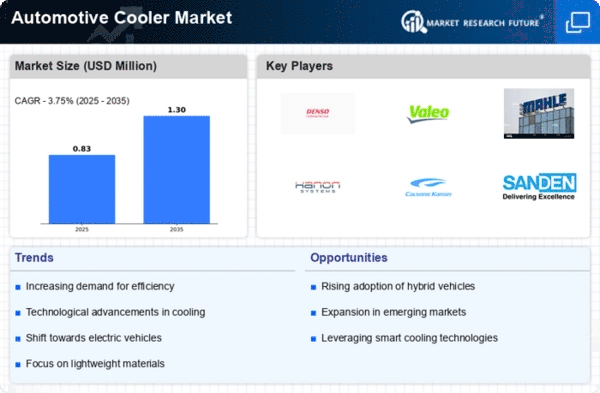
The Global Automotive Cooler Market is projected to grow from 5.44 USD Billion in 2024 to 11.7 USD Billion by 2035, reflecting a robust growth trajectory.

Key Market Trends & Highlights

Automotive Cooler Market Key Trends and Highlights

  • The market is expected to achieve a compound annual growth rate (CAGR) of 7.2 percent from 2025 to 2035. By 2035, the market valuation is anticipated to reach 11.7 USD Billion, indicating substantial growth opportunities. In 2024, the market is valued at 5.44 USD Billion, highlighting its current significance in the automotive sector. Growing adoption of advanced cooling technologies due to increasing vehicle performance requirements is a major market driver.

Market Size & Forecast

2024 Market Size 5.44 (USD Million)
2035 Market Size 11.7 (USD Million)
CAGR (2025-2035) 7.2%
Largest Regional Market Share in 2024 south_america)

Major Players

<p>Calsonic Kansei Corporation, Denso Corporation, Dana Incorporated, Hanon Systems, Mahle GmbH, T.RAD Co., Ltd., Valeo Group</p>

Market Trends

Automotive Cooler Market Market Drivers

Market Growth Projections

The Global Automotive Cooler Market Industry is poised for substantial growth, with projections indicating a market size of 5.44 USD Billion in 2024 and an anticipated increase to 11.7 USD Billion by 2035. This growth trajectory suggests a compound annual growth rate (CAGR) of 7.2% from 2025 to 2035. The expansion is driven by various factors, including the rising demand for electric vehicles, stringent emission regulations, and technological advancements in cooling systems. As the automotive industry evolves, the need for efficient cooling solutions will become increasingly critical, positioning the automotive cooler market for robust growth in the coming years.

Stringent Emission Regulations

Stringent emission regulations imposed by governments worldwide are significantly influencing the Global Automotive Cooler Market Industry. These regulations compel automotive manufacturers to adopt advanced cooling systems that ensure optimal engine performance while minimizing emissions. As a result, there is a growing need for efficient automotive coolers that can maintain engine temperatures within specified limits. This regulatory pressure is expected to contribute to a compound annual growth rate (CAGR) of 7.2% from 2025 to 2035. The focus on sustainability and compliance with environmental standards is likely to drive innovation in cooling technologies, further propelling market growth.

Growth of the Automotive Industry

The overall growth of the automotive industry is a crucial driver for the Global Automotive Cooler Market Industry. As global vehicle production increases, the demand for automotive coolers is likely to rise in tandem. The automotive sector is experiencing a resurgence, with manufacturers ramping up production to meet consumer demand. This growth is projected to contribute to a market size of 5.44 USD Billion in 2024, with expectations of reaching 11.7 USD Billion by 2035. The expansion of automotive production facilities and the introduction of new vehicle models are anticipated to further stimulate demand for efficient cooling solutions, thereby benefiting the automotive cooler market.

Rising Demand for Electric Vehicles

The increasing adoption of electric vehicles (EVs) is a pivotal driver for the Global Automotive Cooler Market Industry. As manufacturers strive to enhance the efficiency and performance of EVs, the need for advanced cooling systems becomes paramount. In 2024, the market is projected to reach 5.44 USD Billion, largely fueled by the growing emphasis on thermal management solutions. This trend is expected to continue, with the market potentially expanding to 11.7 USD Billion by 2035. The integration of innovative cooling technologies in EVs not only improves battery life but also enhances overall vehicle performance, thereby driving demand in the automotive cooler segment.

Technological Advancements in Cooling Systems

Technological advancements in cooling systems are reshaping the Global Automotive Cooler Market Industry. Innovations such as variable speed fans, enhanced heat exchangers, and advanced materials are improving the efficiency and effectiveness of automotive coolers. These advancements not only enhance vehicle performance but also contribute to fuel efficiency and reduced emissions. As automotive manufacturers increasingly prioritize performance and sustainability, the demand for state-of-the-art cooling solutions is expected to rise. This trend aligns with the projected market growth, with estimates indicating a market size of 11.7 USD Billion by 2035, reflecting the impact of these technological developments.

Increasing Consumer Awareness of Vehicle Performance

Increasing consumer awareness regarding vehicle performance and efficiency is driving demand in the Global Automotive Cooler Market Industry. Consumers are becoming more informed about the importance of effective cooling systems in enhancing vehicle longevity and performance. This awareness is prompting manufacturers to invest in advanced cooling technologies that meet consumer expectations for high-performance vehicles. As a result, the market is likely to experience a compound annual growth rate (CAGR) of 7.2% from 2025 to 2035. The shift in consumer preferences towards vehicles with superior cooling capabilities is expected to significantly influence market dynamics.

Market Segment Insights

Get more detailed insights about Automotive Cooler Market Research Report - Global Forecast till 2035

Regional Insights

Key Companies in the Automotive Cooler Market market include

Industry Developments

In July 2020, MAHLE GmbH finished the securing of Behr Hella Service. The securing was embraced to supplement the organization's Aftermarket item range. MAHLE is relied upon to keep dealing with the warm administration business of Behr Hella Service all alone later on. Accordingly, the organization is relied upon adjusting its Aftermarket business reliably with solid unique gear skills, especially in lighting and gadgets.

Future Outlook

Automotive Cooler Market Future Outlook

<p>The Automotive Cooler Market is projected to grow at a 7.2% CAGR from 2024 to 2035, driven by advancements in thermal management and increasing vehicle electrification.</p>

New opportunities lie in:

  • <p>Develop lightweight materials for automotive coolers to enhance fuel efficiency. Invest in smart cooling technologies integrating IoT for real-time performance monitoring. Expand product lines to cater to electric vehicle cooling requirements.</p>

<p>By 2035, the Automotive Cooler Market is expected to achieve substantial growth, reflecting evolving automotive technologies and consumer demands.</p>

Market Segmentation

Automotive Cooler Market Market Dynamics:

  • Major drivers of automotive cooler market:
  • Significant Opportunities for the market: 
  • Market Restraints:
  • Major Challenges of the Market:

Automotive Cooler Market Report overview:

  • Automotive Cooler Market manufacturers
  • distributors
  • and suppliers
  • Market research and consulting firm
  • Investors/shareholders
  • Government and industry associations
  • Raw material suppliers
  • State or government-owned corporations
  • State and national regulatory authorities
  • Research organizations

Automotive Cooler Market Segment Overview:

  • As per type:
  • As per position:
  • As per design:
  • As per fuel type:
  • As per material:
  • As per sales channel:
  • As per region:

Report Scope

Attribute/Metric Details
Market Size 2021:   USD 4723.87 Million
Market Size 2032:   USD 8523.45 Million
  CAGR   11.1% CAGR (2023-2032)
  Base Year   2022
  Forecast Period   2023-2032
  Historical Data   2018- 2022
  Forecast Units   Value (USD Billion)
  Report Coverage   Revenue Forecast, Competitive Landscape, Growth Factors, and Trends
  Segments Covered   Type, Vehicle Type, Application
  Geographies Covered   North America, Europe, Asia-Pacific, and Rest of the World (RoW)
  Key Vendors   BP P.L.C.(UK), Chevron Corporation (US), Cummins Filtration (US), Shandong Yuean Chemical Industry Co. Ltd (China), Gallay Ltd (England), Hayden Automotive (US), NENGUN CO. LTD (Japan), Calsonic Kansei Corporation (Japan), AKG Thermotechnik International GmbH & Co. KG (Germany), and Modine Manufacturing (US)
  Key Market Opportunities   Increasing demand for high speed vehicles, stringent vehicle emission norms
  Key Market Drivers ·  Growing need of passenger comfort, and deployment of HVAC system in vehicles ·  Growing demand for electric vehicles, and emergence of new products in automobiles are providing ·  Growing sales of electric vehicles globally

FAQs

What are the elements contributing to the momentum of the automotive cooler market?

The intensification in demand for high-speed vehicles is anticipated to influence the market significantly.

What is the CAGR anticipated to be detected in the automotive cooler market?

A 11.1% CAGR is predicted to be witnessed by the market.

What revenues are predicted to be seen in the global automotive cooler market?

An income of USD 8523.45 million by 2032 is estimated for the market.

Who are the adversaries in the automotive cooler market?

Calsonic Kansei Corporation (Japan), Gallay Ltd (England), Hayden Automotive (US), Shandong Yuean Chemical Industry Co. Ltd (China), and NENGUN CO. LTD (Japan) are the opponents in the market.

Which regions are expected to acquire prominence in the global automotive cooler market?

The increased sales volume of cars like SUVs is expected to spur the market in the APAC region.

  1. Executive Summary
  2. Scope of the Report
    1. Market Definition
    2. Scope of the Study
      1. Definition
      2. Research Objective
      3. Assumptions
      4. Limitations
    3. Research Process
      1. Primary Research
      2. Secondary Research
    4. Market Size Estimation
    5. Forecast Application
  3. Market Landscape
    1. Porter’s Five Forces Analysis
      1. Threat of New Entrants
      2. Bargaining Power of Buyers
      3. Threat of Substitutes
      4. Rivalry
      5. Bargaining Power of Buyers
    2. Value Chain/Supply Chain Analysis
  4. Market Dynamics
    1. Introduction
    2. Market Drivers
    3. Market Restraints
    4. Market Opportunities
    5. Market Trends
  5. Global Automotive Cooler Market, by Type
    1. Introduction
    2. Plate and Fin
      1. Market Estimates & Forecast, 2023-2032
      2. Market Estimates & Forecast, by Region, 2023-2032
    3. Electric Automotive Cooler
      1. Market Estimates & Forecast, 2023-2032
      2. Market Estimates & Forecast, by Region, 2023-2032
    4. Tube and Fin
      1. Market Estimates & Forecast, 2023-2032
      2. Market Estimates & Forecast, by Region, 2023-2032
  6. Global Automotive Cooler Market, by Vehicle Type
    1. Introduction
    2. Passenger Car
      1. Market Estimates & Forecast, 2023-2032
      2. Market Estimates & Forecast, by Region, 2023-2032
    3. Commercial Vehicle
      1. Market Estimates & Forecast, 2023-2032
      2. Market Estimates & Forecast, by Region, 2023-2032
  7. Global Automotive Cooler Market, by Application
    1. Introduction
    2. Engine Cooler
      1. Market Estimates & Forecast, 2023-2032
      2. Market Estimates & Forecast, by Region, 2023-2032
    3. HVAC Cooler
      1. Market Estimates & Forecast, 2023-2032
      2. Market Estimates & Forecast, by Region, 2023-2032
    4. Brake Lubricant
      1. Market Estimates & Forecast, 2023-2032
      2. Market Estimates & Forecast, by Region, 2023-2032
    5. Others
      1. Market Estimates & Forecast, 2023-2032
      2. Market Estimates & Forecast, by Region, 2023-2032
  8. Global Automotive Cooler Market, by Region
    1. Introduction
    2. North America
      1. Market Estimates & Forecast, by Country, 2023-2032
      2. Market Estimates & Forecast, by Type, 2023-2032
      3. Market Estimates & Forecast, by Application, 2023-2032
      4. Market Estimates & Forecast, by Vehicle Type, 2023-2032
      5. US
      6. Canada
    3. Europe
      1. Market Estimates & Forecast, by Country, 2023-2032
      2. Market Estimates & Forecast, by Type, 2023-2032
      3. Market Estimates & Forecast, by Application, 2023-2032
      4. Market Estimates & Forecast, by Vehicle Type, 2023-2032
      5. UK
      6. Germany
      7. France
      8. Italy
      9. Rest of Europe
    4. Asia-Pacific
      1. Market Estimates & Forecast, by Country, 2023-2032
      2. Market Estimates & Forecast, by Type, 2023-2032
      3. Market Estimates & Forecast, by Application, 2023-2032
      4. Market Estimates & Forecast, by Vehicle Type, 2023-2032
      5. China
      6. Japan
      7. India
      8. Rest of Asia-Pacific
    5. RoW
      1. Market Estimates & Forecast, by Region, 2023-2032
      2. Market Estimates & Forecast, by Type, 2023-2032
      3. Market Estimates & Forecast, by Application, 2023-2032
      4. Market Estimates & Forecast, by Vehicle Type, 2023-2032
      5. Middle East & Africa
      6. South America
  9. Competitive Landscape
  10. Company Profiles
    1. BP P.L.C.
      1. Company Overview
      2. Products/Services Offered
      3. Financial Overview
      4. Key Developments
      5. Key Strategies
      6. SWOT Analysis
    2. Chevron Corporation
      1. Company Overview
      2. Products/Services Offered
      3. Financial Overview
      4. Key Developments
      5. Key Strategies
      6. SWOT Analysis
    3. Cummins Filtration
      1. Company Overview
      2. Products/Services Offered
      3. Financial Overview
      4. Key Developments
      5. Key Strategies
      6. SWOT Analysis
    4. Shandong Yuean Chemical Industry Co. Ltd.
      1. Company Overview
      2. Products/Services Offered
      3. Financial Overview
      4. Key Developments
      5. Key Strategies
      6. SWOT Analysis
    5. Gallay Ltd.
      1. Company Overview
      2. Products/Services Offered
      3. Financial Overview
      4. Key Developments
      5. Key Strategies
      6. SWOT Analysis
    6. Hayden Automotive
      1. Company Overview
      2. Products/Services Offered
      3. Financial Overview
      4. Key Developments
      5. Key Strategies
      6. SWOT Analysis
    7. NENGUN CO. LTD
      1. Company Overview
      2. Products/Services Offered
      3. Financial Overview
      4. Key Developments
      5. Key Strategies
      6. SWOT Analysis
    8. Calsonic Kansei Corporation
      1. Company Overview
      2. Products/Services Offered
      3. Financial Overview
      4. Key Developments
      5. Key Strategies
      6. SWOT Analysis
    9. AKG Thermotechnik International GmbH & Co. KG
      1. Company Overview
      2. Products/Services Offered
      3. Financial Overview
      4. Key Developments
      5. Key Strategies
      6. SWOT Analysis
    10. Modine Manufacturing
      1. Company Overview
      2. Products/Services Offered
      3. Financial Overview
      4. Key Developments
      5. Key Strategies
      6. SWOT Analysis 
    11. List of Tables
  11. Global Automotive Cooler Market, by Region, 2023-2032
  12. North America: Automotive Cooler Market, by Country, 2023-2032
  13. Europe: Automotive Cooler Market, by Country, 2023-2032
  14. Asia-Pacific: Automotive Cooler Market, by Country, 2023-2032
  15. RoW: Automotive Cooler Market, by Region, 2023-2032
  16. Global Automotive Cooler Market, by Type, by Regions, 2023-2032
  17. North America: Automotive Cooler Market, by Type, by Country, 2023-2032
  18. Europe: Automotive Cooler Market, by Type, by Country, 2023-2032
  19. Asia-Pacific: Automotive Cooler Market, by Type, by Country, 2023-2032
  20. RoW: Automotive Cooler Market, by Type, by Region, 2023-2032
  21. Global Automotive Cooler Market, by Application, by Regions, 2023-2032
  22. North America: Automotive Cooler Market, by Application, by Country, 2023-2032
  23. Europe: Automotive Cooler Market, by Application, by Country, 2023-2032
  24. Asia-Pacific: Automotive Cooler Market, by Application, by Country, 2023-2032
  25. RoW: Automotive Cooler Market, by Application, by Region, 2023-2032
  26. Global Automotive Cooler Market, by Vehicle Type, by Regions, 2023-2032
  27. North America: Automotive Cooler Market, by Vehicle Type, by Country, 2023-2032
  28. Europe: Automotive Cooler Market, by Vehicle Type, by Country, 2023-2032
  29. Asia-Pacific: Automotive Cooler Market, by Vehicle Type, by Country, 2023-2032
  30. RoW: Automotive Cooler Market, by Vehicle Type, by Region, 2023-2032
  31. Global Automotive Cooler Market, by Type, 2023-2032
  32. Global Automotive Cooler Market, by Application, 2023-2032
  33. Global Automotive Cooler Market, by Vehicle Type, 2023-2032
  34. North America: Automotive Cooler Market, by Type, 2023-2032
  35. North America: Automotive Cooler Market, by Application, 2023-2032
  36. North America: Automotive Cooler Market, by Vehicle Type, 2023-2032
  37. Europe: Automotive Cooler Market, by Type, 2023-2032
  38. Europe: Automotive Cooler Market, by Application, 2023-2032
  39. Europe: Automotive Cooler Market, by Vehicle Type, 2023-2032
  40. Asia-Pacific: Automotive Cooler Market, by Type, 2023-2032
  41. Asia-Pacific: Automotive Cooler Market, by Application, 2023-2032
  42. Asia-Pacific: Automotive Cooler Market, by Vehicle Type, 2023-2032
  43. RoW: Automotive Cooler Market, by Type, 2023-2032
  44. RoW: Automotive Cooler Market, by Application, 2023-2032
  45. RoW: Automotive Cooler Market, by Vehicle Type, 2023-2032
    1. List of Figures
  46. Research Process of MRFR
  47. Top-Down and Bottom-Up Approach
  48. Market Dynamics
  49. Impact Analysis: Market Drivers
  50. Impact Analysis: Market Restraints
  51. Porter's Five Forces Analysis
  52. Value Chain Analysis
  53. Global Automotive Cooler Market Share, by Type, 2023 (%)
  54. Global Automotive Cooler Market, by Type, 2023-2032 (USD MILLION)
  55. Global Automotive Cooler Market Share, by Application, 2023 (%)
  56. Global Automotive Cooler Market, by Application, 2023-2032 (USD MILLION)
  57. Global Automotive Cooler Market Share, by Vehicle Type, 2023 (%)
  58. Global Automotive Cooler Market, by Vehicle Type, 2023-2032 (USD MILLION)
  59. Global Automotive Cooler Market Share (%), by Region, 2023
  60. Global Automotive Cooler Market, by Region, 2023-2032 (USD MILLION)
  61. North America: Automotive Cooler Market Share (%), 2023
  62. North America: Automotive Cooler Market, by Country, 2023-2032 (USD MILLION)
  63. Europe: Automotive Cooler Market Share (%), 2023
  64. Europe: Automotive Cooler Market, by Country, 2023-2032 (USD MILLION)
  65. Asia-Pacific: Automotive Cooler Market Share (%), 2023
  66. Asia-Pacific: Automotive Cooler Market, by Country, 2023-2032 (USD MILLION)
  67. RoW: Automotive Cooler Market Share (%), 2023
  68. RoW: Automotive Cooler Market, by Region, 2023-2032 (USD MILLION)

Automotive Cooler Market Segmentation

Market Segmentation Overview

  • Detailed segmentation data will be available in the full report
  • Comprehensive analysis by multiple parameters
  • Regional and country-level breakdowns
  • Market size forecasts by segment
Infographic

Free Sample Request

Kindly complete the form below to receive a free sample of this Report

Get Free Sample

Customer Strories

Compare Licence

×
Features License Type
Single User Multiuser License Enterprise User
Price $4,950 $5,950 $7,250
Maximum User Access Limit 1 User Upto 10 Users Unrestricted Access Throughout the Organization
Free Customization
Direct Access to Analyst
Deliverable Format
Platform Access
Discount on Next Purchase 10% 15% 15%
Printable Versions