×
Request Free Sample ×

Kindly complete the form below to receive a free sample of this Report

* Please use a valid business email

Leading companies partner with us for data-driven Insights

clients tt-cursor
Hero Background
English
Chinese
French
Japanese
Korean
German
Spanish

Automotive Battery Thermal Management System Market Share

ID: MRFR/AT/4273-CR
100 Pages
Swapnil Palwe
September 2022

Automotive Battery Thermal Management Market Research Report Information By Technology (Air, Liquid, Phase Change Material, Thermo Electrics) Propulsion (Hybrid Electric Vehicles, Battery Electric Vehicles, Plug-in Hybrid Electric Vehicles, Fuel Cell Vehicle) Vehicle Type (Passenger Cars, Commercial Vehicle) And By Region (North America, Europe, Asia-Pacific, And Middle East & Africa, and South America) - Forecast Till 2035

Share:
Download PDF ×

We do not share your information with anyone. However, we may send you emails based on your report interest from time to time. You may contact us at any time to opt-out.

Automotive Battery Thermal Management System Market Infographic
Purchase Options

Market Share

Automotive Battery Thermal Management System Market Share Analysis

The proliferation of vehicles since the 1970s has led to a surge in emissions, particularly from internal combustion engines. This surge has had adverse effects on the environment, contributing to excessive smog, global warming, and posing serious health risks for humans, including conditions such as asthma, liver disease, lung disease, and cancer. In response to these challenges, governments worldwide are actively working to minimize vehicular emissions by implementing regulations aimed at reducing emissions and enhancing fuel efficiency.

A notable example of these efforts is evident in the actions of the European Parliament and the Council of the European Union. They have established emission standards for passenger cars and light-commercial vehicles, intending to meet the 2020 CO2 emission targets for these vehicles. Similarly, the National Highway Traffic Safety, under the Executive Branch of the US government, has set standards for model years 2022-2025 to regulate emission levels from existing technology vehicles. These standards are designed to forestall the potential escalation of N2O and CH4 emissions in future vehicles.

Amidst these regulatory endeavors, automotive thermal management emerges as a crucial factor in the quest to reduce vehicle emissions and enhance fuel efficiency. This system plays a pivotal role in maintaining the optimal temperature within both internal combustion engines and electric vehicles. By doing so, it not only enhances overall vehicle performance but also improves drivetrain efficiency. Additionally, it addresses issues related to engine overheating, effectively minimizing heat loss and optimizing heat transfer within the system, thereby enhancing vehicle performance.

The anticipated result of these efforts is a surge in demand for thermal management systems in the automotive sector during the forecast period. The convergence of regulatory pressures and the industry's drive towards sustainability and efficiency underscores the importance of advanced thermal management systems in the automotive landscape.

Author
Swapnil Palwe
Team Lead - Research

With a technical background as Bachelor's in Mechanical Engineering, with MBA in Operations Management , Swapnil has 6+ years of experience in market research, consulting and analytics with the tasks of data mining, analysis, and project execution. He is the POC for our clients, for their consulting projects running under the Automotive/A&D domain. Swapnil has worked on major projects in verticals such as Aerospace & Defense, Automotive and many other domain projects. He has worked on projects for fortune 500 companies' syndicate and consulting projects along with several government projects.

Leave a Comment

FAQs

What is the projected market valuation for the Automotive Battery Thermal Management Market in 2035?

<p>The projected market valuation for the Automotive Battery Thermal Management Market in 2035 is 15.59 USD Billion.</p>

What was the market valuation for the Automotive Battery Thermal Management Market in 2024?

<p>The market valuation for the Automotive Battery Thermal Management Market in 2024 was 4.057 USD Billion.</p>

What is the expected CAGR for the Automotive Battery Thermal Management Market during the forecast period 2025 - 2035?

<p>The expected CAGR for the Automotive Battery Thermal Management Market during the forecast period 2025 - 2035 is 13.02%.</p>

Which technology segment is projected to have the highest valuation by 2035?

<p>The Liquid technology segment is projected to reach a valuation of 4.56 USD Billion by 2035.</p>

How does the market valuation for Battery Electric Vehicles compare to other propulsion types in 2035?

<p>By 2035, the market valuation for Battery Electric Vehicles is expected to be 8.0 USD Billion, significantly higher than other propulsion types.</p>

What are the projected valuations for the Passenger Cars and Commercial Vehicle segments by 2035?

<p>The projected valuation for Passenger Cars is 9.5 USD Billion, while Commercial Vehicles is expected to reach 6.09 USD Billion by 2035.</p>

Which key players are leading the Automotive Battery Thermal Management Market?

<p>Key players in the Automotive Battery Thermal Management Market include Continental AG, Robert Bosch GmbH, and Denso Corporation.</p>

What is the expected growth trend for the Phase Change Material technology segment by 2035?

<p>The Phase Change Material technology segment is projected to grow to 3.06 USD Billion by 2035.</p>

What is the market valuation for Hybrid Electric Vehicles in 2035?

<p>The market valuation for Hybrid Electric Vehicles is expected to reach 2.0 USD Billion by 2035.</p>

How does the Automotive Battery Thermal Management Market's growth potential compare across different vehicle types?

<p>The market shows strong growth potential, with Passenger Cars projected at 9.5 USD Billion and Commercial Vehicles at 6.09 USD Billion by 2035.</p>

Market Summary

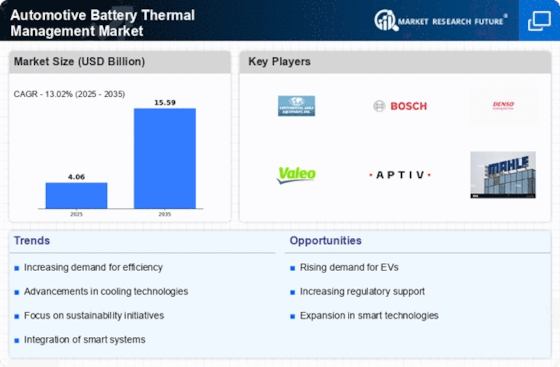
As per Market Research Future analysis, the Automotive Battery Thermal Management Market was estimated at 4.057 USD Billion in 2024. The Automotive Battery Thermal Management industry is projected to grow from 4.586 USD Billion in 2025 to 15.59 USD Billion by 2035, exhibiting a compound annual growth rate (CAGR) of 13.02% during the forecast period 2025 - 2035

Key Market Trends & Highlights

The Automotive Battery Thermal Management Market is poised for substantial growth driven by technological advancements and increasing demand for electric vehicles.

  • The integration of advanced technologies is transforming thermal management systems, enhancing efficiency and performance. Sustainable solutions are gaining traction as manufacturers prioritize eco-friendly materials and processes in battery thermal management. Regulatory compliance is becoming increasingly stringent, pushing companies to innovate and adapt their thermal management strategies. The rising demand for electric vehicles and technological advancements in battery systems are key drivers propelling market growth.

Market Size & Forecast

2024 Market Size 4.057 (USD Billion)
2035 Market Size 15.59 (USD Billion)
CAGR (2025 - 2035) 13.02%
Largest Regional Market Share in 2024 Asia Pacific

Major Players

Continental AG (DE), Robert Bosch GmbH (DE), <a href="https://www.denso.com/in/en/business/thermal-management-system/">Denso Corporation</a> (JP), Valeo SA (FR), Aptiv PLC (IE), Mahle GmbH (DE), Hanon Systems (KR), LG Chem (KR), Samsung SDI (KR), Panasonic Corporation (JP)

Market Trends

The Automotive Battery Thermal Management Market is currently experiencing a transformative phase, driven by the increasing demand for electric vehicles and the necessity for efficient battery performance. As manufacturers strive to enhance battery life and safety, innovative thermal management solutions are emerging. These solutions are designed to maintain optimal operating temperatures, thereby improving overall vehicle efficiency and longevity. The integration of advanced materials and technologies is becoming commonplace, as stakeholders seek to address the challenges posed by heat generation during battery operation. Moreover, the market landscape is evolving with the growing emphasis on sustainability and environmental considerations. Companies are exploring eco-friendly materials and practices to minimize their carbon footprint while maximizing performance. This shift not only aligns with regulatory requirements but also resonates with consumer preferences for greener alternatives. As the Automotive Battery Thermal Management Market continues to expand, it appears poised for significant advancements, potentially reshaping the future of automotive design and functionality.

Integration of Advanced Technologies

The Automotive Battery Thermal Management Market is witnessing a trend towards the incorporation of cutting-edge technologies. This includes the use of smart sensors and IoT devices that monitor battery temperatures in real-time, allowing for proactive adjustments to thermal management systems. Such innovations enhance the efficiency of battery operation and contribute to improved safety.

Focus on Sustainable Solutions

There is a growing emphasis on sustainability within the Automotive Battery Thermal Management Market. Manufacturers are increasingly adopting eco-friendly materials and processes to reduce environmental impact. This trend reflects a broader commitment to sustainability, aligning with consumer demand for greener automotive solutions.

Enhanced Regulatory Compliance

As regulations surrounding vehicle emissions and safety become more stringent, the Automotive Battery Thermal Management Market is adapting accordingly. Companies are investing in research and development to ensure compliance with these evolving standards, which may drive innovation in thermal management technologies.

Automotive Battery Thermal Management System Market Market Drivers

Rising Demand for Electric Vehicles

The increasing adoption of electric vehicles (EVs) is a primary driver for the Automotive Battery Thermal Management Market. As consumers and manufacturers shift towards sustainable transportation solutions, the need for efficient battery thermal management systems becomes paramount. In 2025, it is estimated that the EV market will account for a substantial percentage of total vehicle sales, necessitating advanced thermal management solutions to enhance battery performance and longevity. This trend indicates a growing market for thermal management technologies, as they play a crucial role in maintaining optimal battery temperatures, thereby improving efficiency and safety. Consequently, the Automotive Battery Thermal Management Market is likely to experience significant growth as manufacturers invest in innovative thermal management solutions to meet the demands of the expanding EV sector.

Growth of Renewable Energy Integration

The integration of renewable energy sources into the automotive sector is emerging as a key driver for the Automotive Battery Thermal Management Market. As the shift towards sustainable energy solutions accelerates, the demand for efficient battery systems that can effectively manage thermal conditions becomes increasingly important. In 2025, the market is expected to expand as manufacturers seek to develop thermal management solutions that optimize battery performance in conjunction with renewable energy sources. This trend indicates a growing recognition of the importance of thermal management in enhancing the overall efficiency of electric vehicles powered by renewable energy, thereby creating new opportunities within the Automotive Battery Thermal Management Market.

Consumer Awareness and Demand for Safety

Consumer awareness regarding battery safety and performance is a significant driver for the Automotive Battery Thermal Management Market. As electric vehicles become more prevalent, consumers are increasingly concerned about battery safety, particularly in extreme weather conditions. Effective thermal management systems are essential for maintaining battery temperatures within safe limits, thereby preventing overheating and potential hazards. In 2025, the market is likely to see a surge in demand for advanced thermal management solutions that address these safety concerns. This trend suggests that manufacturers who prioritize safety in their thermal management systems will likely gain consumer trust and enhance their market position within the Automotive Battery Thermal Management Market.

Regulatory Pressure for Emission Reductions

Regulatory frameworks aimed at reducing emissions are driving the Automotive Battery Thermal Management Market. Governments worldwide are implementing stringent regulations to promote cleaner transportation solutions, which in turn increases the demand for electric vehicles and their associated technologies. As manufacturers strive to comply with these regulations, the need for effective thermal management systems becomes critical to ensure battery efficiency and safety. The Automotive Battery Thermal Management Market is expected to benefit from this regulatory pressure, as companies invest in advanced thermal management solutions to meet compliance standards while enhancing vehicle performance. This dynamic indicates a robust market potential for thermal management technologies in the automotive sector.

Technological Advancements in Battery Systems

Technological innovations in battery systems are significantly influencing the Automotive Battery Thermal Management Market. The development of high-capacity batteries, such as solid-state batteries, necessitates advanced thermal management solutions to ensure optimal performance and safety. As these technologies evolve, the complexity of thermal management systems increases, leading to a demand for more sophisticated solutions. In 2025, the market for battery thermal management systems is projected to grow as manufacturers seek to integrate cutting-edge technologies that enhance battery efficiency and lifespan. This trend suggests that companies focusing on research and development in thermal management technologies will likely gain a competitive edge in the Automotive Battery Thermal Management Market.


Market Segment Insights

By Technology: Liquid (Largest) vs. Air (Fastest-Growing)

Within the Automotive Battery Thermal Management Market, the technology segment is prominently divided into four major categories: Air, Liquid, Phase Change Material, and Thermo Electrics. Among these, Liquid cooling technologies have established themselves as the largest segment, widely adopted due to their superior thermal performance over extended usage. Air cooling systems, while historically prevalent, currently hold a smaller market share but are experiencing a renewed interest due to advancements in efficiency and cost-effectiveness, subsequently contributing to their fastest growth in the segment.

Technology: Liquid (Dominant) vs. Air (Emerging)

Liquid cooling technologies are recognized as the dominant force in the Automotive Battery Thermal Management Market. They leverage advanced coolant materials to regulate battery temperatures effectively, promoting enhanced performance and longevity. In contrast, air cooling systems, marked as an emerging technology, offer a simpler and often more affordable solution for thermal management. With escalating demands for electric vehicles, these air cooling systems are evolving rapidly. Their lightweight and compact designs make them appealing for various applications, particularly in smaller vehicles. However, as battery sizes increase, the role of air cooling will continue to evolve, potentially driving innovations that may enhance their efficiency and market share.
By Propulsion: Battery Electric Vehicles (Largest) vs. Hybrid Electric Vehicles (Fastest-Growing)

In the Automotive Battery Thermal Management Market, the distribution of market share among propulsion types reveals that Battery Electric Vehicles (BEVs) command the largest portion of the market, driven by increasing consumer preference for sustainable mobility solutions. Following closely are Hybrid Electric Vehicles (HEVs), which are gaining traction due to their efficiency and ability to bridge the gap between traditional and electric vehicles. Plug-in Hybrid Electric Vehicles (PHEVs) and Fuel Cell Vehicles (FCVs) make up emerging shares as they cater to niche segments but are growing steadily as technology advances.

Market Shift: Battery Electric Vehicles (Dominant) vs. Plug-in Hybrid Electric Vehicles (Emerging)

Battery Electric Vehicles (BEVs) dominate the Automotive Battery Thermal Management Market as they rely entirely on electric power, making them highly efficient in thermal management strategies. Their success is bolstered by a robust infrastructure, such as fast-charging stations, and increasing government incentives promoting electric mobility. Conversely, Plug-in Hybrid Electric Vehicles (PHEVs) are emerging as flexible alternatives, combining internal combustion engines with electric propulsion. This dual capability appeals to consumers hesitant to fully embrace electrification. As advancements in battery technology continue to improve operational efficiencies, both BEVs and PHEVs are expected to play significant roles in shaping the future landscape of automotive propulsion.

By Vehicle Type: Passenger Cars (Largest) vs. Commercial Vehicle (Fastest-Growing)

In the Automotive Battery Thermal Management Market, the segment distribution demonstrates a clear dominance by Passenger Cars, which hold the largest share owing to their extensive production and sales figures globally. The increasing adoption of electric vehicles and the focus on efficient battery management systems in personal cars significantly bolster their market position, reflecting the consumer's preference for advanced technological solutions in everyday transportation. On the other hand, the Commercial Vehicle segment is emerging as the fastest-growing segment in the market. This growth is driven by the rising demand for electric and hybrid commercial vehicles, which necessitate efficient battery thermal management to ensure optimal performance and longevity. Moreover, regulatory standards pushing for cleaner transportation solutions are fueling investments in thermal management technologies specific to commercial applications.

Passenger Cars (Dominant) vs. Commercial Vehicle (Emerging)

The Passenger Cars segment is characterized by its established presence in the market, driven by a vast consumer base that prioritizes comfort, performance, and efficiency. Innovations in battery thermal management systems within this segment focus on enhancing vehicle performance and extending battery life, thus attracting a broad range of automakers investing heavily in R&amp;D. In contrast, the Commercial Vehicle segment, while emerging, is gaining momentum due to increasing investments in electric and hybrid solutions. The need for better thermal management solutions in these vehicles is paramount, as they face unique demands such as higher payloads and extended operational hours, pushing manufacturers to develop specialized thermal management systems capable of meeting these challenges.

Get more detailed insights about Automotive Battery Thermal Management System Market Research Report—Global Forecast till 2035

Regional Insights

The Automotive Battery Thermal Management Market is segmented into North America, Europe, Asia-Pacific, Middle East & Africa, and South America regions. Asia-Pacific is projected to hold the largest revenue market share during the forecast period. This region is the largest Automotive Battery Thermal Management market for automobiles and comprises both emerging and developed economies. With a high focus on reducing carbon emissions and electrifying transportation, the use of electric vehicles in Asia-Pacific is prevalent.

Governments have incentivized the adoption of electric vehicles through subsidies and tax exemptions, further driving the growth of the automotive battery thermal management market in the region.

Figure 3: Automotive Battery Thermal Management Market Share By Region 2022 (%)

In Europe, the European Union (EU) is leading the development of a sustainable circular economy and carbon-free transport system. The manufacturers in Europe have adopted two different approaches for developing electric vehicle models: conversion and purpose. The "conversion" approach involves incorporating new technology such as electric motors and batteries into existing models, while the "purpose" approach involves developing new vehicles that incorporate the latest technologies. These approaches allow manufacturers to install electric drives in cars, driving the growth of the European automotive battery thermal management market.

Additionally, the EU has regulated two policies to regulate average CO2 emissions for new passenger vehicles and vans.

Key Players and Competitive Insights

Major market players are spending a lot of money on R&D to increase their product lines, which will help the Automotive Battery Thermal Management market grow even more. The Automotive Battery Thermal Management Market participants are also taking a range of strategic initiatives to grow their worldwide footprint, including new product launches, contractual agreements, mergers and acquisitions, increased investments, and collaboration with other organizations. Competitors in the automotive battery thermal management industry must offer cost-effective items to expand and survive in an increasingly competitive and rising market environment. The automotive battery thermal management market is characterized by intense competition, with players vying for greater market share. The market is challenged by factors such as rapid technological advancements, changes in government policies, and strict environmental regulations, which could impede its growth. In this competitive landscape, vendors are competing based on product quality, reliability, cost, and aftermarket services. To remain viable and thrive in this environment, vendors must deliver products that are both cost-effective and efficient. Hanon system is the world’s leading automotive supplier and expertise in automotive battery thermal management solution supplier company. The company has pioneered in providing a wide product portfolio specializing in thermal and energy management. The company started offering its wide range of products, including thermal battery management, to support vehicle manufacturers supplying electric, fuel cell, hybrid, and autonomous vehicles to the Automotive Battery Thermal Management market.

Key Companies in the Automotive Battery Thermal Management System Market include

Industry Developments

  • Q2 2024: LG Energy Solution to build new battery thermal management R&D center in South Korea LG Energy Solution announced the opening of a dedicated research and development center focused on advanced battery thermal management technologies for electric vehicles, aiming to accelerate innovation and commercialization of next-generation cooling systems.
  • Q2 2024: Tesla partners with Panasonic to co-develop advanced battery cooling systems for EVs Tesla and Panasonic revealed a strategic partnership to jointly develop and manufacture new battery cooling modules designed to improve thermal efficiency and safety in high-performance electric vehicles.
  • Q2 2024: Valeo launches new high-efficiency battery thermal management system for commercial EV fleets Valeo introduced its latest battery thermal management solution, specifically engineered for commercial electric vehicle fleets, promising improved energy efficiency and extended battery life.
  • Q3 2024: BorgWarner acquires battery thermal management startup ThermalX for $120 million BorgWarner completed the acquisition of ThermalX, a startup specializing in advanced battery cooling technologies, to strengthen its position in the automotive battery thermal management market.
  • Q3 2024: Denso opens new manufacturing facility for battery thermal management components in Hungary Denso inaugurated a new plant in Hungary dedicated to producing battery thermal management modules for European electric vehicle manufacturers, expanding its global manufacturing footprint.
  • Q3 2024: BYD secures major contract to supply battery thermal management systems to Volkswagen BYD signed a multi-year agreement to supply Volkswagen with advanced battery thermal management systems for its upcoming electric vehicle models in Europe.
  • Q4 2024: Gentherm unveils new liquid-cooled battery thermal management platform for EVs Gentherm launched a new liquid-cooled battery thermal management platform designed to enhance temperature control and safety in next-generation electric vehicles.
  • Q4 2024: Samsung SDI announces $200 million investment in battery thermal management technology Samsung SDI committed $200 million to expand its research and development efforts in battery thermal management, targeting improved performance and safety for future EV batteries.
  • Q1 2025: Mahle wins contract to supply battery cooling systems for Stellantis electric vehicles Mahle secured a significant contract to provide battery cooling systems for Stellantis' new line of electric vehicles, marking a major expansion of its automotive thermal management business.
  • Q1 2025: Hitachi Energy launches modular battery thermal management solution for grid storage Hitachi Energy introduced a modular battery thermal management system designed for large-scale grid energy storage applications, aiming to improve reliability and operational efficiency.
  • Q2 2025: Modine Manufacturing opens new battery thermal management R&D center in Germany Modine Manufacturing announced the opening of a new research and development center in Germany focused on battery thermal management technologies for European automotive clients.
  • Q2 2025: Faurecia and CATL form joint venture for battery thermal management systems Faurecia and CATL established a joint venture to develop and manufacture advanced battery thermal management systems for electric vehicles, targeting both European and Asian markets.

Future Outlook

Automotive Battery Thermal Management System Market Future Outlook

The Automotive Battery Thermal Management Market is projected to grow at a 13.02% CAGR from 2025 to 2035, driven by increasing electric vehicle adoption and stringent thermal regulations.

New opportunities lie in:

  • <p>Development of advanced phase change materials for enhanced thermal efficiency. Integration of AI-driven predictive maintenance systems for battery longevity. Expansion into emerging markets with tailored thermal management solutions.</p>

By 2035, the market is expected to be robust, driven by innovation and strategic partnerships.

Market Segmentation

Automotive Battery Thermal Management System Market Propulsion Outlook

  • Hybrid Electric Vehicles
  • Battery Electric Vehicles
  • Plug-in Hybrid Electric Vehicles
  • Fuel Cell Vehicles

Automotive Battery Thermal Management System Market Technology Outlook

  • Air
  • Liquid
  • Phase Change Material
  • Thermo Electrics

Automotive Battery Thermal Management System Market Vehicle Type Outlook

  • Passenger Cars
  • Commercial Vehicle

Report Scope

MARKET SIZE 2024 4.057(USD Billion)
MARKET SIZE 2025 4.586(USD Billion)
MARKET SIZE 2035 15.59(USD Billion)
COMPOUND ANNUAL GROWTH RATE (CAGR) 13.02% (2025 - 2035)
REPORT COVERAGE Revenue Forecast, Competitive Landscape, Growth Factors, and Trends
BASE YEAR 2024
Market Forecast Period 2025 - 2035
Historical Data 2019 - 2024
Market Forecast Units USD Billion
Key Companies Profiled Continental AG (DE), Robert Bosch GmbH (DE), Denso Corporation (JP), Valeo SA (FR), Aptiv PLC (IE), Mahle GmbH (DE), Hanon Systems (KR), LG Chem (KR), Samsung SDI (KR), Panasonic Corporation (JP)
Segments Covered Technology, Region
Key Market Opportunities Integration of advanced cooling technologies enhances efficiency in the Automotive Battery Thermal Management Market.

Key Market Dynamics Rising demand for efficient thermal management solutions drives innovation and competition in the automotive battery sector.
Countries Covered North America, Europe, APAC, South America, MEA

FAQs

What is the projected market valuation for the Automotive Battery Thermal Management Market in 2035?

<p>The projected market valuation for the Automotive Battery Thermal Management Market in 2035 is 15.59 USD Billion.</p>

What was the market valuation for the Automotive Battery Thermal Management Market in 2024?

<p>The market valuation for the Automotive Battery Thermal Management Market in 2024 was 4.057 USD Billion.</p>

What is the expected CAGR for the Automotive Battery Thermal Management Market during the forecast period 2025 - 2035?

<p>The expected CAGR for the Automotive Battery Thermal Management Market during the forecast period 2025 - 2035 is 13.02%.</p>

Which technology segment is projected to have the highest valuation by 2035?

<p>The Liquid technology segment is projected to reach a valuation of 4.56 USD Billion by 2035.</p>

How does the market valuation for Battery Electric Vehicles compare to other propulsion types in 2035?

<p>By 2035, the market valuation for Battery Electric Vehicles is expected to be 8.0 USD Billion, significantly higher than other propulsion types.</p>

What are the projected valuations for the Passenger Cars and Commercial Vehicle segments by 2035?

<p>The projected valuation for Passenger Cars is 9.5 USD Billion, while Commercial Vehicles is expected to reach 6.09 USD Billion by 2035.</p>

Which key players are leading the Automotive Battery Thermal Management Market?

<p>Key players in the Automotive Battery Thermal Management Market include Continental AG, Robert Bosch GmbH, and Denso Corporation.</p>

What is the expected growth trend for the Phase Change Material technology segment by 2035?

<p>The Phase Change Material technology segment is projected to grow to 3.06 USD Billion by 2035.</p>

What is the market valuation for Hybrid Electric Vehicles in 2035?

<p>The market valuation for Hybrid Electric Vehicles is expected to reach 2.0 USD Billion by 2035.</p>

How does the Automotive Battery Thermal Management Market's growth potential compare across different vehicle types?

<p>The market shows strong growth potential, with Passenger Cars projected at 9.5 USD Billion and Commercial Vehicles at 6.09 USD Billion by 2035.</p>

  1. SECTION I: EXECUTIVE SUMMARY AND KEY HIGHLIGHTS
    1. | 1.1 EXECUTIVE SUMMARY
    2. | | 1.1.1 Market Overview
    3. | | 1.1.2 Key Findings
    4. | | 1.1.3 Market Segmentation
    5. | | 1.1.4 Competitive Landscape
    6. | | 1.1.5 Challenges and Opportunities
    7. | | 1.1.6 Future Outlook
  2. SECTION II: SCOPING, METHODOLOGY AND MARKET STRUCTURE
    1. | 2.1 MARKET INTRODUCTION
    2. | | 2.1.1 Definition
    3. | | 2.1.2 Scope of the study
    4. | | | 2.1.2.1 Research Objective
    5. | | | 2.1.2.2 Assumption
    6. | | | 2.1.2.3 Limitations
    7. | 2.2 RESEARCH METHODOLOGY
    8. | | 2.2.1 Overview
    9. | | 2.2.2 Data Mining
    10. | | 2.2.3 Secondary Research
    11. | | 2.2.4 Primary Research
    12. | | | 2.2.4.1 Primary Interviews and Information Gathering Process
    13. | | | 2.2.4.2 Breakdown of Primary Respondents
    14. | | 2.2.5 Forecasting Model
    15. | | 2.2.6 Market Size Estimation
    16. | | | 2.2.6.1 Bottom-Up Approach
    17. | | | 2.2.6.2 Top-Down Approach
    18. | | 2.2.7 Data Triangulation
    19. | | 2.2.8 Validation
  3. SECTION III: QUALITATIVE ANALYSIS
    1. | 3.1 MARKET DYNAMICS
    2. | | 3.1.1 Overview
    3. | | 3.1.2 Drivers
    4. | | 3.1.3 Restraints
    5. | | 3.1.4 Opportunities
    6. | 3.2 MARKET FACTOR ANALYSIS
    7. | | 3.2.1 Value chain Analysis
    8. | | 3.2.2 Porter's Five Forces Analysis
    9. | | | 3.2.2.1 Bargaining Power of Suppliers
    10. | | | 3.2.2.2 Bargaining Power of Buyers
    11. | | | 3.2.2.3 Threat of New Entrants
    12. | | | 3.2.2.4 Threat of Substitutes
    13. | | | 3.2.2.5 Intensity of Rivalry
    14. | | 3.2.3 COVID-19 Impact Analysis
    15. | | | 3.2.3.1 Market Impact Analysis
    16. | | | 3.2.3.2 Regional Impact
    17. | | | 3.2.3.3 Opportunity and Threat Analysis
  4. SECTION IV: QUANTITATIVE ANALYSIS
    1. | 4.1 Automobile, BY Technology (USD Billion)
    2. | | 4.1.1 Air
    3. | | 4.1.2 Liquid
    4. | | 4.1.3 Phase Change Material
    5. | | 4.1.4 Thermo Electrics
    6. | 4.2 Automobile, BY Propulsion (USD Billion)
    7. | | 4.2.1 Hybrid Electric Vehicles
    8. | | 4.2.2 Battery Electric Vehicles
    9. | | 4.2.3 Plug-in Hybrid Electric Vehicles
    10. | | 4.2.4 Fuel Cell Vehicles
    11. | 4.3 Automobile, BY Vehicle Type (USD Billion)
    12. | | 4.3.1 Passenger Cars
    13. | | 4.3.2 Commercial Vehicle
    14. | 4.4 Automobile, BY Region (USD Billion)
    15. | | 4.4.1 North America
    16. | | | 4.4.1.1 US
    17. | | | 4.4.1.2 Canada
    18. | | 4.4.2 Europe
    19. | | | 4.4.2.1 Germany
    20. | | | 4.4.2.2 UK
    21. | | | 4.4.2.3 France
    22. | | | 4.4.2.4 Russia
    23. | | | 4.4.2.5 Italy
    24. | | | 4.4.2.6 Spain
    25. | | | 4.4.2.7 Rest of Europe
    26. | | 4.4.3 APAC
    27. | | | 4.4.3.1 China
    28. | | | 4.4.3.2 India
    29. | | | 4.4.3.3 Japan
    30. | | | 4.4.3.4 South Korea
    31. | | | 4.4.3.5 Malaysia
    32. | | | 4.4.3.6 Thailand
    33. | | | 4.4.3.7 Indonesia
    34. | | | 4.4.3.8 Rest of APAC
    35. | | 4.4.4 South America
    36. | | | 4.4.4.1 Brazil
    37. | | | 4.4.4.2 Mexico
    38. | | | 4.4.4.3 Argentina
    39. | | | 4.4.4.4 Rest of South America
    40. | | 4.4.5 MEA
    41. | | | 4.4.5.1 GCC Countries
    42. | | | 4.4.5.2 South Africa
    43. | | | 4.4.5.3 Rest of MEA
  5. SECTION V: COMPETITIVE ANALYSIS
    1. | 5.1 Competitive Landscape
    2. | | 5.1.1 Overview
    3. | | 5.1.2 Competitive Analysis
    4. | | 5.1.3 Market share Analysis
    5. | | 5.1.4 Major Growth Strategy in the Automobile
    6. | | 5.1.5 Competitive Benchmarking
    7. | | 5.1.6 Leading Players in Terms of Number of Developments in the Automobile
    8. | | 5.1.7 Key developments and growth strategies
    9. | | | 5.1.7.1 New Product Launch/Service Deployment
    10. | | | 5.1.7.2 Merger & Acquisitions
    11. | | | 5.1.7.3 Joint Ventures
    12. | | 5.1.8 Major Players Financial Matrix
    13. | | | 5.1.8.1 Sales and Operating Income
    14. | | | 5.1.8.2 Major Players R&D Expenditure. 2023
    15. | 5.2 Company Profiles
    16. | | 5.2.1 Continental AG (DE)
    17. | | | 5.2.1.1 Financial Overview
    18. | | | 5.2.1.2 Products Offered
    19. | | | 5.2.1.3 Key Developments
    20. | | | 5.2.1.4 SWOT Analysis
    21. | | | 5.2.1.5 Key Strategies
    22. | | 5.2.2 Robert Bosch GmbH (DE)
    23. | | | 5.2.2.1 Financial Overview
    24. | | | 5.2.2.2 Products Offered
    25. | | | 5.2.2.3 Key Developments
    26. | | | 5.2.2.4 SWOT Analysis
    27. | | | 5.2.2.5 Key Strategies
    28. | | 5.2.3 Denso Corporation (JP)
    29. | | | 5.2.3.1 Financial Overview
    30. | | | 5.2.3.2 Products Offered
    31. | | | 5.2.3.3 Key Developments
    32. | | | 5.2.3.4 SWOT Analysis
    33. | | | 5.2.3.5 Key Strategies
    34. | | 5.2.4 Valeo SA (FR)
    35. | | | 5.2.4.1 Financial Overview
    36. | | | 5.2.4.2 Products Offered
    37. | | | 5.2.4.3 Key Developments
    38. | | | 5.2.4.4 SWOT Analysis
    39. | | | 5.2.4.5 Key Strategies
    40. | | 5.2.5 Aptiv PLC (IE)
    41. | | | 5.2.5.1 Financial Overview
    42. | | | 5.2.5.2 Products Offered
    43. | | | 5.2.5.3 Key Developments
    44. | | | 5.2.5.4 SWOT Analysis
    45. | | | 5.2.5.5 Key Strategies
    46. | | 5.2.6 Mahle GmbH (DE)
    47. | | | 5.2.6.1 Financial Overview
    48. | | | 5.2.6.2 Products Offered
    49. | | | 5.2.6.3 Key Developments
    50. | | | 5.2.6.4 SWOT Analysis
    51. | | | 5.2.6.5 Key Strategies
    52. | | 5.2.7 Hanon Systems (KR)
    53. | | | 5.2.7.1 Financial Overview
    54. | | | 5.2.7.2 Products Offered
    55. | | | 5.2.7.3 Key Developments
    56. | | | 5.2.7.4 SWOT Analysis
    57. | | | 5.2.7.5 Key Strategies
    58. | | 5.2.8 LG Chem (KR)
    59. | | | 5.2.8.1 Financial Overview
    60. | | | 5.2.8.2 Products Offered
    61. | | | 5.2.8.3 Key Developments
    62. | | | 5.2.8.4 SWOT Analysis
    63. | | | 5.2.8.5 Key Strategies
    64. | | 5.2.9 Samsung SDI (KR)
    65. | | | 5.2.9.1 Financial Overview
    66. | | | 5.2.9.2 Products Offered
    67. | | | 5.2.9.3 Key Developments
    68. | | | 5.2.9.4 SWOT Analysis
    69. | | | 5.2.9.5 Key Strategies
    70. | | 5.2.10 Panasonic Corporation (JP)
    71. | | | 5.2.10.1 Financial Overview
    72. | | | 5.2.10.2 Products Offered
    73. | | | 5.2.10.3 Key Developments
    74. | | | 5.2.10.4 SWOT Analysis
    75. | | | 5.2.10.5 Key Strategies
    76. | 5.3 Appendix
    77. | | 5.3.1 References
    78. | | 5.3.2 Related Reports
  6. LIST OF FIGURES
    1. | 6.1 MARKET SYNOPSIS
    2. | 6.2 NORTH AMERICA MARKET ANALYSIS
    3. | 6.3 US MARKET ANALYSIS BY TECHNOLOGY
    4. | 6.4 US MARKET ANALYSIS BY PROPULSION
    5. | 6.5 US MARKET ANALYSIS BY VEHICLE TYPE
    6. | 6.6 CANADA MARKET ANALYSIS BY TECHNOLOGY
    7. | 6.7 CANADA MARKET ANALYSIS BY PROPULSION
    8. | 6.8 CANADA MARKET ANALYSIS BY VEHICLE TYPE
    9. | 6.9 EUROPE MARKET ANALYSIS
    10. | 6.10 GERMANY MARKET ANALYSIS BY TECHNOLOGY
    11. | 6.11 GERMANY MARKET ANALYSIS BY PROPULSION
    12. | 6.12 GERMANY MARKET ANALYSIS BY VEHICLE TYPE
    13. | 6.13 UK MARKET ANALYSIS BY TECHNOLOGY
    14. | 6.14 UK MARKET ANALYSIS BY PROPULSION
    15. | 6.15 UK MARKET ANALYSIS BY VEHICLE TYPE
    16. | 6.16 FRANCE MARKET ANALYSIS BY TECHNOLOGY
    17. | 6.17 FRANCE MARKET ANALYSIS BY PROPULSION
    18. | 6.18 FRANCE MARKET ANALYSIS BY VEHICLE TYPE
    19. | 6.19 RUSSIA MARKET ANALYSIS BY TECHNOLOGY
    20. | 6.20 RUSSIA MARKET ANALYSIS BY PROPULSION
    21. | 6.21 RUSSIA MARKET ANALYSIS BY VEHICLE TYPE
    22. | 6.22 ITALY MARKET ANALYSIS BY TECHNOLOGY
    23. | 6.23 ITALY MARKET ANALYSIS BY PROPULSION
    24. | 6.24 ITALY MARKET ANALYSIS BY VEHICLE TYPE
    25. | 6.25 SPAIN MARKET ANALYSIS BY TECHNOLOGY
    26. | 6.26 SPAIN MARKET ANALYSIS BY PROPULSION
    27. | 6.27 SPAIN MARKET ANALYSIS BY VEHICLE TYPE
    28. | 6.28 REST OF EUROPE MARKET ANALYSIS BY TECHNOLOGY
    29. | 6.29 REST OF EUROPE MARKET ANALYSIS BY PROPULSION
    30. | 6.30 REST OF EUROPE MARKET ANALYSIS BY VEHICLE TYPE
    31. | 6.31 APAC MARKET ANALYSIS
    32. | 6.32 CHINA MARKET ANALYSIS BY TECHNOLOGY
    33. | 6.33 CHINA MARKET ANALYSIS BY PROPULSION
    34. | 6.34 CHINA MARKET ANALYSIS BY VEHICLE TYPE
    35. | 6.35 INDIA MARKET ANALYSIS BY TECHNOLOGY
    36. | 6.36 INDIA MARKET ANALYSIS BY PROPULSION
    37. | 6.37 INDIA MARKET ANALYSIS BY VEHICLE TYPE
    38. | 6.38 JAPAN MARKET ANALYSIS BY TECHNOLOGY
    39. | 6.39 JAPAN MARKET ANALYSIS BY PROPULSION
    40. | 6.40 JAPAN MARKET ANALYSIS BY VEHICLE TYPE
    41. | 6.41 SOUTH KOREA MARKET ANALYSIS BY TECHNOLOGY
    42. | 6.42 SOUTH KOREA MARKET ANALYSIS BY PROPULSION
    43. | 6.43 SOUTH KOREA MARKET ANALYSIS BY VEHICLE TYPE
    44. | 6.44 MALAYSIA MARKET ANALYSIS BY TECHNOLOGY
    45. | 6.45 MALAYSIA MARKET ANALYSIS BY PROPULSION
    46. | 6.46 MALAYSIA MARKET ANALYSIS BY VEHICLE TYPE
    47. | 6.47 THAILAND MARKET ANALYSIS BY TECHNOLOGY
    48. | 6.48 THAILAND MARKET ANALYSIS BY PROPULSION
    49. | 6.49 THAILAND MARKET ANALYSIS BY VEHICLE TYPE
    50. | 6.50 INDONESIA MARKET ANALYSIS BY TECHNOLOGY
    51. | 6.51 INDONESIA MARKET ANALYSIS BY PROPULSION
    52. | 6.52 INDONESIA MARKET ANALYSIS BY VEHICLE TYPE
    53. | 6.53 REST OF APAC MARKET ANALYSIS BY TECHNOLOGY
    54. | 6.54 REST OF APAC MARKET ANALYSIS BY PROPULSION
    55. | 6.55 REST OF APAC MARKET ANALYSIS BY VEHICLE TYPE
    56. | 6.56 SOUTH AMERICA MARKET ANALYSIS
    57. | 6.57 BRAZIL MARKET ANALYSIS BY TECHNOLOGY
    58. | 6.58 BRAZIL MARKET ANALYSIS BY PROPULSION
    59. | 6.59 BRAZIL MARKET ANALYSIS BY VEHICLE TYPE
    60. | 6.60 MEXICO MARKET ANALYSIS BY TECHNOLOGY
    61. | 6.61 MEXICO MARKET ANALYSIS BY PROPULSION
    62. | 6.62 MEXICO MARKET ANALYSIS BY VEHICLE TYPE
    63. | 6.63 ARGENTINA MARKET ANALYSIS BY TECHNOLOGY
    64. | 6.64 ARGENTINA MARKET ANALYSIS BY PROPULSION
    65. | 6.65 ARGENTINA MARKET ANALYSIS BY VEHICLE TYPE
    66. | 6.66 REST OF SOUTH AMERICA MARKET ANALYSIS BY TECHNOLOGY
    67. | 6.67 REST OF SOUTH AMERICA MARKET ANALYSIS BY PROPULSION
    68. | 6.68 REST OF SOUTH AMERICA MARKET ANALYSIS BY VEHICLE TYPE
    69. | 6.69 MEA MARKET ANALYSIS
    70. | 6.70 GCC COUNTRIES MARKET ANALYSIS BY TECHNOLOGY
    71. | 6.71 GCC COUNTRIES MARKET ANALYSIS BY PROPULSION
    72. | 6.72 GCC COUNTRIES MARKET ANALYSIS BY VEHICLE TYPE
    73. | 6.73 SOUTH AFRICA MARKET ANALYSIS BY TECHNOLOGY
    74. | 6.74 SOUTH AFRICA MARKET ANALYSIS BY PROPULSION
    75. | 6.75 SOUTH AFRICA MARKET ANALYSIS BY VEHICLE TYPE
    76. | 6.76 REST OF MEA MARKET ANALYSIS BY TECHNOLOGY
    77. | 6.77 REST OF MEA MARKET ANALYSIS BY PROPULSION
    78. | 6.78 REST OF MEA MARKET ANALYSIS BY VEHICLE TYPE
    79. | 6.79 KEY BUYING CRITERIA OF AUTOMOBILE
    80. | 6.80 RESEARCH PROCESS OF MRFR
    81. | 6.81 DRO ANALYSIS OF AUTOMOBILE
    82. | 6.82 DRIVERS IMPACT ANALYSIS: AUTOMOBILE
    83. | 6.83 RESTRAINTS IMPACT ANALYSIS: AUTOMOBILE
    84. | 6.84 SUPPLY / VALUE CHAIN: AUTOMOBILE
    85. | 6.85 AUTOMOBILE, BY TECHNOLOGY, 2024 (% SHARE)
    86. | 6.86 AUTOMOBILE, BY TECHNOLOGY, 2024 TO 2035 (USD Billion)
    87. | 6.87 AUTOMOBILE, BY PROPULSION, 2024 (% SHARE)
    88. | 6.88 AUTOMOBILE, BY PROPULSION, 2024 TO 2035 (USD Billion)
    89. | 6.89 AUTOMOBILE, BY VEHICLE TYPE, 2024 (% SHARE)
    90. | 6.90 AUTOMOBILE, BY VEHICLE TYPE, 2024 TO 2035 (USD Billion)
    91. | 6.91 BENCHMARKING OF MAJOR COMPETITORS
  7. LIST OF TABLES
    1. | 7.1 LIST OF ASSUMPTIONS
    2. | | 7.1.1
    3. | 7.2 North America MARKET SIZE ESTIMATES; FORECAST
    4. | | 7.2.1 BY TECHNOLOGY, 2025-2035 (USD Billion)
    5. | | 7.2.2 BY PROPULSION, 2025-2035 (USD Billion)
    6. | | 7.2.3 BY VEHICLE TYPE, 2025-2035 (USD Billion)
    7. | 7.3 US MARKET SIZE ESTIMATES; FORECAST
    8. | | 7.3.1 BY TECHNOLOGY, 2025-2035 (USD Billion)
    9. | | 7.3.2 BY PROPULSION, 2025-2035 (USD Billion)
    10. | | 7.3.3 BY VEHICLE TYPE, 2025-2035 (USD Billion)
    11. | 7.4 Canada MARKET SIZE ESTIMATES; FORECAST
    12. | | 7.4.1 BY TECHNOLOGY, 2025-2035 (USD Billion)
    13. | | 7.4.2 BY PROPULSION, 2025-2035 (USD Billion)
    14. | | 7.4.3 BY VEHICLE TYPE, 2025-2035 (USD Billion)
    15. | 7.5 Europe MARKET SIZE ESTIMATES; FORECAST
    16. | | 7.5.1 BY TECHNOLOGY, 2025-2035 (USD Billion)
    17. | | 7.5.2 BY PROPULSION, 2025-2035 (USD Billion)
    18. | | 7.5.3 BY VEHICLE TYPE, 2025-2035 (USD Billion)
    19. | 7.6 Germany MARKET SIZE ESTIMATES; FORECAST
    20. | | 7.6.1 BY TECHNOLOGY, 2025-2035 (USD Billion)
    21. | | 7.6.2 BY PROPULSION, 2025-2035 (USD Billion)
    22. | | 7.6.3 BY VEHICLE TYPE, 2025-2035 (USD Billion)
    23. | 7.7 UK MARKET SIZE ESTIMATES; FORECAST
    24. | | 7.7.1 BY TECHNOLOGY, 2025-2035 (USD Billion)
    25. | | 7.7.2 BY PROPULSION, 2025-2035 (USD Billion)
    26. | | 7.7.3 BY VEHICLE TYPE, 2025-2035 (USD Billion)
    27. | 7.8 France MARKET SIZE ESTIMATES; FORECAST
    28. | | 7.8.1 BY TECHNOLOGY, 2025-2035 (USD Billion)
    29. | | 7.8.2 BY PROPULSION, 2025-2035 (USD Billion)
    30. | | 7.8.3 BY VEHICLE TYPE, 2025-2035 (USD Billion)
    31. | 7.9 Russia MARKET SIZE ESTIMATES; FORECAST
    32. | | 7.9.1 BY TECHNOLOGY, 2025-2035 (USD Billion)
    33. | | 7.9.2 BY PROPULSION, 2025-2035 (USD Billion)
    34. | | 7.9.3 BY VEHICLE TYPE, 2025-2035 (USD Billion)
    35. | 7.10 Italy MARKET SIZE ESTIMATES; FORECAST
    36. | | 7.10.1 BY TECHNOLOGY, 2025-2035 (USD Billion)
    37. | | 7.10.2 BY PROPULSION, 2025-2035 (USD Billion)
    38. | | 7.10.3 BY VEHICLE TYPE, 2025-2035 (USD Billion)
    39. | 7.11 Spain MARKET SIZE ESTIMATES; FORECAST
    40. | | 7.11.1 BY TECHNOLOGY, 2025-2035 (USD Billion)
    41. | | 7.11.2 BY PROPULSION, 2025-2035 (USD Billion)
    42. | | 7.11.3 BY VEHICLE TYPE, 2025-2035 (USD Billion)
    43. | 7.12 Rest of Europe MARKET SIZE ESTIMATES; FORECAST
    44. | | 7.12.1 BY TECHNOLOGY, 2025-2035 (USD Billion)
    45. | | 7.12.2 BY PROPULSION, 2025-2035 (USD Billion)
    46. | | 7.12.3 BY VEHICLE TYPE, 2025-2035 (USD Billion)
    47. | 7.13 APAC MARKET SIZE ESTIMATES; FORECAST
    48. | | 7.13.1 BY TECHNOLOGY, 2025-2035 (USD Billion)
    49. | | 7.13.2 BY PROPULSION, 2025-2035 (USD Billion)
    50. | | 7.13.3 BY VEHICLE TYPE, 2025-2035 (USD Billion)
    51. | 7.14 China MARKET SIZE ESTIMATES; FORECAST
    52. | | 7.14.1 BY TECHNOLOGY, 2025-2035 (USD Billion)
    53. | | 7.14.2 BY PROPULSION, 2025-2035 (USD Billion)
    54. | | 7.14.3 BY VEHICLE TYPE, 2025-2035 (USD Billion)
    55. | 7.15 India MARKET SIZE ESTIMATES; FORECAST
    56. | | 7.15.1 BY TECHNOLOGY, 2025-2035 (USD Billion)
    57. | | 7.15.2 BY PROPULSION, 2025-2035 (USD Billion)
    58. | | 7.15.3 BY VEHICLE TYPE, 2025-2035 (USD Billion)
    59. | 7.16 Japan MARKET SIZE ESTIMATES; FORECAST
    60. | | 7.16.1 BY TECHNOLOGY, 2025-2035 (USD Billion)
    61. | | 7.16.2 BY PROPULSION, 2025-2035 (USD Billion)
    62. | | 7.16.3 BY VEHICLE TYPE, 2025-2035 (USD Billion)
    63. | 7.17 South Korea MARKET SIZE ESTIMATES; FORECAST
    64. | | 7.17.1 BY TECHNOLOGY, 2025-2035 (USD Billion)
    65. | | 7.17.2 BY PROPULSION, 2025-2035 (USD Billion)
    66. | | 7.17.3 BY VEHICLE TYPE, 2025-2035 (USD Billion)
    67. | 7.18 Malaysia MARKET SIZE ESTIMATES; FORECAST
    68. | | 7.18.1 BY TECHNOLOGY, 2025-2035 (USD Billion)
    69. | | 7.18.2 BY PROPULSION, 2025-2035 (USD Billion)
    70. | | 7.18.3 BY VEHICLE TYPE, 2025-2035 (USD Billion)
    71. | 7.19 Thailand MARKET SIZE ESTIMATES; FORECAST
    72. | | 7.19.1 BY TECHNOLOGY, 2025-2035 (USD Billion)
    73. | | 7.19.2 BY PROPULSION, 2025-2035 (USD Billion)
    74. | | 7.19.3 BY VEHICLE TYPE, 2025-2035 (USD Billion)
    75. | 7.20 Indonesia MARKET SIZE ESTIMATES; FORECAST
    76. | | 7.20.1 BY TECHNOLOGY, 2025-2035 (USD Billion)
    77. | | 7.20.2 BY PROPULSION, 2025-2035 (USD Billion)
    78. | | 7.20.3 BY VEHICLE TYPE, 2025-2035 (USD Billion)
    79. | 7.21 Rest of APAC MARKET SIZE ESTIMATES; FORECAST
    80. | | 7.21.1 BY TECHNOLOGY, 2025-2035 (USD Billion)
    81. | | 7.21.2 BY PROPULSION, 2025-2035 (USD Billion)
    82. | | 7.21.3 BY VEHICLE TYPE, 2025-2035 (USD Billion)
    83. | 7.22 South America MARKET SIZE ESTIMATES; FORECAST
    84. | | 7.22.1 BY TECHNOLOGY, 2025-2035 (USD Billion)
    85. | | 7.22.2 BY PROPULSION, 2025-2035 (USD Billion)
    86. | | 7.22.3 BY VEHICLE TYPE, 2025-2035 (USD Billion)
    87. | 7.23 Brazil MARKET SIZE ESTIMATES; FORECAST
    88. | | 7.23.1 BY TECHNOLOGY, 2025-2035 (USD Billion)
    89. | | 7.23.2 BY PROPULSION, 2025-2035 (USD Billion)
    90. | | 7.23.3 BY VEHICLE TYPE, 2025-2035 (USD Billion)
    91. | 7.24 Mexico MARKET SIZE ESTIMATES; FORECAST
    92. | | 7.24.1 BY TECHNOLOGY, 2025-2035 (USD Billion)
    93. | | 7.24.2 BY PROPULSION, 2025-2035 (USD Billion)
    94. | | 7.24.3 BY VEHICLE TYPE, 2025-2035 (USD Billion)
    95. | 7.25 Argentina MARKET SIZE ESTIMATES; FORECAST
    96. | | 7.25.1 BY TECHNOLOGY, 2025-2035 (USD Billion)
    97. | | 7.25.2 BY PROPULSION, 2025-2035 (USD Billion)
    98. | | 7.25.3 BY VEHICLE TYPE, 2025-2035 (USD Billion)
    99. | 7.26 Rest of South America MARKET SIZE ESTIMATES; FORECAST
    100. | | 7.26.1 BY TECHNOLOGY, 2025-2035 (USD Billion)
    101. | | 7.26.2 BY PROPULSION, 2025-2035 (USD Billion)
    102. | | 7.26.3 BY VEHICLE TYPE, 2025-2035 (USD Billion)
    103. | 7.27 MEA MARKET SIZE ESTIMATES; FORECAST
    104. | | 7.27.1 BY TECHNOLOGY, 2025-2035 (USD Billion)
    105. | | 7.27.2 BY PROPULSION, 2025-2035 (USD Billion)
    106. | | 7.27.3 BY VEHICLE TYPE, 2025-2035 (USD Billion)
    107. | 7.28 GCC Countries MARKET SIZE ESTIMATES; FORECAST
    108. | | 7.28.1 BY TECHNOLOGY, 2025-2035 (USD Billion)
    109. | | 7.28.2 BY PROPULSION, 2025-2035 (USD Billion)
    110. | | 7.28.3 BY VEHICLE TYPE, 2025-2035 (USD Billion)
    111. | 7.29 South Africa MARKET SIZE ESTIMATES; FORECAST
    112. | | 7.29.1 BY TECHNOLOGY, 2025-2035 (USD Billion)
    113. | | 7.29.2 BY PROPULSION, 2025-2035 (USD Billion)
    114. | | 7.29.3 BY VEHICLE TYPE, 2025-2035 (USD Billion)
    115. | 7.30 Rest of MEA MARKET SIZE ESTIMATES; FORECAST
    116. | | 7.30.1 BY TECHNOLOGY, 2025-2035 (USD Billion)
    117. | | 7.30.2 BY PROPULSION, 2025-2035 (USD Billion)
    118. | | 7.30.3 BY VEHICLE TYPE, 2025-2035 (USD Billion)
    119. | 7.31 PRODUCT LAUNCH/PRODUCT DEVELOPMENT/APPROVAL
    120. | | 7.31.1
    121. | 7.32 ACQUISITION/PARTNERSHIP
    122. | | 7.32.1

Automobile Market Segmentation

Automobile By Technology (USD Billion, 2025-2035)

  • Air
  • Liquid
  • Phase Change Material
  • Thermo Electrics

Automobile By Propulsion (USD Billion, 2025-2035)

  • Hybrid Electric Vehicles
  • Battery Electric Vehicles
  • Plug-in Hybrid Electric Vehicles
  • Fuel Cell Vehicles

Automobile By Vehicle Type (USD Billion, 2025-2035)

  • Passenger Cars
  • Commercial Vehicle
Infographic

Free Sample Request

Kindly complete the form below to receive a free sample of this Report

Get Free Sample

Customer Strories

Compare Licence

×
Features License Type
Single User Multiuser License Enterprise User
Price $4,950 $5,950 $7,250
Maximum User Access Limit 1 User Upto 10 Users Unrestricted Access Throughout the Organization
Free Customization
Direct Access to Analyst
Deliverable Format
Platform Access
Discount on Next Purchase 10% 15% 15%
Printable Versions