Request Free Sample ×

Kindly complete the form below to receive a free sample of this Report

* Please use a valid business email

Leading companies partner with us for data-driven Insights

clients tt-cursor
Hero Background
English
Chinese
French
Japanese
Korean
German
Spanish

Automotive Aftermarket Industry Analysis

ID: MRFR/AT/4790-CR
100 Pages
Triveni Bhoyar
April 2023

Automotive AfterMarket Size, Share & Growth Analysis Report By Product Type (Parts, Accessories, Tires, Lubricants, Service Equipment), By Sales Channel (Online, Offline Retail, Wholesale, Direct Sales), By Vehicle Type (Passenger Cars, Commercial Vehicles, Motorcycles, Heavy-Duty Vehicles), By Service Type (Maintenance Services, Repair Services, Installation Services, Modification Services) and By Regional (North America, Europe, South America, Asia Pacific, Middle East and Africa) - Industry Outlook & Forecast to 2035

Share:
Download PDF ×

We do not share your information with anyone. However, we may send you emails based on your report interest from time to time. You may contact us at any time to opt-out.

Automotive Aftermarket Industry Infographic
Purchase Options

Market Analysis

Automotive Aftermarket (Global, 2024)

Introduction

The motor industry aftermarket is a dynamic and ever-changing sector within the overall industry, and is characterized by a broad range of products and services for the repair, maintenance, and improvement of vehicles after they have been manufactured. The aftermarket is experiencing a major transformation, prompted by technological advances, changing legislation, and the increasingly widespread integration of digital solutions. The aftermarket is the essential link in the chain that ensures the longevity and performance of a vehicle. The rise of electric vehicles and the growing focus on smart technology are also transforming the aftermarket, which is forcing both traditional players and new entrants to constantly develop their products and services. To be able to grasp the opportunities and threats of this sector, it is vital for all the players to understand its complexity.

PESTLE Analysis

Political
In 2024 the aftermarket is influenced by a number of political factors, such as the regulations of the governments for the improvement of the safety and emanation standards of the automobile. For example, the European Union has ruled that by 2024 all new cars must meet the new emission standards of EURO 7, which will reduce nitrogen oxides by 35 % and particulates by 50 %. These regulations force the aftermarket suppliers to adapt their products to the new requirements, which has a direct influence on their business strategies and product offerings.
Economic
In 2024, the economic situation of the car aftermarket is characterized by the growth of the household budget and the increase in vehicle ownership. The annual average household expenditure on the maintenance and repair of automobiles has increased by 10 percent, according to the latest data, to about ten thousand yuan. The number of cars on the road is rising, and the total number of registered vehicles has exceeded 270 million. This is a big market for the aftermarket.
Social
The social trends in 2024 indicate a trend towards greater concern for the environment and greater sensitivity to the environment among consumers in the aftermarket. Surveys show that 65% of consumers are willing to pay a premium for environment-friendly products, such as biodegradable cleaning products and recycled parts. The rising popularity of electric vehicles is also influencing the consumers' choice, and by the end of 2024, the electric vehicle share in the U.S. market is expected to be 30 %, which will have a great influence on the aftermarket in order to respond to the needs of this growing segment.
Technological
In 2024, technological advances are transforming the aftermarket, especially through the integration of digital tools and platforms. Telematics and connected cars are increasingly in use, with some 50 million vehicles in the United States alone equipped with such systems. Real-time diagnostics and remote diagnostics enable the aftermarket to offer faster, more tailored services, thereby increasing both customer satisfaction and the quality of its own operations.
Legal
The legal regulations affecting the automobile aftermarket in 2024 will mainly consist of safety and environment regulations. In 2023 the National Highway Traffic Safety Administration (NHTSA) issued new regulations that all aftermarket parts must meet certain safety standards. Failure to comply with the regulations will result in a fine of up to $100,000 per offense. The law will require the aftermarket industry to have all its products tested and certified. This will increase operating costs, but also increase product reliability and consumer confidence.
Environmental
The growing importance of the environment in the field of after-sales service in 2024. The world's growing concern for the environment has led to stricter waste management regulations. The European Union's Waste of Electric and Electronic Equipment (WEEE) Directive requires that at least 85% of car waste be recycled or reused. This law has forced after-sales service companies to adopt more sustainable practices, such as the reuse of old parts and the reduction of waste. These practices are not only beneficial for the environment, but also for the growing number of consumers who are aware of the environment.

Porter's Five Forces

Threat of New Entrants
The threat of new entrants to the car aftermarket is moderate. The threat of new entrants to the car aftermarket in 2024 is moderate. The market is lucrative, but the established players have strong brand loyalty and distribution networks that are difficult for new entrants to penetrate. Also, regulatory requirements and the need for technical expertise can act as barriers to entry. However, technological developments such as the growth of e-commerce and digital platforms will over time lower these barriers.
Bargaining Power of Suppliers
The suppliers of the motor trade are generally not well positioned in the market. The market is characterized by a large number of suppliers offering a wide range of spare parts and accessories, which reduces the influence of individual suppliers. In addition, many of the aftermarket products are standardized, which makes it easy for the manufacturer and the trade to change suppliers and therefore weakens the power of the suppliers.
Bargaining Power of Buyers
In the aftermarket, the buyers have high bargaining power because of the abundance of the choice. Brands and products compete with each other and consumers can easily compare prices and quality. In addition, the rise of e-commerce has increased the bargaining power of buyers.
Threat of Substitutes
The threat of substitution in the aftermarket is moderate. There are, of course, alternatives to car ownership, such as public transport or ride-hailing services, which reduce the need for car maintenance. But the need for repairs and maintenance will continue to ensure a steady demand for aftermarket products. In the long run, however, developments in the electric vehicle and alternative mobility solutions could be a threat.
Competitive Rivalry
The competition in the car parts industry is very high, with many companies competing for the same market. There are both old and new brands. The companies are constantly improving their products and services in order to attract customers. This has resulted in the use of aggressive marketing and price strategies, which has intensified competition.

SWOT Analysis

Strengths

  • Established distribution networks and supply chains.
  • Diverse product offerings catering to various vehicle types.
  • Strong brand loyalty among consumers for aftermarket parts.
  • Technological advancements in automotive repair and maintenance.
  • Growing trend of DIY repairs among vehicle owners.

Weaknesses

  • Dependence on the economic cycle affecting consumer spending.
  • Challenges in maintaining quality control across various suppliers.
  • Limited awareness of aftermarket options among some consumers.
  • High competition leading to price wars and reduced margins.
  • Potential for counterfeit products affecting brand reputation.

Opportunities

  • Expansion into electric vehicle (EV) aftermarket services.
  • Increased demand for vehicle customization and personalization.
  • Growth in online sales channels and e-commerce platforms.
  • Rising awareness of sustainability and eco-friendly products.
  • Partnerships with automotive manufacturers for original equipment parts.

Threats

  • Intense competition from OEMs entering the aftermarket space.
  • Economic downturns impacting consumer spending on non-essential repairs.
  • Rapid technological changes requiring constant adaptation.
  • Regulatory changes affecting product standards and compliance.
  • Supply chain disruptions impacting availability of parts.

Summary

The 2024 after-market for automobiles will be characterized by a strong distribution network and brand loyalty, but will also be challenged by economic dependence and competition. Opportunities lie in the burgeoning EV sector and in e-commerce, while threats include competition from the original equipment manufacturers and regulatory changes. Strengths and weaknesses must be addressed in order to exploit emerging trends and manage risks.


Author
Author Profile
Triveni Bhoyar
Senior Research Analyst

Triveni Bhoyar has over 5 years of experience in the market research industry, specializing in the Automotive and Aerospace & Defense sectors. She has contributed to 200+ reports, including numerous custom projects for leading global companies, delivering solutions to complex business challenges. Renowned for her ability to generate valuable insights, Triveni excels in addressing unique market dynamics with precision and depth. Her expertise spans market sizing, competitive intelligence, and trend analysis, enabling clients to craft data-driven growth strategies. With strong analytical rigor and a client-centric approach, she plays a pivotal role in driving impactful, strategic decision-making.

Leave a Comment

FAQs

What is the projected market valuation of the Automotive Aftermarket by 2035?

<p>The projected market valuation of the Automotive Aftermarket is expected to reach 600.97 USD Billion by 2035.</p>

What was the market valuation of the Automotive Aftermarket in 2024?

<p>The overall market valuation of the Automotive Aftermarket was 411.98 USD Billion in 2024.</p>

What is the expected CAGR for the Automotive Aftermarket from 2025 to 2035?

<p>The expected CAGR for the Automotive Aftermarket during the forecast period 2025 - 2035 is 3.49%.</p>

Which companies are considered key players in the Automotive Aftermarket?

<p>Key players in the Automotive Aftermarket include AutoZone, Advance Auto Parts, O'Reilly Automotive, and NAPA Auto Parts.</p>

What segment of the Automotive Aftermarket had the highest valuation in 2024?

<p>In 2024, the Parts segment had the highest valuation at 150.0 USD Billion.</p>

How much is the Online sales channel projected to grow by 2035?

<p>The Online sales channel is projected to grow from 82.39 USD Billion in 2024 to 120.0 USD Billion by 2035.</p>

What is the valuation of the Repair Services segment in 2024?

<p>The Repair Services segment was valued at 150.0 USD Billion in 2024.</p>

What is the projected valuation for the Tires segment by 2035?

<p>The Tires segment is projected to reach a valuation of 90.0 USD Billion by 2035.</p>

Which vehicle type is expected to dominate the Automotive Aftermarket by 2035?

<p>Passenger Cars are expected to dominate the Automotive Aftermarket, with a projected valuation of 300.0 USD Billion by 2035.</p>

What is the expected growth for the Installation Services segment from 2024 to 2035?

<p>The Installation Services segment is expected to grow from 80.0 USD Billion in 2024 to 120.0 USD Billion by 2035.</p>

Market Summary

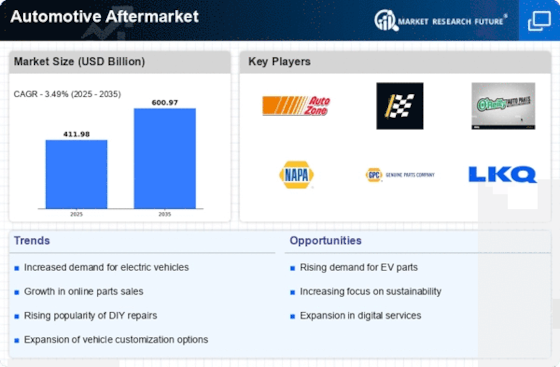
As per Market Research Future analysis, the Automotive Aftermarket Size was estimated at 411.98 USD Billion in 2024. The Automotive Aftermarket industry is projected to grow from 426.37 USD Billion in 2025 to 600.97 USD Billion by 2035, exhibiting a compound annual growth rate (CAGR) of 3.49% during the forecast period 2025 - 2035

Key Market Trends & Highlights

The Automotive Aftermarket is experiencing a transformative shift driven by e-commerce and sustainability.

  • The rise of e-commerce is reshaping the Automotive Aftermarket landscape, particularly in North America, where online retailing remains the largest segment. Sustainability and eco-friendly practices are becoming increasingly important, influencing consumer choices across both parts and accessories segments. Technological advancements are leading to greater vehicle complexity, necessitating specialized parts and services, especially in the fast-growing Asia-Pacific region. The increasing vehicle age and the growth of electric vehicles are significant market drivers, propelling demand in both the parts and online retail segments.

Market Size & Forecast

2024 Market Size 411.98 (USD Billion)
2035 Market Size 600.97 (USD Billion)
CAGR (2025 - 2035) 3.49%
Largest Regional Market Share in 2024 North America

Major Players

<a href="https://www.autozone.com/parts">AutoZone</a> (US), Advance Auto Parts (US), O'Reilly Automotive (US), NAPA Auto Parts (US), Genuine Parts Company (US), LKQ Corporation (US), <a href="https://www.denso.com/in/en/business/automotive-service/">Denso Corporation</a> (JP), Bosch (DE), Magna International (CA), Valeo (FR)

Market Trends

The automotive aftermarket industry report suggests that the industry is currently undergoing a dynamic transformation driven by various factors influencing consumer behavior and technological advancements. As vehicles become increasingly sophisticated, the demand for specialized parts and services is on the rise. This sector encompasses a wide range of products, including replacement parts, accessories, and maintenance services, which are essential for vehicle longevity and performance.

The automotive aftermarket industry report predicts that the growing trend towards vehicle electrification and the integration of advanced driver-assistance systems are reshaping the landscape, prompting aftermarket suppliers to adapt their offerings accordingly. Furthermore, the automotive aftermarket industry statistics claim that the rise of e-commerce platforms has revolutionized how consumers access automotive products, making it easier for them to find and purchase necessary components online. In addition to technological shifts, changing consumer preferences are also impacting the Automotive Aftermarket.

There is a noticeable inclination towards sustainability, with consumers increasingly seeking eco-friendly products and services. This trend is prompting manufacturers and service providers to innovate and develop greener alternatives, such as recycled parts and environmentally friendly lubricants. Moreover, the increasing complexity of modern vehicles necessitates a higher level of expertise among technicians, leading to a growing emphasis on training and certification within the industry. Overall, the Automotive Aftermarket is poised for continued evolution, as it adapts to meet the demands of a changing market landscape and consumer expectations.

Rise of E-commerce in Automotive Aftermarket

The shift towards online shopping is profoundly influencing the Automotive Aftermarket. Consumers are increasingly turning to digital platforms for purchasing parts and accessories, driven by convenience and competitive pricing. This trend is prompting traditional retailers to enhance their online presence and improve customer engagement through digital marketing strategies.

Sustainability and Eco-friendly Practices

The automotive aftermarket industry statistics state that the shift towards online shopping is profoundly influencing the Automotive Aftermarket. Consumers are increasingly turning to digital platforms for purchasing parts and accessories, driven by convenience and competitive pricing. This trend is prompting traditional retailers to enhance their online presence and improve customer engagement through digital marketing strategies.

Technological Advancements and Vehicle Complexity

Modern vehicles are becoming more complex, incorporating advanced technologies that require specialized knowledge for maintenance and repair. This trend is driving the need for skilled technicians and increased training programs within the Automotive Aftermarket, ensuring that service providers can meet the evolving demands of consumers.

Automotive Aftermarket Industry Market Drivers

Increasing Vehicle Age

The average age of vehicles on the road continues to rise, making it a significant driver for the Automotive Aftermarket. As vehicles age, they require more maintenance and replacement parts, leading to increased demand for aftermarket services. Data indicates that the average age of light vehicles in the United States reached approximately 12 years in 2025. This trend suggests that consumers are more likely to invest in repairs and upgrades rather than purchasing new vehicles, thereby bolstering the Automotive Aftermarket Industry Market. Additionally, older vehicles often require specialized parts that are not available through original equipment manufacturers, creating opportunities for aftermarket suppliers to fill this gap.

Rising Consumer Awareness

Consumer awareness regarding vehicle maintenance and the availability of aftermarket products is on the rise, which may drive growth in the Automotive Aftermarket Industry Market. With the proliferation of information through digital platforms, consumers are becoming more informed about their vehicle options and the benefits of aftermarket parts. This trend is reflected in the increasing number of online searches for aftermarket products, suggesting that consumers are actively seeking alternatives to original equipment. Furthermore, as awareness grows, consumers are more likely to consider aftermarket solutions for repairs and enhancements, thereby expanding the market for aftermarket suppliers and service providers.

Growth of Electric Vehicles

The transition towards electric vehicles (EVs) is reshaping the Automotive Aftermarket Industry Market. As more consumers adopt EVs, the demand for specialized parts and services tailored to these vehicles is likely to increase. Reports indicate that the EV market share is projected to reach 30% by 2030, which could significantly impact the aftermarket landscape. This shift necessitates new skills and knowledge among service providers, as traditional automotive repair techniques may not apply to electric drivetrains. Consequently, the Automotive Aftermarket Industry Market must adapt to these changes, potentially leading to the emergence of new business models and service offerings that cater specifically to the needs of EV owners.

Expansion of Online Retailing

The expansion of online retailing is transforming the Automotive Aftermarket Industry Market. E-commerce platforms are increasingly becoming the preferred shopping method for consumers seeking automotive parts and accessories. Data shows that online sales in the automotive aftermarket are expected to grow at a compound annual growth rate of over 10% through 2025. This shift not only provides consumers with greater access to a wider range of products but also allows aftermarket businesses to reach a broader audience. As online shopping becomes more prevalent, traditional brick-and-mortar retailers may need to adapt their strategies to remain competitive in the evolving Automotive Aftermarket Industry Market.

Regulatory Changes and Compliance

Regulatory changes and compliance requirements are influencing the Automotive Aftermarket Industry Market. Governments worldwide are implementing stricter emissions standards and safety regulations, which may necessitate the use of specific aftermarket parts and services. This regulatory environment creates opportunities for aftermarket suppliers who can provide compliant products that meet these new standards. Additionally, as consumers become more environmentally conscious, they may seek aftermarket solutions that align with sustainability goals. The Automotive Aftermarket Industry Market must navigate these regulatory landscapes, which could lead to innovation and the development of new products that cater to both compliance and consumer preferences.

Market Segment Insights

By Type: Parts (Largest) vs. Accessories (Fastest-Growing)

The automotive aftermarket industry statistics suggest that the type segment is primarily driven by 'Parts', which holds the largest market share among the components. These essential components range from engines to brake systems and are critical for vehicle repairs and maintenance. The automotive accessories market, while smaller in share, contribute significantly to market dynamics, providing enhancements and personalizations that cater to consumer preferences. The ongoing demand for quality parts ensures their dominance, but accessories are catching up with increasing consumer spending in customization. In recent years, the aftermarket has witnessed a robust growth trend, particularly in accessories. Factors such as rising vehicle ownership, the aging vehicle fleet, and a growing consumer inclination towards personalization have driven this sector towards expansion. Furthermore, advancements in e-commerce and digital marketing are facilitating access to a broader customer base, enhancing visibility for aftermarket products, thus fostering growth in both parts and accessories segments.

Parts (Dominant) vs. Accessories (Emerging)

In the Automotive Aftermarket, 'Parts' are recognized as the dominant segment, characterized by their critical necessity in vehicle functionality and safety. This includes an array of components essential for maintenance and repairs, ensuring vehicles remain roadworthy. On the other hand, the automotive accessories market are considered an emerging segment, increasingly popular among consumers seeking to enhance their vehicle's aesthetics and functionality. As car owners look for ways to personalize their vehicles, the automotive accessories market has seen innovations such as smart technology and custom design options. The growing trend towards personalization and convenience has positioned accessories as an essential part of the aftermarket landscape, appealing particularly to younger demographics who value uniqueness and tech integration.

By Sales Channel: Online (Largest) vs. Offline Retail (Fastest-Growing)

As per the automotive aftermarket industry statistics, the distribution of market share among various sales channels reveals a significant lean towards online platforms, which stands as the largest channel. In contrast, offline retail is gaining rapid traction, emerging as the fastest-growing segment due to a resurgence of interest in physical dealership experience and personal touch that it offers to consumers. Each channel's performance reflects unique consumer preferences and behaviors that sway towards convenience and immediacy. With the ongoing digital transformation, online sales channels are witnessing enhanced engagement and conversion rates driven by user-friendly platforms, personalized marketing, and an increase in e-commerce penetration. Meanwhile, offline retail is experiencing growth fueled by strategic partnerships, improved in-store experiences, and initiatives aimed at attracting customers back to physical stores. As a result, both channels showcase distinct pathways for future advancements in the Automotive Aftermarket.

Online (Dominant) vs. Wholesale (Emerging)

The online sales channel stands as the dominant force in the Automotive Aftermarket, capturing a significant portion of consumer attention with its extensive product offerings and the convenience of shopping from home. Consumers appreciate the ease of comparing prices, reading reviews, and accessing a wider array of parts than might be available at local stores. In contrast, wholesale sales, while currently emerging in comparison, are poised for growth thanks to the increasing demand from <a href="https://www.marketresearchfuture.com/reports/automotive-service-market-11730">automotive service</a> providers and repair shops seeking competitive pricing on bulk purchases. This segment is progressively adapting to the market's needs through improved logistics and supply chain efficiencies, signaling a notable evolution in the wholesale framework within the aftermarket space.

By Vehicle Type: Passenger Cars (Largest) vs. Commercial Vehicles (Fastest-Growing)

The Automotive Aftermarket is predominantly driven by the <a href="https://www.marketresearchfuture.com/reports/passenger-cars-market-42133">Passenger Cars</a> segment, which holds the largest market share. This segment includes a wide array of vehicles from sedans to hatchbacks, reflecting extensive aftermarket services and parts demand. The diversified nature of passenger vehicles results in a continuous need for maintenance, repairs, and customization, ensuring substantial revenue generation in this segment. In contrast, the Commercial Vehicles segment is poised for rapid growth, fueled by increasing demand for logistics and transportation services. As e-commerce expands, the reliance on commercial and heavy-duty vehicles to deliver goods efficiently continues to increase. Additionally, innovations in fleet management and maintenance solutions are propelling the growth of this segment, enabling businesses to maximize vehicle uptime and efficiency.

Passenger Cars (Dominant) vs. Commercial Vehicles (Emerging)

The Passenger Cars segment remains dominant in the Automotive Aftermarket due to the sheer number of vehicles on the road and the frequency of service requirements, including oil changes, brake replacements, and tire services. This segment benefits from a mature supply chain and a wide range of companies offering products and services for various makes and models. In contrast, the Commercial Vehicles segment is emerging as a dynamic player within the aftermarket landscape, driven by the boom in e-commerce and demand for delivery services. This segment encompasses heavy-duty trucks and vans and poses unique challenges such as longer service intervals and specialized parts. As technology advances, aftermarket solutions for fleet management, telematics, and efficient vehicle maintenance are driving innovation in this sector.

By Service Type: Maintenance Services (Largest) vs. Repair Services (Fastest-Growing)

In the Automotive Aftermarket service segment, Maintenance Services currently dominate the market, holding the largest share due to their ongoing necessity in vehicle upkeep and performance enhancement. This includes regular oil changes, tire rotations, and fluid checks that consumers prioritize for both safety and longevity of their vehicles. Repair Services follow closely, encompassing a range of offerings from minor fixes to major overhauls which also represent a significant portion of the market as they are often driven by the need for vehicle safety and compliance with regulations.

Maintenance Services (Dominant) vs. Repair Services (Emerging)

Maintenance Services stand out as the dominant force within the Automotive Aftermarket, focusing on proactive care that extends vehicle lifespan and enhances performance through regular check-ups and services. This segment resonates well with consumers who are increasingly aware of the importance of maintaining vehicle health to avoid costly repairs down the line. On the other hand, Repair Services, while currently emerging, are rapidly gaining traction as vehicle complexities increase and average vehicle age rises. These services attract customers after breakdowns or when handling technical issues, making them essential for various repair shops seeking to address a growing demand for efficiency and quality service.

Get more detailed insights about Automotive Aftermarket Research Report — Global Forecast till 2035

Regional Insights

North America : Market Leader in Aftermarket

North America remains the largest market for the automotive aftermarket, holding approximately 40% of the global share. Key growth drivers include increasing vehicle ownership, a rise in the average age of vehicles, and a growing trend towards DIY repairs. Regulatory support for emissions standards and safety regulations further catalyzes market growth, ensuring a robust environment for aftermarket services and products. The United States is the dominant player in this region, with major companies like AutoZone, Advance Auto Parts, and O'Reilly Automotive leading the market. The competitive landscape is characterized by a mix of large retailers and independent shops, providing a wide range of products and services. The presence of key players ensures a diverse offering, catering to both professional and DIY consumers, thus enhancing market dynamics.

Europe : Emerging Trends in Aftermarket

Europe's automotive aftermarket is witnessing significant growth, driven by sustainability initiatives and increasing vehicle electrification. The region holds approximately 30% of the global market share, with Germany and France being the largest contributors. Regulatory frameworks promoting eco-friendly practices and the shift towards electric vehicles are key catalysts for market expansion, encouraging innovation in aftermarket services and products. Germany leads the European market, supported by major players like Bosch and Valeo, while France follows closely. The competitive landscape is marked by a mix of established brands and emerging startups focusing on sustainable solutions. The presence of key players ensures a comprehensive range of products, from traditional parts to advanced electric vehicle components, catering to evolving consumer needs.

Asia-Pacific : Rapid Growth and Innovation

Asia-Pacific is rapidly emerging as a powerhouse in the automotive aftermarket, accounting for approximately 25% of the global market share. Key growth drivers include rising disposable incomes, increasing vehicle sales, and a growing trend towards vehicle maintenance and repair. Regulatory support for safety and emissions standards is also fostering a conducive environment for market growth, particularly in countries like China and India. China is the largest market in the region, with significant contributions from local and international players such as Denso and LKQ Corporation. The Australia automotive aftermarket is creating lucrative prospects for leading players in the industry. The competitive landscape is characterized by a mix of established companies and new entrants, focusing on innovation and technology. The presence of key players ensures a diverse range of products and services, catering to the growing demand for quality aftermarket solutions.

Middle East and Africa : Untapped Potential in Aftermarket

The Middle East and Africa represent an untapped potential in the automotive aftermarket, holding approximately 5% of the global market share. Key growth drivers include increasing vehicle ownership, urbanization, and a growing middle class. Regulatory initiatives aimed at improving vehicle safety and emissions standards are also contributing to market growth, creating opportunities for aftermarket services and products in the region. South Africa is the leading market in this region, with a growing presence of both local and international players. The competitive landscape is evolving, with an increasing number of companies entering the market to meet the rising demand for automotive parts and services. The presence of key players ensures a diverse offering, catering to both professional and DIY consumers, thus enhancing market dynamics.

Key Players and Competitive Insights

The Automotive Aftermarket is currently characterized by a dynamic competitive landscape, driven by technological advancements, evolving consumer preferences, and a growing emphasis on sustainability. Key players such as AutoZone (US), O'Reilly Automotive (US), and Denso Corporation (JP) are strategically positioning themselves to leverage these trends. AutoZone (US) focuses on enhancing its digital presence and customer engagement through advanced e-commerce platforms, while O'Reilly Automotive (US) emphasizes regional expansion and localized service offerings to cater to diverse market needs. Denso Corporation (JP), on the other hand, is heavily investing in innovative technologies, particularly in electric vehicle components, which reflects a broader industry shift towards electrification. Collectively, these strategies not only enhance their competitive edge but also shape the overall market dynamics, fostering a more integrated and responsive aftermarket ecosystem. In terms of business tactics, companies are increasingly localizing manufacturing and optimizing supply chains to enhance efficiency and reduce costs. The Automotive Aftermarket appears moderately fragmented, with a mix of large corporations and smaller players. However, the influence of major companies like LKQ Corporation (US) and Bosch (DE) is substantial, as they dominate key segments of the market. Their ability to adapt to changing consumer demands and regulatory environments is crucial in maintaining their competitive positions. In August 2025, LKQ Corporation (US) announced a strategic acquisition of a regional parts distributor, which is expected to enhance its distribution network and improve service delivery in underserved markets. This move is significant as it not only expands LKQ's footprint but also strengthens its supply chain capabilities, allowing for quicker response times to market demands. Such acquisitions are indicative of a broader trend where companies seek to consolidate their market presence through strategic growth initiatives. In September 2025, Bosch (DE) unveiled a new line of aftermarket parts specifically designed for electric vehicles, aligning with the industry's shift towards sustainability and electrification. This initiative is particularly noteworthy as it positions Bosch as a leader in the emerging EV aftermarket segment, potentially capturing a significant share of a rapidly growing market. The introduction of these parts reflects Bosch's commitment to innovation and its proactive approach to meeting future automotive trends. In October 2025, Denso Corporation (JP) launched a collaborative initiative with several automotive manufacturers to develop advanced telematics solutions aimed at enhancing vehicle connectivity and performance. This partnership underscores the importance of strategic alliances in the current market, as companies recognize the need to pool resources and expertise to drive innovation. Such collaborations are likely to become more prevalent as the industry navigates the complexities of digital transformation and consumer expectations. As of October 2025, the Automotive Aftermarket is witnessing a pronounced shift towards digitalization, sustainability, and the integration of artificial intelligence. These trends are reshaping competitive strategies, with companies increasingly focusing on technological advancements rather than solely competing on price. Strategic alliances are playing a pivotal role in this evolution, enabling firms to leverage shared knowledge and resources. Looking ahead, competitive differentiation will likely hinge on innovation, technological integration, and the reliability of supply chains, marking a departure from traditional price-based competition.

Key Companies in the Automotive Aftermarket Industry include

Industry Developments

  • Q2 2024: LKQ Corporation Completes Acquisition of Uni-Select Inc. LKQ Corporation finalized its acquisition of Uni-Select Inc., a major distributor of automotive aftermarket parts, expanding its footprint in North America and Europe.
  • Q1 2024: Advance Auto Parts Appoints Shane O’Kelly as CEO Advance Auto Parts announced the appointment of Shane O’Kelly as its new Chief Executive Officer, signaling a strategic shift in leadership for the automotive aftermarket retailer.
  • Q2 2024: Bosch Opens New Automotive Aftermarket Distribution Center in Texas Bosch inaugurated a new state-of-the-art distribution center in Texas to enhance its logistics and supply chain capabilities for automotive aftermarket products in the U.S.
  • Q2 2024: Genuine Parts Company Announces Strategic Partnership with NAPA AutoCare Genuine Parts Company entered into a strategic partnership with NAPA AutoCare to expand service offerings and strengthen its position in the automotive aftermarket sector.
  • Q3 2024: Dorman Products Launches New Line of EV Aftermarket Parts Dorman Products introduced a new product line focused on electric vehicle aftermarket parts, targeting the growing EV maintenance and repair market.
  • Q2 2024: Magneti Marelli Expands Aftermarket Operations with New Facility in Mexico Magneti Marelli opened a new manufacturing facility in Mexico to increase production capacity for its automotive aftermarket components in the Americas.
  • Q1 2025: AutoZone Announces $500 Million Share Buyback Program AutoZone launched a $500 million share buyback program, reflecting confidence in its ongoing growth and profitability in the automotive aftermarket sector.
  • Q2 2025: MANN+HUMMEL Acquires U.S. Filtration Specialist Tri-Dim Filter Corporation MANN+HUMMEL completed the acquisition of Tri-Dim Filter Corporation, strengthening its portfolio in automotive and industrial filtration solutions.
  • Q2 2024: Tenneco Launches New Monroe Intelligent Suspension Aftermarket Product Tenneco unveiled its Monroe Intelligent Suspension aftermarket product, bringing advanced ride control technology to the replacement parts market.
  • Q3 2024: Parts Authority Secures Major Distribution Contract with National Fleet Operator Parts Authority won a significant distribution contract to supply automotive aftermarket parts to a leading national fleet operator, expanding its commercial reach.
  • Q1 2025: ZF Aftermarket Launches New E-Mobility Service Program ZF Aftermarket introduced a comprehensive service program for electric vehicles, including training and parts supply for independent workshops.
  • Q2 2025: Valeo Opens New R&D Center for Aftermarket Innovations in France Valeo inaugurated a new research and development center in France dedicated to developing innovative products for the automotive aftermarket sector.

Future Outlook

Automotive Aftermarket Industry Future Outlook

The global Automotive Aftermarket is projected to grow at a 3.49% CAGR from 2025 to 2035, driven by technological advancements, increasing vehicle ownership, and a shift towards sustainable practices.

New opportunities lie in:

  • <p>Expansion of e-commerce platforms for aftermarket parts Development of advanced driver-assistance system (ADAS) calibration services Investment in electric vehicle (EV) charging infrastructure maintenance</p>

By 2035, the Automotive Aftermarket is expected to be robust, adapting to evolving consumer needs and technological advancements.

Market Segmentation

Automotive Aftermarket Industry Type Outlook

  • Parts
  • Accessories
  • Tires
  • Lubricants
  • Service Equipment

Automotive Aftermarket Industry Service Type Outlook

  • Maintenance Services
  • Repair Services
  • Installation Services
  • Modification Services

Automotive Aftermarket Industry Vehicle Type Outlook

  • Passenger Cars
  • Commercial Vehicles
  • Motorcycles
  • Heavy-Duty Vehicles

Automotive Aftermarket Industry Sales Channel Outlook

  • Online
  • Offline Retail
  • Wholesale
  • Direct Sales

Report Scope

MARKET SIZE 2024 411.98(USD Billion)
MARKET SIZE 2025 426.37(USD Billion)
MARKET SIZE 2035 600.97(USD Billion)
COMPOUND ANNUAL GROWTH RATE (CAGR) 3.49% (2025 - 2035)
REPORT COVERAGE Revenue Forecast, Competitive Landscape, Growth Factors, and Trends
BASE YEAR 2024
Market Forecast Period 2025 - 2035
Historical Data 2019 - 2024
Market Forecast Units USD Billion
Key Companies Profiled AutoZone (US), Advance Auto Parts (US), O'Reilly Automotive (US), NAPA Auto Parts (US), Genuine Parts Company (US), LKQ Corporation (US), Denso Corporation (JP), Bosch (DE), Magna International (CA), Valeo (FR)
Segments Covered Product Type, Sales Channel, Vehicle Type, Service Type, Regional
Key Market Opportunities Integration of advanced telematics and connected vehicle technologies in the Automotive Aftermarket.
Key Market Dynamics Rising demand for electric vehicle parts drives innovation and competition in the Automotive Aftermarket.
Countries Covered North America, Europe, APAC, South America, MEA

FAQs

What is the projected market valuation of the Automotive Aftermarket by 2035?

<p>The projected market valuation of the Automotive Aftermarket is expected to reach 600.97 USD Billion by 2035.</p>

What was the market valuation of the Automotive Aftermarket in 2024?

<p>The overall market valuation of the Automotive Aftermarket was 411.98 USD Billion in 2024.</p>

What is the expected CAGR for the Automotive Aftermarket from 2025 to 2035?

<p>The expected CAGR for the Automotive Aftermarket during the forecast period 2025 - 2035 is 3.49%.</p>

Which companies are considered key players in the Automotive Aftermarket?

<p>Key players in the Automotive Aftermarket include AutoZone, Advance Auto Parts, O'Reilly Automotive, and NAPA Auto Parts.</p>

What segment of the Automotive Aftermarket had the highest valuation in 2024?

<p>In 2024, the Parts segment had the highest valuation at 150.0 USD Billion.</p>

How much is the Online sales channel projected to grow by 2035?

<p>The Online sales channel is projected to grow from 82.39 USD Billion in 2024 to 120.0 USD Billion by 2035.</p>

What is the valuation of the Repair Services segment in 2024?

<p>The Repair Services segment was valued at 150.0 USD Billion in 2024.</p>

What is the projected valuation for the Tires segment by 2035?

<p>The Tires segment is projected to reach a valuation of 90.0 USD Billion by 2035.</p>

Which vehicle type is expected to dominate the Automotive Aftermarket by 2035?

<p>Passenger Cars are expected to dominate the Automotive Aftermarket, with a projected valuation of 300.0 USD Billion by 2035.</p>

What is the expected growth for the Installation Services segment from 2024 to 2035?

<p>The Installation Services segment is expected to grow from 80.0 USD Billion in 2024 to 120.0 USD Billion by 2035.</p>

  1. SECTION I: EXECUTIVE SUMMARY AND KEY HIGHLIGHTS
    1. | 1.1 EXECUTIVE SUMMARY
    2. | | 1.1.1 Market Overview
    3. | | 1.1.2 Key Findings
    4. | | 1.1.3 Market Segmentation
    5. | | 1.1.4 Competitive Landscape
    6. | | 1.1.5 Challenges and Opportunities
    7. | | 1.1.6 Future Outlook
  2. SECTION II: SCOPING, METHODOLOGY AND MARKET STRUCTURE
    1. | 2.1 MARKET INTRODUCTION
    2. | | 2.1.1 Definition
    3. | | 2.1.2 Scope of the study
    4. | | | 2.1.2.1 Research Objective
    5. | | | 2.1.2.2 Assumption
    6. | | | 2.1.2.3 Limitations
    7. | 2.2 RESEARCH METHODOLOGY
    8. | | 2.2.1 Overview
    9. | | 2.2.2 Data Mining
    10. | | 2.2.3 Secondary Research
    11. | | 2.2.4 Primary Research
    12. | | | 2.2.4.1 Primary Interviews and Information Gathering Process
    13. | | | 2.2.4.2 Breakdown of Primary Respondents
    14. | | 2.2.5 Forecasting Model
    15. | | 2.2.6 Market Size Estimation
    16. | | | 2.2.6.1 Bottom-Up Approach
    17. | | | 2.2.6.2 Top-Down Approach
    18. | | 2.2.7 Data Triangulation
    19. | | 2.2.8 Validation
  3. SECTION III: QUALITATIVE ANALYSIS
    1. | 3.1 MARKET DYNAMICS
    2. | | 3.1.1 Overview
    3. | | 3.1.2 Drivers
    4. | | 3.1.3 Restraints
    5. | | 3.1.4 Opportunities
    6. | 3.2 MARKET FACTOR ANALYSIS
    7. | | 3.2.1 Value chain Analysis
    8. | | 3.2.2 Porter's Five Forces Analysis
    9. | | | 3.2.2.1 Bargaining Power of Suppliers
    10. | | | 3.2.2.2 Bargaining Power of Buyers
    11. | | | 3.2.2.3 Threat of New Entrants
    12. | | | 3.2.2.4 Threat of Substitutes
    13. | | | 3.2.2.5 Intensity of Rivalry
    14. | | 3.2.3 COVID-19 Impact Analysis
    15. | | | 3.2.3.1 Market Impact Analysis
    16. | | | 3.2.3.2 Regional Impact
    17. | | | 3.2.3.3 Opportunity and Threat Analysis
  4. SECTION IV: QUANTITATIVE ANALYSIS
    1. | 4.1 Automobile, BY Type (USD Billion)
    2. | | 4.1.1 Parts
    3. | | 4.1.2 Accessories
    4. | | 4.1.3 Tires
    5. | | 4.1.4 Lubricants
    6. | | 4.1.5 Service Equipment
    7. | 4.2 Automobile, BY Sales Channel (USD Billion)
    8. | | 4.2.1 Online
    9. | | 4.2.2 Offline Retail
    10. | | 4.2.3 Wholesale
    11. | | 4.2.4 Direct Sales
    12. | 4.3 Automobile, BY Vehicle Type (USD Billion)
    13. | | 4.3.1 Passenger Cars
    14. | | 4.3.2 Commercial Vehicles
    15. | | 4.3.3 Motorcycles
    16. | | 4.3.4 Heavy-Duty Vehicles
    17. | 4.4 Automobile, BY Service Type (USD Billion)
    18. | | 4.4.1 Maintenance Services
    19. | | 4.4.2 Repair Services
    20. | | 4.4.3 Installation Services
    21. | | 4.4.4 Modification Services
    22. | 4.5 Automobile, BY Region (USD Billion)
    23. | | 4.5.1 North America
    24. | | | 4.5.1.1 US
    25. | | | 4.5.1.2 Canada
    26. | | 4.5.2 Europe
    27. | | | 4.5.2.1 Germany
    28. | | | 4.5.2.2 UK
    29. | | | 4.5.2.3 France
    30. | | | 4.5.2.4 Russia
    31. | | | 4.5.2.5 Italy
    32. | | | 4.5.2.6 Spain
    33. | | | 4.5.2.7 Rest of Europe
    34. | | 4.5.3 APAC
    35. | | | 4.5.3.1 China
    36. | | | 4.5.3.2 India
    37. | | | 4.5.3.3 Japan
    38. | | | 4.5.3.4 South Korea
    39. | | | 4.5.3.5 Malaysia
    40. | | | 4.5.3.6 Thailand
    41. | | | 4.5.3.7 Indonesia
    42. | | | 4.5.3.8 Rest of APAC
    43. | | 4.5.4 South America
    44. | | | 4.5.4.1 Brazil
    45. | | | 4.5.4.2 Mexico
    46. | | | 4.5.4.3 Argentina
    47. | | | 4.5.4.4 Rest of South America
    48. | | 4.5.5 MEA
    49. | | | 4.5.5.1 GCC Countries
    50. | | | 4.5.5.2 South Africa
    51. | | | 4.5.5.3 Rest of MEA
  5. SECTION V: COMPETITIVE ANALYSIS
    1. | 5.1 Competitive Landscape
    2. | | 5.1.1 Overview
    3. | | 5.1.2 Competitive Analysis
    4. | | 5.1.3 Market share Analysis
    5. | | 5.1.4 Major Growth Strategy in the Automobile
    6. | | 5.1.5 Competitive Benchmarking
    7. | | 5.1.6 Leading Players in Terms of Number of Developments in the Automobile
    8. | | 5.1.7 Key developments and growth strategies
    9. | | | 5.1.7.1 New Product Launch/Service Deployment
    10. | | | 5.1.7.2 Merger & Acquisitions
    11. | | | 5.1.7.3 Joint Ventures
    12. | | 5.1.8 Major Players Financial Matrix
    13. | | | 5.1.8.1 Sales and Operating Income
    14. | | | 5.1.8.2 Major Players R&D Expenditure. 2023
    15. | 5.2 Company Profiles
    16. | | 5.2.1 AutoZone (US)
    17. | | | 5.2.1.1 Financial Overview
    18. | | | 5.2.1.2 Products Offered
    19. | | | 5.2.1.3 Key Developments
    20. | | | 5.2.1.4 SWOT Analysis
    21. | | | 5.2.1.5 Key Strategies
    22. | | 5.2.2 Advance Auto Parts (US)
    23. | | | 5.2.2.1 Financial Overview
    24. | | | 5.2.2.2 Products Offered
    25. | | | 5.2.2.3 Key Developments
    26. | | | 5.2.2.4 SWOT Analysis
    27. | | | 5.2.2.5 Key Strategies
    28. | | 5.2.3 O'Reilly Automotive (US)
    29. | | | 5.2.3.1 Financial Overview
    30. | | | 5.2.3.2 Products Offered
    31. | | | 5.2.3.3 Key Developments
    32. | | | 5.2.3.4 SWOT Analysis
    33. | | | 5.2.3.5 Key Strategies
    34. | | 5.2.4 NAPA Auto Parts (US)
    35. | | | 5.2.4.1 Financial Overview
    36. | | | 5.2.4.2 Products Offered
    37. | | | 5.2.4.3 Key Developments
    38. | | | 5.2.4.4 SWOT Analysis
    39. | | | 5.2.4.5 Key Strategies
    40. | | 5.2.5 Genuine Parts Company (US)
    41. | | | 5.2.5.1 Financial Overview
    42. | | | 5.2.5.2 Products Offered
    43. | | | 5.2.5.3 Key Developments
    44. | | | 5.2.5.4 SWOT Analysis
    45. | | | 5.2.5.5 Key Strategies
    46. | | 5.2.6 LKQ Corporation (US)
    47. | | | 5.2.6.1 Financial Overview
    48. | | | 5.2.6.2 Products Offered
    49. | | | 5.2.6.3 Key Developments
    50. | | | 5.2.6.4 SWOT Analysis
    51. | | | 5.2.6.5 Key Strategies
    52. | | 5.2.7 Denso Corporation (JP)
    53. | | | 5.2.7.1 Financial Overview
    54. | | | 5.2.7.2 Products Offered
    55. | | | 5.2.7.3 Key Developments
    56. | | | 5.2.7.4 SWOT Analysis
    57. | | | 5.2.7.5 Key Strategies
    58. | | 5.2.8 Bosch (DE)
    59. | | | 5.2.8.1 Financial Overview
    60. | | | 5.2.8.2 Products Offered
    61. | | | 5.2.8.3 Key Developments
    62. | | | 5.2.8.4 SWOT Analysis
    63. | | | 5.2.8.5 Key Strategies
    64. | | 5.2.9 Magna International (CA)
    65. | | | 5.2.9.1 Financial Overview
    66. | | | 5.2.9.2 Products Offered
    67. | | | 5.2.9.3 Key Developments
    68. | | | 5.2.9.4 SWOT Analysis
    69. | | | 5.2.9.5 Key Strategies
    70. | | 5.2.10 Valeo (FR)
    71. | | | 5.2.10.1 Financial Overview
    72. | | | 5.2.10.2 Products Offered
    73. | | | 5.2.10.3 Key Developments
    74. | | | 5.2.10.4 SWOT Analysis
    75. | | | 5.2.10.5 Key Strategies
    76. | 5.3 Appendix
    77. | | 5.3.1 References
    78. | | 5.3.2 Related Reports
  6. LIST OF FIGURES
    1. | 6.1 MARKET SYNOPSIS
    2. | 6.2 NORTH AMERICA MARKET ANALYSIS
    3. | 6.3 US MARKET ANALYSIS BY TYPE
    4. | 6.4 US MARKET ANALYSIS BY SALES CHANNEL
    5. | 6.5 US MARKET ANALYSIS BY VEHICLE TYPE
    6. | 6.6 US MARKET ANALYSIS BY SERVICE TYPE
    7. | 6.7 CANADA MARKET ANALYSIS BY TYPE
    8. | 6.8 CANADA MARKET ANALYSIS BY SALES CHANNEL
    9. | 6.9 CANADA MARKET ANALYSIS BY VEHICLE TYPE
    10. | 6.10 CANADA MARKET ANALYSIS BY SERVICE TYPE
    11. | 6.11 EUROPE MARKET ANALYSIS
    12. | 6.12 GERMANY MARKET ANALYSIS BY TYPE
    13. | 6.13 GERMANY MARKET ANALYSIS BY SALES CHANNEL
    14. | 6.14 GERMANY MARKET ANALYSIS BY VEHICLE TYPE
    15. | 6.15 GERMANY MARKET ANALYSIS BY SERVICE TYPE
    16. | 6.16 UK MARKET ANALYSIS BY TYPE
    17. | 6.17 UK MARKET ANALYSIS BY SALES CHANNEL
    18. | 6.18 UK MARKET ANALYSIS BY VEHICLE TYPE
    19. | 6.19 UK MARKET ANALYSIS BY SERVICE TYPE
    20. | 6.20 FRANCE MARKET ANALYSIS BY TYPE
    21. | 6.21 FRANCE MARKET ANALYSIS BY SALES CHANNEL
    22. | 6.22 FRANCE MARKET ANALYSIS BY VEHICLE TYPE
    23. | 6.23 FRANCE MARKET ANALYSIS BY SERVICE TYPE
    24. | 6.24 RUSSIA MARKET ANALYSIS BY TYPE
    25. | 6.25 RUSSIA MARKET ANALYSIS BY SALES CHANNEL
    26. | 6.26 RUSSIA MARKET ANALYSIS BY VEHICLE TYPE
    27. | 6.27 RUSSIA MARKET ANALYSIS BY SERVICE TYPE
    28. | 6.28 ITALY MARKET ANALYSIS BY TYPE
    29. | 6.29 ITALY MARKET ANALYSIS BY SALES CHANNEL
    30. | 6.30 ITALY MARKET ANALYSIS BY VEHICLE TYPE
    31. | 6.31 ITALY MARKET ANALYSIS BY SERVICE TYPE
    32. | 6.32 SPAIN MARKET ANALYSIS BY TYPE
    33. | 6.33 SPAIN MARKET ANALYSIS BY SALES CHANNEL
    34. | 6.34 SPAIN MARKET ANALYSIS BY VEHICLE TYPE
    35. | 6.35 SPAIN MARKET ANALYSIS BY SERVICE TYPE
    36. | 6.36 REST OF EUROPE MARKET ANALYSIS BY TYPE
    37. | 6.37 REST OF EUROPE MARKET ANALYSIS BY SALES CHANNEL
    38. | 6.38 REST OF EUROPE MARKET ANALYSIS BY VEHICLE TYPE
    39. | 6.39 REST OF EUROPE MARKET ANALYSIS BY SERVICE TYPE
    40. | 6.40 APAC MARKET ANALYSIS
    41. | 6.41 CHINA MARKET ANALYSIS BY TYPE
    42. | 6.42 CHINA MARKET ANALYSIS BY SALES CHANNEL
    43. | 6.43 CHINA MARKET ANALYSIS BY VEHICLE TYPE
    44. | 6.44 CHINA MARKET ANALYSIS BY SERVICE TYPE
    45. | 6.45 INDIA MARKET ANALYSIS BY TYPE
    46. | 6.46 INDIA MARKET ANALYSIS BY SALES CHANNEL
    47. | 6.47 INDIA MARKET ANALYSIS BY VEHICLE TYPE
    48. | 6.48 INDIA MARKET ANALYSIS BY SERVICE TYPE
    49. | 6.49 JAPAN MARKET ANALYSIS BY TYPE
    50. | 6.50 JAPAN MARKET ANALYSIS BY SALES CHANNEL
    51. | 6.51 JAPAN MARKET ANALYSIS BY VEHICLE TYPE
    52. | 6.52 JAPAN MARKET ANALYSIS BY SERVICE TYPE
    53. | 6.53 SOUTH KOREA MARKET ANALYSIS BY TYPE
    54. | 6.54 SOUTH KOREA MARKET ANALYSIS BY SALES CHANNEL
    55. | 6.55 SOUTH KOREA MARKET ANALYSIS BY VEHICLE TYPE
    56. | 6.56 SOUTH KOREA MARKET ANALYSIS BY SERVICE TYPE
    57. | 6.57 MALAYSIA MARKET ANALYSIS BY TYPE
    58. | 6.58 MALAYSIA MARKET ANALYSIS BY SALES CHANNEL
    59. | 6.59 MALAYSIA MARKET ANALYSIS BY VEHICLE TYPE
    60. | 6.60 MALAYSIA MARKET ANALYSIS BY SERVICE TYPE
    61. | 6.61 THAILAND MARKET ANALYSIS BY TYPE
    62. | 6.62 THAILAND MARKET ANALYSIS BY SALES CHANNEL
    63. | 6.63 THAILAND MARKET ANALYSIS BY VEHICLE TYPE
    64. | 6.64 THAILAND MARKET ANALYSIS BY SERVICE TYPE
    65. | 6.65 INDONESIA MARKET ANALYSIS BY TYPE
    66. | 6.66 INDONESIA MARKET ANALYSIS BY SALES CHANNEL
    67. | 6.67 INDONESIA MARKET ANALYSIS BY VEHICLE TYPE
    68. | 6.68 INDONESIA MARKET ANALYSIS BY SERVICE TYPE
    69. | 6.69 REST OF APAC MARKET ANALYSIS BY TYPE
    70. | 6.70 REST OF APAC MARKET ANALYSIS BY SALES CHANNEL
    71. | 6.71 REST OF APAC MARKET ANALYSIS BY VEHICLE TYPE
    72. | 6.72 REST OF APAC MARKET ANALYSIS BY SERVICE TYPE
    73. | 6.73 SOUTH AMERICA MARKET ANALYSIS
    74. | 6.74 BRAZIL MARKET ANALYSIS BY TYPE
    75. | 6.75 BRAZIL MARKET ANALYSIS BY SALES CHANNEL
    76. | 6.76 BRAZIL MARKET ANALYSIS BY VEHICLE TYPE
    77. | 6.77 BRAZIL MARKET ANALYSIS BY SERVICE TYPE
    78. | 6.78 MEXICO MARKET ANALYSIS BY TYPE
    79. | 6.79 MEXICO MARKET ANALYSIS BY SALES CHANNEL
    80. | 6.80 MEXICO MARKET ANALYSIS BY VEHICLE TYPE
    81. | 6.81 MEXICO MARKET ANALYSIS BY SERVICE TYPE
    82. | 6.82 ARGENTINA MARKET ANALYSIS BY TYPE
    83. | 6.83 ARGENTINA MARKET ANALYSIS BY SALES CHANNEL
    84. | 6.84 ARGENTINA MARKET ANALYSIS BY VEHICLE TYPE
    85. | 6.85 ARGENTINA MARKET ANALYSIS BY SERVICE TYPE
    86. | 6.86 REST OF SOUTH AMERICA MARKET ANALYSIS BY TYPE
    87. | 6.87 REST OF SOUTH AMERICA MARKET ANALYSIS BY SALES CHANNEL
    88. | 6.88 REST OF SOUTH AMERICA MARKET ANALYSIS BY VEHICLE TYPE
    89. | 6.89 REST OF SOUTH AMERICA MARKET ANALYSIS BY SERVICE TYPE
    90. | 6.90 MEA MARKET ANALYSIS
    91. | 6.91 GCC COUNTRIES MARKET ANALYSIS BY TYPE
    92. | 6.92 GCC COUNTRIES MARKET ANALYSIS BY SALES CHANNEL
    93. | 6.93 GCC COUNTRIES MARKET ANALYSIS BY VEHICLE TYPE
    94. | 6.94 GCC COUNTRIES MARKET ANALYSIS BY SERVICE TYPE
    95. | 6.95 SOUTH AFRICA MARKET ANALYSIS BY TYPE
    96. | 6.96 SOUTH AFRICA MARKET ANALYSIS BY SALES CHANNEL
    97. | 6.97 SOUTH AFRICA MARKET ANALYSIS BY VEHICLE TYPE
    98. | 6.98 SOUTH AFRICA MARKET ANALYSIS BY SERVICE TYPE
    99. | 6.99 REST OF MEA MARKET ANALYSIS BY TYPE
    100. | 6.100 REST OF MEA MARKET ANALYSIS BY SALES CHANNEL
    101. | 6.101 REST OF MEA MARKET ANALYSIS BY VEHICLE TYPE
    102. | 6.102 REST OF MEA MARKET ANALYSIS BY SERVICE TYPE
    103. | 6.103 KEY BUYING CRITERIA OF AUTOMOBILE
    104. | 6.104 RESEARCH PROCESS OF MRFR
    105. | 6.105 DRO ANALYSIS OF AUTOMOBILE
    106. | 6.106 DRIVERS IMPACT ANALYSIS: AUTOMOBILE
    107. | 6.107 RESTRAINTS IMPACT ANALYSIS: AUTOMOBILE
    108. | 6.108 SUPPLY / VALUE CHAIN: AUTOMOBILE
    109. | 6.109 AUTOMOBILE, BY TYPE, 2024 (% SHARE)
    110. | 6.110 AUTOMOBILE, BY TYPE, 2024 TO 2035 (USD Billion)
    111. | 6.111 AUTOMOBILE, BY SALES CHANNEL, 2024 (% SHARE)
    112. | 6.112 AUTOMOBILE, BY SALES CHANNEL, 2024 TO 2035 (USD Billion)
    113. | 6.113 AUTOMOBILE, BY VEHICLE TYPE, 2024 (% SHARE)
    114. | 6.114 AUTOMOBILE, BY VEHICLE TYPE, 2024 TO 2035 (USD Billion)
    115. | 6.115 AUTOMOBILE, BY SERVICE TYPE, 2024 (% SHARE)
    116. | 6.116 AUTOMOBILE, BY SERVICE TYPE, 2024 TO 2035 (USD Billion)
    117. | 6.117 BENCHMARKING OF MAJOR COMPETITORS
  7. LIST OF TABLES
    1. | 7.1 LIST OF ASSUMPTIONS
    2. | | 7.1.1
    3. | 7.2 North America MARKET SIZE ESTIMATES; FORECAST
    4. | | 7.2.1 BY TYPE, 2025-2035 (USD Billion)
    5. | | 7.2.2 BY SALES CHANNEL, 2025-2035 (USD Billion)
    6. | | 7.2.3 BY VEHICLE TYPE, 2025-2035 (USD Billion)
    7. | | 7.2.4 BY SERVICE TYPE, 2025-2035 (USD Billion)
    8. | 7.3 US MARKET SIZE ESTIMATES; FORECAST
    9. | | 7.3.1 BY TYPE, 2025-2035 (USD Billion)
    10. | | 7.3.2 BY SALES CHANNEL, 2025-2035 (USD Billion)
    11. | | 7.3.3 BY VEHICLE TYPE, 2025-2035 (USD Billion)
    12. | | 7.3.4 BY SERVICE TYPE, 2025-2035 (USD Billion)
    13. | 7.4 Canada MARKET SIZE ESTIMATES; FORECAST
    14. | | 7.4.1 BY TYPE, 2025-2035 (USD Billion)
    15. | | 7.4.2 BY SALES CHANNEL, 2025-2035 (USD Billion)
    16. | | 7.4.3 BY VEHICLE TYPE, 2025-2035 (USD Billion)
    17. | | 7.4.4 BY SERVICE TYPE, 2025-2035 (USD Billion)
    18. | 7.5 Europe MARKET SIZE ESTIMATES; FORECAST
    19. | | 7.5.1 BY TYPE, 2025-2035 (USD Billion)
    20. | | 7.5.2 BY SALES CHANNEL, 2025-2035 (USD Billion)
    21. | | 7.5.3 BY VEHICLE TYPE, 2025-2035 (USD Billion)
    22. | | 7.5.4 BY SERVICE TYPE, 2025-2035 (USD Billion)
    23. | 7.6 Germany MARKET SIZE ESTIMATES; FORECAST
    24. | | 7.6.1 BY TYPE, 2025-2035 (USD Billion)
    25. | | 7.6.2 BY SALES CHANNEL, 2025-2035 (USD Billion)
    26. | | 7.6.3 BY VEHICLE TYPE, 2025-2035 (USD Billion)
    27. | | 7.6.4 BY SERVICE TYPE, 2025-2035 (USD Billion)
    28. | 7.7 UK MARKET SIZE ESTIMATES; FORECAST
    29. | | 7.7.1 BY TYPE, 2025-2035 (USD Billion)
    30. | | 7.7.2 BY SALES CHANNEL, 2025-2035 (USD Billion)
    31. | | 7.7.3 BY VEHICLE TYPE, 2025-2035 (USD Billion)
    32. | | 7.7.4 BY SERVICE TYPE, 2025-2035 (USD Billion)
    33. | 7.8 France MARKET SIZE ESTIMATES; FORECAST
    34. | | 7.8.1 BY TYPE, 2025-2035 (USD Billion)
    35. | | 7.8.2 BY SALES CHANNEL, 2025-2035 (USD Billion)
    36. | | 7.8.3 BY VEHICLE TYPE, 2025-2035 (USD Billion)
    37. | | 7.8.4 BY SERVICE TYPE, 2025-2035 (USD Billion)
    38. | 7.9 Russia MARKET SIZE ESTIMATES; FORECAST
    39. | | 7.9.1 BY TYPE, 2025-2035 (USD Billion)
    40. | | 7.9.2 BY SALES CHANNEL, 2025-2035 (USD Billion)
    41. | | 7.9.3 BY VEHICLE TYPE, 2025-2035 (USD Billion)
    42. | | 7.9.4 BY SERVICE TYPE, 2025-2035 (USD Billion)
    43. | 7.10 Italy MARKET SIZE ESTIMATES; FORECAST
    44. | | 7.10.1 BY TYPE, 2025-2035 (USD Billion)
    45. | | 7.10.2 BY SALES CHANNEL, 2025-2035 (USD Billion)
    46. | | 7.10.3 BY VEHICLE TYPE, 2025-2035 (USD Billion)
    47. | | 7.10.4 BY SERVICE TYPE, 2025-2035 (USD Billion)
    48. | 7.11 Spain MARKET SIZE ESTIMATES; FORECAST
    49. | | 7.11.1 BY TYPE, 2025-2035 (USD Billion)
    50. | | 7.11.2 BY SALES CHANNEL, 2025-2035 (USD Billion)
    51. | | 7.11.3 BY VEHICLE TYPE, 2025-2035 (USD Billion)
    52. | | 7.11.4 BY SERVICE TYPE, 2025-2035 (USD Billion)
    53. | 7.12 Rest of Europe MARKET SIZE ESTIMATES; FORECAST
    54. | | 7.12.1 BY TYPE, 2025-2035 (USD Billion)
    55. | | 7.12.2 BY SALES CHANNEL, 2025-2035 (USD Billion)
    56. | | 7.12.3 BY VEHICLE TYPE, 2025-2035 (USD Billion)
    57. | | 7.12.4 BY SERVICE TYPE, 2025-2035 (USD Billion)
    58. | 7.13 APAC MARKET SIZE ESTIMATES; FORECAST
    59. | | 7.13.1 BY TYPE, 2025-2035 (USD Billion)
    60. | | 7.13.2 BY SALES CHANNEL, 2025-2035 (USD Billion)
    61. | | 7.13.3 BY VEHICLE TYPE, 2025-2035 (USD Billion)
    62. | | 7.13.4 BY SERVICE TYPE, 2025-2035 (USD Billion)
    63. | 7.14 China MARKET SIZE ESTIMATES; FORECAST
    64. | | 7.14.1 BY TYPE, 2025-2035 (USD Billion)
    65. | | 7.14.2 BY SALES CHANNEL, 2025-2035 (USD Billion)
    66. | | 7.14.3 BY VEHICLE TYPE, 2025-2035 (USD Billion)
    67. | | 7.14.4 BY SERVICE TYPE, 2025-2035 (USD Billion)
    68. | 7.15 India MARKET SIZE ESTIMATES; FORECAST
    69. | | 7.15.1 BY TYPE, 2025-2035 (USD Billion)
    70. | | 7.15.2 BY SALES CHANNEL, 2025-2035 (USD Billion)
    71. | | 7.15.3 BY VEHICLE TYPE, 2025-2035 (USD Billion)
    72. | | 7.15.4 BY SERVICE TYPE, 2025-2035 (USD Billion)
    73. | 7.16 Japan MARKET SIZE ESTIMATES; FORECAST
    74. | | 7.16.1 BY TYPE, 2025-2035 (USD Billion)
    75. | | 7.16.2 BY SALES CHANNEL, 2025-2035 (USD Billion)
    76. | | 7.16.3 BY VEHICLE TYPE, 2025-2035 (USD Billion)
    77. | | 7.16.4 BY SERVICE TYPE, 2025-2035 (USD Billion)
    78. | 7.17 South Korea MARKET SIZE ESTIMATES; FORECAST
    79. | | 7.17.1 BY TYPE, 2025-2035 (USD Billion)
    80. | | 7.17.2 BY SALES CHANNEL, 2025-2035 (USD Billion)
    81. | | 7.17.3 BY VEHICLE TYPE, 2025-2035 (USD Billion)
    82. | | 7.17.4 BY SERVICE TYPE, 2025-2035 (USD Billion)
    83. | 7.18 Malaysia MARKET SIZE ESTIMATES; FORECAST
    84. | | 7.18.1 BY TYPE, 2025-2035 (USD Billion)
    85. | | 7.18.2 BY SALES CHANNEL, 2025-2035 (USD Billion)
    86. | | 7.18.3 BY VEHICLE TYPE, 2025-2035 (USD Billion)
    87. | | 7.18.4 BY SERVICE TYPE, 2025-2035 (USD Billion)
    88. | 7.19 Thailand MARKET SIZE ESTIMATES; FORECAST
    89. | | 7.19.1 BY TYPE, 2025-2035 (USD Billion)
    90. | | 7.19.2 BY SALES CHANNEL, 2025-2035 (USD Billion)
    91. | | 7.19.3 BY VEHICLE TYPE, 2025-2035 (USD Billion)
    92. | | 7.19.4 BY SERVICE TYPE, 2025-2035 (USD Billion)
    93. | 7.20 Indonesia MARKET SIZE ESTIMATES; FORECAST
    94. | | 7.20.1 BY TYPE, 2025-2035 (USD Billion)
    95. | | 7.20.2 BY SALES CHANNEL, 2025-2035 (USD Billion)
    96. | | 7.20.3 BY VEHICLE TYPE, 2025-2035 (USD Billion)
    97. | | 7.20.4 BY SERVICE TYPE, 2025-2035 (USD Billion)
    98. | 7.21 Rest of APAC MARKET SIZE ESTIMATES; FORECAST
    99. | | 7.21.1 BY TYPE, 2025-2035 (USD Billion)
    100. | | 7.21.2 BY SALES CHANNEL, 2025-2035 (USD Billion)
    101. | | 7.21.3 BY VEHICLE TYPE, 2025-2035 (USD Billion)
    102. | | 7.21.4 BY SERVICE TYPE, 2025-2035 (USD Billion)
    103. | 7.22 South America MARKET SIZE ESTIMATES; FORECAST
    104. | | 7.22.1 BY TYPE, 2025-2035 (USD Billion)
    105. | | 7.22.2 BY SALES CHANNEL, 2025-2035 (USD Billion)
    106. | | 7.22.3 BY VEHICLE TYPE, 2025-2035 (USD Billion)
    107. | | 7.22.4 BY SERVICE TYPE, 2025-2035 (USD Billion)
    108. | 7.23 Brazil MARKET SIZE ESTIMATES; FORECAST
    109. | | 7.23.1 BY TYPE, 2025-2035 (USD Billion)
    110. | | 7.23.2 BY SALES CHANNEL, 2025-2035 (USD Billion)
    111. | | 7.23.3 BY VEHICLE TYPE, 2025-2035 (USD Billion)
    112. | | 7.23.4 BY SERVICE TYPE, 2025-2035 (USD Billion)
    113. | 7.24 Mexico MARKET SIZE ESTIMATES; FORECAST
    114. | | 7.24.1 BY TYPE, 2025-2035 (USD Billion)
    115. | | 7.24.2 BY SALES CHANNEL, 2025-2035 (USD Billion)
    116. | | 7.24.3 BY VEHICLE TYPE, 2025-2035 (USD Billion)
    117. | | 7.24.4 BY SERVICE TYPE, 2025-2035 (USD Billion)
    118. | 7.25 Argentina MARKET SIZE ESTIMATES; FORECAST
    119. | | 7.25.1 BY TYPE, 2025-2035 (USD Billion)
    120. | | 7.25.2 BY SALES CHANNEL, 2025-2035 (USD Billion)
    121. | | 7.25.3 BY VEHICLE TYPE, 2025-2035 (USD Billion)
    122. | | 7.25.4 BY SERVICE TYPE, 2025-2035 (USD Billion)
    123. | 7.26 Rest of South America MARKET SIZE ESTIMATES; FORECAST
    124. | | 7.26.1 BY TYPE, 2025-2035 (USD Billion)
    125. | | 7.26.2 BY SALES CHANNEL, 2025-2035 (USD Billion)
    126. | | 7.26.3 BY VEHICLE TYPE, 2025-2035 (USD Billion)
    127. | | 7.26.4 BY SERVICE TYPE, 2025-2035 (USD Billion)
    128. | 7.27 MEA MARKET SIZE ESTIMATES; FORECAST
    129. | | 7.27.1 BY TYPE, 2025-2035 (USD Billion)
    130. | | 7.27.2 BY SALES CHANNEL, 2025-2035 (USD Billion)
    131. | | 7.27.3 BY VEHICLE TYPE, 2025-2035 (USD Billion)
    132. | | 7.27.4 BY SERVICE TYPE, 2025-2035 (USD Billion)
    133. | 7.28 GCC Countries MARKET SIZE ESTIMATES; FORECAST
    134. | | 7.28.1 BY TYPE, 2025-2035 (USD Billion)
    135. | | 7.28.2 BY SALES CHANNEL, 2025-2035 (USD Billion)
    136. | | 7.28.3 BY VEHICLE TYPE, 2025-2035 (USD Billion)
    137. | | 7.28.4 BY SERVICE TYPE, 2025-2035 (USD Billion)
    138. | 7.29 South Africa MARKET SIZE ESTIMATES; FORECAST
    139. | | 7.29.1 BY TYPE, 2025-2035 (USD Billion)
    140. | | 7.29.2 BY SALES CHANNEL, 2025-2035 (USD Billion)
    141. | | 7.29.3 BY VEHICLE TYPE, 2025-2035 (USD Billion)
    142. | | 7.29.4 BY SERVICE TYPE, 2025-2035 (USD Billion)
    143. | 7.30 Rest of MEA MARKET SIZE ESTIMATES; FORECAST
    144. | | 7.30.1 BY TYPE, 2025-2035 (USD Billion)
    145. | | 7.30.2 BY SALES CHANNEL, 2025-2035 (USD Billion)
    146. | | 7.30.3 BY VEHICLE TYPE, 2025-2035 (USD Billion)
    147. | | 7.30.4 BY SERVICE TYPE, 2025-2035 (USD Billion)
    148. | 7.31 PRODUCT LAUNCH/PRODUCT DEVELOPMENT/APPROVAL
    149. | | 7.31.1
    150. | 7.32 ACQUISITION/PARTNERSHIP
    151. | | 7.32.1

Automobile Market Segmentation

Automobile By Type (USD Billion, 2025-2035)

  • Parts
  • Accessories
  • Tires
  • Lubricants
  • Service Equipment

Automobile By Sales Channel (USD Billion, 2025-2035)

  • Online
  • Offline Retail
  • Wholesale
  • Direct Sales

Automobile By Vehicle Type (USD Billion, 2025-2035)

  • Passenger Cars
  • Commercial Vehicles
  • Motorcycles
  • Heavy-Duty Vehicles

Automobile By Service Type (USD Billion, 2025-2035)

  • Maintenance Services
  • Repair Services
  • Installation Services
  • Modification Services
Infographic

Free Sample Request

Kindly complete the form below to receive a free sample of this Report

Get Free Sample

Customer Strories

Compare Licence

×
Features License Type
Single User Multiuser License Enterprise User
Price $4,950 $5,950 $7,250
Maximum User Access Limit 1 User Upto 10 Users Unrestricted Access Throughout the Organization
Free Customization
Direct Access to Analyst
Deliverable Format
Platform Access
Discount on Next Purchase 10% 15% 15%
Printable Versions