×
Hero Background
English
Chinese
French
Japanese
Korean
German
Spanish

Automotive Active Safety System Market Size

ID: MRFR/AT/4023-HCR
100 Pages
Swapnil Palwe
October 2025

Automotive Active Safety System Market Research Report Information by Product (Tyre-Pressure Monitoring System, Lane Departure Warning, Adaptive Cruise Control, Night Vision System, Driver Monitoring, Anti-Lock Braking System And Blind Spot Detection), Occupant Type (Driver, Passenger, Child, and Pedestrian), Vehicle Type (Passenger Car and Commercial Vehicle), and region - Forecast to 2035

Share:
Download PDF ×

We do not share your information with anyone. However, we may send you emails based on your report interest from time to time. You may contact us at any time to opt-out.

Automotive Active Safety System Market Infographic
Purchase Options

Automotive Active Safety System Size

Automotive Active Safety System Market Growth Projections and Opportunities

The Automotive Active Safety System Market is influenced by various market factors that shape its dynamics and growth trajectory. One of the primary drivers is the increasing concern for road safety among consumers and regulatory bodies worldwide. With a rising number of road accidents and fatalities, governments are enforcing stringent safety regulations, compelling automotive manufacturers to integrate advanced safety systems into their vehicles. This push for safer vehicles has led to a surge in the demand for automotive active safety systems, including features like adaptive cruise control, lane departure warning, and autonomous emergency braking.

Moreover, technological advancements play a pivotal role in driving the market forward. The automotive industry is witnessing rapid technological innovations, particularly in the field of sensor technologies, artificial intelligence, and vehicle-to-vehicle communication systems. These advancements have enabled the development of more sophisticated active safety systems that can accurately detect and respond to potential hazards on the road, thereby enhancing overall vehicle safety.

Another significant market factor is the increasing consumer preference for vehicles equipped with advanced safety features. As awareness about the importance of road safety grows, consumers are becoming more inclined towards vehicles that offer enhanced protection against accidents. This shift in consumer preferences has prompted automakers to prioritize the integration of active safety systems into their vehicles, thereby driving market growth.

Furthermore, the growing trend towards electric and autonomous vehicles is expected to significantly impact the automotive active safety system market. Electric and autonomous vehicles rely heavily on advanced safety technologies to ensure safe operation, thereby creating lucrative opportunities for active safety system manufacturers. As the adoption of electric and autonomous vehicles continues to rise, the demand for advanced safety systems is expected to escalate, further fueling market growth.

On the other hand, there are certain challenges that the automotive active safety system market faces. One such challenge is the high cost associated with these advanced technologies. While active safety systems offer numerous benefits in terms of accident prevention and mitigation, their high cost can deter budget-conscious consumers from opting for vehicles equipped with these features. Additionally, the complexity of integrating and calibrating multiple safety systems within a vehicle can pose technical challenges for automakers, leading to potential implementation issues.

Moreover, the COVID-19 pandemic has also had a significant impact on the automotive industry, including the active safety system market. The temporary shutdown of manufacturing facilities and disruptions in the supply chain have led to production delays and supply shortages, affecting market growth. However, as the automotive industry gradually recovers from the impact of the pandemic, the demand for active safety systems is expected to rebound, driven by the increasing focus on vehicle safety and the resurgence of automotive production.

In conclusion, the automotive active safety system market is influenced by various market factors, including increasing safety regulations, technological advancements, consumer preferences, and the rise of electric and autonomous vehicles. While certain challenges exist, such as high costs and technical complexities, the market is poised for significant growth in the coming years as manufacturers continue to prioritize safety and innovation in vehicle design.
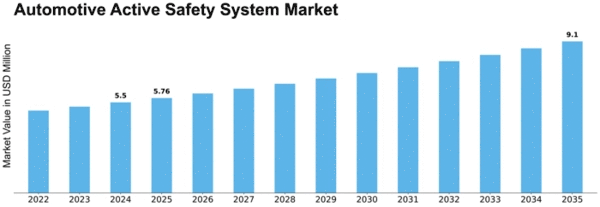

Automotive Active Safety System Market Size Graph
Author
Swapnil Palwe
Team Lead - Research

With a technical background as Bachelor's in Mechanical Engineering, with MBA in Operations Management , Swapnil has 6+ years of experience in market research, consulting and analytics with the tasks of data mining, analysis, and project execution. He is the POC for our clients, for their consulting projects running under the Automotive/A&D domain. Swapnil has worked on major projects in verticals such as Aerospace & Defense, Automotive and many other domain projects. He has worked on projects for fortune 500 companies' syndicate and consulting projects along with several government projects.

Leave a Comment

FAQs

At what CAGR can the automotive active safety system global market expand?

The automotive active safety system market can surge at 16.9% CAGR by 2032.

What is the estimated valuation for the automotive active safety system global market?

MRFR study states that the automotive active safety system market poised to attain a sizable valuation by 2032.

Who are the key players of the automotive active safety system global market?

Infineon Technologies (Germany), PSA Peugeot Citroen (France), Ficosa International S.A. (Spain), Borg Warner Inc.(U.S.), and CAx software (India) are some reputed companies in the automotive active safety system market.

What is the automotive active safety system market growth driver?

The global market of active safety systems can be impelled by the urgency to resolve the rising cases of accidents.

What is the regional analysis of the automotive active safety system market?

The hefty investment made by EU automakers to improve their models can spur the regional market growth.

Market Summary

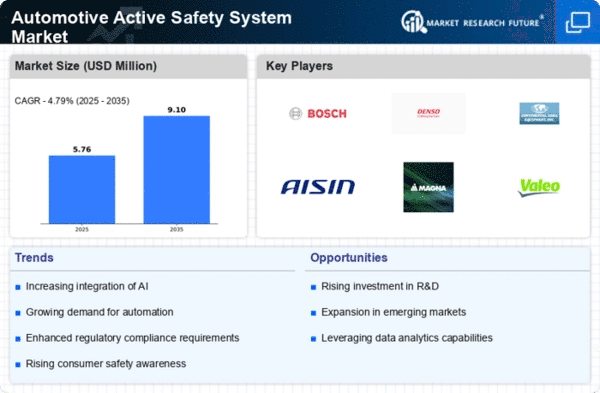
As per MRFR analysis, the Automotive Active Safety System Market was estimated at 5.5 USD Million in 2024. The Automotive Active Safety System industry is projected to grow from 5.7 in 2025 to 9.1 by 2035, exhibiting a compound annual growth rate (CAGR) of 4.79 during the forecast period 2025 - 2035.

Key Market Trends & Highlights

The Automotive Active Safety System Market is poised for substantial growth driven by technological advancements and regulatory demands.

  • The integration of Advanced Driver Assistance Systems (ADAS) is becoming increasingly prevalent in the North American market.
  • Asia-Pacific is emerging as the fastest-growing region, with a notable rise in demand for autonomous vehicle safety features.
  • Automatic Emergency Braking remains the largest segment, while Adaptive Cruise Control is witnessing rapid growth in adoption.
  • Rising consumer awareness of safety features and regulatory pushes for enhanced safety standards are key drivers propelling market expansion.

Market Size & Forecast

2024 Market Size 5.5 (USD Million)
2035 Market Size 9.1 (USD Million)
CAGR (2025 - 2035) 4.79%
Largest Regional Market Share in 2024 North America

Major Players

<p>Robert Bosch GmbH (DE), Denso Corporation (JP), Continental AG (DE), Aisin Seiki Co., Ltd. (JP), Magna International Inc. (CA), Valeo SA (FR), Autoliv Inc. (SE), ZF Friedrichshafen AG (DE), Nissan Motor Co., Ltd. (JP)</p>

Market Trends

The Automotive Active Safety System Market is currently experiencing a transformative phase, driven by advancements in technology and increasing consumer awareness regarding vehicle safety. Manufacturers are integrating sophisticated systems that enhance driver assistance, thereby reducing the likelihood of accidents. This market is characterized by a growing emphasis on features such as collision avoidance, lane departure warnings, and adaptive cruise control. As regulatory bodies worldwide impose stricter safety standards, the demand for these systems is likely to escalate, prompting manufacturers to innovate continuously. Furthermore, the rise of electric and autonomous vehicles is reshaping the landscape, as these vehicles inherently require advanced safety mechanisms to ensure passenger protection and compliance with emerging regulations. In addition to technological advancements, consumer preferences are shifting towards vehicles equipped with comprehensive safety features. This trend is evident as buyers increasingly prioritize safety ratings and the presence of active safety systems in their purchasing decisions. The Automotive Active Safety System Market is thus poised for substantial growth, as stakeholders recognize the importance of integrating these systems into their offerings. Collaboration between automotive manufacturers and technology firms is becoming more prevalent, fostering the development of cutting-edge solutions that enhance vehicle safety. Overall, the market appears to be on a trajectory of sustained expansion, driven by innovation, regulatory pressures, and evolving consumer expectations.

Integration of Advanced Driver Assistance Systems (ADAS)

The Automotive Active Safety System Market is witnessing a notable trend towards the integration of Advanced Driver Assistance Systems (ADAS). These systems encompass a range of technologies designed to assist drivers in various driving conditions, thereby enhancing overall safety. Features such as automatic emergency braking, blind-spot detection, and parking assistance are becoming increasingly common, reflecting a shift towards more automated driving experiences.

Increased Focus on Vehicle-to-Everything (V2X) Communication

Another emerging trend within the Automotive Active Safety System Market is the heightened focus on Vehicle-to-Everything (V2X) communication. This technology enables vehicles to communicate with each other and with infrastructure, such as traffic signals and road signs. By facilitating real-time data exchange, V2X communication aims to improve situational awareness and reduce the risk of accidents, thereby enhancing road safety.

Growing Demand for Autonomous Vehicle Safety Features

The demand for safety features in autonomous vehicles is rapidly increasing, shaping the Automotive Active Safety System Market. As manufacturers develop self-driving technologies, the need for robust safety systems becomes paramount. These features are designed to ensure the safety of passengers and pedestrians alike, addressing public concerns regarding the reliability of autonomous driving systems.

Automotive Active Safety System Market Market Drivers

Regulatory Compliance

Regulatory compliance plays a pivotal role in shaping the Global Automotive Active Safety System Market Industry. Governments worldwide are implementing stringent safety regulations to reduce traffic accidents and fatalities. For example, the European Union has mandated that all new vehicles be equipped with specific active safety features by 2022. Such regulations not only enhance consumer safety but also compel manufacturers to invest in advanced safety technologies. This regulatory push is likely to contribute to the market's growth trajectory, with projections indicating a rise to 113.6 USD Billion by 2035, as compliance becomes a critical factor in vehicle design and production.

Market Growth Projections

The Global Automotive Active Safety System Market Industry is poised for substantial growth, with projections indicating a market value of 20.8 USD Billion in 2024 and an impressive increase to 113.6 USD Billion by 2035. This growth trajectory suggests a compound annual growth rate of 16.69% from 2025 to 2035, reflecting the increasing emphasis on vehicle safety and technological advancements. The market's expansion is likely driven by a combination of regulatory pressures, consumer demand, and ongoing innovations in safety technologies. As the automotive landscape evolves, the active safety system market is expected to play a critical role in shaping the future of vehicle safety.

Technological Advancements

The Global Automotive Active Safety System Market Industry is experiencing rapid technological advancements, particularly in sensor and software technologies. Innovations such as advanced driver-assistance systems (ADAS) are becoming increasingly prevalent, enhancing vehicle safety and performance. For instance, the integration of radar, lidar, and camera systems allows for real-time data processing and improved decision-making capabilities. This trend is expected to drive market growth, as consumers and manufacturers alike prioritize safety features. As a result, the market is projected to reach 20.8 USD Billion in 2024, reflecting the industry's commitment to integrating cutting-edge technology into vehicles.

Increased Investment in R&D

Increased investment in research and development is a crucial driver of the Global Automotive Active Safety System Market Industry. Automakers and technology companies are allocating substantial resources to innovate and enhance safety systems. This focus on R&D is leading to the development of more sophisticated active safety technologies, such as vehicle-to-everything (V2X) communication systems, which improve situational awareness and reduce collision risks. As companies strive to maintain competitive advantages, the influx of investment is expected to accelerate advancements in safety systems. Consequently, this trend is likely to support the market's growth, aligning with the projected increase in market value.

Growing Electric Vehicle Adoption

The growing adoption of electric vehicles (EVs) is significantly impacting the Global Automotive Active Safety System Market Industry. As EVs become more mainstream, manufacturers are integrating advanced safety technologies to address unique challenges associated with electric mobility. For instance, the low center of gravity in EVs can enhance stability, but the need for advanced safety systems remains paramount to mitigate risks. This trend is expected to drive demand for active safety features in EVs, contributing to the overall market growth. The anticipated rise in market value to 113.6 USD Billion by 2035 reflects the increasing integration of safety systems in the evolving automotive landscape.

Consumer Demand for Safety Features

There is a growing consumer demand for enhanced safety features in vehicles, significantly influencing the Global Automotive Active Safety System Market Industry. As awareness of road safety increases, consumers are increasingly seeking vehicles equipped with advanced safety technologies. Features such as automatic emergency braking, lane departure warning, and adaptive cruise control are becoming standard expectations rather than optional add-ons. This shift in consumer preferences is driving manufacturers to prioritize the development of active safety systems, thereby propelling market growth. The anticipated compound annual growth rate of 16.69% from 2025 to 2035 underscores the potential for expansion in this segment.

Market Segment Insights

By Application: Automatic Emergency Braking (Largest) vs. Adaptive Cruise Control (Fastest-Growing)

<p>In the Automotive Active Safety System Market, the application segment is witnessing a significant distribution in market share among key technologies, with Automatic Emergency Braking leading as the dominant feature. This application significantly enhances vehicle safety by detecting potential collisions and applying brakes automatically. Other important applications include Adaptive Cruise Control, Lane Departure Warning, Blind Spot Detection, and Traction Control, each playing a crucial role in modern automotive safety, however, they command lesser market shares compared to the leading segment.</p>

<p>Safety Features: Automatic Emergency Braking (Dominant) vs. Adaptive Cruise Control (Emerging)</p>

<p>Automatic Emergency Braking stands out as the dominant safety feature in the Automotive Active Safety System Market due to its critical role in preventing accidents. It utilizes advanced sensors and algorithms to assess potential collision scenarios and intervenes by applying brakes when necessary. On the other hand, Adaptive Cruise Control, while emerging, is gaining traction as a user-friendly feature that enhances driving comfort by automatically adjusting vehicle speed based on traffic flow. This shift towards increased automation and driver assistance technologies reflects a broader trend in the automotive industry, driving investments and innovations that prioritize safety.</p>

By End Use: Passenger Vehicles (Largest) vs. Commercial Vehicles (Fastest-Growing)

<p>The Automotive Active Safety System Market is predominantly driven by passenger vehicles, which hold the largest share within the end use segment. This sector benefits from the increasing adoption of advanced safety technologies and enhanced consumer awareness regarding safety features. Moreover, regulatory mandates further push the integration of active safety systems in this category, making it a significant contributor to the market's growth. On the other hand, commercial vehicles are emerging as the fastest-growing segment due to rising demand for logistic and transportation services. The industry is witnessing innovations to improve the safety standards of heavy-duty transport, influenced by a surge in e-commerce and the need for efficient delivery systems. This evolving landscape drives the adoption of active safety systems to mitigate accidents and enhance driver safety in commercial applications.</p>

<p>Passenger Vehicles (Dominant) vs. Two-Wheelers (Emerging)</p>

<p>Passenger vehicles remain the dominant force in the Automotive Active Safety System Market, characterized by a broad range of advanced safety features such as collision avoidance systems, automatic emergency braking, and lane-keeping assistance. These features are becoming standard in modern vehicles, greatly enhancing safety and consumer appeal. Conversely, two-wheelers represent an emerging segment, increasingly incorporating active safety systems to address the high vulnerability of riders. While traditionally focused on basic safety features, manufacturers are now introducing technology like anti-lock braking systems and stability control to improve rider safety. This shift indicates a growing recognition of the need for enhanced safety measures in the two-wheeler market, which is gradually gaining traction.</p>

By Technology: Radar Systems (Largest) vs. Camera Systems (Fastest-Growing)

<p>The Automotive Active Safety System Market showcases a range of technologies, with radar systems holding the largest market share due to their reliability and effectiveness in detecting obstacles and vehicles. Camera systems, while trailing radar in terms of market share, are rapidly gaining traction, especially as advancements in AI technology enable enhanced image processing and recognition capabilities. This dynamic distribution indicates a diverse and evolving market that caters to various safety needs. Growth trends in the Automotive Active Safety System Market are primarily driven by the increasing demand for advanced driver assistance systems (ADAS). The emphasis on vehicle safety regulations and the push towards autonomous driving technologies further fuels the adoption of camera systems, which are becoming integral to modern vehicles. As automotive manufacturers innovate and integrate multiple systems, the competition between radar and camera technologies intensifies, leading to innovative solutions in active safety systems.</p>

<p>Technology: Radar Systems (Dominant) vs. Lidar Systems (Emerging)</p>

<p>In the realm of Automotive Active Safety Systems, radar systems emerge as the dominant technology, offering cost-effective and reliable solutions for detecting objects within a vehicle's surroundings. Their ability to perform well in various weather conditions and their longer range capabilities position them as a preferred choice for many manufacturers. On the other hand, Lidar systems are gaining momentum as an emerging technology that provides high-resolution mapping and precise object detection, making them suitable for advanced autonomous systems. While Lidar is currently less prevalent compared to radar, its unique advantages, such as enhanced dimensional perception, are likely to drive its adoption in the coming years, representing a potential paradigm shift in active safety solutions.</p>

By Component: Sensors (Largest) vs. Actuators (Fastest-Growing)

<p>In the Automotive Active Safety System Market, the component segment exhibits a diverse distribution among its key players, namely sensors, actuators, control units, and software. Sensors are acknowledged as the largest contributors to market share, due to their critical role in detecting and responding to various environmental factors that enhance vehicle safety. Actuators, while slightly trailing, are gaining momentum as they play a vital role in automating responses based on sensor input, thus improving system efficiency and reliability.</p>

<p>Sensors: Dominant vs. Actuators: Emerging</p>

<p>Sensors are pivotal to Automotive Active Safety Systems, serving as the primary input devices that relay crucial data about the vehicle's surroundings. Their dominance in the market is attributed to advancements in sensing technologies, including radar and LIDAR, which significantly enhance vehicle safety features. Conversely, actuators represent an emerging segment, driven by innovations that allow for more precise control of vehicle functions like braking and steering. As automation in vehicles increases, the demand for actuators is expected to rise swiftly, underscoring their strategic importance in the future of automotive safety.</p>

By Vehicle Type: Internal Combustion Engine (Largest) vs. Electric Vehicle (Fastest-Growing)

<p>The Automotive Active Safety System Market is primarily dominated by the Internal Combustion Engine (ICE) vehicles, which hold a significant portion of market share. These vehicles have been the traditional choice for consumers, integrating various active safety systems to enhance road safety and comply with regulatory standards. Conversely, Electric Vehicles (EVs) are rapidly gaining traction, as advancements in technology and increasing consumer demand for sustainable options are driving their proliferation in the market. Hybrid vehicles, while not as dominant, are also contributing to the shift towards more environmentally friendly options, capturing a steady share in the market.</p>

<p>Vehicle Type: Internal Combustion Engine (Dominant) vs. Electric Vehicle (Emerging)</p>

<p>Internal Combustion Engine vehicles are currently the dominant segment in the Automotive Active Safety System Market, characterized by their well-established manufacturing ecosystems and widespread consumer base. They integrate traditional safety features such as anti-lock braking systems and electronic stability control. On the other hand, Electric Vehicles represent an emerging segment with innovative safety technologies being developed alongside their battery systems. Their rapid advancement in active safety features is attracting tech-savvy consumers seeking modern solutions to vehicular safety. With government incentives and growing awareness about environmental issues, EVs are expected to become a prominent player in the market, shaping future trends towards intelligent and autonomous driving systems.</p>

Get more detailed insights about Automotive Active Safety System Market Research Report - Global Forecast to 2035

Regional Insights

North America : Market Leader in Safety Systems

North America is poised to maintain its leadership in the Automotive Active Safety System market, holding a significant market share of 2.75 billion in 2024. The region's growth is driven by stringent safety regulations, increasing consumer demand for advanced safety features, and technological innovations. The push for autonomous vehicles and enhanced driver assistance systems further fuels this demand, supported by government initiatives promoting safety standards. The competitive landscape in North America is robust, with key players like Robert Bosch GmbH, Denso Corporation, and Continental AG leading the charge. The U.S. and Canada are the primary markets, benefiting from high vehicle ownership rates and a strong focus on safety technologies. Collaborations between automotive manufacturers and tech companies are also on the rise, enhancing the development of active safety systems to meet evolving consumer expectations.

Europe : Innovation and Regulation Hub

Europe is a critical market for Automotive Active Safety Systems, with a market size of 1.5 billion. The region's growth is propelled by stringent EU regulations mandating advanced safety features in vehicles, alongside a growing consumer preference for safety and sustainability. The European market is characterized by a strong emphasis on innovation, with investments in R&D aimed at developing cutting-edge safety technologies that comply with regulatory standards. Leading countries in this region include Germany, France, and the UK, where major players like Valeo SA and Autoliv Inc. are headquartered. The competitive landscape is marked by collaborations between automotive manufacturers and technology firms to enhance safety systems. As the EU continues to enforce regulations, the demand for active safety systems is expected to rise, driving market growth further.

Asia-Pacific : Emerging Market with Potential

Asia-Pacific is emerging as a significant player in the Automotive Active Safety System market, with a market size of 1.0 billion. The region's growth is driven by increasing vehicle production, rising disposable incomes, and a growing awareness of road safety. Governments are also implementing regulations to enhance vehicle safety, which is further propelling the demand for active safety systems in countries like Japan, China, and India. Japan and China are at the forefront of this market, with key players such as Denso Corporation and Nissan Motor Co., Ltd. leading the charge. The competitive landscape is evolving, with local manufacturers increasingly investing in advanced safety technologies. As the region continues to urbanize and vehicle ownership rises, the demand for automotive safety systems is expected to grow significantly, presenting opportunities for both established and new players in the market.

Middle East and Africa : Developing Market Landscape

The Middle East and Africa region is gradually developing in the Automotive Active Safety System market, with a market size of 0.25 billion. The growth is primarily driven by increasing vehicle sales and a rising awareness of road safety among consumers. Governments in several countries are beginning to implement regulations aimed at improving vehicle safety standards, which is expected to boost the adoption of active safety systems in the coming years. Countries like South Africa and the UAE are leading the way in this market, with a growing number of automotive manufacturers entering the region. The competitive landscape is still in its nascent stages, but there is a noticeable shift towards incorporating advanced safety technologies in vehicles. As the market matures, opportunities for investment and growth in automotive safety systems are likely to expand significantly.

Key Players and Competitive Insights

The Automotive Active Safety System Market is characterized by a dynamic competitive landscape, driven by technological advancements and increasing consumer demand for enhanced vehicle safety. Key players such as Robert Bosch GmbH (Germany), Denso Corporation (Japan), and Continental AG (Germany) are at the forefront, focusing on innovation and strategic partnerships to solidify their market positions. These companies are actively investing in research and development to integrate advanced technologies like AI and machine learning into their safety systems, thereby enhancing their product offerings and addressing the growing regulatory pressures for safety compliance.

In terms of business tactics, companies are increasingly localizing manufacturing to reduce costs and improve supply chain efficiency. The market structure appears moderately fragmented, with several players vying for market share. However, the collective influence of major companies like Valeo SA (France) and Autoliv Inc. (Sweden) is significant, as they leverage their extensive distribution networks and technological expertise to maintain competitive advantages.

In November 2025, Denso Corporation (Japan) announced a strategic partnership with a leading tech firm to develop next-generation sensor technologies aimed at improving vehicle-to-everything (V2X) communication. This collaboration is expected to enhance the effectiveness of active safety systems by enabling real-time data exchange between vehicles and their surroundings, thereby potentially reducing accident rates and improving overall road safety.

In October 2025, Continental AG (Germany) unveiled its latest advanced driver assistance systems (ADAS) that incorporate AI-driven algorithms for predictive safety measures. This launch is particularly noteworthy as it reflects the company's commitment to integrating cutting-edge technology into its product line, positioning itself as a leader in the active safety segment. The predictive capabilities of these systems may significantly enhance driver awareness and response times, thereby contributing to safer driving experiences.

In September 2025, Valeo SA (France) expanded its production capabilities in Eastern Europe, focusing on the manufacturing of advanced radar and camera systems. This expansion is indicative of the company's strategy to localize production and meet the increasing demand for active safety technologies in the region. By enhancing its manufacturing footprint, Valeo aims to improve supply chain resilience and reduce lead times for its customers, which is crucial in a rapidly evolving market.

As of December 2025, the competitive trends in the Automotive Active Safety System Market are increasingly defined by digitalization, sustainability, and the integration of AI technologies. Strategic alliances among key players are shaping the landscape, fostering innovation and enhancing product offerings. The shift from price-based competition to a focus on technological advancement and supply chain reliability is evident, suggesting that future competitive differentiation will hinge on the ability to innovate and adapt to changing consumer expectations.

Key Companies in the Automotive Active Safety System Market market include

Industry Developments

Future Outlook

Automotive Active Safety System Market Future Outlook

<p>The Automotive Active Safety System Market is projected to grow at a 4.79% CAGR from 2024 to 2035, driven by technological advancements, regulatory mandates, and increasing consumer demand for safety features.</p>

New opportunities lie in:

  • <p>Integration of AI-driven predictive analytics for accident prevention</p>
  • <p>Development of advanced driver assistance systems (ADAS) for commercial vehicles</p>
  • <p>Expansion of partnerships with insurance companies for safety incentives</p>

<p>By 2035, the market is expected to be robust, reflecting substantial advancements in safety technologies.</p>

Market Segmentation

Automotive Active Safety System Market End Use Outlook

  • Passenger Vehicles
  • Commercial Vehicles
  • Two-Wheelers
  • Heavy-Duty Vehicles

Automotive Active Safety System Market Component Outlook

  • Sensors
  • Actuators
  • Control Units
  • Software

Automotive Active Safety System Market Technology Outlook

  • Radar Systems
  • Camera Systems
  • Lidar Systems
  • Ultrasonic Sensors

Automotive Active Safety System Market Application Outlook

  • Adaptive Cruise Control
  • Automatic Emergency Braking
  • Lane Departure Warning
  • Blind Spot Detection
  • Traction Control

Automotive Active Safety System Market Vehicle Type Outlook

  • Internal Combustion Engine
  • Electric Vehicle
  • Hybrid Vehicle

Report Scope

MARKET SIZE 20245.5(USD Million)
MARKET SIZE 20255.7(USD Million)
MARKET SIZE 20359.1(USD Million)
COMPOUND ANNUAL GROWTH RATE (CAGR)4.79% (2024 - 2035)
REPORT COVERAGERevenue Forecast, Competitive Landscape, Growth Factors, and Trends
BASE YEAR2024
Market Forecast Period2025 - 2035
Historical Data2019 - 2024
Market Forecast UnitsUSD Million
Key Companies ProfiledRobert Bosch GmbH (DE), Denso Corporation (JP), Continental AG (DE), Aisin Seiki Co., Ltd. (JP), Magna International Inc. (CA), Valeo SA (FR), Autoliv Inc. (SE), ZF Friedrichshafen AG (DE), Nissan Motor Co., Ltd. (JP)
Segments CoveredApplication, End Use, Technology, Component, Vehicle Type
Key Market OpportunitiesIntegration of advanced driver assistance systems enhances safety and meets evolving regulatory standards in the Automotive Active Safety System Market.
Key Market DynamicsRising regulatory standards and technological advancements drive innovation in the Automotive Active Safety System market.
Countries CoveredNorth America, Europe, APAC, South America, MEA

FAQs

At what CAGR can the automotive active safety system global market expand?

The automotive active safety system market can surge at 16.9% CAGR by 2032.

What is the estimated valuation for the automotive active safety system global market?

MRFR study states that the automotive active safety system market poised to attain a sizable valuation by 2032.

Who are the key players of the automotive active safety system global market?

Infineon Technologies (Germany), PSA Peugeot Citroen (France), Ficosa International S.A. (Spain), Borg Warner Inc.(U.S.), and CAx software (India) are some reputed companies in the automotive active safety system market.

What is the automotive active safety system market growth driver?

The global market of active safety systems can be impelled by the urgency to resolve the rising cases of accidents.

What is the regional analysis of the automotive active safety system market?

The hefty investment made by EU automakers to improve their models can spur the regional market growth.

  1. Executive Summary
  2. Scope of the Report
    1. Market Definition
    2. Scope of the Study
      1. Definition
      2. Research Objective
      3. Assumptions
      4. Limitations
    3. Research Process
      1. Primary Research
      2. Secondary Research
    4. Market size Estimation
    5. Forecast Model
  3. Market Landscape
    1. Porter’s Five Forces Analysis
      1. Threat of New Entrants
      2. Bargaining power of buyers
      3. Threat of substitutes
      4. Segment rivalry
      5. Bargaining Power of Buyers
    2. Value Chain/Supply Chain Analysis
  4. Market Dynamics
    1. Introduction
    2. Market Drivers
    3. Market Restraints
    4. Market Opportunities
    5. Market Trends
  5. Global Automotive Active Safety System Market, By Product
    1. Introduction
    2. Tyre-Pressure Monitoring System
      1. Market Estimates & Forecast, 2023-2032
      2. Market Estimates & Forecast by Region, 2023-2032
    3. Lane Departure Warning
      1. Market Estimates & Forecast, 2023-2032
      2. Market Estimates & Forecast by Region, 2023-2032
    4. Adaptive Cruise Control
      1. Market Estimates & Forecast, 2023-2032
      2. Market Estimates & Forecast by Region, 2023-2032
    5. Night Vision System
      1. Market Estimates & Forecast, 2023-2032
      2. Market Estimates & Forecast by Region, 2023-2032
    6. Driver Monitoring
      1. Market Estimates & Forecast, 2023-2032
      2. Market Estimates & Forecast by Region, 2023-2032
    7. Anti-Lock Braking System
      1. Market Estimates & Forecast, 2023-2032
      2. Market Estimates & Forecast by Region, 2023-2032
    8. Blind Spot Detection
      1. Market Estimates & Forecast, 2023-2032
      2. Market Estimates & Forecast by Region, 2023-2032
  6. Global Automotive Active Safety System Market, By Occupant Type
    1. Introduction
    2. Driver
      1. Market Estimates & Forecast, 2023-2032
      2. Market Estimates & Forecast by Region, 2023-2032
    3. Passenger
      1. Market Estimates & Forecast, 2023-2032
      2. Market Estimates & Forecast by Region, 2023-2032
    4. Child
      1. Market Estimates & Forecast, 2023-2032
      2. Market Estimates & Forecast by Region, 2023-2032
    5. Pedestrian
      1. Market Estimates & Forecast, 2023-2032
      2. Market Estimates & Forecast by Region, 2023-2032
  7. Global Automotive Active Safety System Market, By Vehicle Type
    1. Introduction
    2. Passenger Car
      1. Market Estimates & Forecast, 2023-2032
      2. Market Estimates & Forecast by Region, 2023-2032
    3. Commercial Vehicle
      1. Market Estimates & Forecast, 2023-2032
      2. Market Estimates & Forecast by Region, 2023-2032
  8. Global Automotive Active Safety System Market, By Region
    1. Introduction
    2. North America
      1. Market Estimates & Forecast, 2023-2032
      2. Market Estimates & Forecast by Product, 2023-2032
      3. Market Estimates & Forecast by Occupant Type, 2023-2032
      4. Market Estimates & Forecast by Vehicle Type, 2023-2032
      5. The U.S.
      6. Canada
    3. Europe
      1. Market Estimates & Forecast, 2023-2032
      2. Market Estimates & Forecast by Product, 2023-2032
      3. Market Estimates & Forecast by Occupant Type, 2023-2032
      4. Market Estimates & Forecast by Vehicle Type, 2023-2032
      5. U.K.
      6. Germany
      7. France
      8. Italy
      9. Rest of Europe
    4. Asia Pacific
      1. Market Estimates & Forecast, 2023-2032
      2. Market Estimates & Forecast by Product, 2023-2032
      3. Market Estimates & Forecast by Occupant Type, 2023-2032
      4. Market Estimates & Forecast by Vehicle Type, 2023-2032
      5. China
      6. Japan
      7. India
      8. Rest of Asia Pacific
    5. Rest of the World
      1. Market Estimates & Forecast, 2023-2032
      2. Market Estimates & Forecast by Product, 2023-2032
      3. Market Estimates & Forecast by Occupant Type, 2023-2032
      4. Market Estimates & Forecast by Vehicle Type, 2023-2032
  9. Competitive Landscape
  10. Company Profile
    1. Bosch (Germany)
      1. Company Overview
      2. Products/Services Offering
      3. Financial Overview
      4. Key Developments
      5. Strategy
      6. SWOT Analysis
    2. Continental (Germany)
      1. Company Overview
      2. Products/Services Offering
      3. Financial Overview
      4. Key Developments
      5. Strategy
      6. SWOT Analysis
    3. Delphi Technologies (U.K.)
      1. Company Overview
      2. Products/Services Offering
      3. Financial Overview
      4. Key Developments
      5. Strategy
      6. SWOT Analysis
    4. ZF Friedrichshafen (Germany)
      1. Company Overview
      2. Products/Services Offering
      3. Financial Overview
      4. Key Developments
      5. Strategy
      6. SWOT Analysis
    5. Autoliv (Sweden)
      1. Company Overview
      2. Products/Services Offering
      3. Financial Overview
      4. Key Developments
      5. Strategy
      6. SWOT Analysis
    6. Hyundai Mobis (South Korea)
      1. Company Overview
      2. Products/Services Offering
      3. Financial Overview
      4. Key Developments
      5. Strategy
      6. SWOT Analysis
    7. Valeo (France)
      1. Company Overview
      2. Products/Services Offering
      3. Financial Overview
      4. Key Developments
      5. Strategy
      6. SWOT Analysis
    8. DENSO (Japan)
      1. Company Overview
      2. Products/Services Offering
      3. Financial Overview
      4. Key Developments
      5. Strategy
      6. SWOT Analysis
    9. Magna International (Canada)
      1. Company Overview
      2. Products/Services Offering
      3. Financial Overview
      4. Key Developments
      5. Strategy
      6. SWOT Analysis
    10. FLIR Systems (U.S.)
      1. Company Overview
      2. Products/Services Offering
      3. Financial Overview
      4. Key Developments
      5. Strategy
      6. SWOT Analysis
    11. Infineon Technologies (Germany)
      1. Company Overview
      2. Products/Services Offering
      3. Financial Overview
      4. Key Developments
      5. Strategy
      6. SWOT Analysis
    12. Ficosa International S.A. (Spain)
      1. Company Overview
      2. Products/Services Offering
      3. Financial Overview
      4. Key Developments
      5. Strategy
      6. SWOT Analysis
    13. PSA Peugeot Citroen (France)
      1. Company Overview
      2. Products/Services Offering
      3. Financial Overview
      4. Key Developments
      5. Strategy
      6. SWOT Analysis
    14. Borg Warner Inc.(U.S.)
      1. Company Overview
      2. Products/Services Offering
      3. Financial Overview
      4. Key Developments
      5. Strategy
      6. SWOT Analysis
    15. CAx software (India)
      1. Company Overview
      2. Products/Services Offering
      3. Financial Overview
      4. Key Developments
      5. Strategy
      6. SWOT Analysis
    16. List of Tables
  11. Global Automotive Active Safety System Market: By Region, 2023-2032
  12. North America Automotive Active Safety System Market: By Country, 2023-2032
  13. Europe Automotive Active Safety System Market: By Country, 2023-2032
  14. Asia Pacific Automotive Active Safety System Market: By Country, 2023-2032
  15. RoW Automotive Active Safety System Market: By Country, 2023-2032
  16. Global Automotive Active Safety System Market, By Product, By Regions, 2023-2032
  17. North America Automotive Active Safety System Market, By Product, By Country, 2023-2032
  18. Europe Automotive Active Safety System Market, By Product, By Country, 2023-2032
  19. Asia Pacific Automotive Active Safety System Market by Product, By Country, 2023-2032
  20. RoW Automotive Active Safety System Market by Product, By Country, 2023-2032
  21. Global Automotive Active Safety System by Occupant Type Market: By Regions, 2023-2032
  22. North America Automotive Active Safety System Market by Occupant Type: By Country, 2023-2032
  23. Europe Automotive Active Safety System Market by Occupant Type: By Country, 2023-2032
  24. Asia Pacific Automotive Active Safety System Market by Occupant Type: By Country, 2023-2032
  25. RoW Automotive Active Safety System Market by Occupant Type: By Country, 2023-2032
  26. Global Automotive Active Safety System by Vehicle Type Market: By Regions, 2023-2032
  27. North America Automotive Active Safety System Market by Vehicle Type: By Country, 2023-2032
  28. Europe Automotive Active Safety System Market by Vehicle Type: By Country, 2023-2032
  29. Asia Pacific Automotive Active Safety System Market by Vehicle Type: By Country, 2023-2032
  30. RoW Automotive Active Safety System Market by Vehicle Type: By Country, 2023-2032
  31. Global Automotive Active Safety System Market: By Region, 2023-2032
  32. Global Automotive Active Safety System Market: By Product, 2023-2032
  33. Global Automotive Active Safety System Market: By Occupant Type, 2023-2032
  34. Global Automotive Active Safety System Market: By Vehicle Type, 2023-2032
  35. North America Automotive Active Safety System Market, By Country
  36. North America Automotive Active Safety System Market, By Product
  37. North America Automotive Active Safety System Market, By Occupant Type
  38. North America Automotive Active Safety System Market, By Vehicle Type
  39. Europe: Automotive Active Safety System Market, By Country
  40. Europe: Automotive Active Safety System Market, By Product
  41. Europe: Automotive Active Safety System Market, By Occupant Type
  42. Europe: Automotive Active Safety System Market, By Vehicle Type
  43. Asia Pacific: Automotive Active Safety System Market, By Country
  44. Asia Pacific: Automotive Active Safety System Market, By Product
  45. Asia Pacific: Automotive Active Safety System Market, By Occupant Type
  46. Asia Pacific: Automotive Active Safety System Market, By Vehicle Type
  47. RoW: Automotive Active Safety System Market, By Region
  48. RoW Automotive Active Safety System Market, By Product
  49. RoW Automotive Active Safety System Market, By Occupant Type
  50. RoW Automotive Active Safety System Market, By Vehicle Type
    1. List of Figures
  51. Research Process of MRFR
  52. Top down & Bottom up Approach
  53. Market Dynamics
  54. impact analysis: market drivers
  55. impact analysis: market restraints
  56. porter’s five forces analysis
  57. Value chain analysis
  58. Global Automotive Active Safety System Market SHARE, By Product, 2023 (%)
  59. Global Automotive Active Safety System Market, By Product, 2023-2032 (USD MILLION)
  60. Global Automotive Active Safety System Market SHARE, By Occupant Type, 2023 (%)
  61. Global Automotive Active Safety System Market, By Occupant Type, 2023-2032 (USD MILLION)
  62. Global Automotive Active Safety System Market SHARE, By Vehicle Type, 2023 (%)
  63. Global Automotive Active Safety System Market, By Vehicle Type, 2023-2032 (USD MILLION)
  64. Global Automotive Active Safety System Market SHARE (%), BY REGION, 2023
  65. Global Automotive Active Safety System Market, BY REGION, 2023-2032 (USD MILLION)
  66. North America Automotive Active Safety System Market SHARE (%), 2023
  67. North America Automotive Active Safety System Market BY Country, 2023-2032 (USD MILLION)
  68. Europe Automotive Active Safety System Market SHARE (%), 2023
  69. Europe Automotive Active Safety System Market BY Country, 2023-2032 (USD MILLION)
  70. Asia Pacific Automotive Active Safety System Market SHARE (%), 2023
  71. Asia Pacific Automotive Active Safety System Market BY Country, 2023-2032 (USD MILLION)
  72. Rest of the World Automotive Active Safety System Market SHARE (%), 2023
  73. Rest of the World Automotive Active Safety System Market BY Country, 2023-2032 (USD MILLION)

Automotive Active Safety System Market Segmentation

Market Segmentation Overview

  • Detailed segmentation data will be available in the full report
  • Comprehensive analysis by multiple parameters
  • Regional and country-level breakdowns
  • Market size forecasts by segment
Infographic

Free Sample Request

Kindly complete the form below to receive a free sample of this Report

Get Free Sample

Customer Strories

Compare Licence

×
Features License Type
Single User Multiuser License Enterprise User
Price $4,950 $5,950 $7,250
Maximum User Access Limit 1 User Upto 10 Users Unrestricted Access Throughout the Organization
Free Customization
Direct Access to Analyst
Deliverable Format
Platform Access
Discount on Next Purchase 10% 15% 15%
Printable Versions