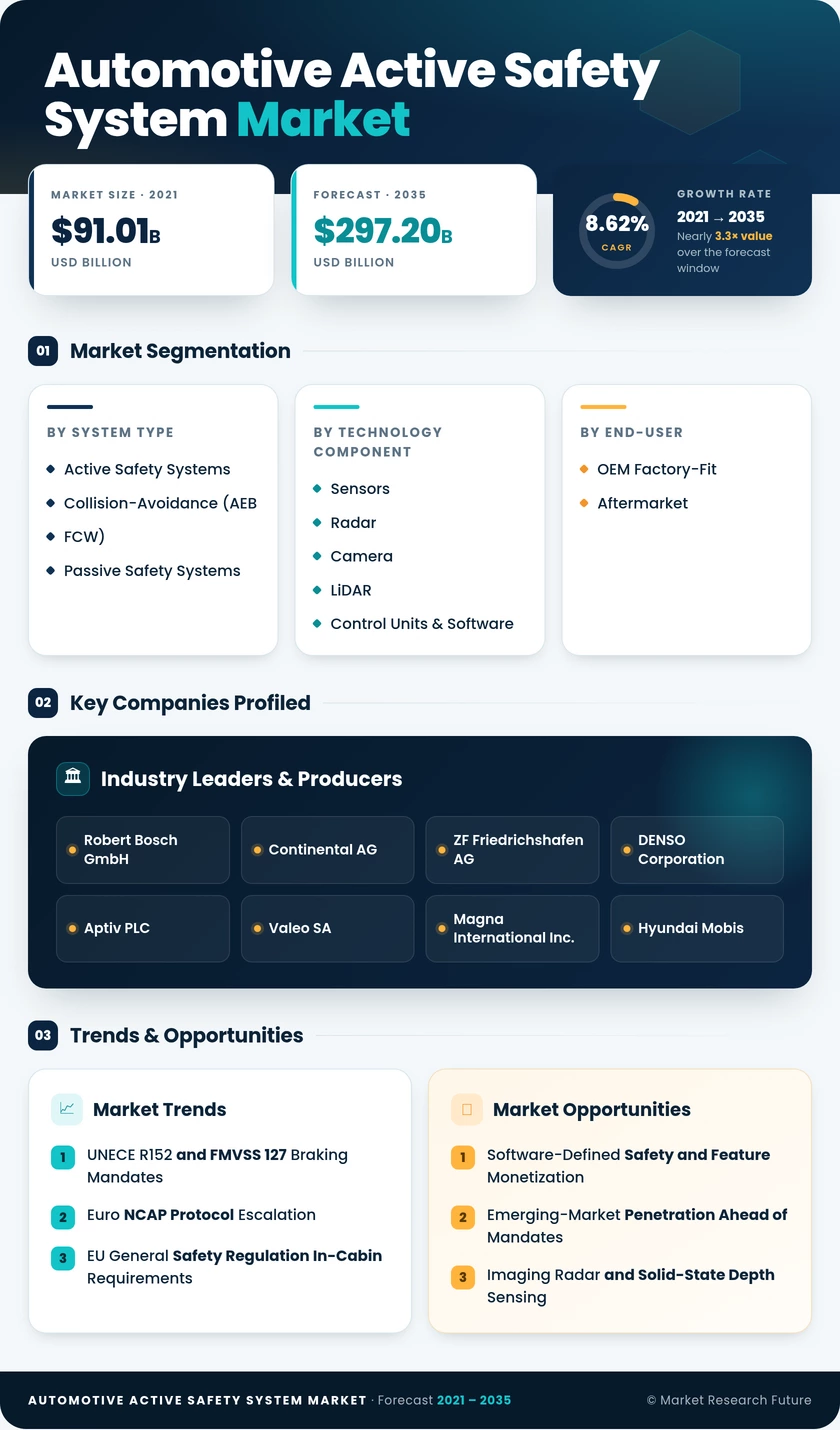
Segmentation Quick Reference
| Dimension | Sub-Segments | Dominant Segment | Fastest Growing Segment |
| By System Type | Active Safety Systems; Collision-Avoidance (AEB, FCW); Passive Safety Systems | Active Safety Systems — 62.0% share (2025) | Collision-Avoidance (AEB, FCW) — 8.85% CAGR (2026–2035) |
| By Technology Component | Sensors; Radar; Camera; LiDAR; Control Units & Software | Sensors — 31.7% share (2025) | LiDAR — 9.08% CAGR (2026–2035) |
| By End-User | OEM Factory-Fit; Aftermarket | OEM Factory-Fit — 77.2% share (2025) | Aftermarket — 9.15% CAGR (2026–2035) |
| By Vehicle Type | Passenger Cars; Light Commercial Vehicle (LCV); Heavy Commercial Vehicles | Passenger Cars — USD 89.57 Billion (2025) | Heavy Commercial Vehicles — 8.73% CAGR (2026–2035) |
| By Propulsion | Internal Combustion Engine (ICE); Battery-Electric Vehicles; Hybrid & Fuel-Cell Vehicles | Internal Combustion Engine (ICE) — 72.2% share (2025) | Battery-Electric Vehicles — 9.61% CAGR (2026–2035) |
| By Region | North America; Europe; Asia-Pacific; South America; Middle East & Africa | Asia-Pacific — 38.5% share (2025) | South America — 9.74% CAGR |
Market Segmentation Overview
By System Type
| Sub-Segment | Key Trend |
| Active Safety Systems | Intervention functions migrate from option packages to standard fitment on entry trims |
| Collision-Avoidance (AEB, FCW) | Scenario coverage widens to junctions, cyclists, and reversing manoeuvres |
| Passive Safety Systems | Adaptive restraints redesigned for electric-platform seating and occupant kinematics |
Active Safety Systems lead this dimension at 62.0% of 2025 value because braking and steering intervention are what UNECE R152 and FMVSS 127 actually require, and rating bodies award almost no credit for warning-only functions. Collision-Avoidance (AEB, FCW) grows fastest at an 8.85% CAGR as protocol scenarios expand beyond straight-line rear-end cases into junction and vulnerable-road-user testing that single-radar hardware cannot pass. Passive Safety Systems continue to draw engineering investment through adaptive belt and airbag tuning, but their growth is tied to vehicle build volume rather than to regulatory escalation.
By Technology Component
| Sub-Segment | Key Trend |
| Sensors | Fusion architectures raise sensor count per vehicle rather than substituting between types |
| Radar | 77-GHz and 4-D imaging modules replace legacy 24-GHz units |
| Camera | Surround-view and in-cabin monitoring become baseline specification |
| LiDAR | Solid-state designs cut unit pricing and eliminate moving parts |
| Control Units & Software | Perception stacks consolidate onto zonal high-performance compute |
Sensors hold 31.7% of component value because fusion designs add units rather than trading one modality for another, and Radar remains the volume workhorse at USD 34.84 Billion on all-weather reliability that optical systems cannot match in fog or glare. LiDAR is the fastest riser at a 9.08% CAGR, now viable on cost after solid-state architectures removed rotating assemblies and brought forward-facing units below USD 550. Control Units & Software matter disproportionately to supplier strategy: as sensing hardware deflates, the perception stack running on consolidated compute is where margin migrates.
By End-User
| Sub-Segment | Key Trend |
| OEM Factory-Fit | Platform-wide sourcing validated under type-approval quality gates |
| Aftermarket | Plug-and-play retrofit kits integrate with existing telematics gateways |
OEM Factory-Fit dominates the Automotive Active Safety System Market because mandated functions must be validated as part of type approval, and only factory integration gives manufacturers the calibration control and warranty exposure management that certification demands. Aftermarket grows faster from a smaller base, driven almost entirely by commercial operators retrofitting camera-based warning and driver monitoring to tractors and vans already in service. Plug-and-play kits interfacing with telematics gateways have cut installation to under four hours.
By Vehicle Type
| Sub-Segment | Key Trend |
| Passenger Cars | Braking and lane functions standardized down to entry hatchbacks |
| Light Commercial Vehicle (LCV) | Urban access rules tied to safety equipment on delivery fleets |
| Heavy Commercial Vehicles | Blind-spot and lane-centring adoption driven by fleet payback math |
Passenger Cars account for USD 89.57 Billion of 2025 value on volume and on consumer sensitivity to published star ratings, which pushes manufacturers to specify above the legal minimum. Heavy Commercial Vehicles grow fastest at an 8.73% CAGR because the business case is explicit rather than reputational: documented reductions in rear-end collision frequency clear fleet capital thresholds within roughly two years at typical mileage. Light Commercial Vehicle (LCV) demand sits between them, pulled along by parcel operators facing municipal access conditions that reference safety equipment directly.
By Propulsion
| Sub-Segment | Key Trend |
| Internal Combustion Engine (ICE) | Cost-optimized sensing packages define the volume price point |
| Battery-Electric Vehicles | Thermal runaway detection and revised crash kinematics add content layers |
| Hybrid & Fuel-Cell Vehicles | Dual-energy fault monitoring and hydrogen leak detection |
Internal Combustion Engine (ICE) platforms still carry 72.2% of 2025 value, and their mature supply chains set the cost benchmark that suppliers must hit on every competing


 Noah Malgeri
Co-Founder

 Peter Groot koerkamp
Account and Business Manager

 Younghwan Choi
Senior Retail Manager

 Mark Irwin
Management Consultant

 Akif Moroglu
Strategy & Business Development Director

 Guilherme Gomes Martins
Product Management Director

 Joseph Aguayo
Sales Operations & Pricing Manager

 La Terria Dodd
Program Support Specialist

 Rob Kooiker
Group Product Manager HVAC & Fire Protection GMA