Request Free Sample ×

Kindly complete the form below to receive a free sample of this Report

* Please use a valid business email

Leading companies partner with us for data-driven Insights

clients tt-cursor
Hero Background
English
Chinese
French
Japanese
Korean
German
Spanish

Automation Control in the Water and Wastewater Industry Trends

ID: MRFR/SEM/11009-CR
188 Pages
Kiran Jinkalwad
November 2023

Automation and Control in the Water & Wastewater Market Size, Share and Research Report By Solution (Scada System, Programmable Logic Controller, Human-Machine Interface, Distributed Control System, Telemetry System, Automatic Meter Reading System, Remote Monitoring & Control System, and Others), By End User (Water & Wastewater Treatment Plant Operators, Maintenance Technician, Engineers & Process Analysts, Network Operations Center Personnel, Environmental Regulators, Water Resource Managers, and Others), and Region– Industry Forecast Till 2035

Share:
Download PDF ×

We do not share your information with anyone. However, we may send you emails based on your report interest from time to time. You may contact us at any time to opt-out.

Automation Control in the Water and Wastewater Industry Infographic
Purchase Options

Market Trends

Key Emerging Trends in the Automation Control in the Water and Wastewater Industry

The following can be considered as the most apparent trends in Automation Control in the Water and Wastewater market to indicate that this branch of industry promotes efficiency, sustainability, and resilience systems’ usage for water treatment. Some major trends include the tow adaption of complex automation technologies to improve water treatment processes. Automation Control Systems allow water and wastewater facilities to monitor, control and optimize multiple process aspects, including quality of the water, the flow rate; as well as chemical dosing amount. The reason for this development is to have more accurate and cost-effective systems of water management, with compliance requirements enforced fully within a clean environment containing safe as well as efficient water supply. In addition, the attention has increased towards smart sensors and Industrial Internet of Things IIoT integration in automation control systems for water and wastewater treatment solutions. Therefore, by deploying the sensors and real-time data analytics that enable immediate notifications about potential issues, preventive maintenance is possible before failures take place to minimize downtime. This trend goes with the digital transformation of the private sector, aiming at improving the effectiveness and safety of water and wastewater treatment plants. Indeed, the market is heading towards centralized automation solutions. On the other hand, primary originally was large scale centralized control systems in significant water treatment plants but distributed and decentralized control architecture is emerging to take over. Through this decentralized automation, there is more flexibility, scalability, and redundancy for the smooth running of small water treatment facilities remotely located pump stations and in distribution networks. In this regard, it has enabled the effective use of resources and helps to keep water in a consistent supply mode even across different geographical regions. More so, energy efficiency is also gaining ground in the Automation Control in the Water and Wastewater market. Many of the water treatment processes are energy-intensive, and the industry is trying to determine their automation solutions that have enabled them to minimize their energy consumption in determining energy conservation. Sustainability initiatives are also supported by the optimization of pumping operations, aeration processes, and other energy-consuming activities which is achieved thorough using advanced control algorithms and predictive analytics to attain sustainability efforts as well as lowering operational costs.


Author
Author Profile
Kiran Jinkalwad
Research Associate Level - II

Kiran Jinkalwad brings over four years of experience in market research, specializing in the ICT and Semiconductor sectors. She has worked on 50+ projects, including custom studies for companies like Microsoft and Huawei, addressing complex business challenges. With a background in Electronics and Telecommunication, Kiran excels in market estimation, forecasting, and strategic analysis. His sharp analytical skills and industry knowledge consistently deliver actionable insights for diverse clients.

Leave a Comment

FAQs

What is the projected market valuation for Automation and Control in the Water and Wastewater Market by 2035?

The projected market valuation for Automation and Control in the Water and Wastewater Market is expected to reach 6881.27 USD Million by 2035.

What was the overall market valuation in 2024?

The overall market valuation for Automation and Control in the Water and Wastewater Market was 3810.44 USD Million in 2024.

What is the expected CAGR for the market during the forecast period 2025 - 2035?

The expected CAGR for the Automation and Control in the Water and Wastewater Market during the forecast period 2025 - 2035 is 5.52%.

Which companies are considered key players in the Automation and Control market?

Key players in the market include Siemens, Schneider Electric, Emerson, Honeywell, Rockwell Automation, ABB, Xylem, Endress+Hauser, and KROHNE.

What are the primary segments within the Automation and Control market?

Primary segments within the market include SCADA Systems, PLCs, HMIs, DCS, Telemetry Systems, RTUs, Alarm Management Systems, Leak Detection Systems, AMR Systems, and Remote Monitoring and Control Systems.

How much revenue did SCADA Systems generate in 2024?

SCADA Systems generated revenue between 600.0 and 1100.0 USD Million in 2024.

What is the revenue range for PLCs in the market?

The revenue range for PLCs in the Automation and Control market is between 700.0 and 1300.0 USD Million.

Who are the end users of Automation and Control systems in the water and wastewater sector?

End users include Water and Wastewater Treatment Plant Operators, Maintenance Technicians, Engineers, Network Operations Center Personnel, Environmental Regulators, and Water Resource Managers.

What was the revenue generated by Water and Wastewater Treatment Plant Operators in 2024?

Water and Wastewater Treatment Plant Operators generated revenue between 1140.0 and 2050.0 USD Million in 2024.

What is the expected growth trend for Remote Monitoring and Control Systems?

Remote Monitoring and Control Systems are projected to generate revenue between 150.0 and 300.0 USD Million during the forecast period.

Market Summary

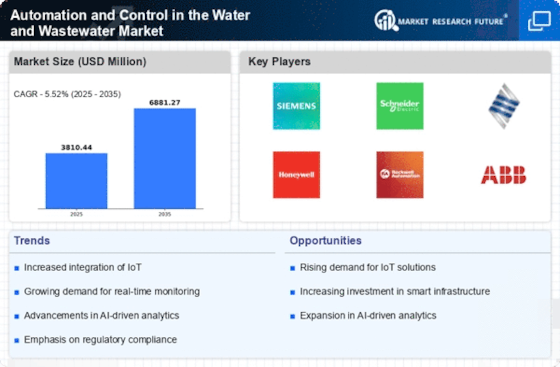
As per Market Research Future analysis, the Automation and Control in the Water and Wastewater Market was estimated at 3810.44 USD Million in 2024. The Automation and Control in the Water and Wastewater industry is projected to grow from 4020.79 USD Million in 2025 to 6881.27 USD Million by 2035, exhibiting a compound annual growth rate (CAGR) of 5.52% during the forecast period 2025 - 2035

Key Market Trends & Highlights

The Automation and Control in the Water and Wastewater Market is experiencing a transformative shift towards smart technologies and sustainable practices.

  • The integration of smart technologies is reshaping operational efficiencies in North America's water management systems. Decentralized water treatment solutions are gaining traction in the Asia-Pacific region, reflecting a shift towards localized management. There is a growing emphasis on sustainability and compliance, particularly among water and wastewater treatment plant operators, who represent the largest segment. Rising demand for efficient water management and regulatory compliance are driving advancements in automation solutions across the market.

Market Size & Forecast

2024 Market Size 3810.44 (USD Million)
2035 Market Size 6881.27 (USD Million)
CAGR (2025 - 2035) 5.52%
Largest Regional Market Share in 2024 Europe

Major Players

Siemens (DE), Schneider Electric (FR), Emerson (US), Honeywell (US), Rockwell Automation (US), ABB (CH), Xylem (US), Endress+Hauser (CH), KROHNE (DE)

Market Trends

The Automation and Control in the Water and Wastewater Market is currently experiencing a transformative phase, driven by advancements in technology and increasing environmental concerns. The integration of smart technologies, such as IoT and AI, is reshaping how water management systems operate. These innovations enhance efficiency, reduce operational costs, and improve service delivery. Furthermore, regulatory pressures and the need for sustainable practices are compelling utilities to adopt automated solutions that ensure compliance and promote resource conservation. As a result, stakeholders are increasingly investing in modernizing infrastructure to meet these evolving demands. In addition, the market is witnessing a shift towards decentralized water treatment solutions. This trend appears to be fueled by the growing recognition of the limitations of traditional centralized systems, particularly in urban areas. Decentralized systems offer flexibility, scalability, and resilience, making them attractive options for municipalities and industries alike. The focus on real-time monitoring and data analytics is also gaining traction, as it allows for proactive management of water resources. Overall, the Automation and Control in the Water and Wastewater Market is poised for continued growth, driven by innovation and a commitment to sustainability.

Integration of Smart Technologies

The incorporation of smart technologies, including IoT and AI, is revolutionizing the Automation and Control in the Water and Wastewater Market. These technologies facilitate real-time monitoring and data analysis, leading to improved operational efficiency and reduced costs.

Decentralized Water Treatment Solutions

There is a noticeable shift towards decentralized water treatment systems, which provide flexibility and resilience. This trend is particularly relevant in urban settings, where traditional centralized systems may struggle to meet demand.

Emphasis on Sustainability and Compliance

The growing focus on sustainability is driving utilities to adopt automated solutions that ensure regulatory compliance. This trend reflects a broader commitment to environmental stewardship and resource conservation in water management.

Automation Control in the Water and Wastewater Industry Market Drivers

Focus on Sustainable Practices

The focus on sustainable practices is becoming a pivotal driver in the Automation and Control in the Water and Wastewater Market. Stakeholders are increasingly recognizing the importance of sustainability in water management, leading to the adoption of technologies that minimize environmental impact. Automation solutions that promote energy efficiency, reduce chemical usage, and enhance resource recovery are gaining traction. For instance, advanced control systems can optimize energy consumption in treatment processes, aligning with sustainability goals. The market is witnessing a shift towards solutions that not only meet operational needs but also contribute to environmental stewardship. As sustainability becomes a priority for water utilities, the demand for innovative automation technologies is likely to grow, shaping the future of the industry.

Investment in Infrastructure Development

Investment in infrastructure development is a crucial driver for the Automation and Control in the Water and Wastewater Market. Many regions are experiencing aging water infrastructure, which necessitates significant upgrades and replacements. Governments and private entities are increasingly allocating funds to modernize water treatment facilities and distribution networks. This investment often includes the implementation of automation technologies that enhance system reliability and efficiency. According to industry reports, billions of dollars are being invested annually in water infrastructure projects, creating a substantial market opportunity for automation solution providers. As these investments continue, the demand for advanced control systems that can optimize operations and reduce costs is expected to rise, further propelling market growth.

Rising Demand for Efficient Water Management

The increasing demand for efficient water management systems is a primary driver in the Automation and Control in the Water and Wastewater Market. As urban populations grow, the need for reliable water supply and wastewater treatment becomes critical. According to recent data, water scarcity affects over 2 billion people, prompting municipalities to adopt advanced automation technologies. These technologies enhance operational efficiency, reduce water loss, and improve service delivery. Furthermore, the integration of real-time monitoring systems allows for better resource allocation and management, which is essential in addressing the challenges posed by climate change and population growth. Consequently, the market for automation and control solutions is expected to expand significantly as stakeholders seek to optimize their water management practices.

Regulatory Compliance and Environmental Standards

Regulatory compliance and adherence to environmental standards are increasingly influencing the Automation and Control in the Water and Wastewater Market. Governments worldwide are implementing stringent regulations to ensure safe drinking water and effective wastewater treatment. For instance, the U.S. Environmental Protection Agency has established guidelines that necessitate the use of advanced monitoring and control systems. These regulations compel water utilities to invest in automation technologies that facilitate compliance, thereby driving market growth. The need for real-time data collection and reporting systems is paramount, as it enables utilities to demonstrate compliance with environmental standards. As a result, the market for automation solutions is likely to witness robust growth, as utilities prioritize investments in technologies that ensure regulatory adherence.

Technological Advancements in Automation Solutions

Technological advancements in automation solutions are reshaping the landscape of the Automation and Control in the Water and Wastewater Market. Innovations such as artificial intelligence, machine learning, and the Internet of Things are being integrated into water management systems, enhancing operational efficiency and decision-making processes. For example, predictive maintenance technologies can reduce downtime and maintenance costs by anticipating equipment failures. The market for these advanced automation solutions is projected to grow, with estimates suggesting a compound annual growth rate of over 10% in the coming years. This growth is driven by the need for smarter, more efficient systems that can adapt to changing environmental conditions and operational demands, thereby improving overall service delivery in water and wastewater management.

Market Segment Insights

By Solution: SCADA Systems (Largest) vs. PLC (Fastest-Growing)

In the Automation and Control in the Water and Wastewater Market, SCADA systems hold a significant market share, serving as the backbone for real-time monitoring and control operations. These systems facilitate the integration of various processes, enabling utilities to efficiently manage water distribution and wastewater treatment. PLC systems, while crucial, represent the fastest-growing segment as municipalities increasingly adopt them for automation tasks due to their robustness and flexibility in programming, leading to enhanced operational efficiency. Growth in this segment is primarily driven by technological advancements and the increasing need for smart water management solutions. The rising focus on sustainability and regulatory compliance is propelling investments in automated systems that enhance operational efficiencies and reduce manpower requirements. Also, the growing adoption of IoT in water management applications is significantly transforming traditional operations, emphasizing the need for advanced control systems to ensure efficient resource utilization.

SCADA Systems (Dominant) vs. HMI (Emerging)

SCADA systems dominate the market due to their extensive capabilities in data collection, process visualization, and remote management of water and wastewater operations. Their ability to integrate multiple sensors and devices makes them essential for large-scale utilities seeking to optimize their processes efficiently. In contrast, Human-Machine Interfaces (HMI) are emerging as vital components that facilitate user interaction with control systems, providing intuitive data visualization and control mechanisms. As utilities aim for better employee engagement and simplified operations, the demand for HMI solutions is rapidly increasing. Both segments are crucial, with <a href="https://www.marketresearchfuture.com/reports/scada-market-2056">SCADA</a> systems leading in market presence, while HMI is quickly evolving due to technological innovations that cater to modern automated needs.

By End User: Water and Wastewater Treatment Plant Operators (Largest) vs. Engineers and Process Analysts (Fastest-Growing)

In the Automation and Control in the Water and Wastewater market, Water and Wastewater Treatment Plant Operators constitute the largest share among end users, reflecting their crucial role in the operational efficiency and regulatory compliance within the sector. They leverage advanced technologies to enhance the quality and sustainability of water resources, making them vital stakeholders. Following closely are Engineers and Process Analysts, who are emerging as key contributors through their innovative approaches to system optimization and automation processes, thereby driving the market's evolution toward efficiency and reliability. Growth trends indicate that the demand for automation solutions is accelerating across various user segments, primarily driven by the increasing need for efficient water management systems and the implementation of regulatory frameworks. Additionally, the rise in smart water initiatives focusing on integrated management systems is leading to heightened investments in technology adoption within Maintenance Technicians and Network Operations Center (NOC) Personnel, further propelling industry advancements. These trends signify a shift towards greater automation, a response to environmental challenges, and the need for sustainable practices, indicating strong future growth potential in this sector.

Water and Wastewater Treatment Plant Operators (Dominant) vs. NOC Personnel (Emerging)

Water and Wastewater Treatment Plant Operators remain the dominant segment in the automation and control landscape, primarily due to their direct involvement in managing treatment facilities. They are heavily reliant on automation to monitor and control processes, ensuring compliance with environmental standards and improving overall efficiency. This role is integral as operators implement advanced technologies to refine treatment methods, optimize resource utilization, and reduce operational costs. In contrast, Network Operations Center (NOC) Personnel are recognized as an emerging segment, playing a pivotal role in overseeing system performance, data monitoring, and troubleshooting. Their contribution is increasingly valued as plants transition to smart systems that require constant oversight and immediate response capability. The synergy between these segments illustrates an integrated approach where operational excellence is bolstered by both established practices and emerging technological innovations.

Get more detailed insights about Automation and Control in the Water and Wastewater Market Research Report—Global Forecast till 2035

Regional Insights

North America : Technological Innovation Leader

North America is the largest market for automation and control in the water and wastewater sector, holding approximately 40% of the global market share. Key growth drivers include stringent regulations on water quality and increasing investments in smart water management technologies. The demand for automation solutions is further fueled by aging infrastructure and the need for efficient resource management, particularly in urban areas. The United States and Canada are the leading countries in this region, with significant contributions from states like California and Texas. Major players such as Siemens, Emerson, and Rockwell Automation dominate the competitive landscape, offering advanced solutions tailored to meet regulatory requirements. The presence of these key players enhances innovation and drives market growth, ensuring that North America remains at the forefront of water management technologies.

Europe : Sustainable Water Solutions Hub

Europe is the second-largest market for automation and control in the water and wastewater sector, accounting for approximately 30% of the global market share. The region's growth is driven by stringent EU regulations aimed at improving water quality and sustainability. Initiatives like the European Green Deal and the Water Framework Directive are pivotal in promoting investments in advanced automation technologies, ensuring compliance with environmental standards. Leading countries such as Germany, France, and the UK are at the forefront of this market, with a strong presence of key players like Schneider Electric and ABB. The competitive landscape is characterized by a focus on innovation and sustainability, with companies investing heavily in R&D to develop smart water solutions. The European market is increasingly adopting IoT and AI technologies to enhance operational efficiency and reduce water wastage.

Asia-Pacific : Emerging Market Potential

Asia-Pacific is witnessing rapid growth in the automation and control market for water and wastewater management, holding approximately 20% of the global market share. The region's growth is driven by urbanization, population growth, and increasing water scarcity issues. Governments are investing in infrastructure development and adopting advanced technologies to improve water management efficiency, supported by favorable regulatory frameworks in countries like India and China. China and India are the leading countries in this region, with significant investments in smart water solutions. The competitive landscape features key players like Xylem and Endress+Hauser, who are focusing on innovative technologies to address the unique challenges faced by these countries. The increasing demand for sustainable water management practices is pushing companies to develop solutions that cater to the specific needs of the region, enhancing overall market growth.

Middle East and Africa : Resource-Rich Frontier

The Middle East and Africa region is emerging as a significant market for automation and control in the water and wastewater sector, accounting for approximately 10% of the global market share. The region faces unique challenges such as water scarcity and climate change, driving the need for advanced automation solutions. Governments are increasingly recognizing the importance of efficient water management, leading to investments in technology and infrastructure to ensure water security. Countries like the UAE and South Africa are leading the way in adopting automation technologies, with a focus on sustainable practices. The competitive landscape includes key players such as Honeywell and KROHNE, who are providing innovative solutions tailored to the region's specific needs. The growing emphasis on water conservation and management is expected to propel market growth in the coming years, making this region a focal point for investment in water technologies.

Key Players and Competitive Insights

With a strong presence across different verticals and geographies, the Automation and Control in the Water and Wastewater Industry Market is highly competitive and dominated by established, pure-play vendors. These vendors have a robust geographic footprint and partner ecosystem to cater to diverse customer segments.The Automation and Control in the Water and Wastewater Industry is highly competitive, with many vendors offering similar products and services.  The major players in the market include Siemens AG, Emerson Electric Co, Mitsubishi Electric Corporation, Schneider Electric, Honeywell International Inc, ABB Group, Danfoss Group, Endress+Hauser Group, Yokogawa Electric Corporation, and Rockwell Automation Inc and Others. Schneider Electric is focusing on research and development for developing new services and products that allow customers to save energy as well as enhance their performance.The company is working on developing advanced technologies, such as AI and IoT, that will allow it to automate industrial processes as well as enhance the reliability of power grids. ABB is well-positioned to benefit from the increasing demand for digital solutions in the power, automation, and electrification industries. The company has a strong reputation, a global presence, and a commitment to innovation. It also invests in new technologies and partnerships to stay ahead of the competition.The Automation and Control in the Water and Wastewater Market is a consolidated market due to increasing competition, acquisitions, mergers, and other strategic market developments and decisions to improve operational effectiveness.

Key Companies in the Automation Control in the Water and Wastewater Industry include

Industry Developments

  • In February 2023, Yokogawa Electric Corporation launched the reinforcement learning service. This service OPreX Realtime OS-based Machine Controllers utilize the factorial actorial Kernel Dynamic Policy Programming reinforcement learning artificial intelligence, as well as consists of packaged software along with an alternative consulting service or training program, which depends on the need of the end user. The target market of these services are Resources and energy, Electronics, Materials, Water and wastewater, Pharmaceuticals, and Electronics.
  • In January 2023, Xylem announced acquisition of Evoqua in an all-stock deal worth about USD 7.5 billion. Both global water technology firms focus on addressing critical water challenges, with Evoqua's expertise in advanced water treatment and services complementing Xylem's solutions. The union anticipates cost synergies of USD 140 million in three years and bolsters growth opportunities, creating a stronger player in the water solutions sector.

Future Outlook

Automation Control in the Water and Wastewater Industry Future Outlook

The Automation and Control in the Water and Wastewater Market is projected to grow at a 5.52% CAGR from 2025 to 2035, driven by technological advancements, regulatory pressures, and increasing demand for efficient water management.

New opportunities lie in:

  • Integration of AI-driven predictive maintenance solutions</p><p>Development of smart water metering systems</p><p>Expansion of remote monitoring and control platforms

By 2035, the market is expected to achieve robust growth, positioning itself as a leader in sustainable water management solutions.

Market Segmentation

Automation Control in the Water and Wastewater Industry End User Outlook

  • Water and Wastewater Treatment Plant Operators
  • Maintenance Technicians
  • Engineers and Process Analysts
  • Network Operations Center (NOC) Personnel
  • Environmental Regulators
  • Water Resource Managers
  • Others

Automation Control in the Water and Wastewater Industry Solution Outlook

  • SCADA (Supervisory Control and Data Acquisition) Systems
  • PLC (Programmable Logic Controller)
  • HMI (Human-Machine Interface)
  • DCS (Distributed Control System)
  • Telemetry Systems
  • Remote Terminal Units (RTUs)
  • Alarm Management Systems
  • Leak Detection Systems
  • Automatic Meter Reading (AMR) Systems
  • Remote Monitoring and Control Systems
  • Others

Report Scope

MARKET SIZE 2024 3810.44(USD Million)
MARKET SIZE 2025 4020.79(USD Million)
MARKET SIZE 2035 6881.27(USD Million)
COMPOUND ANNUAL GROWTH RATE (CAGR) 5.52% (2025 - 2035)
REPORT COVERAGE Revenue Forecast, Competitive Landscape, Growth Factors, and Trends
BASE YEAR 2024
Market Forecast Period 2025 - 2035
Historical Data 2019 - 2024
Market Forecast Units USD Million
Key Companies Profiled Siemens (DE), Schneider Electric (FR), Emerson (US), Honeywell (US), Rockwell Automation (US), ABB (CH), Xylem (US), Endress+Hauser (CH), KROHNE (DE)
Segments Covered Solution, End User
Key Market Opportunities Integration of advanced data analytics for predictive maintenance in the Automation and Control in the Water and Wastewater Market.
Key Market Dynamics Rising demand for smart water management systems drives innovation in automation and control technologies for wastewater treatment.
Countries Covered North America, Europe, APAC, South America, MEA

FAQs

What is the projected market valuation for Automation and Control in the Water and Wastewater Market by 2035?

The projected market valuation for Automation and Control in the Water and Wastewater Market is expected to reach 6881.27 USD Million by 2035.

What was the overall market valuation in 2024?

The overall market valuation for Automation and Control in the Water and Wastewater Market was 3810.44 USD Million in 2024.

What is the expected CAGR for the market during the forecast period 2025 - 2035?

The expected CAGR for the Automation and Control in the Water and Wastewater Market during the forecast period 2025 - 2035 is 5.52%.

Which companies are considered key players in the Automation and Control market?

Key players in the market include Siemens, Schneider Electric, Emerson, Honeywell, Rockwell Automation, ABB, Xylem, Endress+Hauser, and KROHNE.

What are the primary segments within the Automation and Control market?

Primary segments within the market include SCADA Systems, PLCs, HMIs, DCS, Telemetry Systems, RTUs, Alarm Management Systems, Leak Detection Systems, AMR Systems, and Remote Monitoring and Control Systems.

How much revenue did SCADA Systems generate in 2024?

SCADA Systems generated revenue between 600.0 and 1100.0 USD Million in 2024.

What is the revenue range for PLCs in the market?

The revenue range for PLCs in the Automation and Control market is between 700.0 and 1300.0 USD Million.

Who are the end users of Automation and Control systems in the water and wastewater sector?

End users include Water and Wastewater Treatment Plant Operators, Maintenance Technicians, Engineers, Network Operations Center Personnel, Environmental Regulators, and Water Resource Managers.

What was the revenue generated by Water and Wastewater Treatment Plant Operators in 2024?

Water and Wastewater Treatment Plant Operators generated revenue between 1140.0 and 2050.0 USD Million in 2024.

What is the expected growth trend for Remote Monitoring and Control Systems?

Remote Monitoring and Control Systems are projected to generate revenue between 150.0 and 300.0 USD Million during the forecast period.

  1. SECTION I: EXECUTIVE SUMMARY AND KEY HIGHLIGHTS
    1. | 1.1 EXECUTIVE SUMMARY
    2. | | 1.1.1 Market Overview
    3. | | 1.1.2 Key Findings
    4. | | 1.1.3 Market Segmentation
    5. | | 1.1.4 Competitive Landscape
    6. | | 1.1.5 Challenges and Opportunities
    7. | | 1.1.6 Future Outlook
  2. SECTION II: SCOPING, METHODOLOGY AND MARKET STRUCTURE
    1. | 2.1 MARKET INTRODUCTION
    2. | | 2.1.1 Definition
    3. | | 2.1.2 Scope of the study
    4. | | | 2.1.2.1 Research Objective
    5. | | | 2.1.2.2 Assumption
    6. | | | 2.1.2.3 Limitations
    7. | 2.2 RESEARCH METHODOLOGY
    8. | | 2.2.1 Overview
    9. | | 2.2.2 Data Mining
    10. | | 2.2.3 Secondary Research
    11. | | 2.2.4 Primary Research
    12. | | | 2.2.4.1 Primary Interviews and Information Gathering Process
    13. | | | 2.2.4.2 Breakdown of Primary Respondents
    14. | | 2.2.5 Forecasting Model
    15. | | 2.2.6 Market Size Estimation
    16. | | | 2.2.6.1 Bottom-Up Approach
    17. | | | 2.2.6.2 Top-Down Approach
    18. | | 2.2.7 Data Triangulation
    19. | | 2.2.8 Validation
  3. SECTION III: QUALITATIVE ANALYSIS
    1. | 3.1 MARKET DYNAMICS
    2. | | 3.1.1 Overview
    3. | | 3.1.2 Drivers
    4. | | 3.1.3 Restraints
    5. | | 3.1.4 Opportunities
    6. | 3.2 MARKET FACTOR ANALYSIS
    7. | | 3.2.1 Value chain Analysis
    8. | | 3.2.2 Porter's Five Forces Analysis
    9. | | | 3.2.2.1 Bargaining Power of Suppliers
    10. | | | 3.2.2.2 Bargaining Power of Buyers
    11. | | | 3.2.2.3 Threat of New Entrants
    12. | | | 3.2.2.4 Threat of Substitutes
    13. | | | 3.2.2.5 Intensity of Rivalry
    14. | | 3.2.3 COVID-19 Impact Analysis
    15. | | | 3.2.3.1 Market Impact Analysis
    16. | | | 3.2.3.2 Regional Impact
    17. | | | 3.2.3.3 Opportunity and Threat Analysis
  4. SECTION IV: QUANTITATIVE ANALYSIS
    1. | 4.1 Semiconductor & Electronics, BY Solution (USD Million)
    2. | | 4.1.1 SCADA (Supervisory Control and Data Acquisition) Systems
    3. | | 4.1.2 PLC (Programmable Logic Controller)
    4. | | 4.1.3 HMI (Human-Machine Interface)
    5. | | 4.1.4 DCS (Distributed Control System)
    6. | | 4.1.5 Telemetry Systems
    7. | | 4.1.6 Remote Terminal Units (RTUs)
    8. | | 4.1.7 Alarm Management Systems
    9. | | 4.1.8 Leak Detection Systems
    10. | | 4.1.9 Automatic Meter Reading (AMR) Systems
    11. | | 4.1.10 Remote Monitoring and Control Systems
    12. | | 4.1.11 Others
    13. | 4.2 Semiconductor & Electronics, BY End User (USD Million)
    14. | | 4.2.1 Water and Wastewater Treatment Plant Operators
    15. | | 4.2.2 Maintenance Technicians
    16. | | 4.2.3 Engineers and Process Analysts
    17. | | 4.2.4 Network Operations Center (NOC) Personnel
    18. | | 4.2.5 Environmental Regulators
    19. | | 4.2.6 Water Resource Managers
    20. | | 4.2.7 Others
    21. | 4.3 Semiconductor & Electronics, BY Region (USD Million)
    22. | | 4.3.1 North America
    23. | | | 4.3.1.1 US
    24. | | | 4.3.1.2 Canada
    25. | | 4.3.2 Europe
    26. | | | 4.3.2.1 Germany
    27. | | | 4.3.2.2 UK
    28. | | | 4.3.2.3 France
    29. | | | 4.3.2.4 Russia
    30. | | | 4.3.2.5 Italy
    31. | | | 4.3.2.6 Spain
    32. | | | 4.3.2.7 Rest of Europe
    33. | | 4.3.3 APAC
    34. | | | 4.3.3.1 China
    35. | | | 4.3.3.2 India
    36. | | | 4.3.3.3 Japan
    37. | | | 4.3.3.4 South Korea
    38. | | | 4.3.3.5 Malaysia
    39. | | | 4.3.3.6 Thailand
    40. | | | 4.3.3.7 Indonesia
    41. | | | 4.3.3.8 Rest of APAC
    42. | | 4.3.4 South America
    43. | | | 4.3.4.1 Brazil
    44. | | | 4.3.4.2 Mexico
    45. | | | 4.3.4.3 Argentina
    46. | | | 4.3.4.4 Rest of South America
    47. | | 4.3.5 MEA
    48. | | | 4.3.5.1 GCC Countries
    49. | | | 4.3.5.2 South Africa
    50. | | | 4.3.5.3 Rest of MEA
  5. SECTION V: COMPETITIVE ANALYSIS
    1. | 5.1 Competitive Landscape
    2. | | 5.1.1 Overview
    3. | | 5.1.2 Competitive Analysis
    4. | | 5.1.3 Market share Analysis
    5. | | 5.1.4 Major Growth Strategy in the Semiconductor & Electronics
    6. | | 5.1.5 Competitive Benchmarking
    7. | | 5.1.6 Leading Players in Terms of Number of Developments in the Semiconductor & Electronics
    8. | | 5.1.7 Key developments and growth strategies
    9. | | | 5.1.7.1 New Product Launch/Service Deployment
    10. | | | 5.1.7.2 Merger & Acquisitions
    11. | | | 5.1.7.3 Joint Ventures
    12. | | 5.1.8 Major Players Financial Matrix
    13. | | | 5.1.8.1 Sales and Operating Income
    14. | | | 5.1.8.2 Major Players R&D Expenditure. 2023
    15. | 5.2 Company Profiles
    16. | | 5.2.1 Siemens (DE)
    17. | | | 5.2.1.1 Financial Overview
    18. | | | 5.2.1.2 Products Offered
    19. | | | 5.2.1.3 Key Developments
    20. | | | 5.2.1.4 SWOT Analysis
    21. | | | 5.2.1.5 Key Strategies
    22. | | 5.2.2 Schneider Electric (FR)
    23. | | | 5.2.2.1 Financial Overview
    24. | | | 5.2.2.2 Products Offered
    25. | | | 5.2.2.3 Key Developments
    26. | | | 5.2.2.4 SWOT Analysis
    27. | | | 5.2.2.5 Key Strategies
    28. | | 5.2.3 Emerson (US)
    29. | | | 5.2.3.1 Financial Overview
    30. | | | 5.2.3.2 Products Offered
    31. | | | 5.2.3.3 Key Developments
    32. | | | 5.2.3.4 SWOT Analysis
    33. | | | 5.2.3.5 Key Strategies
    34. | | 5.2.4 Honeywell (US)
    35. | | | 5.2.4.1 Financial Overview
    36. | | | 5.2.4.2 Products Offered
    37. | | | 5.2.4.3 Key Developments
    38. | | | 5.2.4.4 SWOT Analysis
    39. | | | 5.2.4.5 Key Strategies
    40. | | 5.2.5 Rockwell Automation (US)
    41. | | | 5.2.5.1 Financial Overview
    42. | | | 5.2.5.2 Products Offered
    43. | | | 5.2.5.3 Key Developments
    44. | | | 5.2.5.4 SWOT Analysis
    45. | | | 5.2.5.5 Key Strategies
    46. | | 5.2.6 ABB (CH)
    47. | | | 5.2.6.1 Financial Overview
    48. | | | 5.2.6.2 Products Offered
    49. | | | 5.2.6.3 Key Developments
    50. | | | 5.2.6.4 SWOT Analysis
    51. | | | 5.2.6.5 Key Strategies
    52. | | 5.2.7 Xylem (US)
    53. | | | 5.2.7.1 Financial Overview
    54. | | | 5.2.7.2 Products Offered
    55. | | | 5.2.7.3 Key Developments
    56. | | | 5.2.7.4 SWOT Analysis
    57. | | | 5.2.7.5 Key Strategies
    58. | | 5.2.8 Endress+Hauser (CH)
    59. | | | 5.2.8.1 Financial Overview
    60. | | | 5.2.8.2 Products Offered
    61. | | | 5.2.8.3 Key Developments
    62. | | | 5.2.8.4 SWOT Analysis
    63. | | | 5.2.8.5 Key Strategies
    64. | | 5.2.9 KROHNE (DE)
    65. | | | 5.2.9.1 Financial Overview
    66. | | | 5.2.9.2 Products Offered
    67. | | | 5.2.9.3 Key Developments
    68. | | | 5.2.9.4 SWOT Analysis
    69. | | | 5.2.9.5 Key Strategies
    70. | 5.3 Appendix
    71. | | 5.3.1 References
    72. | | 5.3.2 Related Reports
  6. LIST OF FIGURES
    1. | 6.1 MARKET SYNOPSIS
    2. | 6.2 NORTH AMERICA MARKET ANALYSIS
    3. | 6.3 US MARKET ANALYSIS BY SOLUTION
    4. | 6.4 US MARKET ANALYSIS BY END USER
    5. | 6.5 CANADA MARKET ANALYSIS BY SOLUTION
    6. | 6.6 CANADA MARKET ANALYSIS BY END USER
    7. | 6.7 EUROPE MARKET ANALYSIS
    8. | 6.8 GERMANY MARKET ANALYSIS BY SOLUTION
    9. | 6.9 GERMANY MARKET ANALYSIS BY END USER
    10. | 6.10 UK MARKET ANALYSIS BY SOLUTION
    11. | 6.11 UK MARKET ANALYSIS BY END USER
    12. | 6.12 FRANCE MARKET ANALYSIS BY SOLUTION
    13. | 6.13 FRANCE MARKET ANALYSIS BY END USER
    14. | 6.14 RUSSIA MARKET ANALYSIS BY SOLUTION
    15. | 6.15 RUSSIA MARKET ANALYSIS BY END USER
    16. | 6.16 ITALY MARKET ANALYSIS BY SOLUTION
    17. | 6.17 ITALY MARKET ANALYSIS BY END USER
    18. | 6.18 SPAIN MARKET ANALYSIS BY SOLUTION
    19. | 6.19 SPAIN MARKET ANALYSIS BY END USER
    20. | 6.20 REST OF EUROPE MARKET ANALYSIS BY SOLUTION
    21. | 6.21 REST OF EUROPE MARKET ANALYSIS BY END USER
    22. | 6.22 APAC MARKET ANALYSIS
    23. | 6.23 CHINA MARKET ANALYSIS BY SOLUTION
    24. | 6.24 CHINA MARKET ANALYSIS BY END USER
    25. | 6.25 INDIA MARKET ANALYSIS BY SOLUTION
    26. | 6.26 INDIA MARKET ANALYSIS BY END USER
    27. | 6.27 JAPAN MARKET ANALYSIS BY SOLUTION
    28. | 6.28 JAPAN MARKET ANALYSIS BY END USER
    29. | 6.29 SOUTH KOREA MARKET ANALYSIS BY SOLUTION
    30. | 6.30 SOUTH KOREA MARKET ANALYSIS BY END USER
    31. | 6.31 MALAYSIA MARKET ANALYSIS BY SOLUTION
    32. | 6.32 MALAYSIA MARKET ANALYSIS BY END USER
    33. | 6.33 THAILAND MARKET ANALYSIS BY SOLUTION
    34. | 6.34 THAILAND MARKET ANALYSIS BY END USER
    35. | 6.35 INDONESIA MARKET ANALYSIS BY SOLUTION
    36. | 6.36 INDONESIA MARKET ANALYSIS BY END USER
    37. | 6.37 REST OF APAC MARKET ANALYSIS BY SOLUTION
    38. | 6.38 REST OF APAC MARKET ANALYSIS BY END USER
    39. | 6.39 SOUTH AMERICA MARKET ANALYSIS
    40. | 6.40 BRAZIL MARKET ANALYSIS BY SOLUTION
    41. | 6.41 BRAZIL MARKET ANALYSIS BY END USER
    42. | 6.42 MEXICO MARKET ANALYSIS BY SOLUTION
    43. | 6.43 MEXICO MARKET ANALYSIS BY END USER
    44. | 6.44 ARGENTINA MARKET ANALYSIS BY SOLUTION
    45. | 6.45 ARGENTINA MARKET ANALYSIS BY END USER
    46. | 6.46 REST OF SOUTH AMERICA MARKET ANALYSIS BY SOLUTION
    47. | 6.47 REST OF SOUTH AMERICA MARKET ANALYSIS BY END USER
    48. | 6.48 MEA MARKET ANALYSIS
    49. | 6.49 GCC COUNTRIES MARKET ANALYSIS BY SOLUTION
    50. | 6.50 GCC COUNTRIES MARKET ANALYSIS BY END USER
    51. | 6.51 SOUTH AFRICA MARKET ANALYSIS BY SOLUTION
    52. | 6.52 SOUTH AFRICA MARKET ANALYSIS BY END USER
    53. | 6.53 REST OF MEA MARKET ANALYSIS BY SOLUTION
    54. | 6.54 REST OF MEA MARKET ANALYSIS BY END USER
    55. | 6.55 KEY BUYING CRITERIA OF SEMICONDUCTOR & ELECTRONICS
    56. | 6.56 RESEARCH PROCESS OF MRFR
    57. | 6.57 DRO ANALYSIS OF SEMICONDUCTOR & ELECTRONICS
    58. | 6.58 DRIVERS IMPACT ANALYSIS: SEMICONDUCTOR & ELECTRONICS
    59. | 6.59 RESTRAINTS IMPACT ANALYSIS: SEMICONDUCTOR & ELECTRONICS
    60. | 6.60 SUPPLY / VALUE CHAIN: SEMICONDUCTOR & ELECTRONICS
    61. | 6.61 SEMICONDUCTOR & ELECTRONICS, BY SOLUTION, 2024 (% SHARE)
    62. | 6.62 SEMICONDUCTOR & ELECTRONICS, BY SOLUTION, 2024 TO 2035 (USD Million)
    63. | 6.63 SEMICONDUCTOR & ELECTRONICS, BY END USER, 2024 (% SHARE)
    64. | 6.64 SEMICONDUCTOR & ELECTRONICS, BY END USER, 2024 TO 2035 (USD Million)
    65. | 6.65 BENCHMARKING OF MAJOR COMPETITORS
  7. LIST OF TABLES
    1. | 7.1 LIST OF ASSUMPTIONS
    2. | | 7.1.1
    3. | 7.2 North America MARKET SIZE ESTIMATES; FORECAST
    4. | | 7.2.1 BY SOLUTION, 2025-2035 (USD Million)
    5. | | 7.2.2 BY END USER, 2025-2035 (USD Million)
    6. | 7.3 US MARKET SIZE ESTIMATES; FORECAST
    7. | | 7.3.1 BY SOLUTION, 2025-2035 (USD Million)
    8. | | 7.3.2 BY END USER, 2025-2035 (USD Million)
    9. | 7.4 Canada MARKET SIZE ESTIMATES; FORECAST
    10. | | 7.4.1 BY SOLUTION, 2025-2035 (USD Million)
    11. | | 7.4.2 BY END USER, 2025-2035 (USD Million)
    12. | 7.5 Europe MARKET SIZE ESTIMATES; FORECAST
    13. | | 7.5.1 BY SOLUTION, 2025-2035 (USD Million)
    14. | | 7.5.2 BY END USER, 2025-2035 (USD Million)
    15. | 7.6 Germany MARKET SIZE ESTIMATES; FORECAST
    16. | | 7.6.1 BY SOLUTION, 2025-2035 (USD Million)
    17. | | 7.6.2 BY END USER, 2025-2035 (USD Million)
    18. | 7.7 UK MARKET SIZE ESTIMATES; FORECAST
    19. | | 7.7.1 BY SOLUTION, 2025-2035 (USD Million)
    20. | | 7.7.2 BY END USER, 2025-2035 (USD Million)
    21. | 7.8 France MARKET SIZE ESTIMATES; FORECAST
    22. | | 7.8.1 BY SOLUTION, 2025-2035 (USD Million)
    23. | | 7.8.2 BY END USER, 2025-2035 (USD Million)
    24. | 7.9 Russia MARKET SIZE ESTIMATES; FORECAST
    25. | | 7.9.1 BY SOLUTION, 2025-2035 (USD Million)
    26. | | 7.9.2 BY END USER, 2025-2035 (USD Million)
    27. | 7.10 Italy MARKET SIZE ESTIMATES; FORECAST
    28. | | 7.10.1 BY SOLUTION, 2025-2035 (USD Million)
    29. | | 7.10.2 BY END USER, 2025-2035 (USD Million)
    30. | 7.11 Spain MARKET SIZE ESTIMATES; FORECAST
    31. | | 7.11.1 BY SOLUTION, 2025-2035 (USD Million)
    32. | | 7.11.2 BY END USER, 2025-2035 (USD Million)
    33. | 7.12 Rest of Europe MARKET SIZE ESTIMATES; FORECAST
    34. | | 7.12.1 BY SOLUTION, 2025-2035 (USD Million)
    35. | | 7.12.2 BY END USER, 2025-2035 (USD Million)
    36. | 7.13 APAC MARKET SIZE ESTIMATES; FORECAST
    37. | | 7.13.1 BY SOLUTION, 2025-2035 (USD Million)
    38. | | 7.13.2 BY END USER, 2025-2035 (USD Million)
    39. | 7.14 China MARKET SIZE ESTIMATES; FORECAST
    40. | | 7.14.1 BY SOLUTION, 2025-2035 (USD Million)
    41. | | 7.14.2 BY END USER, 2025-2035 (USD Million)
    42. | 7.15 India MARKET SIZE ESTIMATES; FORECAST
    43. | | 7.15.1 BY SOLUTION, 2025-2035 (USD Million)
    44. | | 7.15.2 BY END USER, 2025-2035 (USD Million)
    45. | 7.16 Japan MARKET SIZE ESTIMATES; FORECAST
    46. | | 7.16.1 BY SOLUTION, 2025-2035 (USD Million)
    47. | | 7.16.2 BY END USER, 2025-2035 (USD Million)
    48. | 7.17 South Korea MARKET SIZE ESTIMATES; FORECAST
    49. | | 7.17.1 BY SOLUTION, 2025-2035 (USD Million)
    50. | | 7.17.2 BY END USER, 2025-2035 (USD Million)
    51. | 7.18 Malaysia MARKET SIZE ESTIMATES; FORECAST
    52. | | 7.18.1 BY SOLUTION, 2025-2035 (USD Million)
    53. | | 7.18.2 BY END USER, 2025-2035 (USD Million)
    54. | 7.19 Thailand MARKET SIZE ESTIMATES; FORECAST
    55. | | 7.19.1 BY SOLUTION, 2025-2035 (USD Million)
    56. | | 7.19.2 BY END USER, 2025-2035 (USD Million)
    57. | 7.20 Indonesia MARKET SIZE ESTIMATES; FORECAST
    58. | | 7.20.1 BY SOLUTION, 2025-2035 (USD Million)
    59. | | 7.20.2 BY END USER, 2025-2035 (USD Million)
    60. | 7.21 Rest of APAC MARKET SIZE ESTIMATES; FORECAST
    61. | | 7.21.1 BY SOLUTION, 2025-2035 (USD Million)
    62. | | 7.21.2 BY END USER, 2025-2035 (USD Million)
    63. | 7.22 South America MARKET SIZE ESTIMATES; FORECAST
    64. | | 7.22.1 BY SOLUTION, 2025-2035 (USD Million)
    65. | | 7.22.2 BY END USER, 2025-2035 (USD Million)
    66. | 7.23 Brazil MARKET SIZE ESTIMATES; FORECAST
    67. | | 7.23.1 BY SOLUTION, 2025-2035 (USD Million)
    68. | | 7.23.2 BY END USER, 2025-2035 (USD Million)
    69. | 7.24 Mexico MARKET SIZE ESTIMATES; FORECAST
    70. | | 7.24.1 BY SOLUTION, 2025-2035 (USD Million)
    71. | | 7.24.2 BY END USER, 2025-2035 (USD Million)
    72. | 7.25 Argentina MARKET SIZE ESTIMATES; FORECAST
    73. | | 7.25.1 BY SOLUTION, 2025-2035 (USD Million)
    74. | | 7.25.2 BY END USER, 2025-2035 (USD Million)
    75. | 7.26 Rest of South America MARKET SIZE ESTIMATES; FORECAST
    76. | | 7.26.1 BY SOLUTION, 2025-2035 (USD Million)
    77. | | 7.26.2 BY END USER, 2025-2035 (USD Million)
    78. | 7.27 MEA MARKET SIZE ESTIMATES; FORECAST
    79. | | 7.27.1 BY SOLUTION, 2025-2035 (USD Million)
    80. | | 7.27.2 BY END USER, 2025-2035 (USD Million)
    81. | 7.28 GCC Countries MARKET SIZE ESTIMATES; FORECAST
    82. | | 7.28.1 BY SOLUTION, 2025-2035 (USD Million)
    83. | | 7.28.2 BY END USER, 2025-2035 (USD Million)
    84. | 7.29 South Africa MARKET SIZE ESTIMATES; FORECAST
    85. | | 7.29.1 BY SOLUTION, 2025-2035 (USD Million)
    86. | | 7.29.2 BY END USER, 2025-2035 (USD Million)
    87. | 7.30 Rest of MEA MARKET SIZE ESTIMATES; FORECAST
    88. | | 7.30.1 BY SOLUTION, 2025-2035 (USD Million)
    89. | | 7.30.2 BY END USER, 2025-2035 (USD Million)
    90. | 7.31 PRODUCT LAUNCH/PRODUCT DEVELOPMENT/APPROVAL
    91. | | 7.31.1
    92. | 7.32 ACQUISITION/PARTNERSHIP
    93. | | 7.32.1

Semiconductor & Electronics Market Segmentation

Semiconductor & Electronics By Solution (USD Million, 2025-2035)

  • SCADA (Supervisory Control and Data Acquisition) Systems
  • PLC (Programmable Logic Controller)
  • HMI (Human-Machine Interface)
  • DCS (Distributed Control System)
  • Telemetry Systems
  • Remote Terminal Units (RTUs)
  • Alarm Management Systems
  • Leak Detection Systems
  • Automatic Meter Reading (AMR) Systems
  • Remote Monitoring and Control Systems
  • Others

Semiconductor & Electronics By End User (USD Million, 2025-2035)

  • Water and Wastewater Treatment Plant Operators
  • Maintenance Technicians
  • Engineers and Process Analysts
  • Network Operations Center (NOC) Personnel
  • Environmental Regulators
  • Water Resource Managers
  • Others
Infographic

Free Sample Request

Kindly complete the form below to receive a free sample of this Report

Get Free Sample

Customer Strories

Compare Licence

×
Features License Type
Single User Multiuser License Enterprise User
Price $4,950 $5,950 $7,250
Maximum User Access Limit 1 User Upto 10 Users Unrestricted Access Throughout the Organization
Free Customization
Direct Access to Analyst
Deliverable Format
Platform Access
Discount on Next Purchase 10% 15% 15%
Printable Versions
%>