



Automated Fingerprint Identification System Size
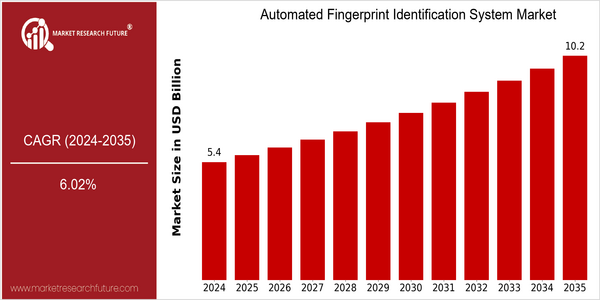
Market Size Snapshot
| Year | Value |
|---|---|
| 2024 | USD 5.36 Billion |
| 2035 | USD 10.2 Billion |
| CAGR (2025-2035) | 6.02 % |
Note – Market size depicts the revenue generated over the financial year
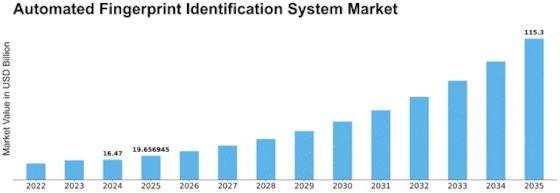
The market for automatic fingerprint identification systems (AFIS) is growing at a rapid pace. The market is expected to reach $ 5.36 billion in 2024 and is projected to reach $ 10.2 billion by 2035. This represents a compound annual growth rate (CAGR) of 6.02% for the period from 2025 to 2035. This growth rate reflects the growing demand for fingerprint recognition systems in various industries. The growing emphasis on security and the need for efficient identification systems are the main drivers of this growth. The AFIS market is expected to grow steadily over the next ten years. The integration of artificial intelligence and machine learning in fingerprint recognition systems is also driving the market. These innovations improve the accuracy and speed of identification and make AFIS more attractive to law enforcement agencies, financial institutions and other industries that need secure access control. In order to meet the growing demand, market leaders such as NEC, Morpho (Safran), and HID Global are investing heavily in R & D, establishing strategic partnerships, and launching new products. These recent developments, such as recent collaborations to improve biometric data security and the end-user experience, are indicative of the changing market dynamics.
Regional Market Size
Regional Deep Dive
The AFIS market is experiencing a high growth in various regions, driven by increasing security concerns, advancements in biometric technology and the growing need for an efficient identification system. Each region has its own specific features that affect the market dynamics, such as regulations, the level of technological development and the cultural attitude towards privacy and security. With governments and companies focusing on enhancing security and simplifying identification processes, the AFIS market is set to grow. In addition, innovations in artificial intelligence and machine learning will further increase the capabilities of the systems.
Europe
- The European Union's General Data Protection Regulation (GDPR) has led to a heightened focus on data privacy, influencing the development and deployment of AFIS technologies that comply with stringent privacy standards.
- Countries like the UK and Germany are investing in smart city initiatives that incorporate biometric identification systems, including AFIS, to enhance public safety and streamline urban management.
Asia Pacific
- China's extensive use of biometric identification in public security initiatives, including the Social Credit System, has accelerated the adoption of AFIS technologies, making it a leader in the market.
- India's Unique Identification Authority is implementing biometric systems for its Aadhaar program, which has created a significant demand for AFIS solutions to manage and verify identities efficiently.
Latin America
- Brazil is implementing biometric voter registration systems to enhance electoral security, which is driving the demand for AFIS technologies in the region.
- Countries like Mexico are increasingly adopting biometric identification systems in law enforcement to address rising crime rates, leading to a growing market for AFIS solutions.
North America
- The United States government has been a pioneer in biometrics. Its most ambitious project, the Next Generation Identification (NGI) system, integrates fingerprint identification with other biometrics.
- Recent regulatory changes, such as the implementation of stricter data protection laws, are prompting organizations to adopt more secure biometric systems, thereby increasing the demand for AFIS solutions.
Middle East And Africa
- The UAE has launched several initiatives, such as the Smart Dubai project, which integrates biometric identification systems, including AFIS, to enhance security and improve citizen services.
- In South Africa, the government is focusing on modernizing its identification systems to combat fraud and improve law enforcement capabilities, leading to increased investments in AFIS technologies.
Did You Know?
“Did you know that the first automated fingerprint identification system was developed in the 1960s, but it wasn't until the 1990s that AFIS technology became widely adopted by law enforcement agencies?” — Biometric Technology Today
Segmental Market Size
The AFIS market plays a key role in the security and identification verification of various departments. It is growing steadily. The main reasons for this are the growing security requirements, especially in the field of law enforcement and border control, and the growing need for effective biometric solutions in commercial applications. Moreover, the regulatory environment in the areas of banking, travel and other industries is gaining importance. AFIS implementations are already in a phase of expansion, with NEC and Gemalto being the main players in North America and Europe. The main applications are criminal identification, access control to secure areas and identification verification in financial services. The digital transformation, the government's biometrics policy and the digital revolution are driving the market. Also, the development of machine learning and artificial intelligence is influencing the AFIS market. Faster and more accurate fingerprint matching is leading to better system performance.
Future Outlook
The market for fingerprint identification systems will grow at a compound annual growth rate (CAGR) of 6.02% from 2024 to 2035. This is due to the increasing use of biometrics in various fields, such as law enforcement, border control, and financial services. In the commercial sector, the penetration of fingerprint identification systems is estimated to be around 50% by 2035. The integration of artificial intelligence and machine learning into fingerprint identification systems is expected to improve the accuracy and efficiency of such systems. Also, the government's support for the use of biometrics for national security and public safety is expected to drive the market. Also, the increasing demand for multi-modal biometric systems and the growing trend towards mobile biometrics will shape the future of the market. Fingerprint identification systems will continue to evolve, which will create opportunities for both end users and suppliers.

























Leave a Comment