Request Free Sample ×

Kindly complete the form below to receive a free sample of this Report

* Please use a valid business email

Leading companies partner with us for data-driven Insights

clients tt-cursor
Hero Background
English
Chinese
French
Japanese
Korean
German
Spanish

Autologous Cell Therapy Market Size

ID: MRFR/HC/7487-HCR
200 Pages
Vikita Thakur
April 2026

Autologous Cell Therapy Market Research Report: Size, Share, Trend Analysis By Applications (Oncology, Cardiology, Orthopedics, Dermatology), By Cell Type (Stem Cells, T Cells, Dendritic Cells, Platelet Rich Plasma), By End-use (Hospitals, Clinics, Research Laboratories), By Technology (Cell Isolation, Cell Expansion, Cryopreservation), and By Regional (North America, Europe, South America, Asia Pacific, Middle East and Africa) - Growth Outlook & Industry Forecast 2025 To 2035

Share:
Download PDF ×

We do not share your information with anyone. However, we may send you emails based on your report interest from time to time. You may contact us at any time to opt-out.

Autologous Cell Therapy Market Infographic
Purchase Options

Autologous Cell Therapy Size

Autologous Cell Therapy Market Growth Projections and Opportunities

Among factors driving the autologous cell therapy market is a range of them influencing its growth and developments. One of primary forces that promote autologous cell therapy is the greater contribution invested in therapeutic potential of autologous cell treatment for treating different medical states. Several initiatives have emerged, making the concept of autologous cells use for treatment purposes popular and contributing to the increasing revival in calls for individualized and regenerative treatment options. Technological developments have a crucial role to effect on the autologous cell therapy market. The growth of further cell therapies is stemmed from the ever-evolving practices that may come to pass in cell isolation, expansion, and manipulation, including advancements technology for gene editing such as CRISPR-Cas9. This technological innovation not only enhances the performance of autologous cell therapies but also broadens their scope in terms of widening the diseases and conditions that they are to be used on. Shaping the market dynamics by cell therapy regulations is among the important aspects of cell therapies. The security, efficacy and quality of autologous cell therapies is assured by strict regulations which will be influence their approval the way in which they are commercialized and placed in clinical settings. These rules should be followed for establishing trust and market entry as trusted institution with healthcare providers, patients, and regulatory bodies. As for autologous cell therapies, the adoption rate varies in different regions due to a range of economic factors and healthcare delivery systems. Factors like the degree of healthcare utilization, reimbursement policies as well as economic status result in affecting the level at which cell therapy is used and patient demand for personalized regenerative treatments. It means that the players are operating in different landscapes and failing to produce products addressing specific challenges posed by these difference healthcare systems. The competitive situation in the market of autologous cell therapy is characterized by a constant process of innovation and development. Currently, biotechnology companies and research institutions focus on the wide range of cell therapies that could be presented with certain features available next to them such as safety and efficiency that is demonstrated in targeting specific diseases. In a competitive environment, the market players continuously face pressure to maintain leading positions in terms of innovation; such an innovative impulse facilitates bringing new technologies to the field of autologous therapies and constantly improving their properties. There are initiatives between cell therapy developers, research institutions as well as healthcare organizations that help in developing innovations in the global tissue and biopsy specimen processing market. The partnerships discussed above concentrate around initiatives like the development new cell sources, clearance of manufacturing process and advances in PMEA approaches. Cooperation between various stakeholders fiui1deceUs transforms the rate of development in autologous cell therapies that meet the demands of changing patients and healthcare workers.
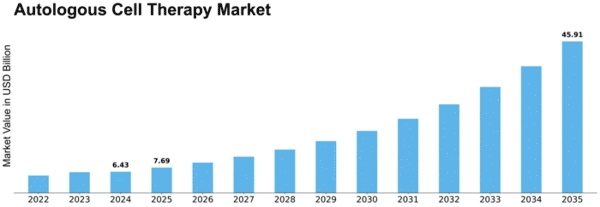
Autologous Cell Therapy Market Size Graph
Author
Author Profile
Vikita Thakur
Senior Research Analyst

She holds an experience of about 5+ years in market research and business consulting projects for sectors such as life sciences, medical devices, and healthcare IT. She possesses a robust background in data analysis, market estimation, competitive intelligence, pipeline analysis market trend identification, and consumer behavior insights. Her expertise lies in technical Sales support, client interaction and project management, designing and implementing market research studies, conducting competitive analysis, and synthesizing complex data into actionable recommendations that drive business growth.

Leave a Comment

FAQs

What is the current valuation of the Autologous Cell Therapy Market?

<p>The market valuation reached 6.43 USD Billion in 2024.</p>

What is the projected market size for the Autologous Cell Therapy Market by 2035?

<p>The market is expected to grow to 45.91 USD Billion by 2035.</p>

What is the expected CAGR for the Autologous Cell Therapy Market during the forecast period?

<p>The market is anticipated to experience a CAGR of 19.56% from 2025 to 2035.</p>

Which application segment holds the highest market value in 2024?

<p>The Oncology segment was valued at 1.93 USD Billion in 2024.</p>

What are the projected values for the Cardiology segment by 2035?

<p>The Cardiology segment is projected to reach 9.27 USD Billion by 2035.</p>

Which cell type is expected to dominate the market by 2035?

<p>T Cells are projected to grow to 16.0 USD Billion by 2035.</p>

What is the market value for Hospitals as an end user in 2024?

<p>Hospitals accounted for 2.57 USD Billion in 2024.</p>

How does the market for Research Institutes compare to other end users by 2035?

<p>Research Institutes are expected to reach 9.0 USD Billion by 2035, indicating substantial growth.</p>

Which key player is likely to lead the Autologous Cell Therapy Market?

<p>Companies like Novartis and Bristol-Myers Squibb are positioned as leaders in the market.</p>

What is the expected growth trend for the Orthopedics segment by 2035?

<p>The Orthopedics segment is projected to grow to 8.16 USD Billion by 2035.</p>

Market Summary

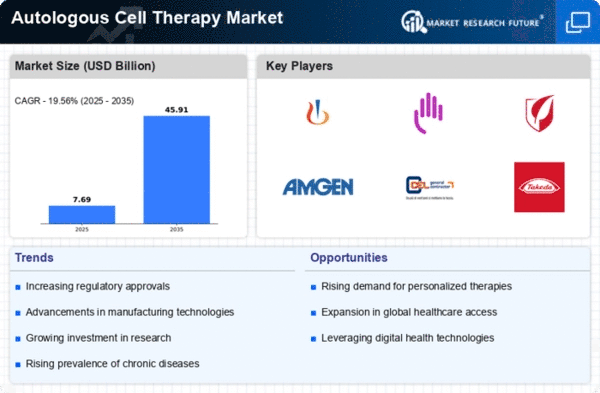
As per MRFR analysis, the Autologous Cell Therapy Market Size was estimated at 6.43 USD Billion in 2024. The Autologous Cell Therapy industry is projected to grow from 7.69 USD Billion in 2025 to 45.91 USD Billion by 2035, exhibiting a compound annual growth rate (CAGR) of 19.56% during the forecast period 2025 - 2035.

Key Market Trends & Highlights

The Autologous Cell Therapy Market is experiencing robust growth driven by technological advancements and increasing investment.

  • Technological advancements are enhancing the efficacy and safety of autologous cell therapies, particularly in oncology. North America remains the largest market, while Asia-Pacific is emerging as the fastest-growing region for autologous cell therapies. The mesenchymal stem cells segment dominates the market, whereas hematopoietic stem cells are witnessing rapid growth. Rising prevalence of chronic diseases and advancements in cell processing technologies are key drivers propelling market expansion.

Market Size & Forecast

2024 Market Size 6.43 (USD Billion)
2035 Market Size 45.91 (USD Billion)
CAGR (2025 - 2035) 19.56%
Largest Regional Market Share in 2024 North America

Major Players

<p><a href="https://www.novartis.com/research-and-development/technology-platforms/cell-therapy/car-t-cell-therapy-and-beyond">Novartis </a>(CH), Bristol-Myers Squibb (US), Gilead Sciences (US), Amgen (US), Celgene (US), Takeda (JP), Roche (CH), Sangamo Therapeutics (US), Celyad (BE)</p>

Market Trends

The Autologous Cell Therapy Market is currently experiencing a notable evolution, driven by advancements in regenerative medicine and personalized treatment approaches. This market encompasses therapies that utilize a patient's own cells for therapeutic purposes, which may enhance efficacy and reduce the risk of immune rejection. As research progresses, the potential applications of autologous cell therapies are expanding, particularly in areas such as oncology, orthopedics, and cardiovascular diseases. The increasing prevalence of chronic conditions and the growing demand for innovative treatment modalities appear to be propelling market growth. Furthermore, regulatory frameworks are evolving to accommodate these novel therapies, which may facilitate their entry into clinical practice. In addition to technological advancements, the Autologous Cell Therapy Market is influenced by rising investments in research and development. Pharmaceutical companies and biotechnology firms are actively pursuing collaborations and partnerships to enhance their product pipelines. This trend suggests a shift towards more integrated approaches in autologous therapy development, where multidisciplinary teams work together to optimize treatment outcomes. Moreover, patient awareness and acceptance of these therapies are gradually increasing, which could further stimulate market expansion. Overall, the Autologous Cell Therapy Market seems poised for continued growth, driven by innovation, collaboration, and a focus on personalized medicine.

Technological Advancements

Recent innovations in cell processing and manipulation techniques are enhancing the efficacy of autologous therapies. These advancements may lead to improved patient outcomes and broaden the scope of applications.

Regulatory Developments

Evolving regulatory frameworks are likely to streamline the approval process for autologous cell therapies. This could facilitate quicker access to novel treatments for patients, thereby expanding market reach.

Increased Investment

Growing investments in research and development by both public and private sectors are fostering innovation in the Autologous Cell Therapy Market. This trend may result in a wider array of therapeutic options and improved treatment modalities.

Autologous Cell Therapy Market Market Drivers

Regulatory Support and Frameworks

Regulatory support plays a pivotal role in shaping the Global Autologous Cell Therapy Market Industry. Governments are establishing frameworks that facilitate the approval and commercialization of autologous therapies. These regulations aim to ensure safety and efficacy while promoting innovation. For example, streamlined approval processes for cell-based therapies can expedite their availability to patients. This supportive environment encourages companies to invest in the development of new treatments, thereby driving market growth. As regulatory bodies continue to adapt to the evolving landscape of cell therapies, the industry is likely to experience enhanced momentum.

Rising Prevalence of Chronic Diseases

The Global Autologous Cell Therapy Market Industry is experiencing growth due to the increasing prevalence of chronic diseases such as cancer, diabetes, and cardiovascular disorders. These conditions often require innovative treatment approaches, and autologous cell therapy offers personalized solutions. For instance, the use of stem cells derived from a patient's own body has shown promise in treating various ailments. As the global population ages and the incidence of these diseases rises, the demand for effective therapies is expected to surge. This trend is likely to contribute to the market's projected growth, with an estimated value of 12.8 USD Billion in 2024.

Technological Advancements in Cell Therapy

Technological innovations are significantly shaping the Global Autologous Cell Therapy Market Industry. Advances in cell processing, gene editing, and biomanufacturing techniques enhance the efficacy and safety of therapies. For example, CRISPR technology allows for precise modifications of genetic material, potentially improving treatment outcomes. These advancements not only facilitate the development of new therapies but also streamline production processes, making treatments more accessible. As a result, the market is poised for substantial growth, with projections indicating a rise to 45 USD Billion by 2035, reflecting a compound annual growth rate of 12.13% from 2025 to 2035.

Increased Investment in Research and Development

Investment in research and development is a critical driver of the Global Autologous Cell Therapy Market Industry. Governments and private entities are allocating significant resources to explore the potential of autologous therapies. This funding supports clinical trials and the development of innovative treatment modalities. For instance, various initiatives aim to enhance the understanding of stem cell applications in regenerative medicine. As research progresses, new therapies are likely to emerge, further expanding the market. The anticipated growth trajectory suggests that the industry will continue to attract investment, fostering advancements that could lead to improved patient outcomes.

Growing Awareness and Acceptance of Cell Therapies

The Global Autologous Cell Therapy Market Industry benefits from increasing awareness and acceptance of cell therapies among healthcare professionals and patients. Educational campaigns and successful case studies are helping to demystify these treatments, leading to greater trust and demand. As patients become more informed about the potential benefits of autologous therapies, they are more likely to seek these options. This shift in perception is crucial for market expansion, as it encourages healthcare providers to incorporate these therapies into treatment protocols. Consequently, the market is expected to witness robust growth, driven by a more informed patient population.

Market Segment Insights

By Application: Oncology (Largest) vs. Cardiology (Fastest-Growing)

<p>The Autologous Cell Therapy Market exhibits significant diversity across its application segment, with Oncology holding the largest share due to the increasing incidence of cancer and advancements in treatment modalities. This segment benefits from robust research and development efforts aimed at immunotherapies and personalized medicine that leverage patients' own cells to combat malignancies. Moreover, other areas like Cardiology and Neurology are progressively gaining traction, attributed to the rise in cardiovascular diseases and neurological disorders that necessitate innovative and effective therapeutic alternatives. In recent years, Cardiology has emerged as the fastest-growing application, driven by an increasing number of clinical trials and successful outcomes from cell-based therapies targeting heart repair and regeneration. The demand for effective treatment options for chronic heart conditions, combined with technological advancements in cell therapy, is propelling this segment's growth. Neurology and Orthopedics are also accelerating, spurred by a rising focus on regenerative medicine and the potential of cell therapies to repair damaged tissues in these fields.</p>

<p>Oncology (Dominant) vs. Cardiology (Emerging)</p>

<p>Oncology stands as a dominant application in the Autologous Cell Therapy Market, leveraging cutting-edge treatments tailored to individual patient profiles. This segment focuses on harnessing the power of the immune system to target and eliminate cancerous cells effectively. With a wide array of therapies including CAR-T cell therapy and tumor-infiltrating lymphocyte therapy, Oncology is at the forefront of research and development efforts in autologous therapy. Conversely, the Cardiology application is emerging in response to increased heart disease prevalence, highlighting the potential of stem cell therapies and other regenerative approaches to repair heart tissue and improve function. Both segments exemplify the dynamic nature of the market, offering unique therapeutic options tailored to critical health challenges.</p>

By Cell Type: Mesenchymal Stem Cells (Largest) vs. Hematopoietic Stem Cells (Fastest-Growing)

<p>In the Autologous Cell Therapy Market, Mesenchymal Stem Cells (MSCs) hold the largest share, predominantly due to their versatile applications in regenerative medicine and their capability to differentiate into various cell types. Meanwhile, Hematopoietic Stem Cells (HSCs) are swiftly gaining traction, positioned as the fastest-growing segment thanks to advancements in gene therapy and improved outcomes in hematological disorders. Understanding these dynamics is crucial for stakeholders looking to navigate a competitive landscape or invest effectively in autologous therapies. Current growth trends reflect a burgeoning interest in MSCs for applications beyond traditional therapy, such as their use in immunotherapy, thus contributing to their sustained dominance. Conversely, the rapid expansion of HSCs is propelled by their successful incorporation into clinical practices for treating blood cancers and genetic diseases. As stem cell technologies evolve, competition and consumer awareness are expected to drive significant growth across both segments.</p>

<p>Stem Cell Types: MSC (Dominant) vs. HSC (Emerging)</p>

<p>Mesenchymal Stem Cells (MSCs) are recognized as the dominant force in the Autologous Cell Therapy Market due to their unique ability to modulate immune responses and their broad application in tissue repair. Their multipotent nature enables them to develop into various cell lineages, making them invaluable in treatments for conditions such as osteoarthritis and cardiovascular diseases. Hematopoietic Stem Cells (HSCs), on the other hand, are emerging rapidly as essential components in regenerative medicine and oncology, particularly in treating hematological malignancies. Their established role in bone marrow transplants and ongoing innovations in cellular therapies have positioned HSCs at the forefront of this evolving market, appealing to both clinicians and researchers aiming to improve patient care.</p>

By End User: Hospitals (Largest) vs. Research Institutes (Fastest-Growing)

<p>In the Autologous Cell Therapy Market, hospitals hold the largest share among end users, driven by their capability to offer comprehensive healthcare services, including advanced treatments involving cell therapies. This segment dominates due to the increasing number of hospital facilities and the growing acceptance of personalized medicine. Research institutes, on the other hand, are witnessing rapid growth as they play a crucial role in the innovation and development of novel therapies. Their focus on clinical trials and academic research enhances their market importance. The growth trends in the autologous cell therapy market are significantly influenced by the rising prevalence of chronic diseases and the escalating demand for advanced therapeutic options. Innovations in cell therapy techniques and an increasing number of strategic collaborations between hospitals and research entities are anticipated to propel expansion within this segment. Furthermore, the emergence of specialty clinics and ambulatory surgical centers is also nurturing the overall market dynamics, promoting accessibility and treatment advancements in personalized medicine.</p>

<p>Hospitals (Dominant) vs. Research Institutes (Emerging)</p>

<p>Hospitals remain the dominant end user in the Autologous Cell Therapy Market, primarily due to their robust infrastructure and capability to integrate advanced therapies into clinical routines seamlessly. Their extensive patient base and well-established operational facilities facilitate the administration and management of autologous treatments efficiently. On the other hand, research institutes are viewed as emerging players within this sector, focusing on cutting-edge research, development, and clinical trials. These institutions are pivotal in aligning scientific innovations with therapeutic practices, thus driving the discovery of novel applications for cell therapies. The synergy between hospitals and research institutes fosters a dynamic environment that enhances treatment modalities and ultimately benefits patient outcomes.</p>

Get more detailed insights about Autologous Cell Therapy Market Research Report - Global Forecast till 2035

Regional Insights

North America : Market Leader in Innovation

North America continues to lead the Autologous Cell Therapy market, holding a significant share of 3.5B in 2024. The region benefits from advanced healthcare infrastructure, substantial R&D investments, and a growing demand for personalized medicine. Regulatory support from agencies like the FDA has accelerated the approval of innovative therapies, driving market growth. The increasing prevalence of chronic diseases and the aging population further fuel demand for these therapies. The competitive landscape in North America is robust, featuring key players such as Novartis, Gilead Sciences, and Bristol-Myers Squibb. These companies are at the forefront of developing cutting-edge therapies, leveraging their strong financial positions to invest in research and development. The U.S. remains the largest market, with Canada also showing promising growth in the sector. The presence of leading biotech firms enhances the region's position as a hub for autologous cell therapy advancements.

Europe : Emerging Market with Potential

Europe's Autologous Cell Therapy market is valued at 1.8B, reflecting a growing interest in regenerative medicine. The region is witnessing increased demand for innovative treatments, driven by rising incidences of chronic diseases and advancements in autologous therapy technologies. Regulatory bodies are actively working to streamline approval processes, which is expected to catalyze market growth. The European Medicines Agency (EMA) is focusing on creating a conducive environment for the development of advanced therapies. Leading countries in Europe include Germany, France, and the UK, which are home to several key players like Celgene and Takeda Pharmaceutical. The competitive landscape is characterized by collaborations between biotech firms and academic institutions, enhancing research capabilities. The presence of a well-established healthcare system and funding initiatives further supports the growth of autologous therapies in the region.

Asia-Pacific : Rapidly Growing Market

The Asia-Pacific region, with a market size of 0.9B, is rapidly emerging in the Autologous Cell Therapy landscape. Factors such as increasing healthcare expenditure, a growing patient population, and advancements in biotechnology are driving this growth. Countries like Japan and China are leading the charge, supported by government initiatives aimed at enhancing healthcare infrastructure and regulatory frameworks. The demand for personalized medicine is also on the rise, further propelling market expansion. Japan stands out as a leader in the region, with significant investments from companies like Takeda and a strong focus on research and development. China is also making strides, with a burgeoning biotech sector and increasing collaborations between public and private entities. The competitive landscape is evolving, with both local and international players vying for market share, indicating a promising future for autologous cell therapies in Asia-Pacific.

Middle East and Africa : Emerging Market Opportunities

The Middle East and Africa (MEA) region, with a market size of 0.23B, is beginning to explore the potential of Autologous Cell Therapy. Factors such as increasing healthcare investments and a rising prevalence of chronic diseases are driving interest in innovative therapies. Regulatory bodies are gradually establishing frameworks to support the development and approval of these therapies, which is crucial for market growth. The region's diverse healthcare needs present unique opportunities for tailored solutions. Countries like South Africa and the UAE are leading the way in adopting advanced medical technologies, including cell therapies. The competitive landscape is still developing, with a mix of local and international players entering the market. As awareness of the benefits of autologous therapies grows, the MEA region is expected to see increased investment and innovation in this sector. "The potential for growth in the MEA region is significant as healthcare systems evolve," notes a report from the World Health Organization.

Key Players and Competitive Insights

The Autologous Cell Therapy Market is currently characterized by a dynamic competitive landscape, driven by advancements in technology, increasing investment in research and development, and a growing demand for personalized medicine. Major players such as Novartis (CH), Bristol-Myers Squibb (US), and Gilead Sciences (US) are strategically positioned to leverage their extensive portfolios and innovative capabilities. Novartis (CH) focuses on enhancing its CAR-T cell therapy offerings, while Bristol-Myers Squibb (US) emphasizes its commitment to expanding its immuno-oncology pipeline. Gilead Sciences (US) is actively pursuing partnerships to bolster its autologous cell therapy initiatives, indicating a collaborative approach to market expansion. Collectively, these strategies contribute to a competitive environment that is increasingly centered on innovation and strategic partnerships. In terms of business tactics, companies are localizing manufacturing to enhance supply chain efficiency and reduce costs. This approach is particularly relevant in the context of autologous therapies, which require rapid processing of patient-derived cells. The market structure appears moderately fragmented, with several key players exerting influence while also facing competition from emerging biotech firms. The collective actions of these companies shape a landscape where agility and responsiveness to market demands are paramount. In November 2025, Novartis (CH) announced a strategic collaboration with a leading academic institution to advance its research in next-generation CAR-T therapies. This partnership is expected to accelerate the development of innovative treatment options, potentially enhancing Novartis's competitive edge in the market. The collaboration underscores the importance of academic partnerships in driving research and development, which is crucial for maintaining leadership in the rapidly evolving field of autologous cell therapy. In October 2025, Bristol-Myers Squibb (US) revealed the successful results of a pivotal clinical trial for its autologous T-cell therapy targeting specific hematological malignancies. This announcement not only reinforces the efficacy of its product but also positions the company favorably against competitors. The positive trial results are likely to bolster investor confidence and may lead to accelerated regulatory approvals, further solidifying Bristol-Myers Squibb's market presence. In September 2025, Gilead Sciences (US) expanded its manufacturing capabilities by investing in a new facility dedicated to autologous cell therapies. This strategic move is anticipated to enhance production capacity and streamline operations, allowing Gilead to meet the growing demand for personalized therapies. The investment reflects a broader trend within the industry, where companies are prioritizing infrastructure development to support innovative treatment modalities. As of December 2025, current competitive trends in the Autologous Cell Therapy Market are increasingly influenced by digitalization, sustainability, and the integration of artificial intelligence (AI) in research and development processes. Strategic alliances are becoming more prevalent, as companies recognize the value of collaboration in navigating complex regulatory environments and accelerating product development. Looking ahead, competitive differentiation is likely to evolve from traditional price-based competition to a focus on innovation, technological advancements, and supply chain reliability. This shift suggests that companies that prioritize these elements will be better positioned to thrive in the future.

Key Companies in the Autologous Cell Therapy Market include

Industry Developments

Using EsoBiotec's in-body genetic modification technology to improve treatment speed and efficacy, AstraZeneca announced in March 17, 2025, that it would buy the company for up to $1 billion in order to expand its capabilities in autologous cell therapies for autoimmune diseases and cancer.

The world's first Nebula-powered autologous iPSC-derived endothelial cell therapy, which targets peripheral artery and coronary artery diseases, was developed by Cellino and South Korea's Karis Bio on April 15, 2025.The two companies intend to industrialize production and start first-in-human trials. MaxCyte and Ori Biotech established a collaboration in June 2025 to improve production efficiency by streamlining closed-loop, scalable autologous cell therapy manufacturing.

Limula has started beta testing their completely automated autologous cell-processing technology in June 2025, which is intended to streamline processes for individualized treatment. Reiterating AbbVie's post-Humira strategic expansion, the company announced in June 30, 2025, that it had acquired Capstan Therapeutics for $2.1 billion.Capstan Therapeutics is the company behind the development of CPTX2309, an autologous CAR-T candidate that targets autoimmune illnesses.

A significant milestone for the use of autologous cell therapy beyond hematologic malignancies was reached on May 31, 2025, when the findings of China's first randomized controlled study of CAR-T treatment for solid tumors showed a 40% increase in overall survival for patients with gastric and GEJ cancer.The continued dominance of autologous CAR-T modalities was further confirmed in March 2024 when Kite Pharma (Gilead) was granted extended FDA clearance for its Yescarta CAR-T treatment in recurrent follicular lymphoma.

Future Outlook

Autologous Cell Therapy Market Future Outlook

<p>The Autologous Cell Therapy Market is projected to grow at a 19.56% CAGR from 2025 to 2035, driven by technological advancements, increasing R&amp;D investments, and rising demand for personalized medicine.</p>

New opportunities lie in:

  • <p>Expansion of telehealth platforms for remote patient monitoring Development of advanced cryopreservation techniques for cell storage Partnerships with biotech firms for innovative product pipelines</p>

<p>By 2035, the Autologous Cell Therapy Market is expected to be robust, reflecting substantial growth and innovation.</p>

Market Segmentation

Autologous Cell Therapy Market End User Outlook

  • Hospitals
  • Research Institutes
  • Ambulatory Surgical Centers
  • Specialty Clinics
  • Laboratories

Autologous Cell Therapy Market Cell Type Outlook

  • Mesenchymal Stem Cells
  • Hematopoietic Stem Cells
  • Adipose-derived Stem Cells
  • Induced Pluripotent Stem Cells
  • T Cells

Autologous Cell Therapy Market Application Outlook

  • Oncology
  • Cardiology
  • Neurology
  • Orthopedics
  • Dermatology

Report Scope

MARKET SIZE 2024 6.43(USD Billion)
MARKET SIZE 2025 7.69(USD Billion)
MARKET SIZE 2035 45.91(USD Billion)
COMPOUND ANNUAL GROWTH RATE (CAGR) 19.56% (2025 - 2035)
REPORT COVERAGE Revenue Forecast, Competitive Landscape, Growth Factors, and Trends
BASE YEAR 2024
Market Forecast Period 2025 - 2035
Historical Data 2019 - 2024
Market Forecast Units USD Billion
Key Companies Profiled Novartis (CH), Bristol-Myers Squibb (US), Gilead Sciences (US), Amgen (US), Celgene (US), Takeda (JP), Roche (CH), Sangamo Therapeutics (US), Celyad (BE)
Segments Covered Application, Cell Type, End User
Key Market Opportunities Advancements in personalized medicine enhance growth potential in the Autologous Cell Therapy Market.
Key Market Dynamics Rising demand for personalized medicine drives innovation and competition in the autologous cell therapy market.
Countries Covered North America, Europe, APAC, South America, MEA

FAQs

What is the current valuation of the Autologous Cell Therapy Market?

<p>The market valuation reached 6.43 USD Billion in 2024.</p>

What is the projected market size for the Autologous Cell Therapy Market by 2035?

<p>The market is expected to grow to 45.91 USD Billion by 2035.</p>

What is the expected CAGR for the Autologous Cell Therapy Market during the forecast period?

<p>The market is anticipated to experience a CAGR of 19.56% from 2025 to 2035.</p>

Which application segment holds the highest market value in 2024?

<p>The Oncology segment was valued at 1.93 USD Billion in 2024.</p>

What are the projected values for the Cardiology segment by 2035?

<p>The Cardiology segment is projected to reach 9.27 USD Billion by 2035.</p>

Which cell type is expected to dominate the market by 2035?

<p>T Cells are projected to grow to 16.0 USD Billion by 2035.</p>

What is the market value for Hospitals as an end user in 2024?

<p>Hospitals accounted for 2.57 USD Billion in 2024.</p>

How does the market for Research Institutes compare to other end users by 2035?

<p>Research Institutes are expected to reach 9.0 USD Billion by 2035, indicating substantial growth.</p>

Which key player is likely to lead the Autologous Cell Therapy Market?

<p>Companies like Novartis and Bristol-Myers Squibb are positioned as leaders in the market.</p>

What is the expected growth trend for the Orthopedics segment by 2035?

<p>The Orthopedics segment is projected to grow to 8.16 USD Billion by 2035.</p>

  1. SECTION I: EXECUTIVE SUMMARY AND KEY HIGHLIGHTS
    1. | 1.1 EXECUTIVE SUMMARY
    2. | | 1.1.1 Market Overview
    3. | | 1.1.2 Key Findings
    4. | | 1.1.3 Market Segmentation
    5. | | 1.1.4 Competitive Landscape
    6. | | 1.1.5 Challenges and Opportunities
    7. | | 1.1.6 Future Outlook
  2. SECTION II: SCOPING, METHODOLOGY AND MARKET STRUCTURE
    1. | 2.1 MARKET INTRODUCTION
    2. | | 2.1.1 Definition
    3. | | 2.1.2 Scope of the study
    4. | | | 2.1.2.1 Research Objective
    5. | | | 2.1.2.2 Assumption
    6. | | | 2.1.2.3 Limitations
    7. | 2.2 RESEARCH METHODOLOGY
    8. | | 2.2.1 Overview
    9. | | 2.2.2 Data Mining
    10. | | 2.2.3 Secondary Research
    11. | | 2.2.4 Primary Research
    12. | | | 2.2.4.1 Primary Interviews and Information Gathering Process
    13. | | | 2.2.4.2 Breakdown of Primary Respondents
    14. | | 2.2.5 Forecasting Model
    15. | | 2.2.6 Market Size Estimation
    16. | | | 2.2.6.1 Bottom-Up Approach
    17. | | | 2.2.6.2 Top-Down Approach
    18. | | 2.2.7 Data Triangulation
    19. | | 2.2.8 Validation
  3. SECTION III: QUALITATIVE ANALYSIS
    1. | 3.1 MARKET DYNAMICS
    2. | | 3.1.1 Overview
    3. | | 3.1.2 Drivers
    4. | | 3.1.3 Restraints
    5. | | 3.1.4 Opportunities
    6. | 3.2 MARKET FACTOR ANALYSIS
    7. | | 3.2.1 Value chain Analysis
    8. | | 3.2.2 Porter's Five Forces Analysis
    9. | | | 3.2.2.1 Bargaining Power of Suppliers
    10. | | | 3.2.2.2 Bargaining Power of Buyers
    11. | | | 3.2.2.3 Threat of New Entrants
    12. | | | 3.2.2.4 Threat of Substitutes
    13. | | | 3.2.2.5 Intensity of Rivalry
    14. | | 3.2.3 COVID-19 Impact Analysis
    15. | | | 3.2.3.1 Market Impact Analysis
    16. | | | 3.2.3.2 Regional Impact
    17. | | | 3.2.3.3 Opportunity and Threat Analysis
  4. SECTION IV: QUANTITATIVE ANALYSIS
    1. | 4.1 Healthcare, BY Application (USD Billion)
    2. | | 4.1.1 Oncology
    3. | | 4.1.2 Cardiology
    4. | | 4.1.3 Neurology
    5. | | 4.1.4 Orthopedics
    6. | | 4.1.5 Dermatology
    7. | 4.2 Healthcare, BY Cell Type (USD Billion)
    8. | | 4.2.1 Mesenchymal Stem Cells
    9. | | 4.2.2 Hematopoietic Stem Cells
    10. | | 4.2.3 Adipose-derived Stem Cells
    11. | | 4.2.4 Induced Pluripotent Stem Cells
    12. | | 4.2.5 T Cells
    13. | 4.3 Healthcare, BY End User (USD Billion)
    14. | | 4.3.1 Hospitals
    15. | | 4.3.2 Research Institutes
    16. | | 4.3.3 Ambulatory Surgical Centers
    17. | | 4.3.4 Specialty Clinics
    18. | | 4.3.5 Pharmaceutical Companies
    19. | 4.4 Healthcare, BY Region (USD Billion)
    20. | | 4.4.1 North America
    21. | | | 4.4.1.1 US
    22. | | | 4.4.1.2 Canada
    23. | | 4.4.2 Europe
    24. | | | 4.4.2.1 Germany
    25. | | | 4.4.2.2 UK
    26. | | | 4.4.2.3 France
    27. | | | 4.4.2.4 Russia
    28. | | | 4.4.2.5 Italy
    29. | | | 4.4.2.6 Spain
    30. | | | 4.4.2.7 Rest of Europe
    31. | | 4.4.3 APAC
    32. | | | 4.4.3.1 China
    33. | | | 4.4.3.2 India
    34. | | | 4.4.3.3 Japan
    35. | | | 4.4.3.4 South Korea
    36. | | | 4.4.3.5 Malaysia
    37. | | | 4.4.3.6 Thailand
    38. | | | 4.4.3.7 Indonesia
    39. | | | 4.4.3.8 Rest of APAC
    40. | | 4.4.4 South America
    41. | | | 4.4.4.1 Brazil
    42. | | | 4.4.4.2 Mexico
    43. | | | 4.4.4.3 Argentina
    44. | | | 4.4.4.4 Rest of South America
    45. | | 4.4.5 MEA
    46. | | | 4.4.5.1 GCC Countries
    47. | | | 4.4.5.2 South Africa
    48. | | | 4.4.5.3 Rest of MEA
  5. SECTION V: COMPETITIVE ANALYSIS
    1. | 5.1 Competitive Landscape
    2. | | 5.1.1 Overview
    3. | | 5.1.2 Competitive Analysis
    4. | | 5.1.3 Market share Analysis
    5. | | 5.1.4 Major Growth Strategy in the Healthcare
    6. | | 5.1.5 Competitive Benchmarking
    7. | | 5.1.6 Leading Players in Terms of Number of Developments in the Healthcare
    8. | | 5.1.7 Key developments and growth strategies
    9. | | | 5.1.7.1 New Product Launch/Service Deployment
    10. | | | 5.1.7.2 Merger & Acquisitions
    11. | | | 5.1.7.3 Joint Ventures
    12. | | 5.1.8 Major Players Financial Matrix
    13. | | | 5.1.8.1 Sales and Operating Income
    14. | | | 5.1.8.2 Major Players R&D Expenditure. 2023
    15. | 5.2 Company Profiles
    16. | | 5.2.1 Novartis (CH)
    17. | | | 5.2.1.1 Financial Overview
    18. | | | 5.2.1.2 Products Offered
    19. | | | 5.2.1.3 Key Developments
    20. | | | 5.2.1.4 SWOT Analysis
    21. | | | 5.2.1.5 Key Strategies
    22. | | 5.2.2 Bristol-Myers Squibb (US)
    23. | | | 5.2.2.1 Financial Overview
    24. | | | 5.2.2.2 Products Offered
    25. | | | 5.2.2.3 Key Developments
    26. | | | 5.2.2.4 SWOT Analysis
    27. | | | 5.2.2.5 Key Strategies
    28. | | 5.2.3 Gilead Sciences (US)
    29. | | | 5.2.3.1 Financial Overview
    30. | | | 5.2.3.2 Products Offered
    31. | | | 5.2.3.3 Key Developments
    32. | | | 5.2.3.4 SWOT Analysis
    33. | | | 5.2.3.5 Key Strategies
    34. | | 5.2.4 Amgen (US)
    35. | | | 5.2.4.1 Financial Overview
    36. | | | 5.2.4.2 Products Offered
    37. | | | 5.2.4.3 Key Developments
    38. | | | 5.2.4.4 SWOT Analysis
    39. | | | 5.2.4.5 Key Strategies
    40. | | 5.2.5 Celgene (US)
    41. | | | 5.2.5.1 Financial Overview
    42. | | | 5.2.5.2 Products Offered
    43. | | | 5.2.5.3 Key Developments
    44. | | | 5.2.5.4 SWOT Analysis
    45. | | | 5.2.5.5 Key Strategies
    46. | | 5.2.6 Takeda Pharmaceutical (JP)
    47. | | | 5.2.6.1 Financial Overview
    48. | | | 5.2.6.2 Products Offered
    49. | | | 5.2.6.3 Key Developments
    50. | | | 5.2.6.4 SWOT Analysis
    51. | | | 5.2.6.5 Key Strategies
    52. | | 5.2.7 Sangamo Therapeutics (US)
    53. | | | 5.2.7.1 Financial Overview
    54. | | | 5.2.7.2 Products Offered
    55. | | | 5.2.7.3 Key Developments
    56. | | | 5.2.7.4 SWOT Analysis
    57. | | | 5.2.7.5 Key Strategies
    58. | | 5.2.8 Celyad Oncology (BE)
    59. | | | 5.2.8.1 Financial Overview
    60. | | | 5.2.8.2 Products Offered
    61. | | | 5.2.8.3 Key Developments
    62. | | | 5.2.8.4 SWOT Analysis
    63. | | | 5.2.8.5 Key Strategies
    64. | | 5.2.9 Kite Pharma (US)
    65. | | | 5.2.9.1 Financial Overview
    66. | | | 5.2.9.2 Products Offered
    67. | | | 5.2.9.3 Key Developments
    68. | | | 5.2.9.4 SWOT Analysis
    69. | | | 5.2.9.5 Key Strategies
    70. | 5.3 Appendix
    71. | | 5.3.1 References
    72. | | 5.3.2 Related Reports
  6. LIST OF FIGURES
    1. | 6.1 MARKET SYNOPSIS
    2. | 6.2 NORTH AMERICA MARKET ANALYSIS
    3. | 6.3 US MARKET ANALYSIS BY APPLICATION
    4. | 6.4 US MARKET ANALYSIS BY CELL TYPE
    5. | 6.5 US MARKET ANALYSIS BY END USER
    6. | 6.6 CANADA MARKET ANALYSIS BY APPLICATION
    7. | 6.7 CANADA MARKET ANALYSIS BY CELL TYPE
    8. | 6.8 CANADA MARKET ANALYSIS BY END USER
    9. | 6.9 EUROPE MARKET ANALYSIS
    10. | 6.10 GERMANY MARKET ANALYSIS BY APPLICATION
    11. | 6.11 GERMANY MARKET ANALYSIS BY CELL TYPE
    12. | 6.12 GERMANY MARKET ANALYSIS BY END USER
    13. | 6.13 UK MARKET ANALYSIS BY APPLICATION
    14. | 6.14 UK MARKET ANALYSIS BY CELL TYPE
    15. | 6.15 UK MARKET ANALYSIS BY END USER
    16. | 6.16 FRANCE MARKET ANALYSIS BY APPLICATION
    17. | 6.17 FRANCE MARKET ANALYSIS BY CELL TYPE
    18. | 6.18 FRANCE MARKET ANALYSIS BY END USER
    19. | 6.19 RUSSIA MARKET ANALYSIS BY APPLICATION
    20. | 6.20 RUSSIA MARKET ANALYSIS BY CELL TYPE
    21. | 6.21 RUSSIA MARKET ANALYSIS BY END USER
    22. | 6.22 ITALY MARKET ANALYSIS BY APPLICATION
    23. | 6.23 ITALY MARKET ANALYSIS BY CELL TYPE
    24. | 6.24 ITALY MARKET ANALYSIS BY END USER
    25. | 6.25 SPAIN MARKET ANALYSIS BY APPLICATION
    26. | 6.26 SPAIN MARKET ANALYSIS BY CELL TYPE
    27. | 6.27 SPAIN MARKET ANALYSIS BY END USER
    28. | 6.28 REST OF EUROPE MARKET ANALYSIS BY APPLICATION
    29. | 6.29 REST OF EUROPE MARKET ANALYSIS BY CELL TYPE
    30. | 6.30 REST OF EUROPE MARKET ANALYSIS BY END USER
    31. | 6.31 APAC MARKET ANALYSIS
    32. | 6.32 CHINA MARKET ANALYSIS BY APPLICATION
    33. | 6.33 CHINA MARKET ANALYSIS BY CELL TYPE
    34. | 6.34 CHINA MARKET ANALYSIS BY END USER
    35. | 6.35 INDIA MARKET ANALYSIS BY APPLICATION
    36. | 6.36 INDIA MARKET ANALYSIS BY CELL TYPE
    37. | 6.37 INDIA MARKET ANALYSIS BY END USER
    38. | 6.38 JAPAN MARKET ANALYSIS BY APPLICATION
    39. | 6.39 JAPAN MARKET ANALYSIS BY CELL TYPE
    40. | 6.40 JAPAN MARKET ANALYSIS BY END USER
    41. | 6.41 SOUTH KOREA MARKET ANALYSIS BY APPLICATION
    42. | 6.42 SOUTH KOREA MARKET ANALYSIS BY CELL TYPE
    43. | 6.43 SOUTH KOREA MARKET ANALYSIS BY END USER
    44. | 6.44 MALAYSIA MARKET ANALYSIS BY APPLICATION
    45. | 6.45 MALAYSIA MARKET ANALYSIS BY CELL TYPE
    46. | 6.46 MALAYSIA MARKET ANALYSIS BY END USER
    47. | 6.47 THAILAND MARKET ANALYSIS BY APPLICATION
    48. | 6.48 THAILAND MARKET ANALYSIS BY CELL TYPE
    49. | 6.49 THAILAND MARKET ANALYSIS BY END USER
    50. | 6.50 INDONESIA MARKET ANALYSIS BY APPLICATION
    51. | 6.51 INDONESIA MARKET ANALYSIS BY CELL TYPE
    52. | 6.52 INDONESIA MARKET ANALYSIS BY END USER
    53. | 6.53 REST OF APAC MARKET ANALYSIS BY APPLICATION
    54. | 6.54 REST OF APAC MARKET ANALYSIS BY CELL TYPE
    55. | 6.55 REST OF APAC MARKET ANALYSIS BY END USER
    56. | 6.56 SOUTH AMERICA MARKET ANALYSIS
    57. | 6.57 BRAZIL MARKET ANALYSIS BY APPLICATION
    58. | 6.58 BRAZIL MARKET ANALYSIS BY CELL TYPE
    59. | 6.59 BRAZIL MARKET ANALYSIS BY END USER
    60. | 6.60 MEXICO MARKET ANALYSIS BY APPLICATION
    61. | 6.61 MEXICO MARKET ANALYSIS BY CELL TYPE
    62. | 6.62 MEXICO MARKET ANALYSIS BY END USER
    63. | 6.63 ARGENTINA MARKET ANALYSIS BY APPLICATION
    64. | 6.64 ARGENTINA MARKET ANALYSIS BY CELL TYPE
    65. | 6.65 ARGENTINA MARKET ANALYSIS BY END USER
    66. | 6.66 REST OF SOUTH AMERICA MARKET ANALYSIS BY APPLICATION
    67. | 6.67 REST OF SOUTH AMERICA MARKET ANALYSIS BY CELL TYPE
    68. | 6.68 REST OF SOUTH AMERICA MARKET ANALYSIS BY END USER
    69. | 6.69 MEA MARKET ANALYSIS
    70. | 6.70 GCC COUNTRIES MARKET ANALYSIS BY APPLICATION
    71. | 6.71 GCC COUNTRIES MARKET ANALYSIS BY CELL TYPE
    72. | 6.72 GCC COUNTRIES MARKET ANALYSIS BY END USER
    73. | 6.73 SOUTH AFRICA MARKET ANALYSIS BY APPLICATION
    74. | 6.74 SOUTH AFRICA MARKET ANALYSIS BY CELL TYPE
    75. | 6.75 SOUTH AFRICA MARKET ANALYSIS BY END USER
    76. | 6.76 REST OF MEA MARKET ANALYSIS BY APPLICATION
    77. | 6.77 REST OF MEA MARKET ANALYSIS BY CELL TYPE
    78. | 6.78 REST OF MEA MARKET ANALYSIS BY END USER
    79. | 6.79 KEY BUYING CRITERIA OF HEALTHCARE
    80. | 6.80 RESEARCH PROCESS OF MRFR
    81. | 6.81 DRO ANALYSIS OF HEALTHCARE
    82. | 6.82 DRIVERS IMPACT ANALYSIS: HEALTHCARE
    83. | 6.83 RESTRAINTS IMPACT ANALYSIS: HEALTHCARE
    84. | 6.84 SUPPLY / VALUE CHAIN: HEALTHCARE
    85. | 6.85 HEALTHCARE, BY APPLICATION, 2024 (% SHARE)
    86. | 6.86 HEALTHCARE, BY APPLICATION, 2024 TO 2035 (USD Billion)
    87. | 6.87 HEALTHCARE, BY CELL TYPE, 2024 (% SHARE)
    88. | 6.88 HEALTHCARE, BY CELL TYPE, 2024 TO 2035 (USD Billion)
    89. | 6.89 HEALTHCARE, BY END USER, 2024 (% SHARE)
    90. | 6.90 HEALTHCARE, BY END USER, 2024 TO 2035 (USD Billion)
    91. | 6.91 BENCHMARKING OF MAJOR COMPETITORS
  7. LIST OF TABLES
    1. | 7.1 LIST OF ASSUMPTIONS
    2. | | 7.1.1
    3. | 7.2 North America MARKET SIZE ESTIMATES; FORECAST
    4. | | 7.2.1 BY APPLICATION, 2025-2035 (USD Billion)
    5. | | 7.2.2 BY CELL TYPE, 2025-2035 (USD Billion)
    6. | | 7.2.3 BY END USER, 2025-2035 (USD Billion)
    7. | 7.3 US MARKET SIZE ESTIMATES; FORECAST
    8. | | 7.3.1 BY APPLICATION, 2025-2035 (USD Billion)
    9. | | 7.3.2 BY CELL TYPE, 2025-2035 (USD Billion)
    10. | | 7.3.3 BY END USER, 2025-2035 (USD Billion)
    11. | 7.4 Canada MARKET SIZE ESTIMATES; FORECAST
    12. | | 7.4.1 BY APPLICATION, 2025-2035 (USD Billion)
    13. | | 7.4.2 BY CELL TYPE, 2025-2035 (USD Billion)
    14. | | 7.4.3 BY END USER, 2025-2035 (USD Billion)
    15. | 7.5 Europe MARKET SIZE ESTIMATES; FORECAST
    16. | | 7.5.1 BY APPLICATION, 2025-2035 (USD Billion)
    17. | | 7.5.2 BY CELL TYPE, 2025-2035 (USD Billion)
    18. | | 7.5.3 BY END USER, 2025-2035 (USD Billion)
    19. | 7.6 Germany MARKET SIZE ESTIMATES; FORECAST
    20. | | 7.6.1 BY APPLICATION, 2025-2035 (USD Billion)
    21. | | 7.6.2 BY CELL TYPE, 2025-2035 (USD Billion)
    22. | | 7.6.3 BY END USER, 2025-2035 (USD Billion)
    23. | 7.7 UK MARKET SIZE ESTIMATES; FORECAST
    24. | | 7.7.1 BY APPLICATION, 2025-2035 (USD Billion)
    25. | | 7.7.2 BY CELL TYPE, 2025-2035 (USD Billion)
    26. | | 7.7.3 BY END USER, 2025-2035 (USD Billion)
    27. | 7.8 France MARKET SIZE ESTIMATES; FORECAST
    28. | | 7.8.1 BY APPLICATION, 2025-2035 (USD Billion)
    29. | | 7.8.2 BY CELL TYPE, 2025-2035 (USD Billion)
    30. | | 7.8.3 BY END USER, 2025-2035 (USD Billion)
    31. | 7.9 Russia MARKET SIZE ESTIMATES; FORECAST
    32. | | 7.9.1 BY APPLICATION, 2025-2035 (USD Billion)
    33. | | 7.9.2 BY CELL TYPE, 2025-2035 (USD Billion)
    34. | | 7.9.3 BY END USER, 2025-2035 (USD Billion)
    35. | 7.10 Italy MARKET SIZE ESTIMATES; FORECAST
    36. | | 7.10.1 BY APPLICATION, 2025-2035 (USD Billion)
    37. | | 7.10.2 BY CELL TYPE, 2025-2035 (USD Billion)
    38. | | 7.10.3 BY END USER, 2025-2035 (USD Billion)
    39. | 7.11 Spain MARKET SIZE ESTIMATES; FORECAST
    40. | | 7.11.1 BY APPLICATION, 2025-2035 (USD Billion)
    41. | | 7.11.2 BY CELL TYPE, 2025-2035 (USD Billion)
    42. | | 7.11.3 BY END USER, 2025-2035 (USD Billion)
    43. | 7.12 Rest of Europe MARKET SIZE ESTIMATES; FORECAST
    44. | | 7.12.1 BY APPLICATION, 2025-2035 (USD Billion)
    45. | | 7.12.2 BY CELL TYPE, 2025-2035 (USD Billion)
    46. | | 7.12.3 BY END USER, 2025-2035 (USD Billion)
    47. | 7.13 APAC MARKET SIZE ESTIMATES; FORECAST
    48. | | 7.13.1 BY APPLICATION, 2025-2035 (USD Billion)
    49. | | 7.13.2 BY CELL TYPE, 2025-2035 (USD Billion)
    50. | | 7.13.3 BY END USER, 2025-2035 (USD Billion)
    51. | 7.14 China MARKET SIZE ESTIMATES; FORECAST
    52. | | 7.14.1 BY APPLICATION, 2025-2035 (USD Billion)
    53. | | 7.14.2 BY CELL TYPE, 2025-2035 (USD Billion)
    54. | | 7.14.3 BY END USER, 2025-2035 (USD Billion)
    55. | 7.15 India MARKET SIZE ESTIMATES; FORECAST
    56. | | 7.15.1 BY APPLICATION, 2025-2035 (USD Billion)
    57. | | 7.15.2 BY CELL TYPE, 2025-2035 (USD Billion)
    58. | | 7.15.3 BY END USER, 2025-2035 (USD Billion)
    59. | 7.16 Japan MARKET SIZE ESTIMATES; FORECAST
    60. | | 7.16.1 BY APPLICATION, 2025-2035 (USD Billion)
    61. | | 7.16.2 BY CELL TYPE, 2025-2035 (USD Billion)
    62. | | 7.16.3 BY END USER, 2025-2035 (USD Billion)
    63. | 7.17 South Korea MARKET SIZE ESTIMATES; FORECAST
    64. | | 7.17.1 BY APPLICATION, 2025-2035 (USD Billion)
    65. | | 7.17.2 BY CELL TYPE, 2025-2035 (USD Billion)
    66. | | 7.17.3 BY END USER, 2025-2035 (USD Billion)
    67. | 7.18 Malaysia MARKET SIZE ESTIMATES; FORECAST
    68. | | 7.18.1 BY APPLICATION, 2025-2035 (USD Billion)
    69. | | 7.18.2 BY CELL TYPE, 2025-2035 (USD Billion)
    70. | | 7.18.3 BY END USER, 2025-2035 (USD Billion)
    71. | 7.19 Thailand MARKET SIZE ESTIMATES; FORECAST
    72. | | 7.19.1 BY APPLICATION, 2025-2035 (USD Billion)
    73. | | 7.19.2 BY CELL TYPE, 2025-2035 (USD Billion)
    74. | | 7.19.3 BY END USER, 2025-2035 (USD Billion)
    75. | 7.20 Indonesia MARKET SIZE ESTIMATES; FORECAST
    76. | | 7.20.1 BY APPLICATION, 2025-2035 (USD Billion)
    77. | | 7.20.2 BY CELL TYPE, 2025-2035 (USD Billion)
    78. | | 7.20.3 BY END USER, 2025-2035 (USD Billion)
    79. | 7.21 Rest of APAC MARKET SIZE ESTIMATES; FORECAST
    80. | | 7.21.1 BY APPLICATION, 2025-2035 (USD Billion)
    81. | | 7.21.2 BY CELL TYPE, 2025-2035 (USD Billion)
    82. | | 7.21.3 BY END USER, 2025-2035 (USD Billion)
    83. | 7.22 South America MARKET SIZE ESTIMATES; FORECAST
    84. | | 7.22.1 BY APPLICATION, 2025-2035 (USD Billion)
    85. | | 7.22.2 BY CELL TYPE, 2025-2035 (USD Billion)
    86. | | 7.22.3 BY END USER, 2025-2035 (USD Billion)
    87. | 7.23 Brazil MARKET SIZE ESTIMATES; FORECAST
    88. | | 7.23.1 BY APPLICATION, 2025-2035 (USD Billion)
    89. | | 7.23.2 BY CELL TYPE, 2025-2035 (USD Billion)
    90. | | 7.23.3 BY END USER, 2025-2035 (USD Billion)
    91. | 7.24 Mexico MARKET SIZE ESTIMATES; FORECAST
    92. | | 7.24.1 BY APPLICATION, 2025-2035 (USD Billion)
    93. | | 7.24.2 BY CELL TYPE, 2025-2035 (USD Billion)
    94. | | 7.24.3 BY END USER, 2025-2035 (USD Billion)
    95. | 7.25 Argentina MARKET SIZE ESTIMATES; FORECAST
    96. | | 7.25.1 BY APPLICATION, 2025-2035 (USD Billion)
    97. | | 7.25.2 BY CELL TYPE, 2025-2035 (USD Billion)
    98. | | 7.25.3 BY END USER, 2025-2035 (USD Billion)
    99. | 7.26 Rest of South America MARKET SIZE ESTIMATES; FORECAST
    100. | | 7.26.1 BY APPLICATION, 2025-2035 (USD Billion)
    101. | | 7.26.2 BY CELL TYPE, 2025-2035 (USD Billion)
    102. | | 7.26.3 BY END USER, 2025-2035 (USD Billion)
    103. | 7.27 MEA MARKET SIZE ESTIMATES; FORECAST
    104. | | 7.27.1 BY APPLICATION, 2025-2035 (USD Billion)
    105. | | 7.27.2 BY CELL TYPE, 2025-2035 (USD Billion)
    106. | | 7.27.3 BY END USER, 2025-2035 (USD Billion)
    107. | 7.28 GCC Countries MARKET SIZE ESTIMATES; FORECAST
    108. | | 7.28.1 BY APPLICATION, 2025-2035 (USD Billion)
    109. | | 7.28.2 BY CELL TYPE, 2025-2035 (USD Billion)
    110. | | 7.28.3 BY END USER, 2025-2035 (USD Billion)
    111. | 7.29 South Africa MARKET SIZE ESTIMATES; FORECAST
    112. | | 7.29.1 BY APPLICATION, 2025-2035 (USD Billion)
    113. | | 7.29.2 BY CELL TYPE, 2025-2035 (USD Billion)
    114. | | 7.29.3 BY END USER, 2025-2035 (USD Billion)
    115. | 7.30 Rest of MEA MARKET SIZE ESTIMATES; FORECAST
    116. | | 7.30.1 BY APPLICATION, 2025-2035 (USD Billion)
    117. | | 7.30.2 BY CELL TYPE, 2025-2035 (USD Billion)
    118. | | 7.30.3 BY END USER, 2025-2035 (USD Billion)
    119. | 7.31 PRODUCT LAUNCH/PRODUCT DEVELOPMENT/APPROVAL
    120. | | 7.31.1
    121. | 7.32 ACQUISITION/PARTNERSHIP
    122. | | 7.32.1

Healthcare Market Segmentation

Healthcare By Application (USD Billion, 2025-2035)

  • Oncology
  • Cardiology
  • Neurology
  • Orthopedics
  • Dermatology

Healthcare By Cell Type (USD Billion, 2025-2035)

  • Mesenchymal Stem Cells
  • Hematopoietic Stem Cells
  • Adipose-derived Stem Cells
  • Induced Pluripotent Stem Cells
  • T Cells

Healthcare By End User (USD Billion, 2025-2035)

  • Hospitals
  • Research Institutes
  • Ambulatory Surgical Centers
  • Specialty Clinics
  • Pharmaceutical Companies
Infographic

Free Sample Request

Kindly complete the form below to receive a free sample of this Report

Get Free Sample

Customer Strories

Compare Licence

×
Features License Type
Single User Multiuser License Enterprise User
Price $4,950 $5,950 $7,250
Maximum User Access Limit 1 User Upto 10 Users Unrestricted Access Throughout the Organization
Free Customization
Direct Access to Analyst
Deliverable Format
Platform Access
Discount on Next Purchase 10% 15% 15%
Printable Versions
%>