Request Free Sample ×

Kindly complete the form below to receive a free sample of this Report

* Please use a valid business email

Leading companies partner with us for data-driven Insights

clients tt-cursor
Hero Background
English
Chinese
French
Japanese
Korean
German
Spanish

Augmented Bone Graft Market Size

ID: MRFR/MED/3529-HCR
100 Pages
Vikita Thakur
April 2026

Augmented Bone Graft Market Research Report by product (Allografts, Bone Grafts Substitutes, Cell-based Matrices), application (Craniomaxillofacial, Dental, Foot & Ankle, Joint Reconstruction, Long Bone, Spinal Fusion), end user– Global forecast till 2035

Share:
Download PDF ×

We do not share your information with anyone. However, we may send you emails based on your report interest from time to time. You may contact us at any time to opt-out.

Augmented Bone Graft Market Infographic
Purchase Options

Augmented Bone Graft Size

Augmented Bone Graft Market Growth Projections and Opportunities

The Augmented Bone Graft market is encouraged by the growing incidence of orthopedic conditions, including fractures, bone defects, and degenerative bone diseases. As those situations necessitate surgical interventions, the demand for effective bone graft solutions, along with Augmented Bone Grafts, is on the upward push. The market is motivated by the biocompatibility and inductive houses of augmented bone grafts. These traits promote bone regeneration and integration, making them favorable selections for surgeons searching for graft substances that beautify the natural healing procedure. The getting older international populace contributes to an extended occurrence of age-related orthopedic situations, inclusive of osteoporosis and degenerative joint sicknesses. The Augmented Bone Graft market benefits from the growing demand for solutions that address bone loss and aid the growing older populace's musculoskeletal health. Minimally invasive surgical procedures keep gaining popularity in orthopedics. Regulatory approvals and adherence to quality requirements for augmented bone graft merchandise impact the market dynamics. Compliance with regulatory necessities ensures the safety and efficacy of these merchandise, fostering trust among healthcare professionals and sufferers. Ongoing studies and the development of sports contribute to the evolution of the Augmented Bone Graft market. Innovations in graft substances, transport systems, and bioengineering techniques enhance the effectiveness and applicability of Augmented Bone Grafts in numerous clinical eventualities. The options of orthopedic surgeons play a critical role in shaping the Augmented Bone Graft market. Factors including ease of use, surgical integration, and scientific outcomes influence the adoption of unique graft merchandise and technologies in orthopedic practices. Fee issues and repayment regulations influence the market because the affordability and repayment of Augmented Bone Graft methods impact their accessibility to a much wider patient populace. These economic elements prompt healthcare vendors and sufferers alike. Intense opposition among producers of Augmented Bone Grafts contributes to market dynamics. Companies try to distinguish their products through innovation, nice and scientific performance, riding improvements, and upgrades within the market. The Augmented Bone Graft market benefits from the enlargement of healthcare facilities globally. Access to superior orthopedic techniques and surgical interventions increases, leading to a broader market for Augmented Bone Graft merchandise and technologies.
Augmented Bone Graft Market Size Graph
Author
Author Profile
Vikita Thakur
Senior Research Analyst

She holds an experience of about 5+ years in market research and business consulting projects for sectors such as life sciences, medical devices, and healthcare IT. She possesses a robust background in data analysis, market estimation, competitive intelligence, pipeline analysis market trend identification, and consumer behavior insights. Her expertise lies in technical Sales support, client interaction and project management, designing and implementing market research studies, conducting competitive analysis, and synthesizing complex data into actionable recommendations that drive business growth.

Leave a Comment

FAQs

What is the current valuation of the Augmented Bone Graft Market as of 2024?

<p>The Augmented Bone Graft Market was valued at approximately 2792.03 USD Million in 2024.</p>

What is the projected market size for the Augmented Bone Graft Market by 2035?

<p>The market is projected to reach approximately 6257.25 USD Million by 2035.</p>

What is the expected CAGR for the Augmented Bone Graft Market during the forecast period 2025 - 2035?

<p>The expected CAGR for the Augmented Bone Graft Market during the forecast period 2025 - 2035 is 7.57%.</p>

Which application segment is expected to generate the highest revenue in the Augmented Bone Graft Market?

<p>The Orthopedic Surgery segment is expected to generate the highest revenue, with projections ranging from 800.0 to 1800.0 USD Million.</p>

How does the revenue from Dental Surgery compare to that from Spinal Surgery in the Augmented Bone Graft Market?

<p>The revenue from Dental Surgery is projected between 600.0 and 1300.0 USD Million, while Spinal Surgery is expected to range from 700.0 to 1500.0 USD Million.</p>

What are the projected revenues for Allograft Bone Graft by 2035?

The Allograft Bone Graft segment is projected to generate revenues between 1200.0 and 2800.0 USD Million by 2035.

Which end user segment is anticipated to have the largest market share in the Augmented Bone Graft Market?

Hospitals are anticipated to have the largest market share, with projected revenues ranging from 1116.01 to 2570.0 USD Million.

What role do key players like Medtronic and Stryker play in the Augmented Bone Graft Market?

Key players such as Medtronic and Stryker are instrumental in driving innovation and market growth within the Augmented Bone Graft Market.

What is the revenue range for the Trauma Surgery segment in the Augmented Bone Graft Market?

The Trauma Surgery segment is projected to generate revenues between 692.03 and 1657.25 USD Million.

How does the revenue from Autograft Bone Graft compare to that from Synthetic Bone Graft?

The revenue from Autograft Bone Graft is projected to range from 392.03 to 657.25 USD Million, whereas Synthetic Bone Graft is expected to range from 600.0 to 1400.0 USD Million.

Market Summary

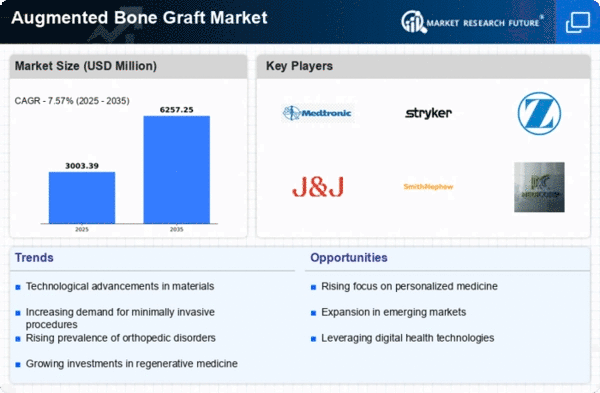
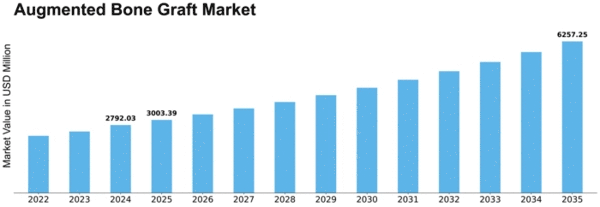
As per MRFR analysis, the Augmented Bone Graft Market Size was estimated at 2792.03 USD Million in 2024. The Augmented Bone Graft industry is projected to grow from 3035.38 USD Million in 2025 to 6257.25 USD Million by 2035, exhibiting a compound annual growth rate (CAGR) of 7.57% during the forecast period 2025 - 2035.

Key Market Trends & Highlights

The Augmented Bone Graft Market is poised for substantial growth driven by technological advancements and increasing demand for minimally invasive procedures.

  • North America remains the largest market for augmented bone grafts, driven by advanced healthcare infrastructure and high surgical volumes.
  • The Asia-Pacific region is emerging as the fastest-growing market, fueled by rising healthcare expenditures and increasing awareness of advanced surgical techniques.
  • Orthopedic surgery continues to dominate the market, while dental surgery is experiencing rapid growth due to rising aesthetic concerns and demand for dental implants.
  • Technological advancements and the growing aging population are key drivers propelling the augmented bone graft market forward.

Market Size & Forecast

2024 Market Size 2792.03 (USD Million)
2035 Market Size 6257.25 (USD Million)
CAGR (2025 - 2035) 7.57%
Largest Regional Market Share in 2024 North America

Major Players

Medtronic (US), Stryker (US), Zimmer Biomet (US), DePuy Synthes (US), Smith & Nephew (GB), MediCorp (US), Acelity (US), Osseon (US), BoneSupport (SE)

Market Trends

The Augmented Bone Graft Market is currently experiencing a notable transformation, driven by advancements in technology and an increasing demand for effective bone regeneration solutions. This market encompasses a variety of products designed to enhance the healing process in orthopedic and dental procedures. The growing prevalence of bone-related disorders, coupled with an aging population, appears to be propelling the need for innovative grafting materials. Furthermore, the rise in minimally invasive surgical techniques is likely to influence the adoption of augmented bone grafts, as these methods often require advanced materials that can facilitate quicker recovery and improved patient outcomes. In addition, the competitive landscape of the Augmented Bone Graft Market is evolving, with numerous companies investing in research and development to introduce novel products. Collaborations between medical device manufacturers and research institutions may foster the creation of more effective grafting solutions. Regulatory bodies are also playing a crucial role in shaping the market by establishing guidelines that ensure the safety and efficacy of these products. As the market continues to expand, it is essential for stakeholders to remain vigilant about emerging trends and technological advancements that could redefine the future of bone grafting solutions.

Technological Advancements

The Augmented Bone Graft Market is witnessing a surge in technological innovations, particularly in the development of bioactive materials. These advancements are enhancing the effectiveness of grafts, promoting faster healing and better integration with host tissues. Companies are increasingly focusing on creating products that mimic natural bone properties, which may lead to improved clinical outcomes.

Rising Demand for Minimally Invasive Procedures

There is a growing preference for minimally invasive surgical techniques among healthcare providers and patients alike. This trend is influencing the Augmented Bone Graft Market, as these procedures often require specialized grafting materials that can facilitate quicker recovery times. The shift towards less invasive options is likely to drive the demand for advanced bone graft solutions.

Increased Collaboration and Partnerships

The Augmented Bone Graft Market is characterized by a trend of increased collaboration between manufacturers and research institutions. These partnerships are fostering innovation and the development of new products that meet the evolving needs of healthcare providers. Such collaborations may enhance the market's ability to deliver effective solutions for bone regeneration.

Augmented Bone Graft Market Market Drivers

Market Growth Projections

The Global Augmented Bone Graft Market Industry is projected to experience substantial growth over the coming years. With an anticipated market value of 1.54 USD Billion in 2024, the industry is set to expand significantly, potentially reaching 3.58 USD Billion by 2035. This growth trajectory suggests a compound annual growth rate of 7.97% from 2025 to 2035. Such projections indicate a robust demand for augmented bone graft products, driven by various factors including technological advancements, increasing healthcare investments, and rising awareness among patients. These metrics underscore the positive outlook for the industry.

Rising Incidence of Bone Disorders

The Global Augmented Bone Graft Market Industry is experiencing growth driven by the increasing prevalence of bone disorders such as osteoporosis and fractures. According to health statistics, the incidence of osteoporosis is projected to rise significantly, particularly among the aging population. This demographic shift is expected to lead to a higher demand for bone grafting procedures, thereby propelling the market forward. The need for effective treatment options for bone-related ailments is paramount, as it directly correlates with the rising number of surgical interventions. Consequently, the Global Augmented Bone Graft Market Industry is poised for expansion as healthcare providers seek innovative solutions to address these challenges.

Growing Awareness and Acceptance of Bone Grafting

There is a notable increase in awareness and acceptance of bone grafting procedures among patients and healthcare providers, which is positively influencing the Global Augmented Bone Graft Market Industry. Educational initiatives and patient advocacy have played a crucial role in demystifying the procedures and highlighting their benefits. As more individuals become informed about the options available for treating bone defects, the demand for augmented bone grafts is likely to rise. This growing acceptance is expected to contribute to a compound annual growth rate of 7.97% from 2025 to 2035, reflecting a robust market outlook.

Technological Advancements in Grafting Techniques

Technological innovations in grafting techniques are playing a pivotal role in shaping the Global Augmented Bone Graft Market Industry. The introduction of advanced materials and methods, such as 3D printing and bioactive scaffolds, enhances the efficacy of bone grafts. These innovations not only improve patient outcomes but also reduce recovery times, making them more appealing to both surgeons and patients. As these technologies continue to evolve, they are likely to drive market growth by offering more effective solutions for bone regeneration. The integration of technology into surgical practices is expected to contribute significantly to the projected market value of 1.54 USD Billion in 2024.

Increasing Investment in Healthcare Infrastructure

The Global Augmented Bone Graft Market Industry is benefiting from increased investment in healthcare infrastructure, particularly in developing regions. Governments and private entities are recognizing the need for improved healthcare facilities and services, which includes the availability of advanced surgical procedures. This investment is likely to enhance access to bone grafting surgeries, thereby driving demand for augmented bone graft products. As healthcare systems expand and modernize, the market is expected to see a surge in the utilization of innovative grafting solutions. This trend aligns with the projected growth trajectory, potentially reaching 3.58 USD Billion by 2035.

Regulatory Support and Approval for Advanced Products

Regulatory bodies are increasingly providing support and expedited approval processes for advanced bone graft products, which is a significant driver for the Global Augmented Bone Graft Market Industry. This regulatory environment fosters innovation and encourages manufacturers to develop new and improved grafting solutions. As a result, the market is likely to see a proliferation of novel products that meet stringent safety and efficacy standards. This supportive regulatory landscape not only enhances product availability but also instills confidence among healthcare providers and patients, further propelling market growth.

Market Segment Insights

By Application: Orthopedic Surgery (Largest) vs. Dental Surgery (Fastest-Growing)

In the Augmented Bone Graft Market, the application of orthopedic surgery holds the largest market share, primarily due to the increasing prevalence of orthopedic disorders such as osteoporosis and fractures. Dental surgery follows as a significant segment, benefiting from rising awareness of dental reconstruction procedures and aesthetic preferences among consumers. Furthermore, spinal and trauma surgeries are gaining traction but presently occupy a smaller share of the market. The imbalance in shares reflects the varying levels of demand across these application areas, with orthopedic surgery representing a more established market presence. Growth trends in this segment are influenced by advancements in bone grafting technologies and an increased focus on patient-specific solutions. Orthopedic surgery remains dominant due to the growing geriatric population and the high incidence of sports injuries. Conversely, the dental surgery segment is witnessing rapid growth driven by the rising adoption of innovative grafting materials and techniques. Factors like the growing emphasis on minimally invasive procedures and the increasing number of cosmetic surgeries are expected to further boost these segments in the coming years.

Orthopedic Surgery (Dominant) vs. Dental Surgery (Emerging)

Orthopedic surgery is characterized by its established methodologies and broad acceptance in the medical community, making it the dominant application for augmented bone grafts. It primarily encompasses the repair and regeneration of bone tissues related to fractures, <a href="https://www.marketresearchfuture.com/reports/joint-replacement-market-43209" target="_blank" title="joint replacement">joint replacements</a>, and <a href="https://www.marketresearchfuture.com/reports/spinal-fusion-market-19208" target="_blank" title="spinal fusion">spinal fusions</a>, thus commanding a significant market interest. In contrast, dental surgery represents an emerging application area, attracting attention due to innovative technologies that enhance aesthetic outcomes in dental implants and restorations. The growing awareness of dental aesthetics and minimally invasive options has led to an expedited adoption of augmented graft materials. Both segments exemplify distinct positioning: where orthopedic applications rely on traditional demand, dental surgery is dynamically adapting to evolving patient preferences, highlighting a shift in market focus.

By Material Type: Synthetic Bone Graft (Largest) vs. Allograft Bone Graft (Fastest-Growing)

In the Augmented Bone Graft Market, the material type segment is primarily dominated by synthetic bone grafts, which are favored for their versatility and ability to mimic natural bone properties. Synthetic bone grafts hold a significant share of the market, benefiting from widespread acceptance due to their reduced risk of disease transmission and increased availability. Following closely are allograft bone grafts, derived from human donors, which are gaining popularity among surgeons and patients alike, further influencing market dynamics and acceptance in clinical practices. The growth trend in this segment is driven by the increasing demand for effective bone grafting solutions arising from trauma and orthopedic surgeries. Advances in synthetic bone materials and techniques have led to enhanced compatibility and effectiveness, positioning synthetic grafts as a primary choice. Allograft bone grafts are emerging rapidly, propelled by a rise in healthcare awareness and the strategic initiatives of key players promoting their benefits in surgical applications. These shifts highlight a transformative landscape in the augmented bone graft market, where innovation and patient preference dictate the pace of growth.

Synthetic Bone Graft (Dominant) vs. Allograft Bone Graft (Emerging)

Synthetic bone grafts have emerged as a dominant force in the Augmented Bone Graft Market, primarily owing to their ability to mimic the composition and structure of natural bone. They are engineered from biocompatible materials, offering enhanced safety profiles and minimal risk of immune reaction. Their applications range from orthopedic surgeries to dental procedures, showcasing versatility. Conversely, allograft bone grafts, derived from human donors, are marked as an emerging segment due to the increasing acceptance by surgeons and the rising prevalence of bone-related disorders. While they provide a natural alternative and good integration potential, issues related to procurement and regulatory constraints present challenges. Together, these two material types illustrate a competitive landscape characterized by innovation, safety, and evolving patient needs.

By End User: Hospitals (Largest) vs. Ambulatory Surgical Centers (Fastest-Growing)

In the Augmented Bone Graft Market, hospitals command a significant share, serving as the primary end user where surgical procedures are conducted. Their established infrastructure and comprehensive patient management enable them to utilize augmented bone grafts in various orthopedic and dental surgeries, cementing their leadership position. Ambulatory surgical centers, meanwhile, are emerging rapidly, providing a more efficient setting for surgical procedures, which increasingly incorporates innovative grafting techniques. Their focus on outpatient services drives their growth in the market.

Hospitals (Dominant) vs. Ambulatory Surgical Centers (Emerging)

Hospitals serve as the dominant end user in the Augmented Bone Graft Market due to their extensive resources and capabilities to handle complex surgical procedures requiring advanced grafting techniques. They have well-established protocols and staff trained to implement these technologies effectively. On the other hand, ambulatory surgical centers are emerging as significant players, leveraging their emphasis on efficiency and cost-effectiveness. These centers often provide a streamlined experience for patients, focusing on outpatient procedures that utilize augmented bone grafts, which aligns with the rising demand for less invasive surgical options. This sets the stage for ambulatory surgical centers to gain traction in the market.

Get more detailed insights about Augmented Bone Graft Market Research Report- Global Forecast till 2035

Regional Insights

North America : Market Leader in Innovation

North America is poised to maintain its leadership in the Augmented Bone Graft Market, holding a significant market share of $1395.0M in 2024. The region's growth is driven by increasing surgical procedures, advancements in technology, and a robust healthcare infrastructure. Regulatory support and favorable reimbursement policies further enhance market dynamics, fostering innovation and adoption of new products. The United States stands as the primary contributor, with key players like Medtronic, Stryker, and Zimmer Biomet leading the competitive landscape. The presence of established companies and ongoing research initiatives contribute to a vibrant market environment. As demand for effective bone graft solutions rises, North America is expected to continue its dominance in the global market.

Europe : Emerging Market with Potential

Europe is witnessing a growing interest in the Augmented Bone Graft Market, with a market size of $835.0M in 2024. Factors such as an aging population, increasing orthopedic surgeries, and advancements in biomaterials are driving demand. Regulatory frameworks in the region are becoming more supportive, facilitating the introduction of innovative products and technologies that enhance patient outcomes. Leading countries like Germany, France, and the UK are at the forefront of this growth, with companies such as Smith & Nephew and BoneSupport making significant contributions. The competitive landscape is characterized by a mix of established players and emerging startups, fostering innovation and collaboration. As the market evolves, Europe is set to become a key player in the global augmented bone graft sector.

Asia-Pacific : Rapidly Growing Market

The Asia-Pacific region is emerging as a significant player in the Augmented Bone Graft Market, with a market size of $450.0M in 2024. The growth is fueled by rising healthcare expenditures, increasing awareness of advanced surgical techniques, and a growing population. Regulatory bodies are also enhancing their frameworks to support the introduction of innovative medical solutions, which is expected to further boost market growth. Countries like China, Japan, and India are leading the charge, with a mix of local and international companies competing for market share. Key players such as MediCorp and Acelity are actively expanding their presence in the region. As the demand for effective bone graft solutions increases, the Asia-Pacific market is poised for substantial growth in the coming years.

Middle East and Africa : Emerging Market Opportunities

The Middle East and Africa region is gradually developing its presence in the Augmented Bone Graft Market, with a market size of $112.03M in 2024. Factors such as increasing healthcare investments, a rise in orthopedic surgeries, and a growing awareness of advanced medical technologies are driving market growth. Regulatory bodies are beginning to establish frameworks that support the introduction of innovative products, which is crucial for market expansion. Countries like South Africa and the UAE are leading the market, with a mix of local and international players vying for opportunities. The competitive landscape is characterized by emerging companies and established firms looking to expand their footprint. As healthcare infrastructure improves, the region is expected to see significant growth in the augmented bone graft sector.

Key Players and Competitive Insights

The Augmented Bone Graft Market is characterized by a dynamic competitive landscape, driven by technological advancements, increasing demand for orthopedic procedures, and a growing aging population. Key players such as Medtronic (US), Stryker (US), and Zimmer Biomet (US) are at the forefront, each adopting distinct strategies to enhance their market presence. Medtronic (US) focuses on innovation through the development of advanced biomaterials, while Stryker (US) emphasizes strategic acquisitions to bolster its product portfolio. Zimmer Biomet (US) is actively pursuing regional expansion, particularly in emerging markets, which collectively shapes a competitive environment that is both collaborative and competitive.The market structure appears moderately fragmented, with several players vying for market share. Key business tactics include localizing manufacturing to reduce costs and optimize supply chains, which is crucial in maintaining competitive pricing. The influence of major companies is significant, as their operational strategies often set industry standards and drive innovation across the sector.

In November Medtronic (US) announced the launch of a new line of augmented bone graft products designed to enhance healing in orthopedic surgeries. This strategic move is likely to strengthen Medtronic's position in the market by addressing the growing demand for effective and reliable bone graft solutions. The introduction of these products may also reflect a broader trend towards personalized medicine, where tailored solutions are increasingly favored.

In October Stryker (US) completed the acquisition of a leading biomaterials company, which is expected to enhance its capabilities in the augmented bone graft segment. This acquisition not only expands Stryker's product offerings but also positions the company to leverage innovative technologies that could redefine surgical outcomes. The strategic importance of this move lies in Stryker's commitment to integrating cutting-edge solutions into its existing portfolio, thereby enhancing its competitive edge.

In September Zimmer Biomet (US) entered into a partnership with a technology firm to develop AI-driven solutions for surgical planning and execution. This collaboration is indicative of a growing trend towards digitalization in the healthcare sector, where data analytics and AI are poised to revolutionize surgical practices. The strategic importance of this partnership lies in its potential to improve patient outcomes and streamline surgical workflows, thereby reinforcing Zimmer Biomet's market position.

As of December current competitive trends in the Augmented Bone Graft Market include a pronounced shift towards digitalization, sustainability, and AI integration. Strategic alliances are increasingly shaping the landscape, fostering innovation and collaboration among key players. Looking ahead, competitive differentiation is likely to evolve from traditional price-based competition to a focus on innovation, technological advancements, and supply chain reliability. This shift underscores the importance of adaptability and forward-thinking strategies in navigating the complexities of the market.

Key Companies in the Augmented Bone Graft Market include

Industry Developments

Future Outlook

Augmented Bone Graft Market Future Outlook

The Augmented Bone Graft Market is projected to grow at a 7.57% CAGR from 2025 to 2035, driven by technological advancements, increasing orthopedic procedures, and rising demand for minimally invasive surgeries.

New opportunities lie in:

  • Development of bioactive augmented grafts for enhanced healing
  • Expansion into emerging markets with tailored product offerings
  • Partnerships with hospitals for integrated surgical solutions

By 2035, the market is expected to achieve substantial growth, solidifying its position as a key segment in orthopedic solutions.

Market Segmentation

Augmented Bone Graft Market End User Outlook

  • Hospitals
  • Ambulatory Surgical Centers
  • Specialty Clinics
  • Research Institutions

Augmented Bone Graft Market Application Outlook

  • Orthopedic Surgery
  • Dental Surgery
  • Spinal Surgery
  • Trauma Surgery

Augmented Bone Graft Market Material Type Outlook

  • Synthetic Bone Graft
  • Allograft Bone Graft
  • Xenograft Bone Graft
  • Autograft Bone Graft

Report Scope

MARKET SIZE 2024 2792.03(USD Million)
MARKET SIZE 2025 3035.38(USD Million)
MARKET SIZE 2035 6257.25(USD Million)
COMPOUND ANNUAL GROWTH RATE (CAGR) 7.57% (2025 - 2035)
REPORT COVERAGE Revenue Forecast, Competitive Landscape, Growth Factors, and Trends
BASE YEAR 2024
Market Forecast Period 2025 - 2035
Historical Data 2019 - 2024
Market Forecast Units USD Million
Key Companies Profiled Medtronic (US), Stryker (US), Zimmer Biomet (US), DePuy Synthes (US), Smith & Nephew (GB), MediCorp (US), Acelity (US), Osseon (US), BoneSupport (SE)
Segments Covered Application, Material Type, End User
Key Market Opportunities Integration of advanced biomaterials and 3D printing technologies in the Augmented Bone Graft Market.
Key Market Dynamics Technological advancements and regulatory changes drive innovation and competition in the augmented bone graft market.
Countries Covered North America, Europe, APAC, South America, MEA

FAQs

What is the current valuation of the Augmented Bone Graft Market as of 2024?

<p>The Augmented Bone Graft Market was valued at approximately 2792.03 USD Million in 2024.</p>

What is the projected market size for the Augmented Bone Graft Market by 2035?

<p>The market is projected to reach approximately 6257.25 USD Million by 2035.</p>

What is the expected CAGR for the Augmented Bone Graft Market during the forecast period 2025 - 2035?

<p>The expected CAGR for the Augmented Bone Graft Market during the forecast period 2025 - 2035 is 7.57%.</p>

Which application segment is expected to generate the highest revenue in the Augmented Bone Graft Market?

<p>The Orthopedic Surgery segment is expected to generate the highest revenue, with projections ranging from 800.0 to 1800.0 USD Million.</p>

How does the revenue from Dental Surgery compare to that from Spinal Surgery in the Augmented Bone Graft Market?

<p>The revenue from Dental Surgery is projected between 600.0 and 1300.0 USD Million, while Spinal Surgery is expected to range from 700.0 to 1500.0 USD Million.</p>

What are the projected revenues for Allograft Bone Graft by 2035?

The Allograft Bone Graft segment is projected to generate revenues between 1200.0 and 2800.0 USD Million by 2035.

Which end user segment is anticipated to have the largest market share in the Augmented Bone Graft Market?

Hospitals are anticipated to have the largest market share, with projected revenues ranging from 1116.01 to 2570.0 USD Million.

What role do key players like Medtronic and Stryker play in the Augmented Bone Graft Market?

Key players such as Medtronic and Stryker are instrumental in driving innovation and market growth within the Augmented Bone Graft Market.

What is the revenue range for the Trauma Surgery segment in the Augmented Bone Graft Market?

The Trauma Surgery segment is projected to generate revenues between 692.03 and 1657.25 USD Million.

How does the revenue from Autograft Bone Graft compare to that from Synthetic Bone Graft?

The revenue from Autograft Bone Graft is projected to range from 392.03 to 657.25 USD Million, whereas Synthetic Bone Graft is expected to range from 600.0 to 1400.0 USD Million.

  1. SECTION I: EXECUTIVE SUMMARY AND KEY HIGHLIGHTS
    1. | 1.1 EXECUTIVE SUMMARY
    2. | | 1.1.1 Market Overview
    3. | | 1.1.2 Key Findings
    4. | | 1.1.3 Market Segmentation
    5. | | 1.1.4 Competitive Landscape
    6. | | 1.1.5 Challenges and Opportunities
    7. | | 1.1.6 Future Outlook
  2. SECTION II: SCOPING, METHODOLOGY AND MARKET STRUCTURE
    1. | 2.1 MARKET INTRODUCTION
    2. | | 2.1.1 Definition
    3. | | 2.1.2 Scope of the study
    4. | | | 2.1.2.1 Research Objective
    5. | | | 2.1.2.2 Assumption
    6. | | | 2.1.2.3 Limitations
    7. | 2.2 RESEARCH METHODOLOGY
    8. | | 2.2.1 Overview
    9. | | 2.2.2 Data Mining
    10. | | 2.2.3 Secondary Research
    11. | | 2.2.4 Primary Research
    12. | | | 2.2.4.1 Primary Interviews and Information Gathering Process
    13. | | | 2.2.4.2 Breakdown of Primary Respondents
    14. | | 2.2.5 Forecasting Model
    15. | | 2.2.6 Market Size Estimation
    16. | | | 2.2.6.1 Bottom-Up Approach
    17. | | | 2.2.6.2 Top-Down Approach
    18. | | 2.2.7 Data Triangulation
    19. | | 2.2.8 Validation
  3. SECTION III: QUALITATIVE ANALYSIS
    1. | 3.1 MARKET DYNAMICS
    2. | | 3.1.1 Overview
    3. | | 3.1.2 Drivers
    4. | | 3.1.3 Restraints
    5. | | 3.1.4 Opportunities
    6. | 3.2 MARKET FACTOR ANALYSIS
    7. | | 3.2.1 Value chain Analysis
    8. | | 3.2.2 Porter's Five Forces Analysis
    9. | | | 3.2.2.1 Bargaining Power of Suppliers
    10. | | | 3.2.2.2 Bargaining Power of Buyers
    11. | | | 3.2.2.3 Threat of New Entrants
    12. | | | 3.2.2.4 Threat of Substitutes
    13. | | | 3.2.2.5 Intensity of Rivalry
    14. | | 3.2.3 COVID-19 Impact Analysis
    15. | | | 3.2.3.1 Market Impact Analysis
    16. | | | 3.2.3.2 Regional Impact
    17. | | | 3.2.3.3 Opportunity and Threat Analysis
  4. SECTION IV: QUANTITATIVE ANALYSIS
    1. | 4.1 Healthcare, BY Application (USD Million)
    2. | | 4.1.1 Orthopedic Surgery
    3. | | 4.1.2 Dental Surgery
    4. | | 4.1.3 Spinal Surgery
    5. | | 4.1.4 Trauma Surgery
    6. | 4.2 Healthcare, BY Material Type (USD Million)
    7. | | 4.2.1 Synthetic Bone Graft
    8. | | 4.2.2 Allograft Bone Graft
    9. | | 4.2.3 Xenograft Bone Graft
    10. | | 4.2.4 Autograft Bone Graft
    11. | 4.3 Healthcare, BY End User (USD Million)
    12. | | 4.3.1 Hospitals
    13. | | 4.3.2 Ambulatory Surgical Centers
    14. | | 4.3.3 Specialty Clinics
    15. | | 4.3.4 Research Institutions
    16. | 4.4 Healthcare, BY Region (USD Million)
    17. | | 4.4.1 North America
    18. | | | 4.4.1.1 US
    19. | | | 4.4.1.2 Canada
    20. | | 4.4.2 Europe
    21. | | | 4.4.2.1 Germany
    22. | | | 4.4.2.2 UK
    23. | | | 4.4.2.3 France
    24. | | | 4.4.2.4 Russia
    25. | | | 4.4.2.5 Italy
    26. | | | 4.4.2.6 Spain
    27. | | | 4.4.2.7 Rest of Europe
    28. | | 4.4.3 APAC
    29. | | | 4.4.3.1 China
    30. | | | 4.4.3.2 India
    31. | | | 4.4.3.3 Japan
    32. | | | 4.4.3.4 South Korea
    33. | | | 4.4.3.5 Malaysia
    34. | | | 4.4.3.6 Thailand
    35. | | | 4.4.3.7 Indonesia
    36. | | | 4.4.3.8 Rest of APAC
    37. | | 4.4.4 South America
    38. | | | 4.4.4.1 Brazil
    39. | | | 4.4.4.2 Mexico
    40. | | | 4.4.4.3 Argentina
    41. | | | 4.4.4.4 Rest of South America
    42. | | 4.4.5 MEA
    43. | | | 4.4.5.1 GCC Countries
    44. | | | 4.4.5.2 South Africa
    45. | | | 4.4.5.3 Rest of MEA
  5. SECTION V: COMPETITIVE ANALYSIS
    1. | 5.1 Competitive Landscape
    2. | | 5.1.1 Overview
    3. | | 5.1.2 Competitive Analysis
    4. | | 5.1.3 Market share Analysis
    5. | | 5.1.4 Major Growth Strategy in the Healthcare
    6. | | 5.1.5 Competitive Benchmarking
    7. | | 5.1.6 Leading Players in Terms of Number of Developments in the Healthcare
    8. | | 5.1.7 Key developments and growth strategies
    9. | | | 5.1.7.1 New Product Launch/Service Deployment
    10. | | | 5.1.7.2 Merger & Acquisitions
    11. | | | 5.1.7.3 Joint Ventures
    12. | | 5.1.8 Major Players Financial Matrix
    13. | | | 5.1.8.1 Sales and Operating Income
    14. | | | 5.1.8.2 Major Players R&D Expenditure. 2023
    15. | 5.2 Company Profiles
    16. | | 5.2.1 Medtronic (US)
    17. | | | 5.2.1.1 Financial Overview
    18. | | | 5.2.1.2 Products Offered
    19. | | | 5.2.1.3 Key Developments
    20. | | | 5.2.1.4 SWOT Analysis
    21. | | | 5.2.1.5 Key Strategies
    22. | | 5.2.2 Stryker (US)
    23. | | | 5.2.2.1 Financial Overview
    24. | | | 5.2.2.2 Products Offered
    25. | | | 5.2.2.3 Key Developments
    26. | | | 5.2.2.4 SWOT Analysis
    27. | | | 5.2.2.5 Key Strategies
    28. | | 5.2.3 Zimmer Biomet (US)
    29. | | | 5.2.3.1 Financial Overview
    30. | | | 5.2.3.2 Products Offered
    31. | | | 5.2.3.3 Key Developments
    32. | | | 5.2.3.4 SWOT Analysis
    33. | | | 5.2.3.5 Key Strategies
    34. | | 5.2.4 DePuy Synthes (US)
    35. | | | 5.2.4.1 Financial Overview
    36. | | | 5.2.4.2 Products Offered
    37. | | | 5.2.4.3 Key Developments
    38. | | | 5.2.4.4 SWOT Analysis
    39. | | | 5.2.4.5 Key Strategies
    40. | | 5.2.5 Smith & Nephew (GB)
    41. | | | 5.2.5.1 Financial Overview
    42. | | | 5.2.5.2 Products Offered
    43. | | | 5.2.5.3 Key Developments
    44. | | | 5.2.5.4 SWOT Analysis
    45. | | | 5.2.5.5 Key Strategies
    46. | | 5.2.6 MediCorp (US)
    47. | | | 5.2.6.1 Financial Overview
    48. | | | 5.2.6.2 Products Offered
    49. | | | 5.2.6.3 Key Developments
    50. | | | 5.2.6.4 SWOT Analysis
    51. | | | 5.2.6.5 Key Strategies
    52. | | 5.2.7 Osseon (US)
    53. | | | 5.2.7.1 Financial Overview
    54. | | | 5.2.7.2 Products Offered
    55. | | | 5.2.7.3 Key Developments
    56. | | | 5.2.7.4 SWOT Analysis
    57. | | | 5.2.7.5 Key Strategies
    58. | | 5.2.8 BoneSupport (SE)
    59. | | | 5.2.8.1 Financial Overview
    60. | | | 5.2.8.2 Products Offered
    61. | | | 5.2.8.3 Key Developments
    62. | | | 5.2.8.4 SWOT Analysis
    63. | | | 5.2.8.5 Key Strategies
    64. | | 5.2.9 Amedica (US)
    65. | | | 5.2.9.1 Financial Overview
    66. | | | 5.2.9.2 Products Offered
    67. | | | 5.2.9.3 Key Developments
    68. | | | 5.2.9.4 SWOT Analysis
    69. | | | 5.2.9.5 Key Strategies
    70. | 5.3 Appendix
    71. | | 5.3.1 References
    72. | | 5.3.2 Related Reports
  6. LIST OF FIGURES
    1. | 6.1 MARKET SYNOPSIS
    2. | 6.2 NORTH AMERICA MARKET ANALYSIS
    3. | 6.3 US MARKET ANALYSIS BY APPLICATION
    4. | 6.4 US MARKET ANALYSIS BY MATERIAL TYPE
    5. | 6.5 US MARKET ANALYSIS BY END USER
    6. | 6.6 CANADA MARKET ANALYSIS BY APPLICATION
    7. | 6.7 CANADA MARKET ANALYSIS BY MATERIAL TYPE
    8. | 6.8 CANADA MARKET ANALYSIS BY END USER
    9. | 6.9 EUROPE MARKET ANALYSIS
    10. | 6.10 GERMANY MARKET ANALYSIS BY APPLICATION
    11. | 6.11 GERMANY MARKET ANALYSIS BY MATERIAL TYPE
    12. | 6.12 GERMANY MARKET ANALYSIS BY END USER
    13. | 6.13 UK MARKET ANALYSIS BY APPLICATION
    14. | 6.14 UK MARKET ANALYSIS BY MATERIAL TYPE
    15. | 6.15 UK MARKET ANALYSIS BY END USER
    16. | 6.16 FRANCE MARKET ANALYSIS BY APPLICATION
    17. | 6.17 FRANCE MARKET ANALYSIS BY MATERIAL TYPE
    18. | 6.18 FRANCE MARKET ANALYSIS BY END USER
    19. | 6.19 RUSSIA MARKET ANALYSIS BY APPLICATION
    20. | 6.20 RUSSIA MARKET ANALYSIS BY MATERIAL TYPE
    21. | 6.21 RUSSIA MARKET ANALYSIS BY END USER
    22. | 6.22 ITALY MARKET ANALYSIS BY APPLICATION
    23. | 6.23 ITALY MARKET ANALYSIS BY MATERIAL TYPE
    24. | 6.24 ITALY MARKET ANALYSIS BY END USER
    25. | 6.25 SPAIN MARKET ANALYSIS BY APPLICATION
    26. | 6.26 SPAIN MARKET ANALYSIS BY MATERIAL TYPE
    27. | 6.27 SPAIN MARKET ANALYSIS BY END USER
    28. | 6.28 REST OF EUROPE MARKET ANALYSIS BY APPLICATION
    29. | 6.29 REST OF EUROPE MARKET ANALYSIS BY MATERIAL TYPE
    30. | 6.30 REST OF EUROPE MARKET ANALYSIS BY END USER
    31. | 6.31 APAC MARKET ANALYSIS
    32. | 6.32 CHINA MARKET ANALYSIS BY APPLICATION
    33. | 6.33 CHINA MARKET ANALYSIS BY MATERIAL TYPE
    34. | 6.34 CHINA MARKET ANALYSIS BY END USER
    35. | 6.35 INDIA MARKET ANALYSIS BY APPLICATION
    36. | 6.36 INDIA MARKET ANALYSIS BY MATERIAL TYPE
    37. | 6.37 INDIA MARKET ANALYSIS BY END USER
    38. | 6.38 JAPAN MARKET ANALYSIS BY APPLICATION
    39. | 6.39 JAPAN MARKET ANALYSIS BY MATERIAL TYPE
    40. | 6.40 JAPAN MARKET ANALYSIS BY END USER
    41. | 6.41 SOUTH KOREA MARKET ANALYSIS BY APPLICATION
    42. | 6.42 SOUTH KOREA MARKET ANALYSIS BY MATERIAL TYPE
    43. | 6.43 SOUTH KOREA MARKET ANALYSIS BY END USER
    44. | 6.44 MALAYSIA MARKET ANALYSIS BY APPLICATION
    45. | 6.45 MALAYSIA MARKET ANALYSIS BY MATERIAL TYPE
    46. | 6.46 MALAYSIA MARKET ANALYSIS BY END USER
    47. | 6.47 THAILAND MARKET ANALYSIS BY APPLICATION
    48. | 6.48 THAILAND MARKET ANALYSIS BY MATERIAL TYPE
    49. | 6.49 THAILAND MARKET ANALYSIS BY END USER
    50. | 6.50 INDONESIA MARKET ANALYSIS BY APPLICATION
    51. | 6.51 INDONESIA MARKET ANALYSIS BY MATERIAL TYPE
    52. | 6.52 INDONESIA MARKET ANALYSIS BY END USER
    53. | 6.53 REST OF APAC MARKET ANALYSIS BY APPLICATION
    54. | 6.54 REST OF APAC MARKET ANALYSIS BY MATERIAL TYPE
    55. | 6.55 REST OF APAC MARKET ANALYSIS BY END USER
    56. | 6.56 SOUTH AMERICA MARKET ANALYSIS
    57. | 6.57 BRAZIL MARKET ANALYSIS BY APPLICATION
    58. | 6.58 BRAZIL MARKET ANALYSIS BY MATERIAL TYPE
    59. | 6.59 BRAZIL MARKET ANALYSIS BY END USER
    60. | 6.60 MEXICO MARKET ANALYSIS BY APPLICATION
    61. | 6.61 MEXICO MARKET ANALYSIS BY MATERIAL TYPE
    62. | 6.62 MEXICO MARKET ANALYSIS BY END USER
    63. | 6.63 ARGENTINA MARKET ANALYSIS BY APPLICATION
    64. | 6.64 ARGENTINA MARKET ANALYSIS BY MATERIAL TYPE
    65. | 6.65 ARGENTINA MARKET ANALYSIS BY END USER
    66. | 6.66 REST OF SOUTH AMERICA MARKET ANALYSIS BY APPLICATION
    67. | 6.67 REST OF SOUTH AMERICA MARKET ANALYSIS BY MATERIAL TYPE
    68. | 6.68 REST OF SOUTH AMERICA MARKET ANALYSIS BY END USER
    69. | 6.69 MEA MARKET ANALYSIS
    70. | 6.70 GCC COUNTRIES MARKET ANALYSIS BY APPLICATION
    71. | 6.71 GCC COUNTRIES MARKET ANALYSIS BY MATERIAL TYPE
    72. | 6.72 GCC COUNTRIES MARKET ANALYSIS BY END USER
    73. | 6.73 SOUTH AFRICA MARKET ANALYSIS BY APPLICATION
    74. | 6.74 SOUTH AFRICA MARKET ANALYSIS BY MATERIAL TYPE
    75. | 6.75 SOUTH AFRICA MARKET ANALYSIS BY END USER
    76. | 6.76 REST OF MEA MARKET ANALYSIS BY APPLICATION
    77. | 6.77 REST OF MEA MARKET ANALYSIS BY MATERIAL TYPE
    78. | 6.78 REST OF MEA MARKET ANALYSIS BY END USER
    79. | 6.79 KEY BUYING CRITERIA OF HEALTHCARE
    80. | 6.80 RESEARCH PROCESS OF MRFR
    81. | 6.81 DRO ANALYSIS OF HEALTHCARE
    82. | 6.82 DRIVERS IMPACT ANALYSIS: HEALTHCARE
    83. | 6.83 RESTRAINTS IMPACT ANALYSIS: HEALTHCARE
    84. | 6.84 SUPPLY / VALUE CHAIN: HEALTHCARE
    85. | 6.85 HEALTHCARE, BY APPLICATION, 2024 (% SHARE)
    86. | 6.86 HEALTHCARE, BY APPLICATION, 2024 TO 2035 (USD Million)
    87. | 6.87 HEALTHCARE, BY MATERIAL TYPE, 2024 (% SHARE)
    88. | 6.88 HEALTHCARE, BY MATERIAL TYPE, 2024 TO 2035 (USD Million)
    89. | 6.89 HEALTHCARE, BY END USER, 2024 (% SHARE)
    90. | 6.90 HEALTHCARE, BY END USER, 2024 TO 2035 (USD Million)
    91. | 6.91 BENCHMARKING OF MAJOR COMPETITORS
  7. LIST OF TABLES
    1. | 7.1 LIST OF ASSUMPTIONS
    2. | | 7.1.1
    3. | 7.2 North America MARKET SIZE ESTIMATES; FORECAST
    4. | | 7.2.1 BY APPLICATION, 2025-2035 (USD Million)
    5. | | 7.2.2 BY MATERIAL TYPE, 2025-2035 (USD Million)
    6. | | 7.2.3 BY END USER, 2025-2035 (USD Million)
    7. | 7.3 US MARKET SIZE ESTIMATES; FORECAST
    8. | | 7.3.1 BY APPLICATION, 2025-2035 (USD Million)
    9. | | 7.3.2 BY MATERIAL TYPE, 2025-2035 (USD Million)
    10. | | 7.3.3 BY END USER, 2025-2035 (USD Million)
    11. | 7.4 Canada MARKET SIZE ESTIMATES; FORECAST
    12. | | 7.4.1 BY APPLICATION, 2025-2035 (USD Million)
    13. | | 7.4.2 BY MATERIAL TYPE, 2025-2035 (USD Million)
    14. | | 7.4.3 BY END USER, 2025-2035 (USD Million)
    15. | 7.5 Europe MARKET SIZE ESTIMATES; FORECAST
    16. | | 7.5.1 BY APPLICATION, 2025-2035 (USD Million)
    17. | | 7.5.2 BY MATERIAL TYPE, 2025-2035 (USD Million)
    18. | | 7.5.3 BY END USER, 2025-2035 (USD Million)
    19. | 7.6 Germany MARKET SIZE ESTIMATES; FORECAST
    20. | | 7.6.1 BY APPLICATION, 2025-2035 (USD Million)
    21. | | 7.6.2 BY MATERIAL TYPE, 2025-2035 (USD Million)
    22. | | 7.6.3 BY END USER, 2025-2035 (USD Million)
    23. | 7.7 UK MARKET SIZE ESTIMATES; FORECAST
    24. | | 7.7.1 BY APPLICATION, 2025-2035 (USD Million)
    25. | | 7.7.2 BY MATERIAL TYPE, 2025-2035 (USD Million)
    26. | | 7.7.3 BY END USER, 2025-2035 (USD Million)
    27. | 7.8 France MARKET SIZE ESTIMATES; FORECAST
    28. | | 7.8.1 BY APPLICATION, 2025-2035 (USD Million)
    29. | | 7.8.2 BY MATERIAL TYPE, 2025-2035 (USD Million)
    30. | | 7.8.3 BY END USER, 2025-2035 (USD Million)
    31. | 7.9 Russia MARKET SIZE ESTIMATES; FORECAST
    32. | | 7.9.1 BY APPLICATION, 2025-2035 (USD Million)
    33. | | 7.9.2 BY MATERIAL TYPE, 2025-2035 (USD Million)
    34. | | 7.9.3 BY END USER, 2025-2035 (USD Million)
    35. | 7.10 Italy MARKET SIZE ESTIMATES; FORECAST
    36. | | 7.10.1 BY APPLICATION, 2025-2035 (USD Million)
    37. | | 7.10.2 BY MATERIAL TYPE, 2025-2035 (USD Million)
    38. | | 7.10.3 BY END USER, 2025-2035 (USD Million)
    39. | 7.11 Spain MARKET SIZE ESTIMATES; FORECAST
    40. | | 7.11.1 BY APPLICATION, 2025-2035 (USD Million)
    41. | | 7.11.2 BY MATERIAL TYPE, 2025-2035 (USD Million)
    42. | | 7.11.3 BY END USER, 2025-2035 (USD Million)
    43. | 7.12 Rest of Europe MARKET SIZE ESTIMATES; FORECAST
    44. | | 7.12.1 BY APPLICATION, 2025-2035 (USD Million)
    45. | | 7.12.2 BY MATERIAL TYPE, 2025-2035 (USD Million)
    46. | | 7.12.3 BY END USER, 2025-2035 (USD Million)
    47. | 7.13 APAC MARKET SIZE ESTIMATES; FORECAST
    48. | | 7.13.1 BY APPLICATION, 2025-2035 (USD Million)
    49. | | 7.13.2 BY MATERIAL TYPE, 2025-2035 (USD Million)
    50. | | 7.13.3 BY END USER, 2025-2035 (USD Million)
    51. | 7.14 China MARKET SIZE ESTIMATES; FORECAST
    52. | | 7.14.1 BY APPLICATION, 2025-2035 (USD Million)
    53. | | 7.14.2 BY MATERIAL TYPE, 2025-2035 (USD Million)
    54. | | 7.14.3 BY END USER, 2025-2035 (USD Million)
    55. | 7.15 India MARKET SIZE ESTIMATES; FORECAST
    56. | | 7.15.1 BY APPLICATION, 2025-2035 (USD Million)
    57. | | 7.15.2 BY MATERIAL TYPE, 2025-2035 (USD Million)
    58. | | 7.15.3 BY END USER, 2025-2035 (USD Million)
    59. | 7.16 Japan MARKET SIZE ESTIMATES; FORECAST
    60. | | 7.16.1 BY APPLICATION, 2025-2035 (USD Million)
    61. | | 7.16.2 BY MATERIAL TYPE, 2025-2035 (USD Million)
    62. | | 7.16.3 BY END USER, 2025-2035 (USD Million)
    63. | 7.17 South Korea MARKET SIZE ESTIMATES; FORECAST
    64. | | 7.17.1 BY APPLICATION, 2025-2035 (USD Million)
    65. | | 7.17.2 BY MATERIAL TYPE, 2025-2035 (USD Million)
    66. | | 7.17.3 BY END USER, 2025-2035 (USD Million)
    67. | 7.18 Malaysia MARKET SIZE ESTIMATES; FORECAST
    68. | | 7.18.1 BY APPLICATION, 2025-2035 (USD Million)
    69. | | 7.18.2 BY MATERIAL TYPE, 2025-2035 (USD Million)
    70. | | 7.18.3 BY END USER, 2025-2035 (USD Million)
    71. | 7.19 Thailand MARKET SIZE ESTIMATES; FORECAST
    72. | | 7.19.1 BY APPLICATION, 2025-2035 (USD Million)
    73. | | 7.19.2 BY MATERIAL TYPE, 2025-2035 (USD Million)
    74. | | 7.19.3 BY END USER, 2025-2035 (USD Million)
    75. | 7.20 Indonesia MARKET SIZE ESTIMATES; FORECAST
    76. | | 7.20.1 BY APPLICATION, 2025-2035 (USD Million)
    77. | | 7.20.2 BY MATERIAL TYPE, 2025-2035 (USD Million)
    78. | | 7.20.3 BY END USER, 2025-2035 (USD Million)
    79. | 7.21 Rest of APAC MARKET SIZE ESTIMATES; FORECAST
    80. | | 7.21.1 BY APPLICATION, 2025-2035 (USD Million)
    81. | | 7.21.2 BY MATERIAL TYPE, 2025-2035 (USD Million)
    82. | | 7.21.3 BY END USER, 2025-2035 (USD Million)
    83. | 7.22 South America MARKET SIZE ESTIMATES; FORECAST
    84. | | 7.22.1 BY APPLICATION, 2025-2035 (USD Million)
    85. | | 7.22.2 BY MATERIAL TYPE, 2025-2035 (USD Million)
    86. | | 7.22.3 BY END USER, 2025-2035 (USD Million)
    87. | 7.23 Brazil MARKET SIZE ESTIMATES; FORECAST
    88. | | 7.23.1 BY APPLICATION, 2025-2035 (USD Million)
    89. | | 7.23.2 BY MATERIAL TYPE, 2025-2035 (USD Million)
    90. | | 7.23.3 BY END USER, 2025-2035 (USD Million)
    91. | 7.24 Mexico MARKET SIZE ESTIMATES; FORECAST
    92. | | 7.24.1 BY APPLICATION, 2025-2035 (USD Million)
    93. | | 7.24.2 BY MATERIAL TYPE, 2025-2035 (USD Million)
    94. | | 7.24.3 BY END USER, 2025-2035 (USD Million)
    95. | 7.25 Argentina MARKET SIZE ESTIMATES; FORECAST
    96. | | 7.25.1 BY APPLICATION, 2025-2035 (USD Million)
    97. | | 7.25.2 BY MATERIAL TYPE, 2025-2035 (USD Million)
    98. | | 7.25.3 BY END USER, 2025-2035 (USD Million)
    99. | 7.26 Rest of South America MARKET SIZE ESTIMATES; FORECAST
    100. | | 7.26.1 BY APPLICATION, 2025-2035 (USD Million)
    101. | | 7.26.2 BY MATERIAL TYPE, 2025-2035 (USD Million)
    102. | | 7.26.3 BY END USER, 2025-2035 (USD Million)
    103. | 7.27 MEA MARKET SIZE ESTIMATES; FORECAST
    104. | | 7.27.1 BY APPLICATION, 2025-2035 (USD Million)
    105. | | 7.27.2 BY MATERIAL TYPE, 2025-2035 (USD Million)
    106. | | 7.27.3 BY END USER, 2025-2035 (USD Million)
    107. | 7.28 GCC Countries MARKET SIZE ESTIMATES; FORECAST
    108. | | 7.28.1 BY APPLICATION, 2025-2035 (USD Million)
    109. | | 7.28.2 BY MATERIAL TYPE, 2025-2035 (USD Million)
    110. | | 7.28.3 BY END USER, 2025-2035 (USD Million)
    111. | 7.29 South Africa MARKET SIZE ESTIMATES; FORECAST
    112. | | 7.29.1 BY APPLICATION, 2025-2035 (USD Million)
    113. | | 7.29.2 BY MATERIAL TYPE, 2025-2035 (USD Million)
    114. | | 7.29.3 BY END USER, 2025-2035 (USD Million)
    115. | 7.30 Rest of MEA MARKET SIZE ESTIMATES; FORECAST
    116. | | 7.30.1 BY APPLICATION, 2025-2035 (USD Million)
    117. | | 7.30.2 BY MATERIAL TYPE, 2025-2035 (USD Million)
    118. | | 7.30.3 BY END USER, 2025-2035 (USD Million)
    119. | 7.31 PRODUCT LAUNCH/PRODUCT DEVELOPMENT/APPROVAL
    120. | | 7.31.1
    121. | 7.32 ACQUISITION/PARTNERSHIP
    122. | | 7.32.1

Healthcare Market Segmentation

Healthcare By Application (USD Million, 2025-2035)

  • Orthopedic Surgery
  • Dental Surgery
  • Spinal Surgery
  • Trauma Surgery

Healthcare By Material Type (USD Million, 2025-2035)

  • Synthetic Bone Graft
  • Allograft Bone Graft
  • Xenograft Bone Graft
  • Autograft Bone Graft

Healthcare By End User (USD Million, 2025-2035)

  • Hospitals
  • Ambulatory Surgical Centers
  • Specialty Clinics
  • Research Institutions
Infographic

Free Sample Request

Kindly complete the form below to receive a free sample of this Report

Get Free Sample

Customer Strories

Compare Licence

×
Features License Type
Single User Multiuser License Enterprise User
Price $4,950 $5,950 $7,250
Maximum User Access Limit 1 User Upto 10 Users Unrestricted Access Throughout the Organization
Free Customization
Direct Access to Analyst
Deliverable Format
Platform Access
Discount on Next Purchase 10% 15% 15%
Printable Versions
%>