×
Request Free Sample ×

Kindly complete the form below to receive a free sample of this Report

* Please use a valid business email

Leading companies partner with us for data-driven Insights

clients tt-cursor
Hero Background
English
Chinese
French
Japanese
Korean
German
Spanish

Audit Software Market Trends

ID: MRFR/ICT/8099-CR
107 Pages
Ankit Gupta
April 2020

Audit Software Market Research Report Information By Component (Solution and Service), By Organization Size (Large Enterprises and Small & Medium Enterprises), By Deployment Model (On-Premise, and Cloud), By Vertical (BFSI, Energy & Utility, Manufacturing, Food & Beverage, Accounting/CPA Firms, and Non-Profit Organizations), and By Region (North America, Europe, Asia-Pacific, And Rest Of The World) – Market Forecast Till 2035

Share:
Download PDF ×

We do not share your information with anyone. However, we may send you emails based on your report interest from time to time. You may contact us at any time to opt-out.

Audit Software Market Infographic
Purchase Options

Market Trends

Key Emerging Trends in the Audit Software Market

The market for Audit Software is now going through big changes and patterns that are making the look of this important business part. Recently, there has been a clear move towards using high tech tools and digital choices in the area of audits. Businesses all over the world are starting to understand that using audit software makes their money-management tasks more efficient, accurate and in line with rules. A big thing making the market go is when computer smarts like AI and ML are added into software used for audits. These tools help do simple jobs without people, looking at data and identifying patterns.

This lowers the chance of mistakes by humans and makes audits better overall. Audit software that uses AI can quickly look at huge sets of data in a way regular methods can't. This helps auditors get useful information and find problems faster. Cloud programs are now a big player in the audit software market. The freedom and ease we get from using cloud services are extra helpful for businesses with teams in different places or lots of offices. Audit software in the cloud lets auditors work together fast, get data from anywhere and makes sure all team members have latest information.

This change goes along with the wider shift towards using cloud in several different businesses. The focus on keeping data safe and private has made people create check software with strong online security features. As companies use more digital tools to handle delicate money details, having secure audit software has become very important. People selling audit software are spending money on safety measures like encryption and multi-step login to protect important information. This helps build trust among those who use these programs. Compliance with rules is an important reason why people use audit software

. As rules get harder and more confusing, companies are using computer programs that can do part of the process on its own. This helps to prevent mistakes in following these laws and saves money from penalties they might have if not done correctly. Software with rules for the law helps companies understand new laws. It also checks if their money actions follow legal standards.

Author
Ankit Gupta
Team Lead - Research

Ankit Gupta is a seasoned market intelligence and strategic research professional with over six plus years of experience in the ICT and Semiconductor industries. With academic roots in Telecom, Marketing, and Electronics, he blends technical insight with business strategy. Ankit has led 200+ projects, including work for Fortune 500 clients like Microsoft and Rio Tinto, covering market sizing, tech forecasting, and go-to-market strategies. Known for bridging engineering and enterprise decision-making, his insights support growth, innovation, and investment planning across diverse technology markets.

Leave a Comment

FAQs

What is the current valuation of the Audit Software Market as of 2024?

<p>The Audit Software Market was valued at 1.27 USD Billion in 2024.</p>

What is the projected market size for the Audit Software Market in 2035?

<p>The market is projected to reach 4.132 USD Billion by 2035.</p>

What is the expected CAGR for the Audit Software Market during the forecast period 2025 - 2035?

<p>The expected CAGR for the Audit Software Market during 2025 - 2035 is 11.32%.</p>

Which companies are considered key players in the Audit Software Market?

<p>Key players in the market include Intuit, SAP, Oracle, Microsoft, Sage, Xero, Zoho, FreshBooks, and BlackLine.</p>

How does the Audit Software Market segment by component?

<p>The market segments by component into Solution, valued at 2.56 USD Billion, and Service, valued at 1.57 USD Billion.</p>

What are the deployment models for Audit Software?

<p>The market is segmented into On-Premise, valued at 1.92 USD Billion, and Cloud, valued at 2.22 USD Billion.</p>

How is the Audit Software Market segmented by organization size?

<p>The market segments by organization size into Large Enterprises, valued at 2.5 USD Billion, and Small & Medium Enterprises, valued at 1.63 USD Billion.</p>

Which verticals are driving growth in the Audit Software Market?

<p>Key verticals include BFSI, valued at 1.23 USD Billion, and Energy & Utility, valued at 0.78 USD Billion.</p>

What was the valuation of the BFSI segment in 2024?

The BFSI segment was valued at 0.38 USD Billion in 2024.

What is the expected growth trajectory for the Audit Software Market?

The market appears poised for substantial growth, potentially reaching over 4.132 USD Billion by 2035.

Market Summary

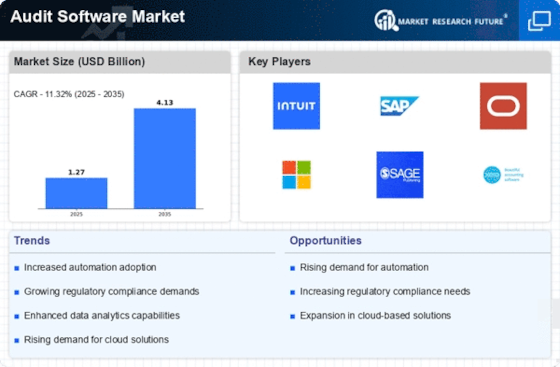
As per Market Research Future analysis, the Audit Software Market Size was estimated at 1.27 USD Billion in 2024. The Audit Software industry is projected to grow from 1.414 USD Billion in 2025 to 4.132 USD Billion by 2035, exhibiting a compound annual growth rate (CAGR) of 11.32% during the forecast period 2025 - 2035

Key Market Trends & Highlights

The Audit Software Market is experiencing robust growth driven by technological advancements and increasing regulatory demands.

  • The integration of advanced technologies, particularly artificial intelligence, is reshaping the audit software landscape. Data security remains a paramount concern, influencing software development and adoption across various sectors. North America continues to dominate the market, while the Asia-Pacific region emerges as the fastest-growing area for audit software solutions. The rising demand for real-time auditing and heightened focus on regulatory compliance are key drivers propelling market expansion.

Market Size & Forecast

2024 Market Size 1.27 (USD Billion)
2035 Market Size 4.132 (USD Billion)
CAGR (2025 - 2035) 11.32%
Largest Regional Market Share in 2024 North America

Major Players

Intuit (US), SAP (DE), Oracle (US), Microsoft (US), Sage (GB), Xero (NZ), Zoho (IN), FreshBooks (CA), BlackLine (US)

Market Trends

The Audit Software Market is currently experiencing a transformative phase, driven by the increasing demand for compliance and risk management solutions across various industries. The global audit management software market share is witnessing steady expansion as organizations increasingly adopt digital tools to strengthen compliance, transparency, and risk management. Organizations are recognizing the necessity of robust auditing processes to ensure transparency and accountability. This shift is largely influenced by regulatory requirements and the need for enhanced operational efficiency. As businesses navigate complex financial landscapes, the integration of advanced technologies such as artificial intelligence and machine learning into audit software is becoming more prevalent. These innovations not only streamline auditing processes but also improve accuracy and reduce human error, thereby fostering trust among stakeholders. Moreover, the growing emphasis on data security and privacy is shaping the Audit Software Market. Companies are increasingly focused on safeguarding sensitive information, which necessitates the adoption of sophisticated auditing tools that can effectively monitor and analyze data access and usage. This trend indicates a broader recognition of the importance of cybersecurity in the auditing process. As organizations continue to adapt to evolving market dynamics, the Audit Software Market is poised for sustained growth, with a clear trajectory towards more integrated and intelligent solutions that address the multifaceted challenges of modern auditing practices. The growing demand for governance and compliance has accelerated adoption in the internal audit management software market, particularly among large enterprises and regulated industries. Additionally, the operational audit software market is gaining traction as organizations focus on improving internal controls, workflow automation, and process efficiency. Some enterprises are also adopting digital marketing audit software to evaluate campaign compliance, data accuracy, and performance reporting.

Integration of Advanced Technologies

The incorporation of artificial intelligence and machine learning into audit software is becoming more common. These technologies enhance the efficiency and accuracy of audits, allowing for real-time data analysis and improved decision-making.

Focus on Data Security

As organizations prioritize data protection, there is a noticeable shift towards audit software that emphasizes security features. This trend reflects the growing awareness of the need to safeguard sensitive information during the auditing process.

Regulatory Compliance and Risk Management

The increasing complexity of regulatory frameworks is driving demand for audit software that can assist organizations in maintaining compliance. This trend highlights the importance of effective risk management strategies in today’s business environment.

Audit Software Market Market Drivers

Rising Cybersecurity Concerns

Rising cybersecurity concerns are significantly influencing the Audit Software Market. As cyber threats become more sophisticated, organizations are prioritizing the security of their financial data. This trend is prompting a surge in demand for audit software that includes advanced cybersecurity features. The market for cybersecurity-focused audit solutions is expected to witness a growth rate of approximately 12% annually over the next few years. Organizations are increasingly seeking software that not only facilitates auditing but also protects sensitive information from potential breaches. This dual focus on auditing and cybersecurity is likely to drive innovation and investment in the Audit Software Market, as businesses strive to safeguard their assets while maintaining compliance.

Expansion of Cloud-Based Solutions

The expansion of cloud-based solutions is a pivotal driver in the Audit Software Market. Cloud technology offers organizations enhanced flexibility, scalability, and cost-effectiveness, making it an attractive option for audit processes. The market for cloud-based audit software is projected to grow significantly, with estimates indicating a potential increase to 4 billion dollars by 2026. This growth is fueled by the increasing adoption of remote work and the need for accessible audit solutions that can be utilized from various locations. Furthermore, cloud-based audit software often includes features such as automatic updates and real-time collaboration, which are appealing to organizations aiming to streamline their auditing processes. As a result, the shift towards cloud-based solutions is likely to continue shaping the landscape of the Audit Software Market.

Growing Demand for Real-Time Auditing

The growing demand for real-time auditing is reshaping the Audit Software Market. Organizations are increasingly recognizing the value of continuous monitoring and real-time insights into their financial data. This trend is reflected in the rising investments in audit software that offers real-time analytics and reporting capabilities. According to recent estimates, the market for real-time auditing solutions is anticipated to expand at a compound annual growth rate of 15% over the next five years. This shift towards real-time auditing not only enhances transparency but also enables organizations to respond swiftly to potential issues, thereby improving overall risk management. Consequently, the demand for audit software that supports real-time functionalities is expected to surge.

Integration of Artificial Intelligence

The integration of artificial intelligence (AI) into the Audit Software Market is transforming traditional auditing processes. AI technologies enhance data analysis capabilities, enabling auditors to identify anomalies and patterns with greater accuracy. This shift is evidenced by a projected increase in the adoption of AI-driven audit solutions, which is expected to reach a market value of approximately 2 billion dollars by 2026. The ability of AI to automate repetitive tasks allows auditors to focus on more strategic activities, thereby increasing efficiency and reducing the time required for audits. As organizations seek to leverage AI for improved decision-making, the demand for AI-integrated audit software is likely to grow, driving innovation within the Audit Software Market.

Increased Focus on Regulatory Compliance

The heightened focus on regulatory compliance is a significant driver in the Audit Software Market. As regulatory frameworks become more complex, organizations are compelled to adopt robust audit solutions to ensure compliance with various standards. The market for compliance-focused audit software is projected to grow substantially, with estimates suggesting a value of over 3 billion dollars by 2025. This growth is driven by the need for organizations to mitigate risks associated with non-compliance, which can lead to severe financial penalties and reputational damage. Consequently, audit software that incorporates compliance management features is becoming increasingly essential for businesses aiming to navigate the intricate landscape of regulations effectively.

Market Segment Insights

By Component: Solution (Largest) vs. Service (Fastest-Growing)

In the Audit Software Market, the 'Solution' component holds the largest market share, reflecting its dominance in providing comprehensive software tools for audit processes. On the other hand, the 'Service' component, while smaller in share, is experiencing rapid growth, indicating a shift in customer preferences towards supplemental services that enhance software usability and support. Within the audit management software market, solution-based platforms dominate due to their ability to automate audit planning, execution, and reporting. Cloud-based deployment is increasingly preferred in the internal audit management software market, offering scalability, remote accessibility, and real-time analytics.

Solution: Software (Dominant) vs. Service: Consulting (Emerging)

The 'Solution' segment, particularly software solutions, remains dominant in the Audit Software Market as organizations increasingly rely on sophisticated tools to streamline audit activities and improve accuracy. These software solutions offer essential functionalities, including data analytics and compliance tracking. Conversely, the 'Service' segment, exemplified by consulting services, is characterized as emerging due to the growing demand for expert guidance and support in software implementation and audit processes. As businesses seek to enhance operational efficiency, these services are becoming indispensable, highlighting a trend towards integrated solutions that combine software capabilities with expert advisory.

By Deployment Model: Cloud (Largest) vs. On-Premise (Fastest-Growing)

The Audit Software Market demonstrates a distinctive division in its deployment models, with the Cloud segment commanding the largest market share. Organizations increasingly favor the flexibility, scalability, and lower upfront costs offered by Cloud deployment, leading to a broader adoption across various sectors. Conversely, the On-Premise model, though smaller in market share, is experiencing rapid growth due to the rising demand for data control and security in compliance-sensitive industries. As organizations place greater emphasis on regulatory adherence, On-Premise solutions are becoming more attractive despite the Cloud's prominence. Growth trends in the Audit Software Market reveal a clear trajectory towards Cloud deployment, driven by advancements in technology and a shift towards remote work. The increasing need for real-time access to audit data and collaborative features has catalyzed the migration to Cloud solutions. Meanwhile, the On-Premise segment is benefiting from niche growth, particularly among organizations that require customized solutions and stringent data privacy measures. This duality in deployment preferences indicates a dynamic market adapting to diverse organizational needs, where Cloud solutions are mainstream, and On-Premise options cater to specific requirements.

Deployment Model: Cloud (Dominant) vs. On-Premise (Emerging)

The Cloud deployment model in the Audit Software Market stands as the dominant force, favored for its user-friendly interface, ease of access, and seamless integration with other digital tools. Users benefit from automatic updates and enhanced collaboration capabilities, which are crucial in today's fast-paced business environment. In contrast, the On-Premise model is emerging as a viable option for companies that prioritize data security and control. These organizations often operate within regulated industries such as finance and healthcare, where compliance requirements drive the need for on-site deployment. As such, On-Premise solutions are increasingly tailored to fit industry-specific needs, presenting a robust alternative in the market despite the Cloud's overall appeal.

By Organization Size: Large Enterprises (Largest) vs. Small & Medium Enterprises (Fastest-Growing)

In the Audit Software Market, the distribution of market share clearly shows that Large Enterprises hold a predominant position, benefiting from extensive resources and complex operational structures that necessitate sophisticated audit solutions. These enterprises leverage advanced software capabilities to ensure compliance, manage risks, and enhance operational efficiency. Consequently, they represent the largest segment in terms of market share, overshadowing smaller organizations who require simpler, more cost-effective solutions suited for their scale of operations. On the other hand, Small &amp; Medium Enterprises (SMEs) are emerging as the fastest-growing segment within the market. The increasing agility of SMEs, coupled with rising regulatory demands and the need for transparency in financial reporting, drives their adoption of audit software. As these businesses increasingly turn to digital solutions, the market sees a significant growth trend that reflects their evolving operational needs and the opportunities that lie in catering to them.

Large Enterprises (Dominant) vs. Small &amp; Medium Enterprises (Emerging)

Large Enterprises in the Audit Software Market thrive due to their established credibility, comprehensive resource availability, and a requirement for robust compliance mechanisms. These organizations typically need sophisticated features such as risk management, <a href="https://www.marketresearchfuture.com/reports/data-analytics-market-1689">data analytics</a>, and regulatory compliance, which empower them to navigate complex operational landscapes successfully. In contrast, Small &amp; Medium Enterprises represent an emerging force within the market, characterized by their flexible structures and a greater emphasis on cost-effectiveness. As SMEs increasingly digitize their accounting and auditing processes, they seek software that delivers essential features without overwhelming them with complexity. This duality in the market highlights the diversity in needs and adoption rates, where Large Enterprises continue to dominate, while SMEs rapidly adapt to new technologies, ushering in transformative changes.

By Vertical: BFSI (Largest) vs. Energy & Utility (Fastest-Growing)

The Audit Software Market showcases a prominent distribution of market share among various verticals, with the BFSI sector being the largest contributor. This sector encompasses banks, financial services, and insurance institutions, which are heavily regulated and require robust audit solutions to ensure compliance and quality control. In contrast, the Energy &amp; Utility sector, which is witnessing rapid <a href="https://www.marketresearchfuture.com/reports/digital-transformation-market-8685">digital transformation</a>, shows significant potential for growth as companies invest in advanced audit technologies to streamline processes and enhance regulatory compliance.

BFSI: Dominant vs. Energy &amp; Utility: Emerging

The BFSI sector stands as the dominant player in the Audit Software Market, characterized by its stringent regulatory requirements, extensive data management needs, and the necessity for thorough risk assessments. Audit software tailored for this vertical provides comprehensive solutions that encompass compliance checks, fraud detection, and transaction monitoring, ensuring operational integrity. On the other hand, the Energy &amp; Utility sector is emerging as a significant force, driven by the increasing complexity of regulatory frameworks and the push for sustainability. Companies in this sector are adopting innovative audit practices to manage risks associated with energy consumption, environmental compliance, and service reliability, carving out a niche for themselves in the market.

Get more detailed insights about Audit Software Market Research Report - Global Forecast to 2035

Regional Insights

North America : Leading Market Innovators

North America is the largest market for audit software, holding approximately 45% of the global share. The region's growth is driven by increasing regulatory compliance requirements and the adoption of advanced technologies like AI and machine learning. The demand for efficient audit processes is further fueled by the rise of remote work and digital transformation initiatives across various sectors. The United States and Canada are the leading countries in this market, with major players like Intuit, Oracle, and Microsoft establishing a strong presence. The competitive landscape is characterized by continuous innovation and strategic partnerships, ensuring that these companies remain at the forefront of the audit software industry. The focus on enhancing user experience and integrating cloud solutions is also shaping market dynamics.

Europe : Regulatory Compliance Focus

Europe is the second-largest market for audit software, accounting for around 30% of the global market share. The region's growth is primarily driven by stringent regulatory frameworks and the need for enhanced transparency in financial reporting. The increasing emphasis on data protection and compliance with regulations like GDPR is propelling demand for robust audit solutions across various industries. Leading countries in this region include Germany, the UK, and France, where companies are increasingly adopting audit software to streamline their processes. In Europe, the UK audit software market remains one of the most mature, supported by strict financial reporting standards and widespread adoption among accounting and CPA firms. Key players such as SAP and Sage are well-established, contributing to a competitive landscape that encourages innovation. The presence of numerous SMEs also drives demand for affordable and scalable audit solutions, further enhancing market growth.

Asia-Pacific : Emerging Market Potential

Asia-Pacific is witnessing significant growth in the audit software market, holding approximately 20% of the global share. The region's expansion is fueled by increasing digitalization, a growing number of startups, and rising awareness of compliance requirements. Countries like China and India are leading this growth, driven by their rapidly evolving economies and the need for efficient audit processes in various sectors. Asia-Pacific represents a high-growth region, with the India audit software market expanding rapidly due to increased SME digitization and regulatory compliance requirements. Meanwhile, the Japan audit software market benefits from advanced enterprise adoption, and the South Korea audit software market is driven by strong technology integration and corporate governance reforms. The competitive landscape is becoming increasingly dynamic, with both local and international players vying for market share. Companies like Xero and Zoho are gaining traction, catering to the needs of small and medium enterprises. The focus on cloud-based solutions and automation is reshaping the market, making audit processes more efficient and accessible for businesses across the region.

Middle East and Africa : Untapped Market Opportunities

The Middle East and Africa region is gradually emerging in the audit software market, currently holding about 5% of the global share. The growth is driven by increasing investments in technology and a rising awareness of the importance of compliance and transparency in financial practices. Countries like South Africa and the UAE are leading this trend, with a growing number of businesses seeking efficient audit solutions to meet regulatory requirements.

The GCC audit software market is gaining momentum as governments and enterprises in the region emphasize regulatory compliance, transparency, and digital governance initiatives.

The South America audit software market is gradually expanding as regulatory frameworks strengthen across the region. The Brazil audit software market leads adoption due to its large BFSI and corporate sectors, while the Argentina audit software market is witnessing steady growth driven by increasing compliance awareness and digital transformation initiatives.

The competitive landscape is still developing, with both local and international players entering the market. Companies are focusing on providing tailored solutions to meet the unique needs of businesses in this region. The increasing adoption of cloud technology and mobile solutions is expected to further enhance market growth, making audit software more accessible to a wider audience.


Key Players and Competitive Insights

Major market players are spending a lot of money on R&D to increase their product lines, which will help the audit software market grow even more. Market participants are also taking a range of strategic initiatives to grow their worldwide footprint, with key market developments such as new product launches, contractual agreements, mergers and acquisitions, increased investments, and collaboration with other organizations. Competitors in the audit software industry must offer cost-effective items to expand and survive in an increasingly competitive and growing market environment. Leading vendors such as SAP, Oracle, and Microsoft collectively account for a significant audit software market share, driven by continuous innovation and cloud-based offerings.
One of the major business strategies manufacturers adopt in the audit software industry to benefit clients and expand the market sector is manufacturing locally to reduce operating costs. The audit software markets major players such as Logic manager, Netwrix Corporation, SAP SE, and others are working on expanding the market demand by investing in research and development activities.
Wolters Kluwer is a provider of software solutions, professional information, and services for clinicians, accountants, lawyers, and tax, finance, audit, risk, compliance, and regulatory sectors. Wolters Kluwer reported 2021 annual revenues of $5.22 billion. The group serves customers in over 180 countries and maintains operations in over 40 countries. In March 2020 - Wolters Kluwer Tax & Accounting launched its cloud-based audit software - "TeamMate+ Public Sector." This solution will help the public sector audit departments automate tasks and streamline audit executions.
Also, Thomson Reuters is a leading provider of business information services. Their products include highly specialized information-enabled software and tools for legal, accounting, tax, trade and compliance professionals combined with the world's news service, Reuters.
In July Thomson Reuters announced the acquisition of HighQ. HighQ provides a secure cloud-based platform for client engagement, workflow automation, and business collaboration.

Key Companies in the Audit Software Market include

Industry Developments

October 2022: HotWax Commerce launched its latest software, the Omnichannel Retail Sales Audit, OReSA. OReSA reconciles accurate sales data daily, quickly catches critical data integration errors, and leverages automation to simplify month-end financials. It was built to serve existing clients like Steve Madden, that faced these all-too-common challenges, but is now publicly available as an extension through the HotWax Commerce Order Management Solution.

Future Outlook

Audit Software Market Future Outlook

The Audit Software Market is projected to grow at 11.32% CAGR from 2025 to 2035, driven by increasing regulatory compliance, technological advancements, and demand for data analytics.

New opportunities lie in:

  • <p>Integration of AI-driven analytics for enhanced audit accuracy. Development of cloud-based solutions for remote auditing capabilities. Expansion into emerging markets with tailored compliance solutions.</p>

By 2035, the market is expected to be robust, reflecting substantial growth and innovation.

Market Segmentation

Audit Software Market Vertical Outlook

  • BFSI
  • Energy & Utility
  • Manufacturing
  • Food & Beverage
  • Accounting/CPA Firms
  • Non-Profit Organizations

Audit Software Market Component Outlook

  • Solution
  • Service

Audit Software Market Deployment Model Outlook

  • On-Premise
  • Cloud

Audit Software Market Organization Size Outlook

  • Large Enterprises
  • Small & Medium Enterprises

Report Scope

MARKET SIZE 2024 1.27(USD Billion)
MARKET SIZE 2025 1.414(USD Billion)
MARKET SIZE 2035 4.132(USD Billion)
COMPOUND ANNUAL GROWTH RATE (CAGR) 11.32% (2025 - 2035)
REPORT COVERAGE Revenue Forecast, Competitive Landscape, Growth Factors, and Trends
BASE YEAR 2024
Market Forecast Period 2025 - 2035
Historical Data 2019 - 2024
Market Forecast Units USD Billion
Key Companies Profiled Intuit (US), SAP (DE), Oracle (US), Microsoft (US), Sage (GB), Xero (NZ), Zoho (IN), FreshBooks (CA), BlackLine (US)
Segments Covered Component, Organization Size, Deployment Model, Vertical, Region
Key Market Opportunities Integration of artificial intelligence enhances efficiency and accuracy in the Audit Software Market.
Key Market Dynamics Rising demand for compliance-driven solutions fuels innovation and competition in the Audit Software Market.
Countries Covered North America, Europe, APAC, South America, MEA

FAQs

What is the current valuation of the Audit Software Market as of 2024?

<p>The Audit Software Market was valued at 1.27 USD Billion in 2024.</p>

What is the projected market size for the Audit Software Market in 2035?

<p>The market is projected to reach 4.132 USD Billion by 2035.</p>

What is the expected CAGR for the Audit Software Market during the forecast period 2025 - 2035?

<p>The expected CAGR for the Audit Software Market during 2025 - 2035 is 11.32%.</p>

Which companies are considered key players in the Audit Software Market?

<p>Key players in the market include Intuit, SAP, Oracle, Microsoft, Sage, Xero, Zoho, FreshBooks, and BlackLine.</p>

How does the Audit Software Market segment by component?

<p>The market segments by component into Solution, valued at 2.56 USD Billion, and Service, valued at 1.57 USD Billion.</p>

What are the deployment models for Audit Software?

<p>The market is segmented into On-Premise, valued at 1.92 USD Billion, and Cloud, valued at 2.22 USD Billion.</p>

How is the Audit Software Market segmented by organization size?

<p>The market segments by organization size into Large Enterprises, valued at 2.5 USD Billion, and Small & Medium Enterprises, valued at 1.63 USD Billion.</p>

Which verticals are driving growth in the Audit Software Market?

<p>Key verticals include BFSI, valued at 1.23 USD Billion, and Energy & Utility, valued at 0.78 USD Billion.</p>

What was the valuation of the BFSI segment in 2024?

The BFSI segment was valued at 0.38 USD Billion in 2024.

What is the expected growth trajectory for the Audit Software Market?

The market appears poised for substantial growth, potentially reaching over 4.132 USD Billion by 2035.

  1. SECTION I: EXECUTIVE SUMMARY AND KEY HIGHLIGHTS
    1. | 1.1 EXECUTIVE SUMMARY
    2. | | 1.1.1 Market Overview
    3. | | 1.1.2 Key Findings
    4. | | 1.1.3 Market Segmentation
    5. | | 1.1.4 Competitive Landscape
    6. | | 1.1.5 Challenges and Opportunities
    7. | | 1.1.6 Future Outlook
  2. SECTION II: SCOPING, METHODOLOGY AND MARKET STRUCTURE
    1. | 2.1 MARKET INTRODUCTION
    2. | | 2.1.1 Definition
    3. | | 2.1.2 Scope of the study
    4. | | | 2.1.2.1 Research Objective
    5. | | | 2.1.2.2 Assumption
    6. | | | 2.1.2.3 Limitations
    7. | 2.2 RESEARCH METHODOLOGY
    8. | | 2.2.1 Overview
    9. | | 2.2.2 Data Mining
    10. | | 2.2.3 Secondary Research
    11. | | 2.2.4 Primary Research
    12. | | | 2.2.4.1 Primary Interviews and Information Gathering Process
    13. | | | 2.2.4.2 Breakdown of Primary Respondents
    14. | | 2.2.5 Forecasting Model
    15. | | 2.2.6 Market Size Estimation
    16. | | | 2.2.6.1 Bottom-Up Approach
    17. | | | 2.2.6.2 Top-Down Approach
    18. | | 2.2.7 Data Triangulation
    19. | | 2.2.8 Validation
  3. SECTION III: QUALITATIVE ANALYSIS
    1. | 3.1 MARKET DYNAMICS
    2. | | 3.1.1 Overview
    3. | | 3.1.2 Drivers
    4. | | 3.1.3 Restraints
    5. | | 3.1.4 Opportunities
    6. | 3.2 MARKET FACTOR ANALYSIS
    7. | | 3.2.1 Value chain Analysis
    8. | | 3.2.2 Porter's Five Forces Analysis
    9. | | | 3.2.2.1 Bargaining Power of Suppliers
    10. | | | 3.2.2.2 Bargaining Power of Buyers
    11. | | | 3.2.2.3 Threat of New Entrants
    12. | | | 3.2.2.4 Threat of Substitutes
    13. | | | 3.2.2.5 Intensity of Rivalry
    14. | | 3.2.3 COVID-19 Impact Analysis
    15. | | | 3.2.3.1 Market Impact Analysis
    16. | | | 3.2.3.2 Regional Impact
    17. | | | 3.2.3.3 Opportunity and Threat Analysis
  4. SECTION IV: QUANTITATIVE ANALYSIS
    1. | 4.1 Information and Communications Technology, BY Component (USD Billion)
    2. | | 4.1.1 Solution
    3. | | 4.1.2 Service
    4. | 4.2 Information and Communications Technology, BY Deployment Model (USD Billion)
    5. | | 4.2.1 On-Premise
    6. | | 4.2.2 Cloud
    7. | 4.3 Information and Communications Technology, BY Organization Size (USD Billion)
    8. | | 4.3.1 Large Enterprises
    9. | | 4.3.2 Small & Medium Enterprises
    10. | 4.4 Information and Communications Technology, BY Vertical (USD Billion)
    11. | | 4.4.1 BFSI
    12. | | 4.4.2 Energy & Utility
    13. | | 4.4.3 Manufacturing
    14. | | 4.4.4 Food & Beverage
    15. | | 4.4.5 Accounting/CPA Firms
    16. | | 4.4.6 Non-Profit Organizations
    17. | 4.5 Information and Communications Technology, BY Region (USD Billion)
    18. | | 4.5.1 North America
    19. | | | 4.5.1.1 US
    20. | | | 4.5.1.2 Canada
    21. | | 4.5.2 Europe
    22. | | | 4.5.2.1 Germany
    23. | | | 4.5.2.2 UK
    24. | | | 4.5.2.3 France
    25. | | | 4.5.2.4 Russia
    26. | | | 4.5.2.5 Italy
    27. | | | 4.5.2.6 Spain
    28. | | | 4.5.2.7 Rest of Europe
    29. | | 4.5.3 APAC
    30. | | | 4.5.3.1 China
    31. | | | 4.5.3.2 India
    32. | | | 4.5.3.3 Japan
    33. | | | 4.5.3.4 South Korea
    34. | | | 4.5.3.5 Malaysia
    35. | | | 4.5.3.6 Thailand
    36. | | | 4.5.3.7 Indonesia
    37. | | | 4.5.3.8 Rest of APAC
    38. | | 4.5.4 South America
    39. | | | 4.5.4.1 Brazil
    40. | | | 4.5.4.2 Mexico
    41. | | | 4.5.4.3 Argentina
    42. | | | 4.5.4.4 Rest of South America
    43. | | 4.5.5 MEA
    44. | | | 4.5.5.1 GCC Countries
    45. | | | 4.5.5.2 South Africa
    46. | | | 4.5.5.3 Rest of MEA
  5. SECTION V: COMPETITIVE ANALYSIS
    1. | 5.1 Competitive Landscape
    2. | | 5.1.1 Overview
    3. | | 5.1.2 Competitive Analysis
    4. | | 5.1.3 Market share Analysis
    5. | | 5.1.4 Major Growth Strategy in the Information and Communications Technology
    6. | | 5.1.5 Competitive Benchmarking
    7. | | 5.1.6 Leading Players in Terms of Number of Developments in the Information and Communications Technology
    8. | | 5.1.7 Key developments and growth strategies
    9. | | | 5.1.7.1 New Product Launch/Service Deployment
    10. | | | 5.1.7.2 Merger & Acquisitions
    11. | | | 5.1.7.3 Joint Ventures
    12. | | 5.1.8 Major Players Financial Matrix
    13. | | | 5.1.8.1 Sales and Operating Income
    14. | | | 5.1.8.2 Major Players R&D Expenditure. 2023
    15. | 5.2 Company Profiles
    16. | | 5.2.1 Intuit (US)
    17. | | | 5.2.1.1 Financial Overview
    18. | | | 5.2.1.2 Products Offered
    19. | | | 5.2.1.3 Key Developments
    20. | | | 5.2.1.4 SWOT Analysis
    21. | | | 5.2.1.5 Key Strategies
    22. | | 5.2.2 SAP (DE)
    23. | | | 5.2.2.1 Financial Overview
    24. | | | 5.2.2.2 Products Offered
    25. | | | 5.2.2.3 Key Developments
    26. | | | 5.2.2.4 SWOT Analysis
    27. | | | 5.2.2.5 Key Strategies
    28. | | 5.2.3 Oracle (US)
    29. | | | 5.2.3.1 Financial Overview
    30. | | | 5.2.3.2 Products Offered
    31. | | | 5.2.3.3 Key Developments
    32. | | | 5.2.3.4 SWOT Analysis
    33. | | | 5.2.3.5 Key Strategies
    34. | | 5.2.4 Microsoft (US)
    35. | | | 5.2.4.1 Financial Overview
    36. | | | 5.2.4.2 Products Offered
    37. | | | 5.2.4.3 Key Developments
    38. | | | 5.2.4.4 SWOT Analysis
    39. | | | 5.2.4.5 Key Strategies
    40. | | 5.2.5 Sage (GB)
    41. | | | 5.2.5.1 Financial Overview
    42. | | | 5.2.5.2 Products Offered
    43. | | | 5.2.5.3 Key Developments
    44. | | | 5.2.5.4 SWOT Analysis
    45. | | | 5.2.5.5 Key Strategies
    46. | | 5.2.6 Xero (NZ)
    47. | | | 5.2.6.1 Financial Overview
    48. | | | 5.2.6.2 Products Offered
    49. | | | 5.2.6.3 Key Developments
    50. | | | 5.2.6.4 SWOT Analysis
    51. | | | 5.2.6.5 Key Strategies
    52. | | 5.2.7 Zoho (IN)
    53. | | | 5.2.7.1 Financial Overview
    54. | | | 5.2.7.2 Products Offered
    55. | | | 5.2.7.3 Key Developments
    56. | | | 5.2.7.4 SWOT Analysis
    57. | | | 5.2.7.5 Key Strategies
    58. | | 5.2.8 FreshBooks (CA)
    59. | | | 5.2.8.1 Financial Overview
    60. | | | 5.2.8.2 Products Offered
    61. | | | 5.2.8.3 Key Developments
    62. | | | 5.2.8.4 SWOT Analysis
    63. | | | 5.2.8.5 Key Strategies
    64. | | 5.2.9 BlackLine (US)
    65. | | | 5.2.9.1 Financial Overview
    66. | | | 5.2.9.2 Products Offered
    67. | | | 5.2.9.3 Key Developments
    68. | | | 5.2.9.4 SWOT Analysis
    69. | | | 5.2.9.5 Key Strategies
    70. | 5.3 Appendix
    71. | | 5.3.1 References
    72. | | 5.3.2 Related Reports
  6. LIST OF FIGURES
    1. | 6.1 MARKET SYNOPSIS
    2. | 6.2 NORTH AMERICA MARKET ANALYSIS
    3. | 6.3 US MARKET ANALYSIS BY COMPONENT
    4. | 6.4 US MARKET ANALYSIS BY DEPLOYMENT MODEL
    5. | 6.5 US MARKET ANALYSIS BY ORGANIZATION SIZE
    6. | 6.6 US MARKET ANALYSIS BY VERTICAL
    7. | 6.7 CANADA MARKET ANALYSIS BY COMPONENT
    8. | 6.8 CANADA MARKET ANALYSIS BY DEPLOYMENT MODEL
    9. | 6.9 CANADA MARKET ANALYSIS BY ORGANIZATION SIZE
    10. | 6.10 CANADA MARKET ANALYSIS BY VERTICAL
    11. | 6.11 EUROPE MARKET ANALYSIS
    12. | 6.12 GERMANY MARKET ANALYSIS BY COMPONENT
    13. | 6.13 GERMANY MARKET ANALYSIS BY DEPLOYMENT MODEL
    14. | 6.14 GERMANY MARKET ANALYSIS BY ORGANIZATION SIZE
    15. | 6.15 GERMANY MARKET ANALYSIS BY VERTICAL
    16. | 6.16 UK MARKET ANALYSIS BY COMPONENT
    17. | 6.17 UK MARKET ANALYSIS BY DEPLOYMENT MODEL
    18. | 6.18 UK MARKET ANALYSIS BY ORGANIZATION SIZE
    19. | 6.19 UK MARKET ANALYSIS BY VERTICAL
    20. | 6.20 FRANCE MARKET ANALYSIS BY COMPONENT
    21. | 6.21 FRANCE MARKET ANALYSIS BY DEPLOYMENT MODEL
    22. | 6.22 FRANCE MARKET ANALYSIS BY ORGANIZATION SIZE
    23. | 6.23 FRANCE MARKET ANALYSIS BY VERTICAL
    24. | 6.24 RUSSIA MARKET ANALYSIS BY COMPONENT
    25. | 6.25 RUSSIA MARKET ANALYSIS BY DEPLOYMENT MODEL
    26. | 6.26 RUSSIA MARKET ANALYSIS BY ORGANIZATION SIZE
    27. | 6.27 RUSSIA MARKET ANALYSIS BY VERTICAL
    28. | 6.28 ITALY MARKET ANALYSIS BY COMPONENT
    29. | 6.29 ITALY MARKET ANALYSIS BY DEPLOYMENT MODEL
    30. | 6.30 ITALY MARKET ANALYSIS BY ORGANIZATION SIZE
    31. | 6.31 ITALY MARKET ANALYSIS BY VERTICAL
    32. | 6.32 SPAIN MARKET ANALYSIS BY COMPONENT
    33. | 6.33 SPAIN MARKET ANALYSIS BY DEPLOYMENT MODEL
    34. | 6.34 SPAIN MARKET ANALYSIS BY ORGANIZATION SIZE
    35. | 6.35 SPAIN MARKET ANALYSIS BY VERTICAL
    36. | 6.36 REST OF EUROPE MARKET ANALYSIS BY COMPONENT
    37. | 6.37 REST OF EUROPE MARKET ANALYSIS BY DEPLOYMENT MODEL
    38. | 6.38 REST OF EUROPE MARKET ANALYSIS BY ORGANIZATION SIZE
    39. | 6.39 REST OF EUROPE MARKET ANALYSIS BY VERTICAL
    40. | 6.40 APAC MARKET ANALYSIS
    41. | 6.41 CHINA MARKET ANALYSIS BY COMPONENT
    42. | 6.42 CHINA MARKET ANALYSIS BY DEPLOYMENT MODEL
    43. | 6.43 CHINA MARKET ANALYSIS BY ORGANIZATION SIZE
    44. | 6.44 CHINA MARKET ANALYSIS BY VERTICAL
    45. | 6.45 INDIA MARKET ANALYSIS BY COMPONENT
    46. | 6.46 INDIA MARKET ANALYSIS BY DEPLOYMENT MODEL
    47. | 6.47 INDIA MARKET ANALYSIS BY ORGANIZATION SIZE
    48. | 6.48 INDIA MARKET ANALYSIS BY VERTICAL
    49. | 6.49 JAPAN MARKET ANALYSIS BY COMPONENT
    50. | 6.50 JAPAN MARKET ANALYSIS BY DEPLOYMENT MODEL
    51. | 6.51 JAPAN MARKET ANALYSIS BY ORGANIZATION SIZE
    52. | 6.52 JAPAN MARKET ANALYSIS BY VERTICAL
    53. | 6.53 SOUTH KOREA MARKET ANALYSIS BY COMPONENT
    54. | 6.54 SOUTH KOREA MARKET ANALYSIS BY DEPLOYMENT MODEL
    55. | 6.55 SOUTH KOREA MARKET ANALYSIS BY ORGANIZATION SIZE
    56. | 6.56 SOUTH KOREA MARKET ANALYSIS BY VERTICAL
    57. | 6.57 MALAYSIA MARKET ANALYSIS BY COMPONENT
    58. | 6.58 MALAYSIA MARKET ANALYSIS BY DEPLOYMENT MODEL
    59. | 6.59 MALAYSIA MARKET ANALYSIS BY ORGANIZATION SIZE
    60. | 6.60 MALAYSIA MARKET ANALYSIS BY VERTICAL
    61. | 6.61 THAILAND MARKET ANALYSIS BY COMPONENT
    62. | 6.62 THAILAND MARKET ANALYSIS BY DEPLOYMENT MODEL
    63. | 6.63 THAILAND MARKET ANALYSIS BY ORGANIZATION SIZE
    64. | 6.64 THAILAND MARKET ANALYSIS BY VERTICAL
    65. | 6.65 INDONESIA MARKET ANALYSIS BY COMPONENT
    66. | 6.66 INDONESIA MARKET ANALYSIS BY DEPLOYMENT MODEL
    67. | 6.67 INDONESIA MARKET ANALYSIS BY ORGANIZATION SIZE
    68. | 6.68 INDONESIA MARKET ANALYSIS BY VERTICAL
    69. | 6.69 REST OF APAC MARKET ANALYSIS BY COMPONENT
    70. | 6.70 REST OF APAC MARKET ANALYSIS BY DEPLOYMENT MODEL
    71. | 6.71 REST OF APAC MARKET ANALYSIS BY ORGANIZATION SIZE
    72. | 6.72 REST OF APAC MARKET ANALYSIS BY VERTICAL
    73. | 6.73 SOUTH AMERICA MARKET ANALYSIS
    74. | 6.74 BRAZIL MARKET ANALYSIS BY COMPONENT
    75. | 6.75 BRAZIL MARKET ANALYSIS BY DEPLOYMENT MODEL
    76. | 6.76 BRAZIL MARKET ANALYSIS BY ORGANIZATION SIZE
    77. | 6.77 BRAZIL MARKET ANALYSIS BY VERTICAL
    78. | 6.78 MEXICO MARKET ANALYSIS BY COMPONENT
    79. | 6.79 MEXICO MARKET ANALYSIS BY DEPLOYMENT MODEL
    80. | 6.80 MEXICO MARKET ANALYSIS BY ORGANIZATION SIZE
    81. | 6.81 MEXICO MARKET ANALYSIS BY VERTICAL
    82. | 6.82 ARGENTINA MARKET ANALYSIS BY COMPONENT
    83. | 6.83 ARGENTINA MARKET ANALYSIS BY DEPLOYMENT MODEL
    84. | 6.84 ARGENTINA MARKET ANALYSIS BY ORGANIZATION SIZE
    85. | 6.85 ARGENTINA MARKET ANALYSIS BY VERTICAL
    86. | 6.86 REST OF SOUTH AMERICA MARKET ANALYSIS BY COMPONENT
    87. | 6.87 REST OF SOUTH AMERICA MARKET ANALYSIS BY DEPLOYMENT MODEL
    88. | 6.88 REST OF SOUTH AMERICA MARKET ANALYSIS BY ORGANIZATION SIZE
    89. | 6.89 REST OF SOUTH AMERICA MARKET ANALYSIS BY VERTICAL
    90. | 6.90 MEA MARKET ANALYSIS
    91. | 6.91 GCC COUNTRIES MARKET ANALYSIS BY COMPONENT
    92. | 6.92 GCC COUNTRIES MARKET ANALYSIS BY DEPLOYMENT MODEL
    93. | 6.93 GCC COUNTRIES MARKET ANALYSIS BY ORGANIZATION SIZE
    94. | 6.94 GCC COUNTRIES MARKET ANALYSIS BY VERTICAL
    95. | 6.95 SOUTH AFRICA MARKET ANALYSIS BY COMPONENT
    96. | 6.96 SOUTH AFRICA MARKET ANALYSIS BY DEPLOYMENT MODEL
    97. | 6.97 SOUTH AFRICA MARKET ANALYSIS BY ORGANIZATION SIZE
    98. | 6.98 SOUTH AFRICA MARKET ANALYSIS BY VERTICAL
    99. | 6.99 REST OF MEA MARKET ANALYSIS BY COMPONENT
    100. | 6.100 REST OF MEA MARKET ANALYSIS BY DEPLOYMENT MODEL
    101. | 6.101 REST OF MEA MARKET ANALYSIS BY ORGANIZATION SIZE
    102. | 6.102 REST OF MEA MARKET ANALYSIS BY VERTICAL
    103. | 6.103 KEY BUYING CRITERIA OF INFORMATION AND COMMUNICATIONS TECHNOLOGY
    104. | 6.104 RESEARCH PROCESS OF MRFR
    105. | 6.105 DRO ANALYSIS OF INFORMATION AND COMMUNICATIONS TECHNOLOGY
    106. | 6.106 DRIVERS IMPACT ANALYSIS: INFORMATION AND COMMUNICATIONS TECHNOLOGY
    107. | 6.107 RESTRAINTS IMPACT ANALYSIS: INFORMATION AND COMMUNICATIONS TECHNOLOGY
    108. | 6.108 SUPPLY / VALUE CHAIN: INFORMATION AND COMMUNICATIONS TECHNOLOGY
    109. | 6.109 INFORMATION AND COMMUNICATIONS TECHNOLOGY, BY COMPONENT, 2024 (% SHARE)
    110. | 6.110 INFORMATION AND COMMUNICATIONS TECHNOLOGY, BY COMPONENT, 2024 TO 2035 (USD Billion)
    111. | 6.111 INFORMATION AND COMMUNICATIONS TECHNOLOGY, BY DEPLOYMENT MODEL, 2024 (% SHARE)
    112. | 6.112 INFORMATION AND COMMUNICATIONS TECHNOLOGY, BY DEPLOYMENT MODEL, 2024 TO 2035 (USD Billion)
    113. | 6.113 INFORMATION AND COMMUNICATIONS TECHNOLOGY, BY ORGANIZATION SIZE, 2024 (% SHARE)
    114. | 6.114 INFORMATION AND COMMUNICATIONS TECHNOLOGY, BY ORGANIZATION SIZE, 2024 TO 2035 (USD Billion)
    115. | 6.115 INFORMATION AND COMMUNICATIONS TECHNOLOGY, BY VERTICAL, 2024 (% SHARE)
    116. | 6.116 INFORMATION AND COMMUNICATIONS TECHNOLOGY, BY VERTICAL, 2024 TO 2035 (USD Billion)
    117. | 6.117 BENCHMARKING OF MAJOR COMPETITORS
  7. LIST OF TABLES
    1. | 7.1 LIST OF ASSUMPTIONS
    2. | | 7.1.1
    3. | 7.2 North America MARKET SIZE ESTIMATES; FORECAST
    4. | | 7.2.1 BY COMPONENT, 2025-2035 (USD Billion)
    5. | | 7.2.2 BY DEPLOYMENT MODEL, 2025-2035 (USD Billion)
    6. | | 7.2.3 BY ORGANIZATION SIZE, 2025-2035 (USD Billion)
    7. | | 7.2.4 BY VERTICAL, 2025-2035 (USD Billion)
    8. | 7.3 US MARKET SIZE ESTIMATES; FORECAST
    9. | | 7.3.1 BY COMPONENT, 2025-2035 (USD Billion)
    10. | | 7.3.2 BY DEPLOYMENT MODEL, 2025-2035 (USD Billion)
    11. | | 7.3.3 BY ORGANIZATION SIZE, 2025-2035 (USD Billion)
    12. | | 7.3.4 BY VERTICAL, 2025-2035 (USD Billion)
    13. | 7.4 Canada MARKET SIZE ESTIMATES; FORECAST
    14. | | 7.4.1 BY COMPONENT, 2025-2035 (USD Billion)
    15. | | 7.4.2 BY DEPLOYMENT MODEL, 2025-2035 (USD Billion)
    16. | | 7.4.3 BY ORGANIZATION SIZE, 2025-2035 (USD Billion)
    17. | | 7.4.4 BY VERTICAL, 2025-2035 (USD Billion)
    18. | 7.5 Europe MARKET SIZE ESTIMATES; FORECAST
    19. | | 7.5.1 BY COMPONENT, 2025-2035 (USD Billion)
    20. | | 7.5.2 BY DEPLOYMENT MODEL, 2025-2035 (USD Billion)
    21. | | 7.5.3 BY ORGANIZATION SIZE, 2025-2035 (USD Billion)
    22. | | 7.5.4 BY VERTICAL, 2025-2035 (USD Billion)
    23. | 7.6 Germany MARKET SIZE ESTIMATES; FORECAST
    24. | | 7.6.1 BY COMPONENT, 2025-2035 (USD Billion)
    25. | | 7.6.2 BY DEPLOYMENT MODEL, 2025-2035 (USD Billion)
    26. | | 7.6.3 BY ORGANIZATION SIZE, 2025-2035 (USD Billion)
    27. | | 7.6.4 BY VERTICAL, 2025-2035 (USD Billion)
    28. | 7.7 UK MARKET SIZE ESTIMATES; FORECAST
    29. | | 7.7.1 BY COMPONENT, 2025-2035 (USD Billion)
    30. | | 7.7.2 BY DEPLOYMENT MODEL, 2025-2035 (USD Billion)
    31. | | 7.7.3 BY ORGANIZATION SIZE, 2025-2035 (USD Billion)
    32. | | 7.7.4 BY VERTICAL, 2025-2035 (USD Billion)
    33. | 7.8 France MARKET SIZE ESTIMATES; FORECAST
    34. | | 7.8.1 BY COMPONENT, 2025-2035 (USD Billion)
    35. | | 7.8.2 BY DEPLOYMENT MODEL, 2025-2035 (USD Billion)
    36. | | 7.8.3 BY ORGANIZATION SIZE, 2025-2035 (USD Billion)
    37. | | 7.8.4 BY VERTICAL, 2025-2035 (USD Billion)
    38. | 7.9 Russia MARKET SIZE ESTIMATES; FORECAST
    39. | | 7.9.1 BY COMPONENT, 2025-2035 (USD Billion)
    40. | | 7.9.2 BY DEPLOYMENT MODEL, 2025-2035 (USD Billion)
    41. | | 7.9.3 BY ORGANIZATION SIZE, 2025-2035 (USD Billion)
    42. | | 7.9.4 BY VERTICAL, 2025-2035 (USD Billion)
    43. | 7.10 Italy MARKET SIZE ESTIMATES; FORECAST
    44. | | 7.10.1 BY COMPONENT, 2025-2035 (USD Billion)
    45. | | 7.10.2 BY DEPLOYMENT MODEL, 2025-2035 (USD Billion)
    46. | | 7.10.3 BY ORGANIZATION SIZE, 2025-2035 (USD Billion)
    47. | | 7.10.4 BY VERTICAL, 2025-2035 (USD Billion)
    48. | 7.11 Spain MARKET SIZE ESTIMATES; FORECAST
    49. | | 7.11.1 BY COMPONENT, 2025-2035 (USD Billion)
    50. | | 7.11.2 BY DEPLOYMENT MODEL, 2025-2035 (USD Billion)
    51. | | 7.11.3 BY ORGANIZATION SIZE, 2025-2035 (USD Billion)
    52. | | 7.11.4 BY VERTICAL, 2025-2035 (USD Billion)
    53. | 7.12 Rest of Europe MARKET SIZE ESTIMATES; FORECAST
    54. | | 7.12.1 BY COMPONENT, 2025-2035 (USD Billion)
    55. | | 7.12.2 BY DEPLOYMENT MODEL, 2025-2035 (USD Billion)
    56. | | 7.12.3 BY ORGANIZATION SIZE, 2025-2035 (USD Billion)
    57. | | 7.12.4 BY VERTICAL, 2025-2035 (USD Billion)
    58. | 7.13 APAC MARKET SIZE ESTIMATES; FORECAST
    59. | | 7.13.1 BY COMPONENT, 2025-2035 (USD Billion)
    60. | | 7.13.2 BY DEPLOYMENT MODEL, 2025-2035 (USD Billion)
    61. | | 7.13.3 BY ORGANIZATION SIZE, 2025-2035 (USD Billion)
    62. | | 7.13.4 BY VERTICAL, 2025-2035 (USD Billion)
    63. | 7.14 China MARKET SIZE ESTIMATES; FORECAST
    64. | | 7.14.1 BY COMPONENT, 2025-2035 (USD Billion)
    65. | | 7.14.2 BY DEPLOYMENT MODEL, 2025-2035 (USD Billion)
    66. | | 7.14.3 BY ORGANIZATION SIZE, 2025-2035 (USD Billion)
    67. | | 7.14.4 BY VERTICAL, 2025-2035 (USD Billion)
    68. | 7.15 India MARKET SIZE ESTIMATES; FORECAST
    69. | | 7.15.1 BY COMPONENT, 2025-2035 (USD Billion)
    70. | | 7.15.2 BY DEPLOYMENT MODEL, 2025-2035 (USD Billion)
    71. | | 7.15.3 BY ORGANIZATION SIZE, 2025-2035 (USD Billion)
    72. | | 7.15.4 BY VERTICAL, 2025-2035 (USD Billion)
    73. | 7.16 Japan MARKET SIZE ESTIMATES; FORECAST
    74. | | 7.16.1 BY COMPONENT, 2025-2035 (USD Billion)
    75. | | 7.16.2 BY DEPLOYMENT MODEL, 2025-2035 (USD Billion)
    76. | | 7.16.3 BY ORGANIZATION SIZE, 2025-2035 (USD Billion)
    77. | | 7.16.4 BY VERTICAL, 2025-2035 (USD Billion)
    78. | 7.17 South Korea MARKET SIZE ESTIMATES; FORECAST
    79. | | 7.17.1 BY COMPONENT, 2025-2035 (USD Billion)
    80. | | 7.17.2 BY DEPLOYMENT MODEL, 2025-2035 (USD Billion)
    81. | | 7.17.3 BY ORGANIZATION SIZE, 2025-2035 (USD Billion)
    82. | | 7.17.4 BY VERTICAL, 2025-2035 (USD Billion)
    83. | 7.18 Malaysia MARKET SIZE ESTIMATES; FORECAST
    84. | | 7.18.1 BY COMPONENT, 2025-2035 (USD Billion)
    85. | | 7.18.2 BY DEPLOYMENT MODEL, 2025-2035 (USD Billion)
    86. | | 7.18.3 BY ORGANIZATION SIZE, 2025-2035 (USD Billion)
    87. | | 7.18.4 BY VERTICAL, 2025-2035 (USD Billion)
    88. | 7.19 Thailand MARKET SIZE ESTIMATES; FORECAST
    89. | | 7.19.1 BY COMPONENT, 2025-2035 (USD Billion)
    90. | | 7.19.2 BY DEPLOYMENT MODEL, 2025-2035 (USD Billion)
    91. | | 7.19.3 BY ORGANIZATION SIZE, 2025-2035 (USD Billion)
    92. | | 7.19.4 BY VERTICAL, 2025-2035 (USD Billion)
    93. | 7.20 Indonesia MARKET SIZE ESTIMATES; FORECAST
    94. | | 7.20.1 BY COMPONENT, 2025-2035 (USD Billion)
    95. | | 7.20.2 BY DEPLOYMENT MODEL, 2025-2035 (USD Billion)
    96. | | 7.20.3 BY ORGANIZATION SIZE, 2025-2035 (USD Billion)
    97. | | 7.20.4 BY VERTICAL, 2025-2035 (USD Billion)
    98. | 7.21 Rest of APAC MARKET SIZE ESTIMATES; FORECAST
    99. | | 7.21.1 BY COMPONENT, 2025-2035 (USD Billion)
    100. | | 7.21.2 BY DEPLOYMENT MODEL, 2025-2035 (USD Billion)
    101. | | 7.21.3 BY ORGANIZATION SIZE, 2025-2035 (USD Billion)
    102. | | 7.21.4 BY VERTICAL, 2025-2035 (USD Billion)
    103. | 7.22 South America MARKET SIZE ESTIMATES; FORECAST
    104. | | 7.22.1 BY COMPONENT, 2025-2035 (USD Billion)
    105. | | 7.22.2 BY DEPLOYMENT MODEL, 2025-2035 (USD Billion)
    106. | | 7.22.3 BY ORGANIZATION SIZE, 2025-2035 (USD Billion)
    107. | | 7.22.4 BY VERTICAL, 2025-2035 (USD Billion)
    108. | 7.23 Brazil MARKET SIZE ESTIMATES; FORECAST
    109. | | 7.23.1 BY COMPONENT, 2025-2035 (USD Billion)
    110. | | 7.23.2 BY DEPLOYMENT MODEL, 2025-2035 (USD Billion)
    111. | | 7.23.3 BY ORGANIZATION SIZE, 2025-2035 (USD Billion)
    112. | | 7.23.4 BY VERTICAL, 2025-2035 (USD Billion)
    113. | 7.24 Mexico MARKET SIZE ESTIMATES; FORECAST
    114. | | 7.24.1 BY COMPONENT, 2025-2035 (USD Billion)
    115. | | 7.24.2 BY DEPLOYMENT MODEL, 2025-2035 (USD Billion)
    116. | | 7.24.3 BY ORGANIZATION SIZE, 2025-2035 (USD Billion)
    117. | | 7.24.4 BY VERTICAL, 2025-2035 (USD Billion)
    118. | 7.25 Argentina MARKET SIZE ESTIMATES; FORECAST
    119. | | 7.25.1 BY COMPONENT, 2025-2035 (USD Billion)
    120. | | 7.25.2 BY DEPLOYMENT MODEL, 2025-2035 (USD Billion)
    121. | | 7.25.3 BY ORGANIZATION SIZE, 2025-2035 (USD Billion)
    122. | | 7.25.4 BY VERTICAL, 2025-2035 (USD Billion)
    123. | 7.26 Rest of South America MARKET SIZE ESTIMATES; FORECAST
    124. | | 7.26.1 BY COMPONENT, 2025-2035 (USD Billion)
    125. | | 7.26.2 BY DEPLOYMENT MODEL, 2025-2035 (USD Billion)
    126. | | 7.26.3 BY ORGANIZATION SIZE, 2025-2035 (USD Billion)
    127. | | 7.26.4 BY VERTICAL, 2025-2035 (USD Billion)
    128. | 7.27 MEA MARKET SIZE ESTIMATES; FORECAST
    129. | | 7.27.1 BY COMPONENT, 2025-2035 (USD Billion)
    130. | | 7.27.2 BY DEPLOYMENT MODEL, 2025-2035 (USD Billion)
    131. | | 7.27.3 BY ORGANIZATION SIZE, 2025-2035 (USD Billion)
    132. | | 7.27.4 BY VERTICAL, 2025-2035 (USD Billion)
    133. | 7.28 GCC Countries MARKET SIZE ESTIMATES; FORECAST
    134. | | 7.28.1 BY COMPONENT, 2025-2035 (USD Billion)
    135. | | 7.28.2 BY DEPLOYMENT MODEL, 2025-2035 (USD Billion)
    136. | | 7.28.3 BY ORGANIZATION SIZE, 2025-2035 (USD Billion)
    137. | | 7.28.4 BY VERTICAL, 2025-2035 (USD Billion)
    138. | 7.29 South Africa MARKET SIZE ESTIMATES; FORECAST
    139. | | 7.29.1 BY COMPONENT, 2025-2035 (USD Billion)
    140. | | 7.29.2 BY DEPLOYMENT MODEL, 2025-2035 (USD Billion)
    141. | | 7.29.3 BY ORGANIZATION SIZE, 2025-2035 (USD Billion)
    142. | | 7.29.4 BY VERTICAL, 2025-2035 (USD Billion)
    143. | 7.30 Rest of MEA MARKET SIZE ESTIMATES; FORECAST
    144. | | 7.30.1 BY COMPONENT, 2025-2035 (USD Billion)
    145. | | 7.30.2 BY DEPLOYMENT MODEL, 2025-2035 (USD Billion)
    146. | | 7.30.3 BY ORGANIZATION SIZE, 2025-2035 (USD Billion)
    147. | | 7.30.4 BY VERTICAL, 2025-2035 (USD Billion)
    148. | 7.31 PRODUCT LAUNCH/PRODUCT DEVELOPMENT/APPROVAL
    149. | | 7.31.1
    150. | 7.32 ACQUISITION/PARTNERSHIP
    151. | | 7.32.1

Information and Communications Technology Market Segmentation

Information and Communications Technology By Component (USD Billion, 2025-2035)

  • Solution
  • Service

Information and Communications Technology By Deployment Model (USD Billion, 2025-2035)

  • On-Premise
  • Cloud

Information and Communications Technology By Organization Size (USD Billion, 2025-2035)

  • Large Enterprises
  • Small & Medium Enterprises

Information and Communications Technology By Vertical (USD Billion, 2025-2035)

  • BFSI
  • Energy & Utility
  • Manufacturing
  • Food & Beverage
  • Accounting/CPA Firms
  • Non-Profit Organizations
Infographic

Free Sample Request

Kindly complete the form below to receive a free sample of this Report

Get Free Sample

Customer Strories

Compare Licence

×
Features License Type
Single User Multiuser License Enterprise User
Price $4,950 $5,950 $7,250
Maximum User Access Limit 1 User Upto 10 Users Unrestricted Access Throughout the Organization
Free Customization
Direct Access to Analyst
Deliverable Format
Platform Access
Discount on Next Purchase 10% 15% 15%
Printable Versions