
Request Free Sample ×

Kindly complete the form below to receive a free sample of this Report

* Please use a valid business email

Leading companies partner with us for data-driven Insights

clients tt-cursor
Hero Background
English
Chinese
French
Japanese
Korean
German
Spanish

Attitude Heading Reference Systems Market Size

ID: MRFR/AD/8833-HCR
172 Pages
Abbas Raut
April 2026

Attitude and Heading Reference Systems Market Size, Share, Industry Trend & Analysis Research Report By Technology (Micro-electromechanical Systems, Fiber Optic Gyroscope, Ring Laser Gyroscope, Inertial Measurement Unit), By Application (Aerospace, Automotive, Marine, Consumer Electronics), By Type (2-Axis, 3-Axis, 4-Axis), By End Use (Commercial, Military, Civil) andBy Regional (North America, Europe, South America, Asia Pacific, Middle East and Africa)- Forecast to 2035

Share:
Download PDF ×

We do not share your information with anyone. However, we may send you emails based on your report interest from time to time. You may contact us at any time to opt-out.

Attitude Heading Reference Systems Market Infographic
Purchase Options

Attitude Heading Reference Systems Size

Attitude Heading Reference Systems Market Growth Projections and Opportunities

Various factors have contributed to the growth and popularity of The Attitude and Heading Reference Systems (AHRS) market in the aerospace and aviation sectors. One such driver is demand for precision navigation systems both manned and unmanned aircrafts. AHRS has a critical role to play by informing about the position, altitude and heading of an aircraft which in turn enables safe flights with improved efficiency. As aviation becomes more intricate with sophisticated autonomous platforms, advanced AHRS technology is required by modern guidance/navigation/control systems.

The landscape for the AHRS market is driven by technological innovation. Advancements in sensor technology such as accelerometers, gyroscopes, magnetometers are necessary in order to develop high performance and compact AHRS units. These measures improve attitude measurement accuracy, agility, response time as well as overall heading measurement fidelity which are critical variables that serve various aircraft domains across the industry. In addition, these also promote miniaturization through integration of Micro-Electro mechanical Systems (MEMS) technology making AHRS units cost effective thus widening its application base in terms of adoptability.

The regulatory standards and safety aspects have huge implications on the AHRS market. The aviation industry comes under strict regulation ensuring that any onboard system performs accordingly to set standards determined by regulations authority bodies. Certification is very crucial because it guarantees that an AHRS unit has been subjected to rigorous tests and meets minimum levels of safety and reliability expected from them. Moreover, broad support from regulatory authorities will drive confidence into adoption of these technologies within various transportation platforms such as commercial planes or helicopters even drones.

Due to economic challenges facing airlines/aircraft operators globally; there is a need for cost-effective solutions thus global economics also influences dynamics in this sector given fuel conservation benefits gained through instituting efficient flight paths so that overall operational excellence could be achieved with reduced maintenance costs at large; fuel prices along with operational efficiency considerations are among key drivers for adoption of avionics-based AHRS technologies.

The AHRS market is further driven by the increasing demand for Unmanned Aerial Vehicles (UAVs) and drone applications. Drones require precise attitude and heading information for smooth flight control and AHRS technology makes a good compact answer to this problem in terms of unmanned platforms. With drones becoming instrumental in areas such as agriculture, surveillance, delivery services and many others, the need for AHRS units is also on the increase thereby proving that these pieces are not only applicable within traditional manned aviation.

Similarly climate conditions also affect the AHRS market. Irrespective of what state it could be exposed to like humidity or magnetized disturbance, an AHRS unit should operate impeccably under any of these conditions or even other environmental situations. These features have made AHRS suitable for aviation industries operating in various parts of the world characterized by diverse climatic conditions."

Attitude Heading Reference Systems Market Size Graph
Author
Author Profile
Abbas Raut
Research Analyst

Abbas Raut is a Senior Research Analyst with 5+ years of experience delivering data-driven insights and strategic recommendations across the Automotive and Aerospace & Defense sectors. He specializes in emerging technologies, industry value chains, and global market dynamics shaping the future of mobility and defense. In automotive, Abbas has led studies on EVs, charging stations, BMS, superchargers, and more, guiding stakeholders through electrification and regulatory shifts. In Aerospace & Defense, he has analyzed markets for military electronics, drones, radars, and electronic warfare solutions, supporting procurement and investment strategies. With expertise in market sizing, forecasting, benchmarking, and technology adoption, Abbas is known for transforming complex datasets into actionable insights that drive strategy, innovation, and growth.

Leave a Comment

FAQs

What is the projected market valuation for the Attitude and Heading Reference Systems Market in 2035?

<p>The projected market valuation for the Attitude and Heading Reference Systems Market in 2035 is 5.627 USD Billion.</p>

What was the overall market valuation for the Attitude and Heading Reference Systems Market in 2024?

<p>The overall market valuation for the Attitude and Heading Reference Systems Market in 2024 was 2.468 USD Billion.</p>

What is the expected CAGR for the Attitude and Heading Reference Systems Market during the forecast period 2025 - 2035?

<p>The expected CAGR for the Attitude and Heading Reference Systems Market during the forecast period 2025 - 2035 is 7.78%.</p>

Which companies are considered key players in the Attitude and Heading Reference Systems Market?

<p>Key players in the Attitude and Heading Reference Systems Market include Honeywell, Northrop Grumman, Thales Group, Rockwell Collins, Moog Inc., Safran, Leonardo S.p.A., Boeing, and General Dynamics.</p>

What are the main technology segments within the Attitude and Heading Reference Systems Market?

<p>The main technology segments include Micro-electromechanical Systems, Fiber Optic Gyroscope, Ring Laser Gyroscope, and Inertial Measurement Unit.</p>

How did the Micro-electromechanical Systems segment perform in 2024?

<p>In 2024, the Micro-electromechanical Systems segment was valued at 0.74 USD Billion and is projected to reach 1.7 USD Billion.</p>

What is the valuation of the Aerospace application segment in 2024?

<p>The Aerospace application segment was valued at 0.74 USD Billion in 2024 and is expected to grow to 1.7 USD Billion.</p>

What are the projected values for the 3-Axis type segment by 2035?

<p>The 3-Axis type segment is projected to grow from 1.0244 USD Billion in 2024 to 2.4244 USD Billion by 2035.</p>

What is the expected growth for the Civil end-use segment from 2024 to 2035?

<p>The Civil end-use segment is expected to grow from 0.988 USD Billion in 2024 to 2.147 USD Billion by 2035.</p>

How does the performance of the Fiber Optic Gyroscope segment compare to other segments?

<p>The Fiber Optic Gyroscope segment was valued at 0.62 USD Billion in 2024 and is projected to reach 1.4 USD Billion, indicating robust growth compared to other segments.</p>

Market Summary

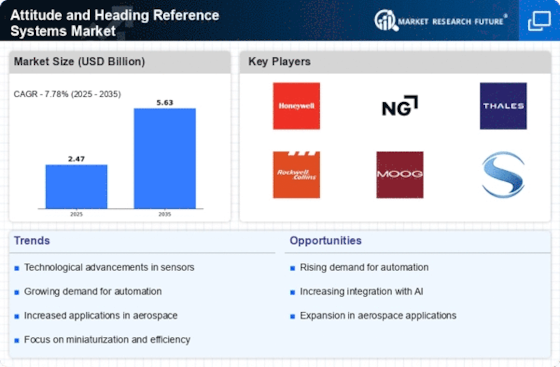
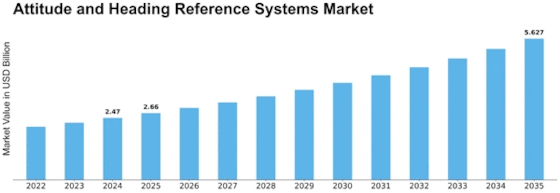
As per Market Research Future analysis, the Attitude and Heading Reference Systems Market was estimated at 2.468 USD Billion in 2024. The Attitude and Heading Reference Systems industry is projected to grow from 2.66 USD Billion in 2025 to 5.627 USD Billion by 2035, exhibiting a compound annual growth rate (CAGR) of 7.78% during the forecast period 2025 - 2035

Key Market Trends & Highlights

The Attitude and Heading Reference Systems Market is poised for substantial growth driven by technological advancements and increasing automation demands.

  • North America remains the largest market for attitude and heading reference systems, reflecting its robust aerospace and defense sectors.
  • The Asia-Pacific region is emerging as the fastest-growing market, fueled by rapid industrialization and technological adoption.
  • Micro-electromechanical systems dominate the market, while fiber optic gyroscopes are gaining traction as the fastest-growing segment.
  • Key market drivers include technological advancements in navigation systems and the rising demand for automation across various sectors.

Market Size & Forecast

2024 Market Size 2.468 (USD Billion)
2035 Market Size 5.627 (USD Billion)
CAGR (2025 - 2035) 7.78%
Largest Regional Market Share in 2024 North America

Major Players

Honeywell (US), Northrop Grumman (US), Thales Group (FR), Rockwell Collins (US), Moog Inc. (US), Safran (FR), Leonardo S.p.A. (IT), Boeing (US), General Dynamics (US)

Market Trends

The Attitude and Heading Reference Systems Market is currently experiencing a notable evolution, driven by advancements in technology and increasing demand across various sectors. The integration of sophisticated sensors and algorithms has enhanced the accuracy and reliability of these systems, making them indispensable in aviation, maritime, and automotive applications. As industries strive for greater efficiency and safety, the adoption of these systems appears to be on the rise, reflecting a broader trend towards automation and precision in navigation. Furthermore, the growing emphasis on unmanned aerial vehicles and autonomous systems is likely to propel the market forward, as these platforms require advanced attitude and heading reference capabilities to operate effectively. In addition to technological advancements, regulatory frameworks and safety standards are evolving, which may influence the Attitude and Heading Reference Systems Market. Manufacturers are increasingly focusing on compliance with stringent regulations, which could lead to innovations in system design and functionality. The competitive landscape is also shifting, with new entrants emerging alongside established players, fostering a dynamic environment that encourages continuous improvement. Overall, the market appears poised for growth, driven by a confluence of technological innovation, regulatory changes, and the increasing need for reliable navigation solutions across diverse applications.

Technological Advancements

Recent innovations in sensor technology and data processing algorithms are enhancing the performance of attitude and heading reference systems. These advancements are likely to improve accuracy and reliability, making systems more appealing to various industries.

Increased Demand for Automation

The rising trend towards automation in sectors such as aviation and maritime is driving the need for sophisticated attitude and heading reference systems. As industries seek to enhance operational efficiency, the demand for these systems is expected to grow.

Regulatory Compliance and Safety Standards

Evolving regulatory frameworks are influencing the design and functionality of attitude and heading reference systems. Manufacturers are focusing on meeting stringent safety standards, which may lead to innovations and improvements in system capabilities.

Attitude Heading Reference Systems Market Market Drivers

Growing Military and Defense Applications

The Attitude and Heading Reference Systems Market is experiencing growth driven by increasing military and defense applications. The demand for advanced navigation and guidance systems in military aircraft, naval vessels, and unmanned aerial vehicles (UAVs) is on the rise. These applications require highly accurate and reliable attitude and heading reference systems to ensure mission success and operational safety. With defense budgets expanding in various regions, investments in advanced AHRS technologies are expected to increase. This trend suggests a promising outlook for the market, as defense contractors seek to enhance the capabilities of their platforms through superior navigation systems.

Regulatory Compliance and Safety Standards

The Attitude and Heading Reference Systems Market is significantly influenced by stringent regulatory compliance and safety standards imposed by various governing bodies. These regulations necessitate the implementation of high-quality attitude and heading reference systems in critical applications such as aviation and maritime navigation. Compliance with standards set by organizations like the Federal Aviation Administration (FAA) and the International Maritime Organization (IMO) is essential for manufacturers. As safety becomes a paramount concern, the demand for reliable AHRS solutions is expected to rise. The market is likely to see an increase in investments aimed at meeting these regulatory requirements, which could lead to a more robust and competitive landscape.

Technological Advancements in Navigation Systems

The Attitude and Heading Reference Systems Market is experiencing a surge in technological advancements, particularly in sensor technology and data processing capabilities. Innovations such as micro-electromechanical systems (MEMS) and fiber optic gyroscopes are enhancing the accuracy and reliability of attitude and heading reference systems. These advancements are crucial for applications in aviation, maritime, and automotive sectors, where precision is paramount. The integration of artificial intelligence and machine learning algorithms into these systems is also gaining traction, allowing for real-time data analysis and improved decision-making. As a result, the market is projected to grow significantly, with estimates suggesting a compound annual growth rate of over 6% in the coming years.

Increased Demand for Automation in Various Sectors

The Attitude and Heading Reference Systems Market is witnessing a notable increase in demand for automation across various sectors, including aerospace, defense, and automotive. This trend is driven by the need for enhanced operational efficiency and safety. Automated systems require reliable attitude and heading reference data to function effectively, thereby propelling the demand for advanced AHRS solutions. The aerospace sector, in particular, is investing heavily in automation technologies, with forecasts indicating that the market for automated flight systems could reach billions in revenue by 2027. This growing reliance on automation is likely to further stimulate the AHRS market, as manufacturers seek to provide systems that meet the evolving needs of automated operations.

Rising Demand for Enhanced User Experience in Aviation

The Attitude and Heading Reference Systems Market is also being propelled by the rising demand for enhanced user experience in aviation. Airlines and aircraft manufacturers are increasingly focusing on passenger comfort and safety, which necessitates the integration of advanced attitude and heading reference systems. These systems play a crucial role in improving flight stability and navigation accuracy, thereby contributing to a smoother flying experience. As the aviation industry continues to evolve, the emphasis on user experience is likely to drive investments in innovative AHRS solutions. Market analysts predict that this trend will contribute to a steady growth trajectory for the AHRS market, with a focus on developing systems that meet the expectations of modern travelers.

Market Segment Insights

By Technology: Micro-electromechanical Systems (Largest) vs. Fiber Optic Gyroscope (Fastest-Growing)

In the Attitude and Heading Reference Systems Market, the segment values are witnessing varied market share distributions. Micro-electromechanical Systems (MEMS) hold the largest share, benefitting from their compact size, reliability, and cost-effectiveness, which has led to widespread adoption in various applications. Conversely, Fiber Optic Gyroscopes, while currently smaller in market share, are rapidly gaining traction due to their precision and reduced drift over time, making them crucial for advanced navigational and aerospace applications.

Technology: MEMS (Dominant) vs. Fiber Optic Gyroscope (Emerging)

Micro-electromechanical Systems (MEMS) are established as the dominant technology in the market, favored for their lightweight design and affordability, making them ideal for commercial and consumer applications. On the other hand, Fiber Optic Gyroscopes are considered the emerging technology, especially within aerospace and defense sectors, due to their superior accuracy and reliability in challenging environments. Both technologies are pivotal in enhancing sensor performance, yet they target different market needs; MEMS focuses on widespread adoption while Fiber Optic Gyroscopes leverage cutting-edge precision capabilities, carving a niche in high-stakes scenarios.

By Application: Aerospace (Largest) vs. Automotive (Fastest-Growing)

In the Attitude and Heading Reference Systems market, the application segment is primarily dominated by the aerospace sector, which holds a substantial share due to its critical need for precise navigation and orientation systems. The automotive sector follows, demonstrating an increasing adoption as more vehicles integrate advanced driver-assistance systems (ADAS) that rely on these reference systems for accurate positioning and navigation. Meanwhile, the marine and consumer electronics segments represent smaller portions of the market, gradually expanding in alignment with innovations in navigation technology and consumer demand for enhanced guidance systems. Growth trends within the application segment highlight an upward trajectory, particularly for automotive systems, which are experiencing significant advancements in autonomous driving technologies. The aerospace application continues to thrive due to rigorous safety and regulatory requirements driving the need for accurate attitude and heading reference systems. Furthermore, the marine sector is witnessing a boost from the increase in leisure boating and commercial shipping, while consumer electronics undergo a transformation with the integration of smart navigation features that appeal to tech-savvy users.

Aerospace (Dominant) vs. Automotive (Emerging)

Aerospace applications of attitude and heading reference systems are considered the dominant segment due to the industry's high standards for performance and reliability. Systems used in aircraft navigation involve advanced technology that ensures appropriate orientation during flight, which is critical for safety and operational efficiency. Aerospace systems often undergo rigorous testing and certification processes, resulting in high-value products that prioritize performance over cost. On the contrary, automotive applications represent an emerging market, rapidly evolving with the rise of smart vehicles. These systems are being integrated into various automotive technologies, such as navigation and control systems, driven by increasing consumer demand for convenience and safety. While the automotive segment is growing at a faster rate owing to innovations in autonomous systems, it still faces challenges related to standardization and safety regulations in comparison to the well-established practices of the aerospace sector.

By Type: 3-Axis (Largest) vs. 2-Axis (Fastest-Growing)

In the Attitude and Heading Reference Systems Market, the segment distribution shows that 3-Axis systems hold the largest market share, dominating the landscape due to their comprehensive motion sensing capabilities. Meanwhile, 2-Axis systems are rapidly gaining traction, representing the fastest-growing segment as they offer a more cost-effective solution for applications requiring less complex orientation data. This trend highlights a broader preference for simplicity and efficiency in various consumer electronics and aerospace applications.

2-Axis (Emerging) vs. 3-Axis (Dominant)

The 3-Axis segment stands as a dominant force within the Attitude and Heading Reference Systems Market, known for its robust capabilities in providing accurate positioning and orientation solutions across various applications such as aviation, marine, and robotics. On the other hand, the 2-Axis segment is emerging with significant growth, driven by its affordability and simplicity, making it particularly appealing for integration in consumer electronics and smaller drones. While 3-Axis systems are preferred for precision-critical environments, the growing demand for lower-cost solutions is propelling 2-Axis systems into the spotlight as dependable alternatives.

By End Use: Commercial (Largest) vs. Military (Fastest-Growing)

The Attitude and Heading Reference Systems Market is characterized by a diverse end-use segment that includes commercial, military, and civil applications. Among these, the commercial sector holds the largest share, driven by the high demand for advanced navigation and control systems in commercial aviation and maritime industries. The military sector, while smaller, is rapidly growing due to increased defense budgets and rising geopolitical tensions, leading to an expanded focus on advanced aerospace and defense capabilities. This trend is reinforcing the military's position in the market as a prominent segment.

Commercial (Dominant) vs. Military (Emerging)

The commercial segment of the Attitude and Heading Reference Systems Market is the dominant player, fueled by the surge in air travel and the ongoing modernization of naval fleets that require precise navigation systems. This segment's growth is supported by advancements in technology and increasing investments from the aviation sector. In contrast, the military segment, though currently emerging in comparison, is gaining momentum rapidly. Enhanced military operations and strategic initiatives are demanding more sophisticated attitude and heading systems, thus fueling innovation and development within this sector. The emerging military segment is anticipated to leverage new technologies to address its unique operational requirements, further driving its growth.

Get more detailed insights about Attitude and Heading Reference Systems Market Research Report - Global Forecast till 2035

Regional Insights

North America held a majority share with a valuation of 0.95 USD Billion in 2023 and is anticipated to further expand to 1.85 USD Billion by 2032, driven by advanced aerospace and defense applications. Europe followed closely, valued at 0.75 USD Billion in 2023, with a growth trajectory leading to 1.55 USD Billion by 2032, reflecting strong demand in commercial aviation.

In APAC, the market was valued at 0.45 USD Billion in 2023, with the potential to reach 1.0 USD Billion by 2032, supported by increasing investments in emerging technologies and rising aerospace demand.

South America, being the least dominant with a valuation of 0.05 USD Billion in 2023, is set for minor growth to 0.1 USD Billion by 2032, whereas the MEA region, valued at 0.09 USD Billion in 2023, also sees an increase to 0.2 USD Billion by 2032, primarily due to defense upgrades.

Source Primary Research, Secondary Research, Market Research Future Database and Analyst Review

Key Players and Competitive Insights

The Attitude and Heading Reference Systems Market is characterized by rapid technological advancements and evolving customer demands. With the increasing reliance on precise navigation and accurate positioning across various industries, key players in the market are engaged in improving their product offerings.Competitive insights reveal a focus on innovation, enhanced functionalities, and integration capabilities, which are driving companies to differentiate themselves in this highly dynamic environment. Market participants are adopting various strategies such as partnerships, mergers, and acquisitions, along with a strong emphasis on research and development initiatives to remain competitive and cater to the needs of diverse applications, including aerospace, marine, and defense sectors.Airmar Technology has established a notable presence in the Attitude and Heading Reference Systems Market by leveraging its strong engineering expertise and commitment to customer service. The company is recognized for its innovative sensor technologies that provide accurate attitude and heading data for various applications.Airmar Technology emphasizes reliability and performance in its product offerings, ensuring that its systems are robust enough to withstand challenging environmental conditions.This focus on quality, coupled with a reputation for technical support, provides Airmar Technology with a competitive advantage, as customers increasingly prioritize dependable systems within their operational frameworks. Additionally, Airmar's adaptability to industry trends and tailored solutions further solidifies its position in the evolving landscape of attitude and heading reference systems.Moog, on the other hand, is another significant player in the Attitude and Heading Reference Systems Market, known for its advanced engineering solutions and high-performance systems. The company cultivates strong relationships with its customers, which helps in understanding specific requirements and delivering customized solutions that address unique operational challenges.Moog specializes in providing sophisticated inertial sensors and control systems that ensure superior accuracy and reliability. Its products are widely used in various applications, ensuring Moog's presence across multiple sectors such as aerospace, defense, and industrial markets.With a reputation for cutting-edge technology and exceptional quality, Moog stands as a formidable competitor in the market, successfully addressing the increasing demands for precision navigation and stabilization solutions.

Key Companies in the Attitude Heading Reference Systems Market include

Industry Developments

The Attitude and Heading Reference Systems Market has seen notable developments, particularly with advancements in technology and increasing demand from various sectors, including aerospace and defense.

Companies like Honeywell and Collins Aerospace are pushing for enhanced integration of advanced sensors and algorithms in their products, which aids in improving navigational accuracy and reliability. The market is also benefiting from growth in unmanned aerial vehicles (UAVs), where firms such as Northrop Grumman and Sierra Nevada Corporation are becoming significant players by focusing on lightweight and efficient attitude and heading reference systems.

Recent mergers and acquisitions have included collaborations aimed at strengthening technological capabilities, with organizations like Moog and KVH Industries exploring partnerships that foster innovation. The overall market valuation is rising, with companies like VectorNav Technologies and Thales experiencing increased investments, reflecting growing confidence in the sector.

This bolstering of capabilities and strategic alliances among key players like Airmar Technology, Rockwell Collins, and Mistral Solutions contributes to the dynamic landscape of the Attitude and Heading Reference Systems Market, indicating a robust upward trajectory in both technological advancement and market expansion.

Future Outlook

Attitude Heading Reference Systems Market Future Outlook

The Attitude and Heading Reference Systems Market is projected to grow at a 7.78% CAGR from 2025 to 2035, driven by advancements in aerospace technology and increasing demand for automation.

New opportunities lie in:

  • Development of compact, lightweight AHRS for UAV applications.
  • Integration of AHRS with AI for enhanced navigation systems.
  • Expansion into emerging markets with tailored AHRS solutions.

By 2035, the market is expected to achieve robust growth, positioning itself as a leader in navigation technology.

Market Segmentation

Attitude Heading Reference Systems Market Type Outlook

  • 2-Axis
  • 3-Axis
  • 4-Axis

Attitude Heading Reference Systems Market End Use Outlook

  • Commercial
  • Military
  • Civil

Attitude Heading Reference Systems Market Technology Outlook

  • Micro-electromechanical Systems
  • Fiber Optic Gyroscope
  • Ring Laser Gyroscope
  • Inertial Measurement Unit

Attitude Heading Reference Systems Market Application Outlook

  • Aerospace
  • Automotive
  • Marine
  • Consumer Electronics

Report Scope

MARKET SIZE 2024 2.468(USD Billion)
MARKET SIZE 2025 2.66(USD Billion)
MARKET SIZE 2035 5.627(USD Billion)
COMPOUND ANNUAL GROWTH RATE (CAGR) 7.78% (2025 - 2035)
REPORT COVERAGE Revenue Forecast, Competitive Landscape, Growth Factors, and Trends
BASE YEAR 2024
Market Forecast Period 2025 - 2035
Historical Data 2019 - 2024
Market Forecast Units USD Billion
Key Companies Profiled Honeywell (US), Northrop Grumman (US), Thales Group (FR), Rockwell Collins (US), Moog Inc. (US), Safran (FR), Leonardo S.p.A. (IT), Boeing (US), General Dynamics (US)
Segments Covered Technology, Application, Type, End Use, Regional
Key Market Opportunities Integration of advanced sensor technologies enhances accuracy in the Attitude and Heading Reference Systems Market.
Key Market Dynamics Technological advancements and regulatory changes drive innovation and competition in the Attitude and Heading Reference Systems market.
Countries Covered North America, Europe, APAC, South America, MEA

FAQs

What is the projected market valuation for the Attitude and Heading Reference Systems Market in 2035?

<p>The projected market valuation for the Attitude and Heading Reference Systems Market in 2035 is 5.627 USD Billion.</p>

What was the overall market valuation for the Attitude and Heading Reference Systems Market in 2024?

<p>The overall market valuation for the Attitude and Heading Reference Systems Market in 2024 was 2.468 USD Billion.</p>

What is the expected CAGR for the Attitude and Heading Reference Systems Market during the forecast period 2025 - 2035?

<p>The expected CAGR for the Attitude and Heading Reference Systems Market during the forecast period 2025 - 2035 is 7.78%.</p>

Which companies are considered key players in the Attitude and Heading Reference Systems Market?

<p>Key players in the Attitude and Heading Reference Systems Market include Honeywell, Northrop Grumman, Thales Group, Rockwell Collins, Moog Inc., Safran, Leonardo S.p.A., Boeing, and General Dynamics.</p>

What are the main technology segments within the Attitude and Heading Reference Systems Market?

<p>The main technology segments include Micro-electromechanical Systems, Fiber Optic Gyroscope, Ring Laser Gyroscope, and Inertial Measurement Unit.</p>

How did the Micro-electromechanical Systems segment perform in 2024?

<p>In 2024, the Micro-electromechanical Systems segment was valued at 0.74 USD Billion and is projected to reach 1.7 USD Billion.</p>

What is the valuation of the Aerospace application segment in 2024?

<p>The Aerospace application segment was valued at 0.74 USD Billion in 2024 and is expected to grow to 1.7 USD Billion.</p>

What are the projected values for the 3-Axis type segment by 2035?

<p>The 3-Axis type segment is projected to grow from 1.0244 USD Billion in 2024 to 2.4244 USD Billion by 2035.</p>

What is the expected growth for the Civil end-use segment from 2024 to 2035?

<p>The Civil end-use segment is expected to grow from 0.988 USD Billion in 2024 to 2.147 USD Billion by 2035.</p>

How does the performance of the Fiber Optic Gyroscope segment compare to other segments?

<p>The Fiber Optic Gyroscope segment was valued at 0.62 USD Billion in 2024 and is projected to reach 1.4 USD Billion, indicating robust growth compared to other segments.</p>

  1. SECTION I: EXECUTIVE SUMMARY AND KEY HIGHLIGHTS
    1. | 1.1 EXECUTIVE SUMMARY
    2. | | 1.1.1 Market Overview
    3. | | 1.1.2 Key Findings
    4. | | 1.1.3 Market Segmentation
    5. | | 1.1.4 Competitive Landscape
    6. | | 1.1.5 Challenges and Opportunities
    7. | | 1.1.6 Future Outlook
  2. SECTION II: SCOPING, METHODOLOGY AND MARKET STRUCTURE
    1. | 2.1 MARKET INTRODUCTION
    2. | | 2.1.1 Definition
    3. | | 2.1.2 Scope of the study
    4. | | | 2.1.2.1 Research Objective
    5. | | | 2.1.2.2 Assumption
    6. | | | 2.1.2.3 Limitations
    7. | 2.2 RESEARCH METHODOLOGY
    8. | | 2.2.1 Overview
    9. | | 2.2.2 Data Mining
    10. | | 2.2.3 Secondary Research
    11. | | 2.2.4 Primary Research
    12. | | | 2.2.4.1 Primary Interviews and Information Gathering Process
    13. | | | 2.2.4.2 Breakdown of Primary Respondents
    14. | | 2.2.5 Forecasting Model
    15. | | 2.2.6 Market Size Estimation
    16. | | | 2.2.6.1 Bottom-Up Approach
    17. | | | 2.2.6.2 Top-Down Approach
    18. | | 2.2.7 Data Triangulation
    19. | | 2.2.8 Validation
  3. SECTION III: QUALITATIVE ANALYSIS
    1. | 3.1 MARKET DYNAMICS
    2. | | 3.1.1 Overview
    3. | | 3.1.2 Drivers
    4. | | 3.1.3 Restraints
    5. | | 3.1.4 Opportunities
    6. | 3.2 MARKET FACTOR ANALYSIS
    7. | | 3.2.1 Value chain Analysis
    8. | | 3.2.2 Porter's Five Forces Analysis
    9. | | | 3.2.2.1 Bargaining Power of Suppliers
    10. | | | 3.2.2.2 Bargaining Power of Buyers
    11. | | | 3.2.2.3 Threat of New Entrants
    12. | | | 3.2.2.4 Threat of Substitutes
    13. | | | 3.2.2.5 Intensity of Rivalry
    14. | | 3.2.3 COVID-19 Impact Analysis
    15. | | | 3.2.3.1 Market Impact Analysis
    16. | | | 3.2.3.2 Regional Impact
    17. | | | 3.2.3.3 Opportunity and Threat Analysis
  4. SECTION IV: QUANTITATIVE ANALYSIS
    1. | 4.1 Aerospace & Defense, BY Technology (USD Billion)
    2. | | 4.1.1 Micro-electromechanical Systems
    3. | | 4.1.2 Fiber Optic Gyroscope
    4. | | 4.1.3 Ring Laser Gyroscope
    5. | | 4.1.4 Inertial Measurement Unit
    6. | 4.2 Aerospace & Defense, BY Application (USD Billion)
    7. | | 4.2.1 Aerospace
    8. | | 4.2.2 Automotive
    9. | | 4.2.3 Marine
    10. | | 4.2.4 Consumer Electronics
    11. | 4.3 Aerospace & Defense, BY Type (USD Billion)
    12. | | 4.3.1 2-Axis
    13. | | 4.3.2 3-Axis
    14. | | 4.3.3 4-Axis
    15. | 4.4 Aerospace & Defense, BY End Use (USD Billion)
    16. | | 4.4.1 Commercial
    17. | | 4.4.2 Military
    18. | | 4.4.3 Civil
    19. | 4.5 Aerospace & Defense, BY Region (USD Billion)
    20. | | 4.5.1 North America
    21. | | | 4.5.1.1 US
    22. | | | 4.5.1.2 Canada
    23. | | 4.5.2 Europe
    24. | | | 4.5.2.1 Germany
    25. | | | 4.5.2.2 UK
    26. | | | 4.5.2.3 France
    27. | | | 4.5.2.4 Russia
    28. | | | 4.5.2.5 Italy
    29. | | | 4.5.2.6 Spain
    30. | | | 4.5.2.7 Rest of Europe
    31. | | 4.5.3 APAC
    32. | | | 4.5.3.1 China
    33. | | | 4.5.3.2 India
    34. | | | 4.5.3.3 Japan
    35. | | | 4.5.3.4 South Korea
    36. | | | 4.5.3.5 Malaysia
    37. | | | 4.5.3.6 Thailand
    38. | | | 4.5.3.7 Indonesia
    39. | | | 4.5.3.8 Rest of APAC
    40. | | 4.5.4 South America
    41. | | | 4.5.4.1 Brazil
    42. | | | 4.5.4.2 Mexico
    43. | | | 4.5.4.3 Argentina
    44. | | | 4.5.4.4 Rest of South America
    45. | | 4.5.5 MEA
    46. | | | 4.5.5.1 GCC Countries
    47. | | | 4.5.5.2 South Africa
    48. | | | 4.5.5.3 Rest of MEA
  5. SECTION V: COMPETITIVE ANALYSIS
    1. | 5.1 Competitive Landscape
    2. | | 5.1.1 Overview
    3. | | 5.1.2 Competitive Analysis
    4. | | 5.1.3 Market share Analysis
    5. | | 5.1.4 Major Growth Strategy in the Aerospace & Defense
    6. | | 5.1.5 Competitive Benchmarking
    7. | | 5.1.6 Leading Players in Terms of Number of Developments in the Aerospace & Defense
    8. | | 5.1.7 Key developments and growth strategies
    9. | | | 5.1.7.1 New Product Launch/Service Deployment
    10. | | | 5.1.7.2 Merger & Acquisitions
    11. | | | 5.1.7.3 Joint Ventures
    12. | | 5.1.8 Major Players Financial Matrix
    13. | | | 5.1.8.1 Sales and Operating Income
    14. | | | 5.1.8.2 Major Players R&D Expenditure. 2023
    15. | 5.2 Company Profiles
    16. | | 5.2.1 Honeywell (US)
    17. | | | 5.2.1.1 Financial Overview
    18. | | | 5.2.1.2 Products Offered
    19. | | | 5.2.1.3 Key Developments
    20. | | | 5.2.1.4 SWOT Analysis
    21. | | | 5.2.1.5 Key Strategies
    22. | | 5.2.2 Northrop Grumman (US)
    23. | | | 5.2.2.1 Financial Overview
    24. | | | 5.2.2.2 Products Offered
    25. | | | 5.2.2.3 Key Developments
    26. | | | 5.2.2.4 SWOT Analysis
    27. | | | 5.2.2.5 Key Strategies
    28. | | 5.2.3 Thales Group (FR)
    29. | | | 5.2.3.1 Financial Overview
    30. | | | 5.2.3.2 Products Offered
    31. | | | 5.2.3.3 Key Developments
    32. | | | 5.2.3.4 SWOT Analysis
    33. | | | 5.2.3.5 Key Strategies
    34. | | 5.2.4 Rockwell Collins (US)
    35. | | | 5.2.4.1 Financial Overview
    36. | | | 5.2.4.2 Products Offered
    37. | | | 5.2.4.3 Key Developments
    38. | | | 5.2.4.4 SWOT Analysis
    39. | | | 5.2.4.5 Key Strategies
    40. | | 5.2.5 Moog Inc. (US)
    41. | | | 5.2.5.1 Financial Overview
    42. | | | 5.2.5.2 Products Offered
    43. | | | 5.2.5.3 Key Developments
    44. | | | 5.2.5.4 SWOT Analysis
    45. | | | 5.2.5.5 Key Strategies
    46. | | 5.2.6 Safran (FR)
    47. | | | 5.2.6.1 Financial Overview
    48. | | | 5.2.6.2 Products Offered
    49. | | | 5.2.6.3 Key Developments
    50. | | | 5.2.6.4 SWOT Analysis
    51. | | | 5.2.6.5 Key Strategies
    52. | | 5.2.7 Leonardo S.p.A. (IT)
    53. | | | 5.2.7.1 Financial Overview
    54. | | | 5.2.7.2 Products Offered
    55. | | | 5.2.7.3 Key Developments
    56. | | | 5.2.7.4 SWOT Analysis
    57. | | | 5.2.7.5 Key Strategies
    58. | | 5.2.8 Boeing (US)
    59. | | | 5.2.8.1 Financial Overview
    60. | | | 5.2.8.2 Products Offered
    61. | | | 5.2.8.3 Key Developments
    62. | | | 5.2.8.4 SWOT Analysis
    63. | | | 5.2.8.5 Key Strategies
    64. | | 5.2.9 General Dynamics (US)
    65. | | | 5.2.9.1 Financial Overview
    66. | | | 5.2.9.2 Products Offered
    67. | | | 5.2.9.3 Key Developments
    68. | | | 5.2.9.4 SWOT Analysis
    69. | | | 5.2.9.5 Key Strategies
    70. | 5.3 Appendix
    71. | | 5.3.1 References
    72. | | 5.3.2 Related Reports
  6. LIST OF FIGURES
    1. | 6.1 MARKET SYNOPSIS
    2. | 6.2 NORTH AMERICA MARKET ANALYSIS
    3. | 6.3 US MARKET ANALYSIS BY TECHNOLOGY
    4. | 6.4 US MARKET ANALYSIS BY APPLICATION
    5. | 6.5 US MARKET ANALYSIS BY TYPE
    6. | 6.6 US MARKET ANALYSIS BY END USE
    7. | 6.7 CANADA MARKET ANALYSIS BY TECHNOLOGY
    8. | 6.8 CANADA MARKET ANALYSIS BY APPLICATION
    9. | 6.9 CANADA MARKET ANALYSIS BY TYPE
    10. | 6.10 CANADA MARKET ANALYSIS BY END USE
    11. | 6.11 EUROPE MARKET ANALYSIS
    12. | 6.12 GERMANY MARKET ANALYSIS BY TECHNOLOGY
    13. | 6.13 GERMANY MARKET ANALYSIS BY APPLICATION
    14. | 6.14 GERMANY MARKET ANALYSIS BY TYPE
    15. | 6.15 GERMANY MARKET ANALYSIS BY END USE
    16. | 6.16 UK MARKET ANALYSIS BY TECHNOLOGY
    17. | 6.17 UK MARKET ANALYSIS BY APPLICATION
    18. | 6.18 UK MARKET ANALYSIS BY TYPE
    19. | 6.19 UK MARKET ANALYSIS BY END USE
    20. | 6.20 FRANCE MARKET ANALYSIS BY TECHNOLOGY
    21. | 6.21 FRANCE MARKET ANALYSIS BY APPLICATION
    22. | 6.22 FRANCE MARKET ANALYSIS BY TYPE
    23. | 6.23 FRANCE MARKET ANALYSIS BY END USE
    24. | 6.24 RUSSIA MARKET ANALYSIS BY TECHNOLOGY
    25. | 6.25 RUSSIA MARKET ANALYSIS BY APPLICATION
    26. | 6.26 RUSSIA MARKET ANALYSIS BY TYPE
    27. | 6.27 RUSSIA MARKET ANALYSIS BY END USE
    28. | 6.28 ITALY MARKET ANALYSIS BY TECHNOLOGY
    29. | 6.29 ITALY MARKET ANALYSIS BY APPLICATION
    30. | 6.30 ITALY MARKET ANALYSIS BY TYPE
    31. | 6.31 ITALY MARKET ANALYSIS BY END USE
    32. | 6.32 SPAIN MARKET ANALYSIS BY TECHNOLOGY
    33. | 6.33 SPAIN MARKET ANALYSIS BY APPLICATION
    34. | 6.34 SPAIN MARKET ANALYSIS BY TYPE
    35. | 6.35 SPAIN MARKET ANALYSIS BY END USE
    36. | 6.36 REST OF EUROPE MARKET ANALYSIS BY TECHNOLOGY
    37. | 6.37 REST OF EUROPE MARKET ANALYSIS BY APPLICATION
    38. | 6.38 REST OF EUROPE MARKET ANALYSIS BY TYPE
    39. | 6.39 REST OF EUROPE MARKET ANALYSIS BY END USE
    40. | 6.40 APAC MARKET ANALYSIS
    41. | 6.41 CHINA MARKET ANALYSIS BY TECHNOLOGY
    42. | 6.42 CHINA MARKET ANALYSIS BY APPLICATION
    43. | 6.43 CHINA MARKET ANALYSIS BY TYPE
    44. | 6.44 CHINA MARKET ANALYSIS BY END USE
    45. | 6.45 INDIA MARKET ANALYSIS BY TECHNOLOGY
    46. | 6.46 INDIA MARKET ANALYSIS BY APPLICATION
    47. | 6.47 INDIA MARKET ANALYSIS BY TYPE
    48. | 6.48 INDIA MARKET ANALYSIS BY END USE
    49. | 6.49 JAPAN MARKET ANALYSIS BY TECHNOLOGY
    50. | 6.50 JAPAN MARKET ANALYSIS BY APPLICATION
    51. | 6.51 JAPAN MARKET ANALYSIS BY TYPE
    52. | 6.52 JAPAN MARKET ANALYSIS BY END USE
    53. | 6.53 SOUTH KOREA MARKET ANALYSIS BY TECHNOLOGY
    54. | 6.54 SOUTH KOREA MARKET ANALYSIS BY APPLICATION
    55. | 6.55 SOUTH KOREA MARKET ANALYSIS BY TYPE
    56. | 6.56 SOUTH KOREA MARKET ANALYSIS BY END USE
    57. | 6.57 MALAYSIA MARKET ANALYSIS BY TECHNOLOGY
    58. | 6.58 MALAYSIA MARKET ANALYSIS BY APPLICATION
    59. | 6.59 MALAYSIA MARKET ANALYSIS BY TYPE
    60. | 6.60 MALAYSIA MARKET ANALYSIS BY END USE
    61. | 6.61 THAILAND MARKET ANALYSIS BY TECHNOLOGY
    62. | 6.62 THAILAND MARKET ANALYSIS BY APPLICATION
    63. | 6.63 THAILAND MARKET ANALYSIS BY TYPE
    64. | 6.64 THAILAND MARKET ANALYSIS BY END USE
    65. | 6.65 INDONESIA MARKET ANALYSIS BY TECHNOLOGY
    66. | 6.66 INDONESIA MARKET ANALYSIS BY APPLICATION
    67. | 6.67 INDONESIA MARKET ANALYSIS BY TYPE
    68. | 6.68 INDONESIA MARKET ANALYSIS BY END USE
    69. | 6.69 REST OF APAC MARKET ANALYSIS BY TECHNOLOGY
    70. | 6.70 REST OF APAC MARKET ANALYSIS BY APPLICATION
    71. | 6.71 REST OF APAC MARKET ANALYSIS BY TYPE
    72. | 6.72 REST OF APAC MARKET ANALYSIS BY END USE
    73. | 6.73 SOUTH AMERICA MARKET ANALYSIS
    74. | 6.74 BRAZIL MARKET ANALYSIS BY TECHNOLOGY
    75. | 6.75 BRAZIL MARKET ANALYSIS BY APPLICATION
    76. | 6.76 BRAZIL MARKET ANALYSIS BY TYPE
    77. | 6.77 BRAZIL MARKET ANALYSIS BY END USE
    78. | 6.78 MEXICO MARKET ANALYSIS BY TECHNOLOGY
    79. | 6.79 MEXICO MARKET ANALYSIS BY APPLICATION
    80. | 6.80 MEXICO MARKET ANALYSIS BY TYPE
    81. | 6.81 MEXICO MARKET ANALYSIS BY END USE
    82. | 6.82 ARGENTINA MARKET ANALYSIS BY TECHNOLOGY
    83. | 6.83 ARGENTINA MARKET ANALYSIS BY APPLICATION
    84. | 6.84 ARGENTINA MARKET ANALYSIS BY TYPE
    85. | 6.85 ARGENTINA MARKET ANALYSIS BY END USE
    86. | 6.86 REST OF SOUTH AMERICA MARKET ANALYSIS BY TECHNOLOGY
    87. | 6.87 REST OF SOUTH AMERICA MARKET ANALYSIS BY APPLICATION
    88. | 6.88 REST OF SOUTH AMERICA MARKET ANALYSIS BY TYPE
    89. | 6.89 REST OF SOUTH AMERICA MARKET ANALYSIS BY END USE
    90. | 6.90 MEA MARKET ANALYSIS
    91. | 6.91 GCC COUNTRIES MARKET ANALYSIS BY TECHNOLOGY
    92. | 6.92 GCC COUNTRIES MARKET ANALYSIS BY APPLICATION
    93. | 6.93 GCC COUNTRIES MARKET ANALYSIS BY TYPE
    94. | 6.94 GCC COUNTRIES MARKET ANALYSIS BY END USE
    95. | 6.95 SOUTH AFRICA MARKET ANALYSIS BY TECHNOLOGY
    96. | 6.96 SOUTH AFRICA MARKET ANALYSIS BY APPLICATION
    97. | 6.97 SOUTH AFRICA MARKET ANALYSIS BY TYPE
    98. | 6.98 SOUTH AFRICA MARKET ANALYSIS BY END USE
    99. | 6.99 REST OF MEA MARKET ANALYSIS BY TECHNOLOGY
    100. | 6.100 REST OF MEA MARKET ANALYSIS BY APPLICATION
    101. | 6.101 REST OF MEA MARKET ANALYSIS BY TYPE
    102. | 6.102 REST OF MEA MARKET ANALYSIS BY END USE
    103. | 6.103 KEY BUYING CRITERIA OF AEROSPACE & DEFENSE
    104. | 6.104 RESEARCH PROCESS OF MRFR
    105. | 6.105 DRO ANALYSIS OF AEROSPACE & DEFENSE
    106. | 6.106 DRIVERS IMPACT ANALYSIS: AEROSPACE & DEFENSE
    107. | 6.107 RESTRAINTS IMPACT ANALYSIS: AEROSPACE & DEFENSE
    108. | 6.108 SUPPLY / VALUE CHAIN: AEROSPACE & DEFENSE
    109. | 6.109 AEROSPACE & DEFENSE, BY TECHNOLOGY, 2024 (% SHARE)
    110. | 6.110 AEROSPACE & DEFENSE, BY TECHNOLOGY, 2024 TO 2035 (USD Billion)
    111. | 6.111 AEROSPACE & DEFENSE, BY APPLICATION, 2024 (% SHARE)
    112. | 6.112 AEROSPACE & DEFENSE, BY APPLICATION, 2024 TO 2035 (USD Billion)
    113. | 6.113 AEROSPACE & DEFENSE, BY TYPE, 2024 (% SHARE)
    114. | 6.114 AEROSPACE & DEFENSE, BY TYPE, 2024 TO 2035 (USD Billion)
    115. | 6.115 AEROSPACE & DEFENSE, BY END USE, 2024 (% SHARE)
    116. | 6.116 AEROSPACE & DEFENSE, BY END USE, 2024 TO 2035 (USD Billion)
    117. | 6.117 BENCHMARKING OF MAJOR COMPETITORS
  7. LIST OF TABLES
    1. | 7.1 LIST OF ASSUMPTIONS
    2. | | 7.1.1
    3. | 7.2 North America MARKET SIZE ESTIMATES; FORECAST
    4. | | 7.2.1 BY TECHNOLOGY, 2025-2035 (USD Billion)
    5. | | 7.2.2 BY APPLICATION, 2025-2035 (USD Billion)
    6. | | 7.2.3 BY TYPE, 2025-2035 (USD Billion)
    7. | | 7.2.4 BY END USE, 2025-2035 (USD Billion)
    8. | 7.3 US MARKET SIZE ESTIMATES; FORECAST
    9. | | 7.3.1 BY TECHNOLOGY, 2025-2035 (USD Billion)
    10. | | 7.3.2 BY APPLICATION, 2025-2035 (USD Billion)
    11. | | 7.3.3 BY TYPE, 2025-2035 (USD Billion)
    12. | | 7.3.4 BY END USE, 2025-2035 (USD Billion)
    13. | 7.4 Canada MARKET SIZE ESTIMATES; FORECAST
    14. | | 7.4.1 BY TECHNOLOGY, 2025-2035 (USD Billion)
    15. | | 7.4.2 BY APPLICATION, 2025-2035 (USD Billion)
    16. | | 7.4.3 BY TYPE, 2025-2035 (USD Billion)
    17. | | 7.4.4 BY END USE, 2025-2035 (USD Billion)
    18. | 7.5 Europe MARKET SIZE ESTIMATES; FORECAST
    19. | | 7.5.1 BY TECHNOLOGY, 2025-2035 (USD Billion)
    20. | | 7.5.2 BY APPLICATION, 2025-2035 (USD Billion)
    21. | | 7.5.3 BY TYPE, 2025-2035 (USD Billion)
    22. | | 7.5.4 BY END USE, 2025-2035 (USD Billion)
    23. | 7.6 Germany MARKET SIZE ESTIMATES; FORECAST
    24. | | 7.6.1 BY TECHNOLOGY, 2025-2035 (USD Billion)
    25. | | 7.6.2 BY APPLICATION, 2025-2035 (USD Billion)
    26. | | 7.6.3 BY TYPE, 2025-2035 (USD Billion)
    27. | | 7.6.4 BY END USE, 2025-2035 (USD Billion)
    28. | 7.7 UK MARKET SIZE ESTIMATES; FORECAST
    29. | | 7.7.1 BY TECHNOLOGY, 2025-2035 (USD Billion)
    30. | | 7.7.2 BY APPLICATION, 2025-2035 (USD Billion)
    31. | | 7.7.3 BY TYPE, 2025-2035 (USD Billion)
    32. | | 7.7.4 BY END USE, 2025-2035 (USD Billion)
    33. | 7.8 France MARKET SIZE ESTIMATES; FORECAST
    34. | | 7.8.1 BY TECHNOLOGY, 2025-2035 (USD Billion)
    35. | | 7.8.2 BY APPLICATION, 2025-2035 (USD Billion)
    36. | | 7.8.3 BY TYPE, 2025-2035 (USD Billion)
    37. | | 7.8.4 BY END USE, 2025-2035 (USD Billion)
    38. | 7.9 Russia MARKET SIZE ESTIMATES; FORECAST
    39. | | 7.9.1 BY TECHNOLOGY, 2025-2035 (USD Billion)
    40. | | 7.9.2 BY APPLICATION, 2025-2035 (USD Billion)
    41. | | 7.9.3 BY TYPE, 2025-2035 (USD Billion)
    42. | | 7.9.4 BY END USE, 2025-2035 (USD Billion)
    43. | 7.10 Italy MARKET SIZE ESTIMATES; FORECAST
    44. | | 7.10.1 BY TECHNOLOGY, 2025-2035 (USD Billion)
    45. | | 7.10.2 BY APPLICATION, 2025-2035 (USD Billion)
    46. | | 7.10.3 BY TYPE, 2025-2035 (USD Billion)
    47. | | 7.10.4 BY END USE, 2025-2035 (USD Billion)
    48. | 7.11 Spain MARKET SIZE ESTIMATES; FORECAST
    49. | | 7.11.1 BY TECHNOLOGY, 2025-2035 (USD Billion)
    50. | | 7.11.2 BY APPLICATION, 2025-2035 (USD Billion)
    51. | | 7.11.3 BY TYPE, 2025-2035 (USD Billion)
    52. | | 7.11.4 BY END USE, 2025-2035 (USD Billion)
    53. | 7.12 Rest of Europe MARKET SIZE ESTIMATES; FORECAST
    54. | | 7.12.1 BY TECHNOLOGY, 2025-2035 (USD Billion)
    55. | | 7.12.2 BY APPLICATION, 2025-2035 (USD Billion)
    56. | | 7.12.3 BY TYPE, 2025-2035 (USD Billion)
    57. | | 7.12.4 BY END USE, 2025-2035 (USD Billion)
    58. | 7.13 APAC MARKET SIZE ESTIMATES; FORECAST
    59. | | 7.13.1 BY TECHNOLOGY, 2025-2035 (USD Billion)
    60. | | 7.13.2 BY APPLICATION, 2025-2035 (USD Billion)
    61. | | 7.13.3 BY TYPE, 2025-2035 (USD Billion)
    62. | | 7.13.4 BY END USE, 2025-2035 (USD Billion)
    63. | 7.14 China MARKET SIZE ESTIMATES; FORECAST
    64. | | 7.14.1 BY TECHNOLOGY, 2025-2035 (USD Billion)
    65. | | 7.14.2 BY APPLICATION, 2025-2035 (USD Billion)
    66. | | 7.14.3 BY TYPE, 2025-2035 (USD Billion)
    67. | | 7.14.4 BY END USE, 2025-2035 (USD Billion)
    68. | 7.15 India MARKET SIZE ESTIMATES; FORECAST
    69. | | 7.15.1 BY TECHNOLOGY, 2025-2035 (USD Billion)
    70. | | 7.15.2 BY APPLICATION, 2025-2035 (USD Billion)
    71. | | 7.15.3 BY TYPE, 2025-2035 (USD Billion)
    72. | | 7.15.4 BY END USE, 2025-2035 (USD Billion)
    73. | 7.16 Japan MARKET SIZE ESTIMATES; FORECAST
    74. | | 7.16.1 BY TECHNOLOGY, 2025-2035 (USD Billion)
    75. | | 7.16.2 BY APPLICATION, 2025-2035 (USD Billion)
    76. | | 7.16.3 BY TYPE, 2025-2035 (USD Billion)
    77. | | 7.16.4 BY END USE, 2025-2035 (USD Billion)
    78. | 7.17 South Korea MARKET SIZE ESTIMATES; FORECAST
    79. | | 7.17.1 BY TECHNOLOGY, 2025-2035 (USD Billion)
    80. | | 7.17.2 BY APPLICATION, 2025-2035 (USD Billion)
    81. | | 7.17.3 BY TYPE, 2025-2035 (USD Billion)
    82. | | 7.17.4 BY END USE, 2025-2035 (USD Billion)
    83. | 7.18 Malaysia MARKET SIZE ESTIMATES; FORECAST
    84. | | 7.18.1 BY TECHNOLOGY, 2025-2035 (USD Billion)
    85. | | 7.18.2 BY APPLICATION, 2025-2035 (USD Billion)
    86. | | 7.18.3 BY TYPE, 2025-2035 (USD Billion)
    87. | | 7.18.4 BY END USE, 2025-2035 (USD Billion)
    88. | 7.19 Thailand MARKET SIZE ESTIMATES; FORECAST
    89. | | 7.19.1 BY TECHNOLOGY, 2025-2035 (USD Billion)
    90. | | 7.19.2 BY APPLICATION, 2025-2035 (USD Billion)
    91. | | 7.19.3 BY TYPE, 2025-2035 (USD Billion)
    92. | | 7.19.4 BY END USE, 2025-2035 (USD Billion)
    93. | 7.20 Indonesia MARKET SIZE ESTIMATES; FORECAST
    94. | | 7.20.1 BY TECHNOLOGY, 2025-2035 (USD Billion)
    95. | | 7.20.2 BY APPLICATION, 2025-2035 (USD Billion)
    96. | | 7.20.3 BY TYPE, 2025-2035 (USD Billion)
    97. | | 7.20.4 BY END USE, 2025-2035 (USD Billion)
    98. | 7.21 Rest of APAC MARKET SIZE ESTIMATES; FORECAST
    99. | | 7.21.1 BY TECHNOLOGY, 2025-2035 (USD Billion)
    100. | | 7.21.2 BY APPLICATION, 2025-2035 (USD Billion)
    101. | | 7.21.3 BY TYPE, 2025-2035 (USD Billion)
    102. | | 7.21.4 BY END USE, 2025-2035 (USD Billion)
    103. | 7.22 South America MARKET SIZE ESTIMATES; FORECAST
    104. | | 7.22.1 BY TECHNOLOGY, 2025-2035 (USD Billion)
    105. | | 7.22.2 BY APPLICATION, 2025-2035 (USD Billion)
    106. | | 7.22.3 BY TYPE, 2025-2035 (USD Billion)
    107. | | 7.22.4 BY END USE, 2025-2035 (USD Billion)
    108. | 7.23 Brazil MARKET SIZE ESTIMATES; FORECAST
    109. | | 7.23.1 BY TECHNOLOGY, 2025-2035 (USD Billion)
    110. | | 7.23.2 BY APPLICATION, 2025-2035 (USD Billion)
    111. | | 7.23.3 BY TYPE, 2025-2035 (USD Billion)
    112. | | 7.23.4 BY END USE, 2025-2035 (USD Billion)
    113. | 7.24 Mexico MARKET SIZE ESTIMATES; FORECAST
    114. | | 7.24.1 BY TECHNOLOGY, 2025-2035 (USD Billion)
    115. | | 7.24.2 BY APPLICATION, 2025-2035 (USD Billion)
    116. | | 7.24.3 BY TYPE, 2025-2035 (USD Billion)
    117. | | 7.24.4 BY END USE, 2025-2035 (USD Billion)
    118. | 7.25 Argentina MARKET SIZE ESTIMATES; FORECAST
    119. | | 7.25.1 BY TECHNOLOGY, 2025-2035 (USD Billion)
    120. | | 7.25.2 BY APPLICATION, 2025-2035 (USD Billion)
    121. | | 7.25.3 BY TYPE, 2025-2035 (USD Billion)
    122. | | 7.25.4 BY END USE, 2025-2035 (USD Billion)
    123. | 7.26 Rest of South America MARKET SIZE ESTIMATES; FORECAST
    124. | | 7.26.1 BY TECHNOLOGY, 2025-2035 (USD Billion)
    125. | | 7.26.2 BY APPLICATION, 2025-2035 (USD Billion)
    126. | | 7.26.3 BY TYPE, 2025-2035 (USD Billion)
    127. | | 7.26.4 BY END USE, 2025-2035 (USD Billion)
    128. | 7.27 MEA MARKET SIZE ESTIMATES; FORECAST
    129. | | 7.27.1 BY TECHNOLOGY, 2025-2035 (USD Billion)
    130. | | 7.27.2 BY APPLICATION, 2025-2035 (USD Billion)
    131. | | 7.27.3 BY TYPE, 2025-2035 (USD Billion)
    132. | | 7.27.4 BY END USE, 2025-2035 (USD Billion)
    133. | 7.28 GCC Countries MARKET SIZE ESTIMATES; FORECAST
    134. | | 7.28.1 BY TECHNOLOGY, 2025-2035 (USD Billion)
    135. | | 7.28.2 BY APPLICATION, 2025-2035 (USD Billion)
    136. | | 7.28.3 BY TYPE, 2025-2035 (USD Billion)
    137. | | 7.28.4 BY END USE, 2025-2035 (USD Billion)
    138. | 7.29 South Africa MARKET SIZE ESTIMATES; FORECAST
    139. | | 7.29.1 BY TECHNOLOGY, 2025-2035 (USD Billion)
    140. | | 7.29.2 BY APPLICATION, 2025-2035 (USD Billion)
    141. | | 7.29.3 BY TYPE, 2025-2035 (USD Billion)
    142. | | 7.29.4 BY END USE, 2025-2035 (USD Billion)
    143. | 7.30 Rest of MEA MARKET SIZE ESTIMATES; FORECAST
    144. | | 7.30.1 BY TECHNOLOGY, 2025-2035 (USD Billion)
    145. | | 7.30.2 BY APPLICATION, 2025-2035 (USD Billion)
    146. | | 7.30.3 BY TYPE, 2025-2035 (USD Billion)
    147. | | 7.30.4 BY END USE, 2025-2035 (USD Billion)
    148. | 7.31 PRODUCT LAUNCH/PRODUCT DEVELOPMENT/APPROVAL
    149. | | 7.31.1
    150. | 7.32 ACQUISITION/PARTNERSHIP
    151. | | 7.32.1

Aerospace & Defense Market Segmentation

Aerospace & Defense By Technology (USD Billion, 2025-2035)

  • Micro-electromechanical Systems
  • Fiber Optic Gyroscope
  • Ring Laser Gyroscope
  • Inertial Measurement Unit

Aerospace & Defense By Application (USD Billion, 2025-2035)

  • Aerospace
  • Automotive
  • Marine
  • Consumer Electronics

Aerospace & Defense By Type (USD Billion, 2025-2035)

  • 2-Axis
  • 3-Axis
  • 4-Axis

Aerospace & Defense By End Use (USD Billion, 2025-2035)

  • Commercial
  • Military
  • Civil
Infographic

Free Sample Request

Kindly complete the form below to receive a free sample of this Report

Get Free Sample

Customer Strories

Compare Licence

×
Features License Type
Single User Multiuser License Enterprise User
Price $4,950 $5,950 $7,250
Maximum User Access Limit 1 User Upto 10 Users Unrestricted Access Throughout the Organization
Free Customization
Direct Access to Analyst
Deliverable Format
Platform Access
Discount on Next Purchase 10% 15% 15%
Printable Versions