×
Request Free Sample ×

Kindly complete the form below to receive a free sample of this Report

* Please use a valid business email

Leading companies partner with us for data-driven Insights

clients tt-cursor
Hero Background
English
Chinese
French
Japanese
Korean
German
Spanish

Atrial Fibrillation Systems Market Share

ID: MRFR/HC/5058-HCR
90 Pages
Rahul Gotadki
February 2026

Atrial Fibrillation Market Research Report: Size, Share, Trend Analysis By Types (Paroxysmal Atrial Fibrillation, Persistent Atrial Fibrillation, Permanent Atrial Fibrillation), By Treatment Approach (Drug Therapy, Cardioversion, Catheter Ablation, Surgical Procedures), By End-user (Hospitals, Ambulatory Surgical Centers, Cardiology Clinics), and By Regional (North America, Europe, South America, Asia Pacific, Middle East and Africa) - Growth Outlook & Industry Forecast 2025 To 2035

Share:
Download PDF ×

We do not share your information with anyone. However, we may send you emails based on your report interest from time to time. You may contact us at any time to opt-out.

Atrial Fibrillation Systems Market Infographic
Purchase Options

Market Share

Atrial Fibrillation Systems Market Share Analysis

Within the field of cardiovascular health, the Atrial Fibrillation (AF) Market is undergoing distinct processes to determine its market share. Organizations in this field are resolutely investigating the serious scene in order to enhance their market position, with a focus on providing solutions for managing and treating atrial fibrillation. Innovation in improvements for clinical equipment is becoming more and more important to organizations. This includes advancements in embedded devices, removal techniques, and catheter-based chores. Improving atrial fibrillation treatment choices' accuracy, security, and sufficiency is the goal of ongoing development. Businesses are aggressively entering new overseas markets. This include working with providers of medical services, modifying treatment plans to meet various legal requirements, and making sure that cutting edge advancements are available in different regions. Businesses are focusing on non-invasive treatment options in response to patient demands and improvements in non-invasive technologies. This provides patients with additional options for managing their atrial fibrillation, including improved lifestyle choices, medication therapies, and remote monitoring devices. Companies fund educational programs for healthcare workers. Meetings, events, and educational resources provide more details on the most recent choices, suggestions, and innovations in atrial fibrillation treatment. Because atrial fibrillation is common and early treatment is crucial, companies are investigating ways to reduce the cost of this treatment. This involves agreements with healthcare payers, payment techniques, and price models to make atrial fibrillation treatments more accessible for patients. Progress is essential, especially when it comes to telehealth and remote monitoring. Businesses are investing in R&D to develop telehealth platforms and remote monitoring equipment that will enable ongoing patient monitoring, timely intervention, and treatment plan adjustments. Organizations that embrace the cutting edge of medical treatment focus on regular communication using EHR. This ensures that data on atrial fibrillation therapy is linked to patient records, promoting comprehensive medical services across the board and enabling medical care providers to make well-informed decisions. For patient-driven care, organizations are changing their responses to atrial fibrillation. Patients are guaranteed to receive individualized and thorough attention when treatment regimens are tailored based on their preferences, lifestyle factors, and co-occurring conditions. The time for developing research on personalized medicine is almost here. Businesses are investigating genetic and biomarker-based approaches to customize atrial fibrillation therapies for individual patients, aiming to maximize therapeutic benefits and minimize adverse effects. Businesses are considering integrating artificial intelligence (AI) into treatment decision-making. Artificial intelligence algorithms analyze patient data to assist healthcare providers in making more informed decisions regarding the best atrial fibrillation treatment methods.


Author
Rahul Gotadki
Research Manager

He holds an experience of about 9+ years in Market Research and Business Consulting, working under the spectrum of Life Sciences and Healthcare domains. Rahul conceptualizes and implements a scalable business strategy and provides strategic leadership to the clients. His expertise lies in market estimation, competitive intelligence, pipeline analysis, customer assessment, etc.

Leave a Comment

FAQs

What is the projected market valuation for the Atrial Fibrillation Market in 2035?

<p>The projected market valuation for the Atrial Fibrillation Market in 2035 is 4.564 USD Billion.</p>

What was the market valuation for the Atrial Fibrillation Market in 2024?

<p>The market valuation for the Atrial Fibrillation Market in 2024 was 1.91 USD Billion.</p>

What is the expected CAGR for the Atrial Fibrillation Market from 2025 to 2035?

<p>The expected CAGR for the Atrial Fibrillation Market during the forecast period 2025 - 2035 is 8.24%.</p>

Which treatment approach had the highest valuation in 2024?

<p>In 2024, Drug Therapy had the highest valuation in the Atrial Fibrillation Market at 0.76 USD Billion.</p>

What are the projected valuations for Paroxysmal Atrial Fibrillation by 2035?

<p>The projected valuation for Paroxysmal Atrial Fibrillation by 2035 is 1.82 USD Billion.</p>

Which key players are leading the Atrial Fibrillation Market?

<p>Key players in the Atrial Fibrillation Market include Bristol-Myers Squibb, Abbott Laboratories, and Medtronic.</p>

What is the projected market size for Surgical Procedures in 2035?

<p>The projected market size for Surgical Procedures in the Atrial Fibrillation Market by 2035 is 0.46 USD Billion.</p>

How does the market for Catheter Ablation compare to other treatment approaches in 2024?

<p>In 2024, Catheter Ablation was valued at 0.57 USD Billion, indicating a strong position among treatment approaches.</p>

What is the expected growth for Ambulatory Surgical Centers in the Atrial Fibrillation Market by 2035?

<p>The expected growth for Ambulatory Surgical Centers in the Atrial Fibrillation Market by 2035 is projected to reach 1.3 USD Billion.</p>

What segment is anticipated to show the most growth in the Atrial Fibrillation Market from 2025 to 2035?

<p>The segment of Drug Therapy is anticipated to show the most growth in the Atrial Fibrillation Market from 2025 to 2035, with a projected valuation of 1.84 USD Billion.</p>

Market Summary

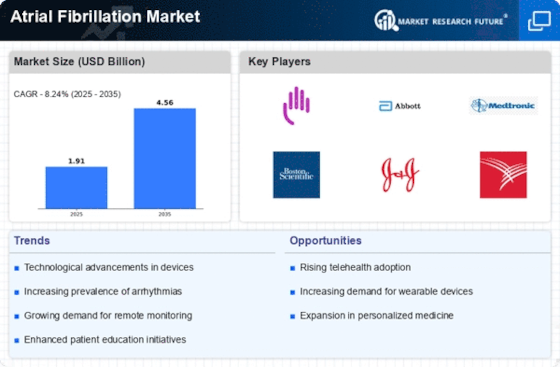
As per Market Research Future analysis, the Atrial Fibrillation Market Size was estimated at 1.91 USD Billion in 2024. The Atrial Fibrillation industry is projected to grow from 2.067 USD Billion in 2025 to 4.564 USD Billion by 2035, exhibiting a compound annual growth rate (CAGR) of 8.24% during the forecast period 2025 - 2035

Key Market Trends & Highlights

The Atrial Fibrillation Market is experiencing robust growth driven by technological advancements and increasing patient awareness.

  • North America remains the largest market for atrial fibrillation treatments, reflecting a strong healthcare infrastructure. The Asia-Pacific region is emerging as the fastest-growing market, driven by rising healthcare investments and awareness. Paroxysmal atrial fibrillation continues to dominate the market, while persistent atrial fibrillation is witnessing rapid growth. Key market drivers include the rising prevalence of atrial fibrillation and advancements in medical technology, which are shaping treatment options.

Market Size & Forecast

2024 Market Size 1.91 (USD Billion)
2035 Market Size 4.564 (USD Billion)
CAGR (2025 - 2035) 8.24%
Largest Regional Market Share in 2024 North America

Major Players

Bristol-Myers Squibb (US), Abbott Laboratories (US), <a href="https://www.medtronic.com/xd-en/healthcare-professionals/products/cardiac-rhythm/ablation-atrial-fibrillation.html">Medtronic </a>(US), Boston Scientific (US), Johnson &amp; Johnson (US), Cardinal Health (US), AtriCure (US), Biotronik (DE), Stryker Corporation (US)

Market Trends

The Atrial Fibrillation Market is currently experiencing notable transformations driven by advancements in technology and an increasing awareness of cardiovascular health. The rise in the aging population, coupled with a growing prevalence of lifestyle-related diseases, has led to a heightened demand for effective management solutions. Innovative treatment options, including catheter ablation and novel anticoagulants, are emerging, suggesting a shift towards more personalized and efficient care. Furthermore, the integration of telemedicine and remote monitoring tools appears to enhance patient engagement and adherence to treatment protocols, potentially improving outcomes. In addition, the competitive landscape of the Atrial Fibrillation Market is evolving, with numerous companies investing in research and development to introduce cutting-edge therapies. Collaborations between healthcare providers and technology firms indicate a trend towards holistic approaches in managing atrial fibrillation. As the market continues to expand, stakeholders must remain vigilant to adapt to changing regulations and patient needs, ensuring that innovations align with clinical efficacy and safety standards. Overall, the Atrial Fibrillation Market is poised for growth, driven by a confluence of factors that emphasize the importance of effective management strategies.

Technological Advancements

The Atrial Fibrillation Market is witnessing a surge in technological innovations, particularly in diagnostic and treatment modalities. Devices such as wearable monitors and advanced imaging techniques are enhancing the ability to detect atrial fibrillation early. This trend suggests a shift towards proactive management, allowing for timely interventions that could improve patient outcomes.

Increased Patient Awareness

There is a growing awareness among patients regarding atrial fibrillation and its potential complications. Educational initiatives and outreach programs are likely contributing to this trend, empowering individuals to seek medical advice sooner. This heightened awareness may lead to increased demand for treatment options and healthcare services.

Focus on Personalized Medicine

The Atrial Fibrillation Market is increasingly leaning towards personalized medicine, where treatment plans are tailored to individual patient profiles. This approach may enhance the effectiveness of therapies and improve adherence, as patients receive care that aligns with their specific health needs and preferences.

Atrial Fibrillation Systems Market Market Drivers

Increased Awareness and Education

The growing awareness and education surrounding atrial fibrillation are pivotal in driving the Atrial Fibrillation Market. Public health campaigns and educational initiatives aimed at both healthcare professionals and patients have significantly improved understanding of AF, its risk factors, and potential complications. This heightened awareness encourages individuals to seek medical attention sooner, leading to earlier diagnosis and treatment. Moreover, healthcare providers are increasingly emphasizing the importance of patient education in managing AF, which can lead to better adherence to treatment plans. As awareness continues to rise, the demand for AF-related products and services is expected to grow, further stimulating the Atrial Fibrillation Market.

Advancements in Medical Technology

Technological innovations play a crucial role in shaping the Atrial Fibrillation Market. Recent advancements in medical devices, such as catheter ablation systems and implantable cardioverter-defibrillators (ICDs), have significantly improved treatment outcomes for patients with AF. These technologies enable more precise and less invasive procedures, which are increasingly preferred by both patients and healthcare providers. Furthermore, the integration of telemedicine and remote monitoring solutions has enhanced patient management, allowing for timely interventions and better adherence to treatment protocols. As these technologies continue to evolve, they are expected to drive growth in the Atrial Fibrillation Market, providing new opportunities for manufacturers and healthcare providers alike.

Rising Prevalence of Atrial Fibrillation

The increasing prevalence of atrial fibrillation (AF) is a primary driver of the Atrial Fibrillation Market. It is estimated that approximately 33.5 million individuals are affected by AF worldwide. This condition is often associated with aging populations, as the risk of developing AF escalates with age. The growing number of elderly individuals, who are more susceptible to cardiovascular diseases, contributes to the rising incidence of AF. Consequently, healthcare systems are compelled to enhance their focus on AF management, leading to a surge in demand for diagnostic tools and treatment options. This trend is likely to continue, as projections indicate that the number of individuals with AF could double by 2050, further propelling the Atrial Fibrillation Market.

Regulatory Support and Reimbursement Policies

Regulatory support and favorable reimbursement policies are essential drivers of the Atrial Fibrillation Market. Governments and regulatory bodies are increasingly recognizing the importance of effective AF management and are implementing policies that facilitate access to innovative treatments. This includes streamlined approval processes for new medical devices and therapies, as well as reimbursement frameworks that support the financial viability of AF treatments. Such policies not only encourage research and development in the Atrial Fibrillation Market but also enhance patient access to necessary care. As these supportive measures continue to evolve, they are likely to foster growth and innovation within the industry.

Growing Investment in Healthcare Infrastructure

Investment in healthcare infrastructure is a significant driver of the Atrial Fibrillation Market. Governments and private entities are increasingly allocating resources to improve healthcare facilities and expand access to advanced medical technologies. This trend is particularly evident in emerging economies, where the demand for quality healthcare services is on the rise. Enhanced healthcare infrastructure facilitates the early diagnosis and effective management of atrial fibrillation, leading to better patient outcomes. Additionally, the establishment of specialized cardiac care centers is likely to contribute to the growth of the Atrial Fibrillation Market, as these centers focus on providing comprehensive care for patients with AF.

Market Segment Insights

By Type: Paroxysmal Atrial Fibrillation (Largest) vs. Persistent Atrial Fibrillation (Fastest-Growing)

In the Atrial Fibrillation Market, Paroxysmal Atrial Fibrillation holds the largest market share among the three types. This segment is characterized by episodes of AFib that come and go, making it a frequent diagnosis among patients. Meanwhile, Persistent Atrial Fibrillation is expanding rapidly, attributed to increasing awareness and improvements in diagnosis and treatment options. As a result, healthcare professionals are increasingly recognizing this type's impact on patient health and treatment regimens, leading to its substantial market growth. The growth trends within this segment are significantly influenced by factors such as rising incidences of cardiovascular diseases and the aging population. Additionally, advancements in medical technology, including novel catheter ablation techniques and improved antiarrhythmic medications, are driving market expansion. Furthermore, clinician education and evolving treatment guidelines continue to support diagnosis and management, further propelling the Persistent Atrial Fibrillation segment as a critical area of focus within the AFib market.

Atrial Fibrillation: Paroxysmal Atrial Fibrillation (Dominant) vs. Permanent Atrial Fibrillation (Emerging)

Paroxysmal Atrial Fibrillation is recognized as the dominant segment within the Atrial Fibrillation Market, primarily due to its episodic nature, leading to timely and effective management interventions. Patients often seek treatment for this type, driving substantial demand for healthcare resources and therapies. In contrast, Permanent Atrial Fibrillation is emerging as a focal point in the market, characterized by continuous AFib that requires ongoing management. This segment is gaining traction as clinical understanding evolves, with healthcare professionals noting its unique challenges and patient needs. Consequently, the gradual identification of targeted therapies tailored for permanent conditions is paving the way for increased market attention, positioning it as an essential category as the AFib landscape continues to develop.

By Treatment Approach: Drug Therapy (Largest) vs. Catheter Ablation (Fastest-Growing)

In the Atrial Fibrillation Market, treatment approaches are diversified into several segments, with Drug Therapy holding the largest share. This segment has gained widespread adoption due to the continued development of innovative pharmacological solutions aimed at rhythm control and stroke prevention. On the other hand, Catheter Ablation is rapidly gaining traction as the preferred choice among physicians and patients seeking effective long-term solutions, given its minimally invasive nature and potential for restoring normal cardiac rhythm. As the market evolves, the overall growth trajectory of the Atrial Fibrillation treatment approaches is influenced by advancements in technology and the increasing prevalence of atrial fibrillation worldwide. The rising elderly population and changing lifestyles are significant contributors to the surge in cases, driving demand for effective treatment options. Additionally, emerging studies support the efficacy of Catheter Ablation, enhancing its appeal, thus stimulating growth in this segment amidst a backdrop of innovation across all treatment methodologies.

Drug Therapy (Dominant) vs. Catheter Ablation (Emerging)

Drug Therapy remains the dominant approach in the Atrial Fibrillation treatment landscape due to its accessibility and established precedent in managing arrhythmias. This approach encompasses a range of medications, including antiarrhythmics and anticoagulants, providing options for both acute management and long-term care. However, Catheter Ablation is an emerging treatment that has captivated attention for its effectiveness, especially for patients who are intolerant to medication or who seek a definitive corrective measure. This method involves targeted radiofrequency energy to modify heart tissue responsible for irregular rhythms, offering a potentially permanent solution for suitable candidates. The growing awareness of treatment efficacy, combined with technological advancements, positions Catheter Ablation as a pivotal option in the rapidly evolving Atrial Fibrillation market.

By End-user: Hospitals (Largest) vs. Cardiology Clinics (Fastest-Growing)

In the Atrial Fibrillation Market, hospitals command the largest market share among end-user segments. This dominance is largely attributed to the extensive range of resources available to hospitals, including advanced technology and specialized personnel. Additionally, hospitals provide comprehensive care services that can accommodate complicated AFL cases, further solidifying their critical role in managing atrial fibrillation. Meanwhile, <a href="https://www.marketresearchfuture.com/reports/ambulatory-services-market-2491">ambulatory </a>surgical centers and cardiology clinics also play significant roles, but they are comparatively smaller in terms of overall market share.

Hospitals (Dominant) vs. Cardiology Clinics (Emerging)

<a href="https://www.marketresearchfuture.com/reports/hospital-services-market-12357">Hospitals </a>serve as the dominant force in the Atrial Fibrillation Market due to their extensive infrastructure and capacity to handle a vast variety of cardiovascular procedures. They have significant access to advanced diagnostic and therapeutic technologies, enabling comprehensive treatment protocols for atrial fibrillation patients. Conversely, cardiology clinics are emerging as a vital segment within this market, often specializing in outpatient care tailored to atrial fibrillation management. They capitalize on a more personal, focused approach and equipped with innovative technologies, which positions them well to meet the growing demand for outpatient cardiac care.

Get more detailed insights about Atrial Fibrillation Market Research Report — Global Forecast till 2035

Regional Insights

The Atrial Fibrillation Market witnessed substantial growth across various regions, with a total valuation of 8.93 USD Billion in 2024. North America was the largest regional market with a valuation of 3.5 USD Billion in 2024, holding a majority stake in the industry, driven by advanced healthcare infrastructure and increasing prevalence of atrial fibrillation.

Europe followed, valued at 2.8 USD Billion in 2024, with strong regulatory frameworks and significant investments in healthcare technologies propelling its growth. The Asia Pacific region, valued at 1.7 USD Billion in 2024, was crucial due to its expanding patient pool and rising awareness of atrial fibrillation treatments, making it a significant area of opportunity.

South America, with a valuation of 0.6 USD Billion in 2024, showed potential for growth as healthcare access improves. The Middle East and Africa, with a market size of 0.33 USD Billion, reflected challenges such as economic constraints but gradually gained attention due to increasing investments in healthcare services.

Together, these regions represented the dynamic landscape of the Atrial Fibrillation Market, showcasing diverse opportunities and challenges in their respective healthcare systems.

Key Players and Competitive Insights

The Atrial Fibrillation Market is a rapidly evolving landscape marked by intense competition driven by a surge in incidence of atrial fibrillation, the increasing prevalence of cardiovascular diseases, and a growing aging population. Various companies are focusing on expanding their portfolios and enhancing their technological capabilities to gain a competitive edge.
The market is characterized by a mix of established players and new entrants, each vying to capture market share through innovative products and tailored solutions. Companies are not only investing in research and development to create cutting-edge therapies and devices but are also forging strategic alliances and partnerships to bolster their market presence globally.
Regulatory approvals and the introduction of minimally invasive procedures are also shaping the competitive dynamics within this market, offering opportunities for players to differentiate themselves through unique offerings.
AtriCure is a prominent player in the Atrial Fibrillation Market, specializing in innovative medical devices designed for the treatment of atrial fibrillation through surgical procedures. The company has carved out a strong market presence by emphasizing a comprehensive range of products that focus on surgical ablation techniques for heart rhythm disorders.
AtriCure's strengths lie in its commitment to clinical research, which has helped establish the efficacy and safety of its offerings. Moreover, the company has built a reputation for fostering relationships with healthcare professionals and expanding access to education surrounding atrial fibrillation treatments.
Through its focused strategies and innovative solutions, AtriCure effectively addresses the evolving needs of patients and providers in the global arena.
Cardiac Science operates within the Atrial Fibrillation Market with a portfolio that primarily includes diagnostic cardiology products and automated external defibrillators. The company has established a significant presence through its innovative solutions aimed at improving patient outcomes in atrial fibrillation and other heart rhythm disorders.
Key strengths of Cardiac Science encompass a robust product line that integrates advanced technology for both hospital and outpatient settings, positioning the company as a reliable partner for healthcare institutions. Additionally, Cardiac Science actively pursues strategic mergers and acquisitions to enhance its capabilities and market reach, broadening its footprint across global regions.
The company’s focus on research and development ensures that it remains at the forefront of advancements in cardiac care, allowing it to respond effectively to market demands while improving treatment methodologies for atrial fibrillation patients.

Key Companies in the Atrial Fibrillation Systems Market include

Industry Developments

With FDA approval anticipated by the end of 2025, Prairie Cardiovascular announced on June 16, 2025, that its two-phase global clinical trial of pulsed-field ablation (PFA) for drug-resistant atrial fibrillation, which was carried out across 43 sites, showed that 96% of atrial flutter participants remained relapse-free and 85% of patients were symptom-free after a year.

For the first time in the United States, Johnson & Johnson MedTech's VARIPULSETM PFA platform and CARTOTM 3 mapping system were approved by the FDA on November 7, 2024. Medtronic stated on October 24, 2024, that the FDA has approved their Affera™ Mapping and Ablation System with Sphere‑9™ catheter, which has dual-energy (PFA and RF) capabilities for atrial flutter and persistent AFib.

Medtronic's PulseSelectTM PFA system for both paroxysmal and chronic AFib was certified by Japan's Ministry of Health on May 10, 2024, extending the technology's reach worldwide. The FDA designated Pulse Biosciences' CellFX® nsPFA system as a Breakthrough Device on July 8, 2024, with the goal of providing quick, non-thermal surgical ablation therapy.

On January 24, 2025, abelacimab, a factor XI inhibitor, was given FDA Fast Track designation after a mid-stage trial revealed a 93% drop in gastrointestinal bleeding and a 62–69% reduction in severe bleeding episodes when compared to rivaroxaban in patients with AFib.

Furthermore, Boston Scientific demonstrated promising results on FARAPULSETM PFA and WATCHMAN FLX LAAC devices at the AF Symposium 2025 in January 2025.

Future Outlook

Atrial Fibrillation Systems Market Future Outlook

The Atrial Fibrillation Market is projected to grow at an 8.24% CAGR from 2025 to 2035, driven by technological advancements, increasing prevalence, and enhanced patient awareness.

New opportunities lie in:

  • Development of AI-driven diagnostic tools for early detection.
  • Expansion of telehealth services for remote patient monitoring.
  • Investment in personalized medicine approaches for tailored treatment plans.

By 2035, the Atrial Fibrillation Market is expected to be robust, driven by innovation and increased healthcare access.

Market Segmentation

Atrial Fibrillation Systems Market Type Outlook

  • Paroxysmal Atrial Fibrillation
  • Persistent Atrial Fibrillation
  • Permanent Atrial Fibrillation

Atrial Fibrillation Systems Market End-user Outlook

  • Hospitals
  • Ambulatory Surgical Centers
  • Cardiology Clinics

Atrial Fibrillation Systems Market Treatment Approach Outlook

  • Drug Therapy
  • Cardioversion
  • Catheter Ablation
  • Surgical Procedures

Report Scope

MARKET SIZE 2024 1.91(USD Billion)
MARKET SIZE 2025 2.067(USD Billion)
MARKET SIZE 2035 4.564(USD Billion)
COMPOUND ANNUAL GROWTH RATE (CAGR) 8.24% (2025 - 2035)
REPORT COVERAGE Revenue Forecast, Competitive Landscape, Growth Factors, and Trends
BASE YEAR 2024
Market Forecast Period 2025 - 2035
Historical Data 2019 - 2024
Market Forecast Units USD Billion
Key Companies Profiled Bristol-Myers Squibb (US), Abbott Laboratories (US), Medtronic (US), Boston Scientific (US), Johnson & Johnson (US), Cardinal Health (US), AtriCure (US), Biotronik (DE), Stryker Corporation (US)
Segments Covered Types, Treatment Approach, End-user, Regional
Key Market Opportunities Integration of wearable technology for continuous monitoring in the Atrial Fibrillation Market.
Key Market Dynamics Rising demand for innovative therapies drives competition and technological advancements in the Atrial Fibrillation Market.
Countries Covered North America, Europe, APAC, South America, MEA

FAQs

What is the projected market valuation for the Atrial Fibrillation Market in 2035?

<p>The projected market valuation for the Atrial Fibrillation Market in 2035 is 4.564 USD Billion.</p>

What was the market valuation for the Atrial Fibrillation Market in 2024?

<p>The market valuation for the Atrial Fibrillation Market in 2024 was 1.91 USD Billion.</p>

What is the expected CAGR for the Atrial Fibrillation Market from 2025 to 2035?

<p>The expected CAGR for the Atrial Fibrillation Market during the forecast period 2025 - 2035 is 8.24%.</p>

Which treatment approach had the highest valuation in 2024?

<p>In 2024, Drug Therapy had the highest valuation in the Atrial Fibrillation Market at 0.76 USD Billion.</p>

What are the projected valuations for Paroxysmal Atrial Fibrillation by 2035?

<p>The projected valuation for Paroxysmal Atrial Fibrillation by 2035 is 1.82 USD Billion.</p>

Which key players are leading the Atrial Fibrillation Market?

<p>Key players in the Atrial Fibrillation Market include Bristol-Myers Squibb, Abbott Laboratories, and Medtronic.</p>

What is the projected market size for Surgical Procedures in 2035?

<p>The projected market size for Surgical Procedures in the Atrial Fibrillation Market by 2035 is 0.46 USD Billion.</p>

How does the market for Catheter Ablation compare to other treatment approaches in 2024?

<p>In 2024, Catheter Ablation was valued at 0.57 USD Billion, indicating a strong position among treatment approaches.</p>

What is the expected growth for Ambulatory Surgical Centers in the Atrial Fibrillation Market by 2035?

<p>The expected growth for Ambulatory Surgical Centers in the Atrial Fibrillation Market by 2035 is projected to reach 1.3 USD Billion.</p>

What segment is anticipated to show the most growth in the Atrial Fibrillation Market from 2025 to 2035?

<p>The segment of Drug Therapy is anticipated to show the most growth in the Atrial Fibrillation Market from 2025 to 2035, with a projected valuation of 1.84 USD Billion.</p>

  1. SECTION I: EXECUTIVE SUMMARY AND KEY HIGHLIGHTS
    1. | 1.1 EXECUTIVE SUMMARY
    2. | | 1.1.1 Market Overview
    3. | | 1.1.2 Key Findings
    4. | | 1.1.3 Market Segmentation
    5. | | 1.1.4 Competitive Landscape
    6. | | 1.1.5 Challenges and Opportunities
    7. | | 1.1.6 Future Outlook
  2. SECTION II: SCOPING, METHODOLOGY AND MARKET STRUCTURE
    1. | 2.1 MARKET INTRODUCTION
    2. | | 2.1.1 Definition
    3. | | 2.1.2 Scope of the study
    4. | | | 2.1.2.1 Research Objective
    5. | | | 2.1.2.2 Assumption
    6. | | | 2.1.2.3 Limitations
    7. | 2.2 RESEARCH METHODOLOGY
    8. | | 2.2.1 Overview
    9. | | 2.2.2 Data Mining
    10. | | 2.2.3 Secondary Research
    11. | | 2.2.4 Primary Research
    12. | | | 2.2.4.1 Primary Interviews and Information Gathering Process
    13. | | | 2.2.4.2 Breakdown of Primary Respondents
    14. | | 2.2.5 Forecasting Model
    15. | | 2.2.6 Market Size Estimation
    16. | | | 2.2.6.1 Bottom-Up Approach
    17. | | | 2.2.6.2 Top-Down Approach
    18. | | 2.2.7 Data Triangulation
    19. | | 2.2.8 Validation
  3. SECTION III: QUALITATIVE ANALYSIS
    1. | 3.1 MARKET DYNAMICS
    2. | | 3.1.1 Overview
    3. | | 3.1.2 Drivers
    4. | | 3.1.3 Restraints
    5. | | 3.1.4 Opportunities
    6. | 3.2 MARKET FACTOR ANALYSIS
    7. | | 3.2.1 Value chain Analysis
    8. | | 3.2.2 Porter's Five Forces Analysis
    9. | | | 3.2.2.1 Bargaining Power of Suppliers
    10. | | | 3.2.2.2 Bargaining Power of Buyers
    11. | | | 3.2.2.3 Threat of New Entrants
    12. | | | 3.2.2.4 Threat of Substitutes
    13. | | | 3.2.2.5 Intensity of Rivalry
    14. | | 3.2.3 COVID-19 Impact Analysis
    15. | | | 3.2.3.1 Market Impact Analysis
    16. | | | 3.2.3.2 Regional Impact
    17. | | | 3.2.3.3 Opportunity and Threat Analysis
  4. SECTION IV: QUANTITATIVE ANALYSIS
    1. | 4.1 Healthcare, BY Type (USD Billion)
    2. | | 4.1.1 Paroxysmal Atrial Fibrillation
    3. | | 4.1.2 Persistent Atrial Fibrillation
    4. | | 4.1.3 Permanent Atrial Fibrillation
    5. | 4.2 Healthcare, BY Treatment Approach (USD Billion)
    6. | | 4.2.1 Drug Therapy
    7. | | 4.2.2 Cardioversion
    8. | | 4.2.3 Catheter Ablation
    9. | | 4.2.4 Surgical Procedures
    10. | 4.3 Healthcare, BY End-user (USD Billion)
    11. | | 4.3.1 Hospitals
    12. | | 4.3.2 Ambulatory Surgical Centers
    13. | | 4.3.3 Cardiology Clinics
    14. | 4.4 Healthcare, BY Region (USD Billion)
    15. | | 4.4.1 North America
    16. | | | 4.4.1.1 US
    17. | | | 4.4.1.2 Canada
    18. | | 4.4.2 Europe
    19. | | | 4.4.2.1 Germany
    20. | | | 4.4.2.2 UK
    21. | | | 4.4.2.3 France
    22. | | | 4.4.2.4 Russia
    23. | | | 4.4.2.5 Italy
    24. | | | 4.4.2.6 Spain
    25. | | | 4.4.2.7 Rest of Europe
    26. | | 4.4.3 APAC
    27. | | | 4.4.3.1 China
    28. | | | 4.4.3.2 India
    29. | | | 4.4.3.3 Japan
    30. | | | 4.4.3.4 South Korea
    31. | | | 4.4.3.5 Malaysia
    32. | | | 4.4.3.6 Thailand
    33. | | | 4.4.3.7 Indonesia
    34. | | | 4.4.3.8 Rest of APAC
    35. | | 4.4.4 South America
    36. | | | 4.4.4.1 Brazil
    37. | | | 4.4.4.2 Mexico
    38. | | | 4.4.4.3 Argentina
    39. | | | 4.4.4.4 Rest of South America
    40. | | 4.4.5 MEA
    41. | | | 4.4.5.1 GCC Countries
    42. | | | 4.4.5.2 South Africa
    43. | | | 4.4.5.3 Rest of MEA
  5. SECTION V: COMPETITIVE ANALYSIS
    1. | 5.1 Competitive Landscape
    2. | | 5.1.1 Overview
    3. | | 5.1.2 Competitive Analysis
    4. | | 5.1.3 Market share Analysis
    5. | | 5.1.4 Major Growth Strategy in the Healthcare
    6. | | 5.1.5 Competitive Benchmarking
    7. | | 5.1.6 Leading Players in Terms of Number of Developments in the Healthcare
    8. | | 5.1.7 Key developments and growth strategies
    9. | | | 5.1.7.1 New Product Launch/Service Deployment
    10. | | | 5.1.7.2 Merger & Acquisitions
    11. | | | 5.1.7.3 Joint Ventures
    12. | | 5.1.8 Major Players Financial Matrix
    13. | | | 5.1.8.1 Sales and Operating Income
    14. | | | 5.1.8.2 Major Players R&D Expenditure. 2023
    15. | 5.2 Company Profiles
    16. | | 5.2.1 Bristol-Myers Squibb (US)
    17. | | | 5.2.1.1 Financial Overview
    18. | | | 5.2.1.2 Products Offered
    19. | | | 5.2.1.3 Key Developments
    20. | | | 5.2.1.4 SWOT Analysis
    21. | | | 5.2.1.5 Key Strategies
    22. | | 5.2.2 Abbott Laboratories (US)
    23. | | | 5.2.2.1 Financial Overview
    24. | | | 5.2.2.2 Products Offered
    25. | | | 5.2.2.3 Key Developments
    26. | | | 5.2.2.4 SWOT Analysis
    27. | | | 5.2.2.5 Key Strategies
    28. | | 5.2.3 Medtronic (US)
    29. | | | 5.2.3.1 Financial Overview
    30. | | | 5.2.3.2 Products Offered
    31. | | | 5.2.3.3 Key Developments
    32. | | | 5.2.3.4 SWOT Analysis
    33. | | | 5.2.3.5 Key Strategies
    34. | | 5.2.4 Boston Scientific (US)
    35. | | | 5.2.4.1 Financial Overview
    36. | | | 5.2.4.2 Products Offered
    37. | | | 5.2.4.3 Key Developments
    38. | | | 5.2.4.4 SWOT Analysis
    39. | | | 5.2.4.5 Key Strategies
    40. | | 5.2.5 Johnson & Johnson (US)
    41. | | | 5.2.5.1 Financial Overview
    42. | | | 5.2.5.2 Products Offered
    43. | | | 5.2.5.3 Key Developments
    44. | | | 5.2.5.4 SWOT Analysis
    45. | | | 5.2.5.5 Key Strategies
    46. | | 5.2.6 Cardinal Health (US)
    47. | | | 5.2.6.1 Financial Overview
    48. | | | 5.2.6.2 Products Offered
    49. | | | 5.2.6.3 Key Developments
    50. | | | 5.2.6.4 SWOT Analysis
    51. | | | 5.2.6.5 Key Strategies
    52. | | 5.2.7 AtriCure (US)
    53. | | | 5.2.7.1 Financial Overview
    54. | | | 5.2.7.2 Products Offered
    55. | | | 5.2.7.3 Key Developments
    56. | | | 5.2.7.4 SWOT Analysis
    57. | | | 5.2.7.5 Key Strategies
    58. | | 5.2.8 Biotronik (DE)
    59. | | | 5.2.8.1 Financial Overview
    60. | | | 5.2.8.2 Products Offered
    61. | | | 5.2.8.3 Key Developments
    62. | | | 5.2.8.4 SWOT Analysis
    63. | | | 5.2.8.5 Key Strategies
    64. | | 5.2.9 Stryker Corporation (US)
    65. | | | 5.2.9.1 Financial Overview
    66. | | | 5.2.9.2 Products Offered
    67. | | | 5.2.9.3 Key Developments
    68. | | | 5.2.9.4 SWOT Analysis
    69. | | | 5.2.9.5 Key Strategies
    70. | 5.3 Appendix
    71. | | 5.3.1 References
    72. | | 5.3.2 Related Reports
  6. LIST OF FIGURES
    1. | 6.1 MARKET SYNOPSIS
    2. | 6.2 NORTH AMERICA MARKET ANALYSIS
    3. | 6.3 US MARKET ANALYSIS BY TYPE
    4. | 6.4 US MARKET ANALYSIS BY TREATMENT APPROACH
    5. | 6.5 US MARKET ANALYSIS BY END-USER
    6. | 6.6 CANADA MARKET ANALYSIS BY TYPE
    7. | 6.7 CANADA MARKET ANALYSIS BY TREATMENT APPROACH
    8. | 6.8 CANADA MARKET ANALYSIS BY END-USER
    9. | 6.9 EUROPE MARKET ANALYSIS
    10. | 6.10 GERMANY MARKET ANALYSIS BY TYPE
    11. | 6.11 GERMANY MARKET ANALYSIS BY TREATMENT APPROACH
    12. | 6.12 GERMANY MARKET ANALYSIS BY END-USER
    13. | 6.13 UK MARKET ANALYSIS BY TYPE
    14. | 6.14 UK MARKET ANALYSIS BY TREATMENT APPROACH
    15. | 6.15 UK MARKET ANALYSIS BY END-USER
    16. | 6.16 FRANCE MARKET ANALYSIS BY TYPE
    17. | 6.17 FRANCE MARKET ANALYSIS BY TREATMENT APPROACH
    18. | 6.18 FRANCE MARKET ANALYSIS BY END-USER
    19. | 6.19 RUSSIA MARKET ANALYSIS BY TYPE
    20. | 6.20 RUSSIA MARKET ANALYSIS BY TREATMENT APPROACH
    21. | 6.21 RUSSIA MARKET ANALYSIS BY END-USER
    22. | 6.22 ITALY MARKET ANALYSIS BY TYPE
    23. | 6.23 ITALY MARKET ANALYSIS BY TREATMENT APPROACH
    24. | 6.24 ITALY MARKET ANALYSIS BY END-USER
    25. | 6.25 SPAIN MARKET ANALYSIS BY TYPE
    26. | 6.26 SPAIN MARKET ANALYSIS BY TREATMENT APPROACH
    27. | 6.27 SPAIN MARKET ANALYSIS BY END-USER
    28. | 6.28 REST OF EUROPE MARKET ANALYSIS BY TYPE
    29. | 6.29 REST OF EUROPE MARKET ANALYSIS BY TREATMENT APPROACH
    30. | 6.30 REST OF EUROPE MARKET ANALYSIS BY END-USER
    31. | 6.31 APAC MARKET ANALYSIS
    32. | 6.32 CHINA MARKET ANALYSIS BY TYPE
    33. | 6.33 CHINA MARKET ANALYSIS BY TREATMENT APPROACH
    34. | 6.34 CHINA MARKET ANALYSIS BY END-USER
    35. | 6.35 INDIA MARKET ANALYSIS BY TYPE
    36. | 6.36 INDIA MARKET ANALYSIS BY TREATMENT APPROACH
    37. | 6.37 INDIA MARKET ANALYSIS BY END-USER
    38. | 6.38 JAPAN MARKET ANALYSIS BY TYPE
    39. | 6.39 JAPAN MARKET ANALYSIS BY TREATMENT APPROACH
    40. | 6.40 JAPAN MARKET ANALYSIS BY END-USER
    41. | 6.41 SOUTH KOREA MARKET ANALYSIS BY TYPE
    42. | 6.42 SOUTH KOREA MARKET ANALYSIS BY TREATMENT APPROACH
    43. | 6.43 SOUTH KOREA MARKET ANALYSIS BY END-USER
    44. | 6.44 MALAYSIA MARKET ANALYSIS BY TYPE
    45. | 6.45 MALAYSIA MARKET ANALYSIS BY TREATMENT APPROACH
    46. | 6.46 MALAYSIA MARKET ANALYSIS BY END-USER
    47. | 6.47 THAILAND MARKET ANALYSIS BY TYPE
    48. | 6.48 THAILAND MARKET ANALYSIS BY TREATMENT APPROACH
    49. | 6.49 THAILAND MARKET ANALYSIS BY END-USER
    50. | 6.50 INDONESIA MARKET ANALYSIS BY TYPE
    51. | 6.51 INDONESIA MARKET ANALYSIS BY TREATMENT APPROACH
    52. | 6.52 INDONESIA MARKET ANALYSIS BY END-USER
    53. | 6.53 REST OF APAC MARKET ANALYSIS BY TYPE
    54. | 6.54 REST OF APAC MARKET ANALYSIS BY TREATMENT APPROACH
    55. | 6.55 REST OF APAC MARKET ANALYSIS BY END-USER
    56. | 6.56 SOUTH AMERICA MARKET ANALYSIS
    57. | 6.57 BRAZIL MARKET ANALYSIS BY TYPE
    58. | 6.58 BRAZIL MARKET ANALYSIS BY TREATMENT APPROACH
    59. | 6.59 BRAZIL MARKET ANALYSIS BY END-USER
    60. | 6.60 MEXICO MARKET ANALYSIS BY TYPE
    61. | 6.61 MEXICO MARKET ANALYSIS BY TREATMENT APPROACH
    62. | 6.62 MEXICO MARKET ANALYSIS BY END-USER
    63. | 6.63 ARGENTINA MARKET ANALYSIS BY TYPE
    64. | 6.64 ARGENTINA MARKET ANALYSIS BY TREATMENT APPROACH
    65. | 6.65 ARGENTINA MARKET ANALYSIS BY END-USER
    66. | 6.66 REST OF SOUTH AMERICA MARKET ANALYSIS BY TYPE
    67. | 6.67 REST OF SOUTH AMERICA MARKET ANALYSIS BY TREATMENT APPROACH
    68. | 6.68 REST OF SOUTH AMERICA MARKET ANALYSIS BY END-USER
    69. | 6.69 MEA MARKET ANALYSIS
    70. | 6.70 GCC COUNTRIES MARKET ANALYSIS BY TYPE
    71. | 6.71 GCC COUNTRIES MARKET ANALYSIS BY TREATMENT APPROACH
    72. | 6.72 GCC COUNTRIES MARKET ANALYSIS BY END-USER
    73. | 6.73 SOUTH AFRICA MARKET ANALYSIS BY TYPE
    74. | 6.74 SOUTH AFRICA MARKET ANALYSIS BY TREATMENT APPROACH
    75. | 6.75 SOUTH AFRICA MARKET ANALYSIS BY END-USER
    76. | 6.76 REST OF MEA MARKET ANALYSIS BY TYPE
    77. | 6.77 REST OF MEA MARKET ANALYSIS BY TREATMENT APPROACH
    78. | 6.78 REST OF MEA MARKET ANALYSIS BY END-USER
    79. | 6.79 KEY BUYING CRITERIA OF HEALTHCARE
    80. | 6.80 RESEARCH PROCESS OF MRFR
    81. | 6.81 DRO ANALYSIS OF HEALTHCARE
    82. | 6.82 DRIVERS IMPACT ANALYSIS: HEALTHCARE
    83. | 6.83 RESTRAINTS IMPACT ANALYSIS: HEALTHCARE
    84. | 6.84 SUPPLY / VALUE CHAIN: HEALTHCARE
    85. | 6.85 HEALTHCARE, BY TYPE, 2024 (% SHARE)
    86. | 6.86 HEALTHCARE, BY TYPE, 2024 TO 2035 (USD Billion)
    87. | 6.87 HEALTHCARE, BY TREATMENT APPROACH, 2024 (% SHARE)
    88. | 6.88 HEALTHCARE, BY TREATMENT APPROACH, 2024 TO 2035 (USD Billion)
    89. | 6.89 HEALTHCARE, BY END-USER, 2024 (% SHARE)
    90. | 6.90 HEALTHCARE, BY END-USER, 2024 TO 2035 (USD Billion)
    91. | 6.91 BENCHMARKING OF MAJOR COMPETITORS
  7. LIST OF TABLES
    1. | 7.1 LIST OF ASSUMPTIONS
    2. | | 7.1.1
    3. | 7.2 North America MARKET SIZE ESTIMATES; FORECAST
    4. | | 7.2.1 BY TYPE, 2025-2035 (USD Billion)
    5. | | 7.2.2 BY TREATMENT APPROACH, 2025-2035 (USD Billion)
    6. | | 7.2.3 BY END-USER, 2025-2035 (USD Billion)
    7. | 7.3 US MARKET SIZE ESTIMATES; FORECAST
    8. | | 7.3.1 BY TYPE, 2025-2035 (USD Billion)
    9. | | 7.3.2 BY TREATMENT APPROACH, 2025-2035 (USD Billion)
    10. | | 7.3.3 BY END-USER, 2025-2035 (USD Billion)
    11. | 7.4 Canada MARKET SIZE ESTIMATES; FORECAST
    12. | | 7.4.1 BY TYPE, 2025-2035 (USD Billion)
    13. | | 7.4.2 BY TREATMENT APPROACH, 2025-2035 (USD Billion)
    14. | | 7.4.3 BY END-USER, 2025-2035 (USD Billion)
    15. | 7.5 Europe MARKET SIZE ESTIMATES; FORECAST
    16. | | 7.5.1 BY TYPE, 2025-2035 (USD Billion)
    17. | | 7.5.2 BY TREATMENT APPROACH, 2025-2035 (USD Billion)
    18. | | 7.5.3 BY END-USER, 2025-2035 (USD Billion)
    19. | 7.6 Germany MARKET SIZE ESTIMATES; FORECAST
    20. | | 7.6.1 BY TYPE, 2025-2035 (USD Billion)
    21. | | 7.6.2 BY TREATMENT APPROACH, 2025-2035 (USD Billion)
    22. | | 7.6.3 BY END-USER, 2025-2035 (USD Billion)
    23. | 7.7 UK MARKET SIZE ESTIMATES; FORECAST
    24. | | 7.7.1 BY TYPE, 2025-2035 (USD Billion)
    25. | | 7.7.2 BY TREATMENT APPROACH, 2025-2035 (USD Billion)
    26. | | 7.7.3 BY END-USER, 2025-2035 (USD Billion)
    27. | 7.8 France MARKET SIZE ESTIMATES; FORECAST
    28. | | 7.8.1 BY TYPE, 2025-2035 (USD Billion)
    29. | | 7.8.2 BY TREATMENT APPROACH, 2025-2035 (USD Billion)
    30. | | 7.8.3 BY END-USER, 2025-2035 (USD Billion)
    31. | 7.9 Russia MARKET SIZE ESTIMATES; FORECAST
    32. | | 7.9.1 BY TYPE, 2025-2035 (USD Billion)
    33. | | 7.9.2 BY TREATMENT APPROACH, 2025-2035 (USD Billion)
    34. | | 7.9.3 BY END-USER, 2025-2035 (USD Billion)
    35. | 7.10 Italy MARKET SIZE ESTIMATES; FORECAST
    36. | | 7.10.1 BY TYPE, 2025-2035 (USD Billion)
    37. | | 7.10.2 BY TREATMENT APPROACH, 2025-2035 (USD Billion)
    38. | | 7.10.3 BY END-USER, 2025-2035 (USD Billion)
    39. | 7.11 Spain MARKET SIZE ESTIMATES; FORECAST
    40. | | 7.11.1 BY TYPE, 2025-2035 (USD Billion)
    41. | | 7.11.2 BY TREATMENT APPROACH, 2025-2035 (USD Billion)
    42. | | 7.11.3 BY END-USER, 2025-2035 (USD Billion)
    43. | 7.12 Rest of Europe MARKET SIZE ESTIMATES; FORECAST
    44. | | 7.12.1 BY TYPE, 2025-2035 (USD Billion)
    45. | | 7.12.2 BY TREATMENT APPROACH, 2025-2035 (USD Billion)
    46. | | 7.12.3 BY END-USER, 2025-2035 (USD Billion)
    47. | 7.13 APAC MARKET SIZE ESTIMATES; FORECAST
    48. | | 7.13.1 BY TYPE, 2025-2035 (USD Billion)
    49. | | 7.13.2 BY TREATMENT APPROACH, 2025-2035 (USD Billion)
    50. | | 7.13.3 BY END-USER, 2025-2035 (USD Billion)
    51. | 7.14 China MARKET SIZE ESTIMATES; FORECAST
    52. | | 7.14.1 BY TYPE, 2025-2035 (USD Billion)
    53. | | 7.14.2 BY TREATMENT APPROACH, 2025-2035 (USD Billion)
    54. | | 7.14.3 BY END-USER, 2025-2035 (USD Billion)
    55. | 7.15 India MARKET SIZE ESTIMATES; FORECAST
    56. | | 7.15.1 BY TYPE, 2025-2035 (USD Billion)
    57. | | 7.15.2 BY TREATMENT APPROACH, 2025-2035 (USD Billion)
    58. | | 7.15.3 BY END-USER, 2025-2035 (USD Billion)
    59. | 7.16 Japan MARKET SIZE ESTIMATES; FORECAST
    60. | | 7.16.1 BY TYPE, 2025-2035 (USD Billion)
    61. | | 7.16.2 BY TREATMENT APPROACH, 2025-2035 (USD Billion)
    62. | | 7.16.3 BY END-USER, 2025-2035 (USD Billion)
    63. | 7.17 South Korea MARKET SIZE ESTIMATES; FORECAST
    64. | | 7.17.1 BY TYPE, 2025-2035 (USD Billion)
    65. | | 7.17.2 BY TREATMENT APPROACH, 2025-2035 (USD Billion)
    66. | | 7.17.3 BY END-USER, 2025-2035 (USD Billion)
    67. | 7.18 Malaysia MARKET SIZE ESTIMATES; FORECAST
    68. | | 7.18.1 BY TYPE, 2025-2035 (USD Billion)
    69. | | 7.18.2 BY TREATMENT APPROACH, 2025-2035 (USD Billion)
    70. | | 7.18.3 BY END-USER, 2025-2035 (USD Billion)
    71. | 7.19 Thailand MARKET SIZE ESTIMATES; FORECAST
    72. | | 7.19.1 BY TYPE, 2025-2035 (USD Billion)
    73. | | 7.19.2 BY TREATMENT APPROACH, 2025-2035 (USD Billion)
    74. | | 7.19.3 BY END-USER, 2025-2035 (USD Billion)
    75. | 7.20 Indonesia MARKET SIZE ESTIMATES; FORECAST
    76. | | 7.20.1 BY TYPE, 2025-2035 (USD Billion)
    77. | | 7.20.2 BY TREATMENT APPROACH, 2025-2035 (USD Billion)
    78. | | 7.20.3 BY END-USER, 2025-2035 (USD Billion)
    79. | 7.21 Rest of APAC MARKET SIZE ESTIMATES; FORECAST
    80. | | 7.21.1 BY TYPE, 2025-2035 (USD Billion)
    81. | | 7.21.2 BY TREATMENT APPROACH, 2025-2035 (USD Billion)
    82. | | 7.21.3 BY END-USER, 2025-2035 (USD Billion)
    83. | 7.22 South America MARKET SIZE ESTIMATES; FORECAST
    84. | | 7.22.1 BY TYPE, 2025-2035 (USD Billion)
    85. | | 7.22.2 BY TREATMENT APPROACH, 2025-2035 (USD Billion)
    86. | | 7.22.3 BY END-USER, 2025-2035 (USD Billion)
    87. | 7.23 Brazil MARKET SIZE ESTIMATES; FORECAST
    88. | | 7.23.1 BY TYPE, 2025-2035 (USD Billion)
    89. | | 7.23.2 BY TREATMENT APPROACH, 2025-2035 (USD Billion)
    90. | | 7.23.3 BY END-USER, 2025-2035 (USD Billion)
    91. | 7.24 Mexico MARKET SIZE ESTIMATES; FORECAST
    92. | | 7.24.1 BY TYPE, 2025-2035 (USD Billion)
    93. | | 7.24.2 BY TREATMENT APPROACH, 2025-2035 (USD Billion)
    94. | | 7.24.3 BY END-USER, 2025-2035 (USD Billion)
    95. | 7.25 Argentina MARKET SIZE ESTIMATES; FORECAST
    96. | | 7.25.1 BY TYPE, 2025-2035 (USD Billion)
    97. | | 7.25.2 BY TREATMENT APPROACH, 2025-2035 (USD Billion)
    98. | | 7.25.3 BY END-USER, 2025-2035 (USD Billion)
    99. | 7.26 Rest of South America MARKET SIZE ESTIMATES; FORECAST
    100. | | 7.26.1 BY TYPE, 2025-2035 (USD Billion)
    101. | | 7.26.2 BY TREATMENT APPROACH, 2025-2035 (USD Billion)
    102. | | 7.26.3 BY END-USER, 2025-2035 (USD Billion)
    103. | 7.27 MEA MARKET SIZE ESTIMATES; FORECAST
    104. | | 7.27.1 BY TYPE, 2025-2035 (USD Billion)
    105. | | 7.27.2 BY TREATMENT APPROACH, 2025-2035 (USD Billion)
    106. | | 7.27.3 BY END-USER, 2025-2035 (USD Billion)
    107. | 7.28 GCC Countries MARKET SIZE ESTIMATES; FORECAST
    108. | | 7.28.1 BY TYPE, 2025-2035 (USD Billion)
    109. | | 7.28.2 BY TREATMENT APPROACH, 2025-2035 (USD Billion)
    110. | | 7.28.3 BY END-USER, 2025-2035 (USD Billion)
    111. | 7.29 South Africa MARKET SIZE ESTIMATES; FORECAST
    112. | | 7.29.1 BY TYPE, 2025-2035 (USD Billion)
    113. | | 7.29.2 BY TREATMENT APPROACH, 2025-2035 (USD Billion)
    114. | | 7.29.3 BY END-USER, 2025-2035 (USD Billion)
    115. | 7.30 Rest of MEA MARKET SIZE ESTIMATES; FORECAST
    116. | | 7.30.1 BY TYPE, 2025-2035 (USD Billion)
    117. | | 7.30.2 BY TREATMENT APPROACH, 2025-2035 (USD Billion)
    118. | | 7.30.3 BY END-USER, 2025-2035 (USD Billion)
    119. | 7.31 PRODUCT LAUNCH/PRODUCT DEVELOPMENT/APPROVAL
    120. | | 7.31.1
    121. | 7.32 ACQUISITION/PARTNERSHIP
    122. | | 7.32.1

Healthcare Market Segmentation

Healthcare By Type (USD Billion, 2025-2035)

  • Paroxysmal Atrial Fibrillation
  • Persistent Atrial Fibrillation
  • Permanent Atrial Fibrillation

Healthcare By Treatment Approach (USD Billion, 2025-2035)

  • Drug Therapy
  • Cardioversion
  • Catheter Ablation
  • Surgical Procedures

Healthcare By End-user (USD Billion, 2025-2035)

  • Hospitals
  • Ambulatory Surgical Centers
  • Cardiology Clinics
Infographic

Free Sample Request

Kindly complete the form below to receive a free sample of this Report

Get Free Sample

Customer Strories

Compare Licence

×
Features License Type
Single User Multiuser License Enterprise User
Price $4,950 $5,950 $7,250
Maximum User Access Limit 1 User Upto 10 Users Unrestricted Access Throughout the Organization
Free Customization
Direct Access to Analyst
Deliverable Format
Platform Access
Discount on Next Purchase 10% 15% 15%
Printable Versions