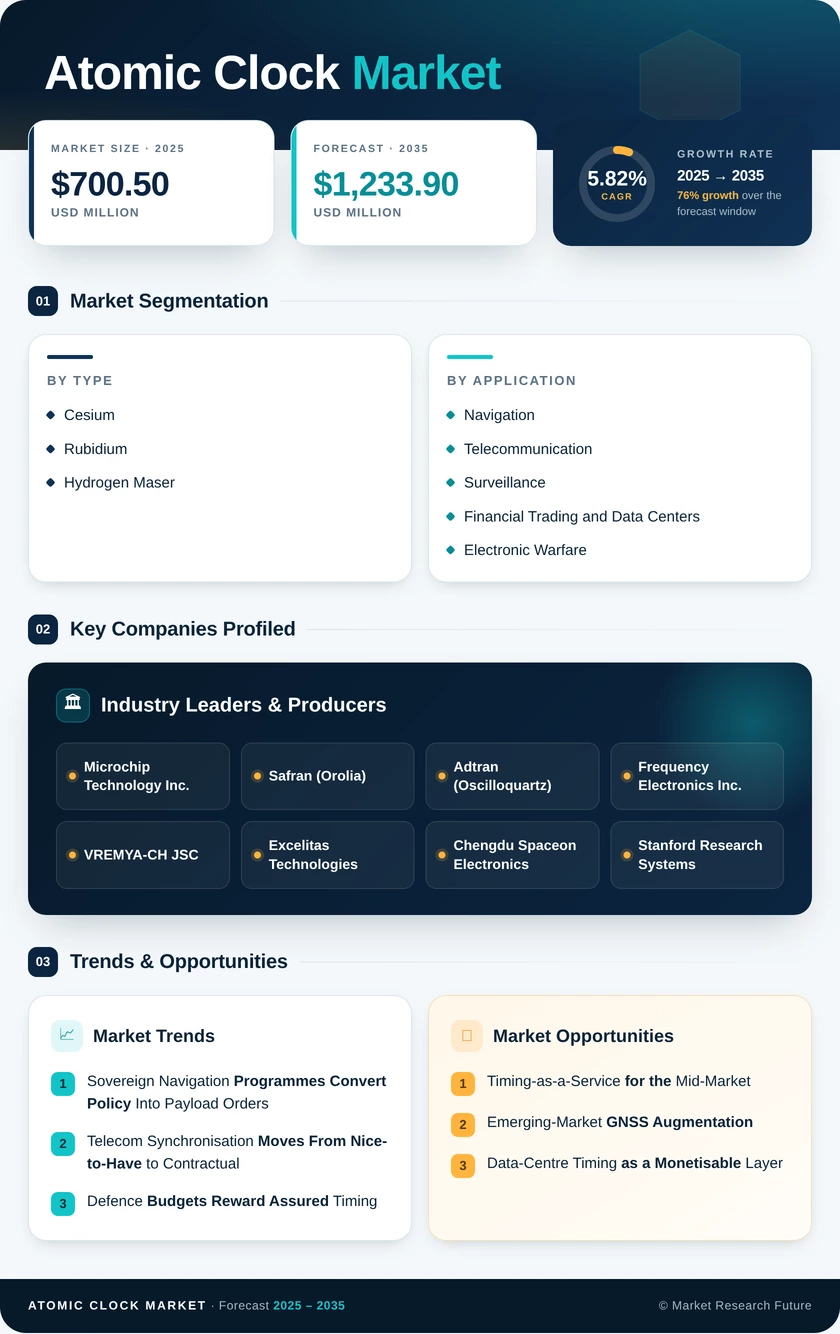
Atomic Clock Market (2026 - 2035)

ID: MRFR/AD/29796-HCR 128 Pages Shubham Munde Last Updated: September 17, 2026
Atomic Clock Market Size, Share, Industry Trend & Analysis Research Report By Type (Rubidium, Cesium, Hydrogen Maser), By End User (Defence, Space, Civil and Commercial), By Application (Navigation, Surveillance, Electronic Warfare, Telecommunication, Financial Trading and Data Centers, Broadcast and Media, Other Applications), By Region (North America, Europe, Asia-Pacific, South America, Middle East & Africa) - Forecast to 2035.
Atomic Clock Market
Market Size
Forecast Period2026-2035
CAGR (2026-2035)5.82%
2025 Market SizeUSD 700.5 Million
2035 Market SizeUSD 1,233.9 Million
Key Players
Microchip Technology Inc.
Safran
Adtran
Frequency Electronics Inc.
VREMYA-CH JSC
Excelitas Technologies
Opportunities
  • Timing-as-a-Service for the Mid-Market
  • Emerging-Market GNSS Augmentation
  • Data-Centre Timing as a Monetisable Layer
  1. 1 Market Overview |
    1. 1.1 Study Assumptions & Market Definition |
    2. 1.2 Scope of the Study |
    3. 1.3 Research Methodology
  2. 2 Market Summary & Key Report Takeaways |
    1. 2.1 By Technology |
    2. 2.2 By Sector |
    3. 2.3 By Region
  3. 3 Global Market Size & Forecast (2021–2035) |
    1. 3.1 Historical Market Size (2021–2025) |
    2. 3.2 Current & Forecast Market Size (2026–2035) |
    3. 3.3 Market Size by Revenue (USD Million) |
    4. 3.4 Year-over-Year Growth Analysis
  4. 4 Market Drivers Analysis |
    1. 4.1 Sovereign Navigation Programmes & GNSS Modernisation |
    2. 4.2 Telecom Phase Synchronisation Requirements |
    3. 4.3 Defence PNT Resilience Funding |
    4. 4.4 Financial Timestamp Compliance Regimes |
    5. 4.5 Miniaturisation Economics |
    6. 4.6 Hyperscale Data-Centre Timing Infrastructure |
    7. 4.7 Optical Standards & SI Second Redefinition
  5. 5 Market Restraints Analysis |
    1. 5.1 Unit Cost & Extended Procurement Cycles |
    2. 5.2 Substitution by Disciplined Oscillators |
    3. 5.3 Export Control & Dual-Use Licensing Friction |
    4. 5.4 Beam-Tube Supply Chain Constraints |
    5. 5.5 Installed-Base Inertia
  6. 6 Market Opportunity Analysis |
    1. 6.1 Timing-as-a-Service for the Mid-Market |
    2. 6.2 Emerging-Market GNSS Augmentation |
    3. 6.3 Data-Centre Timing as a Monetisable Layer |
    4. 6.4 Optical Clock Commercialisation |
    5. 6.5 Space-Qualified Miniature References |
    6. 6.6 Industry Value Chain Analysis |
    7. 6.7 Porter's Five Forces Analysis
  7. 7 Regional Analysis |
    1. 7.1 North America | |
      1. 7.1.1 US | |
      2. 7.1.2 Canada | |
      3. 7.1.3 Mexico |
    2. 7.2 Europe | |
      1. 7.2.1 Germany | |
      2. 7.2.2 UK | |
      3. 7.2.3 France | |
      4. 7.2.4 Italy | |
      5. 7.2.5 Spain | |
      6. 7.2.6 Nordic Countries | |
      7. 7.2.7 Russia | |
      8. 7.2.8 Rest of Europe |
    3. 7.3 Asia-Pacific | |
      1. 7.3.1 China | |
      2. 7.3.2 India | |
      3. 7.3.3 Japan | |
      4. 7.3.4 South Korea | |
      5. 7.3.5 ASEAN | |
      6. 7.3.6 Rest of Asia-Pacific |
    4. 7.4 South America | |
      1. 7.4.1 Brazil | |
      2. 7.4.2 Argentina | |
      3. 7.4.3 Rest of South America |
    5. 7.5 Middle East & Africa | |
      1. 7.5.1 Saudi Arabia | |
      2. 7.5.2 UAE | |
      3. 7.5.3 South Africa | |
      4. 7.5.4 Egypt | |
      5. 7.5.5 Rest of Middle East & Africa
  8. 8 Future Outlook & Strategic Recommendations (2026–2035) |
    1. 8.1 Autonomy & Certification-Driven Timing Requirements |
    2. 8.2 Platform Economics & Integrated Time Stacks |
    3. 8.3 Grid Modernisation as a Second Civil Demand Pool |
    4. 8.4 Redefinition of the Second & Premium-Tier Reset
  9. 9 Segmentation Analysis |
    1. 9.1 By Type | |
      1. 9.1.1 Rubidium | |
      2. 9.1.2 Cesium | |
      3. 9.1.3 Hydrogen Maser |
    2. 9.2 By End User | |
      1. 9.2.1 Defence | |
      2. 9.2.2 Space | |
      3. 9.2.3 Civil and Commercial |
    3. 9.3 By Application | |
      1. 9.3.1 Navigation | |
      2. 9.3.2 Surveillance | |
      3. 9.3.3 Electronic Warfare | |
      4. 9.3.4 Telecommunication | |
      5. 9.3.5 Financial Trading and Data Centers | |
      6. 9.3.6 Broadcast and Media | |
      7. 9.3.7 Other Applications
  10. 10 Competitive Landscape |
    1. 10.1 Market Share Analysis (2026) |
    2. 10.2 Competitive Benchmarking Matrix |
    3. 10.3 Company Profiles | |
      1. 10.3.1 Microchip Technology Inc. | |
      2. 10.3.2 Safran (Orolia) | |
      3. 10.3.3 Adtran (Oscilloquartz) | |
      4. 10.3.4 Frequency Electronics Inc. | |
      5. 10.3.5 VREMYA-CH JSC | |
      6. 10.3.6 Excelitas Technologies | |
      7. 10.3.7 Chengdu Spaceon Electronics | |
      8. 10.3.8 Stanford Research Systems | |
      9. 10.3.9 Leonardo S.p.A. | |
      10. 10.3.10 AccuBeat Ltd. | |
      11. 10.3.11 Exail Technologies | |
      12. 10.3.12 Teledyne e2v
  11. 11 Recent Developments & News
  12. 12 Report Scope & Methodology |
    1. 12.1 Study Period & Base Year |
    2. 12.2 Valuation Currency & Unit Convention |
    3. 12.3 Companies Profiled
  13. 13 Detailed Sources & Citations |
    1. 13.1 Data Sources |
    2. 13.2 Abbreviations
  14. 14 Frequently Asked Questions
  15. 15 LIST OF TABLES Source: Market Research Future (MRFR) Analysis
  16. 16 LIST OF FIGURES Source: Market Research Future (MRFR) Analysis

Segmentation Quick Reference

DimensionSub-SegmentsDominant SegmentFastest Growing Segment
By TypeRubidium, Cesium, Hydrogen MaserCesiumCesium
By End UserDefence, Space, Civil and CommercialCivil and CommercialSpace
By ApplicationNavigation, Surveillance, Electronic Warfare, Telecommunication, Financial Trading and Data Centers, Broadcast and Media, Other ApplicationsNavigationFinancial Trading and Data Centers
By RegionNorth America, Europe, Asia-Pacific, South America, Middle East & AfricaNorth AmericaAsia-Pacific


Market Segmentation Overview

By Type

Sub-SegmentKey Trend
RubidiumDisplacing quartz in embedded and space-constrained platforms as unit costs fall
CesiumRetains primary-reference status through SI traceability; premium pricing intact
Hydrogen MaserSteady scientific and ground-segment demand; limited but defensible niche


Technology selection tracks the deployment environment more than raw performance. Cesium keeps the calibration hierarchy, rubidium takes the volume, and maser demand rises and falls with observatory and ground-station build cycles rather than commercial trends.

By End User

Sub-SegmentKey Trend
DefenceAssured PNT budgets rising, but procurement cycles remain long and licence-constrained
SpaceConstellation refresh cadence shortening; demand shifting to qualified compact units
Civil and CommercialFastest-expanding buyer base; telecom, finance and data centres set specifications


Buyer composition has inverted over a decade. Civil operators now define mainstream requirements, which pressures vendors to compete on price, lead time and software integration rather than laboratory-grade specification sheets alone.

By Application

Sub-SegmentKey Trend
NavigationLargest pool; growth tied to sovereign constellation programme cycles
SurveillanceCoherent radar and ISR platforms drive steady replacement demand
Electronic WarfareFrequency-agile systems require tighter onboard references
TelecommunicationPhase-sync obligations under 5G-Advanced expand addressable nodes
Financial Trading and Data CentersRegulatory timestamping plus cloud clock-bound guarantees compound demand
Broadcast and MediaSingle-frequency network migration sustains modest replacement volume
Other ApplicationsMetrology, research and test infrastructure; stable institutional base


Application demand splits between programme-driven pools that move in steps and compliance-driven pools that compound smoothly. Portfolio balance across both is the clearest predictor of vendor revenue stability through the forecast decade.

By Region

Sub-SegmentKey Trend
North AmericaResilience mandates and audit-trail compliance sustain the largest installed value
EuropeInstitutional metrology and Galileo programme spending anchor demand
Asia-PacificSovereign constellation build-out delivers the highest regional growth rate
South AmericaGround-segment and broadcast modernisation provide incremental volume
Middle East & AfricaNational PNT ambitions and scientific installations open greenfield demand


Geographic momentum favours regions still constructing capability. Mature markets replace and harden; growth markets specify from scratch, which makes early reference-design wins disproportionately valuable over the 2026–2035 window.




Download PDF ×

We do not share your information with anyone. However, we may send you emails based on your report interest from time to time. You may contact us at any time to opt-out.