

×
Hero Background
English
Chinese
French
Japanese
Korean
German
Spanish

Asia Pacific Insomnia Market Trends

ID: MRFR/Pharma/0176-HCR
50 Pages
Kinjoll Dey
October 2025

Asia Pacific Insomnia Market Research Report, By Types Of Therapy (Pharmacological Therapy And Non-Pharmacological Therapy), By Drug Formulation (Capsules, Tablet And Others), By Type Of Diseases (Poor Quality Of Sleep, Sleep Maintenance And Other) - Forecast Till 2035

Share:
Download PDF ×

We do not share your information with anyone. However, we may send you emails based on your report interest from time to time. You may contact us at any time to opt-out.

Asia Pacific Insomnia Market Infographic
Purchase Options

Market Trends

Key Emerging Trends in the Asia Pacific Insomnia Market

The Asia Pacific insomnia market is seeing enormous patterns molded by fast urbanization and way of life changes. As populations in key urban communities develop, the predominance of insomnia is on the rise, driven by elements, for example, business related pressure, expanded screen time, and changing sleep patterns. One of the remarkable patterns is the rising maturing populace across Asia Pacific. With age, the probability of encountering sleep issues, including insomnia, rises. This segment shift is driving the interest for insomnia arrangements, making a remarkable market dynamic. The drug area overwhelms the insomnia market in Asia Pacific, with a striking extension in the turn of events and distribution of sleep medications. Both solution and non-prescription medications are seeing expanded request as people look for successful solutions for address their sleep lacks. Asia Pacific stands apart for its rich legacy of conventional medication. An arising pattern is the combination of conventional cures, for example, natural details and Ayurvedic practices, into insomnia management. Purchasers are showing interest in all-encompassing approaches that line up with social inclinations. The Asia Pacific insomnia market is embracing telemedicine and online counsels as practical options for getting to sleep-related healthcare managements. The accommodation of virtual interviews with sleep trained professionals and the availability of computerized mediations add to the market's advancement. Social variety across the Asia Pacific area impacts sleep practices and impression of insomnia. Market players are adjusting their procedures to address these social subtleties, perceiving the significance of tailoring mediations to resound with the assorted convictions and ways of life of the population. A pattern towards expanded customer training is obvious as people become more proactive in looking for data about sleep health. This pattern is driving an interest for instructive assets, studios, and awareness campaigns focused in on advancing healthy sleep tendencies and tending to insomnia. There is an outstanding movement towards non-pharmacological mediations for overseeing insomnia in Asia Pacific. Mental social treatment for insomnia (CBT-I), unwinding methods, and way of life adjustments are gaining visibleness as people look for without drug choices for long term help.

Author
Kinjoll Dey
Research Analyst Level I

He is an extremely curious individual currently working in Healthcare and Medical Devices Domain. Kinjoll is comfortably versed in data centric research backed by healthcare educational background. He leverages extensive data mining and analytics tools such as Primary and Secondary Research, Statistical Analysis, Machine Learning, Data Modelling. His key role also involves Technical Sales Support, Client Interaction and Project management within the Healthcare team. Lastly, he showcases extensive affinity towards learning new skills and remain fascinated in implementing them.

Leave a Comment

Market Summary

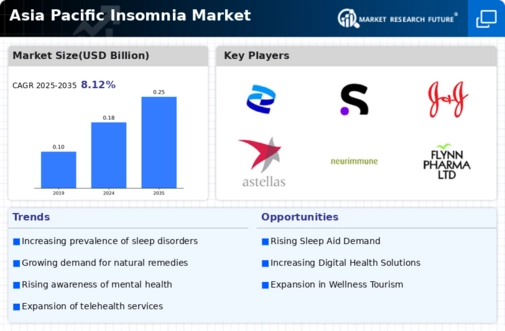
As per Market Research Future Analysis, the Asia Pacific Insomnia Market was valued at USD 0.14 Billion in 2023 and is projected to grow to USD 0.20 Billion by 2032, with a CAGR of 8.12% from 2024 to 2032. Insomnia, the most prevalent sleep disorder, affects a significant portion of the population, particularly women and younger individuals. Factors such as increased alcohol, caffeine, and tobacco consumption, along with psychological and behavioral issues, are driving the rise in insomnia cases. The market is further supported by technological advancements and rising healthcare expenditures. However, a lack of education and awareness may hinder growth.

Key Market Trends & Highlights

The Asia Pacific Insomnia Market is witnessing significant growth driven by various factors.

  • Market Size in 2023: USD 0.14 Billion Projected Market Size by 2032: USD 0.20 Billion CAGR from 2024 to 2032: 8.12% Japan holds the largest market share, with 1 in 5 people affected by insomnia.

Market Size & Forecast

2023 Market Size USD 0.14 Billion
2024 Market Size USD 0.18 Billion
2032 Market Size USD 0.20 Billion
CAGR 8.12%.

Major Players

<p>Key players include Takeda Pharmaceutical Company, <a href="https://www.pfizer.com/news/articles/the_do_s_of_good_sleep_hygiene">Pfizer, Inc</a>., <a href="https://www.eisai.com/news/2025/news202539.html">Eisai</a>, Co., Merck &amp; Co Inc, Sanofi, and GlaxoSmithKline Plc.</p>

Market Trends

Insomnia is the most common sleep disorder. It involves disturbance in the sleep or trouble in falling asleep or waking up too early in the morning. The exact cause is still a mystery. Insomnia can be exist alone or conjugated with the other psychiatric problems. It is most common is women and mostly occur in young age. Conditions like pregnancy, postpartum and menopause can increase the severity of insomnia in the patients. Asia Pacific insomnia market is driven by increasing number of the number of patients suffering from sleep disorders due to adoption of alcohol, caffeine and tobacco by a huge number of population. Many research has explain that psychological and behavioural factor are responsible for causing insomnia. Increasing workload and stressful modern life has increase the demand for the sleeping pills. Technological development and increasing healthcare expenditure has also contributed in the growth of the market. Increasing prevalence of diseases like Alzheimer’s and Parkinson’s has also anticipated to be factor for the growth of this market across Asia Pacific. On other hand, lack of education and lack of awareness may restrain the growth of the market.

Asia Pacific Insomnia Market Market Drivers

Market Segment Insights

Get more detailed insights about Insomnia Market Research Report- Asia Pacific Forecast to 2035

Regional Insights

Regional Analysis

On regional basis, Japan accounts the largest share in the Asia Pacific insomnia market. 1 in every 5 people in japan is suffering from acute or chronic symptoms of insomnia. In Japan insomnia is the major problem than anxiety and depression. India and China are also contribute major share in the market. Approximately 5% of total India’s population is suffering from insomnia. This increasing number of people suffering from insomnia is the major driving factor for the market in Asia Pacific region.

Key Players and Competitive Insights

Key Players for Asia Pacific Insomnia market

Takeda Pharmaceutical Company (Japan), Pfizer, Inc. (US), Eisai, Co. (Japan),  Merck & Co Inc (US), Sanofi (France),  GlaxoSmithKline Plc. (UK), Meda Consumer Healthcare Inc (US), Care Fusion Corporation (US), Pernix Therapeutics (US), Purdue Pharma L.P. (US), Consumer Healthcare Inc. (Canada), Dainippon Sumitomo (Japan), ECR Pharmaceuticals (US), Johnson & Johnson (US),  Astellas (UK), Biocodex S A (France), Neurim (Switzerland), Flynn Pharma (UK). Segmentation Asia Pacific insomnia market has been segmented on the basis of types of therapy which comprises pharmacological therapy and non-pharmacological therapy. Pharmacological therapy is further segmented into benzodiazepines, non-benzodiazepines, melatonin receptor agonists and other. Non pharmacological treatment are further segmented into relaxation therapy, cognitive behavioural therapy, sleep hygiene education, stimulus control, paradoxical intention and other. By drug formulation they are segmented as capsules, tablet and others. On the basis of type of disease they are poor quality of sleep, sleep maintenance and other.

Key Companies in the Asia Pacific Insomnia Market market include

Industry Developments

Future Outlook

Asia Pacific Insomnia Market Future Outlook

Market Segmentation

Asia Pacific Insomnia Market Segmentation

  • Asia Pacific Insomnia Market Intended Audience
  • Manufacturing and packaging industries
  • Insomnia devices and drug manufacturers
  • Insomnia devices and drug suppliers
  • Biotechnology Companies
  • Bio-Pharmaceutical Companies
  • Research and Development (R&D) Companies
  • Government Research Laboratories
  • {" "=>[]}

Report Scope

Attribute/Metric Details
Market Size USD 0.20 Billion by 2032
CAGR 8.12% (2024-2032)
Base Year   2023
Forecast Period   2024-2032
Historical Data   2021
Forecast Units   Value (USD Billion)
Report Coverage Revenue Forecast, Competitive Landscape, Growth Factors, and Trends
Segments Covered Types, end user, Region
Geographies Covered Asia Pacific
Key Vendors Takeda Pharmaceutical Company (Japan), Pfizer, Inc. (US), Eisai, Co. (Japan),  Merck & Co Inc (US), Sanofi (France),  GlaxoSmithKline Plc. (UK), Meda Consumer Healthcare Inc (US), Care Fusion Corporation (US), Pernix Therapeutics (US), Purdue Pharma L.P. (US), Consumer Healthcare Inc. (Canada), Dainippon Sumitomo (Japan), ECR Pharmaceuticals (US), Johnson & Johnson (US),  Astellas (UK), Biocodex S A (France), Neurim (Switzerland), Flynn Pharma (UK)

FAQs

  1. INTRODUCTION
    1. DEFINITION
    2. SCOPE OF STUDY
      1. RESEARCH OBJECTIVE
      2. ASSUMPTIONS & LIMITATIONS
    3. MARKET STRUCTURE:
  2. RESEARCH METHODOLOGY
    1. RESEARCH PROCESS:
    2. PRIMARY RESEARCH
    3. SECONDARY RESEARCH:
  3. MARKET DYNAMICS
    1. DRIVERS
    2. RESTRAINTS
    3. OPPORTUNITIES
    4. MACROECONOMIC INDICATORS
  4. MARKET FACTOR ANALYSIS
    1. PORTERS FIVE FORCES MODEL
    2. BARGAINING POWER OF SUPPLIERS
    3. BARGAINING POWER OF BUYERS
    4. THREAT OF NEW ENTRANTS
    5. THREAT OF SUBSTITUTES
    6. INTENSITY OF RIVALRY
  5. ASIA PACIFIC INSOMNIA MARKET, BY TYPES OF THERAPY
    1. PHARMACOLOGICAL THERAPY
      1. BENZODIAZEPINES
      2. NON-BENZODIAZEPINES
      3. MELATONIN RECEPTOR AGONISTS
      4. OTHER
    2. NON PHARMACOLOGICAL THERAPY
      1. RELAXATION THERAPY
      2. COGNITIVE BEHAVIORAL THERAPY
      3. SLEEP HYGIENE EDUCATION
      4. STIMULUS CONTRO
      5. PARADOXICAL INTENTION
      6. OTHER
  6. ASIA PACIFIC INSOMNIA MARKET, BY DRUG FORMULATION
    1. CAPSULES
    2. TABLET
    3. OTHERS.
  7. ASIA PACIFIC INSOMNIA MARKET, BY TYPE OF DISEASE
    1. POOR QUALITY OF SLEEP
    2. SLEEP MAINTENANCE
    3. OTHER.
  8. GLOBAL INSOMNIA MARKET, BY REGION
    1. INTRODUCTION
      1. JAPAN
      2. CHINA
      3. INDIA
      4. AUSTRALIA
      5. REPUBLIC OF KOREA
      6. REST OF ASIA-PACIFIC
  9. COMPETITIVE LANDSCAPE
    1. MAJOR STRATEGIES ADOPTED BY MARKET PLAYERS
      1. STRATEGIC PARTNERSHIP
      2. MERGER & ACQUISITION
  10. COMPANY PROFILE
    1. EISAI, CO.
      1. OVERVIEW
      2. PRODUCT OVERVIEW
      3. FINANCIALS
      4. KEY DEVELOPMENTS
    2. MERCK & CO INC
      1. OVERVIEW
      2. PRODUCT OVERVIEW
      3. FINANCIALS
      4. KEY DEVELOPMENTS
    3. TAKEDA PHARMACEUTICAL COMPANY
      1. OVERVIEW
      2. PRODUCT OVERVIEW
      3. FINANCIALS
      4. STRATEGY
      5. KEY DEVELOPMENT
    4. SANOFI
      1. OVERVIEW
      2. PRODUCT OVERVIEW
      3. FINANCIALS
      4. KEY DEVELOPMENTS
    5. PFIZER, INC.
      1. OVERVIEW
      2. PRODUCT OVERVIEW
      3. FINANCIALS
      4. KEY DEVELOPMENTS
    6. OTHERS
  11. CONCLUSION
  12. KEY FINDINGS
    1. FROM CEO’S VIEWPOINT
      1. UNMET NEEDS OF THE MARKET
    2. KEY COMPANIES TO WATCH
    3. PREDICTION OF INSOMNIA CARE INDUSTRY
  13. APPENDIX

Market Segmentation Overview

  • Detailed segmentation data will be available in the full report
  • Comprehensive analysis by multiple parameters
  • Regional and country-level breakdowns
  • Market size forecasts by segment
Infographic

Free Sample Request

Kindly complete the form below to receive a free sample of this Report

Get Free Sample

Customer Strories

Compare Licence

×
Features License Type
Single User Multiuser License Enterprise User
Price $4,950 $5,950 $7,250
Maximum User Access Limit 1 User Upto 10 Users Unrestricted Access Throughout the Organization
Free Customization
Direct Access to Analyst
Deliverable Format
Platform Access
Discount on Next Purchase 10% 15% 15%
Printable Versions















