×
Hero Background
English
Chinese
French
Japanese
Korean
German
Spanish

Asia Pacific Butyric Acid Market Size

ID: MRFR/CnM/11166-HCR
128 Pages
Anshula Mandaokar
October 2025

Asia Pacific Butyric Acid Market Research Report Information By Type (Renewable Butyric Acid, Natural Butyric Acid, and Synthetic Butyric Acid), By Derivatives (Sodium Butyrate, Calcium Butyrate, and Others), By Application (Animal Feed, Chemical Intermediate, Food and Flavors, Pharmaceuticals, Perfumes, Inks, Paints and Coatings, Human Dietary Supplements, and Others) – and Asia Pacific Market Forecast Till 2035

Share:
Download PDF ×

We do not share your information with anyone. However, we may send you emails based on your report interest from time to time. You may contact us at any time to opt-out.

Asia Pacific Butyric Acid Market Infographic
Purchase Options

Asia Pacific Butyric Acid Size

Asia Pacific Butyric Acid Market Growth Projections and Opportunities

The Asia-Pacific Butyric Acid Market is a dynamic market with many factors that affect its dynamics. The main market driver for this market is the increasing demand for butyric acid across different industries in the region. Moreover, a steady increase in demand has been a result of the food sector using it as a flavoring agent and preservative, as well as as an animal feed additive, among others. In addition, increased population and rising per capita incomes in many Asia-Pacific countries have led to an increase in the consumption of processed foods that need butyric acid. Another driving force is that people are becoming increasingly health conscious while knowing that this compound has health benefits such as antimicrobial and anti-inflammatory abilities. The Asia-Pacific Butyric Acid Market is influenced by regulatory factors apart from being driven by forces of demand. Moreover, strict regulations concerning food safety standards push manufacturers to use butyric acid to preserve food safely. Consequently, firms strive towards meeting these regulations, resulting in their growth and propelling the entire market forward with high-quality products that can meet growing consumer demands. At the same time, competition on the Asian continent, along with key players' presence, shapes the landscape of this regional industry, otherwise known as the Asia Pacific Butyric Acid Market. There are numerous big makers and sellers of butyric acid within this area, making it quite competitive. Companies focus more on research; hence, they are able to introduce new products through innovation, thus improving their positions within the markets where they operate. This nature promotes technological advancements regarding cost efficiency and product quality during production processes. Economic factors also have an impact on how markets behave. The economic growth, together with industrialization in countries around Asia-Pacific region, significantly influences how butyric acid is consumed within them directly or indirectly. On a global scale, environmental concern has become another factor influencing purchasing decisions made by buyers within the Asian-Pacific Butyric Acid Marketspace. In relation to this development globally, there has been a growing demand for bio-based butyric acid as the world shifts to eco-friendly alternatives. Moreover, geopolitical factors and trade policies also affect the market dynamics of this product. Given that Asia-Pacific area has close economic connections with other world markets, the import-export of butyric acid is greatly affected by them, thereby affecting the entire supply chain and prices in the market. The market growth direction may change because of situations like recent changes in international trading agreements or geopolitical events.
Asia Pacific Butyric Acid Market Size Graph
Author
Anshula Mandaokar
Team Lead - Research

Anshula Mandaokar holds an academic degree in Chemical Engineering and has been contributing to the field for more than 5 years. She has expertise in Market Research and Business Consulting and serves as a Team Lead for a reputed Market Research firm under the Chemicals and Materials domain spectrum. She has worked on multiple projects, generating explicit results in a quick turnaround time. Her understanding of data interpretation justifies her role as a leader.

Leave a Comment

FAQs

What is the current valuation of the Asia Pacific Butyric Acid Market?

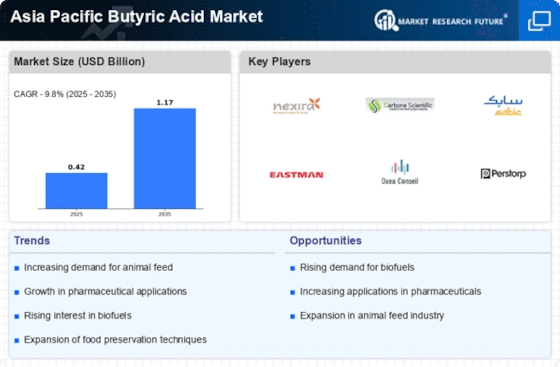
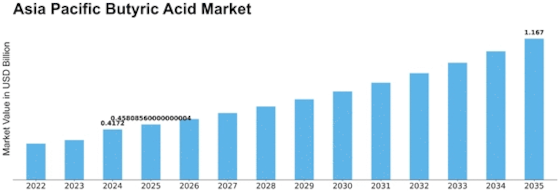
The Asia Pacific Butyric Acid Market was valued at 0.4172 USD Billion in 2024.

What is the projected market size for the Asia Pacific Butyric Acid Market by 2035?

The market is projected to reach 1.167 USD Billion by 2035.

What is the expected CAGR for the Asia Pacific Butyric Acid Market during the forecast period?

The expected CAGR for the market from 2025 to 2035 is 9.8%.

Which companies are considered key players in the Asia Pacific Butyric Acid Market?

Key players include Nexira, Carbone Scientific, SABIC, Eastman Chemical Company, and others.

What are the main types of butyric acid in the market?

The main types include Renewable Butyric Acid, Natural Butyric Acid, and Synthetic Butyric Acid.

Market Summary

As per MRFR analysis, the Asia Pacific Butyric Acid Market Size was estimated at 0.4172 USD Billion in 2024. The Butyric Acid industry is projected to grow from 0.4581 in 2025 to 1.167 by 2035, exhibiting a compound annual growth rate (CAGR) of 9.8 during the forecast period 2025 - 2035.

Key Market Trends & Highlights

The Asia Pacific Butyric Acid Market is poised for substantial growth driven by diverse applications and increasing health awareness.

  • The Asia Pacific region is currently the fastest-growing market for butyric acid, reflecting a shift in consumer preferences towards health-oriented products.
  • Natural butyric acid remains the largest segment, while synthetic butyric acid is emerging as the fastest-growing segment due to its versatility.
  • Sodium butyrate holds the largest market share, whereas calcium butyrate is gaining traction as a rapidly expanding segment in various applications.
  • Key market drivers include the rising demand in personal care products and the increasing awareness of gut health, which are propelling market expansion.

Market Size & Forecast

2024 Market Size 0.4172 (USD Billion)
2035 Market Size 1.167 (USD Billion)
CAGR (2025 - 2035) 9.8%
Largest Regional Market Share in 2024 Asia Pacific

Major Players

<p>Nexira (FR), Carbone Scientific (IN), SABIC (SA), Eastman Chemical Company (US), Oxea (DE), Perstorp (SE), BASF (DE), Kraton Corporation (US), Shandong Jinling (CN)</p>

Market Trends

The Asia Pacific Butyric Acid Market is currently experiencing a notable transformation, driven by various factors that influence its dynamics. The increasing demand for butyric acid in the food and beverage sector, particularly as a flavoring agent and preservative, appears to be a significant contributor to market growth. Additionally, the rising awareness regarding the health benefits associated with butyric acid, such as its role in gut health and potential anti-inflammatory properties, seems to be propelling its adoption in dietary supplements and functional foods. Furthermore, the expansion of the animal feed industry in the region is likely to enhance the utilization of butyric acid as a growth promoter and gut health enhancer in livestock, thereby fostering market expansion. Despite these positive indicators, the Asia Pacific Butyric Acid Market faces challenges that could impact its trajectory. Regulatory hurdles and fluctuating raw material prices may pose obstacles to manufacturers. Moreover, the competition from alternative products and substitutes could potentially hinder growth. Nevertheless, the market appears poised for continued development, with opportunities emerging from innovations in production processes and the increasing focus on sustainable practices. As consumer preferences evolve, the Asia Pacific Butyric Acid Market is likely to adapt, reflecting the changing landscape of health and wellness trends.

Rising Demand in Food Industry

The food and beverage sector is increasingly utilizing butyric acid for its flavoring and preservative properties. This trend indicates a growing consumer preference for natural ingredients, which may drive further adoption in various food products.

Health and Wellness Focus

There is a noticeable shift towards health-conscious products, with butyric acid gaining attention for its potential benefits in gut health. This trend suggests that dietary supplements and functional foods incorporating butyric acid may see heightened interest.

Animal Feed Applications

The expansion of the animal feed industry in the Asia Pacific region is likely to enhance the use of butyric acid as a growth promoter. This trend indicates a growing recognition of the importance of gut health in livestock, potentially boosting market demand.

Asia Pacific Butyric Acid Market Market Drivers

Increasing Use in Bioplastics

The Asia Pacific Butyric Acid Market is also benefiting from the rising interest in sustainable materials, particularly bioplastics. Butyric acid serves as a precursor for the production of biodegradable plastics, which are gaining traction due to environmental concerns. The bioplastics market in the Asia Pacific region is anticipated to grow at a CAGR of approximately 15% over the next few years, driven by increasing regulatory pressures and consumer demand for eco-friendly products. This trend suggests that butyric acid could play a pivotal role in the development of sustainable packaging solutions, thereby enhancing its market presence. As industries seek to reduce their carbon footprint, the integration of butyric acid into bioplastic formulations may become a strategic focus, further propelling the Asia Pacific Butyric Acid Market.

Rising Awareness of Gut Health

The Asia Pacific Butyric Acid Market is significantly influenced by the increasing awareness of gut health among consumers. Butyric acid is known for its role in promoting gut health and supporting digestive functions, which has led to its incorporation into dietary supplements and functional foods. The market for gut health products in the Asia Pacific is projected to grow at a CAGR of approximately 8% over the next few years, reflecting a shift towards preventive health measures. This growing awareness suggests that butyric acid could become a key ingredient in formulations aimed at enhancing digestive health. As consumers prioritize wellness and seek products that support their health, the demand for butyric acid in the Asia Pacific Butyric Acid Market is likely to rise.

Growth in Pharmaceutical Applications

The Asia Pacific Butyric Acid Market is witnessing an expansion in pharmaceutical applications, driven by the compound's therapeutic potential. Butyric acid has been studied for its role in gut health and its anti-inflammatory properties, making it a candidate for various health-related formulations. The pharmaceutical sector in the Asia Pacific is expected to grow significantly, with a projected CAGR of around 7% in the coming years. This growth is likely to enhance the demand for butyric acid as a key ingredient in drug formulations aimed at treating gastrointestinal disorders and other health issues. As research continues to unveil the benefits of butyric acid, its incorporation into pharmaceutical products may become more prevalent, thereby contributing to the overall growth of the Asia Pacific Butyric Acid Market.

Rising Demand in Personal Care Products

The Asia Pacific Butyric Acid Market is experiencing a notable surge in demand from the personal care sector. Butyric acid is increasingly recognized for its potential benefits in skin care formulations, particularly due to its moisturizing and anti-inflammatory properties. As consumers become more conscious of ingredient transparency and efficacy, manufacturers are incorporating butyric acid into creams, lotions, and other cosmetic products. The market for personal care products in the Asia Pacific region is projected to grow at a compound annual growth rate (CAGR) of approximately 5.5% over the next five years, which could further bolster the demand for butyric acid. This trend indicates a shift towards natural and effective ingredients, positioning butyric acid as a key component in the formulation of innovative personal care solutions.

Expansion of Food Preservation Techniques

The Asia Pacific Butyric Acid Market is experiencing growth due to advancements in food preservation techniques. Butyric acid is recognized for its potential as a natural preservative, which aligns with the increasing consumer preference for clean label products. The food preservation market in the region is projected to grow at a CAGR of around 6% in the next few years, driven by the need for longer shelf life and reduced food waste. This trend indicates that butyric acid could become a vital ingredient in the formulation of preservatives that meet consumer demands for safety and quality. As food manufacturers seek innovative solutions to enhance product longevity, the incorporation of butyric acid may gain momentum, thereby contributing to the growth of the Asia Pacific Butyric Acid Market.

Market Segment Insights

By Type: Natural Butyric Acid (Largest) vs. Synthetic Butyric Acid (Fastest-Growing)

<p>In the Asia Pacific Butyric Acid Market, Natural Butyric Acid holds the largest market share, emphasizing its consumer preference for naturally sourced additives. This segment caters to various applications, particularly in the food and feed industries, where the demand for clean label products is on the rise. Meanwhile, Synthetic Butyric Acid, although smaller in share, is emerging rapidly due to advances in production techniques and cost efficiency, offering a viable alternative in several industrial applications.</p>

<p>Natural Butyric Acid (Dominant) vs. Synthetic Butyric Acid (Emerging)</p>

<p>Natural Butyric Acid is characterized by its organic sourcing, appealing to health-conscious consumers and industries striving for sustainability. This segment dominates the market as it aligns with the growing trend of natural ingredients in food and feed. In contrast, Synthetic Butyric Acid is making strides as an emerging segment, driven by its affordability and consistent quality. Its production processes are becoming more efficient, allowing for wider adoption in various applications including pharmaceuticals and agriculture. Together, these segments illustrate the diversified landscape of the Butyric Acid market in Asia Pacific.</p>

By Derivatives: Sodium Butyrate (Largest) vs. Calcium Butyrate (Fastest-Growing)

<p>The Asia Pacific Butyric Acid Market exhibits a diverse distribution of derivatives, with Sodium Butyrate currently holding the largest market share. This segment has established itself as a staple due to its extensive applications in animal feed, pharmaceuticals, and food industries. Conversely, Calcium Butyrate, while smaller in share, is rapidly gaining traction due to its emerging applications in health supplements and functional foods. The 'Others' category encompasses various lesser-known derivatives, contributing to the market's overall dynamism. Growth trends in this segment are primarily driven by the increasing demand for high-quality animal feed and the rising health consciousness among consumers. Emerging markets within the Asia Pacific region are witnessing heightened interest in functional food ingredients that promote gut health and overall wellness. Additionally, advancements in technology and production processes are enabling suppliers to offer innovative solutions that cater to the evolving market needs, thus paving the way for sustained growth in both Sodium and Calcium Butyrate segments.</p>

<p>Sodium Butyrate (Dominant) vs. Calcium Butyrate (Emerging)</p>

<p>Sodium Butyrate is recognized as the dominant derivative in the Asia Pacific Butyric Acid Market, primarily due to its proven efficacy in promoting gut health among livestock. This derivative is widely utilized in the animal nutrition sector, showing a significant preference due to its ability to enhance feed efficiency and overall animal growth. On the other hand, Calcium Butyrate is categorized as an emerging segment due to its growing applications in health supplements and its efficacy in improving intestinal health. As awareness regarding the role of gut health in overall well-being increases, Calcium Butyrate is gaining momentum. Manufacturers are actively exploring innovative formulations to unlock its potential across various sectors, indicating a promising trajectory for this derivative.</p>

By Application: Animal Feed (Largest) vs. Pharmaceuticals (Fastest-Growing)

<p>In the Asia Pacific Butyric Acid Market, the application segment is predominantly characterized by its diverse ranges such as Animal Feed, Pharmaceuticals, and Food and Flavors. Animal Feed holds a significant market share, benefiting from the rising demand for nutritious animal products. In contrast, the Pharmaceuticals segment is gaining traction, reflecting growing health awareness and an increase in preventive healthcare measures among consumers in the region. Other applications such as Inks, Paints and Coatings, and Perfumes also contribute, but to a lesser degree, highlighting the overall fragmentation of this segment.</p>

<p>Animal Feed: Dominant vs. Pharmaceuticals: Emerging</p>

<p>Animal Feed continues to be the dominant application in the Asia Pacific Butyric Acid Market, driven by the livestock industry's increasing focus on health and productivity enhancements through additives. As a key ingredient in promoting growth and gut health in animals, Butyric Acid has seen widespread adoption among feed manufacturers. Conversely, the Pharmaceuticals sector is emerging rapidly as a significant area for Butyric Acid applications. The ingredient's therapeutic properties, including anti-inflammatory and antimicrobial effects, cater to growing consumer health trends, making it vital in nutraceuticals and dietary supplements.</p>

Get more detailed insights about Asia Pacific Butyric Acid Market Research Report—Forecast till 2035

Regional Insights

North America : Innovation and Demand Growth

The North American butyric acid market is driven by increasing applications in food and feed industries, alongside a growing trend towards natural preservatives. The U.S. holds the largest market share at approximately 65%, followed by Canada at 20%. Regulatory support for bio-based chemicals is further catalyzing growth, with initiatives promoting sustainable practices in manufacturing. Key players such as Eastman Chemical Company and BASF are leading the market, focusing on innovation and sustainability. The competitive landscape is characterized by strategic partnerships and investments in R&D to enhance product offerings. The presence of established companies ensures a robust supply chain, catering to the rising demand across various sectors.

Europe : Sustainability and Innovation Focus

The European butyric acid market is characterized by a strong emphasis on sustainability and innovation, driven by stringent regulations on chemical production and environmental impact. Germany and France are the largest markets, holding approximately 30% and 25% of the market share, respectively. The EU's Green Deal and REACH regulations are significant catalysts for growth, promoting the use of bio-based chemicals and sustainable practices. Leading countries are investing in research and development to enhance production processes and reduce environmental footprints. Key players like BASF and Perstorp are at the forefront, focusing on innovative solutions and expanding their product portfolios. The competitive landscape is marked by collaborations and partnerships aimed at meeting regulatory standards and consumer demand for sustainable products.

Asia-Pacific : Emerging Market Potential

The Asia-Pacific butyric acid market is witnessing rapid growth, driven by increasing demand in the food, pharmaceutical, and animal feed sectors. China and India are the largest markets, accounting for approximately 40% and 25% of the market share, respectively. The region's growth is supported by rising disposable incomes and changing dietary patterns, alongside favorable government policies promoting agricultural development. Key players such as Shandong Jinling and Carbone Scientific are expanding their operations to meet the growing demand. The competitive landscape is evolving, with new entrants and established companies investing in capacity expansion and technological advancements. The focus on sustainable production methods is also gaining traction, aligning with global trends towards eco-friendly solutions.

Middle East and Africa : Resource-Rich Opportunities

The Middle East and Africa butyric acid market is emerging, driven by increasing agricultural activities and a growing food processing industry. The region is characterized by a diverse market landscape, with countries like South Africa and Saudi Arabia leading in market share, holding approximately 30% and 20%, respectively. Regulatory frameworks are gradually evolving to support chemical manufacturing and agricultural development, fostering market growth. Key players are focusing on establishing production facilities to cater to local demand, with investments in technology and infrastructure. The competitive landscape is marked by collaborations between local and international companies, aiming to enhance product availability and meet the rising demand in various sectors. The region's resource-rich environment presents significant opportunities for growth in the butyric acid market.

Key Players and Competitive Insights

The Asia Pacific Butyric Acid Market is currently characterized by a dynamic competitive landscape, driven by increasing demand across various sectors such as food, pharmaceuticals, and agriculture. Key players are actively engaging in strategic initiatives to enhance their market presence and operational efficiency. Notably, companies like BASF (DE) and Eastman Chemical Company (US) are focusing on innovation and sustainability, which appear to be pivotal in shaping their competitive positioning. These firms are not only investing in research and development but are also exploring partnerships to leverage technological advancements, thereby fostering a more resilient market environment.

In terms of business tactics, localizing manufacturing and optimizing supply chains are becoming increasingly critical. The market structure is moderately fragmented, with several players vying for market share. This fragmentation allows for a diverse range of products and services, yet it also intensifies competition among key players. The collective influence of these companies is significant, as they strive to differentiate themselves through quality and innovation rather than solely on price.

In August 2025, SABIC (SA) announced a strategic partnership with a leading agricultural firm to develop sustainable butyric acid solutions aimed at enhancing crop yield. This collaboration underscores SABIC's commitment to sustainability and innovation, positioning the company as a leader in eco-friendly agricultural solutions. The strategic importance of this move lies in its potential to tap into the growing demand for sustainable agricultural practices, thereby expanding SABIC's market reach.

In September 2025, Perstorp (SE) launched a new line of butyric acid derivatives designed specifically for the animal nutrition sector. This product line aims to improve livestock health and productivity, reflecting Perstorp's focus on innovation in the agricultural domain. The introduction of these derivatives is likely to strengthen Perstorp's competitive edge by addressing the increasing demand for high-quality animal feed additives, which is crucial for maintaining livestock health.

In October 2025, Eastman Chemical Company (US) unveiled a new digital platform aimed at enhancing customer engagement and streamlining the supply chain for butyric acid products. This initiative indicates a shift towards digital transformation within the industry, allowing Eastman to respond more effectively to market demands. The strategic importance of this digital platform lies in its potential to improve operational efficiency and customer satisfaction, which are essential in a competitive market.

As of October 2025, current competitive trends in the Asia Pacific Butyric Acid Market are increasingly defined by digitalization, sustainability, and the integration of artificial intelligence. Strategic alliances are playing a crucial role in shaping the landscape, as companies seek to combine resources and expertise to drive innovation. Looking ahead, it is anticipated that competitive differentiation will evolve, with a pronounced shift from price-based competition to a focus on innovation, technology, and supply chain reliability. This evolution suggests that companies that prioritize these aspects will likely emerge as leaders in the market.

Key Companies in the Asia Pacific Butyric Acid Market market include

Industry Developments

Future Outlook

Asia Pacific Butyric Acid Market Future Outlook

<p>The Asia Pacific Butyric Acid Market is projected to grow at a 9.8% CAGR from 2024 to 2035, driven by increasing demand in food and pharmaceuticals.</p>

New opportunities lie in:

  • <p>Expansion into bio-based butyric acid production methods.</p>
  • <p>Development of specialized butyric acid formulations for animal feed.</p>
  • <p>Strategic partnerships with pharmaceutical companies for innovative applications.</p>

<p>By 2035, the market is expected to achieve robust growth, positioning itself as a leader in the region.</p>

Market Segmentation

Asia Pacific Butyric Acid Market Type Outlook

  • Renewable Butyric Acid
  • Natural Butyric Acid
  • Synthetic Butyric Acid

Asia Pacific Butyric Acid Market Application Outlook

  • Animal Feed
  • Chemical Intermediate
  • Food and Flavors
  • Pharmaceuticals
  • Perfumes
  • Inks
  • Paints and Coatings
  • Human Dietary Supplements
  • Others

Asia Pacific Butyric Acid Market Derivatives Outlook

  • Sodium Butyrate
  • Calcium Butyrate
  • Others

Report Scope

MARKET SIZE 20240.4172(USD Billion)
MARKET SIZE 20250.4581(USD Billion)
MARKET SIZE 20351.167(USD Billion)
COMPOUND ANNUAL GROWTH RATE (CAGR)9.8% (2024 - 2035)
REPORT COVERAGERevenue Forecast, Competitive Landscape, Growth Factors, and Trends
BASE YEAR2024
Market Forecast Period2025 - 2035
Historical Data2019 - 2024
Market Forecast UnitsUSD Billion
Key Companies ProfiledMarket analysis in progress
Segments CoveredMarket segmentation analysis in progress
Key Market OpportunitiesGrowing demand for natural food preservatives drives innovation in the Asia Pacific Butyric Acid Market.
Key Market DynamicsRising demand for butyric acid in animal feed and pharmaceuticals drives market growth in the Asia Pacific region.
Countries CoveredNorth America, Europe, APAC, South America, MEA

FAQs

What is the current valuation of the Asia Pacific Butyric Acid Market?

The Asia Pacific Butyric Acid Market was valued at 0.4172 USD Billion in 2024.

What is the projected market size for the Asia Pacific Butyric Acid Market by 2035?

The market is projected to reach 1.167 USD Billion by 2035.

What is the expected CAGR for the Asia Pacific Butyric Acid Market during the forecast period?

The expected CAGR for the market from 2025 to 2035 is 9.8%.

Which companies are considered key players in the Asia Pacific Butyric Acid Market?

Key players include Nexira, Carbone Scientific, SABIC, Eastman Chemical Company, and others.

What are the main types of butyric acid in the market?

The main types include Renewable Butyric Acid, Natural Butyric Acid, and Synthetic Butyric Acid.

  1. SECTION I: EXECUTIVE SUMMARY AND KEY HIGHLIGHTS
    1. EXECUTIVE SUMMARY
      1. Market Overview
      2. Key Findings
      3. Market Segmentation
      4. Competitive Landscape
      5. Challenges and Opportunities
      6. Future Outlook
  2. SECTION II: SCOPING, METHODOLOGY AND MARKET STRUCTURE
    1. MARKET INTRODUCTION
      1. Definition
      2. Scope of the study
    2. RESEARCH METHODOLOGY
      1. Overview
      2. Data Mining
      3. Secondary Research
      4. Primary Research
      5. Forecasting Model
      6. Market Size Estimation
      7. Data Triangulation
      8. Validation
  3. SECTION III: QUALITATIVE ANALYSIS
    1. MARKET DYNAMICS
      1. Overview
      2. Drivers
      3. Restraints
      4. Opportunities
    2. MARKET FACTOR ANALYSIS
      1. Value chain Analysis
      2. Porter's Five Forces Analysis
      3. COVID-19 Impact Analysis
  4. SECTION IV: QUANTITATIVE ANALYSIS
    1. Chemicals and Materials, BY Type (USD Billion)
      1. Renewable Butyric Acid
      2. Natural Butyric Acid
      3. Synthetic Butyric Acid
    2. Chemicals and Materials, BY Derivatives (USD Billion)
      1. Sodium Butyrate
      2. Calcium Butyrate
      3. Others
    3. Chemicals and Materials, BY Application (USD Billion)
      1. Animal Feed
      2. Chemical Intermediate
      3. Food and Flavors
      4. Pharmaceuticals
      5. Perfumes
      6. Inks
      7. Paints and Coatings
      8. Human Dietary Supplements
      9. Others
    4. Chemicals and Materials, BY Region (USD Billion)
      1. North America
      2. Europe
      3. APAC
      4. South America
      5. MEA
  5. SECTION V: COMPETITIVE ANALYSIS
    1. Competitive Landscape
      1. Overview
      2. Competitive Analysis
      3. Market share Analysis
      4. Major Growth Strategy in the Chemicals and Materials
      5. Competitive Benchmarking
      6. Leading Players in Terms of Number of Developments in the Chemicals and Materials
      7. Key developments and growth strategies
      8. Major Players Financial Matrix
    2. Company Profiles
      1. Nexira (FR)
      2. Carbone Scientific (IN)
      3. SABIC (SA)
      4. Eastman Chemical Company (US)
      5. Oxea (DE)
      6. Perstorp (SE)
      7. BASF (DE)
      8. Kraton Corporation (US)
      9. Shandong Jinling (CN)
    3. Appendix
      1. References
      2. Related Reports
  6. LIST OF FIGURES
    1. MARKET SYNOPSIS
    2. NORTH AMERICA MARKET ANALYSIS
    3. US MARKET ANALYSIS BY TYPE
    4. US MARKET ANALYSIS BY DERIVATIVES
    5. US MARKET ANALYSIS BY APPLICATION
    6. CANADA MARKET ANALYSIS BY TYPE
    7. CANADA MARKET ANALYSIS BY DERIVATIVES
    8. CANADA MARKET ANALYSIS BY APPLICATION
    9. EUROPE MARKET ANALYSIS
    10. GERMANY MARKET ANALYSIS BY TYPE
    11. GERMANY MARKET ANALYSIS BY DERIVATIVES
    12. GERMANY MARKET ANALYSIS BY APPLICATION
    13. UK MARKET ANALYSIS BY TYPE
    14. UK MARKET ANALYSIS BY DERIVATIVES
    15. UK MARKET ANALYSIS BY APPLICATION
    16. FRANCE MARKET ANALYSIS BY TYPE
    17. FRANCE MARKET ANALYSIS BY DERIVATIVES
    18. FRANCE MARKET ANALYSIS BY APPLICATION
    19. RUSSIA MARKET ANALYSIS BY TYPE
    20. RUSSIA MARKET ANALYSIS BY DERIVATIVES
    21. RUSSIA MARKET ANALYSIS BY APPLICATION
    22. ITALY MARKET ANALYSIS BY TYPE
    23. ITALY MARKET ANALYSIS BY DERIVATIVES
    24. ITALY MARKET ANALYSIS BY APPLICATION
    25. SPAIN MARKET ANALYSIS BY TYPE
    26. SPAIN MARKET ANALYSIS BY DERIVATIVES
    27. SPAIN MARKET ANALYSIS BY APPLICATION
    28. REST OF EUROPE MARKET ANALYSIS BY TYPE
    29. REST OF EUROPE MARKET ANALYSIS BY DERIVATIVES
    30. REST OF EUROPE MARKET ANALYSIS BY APPLICATION
    31. APAC MARKET ANALYSIS
    32. CHINA MARKET ANALYSIS BY TYPE
    33. CHINA MARKET ANALYSIS BY DERIVATIVES
    34. CHINA MARKET ANALYSIS BY APPLICATION
    35. INDIA MARKET ANALYSIS BY TYPE
    36. INDIA MARKET ANALYSIS BY DERIVATIVES
    37. INDIA MARKET ANALYSIS BY APPLICATION
    38. JAPAN MARKET ANALYSIS BY TYPE
    39. JAPAN MARKET ANALYSIS BY DERIVATIVES
    40. JAPAN MARKET ANALYSIS BY APPLICATION
    41. SOUTH KOREA MARKET ANALYSIS BY TYPE
    42. SOUTH KOREA MARKET ANALYSIS BY DERIVATIVES
    43. SOUTH KOREA MARKET ANALYSIS BY APPLICATION
    44. MALAYSIA MARKET ANALYSIS BY TYPE
    45. MALAYSIA MARKET ANALYSIS BY DERIVATIVES
    46. MALAYSIA MARKET ANALYSIS BY APPLICATION
    47. THAILAND MARKET ANALYSIS BY TYPE
    48. THAILAND MARKET ANALYSIS BY DERIVATIVES
    49. THAILAND MARKET ANALYSIS BY APPLICATION
    50. INDONESIA MARKET ANALYSIS BY TYPE
    51. INDONESIA MARKET ANALYSIS BY DERIVATIVES
    52. INDONESIA MARKET ANALYSIS BY APPLICATION
    53. REST OF APAC MARKET ANALYSIS BY TYPE
    54. REST OF APAC MARKET ANALYSIS BY DERIVATIVES
    55. REST OF APAC MARKET ANALYSIS BY APPLICATION
    56. SOUTH AMERICA MARKET ANALYSIS
    57. BRAZIL MARKET ANALYSIS BY TYPE
    58. BRAZIL MARKET ANALYSIS BY DERIVATIVES
    59. BRAZIL MARKET ANALYSIS BY APPLICATION
    60. MEXICO MARKET ANALYSIS BY TYPE
    61. MEXICO MARKET ANALYSIS BY DERIVATIVES
    62. MEXICO MARKET ANALYSIS BY APPLICATION
    63. ARGENTINA MARKET ANALYSIS BY TYPE
    64. ARGENTINA MARKET ANALYSIS BY DERIVATIVES
    65. ARGENTINA MARKET ANALYSIS BY APPLICATION
    66. REST OF SOUTH AMERICA MARKET ANALYSIS BY TYPE
    67. REST OF SOUTH AMERICA MARKET ANALYSIS BY DERIVATIVES
    68. REST OF SOUTH AMERICA MARKET ANALYSIS BY APPLICATION
    69. MEA MARKET ANALYSIS
    70. GCC COUNTRIES MARKET ANALYSIS BY TYPE
    71. GCC COUNTRIES MARKET ANALYSIS BY DERIVATIVES
    72. GCC COUNTRIES MARKET ANALYSIS BY APPLICATION
    73. SOUTH AFRICA MARKET ANALYSIS BY TYPE
    74. SOUTH AFRICA MARKET ANALYSIS BY DERIVATIVES
    75. SOUTH AFRICA MARKET ANALYSIS BY APPLICATION
    76. REST OF MEA MARKET ANALYSIS BY TYPE
    77. REST OF MEA MARKET ANALYSIS BY DERIVATIVES
    78. REST OF MEA MARKET ANALYSIS BY APPLICATION
    79. KEY BUYING CRITERIA OF CHEMICALS AND MATERIALS
    80. RESEARCH PROCESS OF MRFR
    81. DRO ANALYSIS OF CHEMICALS AND MATERIALS
    82. DRIVERS IMPACT ANALYSIS: CHEMICALS AND MATERIALS
    83. RESTRAINTS IMPACT ANALYSIS: CHEMICALS AND MATERIALS
    84. SUPPLY / VALUE CHAIN: CHEMICALS AND MATERIALS
    85. CHEMICALS AND MATERIALS, BY TYPE, 2024 (% SHARE)
    86. CHEMICALS AND MATERIALS, BY TYPE, 2024 TO 2035 (USD Billion)
    87. CHEMICALS AND MATERIALS, BY DERIVATIVES, 2024 (% SHARE)
    88. CHEMICALS AND MATERIALS, BY DERIVATIVES, 2024 TO 2035 (USD Billion)
    89. CHEMICALS AND MATERIALS, BY APPLICATION, 2024 (% SHARE)
    90. CHEMICALS AND MATERIALS, BY APPLICATION, 2024 TO 2035 (USD Billion)
    91. BENCHMARKING OF MAJOR COMPETITORS
  7. LIST OF TABLES
    1. LIST OF ASSUMPTIONS
    2. North America MARKET SIZE ESTIMATES; FORECAST
      1. BY TYPE, 2025-2035 (USD Billion)
      2. BY DERIVATIVES, 2025-2035 (USD Billion)
      3. BY APPLICATION, 2025-2035 (USD Billion)
    3. US MARKET SIZE ESTIMATES; FORECAST
      1. BY TYPE, 2025-2035 (USD Billion)
      2. BY DERIVATIVES, 2025-2035 (USD Billion)
      3. BY APPLICATION, 2025-2035 (USD Billion)
    4. Canada MARKET SIZE ESTIMATES; FORECAST
      1. BY TYPE, 2025-2035 (USD Billion)
      2. BY DERIVATIVES, 2025-2035 (USD Billion)
      3. BY APPLICATION, 2025-2035 (USD Billion)
    5. Europe MARKET SIZE ESTIMATES; FORECAST
      1. BY TYPE, 2025-2035 (USD Billion)
      2. BY DERIVATIVES, 2025-2035 (USD Billion)
      3. BY APPLICATION, 2025-2035 (USD Billion)
    6. Germany MARKET SIZE ESTIMATES; FORECAST
      1. BY TYPE, 2025-2035 (USD Billion)
      2. BY DERIVATIVES, 2025-2035 (USD Billion)
      3. BY APPLICATION, 2025-2035 (USD Billion)
    7. UK MARKET SIZE ESTIMATES; FORECAST
      1. BY TYPE, 2025-2035 (USD Billion)
      2. BY DERIVATIVES, 2025-2035 (USD Billion)
      3. BY APPLICATION, 2025-2035 (USD Billion)
    8. France MARKET SIZE ESTIMATES; FORECAST
      1. BY TYPE, 2025-2035 (USD Billion)
      2. BY DERIVATIVES, 2025-2035 (USD Billion)
      3. BY APPLICATION, 2025-2035 (USD Billion)
    9. Russia MARKET SIZE ESTIMATES; FORECAST
      1. BY TYPE, 2025-2035 (USD Billion)
      2. BY DERIVATIVES, 2025-2035 (USD Billion)
      3. BY APPLICATION, 2025-2035 (USD Billion)
    10. Italy MARKET SIZE ESTIMATES; FORECAST
      1. BY TYPE, 2025-2035 (USD Billion)
      2. BY DERIVATIVES, 2025-2035 (USD Billion)
      3. BY APPLICATION, 2025-2035 (USD Billion)
    11. Spain MARKET SIZE ESTIMATES; FORECAST
      1. BY TYPE, 2025-2035 (USD Billion)
      2. BY DERIVATIVES, 2025-2035 (USD Billion)
      3. BY APPLICATION, 2025-2035 (USD Billion)
    12. Rest of Europe MARKET SIZE ESTIMATES; FORECAST
      1. BY TYPE, 2025-2035 (USD Billion)
      2. BY DERIVATIVES, 2025-2035 (USD Billion)
      3. BY APPLICATION, 2025-2035 (USD Billion)
    13. APAC MARKET SIZE ESTIMATES; FORECAST
      1. BY TYPE, 2025-2035 (USD Billion)
      2. BY DERIVATIVES, 2025-2035 (USD Billion)
      3. BY APPLICATION, 2025-2035 (USD Billion)
    14. China MARKET SIZE ESTIMATES; FORECAST
      1. BY TYPE, 2025-2035 (USD Billion)
      2. BY DERIVATIVES, 2025-2035 (USD Billion)
      3. BY APPLICATION, 2025-2035 (USD Billion)
    15. India MARKET SIZE ESTIMATES; FORECAST
      1. BY TYPE, 2025-2035 (USD Billion)
      2. BY DERIVATIVES, 2025-2035 (USD Billion)
      3. BY APPLICATION, 2025-2035 (USD Billion)
    16. Japan MARKET SIZE ESTIMATES; FORECAST
      1. BY TYPE, 2025-2035 (USD Billion)
      2. BY DERIVATIVES, 2025-2035 (USD Billion)
      3. BY APPLICATION, 2025-2035 (USD Billion)
    17. South Korea MARKET SIZE ESTIMATES; FORECAST
      1. BY TYPE, 2025-2035 (USD Billion)
      2. BY DERIVATIVES, 2025-2035 (USD Billion)
      3. BY APPLICATION, 2025-2035 (USD Billion)
    18. Malaysia MARKET SIZE ESTIMATES; FORECAST
      1. BY TYPE, 2025-2035 (USD Billion)
      2. BY DERIVATIVES, 2025-2035 (USD Billion)
      3. BY APPLICATION, 2025-2035 (USD Billion)
    19. Thailand MARKET SIZE ESTIMATES; FORECAST
      1. BY TYPE, 2025-2035 (USD Billion)
      2. BY DERIVATIVES, 2025-2035 (USD Billion)
      3. BY APPLICATION, 2025-2035 (USD Billion)
    20. Indonesia MARKET SIZE ESTIMATES; FORECAST
      1. BY TYPE, 2025-2035 (USD Billion)
      2. BY DERIVATIVES, 2025-2035 (USD Billion)
      3. BY APPLICATION, 2025-2035 (USD Billion)
    21. Rest of APAC MARKET SIZE ESTIMATES; FORECAST
      1. BY TYPE, 2025-2035 (USD Billion)
      2. BY DERIVATIVES, 2025-2035 (USD Billion)
      3. BY APPLICATION, 2025-2035 (USD Billion)
    22. South America MARKET SIZE ESTIMATES; FORECAST
      1. BY TYPE, 2025-2035 (USD Billion)
      2. BY DERIVATIVES, 2025-2035 (USD Billion)
      3. BY APPLICATION, 2025-2035 (USD Billion)
    23. Brazil MARKET SIZE ESTIMATES; FORECAST
      1. BY TYPE, 2025-2035 (USD Billion)
      2. BY DERIVATIVES, 2025-2035 (USD Billion)
      3. BY APPLICATION, 2025-2035 (USD Billion)
    24. Mexico MARKET SIZE ESTIMATES; FORECAST
      1. BY TYPE, 2025-2035 (USD Billion)
      2. BY DERIVATIVES, 2025-2035 (USD Billion)
      3. BY APPLICATION, 2025-2035 (USD Billion)
    25. Argentina MARKET SIZE ESTIMATES; FORECAST
      1. BY TYPE, 2025-2035 (USD Billion)
      2. BY DERIVATIVES, 2025-2035 (USD Billion)
      3. BY APPLICATION, 2025-2035 (USD Billion)
    26. Rest of South America MARKET SIZE ESTIMATES; FORECAST
      1. BY TYPE, 2025-2035 (USD Billion)
      2. BY DERIVATIVES, 2025-2035 (USD Billion)
      3. BY APPLICATION, 2025-2035 (USD Billion)
    27. MEA MARKET SIZE ESTIMATES; FORECAST
      1. BY TYPE, 2025-2035 (USD Billion)
      2. BY DERIVATIVES, 2025-2035 (USD Billion)
      3. BY APPLICATION, 2025-2035 (USD Billion)
    28. GCC Countries MARKET SIZE ESTIMATES; FORECAST
      1. BY TYPE, 2025-2035 (USD Billion)
      2. BY DERIVATIVES, 2025-2035 (USD Billion)
      3. BY APPLICATION, 2025-2035 (USD Billion)
    29. South Africa MARKET SIZE ESTIMATES; FORECAST
      1. BY TYPE, 2025-2035 (USD Billion)
      2. BY DERIVATIVES, 2025-2035 (USD Billion)
      3. BY APPLICATION, 2025-2035 (USD Billion)
    30. Rest of MEA MARKET SIZE ESTIMATES; FORECAST
      1. BY TYPE, 2025-2035 (USD Billion)
      2. BY DERIVATIVES, 2025-2035 (USD Billion)
      3. BY APPLICATION, 2025-2035 (USD Billion)
    31. PRODUCT LAUNCH/PRODUCT DEVELOPMENT/APPROVAL
    32. ACQUISITION/PARTNERSHIP

Asia Pacific Butyric Acid Market Segmentation

Market Segmentation Overview

  • Detailed segmentation data will be available in the full report
  • Comprehensive analysis by multiple parameters
  • Regional and country-level breakdowns
  • Market size forecasts by segment
Infographic

Free Sample Request

Kindly complete the form below to receive a free sample of this Report

Get Free Sample

Customer Strories

Compare Licence

×
Features License Type
Single User Multiuser License Enterprise User
Price $4,950 $5,950 $7,250
Maximum User Access Limit 1 User Upto 10 Users Unrestricted Access Throughout the Organization
Free Customization
Direct Access to Analyst
Deliverable Format
Platform Access
Discount on Next Purchase 10% 15% 15%
Printable Versions